Question 1archived
In a code language, SUNDAY is written as DNUAYS, how will MOTHER be written as in that language?
- A
THEORM
- B
HTOERM
- C
HOTERM
- D
HTEOMR
Show answer
B. HTOERMUnderstanding the Coding Language Pattern
This question asks us to decipher a coding language pattern applied to the word SUNDAY and then apply the same pattern to the word MOTHER.
Let's look at the given example:
Original word: SUNDAY
Coded word: DNUAYS
We need to find how the letters in SUNDAY are rearranged to form DNUAYS. Let's assign positions to the letters in the original word:
Letter
S
U
N
D
A
Y
Position
1
2
3
4
5
6
Now, let's see where these letters appear in the coded word DNUAYS and note their new positions:
Coded Letter
D
N
U
A
Y
S
Position in Coded Word
1
2
3
4
5
6
Original Letter
D (from pos 4)
N (from pos 3)
U (from pos 2)
A (from pos 5)
Y (from pos 6)
S (from pos 1)
By observing which original position moves to which new position, we can determine the rule:
The letter at original position 4 (D) moves to new position 1.
The letter at original position 3 (N) moves to new position 2.
The letter at original position 2 (U) moves to new position 3.
The letter at original position 5 (A) moves to new position 4.
The letter at original position 6 (Y) moves to new position 5.
The letter at original position 1 (S) moves to new position 6.
So, the order of letters in the coded word is determined by taking the letters from the original positions in the sequence: 4th, 3rd, 2nd, 5th, 6th, 1st.
Let's write this positional transformation:
Original positions → New positions
1 → 6
2 → 3
3 → 2
4 → 1
5 → 4
6 → 5
Alternatively, let's look at the sequence of original positions that form the coded word:
New Position 1 gets letter from Original Position 4
New Position 2 gets letter from Original Position 3
New Position 3 gets letter from Original Position 2
New Position 4 gets letter from Original Position 5
New Position 5 gets letter from Original Position 6
New Position 6 gets letter from Original Position 1
The sequence of original positions for the new word is thus: 4, 3, 2, 5, 6, 1.
Applying the Coding Pattern to MOTHER
Now we apply the same pattern (taking letters from original positions 4, 3, 2, 5, 6, 1) to the word MOTHER.
First, assign positions to the letters in MOTHER:
Letter
M
O
T
H
E
R
Position
1
2
3
4
5
6
Now, let's pick the letters based on the derived pattern (4th, 3rd, 2nd, 5th, 6th, 1st original positions):
Letter from original position 4: H
Letter from original position 3: T
Letter from original position 2: O
Letter from original position 5: E
Letter from original position 6: R
Letter from original position 1: M
Combining these letters in sequence gives us the coded word: HTOERM.
Conclusion
Following the coding pattern where the original positions 4, 3, 2, 5, 6, 1 form the sequence of letters in the coded word, the word MOTHER is coded as HTOERM.
Revision Table: Coding Language Pattern
Original Word
SUNDAY
MOTHER
Positions
1 2 3 4 5 6
1 2 3 4 5 6
Letters
S U N D A Y
M O T H E R
Pattern (Original Pos → New Word Order)
4 3 2 5 6 1
4 3 2 5 6 1
Letters in Coded Word Order
D N U A Y S
H T O E R M
Coded Word
DNUAYS
HTOERM
Additional Information: Types of Letter Coding
Letter coding is a common topic in verbal reasoning. Understanding different types of patterns can help solve such problems quickly. Some common patterns include:
Position Change: Letters change their positions within the word based on a specific rule (as seen in this problem).
Alphabetical Shift: Each letter is shifted a fixed number of places forward or backward in the alphabet (e.g., A → B, B → C, or A → Z, B → Y).
Reverse Alphabetical Order: Letters might correspond to their reverse position in the alphabet (e.g., A → Z, B → Y).
Direct Letter Coding: Specific letters are replaced by specific other letters or symbols directly, without a simple positional or alphabetical shift rule.
Mixed Patterns: A combination of the above rules might be used.
To solve coding-decoding problems, always carefully compare the original word and the coded word to identify the rule or pattern being used. Look for positional changes, letter shifts, or direct substitutions.
Paper & answer key PDF ↗ Question 2archived
Select the option in which the given figure is embedded.
(Rotation is not allowed)

- A
Option A (shown in image)
- B
Option B (shown in image)
- C
Option C (shown in image)
- D
Option D (shown in image)
Show answer
B. Option B (shown in image)Hence, the figure in option 2 is the correct answer.
 Paper & answer key PDF ↗
 Question 3archived
What will be the value of the following equation if ‘÷’ means ‘addition’, ‘+’ means ‘subtraction’, ‘-‘ means ‘multiplication’ and ‘×’ means ‘division’
54 × 6 – 7 ÷ 8 + 2 = ?
- A
57
- B
69
- C
61
- D
63
Show answer
B. 69Understanding the Symbol Substitution Problem
This question requires us to solve a mathematical expression where the usual meaning of arithmetic symbols is changed. We are given a set of rules for symbol substitution, and we need to apply these rules first before performing the calculations according to the standard order of operations.
Applying the New Rules to the Equation
The original equation is: \(54 \times 6 – 7 \div 8 + 2\)
The symbol substitution rules are:
‘÷’ means ‘addition’ (\(+)\)
‘+’ means ‘subtraction’ (\(-\))
‘-‘ means ‘multiplication’ (\(\times\))
‘×’ means ‘division’ (\(\div\))
Let's replace the symbols in the original equation based on these rules:
The symbol ‘×’ between 54 and 6 becomes ‘÷’ (division).
The symbol ‘–’ between 6 and 7 becomes ‘×’ (multiplication).
The symbol ‘÷’ between 7 and 8 becomes ‘+’ (addition).
The symbol ‘+’ between 8 and 2 becomes ‘–’ (subtraction).
So, the new equation after applying the symbol substitution is:
\(54 \div 6 \times 7 + 8 - 2\)
Solving the Mathematical Expression with Order of Operations
Now we need to solve the new equation \(54 \div 6 \times 7 + 8 - 2\). We follow the order of operations, often remembered by acronyms like BODMAS or PEMDAS.
B/P: Brackets/Parentheses (None in this equation)
O/E: Orders/Exponents (None in this equation)
DM: Division and Multiplication (from left to right)
AS: Addition and Subtraction (from left to right)
Let's solve step-by-step:
Perform division: \(54 \div 6 = 9\). The equation becomes \(9 \times 7 + 8 - 2\).
Perform multiplication: \(9 \times 7 = 63\). The equation becomes \(63 + 8 - 2\).
Perform addition: \(63 + 8 = 71\). The equation becomes \(71 - 2\).
Perform subtraction: \(71 - 2 = 69\).
The final value of the equation after symbol substitution and calculation is 69.
Final Answer Calculation Summary
Here is a summary of the steps:
Step
Operation
Equation
Original
Substitute symbols
\(54 \times 6 – 7 \div 8 + 2\)
1
Division (\(\times\) becomes \(\div\))
\(54 \div 6 \times 7 + 8 - 2\)
2
Division (from left)
\(9 \times 7 + 8 - 2\)
3
Multiplication
\(63 + 8 - 2\)
4
Addition (from left)
\(71 - 2\)
5
Subtraction
\(69\)
The value of the given equation after applying the symbol substitution rules is 69.
Revision Table: Symbol Substitution and Arithmetic
Original Symbol
Means (New Operation)
‘÷’
‘addition’ (\(+)\)
‘+’
‘subtraction’ (\(-\))
‘-‘
‘multiplication’ (\(\times\))
‘×’
‘division’ (\(\div\))
Additional Information: Order of Operations
The order of operations is crucial in solving mathematical expressions correctly. It ensures that everyone gets the same result from the same expression. The widely used order is:
First, calculate anything inside Brackets or Parentheses.
Next, calculate Exponents or Orders (like square roots, powers).
Then, perform Division and Multiplication, working from left to right.
Finally, perform Addition and Subtraction, working from left to right.
Remembering this order helps avoid errors in calculations, especially when multiple operations are involved, such as in this symbol substitution problem.
Paper & answer key PDF ↗ Question 4archived
Three of the following four letter-clusters are alike in a certain way and one is different. Pick the odd one out
- A
TUWZ
- B
PQTX
- C
DEGJ
- D
MNPS
Show answer
B. PQTXFinding the Odd Letter Cluster: Detailed Analysis
This problem requires us to identify the letter cluster that does not follow the same pattern as the others. To do this, we will examine the positional value of each letter in the English alphabet and look for a consistent numerical relationship between the letters within each cluster.
Analyzing Letter Positions and Differences
Let's assign numerical values to each letter based on its position (A=1, B=2, ..., Z=26):
Letter Cluster
Letter 1
Letter 2
Letter 3
Letter 4
TUWZ
T (20)
U (21)
W (23)
Z (26)
PQTX
P (16)
Q (17)
T (20)
X (24)
DEGJ
D (4)
E (5)
G (7)
J (10)
MNPS
M (13)
N (14)
P (16)
S (19)
Now, let's look at the difference in positional values between consecutive letters within each cluster:
TUWZ:
Difference between U and T: \(21 - 20 = +1\)
Difference between W and U: \(23 - 21 = +2\)
Difference between Z and W: \(26 - 23 = +3\)
Pattern: +1, +2, +3
PQTX:
Difference between Q and P: \(17 - 16 = +1\)
Difference between T and Q: \(20 - 17 = +3\)
Difference between X and T: \(24 - 20 = +4\)
Pattern: +1, +3, +4
DEGJ:
Difference between E and D: \(5 - 4 = +1\)
Difference between G and E: \(7 - 5 = +2\)
Difference between J and G: \(10 - 7 = +3\)
Pattern: +1, +2, +3
MNPS:
Difference between N and M: \(14 - 13 = +1\)
Difference between P and N: \(16 - 14 = +2\)
Difference between S and P: \(19 - 16 = +3\)
Pattern: +1, +2, +3
Identifying the Pattern and the Odd One Out
Comparing the patterns derived from the differences between consecutive letters:
TUWZ follows the pattern: +1, +2, +3
PQTX follows the pattern: +1, +3, +4
DEGJ follows the pattern: +1, +2, +3
MNPS follows the pattern: +1, +2, +3
Three of the letter clusters (TUWZ, DEGJ, and MNPS) follow a consistent pattern where the difference in positional value between consecutive letters increases by one (+1, +2, +3). The letter cluster PQTX, however, follows a different pattern (+1, +3, +4).
Therefore, PQTX is the odd one out among the given letter clusters.
Revision Table: Letter Cluster Analysis
Letter Cluster
Positional Values
Differences
Pattern
Follows Common Pattern?
TUWZ
20, 21, 23, 26
+1, +2, +3
+1, +2, +3
Yes
PQTX
16, 17, 20, 24
+1, +3, +4
+1, +3, +4
No
DEGJ
4, 5, 7, 10
+1, +2, +3
+1, +2, +3
Yes
MNPS
13, 14, 16, 19
+1, +2, +3
+1, +2, +3
Yes
Additional Information: Letter Series Reasoning
Letter series and letter cluster problems are common in logical reasoning tests. They assess your ability to identify patterns based on the alphabetical order and relationships between letters. Common patterns involve:
Adding or subtracting a fixed number to the letter's position.
Adding or subtracting a sequence of numbers (like +1, +2, +3 or +2, +4, +6).
Alternating patterns.
Skipping letters in a regular sequence.
Vowel/consonant patterns.
Reverse alphabetical order positions.
Solving these problems systematically by writing down the positional values is often the most effective approach to spot the underlying rule or pattern.
Paper & answer key PDF ↗ Question 5archived
Select the correct mirror image of the given figure when the mirror is placed to the right of the figure.

- A
Option A (shown in image)
- B
Option B (shown in image)
- C
Option C (shown in image)
- D
Option D (shown in image)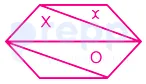
Show answer
C. Option C (shown in image)Hence, the figure in option 3 is the correct answer.
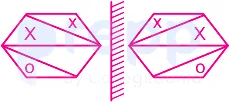 Paper & answer key PDF ↗
 Question 6archived
Select the Venn diagram that best illustrates the relationship between the following classes.
Graduates, Literates, Hardworking
- A
Option A (shown in image)
- B
Option B (shown in image)
- C
Option C (shown in image)
- D
Option D (shown in image)
Show answer
D. Option D (shown in image)Hence, the figure in option 4 is the correct answer.
 Paper & answer key PDF ↗
 Question 7archived
Three of the following four words are alike in a certain way and one is different. Pick the odd word out.
- A
Hindrance
- B
Indulgence
- C
Benevolence
- D
Courtesy
Show answer
A. HindranceUnderstanding the Odd Word Out Question
This question asks us to identify the word that is different from the other three in a given set of four words. These types of questions test our vocabulary and ability to find common relationships or distinctions between words based on their meanings, connotations, or categories.
The words provided are: Hindrance, Indulgence, Benevolence, and Courtesy.
Analyzing the Meanings of the Words
Let's break down the meaning of each word to understand how they relate to or differ from each other:
Hindrance: A thing that provides resistance, delay, or obstruction to something or someone. It's essentially an obstacle or impediment. This word has a negative connotation, suggesting something that stops or slows progress.
Indulgence: The practice of allowing oneself to enjoy the pleasure of something, often excessively. It can also mean the tolerance or allowance of something, or a lenient or overly generous treatment. In some contexts, it refers to granting a favor or a privilege.
Benevolence: The quality of being well meaning; kindness. It refers to a disposition to do good. This word has a positive connotation, relating to goodness and generosity towards others.
Courtesy: The showing of politeness in one's attitude and behavior toward others. It refers to polite behavior or a polite remark. This word also has a positive connotation, related to good manners and respect in social interactions.
Comparing the Words: Finding the Difference
Now let's compare the words based on their meanings and connotations:
Benevolence and Courtesy are positive qualities related to how people interact with others in a kind, polite, and generous way. They describe desirable human traits or behaviors.
Indulgence can have slightly different nuances, but in the context of interactions, it can relate to being lenient, tolerant, or granting something (like an indulgence or favor). While it can sometimes imply excess, it often involves a relationship between people where something is allowed or given, sometimes out of kindness or tolerance.
Hindrance, on the other hand, describes an obstacle or obstruction. It is not a quality of a person's interaction or disposition towards others in the same way the other words are. It represents something that impedes action or progress, which is fundamentally different from qualities like kindness, politeness, or leniency.
Therefore, Hindrance stands out as the word that describes an obstacle or impediment, contrasting with the other words which relate more closely to aspects of human behavior, disposition, or interaction, often with positive or permissive connotations.
Identifying the Odd Word Out
Based on our analysis, Hindrance is the only word in the list that represents an obstacle or something negative that prevents action or progress. The other words (Indulgence, Benevolence, Courtesy) describe characteristics or actions related to positive or permissive human interaction and qualities.
Thus, Hindrance is the odd word out.
Word
Meaning/Connotation
Category
Hindrance
Obstacle, impediment (Negative)
Obstruction/Barrier
Indulgence
Tolerance, allowance, leniency (Can be permissive/interactive)
Behavior/Interaction
Benevolence
Kindness, well-meaning (Positive)
Quality/Disposition
Courtesy
Politeness, good manners (Positive)
Behavior/Interaction
Revision Table: Understanding Word Relationships
Reviewing the words helps reinforce why one is different:
Hindrance: Stops or blocks.
Indulgence: Allows or grants.
Benevolence: Acts kindly.
Courtesy: Acts politely.
The core concept of 'Hindrance' is opposition or blocking, while the others involve forms of positive or permissive interaction or disposition.
Additional Information: Vocabulary Building
Improving vocabulary is key to solving odd word out questions. Here are some tips:
Learn synonyms and antonyms for words.
Understand the nuances and connotations (positive, negative, neutral) of words.
Look at word roots (prefixes, suffixes).
Practice recognizing relationships between words (e.g., cause and effect, part and whole, category).
These strategies help in identifying the connections or differences between seemingly similar words like the ones in this question.
Paper & answer key PDF ↗ Question 8archived
The sequence of folding a piece of square paper (figures X and Y) and the manner in which the folded paper has been cut (figure Z) are shown. How will the paper appear when unfolded?

- A
Option A (shown in image)
- B
Option B (shown in image)
- C
Option C (shown in image)
- D
Option D (shown in image)
Show answer
A. Option A (shown in image)Hence, the figure in option 1 is the correct answer.
 Paper & answer key PDF ↗
 Question 9archived
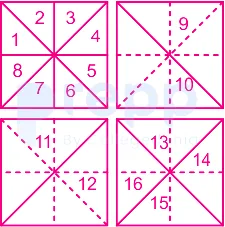
How many triangles are there in the following figure?

- A
12
- B
16
- C
14
- D
18
Show answer
B. 16Number of triangle = 16
Total number of triangle in square = number of partition in square x 2
⇒ Total number of triangle in square = 8 x 2 = 16.
Hence, there are 16 triangles in the given figure.
 Paper & answer key PDF ↗
 Question 10archived
Three of the following four word-pairs are alike in a certain way and one is different. Pick the odd word out.
- A
South Korea : Rupiya
- B
Russia : Ruble
- C
Malaysia : Ringgit
- D
Bangladesh : Taka
Show answer
A. South Korea : RupiyaRelation between the pairs of words in options 2, 3 and 4 →
Country : Currency
But, the currency of South Korea is South Korean Won.
Hence, ‘South Korea : Rupiya’ is the correct answer.
Paper & answer key PDF ↗ Question 11archived
Select the figure that will come next in the following figure series.

- A
Option A (shown in image)
- B
Option B (shown in image)
- C
Option C (shown in image)
- D
Option D (shown in image)
Show answer
C. Option C (shown in image)In the given figure, each square is divided into eight triangles.
Two symbols ‘X’ and ’O’ are changing their positions in the following manner:
1) Symbol ‘O’ is moving to the next alternate triangle in an anticlockwise direction.
2) Symbol ‘X’ is moving in a clockwise direction.
X moves to the adjacent triangle in the second figure.
It leaves one triangle in between while moving to its new position in the third figure.
It leaves two triangles in between while moving to its new position in the fourth figure.
Therefore, it must leave three triangles in between while moving to its new position in the fifth figure.
Hence, the figure in option 3 is the correct answer.
 Paper & answer key PDF ↗
 Question 12archived
Select the word-pair in which the two words are related in the same way as are the two words in the following word-pair.
Frown : Displeasure
- A
Laugh : Comedy
- B
Madness : Illness
- C
Smile : Ecstasy
- D
Grief : Sorrow
Show answer
C. Smile : EcstasyUnderstanding Word Analogies: Frown and Displeasure
Word analogies test your ability to find the relationship between a pair of words and then identify another pair that shares the same relationship. The given word-pair is Frown : Displeasure.
Analyzing the Relationship in Frown : Displeasure
Let's look closely at the relationship between 'Frown' and 'Displeasure'. A frown is a facial expression. Displeasure is a feeling or emotion. When someone feels displeasure, they often express it by frowning. So, a Frown is an expression of Displeasure.
Evaluating the Options
Now, we need to examine each option to see which word-pair has the same "Expression of" relationship as Frown : Displeasure.
Option 1: Laugh : Comedy
A laugh is a sound made when someone is amused or happy. Comedy is a type of entertainment intended to make people laugh. While people laugh in response to comedy, a laugh is not the primary expression of comedy itself. Comedy is the cause, and laughter is often the effect. This relationship is different from Frown : Displeasure.
Option 2: Madness : Illness
Madness can be a symptom or a state resulting from an illness. Illness is the cause, and madness can be a manifestation. This is not the same 'expression of' relationship as seen in Frown : Displeasure.
Option 3: Smile : Ecstasy
A smile is a facial expression. Ecstasy is a feeling of intense joy or happiness. When someone feels ecstasy, they often express it by smiling. Therefore, a Smile is an expression of Ecstasy. This relationship is exactly the same as Frown : Displeasure (Frown is an expression of Displeasure).
Option 4: Grief : Sorrow
Grief and sorrow are very close synonyms. Grief is deep sorrow, especially caused by bereavement. They are essentially the same feeling, not a feeling and its expression. This relationship is different from Frown : Displeasure.
Identifying the Correct Analogy
Comparing the relationships:
Frown is an expression of Displeasure.
Smile is an expression of Ecstasy.
The word-pair Smile : Ecstasy shows the identical relationship where the first word is an expression of the feeling or state described by the second word.
Summary of Option Analysis
Word-Pair
Relationship
Matches Frown : Displeasure?
Frown : Displeasure
Frown is an expression of Displeasure
(Original Pair)
Laugh : Comedy
Laugh is a reaction to Comedy
No
Madness : Illness
Madness is a state resulting from Illness
No
Smile : Ecstasy
Smile is an expression of Ecstasy
Yes
Grief : Sorrow
Grief and Sorrow are synonyms
No
Based on the analysis, the word-pair Smile : Ecstasy is related in the same way as Frown : Displeasure.
Revision Table: Word Analogy Practice
Analogy Type
Description
Example
Part to Whole
First word is part of the second
Finger : Hand
Synonyms
Words have similar meanings
Happy : Joyful
Antonyms
Words have opposite meanings
Hot : Cold
Cause and Effect
First word causes the second
Rain : Flood
Worker and Tool
First word uses the second
Carpenter : Hammer
Action and Object
First word is action on second
Cut : Wood
Expression of Feeling
First word expresses the second feeling
Smile : Happiness
Additional Information on Solving Analogies
Solving word analogies effectively requires strong vocabulary and the ability to identify precise relationships between words. Here are some tips:
Always determine the relationship between the first pair of words carefully.
Express the relationship in a simple sentence (e.g., "A is an expression of B", "A is a type of B").
Apply that exact same sentence structure to each option.
Eliminate options that do not fit the relationship.
Consider different possible relationships if your initial idea doesn't yield a clear answer.
Practice with various types of analogies to improve recognition of relationships.
Understanding the relationship types, like 'Expression of Feeling' demonstrated in Frown : Displeasure and Smile : Ecstasy, is key to mastering word analogy questions.
Paper & answer key PDF ↗ Question 13archived
P is the father of Q and R is the son of S. T is the brother of P. Q is the sister of R. How is S related to T?
- A
Brother-in-law
- B
Brother
- C
Sister-in-law
- D
Daughter
Show answer
C. Sister-in-lawSolving the Family Relationship Puzzle
This question asks us to determine the relationship between two individuals, S and T, based on a series of statements about their family connections. To solve this, we need to build a clear picture of the family structure described in the statements.
Analyzing the Given Family Relations
Let's break down the provided information step by step:
Statement 1: P is the father of Q. This tells us P is male and belongs to the generation above Q.
Statement 2: R is the son of S. This tells us R is male and belongs to the generation below S.
Statement 3: T is the brother of P. This tells us T is male and belongs to the same generation as P.
Statement 4: Q is the sister of R. This tells us Q is female and belongs to the same generation as R. Also, Q and R are siblings.
Deducing Further Relationships
Now, let's combine these statements to infer more connections:
From Statement 1, P is the father of Q.
From Statement 4, Q and R are siblings. This means P is also the father of R (since P is Q's father, and Q and R share parents).
From Statement 2, R is the son of S. We have already deduced that P is the father of R. Since R has both a father (P) and a parent S, and P is the father, S must be the mother of R.
Since S is the mother of R, and Q and R are siblings, S is also the mother of Q.
Therefore, P and S are the parents of both Q and R. Since P is the father and S is the mother, P and S must be married.
From Statement 3, T is the brother of P.
Determining the Relationship Between S and T
We know that S is married to P, and T is the brother of P.
In a family, the wife of one's brother is known as the sister-in-law.
Since S is the wife of P, and T is the brother of P, S is the sister-in-law of T.
Summarizing the Family Structure
Individual
Relationship Clues
Deduced Role
P
Father of Q, Brother of T
Father of Q & R, Husband of S
Q
Sister of R, Child of P
Daughter of P & S, Sister of R
R
Son of S, Sibling of Q
Son of P & S, Brother of Q
S
Parent of R
Mother of Q & R, Wife of P
T
Brother of P
Brother of P, Brother-in-law of S
Based on this structure, S is the wife of T's brother (P). Therefore, S is the sister-in-law of T.
Revision Table: Key Relationships
Relationship
Individuals
Spouses
P and S
Siblings
Q and R
Siblings
P and T
Parent-Child
P & S are parents of Q & R
Sister-in-law
S is T's sister-in-law
Additional Information on Blood Relations Puzzles
Blood relations questions are common in logical reasoning sections of exams. They test your ability to understand and decode complex relationships presented in statements. Here are some tips for solving such puzzles:
Draw a diagram or family tree. This helps visualize the connections. Use symbols for gender (e.g., circle for female, square for male) and lines to connect spouses, siblings, and parent-child relationships.
Break down statements one by one. Don't try to process everything at once.
Identify genders where mentioned (e.g., father, mother, brother, sister, son, daughter).
Pay attention to terms like 'in-law' relationships, which involve marriage connections.
Work backward or forward from known relationships to find the connection between the required individuals.
Common relationships include: Parent, Child, Sibling, Grandparent, Grandchild, Uncle, Aunt, Cousin, Niece, Nephew, Mother-in-law, Father-in-law, Son-in-law, Daughter-in-law, Brother-in-law, Sister-in-law.
By systematically analyzing the given relationships and building the family structure, we can confidently determine how S is related to T in this blood relations puzzle.
Paper & answer key PDF ↗ Question 14archived
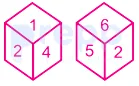
The rotated positions of a dice are given below. Which number will be at the top if ‘3’ is at the bottom?
- A
6
- B
4
- C
2
- D
1
Show answer
C. 2From given fig. it can be concluded that 1,4,5,6 are on the four adjacent sides of 2. i.e. ‘3’ is on the opposite side of ‘2’.
Therefore, when ‘3’ is at the bottom, ‘2’ will be at the top.
Hence, ‘2’ is the correct answer.
Paper & answer key PDF ↗ Question 15archived
Which two signs should be interchanged in the following equation to make it correct?
15 - 9 ÷ 6 × 10 + 5 = 25
- A
× and ÷
- B
+ and ÷
- C
× and -
- D
+ and -
Show answer
D. + and -Solving Equation Sign Interchange Problems
This question asks us to identify which two mathematical signs in the given equation need to be swapped to make the equation mathematically correct. The equation is: \(15 - 9 \div 6 \times 10 + 5 = 25\).
To solve this, we need to evaluate the equation after interchanging the signs specified in each option and check if the result equals 25. We must follow the order of operations (BODMAS/PEMDAS) during evaluation.
Understanding the Order of Operations (BODMAS/PEMDAS)
The order of operations dictates the sequence in which mathematical operations should be performed:
B/P: Brackets/Parentheses
O/E: Orders/Exponents
D/M: Division/Multiplication (from left to right)
A/S: Addition/Subtraction (from left to right)
Let's test each option by interchanging the specified signs in the equation \(15 - 9 \div 6 \times 10 + 5\).
Analyzing Sign Interchange Options
Option 1: Interchanging × and ÷
If we interchange multiplication (\(\times\)) and division (\(\div\)), the equation becomes:
\(15 - 9 \times 6 \div 10 + 5\)
Let's evaluate this expression:
First, multiplication and division from left to right: \(9 \times 6 = 54\)
Equation is now: \(15 - 54 \div 10 + 5\)
Next, division: \(54 \div 10 = 5.4\)
Equation is now: \(15 - 5.4 + 5\)
Finally, addition and subtraction from left to right: \(15 - 5.4 = 9.6\)
Then: \(9.6 + 5 = 14.6\)
The result is 14.6, which is not equal to 25. So, this option is incorrect.
Option 2: Interchanging + and ÷
If we interchange addition (\(+\)) and division (\(\div\)), the equation becomes:
\(15 - 9 + 6 \times 10 \div 5\)
Let's evaluate this expression:
First, multiplication and division from left to right: \(6 \times 10 = 60\)
Equation is now: \(15 - 9 + 60 \div 5\)
Next, division: \(60 \div 5 = 12\)
Equation is now: \(15 - 9 + 12\)
Finally, addition and subtraction from left to right: \(15 - 9 = 6\)
Then: \(6 + 12 = 18\)
The result is 18, which is not equal to 25. So, this option is incorrect.
Option 3: Interchanging × and -
If we interchange multiplication (\(\times\)) and subtraction (\(-\)), the equation becomes:
\(15 \times 9 \div 6 - 10 + 5\)
Let's evaluate this expression:
First, multiplication and division from left to right: \(15 \times 9 = 135\)
Equation is now: \(135 \div 6 - 10 + 5\)
Next, division: \(135 \div 6 = 22.5\)
Equation is now: \(22.5 - 10 + 5\)
Finally, addition and subtraction from left to right: \(22.5 - 10 = 12.5\)
Then: \(12.5 + 5 = 17.5\)
The result is 17.5, which is not equal to 25. So, this option is incorrect.
Option 4: Interchanging + and -
If we interchange addition (\(+\)) and subtraction (\(-\)), the equation becomes:
\(15 + 9 \div 6 \times 10 - 5\)
Let's evaluate this expression following BODMAS/PEMDAS:
First, division: \(9 \div 6 = 1.5\)
Equation is now: \(15 + 1.5 \times 10 - 5\)
Next, multiplication: \(1.5 \times 10 = 15\)
Equation is now: \(15 + 15 - 5\)
Finally, addition and subtraction from left to right: \(15 + 15 = 30\)
Then: \(30 - 5 = 25\)
The result is 25, which is equal to the right side of the original equation. Thus, interchanging '+' and '-' makes the equation correct.
Conclusion on Sign Interchange
Based on the evaluation of each option, interchanging the addition (\(+\)) and subtraction (\(-\)) signs in the equation \(15 - 9 \div 6 \times 10 + 5 = 25\) makes the equation correct.
Revision Table: Equation Sign Swap
Original Equation
Signs Interchanged
New Equation
Result
Correct?
\(15 - 9 \div 6 \times 10 + 5 = 25\)
\(\times\) and \(\div\)
\(15 - 9 \times 6 \div 10 + 5\)
14.6
No
\(15 - 9 \div 6 \times 10 + 5 = 25\)
\(+\) and \(\div\)
\(15 - 9 + 6 \times 10 \div 5\)
18
No
\(15 - 9 \div 6 \times 10 + 5 = 25\)
\(\times\) and \(-\)
\(15 \times 9 \div 6 - 10 + 5\)
17.5
No
\(15 - 9 \div 6 \times 10 + 5 = 25\)
\(+\) and \(-\)
\(15 + 9 \div 6 \times 10 - 5\)
25
Yes
Additional Information: Mathematical Operations and Symbols
Understanding the standard symbols and their meanings is crucial for solving mathematical problems like this sign interchange question.
Addition (\(+\)): Combines two or more quantities.
Subtraction (\(-\)): Finds the difference between two quantities.
Multiplication (\(\times\)): Represents repeated addition or scaling.
Division (\(\div\)): Splits a quantity into equal parts.
Equals Sign (\(=\)): Indicates that the expression on the left side has the same value as the expression on the right side.
Problems involving interchanging signs or numbers require careful application of the order of operations to avoid errors. Practicing more such problems helps in quickly evaluating expressions with different combinations of operators.
Paper & answer key PDF ↗ Question 16archived
In a code language, if FRIDGE is written as GTLHLK, then in the same language how will you write the word KETTLE?
- A
LGWXQK
- B
XKWQLG
- C
GLXWQK
- D
WQLGXK
Show answer
A. LGWXQKAnalyzing the Coding Pattern: FRIDGE to GTLHLK
This question involves a coding-decoding pattern. We are given that the word FRIDGE is coded as GTLHLK. To solve for the code of KETTLE, we first need to understand the rule applied to transform FRIDGE into GTLHLK.
Let's look at the position of each letter in the English alphabet (A=1, B=2, ... Z=26) and compare the letters in FRIDGE and GTLHLK.
FRIDGE
Position
GTLHLK
Position
Difference
F
6
G
7
\small{7 - 6 = +1}
R
18
T
20
\small{20 - 18 = +2}
I
9
L
12
\small{12 - 9 = +3}
D
4
H
8
\small{8 - 4 = +4}
G
7
L
12
\small{12 - 7 = +5}
E
5
K
11
\small{11 - 5 = +6}
From the table, we can clearly see a pattern. Each letter in the word FRIDGE is shifted forward in the alphabet by a number that increases sequentially for each position: +1 for the first letter, +2 for the second, +3 for the third, and so on, up to +6 for the sixth letter.
Applying the Pattern to KETTLE
Now, we apply this same pattern to the word KETTLE to find its code. We will shift the first letter of KETTLE by +1, the second by +2, the third by +3, the fourth by +4, the fifth by +5, and the sixth by +6.
Let's calculate the coded letter for each letter in KETTLE:
K (11) + 1 = 12. The 12th letter is L.
E (5) + 2 = 7. The 7th letter is G.
T (20) + 3 = 23. The 23rd letter is W.
T (20) + 4 = 24. The 24th letter is X.
L (12) + 5 = 17. The 17th letter is Q.
E (5) + 6 = 11. The 11th letter is K.
Combining these letters, the code for KETTLE is LGWXQK.
Comparing with Options
Let's check our result against the given options:
Option 1: LGWXQK
Option 2: XKWQLG
Option 3: GLXWQK
Option 4: WQLGXK
Our calculated code LGWXQK matches Option 1.
Conclusion
Based on the coding pattern observed in the transformation of FRIDGE to GTLHLK, the word KETTLE is coded as LGWXQK.
Revision Table: Coding-Decoding Patterns
Type of Pattern
Description
Example (Simple)
Letter Shifting (Constant)
Each letter shifted by a fixed number of positions.
CAT -> EAT (+2 for C)
Letter Shifting (Varying)
Each letter shifted by a different number, often following a sequence (+1, +2, +3, etc.).
As seen in FRIDGE to GTLHLK (+1, +2, +3, +4, +5, +6).
Reverse Lettering
Coding based on letters equidistant from the end of the alphabet (Z is code for A, Y for B, etc.).
AZ, BY, CX, DW...
Positional Changes
Letters within the word are rearranged according to a rule (e.g., reversing the word, swapping pairs).
STOP -> POTS (Reverse)
Mixed Patterns
Combination of shifting, reversing, or other rules.
Can be complex, requiring careful analysis.
Additional Information on Reasoning Techniques
Coding-decoding questions are common in reasoning sections of competitive exams. They test your ability to identify patterns and apply rules. Here are some tips:
Write down the letters of the alphabet and their positions (1-26) or keep them handy.
Compare the original word and the coded word letter by letter. Look for consistent differences in position.
Check for sequential patterns (+1, +2, +3, ...), constant patterns (+3, +3, +3, ...), or even patterns related to odd/even positions or vowels/consonants.
Consider reversal or rearrangement patterns if letter positions don't show a simple shift.
Practice with different types of coding questions to become familiar with various patterns.
Paper & answer key PDF ↗ Question 17archived
Two statements are given followed by three conclusions numbered I, II and III. Assuming the statements to be true, even if they seem to be at variance with commonly known facts, decided which of the conclusions logically follow(s) from the statements.
Statements:
Some mobile are instruments,
All instruments are heavy items.
Conclusion:
I. Some mobiles are heavy items.
II. No mobile is a heavy item.
III. Some heavy items are instruments.
- A
Only conclusions I and III follow
- B
Only conclusions I follow
- C
Only conclusions III and either conclusion I or II follow
- D
All conclusions follow
Show answer
A. Only conclusions I and III followUnderstanding Syllogism Statements and Conclusions
This question asks us to analyze two statements and determine which of the three given conclusions logically follow from them. We must assume the statements are true, even if they contradict common knowledge.
Analyzing the Given Statements
Let's break down the statements provided:
Statement 1: Some mobile are instruments. This establishes a relationship between the category "mobile" and the category "instruments". It tells us there is at least one mobile that is also an instrument.
Statement 2: All instruments are heavy items. This establishes a relationship between "instruments" and "heavy items". It states that the entire category of "instruments" is included within the category of "heavy items".
Evaluating the Conclusions
Now let's evaluate each conclusion based on the given statements:
Conclusion I: Some mobiles are heavy items.
From Statement 1, we know that some part of the "mobile" group is in the "instruments" group. From Statement 2, we know that the entire "instruments" group is inside the "heavy items" group. Therefore, the part of "mobile" that is in "instruments" must also be in "heavy items". This conclusion logically follows.
Conclusion II: No mobile is a heavy item.
This is a negative conclusion. The statements establish positive relationships ("Some" and "All"). From positive statements, we can generally only derive positive conclusions. Also, based on the analysis of Conclusion I, we found that some mobiles *are* heavy items. Therefore, the conclusion "No mobile is a heavy item" contradicts the logical deduction from the statements and does not follow.
Conclusion III: Some heavy items are instruments.
Statement 2 says, "All instruments are heavy items." This means every single instrument is a heavy item. If all members of group B are part of group C, then it logically follows that some members of group C must be group B (specifically, all the members of group B are those 'some' members of group C). This is a valid conversion of an "All B are C" statement to a "Some C are B" statement. This conclusion logically follows.
Summary of Conclusions
Based on our analysis:
Conclusion I (Some mobiles are heavy items) follows.
Conclusion II (No mobile is a heavy item) does not follow.
Conclusion III (Some heavy items are instruments) follows.
Thus, only conclusions I and III logically follow from the given statements.
Statement/Conclusion
Relationship
Logical Follows?
Reasoning
Statement 1
Some Mobile are Instruments
N/A
Given fact
Statement 2
All Instruments are Heavy Items
N/A
Given fact
Conclusion I
Some Mobiles are Heavy Items
Yes
Mobiles that are Instruments are also Heavy Items (from Statements 1 & 2)
Conclusion II
No Mobile is a Heavy Item
No
Contradicts Conclusion I; Positive statements cannot yield a universal negative conclusion about unrelated sets
Conclusion III
Some Heavy Items are Instruments
Yes
If all Instruments are Heavy Items, then some Heavy Items must be Instruments (Conversion of All B are C to Some C are B)
Revision Table: Key Syllogism Rules
Statement Type
Notation
Conversion
Example
All A are B
A → B (universal affirmative)
Some B are A (valid)
All cats are animals → Some animals are cats
No A is B
A ↔ ¬B (universal negative)
No B is A (valid)
No cat is a dog → No dog is a cat
Some A are B
A ∩ B ≠ ∅ (particular affirmative)
Some B are A (valid)
Some students are tall → Some tall people are students
Some A are not B
A ∩ ¬B ≠ ∅ (particular negative)
Not convertible (invalid)
Some animals are not cats → Some cats are not animals (Invalid)
Combining statements often follows specific rules. For "Some A are B" and "All B are C", the valid conclusion is "Some A are C".
Additional Information on Syllogism
Syllogism is a form of logical reasoning where a conclusion is derived from two propositions (statements). These propositions are called premises. Syllogisms help test deductive reasoning abilities.
Key terms in syllogism include:
Major Term: The predicate of the conclusion (e.g., "heavy items" in Conclusion I).
Minor Term: The subject of the conclusion (e.g., "mobiles" in Conclusion I).
Middle Term: The term that appears in both statements but not in the conclusion (e.g., "instruments"). The middle term connects the major and minor terms.
In this problem:
Statements: Some Mobile are Instruments, All Instruments are Heavy Items.
Conclusion I: Some Mobiles are Heavy Items.
Minor Term: Mobiles
Major Term: Heavy Items
Middle Term: Instruments
The middle term "Instruments" connects "Mobiles" to "Heavy Items", allowing us to logically bridge the gap between the first statement and the conclusion.
Paper & answer key PDF ↗ Question 18archived
Select the option that is related to the third letter-cluster in the same way as the second letter-cluster is related to the first letter-cluster.
DKFM : FIHK ∷ BLGP : ?
- A
DNER
- B
CKHO
- C
DJIN
- D
ZNEN
Show answer
C. DJINUnderstanding Letter Analogies in Reasoning
Letter analogy questions test your ability to identify the relationship between a pair of letter-clusters and apply that same relationship to another letter-cluster. To solve these, we often look at the positions of letters in the English alphabet and how they change between the related pairs.
Analyzing the Relationship: DKFM to FIHK
Let's examine the transformation from the first letter-cluster DKFM to the second letter-cluster FIHK by looking at the position of each corresponding letter in the alphabet (A=1, B=2, C=3, ... Z=26).
Letter (DKFM)
Position
Letter (FIHK)
Position
Change
D
4
F
6
\(6 - 4 = +2\)
K
11
I
9
\(9 - 11 = -2\)
F
6
H
8
\(8 - 6 = +2\)
M
13
K
11
\(11 - 13 = -2\)
From the analysis above, we can see a clear pattern in the change of letter positions: +2, -2, +2, -2.
Applying the Pattern: BLGP to ?
Now, we apply the identified pattern (+2, -2, +2, -2) to the letter-cluster BLGP to find the missing letter-cluster. We take each letter of BLGP and apply the corresponding position shift.
Let's find the letter for each position change:
For the first letter B (Position 2): Apply +2. Position \(2 + 2 = 4\). The letter at position 4 is D.
For the second letter L (Position 12): Apply -2. Position \(12 - 2 = 10\). The letter at position 10 is J.
For the third letter G (Position 7): Apply +2. Position \(7 + 2 = 9\). The letter at position 9 is I.
For the fourth letter P (Position 16): Apply -2. Position \(16 - 2 = 14\). The letter at position 14 is N.
Combining these letters (D, J, I, N), we get the letter-cluster DJIN.
Identifying the Correct Option
The letter-cluster derived by applying the pattern to BLGP is DJIN. We now compare this with the given options:
Option 1: DNER
Option 2: CKHO
Option 3: DJIN
Option 4: ZNEN
The calculated letter-cluster, DJIN, matches Option 3.
Revision Table: Common Letter Analogy Patterns
Pattern Type
Description
Example
Position Shift
Adding or subtracting a fixed number from letter positions.
A+1=B, C+1=D (ABCD to BCDE) or the +2, -2 pattern shown above.
Skipping Letters
Skipping a fixed number of letters between corresponding letters.
A to C (skips B), D to F (skips E).
Reversal
Letters in the second cluster are the reverse order of changes applied to the first.
ABCD to ZYXW (Applying Z-A=-1, Y-B=-3 etc. in reverse order).
Vowel/Consonant
Pattern based on whether letters are vowels or consonants.
Changing vowels only, changing consonants only.
Additional Information: Mastering Analogy Questions
To improve your skills in solving letter analogy problems, consider the following:
Alphabet Position: Memorize the positions of letters in the alphabet or quickly write them down during the exam.
Practice Variety: Solve questions with different types of patterns to recognize them faster.
Look for Consistency: The pattern must apply consistently across all corresponding letters in the first pair.
Check Options: After finding a potential pattern, quickly test it on the options to see which one fits.
Consider Reverse Alphabet: Sometimes patterns relate to positions from the end of the alphabet (Z=1, Y=2, etc.).
Paper & answer key PDF ↗ Question 19archived
Three of the following four letter-clusters are alike in a certain way and one is different. Pick the odd one out.
- A
GESO
- B
MZLY
- C
IVHU
- D
KXJW
Show answer
A. GESOFinding the Odd Letter Cluster: A Step-by-Step Analysis
The question asks us to identify the letter cluster that is different from the other three, based on a certain pattern. We are given four letter clusters: GESO, MZLY, IVHU, and KXJW.
To solve this type of reasoning problem, we usually look at the position of each letter in the English alphabet. Let's assign the alphabetical position to each letter in the given clusters:
A=1, B=2, C=3, ..., Z=26
Analyzing Each Letter Cluster by Position
Let's write down the positions of the letters in each cluster:
GESO: G (7), E (5), S (19), O (15)
MZLY: M (13), Z (26), L (12), Y (25)
IVHU: I (9), V (22), H (8), U (21)
KXJW: K (11), X (24), J (10), W (23)
Now, let's look for a pattern or relationship between the letters within each cluster. A common pattern in such problems involves the differences or sums of the positions of consecutive letters or pairs of letters.
Identifying the Pattern
Let's examine the differences between the letters in each cluster, specifically focusing on pairs. A possible pattern could relate the first two letters and the last two letters.
Cluster
1st and 2nd Letter Difference
3rd and 4th Letter Difference
GESO
G(7) - E(5) $= 7 - 5 = +2$. Or E(5) - G(7) $= 5 - 7 = -2$. Let's consider the step from 1st to 2nd. G to E is 2 steps backward. So, $-2$.
S(19) - O(15) $= 19 - 15 = +4$. Or O(15) - S(19) $= 15 - 19 = -4$. Let's consider the step from 3rd to 4th. S to O is 4 steps backward. So, $-4$.
MZLY
M(13) to Z(26). The difference is $26 - 13 = +13$.
L(12) to Y(25). The difference is $25 - 12 = +13$.
IVHU
I(9) to V(22). The difference is $22 - 9 = +13$.
H(8) to U(21). The difference is $21 - 8 = +13$.
KXJW
K(11) to X(24). The difference is $24 - 11 = +13$.
J(10) to W(23). The difference is $23 - 10 = +13$.
From the analysis above, we can observe a consistent pattern in three of the letter clusters:
In MZLY, IVHU, and KXJW, the difference in alphabetical position between the first and second letter is the same as the difference between the third and fourth letter. In all these three cases, this difference is $+13$.
Let's re-examine GESO. The difference between G and E is $-2$. The difference between S and O is $-4$. These differences are not the same.
Conclusion: Identifying the Odd One Out
Based on the pattern that the difference between the 1st and 2nd letters equals the difference between the 3rd and 4th letters, the clusters MZLY, IVHU, and KXJW follow this rule with a difference of $+13$. The cluster GESO does not follow this rule as its differences are $-2$ and $-4$.
Therefore, GESO is the odd one out among the given letter clusters.
Revision Table: Alphabet Positions and Differences
Cluster
Letter 1 (Position)
Letter 2 (Position)
Letter 3 (Position)
Letter 4 (Position)
Diff (L2-L1)
Diff (L4-L3)
GESO
G (7)
E (5)
S (19)
O (15)
$5-7 = -2$
$15-19 = -4$
MZLY
M (13)
Z (26)
L (12)
Y (25)
$26-13 = +13$
$25-12 = +13$
IVHU
I (9)
V (22)
H (8)
U (21)
$22-9 = +13$
$21-8 = +13$
KXJW
K (11)
X (24)
J (10)
W (23)
$24-11 = +13$
$23-10 = +13$
The revision table clearly shows that GESO has a different pattern of differences compared to the other three clusters.
Additional Information on Letter Series Reasoning
Letter series and letter cluster reasoning problems are common in various competitive exams. They test your ability to identify patterns based on the alphabetical order, position, or other properties of letters.
Here are some common types of patterns you might encounter:
Alphabetical Position: Patterns based on the numerical position of letters (A=1, B=2, etc.).
Differences/Sums: Consistent differences or sums between consecutive letters or letters at specific positions.
Skip Pattern: Skipping a fixed number of letters between consecutive letters in the series.
Vowel/Consonant Pattern: Patterns based on the arrangement of vowels and consonants.
Reverse Alphabetical Order: Patterns involving the alphabet in reverse order (Z=1, Y=2, etc.).
Combinations: A mix of two or more of the above patterns.
To improve your skills in solving such problems, it's helpful to:
Memorize the alphabetical position of each letter.
Practice identifying different types of patterns.
Check multiple possible patterns if the first one doesn't fit all options.
Paper & answer key PDF ↗ Question 20archived
Select the combination of letters that when sequentially placed in the gaps of the given letter series will complete the series
cb_db_cba_bc_bad_c
- A
acbcd
- B
cabdc
- C
acdcb
- D
dcbcb
Show answer
C. acdcbUnderstanding Letter Series Completion
Letter series completion questions require you to identify a pattern or rule that governs the sequence of letters and then use that rule to fill in the missing terms. These patterns can be based on repetition, alphabetical order, skipping letters, or a combination of different logic.
Analyzing the Given Letter Series
The given letter series is: cb_db_cba_bc_bad_c
There are 5 gaps in the series, indicated by underscores. We need to find a sequence of 5 letters from the options that, when placed in these gaps, completes the series according to a specific pattern.
Testing the Options
A common strategy for letter series with options is to test each option by placing the letters in the gaps and checking if a discernible pattern emerges. Let's try the sequence provided by one of the options: acdcb.
If we insert the letters a, c, d, c, b sequentially into the gaps of the series cb_db_cba_bc_bad_c, the series becomes:
Original Series: c b _ d b _ c b a _ b c _ b a d _ c
Inserting a in the 1st gap:
c b a d b _ c b a _ b c _ b a d _ c
Inserting c in the 2nd gap:
c b a d b c c b a _ b c _ b a d _ c
Inserting d in the 3rd gap:
c b a d b c c b a d b c _ b a d _ c
Inserting c in the 4th gap:
c b a d b c c b a d b c c b a d _ c
Inserting b in the 5th gap:
c b a d b c c b a d b c c b a d b c
Identifying the Repeating Pattern
The completed series is: cbadbccbadbccbadbc
Let's examine this sequence for a repeating pattern. We can try grouping the letters into equal segments:
Grouping in 3s: cba | dbc | ccb | adb | ccb | adb | c (Doesn't look consistent)
Grouping in 4s: cbad | bccb | adbc | cbad | bccb | adbc (Doesn't match the completed series)
Grouping in 6s: cbadbc | cbadbc | cbadbc
We can see that the sequence cbadbc repeats exactly 3 times to form the complete series cbadbccbadbccbadbc.
Confirming the Missing Letters
Now let's verify if the letters used to fill the gaps correspond to this repeating pattern.
The repeating block is cbadbc. Its length is 6.
The original series with gaps is 18 characters long when completed (13 given + 5 missing). 18 / 6 = 3. This confirms the pattern repeats 3 times.
Let's map the positions in the original series (1-indexed) to the positions within the repeating pattern (also 1-indexed):
Original Series Position
Original Letter
Pattern Position (Position mod 6)
Letter in Pattern (cbadbc)
Is it a Gap?
Required Letter
1c1cNo-
2b2bNo-
3_3aYesa
4d4dNo-
5b5bNo-
6_6cYesc
7c1cNo-
8b2bNo-
9a3aNo-
10_4dYesd
11b5bNo-
12c6cNo-
13_1cYesc
14b2bNo-
15a3aNo-
16d4dNo-
17_5bYesb
18c6cNo-
The letters required to fill the gaps, based on the repeating pattern cbadbc, are found at original positions 3, 6, 10, 13, and 17. These positions correspond to the 3rd, 6th, 10th, 13th, and 17th letters of the complete series cbadbccbadbccbadbc.
The letters at these positions are:
Position 3: a
Position 6: c
Position 10: d
Position 13: c
Position 17: b
The sequence of missing letters is acdcb. This confirms that inserting acdcb into the gaps creates the repeating pattern cbadbc.
Conclusion
By inserting the letters a, c, d, c, b into the gaps of the series cb_db_cba_bc_bad_c, the completed series cbadbccbadbccbadbc is formed, which follows a clear pattern of the block cbadbc repeating three times.
Revision Table: Letter Series Patterns
Understanding different types of letter series patterns is crucial for solving these questions.
Pattern Type
Description
Example
Repeating Pattern
A specific block of letters repeats throughout the series.
abcabcabc (Block: abc)
Alphabetical Step
Letters progress or regress by a fixed number of steps in the alphabet.
A, C, E, G (+2 steps)
Mixed Pattern
A combination of letters and numbers, or different rules applied alternately.
A1, B2, C3 (Letter & Number sequence)
Grouped Pattern
A pattern emerges when letters are grouped into specific lengths.
AA BB CC DD (Groups of 2)
Additional Information: Solving Letter Series Questions
Here are some tips for solving letter series questions:
Count the total number of letters and gaps in the series. This can help identify the length of the repeating block, if any.
Look for immediate repetitions or sequences (like ab, bc, cd, etc.).
If options are provided, try substituting them into the gaps one by one to see if a pattern becomes visible.
Consider patterns based on alphabetical position (A=1, B=2, etc.), but repeating patterns are common in this format.
Look for patterns in chunks or groups of letters. The size of the groups might be constant or change in a predictable way.
Practice different types of series to become familiar with common patterns.
Paper & answer key PDF ↗ Question 21archived
If FLOWER is coded as 14 and DISTANCE is coded as 18, then how will BUREAUCRAT be coded as?
- A
18
- B
22
- C
28
- D
20
Show answer
B. 22Understanding Word Coding and Logic Reasoning
This question tests our ability to identify a pattern or rule used to code words into numbers. We are given two examples, and we need to apply the same rule to a third word to find its code.
Analyzing the Given Examples
Let's look at the relationship between the words and their corresponding numbers:
FLOWER is coded as 14.
DISTANCE is coded as 18.
We need to find a consistent logic that connects the word (perhaps its letters, length, vowels, consonants, etc.) to the number.
Exploring Possible Patterns
Let's consider different properties of the words:
Number of letters:
FLOWER has 6 letters.
DISTANCE has 8 letters.
Number of vowels:
FLOWER has O, E (2 vowels).
DISTANCE has I, A, E (3 vowels).
Number of consonants:
FLOWER has F, L, W, R (4 consonants).
DISTANCE has D, S, T, N, C (5 consonants).
Alphabetical position of letters: Summing up letter positions usually results in larger numbers, so this might not be the primary logic for small resulting codes like 14 or 18.
Let's try to find a mathematical relationship between the number of letters and the code:
For FLOWER (6 letters, code 14): Could it be 6 \(\times\) some number? 6 \(\times\) 2 = 12 (close to 14). 6 \(\times\) 2 + 2 = 14.
For DISTANCE (8 letters, code 18): Let's test the same rule: 8 \(\times\) 2 + 2 = 16 + 2 = 18.
The rule seems to be: (Number of letters \(\times\) 2) + 2.
Applying the Logic to BUREAUCRAT
Now, let's apply this identified logic to the word BUREAUCRAT to find its code.
Count the number of letters in BUREAUCRAT.
Apply the formula: (Number of letters \(\times\) 2) + 2.
Let's count the letters in BUREAUCRAT: B, U, R, E, A, U, C, R, A, T. There are 10 letters.
Now, apply the formula:
\((10 \times 2) + 2\)
\(= 20 + 2\)
\(= 22\)
So, the code for BUREAUCRAT should be 22.
Summary of the Coding Pattern
Word
Number of Letters
Calculation
Code
FLOWER
6
(6 \(\times\) 2) + 2
14
DISTANCE
8
(8 \(\times\) 2) + 2
18
BUREAUCRAT
10
(10 \(\times\) 2) + 2
22
The pattern holds for both examples and provides a unique code for BUREAUCRAT.
Final Answer Derivation
Based on the established pattern, the word BUREAUCRAT, having 10 letters, is coded as 22.
Revision Table: Coding Logic
Concept
Explanation
Application
Pattern Identification
Analyzing given examples to find a consistent rule.
Comparing FLOWER → 14 and DISTANCE → 18.
Word Length Analysis
Using the total number of letters as a basis for the code.
Noticing lengths 6 and 8 corresponding to codes 14 and 18.
Arithmetic Operation
Applying mathematical operations (+, -, \(\times\), /) to the word property (length) to get the code.
Identifying the rule: (Length \(\times\) 2) + 2.
Applying the Rule
Using the derived rule on a new word.
Calculating the code for BUREAUCRAT (10 letters).
Additional Information: Logical Reasoning in Coding
Coding-decoding questions are common in logical reasoning tests. They require you to find a hidden pattern or rule. The rule can be based on various properties of words, letters, or numbers, such as:
Position of letters in the alphabet.
Number of vowels or consonants.
Total number of letters.
Skipping letters or reversing the order.
Mathematical operations on numerical values derived from letters or counts.
Solving such questions involves careful observation of the examples, forming hypotheses about the possible rules, and testing those hypotheses against all provided examples. Once a consistent rule is found, it can be applied to the target word or number.
Paper & answer key PDF ↗ Question 22archived
Select the option that is related to the third term in the same way as the second term is related to the first term.
29 : 13 ∷ 37 : ?
- A
17
- B
15
- C
23
- D
14
Show answer
A. 17Solving the Number Analogy: 29 : 13 ∷ 37 : ?
This question asks us to find the relationship between the first pair of numbers (29 and 13) and then apply that same relationship to the third number (37) to find the missing fourth number in the analogy.
Understanding the Relationship in the First Pair
Let's look at the numbers 29 and 13. We need to figure out how 13 is derived from 29. Let's try different mathematical operations:
Difference: $29 - 13 = 16$. Is 16 related?
Division: $29 / 13$ is not an integer.
Sum of digits of 29 is $2 + 9 = 11$. This is close to 13.
Perhaps a combination of operations. Let's consider dividing 29 by 2. $29 / 2 = 14.5$. This is also close to 13 or 14.
What if we subtract a small number from 29 and then divide by 2? Let's try subtracting 3: $29 - 3 = 26$. Now divide by 2: $26 / 2 = 13$. This matches the second number!
So, the pattern seems to be: Take the first number, subtract 3, and then divide the result by 2.
Mathematically, this can be written as:
$\text{Second Term} = \frac{\text{First Term} - 3}{2}$
Let's verify this with the first pair:
$\frac{29 - 3}{2} = \frac{26}{2} = 13$
This relationship holds true for the first pair.
Applying the Pattern to Find the Missing Number
Now, we apply the same pattern to the third term, which is 37, to find the fourth term (the missing number). We use the same formula:
$\text{Fourth Term} = \frac{\text{Third Term} - 3}{2}$
Substitute the third term, 37, into the formula:
$\text{Fourth Term} = \frac{37 - 3}{2}$
First, calculate the subtraction:
$37 - 3 = 34$
Now, divide the result by 2:
$\frac{34}{2} = 17$
The missing number in the analogy is 17.
Conclusion
The relationship between 29 and 13 is $(\text{Number} - 3) / 2$. Applying this relationship to 37 gives us $(\text{37} - 3) / 2 = 34 / 2 = 17$. Therefore, the missing term is 17.
Looking at the options, 17 is available.
Revision Table: Number Analogy Logic
Terms
Calculation
Result
First Pair: 29 : 13
$\frac{29 - 3}{2}$
13
Second Pair: 37 : ?
$\frac{37 - 3}{2}$
17
Additional Information: Types of Analogies
Analogies in reasoning questions test your ability to find relationships between pairs of items (numbers, words, letters, etc.) and apply that relationship to a new pair. Number analogies often involve mathematical operations, sequences, properties of numbers (prime, composite, squares, cubes), or digit manipulations.
Word Analogies: Relationships between words based on meaning (synonyms, antonyms), categories, parts/whole, cause/effect, etc.
Letter Analogies: Relationships between letters based on their position in the alphabet, patterns, or sequence.
Number Analogies: Relationships based on mathematical operations, properties, or patterns between numbers.
Mixed Analogies: Combining different types, e.g., letter-number analogies.
Practice with various types of analogy problems helps improve logical reasoning and problem-solving skills for competitive exams and aptitude tests.
Paper & answer key PDF ↗ Question 23archived
Select the set in which the numbers are related in the same way as are the numbers of the following set.
(9, 15, 27)
- A
(12, 20, 36)
- B
(15, 25, 35)
- C
(6, 9, 18)
- D
(21, 35, 56)
Show answer
A. (12, 20, 36)Understanding the Number Relationship
The question asks us to identify a set of numbers that shares the same underlying relationship as the set (9, 15, 27). To do this, we first need to carefully analyze the relationship between the numbers 9, 15, and 27.
Let's look for common factors or patterns:
All three numbers are divisible by 3.
Dividing each number by 3, we get:
\(9 \div 3 = 3\)
\(15 \div 3 = 5\)
\(27 \div 3 = 9\)
So, the original set (9, 15, 27) can be represented as (3 × 3, 3 × 5, 3 × 9). The sequence of multipliers is (3, 5, 9). Let's look at the differences between these multipliers: \(5 - 3 = 2\) and \(9 - 5 = 4\). The differences are 2 and 4. This pattern (3, 5, 9) derived from dividing by a common factor seems to be the core relationship.
Analyzing Option Sets for the Same Pattern
Now, we will examine each given option set and see if it follows the same pattern: dividing by a common factor results in the sequence (3, 5, 9).
Option 1: (12, 20, 36)
Let's find a common factor for 12, 20, and 36. The greatest common divisor (GCD) is 4.
Divide each number by 4:
\(12 \div 4 = 3\)
\(20 \div 4 = 5\)
\(36 \div 4 = 9\)
The resulting sequence is (3, 5, 9). This exactly matches the pattern found in the original set (9, 15, 27).
Option 2: (15, 25, 35)
A common factor for 15, 25, and 35 is 5.
Divide each number by 5:
\(15 \div 5 = 3\)
\(25 \div 5 = 5\)
\(35 \div 5 = 7\)
The resulting sequence is (3, 5, 7). This is an arithmetic progression, which is different from (3, 5, 9).
Option 3: (6, 9, 18)
A common factor for 6, 9, and 18 is 3.
Divide each number by 3:
\(6 \div 3 = 2\)
\(9 \div 3 = 3\)
\(18 \div 3 = 6\)
The resulting sequence is (2, 3, 6). The differences are \(3-2=1\) and \(6-3=3\), which is different from the (3, 5, 9) pattern.
Option 4: (21, 35, 56)
A common factor for 21, 35, and 56 is 7.
Divide each number by 7:
\(21 \div 7 = 3\)
\(35 \div 7 = 5\)
\(56 \div 7 = 8\)
The resulting sequence is (3, 5, 8). The differences are \(5-3=2\) and \(8-5=3\), which is different from the (3, 5, 9) pattern.
Comparing the results, only Option 1 (12, 20, 36) produces the same sequence (3, 5, 9) when each number is divided by its greatest common divisor (or any common factor that yields integer results). Therefore, the set (12, 20, 36) is related in the same way as the set (9, 15, 27).
Revision Table: Number Analogy Check
Set
Common Factor (GCD)
Numbers divided by CF
Sequence
(9, 15, 27)
3
\(9 \div 3\), \(15 \div 3\), \(27 \div 3\)
(3, 5, 9)
(12, 20, 36)
4
\(12 \div 4\), \(20 \div 4\), \(36 \div 4\)
(3, 5, 9)
(15, 25, 35)
5
\(15 \div 5\), \(25 \div 5\), \(35 \div 5\)
(3, 5, 7)
(6, 9, 18)
3
\(6 \div 3\), \(9 \div 3\), \(18 \div 3\)
(2, 3, 6)
(21, 35, 56)
7
\(21 \div 7\), \(35 \div 7\), \(56 \div 7\)
(3, 5, 8)
Additional Information: Solving Number Analogy Problems
Number analogy problems require you to find the relationship between numbers in a given set and apply that same relationship to find a matching set among the options. Common relationships include:
Arithmetic progressions (constant difference).
Geometric progressions (constant ratio).
Operations like addition, subtraction, multiplication, division.
Squaring or cubing numbers.
Relationships based on prime numbers, composite numbers, etc.
Relationships based on the sum or difference of digits.
Patterns after dividing by a common factor or GCD, as seen in this problem.
Combinations of the above operations.
A systematic approach involves trying different types of relationships on the given set and then testing the options against the identified pattern.
Paper & answer key PDF ↗ Question 24archived
Three of the following four numbers are alike in a certain way and one is different. Pick the number that is different from the rest.
- A
789
- B
567
- C
123
- D
457
Show answer
D. 457Understanding the Number Pattern Question
The question asks us to identify the number that is different from the rest among the given four options. We are told that three of the numbers are alike in a certain way, and one is different. This type of question tests our ability to find a common pattern or rule among a set of items and identify the one that doesn't follow the rule. In this case, the items are three-digit numbers.
Analyzing Each Number to Find the Pattern
Let's examine the digits of each number provided in the options:
Option 1: 789 - The digits are 7, 8, and 9.
Option 2: 567 - The digits are 5, 6, and 7.
Option 3: 123 - The digits are 1, 2, and 3.
Option 4: 457 - The digits are 4, 5, and 7.
Now, let's look for a relationship between the digits in each number. A common approach in such number pattern questions is to check for arithmetic progressions, consecutive digits, or other simple relationships between the digits.
Identifying the Common Pattern
Let's re-examine the digits based on potential patterns:
789: The digits 7, 8, and 9 are consecutive integers. They follow the sequence $n, n+1, n+2$ where $n=7$.
567: The digits 5, 6, and 7 are consecutive integers. They follow the sequence $n, n+1, n+2$ where $n=5$.
123: The digits 1, 2, and 3 are consecutive integers. They follow the sequence $n, n+1, n+2$ where $n=1$.
457: The digits are 4, 5, and 7. Let's check if they are consecutive. 4 and 5 are consecutive, but 5 and 7 are not (7 is not $5+1$). They do not follow the sequence $n, n+1, n+2$.
The pattern observed in the first three numbers (789, 567, 123) is that their digits are consecutive numbers in ascending order.
Finding the Different Number
Based on our analysis, the number 457 does not fit the pattern where the digits are consecutive integers in ascending order. The digits 4, 5, and 7 do not form a sequence of consecutive numbers.
Therefore, 457 is the number that is different from the rest.
Conclusion
The pattern is that the digits of the number are consecutive integers in ascending order. Numbers 789, 567, and 123 follow this pattern. Number 457 does not follow this pattern.
Thus, the number that is different from the rest is 457.
Number
Digits
Are Digits Consecutive?
Follows Pattern?
789
7, 8, 9
Yes
Yes
567
5, 6, 7
Yes
Yes
123
1, 2, 3
Yes
Yes
457
4, 5, 7
No
No
Revision Table: Key Concepts in Number Patterns
Concept
Explanation
Example Pattern Type
Consecutive Digits
Digits follow each other in increasing or decreasing order with a difference of 1 (e.g., 1,2,3 or 9,8,7).
Digits form an arithmetic progression with common difference 1 or -1.
Arithmetic Progression
A sequence where the difference between consecutive terms is constant. Applies to digits or the numbers themselves.
Digits: 2, 4, 6 (common difference 2). Numbers: 10, 20, 30 (common difference 10).
Digit Properties
Looking at properties of individual digits (even/odd, prime/composite) or their sum/product.
Sum of digits is constant, product of digits is constant, digits are all prime.
Additional Information: Strategies for Odd One Out Questions
Odd one out questions involving numbers often require you to look for patterns based on various properties. Here are some common strategies:
Digit Analysis: Examine the individual digits within each number. Look for patterns like consecutive digits, arithmetic or geometric progression of digits, or properties of digits (even, odd, prime, etc.).
Number Properties: Check properties of the numbers themselves, such as whether they are prime, composite, perfect squares, perfect cubes, multiples of a certain number, or within a specific range.
Mathematical Operations: Look for relationships based on mathematical operations (sum of digits, product of digits, difference between digits, divisibility rules, etc.).
Sequence or Series: If the numbers are part of a larger implied sequence, try to find the rule governing that sequence. (Less common in this exact format, but related).
By systematically applying these strategies, you can uncover the pattern and identify the number that deviates from it.
Paper & answer key PDF ↗ Question 25archived
Arrange the following words in a logical and meaningful order.
1. Salary
2. Recruitment
3. Education
4. Promotion
5. School
6. Employment
- A
5, 3, 2, 6, 1, 4
- B
5, 3, 2, 6, 4, 1
- C
3, 5, 4, 2, 6, 1
- D
5, 3, 4, 1, 2, 6
Show answer
A. 5, 3, 2, 6, 1, 4Logical Ordering of Words: Career Path Sequence
The question asks us to arrange the given words in a logical and meaningful order, specifically representing a common progression through education and career.
Let's list the words and their corresponding numbers:
Salary
Recruitment
Education
Promotion
School
Employment
Now, let's think about the typical sequence of events in a person's educational and professional journey:
A person usually starts their formal learning in a school.
After attending school, they pursue further education, which could be college, university, or vocational training.
Once educated, they look for a job, which involves recruitment processes.
Successful recruitment leads to gaining employment.
Upon being employed, a person receives a salary as compensation for their work.
Over time, with experience and performance, a person might receive a promotion within their employment.
Following this logical flow, the sequence of words should be:
School (5)
Education (3)
Recruitment (2)
Employment (6)
Salary (1)
Promotion (4)
Putting the numbers together based on this sequence, we get: 5, 3, 2, 6, 1, 4.
Let's compare this sequence with the given options:
Option 1: 5, 3, 2, 6, 1, 4
Option 2: 5, 3, 2, 6, 4, 1
Option 3: 3, 5, 4, 2, 6, 1
Option 4: 5, 3, 4, 1, 2, 6
The logical sequence derived (5, 3, 2, 6, 1, 4) matches Option 1 exactly.
Revision Table: Word Order Logic
Step
Word
Number
Explanation of Position
1
School
5
Initial formal learning institution.
2
Education
3
Broader learning, often following school.
3
Recruitment
2
Process of finding and hiring for a job.
4
Employment
6
Being hired and working in a job.
5
Salary
1
Payment received for employment.
6
Promotion
4
Advancement in position or rank within employment.
Additional Information: Career Progression Concepts
Understanding the logical sequence of education and career steps is fundamental. These steps represent a typical path many individuals take. While paths can vary, this specific ordering follows a common life cycle related to work.
Education: This includes all forms of learning, from basic schooling to advanced degrees or skills training. It prepares individuals for future roles.
Recruitment: This is the phase where individuals search for job openings, apply, interview, and get selected by employers.
Employment: This is the state of working for an employer, performing duties in exchange for compensation.
Salary: This is the regular payment made by an employer to an employee, especially in the case of professional or office work. It's a key aspect of being employed.
Promotion: This signifies moving to a higher position or receiving an increase in responsibility, status, or pay within the same organization. It usually happens after a period of employment.
Arranging these terms logically helps in understanding the standard flow of entering and progressing in the workforce.
Paper & answer key PDF ↗ Question 26archived
In the year 1978, the ________ amendment eliminated the right to acquire, hold and dispose of property as a fundamental right.
- A
41st
- B
42nd
- C
44th
- D
43rd
Show answer
C. 44thUnderstanding the 44th Amendment and Property Rights
The question asks about a significant constitutional amendment enacted in 1978 that changed the status of the right to acquire, hold, and dispose of property. Specifically, it asks which amendment eliminated this right as a fundamental right.
In the Indian Constitution, the right to property was originally included in Part III as a fundamental right under Articles 19(1)(f) and 31. This meant that citizens had a constitutionally guaranteed right to property, and the state could only impose reasonable restrictions on this right and had to pay compensation in case of compulsory acquisition.
However, this fundamental right often led to conflicts between the state's power to acquire land for public welfare projects and the individual's right to property. To resolve this, several attempts were made through earlier amendments.
The crucial change occurred in 1978. The Parliament passed an amendment that significantly altered the status of the right to property. Let's look at the options provided:
41st Amendment
42nd Amendment
44th Amendment
43rd Amendment
The amendment that eliminated the right to acquire, hold, and dispose of property as a fundamental right was the 44th Amendment Act, 1978.
This amendment:
Repealed Article 19(1)(f) and Article 31 from Part III (Fundamental Rights) of the Constitution.
Inserted a new Article, Article 300A, in Part XII of the Constitution.
After this amendment, the right to property was no longer a fundamental right, but it was made a constitutional or legal right under Article 300A. Article 300A states that "No person shall be deprived of his property save by authority of law." This means that a person can be deprived of property, but only according to a valid law made by the legislature, not arbitrarily by the executive.
The distinction is important: as a fundamental right, it was enforceable directly against the state in the Supreme Court under Article 32. As a legal right under Article 300A, it is enforceable through ordinary courts and judicial review, but not directly under Article 32 as a violation of a fundamental right.
Therefore, the 44th Amendment Act of 1978 was the specific amendment that eliminated the right to property from the list of fundamental rights in the Indian Constitution.
Revision Table: Key Amendments Related to Property Rights
Amendment
Year
Key Change Regarding Property Rights
1st Amendment
1951
Added Articles 31A and 31B to protect land reform laws from judicial review under Fundamental Rights (including Right to Property).
4th Amendment
1955
Further restricted judicial review concerning the adequacy of compensation for property acquisition.
17th Amendment
1964
Included more land reform acts in the 9th Schedule.
25th Amendment
1971
Inserted Article 31C, prioritizing Directive Principles over Fundamental Rights (including Right to Property) in certain cases. Also clarified compensation would be an 'amount', not necessarily market value.
44th Amendment
1978
Repealed Right to Property as a Fundamental Right (Articles 19(1)(f), 31); Made it a Legal Right (Article 300A).
Additional Information: Impact of 44th Amendment on Fundamental Rights
The 44th Amendment Act, 1978 was a significant amendment that not only changed the status of property rights but also introduced other important changes. It was enacted by the Janata Government primarily to reverse some of the changes introduced by the controversial 42nd Amendment Act, 1976 (often called the 'Mini Constitution').
Besides the right to property, other key changes introduced by the 44th Amendment include:
Restoration of the original term of the Lok Sabha and state legislative assemblies to five years.
Introduction of constitutional safeguards against the Proclamation of National Emergency (Article 352), requiring the President to declare emergency only on the written recommendation of the Cabinet and replacing 'internal disturbance' with 'armed rebellion' as a ground.
Providing that the Fundamental Rights guaranteed by Articles 20 and 21 (Protection in respect of conviction for offences and Protection of life and personal liberty) cannot be suspended during a National Emergency.
Understanding the 44th Amendment is crucial for comprehending the evolution of fundamental rights and the structure of the Indian Constitution, particularly concerning property rights and emergency provisions.
Paper & answer key PDF ↗ Question 27archived
Which hormone leads to the expulsion of milk from the breast during suckling?
- A
Estrogen
- B
Prolactin
- C
Oxytocin
- D
Progesterone
Show answer
C. OxytocinUnderstanding Hormones and Milk Expulsion
The process of providing milk for a baby involves two main stages: milk production and milk release. Different hormones control these crucial steps. The question asks specifically about the hormone responsible for the expulsion, or release, of milk from the breast during suckling.
Key Hormones Involved in Lactation
Let's look at the hormones mentioned in the options and their roles in the context of breastfeeding and the female reproductive system:
Estrogen: Primarily involved in the development of the mammary glands during puberty and pregnancy. While important for breast development, it is not the main hormone for milk ejection during suckling. High levels of estrogen can actually inhibit milk production after birth.
Prolactin: This hormone is the primary driver of milk production (lactogenesis). It is produced by the anterior pituitary gland. Suckling stimulates the release of prolactin, which tells the mammary glands to make milk. However, prolactin's main role is making the milk, not pushing it out.
Oxytocin: This hormone is produced by the hypothalamus and released by the posterior pituitary gland. It plays a key role in social bonding, labor contractions, and importantly, the milk ejection reflex. Suckling stimulates nerve endings in the nipple, sending signals to the brain that trigger the release of oxytocin.
Progesterone: This hormone is essential for maintaining pregnancy and also contributes to the development of the mammary glands during pregnancy. Like estrogen, high levels during pregnancy inhibit milk production. Levels drop after birth, which helps initiate lactation. It is not directly involved in the milk ejection reflex during suckling.
The Milk Ejection Reflex
The expulsion of milk during suckling is a neuroendocrine reflex often called the "milk ejection reflex" or "let-down reflex." Here's how it works:
When a baby suckles at the nipple, sensory nerves in the nipple and areola are stimulated.
These nerve impulses travel to the hypothalamus in the brain.
The hypothalamus signals the posterior pituitary gland to release oxytocin into the bloodstream.
Oxytocin travels through the blood to the breast tissue.
Oxytocin causes the myoepithelial cells (muscle-like cells) surrounding the milk-producing alveoli and ducts in the breast to contract.
These contractions squeeze the milk out of the alveoli and into the ducts, making it available for the baby to feed.
Therefore, the hormone directly responsible for causing the physical act of milk being pushed out of the breast during suckling is Oxytocin.
Summary of Hormone Roles in Lactation
Hormone
Primary Role in Lactation
Estrogen
Mammary gland development (inhibits milk production after birth)
Prolactin
Milk production (Lactogenesis)
Oxytocin
Milk expulsion (Milk Ejection Reflex)
Progesterone
Mammary gland development (inhibits milk production after birth)
Based on the roles described, Oxytocin is the hormone that leads to the expulsion of milk from the breast during suckling.
Revision Table: Lactation Hormones
Hormone
Source Gland
Key Action related to Milk
Prolactin
Anterior Pituitary
Stimulates milk synthesis (Production)
Oxytocin
Posterior Pituitary
Causes milk ejection (Expulsion)
Estrogen
Ovaries, Placenta
Mammary growth (inhibits milk production)
Progesterone
Corpus Luteum, Placenta
Mammary growth (inhibits milk production)
Additional Information on Milk Ejection
The milk ejection reflex is not just triggered by suckling. It can also be initiated or influenced by various stimuli:
Positive stimuli: Hearing a baby cry, thinking about the baby, or even conditioned responses related to feeding time can sometimes trigger oxytocin release and milk let-down.
Negative stimuli: Stress, anxiety, pain, or embarrassment can inhibit oxytocin release and make the milk ejection reflex more difficult, potentially affecting milk flow.
This reflex highlights the strong connection between the mother's emotional state and physiological processes related to breastfeeding. The release of oxytocin during breastfeeding also has other benefits, including helping the uterus contract back to its pre-pregnancy size and promoting bonding between mother and baby.
Paper & answer key PDF ↗ Question 28archived
Who was the first female chief justice of a state high court in India?
- A
Syeda Tahira
- B
Leila Seth
- C
Fatima Bibi
- D
Ruma Pal
Show answer
B. Leila SethFirst Female Chief Justice of a State High Court in India
India's judiciary has seen significant advancements, including the appointment of women to high judicial positions. The question asks about the pioneering woman who first held the office of Chief Justice in a state High Court.
The position of a Chief Justice in a High Court is very significant. They head the state's highest court, managing its administration and presiding over key cases. Breaking the gender barrier in this role was a major milestone.
Analyzing the Options
Let's look at the individuals mentioned in the options and their contributions to the Indian judiciary or public life:
Syeda Anwara Taimur: She was the first and only female Chief Minister of Assam. While a prominent figure, her career was in politics, not the judiciary.
Leila Seth: She had a distinguished legal career. She became the first woman judge of the Delhi High Court in 1978. More significantly, she became the Chief Justice of the Himachal Pradesh High Court on August 5, 1991, making her the first woman to become the Chief Justice of a state High Court in India.
Fatima Beevi: Justice M. Fathima Beevi was the first female judge to be appointed to the Supreme Court of India in 1989. She was also the first Muslim woman to be appointed to any higher judiciary in the country. While a Supreme Court judge, she was not the first female Chief Justice of a High Court.
Ruma Pal: Justice Ruma Pal served as a judge in the Supreme Court of India from 2000 to 2006. She was a judge of the Calcutta High Court before being elevated to the Supreme Court. Like Fatima Beevi, she was a prominent female judge but not the first female Chief Justice of a High Court.
Leila Seth: A Judicial Pioneer
Based on the analysis of the options and historical records, Leila Seth holds the distinction of being the first woman to serve as the Chief Justice of a state High Court in India. Her appointment to the Himachal Pradesh High Court in 1991 marked a significant moment for gender equality in the Indian judiciary.
Her career was full of firsts; she was also the first woman to top the London Bar examination in 1958.
Therefore, the correct answer is Leila Seth.
Individual
Notable Achievement(s)
Relevant to the Question?
Syeda Anwara Taimur
First and only female Chief Minister of Assam
No (Political Figure)
Leila Seth
First woman judge of Delhi HC, First woman Chief Justice of a state High Court (Himachal Pradesh HC)
Yes
Fatima Beevi
First woman judge of Supreme Court of India
No (Supreme Court Judge)
Ruma Pal
Judge of Supreme Court of India
No (Supreme Court Judge)
Revision Table: Key Judicial Appointments
Judicial Position
First Woman Holder
High Court/Supreme Court
Year of Appointment
High Court Judge
Justice Anna Chandy
Travancore-Cochin High Court (later Kerala High Court)
1959
High Court Chief Justice
Justice Leila Seth
Himachal Pradesh High Court
1991
Supreme Court Judge
Justice M. Fathima Beevi
Supreme Court of India
1989
Additional Information: Women in Indian Judiciary
The journey of women in the Indian judiciary has been one of gradual progress. From the first female judge, Justice Anna Chandy, appointed to a High Court in 1959, to the first female Chief Justice of a High Court, Justice Leila Seth, and the first female Supreme Court judge, Justice M. Fathima Beevi, these appointments have paved the way for greater representation.
Increasing the number of women judges at all levels is crucial for ensuring diverse perspectives in the legal system and building a more inclusive judiciary that better reflects the population it serves.
Paper & answer key PDF ↗ Question 29archived
Mihira Bhoja was the ruler of ______.
- A
Rashtrakuta
- B
Chola
- C
Chalukya
- D
Pratihara
Show answer
D. PratiharaMihira Bhoja and the Pratihara Dynasty
Mihira Bhoja, also known as Bhoja I, was a prominent ruler in the history of India. He is particularly significant for his role in strengthening and expanding his kingdom during a period of considerable political activity. To answer the question "Mihira Bhoja was the ruler of ______", we need to identify the dynasty he belonged to.
Historical records indicate that Mihira Bhoja was a powerful king of the Gurjara-Pratihara dynasty. This dynasty controlled a large part of northern India, including regions like Rajasthan, Madhya Pradesh, Uttar Pradesh, and others, from the 8th to the 11th centuries CE. The Pratiharas were known for their resistance against Arab invasions from Sindh and for participating in the Tripartite Struggle for control over Kannauj, a strategic city in the Ganga valley.
Mihira Bhoja's reign (circa 836-885 CE) was marked by military successes and administrative consolidation. He engaged in conflicts with other major powers of the time, including the Rashtrakutas in the Deccan and the Palas in eastern India, as part of the Tripartite Struggle for Kannauj. His empire reached its zenith during his rule, making the Pratihara dynasty a dominant force in northern India.
Let's consider the given options:
Rashtrakuta: The Rashtrakuta dynasty was a powerful ruling house in the Deccan region during the same period as the Pratiharas and Palas. They were rivals of the Pratiharas, not the dynasty Mihira Bhoja belonged to.
Chola: The Chola dynasty was a prominent power in South India, particularly known for its naval strength and temple building. Their main period of expansion was later than Mihira Bhoja's reign.
Chalukya: The Chalukya dynasty ruled parts of South and Central India at various times. While they were significant, Mihira Bhoja was not a ruler of any of the Chalukya branches.
Pratihara: As discussed, Mihira Bhoja was indeed a famous and powerful ruler of the Gurjara-Pratihara dynasty, centered in northern India.
Therefore, based on historical information, Mihira Bhoja was a ruler of the Pratihara dynasty.
Revision Table: Key Indian Dynasties Mentioned
DynastyMajor RegionProminent Rulers (Examples)Key Contribution/Event
Pratihara (Gurjara-Pratihara)Northern India (Kannauj as capital)Nagabhata I, Mihira Bhoja, Mahendrapala IResistance against Arab invasions, Tripartite Struggle, controlled vast areas of North India
RashtrakutaDeccan (Manyakheta as capital)Dantidurga, Krishna I, Dhruva, Govinda III, Amoghavarsha IRival of Pratiharas & Palas, built Ellora Kailasa temple, patronized arts and literature
CholaSouthern IndiaRajaraja I, Rajendra INaval power, overseas expeditions, grand temple architecture (e.g., Thanjavur Brihadeeswarar Temple)
ChalukyaDeccan and Central India (Badami, Kalyani)Pulakeshin II (Badami), Tailapa II (Kalyani)Known for rock-cut architecture, conflicts with Pallavas and other Deccan powers
Additional Information: The Tripartite Struggle
Mihira Bhoja's reign is closely linked to the Tripartite Struggle, a long-drawn-out conflict between three major powers of the 8th to 10th centuries CE for control over the city of Kannauj. Kannauj was strategically located in the fertile Ganga-Yamuna Doab and symbolized political power and prestige in northern India.
The three dynasties involved in the Tripartite Struggle were:
The Gurjara-Pratiharas from Western/Northern India.
The Palas from Eastern India (Bengal).
The Rashtrakutas from the Deccan.
Each dynasty launched repeated expeditions to capture and hold Kannauj. While all three had periods of success, the Pratiharas eventually established their dominance over Kannauj for a significant period, particularly under rulers like Mihira Bhoja and his successor Mahendrapala I. This struggle significantly impacted the political landscape of early medieval India.
Paper & answer key PDF ↗ Question 30archived
Which of the following is a communicable disease?
- A
Scurvy
- B
Measles
- C
Diabetes
- D
Asthma
Show answer
B. MeaslesUnderstanding Communicable Diseases
A communicable disease is an illness that can be spread from one person to another, or from an animal to a person. This spread can happen through various means, including direct contact (like touching), indirect contact (like touching contaminated surfaces), droplets (from coughing or sneezing), or vectors (like insects).
Let's examine each option provided in the question about which of the following is a communicable disease:
Analyzing the Options
Scurvy: Scurvy is caused by a severe deficiency of Vitamin C (ascorbic acid). It is a nutritional deficiency disease and cannot be spread from one person to another. Therefore, it is a non-communicable disease.
Measles: Measles is a highly contagious infectious disease caused by a virus. It spreads very easily from person to person through respiratory droplets produced when an infected person coughs or sneezes. This makes measles a classic example of a communicable disease.
Diabetes: Diabetes is a chronic metabolic disorder characterized by high levels of blood sugar. It can be caused by genetic factors, lifestyle choices, or a combination of both. Diabetes is not caused by a pathogen and cannot be spread from person to person. It is a non-communicable disease.
Asthma: Asthma is a chronic respiratory condition that affects the airways of the lungs. It is often triggered by allergens, irritants, or exercise. Asthma is not caused by an infectious agent and cannot be transmitted from one person to another. It is a non-communicable disease.
Identifying the Communicable Disease
Based on the analysis, only one of the options fits the definition of a communicable disease – one that can spread from person to person.
Comparing the options:
Disease
Type
Can it spread from person to person?
Communicable?
Scurvy
Nutritional Deficiency
No
No (Non-communicable)
Measles
Infectious (Viral)
Yes
Yes (Communicable)
Diabetes
Metabolic Disorder
No
No (Non-communicable)
Asthma
Respiratory Condition
No
No (Non-communicable)
Therefore, Measles is the disease from the list that is classified as communicable.
Conclusion on Communicable Disease
The question asks to identify the communicable disease among the given options. By definition, a communicable disease is transmissible. Measles fits this description as it is caused by a virus that spreads easily between people. Scurvy, Diabetes, and Asthma are non-communicable diseases.
Revision Table: Communicable vs. Non-Communicable Diseases
Feature
Communicable Diseases
Non-Communicable Diseases
Spread
Spread from person to person, animal to person, or environment to person
Generally do not spread from person to person
Cause
Pathogens (viruses, bacteria, fungi, parasites)
Genetics, lifestyle, environment, deficiency
Examples
Influenza, Measles, COVID-19, Tuberculosis
Diabetes, Heart disease, Asthma, Scurvy, Cancer
Additional Information on Disease Transmission
Communicable diseases can spread through different modes of transmission:
Direct Contact: Touching an infected person, including sexual contact.
Indirect Contact: Touching a contaminated object or surface.
Droplet Spread: Through respiratory droplets expelled when an infected person coughs or sneezes (travel short distances).
Airborne Transmission: Through tiny particles that remain suspended in the air for longer periods (travel longer distances).
Vectorborne Transmission: Spread by insects or animals (vectors) like mosquitoes or ticks.
Vehicle Transmission: Through contaminated food, water, or blood.
Understanding these modes helps in preventing the spread of communicable diseases through measures like vaccination, hygiene, and quarantine.
Paper & answer key PDF ↗ Question 31archived
Which cells in our body are popularly called "soldiers of the human body”?
- A
Basophils
- B
Red blood cells
- C
White blood cells
- D
Eosinophils
Show answer
C. White blood cellsUnderstanding Blood Cells: Soldiers of the Human Body
Our blood contains different types of cells, each with a specific and crucial job to keep our body healthy and functioning. These cells are produced mainly in the bone marrow and circulate throughout the body.
The question asks which cells are commonly referred to as the "soldiers of the human body". This term suggests cells that actively defend the body against threats like infections, diseases, or foreign invaders. Let's examine the options provided.
White Blood Cells: The Body's Defenders
White blood cells, also known as leukocytes, are a key part of the immune system. Their primary function is to protect the body against infectious diseases and foreign invaders. They act like soldiers, identifying and neutralizing harmful pathogens such as bacteria, viruses, fungi, and parasites. Different types of white blood cells perform specialized defense tasks:
Neutrophils: Often the first responders, they engulf and destroy bacteria and fungi.
Lymphocytes: Include B cells (produce antibodies), T cells (directly attack infected cells or regulate immune responses), and Natural Killer cells (kill infected or cancerous cells).
Monocytes: Migrate to tissues and become macrophages, which engulf pathogens, cellular debris, and cancer cells.
Eosinophils: Important for fighting parasitic infections and involved in allergic reactions.
Basophils: Release histamine and other mediators involved in allergic responses and inflammation.
Because of their role in defending the body against threats and fighting infections, white blood cells are popularly called the "soldiers of the human body".
Other Blood Cells and Their Roles
Let's briefly look at the roles of the other options to understand why they don't fit the description of "soldiers" in this context.
Red blood cells (Erythrocytes): These cells are primarily responsible for carrying oxygen from the lungs to the body's tissues and bringing carbon dioxide back to the lungs. They contain hemoglobin, the protein that binds oxygen. Their function is transport, not defense against infection.
Basophils: As mentioned above, basophils are a type of white blood cell, but the term "soldiers" usually refers to the collective function of all white blood cells or the ones primarily involved in attacking pathogens, rather than just one specific type involved in allergic reactions and inflammation mediators.
Eosinophils: Also a type of white blood cell involved in fighting parasites and allergies. Similar to basophils, the general term "soldiers" is better suited for the broader category of white blood cells or the cells most directly involved in attacking common pathogens like bacteria and viruses.
Identifying the Soldiers of the Human Body
Based on their function in protecting the body from pathogens and foreign substances, white blood cells collectively serve as the main defense force. This makes the term "soldiers of the human body" an accurate and popular description for white blood cells.
Revision Table: Key Blood Cell Functions
Blood Cell Type
Primary Function
"Soldier" Description Fit
White Blood Cells
Defend against infections and foreign invaders
Fits well (The Body's Soldiers)
Red Blood Cells
Transport oxygen and carbon dioxide
Does not fit
Basophils (a type of WBC)
Release mediators for allergic reactions/inflammation
Partial fit (a specialized defender), but not the main group referred to as "soldiers"
Eosinophils (a type of WBC)
Fight parasites, involved in allergies
Partial fit (a specialized defender), but not the main group referred to as "soldiers"
Additional Information: The Immune System
The immune system is a complex network of cells, tissues, and organs that work together to protect the body from pathogens. White blood cells are the main cellular components of this system. The immune system has different lines of defense, including physical barriers (like skin), innate immunity (non-specific response involving cells like macrophages and neutrophils), and adaptive immunity (specific response involving lymphocytes that "remember" past invaders). White blood cells play a crucial role in both innate and adaptive immunity, acting as the mobile defense force patrolling the body and responding to threats.
Paper & answer key PDF ↗ Question 32archived
The period between ________ in India's history is known as the Delhi Sultanate period.
- A
1206 A.D. and 1526 A.D.
- B
1526 A.D. and 1857 A.D.
- C
745 A.D. and 1245 A.D.
- D
1105 A.D. and 1445 A.D.
Show answer
A. 1206 A.D. and 1526 A.D.Understanding the Delhi Sultanate Period in Indian History
The question asks about the specific time frame that is referred to as the Delhi Sultanate period in the history of India. This period is a significant era marked by the rule of various Muslim dynasties from Delhi.
The Delhi Sultanate was a series of five dynasties that ruled over a large part of the Indian subcontinent from Delhi. These dynasties were:
The Mamluk dynasty (or Slave dynasty)
The Khilji dynasty
The Tughlaq dynasty
The Sayyid dynasty
The Lodi dynasty
The period of the Delhi Sultanate began after the Ghurid dynasty's rule in northern India. It started with Qutb al-Din Aibak, a former slave of Muhammad Ghori, establishing his independent rule in 1206 A.D. This marked the beginning of the Mamluk dynasty and the Delhi Sultanate.
The Delhi Sultanate period came to an end in 1526 A.D. with the defeat of Ibrahim Lodi, the last ruler of the Lodi dynasty, by Babur in the First Battle of Panipat. This battle paved the way for the establishment of the Mughal Empire in India.
Therefore, the period between 1206 A.D. and 1526 A.D. precisely covers the entire duration of the Delhi Sultanate's rule in India.
Detailed Timeline of Delhi Sultanate Dynasties
To further clarify, here is a table showing the approximate periods of rule for each dynasty under the Delhi Sultanate:
Dynasty
Period (A.D.)
Mamluk (Slave) Dynasty
1206 – 1290
Khilji Dynasty
1290 – 1320
Tughlaq Dynasty
1320 – 1414
Sayyid Dynasty
1414 – 1451
Lodi Dynasty
1451 – 1526
As shown in the table, the combined rule of these dynasties spans from 1206 A.D. to 1526 A.D.
Evaluating the Given Options
Option 1: 1206 A.D. and 1526 A.D. – This range perfectly aligns with the beginning and end dates of the Delhi Sultanate period.
Option 2: 1526 A.D. and 1857 A.D. – This period starts exactly when the Delhi Sultanate ended and covers the period of the Mughal Empire and the beginning of the British Raj.
Option 3: 745 A.D. and 1245 A.D. – This period falls largely before the establishment of the Delhi Sultanate in 1206 A.D. It includes parts of the early medieval period of India.
Option 4: 1105 A.D. and 1445 A.D. – This range partially overlaps with the Delhi Sultanate but does not cover its entire duration (it starts too early and ends too early, missing the Sayyid and Lodi dynasties).
Based on the historical timeline, the period from 1206 A.D. to 1526 A.D. is correctly identified as the Delhi Sultanate period.
Revision Table: Key Dates of the Delhi Sultanate
Event/Period
Date (A.D.)
Beginning of Delhi Sultanate (Establishment of Mamluk Dynasty)
1206
End of Delhi Sultanate (First Battle of Panipat, Mughal Conquest)
1526
Overall Delhi Sultanate Period
1206 – 1526
Additional Information on the Delhi Sultanate
The Delhi Sultanate rulers made significant contributions to Indian culture, architecture, and administration. They introduced new architectural styles, fostered Indo-Persian culture, and established administrative systems that influenced later rulers.
Important rulers from this period include Qutb al-Din Aibak, Iltutmish, Razia Sultan, Alauddin Khilji, Muhammad bin Tughlaq, Firoz Shah Tughlaq, and Ibrahim Lodi. Their reigns saw expansions of territory, administrative reforms, and cultural developments.
The end of the Delhi Sultanate in 1526 marked a major turning point, leading to the rise of the powerful Mughal Empire which would rule India for several centuries.
Paper & answer key PDF ↗ Question 33archived
______ won the inaugural Pro Volleyball League (PVL) title in 2019.
- A
Chennai Spartans
- B
Calicut Heroes
- C
Kochi Blue Spikers
- D
Ahmedabad Defenders
Show answer
A. Chennai SpartansUnderstanding the Pro Volleyball League (PVL) Inaugural Winner
The question asks which team won the first-ever Pro Volleyball League (PVL) title. The Pro Volleyball League was a professional volleyball league in India. The first season, known as the inaugural season, took place in 2019.
To determine the winner of the inaugural Pro Volleyball League (PVL) title in 2019, we need to recall the results of that season's final match.
The final of the Pro Volleyball League (PVL) 2019 season was played between Chennai Spartans and Calicut Heroes.
After a competitive match, Chennai Spartans emerged as the champions of the inaugural Pro Volleyball League (PVL) season in 2019.
Let's look at the options provided:
Chennai Spartans
Calicut Heroes
Kochi Blue Spikers
Ahmedabad Defenders
Based on the results of the 2019 final, Chennai Spartans defeated Calicut Heroes to win the title. Therefore, Chennai Spartans were the winners of the inaugural Pro Volleyball League (PVL) title.
Analysis of Options
Chennai Spartans: This team competed in the final and won the inaugural 2019 PVL title. This is the correct answer.
Calicut Heroes: This team was the runner-up in the 2019 PVL season, losing to Chennai Spartans in the final.
Kochi Blue Spikers: This team participated in the inaugural season but did not reach the final.
Ahmedabad Defenders: This team also participated in the inaugural season but did not reach the final.
Hence, the team that won the inaugural Pro Volleyball League (PVL) title in 2019 was Chennai Spartans.
Revision Table: Pro Volleyball League 2019 Winner
Event
Detail
League
Pro Volleyball League (PVL)
Season
Inaugural (2019)
Winner
Chennai Spartans
Runner-up
Calicut Heroes
Year
2019
Additional Information about Pro Volleyball League
The Pro Volleyball League (PVL) was launched in 2019 as a franchise-based professional volleyball league in India. It was an initiative aimed at promoting volleyball in the country and providing a platform for both Indian and international players.
The inaugural season in 2019 featured several city-based franchises.
Matches were held in different cities across India.
The league followed a specific format with points awarded for sets won, encouraging competitive play throughout the match.
The league aimed to bring volleyball into the mainstream sports consciousness in India.
The league has since evolved and is now known by a different name, but the 2019 season marks the beginning of this professional volleyball journey in India under the Pro Volleyball League banner.
Paper & answer key PDF ↗ Question 34archived
The defending champions _______ won the 85 th Ranji Trophy title in 2019.
- A
Saurashtra
- B
Vidarbha
- C
Karnataka
- D
Mumbai
Show answer
B. VidarbhaUnderstanding the Ranji Trophy and the 85th Edition (2019)
The Ranji Trophy is a premier domestic first-class cricket championship played in India. It is contested by multiple regional and state teams. The 85th edition of this prestigious tournament was played during the 2018-19 Indian cricket season, with the final match taking place in February 2019.
Analyzing the 85th Ranji Trophy Final 2019
The final of the 85th Ranji Trophy was played between Vidarbha and Saurashtra at the Vidarbha Cricket Association Stadium in Nagpur. Both teams had performed exceptionally well throughout the season to reach the final stage.
Key Highlights of the 2019 Final
Teams Involved: Vidarbha vs Saurashtra.
Venue: Vidarbha Cricket Association Stadium, Nagpur.
Match Duration: February 3rd to February 7th, 2019.
Determining the Winner and Defending Champion
To answer the question about the defending champions who won the 85th Ranji Trophy title in 2019, we need to identify two things:
Which team won the 84th Ranji Trophy title (2017-18 season), making them the defending champions?
Which team won the 85th Ranji Trophy title (2018-19 season), which concluded in 2019?
Let's look at the recent winners leading up to 2019:
Season
Edition
Winner
Runner-up
2016-17
83rd
Gujarat
Mumbai
2017-18
84th
Vidarbha
Delhi
2018-19
85th
Vidarbha
Saurashtra
From the table:
The winner of the 84th Ranji Trophy (2017-18 season) was Vidarbha. This means Vidarbha entered the 2018-19 season (the 85th edition) as the defending champions.
The winner of the 85th Ranji Trophy (2018-19 season), which concluded in 2019, was also Vidarbha.
Therefore, the defending champions, Vidarbha, successfully defended their title and won the 85th Ranji Trophy in 2019.
Conclusion
Based on the results of the 84th and 85th editions of the Ranji Trophy, Vidarbha was the defending champion going into the 2018-19 season and subsequently won the final of the 85th Ranji Trophy against Saurashtra in February 2019.
The team that fits the description of being the defending champions and winning the 85th Ranji Trophy title in 2019 is Vidarbha.
Revision Table: Ranji Trophy Champions
Reviewing past results is crucial for understanding the context of domestic cricket tournaments.
Year (Final Concluded)
Edition
Winner
2017
83rd (2016-17)
Gujarat
2018
84th (2017-18)
Vidarbha
2019
85th (2018-19)
Vidarbha
2020
86th (2019-20)
Saurashtra
Additional Information about Ranji Trophy
The Ranji Trophy holds a significant place in Indian cricket, serving as a crucial platform for players to showcase their talent and potentially get selected for higher levels of cricket, including the national team.
It was first held in the 1934-35 season.
The tournament format has evolved over the years, currently featuring multiple teams divided into groups before progressing to knockout stages.
Winning the Ranji Trophy is considered a major achievement for any state or regional cricket team in India.
Paper & answer key PDF ↗ Question 35archived
If there is a lack of money supply in comparison to the supply of goods and services, then the possible consequence would be ______.
- A
Devaluation
- B
Deflation
- C
Hyperinflation
- D
Inflation
Show answer
B. DeflationThe correct option is Option 2: Deflation.
When the money supply is low relative to the abundance of goods and services, there is less money circulating in the economy for people to spend.
Because consumers have less money to buy things, the overall demand for goods and services drops.
To attract customers and sell their excess inventory, businesses are forced to lower their prices.
A sustained decrease in the general price level of goods and services is the definition of deflation.
Other Options:
Inflation / Hyperinflation: This is the exact opposite. It happens when there is too much money chasing too few goods, causing prices to rise.
Devaluation: This refers to a deliberate downward adjustment of the value of a country's currency relative to another currency, group of currencies, or standard, usually set by a government or central bank.
Paper & answer key PDF ↗ Question 36archived
Baglihar Dam is constructed on which river?
- A
Chenab
- B
Sutlej
- C
Indus
- D
Ravi
Show answer
A. ChenabUnderstanding the Baglihar Dam Location
The question asks about the river on which the Baglihar Dam is constructed. Dams are important structures built across rivers for various purposes like irrigation, power generation, and flood control. Knowing the specific river is crucial for understanding the geography and water resources of the region.
Identifying the River for Baglihar Dam
The Baglihar Dam, also known as Baglihar Hydroelectric Power Project, is a run-of-the-river power project on a specific river flowing through the Indian Union Territory of Jammu and Kashmir. Let's examine the options provided:
Chenab
Sutlej
Indus
Ravi
Based on geographical knowledge and records, the Baglihar Dam is indeed built on the Chenab River.
Details about Baglihar Dam
The Baglihar Dam is located near Batote in the Doda district of Jammu and Kashmir. It is a major project that has generated significant discussion regarding water sharing under the Indus Waters Treaty between India and Pakistan. The project's primary purpose is hydroelectric power generation.
Comparing with Other Rivers
Let's briefly consider the other rivers listed in the options:
Sutlej: This river is known for dams like the Bhakra Dam and the Nathpa Jhakri Dam.
Indus: The main river of the Indus system, it has major dams like Tarbela Dam (in Pakistan) and is crucial for irrigation in the region.
Ravi: Dams like the Ranjit Sagar Dam (also known as Thein Dam) are built on the Ravi River.
Each of these rivers is part of the Indus river system but has different dams and projects associated with them. The Baglihar Dam is specifically located on the Chenab River.
Therefore, the correct answer is Chenab.
Dam Name
River
Location (approximate)
Purpose (Primary)
Baglihar Dam
Chenab
Jammu and Kashmir, India
Hydroelectric Power
Bhakra Dam
Sutlej
Himachal Pradesh, India
Hydroelectric Power, Irrigation
Ranjit Sagar Dam (Thein Dam)
Ravi
Punjab, India
Hydroelectric Power, Irrigation
Revision Table: Key Facts on Baglihar Dam and River
Feature
Detail
Dam Name
Baglihar Dam
River
Chenab River
Location
Jammu and Kashmir, India
Main Function
Hydroelectric Power Generation
Additional Information: The Chenab River
The Chenab River is a major river forming in the upper Himalayas and flowing through the Jammu region of India and into the Punjab province of Pakistan. It is one of the five major rivers of the Punjab region. It is formed by the confluence of two rivers, Chandra and Bhaga, at Tandi in the Lahaul and Spiti district of Himachal Pradesh. The Chenab is a significant tributary of the Indus River. Several important projects like Salal Dam and Dul Hasti Dam are also located on the Chenab River in India, in addition to the Baglihar Dam.
Paper & answer key PDF ↗ Question 37archived
Which of the following economic activities employs the maximum number of people in India?
- A
Mining
- B
Tourism
- C
Manufacturing
- D
Agriculture
Show answer
D. AgricultureUnderstanding Economic Activities and Employment in India
Economic activities are broadly categorized into primary, secondary, and tertiary sectors. These sectors represent different stages of production and service provision within an economy. Understanding which sector contributes most significantly to employment is crucial for analyzing a country's economic structure and development level.
Let's examine the employment contribution of the activities mentioned in the options within the Indian context:
Employment in Major Economic Sectors of India
Agriculture: This falls under the primary sector. It involves cultivating land, raising livestock, fishing, and forestry. Historically, agriculture has been the backbone of the Indian economy and a major source of livelihood for a vast portion of its population. Even with economic diversification and growth in other sectors, agriculture continues to employ a very large number of people, especially in rural areas.
Manufacturing: This belongs to the secondary sector, involving the processing of raw materials into finished goods. India has a significant manufacturing sector, contributing substantially to the GDP and employing millions. However, compared to agriculture, its share in total employment has traditionally been lower.
Tourism: This is part of the tertiary or service sector. Tourism includes activities related to travel, hospitality, and related services. While the tourism sector is growing rapidly in India and creates many jobs, particularly in specific regions and urban centers, its overall employment figures are not as extensive as those in agriculture nationwide.
Mining: This is another primary sector activity involving the extraction of minerals and other geological materials. The mining sector provides employment, but it is highly localized to resource-rich areas and employs a significantly smaller workforce compared to broad sectors like agriculture or manufacturing.
Based on long-standing economic data and surveys, agriculture remains the sector that employs the maximum number of people in India, although its share in employment has been gradually declining over the decades as other sectors grow.
Comparative Employment Shares (Illustrative)
Economic Activity
Sector Type
Relative Employment Share in India
Agriculture
Primary
Largest
Manufacturing
Secondary
Significant, but less than Agriculture
Tourism
Tertiary (Service)
Growing, but less than Agriculture/Manufacturing overall
Mining
Primary
Comparatively Small
Therefore, among the given options, agriculture is the economic activity that employs the highest number of people in India.
Revision Table: Indian Economic Activities and Employment
Sector
Key Activities
Employment Status in India
Primary
Agriculture, Mining, Fishing, Forestry
Largest employer, dominated by Agriculture
Secondary
Manufacturing, Construction
Significant employer, growing
Tertiary (Service)
Tourism, IT, Finance, Education, Healthcare, Trade
Major contributor to GDP, growing employer
Additional Information: Economic Structure and Employment Shifts in India
India's economy has undergone significant transformation since independence. While agriculture's share in the Gross Domestic Product (GDP) has declined drastically, its share in employment has reduced at a slower pace. This indicates an issue of underemployment or disguised unemployment in the agricultural sector, where more people are engaged than are actually needed.
The shift of the workforce from agriculture to manufacturing and services is a sign of economic development.
The service sector has become the largest contributor to India's GDP.
Efforts are being made to boost manufacturing and create more employment opportunities outside of agriculture to absorb the surplus labor force.
Understanding the distribution of the workforce across different sectors is key to formulating effective economic policies aimed at sustainable growth and employment generation.
Paper & answer key PDF ↗ Question 38archived
As of May 2019, which political party does actor Raj Babbar belong to?
- A
Bahujan Samaj Party
- B
Samajwadi
- C
Bharatiya Janta Party
- D
Indian National Congress
Show answer
D. Indian National CongressUnderstanding Raj Babbar's Political Affiliation in May 2019
The question asks about the political party affiliation of the actor Raj Babbar as of May 2019. Political affiliations can change over time, so it's important to know the specific timeframe being asked about.
Raj Babbar is a well-known Indian actor and politician who has been involved in politics for several decades, representing different parties at various points in his career.
Analysing Raj Babbar's Political Career
Raj Babbar started his political career with the Janata Dal. He later joined the Samajwadi Party (SP) and was a Member of Parliament (MP) representing the SP.
However, he later switched his allegiance. Let's consider the options provided:
Bahujan Samaj Party (BSP): Raj Babbar was not affiliated with the BSP in May 2019.
Samajwadi Party (SP): Although he was with the SP previously, he had left the party before May 2019.
Bharatiya Janata Party (BJP): Raj Babbar was not a member of the BJP in May 2019.
Indian National Congress (INC): Raj Babbar joined the Indian National Congress after leaving the Samajwadi Party. He held prominent positions within the Congress party, including serving as a Member of Parliament representing the party and also holding state-level leadership roles. As of May 2019, he was actively associated with the Indian National Congress and was contesting elections under the party's banner or involved in the party's campaign efforts during that period.
Based on his political activities and known affiliations in May 2019, Raj Babbar was a member of the Indian National Congress.
Conclusion on Raj Babbar's Party
Reviewing the historical data of Raj Babbar's political journey, it is clear that by May 2019, he was a prominent leader within the Indian National Congress. He was actively involved in the political landscape representing the Congress party during that time.
Revision Table: Raj Babbar's Political Journey Snapshot
Period
Political Party
Notes
Earlier Career
Janata Dal, Samajwadi Party
Served as MP
Post-SP affiliation
Indian National Congress
Joined and held various roles
As of May 2019
Indian National Congress
Active member and leader
Additional Information about Raj Babbar and Politics
Raj Babbar's entry into politics is an example of film personalities transitioning to public service. His career highlights the dynamic nature of political affiliations in India, where individuals may switch parties based on various factors.
Actors entering politics often bring their public recognition, which can be an advantage in elections.
Raj Babbar served multiple terms as a Member of Parliament in both the Lok Sabha (lower house) and Rajya Sabha (upper house).
His role in the Indian National Congress included being the President of the Uttar Pradesh Congress Committee.
Understanding a politician's party history is crucial for analysing their political stance and contributions over time.
Paper & answer key PDF ↗ Question 39archived
Veer Kunwar Singh Jayanti is celebrated in _______ in order to recognise the achievements of Kunwar Singh during the Indian rebellion of 1857.
- A
Himachal Pradesh
- B
Uttar Pradesh
- C
Uttarakhand
- D
Bihar
Show answer
D. BiharUnderstanding Veer Kunwar Singh Jayanti
The question asks in which state Veer Kunwar Singh Jayanti is celebrated to honor his significant role and achievements during the Indian Rebellion of 1857. Veer Kunwar Singh was a prominent figure in the fight against British rule.
Veer Kunwar Singh's Role in 1857 Rebellion
Veer Kunwar Singh was an Indian revolutionary from Jagdispur, currently in Bihar. Despite his advanced age, he led the Indian mutineers in Bihar during the Sepoy Mutiny of 1857. His efforts were crucial in challenging British authority in the region. He fought numerous battles, displaying remarkable bravery and strategic skills.
Celebrating Veer Kunwar Singh Jayanti in India
To commemorate the contributions and sacrifices of Veer Kunwar Singh during the first war of Indian Independence in 1857, his birth anniversary is celebrated as Veer Kunwar Singh Jayanti. This day serves as a tribute to his patriotism and leadership.
Analyzing the Options
We are given four states as options:
Himachal Pradesh
Uttar Pradesh
Uttarakhand
Bihar
We need to determine which of these states celebrates Veer Kunwar Singh Jayanti, recognizing his historical link to the state and his actions in 1857.
Why Bihar Celebrates Veer Kunwar Singh Jayanti
Veer Kunwar Singh belonged to Jagdispur, which is located in Buxar district, Bihar. His main area of operation and leadership during the 1857 rebellion was within the region of present-day Bihar. Therefore, it is in Bihar that his legacy is most strongly associated and celebrated. The state government and the people of Bihar widely recognize his contributions.
Importance of Historical Celebrations
Celebrating the jayanti of historical figures like Veer Kunwar Singh is important for several reasons:
It helps in remembering their sacrifices and contributions to the nation.
It inspires future generations by highlighting their courage and patriotism.
It helps in preserving the history and cultural heritage of the region and the country.
It fosters a sense of national pride and unity.
Revision Table: Veer Kunwar Singh Jayanti
Figure
Event Commemorated
Associated State
Significance
Veer Kunwar Singh
Veer Kunwar Singh Jayanti (Birth Anniversary)
Bihar
Leadership in the 1857 Indian Rebellion
Additional Information: 1857 Rebellion Leaders
The Indian Rebellion of 1857 saw several leaders rise up against the British East India Company rule in different parts of India. Some notable figures include:
Rani Lakshmibai of Jhansi (Uttar Pradesh)
Mangal Pandey (Uttar Pradesh)
Nana Sahib (Uttar Pradesh/Maharashtra)
Tatya Tope (Maharashtra/Madhya Pradesh)
Begum Hazrat Mahal (Uttar Pradesh)
Bahadur Shah Zafar (Delhi)
Veer Kunwar Singh (Bihar)
These leaders played crucial roles in inspiring and leading the resistance in their respective regions, making the 1857 rebellion a widespread challenge to British authority.
Paper & answer key PDF ↗ Question 40archived
21 March 2019 was celebrated by the UN as World Down Syndrome Day and the theme was ________.
- A
"All is well"
- B
“Leave no one behind”
- C
"Live and let live"
- D
"Together we grow"
Show answer
B. “Leave no one behind”Understanding World Down Syndrome Day 2019 Theme
World Down Syndrome Day is an annual global awareness day that has been officially observed by the United Nations since 2012. It is celebrated on 21 March each year.
The date for World Down Syndrome Day, the 21st day of the 3rd month, was chosen to signify the uniqueness of the triplication (trisomy) of the 21st chromosome, which causes Down Syndrome. The day aims to raise public awareness and advocate for the rights, inclusion, and well-being of people with Down Syndrome.
The Theme for World Down Syndrome Day 2019
Each year, World Down Syndrome Day has a specific theme to focus global efforts and discussions. The theme for World Down Syndrome Day on 21 March 2019 was related to ensuring that individuals with Down Syndrome are fully included in society and have the opportunity to participate in all aspects of life without facing discrimination or exclusion.
Upon reviewing the options provided, the theme that aligns with the global advocacy for inclusion and participation for people with Down Syndrome in 2019 was “Leave no one behind”. This theme emphasizes the importance of including everyone, especially vulnerable groups like people with disabilities, in development and decision-making processes.
Analyzing the Options
Let's look at the given options in the context of World Down Syndrome Day 2019:
“All is well”: This is a general phrase and was not the specific theme for World Down Syndrome Day 2019.
“Leave no one behind”: This theme is highly relevant to the goals of Down Syndrome advocacy, which focuses on inclusion and equal opportunities. It is recognized as the official theme for World Down Syndrome Day in 2019.
“Live and let live”: While promoting tolerance, this is a general saying and not the specific theme for the day in 2019.
“Together we grow”: This phrase suggests collaboration and growth, which are positive concepts, but it was not the officially announced theme for World Down Syndrome Day 2019.
Therefore, based on the official theme for that year, “Leave no one behind” was the designated theme for World Down Syndrome Day celebrated by the UN on 21 March 2019.
Revision Table: Key World Down Syndrome Day Facts
Aspect
Details
Event
World Down Syndrome Day
Date Observed
21 March (21/3)
Significance of Date
Represents Trisomy 21 (3 copies of chromosome 21)
UN Recognition
Since 2012
Theme 2019
“Leave no one behind”
Additional Information: Understanding Down Syndrome and Advocacy
Down Syndrome is a chromosomal disorder caused by the presence of all or part of a third copy of chromosome 21. It is associated with intellectual disability, characteristic facial features, and often physical growth delays.
Advocacy for people with Down Syndrome focuses on:
Promoting awareness and understanding.
Ensuring inclusion in schools, workplaces, and communities.
Advocating for equal rights and opportunities.
Supporting health and well-being throughout life.
The theme “Leave no one behind” for World Down Syndrome Day 2019 directly reflects the core principle of ensuring that people with Down Syndrome are not marginalized but are actively included and supported to participate fully in society.
Paper & answer key PDF ↗ Question 41archived
In which of the following states, is the Nanda Devi peak located?
- A
Jammu and Kashmir
- B
Sikkim
- C
Assam
- D
Uttarakhand
Show answer
D. UttarakhandLocating the Majestic Nanda Devi Peak
The question asks us to identify the state in India where the famous Nanda Devi peak is situated. Understanding the geography of India's mountain ranges, particularly the Himalayas, is key to answering this question.
What is Nanda Devi Peak?
Nanda Devi is a prominent mountain peak in India. It holds significant status as the second-highest peak located entirely within India (after Kangchenjunga, if considering peaks fully within India or between India and Nepal border, depending on definition, but Nanda Devi is definitely the highest peak located completely inside India). It is part of the Garhwal Himalayas and is revered locally.
The peak is also the center of the Nanda Devi National Park, a UNESCO World Heritage Site known for its unique ecosystem and biodiversity.
Finding the State Location of Nanda Devi
Based on geographical surveys and administrative boundaries, the Nanda Devi peak is located within the state of Uttarakhand. Uttarakhand is a state in the northern part of India, nestled in the Himalayas. It is known for its stunning mountain landscapes, pilgrimage sites, and rich natural heritage.
Let's consider the options provided:
Jammu and Kashmir: This union territory is located further to the northwest in the Himalayas and is known for peaks like Nanga Parbat and several in the Karakoram range.
Sikkim: Located in the northeastern part of India, Sikkim is home to Kangchenjunga, the highest peak in India (partially shared with Nepal).
Assam: Situated in Northeast India, Assam is primarily known for its plains and foothills, not high Himalayan peaks like Nanda Devi.
Uttarakhand: This state in North India contains a significant portion of the Garhwal and Kumaon Himalayas, including many high peaks like Nanda Devi, Trishul, and Kamet.
Therefore, the Nanda Devi peak is definitively located in Uttarakhand.
Conclusion on Nanda Devi Peak Location
Considering the geographical location of Nanda Devi peak within the Garhwal Himalayas and its administrative classification, it is located in the state of Uttarakhand.
The final answer is Uttarakhand.
Revision Table: Nanda Devi Peak Facts
Feature
Detail
Peak Name
Nanda Devi
Location (State)
Uttarakhand, India
Mountain Range
Garhwal Himalayas
Significance
Highest peak located entirely within India
Associated Area
Nanda Devi National Park (UNESCO World Heritage Site)
Additional Information on Uttarakhand Peaks
Uttarakhand is often referred to as the "Land of the Gods" due to its numerous pilgrimage sites and spiritual significance, often situated amidst breathtaking mountain scenery. Besides Nanda Devi, Uttarakhand is home to several other notable peaks, including:
Kamet
Trishul
Dunagiri
Kedarnath Peak
Gangotri Peak
These peaks are part of the greater Himalayan range and contribute to the state's reputation as a prime destination for mountaineering and trekking. The presence of high peaks like Nanda Devi underscores Uttarakhand's importance in the geography of the Indian Himalayas.
Paper & answer key PDF ↗ Question 42archived
who is the author of the book 'Rajatarangini'?
- A
Somadeva
- B
Banabhatta
- C
Kalidasa
- D
Kalhana
Show answer
D. KalhanaAuthor of Rajatarangini: Unveiling the Historian Kalhana
The question asks about the author of the famous historical work titled 'Rajatarangini'. This book is a significant text, particularly for its detailed account of the history of Kashmir.
Let's examine the options provided:
Somadeva
Banabhatta
Kalidasa
Kalhana
Identifying the Author of Rajatarangini
'Rajatarangini' is a Sanskrit chronicle that provides a historical narrative of the kings of Kashmir, starting from ancient times up to the 12th century CE. It is considered one of the most important indigenous historical works of India.
The author of this comprehensive historical text is indeed Kalhana.
Kalhana was a Kashmiri Brahmin historian. He completed the 'Rajatarangini' around 1148-1149 CE. His work is noted for its attempt at a chronological account and its use of various sources, including inscriptions, coins, ruins, and local traditions, though it also includes legendary accounts.
Analysis of Other Options
Let's look at the other individuals listed in the options to understand why they are not the author of 'Rajatarangini', but are famous for their own contributions to Sanskrit literature and history.
Somadeva: He is known for 'Kathasaritsagara' (Ocean of the Streams of Stories), a vast collection of Indian legends, fairy tales, and folk tales. He lived in Kashmir in the 11th century, but his work is a collection of stories, not a historical chronicle of kings in the manner of 'Rajatarangini'.
Banabhatta: A renowned Sanskrit writer of the 7th century CE. He was the court poet of King Harsha. His most famous works are 'Harshacharita' (Biography of Harsha), a historical biography, and 'Kadambari', a romantic novel. While 'Harshacharita' is historical, it is not 'Rajatarangini', and Banabhatta lived centuries before Kalhana.
Kalidasa: Widely regarded as the greatest Sanskrit poet and dramatist. His works include famous plays like 'Abhijnanasakuntalam' (The Recognition of Shakuntala) and epic poems like 'Raghuvamsa' and 'Kumarasambhava'. He likely lived in the 4th or 5th century CE. His works are primarily dramas and poetry, not historical chronicles like 'Rajatarangini'.
Based on historical evidence and literary attribution, Kalhana is the sole author of 'Rajatarangini'.
Author
Famous Work(s)
Period (Approximate)
Kalhana
Rajatarangini
12th Century CE
Somadeva
Kathasaritsagara
11th Century CE
Banabhatta
Harshacharita, Kadambari
7th Century CE
Kalidasa
Abhijnanasakuntalam, Raghuvamsa, etc.
4th-5th Century CE
Therefore, the author of the book 'Rajatarangini' is Kalhana.
Revision Table: Rajatarangini Author
Book Title
Author
Significance
Rajatarangini
Kalhana
Historical chronicle of Kashmir
Additional Information: Rajatarangini and Historical Writing
'Rajatarangini' is significant because it attempts to present a continuous history of a region (Kashmir) over a very long period. While it contains mythological elements, it also incorporates historical sources and details that make it valuable for understanding the history of Kashmir and the Indian subcontinent. Kalhana's approach is sometimes seen as an early form of historical writing in India, though it differs from modern historiography.
Paper & answer key PDF ↗ Question 43archived
The amount of light entering the eye can be controlled and regulated by the ______.
- A
cornea
- B
retina
- C
pupil
- D
iris
Show answer
C. pupilUnderstanding How Light Enters the Eye
The question asks about the specific part of the eye responsible for controlling and regulating the amount of light that enters. This is a crucial function that allows us to see clearly in different lighting conditions, from bright sunshine to dim rooms.
Exploring Key Structures for Light Control in the Eye
Let's look at the options provided and understand the role each structure plays in vision:
Cornea: This is the transparent outer layer at the front of the eye. Its main job is to refract or bend light as it enters the eye, helping to focus it. While it's the first part light encounters, it doesn't control the *amount* of light entering.
Retina: Located at the back of the eye, the retina is a light-sensitive tissue containing photoreceptor cells (rods and cones). It receives the focused light and converts it into electrical signals that are sent to the brain. The retina processes light but doesn't regulate how much enters.
Pupil: The pupil is the dark, circular opening located in the center of the iris. It acts like the aperture of a camera, controlling the amount of light that passes through to the lens and onto the retina. In bright light, the pupil becomes smaller (constricts), reducing the light. In dim light, it becomes larger (dilates), allowing more light in.
Iris: The iris is the colored part of the eye that surrounds the pupil. It is a muscle that controls the size of the pupil. By expanding or contracting, the iris changes the diameter of the pupil, thereby regulating the amount of light entering the eye. So, while the iris *controls* the pupil's size, it is the pupil itself that is the opening through which light passes, and whose size is adjusted to regulate the light amount.
How the Pupil Regulates Light
The pupil's ability to change size is essential for clear vision across different light levels. When you move from a bright environment to a dim one, your iris muscles relax, making the pupil larger (dilation). This lets more of the available light reach the retina, improving your ability to see. Conversely, when you move into a bright environment, your iris muscles contract, making the pupil smaller (constriction). This reduces the amount of light entering, preventing the photoreceptors in the retina from becoming overwhelmed and damaged by excessive light.
Therefore, it is the pupil that serves as the adjustable opening that directly controls the quantity of light reaching the interior of the eye.
Comparing Eye Parts and Their Functions
Here's a quick comparison of the functions related to light and vision:
Eye Part
Primary Function Related to Light
Cornea
Refracts (bends) incoming light
Retina
Detects light and converts it to electrical signals
Pupil
Regulates the amount of light entering the eye
Iris
Controls the size of the pupil
Conclusion on Light Control
Based on the functions of these eye structures, the part that directly controls and regulates the amount of light entering the eye is the pupil.
Revision Table: Key Functions for Eye Health
Eye Structure
Function
Cornea
Protection and initial light focusing
Iris
Controls pupil size, eye color
Pupil
Regulates light entry
Lens
Focuses light onto the retina
Retina
Light detection and signal conversion
Optic Nerve
Transmits visual signals to the brain
Additional Information: The Eye's Adaptive Reflex
The change in pupil size in response to light is an automatic reflex, meaning it happens without conscious thought. This pupillary light reflex is controlled by the autonomic nervous system. In bright light, the parasympathetic nervous system causes the iris sphincter muscle to contract, constricting the pupil (miosis). In dim light, the sympathetic nervous system causes the iris dilator muscle to contract, dilating the pupil (mydriasis). This rapid adjustment ensures optimal vision and protects the delicate photoreceptors in the retina from damage due to excessive light.
Paper & answer key PDF ↗ Question 44archived
Vikramashila University was founded by _______, a Pala king.
- A
Dharmapala
- B
Pulakeshin I
- C
Mihira Bhoja
- D
Rajendra Chola
Show answer
A. DharmapalaUnderstanding Vikramashila University and its Founder
Vikramashila University was one of the two most important centres of learning in India during the Pala Empire, along with Nalanda University. It was located in Bhagalpur district, Bihar. These institutions played a crucial role in the spread of Buddhist knowledge and culture.
Identifying the Founder of Vikramashila University
The question asks to identify the Pala king who founded Vikramashila University. Let's examine the options provided:
Dharmapala
Pulakeshin I
Mihira Bhoja
Rajendra Chola
Historical sources confirm that Vikramashila University was founded by King Dharmapala, a prominent ruler of the Pala dynasty who reigned from around 783 to 815 CE. Dharmapala was a great patron of Buddhism and established several monasteries and educational institutions, with Vikramashila being the most notable.
Analysis of Options
Dharmapala: Dharmapala was indeed a Pala king and is widely credited with founding Vikramashila University. This aligns with historical records.
Pulakeshin I: Pulakeshin I was the founder of the Chalukya dynasty of Vatapi. He was a contemporary of the Gupta period, much earlier than the Pala dynasty, and was not associated with founding Vikramashila.
Mihira Bhoja: Mihira Bhoja was a ruler of the Gurjara-Pratihara dynasty. He reigned during the 9th century, contemporaneous with later Pala rulers, but was not part of the Pala dynasty and did not found Vikramashila.
Rajendra Chola: Rajendra Chola was a powerful king of the Chola dynasty in South India who reigned in the 11th century. He was not connected to the Pala dynasty or the founding of Vikramashila University.
Based on historical evidence, the founder of Vikramashila University was the Pala king, Dharmapala.
Comparison of Rulers and Dynasties
Ruler
Dynasty
Associated with Vikramashila?
Dharmapala
Pala Dynasty
Yes (Founder)
Pulakeshin I
Chalukya Dynasty
No
Mihira Bhoja
Gurjara-Pratihara Dynasty
No
Rajendra Chola
Chola Dynasty
No
Conclusion on Vikramashila University's Founder
The evidence clearly indicates that Pala king Dharmapala was the founder of Vikramashila University. This makes option 1 the correct answer.
Revision Table: Ancient Indian Universities
Key Ancient Indian Universities
University
Founded by (if known)
Location (Ancient/Modern)
Significance
Nalanda University
Traditionally Kumaragupta I (Gupta dynasty)
Bihar
Major centre of Buddhist and general learning
Vikramashila University
Dharmapala (Pala dynasty)
Bihar
Known for Tantric Buddhism studies
Taxila University
Pre-dates most dynasties, perhaps rooted in ancient tradition
Ancient Gandhara (Modern Pakistan)
One of the earliest centres, known for various subjects
Vallabhi University
Maitraka dynasty
Gujarat
Important centre for Hinayana Buddhism
Additional Information: Pala Dynasty and Education
The Pala dynasty ruled over Bengal and Bihar from the 8th to the 12th century CE. They were great patrons of art, architecture, and learning. Besides founding Vikramashila University, Dharmapala also renovated and expanded Nalanda University.
Vikramashila University attracted students and scholars from all over Asia and was particularly famous for its studies in Tantric Buddhism, logic, grammar, and philosophy. It had a large library and several temples and stupas within its complex. Like Nalanda, Vikramashila was eventually destroyed during the Turkic invasions in the 12th and 13th centuries.
Paper & answer key PDF ↗ Question 45archived
The festival of Marabats and Badgyas celebrated in _______ directly confronts social evils and criticise their perpetrators through a procession with effigies.
- A
Jabalpur
- B
Panaji
- C
Hyderabad
- D
Nagpur
Show answer
D. NagpurUnderstanding the Marabats and Badgyas Festival Location
The question asks about the specific city where the festival of Marabats and Badgyas is celebrated. This festival is known for its unique way of addressing social issues and criticising people seen as responsible for them.
What is the Marabats and Badgyas Festival?
The Marabats and Badgyas festival is a traditional celebration with a strong social commentary aspect. Key features include:
It involves creating effigies (dolls or figures) of individuals or abstract concepts representing social evils, like corruption, inflation, or specific people perceived negatively by the public.
These effigies are paraded through the streets in a procession.
The procession is a form of public protest and criticism against these social issues and their perpetrators.
Towards the end of the festival, the effigies are usually burned, symbolising the destruction of the social evils or the criticism directed at those represented.
This festival serves as a unique platform for people to voice their grievances and criticisms in a festive yet pointed manner.
Identifying the Festival Location
Different cities in India have unique festivals. The Marabats and Badgyas festival is particularly famous and deeply rooted in the culture of one specific city among the options provided.
Let's consider the options:
Option
City
Relation to Marabats and Badgyas
1
Jabalpur
Known for various festivals, but not typically associated with Marabats and Badgyas.
2
Panaji
Capital of Goa, known for festivals like Carnival and Shigmo, not Marabats and Badgyas.
3
Hyderabad
Known for festivals like Bonalu and Eid, not Marabats and Badgyas.
4
Nagpur
Widely recognised as the city where the Marabats and Badgyas festival is a significant annual event.
Based on cultural knowledge and historical context, the festival of Marabats and Badgyas is prominently celebrated in Nagpur, Maharashtra. It is held on the day of Pola, typically in August or September.
Conclusion
The festival of Marabats and Badgyas, known for confronting social evils through processions with effigies, is a unique cultural event specific to Nagpur.
Revision Table: Festival Details
Feature
Description
Festival Name
Marabats and Badgyas
Location
Nagpur, Maharashtra
Purpose
Confronting social evils, criticising perpetrators
Method
Processions with effigies (Marabats and Badgyas)
Effigy Symbolism
Representations of social issues, negative figures
Timing
Typically on Pola festival day (August/September)
Additional Information on Nagpur Festivals
Nagpur is known for various festivals, but Marabats and Badgyas holds a special place due to its social significance. While traditional religious festivals are common across India, festivals like Marabats and Badgyas highlight a specific regional tradition of public discourse and protest integrated into cultural celebrations. The effigies are carefully crafted and often represent contemporary issues or figures that have been subjects of public debate or criticism in the preceding year.
Paper & answer key PDF ↗ Question 46archived
In which part of the Indian Constitution are centre-state relations mentioned?
- A
Part VI (Article 227 to 234)
- B
Part XI (Article 245 to 263)
- C
Part X (Article 234 to 240)
- D
Part XII (Article 265 to 277)
Show answer
B. Part XI (Article 245 to 263)Understanding Centre-State Relations in the Indian Constitution
The Indian Constitution establishes a federal system with a clear division of powers between the central government and the state governments. The relations between the Centre and the States are crucial for the effective functioning of this federal structure. These relations are detailed across various parts of the Constitution, covering legislative, administrative, and financial aspects.
Identifying the Relevant Constitutional Part
The question asks in which part of the Indian Constitution the centre-state relations are mentioned. Let's examine the options provided:
Part VI (Article 227 to 234): This part primarily deals with the High Courts in the States and subordinate courts. It does not cover the general framework of centre-state relations.
Part XI (Article 245 to 263): This part is specifically titled "Relations between the Union and the States". It is divided into two chapters: Chapter I - Legislative Relations (Article 245 to 255) and Chapter II - Administrative Relations (Article 256 to 263). This part directly addresses centre-state relations.
Part X (Article 234 to 240): This part deals with Scheduled and Tribal Areas. It is not the primary section for general centre-state relations.
Part XII (Article 265 to 277): This part is titled "Finance, Property, Contracts and Suits". While it covers financial relations between the Centre and the States (Article 268 onwards), Part XI lays down the broader framework for legislative and administrative relations, which are fundamental to the overall centre-state dynamics. Part XII complements Part XI by covering the financial dimension.
Based on the structure and titles of the parts of the Indian Constitution, Part XI is the primary part dedicated to the relations between the Union and the States, specifically covering legislative and administrative relations within the Article range of 245 to 263.
Detailed Analysis of Part XI
Part XI of the Constitution covers the following key aspects:
Chapter I: Legislative Relations (Article 245-255)
Deals with the distribution of legislative powers between the Union and the States.
Includes subjects on which Parliament can make laws and subjects on which State Legislatures can make laws.
Discusses the power of Parliament to legislate on State List subjects under certain circumstances (e.g., national interest, emergency, implementation of international treaties).
Chapter II: Administrative Relations (Article 256-263)
Covers the distribution of executive power.
Includes obligations of States and the Union.
Discusses the Centre's direction to States, delegation of powers, and settlement of inter-state water disputes.
Mentions the Inter-State Council (Article 263) for coordination between states and between the Centre and States.
Therefore, Part XI is indeed where the centre-state relations, specifically legislative and administrative aspects, are primarily mentioned within the Articles 245 to 263.
Comparison of Constitutional Parts and Topics
Constitutional Part
Relevant Articles
Primary Subject Matter
Part VI
Article 214 to 237 (Error in option, provided 227-234)
The States (Executive, State Legislature, High Courts, Subordinate Courts)
Part X
Article 244 to 244A (Error in option, provided 234-240)
The Scheduled and Tribal Areas
Part XI
Article 245 to 263
Relations between the Union and the States (Legislative and Administrative)
Part XII
Article 264 to 300A (Error in option, provided 265-277)
Finance, Property, Contracts and Suits (Includes Financial Relations)
Comparing this with the options, Option 2 correctly identifies Part XI and the relevant range of Articles (245 to 263) as dealing with centre-state relations.
Revision Table: Key Parts of the Indian Constitution
Part
Subject
Part I
The Union and its Territory
Part II
Citizenship
Part III
Fundamental Rights
Part IV
Directive Principles of State Policy
Part IVA
Fundamental Duties
Part V
The Union
Part VI
The States
Part VII
Repealed
Part VIII
The Union Territories
Part IX
The Panchayats
Part IXA
The Municipalities
Part IXB
The Co-operative Societies
Part X
The Scheduled and Tribal Areas
Part XI
Relations between the Union and the States
Part XII
Finance, Property, Contracts and Suits
Part XIII
Trade, Commerce and Intercourse within the territory of India
Part XIV
Services under the Union and the States
Part XIVA
Tribunals
Part XV
Elections
Part XVI
Special Provisions relating to certain classes
Part XVII
Official Language
Part XVIII
Emergency Provisions
Part XIX
Miscellaneous
Part XX
Amendment of the Constitution
Part XXI
Temporary, Transitional and Special Provisions
Part XXII
Short title, commencement, authoritative text in Hindi and Repeals
Additional Information on Centre-State Relations
Centre-State relations in India are often studied under three main heads:
Legislative Relations: As mentioned, covered primarily in Part XI, Articles 245-255. This defines how laws are made and the subjects for legislation by the Centre and States based on the Union List, State List, and Concurrent List in the Seventh Schedule.
Administrative Relations: Also covered in Part XI, Articles 256-263. This deals with how the executive power is exercised, ensuring coordination and cooperation between the two levels of government. It includes the power of the Union to give directions to States and the concept of mutual delegation of functions.
Financial Relations: Covered in Part XII, Articles 264-300A. This deals with the distribution of financial resources, taxation powers, grants-in-aid, and the role of the Finance Commission (Article 280) in recommending the distribution of tax revenues between the Centre and States.
While Part XI lays the foundation for legislative and administrative relations (Articles 245-263), financial relations are covered in Part XII (Articles 264-300A). Thus, Part XI is the most direct answer to the question asking where centre-state relations are mentioned in general terms, encompassing the legislative and administrative aspects.
Paper & answer key PDF ↗ Question 47archived
Which of the following has the highest protein content per gram?
- A
Wheat
- B
Soyabean
- C
Groundnut
- D
Apple
Show answer
B. SoyabeanUnderstanding Protein Content in Foods
Protein is a vital macronutrient essential for building and repairing tissues, making enzymes and hormones, and providing energy. Different foods contain varying amounts of protein. This question asks us to identify which of the given options has the highest protein content per gram.
Comparing Protein Sources
Let's look at the approximate protein content per 100 grams for each option:
Food Item
Approximate Protein Content (per 100g)
Wheat (whole)
~12-15 grams
Soyabean (dry)
~35-40 grams
Groundnut (peanuts)
~25-28 grams
Apple
~0.3 grams
Analyzing Protein Content per Gram
Comparing these values directly tells us which food source offers the most protein for a given weight. From the table:
Wheat provides a moderate amount of protein, common in grains.
Soyabean stands out with a significantly high protein content, making it a rich plant-based source.
Groundnut is also a good source of protein, often used as a snack or in various dishes.
Apple, being a fruit, is primarily composed of carbohydrates and water, with very low protein content.
Based on these typical values, Soyabean contains substantially more protein per gram compared to Wheat, Groundnut, and especially Apple.
Why Soyabean is High in Protein
Soyabeans are legumes, known for being excellent sources of plant protein. They are often processed into various products like tofu, tempeh, soy milk, and textured vegetable protein (TVP), which are widely used as protein alternatives, especially in vegetarian and vegan diets, due to their high protein concentration.
Conclusion: Identifying the Highest Protein Food
Comparing the protein content of the listed food items, it is clear that Soyabean offers the highest amount of protein per gram among the choices provided. Therefore, if you are looking for the most protein bang for your buck (or gram), Soyabean is the best option in this list.
Revision Table: Key Protein Sources Comparison
Food Source Category
Examples
Protein Content Level
Legumes
Soyabeans, Lentils, Chickpeas
High
Grains
Wheat, Oats, Rice
Moderate
Nuts & Seeds
Groundnuts, Almonds, Sunflower Seeds
High to Moderate
Fruits
Apple, Banana, Orange
Very Low
Additional Information on Dietary Protein
Dietary protein is crucial for numerous bodily functions. It is made up of amino acids, some of which are called "essential" because the body cannot produce them and they must be obtained from food. Different protein sources provide different profiles of amino acids.
Complete Proteins: These sources contain all nine essential amino acids. Animal products (meat, fish, eggs, dairy) are typically complete proteins. Soyabean is one of the few plant-based foods considered a complete protein source.
Incomplete Proteins: Most plant proteins (like those in grains, beans, nuts) are incomplete, meaning they are low in one or more essential amino acids. However, combining different plant protein sources throughout the day (e.g., rice with beans) can provide a complete set of essential amino acids.
Protein Requirements: Individual protein needs vary based on age, sex, weight, activity level, and health status. Athletes and those recovering from injury may require more protein.
Benefits of Protein: Adequate protein intake supports muscle growth and repair, satiety (feeling full), bone health, and metabolic functions.
Paper & answer key PDF ↗ Question 48archived
‘Mithun’, a cattle breed is found in ______.
- A
Tamilnadu
- B
Arunachal Pradesh
- C
Maharashtra
- D
Kerala
Show answer
B. Arunachal PradeshLocating the Mithun Cattle Breed in India
The question asks about the geographical location where the unique 'Mithun' cattle breed is primarily found in India. Understanding the distribution of specific animal breeds is important in zoology, geography, and agricultural studies.
The Mithun, scientifically known as Bos frontalis, is a semi-domesticated bovine primarily found in the hilly and mountainous regions of Northeast India. It holds significant cultural and traditional value for the indigenous communities in these areas.
Let's examine the options provided:
Tamil Nadu: This state is located in South India. While Tamil Nadu has various native cattle breeds like Kangayam, Umblachery, and Pulikulam, the Mithun is not found here.
Arunachal Pradesh: This state is part of Northeast India and shares borders with Bhutan, China, and Myanmar. The hilly terrain and climate of Arunachal Pradesh are suitable habitats for the Mithun. The Mithun is deeply integrated into the cultural and economic life of the tribes in Arunachal Pradesh.
Maharashtra: Located in West India, Maharashtra is home to breeds like Gir, Red Kandhari, and Deoni cattle. The Mithun is not native to Maharashtra.
Kerala: Situated in South India, Kerala has breeds like Vechur cattle, Kasaragod Dwarf, and Vilwadri. The Mithun is not found in Kerala.
Based on its known habitat and distribution, the Mithun cattle breed is predominantly found in Arunachal Pradesh and other parts of Northeast India, including Nagaland, Manipur, and Mizoram, as well as neighbouring countries like Myanmar, Bhutan, and China.
Therefore, among the given options, Arunachal Pradesh is the correct answer for the location where the Mithun cattle breed is found.
Revision Table: Mithun Cattle Location
State
Mithun Presence
Notes
Tamil Nadu
Absent
Located in South India; Different native breeds.
Arunachal Pradesh
Present
Located in Northeast India; Primary habitat.
Maharashtra
Absent
Located in West India; Different native breeds.
Kerala
Absent
Located in South India; Different native breeds.
Additional Information about Mithun Cattle
The Mithun (Bos frontalis) is considered a descendant of the wild Gaur (Bos gaurus). It plays a crucial role in the social, cultural, and religious life of the tribal people in Northeast India. Mithun are primarily raised for meat and hold significance as a form of wealth, often used in traditional exchanges and sacrifices. They are well-adapted to the hilly terrain and forest environment of their native region. Conservation efforts are sometimes focused on maintaining the genetic purity of the Mithun breed and supporting the communities that raise them.
Paper & answer key PDF ↗ Question 49archived
In 2019, Kazakhstan renamed its capital Astana to ______ .
- A
Nursultan
- B
Nurbayev
- C
NurNazar
- D
Nazarbayev
Show answer
A. NursultanUnderstanding Kazakhstan's Capital Renaming
This question asks about a significant change regarding the capital city of Kazakhstan in 2019. Capital cities are important symbols of a country's identity and history, and changes to their names often reflect political or social shifts.
In March 2019, the capital city of Kazakhstan, which was known as Astana, was officially renamed. The renaming was done to honor the outgoing long-serving President of Kazakhstan, Nursultan Nazarbayev.
Analysing the Options for the Capital's New Name
Let's look at the options provided:
Nursultan
Nurbayev
NurNazar
Nazarbayev
The renaming was specifically in honor of President Nursultan Nazarbayev. The new name for the capital city was chosen to be directly related to his first name.
Considering the options, the name that aligns with honoring Nursultan Nazarbayev by adopting his first name is "Nursultan".
Details of the 2019 Renaming
Following the resignation of President Nursultan Nazarbayev after nearly three decades in power, the parliament of Kazakhstan voted to rename the capital city Astana to Nursultan. This change became official shortly after.
This act was a tribute to the former president's role in the country's development and his decision to move the capital from Almaty to Akmola (which was later renamed Astana) in 1997.
Subsequent Developments (Beyond 2019)
It is worth noting for broader understanding that this renaming was not permanent. In September 2022, the capital city was renamed back to Astana by a decree signed by President Kassym-Jomart Tokayev, following a proposal from the parliament.
However, the question specifically asks about the renaming that occurred in 2019. At that time, the capital Astana was renamed to Nursultan.
Conclusion on Kazakhstan Capital Name
Based on the historical event in 2019, the capital of Kazakhstan, Astana, was renamed to Nursultan.
Therefore, the correct answer is Nursultan.
Year
Event
Capital Name
Pre-1997
Capital located in Almaty
Almaty
1997-1998
Capital moved to Akmola
Akmola
1998-2019
Akmola renamed
Astana
2019-2022
Astana renamed to honor former President
Nursultan
2022 onwards
Nursultan renamed back
Astana
Revision Table: Kazakhstan Capital Renaming
Reviewing the key points:
The question pertains to the 2019 renaming.
The capital before 2019 was Astana.
The renaming honored former President Nursultan Nazarbayev.
The new name adopted in 2019 was Nursultan.
The name was changed back to Astana in 2022.
Additional Information: Kazakhstan's Capital History
Kazakhstan's capital has undergone several name changes and relocations since the country gained independence. Initially, the capital was Almaty (formerly Alma-Ata). In 1997, the capital was moved north to Akmola, a city on the Ishim River. Akmola was renamed Astana in 1998. The city developed significantly as the capital, with modern architecture and infrastructure. The 2019 renaming to Nursultan was a temporary change, reflecting a period of transition after the long-serving president's departure. The subsequent decision in 2022 to revert to Astana indicates a shift back towards the city's established identity.
Paper & answer key PDF ↗ Question 50archived
Who bagged the 4 th Carnot Prize 2018 for his contribution towards sustainable energy solutions?
- A
Hardeep Puri
- B
Piyush Goyal
- C
Harsh Vardhan
- D
Arun Jaitley
Show answer
B. Piyush GoyalUnderstanding the Carnot Prize and the 2018 Winner
The question asks about the recipient of the 4th Carnot Prize in 2018, specifically for their work related to sustainable energy solutions. The Carnot Prize is an annual award given by the Kleinman Center for Energy Policy at the University of Pennsylvania.
The 4th Carnot Prize 2018 Recipient
The 4th Carnot Prize, awarded in 2018, recognized significant contributions to energy policy and its impact on the world. The recipient in 2018 was an individual who played a key role in India's energy sector and championed initiatives aimed at promoting sustainable energy. This individual was noted for their efforts in expanding energy access and promoting renewable energy adoption in India.
Let's examine the options provided in relation to this information:
Hardeep Puri
Piyush Goyal
Harsh Vardhan
Arun Jaitley
Based on the available information about the 2018 Carnot Prize recipient for contributions to sustainable energy, the award was presented to Piyush Goyal. At the time, he held significant portfolios in the Indian government related to power, coal, new and renewable energy, and mines.
His work included notable advancements in areas like:
Boosting solar power generation capacity.
Implementing energy efficiency programs.
Expanding electricity access to unserved households.
These initiatives aligned with the criteria for the Carnot Prize, which honors distinguished contributions to energy policy.
Conclusion
The individual who bagged the 4th Carnot Prize in 2018 for his contribution towards sustainable energy solutions was Piyush Goyal.
Revision Table: Carnot Prize 2018
Award
Year
Recipient
Reason for Award
Carnot Prize
2018
Piyush Goyal
Contribution towards sustainable energy solutions and energy access in India
Additional Information: Carnot Prize and Energy Policy
The Carnot Prize is named after French physicist Nicolas Sadi Carnot, who developed the concept of the Carnot cycle, a fundamental principle in thermodynamics. The prize aims to recognize individuals or groups who have made outstanding contributions to energy policy. It is awarded annually by the Kleinman Center for Energy Policy at the University of Pennsylvania School of Design.
The prize highlights the importance of effective policy in shaping the energy landscape and addressing global challenges related to energy security, sustainability, and climate change. Past recipients have included policymakers, academics, and leaders from various sectors involved in energy.
Understanding energy policy is crucial because it influences:
The mix of energy sources used (e.g., fossil fuels, renewables).
Energy prices for consumers and industries.
Investment in energy infrastructure.
Efforts to mitigate climate change.
Sustainable energy solutions involve developing and implementing energy systems that meet present needs without compromising the ability of future generations to meet their own needs. This includes promoting renewable energy sources like solar and wind, improving energy efficiency, and developing cleaner technologies.
Paper & answer key PDF ↗ Question 51archived
The area of a triangle is 15 sq cm and the radius of its incircle is 3 cm. Its perimeter is equal to∶
- A
12 cm
- B
20 cm
- C
10 cm
- D
5 cm
Show answer
C. 10 cmFinding the Perimeter of a Triangle Using Area and Inradius
The question asks us to find the perimeter of a triangle given its area and the radius of its incircle. This involves using a fundamental formula that connects these three properties of a triangle.
Understanding the Relationship: Area, Inradius, and Perimeter
There is a well-known formula relating the area of a triangle (\(A\)), its inradius (\(r\)), and its semi-perimeter (\(s\)). The semi-perimeter is half of the triangle's perimeter.
The formula is:
\begin{equation*} A = r \times s \end{equation*}
Where:
\(A\) is the area of the triangle.
\(r\) is the radius of the incircle.
\(s\) is the semi-perimeter of the triangle.
The perimeter (\(P\)) of the triangle is twice the semi-perimeter:
\begin{equation*} P = 2s \end{equation*}
Applying the Formula to Calculate Perimeter
We are given the following information:
Area (\(A\)) = 15 sq cm
Inradius (\(r\)) = 3 cm
We can use the formula \(A = r \times s\) to find the semi-perimeter (\(s\)).
\begin{equation*} 15 \text{ sq cm} = 3 \text{ cm} \times s \end{equation*}
Now, we can solve for \(s\):
\begin{equation*} s = \frac{15 \text{ sq cm}}{3 \text{ cm}} \end{equation*}
\begin{equation*} s = 5 \text{ cm} \end{equation*}
The semi-perimeter of the triangle is 5 cm.
To find the perimeter (\(P\)), we use the relationship \(P = 2s\):
\begin{equation*} P = 2 \times 5 \text{ cm} \end{equation*}
\begin{equation*} P = 10 \text{ cm} \end{equation*}
So, the perimeter of the triangle is 10 cm.
Comparing with Options
Let's compare our calculated perimeter with the given options:
Option 1: 12 cm
Option 2: 20 cm
Option 3: 10 cm
Option 4: 5 cm
Our calculated perimeter, 10 cm, matches Option 3.
Summary of Calculation
Given Property
Value
Area (\(A\))
15 sq cm
Inradius (\(r\))
3 cm
Semi-perimeter (\(s\)) Calculation
\(s = A/r = 15/3 = 5\) cm
Perimeter (\(P\)) Calculation
\(P = 2s = 2 \times 5 = 10\) cm
The perimeter of the triangle is 10 cm.
Revision Table: Triangle Properties
Property
Definition/Formula
Area (\(A\))
Space enclosed by the triangle's sides. Formula: \(A = \frac{1}{2} \times \text{base} \times \text{height}\) or \(A = \sqrt{s(s-a)(s-b)(s-c)}\) (Heron's formula) or \(A = r \times s\).
Incircle
The largest circle that can be inscribed inside the triangle; tangent to all three sides.
Inradius (\(r\))
The radius of the incircle. Formula: \(r = A/s\).
Semi-perimeter (\(s\))
Half of the perimeter. Formula: \(s = (a+b+c)/2\), where a, b, c are side lengths.
Perimeter (\(P\))
The total length of the sides. Formula: \(P = a+b+c\) or \(P = 2s\).
Additional Information on Triangle Calculations
The relationship \(A = r \times s\) is a very useful formula when dealing with the incircle of a triangle. It directly links the area, the radius of the inscribed circle, and the perimeter (via the semi-perimeter).
This formula can be derived by dividing the triangle into three smaller triangles, with vertices at the triangle's vertices and the incenter (the center of the incircle). The height of each smaller triangle is the inradius (\(r\)), and the bases are the sides of the main triangle (a, b, c). The sum of the areas of these three smaller triangles equals the area of the main triangle:
\begin{equation*} A = \frac{1}{2}ar + \frac{1}{2}br + \frac{1}{2}cr \end{equation*}
Factoring out \( \frac{1}{2}r \):
\begin{equation*} A = \frac{1}{2}r (a+b+c) \end{equation*}
Since the perimeter \(P = a+b+c\) and the semi-perimeter \(s = (a+b+c)/2\), we have \(a+b+c = 2s\). Substituting this into the equation:
\begin{equation*} A = \frac{1}{2}r (2s) \end{equation*}
\begin{equation*} A = rs \end{equation*}
This derivation shows why the formula \(A = rs\) holds true for any triangle.
Paper & answer key PDF ↗ Question 52archived
The areas of the three adjacent faces of a cuboid are 32 cm 2, 24 cm 2and 48 cm 2. What is the volume of the cuboid?
- A
128 cm3
- B
256 cm3
- C
288 cm3
- D
192 cm3
Show answer
D. 192 cm3Finding Cuboid Volume from Adjacent Face Areas
This problem asks us to find the volume of a cuboid given the areas of its three adjacent faces. Let's consider a cuboid with dimensions length (\(l\)), width (\(w\)), and height (\(h\)).
The areas of the three adjacent faces are given. These areas correspond to \(l \times w\), \(w \times h\), and \(h \times l\). Let's assign the given values to these areas:
Area 1: \(l \times w = 32 \, \text{cm}^2\)
Area 2: \(w \times h = 24 \, \text{cm}^2\)
Area 3: \(h \times l = 48 \, \text{cm}^2\)
The volume of the cuboid (\(V\)) is given by the formula:
\(V = l \times w \times h\)
We can find the volume by multiplying the three given area equations together:
\((l \times w) \times (w \times h) \times (h \times l) = 32 \times 24 \times 48\)
This simplifies to:
\(l^2 \times w^2 \times h^2 = 32 \times 24 \times 48\)
We know that \((l \times w \times h)^2 = l^2 \times w^2 \times h^2\). Since \(V = l \times w \times h\), we can write:
\(V^2 = 32 \times 24 \times 48\)
Now, let's calculate the product of the areas:
\(32 \times 24 = 768\)
\(768 \times 48 = 36864\)
So, \(V^2 = 36864\)
To find the volume \(V\), we need to take the square root of 36864:
\(V = \sqrt{36864}\)
Let's find the square root. We can prime factorize the numbers:
\(32 = 2^5\)
\(24 = 2^3 \times 3\)
\(48 = 2^4 \times 3\)
Multiplying them:
\(V^2 = (2^5) \times (2^3 \times 3) \times (2^4 \times 3)\)
\(V^2 = 2^{(5+3+4)} \times 3^{(1+1)}\)
\(V^2 = 2^{12} \times 3^2\)
Now, take the square root:
\(V = \sqrt{2^{12} \times 3^2} = \sqrt{(2^6)^2 \times 3^2} = 2^6 \times 3\)
Calculate the value:
\(2^6 = 64\)
\(V = 64 \times 3 = 192\)
The volume of the cuboid is 192 cm<sup>3</sup>.
Revision Table: Cuboid Properties
Property
Formula (for dimensions \(l, w, h\))
Volume (V)
\(l \times w \times h\)
Total Surface Area
\(2(lw + wh + hl)\)
Area of Adjacent Faces
\(lw, wh, hl\)
Diagonal Length
\(\sqrt{l^2 + w^2 + h^2}\)
Additional Information on Cuboids
A cuboid is a three-dimensional solid shape bounded by six rectangular faces. It is also known as a rectangular prism or a rectangular parallelepiped. Key characteristics of a cuboid include:
It has 6 faces.
It has 12 edges.
It has 8 vertices.
Opposite faces are identical (congruent rectangles).
Adjacent faces meet at a right angle.
Understanding the relationship between the dimensions, face areas, and volume is fundamental in solving geometry problems involving cuboids. The method used in this solution, multiplying the areas of adjacent faces, is a standard technique to find the volume when individual dimensions are not directly given but their pairwise products (the face areas) are known.
Paper & answer key PDF ↗ Question 53archived
The total production of type C cars in 2015 and type E cars in 2018 taken together is what percent of the total production of cars in 2014 and 2017 taken together?
- A
20
- B
27
- C
22
- D
25
Show answer
A. 20Understanding the Car Production Data and Question
The question asks us to calculate a percentage based on the provided table showing the production of different types of cars (A, B, C, D, E) over five years (2014 to 2018). We need to find what percentage the combined production of specific car types in specific years is, compared to the total production of all cars in two other years.
First, let's look at the production data presented in the table:
Cars/Year
2014
2015
2016
2017
2018
A
64
56
57
63
70
B
48
54
63
64
72
C
33
42
48
57
64
D
25
45
40
55
35
E
40
48
52
61
60
All production figures in the table are given in thousands.
Calculating the Numerator: Specific Car Production
The first part of the calculation requires finding the total production of type C cars in 2015 and type E cars in 2018.
Production of type C cars in 2015: From the table, this is 42 thousand.
Production of type E cars in 2018: From the table, this is 60 thousand.
Total production of type C cars in 2015 and type E cars in 2018 taken together is the sum of these two values:
\(\text{Total specific production} = \text{Production of C in 2015} + \text{Production of E in 2018}\)
\(\text{Total specific production} = 42 + 60 = 102 \text{ thousand}\)
So, the numerator for our percentage calculation is 102 thousand.
Calculating the Denominator: Total Car Production in Specified Years
The second part of the calculation requires finding the total production of all types of cars in 2014 and 2017 taken together.
First, let's calculate the total production in 2014 by summing the production of all car types (A, B, C, D, E) in that year:
Production in 2014:
Type A: 64 thousand
Type B: 48 thousand
Type C: 33 thousand
Type D: 25 thousand
Type E: 40 thousand
\(\text{Total production in 2014} = 64 + 48 + 33 + 25 + 40 = 210 \text{ thousand}\)
Next, let's calculate the total production in 2017 by summing the production of all car types (A, B, C, D, E) in that year:
Production in 2017:
Type A: 63 thousand
Type B: 64 thousand
Type C: 57 thousand
Type D: 55 thousand
Type E: 61 thousand
\(\text{Total production in 2017} = 63 + 64 + 57 + 55 + 61 = 300 \text{ thousand}\)
Total production of cars in 2014 and 2017 taken together is the sum of the total production in these two years:
\(\text{Total production in 2014 and 2017} = \text{Total production in 2014} + \text{Total production in 2017}\)
\(\text{Total production in 2014 and 2017} = 210 + 300 = 510 \text{ thousand}\)
So, the denominator for our percentage calculation is 510 thousand.
Performing the Percentage Calculation
The question asks for the total production of type C cars in 2015 and type E cars in 2018 taken together as a percentage of the total production of cars in 2014 and 2017 taken together.
Percentage = \(\left( \frac{\text{Total specific production}}{\text{Total production in 2014 and 2017}} \right) \times 100\)
Percentage = \(\left( \frac{102}{510} \right) \times 100\)
Percentage = \(\left( \frac{102}{510} \right) \times 100 = \left( \frac{102 \times 100}{510} \right) = \frac{10200}{510}\)
To simplify the fraction \(\frac{102}{510}\):
Both 102 and 510 are divisible by 2: \(\frac{102}{510} = \frac{51}{255}\)
Both 51 and 255 are divisible by 3: \(\frac{51}{255} = \frac{17}{85}\)
Both 17 and 85 are divisible by 17: \(\frac{17}{85} = \frac{1}{5}\)
So, the fraction is \(\frac{1}{5}\). Now, multiply by 100:
Percentage = \(\frac{1}{5} \times 100 = 20\)
The result is 20%.
Conclusion
The total production of type C cars in 2015 and type E cars in 2018 taken together is 20% of the total production of cars in 2014 and 2017 taken together.
The final answer is 20.
Revision Table: Car Production Analysis
Component
Calculation
Value (thousands)
Production of Type C in 2015
Directly from table
42
Production of Type E in 2018
Directly from table
60
Total Specific Production (Numerator)
42 + 60
102
Total Production in 2014
64 + 48 + 33 + 25 + 40
210
Total Production in 2017
63 + 64 + 57 + 55 + 61
300
Total Production in 2014 and 2017 (Denominator)
210 + 300
510
Percentage
(102 / 510) * 100
20%
Additional Information: Percentage Calculation from Data
Calculating percentages from tables is a common type of data interpretation question. It involves identifying the correct values for the numerator (the part) and the denominator (the whole) from the given data. The formula for percentage is always:
Percentage = \(\left( \frac{\text{Part}}{\text{Whole}} \right) \times 100\)
In this specific problem:
The 'Part' is the combined production of Type C cars in 2015 and Type E cars in 2018.
The 'Whole' is the combined total production of all cars in 2014 and 2017.
It's crucial to read the question carefully to correctly identify which numbers from the table correspond to the 'Part' and the 'Whole'. Sometimes, you might need to perform sums or averages before calculating the final percentage.
Paper & answer key PDF ↗ Question 54archived
The total production of type D cars during 2015 to 2017 is what percent less than the total production of type E cars during 2014, 2015, 2016 and 2018 taken together?
- A
35
- B
32
- C
30
- D
28
Show answer
C. 30Car Production Data Analysis
The question asks us to compare the total production of Type D cars over a specific period (2015-2017) with the total production of Type E cars over another period (2014, 2015, 2016, and 2018) and find the percentage difference.
Understanding the Car Production Data Table
First, let's look at the provided table which shows the production of different types of cars in thousands over several years:
Cars/Year
2014
2015
2016
2017
2018
A
64
56
57
63
70
B
48
54
63
64
72
C
33
42
48
57
64
D
25
45
40
55
35
E
40
48
52
61
60
Calculating Total Production of Type D Cars (2015-2017)
We need to find the total production of Type D cars for the years 2015, 2016, and 2017. From the table:
Production of Type D cars in 2015 = 45 thousand
Production of Type D cars in 2016 = 40 thousand
Production of Type D cars in 2017 = 55 thousand
Total production of Type D cars from 2015 to 2017 is the sum of these values:
\(\text{Total D production (2015-2017)} = 45 + 40 + 55\)
\(\text{Total D production (2015-2017)} = 140 \text{ thousand}\)
Calculating Total Production of Type E Cars (2014, 2015, 2016, 2018)
Next, we need to find the total production of Type E cars for the years 2014, 2015, 2016, and 2018. From the table:
Production of Type E cars in 2014 = 40 thousand
Production of Type E cars in 2015 = 48 thousand
Production of Type E cars in 2016 = 52 thousand
Production of Type E cars in 2018 = 60 thousand
Total production of Type E cars from 2014, 2015, 2016, and 2018 is the sum of these values:
\(\text{Total E production (2014, 2015, 2016, 2018)} = 40 + 48 + 52 + 60\)
\(\text{Total E production (2014, 2015, 2016, 2018)} = 200 \text{ thousand}\)
Calculating the Percentage Difference in Car Production
We need to find what percent the total production of Type D cars (2015-2017) is less than the total production of Type E cars (2014, 2015, 2016, 2018). The formula for percentage less than is:
Percentage less than B = \(\frac{\text{B - A}}{\text{B}} \times 100\%\), where A is the smaller value and B is the larger value.
In this case, A = Total D production (140) and B = Total E production (200).
Difference in production = \(\text{Total E production} - \text{Total D production}\)
Difference in production = \(200 - 140 = 60 \text{ thousand}\)
Percentage less than Type E production = \(\frac{\text{Difference}}{\text{Total E production}} \times 100\%\)
Percentage less than Type E production = \(\frac{60}{200} \times 100\%\)
Percentage less than Type E production = \(\frac{6}{20} \times 100\%\)
Percentage less than Type E production = \(\frac{3}{10} \times 100\%\)
Percentage less than Type E production = \(0.3 \times 100\%\)
Percentage less than Type E production = \(30\%\)
The total production of Type D cars during 2015 to 2017 is 30% less than the total production of Type E cars during 2014, 2015, 2016, and 2018 taken together.
Comparing with Options
The calculated percentage less is 30%, which matches one of the given options.
Option 1: 35%
Option 2: 32%
Option 3: 30%
Option 4: 28%
The calculated value of 30% aligns with Option 3.
Revision Table: Car Production Calculations
Calculation Step
Details
Result (thousands)
Total Type D (2015-2017)
45 + 40 + 55
140
Total Type E (2014, 2015, 2016, 2018)
40 + 48 + 52 + 60
200
Difference (E - D)
200 - 140
60
Percentage Less than E
(60 / 200) * 100%
30%
Additional Information: Percentage Calculations
Percentage difference questions often require careful reading to determine the base value for the calculation. When asked "A is what percent less than B?", the base is B. The formula is \(\frac{\text{B - A}}{\text{B}} \times 100\%\). If the question asks "A is what percent of B?", the formula is \(\frac{\text{A}}{\text{B}} \times 100\%\).
In this car production problem, Type D production is being compared *to* Type E production, making Type E production the base (denominator) for the percentage calculation.
Paper & answer key PDF ↗ Question 55archived
The ratio of the total production of type A cars in 2015 and type B cars in 2014 taken together to the total production of type C cars in 2017 and type E cars in 2018 taken together is∶
- A
4 ∶ 5
- B
8 ∶ 9
- C
34 ∶ 39
- D
16 ∶ 19
Show answer
B. 8 ∶ 9Analyzing Car Production Data for Ratio Calculation
The question asks us to find the ratio of two specific sums derived from the provided table showing the production of different types of cars across several years. We need to find the total production of Type A cars in 2015 and Type B cars in 2014, sum them up, and then find the total production of Type C cars in 2017 and Type E cars in 2018, sum them up. Finally, we will calculate the ratio of the first sum to the second sum.
Cars/Year
2014
2015
2016
2017
2018
A
64
56
57
63
70
B
48
54
63
64
72
C
33
42
48
57
64
D
25
45
40
55
35
E
40
48
52
61
60
Step-by-Step Ratio Calculation from Car Production Data
Let's extract the required production figures from the table:
Production of Type A cars in 2015 = 56 thousand
Production of Type B cars in 2014 = 48 thousand
Production of Type C cars in 2017 = 57 thousand
Production of Type E cars in 2018 = 60 thousand
Now, let's calculate the two sums required for the ratio:
Sum 1 (Type A 2015 + Type B 2014) = $56 + 48 = 104$ thousand
Sum 2 (Type C 2017 + Type E 2018) = $57 + 60 = 117$ thousand
The ratio of the total production of Type A cars in 2015 and Type B cars in 2014 taken together to the total production of Type C cars in 2017 and Type E cars in 2018 taken together is the ratio of Sum 1 to Sum 2.
Ratio = Sum 1 : Sum 2
Ratio = $104 : 117$
To simplify the ratio, we need to find the greatest common divisor (GCD) of 104 and 117. We can list the factors of each number:
Factors of 104: 1, 2, 4, 8, 13, 26, 52, 104
Factors of 117: 1, 3, 9, 13, 39, 117
The greatest common divisor is 13.
Now, divide both parts of the ratio by the GCD (13):
$104 \div 13 = 8$
$117 \div 13 = 9$
So, the simplified ratio is $8 : 9$.
Revision Table: Key Figures
Category
Car Type and Year
Production (thousands)
Component 1 (Sum 1)
Type A 2015
56
Component 1 (Sum 1)
Type B 2014
48
Sum 1 Total
Type A 2015 + Type B 2014
$56 + 48 = 104$
Component 2 (Sum 2)
Type C 2017
57
Component 2 (Sum 2)
Type E 2018
60
Sum 2 Total
Type C 2017 + Type E 2018
$57 + 60 = 117$
Final Ratio
Sum 1 : Sum 2
$104 : 117 = 8 : 9$
Additional Information: Understanding Ratios and Data Tables
A ratio is a way to compare two quantities. It shows how many times one quantity contains the other. Ratios can be written with a colon (a:b), as a fraction ($\frac{a}{b}$), or using the word "to" (a to b). In this problem, we calculated a ratio from data presented in a table.
Data tables are useful for organizing information in rows and columns, making it easy to look up specific values. When solving problems involving tables, carefully identify the row and column that intersect to find the required data points. Always pay attention to the units mentioned, though in this case, since the ratio is of two quantities in "thousands," the unit cancels out.
Simplifying a ratio means dividing both parts by their greatest common divisor to express it in its simplest form, which makes comparison easier.
Paper & answer key PDF ↗ Question 56archived
AB and CD are two parallel chords of a circle such that AB = 6 cm and CD = 2AB. Both chords are on the same side of the centre of the circle. If the distance between them is equal to one-fourth of the length of CD, then the radius of the circle is∶
- A
5√3 cm
- B
4√3 cm
- C
3√5 cm
- D
4√5 cm
Show answer
C. 3√5 cmUnderstanding the Problem: Finding Circle Radius with Parallel Chords
The question asks us to find the radius of a circle given information about two parallel chords, AB and CD. We are told their lengths are related, they are on the same side of the center, and the distance between them is given relative to the length of one chord.
Given Information:
Chords AB and CD are parallel.
AB = 6 cm.
CD = 2AB.
Both chords are on the same side of the circle's center.
The distance between AB and CD is equal to one-fourth of the length of CD.
Step 1: Calculate the Lengths of the Chords
We are given that AB = 6 cm.
The length of chord CD is twice the length of AB.
CD = 2 × AB
CD = 2 × 6 cm
CD = 12 cm
Step 2: Determine the Distance Between the Parallel Chords
The distance between chords AB and CD is stated to be one-fourth of the length of CD.
Distance = $\frac{1}{4}$ × CD
Distance = $\frac{1}{4}$ × 12 cm
Distance = 3 cm
Step 3: Set up the Geometry and Use Properties of Chords
Let O be the center of the circle. When a perpendicular is drawn from the center to a chord, it bisects the chord.
Let M be the midpoint of AB and N be the midpoint of CD.
OM $\perp$ AB and ON $\perp$ CD.
Since AB and CD are parallel, O, N, and M are collinear.
The distance from the center to a chord is inversely related to the chord length (longer chord is closer to the center). Since CD (12 cm) is longer than AB (6 cm), CD is closer to the center O. AB is farther from the center O.
Because both chords are on the same side of the center, the distance between them is the difference between their distances from the center.
Let ON be the distance from O to CD, and OM be the distance from O to AB.
The distance between the chords is OM - ON.
OM - ON = 3 cm
OM = ON + 3
Now, let's find the lengths of the semi-chords:
AM = $\frac{1}{2}$ AB = $\frac{1}{2}$ × 6 cm = 3 cm
ND = $\frac{1}{2}$ CD = $\frac{1}{2}$ × 12 cm = 6 cm
Step 4: Apply the Pythagorean Theorem to Find the Radius
Consider the right-angled triangle OND. OD is the radius (r).
$\text{ON}^2 + \text{ND}^2 = \text{OD}^2$
$\text{ON}^2 + 6^2 = r^2$
$\text{ON}^2 + 36 = r^2 \quad \text{(Equation 1)}$
Consider the right-angled triangle OMA. OA is the radius (r).
$\text{OM}^2 + \text{AM}^2 = \text{OA}^2$
$\text{OM}^2 + 3^2 = r^2$
$\text{OM}^2 + 9 = r^2 \quad \text{(Equation 2)}$
We have OM = ON + 3. Substitute this into Equation 2:
$(\text{ON} + 3)^2 + 9 = r^2$
$\text{ON}^2 + 6 \cdot \text{ON} + 9 + 9 = r^2$
$\text{ON}^2 + 6 \cdot \text{ON} + 18 = r^2 \quad \text{(Equation 3)}$
Now we can equate Equation 1 and Equation 3 since both are equal to $r^2$:
$\text{ON}^2 + 36 = \text{ON}^2 + 6 \cdot \text{ON} + 18$
Subtract $\text{ON}^2$ from both sides:
$36 = 6 \cdot \text{ON} + 18$
Subtract 18 from both sides:
$36 - 18 = 6 \cdot \text{ON}$
$18 = 6 \cdot \text{ON}$
Divide by 6 to find ON:
$\text{ON} = \frac{18}{6} = 3$ cm
Now substitute the value of ON back into Equation 1 to find the radius $r$:
$r^2 = \text{ON}^2 + 36$
$r^2 = 3^2 + 36$
$r^2 = 9 + 36$
$r^2 = 45$
$r = \sqrt{45} = \sqrt{9 \times 5} = 3\sqrt{5}$ cm
Alternatively, we can find OM first: OM = ON + 3 = 3 + 3 = 6 cm.
Substitute OM into Equation 2:
$r^2 = \text{OM}^2 + 9$
$r^2 = 6^2 + 9$
$r^2 = 36 + 9$
$r^2 = 45$
$r = \sqrt{45} = 3\sqrt{5}$ cm
Both methods yield the same radius.
Summary of Key Values:
Quantity
Value
Length of AB
6 cm
Length of CD
12 cm
Distance between Chords
3 cm
Half Length of AB (AM)
3 cm
Half Length of CD (ND)
6 cm
Distance of CD from Center (ON)
3 cm
Distance of AB from Center (OM)
6 cm
Radius (r)
$3\sqrt{5}$ cm
Revision Table: Circle Properties and Calculations
Concept
Description
Application in this Problem
Perpendicular from Center to Chord
A line drawn from the center of a circle perpendicular to a chord bisects the chord.
Used to find the half-lengths AM and ND. OM $\perp$ AB means AM = MB. ON $\perp$ CD means CN = ND.
Distance from Center to Chord
The length of the perpendicular segment from the center to the chord. Shorter chords are farther from the center; longer chords are closer.
OM and ON represent these distances. CD is longer than AB, so ON < OM. This confirms our OM - ON = 3 setup is correct for chords on the same side with the longer chord closer.
Pythagorean Theorem
In a right-angled triangle, the square of the hypotenuse is equal to the sum of the squares of the other two sides ($a^2 + b^2 = c^2$).
Applied to triangles OMA and OND, where OA and OD are the hypotenuses (radii), and the sides are the half-chord lengths and the distances from the center. $\text{ON}^2 + \text{ND}^2 = r^2$ and $\text{OM}^2 + \text{AM}^2 = r^2$.
Additional Information: Parallel Chords in a Circle
Parallel chords in a circle have their midpoints and the center of the circle lying on a single straight line that is perpendicular to both chords.
There are two main cases for parallel chords:
Chords on the same side of the center: The distance between the chords is the difference between their distances from the center. The longer chord is always closer to the center than the shorter chord. If the distances from the center are $d_1$ and $d_2$ ($d_1 < d_2$), the distance between chords is $d_2 - d_1$.
Chords on opposite sides of the center: The distance between the chords is the sum of their distances from the center. If the distances from the center are $d_1$ and $d_2$, the distance between chords is $d_1 + d_2$.
In both cases, if a chord has length $l$ and its distance from the center is $d$, and the circle's radius is $r$, the relationship $d^2 + (\frac{l}{2})^2 = r^2$ always holds true based on the Pythagorean theorem. This fundamental relationship is key to solving problems involving chord lengths, distances from the center, and the radius.
Paper & answer key PDF ↗ Question 57archived
The value of \(2\frac{7}{8} \div \left( {3\frac{5}{6} \div \frac{2}{7}{\rm{of\;}}2\frac{1}{3}} \right) \times \left[ {\left( {2\frac{6}{7}{\rm{of\;}}4\frac{1}{5} \div \frac{2}{3}} \right) \times \frac{5}{9}} \right]\) is∶
- A
4
- B
1/23
- C
5
- D
1/4
Show answer
C. 5Solving Complex Fraction Expressions using BODMAS
To solve this complex mathematical expression involving fractions and various operations, we need to follow the order of operations, often remembered by the acronym BODMAS or PEMDAS.
BODMAS stands for:
Brackets (Parentheses)
Order (Powers, Square Roots, etc.) / Of
Division
Multiplication
Addition
Subtraction
In the given expression, we have mixed fractions, division, multiplication, and the 'of' operation. We will proceed step-by-step according to the BODMAS rule.
The given expression is: \(2\frac{7}{8} \div \left( {3\frac{5}{6} \div \frac{2}{7}{\rm{of\;}}2\frac{1}{3}} \right) \times \left[ {\left( {2\frac{6}{7}{\rm{of\;}}4\frac{1}{5} \div \frac{2}{3}} \right) \times \frac{5}{9}} \right]\)
Step 1: Convert Mixed Fractions to Improper Fractions
First, convert all mixed fractions into improper fractions:
\(2\frac{7}{8} = \frac{(2 \times 8) + 7}{8} = \frac{16 + 7}{8} = \frac{23}{8}\)
\(3\frac{5}{6} = \frac{(3 \times 6) + 5}{6} = \frac{18 + 5}{6} = \frac{23}{6}\)
\(2\frac{1}{3} = \frac{(2 \times 3) + 1}{3} = \frac{6 + 1}{3} = \frac{7}{3}\)
\(2\frac{6}{7} = \frac{(2 \times 7) + 6}{7} = \frac{14 + 6}{7} = \frac{20}{7}\)
\(4\frac{1}{5} = \frac{(4 \times 5) + 1}{5} = \frac{20 + 1}{5} = \frac{21}{5}\)
The expression now becomes:
\(\frac{23}{8} \div \left( {\frac{23}{6} \div \frac{2}{7}{\rm{of\;}}\frac{7}{3}} \right) \times \left[ {\left( {\frac{20}{7}{\rm{of\;}}\frac{21}{5} \div \frac{2}{3}} \right) \times \frac{5}{9}} \right]\)
Step 2: Solve Operations within Brackets (Parentheses)
We will solve the innermost operations first, following the BODMAS rule inside each bracket.
Left Parenthesis: \(\left( {\frac{23}{6} \div \frac{2}{7}{\rm{of\;}}\frac{7}{3}} \right)\)
Inside this parenthesis, we have 'of' and division. According to BODMAS, 'of' is done before division.
Calculate \(\frac{2}{7}{\rm{of\;}}\frac{7}{3}\):
\(\frac{2}{7}{\rm{of\;}}\frac{7}{3} = \frac{2}{7} \times \frac{7}{3} = \frac{2 \times 7}{7 \times 3} = \frac{14}{21} = \frac{2}{3}\)
Now, perform the division inside the parenthesis:
\(\frac{23}{6} \div \frac{2}{3} = \frac{23}{6} \times \frac{3}{2} = \frac{23 \times 3}{6 \times 2} = \frac{23 \times 3}{(2 \times 3) \times 2} = \frac{23}{4}\)
So, the left parenthesis evaluates to \(\frac{23}{4}\).
Right Bracket: \(\left[ {\left( {\frac{20}{7}{\rm{of\;}}\frac{21}{5} \div \frac{2}{3}} \right) \times \frac{5}{9}} \right]\)
Inside this bracket, we first solve the inner parenthesis \(\left( {\frac{20}{7}{\rm{of\;}}\frac{21}{5} \div \frac{2}{3}} \right)\). Within this inner parenthesis, we have 'of' and division. 'of' is done first.
Calculate \(\frac{20}{7}{\rm{of\;}}\frac{21}{5}\):
\(\frac{20}{7}{\rm{of\;}}\frac{21}{5} = \frac{20}{7} \times \frac{21}{5} = \frac{20 \times 21}{7 \times 5} = \frac{(4 \times 5) \times (3 \times 7)}{7 \times 5}\)
Cancel out common factors (5 and 7): \(= 4 \times 3 = 12\)
Now, perform the division inside the inner parenthesis:
\(12 \div \frac{2}{3} = 12 \times \frac{3}{2} = \frac{12 \times 3}{2} = 6 \times 3 = 18\)
So, the inner parenthesis evaluates to 18. Now substitute this back into the right bracket:
\(\left[ {18 \times \frac{5}{9}} \right]\)
Perform the multiplication inside the right bracket:
\(18 \times \frac{5}{9} = \frac{18 \times 5}{9} = \frac{(2 \times 9) \times 5}{9}\)
Cancel out the common factor (9): \(= 2 \times 5 = 10\)
So, the right bracket evaluates to 10.
Step 3: Substitute Evaluated Bracket Values Back
The original expression now simplifies to:
\(\frac{23}{8} \div \left( {\frac{23}{4}} \right) \times \left[ {10} \right]\)
\(\frac{23}{8} \div \frac{23}{4} \times 10\)
Step 4: Perform Division and Multiplication from Left to Right
According to BODMAS, division and multiplication are performed from left to right.
Perform the division first:
\(\frac{23}{8} \div \frac{23}{4} = \frac{23}{8} \times \frac{4}{23} = \frac{23 \times 4}{8 \times 23}\)
Cancel out the common factor (23) and simplify \(\frac{4}{8}\): \(= \frac{4}{8} = \frac{1}{2}\)
Now, perform the multiplication:
\(\frac{1}{2} \times 10 = \frac{1 \times 10}{2} = \frac{10}{2} = 5\)
Final Result
The value of the given complex fraction expression is 5.
Revision Table: BODMAS Rule Summary
Operation Type
Order
Example
Brackets
First
Solve operations inside (), {}, []
Of / Order
Second
Powers, roots, 'of' (multiplication)
Division & Multiplication
Third
From left to right
Addition & Subtraction
Fourth
From left to right
Additional Information: Understanding 'Of' in BODMAS
In BODMAS, 'Of' represents multiplication, specifically multiplication related to fractions (like 'fraction of a quantity') or percentages. It is performed after brackets but before standard division and multiplication. For example, \(\frac{1}{2}\) of 10 means \(\frac{1}{2} \times 10\). While it results in multiplication, its higher priority than regular multiplication/division in the BODMAS order is crucial for correctly solving expressions like the one above.
Paper & answer key PDF ↗ Question 58archived
In the data related to the production of type D cars is represented by a pie chart, then the central angle of the sector representing production of cars in 2015 will be∶
- A
72°
- B
81°
- C
99°
- D
63°
Show answer
B. 81°Understanding Car Production Data and Pie Charts
The question asks us to represent the production data of a specific type of car (Type D) across different years using a pie chart and then find the central angle corresponding to the production in the year 2015.
A pie chart is a circular statistical graphic, which is divided into slices to illustrate numerical proportion. In a pie chart, the arc length of each slice, and consequently its central angle and area, is proportional to the quantity it represents.
Analyzing the Data for Type D Cars
First, let's extract the production data for Type D cars from the given table for the years 2014 to 2018.
Year
Type D Production (in thousands)
2014
25
2015
45
2016
40
2017
55
2018
35
Calculating Total Production of Type D Cars
To represent this data in a pie chart, we need the total production of Type D cars over these years. We sum the production figures for each year:
Total Production of Type D cars = Production in 2014 + Production in 2015 + Production in 2016 + Production in 2017 + Production in 2018
Total Production = $25 + 45 + 40 + 55 + 35$
Total Production = $200$ thousand cars
Calculating the Central Angle for 2015 Production
In a pie chart, the total angle is $360^{\circ}$. The central angle for each sector is proportional to the value it represents compared to the total value. The formula to calculate the central angle for a specific category is:
Central Angle = $\left( \frac{\text{Value of the Category}}{\text{Total Value}} \right) \times 360^{\circ}$
Here, the category is the production of Type D cars in 2015, and the total value is the total production of Type D cars from 2014 to 2018.
Value of Type D Production in 2015 = 45 thousand cars
Total Production of Type D cars = 200 thousand cars
Now, we calculate the central angle for the sector representing the production in 2015:
Central Angle for 2015 = $\left( \frac{45}{200} \right) \times 360^{\circ}$
Let's simplify the calculation:
Central Angle for 2015 = $\left( \frac{45}{200} \right) \times 360^{\circ} = \left( \frac{9}{40} \right) \times 360^{\circ}$
We can divide 360 by 40:
$360 \div 40 = 9$
So, Central Angle for 2015 = $9 \times 9^{\circ}$
Central Angle for 2015 = $81^{\circ}$
Thus, the central angle of the sector representing the production of Type D cars in 2015 in a pie chart will be $81^{\circ}$.
Summary of Calculation
The steps involved in calculating the central angle are:
1. Identify the specific data point (production in 2015).
2. Calculate the total value for the entire data set (total production of Type D cars across all years).
3. Use the formula: Central Angle = (Specific Data Point / Total Value) $\times 360^{\circ}$.
Revision Table: Key Concepts
Term
Definition/Concept
Application in Problem
Pie Chart
A circular graph divided into sectors, where each sector's area is proportional to the quantity it represents.
Used to represent the distribution of Type D car production across years.
Central Angle
The angle at the center of the circle subtended by a sector. It is proportional to the fraction of the total value represented by the sector.
Calculated for the sector representing 2015 production.
Data Representation
Presenting data in a visual format (like tables, charts) for easier understanding and analysis.
Converting table data for Type D cars into a pie chart representation.
Additional Information: Data Visualization
Data visualization is the graphical representation of information and data. Using visual elements like charts, graphs, and maps, data visualization tools provide an accessible way to see and understand trends, outliers, and patterns in data. In this problem, converting table data into a pie chart is a form of data visualization.
Other common types of data visualization include:
Bar Graphs: Useful for comparing quantities of different categories.
Line Graphs: Ideal for showing trends over time.
Histograms: Used to display the distribution of a dataset.
Scatter Plots: Show the relationship between two numerical variables.
Choosing the right type of chart depends on the data and what you want to represent. A pie chart is best used when you want to show the proportion of each category relative to the whole.
Paper & answer key PDF ↗ Question 59archived
In ΔABC, the sides AB and AC are extended to P and Q, respectively. The bisectors of ∠PBC and ∠QCB intersect at a point R. If ∠R = 66°, then the measure of ∠A is∶
- A
48°
- B
24°
- C
36°
- D
72°
Show answer
A. 48°Understanding the Geometry Problem
The problem asks us to find the measure of angle A in a triangle ABC. We are given that the sides AB and AC are extended to points P and Q, respectively. This creates exterior angles $\angle$PBC and $\angle$QCB. The bisectors of these two exterior angles meet at a point R, and we are given that $\angle$R = 66°.
This type of geometry problem involves the properties of angles in a triangle and the specific relationship between the angle formed by the bisectors of two exterior angles and the opposite interior angle.
Key Concepts: Exterior Angles and Angle Bisectors
Before we solve the problem, let's quickly review the concepts involved:
Exterior Angle: An exterior angle of a triangle is formed by extending one of its sides. The exterior angle and the adjacent interior angle at the same vertex form a linear pair (sum up to 180°).
Angle Bisector: An angle bisector is a ray that divides an angle into two equal angles.
In ΔABC, extending AB to P creates the exterior angle $\angle$PBC. Extending AC to Q creates the exterior angle $\angle$QCB. BR is the bisector of $\angle$PBC, meaning $\angle$RBC = $\angle$PBR. CR is the bisector of $\angle$QCB, meaning $\angle$RCB = $\angle$QCR.
Relationship Between Exterior Angle Bisectors and Interior Angle
There is a standard geometric theorem that relates the angle formed by the bisectors of two exterior angles of a triangle to the third interior angle. If the bisectors of the exterior angles at vertices B and C of ΔABC meet at R, then the measure of $\angle$R is related to the measure of the interior angle $\angle$A by the formula:
$$ \angle R = 90° - \frac{1}{2} \angle A $$
This formula is crucial for solving this problem involving exterior angle bisectors.
Calculating the Measure of Angle A
We are given that $\angle$R = 66°. We can substitute this value into the formula mentioned above:
$$ 66° = 90° - \frac{1}{2} \angle A $$
Now, we need to solve this equation for $\angle$A. Let's rearrange the terms to isolate $\frac{1}{2} \angle A$:
$$ \frac{1}{2} \angle A = 90° - 66° $$
Subtracting 66° from 90°:
$$ \frac{1}{2} \angle A = 24° $$
To find $\angle$A, multiply both sides of the equation by 2:
$$ \angle A = 2 \times 24° $$
$$ \angle A = 48° $$
Conclusion
Using the relationship between the angle formed by the bisectors of the exterior angles ($\angle$R) and the opposite interior angle ($\angle$A), we found that the measure of $\angle$A is 48°. This matches one of the given options.
Revision Table: Key Geometry Concepts
Concept
Description
Relevance to Problem
Exterior Angle
Angle formed by a side and the extension of an adjacent side. Sum with adjacent interior angle is 180°.
$\angle$PBC and $\angle$QCB are exterior angles.
Angle Bisector
A line segment or ray that divides an angle into two equal parts.
BR bisects $\angle$PBC, CR bisects $\angle$QCB.
Exterior Angle Bisector Theorem (for angle R)
Angle formed by exterior angle bisectors of two vertices = 90° - (1/2 * third interior angle).
Used directly to relate $\angle$R and $\angle$A.
Additional Information: Related Triangle Properties
Understanding other angle properties in triangles can also be helpful for solving geometry problems:
Angle Sum Property: The sum of the interior angles in any triangle is always 180° ($\angle$A + $\angle$B + $\angle$C = 180°).
Exterior Angle Property: An exterior angle of a triangle is equal to the sum of the two opposite interior angles ($\angle$PBC = $\angle$A + $\angle$C; $\angle$QCB = $\angle$A + $\angle$B).
Interior Angle Bisectors: If the bisectors of interior angles $\angle$B and $\angle$C meet at a point I, the angle formed is related to $\angle$A by the formula: $\angle$BIC = 90° + $\frac{1}{2} \angle A$. Note the difference in formula and sign compared to exterior angle bisectors.
These properties provide a comprehensive understanding of angles within and around a triangle, which is fundamental in Euclidean geometry problems like this one involving angle calculations and angle bisectors.
Paper & answer key PDF ↗ Question 60archived
If sec θ – tan θ = P, then cosec θ = ?
- A
\(\frac{{{{\rm{P}}^2} + 1}}{{1 - {{\rm{P}}^2}}}\)
- B
\(\frac{{1 - {{\rm{P}}^2}}}{{1 + {{\rm{P}}^2}}}\)
- C
\(\frac{{2{\rm{P}}}}{{1 - {{\rm{P}}^2}}}\)
- D
\(\frac{{2{\rm{P}}}}{{1 + {{\rm{P}}^2}}}\)
Show answer
A. \(\frac{{{{\rm{P}}^2} + 1}}{{1 - {{\rm{P}}^2}}}\)Finding Cosecant Theta Given Secant and Tangent Relationship
This solution explains how to find the value of cosecant theta ($\csc \theta$) when given the relationship between secant theta ($\sec \theta$) and tangent theta ($\tan \theta$), specifically $\sec \theta - \tan \theta = P$. We will use fundamental trigonometric identities and algebraic manipulation to solve this problem.
Key Trigonometric Concepts
To solve this, we need to recall some important trigonometric identities:
The Pythagorean Identity: $\\sec^2 \theta - \tan^2 \theta = 1$
The reciprocal identity: $\\csc \theta = \frac{1}{\sin \theta}$
The quotient identity: $\\tan \theta = \frac{\sin \theta}{\cos \theta}$
The reciprocal identity: $\\sec \theta = \frac{1}{\cos \theta}$
Step-by-Step Solution
Step 1: Utilize the Given Equation
We are given the equation:
$$ \sec \theta - \tan \theta = P $$ (Equation 1)
Step 2: Apply the Pythagorean Identity
The fundamental Pythagorean identity involving secant and tangent is:
$$ \sec^2 \theta - \tan^2 \theta = 1 $$
We can factor the left side as a difference of squares:
$$ (\sec \theta - \tan \theta)(\sec \theta + \tan \theta) = 1 $$
Step 3: Substitute and Solve for $(\sec \theta + \tan \theta)$
Substitute the given Equation 1 into the factored identity:
$$ (P)(\sec \theta + \tan \theta) = 1 $$
Now, we can express $(\sec \theta + \tan \theta)$ in terms of P:
$$ \sec \theta + \tan \theta = \frac{1}{P} $$ (Equation 2)
Step 4: Solve for $\sin \theta$
We now have a system of two linear equations with $\sec \theta$ and $\tan \theta$:
$ \sec \theta - \tan \theta = P $
$ \sec \theta + \tan \theta = \frac{1}{P} $
To find $\sin \theta$, we can first find $\tan \theta$. Subtract Equation 1 from Equation 2:
$$ (\sec \theta + \tan \theta) - (\sec \theta - \tan \theta) = \frac{1}{P} - P $$
$$ 2 \tan \theta = \frac{1 - P^2}{P} $$
$$ \tan \theta = \frac{1 - P^2}{2P} $$
We know that $\sec \theta = \frac{1}{\cos \theta}$ and $\tan \theta = \frac{\sin \theta}{\cos \theta}$. Therefore:
$$ \tan \theta = \sin \theta \times \sec \theta $$
We also need $\sec \theta$. Add Equation 1 and Equation 2:
$$ (\sec \theta - \tan \theta) + (\sec \theta + \tan \theta) = P + \frac{1}{P} $$
$$ 2 \sec \theta = \frac{P^2 + 1}{P} $$
$$ \sec \theta = \frac{P^2 + 1}{2P} $$
Now substitute $\sec \theta$ and $\tan \theta$ into $\tan \theta = \sin \theta \times \sec \theta$:
$$ \frac{1 - P^2}{2P} = \sin \theta \times \left(\frac{P^2 + 1}{2P}\right) $$
Solve for $\sin \theta$:
$$ \sin \theta = \frac{1 - P^2}{2P} \times \frac{2P}{P^2 + 1} $$
$$ \sin \theta = \frac{1 - P^2}{P^2 + 1} $$
Step 5: Calculate $\csc \theta$
Using the reciprocal identity $\csc \theta = \frac{1}{\sin \theta}$:
$$ \csc \theta = \frac{1}{\frac{1 - P^2}{P^2 + 1}} $$
$$ \csc \theta = \frac{P^2 + 1}{1 - P^2} $$
Final Answer Derivation
By applying the Pythagorean identity and performing algebraic steps, we derived the value of $\csc \theta$ in terms of $P$. The result shows that:
$$ \csc \theta = \frac{P^2 + 1}{1 - P^2} $$
This matches the first option provided.
Paper & answer key PDF ↗ Question 61archived
What will be the compound interest (nearest to integer) on a sum of Rs. 25,000 for 2 years at 12% p.a., if the interest is compounded 8 monthly?
- A
Rs. 6,394
- B
Rs. 6,493
- C
Rs. 6,439
- D
Rs. 6,349
Show answer
B. Rs. 6,493Calculating Compound Interest with 8-Monthly Compounding
Let's calculate the compound interest on a principal amount of Rs. 25,000 for 2 years at an annual interest rate of 12% when the interest is compounded 8 monthly. Understanding how to handle non-annual compounding periods is key to solving this problem.
Understanding the Given Data
Principal amount (P) = Rs. 25,000
Time period (T) = 2 years
Annual interest rate (R) = 12% per annum
Compounding frequency: 8 monthly
Step 1: Determine the Number of Compounding Periods
The interest is compounded every 8 months. The total time period is 2 years, which is equal to \( 2 \times 12 = 24 \) months.
To find the number of compounding periods, we divide the total time in months by the duration of each compounding period:
\( \text{Number of periods (n)} = \frac{\text{Total time in months}}{\text{Compounding period in months}} \)
\( n = \frac{24}{8} = 3 \)
So, there will be 3 compounding periods over 2 years.
Step 2: Determine the Rate of Interest per Compounding Period
The annual interest rate is 12%. This rate is for 12 months. We need to find the rate for an 8-month period.
\( \text{Rate per period (r)} = \frac{\text{Annual Rate}}{\text{Number of months in a year}} \times \text{Number of months in a compounding period} \)
\( r = \frac{12\%}{12} \times 8 \)
\( r = 1\% \times 8 \)
\( r = 8\% \)
So, the interest rate per 8-month period is 8%.
Step 3: Calculate the Amount after 2 Years
The formula for the amount (A) when interest is compounded periodically is:
\( A = P \left(1 + \frac{r}{100}\right)^n \)
Where:
P = Principal amount (Rs. 25,000)
r = Rate per compounding period (8%)
n = Number of compounding periods (3)
Substitute the values into the formula:
\( A = 25000 \left(1 + \frac{8}{100}\right)^3 \)
\( A = 25000 \left(1 + 0.08\right)^3 \)
\( A = 25000 (1.08)^3 \)
Now, calculate \( (1.08)^3 \):
\( (1.08)^2 = 1.08 \times 1.08 = 1.1664 \)
\( (1.08)^3 = 1.1664 \times 1.08 = 1.259712 \)
Now, calculate the amount A:
\( A = 25000 \times 1.259712 \)
\( A = 31492.8 \)
The total amount after 2 years is Rs. 31,492.8.
Step 4: Calculate the Compound Interest
The compound interest (CI) is the difference between the amount and the principal.
\( \text{CI} = A - P \)
\( \text{CI} = 31492.8 - 25000 \)
\( \text{CI} = 6492.8 \)
Step 5: Round to the Nearest Integer
The question asks for the compound interest nearest to the integer. Rounding 6492.8 to the nearest integer gives 6493.
The compound interest is approximately Rs. 6,493.
Revision Table: Compound Interest Concepts
Concept
Description
Formula (Annual Compounding)
Principal (P)
The initial amount of money.
N/A
Rate (R)
The annual interest rate.
N/A
Time (T)
The duration for which the money is invested or borrowed.
N/A
Amount (A)
The total money after interest is added to the principal.
\( A = P \left(1 + \frac{R}{100}\right)^T \)
Compound Interest (CI)
The interest calculated on the principal and the accumulated interest from previous periods.
\( CI = A - P \) or \( CI = P \left[ \left(1 + \frac{R}{100}\right)^T - 1 \right] \)
Compounding Frequency
How often interest is added to the principal within a year (e.g., annually, half-yearly, quarterly, monthly, or in this case, 8-monthly).
Affects the rate per period and number of periods.
Additional Information: Periodic Compounding
When interest is not compounded annually, the annual rate needs to be adjusted to the rate per compounding period, and the total time needs to be expressed in terms of the number of compounding periods. If interest is compounded 'm' times a year, the rate per period is \( \frac{R}{m} \) and the number of periods for T years is \( m \times T \).
In this specific question, the compounding is every 8 months. This doesn't fit neatly into standard annual divisions (like semi-annual or quarterly). However, the principle remains the same:
Calculate the rate for the specific compounding period (8 months).
Calculate the total number of such compounding periods within the given time (2 years or 24 months).
The formula \( A = P \left(1 + \frac{r}{100}\right)^n \) is a generalized formula where 'r' is the rate per period and 'n' is the total number of periods, regardless of whether those periods are annual, semi-annual, or any other fixed interval.
This problem highlights the importance of correctly determining the rate and number of periods based on the specified compounding frequency.
Paper & answer key PDF ↗ Question 62archived
If a 2+ b 2+ 64c 2+ 16c + 3 = 2(a + b), then the value of 4a 7+ b 7+ 8c 2is∶
- A
\(3\frac{7}{8}\)
- B
\(4\frac{7}{8}\)
- C
\(5\frac{1}{8}\)
- D
\(4\frac{1}{8}\)
Show answer
C. \(5\frac{1}{8}\)Solving the Given Algebraic Equation
The problem provides a specific algebraic equation relating variables \(a\), \(b\), and \(c\), and asks for the value of a different expression involving powers of these variables. The key to solving this type of problem is often to manipulate the given equation to find the specific values of the variables.
The given equation is:
\(a^2 + b^2 + 64c^2 + 16c + 3 = 2(a + b)\)
First, let's expand the right side and rearrange the equation to bring all terms to one side:
\(a^2 + b^2 + 64c^2 + 16c + 3 = 2a + 2b\)
\(a^2 - 2a + b^2 - 2b + 64c^2 + 16c + 3 = 0\)
Applying the Completing the Square Method
The structure of the equation, with squared terms and linear terms, suggests using the completing the square method. This method helps transform expressions into perfect squares, which is useful if the sum of squares equals zero.
Let's complete the square for each variable:
For \(a\): \(a^2 - 2a\). We need to add \((\frac{-2}{2})^2 = (-1)^2 = 1\) to make it a perfect square \( (a-1)^2 = a^2 - 2a + 1 \).
For \(b\): \(b^2 - 2b\). We need to add \((\frac{-2}{2})^2 = (-1)^2 = 1\) to make it a perfect square \( (b-1)^2 = b^2 - 2b + 1 \).
For \(c\): \(64c^2 + 16c\). First, factor out 64: \(64(c^2 + \frac{16}{64}c) = 64(c^2 + \frac{1}{4}c)\). Inside the parenthesis, we need to add \((\frac{1/4}{2})^2 = (\frac{1}{8})^2 = \frac{1}{64}\) to complete the square for \(c\). So, \(c^2 + \frac{1}{4}c + \frac{1}{64} = (c + \frac{1}{8})^2\). Multiplying by 64, we get \(64(c^2 + \frac{1}{4}c + \frac{1}{64}) = 64c^2 + 16c + 1\). So, we need to add 1 to the expression \(64c^2 + 16c\).
Now, rewrite the rearranged equation by grouping the terms and adding/subtracting the necessary constants to complete the squares:
\((a^2 - 2a + 1) + (b^2 - 2b + 1) + (64c^2 + 16c + 1) + 3 - 1 - 1 - 1 = 0\)
Simplify the equation:
\((a-1)^2 + (b-1)^2 + (8c+1)^2 + 0 = 0\)
\((a-1)^2 + (b-1)^2 + (8c+1)^2 = 0\)
Finding the Values of a, b, and c
The sum of squares of real numbers can only be zero if each individual square term is zero. This is a crucial property used to solve such equations.
Therefore, we must have:
\(a-1 = 0 \implies a = 1\)
\(b-1 = 0 \implies b = 1\)
\(8c+1 = 0 \implies 8c = -1 \implies c = -\frac{1}{8}\)
So, we have found the unique values for \(a\), \(b\), and \(c\) that satisfy the given equation.
Evaluating the Expression \(4a^7 + b^7 + 8c^2\)
Now we need to find the value of the expression \(4a^7 + b^7 + 8c^2\) using the values \(a=1\), \(b=1\), and \(c=-\frac{1}{8}\).
\(4(1)^7 + (1)^7 + 8(-\frac{1}{8})^2\)
Let's calculate each term:
\(1^7 = 1\)
\((-\frac{1}{8})^2 = (-\frac{1}{8}) \times (-\frac{1}{8}) = \frac{1}{64}\)
Substitute these values back into the expression:
\(4(1) + 1 + 8(\frac{1}{64})\)
\(4 + 1 + \frac{8}{64}\)
\(5 + \frac{1}{8}\)
The value is \(5 + \frac{1}{8}\), which can be written as a mixed number \(5\frac{1}{8}\).
This value matches one of the given options.
Revision Table: Key Steps
Step
Description
Result
1
Rearrange the given equation
\(a^2 - 2a + b^2 - 2b + 64c^2 + 16c + 3 = 0\)
2
Complete the square for a
\((a-1)^2 - 1\)
3
Complete the square for b
\((b-1)^2 - 1\)
4
Complete the square for c
\(64(c + \frac{1}{8})^2 - 1\)
5
Rewrite the equation as sum of squares
\((a-1)^2 + (b-1)^2 + (8c+1)^2 = 0\)
6
Solve for a, b, c
\(a=1, b=1, c=-\frac{1}{8}\)
7
Evaluate the expression \(4a^7 + b^7 + 8c^2\)
\(5\frac{1}{8}\)
Additional Information: Sum of Non-Negative Terms
A key concept used in this solution is that the sum of non-negative terms (like squares of real numbers) can only be zero if every single term in the sum is zero. Mathematically, if \(x_1, x_2, \dots, x_n\) are real numbers, and \(\sum_{i=1}^{n} x_i^2 = 0\), then it must be true that \(x_i^2 = 0\) for all \(i=1, \dots, n\), which implies \(x_i = 0\) for all \(i=1, \dots, n\). This property is widely used in algebra to find the values of variables when an equation can be manipulated into the form of a sum of squares equaling zero.
Completing the square is a powerful technique to transform quadratic expressions into a perfect square plus a constant. For a quadratic expression like \(Ax^2 + Bx\), if \(A \neq 0\), you can write it as \(A(x^2 + \frac{B}{A}x)\). To complete the square inside the parenthesis, add \((\frac{B/A}{2})^2 = (\frac{B}{2A})^2\). So, \(x^2 + \frac{B}{A}x + (\frac{B}{2A})^2 = (x + \frac{B}{2A})^2\). The expression becomes \(A(x + \frac{B}{2A})^2 - A(\frac{B}{2A})^2\).
Paper & answer key PDF ↗ Question 63archived
The value of θ, when √3cos θ + sin θ = 1 (0° ≤ θ ≤ 90°), is∶
- A
90°
- B
60°
- C
30°
- D
0°
Show answer
A. 90°Solving the Trigonometric Equation √3cos θ + sin θ = 1
The problem asks for the value of θ that satisfies the given trigonometric equation \(\sqrt{3}\cos \theta + \sin \theta = 1\), within the specified range \(0^\circ \le \theta \le 90^\circ\).
This equation is in the form \(a\cos \theta + b\sin \theta = c\), where \(a = \sqrt{3}\), \(b = 1\), and \(c = 1\). We can solve this type of equation by converting the left-hand side into a single trigonometric ratio using the amplitude-phase form \(R\cos(\theta - \alpha)\) or \(R\sin(\theta + \alpha)\).
Steps to Solve the Equation
Calculate the amplitude \(R\):
The amplitude \(R\) is given by \(R = \sqrt{a^2 + b^2}\).
Here, \(a = \sqrt{3}\) and \(b = 1\), so \(R = \sqrt{(\sqrt{3})^2 + (1)^2} = \sqrt{3 + 1} = \sqrt{4} = 2\).
Divide the entire equation by \(R\):
Divide the equation \(\sqrt{3}\cos \theta + \sin \theta = 1\) by 2:
\(\frac{\sqrt{3}}{2}\cos \theta + \frac{1}{2}\sin \theta = \frac{1}{2}\)
Convert the left side into a single trigonometric ratio:
We need to find an angle \(\alpha\) such that \(\cos \alpha = \frac{\sqrt{3}}{2}\) and \(\sin \alpha = \frac{1}{2}\). This angle is \(\alpha = 30^\circ\). Alternatively, we can find an angle \(\beta\) such that \(\sin \beta = \frac{\sqrt{3}}{2}\) and \(\cos \beta = \frac{1}{2}\). This angle is \(\beta = 60^\circ\).
Using \(\alpha = 30^\circ\): Substitute \(\frac{\sqrt{3}}{2} = \cos 30^\circ\) and \(\frac{1}{2} = \sin 30^\circ\) into the equation:
\(\cos 30^\circ \cos \theta + \sin 30^\circ \sin \theta = \frac{1}{2}\)
Using the identity \(\cos(A - B) = \cos A \cos B + \sin A \sin B\), where \(A = 30^\circ\) and \(B = \theta\), the equation becomes:
\(\cos(30^\circ - \theta) = \frac{1}{2}\)
Using \(\beta = 60^\circ\): Substitute \(\frac{\sqrt{3}}{2} = \sin 60^\circ\) and \(\frac{1}{2} = \cos 60^\circ\) into the equation:
\(\sin 60^\circ \cos \theta + \cos 60^\circ \sin \theta = \frac{1}{2}\)
Using the identity \(\sin(A + B) = \sin A \cos B + \cos A \sin B\), where \(A = 60^\circ\) and \(B = \theta\), the equation becomes:
\(\sin(60^\circ + \theta) = \frac{1}{2}\)
Let's use the second form: \(\sin(60^\circ + \theta) = \frac{1}{2}\).
Find the general solution for the angle:
We know that \(\sin 30^\circ = \frac{1}{2}\). So, one possible value for \(60^\circ + \theta\) is \(30^\circ\). However, consider the range of \(60^\circ + \theta\).
Given the range \(0^\circ \le \theta \le 90^\circ\), the range for \(60^\circ + \theta\) is:
\(60^\circ + 0^\circ \le 60^\circ + \theta \le 60^\circ + 90^\circ\)
\(60^\circ \le 60^\circ + \theta \le 150^\circ\)
We are looking for angles \(x\) in the range \(60^\circ \le x \le 150^\circ\) such that \(\sin x = \frac{1}{2}\). The angles for which sine is \(\frac{1}{2}\) are \(30^\circ, 150^\circ, 390^\circ, \dots\) and \(-210^\circ, -330^\circ, \dots\).
Among these, only \(150^\circ\) lies in the range \(60^\circ \le x \le 150^\circ\).
Therefore, we must have \(60^\circ + \theta = 150^\circ\).
Solve for θ:
\(\theta = 150^\circ - 60^\circ\)
\(\theta = 90^\circ\)
Verify the solution within the given range:
The calculated value \(\theta = 90^\circ\) is within the specified range \(0^\circ \le \theta \le 90^\circ\).
Check the solution in the original equation:
Substitute \(\theta = 90^\circ\) into the original equation \(\sqrt{3}\cos \theta + \sin \theta = 1\):
\(\sqrt{3}\cos 90^\circ + \sin 90^\circ = \sqrt{3}(0) + 1 = 0 + 1 = 1\).
The equation is satisfied.
Thus, the value of θ is 90°.
Let's check the options:
Option
Value
Check ( √3cos θ + sin θ )
Is it 1?
1
90°
√3cos 90° + sin 90° = √3(0) + 1 = 1
Yes
2
60°
√3cos 60° + sin 60° = √3(1/2) + √3/2 = √3
No
3
30°
√3cos 30° + sin 30° = √3(√3/2) + 1/2 = 3/2 + 1/2 = 4/2 = 2
No
4
0°
√3cos 0° + sin 0° = √3(1) + 0 = √3
No
The only value of θ in the given range that satisfies the equation is 90°.
Revision Table: Key Trigonometric Values and Identities
Angle (θ)
sin θ
cos θ
0°
0
1
30°
1/2
√3/2
60°
√3/2
1/2
90°
1
0
150°
1/2
-√3/2
Identity: \(\sin(A + B) = \sin A \cos B + \cos A \sin B\)
Identity: \(\cos(A - B) = \cos A \cos B + \sin A \sin B\)
Additional Information on Solving a cos θ + b sin θ = c
Equations of the form \(a\cos \theta + b\sin \theta = c\) can always be solved by transforming the left side into a single sine or cosine function.
The transformation is based on the fact that \(a\cos \theta + b\sin \theta\) can be written as \(R\cos(\theta - \alpha)\) or \(R\sin(\theta + \alpha)\), where \(R = \sqrt{a^2 + b^2}\).
To use \(R\cos(\theta - \alpha)\), find \(\alpha\) such that \(\cos \alpha = a/R\) and \(\sin \alpha = b/R\).
To use \(R\sin(\theta + \alpha)\), find \(\alpha\) such that \(\sin \alpha = a/R\) and \(\cos \alpha = b/R\).
Once transformed, the equation becomes \(R\cos(\theta - \alpha) = c\) or \(R\sin(\theta + \alpha) = c\), which simplifies to \(\cos(\theta - \alpha) = c/R\) or \(\sin(\theta + \alpha) = c/R\). These are standard trigonometric equations that can be solved for \(\theta - \alpha\) or \(\theta + \alpha\), and subsequently for \(\theta\). The existence of solutions depends on whether \(-1 \le c/R \le 1\), which means \(-R \le c \le R\), or \(c^2 \le a^2 + b^2\). In our case, \(c=1\) and \(R=2\), and \(-1 \le 1/2 \le 1\), so solutions exist.
Paper & answer key PDF ↗ Question 64archived
A man purchases 100 copies of a book from the publisher and gets a discount of 25%. He buys 50 copies from a retailer at a discount of 10%. He got an overall discount of∶
- A
17.5%
- B
35%
- C
20%
- D
16.5%
Show answer
C. 20%Calculating Overall Discount on Book Purchase
This problem involves calculating the weighted average discount when purchasing items from different sources with varying discount rates. We need to find the total discount received across all purchases compared to the total original price.
Let's break down the purchases made by the man:
Purchase 1: 100 copies from the publisher at a 25% discount.
Purchase 2: 50 copies from a retailer at a 10% discount.
To calculate the overall discount, let's assume the original price (list price) of one copy of the book is $P$.
Purchase Details from Publisher
Number of copies = 100
Discount rate = 25%
Total list price from publisher = $100 \times P$
Discount amount from publisher = $25\%$ of $(100 \times P) = 0.25 \times 100 \times P = 25P$
Amount paid to publisher = Total list price - Discount amount = $100P - 25P = 75P$
Purchase Details from Retailer
Number of copies = 50
Discount rate = 10%
Total list price from retailer = $50 \times P$
Discount amount from retailer = $10\%$ of $(50 \times P) = 0.10 \times 50 \times P = 5P$
Amount paid to retailer = Total list price - Discount amount = $50P - 5P = 45P$
Calculating Overall Discount
Total number of copies purchased = $100 + 50 = 150$ copies
Total original list price for all copies = Total list price from publisher + Total list price from retailer = $100P + 50P = 150P$
Total amount paid for all copies = Amount paid to publisher + Amount paid to retailer = $75P + 45P = 120P$
Total discount received = Total original list price - Total amount paid = $150P - 120P = 30P$
The overall discount percentage is calculated as:
Overall Discount Percentage = $\left( \frac{\text{Total Discount Received}}{\text{Total Original List Price}} \right) \times 100\%$
Overall Discount Percentage = $\left( \frac{30P}{150P} \right) \times 100\%$
Overall Discount Percentage = $\left( \frac{30}{150} \right) \times 100\%$
Overall Discount Percentage = $\left( \frac{1}{5} \right) \times 100\%$
Overall Discount Percentage = $0.20 \times 100\% = 20\%$
Thus, the man got an overall discount of 20%.
Summary of Calculations
Purchase Source
Copies
Discount Rate
List Price
Discount Amount
Amount Paid
Publisher
100
25%
$100P$
$25P$
$75P$
Retailer
50
10%
$50P$
$5P$
$45P$
Total
150
$150P$
$30P$
$120P$
Overall Discount Percentage = $\frac{\text{Total Discount}}{\text{Total List Price}} \times 100\% = \frac{30P}{150P} \times 100\% = 20\%$
Revision Table: Key Concepts in Discount Calculations
Term
Definition
Calculation
List Price
The marked or original price of an item.
Discount
A reduction in the price of an item.
List Price - Selling Price
Discount Rate (%)
The percentage of reduction on the list price.
(Discount Amount / List Price) $\times 100\%$
Selling Price (Amount Paid)
The price after applying the discount.
List Price - Discount Amount or List Price $\times$ (1 - Discount Rate/100)
Overall Discount
Total discount on total purchase value.
(Total Discount Amount / Total List Price) $\times 100\%$
Additional Information: Weighted Average Discount
This problem can also be seen as finding a weighted average discount. The discount rates (25% and 10%) are weighted by the list price value of the copies purchased at that rate. The formula for a weighted average discount can be:
Weighted Average Discount = $\frac{\sum (\text{List Price}_i \times \text{Discount Rate}_i)}{\sum \text{List Price}_i}$
In this case:
List Price from Publisher ($LP_1$) = $100P$, Discount Rate ($D_1$) = 25% = 0.25
List Price from Retailer ($LP_2$) = $50P$, Discount Rate ($D_2$) = 10% = 0.10
Weighted Average Discount = $\frac{(100P \times 0.25) + (50P \times 0.10)}{100P + 50P}$
Weighted Average Discount = $\frac{25P + 5P}{150P}$
Weighted Average Discount = $\frac{30P}{150P} = \frac{30}{150} = \frac{1}{5} = 0.20$
As a percentage, this is $0.20 \times 100\% = 20\%$. This confirms the result obtained earlier using total values.
Understanding weighted averages is useful for problems where different quantities or values are subject to different rates (like interest rates, discounts, prices, etc.).
Paper & answer key PDF ↗ Question 65archived
Anu allows a 20% discount on the marked price of an article and still makes a profit of 25%. If he gains Rs. 44.80 on the sale of the article, then the cost price of the article is∶
- A
Rs. 179.20
- B
Rs. 192.80
- C
Rs. 188.80
- D
Rs. 184.20
Show answer
A. Rs. 179.20This problem involves concepts of cost price, selling price, marked price, profit percentage, and discount percentage. We are given the profit amount and the profit percentage, along with the discount percentage on the marked price. We need to find the cost price of the article.
Understanding Profit and Cost Price
Profit is the amount gained when an article is sold for more than its cost price. Profit percentage is calculated on the cost price (unless specified otherwise).
The formula for profit is:
\(\text{Profit} = \text{Selling Price (SP)} - \text{Cost Price (CP)}\)
The formula for profit percentage is:
\(\text{Profit Percentage} = \left( \frac{\text{Profit}}{\text{CP}} \right) \times 100\%\)
From the problem, we know the profit amount is Rs. 44.80 and the profit percentage is 25%.
Using the profit percentage formula, we can write:
\(25\% = \left( \frac{44.80}{\text{CP}} \right) \times 100\%\)
Let's solve for CP:
\(\frac{25}{100} = \frac{44.80}{\text{CP}}\)
\(0.25 = \frac{44.80}{\text{CP}}\)
\(\text{CP} = \frac{44.80}{0.25}\)
\(\text{CP} = 44.80 \times 4\)
\(\text{CP} = 179.20\)
So, the cost price of the article is Rs. 179.20.
Calculating Selling Price
Now that we have the cost price and the profit amount, we can also find the selling price.
\(\text{SP} = \text{CP} + \text{Profit}\)
\(\text{SP} = 179.20 + 44.80\)
\(\text{SP} = 224.00\)
The selling price of the article is Rs. 224.00.
Relating Selling Price and Marked Price with Discount
The problem also mentions a discount of 20% on the marked price. The selling price is obtained after giving a discount on the marked price.
\(\text{Discount} = \text{Marked Price (MP)} - \text{Selling Price (SP)}\)
Discount percentage is usually calculated on the marked price.
\(\text{Discount Percentage} = \left( \frac{\text{Discount}}{\text{MP}} \right) \times 100\%\)
We know the discount percentage is 20% and we calculated the SP is Rs. 224.00.
The selling price is \( (100 - \text{Discount Percentage})\% \) of the marked price.
\(\text{SP} = \text{MP} \times \left( \frac{100 - \text{Discount Percentage}}{100} \right)\)
\(224.00 = \text{MP} \times \left( \frac{100 - 20}{100} \right)\)
\(224.00 = \text{MP} \times \left( \frac{80}{100} \right)\)
\(224.00 = \text{MP} \times 0.80\)
Solving for MP:
\(\text{MP} = \frac{224.00}{0.80}\)
\(\text{MP} = \frac{2240}{8}\)
\(\text{MP} = 280.00\)
The marked price of the article is Rs. 280.00.
Verification of the Solution
Let's check if the calculated values are consistent with the problem statement.
Cost Price (CP) = Rs. 179.20
Profit = Rs. 44.80
Profit % = \( \left( \frac{44.80}{179.20} \right) \times 100\% \) = \( 0.25 \times 100\% \) = 25% (Matches the given profit percentage)
Selling Price (SP) = CP + Profit = 179.20 + 44.80 = Rs. 224.00
Marked Price (MP) = Rs. 280.00
Discount = MP - SP = 280.00 - 224.00 = Rs. 56.00
Discount % = \( \left( \frac{56.00}{280.00} \right) \times 100\% \) = \( \frac{56}{280} \times 100\% \) = \( \frac{1}{5} \times 100\% \) = 20% (Matches the given discount percentage)
All conditions are satisfied. The cost price is Rs. 179.20.
figure class="table">
<table>
<caption>Summary of Values</caption>
<thead>
<tr>
<th>Item</th>
<th>Value</th>
</tr>
</thead>
<tbody>
<tr>
<td>Cost Price (CP)</td>
<td>Rs. 179.20</td>
</tr>
<tr>
<td>Profit Amount</td>
<td>Rs. 44.80</td>
</tr>
<tr>
<td>Profit Percentage</td>
<td>25%</td>
</tr>
<tr>
<td>Selling Price (SP)</td>
<td>Rs. 224.00</td>
</tr>
<tr>
<td>Discount Percentage</td>
<td>20%</td>
</tr>
<tr>
<td>Marked Price (MP)</td>
<td>Rs. 280.00</td>
</tr>
</tbody>
</table>
</figure>
The cost price of the article is Rs. 179.20.
Revision Table: Profit, Loss, and Discount Concepts
figure class="table">
<table>
<thead>
<tr>
<th>Term</th>
<th>Definition</th>
<th>Formula</th>
</tr>
</thead>
<tbody>
<tr>
<td>Cost Price (CP)</td>
<td>The price at which an article is purchased.</td>
<td>-</td>
</tr>
<tr>
<td>Selling Price (SP)</td>
<td>The price at which an article is sold.</td>
<td>\(\text{SP} = \text{CP} + \text{Profit}\) or \(\text{SP} = \text{CP} - \text{Loss}\)</td>
</tr>
<tr>
<td>Marked Price (MP)</td>
<td>The price listed on the article; the price before discount.</td>
<td>\(\text{SP} = \text{MP} - \text{Discount}\)</td>
</tr>
<tr>
<td>Profit</td>
<td>Gain when SP > CP.</td>
<td>\(\text{Profit} = \text{SP} - \text{CP}\)</td>
</tr>
<tr>
<td>Loss</td>
<td>Incurred when SP < CP.</td>
<td>\(\text{Loss} = \text{CP} - \text{SP}\)</td>
</tr>
<tr>
<td>Profit %</td>
<td>Profit calculated as a percentage of CP.</td>
<td>\(\left( \frac{\text{Profit}}{\text{CP}} \right) \times 100\%\)</td>
</tr>
<tr>
<td>Loss %</td>
<td>Loss calculated as a percentage of CP.</td>
<td>\(\left( \frac{\text{Loss}}{\text{CP}} \right) \times 100\%\)</td>
</tr>
<tr>
<td>Discount</td>
<td>Reduction in price given on MP.</td>
<td>\(\text{Discount} = \text{MP} - \text{SP}\)</td>
</tr>
<tr>
<td>Discount %</td>
<td>Discount calculated as a percentage of MP.</td>
<td>\(\left( \frac{\text{Discount}}{\text{MP}} \right) \times 100\%\)</td>
</tr>
</tbody>
</table>
</figure>
Additional Information on Profit and Discount Calculations
Understanding the base for percentage calculations is crucial. Profit and loss percentages are typically calculated on the Cost Price. Discount percentage is typically calculated on the Marked Price.
When a profit of P% is made on an article, the Selling Price (SP) is related to the Cost Price (CP) by the formula:
\(\text{SP} = \text{CP} \times \left( \frac{100 + P}{100} \right)\)
Similarly, if a discount of D% is offered on the Marked Price (MP), the Selling Price (SP) is related to the Marked Price (MP) by the formula:
\(\text{SP} = \text{MP} \times \left( \frac{100 - D}{100} \right)\)
In this problem, we were given the profit amount directly, which allowed us to find the CP first using the profit percentage definition. If we were only given the profit percentage and discount percentage, we would typically establish relationships between CP, SP, and MP using the formulas involving percentages.
For example, given 25% profit on CP, SP = 1.25 * CP. Given 20% discount on MP, SP = 0.80 * MP. Equating these, 1.25 * CP = 0.80 * MP, which gives a relationship between CP and MP. Then, knowing the profit amount or SP would allow finding the specific values.
In this particular question, the direct profit amount made it simpler to find the CP initially.
Paper & answer key PDF ↗ Question 66archived
If a 2+ b 2+ c 2= 21, and a + b + c = 7, then (ab + bc + ca) is equal to∶
- A
14
- B
8
- C
12
- D
28
Show answer
A. 14Understanding the Algebraic Expression Problem
The question asks us to find the value of the expression \((ab + bc + ca)\), given the values of \((a+b+c)\) and \((a^2 + b^2 + c^2)\). This is a standard algebra problem that involves using a common algebraic identity.
Key Algebraic Identity
To solve this problem, we need to recall the algebraic identity for the square of the sum of three terms:
\[ (a+b+c)^2 = a^2 + b^2 + c^2 + 2(ab + bc + ca) \]
This identity relates the sum of the terms, the sum of the squares of the terms, and the sum of the products of the terms taken two at a time.
Solving for \(ab + bc + ca\)
We are given the following information:
\(a^2 + b^2 + c^2 = 21\)
\(a + b + c = 7\)
We need to find the value of \((ab + bc + ca)\).
Let's use the algebraic identity mentioned above. We know \((a+b+c)\), so we can square this value:
\[ (a+b+c)^2 = 7^2 \]
\[ (a+b+c)^2 = 49 \]
Now, substitute the expression for \((a+b+c)^2\) from the identity:
\[ a^2 + b^2 + c^2 + 2(ab + bc + ca) = 49 \]
We are given that \(a^2 + b^2 + c^2 = 21\). Substitute this value into the equation:
\[ 21 + 2(ab + bc + ca) = 49 \]
Now, we can solve for \(2(ab + bc + ca)\) by subtracting 21 from both sides of the equation:
\[ 2(ab + bc + ca) = 49 - 21 \]
\[ 2(ab + bc + ca) = 28 \]
Finally, to find the value of \((ab + bc + ca)\), divide both sides by 2:
\[ ab + bc + ca = \frac{28}{2} \]
\[ ab + bc + ca = 14 \]
Step-by-Step Calculation Summary
Here are the steps we followed:
Start with the identity: \((a+b+c)^2 = a^2 + b^2 + c^2 + 2(ab + bc + ca)\).
Substitute the given value \((a+b+c) = 7\) into the identity's left side: \(7^2 = 49\).
Substitute the given value \(a^2 + b^2 + c^2 = 21\) into the identity's right side.
The equation becomes: \(49 = 21 + 2(ab + bc + ca)\).
Rearrange the equation to isolate \(2(ab + bc + ca)\): \(2(ab + bc + ca) = 49 - 21 = 28\).
Solve for \((ab + bc + ca)\): \((ab + bc + ca) = 28 / 2 = 14\).
The value of \((ab + bc + ca)\) is 14.
Given Information
Identity Used
Calculation Step
Result
\(a^2 + b^2 + c^2 = 21\)
\((a+b+c)^2 = a^2 + b^2 + c^2 + 2(ab + bc + ca)\)
\((a+b+c)^2 = 7^2\)
49
\(a + b + c = 7\)
\(49 = (a^2 + b^2 + c^2) + 2(ab + bc + ca)\)
Substitution
Find \(ab + bc + ca\)
\(49 = 21 + 2(ab + bc + ca)\)
\(2(ab + bc + ca) = 49 - 21 = 28\)
\(ab + bc + ca = 28 / 2\)
14
Revision Table: Key Algebraic Formulas
Formula/Identity
Description
\((x+y)^2 = x^2 + 2xy + y^2\)
Square of a binomial
\((x-y)^2 = x^2 - 2xy + y^2\)
Square of a binomial
\(x^2 - y^2 = (x-y)(x+y)\)
Difference of squares
\((x+y+z)^2 = x^2 + y^2 + z^2 + 2(xy + yz + zx)\)
Square of a trinomial (used in this problem)
\((x+y)^3 = x^3 + 3x^2y + 3xy^2 + y^3\)
Cube of a binomial
\((x-y)^3 = x^3 - 3x^2y + 3xy^2 - y^3\)
Cube of a binomial
Additional Information: Applications of Algebraic Identities
Algebraic identities are useful tools for simplifying expressions, solving equations, and proving mathematical relationships. The identity used in this problem, \((a+b+c)^2 = a^2 + b^2 + c^2 + 2(ab + bc + ca)\), is particularly helpful in symmetric expressions involving three variables.
They can help compute squares or cubes of numbers easily (e.g., \(101^2 = (100+1)^2\)).
They are fundamental in factorising polynomials.
They are used extensively in various fields like physics, engineering, and computer science.
Understanding these identities helps in solving competitive exams faster.
The relationship between the sum, sum of squares, and sum of pairwise products of variables appears in many areas of mathematics, including quadratic forms and polynomial theory.
Paper & answer key PDF ↗ Question 67archived
If (27x 3– 343y 3) ÷ (3x – 7y) = Ax 2+ By 2+ 7Cyx, then the value of (4A – B + 5C) is∶
- A
0
- B
1
- C
2
- D
3
Show answer
C. 2Solving the Algebraic Expression and Finding the Value
The question asks us to find the value of the expression $(4A - B + 5C)$ given the identity:
\((27x^3 - 343y^3) \div (3x - 7y) = Ax^2 + By^2 + 7Cyx\)
Understanding the Difference of Cubes Formula
The numerator on the left side, \(27x^3 - 343y^3\), is in the form of a difference of cubes, which is \(a^3 - b^3\). The formula for the difference of cubes is:
\(a^3 - b^3 = (a - b)(a^2 + ab + b^2)\)
In our expression, we can identify \(a\) and \(b\):
\(a^3 = 27x^3 \implies a = \sqrt[3]{27x^3} = 3x\)
\(b^3 = 343y^3 \implies b = \sqrt[3]{343y^3} = 7y\)
Now, applying the difference of cubes formula:
\(27x^3 - 343y^3 = (3x)^3 - (7y)^3 = (3x - 7y)((3x)^2 + (3x)(7y) + (7y)^2)\)
\(27x^3 - 343y^3 = (3x - 7y)(9x^2 + 21xy + 49y^2)\)
Performing the Polynomial Division
Now, we can perform the division stated in the question:
\((27x^3 - 343y^3) \div (3x - 7y) = \frac{(3x - 7y)(9x^2 + 21xy + 49y^2)}{(3x - 7y)}\)
Assuming \(3x - 7y \neq 0\), we can cancel out the common factor \((3x - 7y)\) from the numerator and the denominator:
Result of division \(= 9x^2 + 21xy + 49y^2\)
Comparing with the Given Form to Find A, B, and C
The problem states that the result of the division is equal to \(Ax^2 + By^2 + 7Cyx\). Let's compare the result we obtained with this form:
Our result: \(9x^2 + 49y^2 + 21xy\)
Given form: \(Ax^2 + By^2 + 7Cyx\)
We can rewrite the terms to align them better:
Our result: \(9x^2 + 49y^2 + 21xy\)
Given form: \(Ax^2 + By^2 + (7C)xy\)
By comparing the coefficients of the corresponding terms ($x^2$, $y^2$, and $xy$), we can find the values of A, B, and C:
Coefficient of \(x^2\): \(A = 9\)
Coefficient of \(y^2\): \(B = 49\)
Coefficient of \(xy\): \(21 = 7C\)
From the last equation, we can find C:
\(7C = 21\)
\(C = \frac{21}{7}\)
\(C = 3\)
So, we have \(A=9\), \(B=49\), and \(C=3\).
Calculating the Value of (4A – B + 5C)
Finally, we need to substitute the values of A, B, and C into the expression \(4A - B + 5C\) and calculate its value:
\(4A - B + 5C = 4(9) - (49) + 5(3)\)
\(= 36 - 49 + 15\)
Now, perform the arithmetic operations:
\(= (36 + 15) - 49\)
\(= 51 - 49\)
\(= 2\)
The value of the expression \((4A - B + 5C)\) is 2.
This matches option 3.
Revision Table: Key Algebraic Concepts
Concept
Description
Formula/Example
Difference of Cubes
A cubic expression involving the subtraction of two perfect cubes.
\(a^3 - b^3 = (a - b)(a^2 + ab + b^2)\)
Polynomial Division
Dividing one polynomial by another. Factorization can simplify the process if the divisor is a factor of the dividend.
\(\frac{P(x)}{D(x)} = Q(x) + \frac{R(x)}{D(x)}\) (where P is dividend, D is divisor, Q is quotient, R is remainder)
Coefficient Comparison
Equating coefficients of like terms in two identical polynomial expressions to find unknown constants.
If \(ax^2 + bx + c = px^2 + qx + r\), then \(a=p\), \(b=q\), \(c=r\).
Additional Information: Recognizing Algebraic Forms
Recognizing common algebraic forms like the difference of squares (\(a^2 - b^2\)), sum/difference of cubes (\(a^3 \pm b^3\)), and perfect square trinomials (\(a^2 \pm 2ab + b^2\)) is crucial for simplifying expressions and solving equations efficiently. In this problem, identifying \(27x^3 - 343y^3\) as a difference of cubes allowed us to factor it, making the division straightforward.
For example:
Difference of Squares: \(x^2 - 9 = (x-3)(x+3)\)
Sum of Cubes: \(8p^3 + 1 = (2p)^3 + 1^3 = (2p+1)((2p)^2 - (2p)(1) + 1^2) = (2p+1)(4p^2 - 2p + 1)\)
Perfect Square Trinomial: \(4m^2 + 12mn + 9n^2 = (2m)^2 + 2(2m)(3n) + (3n)^2 = (2m + 3n)^2\)
Practice with these identities helps in quickly manipulating algebraic expressions encountered in various problems, including those involving polynomial division and coefficient comparison.
Paper & answer key PDF ↗ Question 68archived
Three numbers are such that if the average of any two of them is added to the third number, the sums obtained are 168, 174 and 180 respectively. What is the average of the original three numbers?
- A
86
- B
84
- C
89
- D
87
Show answer
D. 87Understanding the Problem of Three Numbers
The question asks for the average of three unknown numbers. We are given three conditions based on combining the average of any two numbers with the third number. Let's denote the three numbers as \(x\), \(y\), and \(z\).
Setting Up the Equations
Based on the problem description, we can form three equations:
The average of \(x\) and \(y\) added to \(z\) is 168.
\(\frac{x+y}{2} + z = 168\)
The average of \(y\) and \(z\) added to \(x\) is 174.
\(\frac{y+z}{2} + x = 174\)
The average of \(x\) and \(z\) added to \(y\) is 180.
\(\frac{x+z}{2} + y = 180\)
Simplifying the Equations
We can simplify each equation by multiplying by 2 to remove the fraction:
Equation 1: \(x+y+2z = 168 \times 2 = 336\)
Equation 2: \(y+z+2x = 174 \times 2 = 348\)
Equation 3: \(x+z+2y = 180 \times 2 = 360\)
So, we have the following system of linear equations:
\(x+y+2z = 336\) (Equation A)
\(2x+y+z = 348\) (Equation B)
\(x+2y+z = 360\) (Equation C)
Solving for the Sum of the Three Numbers
We need to find the average of the three numbers, which is \(\frac{x+y+z}{3}\). A straightforward way to find the sum \(x+y+z\) from this system is to add all three equations together:
(Equation A) + (Equation B) + (Equation C):
\((x+y+2z) + (2x+y+z) + (x+2y+z) = 336 + 348 + 360\)
Combine like terms:
\((x+2x+x) + (y+y+2y) + (2z+z+z) = 1044\)
\(4x + 4y + 4z = 1044\)
Now, factor out 4 from the left side:
\(4(x+y+z) = 1044\)
To find the sum \(x+y+z\), divide both sides by 4:
\(x+y+z = \frac{1044}{4}\)
\(x+y+z = 261\)
Calculating the Average of the Original Three Numbers
The average of the three numbers \(x\), \(y\), and \(z\) is their sum divided by 3:
Average = \(\frac{x+y+z}{3}\)
Substitute the sum we found:
Average = \(\frac{261}{3}\)
Average = 87
Therefore, the average of the original three numbers is 87.
Summary of Equations and Solution
Equation
Simplified Form
\(\frac{x+y}{2} + z = 168\)
\(x+y+2z = 336\)
\(\frac{y+z}{2} + x = 174\)
\(2x+y+z = 348\)
\(\frac{x+z}{2} + y = 180\)
\(x+2y+z = 360\)
Adding the simplified equations:
\((x+y+2z) + (2x+y+z) + (x+2y+z) = 336 + 348 + 360\)
\(4x + 4y + 4z = 1044\)
\(4(x+y+z) = 1044\)
\(x+y+z = \frac{1044}{4} = 261\)
Average = \(\frac{x+y+z}{3} = \frac{261}{3} = 87\)
Final Answer for Average of Three Numbers
The average of the original three numbers is 87.
Revision Table: Key Concepts in Three Numbers Problem
Concept
Description
Application in this Problem
Average
Sum of quantities divided by the number of quantities. For three numbers \(x, y, z\), average is \(\frac{x+y+z}{3}\).
The final goal is to find this value.
Setting up Equations
Translating word problem statements into mathematical equations.
Forming three equations based on the given conditions.
System of Linear Equations
A set of two or more linear equations involving the same variables.
We get a system with three equations and three variables (\(x, y, z\)).
Solving System by Addition
Adding equations to eliminate variables or simplify the system.
Adding all three equations helped us directly find the sum \((x+y+z)\).
Additional Information: Solving for Individual Numbers
While the problem only asks for the average, we can also find the individual values of the three numbers using the sum \(x+y+z = 261\) and the simplified equations:
Using \(x+y+2z = 336\) and \(x+y+z = 261\):
\((x+y+z) + z = 336\)
\(261 + z = 336\)
\(z = 336 - 261 = 75\)
Using \(2x+y+z = 348\) and \(x+y+z = 261\):
\(x + (x+y+z) = 348\)
\(x + 261 = 348\)
\(x = 348 - 261 = 87\)
Using \(x+2y+z = 360\) and \(x+y+z = 261\):
\((x+y+z) + y = 360\)
\(261 + y = 360\)
\(y = 360 - 261 = 99\)
So the three numbers are 87, 99, and 75. You can verify that their average is \(\frac{87+99+75}{3} = \frac{261}{3} = 87\).
Paper & answer key PDF ↗ Question 69archived
The ratio of the efficiencies of A, B and C is 7 ∶ 5 ∶ 4. Working together, they can finish a work in 35 days. A and B work together for 28 days. The remaining work will be completed (in days) by C alone∶
- A
49
- B
56
- C
63
- D
60
Show answer
B. 56Understanding Work, Efficiency, and Time
This problem involves the concepts of work, efficiency, and time. Efficiency is the rate at which work is done. If we know the efficiency and the time taken, we can find the total work. Similarly, if we know the total work and efficiency, we can find the time taken.
Analyzing the Efficiency Ratio
The problem states that the ratio of the efficiencies of A, B, and C is 7 ∶ 5 ∶ 4. This means that for every 7 units of work A does in a day, B does 5 units, and C does 4 units in a day. We can represent their efficiencies as:
Efficiency of A = 7 units/day
Efficiency of B = 5 units/day
Efficiency of C = 4 units/day
The combined efficiency of A, B, and C working together is the sum of their individual efficiencies.
\(\text{Combined efficiency of A, B, and C} = \text{Efficiency of A} + \text{Efficiency of B} + \text{Efficiency of C}\)
\(\text{Combined efficiency of A, B, and C} = 7 + 5 + 4 = 16 \text{ units/day}\)
Calculating Total Work
We are told that A, B, and C working together can finish the entire work in 35 days. Using the combined efficiency and the total time, we can calculate the total amount of work.
\(\text{Total Work} = \text{Combined Efficiency} \times \text{Time taken together}\)
\(\text{Total Work} = 16 \text{ units/day} \times 35 \text{ days} = 560 \text{ units}\)
So, the total work required to complete the job is 560 units.
Work Done by A and B
A and B work together for 28 days. First, let's find their combined efficiency.
\(\text{Combined efficiency of A and B} = \text{Efficiency of A} + \text{Efficiency of B}\)
\(\text{Combined efficiency of A and B} = 7 + 5 = 12 \text{ units/day}\)
Now, we can calculate the work done by A and B in 28 days.
\(\text{Work done by A and B} = \text{Combined efficiency of A and B} \times \text{Time A and B worked}\)
\(\text{Work done by A and B} = 12 \text{ units/day} \times 28 \text{ days}\)
12
\(\times\)
28
96 (12 \(\times\) 8)
+
240 (12 \(\times\) 20)
---
---
336
So, A and B together completed 336 units of work in 28 days.
Calculating Remaining Work
The total work is 560 units. A and B completed 336 units. The remaining work is the difference between the total work and the work done by A and B.
\(\text{Remaining Work} = \text{Total Work} - \text{Work done by A and B}\)
\(\text{Remaining Work} = 560 \text{ units} - 336 \text{ units}\)
\(\text{Remaining Work} = 224 \text{ units}\)
This remaining 224 units of work needs to be completed by C alone.
Time Taken by C to Complete Remaining Work
The efficiency of C is 4 units/day. To find the time taken by C to complete the remaining 224 units of work, we divide the remaining work by C's efficiency.
\(\text{Time taken by C} = \frac{\text{Remaining Work}}{\text{Efficiency of C}}\)
\(\text{Time taken by C} = \frac{224 \text{ units}}{4 \text{ units/day}}\)
56
\(4\)
\( \overline{) \ 224} \)
\( -20 \)
\( \overline{\ \ 24} \)
\( \ -24 \)
\( \overline{\ \ \ 0} \)
\(\text{Time taken by C} = 56 \text{ days}\)
Therefore, C alone will complete the remaining work in 56 days.
Step-by-Step Solution Summary
Determine the combined efficiency of A, B, and C from the given ratio (7:5:4). Combined efficiency = 7 + 5 + 4 = 16 units/day.
Calculate the total work using the combined efficiency and the time taken by all three working together (35 days). Total work = 16 * 35 = 560 units.
Determine the combined efficiency of A and B. Combined efficiency of A and B = 7 + 5 = 12 units/day.
Calculate the work done by A and B in 28 days. Work done by A and B = 12 * 28 = 336 units.
Calculate the remaining work by subtracting the work done by A and B from the total work. Remaining work = 560 - 336 = 224 units.
Calculate the time taken by C to complete the remaining work using C's efficiency (4 units/day). Time taken by C = Remaining work / Efficiency of C = 224 / 4 = 56 days.
Revision Table: Key Concepts
Concept
Formula/Calculation
Efficiency Ratio A:B:C
7:5:4
Combined Efficiency (A+B+C)
\(7+5+4 = 16\) units/day
Total Work
\(16 \text{ units/day} \times 35 \text{ days} = 560\) units
Combined Efficiency (A+B)
\(7+5 = 12\) units/day
Work done by A & B in 28 days
\(12 \text{ units/day} \times 28 \text{ days} = 336\) units
Remaining Work
\(560 - 336 = 224\) units
Time taken by C (Remaining Work)
\(224 \text{ units} / 4 \text{ units/day} = 56\) days
Additional Information on Work and Time Problems
Work and time problems often involve calculating the rate of work (efficiency) and using it to determine the time taken to complete a task. Here are some key points:
If a person can do a piece of work in 'd' days, their one day's work (efficiency) is \(1/d\).
If a person's one day's work is \(1/d\), they can complete the work in 'd' days.
If multiple people work together, their combined one day's work (combined efficiency) is the sum of their individual one day's work.
Total Work = Efficiency \(\times\) Time. This fundamental relationship is used to solve most problems.
When efficiency is given as a ratio, it is convenient to assume the efficiency values directly from the ratio (or multiply them by a common factor 'x') to calculate total work and work done.
Understanding the relationship between work, efficiency, and time is crucial for solving such problems efficiently.
Paper & answer key PDF ↗ Question 70archived
The income of A is 25% more than that of B and the income of C is 65% less than the sum of the incomes of A and B. Income of C is what percent less than the income of A?
- A
28
- B
37
- C
32
- D
35
Show answer
B. 37Understanding the Income Comparison Problem
This problem involves calculating incomes based on given percentage relationships and then finding the percentage difference between two specific incomes. We are given the relationships between the incomes of three individuals, A, B, and C, and asked to find how much C's income is less than A's income in percentage terms.
Step-by-Step Income Calculation
To solve this, we can assume a convenient value for one person's income and calculate the others based on the percentages provided. Let's assume the income of B is a round number, like 100 units.
Step 1: Assume B's Income
Let B's income be $\text{Rs. } 100$.
Step 2: Calculate A's Income
A's income is 25% more than B's income.
Increase in A's income $= 25\% \text{ of B's income} = \frac{25}{100} \times 100 = 25$.
A's income $= \text{B's income} + \text{Increase} = 100 + 25 = 125$.
So, A's income is $\text{Rs. } 125$.
Step 3: Calculate the Sum of A's and B's Incomes
Sum of A's and B's incomes $= \text{A's income} + \text{B's income} = 125 + 100 = 225$.
The sum of their incomes is $\text{Rs. } 225$.
Step 4: Calculate C's Income
C's income is 65% less than the sum of A's and B's incomes.
Decrease in C's income $= 65\% \text{ of the sum} = \frac{65}{100} \times 225$.
$\frac{65}{100} \times 225 = \frac{13}{20} \times 225 = 13 \times \frac{225}{20} = 13 \times 11.25 = 146.25$.
C's income $= \text{Sum} - \text{Decrease} = 225 - 146.25 = 78.75$.
So, C's income is $\text{Rs. } 78.75$.
Calculating Percentage Less Than A
Now we need to find out what percentage C's income is less than A's income. We have:
A's income = $\text{Rs. } 125$
C's income = $\text{Rs. } 78.75$
The difference between A's income and C's income is:
Difference $= \text{A's income} - \text{C's income} = 125 - 78.75 = 46.25$.
To find the percentage by which C's income is less than A's income, we use the formula:
$\text{Percentage Less} = \frac{\text{Difference}}{\text{Reference Value}} \times 100$
Here, the reference value is A's income because we are comparing C's income to A's income.
$\text{Percentage Less} = \frac{46.25}{125} \times 100$
Let's perform the calculation:
$\frac{46.25}{125} \times 100 = \frac{46.25 \times 100}{125} = \frac{4625}{125}$
Dividing 4625 by 125:
$\frac{4625}{125} = 37$
So, C's income is 37% less than the income of A.
Let's summarise the incomes:
Individual
Assumed/Calculated Income
B
100
A
125
C
78.75
Comparing C's income (78.75) with A's income (125):
Percentage less $= \frac{125 - 78.75}{125} \times 100 = \frac{46.25}{125} \times 100 = 0.37 \times 100 = 37\%$.
Final Answer Derivation
Based on our calculations, the income of C is 37% less than the income of A.
Revision Table - Income Percentage Calculations
Concept
Formula/Method
Application in Problem
Percentage Increase
Original Value + (Percentage / 100) * Original Value
A's income = B's income + 25% of B's income
Percentage Decrease
Original Value - (Percentage / 100) * Original Value
C's income = Sum of A&B - 65% of Sum of A&B
Percentage Less Than
((Reference Value - Compared Value) / Reference Value) * 100
((A's Income - C's Income) / A's Income) * 100
Additional Information - Percentage Concepts
Percentages are a fundamental concept in mathematics used to express a part of a whole as a fraction of 100. They are widely used in finance, statistics, and everyday calculations like discounts, taxes, and growth rates.
Base Value: When calculating percentage change, it's crucial to identify the correct base or reference value against which the change is measured. In this problem, when calculating how much C's income is less than A's, A's income is the base.
'More Than' vs. 'Less Than': The phrases "more than" and "less than" indicate whether you should add or subtract the calculated percentage amount from the original value.
Calculating Percentage Of: To find 'x% of a value Y', you calculate $\frac{x}{100} \times Y$.
Understanding these basic percentage concepts is key to solving problems involving percentage increases, decreases, and comparisons.
Paper & answer key PDF ↗ Question 71archived
On selling an article for Rs. 800, a person loses 20% of its selling price. At what price should he sell it to gain 25% on its cost price?
- A
Rs. 1,152
- B
Rs. 1,200
- C
Rs. 1,250
- D
Rs. 1,280
Show answer
B. Rs. 1,200The correct answer is Rs. 1,200.
Summary of Calculations Description Value Initial Selling Price (SP) Rs. Unless specified otherwise, profit or loss percentage is typically calculated on the Cost Price. However, in this question, the initial loss was explicitly stated to be on the selling price, making it a key detail for the first step of finding the cost price. Understanding the base (CP or SP) for percentage calculation is fundamental to correctly solving these types of problems.
Paper & answer key PDF ↗ Question 72archived
If x + y = 1 and xy(xy – 2) = 12, then the value of x 4+ y 4is∶
- A
23
- B
19
- C
20
- D
25
Show answer
D. 25Finding the Value of $x^4 + y^4$ Given Algebraic Equations
We are given two equations involving variables x and y:
Equation 1: $x + y = 1$
Equation 2: $xy(xy – 2) = 12$
Our goal is to find the value of $x^4 + y^4$.
Step 1: Simplify and Solve the Second Equation for $xy$
The second equation is $xy(xy – 2) = 12$. Let's expand this equation:
$(xy)^2 - 2(xy) = 12$
Rearranging it into a standard quadratic form by moving the constant term to the left side:
$(xy)^2 - 2(xy) - 12 = 0$
Let $p = xy$. The equation becomes:
$p^2 - 2p - 12 = 0$
This is a quadratic equation in terms of $p$. We can solve for $p$ using the quadratic formula: $p = \frac{-b \pm \sqrt{b^2 - 4ac}}{2a}$, where $a=1$, $b=-2$, and $c=-12$.
$p = \frac{-(-2) \pm \sqrt{(-2)^2 - 4(1)(-12)}}{2(1)}$
$p = \frac{2 \pm \sqrt{4 + 48}}{2}$
$p = \frac{2 \pm \sqrt{52}}{2}$
$p = \frac{2 \pm \sqrt{4 \times 13}}{2}$
$p = \frac{2 \pm 2\sqrt{13}}{2}$
$p = 1 \pm \sqrt{13}$
So, we have two possible values for $xy$:
Case A: $xy = 1 + \sqrt{13}$
Case B: $xy = 1 - \sqrt{13}$
Step 2: Find the Value of $x^2 + y^2$ using $(x+y)$ and $(xy)$
We know the algebraic identity: $(x+y)^2 = x^2 + y^2 + 2xy$.
From Equation 1, we have $x+y = 1$.
Substituting this into the identity:
$1^2 = x^2 + y^2 + 2xy$
$1 = x^2 + y^2 + 2xy$
Rearranging to solve for $x^2 + y^2$:
$x^2 + y^2 = 1 - 2xy$
Now, we calculate $x^2 + y^2$ for each case of $xy$:
Case A: If $xy = 1 + \sqrt{13}$, then $x^2 + y^2 = 1 - 2(1 + \sqrt{13}) = 1 - 2 - 2\sqrt{13} = -1 - 2\sqrt{13}$.
Case B: If $xy = 1 - \sqrt{13}$, then $x^2 + y^2 = 1 - 2(1 - \sqrt{13}) = 1 - 2 + 2\sqrt{13} = -1 + 2\sqrt{13}$.
Step 3: Find the Value of $x^4 + y^4$ using $(x^2+y^2)$ and $(xy)^2$
We use another algebraic identity: $(x^2 + y^2)^2 = (x^2)^2 + (y^2)^2 + 2x^2y^2$, which simplifies to $(x^2 + y^2)^2 = x^4 + y^4 + 2(xy)^2$.
Rearranging to solve for $x^4 + y^4$:
$x^4 + y^4 = (x^2 + y^2)^2 - 2(xy)^2$
Now, we calculate $x^4 + y^4$ for each case:
Case A: $xy = 1 + \sqrt{13}$ and $x^2 + y^2 = -1 - 2\sqrt{13}$
First, calculate $(xy)^2$:
$(xy)^2 = (1 + \sqrt{13})^2 = 1^2 + 2(1)\sqrt{13} + (\sqrt{13})^2 = 1 + 2\sqrt{13} + 13 = 14 + 2\sqrt{13}$
Next, calculate $(x^2 + y^2)^2$:
$(x^2 + y^2)^2 = (-1 - 2\sqrt{13})^2 = (-(1 + 2\sqrt{13}))^2 = (1 + 2\sqrt{13})^2$
$(1 + 2\sqrt{13})^2 = 1^2 + 2(1)(2\sqrt{13}) + (2\sqrt{13})^2 = 1 + 4\sqrt{13} + 4 \times 13 = 1 + 4\sqrt{13} + 52 = 53 + 4\sqrt{13}$
Now, substitute these values into the formula for $x^4 + y^4$:
$x^4 + y^4 = (x^2 + y^2)^2 - 2(xy)^2$
$x^4 + y^4 = (53 + 4\sqrt{13}) - 2(14 + 2\sqrt{13})$
$x^4 + y^4 = 53 + 4\sqrt{13} - 28 - 4\sqrt{13}$
$x^4 + y^4 = 53 - 28 = 25$
Case B: $xy = 1 - \sqrt{13}$ and $x^2 + y^2 = -1 + 2\sqrt{13}$
First, calculate $(xy)^2$:
$(xy)^2 = (1 - \sqrt{13})^2 = 1^2 - 2(1)\sqrt{13} + (\sqrt{13})^2 = 1 - 2\sqrt{13} + 13 = 14 - 2\sqrt{13}$
Next, calculate $(x^2 + y^2)^2$:
$(x^2 + y^2)^2 = (-1 + 2\sqrt{13})^2 = (2\sqrt{13} - 1)^2$
$(2\sqrt{13} - 1)^2 = (2\sqrt{13})^2 - 2(2\sqrt{13})(1) + 1^2 = 4 \times 13 - 4\sqrt{13} + 1 = 52 - 4\sqrt{13} + 1 = 53 - 4\sqrt{13}$
Now, substitute these values into the formula for $x^4 + y^4$:
$x^4 + y^4 = (x^2 + y^2)^2 - 2(xy)^2$
$x^4 + y^4 = (53 - 4\sqrt{13}) - 2(14 - 2\sqrt{13})$
$x^4 + y^4 = 53 - 4\sqrt{13} - 28 + 4\sqrt{13}$
$x^4 + y^4 = 53 - 28 = 25$
Conclusion
In both possible cases for the value of $xy$, the value of $x^4 + y^4$ is 25.
Revision Table: Key Algebraic Identities
Identity
Formula
Square of a sum
$(a+b)^2 = a^2 + b^2 + 2ab$
Square of a difference
$(a-b)^2 = a^2 + b^2 - 2ab$
Difference of squares
$a^2 - b^2 = (a-b)(a+b)$
Additional Information: Symmetric Polynomials and Equations
The expressions $x+y$ and $xy$ are called elementary symmetric polynomials in two variables. Any symmetric polynomial in $x$ and $y$ (a polynomial that remains unchanged if $x$ and $y$ are swapped) can be expressed in terms of $x+y$ and $xy$.
For example:
$x^2 + y^2 = (x+y)^2 - 2xy$
$x^3 + y^3 = (x+y)^3 - 3xy(x+y)$
$x^4 + y^4 = (x^2 + y^2)^2 - 2(xy)^2 = ((x+y)^2 - 2xy)^2 - 2(xy)^2$
In this problem, we were given values or equations involving $x+y$ and $xy$, allowing us to find the value of the symmetric polynomial $x^4 + y^4$ without needing to find the individual values of $x$ and $y$.
The relationship between $x+y$, $xy$, and a quadratic equation is also fundamental. If $x$ and $y$ are the roots of a quadratic equation, the equation can be written as $t^2 - (x+y)t + xy = 0$, where $t$ is the variable. In our case, since we know $x+y=1$ and $xy = 1 \pm \sqrt{13}$, $x$ and $y$ are the roots of the quadratic equation $t^2 - 1t + (1 \pm \sqrt{13}) = 0$.
Paper & answer key PDF ↗ Question 73archived
If x is added to each of 12, 28, 21 and 45, the numbers so obtained, in this order, are in proportion. What is the mean proportional between (x + 3) and (4x + 1)?
- A
15
- B
18
- C
12
- D
10
Show answer
A. 15Solving Proportion Problems and Finding Mean Proportional
This problem involves two main steps: first, finding the value of the unknown 'x' using the concept of proportion, and second, calculating the mean proportional between two expressions involving 'x'.
Understanding Proportion
Four numbers, say a, b, c, and d, are in proportion if the ratio of the first two is equal to the ratio of the last two. Mathematically, this is written as:
\[ \frac{a}{b} = \frac{c}{d} \]
In this question, when 'x' is added to each of the numbers 12, 28, 21, and 45, the new numbers are 12+x, 28+x, 21+x, and 45+x. These new numbers, in that order, are in proportion. So, we can set up the equation:
\[ \frac{12+x}{28+x} = \frac{21+x}{45+x} \]
Finding the Value of x
To solve for 'x', we cross-multiply the terms in the proportion equation:
\[ (12+x)(45+x) = (21+x)(28+x) \]
Now, let's expand both sides of the equation:
\[ 12 \times 45 + 12x + 45x + x^2 = 21 \times 28 + 21x + 28x + x^2 \]
\[ 540 + 57x + x^2 = 588 + 49x + x^2 \]
We can subtract \(x^2\) from both sides of the equation:
\[ 540 + 57x = 588 + 49x \]
Now, let's collect the 'x' terms on one side and the constant terms on the other side. Subtract \(49x\) from both sides:
\[ 540 + 57x - 49x = 588 \]
\[ 540 + 8x = 588 \]
Subtract 540 from both sides:
\[ 8x = 588 - 540 \]
\[ 8x = 48 \]
Finally, divide by 8 to find the value of 'x':
\[ x = \frac{48}{8} \]
\[ x = 6 \]
Understanding Mean Proportional
The mean proportional between two positive numbers, say 'a' and 'b', is the number 'm' such that a, m, and b are in geometric progression, or equivalently, the ratio a/m is equal to the ratio m/b. This gives us:
\[ \frac{a}{m} = \frac{m}{b} \]
\[ m^2 = ab \]
\[ m = \sqrt{ab} \]
In this problem, we need to find the mean proportional between \((x+3)\) and \((4x+1)\).
Calculating the Mean Proportional
We found that \(x = 6\). Now we need to evaluate the expressions \((x+3)\) and \((4x+1)\) using this value of x.
\(x+3 = 6+3 = 9\)
\(4x+1 = 4(6)+1 = 24+1 = 25\)
So, we need to find the mean proportional between 9 and 25. Using the formula \(m = \sqrt{ab}\):
\[ \text{Mean Proportional} = \sqrt{9 \times 25} \]
\[ \text{Mean Proportional} = \sqrt{225} \]
The square root of 225 is 15.
\[ \text{Mean Proportional} = 15 \]
Therefore, the mean proportional between \((x+3)\) and \((4x+1)\) is 15.
Summary of Steps
Here is a quick recap of the steps taken:
Set up the proportion equation based on the problem statement.
Solve the equation for 'x' by cross-multiplication and simplifying.
Evaluate the two expressions \((x+3)\) and \((4x+1)\) using the value of 'x'.
Calculate the mean proportional of these two evaluated expressions using the formula \(\sqrt{ab}\).
Step
Description
Result
1
Proportion Equation
\(\frac{12+x}{28+x} = \frac{21+x}{45+x}\)
2
Solve for x
\(x = 6\)
3
Evaluate Expressions
\(x+3 = 9\), \(4x+1 = 25\)
4
Calculate Mean Proportional
\(\sqrt{9 \times 25} = 15\)
Revision Table: Proportion and Mean Proportional Concepts
Concept
Definition
Formula
Proportion
Equality of two ratios: \(a/b = c/d\)
\(\frac{a}{b} = \frac{c}{d} \implies ad = bc\)
Mean Proportional
A number 'm' such that \(a:m = m:b\)
\(m = \sqrt{ab}\) (for positive a, b)
Additional Information: Ratios and Proportions in Math
Ratios and proportions are fundamental concepts in mathematics used to compare quantities. A ratio is a comparison of two quantities by division, often written as a:b or a/b. A proportion is a statement that two ratios are equal.
Understanding proportions is crucial for solving many types of problems, including those involving scaling, percentages, and similarity. The concept of mean proportional is a specific application, particularly relevant in geometry (e.g., geometric mean theorem) and algebraic problems like the one discussed here.
When solving proportion equations like \(\frac{a+x}{b+x} = \frac{c+x}{d+x}\), cross-multiplication is a standard algebraic technique. Expanding and simplifying the resulting equation allows us to isolate and find the value of the unknown variable, 'x'. Care must be taken with algebraic manipulations to avoid errors.
Paper & answer key PDF ↗ Question 74archived
If an 8-digit number 179x091y is divisible by 88, the value of (5x – 8y) is∶
- A
5
- B
4
- C
9
- D
7
Show answer
B. 48 digit number 179x091y is divisible by 88 means that the number is divisible by 11 and 8 both.
⇒ 91y is divisible by 8 if we put y = 2 as the last three digits are divisible by 8.
⇒ 179x0912 is divisible by 11 if we put x = 4 as the difference between the sum of odd digit place and the sum of the even digit place is 11.
⇒ 5x – 8y = 5 × 4 – 8 × 2 = 4
Paper & answer key PDF ↗ Question 75archived
ABCD is a cyclic quadrilateral in which ∠A = 67° and ∠B = 92°. What is the difference between the measures of ∠C and ∠D?
- A
27°
- B
29°
- C
25°
- D
19°
Show answer
C. 25°Understanding Cyclic Quadrilaterals and Angles
A cyclic quadrilateral is a quadrilateral whose vertices all lie on a single circle. A key property of a cyclic quadrilateral is that the sum of its opposite angles is $180^\circ$. These opposite angles are said to be supplementary angles.
In the given problem, ABCD is a cyclic quadrilateral. We are given the measures of two angles, $\ang{A}$ and $\ang{B}$. We need to find the difference between the measures of $\ang{C}$ and $\ang{D}$.
Calculating Angles C and D in the Cyclic Quadrilateral
We use the property that opposite angles in a cyclic quadrilateral are supplementary:
$\ang{A} + \ang{C} = 180^\circ$
$\ang{B} + \ang{D} = 180^\circ$
Step 1: Find the measure of ∠C
We are given $\ang{A} = 67^\circ$. Using the property $\ang{A} + \ang{C} = 180^\circ$, we can find $\ang{C}$:
$\ang{C} = 180^\circ - \ang{A}$
$\ang{C} = 180^\circ - 67^\circ$
$\ang{C} = 113^\circ$
Step 2: Find the measure of ∠D
We are given $\ang{B} = 92^\circ$. Using the property $\ang{B} + \ang{D} = 180^\circ$, we can find $\ang{D}$:
$\ang{D} = 180^\circ - \ang{B}$
$\ang{D} = 180^\circ - 92^\circ$
$\ang{D} = 88^\circ$
So, we have the measures of all four angles in the cyclic quadrilateral ABCD:
Angle
Measure
$\ang{A}$
$67^\circ$
$\ang{B}$
$92^\circ$
$\ang{C}$
$113^\circ$
$\ang{D}$
$88^\circ$
Finding the Difference Between ∠C and ∠D
The question asks for the difference between the measures of $\ang{C}$ and $\ang{D}$. We calculate this difference:
Difference $= |\ang{C} - \ang{D}|$
Difference $= |113^\circ - 88^\circ|$
Difference $= |25^\circ|$
Difference $= 25^\circ$
The difference between the measures of $\ang{C}$ and $\ang{D}$ is $25^\circ$.
Revision Table: Cyclic Quadrilateral Properties
Property
Description
Formula
Opposite Angles are Supplementary
The sum of any pair of opposite angles is $180^\circ$.
$\ang{A} + \ang{C} = 180^\circ$
$\ang{B} + \ang{D} = 180^\circ$
Exterior Angle Property
An exterior angle is equal to the interior opposite angle.
Exterior angle at vertex A = $\ang{C}$
Additional Information on Cyclic Quadrilaterals
A cyclic quadrilateral is also known as a concyclic quadrilateral because its vertices are concyclic (lie on the same circle). Besides the supplementary property of opposite angles, here are a few more facts about cyclic quadrilaterals:
If a quadrilateral has opposite angles that are supplementary, then it is a cyclic quadrilateral.
Ptolemy's theorem relates the lengths of the sides and diagonals of a cyclic quadrilateral. It states that the sum of the products of the lengths of opposite sides is equal to the product of the lengths of the diagonals ($AC \cdot BD = AB \cdot CD + BC \cdot AD$).
The perpendicular bisectors of the sides of a cyclic quadrilateral are concurrent at the center of the circumscribed circle.
Understanding these properties helps solve various geometry problems involving cyclic quadrilaterals.
Paper & answer key PDF ↗ Question 76archived
Select the correct passive form of the given sentence.
Please show me my son's Mathematics notebook.
- A
My son's Mathematics notebook was please shown to me.
- B
My son may please be shown the Mathematics notebook.
- C
You are requested to show me my son's Mathematics notebook.
- D
I will please be shown my son's Mathematics notebook.
Show answer
C. You are requested to show me my son's Mathematics notebook.Converting Imperative Sentences to Passive Voice
The question asks us to select the correct passive form of the sentence: "Please show me my son's Mathematics notebook." This is an imperative sentence which is also a polite request because of the word "Please".
Imperative sentences give commands, make requests, or offer advice. When converting imperative sentences into the passive voice, the structure depends on whether it's a command, a request, or involves a direct/indirect object.
For polite requests beginning with "Please", the standard passive structure is:
You are requested to + [base form of the main verb] + [rest of the sentence]
Let's apply this rule to the given sentence: "Please show me my son's Mathematics notebook."
The main verb is "show".
The sentence is a polite request due to "Please".
Following the structure, the passive form would be:
You are requested to + show + me my son's Mathematics notebook.
This gives us: "You are requested to show me my son's Mathematics notebook."
Now let's examine the given options:
Option 1: My son's Mathematics notebook was please shown to me.
This structure is incorrect for a passive request. "Was shown" implies a past action, not a present request. The placement of "please" is also unusual.
Option 2: My son may please be shown the Mathematics notebook.
This uses the modal verb "may", which expresses possibility or permission, not a direct request. It changes the meaning of the original sentence.
Option 3: You are requested to show me my son's Mathematics notebook.
This perfectly matches the standard passive structure for polite requests using "Please". It maintains the meaning of the original sentence as a request.
Option 4: I will please be shown my son's Mathematics notebook.
This uses the future tense "will be shown", which again changes the meaning from a present request to a future certainty or action. It does not represent the passive form of the original request.
Based on the analysis, only Option 3 correctly converts the imperative sentence (polite request) into its appropriate passive form.
Revision Table: Active vs. Passive Requests
Active Voice (Request)
Passive Voice (Request)
Notes
Please + verb + ...
You are requested to + verb + ...
Standard for polite requests.
Show me the book. (Command/Request)
Let the book be shown to me. OR
You are asked/told to show me the book.
Passive depends on interpretation (command vs. request) and desired focus. "Let" construction is common for general imperatives.
Additional Information on Passive Voice of Imperatives
Converting imperative sentences to passive voice requires understanding the type of imperative:
Simple Commands/Orders: These can often be converted using the structure "Let + object + be + past participle". For example, "Open the door" becomes "Let the door be opened".
Requests (without 'Please'): These can sometimes use "You are asked/told to + base verb + ..." or the "Let" structure, depending on context.
Requests (with 'Please'): As seen in this question, the structure "You are requested to + base verb + ..." is most appropriate and common.
Negative Imperatives: For commands like "Do not make a noise," the passive can be "Let no noise be made" or "You are ordered not to make a noise."
Imperatives with Objects: If there is a direct and indirect object, both can potentially become the subject in the passive voice, though one form is usually more common or natural. In "Show me my son's Mathematics notebook," "my son's Mathematics notebook" is the direct object and "me" is the indirect object. A potential (though less common for a request) passive focusing on the direct object could be "Let my son's Mathematics notebook be shown to me." However, for a polite request with "Please," the "You are requested to..." form is preferred as it directly addresses the person being requested.
Understanding the context and the intention (command, request, advice) of the imperative sentence is key to choosing the correct passive transformation.
Paper & answer key PDF ↗ Question 77archived
Select the most appropriate meaning of the given idiom.
Pull someone's leg
- A
Tell someone a secret
- B
Deceive someone playfully
- C
Get upset with someone
- D
Trust someone
Show answer
B. Deceive someone playfullyUnderstanding the Idiom: Pull Someone's Leg
Let's break down the meaning of the idiom "Pull someone's leg". Idioms are phrases that have a figurative meaning different from the literal meaning of the words. Understanding idioms is important for English language proficiency.
What does 'Pull someone's leg' mean?
The idiom "pull someone's leg" means to tease or trick someone in a playful way, often by telling them something untrue as a joke. It's not meant to cause harm or serious deception, but rather to have a bit of fun at someone's expense.
Analyzing the Given Options
Let's examine each option to see which one best fits the meaning of "pull someone's leg":
Option 1: Tell someone a secret
This is not the meaning of the idiom. Telling a secret involves sharing confidential information, which is different from playful teasing or tricking.
Option 2: Deceive someone playfully
This option perfectly captures the essence of "pulling someone's leg". It involves tricking or misleading someone, but in a lighthearted, joking manner, without malicious intent.
Option 3: Get upset with someone
This is the opposite of the idiom's meaning. Pulling someone's leg is about playing a trick, not getting angry or upset with them.
Option 4: Trust someone
This option is also unrelated to the idiom. Trusting someone means having confidence in their reliability or honesty. Pulling someone's leg involves a mild form of deception, even if playful.
Conclusion on Pull Someone's Leg
Based on the analysis, the most appropriate meaning of the idiom "pull someone's leg" is to deceive someone playfully. It's a common English idiom used to describe joking or teasing.
The correct option is therefore Option 2.
Revision Table: Idiom Meaning
Idiom
Meaning
Example Sentence
Pull someone's leg
To tease or deceive someone playfully
Don't worry, I'm just pulling your leg about the test tomorrow.
Additional Information: Understanding Idioms
Idioms are fascinating parts of language. They add color and depth to communication. Here are a few key points about idioms:
Idioms have a figurative meaning that cannot be guessed from the literal meaning of the individual words.
Learning idioms helps you understand native speakers better and makes your own language sound more natural.
Context is crucial when interpreting idioms.
Idioms are used in both informal and sometimes formal contexts, depending on the specific idiom.
Examples of other common English idioms include "break a leg" (meaning good luck), "kick the bucket" (meaning to die), and "let the cat out of the bag" (meaning to reveal a secret).
Paper & answer key PDF ↗ Question 78archived
Select the most appropriate option to substitute the underlined segment in the given sentence. If no substitution is required, select No improvement.
She read that novel since she got up in the morning.
- A
Reads that novel
- B
Has been reading that novel
- C
Has read that novel
- D
No improvement
Show answer
B. Has been reading that novelUnderstanding Tenses in Sentence Correction
The original sentence is "She read that novel since she got up in the morning." We need to choose the most appropriate tense to substitute the underlined segment "read that novel since she got up in the morning". The phrase "since she got up in the morning" indicates a specific starting point in the past, and the action of reading is likely ongoing or has just finished after continuing for a period. This context usually requires a perfect tense, specifically the present perfect or present perfect continuous tense, to show an action that started in the past and has a connection to the present.
Analyzing the Options
Let's look at each option and evaluate its suitability:
Reads that novel: This is the simple present tense. The simple present is used for habits, routines, facts, and scheduled events. It does not fit the context of an action that started at a specific time in the past ("since she got up") and continued until now.
Has been reading that novel: This is the present perfect continuous tense. It is used for actions that started in the past and are still continuing in the present. The phrase "since she got up in the morning" perfectly fits the use case for the present perfect continuous tense, indicating the duration of the reading activity from that past point up to the present moment. This tense strongly suggests that she started reading when she got up and is still reading or has very recently stopped.
Has read that novel: This is the present perfect tense. The present perfect tense can be used with "since" to indicate an action that started in the past and continues to the present. However, when the action is ongoing and the duration is emphasized (as implied by reading a novel over a period), the present perfect continuous ("has been reading") is generally preferred. "Has read" could also imply that she finished the novel at some point after getting up. While grammatically possible in some contexts, "has been reading" is a more natural fit for an activity like reading a novel that typically takes time and is likely ongoing throughout the morning.
No improvement: The original sentence uses the simple past tense ("read"). Using the simple past tense "read" with "since she got up in the morning" is grammatically incorrect in this context. The simple past describes a completed action in the past. The phrase "since she got up" connects the action to the present, requiring a perfect tense. Therefore, improvement is needed.
Conclusion on the Correct Tense
Comparing the options, the present perfect continuous tense ("has been reading that novel") is the most suitable choice because it accurately reflects an action (reading the novel) that started at a specific point in the past (when she got up) and has continued up to the present moment, or has recently stopped with a clear connection to the present. The use of "since" strongly supports the need for a continuous aspect to emphasize the duration of the activity.
Tense
Usage with 'Since'
Fit with "since she got up in the morning"
Simple Past (read)
Incorrect for ongoing/continuous actions started in the past.
Poor fit. Indicates a completed action.
Simple Present (reads)
Incorrect for actions starting in the past and continuing.
Poor fit. Indicates habit or fact.
Present Perfect (has read)
Can be used, but often implies completion or a state.
Possible, but less natural for an ongoing action over time compared to present perfect continuous.
Present Perfect Continuous (has been reading)
Used for actions that started in the past and continue to the present, emphasizing duration.
Excellent fit. Emphasizes the ongoing nature of reading since she got up.
Therefore, the most appropriate substitution is "Has been reading that novel".
Revision Table: Understanding 'Since' and Tenses
Tense Form
Structure
Usage Example with 'Since'
Present Perfect
Subject + has/have + past participle + ... + since + past time/event
She has lived here since 2010. (Action started in 2010 and continues)
Present Perfect Continuous
Subject + has/have + been + verb-ing + ... + since + past time/event
She has been living here since 2010. (Similar to present perfect, often emphasizes duration)
Past Perfect
Subject + had + past participle + ... + since + past time/event (in relation to another past event)
He said he had felt unwell since the morning. (Feeling started in the morning before the time of speaking)
Additional Information: Present Perfect vs. Present Perfect Continuous
Both present perfect and present perfect continuous tenses can be used with 'since' and 'for' to talk about actions that started in the past and continue up to the present. However, there are nuances:
Present Perfect Simple: Often used for actions that are completed but have a result in the present, or states that have continued. Example: "I have finished my homework." or "She has lived here for ten years." (focus on the fact of living here).
Present Perfect Continuous: Often used for ongoing actions, emphasizing the duration or the activity itself. Example: "I have been doing my homework for three hours." (emphasizes the duration of the activity) or "She has been living here for ten years." (emphasizes the process or experience of living here).
For action verbs that show a continuous activity like 'reading', 'working', 'waiting', 'studying', etc., the present perfect continuous is very commonly used with 'since' or 'for' to describe an action that started in the past and is still happening or has just finished after a period of time.
Paper & answer key PDF ↗ Question 79archived
Select the wrongly spelt word.
- A
Exite
- B
Exclaim
- C
Exchange
- D
Exercise
Show answer
A. ExiteIdentifying the Wrongly Spelt Word in English
The question asks us to identify the word that is spelt incorrectly among the given options. To do this, we need to examine each word and compare it to the standard spelling in English dictionaries.
Analyzing Each Word for Correct Spelling
Let's look at each option provided:
Exite
Exclaim
Exchange
Exercise
Now, let's evaluate the spelling of each word:
Exclaim: This word is spelt correctly. It means to cry out suddenly in surprise, anger, or pain. For example, "She would exclaim with delight."
Exchange: This word is spelt correctly. It means to give something and receive something else in return, or an act of doing this. For example, "They will exchange gifts."
Exercise: This word is spelt correctly. It means activity requiring physical effort, carried out to sustain or improve health and fitness, or a task or problem designed to develop skill or knowledge. For example, "Daily exercise is good for health."
Exite: This word is misspelt. The standard spelling for the word that means to arouse strong feelings of enthusiasm or eagerness in someone is 'Excite'.
Comparing 'Exite' with its correct form 'Excite', we can clearly see the difference in spelling. The 'c' is missing from the first version.
Identifying the Misspelt Word
Based on our analysis, the word 'Exite' is not a standard English spelling. The correctly spelt word with a similar pronunciation and meaning is 'Excite'. Therefore, 'Exite' is the wrongly spelt word among the options provided.
The other words, 'Exclaim', 'Exchange', and 'Exercise', are all correctly spelt according to standard English conventions.
Conclusion on Wrong Spelling
The word that is spelt wrongly in the given list is 'Exite'. The correct spelling is 'Excite'.
Spelling Analysis of Options
Word Provided
Is it Correctly Spelt?
Correct Spelling (if applicable)
Meaning (of correct word)
Exite
No
Excite
Arouse strong feelings of enthusiasm or eagerness.
Exclaim
Yes
Exclaim
Cry out suddenly in surprise, anger, or pain.
Exchange
Yes
Exchange
An act of giving something and receiving something else.
Exercise
Yes
Exercise
Physical activity or a task to develop skill.
Spelling Revision Table
Commonly Confused Spellings Related to 'Excite'
Misspelling
Correct Spelling
Note
Exite
Excite
Common error, 'c' before 'i'.
Excitement
Excitement
Noun form of 'excite'.
Exciting
Exciting
Present participle/adjective form.
Additional Information on Spelling Accuracy
Accurate spelling is crucial for clear communication in writing. Misspelling words, especially common ones, can sometimes lead to confusion or detract from the credibility of the writer. Developing strong spelling skills involves:
Learning common spelling rules (though English has many exceptions!).
Practicing regularly through writing.
Using a dictionary or spell-checker when unsure.
Paying attention to words you frequently misspell.
Understanding word origins (etymology) can sometimes help with spelling patterns.
For instance, the word 'Excite' comes from the Latin word 'excitare'. Many English words derived from Latin or Greek roots follow specific spelling patterns which can be helpful to learn.
In this particular case, 'Exite' is a phonetic misspelling, where the sound 'ks' is incorrectly represented by 'x' followed directly by 'i' without the 'c'. The standard pattern uses 'xc' before 'i' or 'e' to create the 'ks' sound, as seen in 'excite', 'excellent', 'except'.
Paper & answer key PDF ↗ Question 80archived
Select the antonym of the given word.
PARDON
- A
Kindness
- B
Grace
- C
Mercy
- D
Punish
Show answer
D. PunishFinding the Antonym of PARDON
To find the antonym of the word PARDON, we first need to understand what PARDON means. PARDON typically means to forgive or excuse someone for an offense or mistake. It is an act of clemency or absolution.
An antonym is a word that has the opposite meaning of another word. We are looking for a word among the options that means the opposite of forgiving or excusing someone.
Analyzing the Options
Let's look at each option provided:
Kindness: This refers to the quality of being friendly, generous, and considerate. While kindness might lead someone to pardon, it is not the opposite of pardoning.
Grace: This can mean courteous good will, or in a religious context, the free and unmerited favor of God. It is often associated with forgiveness and clemency, similar in meaning to pardon.
Mercy: This refers to compassion or forgiveness shown toward someone whom it is within one's power to punish or harm. Mercy is closely related to pardon; it is not the opposite.
Punish: This means to inflict a penalty or sanction on someone as retribution for an offense. This action is the direct opposite of forgiving or excusing an offense. Instead of letting someone off or forgiving them, punishment involves penalizing them for their actions.
Identifying the Antonym
Based on the meanings, the word that represents the opposite of forgiving or excusing an offense (PARDON) is to penalize someone for it (PUNISH).
Therefore, the antonym of PARDON is PUNISH.
Word
Meaning
Relationship to PARDON
PARDON
To forgive or excuse an offense
The base word
Kindness
Friendly, generous, considerate behavior
Related concept, but not an antonym
Grace
Clemency, forgiveness, unmerited favor
Similar meaning (Synonym/Related)
Mercy
Compassion or forgiveness instead of punishment
Similar meaning (Synonym/Related)
Punish
To inflict a penalty for an offense
Opposite meaning (Antonym)
Conclusion
Comparing the options, Punish is the most fitting antonym for PARDON.
Revision Table: Antonyms of PARDON
Word
Antonym(s)
PARDON
Punish, Condemn, Convict, Blame, Chastise
Additional Information: Synonyms of PARDON
While we focused on the antonym, it's also helpful to know synonyms for PARDON to better understand its meaning. Some synonyms include:
Forgive
Excuse
Absolve
Acquit
Release
Clemency
Understanding both synonyms and antonyms helps build a stronger vocabulary and grasp the nuances of word meanings.
Paper & answer key PDF ↗ Question 81archived
Select the most appropriate option for blank No. 2.
- A
there
- B
where
- C
when
- D
wherever
Show answer
B. whereUnderstanding the Passage and Blank No. 2
The passage describes Admiral Byron's mission for the British Navy. He was tasked with two main objectives: first, settling an island near South America for ships to resupply, and second, finding a new route to the East Indies. The second blank is located in the part of the sentence discussing the purpose of the island settlement:
"...settling an island off the South American coast (2)______ ships could resupply..."
We need to choose the most appropriate word to connect the noun "island" (a place) with the clause "ships could resupply", explaining the relationship between the place and the action happening there.
Analyzing the Options for Blank No. 2
Let's look at the given alternatives and see which one fits grammatically and contextually in Blank No. 2.
Option 1: there - "settling an island... there ships could resupply". 'There' is an adverb referring to a place already mentioned. While it refers to a place, using it like this to introduce a clause explaining the purpose or activity at that place is not standard English grammar. It would typically be used after the place is established, e.g., "He went to the island. There, ships could resupply."
Option 2: where - "settling an island... where ships could resupply". 'Where' is a relative adverb used to introduce a relative clause that modifies a noun referring to a place. It means "in or at which". This fits perfectly, as the clause "where ships could resupply" describes the function or characteristic of the island, explaining *at which location* ships could resupply.
Option 3: when - "settling an island... when ships could resupply". 'When' is a relative adverb used to introduce a relative clause modifying a noun referring to time. The word before the blank is "island", which refers to a place, not time. Therefore, 'when' is inappropriate here.
Option 4: wherever - "settling an island... wherever ships could resupply". 'Wherever' means "in or to any place that". The passage is about settling *an* island, implying a specific location is being sought for the resupply point. 'Wherever' suggests any location where resupply is possible, which contradicts the idea of finding and settling a particular island for this purpose.
Determining the Most Appropriate Word
Based on the analysis, the word that correctly and smoothly connects the noun "island" (a place) with the explanatory clause "ships could resupply" is "where". It functions as a relative adverb specifying the location where the action takes place.
The completed phrase would be: "...settling an island off the South American coast where ships could resupply..."
Conclusion on Blank No. 2
The most appropriate option for blank No. 2 is 'where'.
Blank No.
Context
Options
Most Appropriate Word
Reason
2
island... ______ ships could resupply
there, where, when, wherever
where
Refers to the place (island) where the action (resupply) happens.
Revision Table: Key Concepts in Passage Completion
Concept
Explanation
Example Usage (relevant to this question type)
Relative Adverbs
Words like 'where', 'when', 'why' used to introduce relative clauses modifying nouns related to place, time, or reason.
This is the island where they landed.
That was the year when the mission began.
Context Clues
Using the surrounding words and sentences in the passage to understand the meaning and grammatical structure needed for the blank.
The words "island" (a place) and "ships could resupply" (an action at a place) strongly suggest a word related to location.
Grammatical Fit
Ensuring the chosen word fits correctly into the sentence structure according to the rules of grammar.
'Where' correctly functions as a relative adverb connecting a place noun to a clause describing activity there. 'There' does not function in this way here.
Additional Information: Relative Adverbs Explained
Relative adverbs are important for joining sentences and providing more information about a noun. The most common ones are 'where', 'when', and 'why'.
Where: Used for places. It replaces phrases like "in which", "at which", "on which".
Example: This is the house where I grew up. (This is the house in which I grew up.)
When: Used for times. It replaces phrases like "in which", "at which", "on which" when referring to time.
Example: I remember the day when we first met. (I remember the day on which we first met.)
Why: Used for reasons. It replaces phrases like "for which".
Example: That's the reason why he left. (That's the reason for which he left.)
In the given passage, the blank follows "island", which is a noun referring to a place. The clause "ships could resupply" describes an action happening at that place. Therefore, the relative adverb 'where' is the correct choice to introduce this clause and link it back to "island".
Paper & answer key PDF ↗ Question 82archived
Select the correct active form of the given sentence.
The crop was adversely affected by the inadequate rainfall.
- A
The inadequate rainfall was adversely affecting the crop.
- B
The adversely rainfall has affected the inadequate crop.
- C
The inadequate crop adversely affected the rainfall.
- D
The inadequate rainfall adversely affected the crop.
Show answer
D. The inadequate rainfall adversely affected the crop.Understanding Active and Passive Voice Conversion
Sentence voice is a grammatical concept that describes the relationship between the verb and the subject. There are two main types of voice in English: active voice and passive voice.
What are Active and Passive Voice?
Active Voice: In the active voice, the subject of the sentence performs the action. The structure is typically Subject + Verb + Object. Example: "The dog chased the cat." (The dog is the subject doing the action 'chased' to the object 'the cat').
Passive Voice: In the passive voice, the subject of the sentence receives the action. The doer of the action (the agent) is often mentioned after the verb, usually introduced by the word 'by'. The structure is typically Subject + Be verb + Past Participle + (by Agent). Example: "The cat was chased by the dog." (The cat is the subject receiving the action 'was chased'. The doer 'the dog' is introduced by 'by').
Analyzing the Given Passive Sentence
The sentence provided is: "The crop was adversely affected by the inadequate rainfall."
Let's break down this passive sentence:
Subject (receiving the action): The crop
Be verb + Past Participle (passive verb): was affected
Adverb modifying the verb: adversely
Preposition introducing the agent: by
Agent (doer of the action): the inadequate rainfall
This sentence is in the simple past tense passive voice, indicated by 'was' + past participle 'affected'. The doer of the action is 'the inadequate rainfall'.
Converting from Passive to Active Voice
To convert a passive sentence to an active sentence, follow these steps:
Identify the agent (the doer of the action) in the passive sentence. This agent will become the subject of the active sentence.
Identify the verb phrase in the passive sentence (Be verb + Past Participle). Determine the tense of the passive verb.
Convert the passive verb into the corresponding active verb form, using the tense identified in step 2.
Identify the subject of the passive sentence. This will become the object of the active sentence.
Assemble the active sentence using the structure: Agent (new subject) + Active Verb + Subject (new object). Include any adverbs or other modifying words in their appropriate places.
Applying these steps to "The crop was adversely affected by the inadequate rainfall":
The agent is "the inadequate rainfall". This will be the subject of the active sentence.
The verb phrase is "was affected". This is simple past passive. The active verb form needed is the simple past tense of 'affect', which is 'affected'. The adverb 'adversely' modifies 'affected'.
The active verb phrase will be "adversely affected".
The subject of the passive sentence is "the crop". This will be the object of the active sentence.
Assemble the active sentence: "The inadequate rainfall" + "adversely affected" + "the crop".
The resulting active sentence is: "The inadequate rainfall adversely affected the crop."
Evaluating the Options
Let's examine each option based on our conversion:
Option
Sentence
Analysis
1
The inadequate rainfall was adversely affecting the crop.
This sentence is in the past continuous tense (was affecting). The original passive sentence was simple past, so the active sentence should also be simple past. Incorrect tense.
2
The adversely rainfall has affected the inadequate crop.
This changes the meaning significantly and is grammatically incorrect ("adversely rainfall"). It also uses the present perfect tense (has affected), not simple past. Incorrect.
3
The inadequate crop adversely affected the rainfall.
This reverses the roles of the crop and the rainfall. It states that the crop affected the rainfall, which is the opposite of the original sentence's meaning. Incorrect.
4
The inadequate rainfall adversely affected the crop.
The subject is "The inadequate rainfall" (the agent). The verb is "adversely affected" (simple past active). The object is "the crop" (the original subject). This matches the correct active form derived from the passive sentence and retains the original meaning and tense. Correct.
Conclusion
Based on the conversion process and the analysis of the options, the correct active form of the sentence "The crop was adversely affected by the inadequate rainfall" is "The inadequate rainfall adversely affected the crop."
Revision Table: Active vs. Passive Voice Key Points
Feature
Active Voice
Passive Voice
Focus
Subject performs action
Subject receives action
Typical Structure
Subject + Verb + Object
Subject + Be verb + Past Participle + (by Agent)
When Used
When the doer is important or clear; for directness and clarity
When the action or recipient is more important than the doer; when the doer is unknown or unimportant
Verb Form
Matches tense (e.g., eats, ate, will eat)
Be verb (conjugated for tense) + Past Participle (e.g., is eaten, was eaten, will be eaten)
Additional Information: Transforming Sentences
Transforming sentences between active and passive voice is a common exercise in English grammar. It's important to ensure that when you change the voice, you maintain the original meaning and tense of the sentence.
Pay close attention to the verb tense in the original passive sentence. The active sentence must use the corresponding active verb form in the same tense.
The word 'by' in a passive sentence often signals the agent, which will become the subject in the active sentence.
Not all passive sentences include a 'by' phrase. In such cases, the doer of the action is either unknown or irrelevant, and you might need to introduce a general subject (e.g., someone, something, they, people) when converting to active voice, or the conversion might not be appropriate if the agent truly isn't known or important. However, for typical conversion exercises, the agent is usually present with 'by'.
Using active voice often makes writing more direct, clear, and concise. Passive voice can be useful in specific contexts, such as scientific writing where the process is more important than the person performing it, or when you want to avoid mentioning the doer of an action.
Paper & answer key PDF ↗ Question 83archived
Select the word which means the same as the group of words given.
A cylindrical container bulging out in the middle, traditionally made of wooden staves for keeping oil, beer etc.
- A
bale
- B
barrel
- C
bushel
- D
bin
Show answer
B. barrelUnderstanding the Vocabulary Question: Container Descriptions
The question asks us to identify a specific word that matches a detailed description of a type of container. We need to find the term that signifies "A cylindrical container bulging out in the middle, traditionally made of wooden staves for keeping oil, beer etc." This description highlights key features: cylindrical shape, bulging middle, construction from wooden staves, and common use for storing liquids like oil or beer.
Analyzing the Options for Container Words
Let's examine each option to see which word best fits the definition provided:
bale: A bale is typically a large, compressed bundle of something like hay, cotton, or paper, tied securely. It does not match the description of a cylindrical, bulging container made of staves.
barrel: A barrel is defined as a cylindrical container, often bulging in the middle, and traditionally constructed from wooden planks (staves) held together by metal hoops. Barrels are commonly used for storing and transporting liquids such as beer, wine, whiskey, and oil. This definition aligns perfectly with the given phrase.
bushel: A bushel is primarily a unit of volume measurement, commonly used for dry goods like grains or fruits. While it can sometimes refer to a container holding this volume, the specific description (cylindrical, bulging, staves) is not its defining characteristic.
bin: A bin is a general term for a container used for storage, such as a trash bin or a storage bin for grain. It doesn't typically have the specific shape (bulging middle) or traditional construction (wooden staves) mentioned in the question.
Conclusion: Identifying the Correct Word
Based on the analysis of the definitions, the word that precisely matches the description of "A cylindrical container bulging out in the middle, traditionally made of wooden staves for keeping oil, beer etc." is barrel.
Paper & answer key PDF ↗ Question 84archived
Select the most appropriate option for blank No. 5.
- A
stood up
- B
came out
- C
appeared
- D
showed
Show answer
C. appearedSolving Fill in the Blank for Blank 5
The question asks us to select the most appropriate word to fill in blank No. 5 in the given passage about Admiral Byron's journey. The sentence containing the blank is: "After a month of empty blue horizon, a tiny island (5)______." We need to choose the word that best describes an island becoming visible after a long search or journey.
Analyzing the Options for Blank 5
Let's look at each option provided for blank 5:
stood up: This phrase is typically used to describe a person rising from a sitting or lying position. It is not suitable for describing an island becoming visible.
came out: This phrase can mean to emerge or become known, but it is less commonly used for geographical features like islands appearing on the horizon compared to 'appeared'.
appeared: This word means to become visible or to come into sight. This is a very common and natural way to describe land or an object being sighted on the horizon after a period of not seeing it.
showed: The word "showed" on its own usually requires an object (e.g., "it showed itself") or is part of a phrasal verb (e.g., "showed up"). Used alone as provided, it does not fit grammatically or contextually to describe the island's emergence.
Choosing the Most Appropriate Word
Considering the context – a long journey over the empty Pacific Ocean followed by the sighting of an island – the word that best describes the island becoming visible is "appeared". It perfectly captures the sense of something previously unseen coming into sight.
Therefore, the most appropriate option for blank No. 5 is "appeared".
Explanation of Correct Choice
The sentence describes the moment an island became visible after a long time at sea. The verb "appeared" is the standard and most fitting word in English to convey that something came into sight or became discernible. The other options do not convey this meaning as accurately or naturally in this specific context.
Revision Table: Understanding Word Choices
Word
Meaning
Suitability for "island becoming visible"
Stood up
Rose from a resting position (usually person)
Not suitable
Came out
Emerged, became known (less common for land sighting)
Less suitable
Appeared
Became visible, came into sight
Most suitable
Showed
Presented, revealed (needs object or phrasal verb)
Not suitable alone
Additional Information: Vocabulary in Context
When filling in blanks in a passage, it is crucial to consider the surrounding words and the overall meaning of the text. This type of question tests your vocabulary and understanding of how words are used in different contexts. Always try substituting each option into the blank and reading the sentence aloud to see which one sounds most natural and makes the most sense. Pay attention to:
The grammatical structure of the sentence.
The meaning of the words and their common usage.
The tone and topic of the passage.
In this passage, the language is descriptive, recounting an exploration journey. Words related to sighting land or geographical features becoming visible are appropriate. "Appeared" fits this need precisely.
Paper & answer key PDF ↗ Question 85archived
Select the wrongly spelt word.
- A
Consceince
- B
Commission
- C
Comparable
- D
Committee
Show answer
A. ConsceinceIdentifying the Wrongly Spelt Word
The question asks us to identify the word among the given options that is spelt incorrectly. To do this, we need to carefully examine the spelling of each word provided.
Let's look at each option:
Consceince: This spelling appears incorrect.
Commission: This is a standard English word and is spelt correctly.
Comparable: This is a standard English word and is spelt correctly.
Committee: This is a standard English word and is spelt correctly.
Upon review, the word "Consceince" is not the standard or correct spelling of the intended word. The correct spelling is "conscience".
Let's confirm the correct spellings:
Commission - Correct
Comparable - Correct
Committee - Correct
Conscience - Correct (The provided option "Consceince" is incorrect)
Therefore, the wrongly spelt word among the given options is "Consceince".
Detailed Analysis of Spellings
Understanding common spelling patterns and tricky words can help identify errors. Let's break down the spellings:
Commission: Often misspelled with one 'm' or one 's'. It has double 'm' and double 's'.
Comparable: Sometimes confused with 'comparible'. The correct suffix is '-able'.
Committee: A classic tricky word with double 'm', double 't', and double 'e'.
Conscience: Often misspelled with 's' before 'c' or incorrect vowels. The correct sequence is 's-c-i'.
Word as Given
Is Spelling Correct?
Correct Spelling (if different)
Consceince
No
Conscience
Commission
Yes
Commission
Comparable
Yes
Comparable
Committee
Yes
Committee
Based on this analysis, "Consceince" is clearly the wrongly spelt word.
Revision Table: Common Spelling Errors
Commonly Misspelt Word
Incorrect Spelling Example(s)
Correct Spelling
Acknowledge
Acknowlege
Acknowledge
Believe
Beleive
Believe
Receive
Recieve
Receive
Separate
Seperate
Separate
Definitely
Definately, Definitly
Definitely
Additional Information: Tips for Improving Spelling
Improving your spelling takes practice and attention to detail. Here are some tips:
Read Widely: Reading exposes you to correct spellings in context.
Use a Dictionary: When in doubt, look it up!
Break Down Words: For long words, break them into syllables or parts.
Learn Common Prefixes and Suffixes: Understanding how these attach can help with spelling.
Practice Writing: Regularly writing helps reinforce correct spellings.
Make a List of Your Personal Errors: Keep track of words you often misspell and practice them.
Use Mnemonics: Create memory aids for tricky spellings (e.g., 'a lot' is two words, like 'a lot of space').
Proofread Carefully: Always review your writing for spelling mistakes.
Paper & answer key PDF ↗ Question 86archived
Select the most appropriate option to substitute the underlined segment in the given sentence. If no substitution is required, select No improvement.
If I have money, I purchase this house.
- A
I purchased
- B
I will purchase
- C
I have purchased
- D
No improvement
Show answer
B. I will purchaseUnderstanding Conditional Sentences for English Grammar
The given sentence is "If I have money, I purchase this house." This is a conditional sentence, which means it discusses a situation or condition and its possible result.
Conditional sentences typically have two parts:
The 'if' clause (condition).
The main clause (result).
In this sentence, "If I have money" is the 'if' clause, and "I purchase this house" is the main clause.
Analyzing the Original Sentence Structure
The structure of the original sentence is: If + Present Simple (have), Present Simple (purchase).
This structure is usually associated with the Zero Conditional, which talks about general truths, scientific facts, or habitual actions. For example:
If you heat ice, it melts. (General truth)
If I study hard, I pass the exam. (Habitual action based on a condition)
However, the sentence "I purchase this house" in the context of "If I have money" implies a specific future action (purchasing the house) that will happen if the condition (having money) is met. Using the present simple "I purchase" for a future specific action is not standard English grammar in this type of conditional sentence.
Examining the Options for Substitution
Let's look at the provided options to find the most appropriate substitution for the underlined segment "I purchase".
I purchased: This is the past simple tense. This would typically be used in Type 2 or Type 3 conditional sentences, which talk about hypothetical or impossible situations in the present or past. It doesn't fit the structure needed here for a possible future event.
I will purchase: This is the future simple tense (will + base verb). This fits the structure of the Type 1 Conditional (also called the First Conditional).
Type 1 Conditional Sentence Structure
The Type 1 Conditional structure is used to talk about a possible situation in the future and its possible result. The structure is:
If + Present Simple, will + base verb
Examples:
If it rains tomorrow, I will stay home.
If you study, you will pass the exam.
Applying this to the original sentence: "If I have money," (Present Simple) requires a main clause in the future tense to express the likely result. Therefore, "I will purchase this house" fits the Type 1 Conditional structure correctly.
I have purchased: This is the present perfect tense. It describes an action completed in the past but with relevance to the present, or an action that started in the past and continues to the present. It is not used to express a future outcome dependent on a present or future condition.
No improvement: As discussed, the original sentence "If I have money, I purchase this house" is grammatically awkward for expressing a future possibility. The main clause should be in the future tense ("will purchase") to align with standard Type 1 Conditional structure.
Conclusion on Substituting the Underlined Segment
Based on the analysis of conditional sentence types, the most appropriate substitution for "I purchase this house" to form a grammatically correct sentence expressing a future possibility is "I will purchase this house".
The corrected sentence becomes: "If I have money, I will purchase this house."
Conditional Type
Structure (If Clause, Main Clause)
Usage
Example
Zero Conditional
If + Present Simple, Present Simple
General truths, facts, habitual actions
If you heat water to 100°C, it boils.
Type 1 Conditional
If + Present Simple, will + base verb
Possible future condition and its likely result
If it's sunny tomorrow, I will go to the park.
Type 2 Conditional
If + Past Simple, would + base verb
Hypothetical present/future condition and its unlikely/impossible result
If I won the lottery, I would buy a mansion.
Type 3 Conditional
If + Past Perfect, would have + Past Participle
Hypothetical past condition and its impossible past result
If I had studied harder, I would have passed the exam.
Revision Table: Checking Sentence Improvement
Original Segment
Substitution Option
Resulting Sentence
Grammatical Correctness/Suitability
I purchase
I purchased
If I have money, I purchased this house.
Incorrect (mix of present condition and past result)
I purchase
I will purchase
If I have money, I will purchase this house.
Correct (Type 1 Conditional)
I purchase
I have purchased
If I have money, I have purchased this house.
Incorrect (mix of present condition and present perfect result for future possibility)
I purchase
No improvement
If I have money, I purchase this house.
Incorrect (present simple for future result in this context)
Additional Information on Conditional Sentences
Conditional sentences are crucial for expressing cause and effect, possibilities, and hypothetical situations in English. Understanding the different types and their structures is key to using them correctly.
Sometimes, modal verbs other than 'will' can be used in the main clause of a Type 1 Conditional, such as 'can', 'may', 'might', or 'should', to express different degrees of certainty or advice. For example: "If you finish your homework, you can watch TV."
The order of the clauses can be reversed. The 'if' clause can come after the main clause, but when the 'if' clause comes first, it is usually followed by a comma. Example: "I will purchase this house if I have money." (No comma needed when 'if' clause is second).
While the structure 'If + Present Simple, Present Simple' is valid for Zero Conditional (general truths/habitual actions), it is not appropriate for expressing a specific future action contingent on a condition, as is the case in the given sentence.
Paper & answer key PDF ↗ Question 87archived
In the sentence identify the segment which contains the grammatical error.
Torrential rains and winds of up to 170 km per hour swept away roads, homes, and bridges and knocking down power and communication lines.
- A
Knocking down
- B
Homes and bridges
- C
Swept away roads
- D
Winds of up to
Show answer
A. Knocking downIdentifying Grammatical Errors in Sentences
Let's carefully examine the given sentence: "Torrential rains and winds of up to 170 km per hour swept away roads, homes, and bridges and knocking down power and communication lines."
We need to find the segment that contains a grammatical error. Let's break down the sentence structure.
Analyzing the Sentence Structure and Parallelism
The sentence describes the actions performed by "Torrential rains and winds of up to 170 km per hour". The main actions are linked by the conjunction "and". The first action is "swept away roads, homes, and bridges". The verb used here is "swept", which is in the past tense.
The second action described is "knocking down power and communication lines". The verb form used here is "knocking", which is a present participle (-ing form). When connecting multiple actions or items in a series using conjunctions like "and", the grammatical structure of each element should be parallel.
In this sentence, the verb "swept" is in the past tense. For parallel structure, the verb following "and" should also be in the past tense to match "swept". The correct past tense form of "knock down" is "knocked down".
Identifying the Error Segment
The phrase "knocking down power and communication lines" uses the incorrect verb form ("knocking down") to maintain parallelism with the preceding past tense verb ("swept away"). Therefore, the segment with the grammatical error is "knocking down".
Correcting the Sentence
To correct the sentence, we should change "knocking down" to "knocked down":
Corrected sentence: Torrential rains and winds of up to 170 km per hour swept away roads, homes, and bridges and knocked down power and communication lines.
Evaluating the Options
Let's look at the given options:
Knocking down
Homes and bridges
Swept away roads
Winds of up to
Based on our analysis, the segment containing the grammatical error due to a lack of parallel structure is "knocking down". This matches Option 1.
Conclusion
The grammatical error lies in the lack of parallel structure between the verbs "swept" and "knocking down". The verb should be "knocked down". The segment "Knocking down" contains this error.
Sentence Part
Analysis
Grammatical Correctness
Torrential rains and winds of up to 170 km per hour
Subject phrase
Correct
swept away roads, homes, and bridges
First main action (Past Tense)
Correct verb form in isolation
and knocking down power and communication lines
Second main action (Present Participle)
Incorrect form for parallelism with "swept"
Revision Table: Key Grammar Concepts
Concept
Explanation
Example
Parallel Structure
Using the same pattern of words to show that two or more ideas have the same level of importance. This is often used with lists, series, or clauses joined by conjunctions like 'and', 'or', 'but'.
Incorrect: She likes swimming, hiking, and to ride a bike.
Correct: She likes swimming, hiking, and riding a bike. (or ... and to ride and to hike and to swim)
Verb Tense Consistency
Maintaining the same verb tense throughout a sentence or paragraph unless there is a reason to change it (e.g., indicating a shift in time).
Incorrect: He woke up, eats breakfast, and left.
Correct: He woke up, ate breakfast, and left.
Additional Information: Parallelism in Sentences
Parallelism, also known as parallel structure or parallel construction, is a balance within one or more sentences of similar phrases or clauses that have the same grammatical structure.
It is crucial for clarity, readability, and flow in writing. When elements in a series are not parallel, the sentence sounds awkward and can be confusing.
Parallelism can involve words, phrases, or clauses:
Words: She was clever, kind, and generous. (All are adjectives)
Phrases: He walked to the store, ran errands at the mall, and drove back home. (All are verb phrases starting with a past tense verb)
Clauses: What you see is what you get. (Both are noun clauses with the same structure)
In the given sentence, the error involved parallel verb phrases. "Swept away..." and "knocking down..." should have matching verb forms (both past tense) because they describe concurrent actions by the same subject.
Paper & answer key PDF ↗ Question 88archived
Select the most appropriate option for blank No. 4.
- A
largest
- B
more larger
- C
larger
- D
large
Show answer
A. largestAnalyzing the Passage and Fill in the Blank Question
The question asks us to fill in the fourth blank in a given passage. The passage describes Admiral Byron's journey to find a route to the East Indies. He sails around South America and encounters the Pacific Ocean, which is described as "the world’s (4)______ body of water". We need to choose the most appropriate word from the given options to complete this phrase.
Understanding Blank No. 4
The phrase "the world’s ______ body of water" describes the Pacific Ocean. The structure "the world's" indicates that we are comparing the Pacific Ocean to all other bodies of water in the world. To compare one thing to an entire group, we typically use the superlative degree of the adjective.
Analyzing the Options for Blank No. 4
Let's look at the given options:
1. largest: This is the superlative form of the adjective 'large'. It means bigger than all others in the group being considered (in this case, all bodies of water in the world).
2. more larger: This option uses both 'more' and the comparative form 'larger'. Using both together is grammatically incorrect. We use either 'more large' (though 'larger' is standard) or 'largest', but not 'more larger'.
3. larger: This is the comparative form of the adjective 'large'. It is used to compare two things (e.g., "The Pacific Ocean is larger than the Atlantic Ocean"). It is not used to compare one thing to a group of three or more, or to everything else in the world.
4. large: This is the positive form of the adjective 'large'. It describes something big, but it doesn't make a comparison (e.g., "The Pacific Ocean is a large body of water"). It is not appropriate when comparing something to 'the world's' others.
Determining the Correct Word
Since the sentence describes the Pacific Ocean by comparing it to all other bodies of water in "the world", we need the superlative form of the adjective 'large'. The superlative form is 'largest'. The Pacific Ocean is indeed the largest ocean on Earth.
Therefore, the phrase should be "the world’s largest body of water".
Conclusion for Blank No. 4
Based on the grammatical requirement for a superlative adjective to compare the Pacific Ocean to all other bodies of water in the world, and considering the options provided, 'largest' is the only correct choice.
Revision Table: Degrees of Adjectives
Degree
Usage
Example (using 'large')
Positive
Describes a single noun; no comparison.
This is a large lake.
Comparative
Compares two nouns.
This lake is larger than that one.
Superlative
Compares three or more nouns; indicates the highest degree within a group.
This is the largest lake in the country.
Additional Information on Superlative Adjectives
Superlative adjectives are used to describe an item which is at the upper or lower limit of a quality (e.g., the tallest, the smallest, the fastest, the highest). They are typically used with 'the'.
Formation of Superlatives:
For most one-syllable adjectives, add '-est' (e.g., tall - tallest, fast - fastest).
For adjectives ending in 'e', add '-st' (e.g., large - largest, simple - simplest).
For adjectives ending in a consonant + 'y', change 'y' to 'i' and add '-est' (e.g., happy - happiest, easy - easiest).
For some two-syllable adjectives and most adjectives with three or more syllables, use 'most' before the adjective (e.g., most beautiful, most important).
Some adjectives have irregular superlative forms (e.g., good - best, bad - worst, far - farthest/furthest).
In the given passage, 'large' is a one-syllable adjective ending in 'e', so its superlative form is 'largest', fitting the rule.
Paper & answer key PDF ↗ Question 89archived
Select the most appropriate option for blank No. 1.
- A
with
- B
for
- C
of
- D
from
Show answer
A. withUnderstanding Cloze Tests and Filling Blanks
Cloze tests assess your understanding of vocabulary, grammar, and context within a passage. To correctly fill the blanks, you need to read the sentence carefully, consider the words surrounding the blank, and evaluate which of the given options fits grammatically and makes the most sense in the overall context.
Let's focus on the first blank in the provided passage:
Eager to control the South Atlantic, the British Navy had tasked Admiral Byron (1)______ settling an island off the South American coast...
The sentence states that the British Navy "tasked" Admiral Byron. The verb "task" means to assign a specific duty or responsibility to someone. We need to determine the correct preposition to follow "tasked" when referring to the task itself.
Analyzing Options for Blank No. 1
Let's look at the given options and see which one correctly completes the phrase "tasked Admiral Byron ______ settling an island":
with: The structure "tasked with something" or "tasked with doing something" is a standard idiomatic expression in English. It means someone has been assigned the job or responsibility of doing that particular thing. For example, "He was tasked with completing the report." This fits the context where Admiral Byron was assigned the task of settling the island.
for: While "responsible for something" or "known for something" are common, "tasked for something" is not the standard grammatical structure when describing the task assigned. You might do something 'for' someone, but you are typically 'tasked with' the action or object of the task.
of: The preposition "of" is generally not used after "tasked" in this way. For example, you might say "the task *of* settling," but not "tasked *of* settling."
from: The preposition "from" indicates origin or separation. It does not fit the context of assigning a task. You might receive a task 'from' someone, but you are not 'tasked from' doing something.
Determining the Most Appropriate Option
Based on the analysis of standard English idioms and grammar, the phrase "tasked with settling an island" is the correct and most appropriate construction. The British Navy assigned the responsibility *of* settling the island *to* Admiral Byron, and "tasked with" accurately conveys this assignment.
Therefore, the most appropriate option for blank No. 1 is "with".
The completed part of the sentence reads: "...the British Navy had tasked Admiral Byron with settling an island off the South American coast..."
Revision Table: Understanding 'Tasked With'
Phrase
Usage Context
Correct/Incorrect
Tasked with [doing something]
Assigning responsibility for an action.
Correct (Standard idiom)
Tasked with [a task/responsibility]
Assigning a specific duty.
Correct (Standard idiom)
Tasked for [doing something]
Assigning responsibility for an action.
Incorrect (Not standard)
Tasked of [doing something]
Assigning responsibility for an action.
Incorrect (Grammatically incorrect)
Tasked from [doing something]
Assigning responsibility for an action.
Incorrect (Incorrect meaning)
Additional Information: Prepositions After Verbs
Many verbs in English require specific prepositions to form correct phrases or idioms. These are often not easily predictable and need to be learned through exposure and practice. Some examples include:
Accused of
Believe in
Depend on
Listen to
Rely on
Succeed in
Talk about or to
In this case, "tasked with" is the correct prepositional phrase to indicate the assignment of a duty or responsibility. Understanding these fixed phrases and verb-preposition combinations is crucial for excelling in cloze tests and improving overall English fluency and accuracy.
Paper & answer key PDF ↗ Question 90archived
Select the most appropriate meaning of the given idiom.
Actions speak louder than words
- A
What you do is more important than what you say
- B
Do something without planning
- C
Look for solutions in the wrong place
- D
Take up a task that you cannot finish
Show answer
A. What you do is more important than what you sayUnderstanding the Idiom "Actions Speak Louder Than Words"
The question asks for the most appropriate meaning of the idiom "Actions speak louder than words". Idioms are phrases or expressions whose meaning cannot be deduced simply from the ordinary meaning of the individual words. They have a figurative meaning that is commonly understood.
Let's break down the idiom "Actions speak louder than words".
Actions: Refers to what someone does.
Words: Refers to what someone says or promises.
Speak louder than: Implies that one thing has more impact, significance, or credibility than the other.
Putting this together, the idiom suggests that what a person actually does is a more reliable indicator of their intentions, feelings, or character than what they merely say they will do or how they express themselves verbally. Deeds are considered more significant and telling than simple verbal statements.
Analyzing the Options for the Idiom's Meaning
Now let's look at the given options and see which one aligns best with the meaning of "Actions speak louder than words".
Option 1: What you do is more important than what you say. This option directly reflects the core idea of the idiom – that actions (what you do) carry more weight and are more meaningful than words (what you say).
Option 2: Do something without planning. This refers to spontaneity or impulsiveness. This meaning has no connection to the comparison between actions and words in terms of their significance.
Option 3: Look for solutions in the wrong place. This is the meaning of a different idiom, like "barking up the wrong tree". It's irrelevant to "Actions speak louder than words".
Option 4: Take up a task that you cannot finish. This relates to biting off more than one can chew or starting something without the ability to complete it. This meaning is also unrelated to the idiom in question.
Comparing Idiom Meaning to Options
Based on our analysis, the meaning of "Actions speak louder than words" is that concrete actions are more impactful and reliable than mere verbal expressions or promises. Comparing this to the options:
Idiom
Meaning
Option
Match?
Actions speak louder than words
Deeds are more significant than verbal statements or promises.
What you do is more important than what you say
Yes, this captures the essence.
Actions speak louder than words
Deeds are more significant than verbal statements or promises.
Do something without planning
No, unrelated.
Actions speak louder than words
Deeds are more significant than verbal statements or promises.
Look for solutions in the wrong place
No, unrelated (different idiom).
Actions speak louder than words
Deeds are more significant than verbal statements or promises.
Take up a task that you cannot finish
No, unrelated (different concept/idiom).
Option 1 is the only choice that accurately describes the meaning of the idiom "Actions speak louder than words". It emphasizes the greater importance of doing something over just talking about it.
Conclusion on Idiom Meaning
The idiom "Actions speak louder than words" is a common way to say that what someone does is a better indicator of their true intentions or character than what they say. Therefore, the most appropriate meaning is that the things you do have more significance than the things you only say.
Revision Table: Understanding Idioms
Concept
Description
Example Idiom
Idiom Definition
A phrase whose meaning cannot be deduced from the literal meaning of its words; has a figurative meaning.
Bite the bullet
Meaning of "Actions Speak Louder Than Words"
Deeds are more significant and reliable than verbal promises or claims.
Actions speak louder than words.
Importance in Communication
Using actions to back up words builds trust and credibility.
Showing up on time (action) matters more than saying "I'll be there" (words).
Additional Information on English Idioms
Idioms are a crucial part of mastering any language, including English. They add color and nuance to communication. Understanding common idioms helps in comprehending native speakers and improving one's own expressive abilities. Many idioms are rooted in historical contexts, cultural practices, or observations of nature and human behavior. For instance, "Actions speak louder than words" reflects a universal truth about the reliability of evidence provided by deeds versus mere talk.
Learning idioms requires memorization and exposure to their use in context. When encountering a new idiom, try to:
Guess its meaning from the context it is used in.
Look up its definition in a dictionary or online resource.
Practice using the idiom in sentences to make it part of your active vocabulary.
Focusing on idioms like "Actions speak louder than words" enhances understanding of commonly used expressions and improves overall English proficiency.
Paper & answer key PDF ↗ Question 91archived
Select the most appropriate option for blank No. 3.
- A
path
- B
road
- C
route
- D
means
Show answer
C. routeUnderstanding the Passage and Blank No. 3
The passage describes the voyage of Admiral Byron, tasked by the British Navy to find a way to the East Indies. He needed a place to resupply ships and then an alternative way or course to reach his destination, the East Indies.
The question asks us to fill in Blank No. 3, which is part of the phrase "...finding an alternative (3)______ to the East Indies." We need to select the most appropriate word from the given options that fits this context of finding a way to travel a long distance, specifically by sea, to the East Indies.
Analyzing Options for Blank No. 3
Let's look at the options provided for Blank No. 3:
path
road
route
means
We need to consider which word best describes a way of traveling to a distant region like the East Indies, especially in the context of a naval expedition.
Path: This typically refers to a narrow way on land, often unpaved, or a specific course taken. While a path can be metaphorical, it doesn't usually describe a major sea passage between continents.
Road: This word is used for a paved way for vehicles on land. It is completely unsuitable for describing a way across an ocean to the East Indies.
Route: This term refers to a way or course taken in getting from a starting point to a destination. It is commonly used for travel over land, sea, or air. A "sea route" is a standard term for a navigable passage for ships.
Means: This is a very general word meaning a method or way of doing something. While finding a "means" to the East Indies makes grammatical sense, "route" is a more specific and appropriate term for the physical or geographical way taken for travel, especially in the context of navigation and voyages.
Determining the Most Appropriate Word
Considering the context of Admiral Byron's naval journey and the search for a way to reach the East Indies, the word "route" is the most fitting choice. Navigators follow routes across the oceans. An "alternative route" implies finding a different course or passage compared to the known ones (like the Cape of Good Hope). "Path" and "road" are clearly incorrect in a sea context. "Means" is too vague compared to the specific concept of a travel course described by "route".
Therefore, "route" is the most appropriate word to complete the sentence "...finding an alternative route to the East Indies."
Option Suitability Analysis for Blank No. 3
Option
Meaning
Suitability in Context (Naval Voyage to East Indies)
path
A way on land, specific course
Generally unsuitable for a major sea passage.
road
Paved way for land vehicles
Incorrect; relates to land travel.
route
A course taken to get to a destination (land, sea, air)
Highly suitable; standard term for sea passage.
means
A method or way
Grammatically possible but less specific than "route" for describing the travel course itself.
Completed Sentence with the Chosen Word
Filling in the blank with "route", the phrase becomes:
"...and then finding an alternative route to the East Indies."
This makes perfect sense in the context of historical exploration and finding new sea passages.
Revision Table: Key Concepts Revisited
Revision Table: Blank No. 3 Analysis
Concept
Explanation
Context
Admiral Byron's naval voyage, finding a way to the East Indies.
Blank No. 3
Refers to the way or course of travel needed.
Appropriate Term
"Route" is the most suitable word for a sea passage or travel course to a distant destination.
Additional Information: Historical Sea Routes
Historically, finding reliable sea routes was crucial for trade, exploration, and military control. The passage mentions an "alternative route to the East Indies." Before the Suez Canal, the primary sea route from Europe to the East Indies involved sailing around the southern tip of Africa (Cape of Good Hope). Finding alternative routes, such as potentially through a northwest passage (which was not the case here, as Byron rounded South America), or exploring different passages around continents, was a major goal for navies and trading companies. Admiral Byron's task involved exploring possibilities to improve British control and access to important trading regions like the East Indies.
Paper & answer key PDF ↗ Question 92archived
Select the word which means the same as the group of words given.
A person who draws or produces maps
- A
Choreographer
- B
Cartographer
- C
Lexicographer
- D
Calligrapher
Show answer
B. CartographerUnderstanding the Term for a Person Who Draws Maps
The question asks for a single word that describes someone whose job is to draw or produce maps. Let's look at the options provided and understand what each term means.
Analyzing the Options
Choreographer: A choreographer is a person who designs and arranges sequences of movements for dances. This term is related to dance, not maps.
Cartographer: A cartographer is a person who studies or practices cartography, which is the art, science, and technology of making maps. This term directly relates to drawing and producing maps.
Lexicographer: A lexicographer is a person who writes or compiles dictionaries. Their work involves words and their meanings, not maps.
Calligrapher: A calligrapher is a person who practices calligraphy, which is the art of producing decorative handwriting or lettering with a pen or brush. This term is about writing styles, not maps.
Identifying the Correct Term
Based on the definitions, the term that specifically refers to a person who draws or produces maps is 'Cartographer'.
Detailed Explanation
The core task described is creating maps. We need the word that names the professional who does this work. Let's break down the options again:
If someone creates dances, they are a Choreographer.
If someone creates dictionaries, they are a Lexicographer.
If someone creates decorative writing, they are a Calligrapher.
If someone creates maps, they are a Cartographer.
Therefore, the word that means the same as "A person who draws or produces maps" is Cartographer.
Profession
Definition
Related to Maps?
Choreographer
Designs dance movements
No
Cartographer
Draws or produces maps
Yes
Lexicographer
Compiles dictionaries
No
Calligrapher
Practices decorative handwriting
No
Revision Table: Professions and Their Work
Term
Meaning
Choreographer
Designs dances
Cartographer
Makes maps
Lexicographer
Compiles dictionaries
Calligrapher
Practices decorative writing
Additional Information: The Art of Cartography
Cartography is an ancient and important field. Mapmaking involves collecting data about an area, interpreting it, and then representing it visually on a map. This can be done using various techniques, from traditional hand-drawing to modern computer-assisted design and Geographic Information Systems (GIS). Cartographers need skills in geography, design, and often computer technology. Maps are essential tools for navigation, planning, education, and research.
Understanding these specific terms helps in building vocabulary and correctly identifying professions based on their core tasks.
Paper & answer key PDF ↗ Question 93archived
Select the most appropriate word to fill in the blank.
A number of Indian goods face a ______ competition from Chinese goods in terms of prices and looks.
- A
Bold
- B
Powerless
- C
Fierce
- D
Angry
Show answer
C. FierceUnderstanding the Fill in the Blank Question
The question asks us to choose the most appropriate word to describe the type of competition that Indian goods face from Chinese goods, specifically mentioning price and looks as factors. We need to select a word that accurately reflects the intensity or nature of this competition.
Analyzing the Options
Let's look at the meaning of each provided word and see how it fits the context of describing competition:
Bold: This word usually means showing a willingness to take risks; confident and courageous. It can also mean prominent or eye-catching (like bold colours). It doesn't typically describe the intensity or nature of economic competition between goods.
Powerless: This word means without power or ability. If Indian goods faced powerless competition, it would mean the Chinese goods were weak or ineffective competitors, which contradicts the context of facing significant challenge in price and looks.
Fierce: This word means having or displaying an intense or ferocious aggressiveness. In a competitive context, it means very intense, strong, and difficult to overcome. Fierce competition implies that the competitors are strong rivals, making it challenging for others to compete.
Angry: This word describes a strong feeling of annoyance, displeasure, or hostility. It describes an emotion felt by people, not the nature of competition between goods.
Identifying the Most Appropriate Word for Competition
Based on the analysis, the word that best describes intense or strong competition, especially when factors like price and appearance make it challenging for one party (Indian goods) to compete against another (Chinese goods), is "Fierce". Fierce competition indicates that the challenge is significant and difficult to meet.
The sentence states that Indian goods face competition from Chinese goods in terms of prices and looks. This suggests that the Chinese goods are competitive in these areas, posing a strong challenge. The word "fierce" accurately conveys this sense of strong, intense, and challenging competition.
Therefore, the most appropriate word to fill the blank is "Fierce".
Revision Table: Understanding Competition Vocabulary
Word
General Meaning
Suitability for Describing Competition
Bold
Courageous; prominent
Not suitable for describing the intensity of competition.
Powerless
Lacking strength/ability
Opposite of strong competition; not suitable.
Fierce
Intense; strong; aggressive
Highly suitable for describing strong, challenging competition.
Angry
Feeling of hostility
Describes emotion, not the nature of competition itself.
Additional Information on Describing Competition
Competition in economics and business can be described using various adjectives depending on its nature and intensity. Some common terms used to describe competition include:
Intense Competition: Similar to fierce, means very strong and difficult.
Stiff Competition: Implies strong rivalry, making it hard to succeed.
Cutthroat Competition: Very aggressive competition where companies may lower prices drastically or take other drastic measures.
Healthy Competition: Competition that benefits consumers through better products or lower prices without being destructive to the market.
Monopolistic Competition: A market structure where many firms sell similar but not identical products.
In the given sentence, mentioning factors like price and looks suggests a situation where consumers might choose Chinese goods over Indian goods due to competitive pricing or appearance, indicating a significant challenge for Indian goods. "Fierce" aptly captures this challenging and intense rivalry.
Paper & answer key PDF ↗ Question 94archived
Select the synonym of the given word.
INARTICULATE
- A
Eloquent
- B
Fluent
- C
Inevitable
- D
Incoherent
Show answer
D. IncoherentFinding the Synonym for INARTICULATE
The question asks us to identify the synonym of the word INARTICULATE from the given options. A synonym is a word that means exactly or nearly the same as another word in the same language.
Understanding the Meaning of INARTICULATE
The word INARTICULATE means:
Unable to express oneself clearly or fluently.
Not expressed clearly or easily understood.
Lacking the ability to express one's thoughts or feelings well in words.
Essentially, it describes someone who has difficulty speaking or expressing themselves in a way that is clear or smooth.
Analyzing the Options for a Synonym
Let's examine each option to see which word has a meaning similar to INARTICULATE.
Eloquent: This word means fluent or persuasive in speaking or writing. It describes someone who can express themselves very clearly, powerfully, and effectively. This is the opposite of INARTICULATE.
Fluent: This word means able to express oneself easily and articulately. It refers to speaking or writing smoothly and readily. This is also the opposite of INARTICULATE.
Inevitable: This word means certain to happen; unavoidable. It has no relation to the ability to speak or express oneself.
Incoherent: This word means expressed in an incomprehensible or confusing way. It describes language or thoughts that are difficult to understand because they lack structure or clarity. Someone who is speaking incoherently is not expressing themselves clearly.
Comparing Definitions to Find the Synonym
Let's compare the core meaning of INARTICULATE with the definitions of the options:
INARTICULATE: Unable to express clearly or fluently.
Eloquent: Expresses clearly and fluently.
Fluent: Expresses easily and articulately (clearly).
Inevitable: Certain to happen (unrelated).
Incoherent: Expressed in a confusing or unclear way.
Based on these definitions, Incoherent is the word that is most similar in meaning to INARTICULATE. Both words suggest a lack of clarity or fluency in expression.
Conclusion
The word that is a synonym for INARTICULATE is INCOHERENT because both describe a lack of clear or fluent expression.
Revision Table: Understanding Vocabulary
Word
Meaning
Relation to INARTICULATE
INARTICULATE
Unable to express clearly or fluently
The base word
Eloquent
Fluent or persuasive in speaking/writing
Antonym (Opposite)
Fluent
Expresses easily and articulately
Antonym (Opposite)
Inevitable
Certain to happen; unavoidable
Unrelated
Incoherent
Expressed in a confusing or unclear way
Synonym (Similar)
Additional Information on Synonyms and Antonyms
Understanding synonyms and antonyms is crucial for vocabulary building and improving language skills. Synonyms help you use different words to express the same idea, making your language richer and more varied. Antonyms help you understand the nuances of word meanings by showing contrasts.
Synonym: A word or phrase that means exactly or nearly the same as another word or phrase in the same language. Example: 'happy' is a synonym of 'joyful'.
Antonym: A word opposite in meaning to another word. Example: 'happy' is an antonym of 'sad'.
When learning new vocabulary, always try to find both synonyms and antonyms. This helps in grasping the full range of the word's meaning and how it can be used in different contexts.
Paper & answer key PDF ↗ Question 95archived
Select the most appropriate word to fill in the blank.
Many items made of ivory were ______ from a dealer in antiques by the custom authorities at the Delhi airport.
- A
appropriated
- B
confiscated
- C
annexed
- D
hijacked
Show answer
B. confiscatedUnderstanding the Question: Customs Seizing Ivory Items
The question asks us to select the most suitable word to complete the sentence describing customs authorities taking possession of ivory items from an antique dealer at the Delhi airport. This scenario implies a legal or regulatory action taken by the authorities regarding goods that might be restricted or prohibited.
Analyzing the Options for the Blank
Let's look at the meaning of each option and see how well it fits the context of customs authorities taking items:
appropriated: This word means to take something for one's own use, often without permission, or to set aside funds for a specific purpose. While it involves taking, it doesn't specifically describe authorities legally seizing goods due to regulations.
confiscated: This means to take or seize someone's property with authority, often as a penalty or because it is prohibited. This aligns perfectly with the actions of customs authorities who might seize items like ivory if they are being transported illegally or without proper documentation.
annexed: This term refers to taking control of a territory or place, typically by force. It is used for geographical or political contexts, not for seizing individual items.
hijacked: This means to illegally seize control of a vehicle, such as an aircraft or ship, usually while it is in transit. This word is completely unrelated to the act of customs authorities taking items.
Selecting the Most Appropriate Word: Confiscated
Based on the meanings and the context of customs authorities at an airport dealing with potentially prohibited items like ivory, the word that best describes their action of taking the items is "confiscated." Authorities have the legal power to seize goods that violate import/export laws, and "confiscated" is the standard term for such a seizure.
The completed sentence is:
Many items made of ivory were confiscated from a dealer in antiques by the custom authorities at the Delhi airport.
Word
Meaning in Context
Fits the Blank?
Appropriated
Taken for one's use or set aside for a purpose (less formal/legal seizure)
No
Confiscated
Seized by authority (often due to violation)
Yes
Annexed
Took control of territory
No
Hijacked
Illegally seized control of a vehicle
No
Revision Table: Vocabulary for Seizure
Term
General Meaning
Example Usage
Confiscate
To seize by authority
The police confiscated the illegal drugs.
Seize
To take hold of something suddenly and forcibly; to take possession of legally
Customs can seize goods that are undeclared.
Appropriate
To take for one's own use, typically without permission; to set aside (funds)
He appropriated the funds for his personal use.
Impound
To take legal possession of something, especially vehicles or stray animals
The car was impounded for parking violations.
Additional Information: Customs and Prohibited Goods
Customs authorities are responsible for controlling the flow of goods into and out of a country. They enforce laws related to trade, taxes (duties), and the import/export of prohibited or restricted items. Ivory is often subject to strict international regulations due to efforts to protect endangered species (like elephants). Therefore, transporting ivory items without proper permits is typically illegal, leading to seizure by customs.
Words related to the actions of authorities taking items include:
Seize
Impound
Forfeit (when property is lost as a penalty)
Detain (to hold back or keep something)
In this specific context involving regulatory seizure by authorities, "confiscated" is the most precise and common term.
Paper & answer key PDF ↗ Question 96archived
Select the antonym of the given word.
EXCEPTIONAL
- A
Uncommon
- B
Unthinkable
- C
Unremarkable
- D
Unimaginable
Show answer
C. UnremarkableFinding the Antonym of EXCEPTIONAL
Understanding the meaning of a word is crucial to finding its antonym. An antonym is a word that means the opposite of another word.
What does EXCEPTIONAL mean?
The word EXCEPTIONAL means unusual, extraordinary, not typical, or outstanding. Something exceptional is special and stands out from others.
Identifying the Antonym
We are looking for a word that means the opposite of outstanding, special, or unusual. Let's look at the given options:
Uncommon: This means not common or rare. This is similar in meaning to exceptional, not its opposite.
Unthinkable: This means impossible to imagine or consider. This is not related to being special or ordinary.
Unremarkable: This means ordinary, not special, or not worthy of attention. This is the direct opposite of being exceptional.
Unimaginable: This means impossible to imagine. Similar to unthinkable and not the opposite of exceptional.
Comparing the meanings, the word that is the opposite of EXCEPTIONAL (unusual, outstanding) is UNREMARKABLE (ordinary, not special).
Word
Meaning
Relationship to EXCEPTIONAL
EXCEPTIONAL
Outstanding, unusual, special
Original word
Uncommon
Not common, rare
Similar meaning (Synonym)
Unthinkable
Impossible to imagine
Unrelated
Unremarkable
Ordinary, not special
Opposite meaning (Antonym)
Unimaginable
Impossible to imagine
Unrelated
Therefore, the antonym of EXCEPTIONAL is Unremarkable.
Revision Table: Antonyms and Synonyms
To reinforce the concept, here is a quick look at the relationships:
Word
Meaning
Antonym
Synonym (partial)
EXCEPTIONAL
Outstanding, unusual
Unremarkable, ordinary
Extraordinary, unusual, outstanding
Additional Information: Understanding Word Relationships
Knowing word relationships like antonyms and synonyms helps improve vocabulary and comprehension. Antonyms are words with opposite meanings, while synonyms are words with similar meanings. Understanding these relationships is key to mastering language arts questions.
Antonyms: big <code><</code> small, hot <code><</code> cold
Synonyms: big <code>=</code> large, hot <code>=</code> warm
Practicing identifying antonyms and synonyms for various words, including words like exceptional and unremarkable, can greatly enhance verbal skills.
Paper & answer key PDF ↗ Question 97archived
Given below are four jumbled sentences. Select the option that gives their correct order.
A. And 844 million don’t have access to clean water close to home, according to the latest report by WaterAid.
B. Around 4 billion people in the world live in physically water-scarce areas.
C. It is because globally we use six times as much water today as we did 100 years ago.
D. The world’s water crisis is getting worse.
- A
DACB
- B
BDCA
- C
CADB
- D
BADC
Show answer
D. BADCUnderstanding Jumbled Sentences: Ordering the World's Water Crisis Details
This question asks us to arrange four jumbled sentences into a coherent paragraph that logically describes the world's water crisis. To do this, we need to read each sentence carefully and look for connections, transitions, and the overall flow of ideas.
Analyzing the Sentences:
Sentence A: "And 844 million don’t have access to clean water close to home, according to the latest report by WaterAid." - This sentence provides a specific statistic and cites a source. The word "And" suggests it follows another related point, likely another statistic or fact about the water crisis.
Sentence B: "Around 4 billion people in the world live in physically water-scarce areas." - This sentence provides a large-scale statistic about water scarcity. It sounds like a good starting point or a strong piece of evidence.
Sentence C: "It is because globally we use six times as much water today as we did 100 years ago." - This sentence provides a reason or explanation ("It is because...") for something mentioned previously. It likely explains why the water crisis is happening or worsening.
Sentence D: "The world’s water crisis is getting worse." - This sentence is a direct statement about the state of the water crisis. It could serve as an introductory statement or a concluding statement after presenting evidence.
Finding the Logical Order (BADC):
Let's examine the provided correct order, BADC, and see how the sentences connect:
B comes first: "Around 4 billion people in the world live in physically water-scarce areas." This sentence starts by presenting a significant fact about water scarcity, setting the stage for the topic.
A comes after B: "And 844 million don’t have access to clean water close to home, according to the latest report by WaterAid." Sentence A follows B, adding another specific statistic related to water access problems. The word "And" smoothly links this second piece of data to the first one in sentence B, presenting multiple facets of the water problem.
D comes after A: "The world’s water crisis is getting worse." After presenting two pieces of evidence (B and A) about widespread water scarcity and lack of access, sentence D states the overall conclusion derived from these facts: the crisis is worsening. This structure presents the evidence first, then the conclusion based on that evidence.
C comes after D: "It is because globally we use six times as much water today as we did 100 years ago." Sentence C provides the primary reason why the water crisis, confirmed in D, is worsening. The phrase "It is because" directly links back to the statement in D.
Thus, the order BADC presents facts (B, A), states the resulting problem or conclusion (D), and then explains the cause (C). This forms a coherent paragraph structure.
Order
Sentence
Function
Connection to Previous Sentence
B
Around 4 billion people in the world live in physically water-scarce areas.
Introduces a key statistic about the problem.
Starting point.
A
And 844 million don’t have access to clean water close to home, according to the latest report by WaterAid.
Adds another related statistic.
"And" links to the previous statistic in B.
D
The world’s water crisis is getting worse.
States the overall conclusion based on the preceding facts (B & A).
Summarizes the situation described in B & A.
C
It is because globally we use six times as much water today as we did 100 years ago.
Explains the reason for the situation described in D.
"It is because" explains why the crisis is worsening (D).
Conclusion on Sentence Ordering
By analyzing the content and transition words in each sentence, we can see how the order BADC creates a logical flow, starting with statistics about water issues, concluding that the crisis is worsening, and then providing the reason for this trend. This demonstrates the importance of identifying how sentences build upon each other to form a cohesive text.
Revision Table: Jumbled Sentences Practice
Concept
Key Idea
How it Helps Ordering
Topic Sentence
Often introduces the main idea.
Look for a sentence that seems to state the subject.
Supporting Sentences
Provide details, examples, or statistics.
These usually follow the topic sentence.
Transition Words
Words like "And", "Because", "Therefore", "However".
Indicate relationships between ideas (addition, cause-effect, contrast, etc.).
Concluding Sentence
Summarizes or concludes the paragraph.
May rephrase the main idea or offer a final thought.
Additional Information: The World Water Crisis
The world water crisis is a significant global issue. It involves both physical water scarcity (not enough water available) and economic water scarcity (lack of infrastructure to access available water). Factors contributing to the crisis include increased demand due to population growth and agriculture, pollution reducing usable water sources, and climate change altering precipitation patterns. Organizations like WaterAid work to improve access to clean water, sanitation, and hygiene in communities around the world, highlighting the scale of the problem through reports and data.
Paper & answer key PDF ↗ Question 98archived
Select the synonym of the given word.
INEPT
- A
Clumsy
- B
Strong
- C
Capable
- D
Fit
Show answer
A. ClumsyUnderstanding the Word INEPT
To find the correct synonym for the word INEPT, we first need to understand its meaning. The word INEPT is an adjective used to describe someone or something that is not skilled or effective at doing something. It implies a lack of ability or competence.
Analyzing the Options for INEPT Synonym
Let's look at the given options and their meanings:
Clumsy: This word describes someone who is awkward in movement or handling things, often resulting in dropping or breaking things. It implies a lack of grace and coordination, which can be related to a lack of skill in physical tasks.
Strong: This word describes someone having the power to move heavy weights or perform physically demanding tasks. It relates to physical power or resilience, not necessarily skill or effectiveness.
Capable: This word describes someone able to achieve efficiently whatever one has to do. It means having the ability or qualities necessary for doing something. This is the opposite of INEPT.
Fit: This word can mean in good health, suitable for a purpose, or properly sized. It doesn't directly relate to skill or competence in a general sense like INEPT does.
Identifying the Synonym for INEPT
Comparing the meaning of INEPT (lacking skill or effectiveness) with the meanings of the options, we can see which word is closest in meaning.
INEPT implies a lack of skill or competence, often leading to mistakes or poor performance.
Clumsy specifically refers to a lack of physical coordination, often leading to awkwardness and mistakes in physical actions. This aligns well with the idea of being unskilled or ineffective in a physical context. While INEPT can apply more broadly than just physical actions, "clumsy" captures a key aspect of ineffectiveness and lack of skill.
Strong is about power, not skill.
Capable is the opposite of INEPT.
Fit relates to health or suitability, not general skill.
Therefore, Clumsy is the most suitable synonym among the given options as it describes a specific type of ineffectiveness or lack of skill, particularly in physical handling or movement.
INEPT and its Synonym CLUMSY
The word INEPT is often used to describe someone who is socially awkward or generally incompetent. However, it can also describe someone who is awkward or unskilled in physical activities. The word Clumsy directly describes this physical awkwardness and lack of skill, making it a close synonym in certain contexts.
Conclusion: Selecting the Correct Synonym
Based on the analysis of the meanings, the word that is a synonym for INEPT among the given options is Clumsy.
Word and Potential Synonyms
Word
Meaning
Option
Option Meaning
Synonym?
INEPT
Lacking skill or competence; ineffective.
Clumsy
Awkward in movement or handling.
Yes (in the sense of unskilled/awkward)
INEPT
Lacking skill or competence; ineffective.
Strong
Having physical power.
No
INEPT
Lacking skill or competence; ineffective.
Capable
Able to do things efficiently; competent.
No (Antonym)
INEPT
Lacking skill or competence; ineffective.
Fit
In good health; suitable.
No
Revision Table: INEPT Synonym
Reviewing INEPT and Clumsy
Word
Synonym
Brief Meaning
INEPT
Clumsy
Unskilled, awkward, ineffective.
Additional Information: Expanding on INEPT and Synonyms
While Clumsy is a suitable synonym in the context of physical awkwardness or lack of dexterity, INEPT can have broader meanings. Other words that can be synonyms for INEPT depending on the specific context include:
Incompetent (general lack of ability)
Unskilled (lacking learned skills)
Awkward (lacking grace or ease, socially or physically)
Maladroit (lacking skill, especially with hands)
Ineffectual (not producing the desired outcome)
Understanding the nuances between these synonyms helps in choosing the most precise word for any given situation. For example, someone might be INEPT at public speaking (lacking skill), while being Clumsy with tools (lacking physical dexterity).
Paper & answer key PDF ↗ Question 99archived
In the sentence identify the segment which contains the grammatical error.
She lost a big order from a known showroom in case of her own carelessness.
- A
She lost a big order
- B
her own carelessness
- C
from a known showroom
- D
in case of
Show answer
D. in case ofIdentifying Grammatical Errors in Sentences
Let's break down the given sentence to find the part that contains a grammatical error. The sentence is: "She lost a big order from a known showroom in case of her own carelessness." We need to examine the different segments as provided in the options to see which one makes the sentence grammatically incorrect.
Analyzing Sentence Segments for Grammar
The sentence can be divided into segments to check for errors:
Segment 1: She lost a big order
Segment 2: from a known showroom
Segment 3: in case of
Segment 4: her own carelessness
We need to evaluate each segment's grammatical correctness and how it fits within the entire sentence structure.
Finding the Grammatical Error: Examining "in case of"
Let's look closely at the phrase "in case of". The phrase "in case of" is typically used to mean "in the event of" or "as a precaution against a possible future event". For example, "Take an umbrella in case of rain" means take an umbrella because it might rain.
In the sentence "She lost a big order from a known showroom in case of her own carelessness", the phrase "in case of her own carelessness" is meant to explain the reason or cause for losing the order. However, "in case of" does not convey cause or reason. It conveys a contingency or a preventative measure.
To express the reason why she lost the order (which was her carelessness), we should use a phrase that indicates cause, such as "because of", "due to", "owing to", or "on account of".
For example, the correct sentence structure would be: "She lost a big order from a known showroom because of her own carelessness."
Since "in case of" is used to express cause in this sentence, which is an incorrect usage of this phrase, this segment contains the grammatical error.
Segment Containing the Grammatical Error
Based on the analysis, the segment containing the grammatical error is "in case of". This phrase is incorrectly used to indicate the cause or reason for losing the order.
Revision Table: Correcting Grammar
Incorrect Phrase
Correct Usage (Example)
Phrase for Cause/Reason
Corrected Sentence Part
in case of
Take precautions in case of fire. (Meaning: in the event of fire)
because of, due to, owing to, on account of
because of her own carelessness
Additional Information on Prepositions and Phrases
Understanding how different prepositions and prepositional phrases function is key to avoiding grammatical errors like this one. Here are a few examples:
Because of: Indicates the reason or cause for something. (e.g., He was late because of heavy traffic.)
Due to: Also indicates cause, often used after a noun or pronoun. (e.g., The delay was due to a technical problem.)
In case of: Indicates what to do in a specific future event. (e.g., Call the emergency number in case of an accident.)
On account of: Similar to "because of," indicates the reason for something. (e.g., The game was cancelled on account of the rain.)
Choosing the correct prepositional phrase depends entirely on the meaning you want to convey in the sentence. In the original sentence, the intended meaning was cause, making "in case of" inappropriate.
Paper & answer key PDF ↗ Question 100archived
Given below are four jumbled sentences. Select the option that gives their correct order.
A. An estimated 70% of this plastic enters the sea sinks
B. This is a problem that stretches far beyond India
C. Eight million tonnes of plastic ends up in the world 's oceans every year, causing damage to the fragile ecosystem
D. And much of it is not biodegradable
- A
ADBC
- B
CADB
- C
CDBA
- D
ABDC
Show answer
B. CADBUnderstanding Sentence Reordering: Plastic Pollution Example
Sentence reordering questions test your ability to find the logical sequence of given sentences to form a coherent paragraph. The key is to identify connecting words, pronouns, and ideas that link sentences together.
The Jumbled Sentences
Here are the four sentences provided:
A. An estimated 70% of this plastic enters the sea sinks
B. This is a problem that stretches far beyond India
C. Eight million tonnes of plastic ends up in the world 's oceans every year, causing damage to the fragile ecosystem
D. And much of it is not biodegradable
Finding the Correct Order (CADB)
Let's analyze why the order CADB creates a logical flow:
Sentence C: "Eight million tonnes of plastic ends up in the world 's oceans every year, causing damage to the fragile ecosystem". This sentence introduces the main topic: the large amount of plastic entering the world's oceans and its negative impact. It serves as a strong introductory statement for the paragraph.
Sentence A: "An estimated 70% of this plastic enters the sea sinks". The phrase "this plastic" in sentence A clearly refers back to the "Eight million tonnes of plastic" mentioned in sentence C. Sentence A provides a specific detail about what happens to a large portion of the plastic introduced in C.
Sentence D: "And much of it is not biodegradable". The phrase "much of it" refers to the plastic mentioned in the previous sentences (specifically, the plastic that enters the sea and sinks, as per A). Sentence D adds another important characteristic of this plastic, explaining why its presence in the ocean is a long-term problem. The conjunction "And" smoothly connects this point to the previous statement.
Sentence B: "This is a problem that stretches far beyond India". The phrase "This problem" in sentence B refers to the entire issue of ocean plastic pollution described in the preceding sentences (C, A, and D). Sentence B broadens the scope of the discussion, indicating that this plastic pollution problem is not limited to one region but is a global issue.
Therefore, the sequence C-A-D-B follows a logical progression:
Introduce the problem (magnitude of plastic pollution in oceans and its impact - C).
Give a specific detail about what happens to this plastic (a large portion sinks - A).
Add another crucial characteristic of the plastic (it's not biodegradable - D).
Comment on the overall scope of this problem (it's widespread - B).
This creates a coherent and well-structured paragraph about the issue of plastic pollution in the oceans.
Position
Sentence
Explanation of Link/Role
1st
C
Introduces the main topic: ocean plastic pollution.
2nd
A
Refers to "this plastic" from C and describes what happens to it.
3rd
D
Refers to "much of it" (the plastic) and adds a key characteristic (not biodegradable). Connected by "And".
4th
B
Refers to "This problem" (the entire issue) and comments on its broad scope.
Conclusion on Sentence Order
Based on the logical connections and flow of ideas, the correct order for the sentences is CADB.
Revision Table: Key Concepts in Sentence Arrangement
Concept
Importance
How to Identify
Introductory Sentence
Sets the topic and context. Often a general statement.
Look for sentences that state a main idea without referring back to something previously mentioned.
Connecting Words
Show relationships between ideas (e.g., 'and', 'but', 'therefore', 'however').
Identify conjunctions and transition words that link sentences logically.
Pronoun References
Pronouns (e.g., he, she, it, this, that, these, those) refer back to nouns mentioned earlier.
Find pronouns and determine which noun they replace. The sentence containing the noun usually comes before the sentence with the pronoun.
Idea Flow
Ensuring a smooth transition from one idea to the next.
Check if the sequence of sentences tells a coherent story or explains a concept step-by-step.
Additional Information: Impact of Plastic Pollution
The issue of plastic pollution, particularly in oceans, is a significant environmental challenge. As the sentences highlight, millions of tonnes enter the oceans annually. The fact that plastic is largely not biodegradable means it persists in the environment for hundreds or thousands of years, breaking down into smaller microplastics.
The impact on the fragile ecosystem is severe:
Marine animals can ingest plastic debris, mistaking it for food, leading to starvation or internal injuries.
Animals can get entangled in larger plastic items, causing injury, suffocation, or drowning.
Microplastics can enter the food chain, potentially affecting human health through the consumption of seafood.
Plastic pollution affects habitats like coral reefs and mangroves.
Understanding the scope and nature of this problem, as presented in the jumbled sentences, underscores the importance of efforts to reduce plastic use, improve waste management, and clean up existing pollution.
Paper & answer key PDF ↗ Browser storage is unavailable. You can still browse and practise; progress will last for this visit.