Question 1archived
Select the number – pair in which the two numbers are related in the same way as are the two numbers of the following number – pair
28 : 63
- A
48 : 98
- B
16 : 36
- C
36 : 78
- D
12 : 28
Show answer
B. 16 : 36Finding the Number Pair Analogy
The question asks us to identify the number pair that shares the same relationship as the pair 28 : 63. To solve this, we first need to analyze the relationship between 28 and 63.
Analyzing the Given Number Pair: 28 : 63
Let's find the greatest common divisor (GCD) of 28 and 63.
Factors of 28 are 1, 2, 4, 7, 14, 28.
Factors of 63 are 1, 3, 7, 9, 21, 63.
The greatest common divisor of 28 and 63 is 7.
Now, let's divide both numbers in the pair by their GCD:
$$ \frac{28}{7} = 4 $$
$$ \frac{63}{7} = 9 $$
The ratio of the two numbers in the pair 28 : 63 is 4 : 9. So, the relationship is that the two numbers are in the ratio 4:9, or one number is (4/9) times the other, or both numbers are multiples of some number, with the base factors being 4 and 9.
We need to find an option pair where the two numbers have the same ratio of 4 : 9.
Evaluating the Options
Let's check each option pair to see if their ratio is 4 : 9.
Option 1: 48 : 98
Find the GCD of 48 and 98.
Factors of 48: 1, 2, 3, 4, 6, 8, 12, 16, 24, 48
Factors of 98: 1, 2, 7, 14, 49, 98
GCD(48, 98) = 2.
Divide both numbers by their GCD:
$$ \frac{48}{2} = 24 $$
$$ \frac{98}{2} = 49 $$
The ratio is 24 : 49. This is not 4 : 9.
Option 2: 16 : 36
Find the GCD of 16 and 36.
Factors of 16: 1, 2, 4, 8, 16
Factors of 36: 1, 2, 3, 4, 6, 9, 12, 18, 36
GCD(16, 36) = 4.
Divide both numbers by their GCD:
$$ \frac{16}{4} = 4 $$
$$ \frac{36}{4} = 9 $$
The ratio is 4 : 9. This matches the ratio of the original pair 28 : 63.
Option 3: 36 : 78
Find the GCD of 36 and 78.
Factors of 36: 1, 2, 3, 4, 6, 9, 12, 18, 36
Factors of 78: 1, 2, 3, 6, 13, 26, 39, 78
GCD(36, 78) = 6.
Divide both numbers by their GCD:
$$ \frac{36}{6} = 6 $$
$$ \frac{78}{6} = 13 $$
The ratio is 6 : 13. This is not 4 : 9.
Option 4: 12 : 28
Find the GCD of 12 and 28.
Factors of 12: 1, 2, 3, 4, 6, 12
Factors of 28: 1, 2, 4, 7, 14, 28
GCD(12, 28) = 4.
Divide both numbers by their GCD:
$$ \frac{12}{4} = 3 $$
$$ \frac{28}{4} = 7 $$
The ratio is 3 : 7. This is not 4 : 9.
Conclusion
The only number pair that has the same 4 : 9 ratio as 28 : 63 is 16 : 36.
Number Pair
GCD
Ratio (Simplified)
Matches 28:63?
28 : 63
7
4 : 9
Base Pair
48 : 98
2
24 : 49
No
16 : 36
4
4 : 9
Yes
36 : 78
6
6 : 13
No
12 : 28
4
3 : 7
No
Revision Table: Number Analogy Basics
Concept
Description
Example
Analogy
A comparison between two things based on their similar structure or relationship.
Tree : Forest :: Cloud : Sky
Number Analogy
Finding a relationship between two numbers and applying it to other pairs.
4 : 16 (square relationship)
Ratio
A comparison of two quantities by division.
a : b or a/b
Greatest Common Divisor (GCD)
The largest positive integer that divides two or more integers without a remainder. Used to simplify ratios.
GCD(12, 18) = 6
Additional Information: Solving Number Analogies
Solving number analogy questions often involves identifying the mathematical relationship between the numbers in the given pair. Common relationships include:
Arithmetic operations (addition, subtraction, multiplication, division)
Powers or roots (squares, cubes, square roots, cube roots)
Sequences (e.g., consecutive numbers, prime numbers, odd/even numbers)
Specific factors or multiples
Ratios
Combinations of the above
A good strategy is to:
Look for obvious relationships like addition, subtraction, multiplication, or division.
Consider powers or roots.
Calculate the ratio of the numbers and simplify it using GCD. This often reveals the core relationship, as seen in the 28 : 63 example.
Check for sequential relationships or properties of the numbers (prime, composite, even, odd).
Apply the identified relationship to each option pair.
Select the option that fits the established rule.
Practicing different types of number analogy problems helps in quickly recognizing common patterns and relationships.
Paper & answer key PDF ↗ Question 2archived
Select the Venn diagram that best illustrates the relationship between the following classes.
Doctors, Salaried Persons, Parents
- A
Option A (shown in image)
- B
Option B (shown in image)
- C
Option C (shown in image)
- D
Option D (shown in image)
Show answer
B. Option B (shown in image)1) Doctors can be Salaried person and also Parents.
2) Parents can be Salaried person and also a Doctor.
3) Salaried person can be a Doctor and also a Parent.
The final arrangement is:
Hence, Option 2 is the correct answer.
 Paper & answer key PDF ↗
 Question 3archived
If POSTER is coded as 592314 and DARK is coded as 8647, then how will STROKE be coded as?
- A
234971
- B
234917
- C
493287
- D
329417
Show answer
A. 234971Solving Coding-Decoding Problems
This type of question falls under coding-decoding or letter coding. In these problems, letters are assigned numerical values based on a specific pattern or rule. We are given example codes and need to use them to decode a new word.
Analyzing the Given Codes
We are given two examples of words coded into numbers:
POSTER is coded as 592314
DARK is coded as 8647
Our goal is to find the code for STROKE.
Finding the Letter-to-Code Mapping
Let's examine the first coded word, POSTER = 592314. We can infer the code for each letter by its position:
P $\rightarrow$ 5
O $\rightarrow$ 9
S $\rightarrow$ 2
T $\rightarrow$ 3
E $\rightarrow$ 1
R $\rightarrow$ 4
Now, let's look at the second coded word, DARK = 8647:
D $\rightarrow$ 8
A $\rightarrow$ 6
R $\rightarrow$ 4
K $\rightarrow$ 7
We can see that the code for the letter 'R' is 4 in both lists, which confirms that the mapping is consistent across the given words. We now have a unique numerical code for each relevant letter.
Letter-to-Code Mapping Derived from Examples
Letter
Code
P
5
O
9
S
2
T
3
E
1
R
4
D
8
A
6
K
7
Coding the Word STROKE
Now we will use the mapping we found to code the word STROKE. We will replace each letter in STROKE with its corresponding numerical code:
S $\rightarrow$ 2
T $\rightarrow$ 3
R $\rightarrow$ 4
O $\rightarrow$ 9
K $\rightarrow$ 7
E $\rightarrow$ 1
Putting these numbers together in the order they appear in STROKE, we get the code:
S T R O K E
2 3 4 9 7 1
So, STROKE is coded as 234971.
Revision Table: Key Concepts in Coding-Decoding
Types of Coding-Decoding
Type
Description
Example
Letter Coding
Letters are replaced by other letters or symbols based on a rule (e.g., shifting alphabets, reversing order).
CAT is coded as DBW (each letter shifted by +1).
Number/Symbol Coding
Words are coded into numbers or symbols based on patterns (e.g., direct letter-to-number substitution, position in alphabet, simple arithmetic).
This problem is a direct letter-to-number substitution.
Mixed Coding
A combination of letter, number, or symbol codes are used. Often, sentences are coded, and you need to find the code for individual words by comparing multiple statements.
'red is good' is '1a 2b 3c', 'good and sweet' is '3c 4d 5e'. Code for 'good' is '3c'.
Additional Information: Tips for Solving Coding Problems
Here are some helpful tips for tackling coding and decoding questions in exams:
Analyze Examples: Carefully look at the given coded examples. Try to identify the pattern or rule being used. Is it letter shifting, reversing, direct substitution, or something else?
Identify Unique Mappings: If numbers or symbols are used, check if each letter has a unique code or if the code depends on the letter's position.
Check Consistency: If multiple examples are given, verify that the rule or mapping is consistent across all examples.
List the Alphabet: For letter coding problems involving shifting, writing down the alphabet with its positions (A=1, B=2, ...) can be very helpful.
Break Down the Target Word: Once you understand the rule, apply it letter by letter to the word you need to code or decode.
Look for Common Letters: In mixed coding (sentence-based), identify words common to multiple statements to find their codes.
Practice: Solving various types of coding-decoding problems will help you quickly identify patterns and apply rules.
Paper & answer key PDF ↗ Question 4archived
Which two signa should be interchanged in the following equation to make it correct?
12 – 6 ÷ 12 × 6 + 6 = 9
- A
+ and ÷
- B
× and +
- C
and +
- D
÷ and ×
Show answer
C. and +Solving Equations by Interchanging Signs
This problem requires us to find which pair of arithmetic signs, when interchanged in the given equation, will make the equation mathematically correct. The given equation is:
\(12 - 6 \div 12 \times 6 + 6 = 9\)
Let's first evaluate the original equation using the order of operations (BODMAS/PEMDAS - Brackets, Orders, Division and Multiplication (from left to right), Addition and Subtraction (from left to right)):
\(12 - (6 \div 12) \times 6 + 6\)
\(12 - 0.5 \times 6 + 6\)
\(12 - 3 + 6\)
\(9 + 6\)
\(15\)
The original equation evaluates to 15, which is not equal to 9. We need to test each option by interchanging the specified signs and re-evaluating the equation.
Testing Options for Sign Interchange
We will check each provided option one by one.
Option 1: Interchange + and ÷
If we interchange '+' and '÷', the equation becomes:
\(12 - 6 + 12 \times 6 \div 6\)
Now, let's evaluate this new equation:
\(12 - 6 + 12 \times (6 \div 6)\)
\(12 - 6 + 12 \times 1\)
\(12 - 6 + 12\)
\(6 + 12\)
\(18\)
This result (18) is not equal to 9. So, Option 1 is incorrect.
Option 2: Interchange × and +
If we interchange '×' and '+', the equation becomes:
\(12 - 6 \div 12 + 6 \times 6\)
Now, let's evaluate this new equation:
\(12 - (6 \div 12) + (6 \times 6)\)
\(12 - 0.5 + 36\)
\(11.5 + 36\)
\(47.5\)
This result (47.5) is not equal to 9. So, Option 2 is incorrect.
Option 3: Interchange - and +
If we interchange '-' and '+', the equation becomes:
\(12 + 6 \div 12 \times 6 - 6\)
Now, let's evaluate this new equation:
\(12 + (6 \div 12) \times 6 - 6\)
\(12 + 0.5 \times 6 - 6\)
\(12 + 3 - 6\)
\(15 - 6\)
\(9\)
This result (9) is equal to the target value in the original equation. So, interchanging '-' and '+' makes the equation correct.
Option 4: Interchange ÷ and ×
If we interchange '÷' and '×', the equation becomes:
\(12 - 6 \times 12 \div 6 + 6\)
Now, let's evaluate this new equation:
\(12 - (6 \times 12 \div 6) + 6\)
\(12 - (72 \div 6) + 6\)
\(12 - 12 + 6\)
\(0 + 6\)
\(6\)
This result (6) is not equal to 9. So, Option 4 is incorrect.
Conclusion on Sign Interchange
Based on our evaluation of each option, interchanging the '-' and '+' signs in the original equation \(12 - 6 \div 12 \times 6 + 6 = 9\) makes the equation correct, as it results in 9.
Sign Interchange
New Equation
Evaluation Result
Correct?
+ and ÷
\(12 - 6 + 12 \times 6 \div 6\)
18
No
× and +
\(12 - 6 \div 12 + 6 \times 6\)
47.5
No
- and +
\(12 + 6 \div 12 \times 6 - 6\)
9
Yes
÷ and ×
\(12 - 6 \times 12 \div 6 + 6\)
6
No
Revision Table: Understanding Sign Interchange Problems
Solving problems involving sign interchange requires careful application of the order of operations. Here’s a quick summary:
Identify the original equation and the target result.
Understand the pairs of signs to be interchanged for each option.
For each option, rewrite the equation with the signs swapped.
Evaluate the new equation strictly following the order of operations (BODMAS/PEMDAS).
Compare the result with the target result to determine if the interchange makes the equation correct.
Additional Information: Order of Operations (BODMAS/PEMDAS)
The order of operations is a rule used to clarify the sequence of operations in an expression. It ensures that everyone gets the same answer when evaluating an expression.
BODMAS: Brackets, Orders (powers, roots), Division and Multiplication (left-to-right), Addition and Subtraction (left-to-right).
PEMDAS: Parentheses, Exponents, Multiplication and Division (left-to-right), Addition and Subtraction (left-to-right).
In our calculations, we performed division and multiplication before addition and subtraction, working from left to right for operations at the same level.
Paper & answer key PDF ↗ Question 5archived
Select the correct mirror image of the given figure when the mirror is placed to the right of the figure.

- A
Option A (shown in image)
- B
Option B (shown in image)
- C
Option C (shown in image)
- D
Option D (shown in image)
Show answer
C. Option C (shown in image)The archived key marks Option 3 as correct; a worked explanation is not included in this transcription.
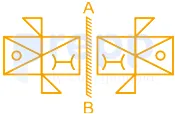 Paper & answer key PDF ↗
 Question 6archived
‘Dumbness’ is related to ‘Speech’ in the same way as ‘_______’ is related to ‘Memory’.
- A
Illusion
- B
Thoughtless
- C
Recognition
- D
Amnesia
Show answer
D. AmnesiaUnderstanding Analogies: Speech and Memory Relationships
Analogy questions test your ability to identify the relationship between two concepts and apply that same relationship to a different pair of concepts. In this question, we are given the pair ‘Dumbness’ and ‘Speech’ and asked to find the word related to ‘Memory’ in the same way.
Analyzing the Relationship: Dumbness and Speech
The term ‘Dumbness’ refers to the inability to speak. Therefore, the relationship between ‘Dumbness’ and ‘Speech’ is that ‘Dumbness’ is the lack or absence of ‘Speech’ ability. It represents a significant impairment or total loss of the function of speaking.
Applying the Relationship to Memory
Following the same pattern, we need to find a term that represents the lack or absence of ‘Memory’. We are looking for a word that describes the state of being unable to remember or having a significant impairment in memory function.
Evaluating the Options for Memory Relationship
Let's examine each option to see which one fits the established relationship:
Illusion: An illusion is a false perception of reality. It is related to senses and perception, not directly to the inability to remember things stored in memory.
Thoughtless: Thoughtless describes someone who acts without thinking about the consequences or the feelings of others. It relates to thinking and consideration, not the ability to remember.
Recognition: Recognition is the process of identifying something or someone previously encountered. This is an aspect of memory retrieval, not the lack of memory itself.
Amnesia: Amnesia is a condition characterized by a partial or total loss of memory. This term precisely describes the inability to remember, which aligns with the relationship observed between ‘Dumbness’ and ‘Speech’ (inability to speak).
Based on this analysis, ‘Amnesia’ shares the same relationship with ‘Memory’ as ‘Dumbness’ shares with ‘Speech’. Both are terms for the loss or inability of a specific function.
Pair
Relationship
Dumbness : Speech
Dumbness is the inability to perform Speech.
_______ : Memory
The blank term is the inability to perform Memory function.
Therefore, the word that completes the analogy is ‘Amnesia’.
Revision Table: Key Concepts
Term
Meaning
Relevance to Analogy
Dumbness
Inability to speak
First term in the analogy, defining the type of relationship (lack of function)
Speech
Ability to speak
Function related to Dumbness
Memory
Ability to remember information
Function related to the blank term
Amnesia
Loss of memory
Fits the "lack of function" relationship with Memory
Additional Information: Types of Memory Loss
Memory loss, or amnesia, can manifest in various forms. Understanding these can deepen the understanding of the term ‘Amnesia’ in relation to ‘Memory’:
Anterograde Amnesia: Difficulty forming new memories after the event that caused the amnesia.
Retrograde Amnesia: Difficulty remembering events that occurred before the event that caused the amnesia.
Transient Global Amnesia: A temporary, sudden episode of memory loss that may also include confusion.
Dissociative Amnesia: Memory loss caused by trauma or stress, often involving inability to recall personal information.
Regardless of the specific type, amnesia represents a significant impairment in the function of memory, just as dumbness represents a significant impairment in the function of speech.
Paper & answer key PDF ↗ Question 7archived
Select the option that is related to the third term in the same way as the second term is related to the first term.
Happy : Glad ∷ Sad : ?
- A
Gloomy
- B
Merry
- C
Contented
- D
Mellow
Show answer
A. GloomyUnderstanding the Analogy: Happy is to Glad as Sad is to ?
The question asks us to find the word that completes the analogy: Happy : Glad :: Sad : ?. This type of question tests our ability to identify the relationship between the first pair of words and apply the same relationship to the third word to find the fourth word.
Let's analyze the relationship between the first pair of words: Happy and Glad.
Happy means feeling or showing pleasure or contentment.
Glad means feeling pleasure or happiness.
Based on these definitions, "Happy" and "Glad" are synonyms. They have very similar meanings.
Now, we need to find a word that is related to Sad in the same way that Glad is related to Happy. This means we are looking for a synonym of Sad.
Let's examine the given options to find the synonym for "Sad":
Gloomy: Means feeling distressed or pessimistic; depressing or disheartening. This word is a synonym for sad.
Merry: Means cheerful and lively. This is an antonym (opposite) of sad.
Contented: Means feeling or expressing satisfaction with things as they are. This is different from feeling sad; it implies a state of satisfaction.
Mellow: Means pleasantly smooth or soft; calm, without intensity. This describes a mood that is relaxed rather than sad.
Comparing the options, Gloomy is the word that is a synonym for Sad, just as Glad is a synonym for Happy.
Therefore, the analogy is completed as: Happy : Glad :: Sad : Gloomy.
Analyzing the Options for Sad's Synonym
We can summarize the relationship of each option to the word 'Sad' in a simple way:
Gloomy: Synonym of Sad
Merry: Antonym of Sad
Contented: Different meaning, related to satisfaction
Mellow: Different meaning, related to calmness
The only option that fits the identified relationship (synonymy) is Gloomy.
Conclusion on the Analogy
The relationship between Happy and Glad is that they are synonyms. Applying the same relationship to Sad, we look for its synonym. Among the given options, Gloomy is the synonym of Sad. Hence, the correct completion of the analogy is Sad : Gloomy.
Revision Table: Key Concepts in Analogies
Term
Concept
Example
Analogy
Comparison showing relationship similarity
Cat : Meow :: Dog : Bark
Synonym
Words with similar meanings
Happy, Glad
Antonym
Words with opposite meanings
Happy, Sad
Relationship types
Synonym, Antonym, Part-Whole, Cause-Effect, etc.
Happy-Glad (Synonym), Day-Night (Antonym)
Additional Information: Solving Word Analogies
Word analogies require you to understand the relationship between the first pair of words. Common relationships include:
Synonyms (e.g., Big : Large)
Antonyms (e.g., Hot : Cold)
Part to Whole (e.g., Finger : Hand)
Cause and Effect (e.g., Fire : Smoke)
Worker and Tool (e.g., Carpenter : Hammer)
Action and Object (e.g., Read : Book)
Degree (e.g., Warm : Hot)
Once you identify the specific relationship in the first pair, apply the exact same relationship to the third word to find the fourth word from the options provided.
Paper & answer key PDF ↗ Question 8archived
How many triangles are there in the following figure?

- A
12
- B
11
- C
15
- D
13
Show answer
C. 15Hence total triangles are 15.
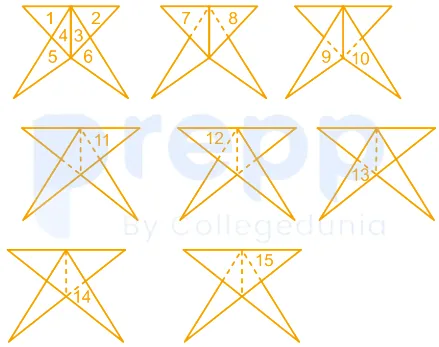 Paper & answer key PDF ↗
 Question 9archived
Arrange the following words in a logical and meaningful order.
1. Writing
2. Distributing
3. Publishing
4. Printing
5. Editing
- A
2, 3, 4, 5, 1
- B
2, 4, 3, 1, 5
- C
1, 5, 4, 3, 2
- D
1, 2, 3, 4, 5
Show answer
C. 1, 5, 4, 3, 2The question asks us to arrange the given words in a logical and meaningful order, representing a common process related to creating and sharing written content. The words are:
Writing
Distributing
Publishing
Printing
Editing
Let's think about the natural sequence of these activities when creating and sharing something like a book, article, or document.
Understanding the Logical Order of Content Creation and Distribution
Consider the steps involved in getting a piece of writing from an idea to the hands of readers. The process typically starts with creating the content, then refining it, producing physical copies (if applicable), making it publicly available, and finally getting it to the audience.
Let's analyze the steps in a logical flow:
You must first create the initial content. This is the act of Writing. So, Writing (1) is the starting point.
Once you have written something, it usually needs refinement. You check for errors, improve clarity, and make revisions. This process is called Editing. Editing (5) logically follows Writing.
After editing and finalizing the content, if you intend to produce physical copies (like a book or newspaper), the next step is to create those copies. This is Printing. Printing (4) comes after Editing, specifically for print media.
Once the content is ready, either in print or digital format, you need to make it available to the public or the intended audience. This is the act of Publishing. Publishing (3) typically occurs after the content is finalized and prepared (written, edited, printed if needed).
Finally, after the content is published, you need to get it to the people who will read it. This involves sharing it, selling it, or distributing it through various channels. This is Distributing. Distributing (2) is the final step in getting the published work to the audience.
Based on this logical flow, the order of the words should be:
Writing (1)
Editing (5)
Printing (4)
Publishing (3)
Distributing (2)
Logical Arrangement of Publishing Process Steps
Mapping the numbers to this logical sequence gives us the arrangement:
1 (Writing) → 5 (Editing) → 4 (Printing) → 3 (Publishing) → 2 (Distributing)
So, the logical and meaningful order of the numbers is 1, 5, 4, 3, 2.
Revision Table: Content Creation Steps
Logical Step Order
Activity
Corresponding Number
1st
Writing
1
2nd
Editing
5
3rd
Printing
4
4th
Publishing
3
5th
Distributing
2
Additional Information: Types of Publishing & Distribution
It's worth noting that the exact steps can vary slightly depending on the medium. For digital content, the Printing step might be skipped entirely. Publishing can include uploading to a website, releasing an e-book, or posting on social media. Distribution can involve online downloads, physical delivery, or sharing links. However, the core logical flow of creating, refining, making available, and sharing generally remains the same.
Paper & answer key PDF ↗ Question 10archived
Select the set in which the numbers are related in the same way as are the numbers of the following set.
(12, 16, 28)
- A
(20, 25, 35)
- B
(9, 15, 21)
- C
(18, 24, 42)
- D
(36, 48, 77)
Show answer
C. (18, 24, 42)Understanding Number Set Relationships
The question asks us to identify a set of numbers from the given options that shares the same relationship as the numbers in the set (12, 16, 28). To solve this number analogy problem, we first need to discover the underlying pattern or relationship between the numbers in the reference set (12, 16, 28).
Analyzing the Given Number Set (12, 16, 28)
Let's examine the numbers 12, 16, and 28 to find a relationship. We can look for arithmetic progressions, geometric progressions, differences, sums, or patterns related to common factors.
One simple observation is that $12 + 16 = 28$. The sum of the first two numbers equals the third number. Let's check if this applies to any of the options.
Another common method for number sets is to find the Greatest Common Divisor (GCD) and examine the resulting quotients.
Let's find the GCD of 12, 16, and 28.
The factors of 12 are 1, 2, 3, 4, 6, 12.
The factors of 16 are 1, 2, 4, 8, 16.
The factors of 28 are 1, 2, 4, 7, 14, 28.
The common factors are 1, 2, 4. The greatest common divisor is 4.
Now, let's divide each number in the set by the GCD (4):
$\frac{12}{4} = 3$
$\frac{16}{4} = 4$
$\frac{28}{4} = 7$
The quotients are 3, 4, and 7. Let's look for a relationship among these quotients. We can see that $3 + 4 = 7$.
So, the pattern is: Find the GCD of the three numbers. The quotients obtained by dividing the numbers by their GCD are $q_1, q_2, q_3$, such that $q_1 + q_2 = q_3$. In other words, the numbers are in the ratio 3:4:7.
Evaluating the Options for the Same Relationship
Now, we will apply this pattern to each of the given options to find the set that follows the same rule.
Option 1: (20, 25, 35)
Let's find the GCD of 20, 25, and 35.
GCD(20, 25, 35) = 5
Divide the numbers by 5:
$\frac{20}{5} = 4$
$\frac{25}{5} = 5$
$\frac{35}{5} = 7$
Check the sum of the first two quotients: $4 + 5 = 9$. This is not equal to the third quotient (7). So, this set does not follow the pattern.
Option 2: (9, 15, 21)
Let's find the GCD of 9, 15, and 21.
GCD(9, 15, 21) = 3
Divide the numbers by 3:
$\frac{9}{3} = 3$
$\frac{15}{3} = 5$
$\frac{21}{3} = 7$
Check the sum of the first two quotients: $3 + 5 = 8$. This is not equal to the third quotient (7). So, this set does not follow the pattern.
Option 3: (18, 24, 42)
Let's find the GCD of 18, 24, and 42.
GCD(18, 24, 42) = 6
Divide the numbers by 6:
$\frac{18}{6} = 3$
$\frac{24}{6} = 4$
$\frac{42}{6} = 7$
Check the sum of the first two quotients: $3 + 4 = 7$. This is equal to the third quotient (7). This set follows the pattern.
Option 4: (36, 48, 77)
Let's find the GCD of 36, 48, and 77.
Factors of 36: 1, 2, 3, 4, 6, 9, 12, 18, 36
Factors of 48: 1, 2, 3, 4, 6, 8, 12, 16, 24, 48
Factors of 77: 1, 7, 11, 77
The only common factor is 1. GCD(36, 48, 77) = 1.
Divide the numbers by 1:
$\frac{36}{1} = 36$
$\frac{48}{1} = 48$
$\frac{77}{1} = 77$
Check the sum of the first two quotients: $36 + 48 = 84$. This is not equal to the third quotient (77). So, this set does not follow the pattern.
Conclusion
Based on our analysis, only the set (18, 24, 42) demonstrates the same relationship as the set (12, 16, 28). Both sets, when divided by their Greatest Common Divisor, result in the quotients 3, 4, and 7, where the sum of the first two quotients equals the third ($3 + 4 = 7$).
The relationship is that the numbers are in the ratio 3:4:7.
For (12, 16, 28), the common factor is 4 ($12 = 4 \times 3$, $16 = 4 \times 4$, $28 = 4 \times 7$).
For (18, 24, 42), the common factor is 6 ($18 = 6 \times 3$, $24 = 6 \times 4$, $42 = 6 \times 7$).
Therefore, the set (18, 24, 42) is related in the same way as (12, 16, 28).
Revision Table: Checking Number Set Relationships
Set
Numbers
GCD
Quotients (Num / GCD)
Check Pattern ($q_1 + q_2 = q_3$)
Follows Pattern?
Given Set
(12, 16, 28)
4
(3, 4, 7)
$3 + 4 = 7$
Yes
Option 1
(20, 25, 35)
5
(4, 5, 7)
$4 + 5 = 9 \neq 7$
No
Option 2
(9, 15, 21)
3
(3, 5, 7)
$3 + 5 = 8 \neq 7$
No
Option 3
(18, 24, 42)
6
(3, 4, 7)
$3 + 4 = 7$
Yes
Option 4
(36, 48, 77)
1
(36, 48, 77)
$36 + 48 = 84 \neq 77$
No
Additional Information on Number Analogy and GCD
Number analogy questions test your ability to find patterns and logical relationships between numbers. These relationships can involve basic arithmetic operations, ratios, squares, cubes, prime numbers, or properties like divisibility.
The Greatest Common Divisor (GCD), also known as the Highest Common Factor (HCF), is the largest positive integer that divides each of the integers in a set without leaving a remainder. Finding the GCD is often a useful first step in simplifying number sets to reveal underlying proportional relationships, as demonstrated in this problem where the numbers in the set and the correct option share the same underlying ratio (3:4:7) after being divided by their respective GCDs. Recognizing common factors and ratios is a key skill in solving many types of numerical reasoning problems.
Paper & answer key PDF ↗ Question 11archived
Rs. 820 is divided among 6 men, 8 women, and 12 boys in such a way that every woman gets an amount equal to that received by one man and one boy combined and that every man gets one and a half times the amount received by a boy. What is the total amount received by 8 women?
- A
Rs. 380
- B
Rs. 240
- C
Rs. 300
- D
Rs. 400
Show answer
D. Rs. 400Understanding the Money Division Problem
The problem describes how a total amount of Rs. 820 is divided among a group of men, women, and boys. We are given specific relationships between the amounts received by individuals from each group. Our goal is to find the total amount received by all the women.
Defining Variables and Setting Up Equations
Let's represent the amount received by one person from each group:
Let \(B\) be the amount received by one boy.
Let \(M\) be the amount received by one man.
Let \(W\) be the amount received by one woman.
Based on the problem statement, we can write down the relationships:
Total amount: The total money distributed is the sum of the amounts received by all individuals. There are 6 men, 8 women, and 12 boys.
Total Amount $= (\text{Number of men} \times M) + (\text{Number of women} \times W) + (\text{Number of boys} \times B)$
\(6M + 8W + 12B = 820\) (Equation 1)
Relationship between woman's share, man's share, and boy's share: Every woman gets an amount equal to that received by one man and one boy combined.
\(W = M + B\) (Equation 2)
Relationship between man's share and boy's share: Every man gets one and a half times the amount received by a boy.
\(M = 1.5 \times B\)
\(M = \frac{3}{2} B\) (Equation 3)
Solving the System of Equations
Now we have a system of three equations with three variables (\(M\), \(W\), \(B\)). We can use substitution to solve for the individual amounts.
Substitute Equation 3 (\(M = \frac{3}{2} B\)) into Equation 2 (\(W = M + B\)):
\(W = \frac{3}{2} B + B\)
To add the terms on the right side, find a common denominator:
\(W = \frac{3}{2} B + \frac{2}{2} B\)
\(W = \frac{3B + 2B}{2}\)
\(W = \frac{5}{2} B\) (Equation 4)
Now we have expressions for \(M\) (Equation 3) and \(W\) (Equation 4) in terms of \(B\). Substitute these expressions into Equation 1 (\(6M + 8W + 12B = 820\)):
\(6 \left(\frac{3}{2} B\right) + 8 \left(\frac{5}{2} B\right) + 12B = 820\)
Simplify the terms:
\(\left(\frac{6 \times 3}{2}\right) B + \left(\frac{8 \times 5}{2}\right) B + 12B = 820\)
\(\left(\frac{18}{2}\right) B + \left(\frac{40}{2}\right) B + 12B = 820\)
\(9B + 20B + 12B = 820\)
Combine the terms involving \(B\):
\((9 + 20 + 12) B = 820\)
\(41B = 820\)
Now, solve for \(B\):
\(B = \frac{820}{41}\)
\(B = 20\)
So, the amount received by one boy is Rs. 20.
Calculating Individual Shares
Now that we know the value of \(B\), we can find the values of \(M\) and \(W\) using the relationships we found:
Amount received by one man (\(M\)):
\(M = \frac{3}{2} B = \frac{3}{2} \times 20\)
\(M = 3 \times 10 = 30\)
So, one man receives Rs. 30.
Amount received by one woman (\(W\)):
\(W = \frac{5}{2} B = \frac{5}{2} \times 20\)
\(W = 5 \times 10 = 50\)
So, one woman receives Rs. 50.
Alternatively, using \(W = M + B\): \(W = 30 + 20 = 50\). This confirms our result.
Verification of Total Amount
Let's check if these individual amounts add up to the total amount of Rs. 820:
Total amount for 6 men = \(6 \times M = 6 \times 30 = 180\)
Total amount for 8 women = \(8 \times W = 8 \times 50 = 400\)
Total amount for 12 boys = \(12 \times B = 12 \times 20 = 240\)
Total distributed amount = \(180 + 400 + 240 = 820\).
This matches the given total amount, confirming our calculations for individual shares are correct.
Finding the Total Amount Received by 8 Women
The question asks for the total amount received by 8 women. Since each woman receives Rs. 50, the total amount for 8 women is:
Total amount for 8 women = \(8 \times W = 8 \times 50 = 400\)
The total amount received by 8 women is Rs. 400.
Group
Number
Amount per person
Total Amount for Group
Men
6
Rs. 30
\(6 \times 30 = 180\)
Women
8
Rs. 50
\(8 \times 50 = 400\)
Boys
12
Rs. 20
\(12 \times 20 = 240\)
Grand Total
\(180 + 400 + 240 = 820\)
Conclusion
By setting up equations based on the given information and solving them, we found the amount received by each boy, man, and woman. The total amount received by 8 women is Rs. 400.
Revision Table: Money Division Concepts
Concept
Explanation
Application in Problem
Setting up Variables
Using symbols (like \(B\), \(M\), \(W\)) to represent unknown quantities.
Representing the amount each boy, man, and woman receives.
Formulating Equations
Translating word problems into mathematical equations based on relationships between quantities.
Writing equations for the total amount, woman's share, and man's share.
Substitution Method
Solving a system of equations by expressing one variable in terms of another and substituting into other equations.
Used to find the value of \(B\) by expressing \(M\) and \(W\) in terms of \(B\).
Solving Linear Equations
Finding the value of the unknown variable that satisfies the equation.
Used to find the specific amounts \(B\), \(M\), and \(W\).
Verification
Checking if the calculated values satisfy the original conditions of the problem.
Summing up the total amounts for each group to ensure it equals Rs. 820.
Additional Information: Proportional Distribution Problems
This problem is an example of a proportional distribution question. These problems involve dividing a total quantity among different categories based on given ratios or relationships between the categories. The key steps usually involve:
Identifying the quantities to be distributed and the categories among which it is divided.
Defining variables for the amounts received by individuals or units in each category.
Translating the given relationships and the total quantity into a system of equations.
Solving the system of equations to find the value of each variable, often by expressing all variables in terms of a single variable.
Calculating the specific amount requested in the question using the values of the variables.
Understanding how to set up and solve systems of linear equations is crucial for these types of problems. Sometimes, the relationships are given directly as ratios (e.g., man:boy ratio is 3:2), which can also be used to set up the equations.
Paper & answer key PDF ↗ Question 12archived
A square paper is folded and cut as shown below. How will it appear when unfolded?
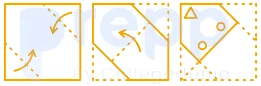
- A
Option A (shown in image)
- B
Option B (shown in image)
- C
Option C (shown in image)
- D
Option D (shown in image)
Show answer
B. Option B (shown in image)Hence option 2) is correct answer.
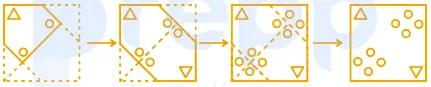 Paper & answer key PDF ↗
 Question 13archived
Select the option in which the given figure is embedded.

- A
Option A (shown in image)
- B
Option B (shown in image)
- C
Option C (shown in image)
- D
Option D (shown in image)
Show answer
D. Option D (shown in image)Hence option 4 is correct answer.
 Paper & answer key PDF ↗
 Question 14archived
In a family of eight persons, there are two couples, each having two children. C and D are cousin brothers. The father of E is married to G, who is the aunt of F. F’s mother, H is married to B, the brother of A. C is the nephew of H. How is A related to D?
- A
Father
- B
Brother
- C
Nephew
- D
Uncle
Show answer
D. UncleAnalyzing the Family Relationship Puzzle
Let's break down the information provided in the question step by step to build the family tree and determine the relationship between A and D.
We are told there is a family of eight persons, consisting of two couples, each with two children. This means there are 4 adults (the couples) and 4 children, totaling 8 people.
Identifying Key Clues
There are two couples, each with two children.
C and D are cousin brothers (both male).
The father of E is married to G.
G is the aunt of F.
F’s mother, H, is married to B.
B is the brother of A.
C is the nephew of H.
Building the Family Tree
Let's use the clues to connect the family members:
"F’s mother, H, is married to B". This tells us B and H are a couple. F is their child. Since each couple has two children, B and H have one more child besides F.
"B is the brother of A". This places A and B in the same generation. B is male.
"The father of E is married to G". This tells us there is another couple. Let the father of E be P. So, P and G are a couple, and E is their child. They have one more child besides E.
The two couples are (B, H) and (P, G). The children are F, one more child from (B, H), and E, one more child from (P, G). These 8 people must be B, H, P, G, F, E, and the two other children.
"G is the aunt of F". F is a child of B and H. An aunt is the sister of a parent or the wife of a parent's brother. G is one of the parents in the second couple (P, G). For G to be F's aunt, G must be a sibling of B or H.
"C is the nephew of H". H is one of the parents in the first couple (B, H). C is one of the children (the two other children besides F and E). For C to be H's nephew, C must be the son of H's sibling or B's sibling. C is also from the other couple (P, G), as cousins are from different couples. So C is a child of P or G.
"C and D are cousin brothers". C and D are both male. They are cousins, meaning their parents are siblings or married to siblings. Since C is a child of (P, G) and D must be the other child of (B, H) for them to be cousins, this fits.
Let's connect G being F's aunt and C being H's nephew with C and D being cousins. C is a child of P-G, and D is a child of B-H. For them to be cousins, their parents must be siblings.
If G is B's sister: G is aunt of F (B's child). C is child of P-G. G is B's sister. C is child of G. C is B's nephew. H is B's wife, so C is also H's nephew. This fits all conditions (G is aunt of F, C is nephew of H, C and D can be cousins).
If G is H's sister: G is aunt of F (H's child). C is child of P-G. G is H's sister. C is child of G. C is H's nephew/niece. If C is male, he is nephew. This also fits all conditions.
Let's use the case where G is B's sister, as it directly connects to 'B, brother of A'.
B and H are married with children D and F.
P and G are married with children C and E.
B and G are siblings (G is B's sister).
B is the brother of A. This means A and B are brothers, and G is their sister. So, A, B are male siblings and G is their female sibling.
A is a person outside the family of 8, but related. The 8 persons are B, H, P, G, D, F, C, E.
D is a child of B and H.
A is the brother of B.
Based on this structure:
Generation
Person
Relation
Adults (Siblings)
A
Brother of B
B
Brother of A, Brother of G, Married to H
G
Sister of A, Sister of B, Married to P
Adults (Spouses)
H
Married to B
P
Married to G
Children (Couple B-H)
D
Son of B & H (Cousin of C & E)
F
Child of B & H
Children (Couple P-G)
C
Son of P & G (Cousin of D & F), Nephew of H
E
Child of P & G
The 8 people in the family are B, H, P, G, D, F, C, E. A is related to the family through B.
Determining the Relationship of A to D
D is the son of B and H. B is D's father.
A is the brother of B.
Therefore, A is the brother of D's father.
The brother of one's father is one's uncle.
So, A is the uncle of D.
Conclusion
By carefully constructing the family relationships based on the given clues, we determined the structure. A is the brother of B, who is the father of D. Thus, A is D's uncle.
Question
Relationship Found
How is A related to D?
A is the uncle of D.
Revision Table: Key Relationships
Person
Relation to others mentioned
A
Brother of B
B
Brother of A, Husband of H, Father of D and F
H
Wife of B, Mother of D and F, Aunt of C (by marriage)
P
Husband of G, Father of C and E
G
Wife of P, Sister of B (and A), Aunt of D and F
C
Son of P and G, Cousin of D and F, Nephew of B and H
D
Son of B and H, Cousin of C and E
E
Child of P and G
F
Child of B and H
Additional Information on Family Relationships
Understanding common relationship terms is crucial for solving these types of puzzles.
Sibling: A brother or sister.
Spouse: A husband or wife.
Parent: A father or mother.
Child: A son or daughter.
Uncle: The brother of one's parent.
Aunt: The sister of one's parent, or the wife of one's parent's brother.
Nephew: The son of one's sibling.
Niece: The daughter of one's sibling.
Cousin: The child of one's parent's sibling. Cousins are in the same generation.
Cousin Brother/Sister: Used to specify the gender of a cousin.
When solving family tree problems, always start with the clearest connections (like marital relationships or parent-child links) and then expand using sibling and cousin relationships. Pay close attention to genders mentioned (brother, sister, son, daughter, nephew, niece) and terms like 'cousin brother' which specifies gender.
Paper & answer key PDF ↗ Question 15archived
Select the option that is related to the third letter-cluster in the same way as the second letter-cluster.
JKLM : HLKO ∷ PQRS : ?
- A
MRQV
- B
ORQT
- C
NRQU
- D
NQRU
Show answer
C. NRQUSolving Letter Cluster Analogy Questions
This question asks us to find the relationship between the first pair of letter clusters, JKLM and HLKO, and then apply that same relationship to the letter cluster PQRS to find the missing cluster. These types of questions test your ability to identify patterns in letter sequences based on their positions in the alphabet.
Analyzing the Pattern: JKLM to HLKO
Let's look at how each letter in JKLM changes to become the corresponding letter in HLKO. We can use the alphabetical position of each letter.
Position
Letter in JKLM
Alphabetical Position
Letter in HLKO
Alphabetical Position
Change
1st
J
\(10\)
H
\(8\)
\(8 - 10 = -2\)
2nd
K
\(11\)
L
\(12\)
\(12 - 11 = +1\)
3rd
L
\(12\)
K
\(11\)
\(11 - 12 = -1\)
4th
M
\(13\)
O
\(15\)
\(15 - 13 = +2\)
The pattern observed in the change of alphabetical positions is:
1st letter: Position \(-2\)
2nd letter: Position \(+1\)
3rd letter: Position \(-1\)
4th letter: Position \(+2\)
Applying the Pattern to PQRS
Now, we apply this same pattern of changes to the letter cluster PQRS. Let's find the alphabetical positions of the letters in PQRS and apply the respective changes.
Position
Letter in PQRS
Alphabetical Position
Change (Pattern)
New Position
New Letter
1st
P
\(16\)
\(-2\)
\(16 - 2 = 14\)
N
2nd
Q
\(17\)
\(+1\)
\(17 + 1 = 18\)
R
3rd
R
\(18\)
\(-1\)
\(18 - 1 = 17\)
Q
4th
S
\(19\)
\(+2\)
\(19 + 2 = 21\)
U
By applying the pattern \(-2, +1, -1, +2\) to the letters PQRS, we get the new letter cluster NRQU.
Checking the Options
Let's compare our result NRQU with the given options:
Option 1: MRQV - Does not match NRQU.
Option 2: ORQT - Does not match NRQU.
Option 3: NRQU - Matches our result.
Option 4: NQRU - Does not match NRQU (the order of Q and R is different).
Therefore, the letter cluster that is related to PQRS in the same way as HLKO is related to JKLM is NRQU.
Revision Table: Key Pattern Identification
Cluster 1
Cluster 2
Relationship Pattern (Alphabetical Position Change)
JKLM
HLKO
1st: -2, 2nd: +1, 3rd: -1, 4th: +2
PQRS
NRQU
Applying the same -2, +1, -1, +2 pattern
Additional Information: Letter Analogies and Reasoning
Letter analogy questions are common in reasoning tests. They require you to decipher the rule or pattern connecting two given letter sets and apply it to a third set. The patterns can be based on:
Alphabetical position shifts (like in this question).
Skipping a fixed number of letters.
Reversing the order of letters.
Vowel/consonant relationships.
Combination of different rules.
Practicing with different types of patterns is key to solving these reasoning problems quickly and accurately. Always write down the alphabetical positions if it helps you see the numerical relationship clearly.
Paper & answer key PDF ↗ Question 16archived
Three of the following four numbers are a like in a certain way and one is different, Pick the number that is different from the rest.
- A
341
- B
209
- C
166
- D
154
Show answer
C. 166Number Analogy: Finding the Different Number
This problem requires us to identify which number among the given options (341, 209, 166, 154) does not follow the same pattern as the other three. We need to find a common characteristic shared by three of the numbers that the fourth one lacks.
Analyzing the Number Pattern
Let's examine the properties of each number to find a distinguishing pattern:
The numbers provided are 341, 209, 166, and 154.
We look for mathematical properties like divisibility, sum of digits, prime factorization, etc., that might group three numbers together.
Divisibility by 11 Rule Explained
A common technique in these types of questions is to check for divisibility rules. Let's test the divisibility by 11 for each number. The rule for divisibility by 11 involves calculating the alternating sum of the digits of the number. If this alternating sum is 0 or divisible by 11, the number itself is divisible by 11.
The formula for the alternating sum of digits for a number like 'abc' is $a - b + c$. For a number 'abcd', it would be $a - b + c - d$, and so on.
Step-by-Step Check for Each Number
Let's apply the divisibility rule for 11 to each of the given numbers:
Checking 341:
The alternating sum of digits is $3 - 4 + 1 = 0$. Since 0 is divisible by 11, the number 341 is divisible by 11.
Calculation: $341 \div 11 = 31$.
Checking 209:
The alternating sum of digits is $2 - 0 + 9 = 11$. Since 11 is divisible by 11, the number 209 is divisible by 11.
Calculation: $209 \div 11 = 19$.
Checking 166:
The alternating sum of digits is $1 - 6 + 6 = 1$. Since 1 is not divisible by 11, the number 166 is not divisible by 11.
Checking 154:
The alternating sum of digits is $1 - 5 + 4 = 0$. Since 0 is divisible by 11, the number 154 is divisible by 11.
Calculation: $154 \div 11 = 14$.
Conclusion: Identifying the Odd One Out
Based on the divisibility test for 11, we observe the following:
341 is divisible by 11.
209 is divisible by 11.
154 is divisible by 11.
166 is NOT divisible by 11.
Therefore, three of the numbers (341, 209, 154) share the common property of being divisible by 11. The number 166 is different because it does not possess this property.
The number that is different from the rest is 166.
Paper & answer key PDF ↗ Question 17archived
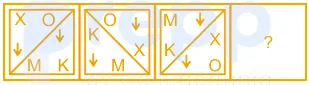
Select the figure that will come next in the following figure series.
- A
Option A (shown in image)
- B
Option B (shown in image)
- C
Option C (shown in image)
- D
Option D (shown in image)
Show answer
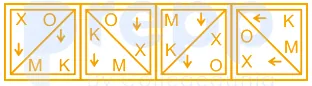
C. Option C (shown in image)By looking at diagram we see that there are two symbols between two given arrows.
Only option 3 fulfils this pattern.
Hence, option 3 is the correct answer.
 Paper & answer key PDF ↗
 Question 18archived
Three of the following four words are alike in a certain way and one is different. Pick the odd word out.
- A
Papaya
- B
Guava
- C
Cucumber
- D
Pomegranate
Show answer
C. CucumberUnderstanding the "Odd Word Out" Concept
This type of question asks you to identify the word that is different from the others in a given list. The difference is usually based on a common characteristic or category that applies to three of the words but not the fourth. You need to analyze each word and find the underlying relationship or classification.
Analyzing the Given Words: Papaya, Guava, Cucumber, Pomegranate
Let's look at each word provided in the list:
Papaya: This is a type of fruit. It is typically sweet and eaten as a fruit.
Guava: This is also a type of fruit. It can be sweet or slightly tart and is commonly eaten as a fruit.
Cucumber: While botanically a fruit, a cucumber is widely considered and used as a vegetable in cooking. It is typically eaten in salads, pickles, or other savory dishes and is not sweet.
Pomegranate: This is a type of fruit, known for its juicy seeds, which are typically sweet or tart and eaten as a fruit.
Identifying the Common Characteristic
We can see that Papaya, Guava, and Pomegranate are all commonly classified and consumed as sweet or tart fruits. They are typically associated with desserts, snacks, or fruit salads.
On the other hand, Cucumber, although botanically a fruit (it grows from a flower and contains seeds), is culturally and culinarily treated as a vegetable. It is typically used in savory dishes like salads, sandwiches, and stir-fries, and its taste is not sweet like the other three items.
Determining the Odd Word Out
Based on the common usage and culinary classification, Papaya, Guava, and Pomegranate fit into the category of 'sweet/tart fruits commonly eaten raw as a snack or dessert'. Cucumber does not fit neatly into this category because it is primarily used as a vegetable in savory preparations.
Therefore, Cucumber is the odd word out.
Revision Table
Word
Botanical Classification
Culinary Classification/Typical Use
Sweet/Tart Taste
Papaya
Fruit
Fruit
Yes
Guava
Fruit
Fruit
Yes
Cucumber
Fruit
Vegetable
No (Mild, often bland)
Pomegranate
Fruit
Fruit
Yes
Additional Information on Fruit vs. Vegetable Classification
The distinction between fruits and vegetables can sometimes be confusing because there are both botanical and culinary definitions. Understanding this difference helps in solving classification questions:
Botanical Definition: A fruit develops from the flower of a plant and contains seeds. Vegetables consist of other parts of plants, such as roots (carrots, potatoes), stems (celery, asparagus), leaves (spinach, lettuce), and flowers (broccoli, cauliflower). By this definition, items like tomatoes, cucumbers, squash, peppers, and avocados are technically fruits.
Culinary Definition: This classification is based on how a plant part is used in cooking. Items typically eaten raw or used in sweet dishes (desserts, snacks, jams) are usually considered fruits. Items used in savory dishes (soups, stews, salads, main courses) are usually considered vegetables. This is why items like tomatoes and cucumbers are often treated as vegetables in the kitchen.
In reasoning questions like this, the classification is often based on the more common, everyday culinary understanding rather than strict botanical definitions.
Paper & answer key PDF ↗ Question 19archived
Two statements are given followed by three conclusions numbered I, II and III. Assuming the statements to be true even if they seem to be at variance with commonly known facts, decide which of the conclusions logically follow(s) form the statements.
Statements:
Some students are players
Some players are athletes
Conclusions:
I. Some students are athletes.
II. Some players are students
III. No students is an athlete.
- A
Only conclusion II and either conclusion I or III follow
- B
Only conclusion I follows
- C
Only conclusions II and III follow
- D
None of the conclusions follows.
Show answer
A. Only conclusion II and either conclusion I or III followUnderstanding Syllogism Statements and Conclusions
This question asks us to analyze two statements and determine which of the given conclusions logically follow from them. We must assume the statements are true, even if they contradict common knowledge.
Analyzing the Given Syllogism Statements
We have two statements:
Some students are players.
Some players are athletes.
These are both 'Some' type statements, indicating a partial overlap between the categories mentioned.
Analyzing the Given Syllogism Conclusions
We need to evaluate three conclusions:
Some students are athletes.
Some players are students.
No students is an athlete.
Evaluating Each Syllogism Conclusion
Conclusion I: Some students are athletes.
The statements tell us about the relationship between Students and Players, and Players and Athletes. There is no direct statement connecting Students and Athletes. From "Some Students are Players" and "Some Players are Athletes", we cannot definitively conclude that "Some Students are Athletes". It is possible, but not guaranteed by the statements alone. For example, the students who are players might be entirely different from the players who are athletes. Or there might be some overlap.
Conclusion II: Some players are students.
The first statement is "Some students are players". In syllogism, if a statement says "Some A are B", it logically follows that "Some B are A". This is called the conversion of an 'I' (Some) statement. Therefore, if "Some students are players", then it must be true that "Some players are students". This conclusion definitely follows from Statement 1.
Conclusion III: No students is an athlete.
Similar to Conclusion I, the statements do not establish a direct relationship between Students and Athletes. From "Some Students are Players" and "Some Players are Athletes", we cannot definitively conclude that "No Students is an Athlete". It is possible that no students are athletes, but it is also possible that some students are athletes (as in Conclusion I). This conclusion is not guaranteed by the statements alone.
Considering Conclusions I and III Together (Complementary Pair)
Notice that Conclusions I ("Some students are athletes") and III ("No students is an athlete") form a complementary pair. In a situation where the statements do not provide a definite link between two categories (Students and Athletes in this case), either 'Some' relationship exists or the 'No' relationship exists. One of them must be true. Since the statements "Some Students are Players" and "Some Players are Athletes" do not lead to a definite 'Some' or 'No' conclusion between Students and Athletes, these two conclusions form an 'either/or' case.
Synthesizing the Findings for Syllogism
Conclusion I (Some students are athletes) - Does not necessarily follow.
Conclusion II (Some players are students) - Definitely follows from Statement 1.
Conclusion III (No students is an athlete) - Does not necessarily follow.
However, Conclusion I and Conclusion III form a complementary pair. This means either Conclusion I is true OR Conclusion III is true, but not both. This occurs when the given statements do not provide a conclusive link between the subjects and predicates of these conclusions.
Therefore, Conclusion II definitely follows, and either Conclusion I or Conclusion III follows.
Syllogism Decision Summary
Based on the logical analysis:
Conclusion II is certainly true.
Conclusions I and III form an 'either/or' scenario.
The set of conclusions that follow is: Only conclusion II and either conclusion I or III follow.
Statement/Conclusion
Type
Follows?
Reasoning
Statement 1: Some students are players
I
Given
Premise
Statement 2: Some players are athletes
I
Given
Premise
Conclusion I: Some students are athletes
I
Does not necessarily follow
No definite link between Students and Athletes from premises
Conclusion II: Some players are students
I
Definitely follows
Conversion of Statement 1 ('Some A are B' implies 'Some B are A')
Conclusion III: No students is an athlete
E
Does not necessarily follow
No definite link between Students and Athletes from premises
Conclusion I and III
I & E
Either/Or
Form a complementary pair when no definite conclusion exists between categories
Syllogism Revision Table
Statement Type
Notation
Example
Conversion
Universal Affirmative (All)
A
All S are P
Conversion is not simple; 'All P are S' is not guaranteed.
Universal Negative (No)
E
No S is P
No P is S (Simple Conversion)
Particular Affirmative (Some)
I
Some S are P
Some P are S (Simple Conversion)
Particular Negative (Some Not)
O
Some S are not P
Conversion is not valid.
Additional Information on Syllogism Concepts
Syllogism is a form of logical reasoning where a conclusion is drawn from two given statements. Key concepts include:
Statements/Premises: The given assumptions we must accept as true.
Conclusions: Inferences drawn from the statements.
Categorical Syllogism: Deals with statements that relate categories (like Students, Players, Athletes).
Types of Statements: Universal Affirmative (All), Universal Negative (No), Particular Affirmative (Some), Particular Negative (Some not).
Complementary Pairs: Certain pairs of conclusions are such that if the premises do not yield a definite relation, one of the conclusions in the pair must be true. Common pairs are 'Some' vs 'No' (as seen here) and 'All' vs 'Some Not'. When conclusions form a complementary pair, and neither individually follows definitively, the answer is often "either... or...".
Venn Diagrams: A common method to visually represent the relationships described by the statements and test the validity of conclusions.
In this problem, the combination of two 'Some' statements connecting three terms (Students-Players-Athletes) often results in no definite conclusion between the first and third terms, leading to an either/or situation for the 'Some' and 'No' conclusions about those terms.
Paper & answer key PDF ↗ Question 20archived
Select the combination of letters that when sequentially placed in the gaps of the given letter series will complete the series.
dc_abc_cb_bcd_ba_c
- A
cbadb
- B
bdacb
- C
dbacb
- D
dbcab
Show answer
B. bdacbSolving Letter Series Completion Problems
Letter series completion questions require you to find the underlying pattern in a sequence of letters and use that pattern to fill in the missing terms. The pattern can involve repetition, alphabetical order, skipping letters, or a combination of rules.
Analyzing the Given Letter Series
The given series is: dc_abc_cb_bcd_ba_c. There are 5 gaps to be filled. We need to test the given options to see which sequence of letters, when placed in the gaps, creates a logical pattern in the complete series.
The options provide sequences of 5 letters.
Testing the Options
Let's insert the letters from the correct option, bdacb, into the gaps of the original series.
Original Series: dc_abc_cb_bcd_ba_c
Gaps to fill (in order): 1st, 2nd, 3rd, 4th, 5th
Letters from Option 2 (bdacb): b, d, a, c, b
Inserting the letters sequentially:
After 'dc', insert 'b': dcb
After 'abc', insert 'd': abcd
After 'cb', insert 'a': cba
After 'bcd', insert 'c': bcdc
After 'ba', insert 'b': bab
The final 'c' remains at the end.
Joining all the segments with the inserted letters gives the complete series:
dcb + abcd + cba + bcdc + bab + c = dcbabcdcbabcdcbbc
Wait, let's re-insert carefully into the original structure dc_abc_cb_bcd_ba_c using bdacb:
d c (gap 1: b) a b c (gap 2: d) c b (gap 3: a) b c d (gap 4: c) b a (gap 5: b) c
The complete series formed is: dcb a b c d c b a b c d c b a c
Let's write it out continuously: dcbabcdcbabcdcbac
Let's check the length: There were 12 letters in the original series and 5 gaps, so the final series should have $12 + 5 = 17$ letters. The series dcbabcdcbabcdcbac has 17 letters.
Identifying the Pattern
Now, let's examine the completed series dcbabcdcbabcdcbac for a pattern.
Let's look for repeating blocks of letters:
The first 6 letters are dcbabc.
The next 6 letters (starting from position 7) are dcbabc.
The remaining letters (starting from position 13) are dcbac.
The pattern is a repeating block dcbabc. The block repeats fully twice, and the final segment is a truncated version of the same block, missing the last letter ('b').
The series can be segmented as: (dcbabc) (dcbabc) (dcbac)
This consistent pattern emerges when the letters bdacb are used to fill the gaps.
Conclusion
By inserting the letters bdacb into the gaps of the series dc_abc_cb_bcd_ba_c, we obtain the complete series dcbabcdcbabcdcbac. This series exhibits a clear repeating pattern of the block dcbabc, with the final part being a slightly shortened version of the block. Therefore, the combination of letters bdacb correctly completes the series.
Gap No.
Letter Inserted (from bdacb)
Position in Series
1
b
After 'dc'
2
d
After 'abc'
3
a
After 'cb'
4
c
After 'bcd'
5
b
After 'ba'
Revision Table: Letter Series Patterns
Type of Pattern
Description
Example
Repeating Block
A fixed sequence of letters repeats throughout the series.
abcabcabc...
Alternating Pattern
Two or more different patterns alternate.
abCdeFghI... (Lowercase alphabetical, Uppercase skip 2)
Alphabetical Position
Pattern based on the position of letters in the alphabet (e.g., adding/subtracting positions).
A(1), C(3), E(5), G(7)... (Adding 2 to position)
Skipping Letters
Letters are skipped in a regular sequence (e.g., skip 1, skip 2).
A, C, E, G... (Skipping one letter)
Reverse Alphabetical
Letters appear in reverse alphabetical order or follow a pattern in reverse.
Z, X, V, T...
Additional Information: Tips for Solving Letter Series
Solving letter series problems effectively requires a systematic approach. Here are some tips:
Count the total number of letters and gaps in the series. This can sometimes suggest the length of the repeating block (e.g., if the total is 16, look for blocks of 4 or 8).
Look for repeating segments or groups of letters even before filling the gaps.
Check the options and try inserting them one by one. This is often necessary when the pattern isn't immediately obvious.
Once a series is completed with an option, read it aloud or segment it visually to identify repeating blocks.
Consider patterns based on alphabetical order, position values (A=1, B=2, etc.), skipping letters, or combinations of these.
Look for symmetry or alternating patterns if a simple repeating block isn't found.
Practice with various types of letter series to become familiar with common patterns.
Paper & answer key PDF ↗ Question 21archived
Which number will replace the question mark (?) in the following series?
2, 3, 6, 10, 17, 28, ?
- A
43
- B
46
- C
39
- D
45
Show answer
B. 46Understanding the Number Series Problem
We are given a number series: 2, 3, 6, 10, 17, 28, ?. Our task is to find the number that should replace the question mark, following the pattern established by the preceding numbers.
Identifying the Pattern in the Series
To solve number series problems, we look for a relationship between consecutive terms or other terms in the sequence. Let's examine the differences between consecutive terms:
Difference between 3 and 2 is \(3 - 2 = 1\)
Difference between 6 and 3 is \(6 - 3 = 3\)
Difference between 10 and 6 is \(10 - 6 = 4\)
Difference between 17 and 10 is \(17 - 10 = 7\)
Difference between 28 and 17 is \(28 - 17 = 11\)
The sequence of differences is 1, 3, 4, 7, 11. Let's look for a pattern in this difference sequence.
\(1 + 3 = 4\)
\(3 + 4 = 7\)
\(4 + 7 = 11\)
It appears that, starting from the third difference, each difference is the sum of the previous two differences. Let \(D_n\) be the difference between the n-th term and the (n-1)-th term. Then, \(D_n = D_{n-1} + D_{n-2}\) for \(n \ge 4\).
Alternatively, we can look for a pattern directly between the terms themselves. Let's test if a term is related to the sum of the previous terms.
Term 3 (6) vs Term 1 (2) + Term 2 (3): \(2 + 3 = 5\). \(6 = 5 + 1\).
Term 4 (10) vs Term 2 (3) + Term 3 (6): \(3 + 6 = 9\). \(10 = 9 + 1\).
Term 5 (17) vs Term 3 (6) + Term 4 (10): \(6 + 10 = 16\). \(17 = 16 + 1\).
Term 6 (28) vs Term 4 (10) + Term 5 (17): \(10 + 17 = 27\). \(28 = 27 + 1\).
This reveals a consistent pattern: each term (starting from the third term) is equal to the sum of the two preceding terms plus 1. Mathematically, if \(T_n\) represents the n-th term, the pattern is \(T_n = T_{n-1} + T_{n-2} + 1\) for \(n \ge 3\).
Calculating the Next Number in the Sequence
Using the identified pattern \(T_n = T_{n-1} + T_{n-2} + 1\), we can find the next term in the series, which is the 7th term. The 7th term will be the sum of the 6th term and the 5th term, plus 1.
The 6th term is 28.
The 5th term is 17.
So, the 7th term is calculated as:
\( T_7 = T_6 + T_5 + 1 \)
\( T_7 = 28 + 17 + 1 \)
\( T_7 = 45 + 1 \)
\( T_7 = 46 \)
The number that replaces the question mark is 46.
Conclusion: The Missing Number
Based on the pattern \(T_n = T_{n-1} + T_{n-2} + 1\), the next number in the series 2, 3, 6, 10, 17, 28, ? is 46.
Revision Table: Key Concepts in Number Series
Series Type
Description
Example Pattern
Arithmetic Series
Constant difference between consecutive terms.
\(a, a+d, a+2d, \dots\)
Geometric Series
Constant ratio between consecutive terms.
\(a, ar, ar^2, \dots\)
Fibonacci Series
Each term is the sum of the two preceding ones (usually starting 0, 1 or 1, 1).
\(0, 1, 1, 2, 3, 5, \dots\)
Difference Series
The difference between consecutive terms follows a pattern (e.g., arithmetic, geometric, or another series).
If series is 1, 2, 4, 7, 11... differences are 1, 2, 3, 4...
Mixed Series
Combination of multiple patterns or operations.
Squaring and adding/subtracting a number; alternating patterns.
Additional Information: Tips for Solving Number Patterns
When tackling number series questions, consider these strategies:
Calculate the differences between adjacent terms. Look for patterns in these differences.
If the first differences don't show a clear pattern, calculate the differences of the differences (second-order differences).
Check if terms are related by multiplication or division (geometric series).
Look for common sequences like squares (\(1, 4, 9, 16, \dots\)), cubes (\(1, 8, 27, 64, \dots\)), or prime numbers (\(2, 3, 5, 7, 11, \dots\)).
Test if a term is a sum or product of previous terms (like Fibonacci or the pattern found in this question).
Look for alternating patterns, where odd-positioned terms follow one rule and even-positioned terms follow another, or where the pattern alternates between two operations.
Consider patterns involving operations on the term number (e.g., \(n^2+1\), \(n \times (n+1)\)).
Paper & answer key PDF ↗ Question 22archived
Select the set in which the numbers are related in the same way as are the numbers of the following set.
(15, 22, 31)
- A
(23, 30, 40)
- B
(7, 14, 23)
- C
(11, 18, 29)
- D
(5, 11, 20)
Show answer
B. (7, 14, 23)Understanding Number Analogies
Number analogy questions test your ability to find the relationship between numbers in a given set and apply that relationship to other sets. The goal is to identify the pattern or rule governing the original set and then find the option set that follows the identical rule.
Analyzing the Given Set: (15, 22, 31)
Let's examine the relationship between the numbers in the set (15, 22, 31). We can look for patterns like differences, ratios, or mathematical operations between consecutive numbers.
Consider the differences between consecutive numbers:
Difference between the second and first number: $\text{22 - 15 = 7}$
Difference between the third and second number: $\text{31 - 22 = 9}$
The pattern observed is that the second number is obtained by adding 7 to the first number, and the third number is obtained by adding 9 to the second number. The relationship is $\text{(x, x+7, (x+7)+9)}$ or $\text{(x, x+7, x+16)}$.
Evaluating the Options
Now, let's test each option to see which set follows the same pattern (add 7, then add 9).
Option 1: (23, 30, 40)
Difference between the second and first number: $\text{30 - 23 = 7}$
Difference between the third and second number: $\text{40 - 30 = 10}$
The pattern is add 7, then add 10. This does not match the original pattern (add 7, add 9).
Option 2: (7, 14, 23)
Difference between the second and first number: $\text{14 - 7 = 7}$
Difference between the third and second number: $\text{23 - 14 = 9}$
The pattern is add 7, then add 9. This exactly matches the pattern found in the set (15, 22, 31).
Option 3: (11, 18, 29)
Difference between the second and first number: $\text{18 - 11 = 7}$
Difference between the third and second number: $\text{29 - 18 = 11}$
The pattern is add 7, then add 11. This does not match the original pattern (add 7, add 9).
Option 4: (5, 11, 20)
Difference between the second and first number: $\text{11 - 5 = 6}$
Difference between the third and second number: $\text{20 - 11 = 9}$
The pattern is add 6, then add 9. This does not match the original pattern (add 7, add 9).
Conclusion
Based on the analysis, only the set (7, 14, 23) follows the same pattern of adding 7 to the first number to get the second, and adding 9 to the second number to get the third, as seen in the original set (15, 22, 31).
Set
Relationship between numbers
Pattern
Matches (15, 22, 31) pattern?
(15, 22, 31)
$22 - 15 = 7$, $31 - 22 = 9$
+7, +9
Original pattern
(23, 30, 40)
$30 - 23 = 7$, $40 - 30 = 10$
+7, +10
No
(7, 14, 23)
$14 - 7 = 7$, $23 - 14 = 9$
+7, +9
Yes
(11, 18, 29)
$18 - 11 = 7$, $29 - 18 = 11$
+7, +11
No
(5, 11, 20)
$11 - 5 = 6$, $20 - 11 = 9$
+6, +9
No
Revision Table: Key Learnings for Number Analogies
Concept
Explanation
Application to (15, 22, 31)
Identify the pattern
Look for differences, sums, products, ratios, or sequential operations between numbers in the given set.
Differences were 7 and 9 ($15 \xrightarrow{+7} 22 \xrightarrow{+9} 31$).
Test the pattern
Apply the identified pattern to each option set.
Check if adding 7 and then 9 works for the numbers in each option.
Match the pattern
Select the option set that exactly replicates the relationship of the original set.
(7, 14, 23) showed $7 \xrightarrow{+7} 14 \xrightarrow{+9} 23$.
Additional Information: Types of Number Patterns
Number analogy problems can involve various types of patterns. Here are a few common ones:
Arithmetic Progression: Adding or subtracting a constant value (e.g., 3, 6, 9).
Geometric Progression: Multiplying or dividing by a constant value (e.g., 2, 4, 8).
Difference Pattern: The differences between consecutive numbers follow a pattern themselves (e.g., 1, 3, 6, 10 - differences are +2, +3, +4).
Mixed Operations: Combining addition, subtraction, multiplication, or division in a sequence (e.g., multiply by 2, then add 1).
Square or Cube Patterns: Numbers related to squares or cubes ($n^2$, $n^3$, $n^2 \pm 1$, etc.).
Digit Operations: Operations performed on the digits of the numbers.
To solve number analogy questions effectively, practice recognizing these different types of patterns.
Paper & answer key PDF ↗ Question 23archived
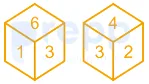
Two different positions of the same dice are shown. Which number will be at the top if 1 is at the bottom?
- A
5
- B
6
- C
2
- D
4
Show answer
D. 4If we rotate 1 st cube to get 3 on the front face and 2 on the bottom face.
1, 6 are adjacent to 3 in 1 st cube and 2, 4 are adjacent to 3 in 2 nd cube.
6 is at top and 2 is on the bottom if we rotate the cube.
So 1 and 4 will be opposite to each other
Hence 4 will be on top when 1 is at the bottom.
Paper & answer key PDF ↗ Question 24archived
In a code language, TEACHING is written as SDBDGHOH. How will BOOKWORM be written as in that language?
- A
ANPLVNSN
- B
ANPLXNNS
- C
CPNJXPSL
- D
ANPLXPSL
Show answer
A. ANPLVNSNUnderstanding the Coding Decoding Logic
This question involves decoding a pattern used to transform one word into another. We are given that the word TEACHING is written as SDBDGHOH in a specific code language. Our goal is to find the pattern and apply it to the word BOOKWORM.
Analyzing the Code Pattern for TEACHING
Let's compare each letter of the original word TEACHING with the corresponding letter in the coded word SDBDGHOH.
We can observe the positional change or relationship between the letters:
T (20th letter) changes to S (19th letter) - This is a change of -1.
E (5th letter) changes to D (4th letter) - This is a change of -1.
A (1st letter) changes to B (2nd letter) - This is a change of +1.
C (3rd letter) changes to D (4th letter) - This is a change of +1.
H (8th letter) changes to G (7th letter) - This is a change of -1.
I (9th letter) changes to H (8th letter) - This is a change of -1.
N (14th letter) changes to O (15th letter) - This is a change of +1.
G (7th letter) changes to H (8th letter) - This is a change of +1.
Let's represent the changes in a table format for clarity:
Original Letter
Coded Letter
Change
Position Change
T
S
T → S
-1
E
D
E → D
-1
A
B
A → B
+1
C
D
C → D
+1
H
G
H → G
-1
I
H
I → H
-1
N
O
N → O
+1
G
H
G → H
+1
The pattern of change is: -1, -1, +1, +1, -1, -1, +1, +1.
Applying the Coding Pattern to BOOKWORM
Now, we apply the discovered pattern (-1, -1, +1, +1, -1, -1, +1, +1, ...) to the letters of the word BOOKWORM.
B (1st letter): Apply -1. B - 1 position in the alphabet is A.
O (2nd letter): Apply -1. O - 1 position in the alphabet is N.
O (3rd letter): Apply +1. O + 1 position in the alphabet is P.
K (4th letter): Apply +1. K + 1 position in the alphabet is L.
W (5th letter): Apply -1. W - 1 position in the alphabet is V.
O (6th letter): Apply -1. O - 1 position in the alphabet is N.
R (7th letter): Apply +1. R + 1 position in the alphabet is S.
M (8th letter): Apply +1. M + 1 position in the alphabet is N.
Let's see the transformation in a table:
Original Letter
Position
Pattern
Coded Letter
B
1st
-1
A
O
2nd
-1
N
O
3rd
+1
P
K
4th
+1
L
W
5th
-1
V
O
6th
-1
N
R
7th
+1
S
M
8th
+1
N
Combining the coded letters for BOOKWORM, we get ANPLVNSN.
Matching with the Options
Now let's compare our derived code ANPLVNSN with the given options:
ANPLVNSN
ANPLXNNS
CPNJXPSL
ANPLXPSL
Our derived code ANPLVNSN exactly matches Option 1.
Conclusion
The code language uses an alternating pattern of subtracting 1 from the first two letters, adding 1 to the next two, subtracting 1 from the subsequent two, and so on. Applying this logic to BOOKWORM gives the coded word ANPLVNSN.
Revision Table: Key Concepts in Coding Decoding
Concept
Description
Example (based on this question)
Letter Coding
Replacing each letter of a word with a different letter or symbol based on a specific rule or pattern.
TEACHING coded as SDBDGHOH
Pattern Recognition
Identifying the underlying rule or logic behind the transformation of letters or words.
The (-1, -1, +1, +1) pattern identified in TEACHING → SDBDGHOH
Positional Change
The rule involves shifting the letters forward (+) or backward (-) in the alphabetical series by a fixed or varying number of positions.
T → S (-1), A → B (+1)
Additional Information on Coding Decoding Problems
Coding-decoding questions are common in competitive exams and test logical reasoning and pattern recognition skills. There are various types of patterns you might encounter:
Letter Shift: Each letter is shifted by a fixed number of positions (e.g., +1 for all letters, -2 for all letters).
Alternating Shift: The shift pattern alternates between letters (e.g., +1, -1, +1, -1...). This was the pattern used in this specific problem.
Reverse Order: The letters of the word are written in reverse order, sometimes with an additional shift.
Opposite Letters: Letters are replaced by their opposite letters in the alphabetical series (A is opposite Z, B is opposite Y, etc.).
Consonant/Vowel Pattern: Different rules are applied to consonants and vowels.
Mixed Patterns: A combination of two or more of the above patterns.
To solve these problems, carefully compare the original word and the coded word, letter by letter. Look for consistent changes in position or other relationships. Once the pattern is identified, apply it consistently to the new word to find its coded form.
Paper & answer key PDF ↗ Question 25archived
Three of the following four letter -clusters are alike in a certain way and one is different. Pick the odd one out.
- A
PAST
- B
ZOOM
- C
DECK
- D
BIRD
Show answer
B. ZOOMFinding the Odd Letter Cluster Out
In this type of question, we are given a set of letter clusters, and we need to find the one that does not fit a certain pattern or rule that applies to the others. This is a common type of verbal reasoning question.
The given letter clusters are:
PAST
ZOOM
DECK
BIRD
Analyzing the Letter Clusters for Patterns
Let's examine each letter cluster closely to identify any relationships between the letters, their positions, or their types (vowels/consonants).
Consider the composition of each letter cluster in terms of vowels (A, E, I, O, U) and consonants.
PAST: P (consonant), A (vowel), S (consonant), T (consonant). It contains 1 vowel and 3 consonants.
ZOOM: Z (consonant), O (vowel), O (vowel), M (consonant). It contains 2 vowels (the letter 'O' appears twice) and 2 consonants.
DECK: D (consonant), E (vowel), C (consonant), K (consonant). It contains 1 vowel and 3 consonants.
BIRD: B (consonant), I (vowel), R (consonant), D (consonant). It contains 1 vowel and 3 consonants.
Identifying the Pattern and the Odd One Out
Based on our analysis:
PAST has 1 vowel.
ZOOM has 2 vowels.
DECK has 1 vowel.
BIRD has 1 vowel.
We can see that the letter clusters PAST, DECK, and BIRD all share the pattern of having exactly one vowel. The letter cluster ZOOM is different because it has two vowels.
Therefore, ZOOM is the odd one out as it does not follow the pattern of having only one vowel like the other three.
Let's summarize the vowel count in a table:
Letter Cluster
Vowels Present
Number of Vowels
PAST
A
1
ZOOM
O, O
2
DECK
E
1
BIRD
I
1
This table clearly shows that ZOOM has a different number of vowels compared to the other three letter clusters.
Conclusion
The letter cluster that is different from the others is ZOOM, based on the number of vowels it contains.
Revision Table: Understanding Odd One Out Letter Clusters
Concept
Description
Application in this problem
Odd One Out
Identifying the item that doesn't fit a pattern shared by others.
Finding which letter cluster is different.
Pattern Recognition
Discovering the rule or property common to a group of items.
Identifying the vowel count pattern (one vowel).
Vowel/Consonant Analysis
Categorizing letters and counting their occurrences.
Used to find the pattern in letter clusters PAST, DECK, BIRD (1 vowel) vs. ZOOM (2 vowels).
Additional Information: Types of Letter Pattern Questions
Odd one out questions using letter clusters or words can be based on various patterns. Here are a few common types:
Number of Vowels/Consonants: As seen in this problem.
Letter Positions: Based on the alphabetical position of letters (e.g., sum of positions, difference between positions).
Sequence: Letters following a specific order (e.g., alphabetical, reverse alphabetical, skipping letters).
Specific Letters: Presence or absence of a particular letter or type of letter (e.g., all letters are before 'M' in the alphabet).
Meaning/Category: For words, based on their meaning or the category they belong to (though less common for simple letter clusters like these).
Repetition: Presence or absence of repeated letters. In this case, ZOOM also has a repeated letter ('O'), which is another pattern that distinguishes it from the others (PAST, DECK, BIRD have no repeated letters). Both the vowel count and the repetition pattern lead to the same answer, making the vowel count a strong candidate for the intended pattern.
To solve these questions effectively, it's helpful to check for these different types of patterns systematically.
Paper & answer key PDF ↗ Question 26archived
A sustained rise in the general price level in an economy is called ________.
- A
Stagflation
- B
Inflation
- C
Deflation
- D
Disinflation
Show answer
B. InflationUnderstanding Changes in the General Price Level
The question asks to identify the term for a sustained rise in the general price level within an economy. Let's break down the key concepts involved and examine the options provided.
The general price level refers to the average of prices of all goods and services produced and consumed in an economy over a period of time. It is often measured using price indexes like the Consumer Price Index (CPI) or the Wholesale Price Index (WPI).
A sustained rise means that this average price level increases consistently over a period, not just a temporary fluctuation.
Defining the Options
Let's look at the definitions of the economic terms given in the options:
Inflation: This is defined as a sustained increase in the general price level of goods and services in an economy over a period of time. When the general price level rises, each unit of currency buys fewer goods and services; consequently, inflation reflects a reduction in the purchasing power per unit of money – a loss of real value in the medium of exchange and unit of account within the economy.
Deflation: This is the opposite of inflation. Deflation is a decrease in the general price level of goods and services. During deflation, the purchasing power of currency increases.
Disinflation: This refers to a decrease in the rate of inflation. The general price level is still rising, but at a slower pace than before. It is not the same as deflation, where prices are falling.
Stagflation: This is a more complex economic situation where the economy experiences slow economic growth (stagnation), high unemployment, AND rising prices (inflation) simultaneously. It combines elements of stagnation and inflation.
Analyzing the Question and Options
The question specifically asks for a "sustained rise in the general price level". Comparing this description to the definitions above:
Inflation directly matches this definition: a sustained rise in the general price level.
Deflation describes falling prices, which is the opposite.
Disinflation describes a slowing rate of price increases, not the rise itself.
Stagflation involves a rise in prices (inflation), but also includes slow growth and high unemployment, which are not mentioned in the question's definition.
Therefore, the term that precisely matches the definition of a sustained rise in the general price level is Inflation.
Comparison of Price Level Changes
Term
Description
Inflation
Sustained rise in general price level.
Deflation
Sustained fall in general price level.
Disinflation
Slowing down of the rate of inflation (prices still rising, but slower).
Stagflation
Inflation + Slow Growth + High Unemployment.
Conclusion on General Price Level Changes
Based on the definitions and analysis, the term for a sustained rise in the general price level in an economy is Inflation.
Revision Table: Key Economic Terms
Summary of Price Level Concepts
Term
What it Means for Prices
Inflation
Prices are going up consistently.
Deflation
Prices are going down consistently.
Disinflation
Prices are still going up, but the speed of increase is slowing down.
Stagflation
Prices are going up, but the economy isn't growing well, and many people are jobless.
Additional Information on Inflation
Inflation is a widely discussed topic in economics due to its effects on individuals and the economy. Understanding its causes and consequences is important.
Causes of Inflation:
Demand-Pull Inflation: Occurs when aggregate demand in an economy increases rapidly, outpacing aggregate supply. Too much money chasing too few goods.
Cost-Push Inflation: Occurs when the costs of production for businesses rise (e.g., wages, raw materials), leading businesses to increase prices to maintain profit margins.
Built-in Inflation: Related to adaptive expectations; as workers expect inflation, they demand wage increases, which drives up costs for firms, leading to higher prices, creating a wage-price spiral.
Effects of Inflation:
Reduces purchasing power of money.
Can redistribute income and wealth (e.g., debtors may benefit at the expense of creditors).
Increases uncertainty for businesses and consumers.
Can lead to menu costs (cost of changing prices) and shoe-leather costs (cost of time and effort to minimize money holdings).
Can distort relative prices.
Central banks often aim to maintain a low and stable rate of inflation, typically around 2%, which is considered beneficial for economic stability.
Paper & answer key PDF ↗ Question 27archived
TV remote controls work on the principle of ________.
- A
Bluetooth technology
- B
Ultrasonic waves
- C
Laser technology
- D
Infrared waves
Show answer
D. Infrared wavesLet's understand how TV remote controls communicate with the television set. The question asks about the fundamental principle or technology that enables this communication.
Understanding TV Remote Control Technology
TV remote controls send commands wirelessly to the TV. Different technologies can be used for wireless communication, but only one is commonly employed in modern TV remotes.
Let's look at the given options:
Bluetooth technology: Bluetooth is a wireless technology used for exchanging data over short distances. It operates in the radio frequency spectrum (around 2.4 GHz). While some advanced remotes or gaming controllers might use Bluetooth, it is not the standard technology for traditional, low-cost TV remote controls.
Ultrasonic waves: Ultrasonic waves are sound waves with frequencies higher than the upper audible limit of human hearing (typically > 20 kHz). Some older or less common remote controls, particularly for garage doors or alarms, might have used ultrasonic technology, but it is not the method used by standard TV remotes today.
Laser technology: Laser technology uses concentrated beams of light. While lasers are used in various applications like pointers or data transmission over fibers, they are not used for sending simple commands from a handheld TV remote to a television set. It would require precise aiming and could potentially be hazardous.
Infrared waves: Infrared (IR) radiation is electromagnetic radiation with wavelengths longer than visible light but shorter than microwaves. Infrared waves are commonly used for short-range communication in devices like remote controls, where a line of sight is required between the transmitter (remote) and the receiver (TV).
How Infrared Waves Power TV Remotes
Most modern TV remote controls work by emitting pulses of infrared light. When you press a button on the remote, an infrared LED (Light Emitting Diode) inside the remote control flashes a specific sequence of infrared pulses. This sequence of pulses represents a digital code corresponding to the button you pressed (e.g., power, volume up, channel down).
A sensor on the TV receives these infrared pulses. The TV decodes the sequence and performs the corresponding action. Because infrared light is used, the remote typically needs to be pointed towards the TV's sensor for the signal to be received.
Comparing Technologies for TV Remotes
Here's a quick comparison of why infrared is preferred over the other options for typical TV remotes:
Technology
Typical Range
Line of Sight Required?
Common Use in Remotes
Bluetooth
Up to 10-100 meters
No
Advanced/Gaming Remotes
Ultrasonic Waves
Short range
Yes (sound path)
Older/Specialty Remotes
Laser Technology
Can be long range
Yes (light path)
Not used in standard TV remotes
Infrared Waves
Up to 10 meters
Yes (light path)
Standard TV Remotes
Based on how standard TV remote controls function and the technology widely implemented, the principle they work on is the use of infrared waves.
Revision Table: TV Remote Principles
Concept
Explanation
Relevance to TV Remotes
Infrared Radiation
Electromagnetic waves beyond visible red light.
Used to transmit signals wirelessly.
IR LED
A light-emitting diode that produces infrared light.
Component in the remote that sends the signal.
IR Receiver
A sensor on the TV that detects infrared light pulses.
Component on the TV that receives the signal.
Digital Code
Sequence of pulses representing a command.
What the infrared signal carries.
Additional Information: Infrared Communication
Infrared communication is also used in many other devices for short-range wireless data transfer. Examples include:
Older mobile phones for data beaming.
Remote controls for air conditioners, stereos, etc.
Some sensors and detectors.
The main limitation of infrared communication is the requirement for a direct line of sight between the transmitter and receiver. This is why you have to point the TV remote at the television.
Paper & answer key PDF ↗ Question 28archived
In March 2019, who among the followings was appointed as India's first Lokpal?
- A
Justice N V Ramana
- B
Justice S A Bobde
- C
Justice Pinaki Chandra Ghose
- D
Justice A K Sikri
Show answer
C. Justice Pinaki Chandra GhoseUnderstanding India's First Lokpal Appointment in March 2019
The question asks about the individual appointed as India's first Lokpal in March 2019. The Lokpal is a crucial independent body that deals with complaints of corruption against public functionaries at the central level in India. The establishment of the Lokpal and Lokayuktas institution is a significant step towards ensuring transparency and accountability in governance.
Following the Lokpal and Lokayuktas Act, 2013, the process for appointing the Lokpal involves a selection committee. The appointment of the first Lokpal was a much-anticipated event.
In March 2019, the Indian government officially appointed the first Lokpal of India.
Let's look at the options provided:
Justice N V Ramana
Justice S A Bobde
Justice Pinaki Chandra Ghose
Justice A K Sikri
Based on the official appointment made in March 2019, the individual who became India's first Lokpal was Justice Pinaki Chandra Ghose.
Justice Pinaki Chandra Ghose is a former Judge of the Supreme Court of India and was also a member of the National Human Rights Commission before his appointment as the Lokpal.
Let's briefly consider the other options in the context of their roles around that time, although they were not appointed as the first Lokpal:
Justice N V Ramana: Was a judge of the Supreme Court at the time and later became the Chief Justice of India.
Justice S A Bobde: Was a judge of the Supreme Court at the time and later became the Chief Justice of India, succeeding Justice Ranjan Gogoi.
Justice A K Sikri: Was a judge of the Supreme Court at the time and retired in March 2019. He was part of the selection panel for the Lokpal.
Therefore, the correct answer is the individual who was appointed as the first Lokpal in March 2019.
The person appointed as India's first Lokpal was Justice Pinaki Chandra Ghose.
Revision Table: India's First Lokpal
Position
Individual
Appointment Date (Relevant to First Lokpal)
India's First Lokpal
Justice Pinaki Chandra Ghose
March 2019
Former Supreme Court Judge
Justice Pinaki Chandra Ghose
Prior to Lokpal appointment
Additional Information on Lokpal and Anti-Corruption
The Lokpal is the apex body in India to inquire into allegations of corruption against certain public functionaries, including the Prime Minister, ministers, and Members of Parliament, as well as group 'A', 'B', 'C', and 'D' officers and officials of the central government. Key aspects of the Lokpal institution include:
Mandate: To inquire into complaints of corruption.
Structure: Consists of a Chairperson and a maximum of eight members.
Selection: The Chairperson and members are appointed by the President based on the recommendation of a Selection Committee. The Selection Committee includes the Prime Minister, the Speaker of the Lok Sabha, the Leader of Opposition in the Lok Sabha, the Chief Justice of India (or a Judge nominated by the CJI), and an eminent jurist nominated by the Chairperson and members of the Committee.
Purpose: Aims to provide a mechanism for citizens to report corruption and ensures accountability among public servants.
The establishment of the Lokpal was a result of years of public demand for a strong anti-corruption ombudsman.
Paper & answer key PDF ↗ Question 29archived
Poush Mela displays local artisans displaying folk dances, music, food and culture of _______.
- A
Uttarakhand
- B
Gujarat
- C
West Bengal
- D
Rajasthan
Show answer
C. West BengalUnderstanding Poush Mela and West Bengal Culture
The question asks about the Poush Mela and which state's culture it primarily displays through folk dances, music, and food.
Poush Mela is a significant annual fair and festival held in Shantiniketan, West Bengal. It takes place during the Bengali month of Poush, usually around the end of December.
This vibrant festival is a celebration of the rich cultural heritage of West Bengal, particularly the rural and folk traditions associated with the region around Shantiniketan, established by Rabindranath Tagore.
During Poush Mela, visitors can experience a wide array of cultural expressions:
Folk Dances: Performances of traditional folk dances from different parts of West Bengal.
Music: Live performances of Bengali folk music, including Baul music, which is very popular in the region.
Food: Stalls offering traditional Bengali cuisine and local delicacies.
Local Artisans: Display and sale of handicrafts, textiles, pottery, and other artisanal products made by local craftspeople.
Cultural Programs: Various other cultural activities showcasing the diverse culture of the state.
Based on its location and the cultural elements displayed, Poush Mela is renowned for showcasing the folk culture, music, dances, and food of West Bengal.
Key Facts about Poush Mela
Aspect
Description
Location
Shantiniketan, West Bengal
Time
Bengali month of Poush (typically late December)
Focus
Folk culture, music, dance, crafts, food
Significance
Celebration of West Bengal's cultural heritage
Revision Table: Poush Mela and West Bengal
Poush Mela Festival Overview
Festival
State
Key Highlights
Poush Mela
West Bengal
Folk music, dance, local crafts, Bengali food
Additional Information: West Bengal Festivals and Culture
West Bengal is known for its vibrant cultural scene and numerous festivals throughout the year. Apart from Poush Mela, other significant cultural events and aspects include:
Durga Puja: The most important festival, celebrated with great grandeur and artistic pandals.
Noboborsho (Bengali New Year): Celebrated in April with cultural programs and traditional feasts.
Baul Music: A unique tradition of mystic minstrel singers recognised by UNESCO as a Masterpiece of the Oral and Intangible Heritage of Humanity.
Tagore's Influence: Shantiniketan, the venue for Poush Mela, was founded by Rabindranath Tagore, and the festival often reflects the cultural ideals promoted by him and Visva-Bharati University.
These elements collectively contribute to the rich cultural tapestry of West Bengal, which is prominently displayed in festivals like Poush Mela.
Paper & answer key PDF ↗ Question 30archived
Who among the following was one of the Governors during the reign of Alauddin Khilji?
- A
Ghiyasuddin Tughlaq
- B
Nasiruddin Mahmud
- C
Shams-ud-din Iltutmish
- D
Jalal-ud-din Khilji
Show answer
A. Ghiyasuddin TughlaqUnderstanding Governors During Alauddin Khilji's Rule
The question asks about one of the governors who served during the reign of Sultan Alauddin Khilji of the Delhi Sultanate.
Alauddin Khilji ruled from 1296 to 1316 CE. His reign was significant for its military campaigns, administrative reforms, and expansion of the Sultanate's territory. To manage this vast territory, he appointed various governors in different provinces.
Analyzing the Options
Let's look at the provided options and their historical context:
Ghiyasuddin Tughlaq
Nasiruddin Mahmud
Shams-ud-din Iltutmish
Jalal-ud-din Khilji
Option 1: Ghiyasuddin Tughlaq
Ghiyasuddin Tughlaq, whose original name was Ghazi Malik, was a prominent military commander and frontier governor during Alauddin Khilji's reign. He served as the governor of Dipalpur, a crucial frontier province in the Punjab region, responsible for defending against Mongol invasions. His effective defense of the frontier earned him considerable reputation. After the death of Alauddin Khilji and subsequent political instability, Ghazi Malik eventually rose to power and founded the Tughlaq dynasty, ruling as Sultan Ghiyasuddin Tughlaq from 1320 to 1325 CE.
Option 2: Nasiruddin Mahmud
Nasiruddin Mahmud was a Sultan of the Mamluk dynasty, ruling from 1246 to 1266 CE. He was a successor of Shams-ud-din Iltutmish and preceded Ghiyas-ud-din Balban. His reign falls well before that of Alauddin Khilji (1296-1316 CE). Therefore, he could not have been a governor under Alauddin Khilji.
Option 3: Shams-ud-din Iltutmish
Shams-ud-din Iltutmish was another prominent Sultan of the Mamluk dynasty, who ruled from 1211 to 1236 CE. He is considered one of the most important rulers of the Delhi Sultanate, consolidating its power after the death of Qutb-ud-din Aibak. His reign also predates Alauddin Khilji's rule significantly.
Option 4: Jalal-ud-din Khilji
Jalal-ud-din Khilji was the founder of the Khilji dynasty and ruled from 1290 to 1296 CE. He was Alauddin Khilji's uncle and father-in-law, and Alauddin assassinated him to take the throne. Jalal-ud-din was the Sultan before Alauddin, not a governor under him.
Conclusion
Based on the historical roles of the individuals mentioned, Ghiyasuddin Tughlaq was indeed a governor under Alauddin Khilji, specifically responsible for the Dipalpur region and frontier defense. The other options refer to rulers from different periods or the predecessor of Alauddin Khilji.
Thus, the correct answer is Ghiyasuddin Tughlaq.
Revision Table: Key Figures
Figure
Role/Status
Relevant Period
Connection to Alauddin Khilji
Ghiyasuddin Tughlaq
Governor (e.g., Dipalpur), later Sultan
Late 13th - Early 14th Century
Served as governor under Alauddin Khilji
Nasiruddin Mahmud
Sultan (Mamluk Dynasty)
1246 - 1266 CE
Ruled before Alauddin Khilji
Shams-ud-din Iltutmish
Sultan (Mamluk Dynasty)
1211 - 1236 CE
Ruled before Alauddin Khilji
Jalal-ud-din Khilji
Sultan (Founder of Khilji Dynasty)
1290 - 1296 CE
Uncle & Predecessor of Alauddin Khilji
Additional Information: Administration under Alauddin Khilji
Alauddin Khilji implemented several administrative and military reforms to strengthen his rule and ensure the stability of the Delhi Sultanate. His administration relied on loyal officials and governors appointed to manage different provinces and strategic locations. These governors were crucial for maintaining law and order, collecting revenue, and defending the borders, particularly against the frequent Mongol incursions from the northwest. Ghiyasuddin Tughlaq's governorship of Dipalpur is a prime example of such a strategic appointment focusing on frontier defense.
Paper & answer key PDF ↗ Question 31archived
Pramod Sawant became Chief Minister of which Indian state in March, 2019?
- A
Tamil Nadu
- B
Maharashtra
- C
Goa
- D
Kerala
Show answer
C. GoaUnderstanding the Chief Minister Appointment in March 2019
The question asks about the Indian state where Pramod Sawant became the Chief Minister in March 2019. This involves recalling significant political appointments in Indian states around that specific time period.
Identifying the State: Pramod Sawant and Goa
Pramod Sawant took oath as the Chief Minister of Goa on March 19, 2019. This appointment followed the demise of the then-serving Chief Minister, Manohar Parrikar. Pramod Sawant was the Speaker of the Goa Legislative Assembly before becoming the Chief Minister of Goa.
Therefore, the state in question is Goa.
Analyzing the Options
Let's look at the provided options and understand why they are incorrect based on the timeline and the Chief Ministers of those states in March 2019:
Tamil Nadu: In March 2019, the Chief Minister of Tamil Nadu was Edappadi K. Palaniswami. Pramod Sawant has no political association with Tamil Nadu.
Maharashtra: In March 2019, Devendra Fadnavis was the Chief Minister of Maharashtra. Uddhav Thackeray became CM later in 2019. Pramod Sawant is not associated with Maharashtra politics.
Goa: As discussed, Pramod Sawant became the Chief Minister of Goa in March 2019. This matches the information in the question.
Kerala: In March 2019, Pinarayi Vijayan was and continues to be the Chief Minister of Kerala. Pramod Sawant is not associated with Kerala politics.
Based on the political events of March 2019, Pramod Sawant's appointment was specifically related to the state of Goa.
Chief Ministers in March 2019 for the given states
State
Chief Minister in March 2019
Tamil Nadu
Edappadi K. Palaniswami
Maharashtra
Devendra Fadnavis
Goa
Pramod Sawant (assumed office March 19, 2019)
Kerala
Pinarayi Vijayan
Conclusion
The question correctly identifies the timing (March 2019) and the person (Pramod Sawant) regarding a Chief Minister appointment. Based on the political history of Indian states, Pramod Sawant assumed the role of Chief Minister of Goa during this period.
Revision Table: Pramod Sawant CM Appointment
Key Details: Pramod Sawant CM
Person
Position
State
Date of Appointment
Pramod Sawant
Chief Minister
Goa
March 19, 2019
Additional Information: Goa Politics and Pramod Sawant
Pramod Sawant is a leader from the Bharatiya Janata Party (BJP). He represents the Sanquelim constituency in the Goa Legislative Assembly. His political career includes serving as the Speaker of the Assembly before becoming the Chief Minister. His appointment as Chief Minister of Goa in March 2019 was a significant political event in the state following the passing of his predecessor.
Paper & answer key PDF ↗ Question 32archived
Which of the following passes connects Tawang with Lhasa?
- A
Bum La Pass
- B
Chankan Pass
- C
Kumjawng Pass
- D
Hpungan Pass
Show answer
A. Bum La PassConnecting Tawang and Lhasa: Identifying the Correct Pass
The question asks us to identify the mountain pass that serves as a connection point between Tawang in Arunachal Pradesh, India, and Lhasa in Tibet, China. Understanding the geographical location of these places and the major mountain passes in the Himalayan region is key to answering this question.
Analyzing the Options for Tawang-Lhasa Connection
Let's look at the options provided:
Bum La Pass: This pass is located at the border between India and China in the Tawang district of Arunachal Pradesh. It is historically significant and lies at a high altitude.
Chankan Pass: Information about this pass is less commonly known in the context of major connections to Lhasa.
Kumjawng Pass: Similar to Chankan Pass, this pass is not widely recognized as a primary route connecting Tawang to Lhasa.
Hpungan Pass: This pass is also not a widely known or recognized pass connecting Tawang directly to Lhasa.
Based on geographical knowledge and historical context, the Bum La Pass is the well-known pass that connects Tawang with Tibet, providing a route towards areas that eventually lead to Lhasa. It has historical significance related to trade routes and border interactions.
Detailed Explanation: Bum La Pass
The Bum La Pass is situated about 37 kilometers north of Tawang town in Arunachal Pradesh, India, at an elevation of around 4,600 meters (15,100 ft). It is one of the passes agreed upon by India and China for border personnel meetings and is recognized as a border trading point. Historically, it was a route used for movement between Tawang and Tibet. The connection between Tawang and Lhasa relies on traversing through Tibet from the border, and Bum La Pass is the key point linking Tawang to the Tibetan side, thus serving as the pass connecting Tawang with Lhasa via routes in Tibet.
Comparing Options
Let's summarize the known connections of the passes mentioned:
Pass Name
Location/Significance
Connection to Tawang-Lhasa
Bum La Pass
India-China border, Tawang district, Arunachal Pradesh
Known historical route connecting Tawang with Tibet, leading towards Lhasa.
Chankan Pass
Less commonly known pass
Not typically cited as a primary Tawang-Lhasa connector.
Kumjawng Pass
Less commonly known pass
Not typically cited as a primary Tawang-Lhasa connector.
Hpungan Pass
Less commonly known pass
Not typically cited as a primary Tawang-Lhasa connector.
Therefore, the Bum La Pass is the correct answer as it is the pass that connects Tawang with the Tibetan region, which is the route leading to Lhasa.
Revision Table: Important Passes
Pass
Connects
State/Region
Notes
Bum La Pass
Tawang (India) & Tibet (China)
Arunachal Pradesh
Historical trade route, border meeting point.
Nathu La Pass
Sikkim (India) & Tibet (China)
Sikkim
Major border trade route.
Lipulekh Pass
Uttarakhand (India) & Tibet (China)
Uttarakhand
Pilgrimage route to Kailash Mansarovar.
Additional Information on Himalayan Passes
Mountain passes are crucial geographical features in the Himalayas, facilitating movement across challenging terrain. They have historically served as trade routes, migration paths, and strategic military points. The passes connecting India and China across the Himalayas are particularly significant due to the long shared border and historical interactions.
Passes are often located at high altitudes and are therefore subject to extreme weather conditions, often remaining closed for several months during winter.
The significance of passes like Bum La Pass extends beyond geography to include cultural and political aspects, influencing regional history and relations.
Understanding the location and connectivity of these passes is vital for studying the geography and geopolitics of the Himalayas.
Paper & answer key PDF ↗ Question 33archived
________ is the study of the microanatomy of cells, tissues and organs as seen through a microscope.
- A
Paleontology
- B
Ichthyology
- C
Histology
- D
Entomology
Show answer
C. HistologyThe correct answer is Option 3: Histology.
What is Histology?
Histology is the branch of biology that studies the microscopic anatomy (microanatomy) of biological tissues. By examining extremely thin slices of tissues under a light or electron microscope, scientists and doctors can see how cells are structured and how they organize themselves into organs.
Why it matters: It is a crucial tool in medicine, especially in pathology, where doctors analyze tissue biopsies to diagnose diseases like cancer.
Quick Look at the Other Options:
To expand your vocabulary and biology knowledge, here is what the other branches study:
Paleontology: The scientific study of prehistoric life, primarily through the examination of fossils.
Ichthyology: The branch of zoology devoted to the study of fish.
Entomology: The scientific study of insects.
Paper & answer key PDF ↗ Question 34archived
The invasion of Delhi by Timur in ________ A.D marked the end of the Tughlaq empire.
- A
1452
- B
1645
- C
1215
- D
1398
Show answer
D. 1398Timur's Invasion of Delhi and the End of the Tughlaq Empire
The question asks about the year when Timur's invasion of Delhi took place, marking a significant event that led to the decline or end of the Tughlaq empire.
Historically, Timur, also known as Tamerlane, a Turco-Mongol conqueror, invaded Northern India in the late 14th century. His main target was Delhi, the capital of the Delhi Sultanate, which was then ruled by the Tughlaq dynasty under Sultan Nasir-ud-Din Mahmud Shah Tughlaq.
Timur's forces marched through Punjab and ultimately reached Delhi. A major battle took place outside the walls of Delhi, which Timur won decisively. His forces entered Delhi, leading to widespread destruction, massacre, and plunder. This invasion had a devastating impact on the Delhi Sultanate and the ruling Tughlaq dynasty.
The specific year of this invasion is a key historical detail. Let's consider the options provided:
1452
1645
1215
1398
Based on historical records, Timur's invasion of Delhi occurred in the year 1398 A.D. This event severely weakened the Tughlaq dynasty, which lingered on for a few more years in a fragmented state before being eventually replaced by the Sayyid dynasty.
Therefore, the invasion of Delhi by Timur in 1398 A.D. is widely considered the event that effectively marked the end of the powerful rule of the Tughlaq empire, even though the dynasty officially ended later.
Let's summarize the key facts:
Event
Invader
Ruler in Delhi
Impact
Year (A.D.)
Invasion of Delhi
Timur (Tamerlane)
Nasir-ud-Din Mahmud Shah Tughlaq
Severe weakening of Tughlaq dynasty; widespread destruction in Delhi
1398
Considering the historical context and the impact on the Tughlaq empire, the year 1398 A.D. is the correct answer.
Revision Table: Key Dynasties of Delhi Sultanate
Dynasty
Period (approx.)
Key Rulers
Notes
Mamluk / Slave Dynasty
1206 - 1290
Qutb-ud-din Aibak, Iltutmish, Balban
Founded after the death of Muhammad Ghori
Khalji Dynasty
1290 - 1320
Alauddin Khalji
Known for economic reforms and military expansion
Tughlaq Dynasty
1320 - 1414
Ghiyas-ud-din Tughlaq, Muhammad bin Tughlaq, Firoz Shah Tughlaq
Largest geographical spread; declined after Timur's invasion
Sayyid Dynasty
1414 - 1451
Khizr Khan
Followed the Tughlaqs
Lodi Dynasty
1451 - 1526
Bahlul Lodi, Ibrahim Lodi
Overthrown by Babur, marking the beginning of the Mughal Empire
Additional Information: Impact of Timur's Delhi Invasion
Timur's invasion in 1398 A.D. had profound and long-lasting consequences for the region:
Weakening of Central Authority: The Delhi Sultanate, particularly the Tughlaq dynasty, was severely weakened. The Sultanate lost much of its territory and prestige.
Devastation of Delhi: The city of Delhi suffered immense destruction, loss of life, and plunder of wealth and resources. It took many years for the city to recover.
Rise of Regional Kingdoms: The weakening of the central power in Delhi led to the emergence and consolidation of various regional kingdoms and independent states across India, such as the Jaunpur Sultanate, Malwa Sultanate, Gujarat Sultanate, and the Bahmani Kingdom.
Population Displacement: The invasion caused significant displacement of the population. Timur is also known to have taken skilled artisans and builders from Delhi back to his capital, Samarkand.
End of Tughlaq's Effective Rule: Although the Tughlaq dynasty technically continued for a couple more decades, its authority was greatly diminished after 1398. The Sayyid dynasty eventually took over in 1414.
This invasion is considered a turning point in the history of the Delhi Sultanate, accelerating its decline and fragmenting the political landscape of North India.
Paper & answer key PDF ↗ Question 35archived
Which of the following passes is known as the gateway connecting Jammu and Srinagar?
- A
Lanak-La Pass
- B
Chang-La Pass
- C
Banihal Pass
- D
Aghil Pass
Show answer
C. Banihal PassUnderstanding Mountain Passes and Connectivity
Mountain passes are significant geographical features that act as routes through mountain ranges. They often play a crucial role in connecting different regions, facilitating trade, travel, and communication across challenging terrain. The question asks which pass serves as the primary gateway connecting two important locations: Jammu and Srinagar.
Identifying the Gateway Connecting Jammu and Srinagar
To find the pass that connects Jammu and Srinagar, we need to look at the geographical location and significance of each option provided.
Lanak-La Pass: This pass is located in the Aksai Chin region, connecting Ladakh with Tibet. It is not involved in the route between Jammu and Srinagar.
Chang-La Pass: Located in Ladakh, this high-altitude pass connects Leh with the Changthang Plateau and Pangong Lake. It is also not on the route between Jammu and Srinagar.
Banihal Pass: Situated in the Pir Panjal Range of the Himalayas, Banihal Pass historically connected the Kashmir Valley (including Srinagar) with the plains to the south (including Jammu). It has been a vital link for centuries. While modern routes like the Jawahar Tunnel and Chenani-Nashri Tunnel bypass the highest point of the pass, the overall corridor is still associated with Banihal, making it the historical and practical gateway.
Aghil Pass: Located in the Karakoram Range, this pass connects Ladakh with Xinjiang, China. It is far to the north and has no connection to the Jammu-Srinagar route.
Based on the locations and historical significance, the Banihal Pass is the one that serves as the gateway connecting Jammu and Srinagar.
Detailed Analysis of Banihal Pass
The Banihal Pass is a mountain pass located at an elevation of 2,832 meters (9,291 ft). It crosses the Pir Panjal Range. The name "Banihal" itself means "blizzard" in the local language, indicating the harsh weather conditions often encountered there. It is on the National Highway 44 (NH 44), which is the main road connecting Jammu and Srinagar. The development of tunnels has significantly improved connectivity by providing all-weather routes that bypass the pass's summit, but the geographical importance of the Banihal region as the connection point remains.
Comparison of Passes
Pass Name
Mountain Range
Region Connected
Relevance to Jammu-Srinagar
Lanak-La Pass
Himalayas
Ladakh & Tibet (Aksai Chin)
None
Chang-La Pass
Ladakh Range
Leh & Changthang (Ladakh)
None
Banihal Pass
Pir Panjal Range
Jammu & Kashmir Valley (Srinagar)
Direct Connection/Gateway
Aghil Pass
Karakoram Range
Ladakh & Xinjiang (China)
None
The table clearly shows that Banihal Pass is the only pass listed that connects the Jammu region with the Kashmir Valley, where Srinagar is located.
Conclusion
The mountain pass known as the gateway connecting Jammu and Srinagar is the Banihal Pass. Its strategic location in the Pir Panjal range has made it a crucial link for centuries, facilitating movement between the northern plains and the Kashmir Valley.
Revision Table: Important Mountain Passes
Pass Name
Location/Range
Connects
Banihal Pass
Pir Panjal, J&K
Jammu and Srinagar
Zoji La Pass
Great Himalayas, Ladakh
Srinagar and Leh
Rohtang Pass
Pir Panjal, Himachal Pradesh
Kullu Valley and Lahaul Valley
Nathu La Pass
Eastern Himalayas, Sikkim
Sikkim and Tibet
Additional Information on Jammu-Srinagar Connectivity
While Banihal Pass is historically significant, modern infrastructure has evolved:
Jawahar Tunnel: Built below the Banihal Pass, this tunnel provides an all-weather route, significantly reducing travel time and avoiding the snow-covered pass summit.
Chenani-Nashri Tunnel (Dr. Syama Prasad Mookerjee Tunnel): Located further south of Banihal, this is one of India's longest road tunnels, also contributing to the bypass of difficult mountainous terrain on the Jammu-Srinagar highway.
Despite these tunnels, the Banihal region remains the critical geographical corridor connecting Jammu and Srinagar, and the pass retains its historical significance.
Paper & answer key PDF ↗ Question 36archived
________ is a scientific discipline concerned with the study of plant pollen, spores, and certain microscopic planktonic organisms, in both, living and fossil form.
- A
Dendrology
- B
Ethnobotany
- C
Palynology
- D
Paleobotany
Show answer
C. PalynologyUnderstanding the Study of Pollen and Spores: Palynology Explained
The question asks to identify the scientific discipline focused on studying plant pollen, spores, and specific microscopic planktonic organisms, encompassing both living and fossil forms. Let's examine the options provided to determine which best fits this description.
Here are the definitions of the scientific fields mentioned:
Dendrology: This is the scientific study of trees and woody plants. While trees produce pollen, dendrology focuses on the plants themselves, not primarily on the pollen and spores as microscopic entities.
Ethnobotany: This field studies the relationship between people and plants, exploring how plants are used, perceived, and managed across different human societies. It does not specifically focus on microscopic structures like pollen or spores.
Palynology: This discipline is specifically dedicated to the study of pollen, spores, and sometimes includes other microscopic organic particles found in samples like soil, sediment, air, or water. Palynologists study these microfossils (fossil pollen and spores) to reconstruct past environments and climates, and also study modern pollen and spores for various applications. The description in the question precisely matches the scope of palynology, covering both living and fossil forms of pollen, spores, and related microscopic organisms.
Paleobotany: This is the study of fossil plants. While paleobotany involves studying plant remains from the past, its focus is broader than just pollen and spores and includes fossil leaves, stems, seeds, and wood. Palynology can be considered a sub-discipline of paleobotany or geology, but it has a distinct and specific focus on pollen and spores.
Based on these definitions, Palynology is the scientific discipline that directly aligns with the study of plant pollen, spores, and microscopic planktonic organisms in both living and fossil states as described in the question.
Scientific Discipline
Primary Focus
Dendrology
Study of trees and woody plants
Ethnobotany
Study of the relationship between people and plants
Palynology
Study of pollen, spores, and microscopic plankton (living & fossil)
Paleobotany
Study of fossil plants (leaves, stems, pollen, etc.)
Therefore, the discipline concerned with the study of plant pollen, spores, and certain microscopic planktonic organisms, in both living and fossil form, is Palynology.
Revision Table: Key Terms in Plant and Fossil Study
Term
Meaning
Palynology
Study of pollen and spores
Pollen
Male gametophytes of seed plants
Spores
Reproductive units of non-seed plants (ferns, mosses) and fungi
Paleo-
Relating to ancient times or fossil forms
Fossil
Preserved remains or traces of organisms from the past
Additional Information on Palynology and its Applications
Palynology is a fascinating field with wide-ranging applications. Because pollen and spores have tough outer walls (exines) that preserve well in sediments, they provide valuable information about past vegetation, climate, and environments. This makes palynology a crucial tool in:
Paleoclimatology: Reconstructing past climates by analyzing pollen assemblages found in sediment cores. Different plant types thrive under different climatic conditions.
Paleoecology: Understanding past ecosystems and vegetation changes over time.
Archaeology: Investigating human impact on the environment by analyzing pollen found in archaeological sites.
Forensics: Analyzing pollen or spores found at crime scenes to link suspects to locations.
Allergy Studies: Monitoring airborne pollen levels to help people with pollen allergies.
Oil and Gas Exploration: Using fossil pollen (palynomorphs) to date rock layers.
The study of microscopic planktonic organisms like dinoflagellates and acritarchs is also part of palynology, particularly in marine and aquatic sediments, adding further dimensions to reconstructing past environments.
Paper & answer key PDF ↗ Question 37archived
In March 2019, India won five silver medals at the Makran Cup Boxing Tournament in Iran. Who among the following is NOT one of the silver medallist?
- A
Duryodhan Singh Negi
- B
Deepak Singh
- C
Manish Kaushik
- D
P Lalitha Prasad
Show answer
B. Deepak SinghUnderstanding the Makran Cup Boxing Tournament 2019
The Makran Cup Boxing Tournament is an international boxing event. In March 2019, the tournament was held in Iran, where boxers from various countries competed. India participated in this tournament and had a notable performance, securing several medals, including five silver medals.
Identifying India's Silver Medallists at Makran Cup 2019
India indeed won five silver medals at the Makran Cup Boxing Tournament in March 2019. The question asks to identify the individual among the given options who was NOT one of these silver medallists.
Based on the results of the tournament, the following boxers from the provided options were among India's silver medallists:
Duryodhan Singh Negi
Manish Kaushik
P Lalitha Prasad
These three individuals successfully reached the final matches in their respective weight categories, securing silver medals for India.
Analysing the Options
Let's examine each option in light of the tournament results:
Duryodhan Singh Negi: He won a silver medal for India at the Makran Cup 2019.
Deepak Singh: We need to determine if he was a silver medallist.
Manish Kaushik: He won a silver medal for India at the Makran Cup 2019.
P Lalitha Prasad: He won a silver medal for India at the Makran Cup 2019.
Given that Duryodhan Singh Negi, Manish Kaushik, and P Lalitha Prasad were silver medallists, the individual who was NOT a silver medallist among the options is Deepak Singh.
Makran Cup 2019 Indian Boxers Status (from options)
Boxer Name
Medal Won at Makran Cup 2019
Duryodhan Singh Negi
Silver Medal
Deepak Singh
Not a Silver Medallist (among the options)
Manish Kaushik
Silver Medal
P Lalitha Prasad
Silver Medal
Therefore, Deepak Singh was not one of the five silver medallists India won at the Makran Cup Boxing Tournament in March 2019.
Conclusion
The question asked to identify the person who was NOT a silver medallist among the given options. Based on the results, Duryodhan Singh Negi, Manish Kaushik, and P Lalitha Prasad won silver medals. Deepak Singh was not among the silver medallists from this list.
Revision Table: Makran Cup Boxing Facts
Key Details: Makran Cup 2019 Boxing
Event
Host Country
Year
India's Silver Medals (among options)
Makran Cup Boxing Tournament
Iran
March 2019
Duryodhan Singh Negi, Manish Kaushik, P Lalitha Prasad
Additional Information on India's Makran Cup Performance
Apart from the five silver medals, India also performed commendably in other categories at the Makran Cup 2019. Indian boxers secured gold medals as well. For instance, Deepak Singh (different individual from the option, likely referring to a different weight category performance or result) won a gold medal at the same tournament. Therefore, while Deepak Singh mentioned in the options was not a silver medallist among the given choices, another boxer named Deepak Singh did win a gold medal, which can sometimes cause confusion.
This tournament provided valuable international exposure and experience for the Indian boxing contingent.
Paper & answer key PDF ↗ Question 38archived
Rust needs three components to occur, i.e., ________.
- A
Iron, nitrogen and moisture
- B
Iron, oxygen and moisture
- C
Helium, hydrogen and nitrogen
- D
Steel, iron and oxygen
Show answer
B. Iron, oxygen and moistureUnderstanding Rust Formation: The Key Components
Rusting is a specific type of corrosion that affects iron and alloys containing iron, such as steel. It's a common process we observe on old cars, fences, and other iron objects exposed to the elements. To understand what causes rust, we need to look at the essential ingredients required for this chemical reaction to occur.
The Three Necessary Elements for Rusting
Rusting is an electrochemical process that requires the interaction of iron with its environment. For rust to form, three specific components must be present:
Iron: This is the base metal that undergoes oxidation. Rust is essentially hydrated iron(III) oxide.
Oxygen: This acts as the oxidizing agent, accepting electrons released by the iron atoms. Oxygen is typically supplied from the air.
Moisture: Water is crucial as it acts as an electrolyte, allowing ions to move and facilitating the electrical part of the electrochemical process. Rusting happens much faster in the presence of water.
The chemical reaction can be simplified, but at its core, iron ($\text{Fe}$) reacts with oxygen ($\text{O}_2$) in the presence of water ($\text{H}_2\text{O}$) to form hydrated iron(III) oxide ($\text{Fe}_2\text{O}_3 \cdot n\text{H}_2\text{O}$), which is rust.
$\text{Fe} + \text{O}_2 + \text{H}_2\text{O} \rightarrow \text{Fe}_2\text{O}_3 \cdot n\text{H}_2\text{O}$ (Rust)
Analyzing the Options Provided
Let's evaluate the given options based on the requirement for iron, oxygen, and moisture for rusting:
Option 1: Iron, nitrogen and moisture. While nitrogen is present in the air along with oxygen, it is not a primary reactant in the formation of rust. Oxygen is necessary. This option is incorrect.
Option 2: Iron, oxygen and moisture. This option correctly lists the three fundamental components needed for rusting to occur: the metal (iron), the oxidizing agent (oxygen), and the electrolyte medium (moisture).
Option 3: Helium, hydrogen and nitrogen. None of these are iron, which is the metal that rusts. This option completely lacks the essential components. This option is incorrect.
Option 4: Steel, iron and oxygen. Steel is an alloy that contains iron, so the requirement for the metal is met. Oxygen is also correctly listed. However, moisture is missing. While some slow oxidation might occur without bulk water, the typical process of rusting that is observed requires moisture to act as an electrolyte. This option is incomplete for describing the common process.
Therefore, the combination of iron, oxygen, and moisture is essential for rust formation.
Summary of Rust Components
Essential Ingredients for Rust
Component
Why it's needed for Rust
Iron
The metal that gets oxidized (rusts)
Oxygen
Reacts with iron; the oxidizing agent
Moisture
Acts as an electrolyte, speeds up the reaction
Revision Table: Rusting Facts
Key Facts About Rusting
Aspect
Description
Nature
Electrochemical process
Affected Material
Iron and iron alloys (like steel)
Chemical Product
Hydrated Iron(III) Oxide ($\text{Fe}_2\text{O}_3 \cdot n\text{H}_2\text{O}$)
Process Type
Corrosion (specifically of iron)
Additional Information: Preventing Rust and Corrosion
Since rust requires iron, oxygen, and moisture, preventing rust often involves removing one or more of these components from the equation:
Applying protective coatings like paint or plastic to create a barrier against oxygen and moisture.
Using methods like galvanization (coating with zinc) or tin plating, where another metal corrodes instead of the iron.
Creating alloys resistant to corrosion, such as stainless steel (iron mixed with chromium and nickel).
Controlling the environment, for example, by using dehumidifiers to reduce moisture levels in enclosed spaces.
Understanding the components of rusting helps in developing effective strategies for prevention and protection of iron objects.
Paper & answer key PDF ↗ Question 39archived
Who founded the Indian Statistical Institute on 17 December 1931?
- A
P.C. Mahalanobis
- B
M.H. Hansen
- C
R.A. Fischer
- D
F. Yates
Show answer
A. P.C. MahalanobisUnderstanding the Indian Statistical Institute's Founder
This question asks about the individual who played a pivotal role in establishing a significant institution in India: the Indian Statistical Institute (ISI). The founding date is also provided as 17 December 1931.
Identifying the Founder of ISI
The Indian Statistical Institute was founded by a visionary scientist and statistician whose work had a profound impact on statistics in India and globally. Let's look at the options provided:
P.C. Mahalanobis
M.H. Hansen
R.A. Fischer
F. Yates
Among these options, the renowned figure credited with founding the Indian Statistical Institute on December 17, 1931, is Prasanta Chandra Mahalanobis.
The Role of P.C. Mahalanobis
Prof. P.C. Mahalanobis was an Indian scientist and statistician. He is celebrated for his pioneering work in statistics and for establishing ISI, which became a premier centre for statistical research, training, and application. His contributions to statistics, including the Mahalanobis distance, and his role in large-scale sample surveys were significant.
Confirming the Founding Details
The Indian Statistical Institute (ISI) was indeed founded by P.C. Mahalanobis in Kolkata on 17 December 1931. It was later registered on 28 April 1932, as a non-profit distributing society under the Societies Registration Act XXI of 1860. ISI eventually became an institute of national importance by an act of the Indian Parliament in 1959.
Conclusion on the Founder
Based on historical facts and the provided options, P.C. Mahalanobis is the correct answer for who founded the Indian Statistical Institute on 17 December 1931.
Revision Table: Key Details
Institution
Founder
Date Founded
Indian Statistical Institute (ISI)
P.C. Mahalanobis
17 December 1931
Additional Information on P.C. Mahalanobis and ISI
P.C. Mahalanobis is often referred to as the 'father of Indian statistics'.
He played a key role in designing India's second five-year plan, focusing on industrialization.
ISI campuses are located in several cities across India, with its headquarters in Kolkata.
World Statistics Day is celebrated every five years on October 20. National Statistics Day in India is celebrated on June 29, the birth anniversary of P.C. Mahalanobis.
Paper & answer key PDF ↗ Question 40archived
Which of the following articles promotes equal justice and free legal aid for all the citizens?
- A
39A
- B
43A
- C
48A
- D
32A
Show answer
A. 39AUnderstanding Equal Justice and Free Legal Aid in the Indian Constitution
The Indian Constitution contains several articles that aim to ensure justice and equality for all citizens. One specific article focuses on providing equal justice and offering free legal aid to ensure that economic or other disabilities do not prevent anyone from securing justice.
Article Promoting Equal Justice and Free Legal Aid
Let's look at the options provided and understand what each article deals with:
Article ${39A}$: This article is part of the Directive Principles of State Policy (DPSPs). It specifically directs the State to secure that the operation of the legal system promotes justice, on a basis of equal opportunity, and shall, in particular, provide free legal aid, by suitable legislation or schemes or in any other way, to ensure that opportunities for securing justice are not denied to any citizen by reason of economic or other disabilities. This perfectly matches the description of promoting equal justice and free legal aid.
Article ${43A}$: This article, also a DPSP, deals with the participation of workers in the management of industries.
Article ${48A}$: This article, another DPSP, deals with the protection and improvement of the environment and safeguarding of forests and wildlife.
Article ${32A}$: This article was inserted by the 42nd Amendment but later repealed by the 43rd Amendment. It dealt with the constitutional validity of State laws not to be considered in proceedings under Article ${32}$. It is not related to equal justice or free legal aid.
Based on the analysis of each article, Article ${39A}$ is the one that directly promotes equal justice and free legal aid for all citizens.
Comparison of Articles
Article Number
Purpose/Subject Matter
${39A}$
Equal justice and free legal aid
${43A}$
Participation of workers in management
${48A}$
Protection and improvement of environment
${32A}$
Repealed; related to validity of state laws (formerly)
Therefore, the article that promotes equal justice and free legal aid is Article ${39A}$.
Revision Table: Key Articles and Principles
Summary of Relevant Constitutional Articles
Article
Principle/Provision
${39A}$
State to provide equal justice and free legal aid.
${43A}$
State to secure participation of workers in management.
${48A}$
State to protect and improve the environment.
Additional Information on Legal Aid and Directive Principles
Article ${39A}$ was added to the Constitution by the 42nd Amendment Act, 1976. It is a significant step towards making access to justice a reality for economically weaker sections of society. While Directive Principles of State Policy (DPSPs) are not directly enforceable in courts, Article ${39A}$ has led to the enactment of legislation like the Legal Services Authorities Act, 1987, which established a nationwide network of legal aid services.
This article is a reflection of the constitutional commitment to building a welfare state where justice is accessible to all, regardless of their financial status. It bridges the gap between formal legal rights and the practical ability of people to access the legal system.
Paper & answer key PDF ↗ Question 41archived
Majuli, the largest river island in the world is located in ________.
- A
Uttar Pradesh
- B
Assam
- C
Nagaland
- D
Arunachal Pradesh
Show answer
B. AssamUnderstanding Majuli: The World's Largest River Island
The question asks about the geographical location of Majuli, which is recognized as the largest river island in the world. Identifying its location helps us understand its geographical context within India.
Majuli is a large river island in the Brahmaputra River. It is famous globally for being the largest river island and also for its unique culture and biodiversity. Understanding its location is a common general knowledge question, especially for competitive exams.
Analyzing the Options
Let's look at the given options:
Uttar Pradesh: This state is in Northern India and is not located in the region where the Brahmaputra River forms such large islands.
Assam: This state is in North-Eastern India and is known for the Brahmaputra River flowing through it. River islands, including large ones, are characteristic features of this river in Assam.
Nagaland: This state is also in North-Eastern India, but it is primarily a hilly state and not directly associated with large river islands on the Brahmaputra River.
Arunachal Pradesh: This state is located further upstream of the Brahmaputra River and is characterized by mountainous terrain. While the Brahmaputra (known as Siang here) flows through it, the large river islands like Majuli are formed downstream in the plains of Assam.
Determining the Correct Location of Majuli
Based on geographical facts, Majuli island is situated in the state of Assam, India. It is formed by the Brahmaputra River in the south and the Kherkutia Xuti, an anabranch of the Brahmaputra, joined by the Subansiri River in the north. This geographical setting places it firmly within the boundaries of Assam.
Location of Majuli Island
Feature
Detail
Island Name
Majuli
Type
River Island
Location (State, India)
Assam
River
Brahmaputra River
Significance
World's largest river island
Therefore, the correct state where Majuli, the largest river island in the world, is located is Assam.
Revision Table: Key Facts about Majuli
Fact
Detail
Majuli's Status
Largest river island globally
Located In
Assam, India
Formed By
Brahmaputra River and its anabranches
Cultural Importance
Centre of Assamese neo-Vaishnavite culture
Additional Information on River Islands and Assam Geography
River islands, also known as fluvial islands, are landforms within a river channel. They are created by deposition of sediment or erosion and subsequent separation of land by water flow. The Brahmaputra River, being one of the largest rivers in the world with a high sediment load, is prone to forming such islands, with Majuli being the most prominent example.
Assam's geography is significantly shaped by the Brahmaputra River and its tributaries. The state features fertile plains alongside hilly regions. Majuli is part of the Brahmaputra valley in Assam and is susceptible to erosion, which is a major environmental challenge for the island.
Paper & answer key PDF ↗ Question 42archived
________ was observed nationwide from 24th to 30th April, 2019.
- A
World Environment Week
- B
World Postal Week
- C
World Tourism Week
- D
World Immunization Week
Show answer
D. World Immunization WeekUnderstanding World Immunization Week 2019
The question asks about an event observed nationwide in a specific week of April 2019. We need to identify which of the given options corresponds to an event celebrated during the period of 24th to 30th April, 2019.
Analyzing the Options for April 24-30, 2019
Let's look at the provided options and determine which one aligns with the date range of 24th to 30th April.
World Environment Week: World Environment Day is on June 5th, and related activities often take place around this date, not typically in April.
World Postal Week: World Post Day is observed on October 9th, and World Postal Week is usually celebrated in the week following this day in October.
World Tourism Week: World Tourism Day is celebrated on September 27th, and World Tourism Week activities would generally be around this date in September.
World Immunization Week: This is an annual event celebrated in the last week of April. Its aim is to promote the use of vaccines to protect people of all ages against disease. In 2019, the last week of April indeed fell between the 24th and the 30th.
Identifying the Correct Week
Based on the typical observation dates of these international weeks, World Immunization Week is the event that consistently falls in the last week of April. For the year 2019, the date range of 24th to 30th April fits perfectly within the last week of the month, which was designated for this important global health awareness campaign.
Conclusion on April 2019 Observation
Therefore, the event observed nationwide from 24th to 30th April, 2019, was World Immunization Week.
Revision Table: Important Weeks
Event
Typical Observation Period
Significance
World Environment Day/Week
Around June 5th
Promotes environmental protection.
World Postal Day/Week
Around October 9th
Highlights the role of the postal sector.
World Tourism Day/Week
Around September 27th
Raises awareness about tourism's social, cultural, political, and economic value.
World Immunization Week
Last week of April
Promotes the use of vaccines to protect against disease.
Additional Information on World Immunization Week
World Immunization Week is spearheaded by the World Health Organization (WHO). Each year, it has a theme to highlight a specific area of focus in immunization. The campaign aims to remind everyone about the critical importance of vaccination for preventing numerous infectious diseases and saving millions of lives every year. It encourages people to get vaccinated, and countries to invest in immunization programs.
Paper & answer key PDF ↗ Question 43archived
Government of India nominated member of NITI Aayog, ________ to head the Food and Agriculture Organisation (FAO) in March 2019.
- A
V K Paul
- B
Amitabh Kant
- C
Binay Ranjan Sen
- D
Ramesh Chand
Show answer
D. Ramesh ChandUnderstanding India's FAO Nomination
The question asks about the specific member of NITI Aayog who was nominated by the Government of India to head the Food and Agriculture Organisation (FAO) in March 2019. This involves knowing key government appointments and international nominations related to agriculture and policy.
Analysing the NITI Aayog Member Nomination
Let's look at the options provided, focusing on their roles within the Indian government and their relevance to this specific nomination:
V K Paul: Dr. V. K. Paul is a renowned pediatrician and a Member of NITI Aayog, but primarily focuses on health and nutrition.
Amitabh Kant: Shri Amitabh Kant is a former CEO of NITI Aayog and is known for his role in policy and economic reforms.
Binay Ranjan Sen: Shri Binay Ranjan Sen was an Indian diplomat and served as the Director-General of the FAO much earlier, from 1956 to 1967. He is not a contemporary NITI Aayog member.
Ramesh Chand: Dr. Ramesh Chand is a prominent agricultural economist and a Member of NITI Aayog, specifically dealing with agriculture.
Considering the focus on the Food and Agriculture Organisation (FAO), a nomination from a member specializing in agriculture or related fields would be logical. Dr. Ramesh Chand's expertise aligns well with the FAO's mandate.
Identifying the Correct Nominee for FAO Head
In March 2019, the Government of India did nominate a candidate for the post of Director-General of the Food and Agriculture Organisation (FAO). The candidate put forward was indeed Dr. Ramesh Chand, who is a Member of NITI Aayog focusing on agricultural policy.
Therefore, the correct answer is Ramesh Chand.
Nominee Option
Key Role (NITI Aayog/Govt.)
Relevance to FAO Nomination (March 2019)
V K Paul
Member, NITI Aayog (Health)
Low relevance to FAO head role
Amitabh Kant
Former CEO, NITI Aayog
General policy/economy focus, not specific to agriculture
Binay Ranjan Sen
Former FAO Director-General (1956-1967)
Historical figure, not a NITI Aayog member in 2019
Ramesh Chand
Member, NITI Aayog (Agriculture)
High relevance due to agriculture expertise
Conclusion on India's FAO Nomination
Based on the roles and the timeline mentioned in the question, Dr. Ramesh Chand, the NITI Aayog member focusing on agriculture, was nominated by the Government of India in March 2019 to head the Food and Agriculture Organisation (FAO).
Revision Table: NITI Aayog and International Nominations
Body/Position
Key Area
Relevant Personality (Example from options)
NITI Aayog Member
Agriculture Policy
Ramesh Chand
NITI Aayog Member
Health Policy
V K Paul
FAO Director-General
Food and Agriculture
Binay Ranjan Sen (Historical)
Additional Information: Food and Agriculture Organisation (FAO)
The Food and Agriculture Organisation (FAO) is a specialized agency of the United Nations that leads international efforts to defeat hunger. Serving both developed and developing countries, FAO acts as a neutral forum where all nations meet on equal footing to negotiate agreements and debate policy. It is also a source of knowledge and information, and helps developing countries and countries in transition modernise and improve agriculture, forestry and fisheries practices, ensuring good nutrition and food security for all.
The headquarters of the FAO is in Rome, Italy. The head of the organization is the Director-General, who is elected for a four-year term.
Paper & answer key PDF ↗ Question 44archived
Who founded the Sayyid dynasty?
- A
Khizr Khan
- B
Nizam Shah
- C
Bahlul Khan
- D
Muhammad-bin-Farid
Show answer
A. Khizr KhanThe question asks about the founder of the Sayyid dynasty, which was one of the ruling dynasties of the Delhi Sultanate in India.
Understanding the Sayyid Dynasty
The Sayyid dynasty ruled the Delhi Sultanate from 1414 to 1451. This period came after the Tughlaq dynasty and was marked by instability and a significantly reduced territory compared to previous Sultanates. The Sayyids claimed descent from Prophet Muhammad.
Khizr Khan: Founder of the Sayyid Dynasty
The founder of the Sayyid dynasty was Khizr Khan. He had been appointed governor of Multan by Firuz Shah Tughlaq. After Timur's invasion in 1398, which severely weakened the Delhi Sultanate, Khizr Khan took advantage of the prevailing chaos. In 1414, he captured Delhi and established the Sayyid rule. He did not take on the title of Sultan, but initially ruled as a viceroy of Timur, and later of Timur's son, Shah Rukh.
Khizr Khan's rule laid the foundation for the Sayyid dynasty, although it was a period of limited power for the Delhi Sultanate.
Examining Other Options
Nizam Shah: Nizam Shah was a ruler of the Ahmednagar Sultanate in the Deccan region, much later than the founding of the Sayyid dynasty. He is not associated with the Delhi Sultanate dynasties discussed here.
Bahlul Khan: Bahlul Khan Lodi was the founder of the Lodi dynasty, which succeeded the Sayyid dynasty in the Delhi Sultanate in 1451. He was not the founder of the Sayyid dynasty.
Muhammad-bin-Farid: While there was a ruler named Muhammad Shah Sayyid (son of Farid Khan, grandson of Khizr Khan), he was the third ruler of the Sayyid dynasty, not its founder. The name given in the option does not precisely match any prominent figure associated with founding the dynasty.
Founders of Delhi Sultanate Dynasties
To better understand the context, here is a table showing the major dynasties of the Delhi Sultanate and their founders:
Dynasty
Period
Founder
Slave Dynasty (or Mamluk Dynasty)
1206 - 1290
Qutb-ud-din Aibak
Khilji Dynasty
1290 - 1320
Jalal-ud-din Firoz Khilji
Tughlaq Dynasty
1320 - 1414
Ghiyas-ud-din Tughlaq
Sayyid Dynasty
1414 - 1451
Khizr Khan
Lodi Dynasty
1451 - 1526
Bahlul Khan Lodi
Based on historical records, Khizr Khan is recognized as the founder of the Sayyid dynasty.
Revision Table: Key Points on Sayyid Dynasty Founder
Here are some key points to remember about the founder of the Sayyid dynasty:
Founder: Khizr Khan
Dynasty: Sayyid Dynasty
Period of foundation: 1414 CE
Location: Delhi Sultanate
Previous Role: Governor of Multan under Tughlaqs
Claim: Descendant of Prophet Muhammad
Additional Information on Sayyid Dynasty
The Sayyid dynasty's rule was relatively short and marked by a decline in the Sultanate's power and territory following Timur's invasion. The rulers struggled with internal rebellions and external threats. Notable rulers after Khizr Khan included Mubarak Shah and Muhammad Shah. The last ruler, Ala-ud-din Alam Shah, voluntarily abdicated in favor of Bahlul Khan Lodi, leading to the establishment of the Lodi dynasty and the end of the Sayyid rule.
Paper & answer key PDF ↗ Question 45archived
Kala Bhavana, founded in 1919, is a noted institution of education and research in visual arts. It is located in _______.
- A
West Bengal
- B
Bihar
- C
Sikkim
- D
Uttar Pradesh
Show answer
A. West BengalUnderstanding Kala Bhavana and its Location
The question asks about the location of Kala Bhavana, a renowned institution dedicated to education and research in the visual arts, founded in 1919.
Kala Bhavana is a significant centre for learning and practicing art. Its history dates back to the early 20th century, making it one of the older institutions of its kind in India.
Let's examine the options provided for its location:
West Bengal
Bihar
Sikkim
Uttar Pradesh
To determine the correct location, one needs to know about the history and establishment of this institution.
Locating Kala Bhavana: West Bengal Connection
Kala Bhavana was founded in 1919 by the famous Nobel laureate Rabindranath Tagore. It is an integral part of Visva-Bharati University, located in Santiniketan.
Santiniketan is a small town situated in the Birbhum district of the state of West Bengal, India.
Therefore, Kala Bhavana, being part of Visva-Bharati University in Santiniketan, is located in West Bengal.
Analysing the Options for Kala Bhavana's Location
Based on the established fact that Kala Bhavana is in Santiniketan, West Bengal, let's check this against the given options:
Option
Is it the location of Kala Bhavana?
West Bengal
Yes
Bihar
No
Sikkim
No
Uttar Pradesh
No
From the analysis, it is clear that Kala Bhavana is located in West Bengal.
Conclusion on Kala Bhavana's Location
Kala Bhavana, the institution for visual arts founded in 1919, is located in Santiniketan, which is in West Bengal.
Revision Table: Key Facts about Kala Bhavana
Aspect
Detail
Institution Name
Kala Bhavana
Field of Education
Visual Arts
Year Founded
1919
Founder
Rabindranath Tagore
Location
Santiniketan, West Bengal
Part of
Visva-Bharati University
Additional Information on Kala Bhavana and Santiniketan
Kala Bhavana is one of the most respected art schools in India. It played a crucial role in the development of modern Indian art. Many prominent artists have studied or taught here, including Nandalal Bose, Benode Behari Mukherjee, and Ramkinkar Baij.
Santiniketan itself was conceived by Rabindranath Tagore as a place where the relationship between humanity and nature could be nurtured, and where learning could take place in harmony with the environment. Visva-Bharati University, encompassing Kala Bhavana, was envisioned as a centre for cultural exchange and study.
The approach to visual arts education at Kala Bhavana often involves learning traditional techniques alongside modern and experimental methods, emphasizing a connection to nature and local culture, characteristic of Tagore's philosophy for Santiniketan.
Paper & answer key PDF ↗ Question 46archived
Who was appointed as the director of Bhabha Atomic Research Centre (BARC) for a period of three years in March 2019?
- A
Ajit Kumar Mohanty
- B
Kamlesh Nilkanth Vyas
- C
Vishvapavan Pati
- D
Satyajeet Rajan
Show answer
A. Ajit Kumar MohantyUnderstanding the Bhabha Atomic Research Centre (BARC) Appointment
This question asks about a significant appointment made at a key scientific institution in India, the Bhabha Atomic Research Centre (BARC). Knowing the leadership of such organizations is important for general knowledge and current affairs, particularly for competitive exams.
BARC is India's premier multi-disciplinary nuclear research centre based in Trombay, Mumbai. Its core mandate includes research and development in nuclear science and engineering, nuclear reactors, fuel reprocessing, waste management, and applications of radioisotopes in various fields like medicine, agriculture, and industry. The Director of BARC is a crucial position, guiding the institution's research and strategic direction.
Analyzing the Options for BARC Director Appointment
The question specifically asks who was appointed as the Director of BARC in March 2019 for a period of three years. Let's look at the provided options:
Ajit Kumar Mohanty
Kamlesh Nilkanth Vyas
Vishvapavan Pati
Satyajeet Rajan
To determine the correct answer, we need to recall or research who held the position of BARC Director around March 2019 and the nature of that appointment.
Identifying the Correct BARC Director Appointed in March 2019
News reports and official announcements from March 2019 confirm that Ajit Kumar Mohanty was appointed as the Director of Bhabha Atomic Research Centre (BARC). He succeeded Kamlesh Nilkanth Vyas, who was appointed as the Chairman of the Atomic Energy Commission and Secretary of the Department of Atomic Energy.
Ajit Kumar Mohanty is a distinguished physicist and has contributed significantly to nuclear physics research. His appointment as BARC Director was a notable event in India's scientific community.
Explanation of the Correct Answer
Based on the information available regarding appointments at BARC in March 2019, Ajit Kumar Mohanty took over as the Director. The tenure mentioned in the question, three years, aligns with typical government appointments, although extensions are possible. The other individuals listed in the options were not appointed as BARC Director at that specific time.
Therefore, the individual appointed as the director of Bhabha Atomic Research Centre (BARC) for a period of three years in March 2019 was Ajit Kumar Mohanty.
Revision Table: Key Details
Institution
Role
Appointee (March 2019)
Predecessor
Bhabha Atomic Research Centre (BARC)
Director
Ajit Kumar Mohanty
Kamlesh Nilkanth Vyas
Additional Information: BARC and its Significance
The Bhabha Atomic Research Centre (BARC) plays a vital role in India's nuclear program, both for strategic purposes and peaceful applications. Key aspects include:
Nuclear Power: Research and development for building and operating nuclear power plants.
Nuclear Fuel Cycle: Activities related to uranium mining, fuel fabrication, fuel reprocessing, and radioactive waste management.
Research Reactors: Operating research reactors like Apsara, Dhruva, and CIRUS (now decommissioned) for research, isotope production, and training.
Isotope Production: Producing radioisotopes for applications in healthcare (diagnosis and treatment), agriculture (crop improvement, pest control), food preservation, and industry (gauging, radiography).
Basic Research: Conducting research in physics, chemistry, biology, materials science, and other related fields.
Safety: Ensuring nuclear safety and radiation protection in all its operations.
BARC continues to be at the forefront of nuclear science and technology in India, contributing significantly to the nation's scientific and technological advancements.
Paper & answer key PDF ↗ Question 47archived
________ in Himachal Pradesh is a famous tourist attraction.
- A
Rohtang Pass
- B
Mintaka Pass
- C
Chang-La Pass
- D
Aghil Pass
Show answer
A. Rohtang PassIdentifying Famous Tourist Attractions in Himachal Pradesh
The question asks us to identify a famous tourist attraction located in the state of Himachal Pradesh from the given options, which are all mountain passes.
Let's analyze each option to determine its location and significance as a tourist spot:
Rohtang Pass: This mountain pass is located in the Pir Panjal Range of the Himalayas, approximately 51 kilometers from Manali in Himachal Pradesh. It is a very famous tourist spot known for its scenic beauty, snow (often even in summer), and as a gateway to the Lahaul and Spiti valleys. Due to its popularity, it requires permits for vehicular movement during the tourist season.
Mintaka Pass: This pass is located in the Karakoram Mountains, near the border of Pakistan, Afghanistan, and China. It is not located in Himachal Pradesh and is not typically considered a major tourist attraction in India.
Chang-La Pass: Situated in Ladakh, India, in the Leh-Manali Highway region. It is one of the high mountain passes in Ladakh, known for housing the Chang La Temple. While a significant pass, it is in Ladakh, not Himachal Pradesh.
Aghil Pass: This pass is also located in the Karakoram range, connecting Ladakh (India) to Xinjiang (China). Similar to Mintaka Pass, it is not in Himachal Pradesh and is not a well-known tourist destination in the state.
Based on the locations of the passes, Rohtang Pass is the only one situated in Himachal Pradesh and is widely recognized as a very famous tourist attraction.
Therefore, the correct answer is Rohtang Pass.
Comparison of Passes
Pass Name
Approximate Location
State/Region
Famous Tourist Attraction?
Rohtang Pass
Pir Panjal Range, near Manali
Himachal Pradesh, India
Yes, very famous
Mintaka Pass
Karakoram Mountains
Near border of Pakistan, Afghanistan, China (not in HP)
No
Chang-La Pass
Ladakh
Ladakh, India (not in HP)
Known pass, but not in Himachal Pradesh
Aghil Pass
Karakoram Mountains
Ladakh, India / Xinjiang, China (not in HP)
No
Revision Table: Key Himachal Pradesh Passes
Pass
Location/Route Connects
Significance
Rohtang Pass
Connects Kullu Valley with Lahaul and Spiti Valleys
Major tourist destination, scenic beauty, accessibility to tribal areas
Kunzum Pass
Connects Lahaul Valley with Spiti Valley
High altitude pass, important for travel within Spiti
Bara-lacha La
High altitude pass on NH3, connecting Lahaul district in HP to Ladakh
Important highway pass, source of Bhaga river
Hampta Pass
Connects Kullu Valley with Lahaul Valley
Popular trekking route
Additional Information on Rohtang Pass Tourism
Rohtang Pass tourism is a significant part of Himachal Pradesh's economy. It is open for tourists usually from May/June to October/November, depending on snow conditions. The pass offers stunning views of glaciers, peaks, and the Chandra River. Activities like skiing, snowboarding, and snow scooter rides are popular during the season. However, due to the high tourist traffic, measures are taken to regulate visitors and protect the fragile environment.
Paper & answer key PDF ↗ Question 48archived
________ is the branch of zoology concerned with the study of amphibians.
- A
Morphology
- B
Herpetology
- C
Mammology
- D
Ethology
Show answer
B. HerpetologyUnderstanding the Study of Amphibians
The question asks to identify the specific branch of zoology that is concerned with the study of amphibians. Zoology itself is the branch of biology dedicated to the study of animals. Within zoology, there are many specialized fields focusing on different groups of animals or specific aspects of animal life.
Analyzing the Options
Let's look at the provided options and understand what each branch of study involves:
Morphology
Morphology is the branch of biology that deals with the study of the form and structure of organisms and their specific structural features. It is not limited to just amphibians but studies the structure of all living things, both plants and animals.
Herpetology
Herpetology is the branch of zoology specifically concerned with the study of amphibians and reptiles. Amphibians include animals like frogs, toads, salamanders, and newts. Reptiles include snakes, lizards, turtles, and crocodiles. Therefore, Herpetology directly includes the study of amphibians.
Mammology
Mammology, sometimes spelled Mammalogy, is the branch of zoology dedicated to the study of mammals. Mammals are a class of vertebrate animals characterized by features such as mammary glands, fur or hair, and typically giving birth to live young. This field focuses on mammals, not amphibians.
Ethology
Ethology is the scientific and objective study of animal behavior, usually with a focus on behavior under natural conditions. Ethologists study the actions and responses of animals in their environment. While amphibians exhibit behavior that can be studied by ethologists, Ethology is about behavior across the animal kingdom, not exclusively the study of amphibians themselves.
Conclusion
Based on the definitions, Herpetology is the specialized branch of zoology that includes the study of amphibians. Therefore, Herpetology is the correct answer.
Branch of Zoology
Focus of Study
Morphology
Form and structure of organisms
Herpetology
Amphibians and Reptiles
Mammology
Mammals
Ethology
Animal Behavior
Thus, the branch of zoology concerned with the study of amphibians is Herpetology.
Revision Table: Branches of Zoology
Term
Definition
Zoology
The scientific study of animals.
Herpetology
The study of amphibians and reptiles.
Amphibians
A class of cold-blooded vertebrates that typically metamorphose from a juvenile water-breathing form (like tadpoles) to an adult air-breathing form (like frogs). Includes frogs, toads, salamanders, newts, and caecilians.
Morphology
Study of the form and structure of organisms.
Mammology
Study of mammals.
Ethology
Study of animal behavior.
Additional Information about Herpetology and Amphibians
Herpetology is an important field for understanding biodiversity, evolution, and ecology. Amphibians are often sensitive to environmental changes due to their permeable skin, making them valuable indicators of ecosystem health. Studying amphibians within Herpetology involves various aspects such as:
Taxonomy and Systematics: Classifying and understanding the evolutionary relationships of different amphibian species.
Ecology: Studying their interactions with their environment, including habitat requirements, diet, and predators.
Physiology: Understanding their bodily functions, such as respiration through skin and lungs, and temperature regulation.
Behavior: Observing mating rituals, communication, and foraging strategies.
Conservation: Assessing threats like habitat loss, pollution, and disease (such as chytridiomycosis) and developing strategies for protecting amphibian populations.
Examples of amphibians studied in Herpetology include:
Anura (frogs and toads)
Caudata (salamanders and newts)
Gymnophiona (caecilians)
The study of amphibians through Herpetology provides crucial insights into these fascinating creatures and the health of the planet's ecosystems.
Paper & answer key PDF ↗ Question 49archived
In March 2019, the government of India appointed ________as the director-general of the National Archives of India.
- A
V K Paul
- B
Kamlesh Vyas
- C
P V Ramesh
- D
Binay Sen
Show answer
C. P V RameshNational Archives of India Director General Appointment
The question asks about the appointment of the Director-General of the National Archives of India in March 2019. This is a matter of significant public appointment within a key government institution responsible for preserving India's documentary heritage.
Identifying the Director General
In March 2019, the government of India made several key appointments. Among these was the appointment to the post of Director-General of the National Archives of India. The individual appointed was P V Ramesh.
P V Ramesh, an Indian Administrative Service (IAS) officer, was appointed to this role, bringing his experience to the National Archives of India.
Role of National Archives of India Director General
The Director-General is the administrative head of the National Archives of India. This institution is the custodian of the non-current records of the Government of India and its predecessor bodies. The Director-General is responsible for the proper upkeep, preservation, administration, and accessibility of these historical records for scholarly research and public access.
The appointment of the Director-General is crucial for the effective functioning and strategic direction of the National Archives of India.
Verification of the March 2019 Appointment
Based on government notifications and reports from that period, P V Ramesh was indeed appointed as the Director-General of the National Archives of India in March 2019. His tenure in this role was significant for the institution.
Considering the options provided:
V K Paul: Known for contributions in other government sectors, particularly health.
Kamlesh Vyas: Associated with atomic energy sector.
P V Ramesh: Appointed as Director-General of the National Archives of India in March 2019.
Binay Sen: Not the individual appointed to this specific role at that time.
Therefore, the individual appointed as the Director-General of the National Archives of India in March 2019 was P V Ramesh.
Revision Table: Key Appointment Details
Reviewing the specific appointment details is important for general knowledge and exam preparation.
Position: Director-General, National Archives of India
Appointment Month/Year: March 2019
Appointed Individual: P V Ramesh
Additional Information: National Archives of India
The National Archives of India (NAI) is the repository of the non-current records of the Government of India. Established in 1891 as the Imperial Record Department, it is located in New Delhi. It functions as an attached office of the Ministry of Culture.
Key functions of the National Archives of India include:
Accessioning and preserving public records.
Guiding government departments on records management.
Providing access to records for research and public reference.
Undertaking repair and conservation of documents.
Promoting archival awareness and training through its School of Archival Studies.
Understanding the role of institutions like the National Archives of India provides context for the significance of key appointments like the Director-General.
Paper & answer key PDF ↗ Question 50archived
________ created history in its second Twenty-20 International against Ireland by achieving the highest-ever T20 total at the Rajiv Gandhi International Cricket Stadium in Dehradun, Uttarakhand.
- A
India
- B
Afghanistan
- C
Pakistan
- D
Australia
Show answer
B. AfghanistanAnalysis of the T20 Record at Dehradun Stadium
The question asks to identify the cricket team that achieved the highest-ever total in a Twenty-20 International match at the Rajiv Gandhi International Cricket Stadium in Dehradun, Uttarakhand, during its second T20I against Ireland.
Let's analyze the key elements:
Format: Twenty-20 International (T20I) cricket.
Opponent: Ireland.
Venue: Rajiv Gandhi International Cricket Stadium, Dehradun, Uttarakhand.
Achievement: Highest-ever T20 total at this specific stadium.
Match context: Second match of a series against Ireland.
To determine the correct team, we need to recall or find information about significant T20 matches played at the Rajiv Gandhi International Cricket Stadium in Dehradun and specifically look for a record-breaking total achieved against Ireland.
Historical cricket records show that a significant T20I series was played between Afghanistan and Ireland in Dehradun in February 2019. In the second match of this series, Afghanistan posted a record-breaking total.
Here's a look at the options provided:
India: While India plays matches in India, the record specified relates to a match against Ireland at this specific venue, and the record was not set by India in a match against Ireland here.
Afghanistan: Afghanistan used Dehradun as a 'home' ground for some international series, including one against Ireland. This aligns with the context of the question.
Pakistan: Pakistan has played T20Is, but this specific record at this venue against Ireland is not associated with them.
Australia: Australia is a major cricket team, but they were not involved in setting this particular record against Ireland at this venue.
Investigation into the records confirms that on February 23, 2019, in the second T20 International against Ireland at the Rajiv Gandhi International Cricket Stadium in Dehradun, Afghanistan scored an impressive total of 278 for 3 wickets in their 20 overs. This score was, at the time, the highest team total ever recorded in a Twenty-20 International match.
Therefore, Afghanistan is the team that created history by achieving the highest-ever T20 total at this venue against Ireland.
The correct option is Afghanistan.
Revision Table: Key Facts on Dehradun T20 Record
Event
Detail
Format
Twenty-20 International (T20I)
Venue
Rajiv Gandhi International Cricket Stadium, Dehradun
Match
Second T20I
Opponent
Ireland
Record Set By
Afghanistan
Record Achieved
Highest-ever T20 total at the venue (and then World Record T20I total)
Score
278/3
Date
February 23, 2019
Additional Information: T20 Cricket Records
Twenty-20 International cricket is known for high scores and rapid scoring. Team totals can vary significantly depending on the pitch, ground size, and the performance of the batsmen. The record mentioned in the question highlights a particularly dominant batting performance by Afghanistan.
T20 records are constantly being updated as teams play more matches and batting strategies evolve.
Scores like 278/3 are rare and stand out in the history of the format.
Stadiums often have specific records associated with them for different formats of the game (Test, ODI, T20I).
The Rajiv Gandhi International Cricket Stadium in Dehradun has hosted international matches and has its own set of records.
Paper & answer key PDF ↗ Question 51archived
When the price of an item was reduced by 20%, then its sale increased by x%. If there is an increase of 60% in the receipt of the revenue, then the value of x is:
- A
80
- B
120
- C
96
- D
100
Show answer
D. 100The correct answer is 100.
For example: If price decreases, sale volume often increases (assuming demand is elastic). If price increases, sale volume often decreases. The overall effect on revenue depends on which change has a greater impact in percentage terms, relative to the original values. In this problem, the 20% price decrease was offset by a significant 100% increase in sales volume, resulting in an overall 60% increase in revenue.
Paper & answer key PDF ↗ Question 52archived
The value of 16 ÷ 4 of 4 × [3 ÷ 4 of {4 × 3 ÷ (3 + 3)}] ÷ (2 ÷ 4 of 8) is:
- A
16
- B
48
- C
9
- D
6
Show answer
D. 6Understanding the BODMAS Rule for Calculations
To solve the given arithmetic expression, we must follow the BODMAS (or PEMDAS) rule. This rule dictates the correct order of operations to ensure a unique and accurate result for any given mathematical expression.
The BODMAS rule stands for:
Brackets (Parentheses)
Of (Orders, Exponents, roots)
Division and Multiplication (from left to right)
Addition and Subtraction (from left to right)
Let's break down the given expression step-by-step:
The expression is: \(16 \div 4 \text{ of } 4 \times [3 \div 4 \text{ of } \{4 \times 3 \div (3 + 3)\}] \div (2 \div 4 \text{ of } 8)\)
Step-by-Step Calculation using BODMAS
Step 1: Solve the innermost Brackets (Parentheses)
First, we evaluate the expression inside the innermost parentheses: \((3 + 3)\)
\((3 + 3) = 6\)
The expression now becomes: \(16 \div 4 \text{ of } 4 \times [3 \div 4 \text{ of } \{4 \times 3 \div 6\}] \div (2 \div 4 \text{ of } 8)\)
Step 2: Solve the innermost Brackets (Braces)
Next, evaluate the expression inside the braces: \(\{4 \times 3 \div 6\}\)
Within the braces, we have multiplication and division. According to BODMAS, we perform these from left to right.
First, multiplication: \(4 \times 3 = 12\)
Then, division: \(12 \div 6 = 2\)
So, \(\{4 \times 3 \div 6\} = 2\)
The expression now becomes: \(16 \div 4 \text{ of } 4 \times [3 \div 4 \text{ of } 2] \div (2 \div 4 \text{ of } 8)\)
Step 3: Solve the next set of Brackets (Square Brackets) and perform 'of' operations inside remaining brackets
Let's evaluate the expression inside the square brackets: \([3 \div 4 \text{ of } 2]\)
'Of' operation comes before division. \(4 \text{ of } 2\) means \(4 \times 2\).
\(4 \text{ of } 2 = 4 \times 2 = 8\)
So, \([3 \div 4 \text{ of } 2]\) becomes \([3 \div 8]\).
Now, let's look at the other set of parentheses: \((2 \div 4 \text{ of } 8)\)
Again, perform 'of' operation first. \(4 \text{ of } 8\) means \(4 \times 8\).
\(4 \text{ of } 8 = 4 \times 8 = 32\)
So, \((2 \div 4 \text{ of } 8)\) becomes \((2 \div 32)\).
The expression now becomes: \(16 \div 4 \text{ of } 4 \times [3 \div 8] \div (2 \div 32)\)
Step 4: Perform 'of' operation outside brackets
Now, perform the 'of' operation outside the brackets: \(4 \text{ of } 4\)
\(4 \text{ of } 4 = 4 \times 4 = 16\)
The expression is now simplified to: \(16 \div 16 \times [3 \div 8] \div (2 \div 32)\)
Step 5: Perform Division and Multiplication from left to right
The expression is: \(16 \div 16 \times (3/8) \div (2/32)\)
Remember that \(2 \div 32\) can be simplified: \(2 \div 32 = 2/32 = 1/16\)
The expression is now: \(16 \div 16 \times (3/8) \div (1/16)\)
Perform operations from left to right:
First, division: \(16 \div 16 = 1\)
Next, multiplication: \(1 \times (3/8) = 3/8\)
Finally, division: \((3/8) \div (1/16)\)
Dividing by a fraction is the same as multiplying by its reciprocal:
\((3/8) \div (1/16) = (3/8) \times (16/1)\)
Multiply the fractions:
\((3/8) \times (16/1) = (3 \times 16) / (8 \times 1) = 48 / 8\)
Perform the final division:
\(48 \div 8 = 6\)
Thus, the value of the expression is 6.
Let's summarize the steps and results in a table:
Step
Operation
Calculation
Expression Remaining
1
Innermost Parentheses
\(3 + 3 = 6\)
\(16 \div 4 \text{ of } 4 \times [3 \div 4 \text{ of } \{4 \times 3 \div 6\}] \div (2 \div 4 \text{ of } 8)\)
2
Innermost Braces
\(4 \times 3 \div 6 = 12 \div 6 = 2\)
\(16 \div 4 \text{ of } 4 \times [3 \div 4 \text{ of } 2] \div (2 \div 4 \text{ of } 8)\)
3a
'Of' inside Square Brackets
\(4 \text{ of } 2 = 8\)
\(16 \div 4 \text{ of } 4 \times [3 \div 8] \div (2 \div 4 \text{ of } 8)\)
3b
'Of' inside Parentheses
\(4 \text{ of } 8 = 32\)
\(16 \div 4 \text{ of } 4 \times [3 \div 8] \div (2 \div 32)\)
4
'Of' outside Brackets
\(4 \text{ of } 4 = 16\)
\(16 \div 16 \times (3/8) \div (1/16)\)
5a
Division (left to right)
\(16 \div 16 = 1\)
\(1 \times (3/8) \div (1/16)\)
5b
Multiplication (left to right)
\(1 \times (3/8) = 3/8\)
\((3/8) \div (1/16)\)
5c
Division (left to right)
\((3/8) \div (1/16) = (3/8) \times 16 = 48/8 = 6\)
\(6\)
The final value of the expression is 6.
Revision Table: Key Concepts
Concept
Description
Order in BODMAS
Brackets
Operations inside (), {}, []
First (innermost to outermost)
Of
Means multiplication, related to powers/roots.
Second (after brackets, before division/multiplication)
Division & Multiplication
Standard division and multiplication.
Third (from left to right)
Addition & Subtraction
Standard addition and subtraction.
Fourth (from left to right)
Additional Information: BODMAS vs. PEMDAS
The BODMAS rule is also known as PEMDAS in some regions. The acronyms are slightly different but represent the same order of operations:
Parentheses (equivalent to Brackets)
Exponents (equivalent to Orders/Of, typically covering powers and roots)
Multiplication and Division (from left to right)
Addition and Subtraction (from left to right)
The key difference is that 'Of' explicitly includes operations like percentages or fractions of a number, which often translate to multiplication, and it is performed before standard multiplication and division in BODMAS. PEMDAS groups 'Exponents' which covers powers and roots, and then standard multiplication/division. In practice, for expressions like the one solved, 'of' is treated as multiplication but is performed before division or multiplication that is explicitly written as \(\times\) or \(\div\) at the same level outside brackets. The left-to-right rule for division/multiplication and addition/subtraction is crucial in both systems.
Paper & answer key PDF ↗ Question 53archived
The efficiencies of A, B and C are in the ratio 5 : 3 : 8. Working together they can complete a work in 30 days. A and B worked together for 20 days. The remaining work will be completed by C alone in:
- A
30 days
- B
32 days
- C
36 days
- D
40 days
Show answer
D. 40 daysUnderstanding Work and Efficiency Problems
This problem involves the concept of work, efficiency, and time. Efficiency is typically defined as the amount of work done per unit of time. The total work is the product of efficiency and the time taken to complete the work.
The question gives us the ratio of efficiencies of three individuals, A, B, and C, and the time they take to complete a task when working together. We then need to find the time taken by one individual, C, to complete the remaining work after A and B have worked for a specific period.
Calculating Total Work
The efficiencies of A, B, and C are in the ratio 5 : 3 : 8. Let their individual efficiencies be $5k$, $3k$, and $8k$ units of work per day, where $k$ is a constant. The combined efficiency of A, B, and C working together is the sum of their individual efficiencies:
Combined Efficiency (A+B+C) = Efficiency of A + Efficiency of B + Efficiency of C
Combined Efficiency (A+B+C) = $5k + 3k + 8k = 16k$ units/day
They can complete the work together in 30 days. Using the formula Total Work = Combined Efficiency $\times$ Time, we can calculate the total work:
Total Work = $(16k \text{ units/day}) \times (30 \text{ days}) = 480k$ units
Work Done by A and B
A and B worked together for 20 days. First, let's find their combined efficiency:
Combined Efficiency (A+B) = Efficiency of A + Efficiency of B
Combined Efficiency (A+B) = $5k + 3k = 8k$ units/day
Now, we can calculate the work done by A and B in 20 days:
Work Done by A and B = Combined Efficiency (A+B) $\times$ Time worked
Work Done by A and B = $(8k \text{ units/day}) \times (20 \text{ days}) = 160k$ units
Calculating Remaining Work
The remaining work is the total work minus the work already done by A and B:
Remaining Work = Total Work - Work Done by A and B
Remaining Work = $480k$ units - $160k$ units = $320k$ units
Time Taken by C to Complete Remaining Work
The remaining work is to be completed by C alone. The efficiency of C is given as $8k$ units/day.
To find the time taken by C, we use the formula Time = Work / Efficiency:
Time taken by C = Remaining Work / Efficiency of C
Time taken by C = $(320k \text{ units}) / (8k \text{ units/day})$
Time taken by C = $(320/8)$ days
Time taken by C = 40 days
Therefore, the remaining work will be completed by C alone in 40 days.
Individual
Efficiency Ratio
Assumed Efficiency (units/day)
A
5
$5k$
B
3
$3k$
C
8
$8k$
Let's summarize the steps:
Determine individual and combined efficiencies based on the given ratio.
Calculate the total work using the combined efficiency of A, B, and C and the time they take together.
Calculate the work done by A and B in the specified number of days.
Find the remaining work by subtracting the work done from the total work.
Calculate the time C takes to complete the remaining work using C's efficiency.
Revision Table: Work and Time Concepts
Concept
Formula/Relation
Notes
Efficiency
Work / Time
Rate of doing work
Total Work
Efficiency × Time
Total amount of task
Combined Efficiency
Sum of individual efficiencies
Used when multiple people work together
Time Taken
Work / Efficiency
Duration to complete work
Additional Information: Efficiency and Time Relationship
Efficiency and time taken to complete a fixed amount of work are inversely proportional. This means that if a person is more efficient (higher efficiency), they will take less time to complete the same amount of work, assuming all other factors are constant. If a person is less efficient (lower efficiency), they will take more time.
For example, if person X is twice as efficient as person Y, then person X will take half the time person Y takes to do the same job.
In this problem, knowing the efficiencies allows us to directly compare how fast each person (or group of people) can complete a task and calculate the amount of work done over a period.
Paper & answer key PDF ↗ Question 54archived
If sin θ = 4 cos θ, then what is the value of sin θ cos θ?
- A
4/17
- B
2/9
- C
3/4
- D
3/10
Show answer
A. 4/17Understanding the Trigonometry Problem
The question asks us to find the value of the product of sin θ and cos θ, given a specific relationship between them: sin θ = 4 cos θ. This is a common type of trigonometry problem that requires using trigonometric identities or relationships within a right-angled triangle.
Solving for sin θ cos θ
We are given the equation:
\begin{equation} \sin \theta = 4 \cos \theta \end{equation}
To find $\sin \theta \cos \theta$, we can manipulate this equation. One approach is to divide both sides by $\cos \theta$, assuming $\cos \theta \neq 0$.
\begin{equation} \frac{\sin \theta}{\cos \theta} = 4 \end{equation}
Recall the definition of the tangent function:
\begin{equation} \tan \theta = \frac{\sin \theta}{\cos \theta} \end{equation}
So, we have:
\begin{equation} \tan \theta = 4 \end{equation}
Now, we can think of a right-angled triangle where $\tan \theta = 4/1$. In a right-angled triangle, $\tan \theta$ is the ratio of the length of the side opposite the angle $\theta$ to the length of the side adjacent to the angle $\theta$.
Opposite side = 4 (or 4k)
Adjacent side = 1 (or 1k)
Using the Pythagorean theorem, we can find the length of the hypotenuse:
Hypotenuse$^2$ = Opposite$^2$ + Adjacent$^2$
Hypotenuse$^2$ = $4^2 + 1^2 = 16 + 1 = 17$
Hypotenuse = $\sqrt{17}$
Now we can find the values of $\sin \theta$ and $\cos \theta$ using their definitions in a right-angled triangle:
\begin{equation} \sin \theta = \frac{\text{Opposite}}{\text{Hypotenuse}} = \frac{4}{\sqrt{17}} \end{equation}
\begin{equation} \cos \theta = \frac{\text{Adjacent}}{\text{Hypotenuse}} = \frac{1}{\sqrt{17}} \end{equation}
Since the original equation $\sin \theta = 4 \cos \theta$ implies that $\sin \theta$ and $\cos \theta$ have the same sign (both positive or both negative), the values derived from the triangle approach (which assumes $\theta$ is acute, placing it in Quadrant I) are valid up to a sign. However, the product $\sin \theta \cos \theta$ will have the same value regardless of whether they are both positive or both negative.
Finally, we calculate the product $\sin \theta \cos \theta$:
\begin{equation} \sin \theta \cos \theta = \left(\frac{4}{\sqrt{17}}\right) \left(\frac{1}{\sqrt{17}}\right) \end{equation}
\begin{equation} \sin \theta \cos \theta = \frac{4 \times 1}{\sqrt{17} \times \sqrt{17}} \end{equation}
\begin{equation} \sin \theta \cos \theta = \frac{4}{17} \end{equation}
Alternative Method Using Identities
We can also solve this using the identity $\sin^2 \theta + \cos^2 \theta = 1$.
From $\sin \theta = 4 \cos \theta$, we can square both sides:
\begin{equation} \sin^2 \theta = (4 \cos \theta)^2 \end{equation}
\begin{equation} \sin^2 \theta = 16 \cos^2 \theta \end{equation}
Substitute $\sin^2 \theta = 1 - \cos^2 \theta$ into the equation:
\begin{equation} 1 - \cos^2 \theta = 16 \cos^2 \theta \end{equation}
Add $\cos^2 \theta$ to both sides:
\begin{equation} 1 = 16 \cos^2 \theta + \cos^2 \theta \end{equation}
\begin{equation} 1 = 17 \cos^2 \theta \end{equation}
Solve for $\cos^2 \theta$:
\begin{equation} \cos^2 \theta = \frac{1}{17} \end{equation}
Now we need $\sin \theta \cos \theta$. We can write $\sin \theta \cos \theta$ as $\sin \theta \times \cos \theta$.
From the original equation $\sin \theta = 4 \cos \theta$, substitute this into the product:
\begin{equation} \sin \theta \cos \theta = (4 \cos \theta) \cos \theta \end{equation}
\begin{equation} \sin \theta \cos \theta = 4 \cos^2 \theta \end{equation}
Substitute the value of $\cos^2 \theta$ we found:
\begin{equation} \sin \theta \cos \theta = 4 \left(\frac{1}{17}\right) \end{equation}
\begin{equation} \sin \theta \cos \theta = \frac{4}{17} \end{equation}
Both methods yield the same result.
Summary of Result
Given $\sin \theta = 4 \cos \theta$, the value of $\sin \theta \cos \theta$ is $\frac{4}{17}$.
Given
To Find
Result
$\sin \theta = 4 \cos \theta$
$\sin \theta \cos \theta$
$\frac{4}{17}$
Revision Table: Key Trigonometry Concepts
Concept
Description
Formula/Identity
Tangent ($\tan \theta$)
Ratio of opposite to adjacent side in a right triangle; also ratio of sin to cos.
$\tan \theta = \frac{\text{Opposite}}{\text{Adjacent}} = \frac{\sin \theta}{\cos \theta}$
Sine ($\sin \theta$)
Ratio of opposite side to hypotenuse in a right triangle.
$\sin \theta = \frac{\text{Opposite}}{\text{Hypotenuse}}$
Cosine ($\cos \theta$)
Ratio of adjacent side to hypotenuse in a right triangle.
$\cos \theta = \frac{\text{Adjacent}}{\text{Hypotenuse}}$
Pythagorean Identity
Relates sine and cosine squared.
$\sin^2 \theta + \cos^2 \theta = 1$
Additional Information on Trigonometric Ratios
Trigonometric ratios like sine, cosine, and tangent are fundamental to the study of triangles and periodic functions. They represent relationships between the angles and sides of a right-angled triangle. These ratios are constant for a given angle, regardless of the size of the triangle.
The values of $\sin \theta$, $\cos \theta$, and $\tan \theta$ depend on the angle $\theta$.
The Pythagorean identity, $\sin^2 \theta + \cos^2 \theta = 1$, is derived directly from the Pythagorean theorem applied to a right triangle with hypotenuse 1.
The signs of trigonometric ratios change depending on the quadrant in which the angle $\theta$ lies. However, products or squares of ratios might result in a positive value even if the individual ratios are negative. In this problem, $\sin \theta = 4 \cos \theta$ means $\sin \theta$ and $\cos \theta$ must have the same sign, occurring in Quadrant I (both positive) or Quadrant III (both negative). In both quadrants, $\sin \theta \cos \theta$ is positive.
Understanding the relationships between the ratios (like $\tan \theta = \sin \theta / \cos \theta$) is crucial for solving many trigonometric problems.
Paper & answer key PDF ↗ Question 55archived
The length of a metallic pipe is 7.56 m. Its external and internal radii are 2.5 cm and 1.5 cm respectively. If 1 cm 3of the metal weight 7.5 g, then the weight of the pipe is : (Take π = 22/7)
- A
70.14 kg
- B
69.68 kg
- C
72.82 kg
- D
71.28 kg
Show answer
D. 71.28 kgUnderstanding the Problem: Calculating the Weight of a Metallic Pipe
The question asks us to find the total weight of a metallic pipe. We are given the pipe's length, its external and internal radii, and the weight per cubic centimeter of the metal (density). To find the total weight, we first need to calculate the volume of the metal used to make the pipe.
Key Information Provided:
Length of the pipe (h) = 7.56 m
External radius (R) = 2.5 cm
Internal radius (r) = 1.5 cm
Weight of 1 cm³ of metal = 7.5 g
Use π = 22/7
Step-by-Step Solution for Pipe Weight Calculation
Step 1: Ensure Consistent Units
The radii and density are given in centimeters (cm) and grams (g), while the length is in meters (m). We need to convert the length to centimeters to maintain consistent units for volume calculation.
Length (h) = 7.56 m
Since 1 m = 100 cm, we convert:
\( h = 7.56 \times 100 \text{ cm} \)
\( h = 756 \text{ cm} \)
Step 2: Calculate the Volume of the Metal
A metallic pipe is essentially a hollow cylinder. The volume of the metal is the volume of the outer cylinder minus the volume of the inner hollow space. The formula for the volume of a cylinder is \( V = \pi r^2 h \).
Volume of the outer cylinder (using external radius R): \( V_{outer} = \pi R^2 h \)
Volume of the inner cylinder (using internal radius r): \( V_{inner} = \pi r^2 h \)
Volume of the metal ( \( V_{metal} \) ) is the difference:
\( V_{metal} = V_{outer} - V_{inner} \)
\( V_{metal} = \pi R^2 h - \pi r^2 h \)
\( V_{metal} = \pi h (R^2 - r^2) \)
Substitute the given values:
\( R = 2.5 \text{ cm} \)
\( r = 1.5 \text{ cm} \)
\( h = 756 \text{ cm} \)
\( \pi = \frac{22}{7} \)
First, calculate \( R^2 - r^2 \):
\( R^2 = (2.5)^2 = 6.25 \)
\( r^2 = (1.5)^2 = 2.25 \)
\( R^2 - r^2 = 6.25 - 2.25 = 4.00 \text{ cm}^2 \)
Now, calculate the volume of the metal:
\( V_{metal} = \frac{22}{7} \times 756 \times 4.00 \)
\( V_{metal} = \frac{22}{7} \times (756 \times 4) \)
\( V_{metal} = \frac{22}{7} \times 3024 \)
Divide 3024 by 7:
\( 3024 \div 7 = 432 \)
So,
\( V_{metal} = 22 \times 432 \)
Now, perform the multiplication:
\( 22 \times 432 = 22 \times (400 + 30 + 2) = 22 \times 400 + 22 \times 30 + 22 \times 2 \)
\( = 8800 + 660 + 44 \)
\( = 9504 \)
So, the volume of the metal is \( 9504 \text{ cm}^3 \).
Step 3: Calculate the Weight of the Pipe
We are given that 1 cm³ of metal weighs 7.5 g. To find the total weight, we multiply the volume of the metal by the weight per unit volume.
Weight of the pipe = Volume of metal \(\times\) Weight per cm³
Weight in grams = \( 9504 \times 7.5 \text{ g} \)
Calculate the weight:
\( 9504 \times 7.5 = 9504 \times \frac{15}{2} \)
\( = 4752 \times 15 \)
\( = 4752 \times (10 + 5) = 4752 \times 10 + 4752 \times 5 \)
\( = 47520 + 23760 \)
\( = 71280 \)
The weight of the pipe is 71280 grams.
Step 4: Convert Weight from Grams to Kilograms
The options are given in kilograms (kg). We need to convert the weight from grams to kilograms.
Since 1 kg = 1000 g, we divide the weight in grams by 1000.
Weight in kg = \( \frac{71280}{1000} \text{ kg} \)
Weight in kg = \( 71.28 \text{ kg} \)
Thus, the weight of the metallic pipe is 71.28 kg.
Summary of Calculation Steps
Parameter
Value
Unit
Calculation/Notes
Length (h)
7.56
m
Given
Length (h)
756
cm
\(7.56 \times 100\)
External Radius (R)
2.5
cm
Given
Internal Radius (r)
1.5
cm
Given
Weight per 1 cm³
7.5
g
Given
\(R^2\)
6.25
cm²
\(2.5^2\)
\(r^2\)
2.25
cm²
\(1.5^2\)
\(R^2 - r^2\)
4.00
cm²
\(6.25 - 2.25\)
Volume of Metal
9504
cm³
\( \frac{22}{7} \times 756 \times 4 \)
Weight (grams)
71280
g
\(9504 \times 7.5\)
Weight (kilograms)
71.28
kg
\( \frac{71280}{1000} \)
Final Answer Verification
The calculated weight of the pipe is 71.28 kg, which matches one of the provided options.
Revision Table: Key Concepts
Concept
Description
Formula (where applicable)
Volume of a Cylinder
The space occupied by a cylinder.
\( V = \pi r^2 h \)
Volume of a Hollow Cylinder (Pipe)
The volume of the material used, difference between the volume of the outer and inner cylinders.
\( V_{metal} = \pi h (R^2 - r^2) \)
Density
Mass (or weight) per unit volume of a substance.
\( \text{Density} = \frac{\text{Mass}}{\text{Volume}} \) or \( \text{Mass} = \text{Density} \times \text{Volume} \)
Unit Conversion
Changing a measurement from one unit to another (e.g., meters to centimeters, grams to kilograms).
1 m = 100 cm, 1 kg = 1000 g
Additional Information: Understanding Hollow Cylinders and Density
A hollow cylinder, like a pipe, is a 3D shape with two circular bases and a curved surface. When calculating the volume of the material in a hollow object, we find the volume of the outer shape and subtract the volume of the inner hollow space. For a pipe, this means calculating the volume of a cylinder with the external radius and subtracting the volume of a cylinder with the internal radius, both having the same length.
Density is a fundamental property of a substance that tells us how much mass is packed into a given volume. In this problem, the density is given in terms of weight (grams per cubic centimeter). This value allows us to convert the calculated volume of the metal directly into its weight. Consistent units are crucial for accurate calculations in such problems.
Paper & answer key PDF ↗ Question 56archived
If 2x 2+ y 2+ 6x – 2xy + 9 = 0, then the value of (4x 3– y 3+ x 2y 2) is:
- A
0
- B
-9
- C
-3
- D
9
Show answer
A. 0Understanding the Given Equation
The problem provides a non-linear equation relating variables $x$ and $y$: $2x^2 + y^2 + 6x - 2xy + 9 = 0$. We are asked to find the value of the expression $4x^3 - y^3 + x^2y^2$. To do this, we first need to find the specific values of $x$ and $y$ that satisfy the given equation.
Solving the Equation for x and y
The given equation $2x^2 + y^2 + 6x - 2xy + 9 = 0$ looks complex, but we can try to rearrange it to identify perfect squares. Let's group terms:
Rearrange the terms: $(x^2 - 2xy + y^2) + x^2 + 6x + 9 = 0$
We can see two potential perfect square forms:
The terms $x^2 - 2xy + y^2$ form the square of a difference: $(x - y)^2$.
The terms $x^2 + 6x + 9$ form the square of a sum: $(x + 3)^2$.
Substituting these into the rearranged equation:
$(x - y)^2 + (x + 3)^2 = 0$
Now we have the sum of two squared terms equal to zero. For real numbers $x$ and $y$, a squared term $(A)^2$ is always greater than or equal to zero ($A^2 \ge 0$). The sum of two non-negative terms can only be zero if and only if both terms are individually zero.
Therefore, we must have:
$(x - y)^2 = 0$
$(x + 3)^2 = 0$
From the second equation, $(x + 3)^2 = 0$, we take the square root of both sides:
$\sqrt{(x + 3)^2} = \sqrt{0}$
$x + 3 = 0$
Solving for $x$: $x = -3$
Now substitute the value of $x$ into the first equation, $(x - y)^2 = 0$:
$(-3 - y)^2 = 0$
Take the square root of both sides:
$\sqrt{(-3 - y)^2} = \sqrt{0}$
$-3 - y = 0$
Solving for $y$:
$-3 = y$
So, the unique values that satisfy the equation are $x = -3$ and $y = -3$.
Evaluating the Expression $4x^3 - y^3 + x^2y^2$
Now that we have found $x = -3$ and $y = -3$, we can substitute these values into the given expression $4x^3 - y^3 + x^2y^2$ to find its value.
Substitute $x = -3$ and $y = -3$ into the expression:
$4(-3)^3 - (-3)^3 + (-3)^2(-3)^2$
Calculate the powers:
$(-3)^3 = -3 \times -3 \times -3 = 9 \times -3 = -27$
$(-3)^2 = -3 \times -3 = 9$
Substitute these values back into the expression:
$4(-27) - (-27) + (9)(9)$
Perform the multiplications:
$4(-27) = -108$
$-( -27) = +27$
$(9)(9) = 81$
Substitute these results back:
$-108 + 27 + 81$
Now perform the addition:
$-108 + (27 + 81) = -108 + 108$
Finally, calculate the sum:
$-108 + 108 = 0$
The value of the expression $4x^3 - y^3 + x^2y^2$ for $x=-3$ and $y=-3$ is $0$.
Final Answer Calculation Summary
Given equation: $2x^2 + y^2 + 6x - 2xy + 9 = 0$
Rearranging and factoring gives: $(x-y)^2 + (x+3)^2 = 0$
This implies: $x-y=0$ and $x+3=0$
Solving these gives: $x=-3$ and $y=-3$
Expression to evaluate: $4x^3 - y^3 + x^2y^2$
Substitute $x=-3, y=-3$:
$4(-3)^3 - (-3)^3 + (-3)^2(-3)^2$
$4(-27) - (-27) + (9)(9)$
$-108 + 27 + 81$
$-108 + 108 = 0$
The value of the expression is 0.
Revision Table: Equation Solving Steps
Step
Action
Result
1
Group terms in $2x^2 + y^2 + 6x - 2xy + 9 = 0$
$(x^2 - 2xy + y^2) + (x^2 + 6x + 9) = 0$
2
Factor perfect squares
$(x - y)^2 + (x + 3)^2 = 0$
3
Set each square term to zero
$(x - y)^2 = 0$ and $(x + 3)^2 = 0$
4
Solve for $x$ and $y$
$x = -3$, $y = -3$
5
Substitute $x, y$ into $4x^3 - y^3 + x^2y^2$
$4(-3)^3 - (-3)^3 + (-3)^2(-3)^2$
6
Evaluate the expression
$4(-27) - (-27) + (9)(9) = -108 + 27 + 81 = 0$
Additional Information on Perfect Squares
A perfect square trinomial is a trinomial that results from squaring a binomial. The general forms are:
$(a+b)^2 = a^2 + 2ab + b^2$
$(a-b)^2 = a^2 - 2ab + b^2$
In this problem, we used the identities in reverse (factoring):
$x^2 - 2xy + y^2$ matches the form $a^2 - 2ab + b^2$ with $a=x$ and $b=y$, so it factors as $(x-y)^2$.
$x^2 + 6x + 9$ matches the form $a^2 + 2ab + b^2$ with $a=x$ and $b=3$ (since $2ab = 2 \times x \times 3 = 6x$ and $b^2=3^2=9$), so it factors as $(x+3)^2$.
Recognizing these patterns is crucial for solving equations by completing the square or by rearranging them into sums of squares, as was done in this problem. The property that the sum of squares of real numbers is zero only if each square is zero is fundamental in solving this type of equation, as it transforms a single equation into a system of simpler equations.
Paper & answer key PDF ↗ Question 57archived
A trader marks his goods at 40% above the cost price. He sells 70% of the goods at the marked price and the rest, he sells by allowing a 40% discount on the marked price. His percentage profit is:
- A
23.2
- B
23.4
- C
24.4
- D
24.2
Show answer
A. 23.2Trader Profit Percentage Calculation
This problem requires us to calculate the overall profit percentage for a trader who sells goods partly at the marked price and partly at a discount.
Let's break down the problem into steps:
Assume a convenient cost price for the goods.
Calculate the marked price based on the given markup percentage.
Divide the goods into the two specified parts (70% and 30%).
Calculate the selling price for each part.
Calculate the total selling price for all goods.
Calculate the total profit.
Calculate the percentage profit.
Step 1: Assume Cost Price (CP)
Let's assume the cost price (CP) of the total goods is \(100\) units for simplicity. This allows us to easily calculate percentages.
Step 2: Calculate Marked Price (MP)
The trader marks his goods at 40% above the cost price.
Marked Price (MP) = Cost Price (CP) + Markup Percentage of CP
Markup = \(40\%\) of CP
\(MP = CP + 0.40 \times CP\)
\(MP = 100 + 0.40 \times 100 = 100 + 40 = 140\) units.
So, the marked price is \(140\) units.
Step 3: Divide the Goods
The goods are divided into two parts:
Part 1: 70% of the goods
Part 2: The rest, which is \(100\% - 70\% = 30\%\) of the goods
Assuming the cost price of the total goods is 100, the cost price corresponding to 70% of the goods is \(70\) units, and for 30% of the goods is \(30\) units.
Step 4: Calculate Selling Price (SP) for Each Part
Part 1 (70% of goods):
These goods are sold at the marked price (MP).
SP for Part 1 = \(70\%\) of the Marked Price for the total goods.
However, it's better to think in terms of selling 70% of the *quantity* of goods at the marked price per unit. Let's consider the CP of 70% of the goods is 70. The corresponding MP for this portion of goods, maintaining the 40% markup, would be \(70 \times 1.40 = 98\). This is not correct. The MP is set per unit or for the whole lot. If we take the CP of 100 for the whole lot, the MP is 140 for the whole lot. Selling 70% of the goods at MP means selling 70% of the total quantity at the price of 140/100 = 1.4 per unit of CP.
Let's assume CP per unit is \(c\). Total CP for \(N\) units is \(N \times c\). Let \(N=100\) units for simplicity, so total CP = \(100c\).
MP per unit = \(c + 40\% \text{ of } c = c + 0.4c = 1.4c\).
Selling 70% of goods (70 units) at MP per unit:
SP for Part 1 = Quantity \(\times\) MP per unit = \(70 \times 1.4c = 98c\).
Part 2 (30% of goods):
These goods are sold after allowing a 40% discount on the marked price.
Discount percentage = \(40\%\).
Discount amount per unit = \(40\% \text{ of MP per unit}\) = \(0.40 \times 1.4c = 0.56c\).
Selling Price (SP) per unit for Part 2 = MP per unit - Discount amount per unit = \(1.4c - 0.56c = 0.84c\).
Selling 30% of goods (30 units) at this discounted SP per unit:
SP for Part 2 = Quantity \(\times\) Discounted SP per unit = \(30 \times 0.84c = 25.2c\).
Step 5: Calculate Total Selling Price (Total SP)
Total SP = SP for Part 1 + SP for Part 2
Total SP = \(98c + 25.2c = 123.2c\).
Step 6: Calculate Total Profit
Total Profit = Total SP - Total CP
Total CP = \(100c\)
Total Profit = \(123.2c - 100c = 23.2c\).
Step 7: Calculate Percentage Profit
Percentage Profit = \(\left( \frac{\text{Total Profit}}{\text{Total CP}} \right) \times 100\%\)
Percentage Profit = \(\left( \frac{23.2c}{100c} \right) \times 100\%\)
Percentage Profit = \(\left( \frac{23.2}{100} \right) \times 100\% = 23.2\%\).
The trader's percentage profit is 23.2%.
Metric
Value (assuming CP = 100c)
Total Cost Price (CP)
\(100c\)
Marked Price (MP) per unit
\(1.4c\)
Quantity Sold at MP
\(70\) units
SP for 70% Goods
\(98c\)
Quantity Sold at Discount
\(30\) units
Discounted SP per unit
\(0.84c\)
SP for 30% Goods
\(25.2c\)
Total Selling Price (SP)
\(123.2c\)
Total Profit
\(23.2c\)
Percentage Profit
\(23.2\%\)
Revision Table: Key Concepts
Term
Definition
Calculation Example
Cost Price (CP)
The original price at which goods are bought.
Assumed as 100 units for calculation.
Marked Price (MP)
The price at which goods are marked for sale, usually above CP.
\(CP + \text{Markup} = 100 + 40 = 140\).
Selling Price (SP)
The actual price at which goods are sold to the customer.
Can be MP or MP after discount.
Profit
When SP > CP. Profit = SP - CP.
\(123.2 - 100 = 23.2\).
Profit Percentage
Profit expressed as a percentage of the Cost Price.
\((\text{Profit} / CP) \times 100\%\).
Discount
A reduction in the Marked Price.
\(40\%\) of MP in this case.
Additional Information: Profit and Loss Basics
Understanding profit and loss is fundamental in business and quantitative aptitude. Here are some key points:
Profit occurs when the Selling Price (SP) is greater than the Cost Price (CP).
Loss occurs when the Selling Price (SP) is less than the Cost Price (CP).
Profit Percentage is always calculated on the Cost Price unless otherwise stated.
Loss Percentage is also always calculated on the Cost Price unless otherwise stated.
Discounts are always calculated on the Marked Price (MP).
Formulas to remember:
Profit = SP - CP
Loss = CP - SP
Profit % = \(\left( \frac{\text{Profit}}{CP} \right) \times 100\)
Loss % = \(\left( \frac{\text{Loss}}{CP} \right) \times 100\)
SP = CP + Profit (or CP \(\times (1 + \text{Profit %}/100)\))
SP = CP - Loss (or CP \(\times (1 - \text{Loss %}/100)\))
MP = CP + Markup
Discount = MP - SP
Discount % = \(\left( \frac{\text{Discount}}{MP} \right) \times 100\)
SP = MP - Discount (or MP \(\times (1 - \text{Discount %}/100)\))
This problem combined concepts of markup, discount, and calculating overall profit percentage from segmented sales.
Paper & answer key PDF ↗ Question 58archived
The table shows the production of different types of cars (in thousands).
City/ Year
2012
2013
2014
2015
2016
A
54
58
60
63
55
B
40
54
56
61
67
C
46
50
63
73
77
D
33
35
48
45
49
E
47
43
53
48
52
The total production of all type of cars, except type B, in 2012 is what percent less than the total production of all types of cars in 2016?
- A
40
- B
25.8
- C
26.7
- D
42
Show answer
A. 40Analyzing Car Production Data: Calculating Percentage Decrease
This solution explains how to determine the percentage by which the total car production, excluding type B, in 2012 was less than the total production of all car types in 2016, based on the provided table.
Data Table Overview
The table provides the production figures (in thousands) for five different types of cars (A, B, C, D, E) across five years (2012 to 2016).
City/ Year
2012
2013
2014
2015
2016
A
54
58
60
63
55
B
40
54
56
61
67
C
46
50
63
73
77
D
33
35
48
45
49
E
47
43
53
48
52
Step 1: Calculate Total Production Excluding Type B in 2012
We need to sum the production of all car types except type B for the year 2012. From the table, the relevant figures are:
Type A production in 2012: 54 (thousands)
Type C production in 2012: 46 (thousands)
Type D production in 2012: 33 (thousands)
Type E production in 2012: 47 (thousands)
The total production excluding type B in 2012 is calculated as:
$$ \text{Total Production (2012, excluding B)} = 54 + 46 + 33 + 47 $$
$$ \text{Total Production (2012, excluding B)} = 100 + 33 + 47 $$
$$ \text{Total Production (2012, excluding B)} = 133 + 47 = 180 \text{ (thousands)} $$
Step 2: Calculate Total Production in 2016
Next, we calculate the total production of all car types (A, B, C, D, E) for the year 2016. From the table, the figures are:
Type A production in 2016: 55 (thousands)
Type B production in 2016: 67 (thousands)
Type C production in 2016: 77 (thousands)
Type D production in 2016: 49 (thousands)
Type E production in 2016: 52 (thousands)
The total production in 2016 is calculated as:
$$ \text{Total Production (2016)} = 55 + 67 + 77 + 49 + 52 $$
$$ \text{Total Production (2016)} = 122 + 77 + 49 + 52 $$
$$ \text{Total Production (2016)} = 199 + 49 + 52 $$
$$ \text{Total Production (2016)} = 248 + 52 = 300 \text{ (thousands)} $$
Step 3: Calculate the Percentage Difference
We need to find out how much less the 2012 production (excluding type B) is compared to the total 2016 production. This is calculated as a percentage.
First, find the difference in production:
$$ \text{Difference} = \text{Total Production (2016)} - \text{Total Production (2012, excluding B)} $$
$$ \text{Difference} = 300 - 180 = 120 \text{ (thousands)} $$
Now, calculate the percentage decrease relative to the 2016 total production:
$$ \text{Percentage Less} = \left( \frac{\text{Difference}}{\text{Total Production (2016)}} \right) \times 100 $$
$$ \text{Percentage Less} = \left( \frac{120}{300} \right) \times 100 $$
$$ \text{Percentage Less} = \left( \frac{12}{30} \right) \times 100 $$
$$ \text{Percentage Less} = \left( \frac{2}{5} \right) \times 100 $$
$$ \text{Percentage Less} = 0.4 \times 100 = 40\% $$
Conclusion
The total production of all car types, except type B, in 2012 was 40% less than the total production of all types of cars in 2016.
Paper & answer key PDF ↗ Question 59archived
The vertices of ΔPQR lie on a circle with centre O, SR is a tangent to the circle at the point R. If QR bisects the ∠ORS, then what is the measures of ∠RPQ?
- A
60°
- B
30°
- C
40°
- D
45°
Show answer
D. 45°Understanding the Geometry Problem
The problem involves a triangle PQR inscribed in a circle with center O. A tangent line SR touches the circle at point R. We are given that the line segment QR bisects the angle formed by the radius OR and the tangent SR, which is ∠ORS. We need to find the measure of ∠RPQ.
Applying Tangent Properties
A fundamental property of circles states that the radius drawn to the point of tangency is perpendicular to the tangent line at that point.
In this case, OR is the radius drawn to the point of tangency R, and SR is the tangent at R.
Therefore, the angle between the radius OR and the tangent SR, ∠ORS, is $90^{\circ}$.
Mathematically:
$\angle \text{ORS} = 90^{\circ}$
Using the Angle Bisector Condition
We are given that QR bisects ∠ORS. This means that QR divides the angle ∠ORS into two equal angles: ∠ORQ and ∠QRS.
Since ∠ORS is $90^{\circ}$, each of the bisected angles is half of $90^{\circ}$.
$\angle \text{ORQ} = \angle \text{QRS} = \frac{\angle \text{ORS}}{2} = \frac{90^{\circ}}{2} = 45^{\circ}$
So, $\angle \text{ORQ} = 45^{\circ}$.
Analyzing Triangle ORQ
Consider the triangle ORQ. O is the center of the circle, and R and Q are points on the circle.
OR is the radius of the circle.
OQ is also the radius of the circle.
Since OR and OQ are both radii, they must have equal length.
OR = OQ (Radii of the same circle)
Therefore, triangle ORQ is an isosceles triangle. In an isosceles triangle, the angles opposite the equal sides are equal. The angles opposite sides OR and OQ are ∠OQR and ∠ORQ, respectively.
So, $\angle \text{OQR} = \angle \text{ORQ}$.
We already found that $\angle \text{ORQ} = 45^{\circ}$.
Thus, $\angle \text{OQR} = 45^{\circ}$.
Now, we can find the third angle in triangle ORQ, which is ∠QOR, the angle at the center. The sum of angles in a triangle is $180^{\circ}$.
$\angle \text{QOR} + \angle \text{ORQ} + \angle \text{OQR} = 180^{\circ}$
$\angle \text{QOR} + 45^{\circ} + 45^{\circ} = 180^{\circ}$
$\angle \text{QOR} + 90^{\circ} = 180^{\circ}$
$\angle \text{QOR} = 180^{\circ} - 90^{\circ} = 90^{\circ}$
The angle subtended by arc QR at the center O is $90^{\circ}$.
Applying the Central Angle Theorem
A key theorem in circle geometry relates the angle subtended by an arc at the center to the angle subtended by the same arc at any point on the remaining part of the circle. The central angle is double the inscribed angle.
The arc QR subtends ∠QOR at the center O.
The same arc QR subtends ∠QPR at the point P on the remaining part of the circle. Note that ∠QPR is the same as ∠RPQ, the angle we need to find.
According to the theorem:
$\angle \text{QOR} = 2 \times \angle \text{QPR}$
We found $\angle \text{QOR} = 90^{\circ}$.
So, $90^{\circ} = 2 \times \angle \text{QPR}$
To find ∠QPR, we divide the central angle by 2:
$\angle \text{QPR} = \frac{90^{\circ}}{2} = 45^{\circ}$
Since ∠RPQ is the same as ∠QPR,
$\angle \text{RPQ} = 45^{\circ}$.
Conclusion on Angle RPQ
By using the properties of tangents, angle bisectors, isosceles triangles, and the relationship between central and inscribed angles, we have determined that the measure of ∠RPQ is $45^{\circ}$.
Step
Action
Result
1
Apply tangent-radius property at R.
$\angle \text{ORS} = 90^{\circ}$
2
Use QR bisects $\angle \text{ORS}$.
$\angle \text{ORQ} = 45^{\circ}$
3
Identify $\Delta$ORQ as isosceles (OR=OQ).
$\angle \text{OQR} = \angle \text{ORQ} = 45^{\circ}$
4
Calculate $\angle \text{QOR}$ in $\Delta$ORQ.
$\angle \text{QOR} = 180^{\circ} - (45^{\circ}+45^{\circ}) = 90^{\circ}$
5
Apply central angle theorem for arc QR.
$\angle \text{QOR} = 2 \times \angle \text{QPR}$
6
Solve for $\angle \text{QPR}$ (which is $\angle \text{RPQ}$).
$\angle \text{RPQ} = 90^{\circ} / 2 = 45^{\circ}$
Revision Table: Circle Geometry Concepts
Here's a quick review of the key concepts used in this problem:
Tangent-Radius Property: A tangent to a circle is perpendicular to the radius at the point of tangency.
Angle Bisector: A line or segment that divides an angle into two equal angles.
Isosceles Triangle: A triangle with two sides of equal length. The angles opposite the equal sides are also equal.
Angles in a Triangle: The sum of the interior angles of any triangle is $180^{\circ}$.
Central Angle Theorem: The angle subtended by an arc at the center of a circle is double the angle subtended by the same arc at any point on the circumference.
Additional Information: Related Circle Theorems
Understanding other circle theorems can help solve a variety of geometry problems. Some important ones include:
Angles in the Same Segment: Angles subtended by the same arc in the same segment of a circle are equal.
Angle in a Semicircle: The angle in a semicircle is always a right angle ($90^{\circ}$). This is a special case of the central angle theorem where the central angle is $180^{\circ}$ (diameter).
Cyclic Quadrilateral: Opposite angles of a cyclic quadrilateral (a quadrilateral inscribed in a circle) are supplementary (sum up to $180^{\circ}$).
Alternate Segment Theorem: The angle between a tangent and a chord through the point of contact is equal to the angle in the alternate segment. In our problem, ∠QRS (between tangent SR and chord QR) is $45^{\circ}$. The angle in the alternate segment is ∠RPQ. So, ∠RPQ = ∠QRS = $45^{\circ}$ by this theorem. This provides an alternative way to get the answer after finding ∠QRS.
These theorems, along with the properties of triangles and other geometric shapes, are crucial for solving problems involving circles.
Paper & answer key PDF ↗ Question 60archived
The table shows the production of different types of cars (in thousands).
City/ Year
2012
2013
2014
2015
2016
A
54
58
60
63
55
B
40
54
56
61
67
C
46
50
63
73
77
D
33
35
48
45
49
E
47
43
53
48
52
If the data related to the production of type D cars is represented by a pie chart, then the central angle of the sector representing the production of cars in 2013 will be:
- A
77°
- B
84°
- C
75°
- D
60°
Show answer
D. 60°Calculating Central Angle for Pie Chart Sector
The question asks us to find the central angle for the sector representing the production of type D cars in the year 2013, if the data for type D cars across different years is shown in a pie chart. To do this, we first need to know the total production of type D cars over the years covered by the table and the production specifically in the year 2013.
Extracting Data for Type D Cars
Let's look at the row corresponding to Type D cars in the provided table and note the production figures (in thousands) for each year:
2012: 33
2013: 35
2014: 48
2015: 45
2016: 49
Calculating Total Production of Type D Cars
To represent this data in a pie chart, the total production of type D cars across all these years will represent the entire 360 degrees of the circle. We sum the production for each year to find the total:
Total production = Production in 2012 + 2013 + 2014 + 2015 + 2016
Total production = $33 + 35 + 48 + 45 + 49$
Total production = $210$ thousand cars.
Calculating the Central Angle for 2013 Production
The production of type D cars in 2013 is 35 thousand. To find the central angle for this year in a pie chart representing the total production of type D cars, we calculate the proportion of 2013 production relative to the total production and multiply it by the total angle of a circle ($360^{\circ}$).
Proportion of 2013 production = $\frac{\text{Production in 2013}}{\text{Total Production of Type D Cars}}$
Proportion of 2013 production = $\frac{35}{210}$
Now, we calculate the central angle:
Central Angle for 2013 = Proportion of 2013 production $\times 360^{\circ}$
Central Angle for 2013 = $\frac{35}{210} \times 360^{\circ}$
We can simplify the fraction $\frac{35}{210}$:
$\frac{35}{210} = \frac{5 \times 7}{30 \times 7} = \frac{5}{30} = \frac{1}{6}$
So, the central angle calculation becomes:
Central Angle for 2013 = $\frac{1}{6} \times 360^{\circ}$
Central Angle for 2013 = $\frac{360^{\circ}}{6}$
Central Angle for 2013 = $60^{\circ}$
Comparing with Options
The calculated central angle for the production of type D cars in 2013 is $60^{\circ}$. Let's compare this with the given options:
$77^{\circ}$
$84^{\circ}$
$75^{\circ}$
$60^{\circ}$
Our calculated value matches option 4.
Revision Table: Key Concepts for Pie Charts
Concept
Description
Formula
Pie Chart
A circular statistical graphic divided into slices to illustrate numerical proportion.
N/A
Sector
A slice of the pie chart representing a category or value.
N/A
Central Angle
The angle subtended by a sector at the center of the circle. Represents the proportion of the value out of the total.
$\text{Central Angle} = \left(\frac{\text{Value of Category}}{\text{Total Value}}\right) \times 360^{\circ}$
Total Angle
The sum of all central angles in a pie chart, which is always $360^{\circ}$.
$\Sigma (\text{Central Angles}) = 360^{\circ}$
Additional Information on Representing Data
Representing data visually is a powerful way to understand trends and proportions. Different types of graphs are suitable for different kinds of data:
Bar Graphs: Used to compare values across different categories. The length of the bars represents the magnitude of the value.
Line Graphs: Used to show trends over time or continuous intervals. Points representing data values are connected by lines.
Histograms: Similar to bar graphs but used for continuous data grouped into bins. The area of the bar is proportional to the frequency.
Pie Charts: Used to show the composition of a whole. Each slice represents a proportion of the total sum of data. They are best used when you have a small number of categories and want to show their relative contribution to the total, as in this problem where we analyze the contribution of each year's production to the total production of type D cars.
When creating a pie chart, ensuring that the sum of all proportions equals 1 (or 100%) and the sum of all central angles equals $360^{\circ}$ is crucial for accurate representation.
Paper & answer key PDF ↗ Question 61archived
In a circle with center O, ACBO is a parallelogram where C is a point on the minor arc AB. What is the measure of ∠AOB?
- A
110°
- B
120°
- C
150°
- D
100°
Show answer
B. 120°Finding the Measure of Angle AOB in a Circle Parallelogram
Let's analyze the given problem involving a circle and a parallelogram.
We are given:
A circle with center O.
ACBO is a parallelogram.
C is a point located on the minor arc AB.
We need to find the measure of ∠AOB.
First, let's understand the properties of the figures involved.
Circle: All radii have the same length. In this circle, OA, OB, and OC are radii. Therefore, \(OA = OB = OC\). Let's denote the radius by \(r\). So, \(OA = OB = OC = r\).
Parallelogram ACBO: In a parallelogram, opposite sides are equal in length.
Side AC is opposite to side OB. So, \(AC = OB\).
Side BC is opposite to side OA. So, \(BC = OA\).
Now, let's combine the information from the circle and the parallelogram.
We know \(OA = r\) and \(OB = r\).
From the parallelogram properties, we have \(AC = OB\) and \(BC = OA\).
Substituting the radius \(r\) into these equalities:
\(AC = r\) (since \(OB = r\))
\(BC = r\) (since \(OA = r\))
So, we have \(OA = OB = OC = AC = BC = r\). This means that all the sides connected to the center O (OA, OB, OC) and the segments AC and BC are equal to the radius \(r\).
Consider the triangle OAC:
The sides are OA, OC, and AC. We found that \(OA = r\), \(OC = r\), and \(AC = r\). Since all three sides are equal, triangle OAC is an equilateral triangle.
In an equilateral triangle, all angles are equal to \(60^\circ\).
Therefore, ∠AOC = \(60^\circ\).
Consider the triangle OBC:
The sides are OB, OC, and BC. We found that \(OB = r\), \(OC = r\), and \(BC = r\). Since all three sides are equal, triangle OBC is an equilateral triangle.
In an equilateral triangle, all angles are equal to \(60^\circ\).
Therefore, ∠BOC = \(60^\circ\).
Since C is a point on the minor arc AB, the angle ∠AOB is the sum of angles ∠AOC and ∠BOC.
∠AOB = ∠AOC + ∠BOC
Substitute the angle values we found:
∠AOB = \(60^\circ + 60^\circ\)
∠AOB = \(120^\circ\)
Thus, the measure of ∠AOB is \(120^\circ\).
Step-by-Step Calculation
Identify given information: Circle center O, ACBO is a parallelogram, C on minor arc AB.
Recognize that OA, OB, OC are radii, so \(OA = OB = OC = r\).
Use parallelogram properties: Opposite sides are equal, so \(AC = OB\) and \(BC = OA\).
Substitute radius length: \(AC = r\) and \(BC = r\).
Observe triangle OAC: \(OA = OC = AC = r\), making it equilateral.
Deduce angles in triangle OAC: ∠AOC = \(60^\circ\).
Observe triangle OBC: \(OB = OC = BC = r\), making it equilateral.
Deduce angles in triangle OBC: ∠BOC = \(60^\circ\).
Since C is on the minor arc AB, ∠AOB = ∠AOC + ∠BOC.
Calculate ∠AOB = \(60^\circ + 60^\circ = 120^\circ\).
Revision Table: Circle Geometry and Parallelograms
Concept
Description
Relevance to Problem
Circle Radii
All radii in the same circle are equal in length.
OA = OB = OC = \(r\).
Parallelogram Properties
Opposite sides are equal in length.
AC = OB and BC = OA.
Equilateral Triangle
A triangle with all three sides equal. All angles are \(60^\circ\).
Triangles OAC and OBC are equilateral.
Angle Addition Postulate
If point C is in the interior of <AOB, then <AOB = <AOC + <COB.
Used to find <AOB by summing <AOC and <BOC.
Additional Information on Related Geometry Concepts
This problem beautifully combines properties of circles and parallelograms, leading to the formation of equilateral triangles.
Properties of a Parallelogram
A parallelogram is a quadrilateral with two pairs of parallel sides. Key properties include:
Opposite sides are equal in length.
Opposite angles are equal in measure.
Adjacent angles are supplementary (sum to \(180^\circ\)).
Diagonals bisect each other.
In our problem, we primarily used the property of equal opposite sides: \(AC = OB\) and \(BC = OA\).
Properties of a Circle
A circle is the set of all points in a plane that are equidistant from a fixed point (the center). Key properties include:
The radius is the distance from the center to any point on the circle. All radii are equal.
The diameter is a line segment passing through the center with endpoints on the circle; its length is twice the radius.
An arc is a portion of the circle's circumference. A minor arc is shorter than a semicircle, and a major arc is longer.
In this problem, the equality of radii \(OA=OB=OC\) was crucial, as was the information that C lies on the minor arc AB, which implies ∠AOB is the sum of ∠AOC and ∠BOC.
Equilateral Triangles
An equilateral triangle is a special type of triangle where all three sides are equal in length. As a result, all three interior angles are also equal, and each measures \(60^\circ\).
Recognizing that triangles OAC and OBC were equilateral from the derived side lengths (\(r\)) was the key step to finding the angles ∠AOC and ∠BOC.
By applying these fundamental geometric principles, we were able to determine the measure of ∠AOB.
Paper & answer key PDF ↗ Question 62archived
If x 2+ y 2+ z 2= 133, xy + yz + zx = 114 and xyz = 216, then the value of x 3+ y 3+ z 3is:
- A
948
- B
942
- C
1009
- D
999
Show answer
C. 1009Calculating the Value of x<sup>3</sup> + y<sup>3</sup> + z<sup>3</sup> given Algebraic Expressions
The problem asks us to find the value of $\text{x}^3 + \text{y}^3 + \text{z}^3$ given the values of $\text{x}^2 + \text{y}^2 + \text{z}^2$, $\text{xy} + \text{yz} + \text{zx}$, and $\text{xyz}$. This requires the application of a fundamental algebraic identity related to the sum of cubes.
Understanding the Key Algebraic Identity
The primary identity connecting these expressions is:
$\text{x}^3 + \text{y}^3 + \text{z}^3 - 3\text{xyz} = (\text{x} + \text{y} + \text{z})(\text{x}^2 + \text{y}^2 + \text{z}^2 - (\text{xy} + \text{yz} + \text{zx}))$
To find $\text{x}^3 + \text{y}^3 + \text{z}^3$, we need to know the values of $(\text{x} + \text{y} + \text{z})$, $(\text{x}^2 + \text{y}^2 + \text{z}^2)$, $(\text{xy} + \text{yz} + \text{zx})$, and $\text{xyz}$.
We are given:
$\text{x}^2 + \text{y}^2 + \text{z}^2 = 133$
$\text{xy} + \text{yz} + \text{zx} = 114$
$\text{xyz} = 216$
The only missing piece is $(\text{x} + \text{y} + \text{z})$.
Finding the Value of (x + y + z)
We can find $(\text{x} + \text{y} + \text{z})$ using another common algebraic identity:
$(\text{x} + \text{y} + \text{z})^2 = \text{x}^2 + \text{y}^2 + \text{z}^2 + 2(\text{xy} + \text{yz} + \text{zx})$
Now, substitute the given values into this identity:
$(\text{x} + \text{y} + \text{z})^2 = 133 + 2(114)$
Calculate the value:
$(\text{x} + \text{y} + \text{z})^2 = 133 + 228$
$(\text{x} + \text{y} + \text{z})^2 = 361$
Taking the square root of both sides:
$\text{x} + \text{y} + \text{z} = \sqrt{361}$
$\text{x} + \text{y} + \text{z} = \pm 19$
Given the options are positive integers, we will proceed with the positive value, $\text{x} + \text{y} + \text{z} = 19$.
Step-by-Step Calculation of x<sup>3</sup> + y<sup>3</sup> + z<sup>3</sup>
Now that we have all the necessary values, we can substitute them into the main identity:
$\text{x}^3 + \text{y}^3 + \text{z}^3 - 3\text{xyz} = (\text{x} + \text{y} + \text{z})(\text{x}^2 + \text{y}^2 + \text{z}^2 - (\text{xy} + \text{yz} + \text{zx}))$
Substitute the known values:
$\text{x}^3 + \text{y}^3 + \text{z}^3 - 3(216) = (19)(133 - (114))$
Simplify the terms:
$\text{x}^3 + \text{y}^3 + \text{z}^3 - 648 = (19)(133 - 114)$
$\text{x}^3 + \text{y}^3 + \text{z}^3 - 648 = (19)(19)$
$\text{x}^3 + \text{y}^3 + \text{z}^3 - 648 = 361$
Now, isolate $\text{x}^3 + \text{y}^3 + \text{z}^3$ by adding 648 to both sides:
$\text{x}^3 + \text{y}^3 + \text{z}^3 = 361 + 648$
$\text{x}^3 + \text{y}^3 + \text{z}^3 = 1009$
Final Answer
The value of $\text{x}^3 + \text{y}^3 + \text{z}^3$ is 1009.
Revision Table: Algebraic Identities Used
Identity
Purpose
$(\text{a} + \text{b} + \text{c})^2 = \text{a}^2 + \text{b}^2 + \text{c}^2 + 2(\text{ab} + \text{bc} + \text{ca})$
Used to find the value of $(\text{x} + \text{y} + \text{z})$ when $(\text{x}^2 + \text{y}^2 + \text{z}^2)$ and $(\text{xy} + \text{yz} + \text{zx})$ are known.
$\text{a}^3 + \text{b}^3 + \text{c}^3 - 3\text{abc} = (\text{a} + \text{b} + \text{c})(\text{a}^2 + \text{b}^2 + \text{c}^2 - \text{ab} - \text{bc} - \text{ca})$
Used to find the value of $(\text{x}^3 + \text{y}^3 + \text{z}^3)$ when $(\text{x} + \text{y} + \text{z})$, $(\text{x}^2 + \text{y}^2 + \text{z}^2)$, $(\text{xy} + \text{yz} + \text{zx})$, and $\text{xyz}$ are known.
Additional Information: Related Concepts in Algebra
This problem highlights the importance of recognizing and applying algebraic identities. These identities are powerful tools for simplifying expressions and solving equations involving sums, differences, and powers of variables. Understanding how different symmetric polynomial expressions like $(\text{x} + \text{y} + \text{z})$, $(\text{x}^2 + \text{y}^2 + \text{z}^2)$, $(\text{xy} + \text{yz} + \text{zx})$, and $(\text{x}^3 + \text{y}^3 + \text{z}^3)$ relate to each other is crucial in algebra. Problems like this often appear in exams to test your proficiency in using these standard formulas.
Another way to express the second identity used is:
$\text{x}^3 + \text{y}^3 + \text{z}^3 = (\text{x} + \text{y} + \text{z})(\text{x}^2 + \text{y}^2 + \text{z}^2 - \text{xy} - \text{yz} - \text{zx}) + 3\text{xyz}$
This form is directly applicable once $(\text{x} + \text{y} + \text{z})$ is determined.
Paper & answer key PDF ↗ Question 63archived
The ratio of the present ages of A and B is 8 : 9. After 9 years, this ratio will become 19 : 21. C is 3 years younger to B. What is the present (in years) of C?
- A
49
- B
48
- C
51
- D
52
Show answer
C. 51Solving Age Ratio Problems: Finding Present Age
This problem involves finding the present age of a person based on age ratios at different times and a relationship between two individuals' ages. We are given the initial ratio of ages of A and B, the ratio after a certain number of years, and the age difference between C and B.
Setting Up the Equations for Age Ratios
Let the present age of A be $8x$ years and the present age of B be $9x$ years, according to the given ratio of 8:9.
After 9 years:
Age of A will be $8x + 9$ years.
Age of B will be $9x + 9$ years.
The problem states that after 9 years, the ratio of their ages will be 19:21. We can write this as an equation:
\begin{equation} \frac{8x + 9}{9x + 9} = \frac{19}{21} \end{equation}
Solving for the Unknown Variable
Now, we need to solve this equation for $x$. We can cross-multiply:
\begin{align*} 21(8x + 9) &= 19(9x + 9) \\ 168x + 189 &= 171x + 171 \end{align*}
Next, we rearrange the terms to isolate $x$:
\begin{align*} 189 - 171 &= 171x - 168x \\ 18 &= 3x \end{align*}
Finally, solve for $x$:
\begin{equation} x = \frac{18}{3} = 6 \end{equation}
Calculating Present Ages of A and B
Now that we have the value of $x$, we can find the present ages of A and B:
Present age of A = $8x = 8 \times 6 = 48$ years.
Present age of B = $9x = 9 \times 6 = 54$ years.
Finding the Present Age of C
The problem states that C is 3 years younger than B. To find the present age of C, we subtract 3 from B's present age:
\begin{equation} \text{Present age of C} = \text{Present age of B} - 3 \end{equation}
\begin{equation} \text{Present age of C} = 54 - 3 = 51 \text{ years} \end{equation}
Therefore, the present age of C is 51 years.
Person
Present Age (in terms of x)
Present Age (in years)
Age after 9 years
A
$8x$
$8 \times 6 = 48$
$48 + 9 = 57$
B
$9x$
$9 \times 6 = 54$
$54 + 9 = 63$
C
N/A
$54 - 3 = 51$
$51 + 9 = 60$
Let's verify the ratio of A and B's ages after 9 years: $\frac{57}{63}$. Dividing both numerator and denominator by 3, we get $\frac{19}{21}$, which matches the ratio given in the problem. This confirms our value of $x$ is correct.
Conclusion
Based on the age ratios and the relationship between B and C's ages, the present age of C is 51 years.
Revision Table: Key Steps in Age Problems
Step
Description
Application in this Problem
1
Represent present ages using a variable based on the given ratio.
A = $8x$, B = $9x$
2
Write expressions for ages after/before the specified number of years.
A (after 9 yrs) = $8x+9$, B (after 9 yrs) = $9x+9$
3
Form an equation using the new ratio or age difference.
$\frac{8x + 9}{9x + 9} = \frac{19}{21}$
4
Solve the equation for the variable.
$x = 6$
5
Calculate the required ages using the value of the variable.
Present age of B = $9 \times 6 = 54$. Present age of C = $54 - 3 = 51$.
Additional Information: Understanding Age and Ratio Concepts
Age problems often involve setting up linear equations based on given conditions related to age differences, ratios, or sums of ages at different points in time. The key is to correctly translate the word problem into algebraic expressions and equations.
Ratio: A ratio compares two quantities. If the ratio of A's age to B's age is $m:n$, it means for some value $x$, A's age is $mx$ and B's age is $nx$.
Age Progression: If someone's current age is $A$, their age after $y$ years will be $A+y$, and their age $y$ years ago was $A-y$.
Age Difference: The difference between two people's ages remains constant over time. If A is $k$ years older than B today, A will still be $k$ years older than B in any number of years.
These fundamental concepts help in solving various types of age-related word problems encountered in quantitative aptitude sections of exams.
Paper & answer key PDF ↗ Question 64archived
What is the compound interest on a sum of Rs. 10,000 at 14% p.a. for \(2\frac{5}{7}\) years where the interest is compounded yearly?
- A
Rs. 4,259
- B
Rs. 4,439
- C
Rs. 4,394
- D
Rs. 4,296
Show answer
D. Rs. 4,296Understanding Compound Interest for Mixed Time Periods
The question asks us to calculate the compound interest on a principal amount of Rs. 10,000 at a rate of 14% per annum for a duration of \(2\frac{5}{7}\) years, with the interest compounded yearly.
When the time period for compound interest calculation is a mixed fraction, like \(n\frac{a}{b}\) years, the total amount is calculated in two steps:
Calculate the amount for the complete number of years (\(n\)) using the compound interest formula.
Calculate the simple interest on the amount obtained after \(n\) years for the fractional part of the year (\(\frac{a}{b}\)) at the given annual rate.
The total amount at the end of the mixed period is the sum of the amount after \(n\) years and the simple interest for the fractional part.
Step-by-Step Compound Interest Calculation
Let's break down the calculation based on the given values:
Principal (P) = Rs. 10,000
Rate (R) = 14% per annum
Time (T) = \(2\frac{5}{7}\) years
Calculating Amount After Full Years
First, we calculate the amount after the complete 2 years using the compound interest formula:
\( \text{Amount} = P \left(1 + \frac{R}{100}\right)^n \)
Where \(P = 10000\), \(R = 14\), and \(n = 2\).
\( \text{Amount after 2 years} = 10000 \left(1 + \frac{14}{100}\right)^2 \)
\( = 10000 \left(\frac{100+14}{100}\right)^2 \)
\( = 10000 \left(\frac{114}{100}\right)^2 \)
\( = 10000 (1.14)^2 \)
\( = 10000 \times 1.2996 \)
\( = 12996 \)
So, the amount after 2 full years is Rs. 12,996.
Calculating Interest for the Fractional Part
Now, we need to calculate the interest for the remaining fractional part of the year, which is \( \frac{5}{7} \) years. This interest is calculated as simple interest on the amount accumulated after 2 years (Rs. 12,996).
The formula for Simple Interest (SI) is:
\( SI = \frac{P \times R \times T}{100} \)
Here, the principal for this calculation is the amount after 2 years (P' = Rs. 12,996), the rate is the same (R = 14%), and the time is the fractional part (\(T' = \frac{5}{7}\) years).
\( \text{SI for fractional part} = \frac{12996 \times 14 \times \frac{5}{7}}{100} \)
\( = \frac{12996 \times 14 \times 5}{100 \times 7} \)
\( = \frac{12996 \times 2 \times 5}{100} \) (Since \( \frac{14}{7} = 2 \))
\( = \frac{12996 \times 10}{100} \)
\( = \frac{129960}{100} \)
\( = 1299.60 \)
The simple interest for the remaining \( \frac{5}{7} \) year is Rs. 1299.60.
Calculating Total Amount and Compound Interest
The total amount after \(2\frac{5}{7}\) years is the sum of the amount after 2 years and the simple interest for the fractional part.
\( \text{Total Amount} = \text{Amount after 2 years} + \text{SI for fractional part} \)
\( = 12996 + 1299.60 \)
\( = 14295.60 \)
The compound interest is the total amount minus the original principal.
\( \text{Compound Interest} = \text{Total Amount} - \text{Principal} \)
\( = 14295.60 - 10000 \)
\( = 4295.60 \)
Rounding to the nearest whole number, the compound interest is approximately Rs. 4296.
Particular
Value
Principal (P)
Rs. 10,000
Rate (R)
14% p.a.
Time (T)
\(2\frac{5}{7}\) years
Amount after 2 years
Rs. 12,996
SI for \( \frac{5}{7} \) year on Rs. 12,996
Rs. 1299.60
Total Amount after \(2\frac{5}{7}\) years
Rs. 14295.60
Compound Interest
Rs. 4295.60 (approx Rs. 4296)
Thus, the compound interest on Rs. 10,000 at 14% p.a. for \(2\frac{5}{7}\) years compounded yearly is approximately Rs. 4296.
Revision Table: Compound Interest Formulas
Concept
Formula (Yearly Compounding)
Amount (A) after 'n' years
\( A = P \left(1 + \frac{R}{100}\right)^n \)
Compound Interest (CI) after 'n' years
\( CI = A - P \) or \( CI = P \left[\left(1 + \frac{R}{100}\right)^n - 1\right] \)
Amount for \(n\frac{a}{b}\) years
\( A = P \left(1 + \frac{R}{100}\right)^n \left(1 + \frac{\frac{a}{b} \times R}{100}\right) \)
(This formula is a shortcut combining steps 1 and 2 calculation of Amount directly)
Note: The formula for \(n\frac{a}{b}\) years can also be written as \( A = P \left(1 + \frac{R}{100}\right)^n \left(1 + \frac{(\frac{a}{b})R}{100}\right) \). Using this shortcut:
\( A = 10000 \left(1 + \frac{14}{100}\right)^2 \left(1 + \frac{\frac{5}{7} \times 14}{100}\right) \)
\( A = 10000 (1.14)^2 \left(1 + \frac{\frac{70}{7}}{100}\right) \)
\( A = 10000 (1.2996) \left(1 + \frac{10}{100}\right) \)
\( A = 12996 (1 + 0.1) \)
\( A = 12996 \times 1.1 \)
\( A = 14295.6 \)
This confirms the total amount calculated previously. Compound Interest = \( 14295.6 - 10000 = 4295.6 \).
Additional Information: Understanding Compound Interest
Compound interest is interest calculated on the initial principal, which also includes all of the accumulated interest from previous periods on a deposit or loan. It is often described as "interest on interest". It leads to faster growth of an investment or debt compared to simple interest because the principal amount increases over time.
Principal (P): The initial amount of money borrowed or invested.
Rate (R): The annual interest rate.
Time (T or n): The duration for which the money is borrowed or invested.
Compounding Frequency: How often the interest is added to the principal (e.g., yearly, half-yearly, quarterly, monthly). In this question, it is compounded yearly.
When the time is a mixed fraction, we apply the compound interest formula for the integer part of the time and then use simple interest for the fractional part on the accumulated amount after the integer period. This is because compounding typically happens at fixed intervals (like annually in this case), and any period less than the compounding interval is usually treated with simple interest principles applied to the balance at the beginning of that interval.
Paper & answer key PDF ↗ Question 65archived
The table shows the production of different types of cars (in thousands).
City/ Year
2012
2013
2014
2015
2016
A
54
58
60
63
55
B
40
54
56
61
67
C
46
50
63
73
77
D
33
35
48
45
49
E
47
43
53
48
52
What is the ratio of the total production of type E cars in 2014 and type C cars in 2016 taken together to the total production of type B cars in 2014 and type D cars in 2013 taken together?
- A
9 : 8
- B
10 : 7
- C
11 : 5
- D
11 : 8
Show answer
B. 10 : 7Car Production Data Analysis and Ratio Calculation
The problem requires us to calculate a specific ratio based on the car production data provided in the table. We need to find the total production for two different combinations of car types and years and then determine their ratio.
Identifying Relevant Car Production Data
First, let's identify the production figures from the table for each required category:
Type E cars in 2014
Type C cars in 2016
Type B cars in 2014
Type D cars in 2013
Looking at the provided data table:
Production of Type E cars in 2014 is ${53}$ thousand units.
Production of Type C cars in 2016 is ${77}$ thousand units.
Production of Type B cars in 2014 is ${56}$ thousand units.
Production of Type D cars in 2013 is ${35}$ thousand units.
Calculating the Totals for the Ratio Parts
The first part of the ratio is the total production of Type E cars in 2014 and Type C cars in 2016 taken together.
Total 1 = (Production of Type E in 2014) + (Production of Type C in 2016)
Total 1 = ${53 + 77}$ thousand units
Total 1 = ${130}$ thousand units
The second part of the ratio is the total production of Type B cars in 2014 and Type D cars in 2013 taken together.
Total 2 = (Production of Type B in 2014) + (Production of Type D in 2013)
Total 2 = ${56 + 35}$ thousand units
Total 2 = ${91}$ thousand units
Forming and Simplifying the Ratio
The required ratio is the ratio of Total 1 to Total 2.
Ratio = Total 1 : Total 2
Ratio = ${130 : 91}$
To simplify the ratio ${130 : 91}$, we need to find the greatest common divisor (GCD) of 130 and 91.
Let's list the factors:
Factors of 130: 1, 2, 5, 10, 13, 26, 65, 130
Factors of 91: 1, 7, 13, 91
The GCD of 130 and 91 is 13.
Now, divide both parts of the ratio by their GCD:
First part: ${130 \div 13 = 10}$
Second part: ${91 \div 13 = 7}$
So, the simplified ratio is ${10 : 7}$.
Conclusion on Car Production Ratio
The ratio of the total production of Type E cars in 2014 and Type C cars in 2016 taken together to the total production of Type B cars in 2014 and Type D cars in 2013 taken together is ${10 : 7}$.
Revision Table: Car Production Data Calculation
Category
Production (Thousands)
Calculation/Value
Type E cars (2014)
${53}$
Value from table
Type C cars (2016)
${77}$
Value from table
Type B cars (2014)
${56}$
Value from table
Type D cars (2013)
${35}$
Value from table
Sum 1 (E 2014 + C 2016)
${130}$
${53 + 77}$
Sum 2 (B 2014 + D 2013)
${91}$
${56 + 35}$
Ratio (Sum 1 : Sum 2)
${10 : 7}$
${130 : 91 \implies (130 \div 13) : (91 \div 13)}$
Additional Information: Understanding Data Tables and Ratios
Data tables are a common way to organize and present information, making it easier to compare values across different categories (like car types) and periods (like years). Analyzing data from tables often involves extracting specific pieces of information and performing calculations.
Key points when working with data tables:
Carefully read the row and column headers to understand what data each cell represents.
Locate the intersection of the correct row and column to find a specific data point.
Pay attention to units (e.g., "in thousands") and apply them correctly in calculations.
A ratio expresses the relationship between two numbers, indicating how many times the first number contains the second or vice versa. Ratios are often simplified to their lowest terms, much like fractions.
A ratio ${a : b}$ can be written as a fraction $\frac{a}{b}$.
To simplify a ratio, divide both parts by their greatest common divisor (GCD).
Ratios are used in various contexts, including comparing quantities, scaling recipes, and analyzing data trends.
This problem combines data extraction from a table with the calculation and simplification of a ratio, which is a fundamental skill in quantitative analysis.
Paper & answer key PDF ↗ Question 66archived
If \(\frac{{{{\cos }^2}{\rm{\theta }}}}{{{{\cot }^2}{\rm{\theta }} - {{\cos }^2}{\rm{\theta }}}} = 3,{\rm{}}\) 0° < θ < 90°, then the value of cot θ + cosec θ is:
- A
√3/2
- B
√3
- C
2√3
- D
(3√3)/4
Show answer
B. √3Solving the Trigonometric Equation
The problem asks us to find the value of \(\cot \theta + \cosec \theta\) given the equation \(\frac{{{{\cos }^2}{\rm{\theta }}}}{{{{\cot }^2}{\rm{\theta }} - {{\cos }^2}{\rm{\theta }}}} = 3\), with the condition 0° < θ < 90°.
First, we need to solve the given trigonometric equation for \(\theta\).
Step-by-Step Solution to the Equation
Given equation:
\[ \frac{{{{\cos }^2}{\rm{\theta }}}}{{{{\cot }^2}{\rm{\theta }} - {{\cos }^2}{\rm{\theta }}}} = 3 \]
We know that \(\cot \theta = \frac{{\cos \theta}}{{\sin \theta}}\), so \(\cot^2 \theta = \frac{{\cos^2 \theta}}{{\sin^2 \theta}}\). Substitute this into the denominator of the equation:
Denominator: \( {{\cot }^2}{\rm{\theta }} - {{\cos }^2}{\rm{\theta }} = \frac{{{{\cos }^2}{\rm{\theta }}}}{{{{\sin }^2}{\rm{\theta }}}} - {{\cos }^2}{\rm{\theta }} \)
Factor out \({{\cos }^2}{\rm{\theta }}\) from the denominator:
\[ {{\cos }^2}{\rm{\theta }}\left( {\frac{1}{{{{\sin }^2}{\rm{\theta }}}} - 1} \right) \]
Combine the terms inside the parenthesis:
\[ {{\cos }^2}{\rm{\theta }}\left( {\frac{{1 - {{\sin }^2}{\rm{\theta }}}}{{{{\sin }^2}{\rm{\theta }}}}} \right) \]
Using the identity \({1 - {{\sin }^2}{\rm{\theta }}} = {{\cos }^2}{\rm{\theta }}\), we get:
\[ {{\cos }^2}{\rm{\theta }}\left( {\frac{{{{\cos }^2}{\rm{\theta }}}}{{{{\sin }^2}{\rm{\theta }}}}} \right) = \frac{{{{\cos }^4}{\rm{\theta }}}}{{{{\sin }^2}{\rm{\theta }}}} \]
Now substitute this back into the original equation:
\[ \frac{{{{\cos }^2}{\rm{\theta }}}}{\frac{{{{\cos }^4}{\rm{\theta }}}}{{{{\sin }^2}{\rm{\theta }}}}} = 3 \]
Multiply by the reciprocal of the denominator:
\[ {{\cos }^2}{\rm{\theta }} \times \frac{{{{\sin }^2}{\rm{\theta }}}}{{{{\cos }^4}{\rm{\theta }}}} = 3 \]
Cancel out \({{\cos }^2}{\rm{\theta }}\) from the numerator and denominator:
\[ \frac{{{{\sin }^2}{\rm{\theta }}}}{{{{\cos }^2}{\rm{\theta }}}} = 3 \]
This simplifies to:
\[ {{\tan }^2}{\rm{\theta }} = 3 \]
Taking the square root of both sides:
\[ {\tan {\rm{\theta }}} = \pm \sqrt 3 \]
The problem states that 0° < θ < 90°. In this range, \(\theta\) is in the first quadrant, where the tangent function is positive. Therefore, we take the positive root:
\[ {\tan {\rm{\theta }}} = \sqrt 3 \]
For 0° < θ < 90°, the angle whose tangent is \(\sqrt 3\) is 60°. So,
\[ {\rm{\theta }} = 60^\circ \]
Calculating cot θ + cosec θ
Now that we have the value of \(\theta\), we can calculate \(\cot \theta\) and \(\cosec \theta\).
\(\cot \theta = \cot 60^\circ\). The value of \(\cot 60^\circ\) is \(\frac{1}{{\sqrt 3}}\).
\(\cosec \theta = \cosec 60^\circ\). The value of \(\sin 60^\circ\) is \(\frac{{\sqrt 3}}{2}\). Since \(\cosec \theta = \frac{1}{{\sin \theta}}\), \(\cosec 60^\circ = \frac{1}{{\frac{{\sqrt 3}}{2}}} = \frac{2}{{\sqrt 3}}\).
Now, we find the sum \(\cot \theta + \cosec \theta\):
\[ \cot \theta + \cosec \theta = \frac{1}{{\sqrt 3}} + \frac{2}{{\sqrt 3}} \]
Since the denominators are the same, we can add the numerators:
\[ \frac{{1 + 2}}{{\sqrt 3}} = \frac{3}{{\sqrt 3}} \]
To rationalize the denominator, multiply the numerator and the denominator by \(\sqrt 3\):
\[ \frac{3}{{\sqrt 3}} \times \frac{{\sqrt 3}}{{\sqrt 3}} = \frac{{3\sqrt 3}}{3} = \sqrt 3 \]
Thus, the value of \(\cot \theta + \cosec \theta\) is \(\sqrt 3\).
Trigonometric Ratio
Value at 60°
\(\tan 60^\circ\)
\(\sqrt 3\)
\(\cot 60^\circ\)
\(\frac{1}{{\sqrt 3}}\)
\(\sin 60^\circ\)
\(\frac{{\sqrt 3}}{2}\)
\(\cosec 60^\circ\)
\(\frac{2}{{\sqrt 3}}\)
Revision Table: Key Trigonometric Identities and Values
Identity/Value
Formula/Value
\(\cot \theta\)
\(\frac{{\cos \theta}}{{\sin \theta}}\)
\(\cosec \theta\)
\(\frac{1}{{\sin \theta}}\)
\({{\sin }^2}{\rm{\theta }} + {{\cos }^2}{\rm{\theta }}\)
1
\({1 - {{\sin }^2}{\rm{\theta }}}\)
\({{\cos }^2}{\rm{\theta }}\)
\(\tan 60^\circ\)
\(\sqrt 3\)
\(\cot 60^\circ\)
\(\frac{1}{{\sqrt 3}}\)
\(\sin 60^\circ\)
\(\frac{{\sqrt 3}}{2}\)
\(\cosec 60^\circ\)
\(\frac{2}{{\sqrt 3}}\)
Additional Information on Trigonometric Equations
Solving trigonometric equations involves finding the values of the variable (usually an angle) that satisfy the given equation. Here are some general strategies:
Use fundamental trigonometric identities to simplify the equation.
Express all trigonometric functions in terms of a single function if possible (e.g., all in terms of sine or cosine).
If the equation is quadratic in form, use factorization or the quadratic formula.
Pay attention to the given range for the angle, as it restricts the possible solutions.
Remember the signs of trigonometric functions in different quadrants when dealing with square roots or inverse functions.
In this specific problem, converting \(\cot^2 \theta\) to terms of \(\sin \theta\) and \(\cos \theta\) was the key step in simplifying the complex fraction and arriving at a basic equation involving only \(\tan^2 \theta\).
Paper & answer key PDF ↗ Question 67archived
The distance between two station A and B is 800 km. A train X starts from A and moves towards B at 40 km/h and another trains Y starts from B and moves towards A at 60 km/h. how far from A will they cross each other?
- A
300 km
- B
320 km
- C
380 km
- D
360 km
Show answer
B. 320 kmSolving the Train Meeting Point Problem
This problem involves two trains traveling towards each other from different stations. We need to find out where they meet. When two objects move towards each other, we can use the concept of relative speed to determine how quickly the distance between them decreases.
Here's what we know:
Distance between station A and station B = 800 km
Speed of train X (starting from A towards B) = 40 km/h
Speed of train Y (starting from B towards A) = 60 km/h
Calculating the Relative Speed
Since the two trains are moving towards each other, their speeds add up to find the rate at which the distance between them closes. This is called their relative speed.
Relative Speed = Speed of Train X + Speed of Train Y
\[
\text{Relative Speed} = 40 \, \text{km/h} + 60 \, \text{km/h} = 100 \, \text{km/h}
\]
This means the distance between the trains decreases by 100 km every hour.
Calculating the Time Until the Trains Meet
The trains will meet when the entire distance between A and B (800 km) has been covered by their combined movement. We can find the time it takes using the total distance and the relative speed.
Time = Total Distance ÷ Relative Speed
\[
\text{Time} = \frac{800 \, \text{km}}{100 \, \text{km/h}} = 8 \, \text{hours}
\]
So, the two trains will meet 8 hours after they start traveling.
Calculating the Distance from Station A Where They Meet
We need to find out how far from station A the trains meet. Since train X starts from A and travels towards B, the distance it covers in the 8 hours before meeting train Y will be the meeting point's distance from A.
Distance from A = Speed of Train X × Time
\[
\text{Distance from A} = 40 \, \text{km/h} \times 8 \, \text{hours} = 320 \, \text{km}
\]
Therefore, the trains will cross each other at a point 320 km away from station A.
Summary of Train Meeting Calculation
Here is a quick summary of the steps:
Find the relative speed of the two trains moving towards each other.
Calculate the time it takes for them to meet using the total distance and relative speed.
Calculate the distance traveled by the train starting from A in that time to find the meeting point's distance from A.
Quantity
Value
Calculation/Reason
Distance A to B
800 km
Given
Speed of Train X (from A)
40 km/h
Given
Speed of Train Y (from B)
60 km/h
Given
Relative Speed
100 km/h
\(40 + 60\) km/h (moving towards each other)
Time to Meet
8 hours
\(800 \div 100\) hours
Distance from A (where they meet)
320 km
\(40 \times 8\) km
Revision Table: Key Concepts
Concept
Explanation
Formula (Simple Case)
Relative Speed (towards each other)
The sum of the speeds of two objects moving in opposite directions towards each other. It represents the rate at which the distance between them decreases.
\(V_{\text{relative}} = V_1 + V_2\)
Relative Speed (away from each other)
The sum of the speeds of two objects moving in opposite directions away from each other. It represents the rate at which the distance between them increases.
\(V_{\text{relative}} = V_1 + V_2\)
Relative Speed (same direction, faster chasing slower)
The difference between the speeds of two objects moving in the same direction. It represents the rate at which the distance between them changes (decreases if faster is behind).
\(V_{\text{relative}} = V_{\text{faster}} - V_{\text{slower}}\)
Distance, Speed, Time Relationship
Fundamental relationship in motion problems.
Distance = Speed × Time
Additional Information: Relative Motion
Relative motion is a crucial concept in physics and kinematics. It describes the motion of an object with respect to another object or a specific point of reference. In the train problem, we used the concept of relative speed because we were interested in how quickly the distance between the two moving trains changed.
When calculating relative speed:
If objects move towards each other (like in this problem), their relative speed is the sum of their individual speeds.
If objects move away from each other in opposite directions, their relative speed is also the sum of their individual speeds.
If objects move in the same direction, their relative speed is the absolute difference between their individual speeds.
Understanding relative motion helps simplify problems involving multiple moving bodies by allowing us to analyze the motion from a frame of reference attached to one of the bodies.
Paper & answer key PDF ↗ Question 68archived
ABDC is a parallelogram in which diagonals AD and BC intersect at O. AE and DF are perpendicular on BC at E and F, respectively. Which of the following is not true?
- A
ΔADC ≅ ΔABD
- B
ΔAOE ≅ ΔDOF
- C
ΔABC ≅ ΔDCB
- D
ΔAEB ≅ ΔDFC
Show answer
A. ΔADC ≅ ΔABDAs we know,
In quadrilateral opposite sides are parallel and equal and its diagonals bisect each other.
Go through the option (1)
In ΔADC and In ΔABD
⇒ AC = DB(Opposite sides)
⇒ AD = AD(Common)
⇒ ∠ACD = ∠ABD (Opposite angles)
Now, we can say ΔACD ≅ ΔDBA not ΔADC ≅ ΔABD
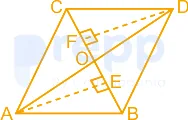 Paper & answer key PDF ↗
 Question 69archived
If x + y = 12 and xy = 27, x > y, then the value of (x 3– y 3) is:
- A
720
- B
724
- C
710
- D
702
Show answer
D. 702Finding the Value of x³ - y³ from Given Equations
The problem asks us to find the value of the expression $\left(x^3 - y^3\right)$ given two equations relating x and y, and a condition about their relative values:
Equation 1: $x + y = 12$
Equation 2: $xy = 27$
Condition: $x > y$
To find the value of $\left(x^3 - y^3\right)$, we first need to determine the individual values of x and y.
Determining the Values of x and y
We are given the sum $\left(x+y\right)$ and the product $\left(xy\right)$ of two numbers, x and y. These two numbers can be found by considering a quadratic equation whose roots are x and y. A quadratic equation with roots r1 and r2 is given by $t^2 - \left(r1 + r2\right)t + \left(r1 \times r2\right) = 0$.
In our case, the roots are x and y, the sum is 12, and the product is 27. So, x and y are the roots of the quadratic equation:
$\qquad t^2 - \left(x+y\right)t + xy = 0$
Substituting the given values:
$\qquad t^2 - 12t + 27 = 0$
We can solve this quadratic equation for t by factoring. We look for two numbers that multiply to 27 and add up to -12. These numbers are -9 and -3.
So, the equation can be factored as:
$\qquad \left(t - 9\right)\left(t - 3\right) = 0$
This gives us two possible values for t:
$t - 9 = 0 \implies t = 9$
$t - 3 = 0 \implies t = 3$
The roots of the equation are 9 and 3. These are the values of x and y.
Now we use the condition $x > y$. Since 9 is greater than 3, we assign:
$x = 9$
$y = 3$
Let's quickly verify these values using the original equations:
$x + y = 9 + 3 = 12$ (Matches the given sum)
$xy = 9 \times 3 = 27$ (Matches the given product)
$x > y$ (9 > 3) (Matches the given condition)
The values $x = 9$ and $y = 3$ are correct.
Calculating the Value of x³ - y³
Now that we have the values of x and y, we can calculate $x^3 - y^3$.
First, calculate $x^3$:
$\qquad x^3 = 9^3 = 9 \times 9 \times 9 = 81 \times 9 = 729$
Next, calculate $y^3$:
$\qquad y^3 = 3^3 = 3 \times 3 \times 3 = 9 \times 3 = 27$
Finally, calculate the difference $x^3 - y^3$:
$\qquad x^3 - y^3 = 729 - 27 = 702$
Alternatively, we could use the algebraic identity $\left(a^3 - b^3\right) = \left(a - b\right)\left(a^2 + ab + b^2\right)$.
We already know $xy = 27$. We need $x - y$ and $x^2 + y^2$.
We can find $x - y$ using the identity $\left(x - y\right)^2 = \left(x + y\right)^2 - 4xy$:
$\qquad \left(x - y\right)^2 = \left(12\right)^2 - 4\left(27\right)$
$\qquad \left(x - y\right)^2 = 144 - 108$
$\qquad \left(x - y\right)^2 = 36$
Since $x > y$, $x - y$ must be positive:
$\qquad x - y = \sqrt{36} = 6$
Now, we need $x^2 + y^2$. We can find this using the identity $\left(x + y\right)^2 = x^2 + 2xy + y^2$:
$\qquad x^2 + y^2 = \left(x + y\right)^2 - 2xy$
$\qquad x^2 + y^2 = \left(12\right)^2 - 2\left(27\right)$
$\qquad x^2 + y^2 = 144 - 54$
$\qquad x^2 + y^2 = 90$
Now substitute these values into the identity for $x^3 - y^3$:
$\qquad x^3 - y^3 = \left(x - y\right)\left(x^2 + xy + y^2\right)$
$\qquad x^3 - y^3 = \left(6\right)\left(90 + 27\right)$
$\qquad x^3 - y^3 = \left(6\right)\left(117\right)$
$\qquad x^3 - y^3 = 702$
Both methods yield the same result, 702.
Revision Table: Key Concepts in Algebra
Concept
Description
Relevant Formula/Identity
Sum and Product of Roots
If x and y are roots of $at^2 + bt + c = 0$, then $x+y = -b/a$ and $xy = c/a$. Conversely, x and y are roots of $t^2 - (x+y)t + xy = 0$.
$t^2 - (x+y)t + xy = 0$
Difference of Cubes
The algebraic identity for the difference between two cubic terms.
$a^3 - b^3 = (a - b)(a^2 + ab + b^2)$
Square of Sum/Difference
Identities relating the square of a sum or difference to squares and product.
$(a + b)^2 = a^2 + 2ab + b^2$
$(a - b)^2 = a^2 - 2ab + b^2$
Additional Information: Algebraic Identities and Solving Systems
Algebraic identities are powerful tools that help simplify expressions and solve equations efficiently. In this problem, using identities like the difference of cubes or the square of a sum/difference provides alternative ways to reach the solution or verify results obtained by finding individual values of x and y.
When given the sum and product of two variables, they are the roots of a quadratic equation. Solving this quadratic equation is a standard technique to find the values of the variables. Remember to consider any additional conditions, like $x > y$ in this case, when assigning the values to the variables.
Commonly used algebraic identities include:
$\left(a+b\right)^2 = a^2 + 2ab + b^2$
$\left(a-b\right)^2 = a^2 - 2ab + b^2$
$\left(a+b\right)^3 = a^3 + 3a^2b + 3ab^2 + b^3 = a^3 + b^3 + 3ab(a+b)$
$\left(a-b\right)^3 = a^3 - 3a^2b + 3ab^2 - b^3 = a^3 - b^3 - 3ab(a-b)$
$a^2 - b^2 = (a-b)(a+b)$
$a^3 + b^3 = (a+b)(a^2 - ab + b^2)$
$a^3 - b^3 = (a-b)(a^2 + ab + b^2)$
These identities are fundamental in simplifying and manipulating algebraic expressions, especially in problems involving powers of variables.
Paper & answer key PDF ↗ Question 70archived
If a 9-digit number 32x4115y2 is divisible by 88, then the value of (4x – y) for the smallest possible value of y is:
- A
20
- B
-1
- C
31
- D
11
Show answer
C. 31Understanding the Divisibility Problem
The question asks us to find the value of the expression \( (4x - y) \) for a 9-digit number \( 32x4115y2 \), given that the number is divisible by 88 and we need to use the smallest possible value for the digit \( y \).
To solve this, we need to understand the divisibility rules for 88. A number is divisible by 88 if it is divisible by both 8 and 11, because 8 and 11 are co-prime factors of 88 (\( 88 = 8 \times 11 \)).
Applying the Divisibility Rule for 8
The divisibility rule for 8 states that a number is divisible by 8 if the number formed by its last three digits is divisible by 8.
For the number \( 32x4115y2 \), the last three digits form the number \( 5y2 \). We need to find the smallest digit \( y \) (where \( y \) can be any digit from 0 to 9) such that \( 5y2 \) is divisible by 8.
Let's test possible values for \( y \):
If \( y=0 \), the number is 502. \( 502 \div 8 = 62 \) with a remainder of 6. Not divisible by 8.
If \( y=1 \), the number is 512. \( 512 \div 8 = 64 \). Divisible by 8.
Since we are looking for the smallest possible value of \( y \), and we found that \( y=1 \) makes the last three digits divisible by 8, the smallest possible value for \( y \) is 1.
Applying the Divisibility Rule for 11
Now that we know the smallest value of \( y \) is 1, the number becomes \( 32x411512 \). The divisibility rule for 11 states that a number is divisible by 11 if the difference between the sum of the digits at the odd places (from the right) and the sum of the digits at the even places (from the right) is either 0 or a multiple of 11.
Let's find the sum of digits at odd and even places for the number \( 32x411512 \):
Number: \( 3 \quad 2 \quad x \quad 4 \quad 1 \quad 1 \quad 5 \quad 1 \quad 2 \)
Positions (from right): \( 9^{th} \quad 8^{th} \quad 7^{th} \quad 6^{th} \quad 5^{th} \quad 4^{th} \quad 3^{rd} \quad 2^{nd} \quad 1^{st} \)
Sum of digits at odd places (1st, 3rd, 5th, 7th, 9th): \( 2 + 5 + 1 + x + 3 = 11 + x \)
Sum of digits at even places (2nd, 4th, 6th, 8th): \( 1 + 1 + 4 + 2 = 8 \)
The difference between these sums is \( (11 + x) - 8 = 3 + x \).
For the number \( 32x411512 \) to be divisible by 11, the difference \( (3 + x) \) must be 0 or a multiple of 11. Since \( x \) is a digit (0-9), the value of \( 3 + x \) can range from \( 3+0=3 \) to \( 3+9=12 \).
The only multiple of 11 within this range is 11 itself.
So, we set the difference equal to 11:
\( 3 + x = 11 \)
Solving for \( x \):
\( x = 11 - 3 \)
\( x = 8 \)
So, for the smallest possible value of \( y \) (which is 1), the value of \( x \) is 8.
Calculating the Expression (4x - y)
We have found the values \( x = 8 \) and \( y = 1 \). Now we need to calculate the value of the expression \( (4x - y) \).
\( 4x - y = 4(8) - 1 \)
\( 4x - y = 32 - 1 \)
\( 4x - y = 31 \)
Final Answer
The value of \( (4x - y) \) for the smallest possible value of \( y \) is 31.
Revision Table: Divisibility Rules Summary
Divisible By
Rule
Example (Relevant to problem)
8
The number formed by the last three digits is divisible by 8.
512 is divisible by 8 (\( 512 \div 8 = 64 \))
11
The difference between the sum of digits at odd places (from the right) and the sum of digits at even places (from the right) is 0 or a multiple of 11.
For 328411512: (2+5+1+8+3) - (1+1+4+2) = 19 - 8 = 11 (multiple of 11)
88
The number must be divisible by both 8 and 11.
328411512 is divisible by 88.
Additional Information: Co-prime Factors and Divisibility
When a number is divisible by a composite number like 88, we often use its prime factors or co-prime factors. In this case, 8 and 11 are co-prime (their greatest common divisor is 1). If a number is divisible by two co-prime numbers, it is also divisible by their product.
Other examples:
Divisibility by 6: Check divisibility by 2 and 3.
Divisibility by 12: Check divisibility by 3 and 4.
Divisibility by 15: Check divisibility by 3 and 5.
Using this property simplifies checking divisibility for larger composite numbers by breaking it down into simpler divisibility rules.
Paper & answer key PDF ↗ Question 71archived
The average of twelve numbers is 46. The average of the first four numbers is 43 and that of the last five numbers is 49.4. The 5 th and the 6 th numbers are respectively 4 and 6 more than the 7 th number. What is the average of the 5 th and 7 th numbers?
- A
44.5
- B
43
- C
44
- D
43.5
Show answer
B. 43Understanding the Average of Numbers Problem
The problem provides information about the average of a set of twelve numbers and the averages of specific subsets of these numbers. We are also given relationships between three of the numbers (the 5th, 6th, and 7th). Our goal is to find the average of the 5th and 7th numbers.
Let the twelve numbers be $n_1, n_2, \dots, n_{12}$.
Step-by-Step Solution
1. Calculate the Total Sum of Twelve Numbers
The average of twelve numbers is given as 46. The total sum of these twelve numbers is the average multiplied by the number of terms.
Total Sum $=$ Average $\times$ Number of terms
Total Sum $=$ $46 \times 12$
Total Sum $=$ $552$
So, $n_1 + n_2 + \dots + n_{12} = 552$.
2. Calculate the Sum of the First Four Numbers
The average of the first four numbers ($n_1, n_2, n_3, n_4$) is 43.
Sum of First Four Numbers $=$ Average $\times$ Number of terms
Sum of First Four Numbers $=$ $43 \times 4$
Sum of First Four Numbers $=$ $172$
So, $n_1 + n_2 + n_3 + n_4 = 172$.
3. Calculate the Sum of the Last Five Numbers
The average of the last five numbers ($n_8, n_9, n_{10}, n_{11}, n_{12}$) is 49.4.
Sum of Last Five Numbers $=$ Average $\times$ Number of terms
Sum of Last Five Numbers $=$ $49.4 \times 5$
Sum of Last Five Numbers $=$ $247$
So, $n_8 + n_9 + n_{10} + n_{11} + n_{12} = 247$.
4. Find the Sum of the Remaining Numbers (5th, 6th, and 7th)
The twelve numbers consist of the first four, the next three (5th, 6th, 7th), and the last five. The sum of the 5th, 6th, and 7th numbers can be found by subtracting the sum of the first four and the sum of the last five from the total sum.
Sum of ($n_5 + n_6 + n_7$) $=$ Total Sum $-$ Sum of First Four $-$ Sum of Last Five
Sum of ($n_5 + n_6 + n_7$) $=$ $552 - 172 - 247$
Sum of ($n_5 + n_6 + n_7$) $=$ $552 - 419$
Sum of ($n_5 + n_6 + n_7$) $=$ $133$
5. Use the Given Relationships to Find the Values of the 5th, 6th, and 7th Numbers
We are given the following relationships:
The 5th number is 4 more than the 7th number.
The 6th number is 6 more than the 7th number.
Let the 7th number be represented by the variable $x$.
7th number ($n_7$) $= x$
5th number ($n_5$) $= x + 4$
6th number ($n_6$) $= x + 6$
Now, substitute these expressions into the equation for the sum of the 5th, 6th, and 7th numbers:
$n_5 + n_6 + n_7 = 133$
$(x + 4) + (x + 6) + x = 133$
$3x + 10 = 133$
Subtract 10 from both sides:
$3x = 133 - 10$
$3x = 123$
Divide by 3:
$x = \frac{123}{3}$
$x = 41$
So, the 7th number ($n_7$) is 41.
Now we can find the 5th number:
5th number ($n_5$) $= x + 4 = 41 + 4 = 45$
We can also find the 6th number (though not required for the final answer):
6th number ($n_6$) $= x + 6 = 41 + 6 = 47$
6. Calculate the Average of the 5th and 7th Numbers
We need to find the average of the 5th number (45) and the 7th number (41).
Average $=$ $\frac{\text{Sum of numbers}}{\text{Number of terms}}$
Average of 5th and 7th numbers $=$ $\frac{n_5 + n_7}{2}$
Average of 5th and 7th numbers $=$ $\frac{45 + 41}{2}$
Average of 5th and 7th numbers $=$ $\frac{86}{2}$
Average of 5th and 7th numbers $=$ $43$
The average of the 5th and 7th numbers is 43.
Calculation Step
Value/Expression
Total Sum (12 numbers)
$12 \times 46 = 552$
Sum of First 4 numbers
$4 \times 43 = 172$
Sum of Last 5 numbers
$5 \times 49.4 = 247$
Sum of 5th, 6th, 7th numbers
$552 - 172 - 247 = 133$
Let 7th number be $x$
$n_7 = x$
5th number
$n_5 = x + 4$
6th number
$n_6 = x + 6$
Equation for sum
$(x+4) + (x+6) + x = 133$
Solve for $x$ (7th number)
$3x + 10 = 133 \implies 3x = 123 \implies x = 41$
5th number ($n_5$)
$41 + 4 = 45$
7th number ($n_7$)
$41$
Average of 5th and 7th
$\frac{45 + 41}{2} = \frac{86}{2} = 43$
Revision Table: Key Concepts Reviewed
Concept
Description
Formula
Average
Sum of a set of numbers divided by the count of numbers in the set.
Average = $\frac{\text{Sum}}{\text{Count}}$
Sum from Average
The total sum of a set of numbers can be found if the average and count are known.
Sum = Average $\times$ Count
Solving Linear Equations
Using algebraic operations to find the value of an unknown variable.
Example: $ax + b = c \implies ax = c - b \implies x = \frac{c-b}{a}$
Additional Information: Understanding Arithmetic Mean
The term "average" in this context refers to the arithmetic mean. It is a common measure of central tendency. It gives us a single value that represents the center of a dataset. Problems involving averages often require calculating sums based on given averages or finding missing values using the properties of the mean.
In problems like this, breaking down the total set into smaller subsets and using the sum property is a crucial technique. Representing unknown numbers with variables and setting up equations based on the given relationships is also a standard approach for solving such quantitative aptitude questions.
Paper & answer key PDF ↗ Question 72archived
In ΔABC with sides 6 cm, 7 cm and 8 cm, the angle bisector of the largest angle divides the opposite side into two segments. What is the length of the shorter segment?
- A
56/13 cm
- B
48/13 cm
- C
21/5 cm
- D
24/5 cm
Show answer
B. 48/13 cmSolving Triangle Problems Using the Angle Bisector Theorem
The problem asks us to find the length of the shorter segment created when the angle bisector of the largest angle in a triangle divides the opposite side. We are given the side lengths of the triangle as 6 cm, 7 cm, and 8 cm.
Identifying the Largest Angle and Opposite Side
In any triangle, the largest angle is always opposite the longest side. The given side lengths are 6 cm, 7 cm, and 8 cm. The longest side is 8 cm.
Let's label the triangle ABC. Suppose the sides opposite vertices A, B, and C are a, b, and c respectively. We can assign the side lengths in any order, but the longest side is 8 cm. Let's assume the side with length 8 cm is AC (side b). Then the angle opposite AC is $\angle B$. So, the largest angle is $\angle B$. The angle bisector of $\angle B$ divides the side AC (length 8 cm).
Let the side lengths be:
AB = 6 cm
BC = 7 cm
AC = 8 cm
The largest angle is $\angle B$, opposite the side AC = 8 cm.
Applying the Angle Bisector Theorem
The Angle Bisector Theorem states that if a ray bisects an angle of a triangle, then it divides the opposite side into two segments that are proportional to the other two sides of the triangle.
Let BD be the angle bisector of $\angle B$, where D is a point on AC. According to the Angle Bisector Theorem:
\(\frac{AD}{DC} = \frac{AB}{BC}\)
We know AB = 6 cm and BC = 7 cm. So,
\(\frac{AD}{DC} = \frac{6}{7}\)
This means that the ratio of the lengths of the segments AD and DC is 6:7.
Calculating the Lengths of the Segments
The point D lies on the side AC, so the sum of the lengths of the segments AD and DC must equal the total length of AC.
\(AD + DC = AC\)
We know AC = 8 cm. So,
\(AD + DC = 8\)
We have a system of two equations:
\(\frac{AD}{DC} = \frac{6}{7}\)
\(AD + DC = 8\)
From equation (1), we can write \(7 \cdot AD = 6 \cdot DC\). We can express DC in terms of AD using equation (2): \(DC = 8 - AD\).
Substitute this into the first equation:
\(7 \cdot AD = 6 \cdot (8 - AD)\)
Now, we solve for AD:
\(7 \cdot AD = 48 - 6 \cdot AD\)
\(7 \cdot AD + 6 \cdot AD = 48\)
\(13 \cdot AD = 48\)
\(AD = \frac{48}{13}\) cm
Now, we find DC using \(DC = 8 - AD\):
\(DC = 8 - \frac{48}{13}\)
To subtract, find a common denominator:
\(DC = \frac{8 \cdot 13}{13} - \frac{48}{13}\)
\(DC = \frac{104 - 48}{13}\)
\(DC = \frac{56}{13}\) cm
Identifying the Shorter Segment
The angle bisector divides the opposite side into two segments with lengths \(\frac{48}{13}\) cm and \(\frac{56}{13}\) cm. We need to find the length of the shorter segment.
Comparing the two fractions, \(\frac{48}{13}\) and \(\frac{56}{13}\), we look at the numerators since the denominators are the same. Since 48 < 56, \(\frac{48}{13}\) is the shorter segment.
The length of the shorter segment is \(\frac{48}{13}\) cm.
Side
Length (cm)
AB
6
BC
7
AC
8
Segment
Length (cm)
AD
\(\frac{48}{13}\)
DC
\(\frac{56}{13}\)
Conclusion
Using the Angle Bisector Theorem and the given side lengths of the triangle, we found that the angle bisector of the largest angle divides the opposite side into segments of length \(\frac{48}{13}\) cm and \(\frac{56}{13}\) cm. The shorter of these two segments is \(\frac{48}{13}\) cm.
Revision Table: Key Concepts
Concept
Description
Largest Angle
Opposite the longest side in a triangle.
Angle Bisector Theorem
Divides the opposite side in the ratio of the other two sides.
Segment Lengths
Parts of the side divided by the angle bisector.
Additional Information: Properties of Triangle Segments
Understanding how different lines and points relate within a triangle is fundamental in geometry. Besides the angle bisector, other significant lines include:
Median: A line segment from a vertex to the midpoint of the opposite side. The three medians intersect at the centroid, which is the center of mass of the triangle.
Altitude: A line segment from a vertex perpendicular to the opposite side (or its extension). The three altitudes intersect at the orthocenter.
Perpendicular Bisector: A line perpendicular to a side at its midpoint. The three perpendicular bisectors intersect at the circumcenter, which is the center of the circle passing through all three vertices (circumcircle).
Each of these segments and points has unique properties and theorems associated with them, crucial for solving various geometry problems.
Paper & answer key PDF ↗ Question 73archived
Abhi bought two articles for Rs. 624. He sold one at a loss of 14% and the other at a profit of 14%. If the selling price of both the articles is equal, then the difference between their cost prices (in Rs.) is:
- A
89.64
- B
87.36
- C
89.68
- D
88.84
Show answer
B. 87.36Understanding the Problem: Cost Price and Selling Price Analysis
The question involves two articles purchased for a total amount. One article is sold at a percentage loss, and the other is sold at a percentage profit. A key piece of information is that the selling price of both articles is the same. We need to find the difference between the initial cost prices of these two articles.
Setting up the Equations
Let's denote the cost price (CP) of the first article as $C_1$ and the cost price of the second article as $C_2$.
The total cost of the two articles is given as Rs. 624.
So, we have the equation: $$C_1 + C_2 = 624 \quad (*)$$
The first article is sold at a loss of 14%. The selling price (SP) of the first article, $SP_1$, can be calculated as:
$$SP_1 = C_1 - (14\% \text{ of } C_1)$$
$$SP_1 = C_1 \times \left(1 - \frac{14}{100}\right) = C_1 \times (1 - 0.14) = 0.86 C_1$$
The second article is sold at a profit of 14%. The selling price (SP) of the second article, $SP_2$, can be calculated as:
$$SP_2 = C_2 + (14\% \text{ of } C_2)$$
$$SP_2 = C_2 \times \left(1 + \frac{14}{100}\right) = C_2 \times (1 + 0.14) = 1.14 C_2$$
We are given that the selling price of both articles is equal.
So, we have the equation: $$SP_1 = SP_2$$
$$0.86 C_1 = 1.14 C_2 \quad (**)$$
Solving for the Cost Prices
Now we have a system of two linear equations with two variables $C_1$ and $C_2$:
$C_1 + C_2 = 624$
$0.86 C_1 = 1.14 C_2$
From the second equation, we can express the ratio of $C_1$ to $C_2$:
$$ \frac{C_1}{C_2} = \frac{1.14}{0.86} = \frac{114}{86} = \frac{57}{43} $$
This means that $C_1$ and $C_2$ are in the ratio 57 : 43. We can represent the cost prices as $C_1 = 57x$ and $C_2 = 43x$ for some common factor $x$.
Substitute these into the first equation:
$$ 57x + 43x = 624 $$
$$ 100x = 624 $$
$$ x = \frac{624}{100} = 6.24 $$
Now we can find the actual cost prices:
$C_1 = 57x = 57 \times 6.24$
$C_2 = 43x = 43 \times 6.24$
Let's calculate these values:
$$ C_1 = 57 \times 6.24 = 355.68 $$
$$ C_2 = 43 \times 6.24 = 268.32 $$
We can check if the sum is 624: $355.68 + 268.32 = 624$. This is correct.
Calculating the Difference in Cost Prices
The question asks for the difference between their cost prices, which is $|C_1 - C_2|$. Since $C_1$ corresponds to the article sold at a loss (meaning its SP is lower than CP), and $C_2$ corresponds to the article sold at a profit (meaning its SP is higher than CP), and $0.86 C_1 = 1.14 C_2$ implies $C_1$ must be greater than $C_2$, the difference is $C_1 - C_2$.
Difference $= C_1 - C_2 = 355.68 - 268.32$
Alternatively, using the expressions with $x$:
Difference $= 57x - 43x = 14x$
Substitute the value of $x$:
Difference $= 14 \times 6.24$
Let's calculate $14 \times 6.24$:
$14 \times 6 = 84$
$14 \times 0.24 = 14 \times \frac{24}{100} = \frac{336}{100} = 3.36$
Difference $= 84 + 3.36 = 87.36$
Final Answer on Cost Price Difference
The difference between the cost prices of the two articles is Rs. 87.36.
Revision Table: Profit and Loss Concepts
Concept
Formula
Explanation
Selling Price (SP) with Profit
$SP = CP \times (1 + \text{Profit Percentage})$
When an item is sold for more than its cost price.
Selling Price (SP) with Loss
$SP = CP \times (1 - \text{Loss Percentage})$
When an item is sold for less than its cost price.
Profit Percentage
$\frac{Profit}{CP} \times 100$
Profit is $SP - CP$ (if $SP > CP$).
Loss Percentage
$\frac{Loss}{CP} \times 100$
Loss is $CP - SP$ (if $CP > SP$).
Additional Information: Ratio Method for Equal SP Problems
Problems where items are sold at different profit/loss percentages but have the same selling price can often be solved efficiently using ratios. If an article is sold at a profit of $P\%$ and another at a loss of $L\%$, and their selling prices are equal ($SP_1 = SP_2$), then:
$$ CP_1 \times \left(1 + \frac{P}{100}\right) = CP_2 \times \left(1 - \frac{L}{100}\right) $$
$$ CP_1 \times \frac{100+P}{100} = CP_2 \times \frac{100-L}{100} $$
$$ \frac{CP_1}{CP_2} = \frac{100-L}{100+P} $$
In this specific problem, $P=14\%$ and $L=14\%$.
$$ \frac{C_1}{C_2} = \frac{100-14}{100+14} = \frac{86}{114} = \frac{43}{57} $$
Wait, looking back at our calculation $0.86 C_1 = 1.14 C_2$, this gave $\frac{C_1}{C_2} = \frac{1.14}{0.86} = \frac{114}{86} = \frac{57}{43}$. The formula should correctly reflect that the cost price of the article sold at a loss ($C_1$ in our case) must be higher than the cost price of the article sold at a profit ($C_2$ in our case) for their selling prices to be equal. A higher CP compensates for the loss percentage to reach the same SP as a lower CP with a profit percentage.
So, if Article A is at $L\%$ loss and Article B is at $P\%$ profit, and $SP_A = SP_B$, then $\frac{CP_A}{CP_B} = \frac{100+P}{100-L}$.
Applying this corrected ratio formula:
Let Article 1 be the one with 14% loss ($L=14$). Let Article 2 be the one with 14% profit ($P=14$).
$$ \frac{C_1}{C_2} = \frac{100+14}{100-14} = \frac{114}{86} = \frac{57}{43} $$
This matches our initial calculation from the equations $0.86 C_1 = 1.14 C_2$. The ratio method confirms our approach and provides a quick way to find the ratio of cost prices when selling prices are equal.
Paper & answer key PDF ↗ Question 74archived
The table shows the production of different types of cars (in thousands).
City/ Year
2012
2013
2014
2015
2016
A
54
58
60
63
55
B
40
54
56
61
67
C
46
50
63
73
77
D
33
35
48
45
49
E
47
43
53
48
52
The total production of type E cars in 2012 and 2013 is approximately what percent more than the average production of type A cars during the years 2012 to 2016?
- A
56.4
- B
53.8
- C
52.2
- D
55.2
Show answer
D. 55.2Analyzing Car Production Data
The problem asks us to analyze the provided table showing car production data for different types (A, B, C, D, E) across several years (2012 to 2016) in thousands. We need to compare the total production of type E cars in 2012 and 2013 with the average production of type A cars over the entire five-year period (2012-2016) and express the difference as a percentage.
City/ Year
2012
2013
2014
2015
2016
A
54
58
60
63
55
B
40
54
56
61
67
C
46
50
63
73
77
D
33
35
48
45
49
E
47
43
53
48
52
Step 1: Calculate Total Production of Type E Cars in 2012 and 2013
From the table, the production of type E cars in 2012 is 47 thousand and in 2013 is 43 thousand.
Total production of type E cars in 2012 and 2013 = Production in 2012 + Production in 2013
Total production of type E cars = $47 + 43 = 90$ thousand.
So, the total production of type E cars in 2012 and 2013 is 90 thousand units.
Step 2: Calculate the Average Production of Type A Cars from 2012 to 2016
From the table, the production of type A cars in the years 2012, 2013, 2014, 2015, and 2016 are 54, 58, 60, 63, and 55 thousand respectively.
Total production of type A cars from 2012 to 2016 = Sum of production in these years
Total production of type A cars = $54 + 58 + 60 + 63 + 55 = 290$ thousand.
The average production is the total production divided by the number of years (5).
Average production of type A cars = $\frac{\text{Total production}}{\text{Number of years}} = \frac{290}{5} = 58$ thousand.
So, the average production of type A cars during 2012 to 2016 is 58 thousand units.
Step 3: Calculate the Difference
We need to find out how much more the total production of type E cars (2012-2013) is compared to the average production of type A cars (2012-2016).
Difference = Total production of type E cars (2012-2013) - Average production of type A cars (2012-2016)
Difference = $90 - 58 = 32$ thousand.
Step 4: Calculate the Percentage More
The question asks for the percentage by which the total production of type E cars (2012-2013) is more than the average production of type A cars (2012-2016). The base for the percentage calculation is the average production of type A cars.
Percentage more = $\left( \frac{\text{Difference}}{\text{Average production of type A cars}} \right) \times 100$
Percentage more = $\left( \frac{32}{58} \right) \times 100$
Percentage more $\approx 0.5517 \times 100$
Percentage more $\approx 55.17\%$
Rounding to one decimal place, the percentage more is approximately 55.2%.
Summary of Calculations
Total production of type E (2012 & 2013): 90 thousand
Average production of type A (2012-2016): 58 thousand
Difference: 32 thousand
Percentage more: $\left(\frac{32}{58}\right) \times 100 \approx 55.2\%$
Therefore, the total production of type E cars in 2012 and 2013 is approximately 55.2 percent more than the average production of type A cars during the years 2012 to 2016.
Revision Table: Car Production Analysis
Metric
Value (in thousands)
Calculation Basis
Type E Total (2012-2013)
90
Sum of 2012 and 2013 production for Type E (47+43)
Type A Average (2012-2016)
58
Sum of 2012-2016 production for Type A (54+58+60+63+55) divided by 5
Difference
32
Type E Total - Type A Average (90 - 58)
Percentage More
~55.2%
(Difference / Type A Average) * 100 ($\frac{32}{58} \times 100$)
Additional Information: Data Interpretation and Percentage Calculations
This problem involves interpreting data from a table and performing percentage calculations. Understanding these concepts is crucial for data analysis questions.
Data Interpretation: Extracting specific values or sums of values from a table based on rows (car types) and columns (years).
Average: The average (or mean) is calculated by summing all the values in a set and dividing by the number of values. Formula: Average $= \frac{\text{Sum of values}}{\text{Number of values}}$.
Percentage More: To find out what percentage value X is more than value Y, we calculate the difference (X - Y), divide by Y (the base value we are comparing against), and multiply by 100. Formula: Percentage More $= \left( \frac{X - Y}{Y} \right) \times 100$. In this case, X is the total production of Type E (2012-2013) and Y is the average production of Type A (2012-2016).
Percentage Difference: Note that "percentage more" is a specific type of percentage difference calculation where the comparison base is explicitly the second value. If the question just asked for "percentage difference", the base might need to be clarified or could be the average of the two values depending on context, but "percentage more than Y" clearly sets Y as the base.
These skills are fundamental in quantitative aptitude sections of various exams.
Paper & answer key PDF ↗ Question 75archived
Let \({\rm{a}} = \frac{{2\sin {\rm{x}}}}{{1 + \sin {\rm{x}} + \cos {\rm{x}}}}{\rm{and\;b}} = \frac{{\rm{c}}}{{1 + \sin {\rm{x}}}}\) . then a = b, if c = ?
- A
1 + sin x cos x
- B
1 + sin x – cos x
- C
1 +cos x – sin x
- D
1 – sin x cos x
Show answer
B. 1 + sin x – cos xSolving Trigonometric Equation to Find 'c'
The problem asks us to find the value of 'c' such that two given trigonometric expressions, 'a' and 'b', are equal. The expressions are:
\[{\rm{a}} = \frac{{2\sin {\rm{x}}}}{{1 + \sin {\rm{x}} + \cos {\rm{x}}}}\]
\[{\rm{b}} = \frac{{\rm{c}}}{{1 + \sin {\rm{x}}}}\]
We are given the condition \({\rm{a}} = {\rm{b}}\). Substituting the expressions for 'a' and 'b', we get the equation:
\[\frac{{2\sin {\rm{x}}}}{{1 + \sin {\rm{x}} + \cos {\rm{x}}}} = \frac{{\rm{c}}}{{1 + \sin {\rm{x}}}}\]
Our goal is to find the value of 'c' that satisfies this equation. We can rearrange the equation to solve for 'c':
\[{\rm{c}} = \frac{{2\sin {\rm{x}} \cdot (1 + \sin {\rm{x}})}}{{1 + \sin {\rm{x}} + \cos {\rm{x}}}}\]
However, this expression for 'c' does not directly match the given options. A better approach for multiple-choice questions is to test the options provided for 'c' by substituting them back into the equation \({\rm{a}} = {\rm{b}}\) and verifying if the equality holds.
Verifying the Correct Option for 'c'
Let's take the provided correct option for 'c', which is \(1 + \sin {\rm{x}} - \cos {\rm{x}}\). We substitute this into the expression for 'b':
\[{\rm{b}} = \frac{{1 + \sin {\rm{x}} - \cos {\rm{x}}}}{{1 + \sin {\rm{x}}}}\]
Now we need to check if \({\rm{a}} = {\rm{b}}\), i.e., if:
\[\frac{{2\sin {\rm{x}}}}{{1 + \sin {\rm{x}} + \cos {\rm{x}}}} = \frac{{1 + \sin {\rm{x}} - \cos {\rm{x}}}}{{1 + \sin {\rm{x}}}}\]
To verify this equality, we can cross-multiply:
\[2\sin {\rm{x}} \cdot (1 + \sin {\rm{x}}) = (1 + \sin {\rm{x}} - \cos {\rm{x}}) \cdot (1 + \sin {\rm{x}} + \cos {\rm{x}})\]
Expanding Both Sides of the Equation
Let's expand the left side (LHS):
\[{\rm{LHS}} = 2\sin {\rm{x}} + 2\sin^2 {\rm{x}}\]
Now let's expand the right side (RHS). Notice that the RHS is in the form \((A - B)(A + B)\), where \(A = (1 + \sin {\rm{x}})\) and \(B = \cos {\rm{x}}\). Using the difference of squares formula \(A^2 - B^2\):
\[{\rm{RHS}} = (1 + \sin {\rm{x}})^2 - (\cos {\rm{x}})^2\]
Expand \((1 + \sin {\rm{x}})^2\):
\[(1 + \sin {\rm{x}})^2 = 1^2 + 2 \cdot 1 \cdot \sin {\rm{x}} + (\sin {\rm{x}})^2 = 1 + 2\sin {\rm{x}} + \sin^2 {\rm{x}}\]
So the RHS becomes:
\[{\rm{RHS}} = (1 + 2\sin {\rm{x}} + \sin^2 {\rm{x}}) - \cos^2 {\rm{x}}\]
Using the fundamental trigonometric identity \(\sin^2 {\rm{x}} + \cos^2 {\rm{x}} = 1\), we know that \(\cos^2 {\rm{x}} = 1 - \sin^2 {\rm{x}}\). Substitute this into the RHS expression:
\[{\rm{RHS}} = (1 + 2\sin {\rm{x}} + \sin^2 {\rm{x}}) - (1 - \sin^2 {\rm{x}})\]
\[{\rm{RHS}} = 1 + 2\sin {\rm{x}} + \sin^2 {\rm{x}} - 1 + \sin^2 {\rm{x}}\]
Combine like terms:
\[{\rm{RHS}} = (1 - 1) + 2\sin {\rm{x}} + (\sin^2 {\rm{x}} + \sin^2 {\rm{x}})\]
\[{\rm{RHS}} = 0 + 2\sin {\rm{x}} + 2\sin^2 {\rm{x}}\]
\[{\rm{RHS}} = 2\sin {\rm{x}} + 2\sin^2 {\rm{x}}\]
Comparing the expanded LHS and RHS:
\[{\rm{LHS}} = 2\sin {\rm{x}} + 2\sin^2 {\rm{x}}\]
\[{\rm{RHS}} = 2\sin {\rm{x}} + 2\sin^2 {\rm{x}}\]
Since LHS = RHS, the equality holds when \({\rm{c}} = 1 + \sin {\rm{x}} - \cos {\rm{x}}\).
Conclusion
The value of 'c' that makes \({\rm{a}} = {\rm{b}}\) is \(1 + \sin {\rm{x}} - \cos {\rm{x}}\).
Expression
Form
\({\rm{a}}\)
\(\frac{{2\sin {\rm{x}}}}{{1 + \sin {\rm{x}} + \cos {\rm{x}}}}\)
\({\rm{b}}\)
\(\frac{{\rm{c}}}{{1 + \sin {\rm{x}}}}\)
Condition
\({\rm{a}} = {\rm{b}}\)
Value of \({\rm{c}}\) (Result)
\(1 + \sin {\rm{x}} - \cos {\rm{x}}\)
Revision Table: Trigonometric Identities and Formulas
Identity/Formula
Description
\(\sin^2 \theta + \cos^2 \theta = 1\)
The fundamental trigonometric identity relating sine and cosine.
\((A+B)(A-B) = A^2 - B^2\)
Difference of squares formula used in algebraic expansion.
\((a+b)^2 = a^2 + 2ab + b^2\)
Formula for squaring a binomial.
Additional Information: Simplifying Trigonometric Expressions
Simplifying trigonometric expressions often involves using fundamental identities to rewrite parts of the expression in a different form. Common strategies include:
Converting everything to sine and cosine.
Using Pythagorean identities like \(\sin^2 \theta + \cos^2 \theta = 1\).
Using reciprocal or quotient identities.
Factoring or expanding expressions using algebraic formulas (like difference of squares).
Finding a common denominator when adding or subtracting fractions.
Multiplying the numerator and denominator by a conjugate expression.
In this problem, expanding the terms after cross-multiplication and using the identity \(\cos^2 {\rm{x}} = 1 - \sin^2 {\rm{x}}\) was key to simplifying the expression and proving the equality.
Paper & answer key PDF ↗ Question 76archived
Select the most appropriate option to substitute the underlined segment in the given sentence. If no substitution is required, select No improvement.
The Head has been so busy to go through these files and resolve the matter
- A
too busy to go through
- B
so busy to go through
- C
such busy to go through
- D
No improvement
Show answer
A. too busy to go throughUnderstanding Sentence Substitution: Correcting "So Busy To Go Through"
Let's analyze the given sentence: "The Head has been so busy to go through these files and resolve the matter". We need to find the most appropriate substitution for the underlined segment, "so busy to go through".
The original sentence uses the construction "so + adjective + to + infinitive". While "so...that" is a common structure to show cause and effect (e.g., "He was so tired that he couldn't work"), the structure "so + adjective + to + infinitive" is generally not used to express that the degree of the adjective prevents an action.
Analyzing the Options for "So Busy To Go Through"
Let's look at the provided options:
<p>too busy to go through</p>
<p>so busy to go through</p>
<p>such busy to go through</p>
<p>No improvement</p>
Evaluating Option 1: Too Busy To Go Through
This option uses the structure "too + adjective + to + infinitive". This structure is used to indicate that the degree of the adjective is excessive and prevents or makes an action impossible. For example, "It is too cold to go outside" means it is so cold that you cannot go outside.
In our sentence, "The Head has been too busy to go through these files..." correctly conveys that the Head's excessive busyness is preventing him from going through the files and resolving the matter. This is a grammatically correct and natural-sounding construction in English.
Evaluating Option 2: So Busy To Go Through
This is the original phrasing. As discussed earlier, "so + adjective + to + infinitive" is not the standard way to express that the adjective's degree prevents an action. The more common and correct structure for this meaning is "too + adjective + to + infinitive". Therefore, this option requires improvement.
Evaluating Option 3: Such Busy To Go Through
"Such" is typically used with a noun or a noun phrase (e.g., "such a busy day", "such beautiful flowers"). "Busy" in the sentence is an adjective modifying an implied noun (like 'person', referring to the Head). Using "such" directly before an adjective like "busy" without a following noun is incorrect. This option is grammatically flawed.
Evaluating Option 4: No Improvement
Since Option 1 provides a grammatically correct and appropriate substitution for the awkward original phrasing, improvement is required. Therefore, "No improvement" is not the correct choice.
Conclusion: Choosing the Correct Substitution
Comparing the options, "too busy to go through" is the correct and most appropriate substitution because it uses the standard grammatical structure "too + adjective + to + infinitive" to express that the Head's busyness is a barrier to performing the action of going through the files.
The corrected sentence would be: "The Head has been too busy to go through these files and resolve the matter."
Revision Table: Understanding 'Too' vs. 'So' vs. 'Such'
Structure
Usage
Example
Too + Adjective/Adverb + To + Infinitive
Indicates excessiveness that prevents an action.
It's too hot to play outside.
So + Adjective/Adverb + That + Clause
Indicates cause and effect or result.
He was so tired that he fell asleep.
Such + (a/an) + Adjective + Noun + That + Clause
Indicates a high degree of a quality in a noun; shows cause and effect.
It was such a good book that I read it twice.
So + Adjective/Adverb (without 'that' clause following)
Used for emphasis (informal) or comparison (formal). Not typically followed by 'to + infinitive' in the sense of preventing an action.
He was so kind! (Emphasis)
She ran so quickly. (Emphasis)
She is not so tall as her brother. (Comparison)
Additional Information on Sentence Correction
Sentence correction questions test your understanding of standard English grammar, usage, and structure. Identifying common errors like incorrect use of "too", "so", and "such" is crucial.
The "too...to" construction always implies a negative result – the action in the infinitive cannot happen because of the excessive degree of the adjective or adverb.
The "so...that" construction shows a direct consequence or result. The effect follows the cause expressed by "so + adjective/adverb".
"Such" is used before nouns to express a high degree or to introduce a consequence, often followed by "that". Remember to use "a/an" between "such" and a singular countable noun (e.g., "such a mistake", "such an idea").
Practice identifying these patterns in different sentences to improve your grammar and sentence substitution skills.
Paper & answer key PDF ↗ Question 77archived
Select the most appropriate option for blank No. 2.
- A
In
- B
At
- C
Into
- D
On
Show answer
A. InUnderstanding Prepositions in Context: Fill in the Blank Question
The question asks us to fill in the blanks in a passage describing the nature of the war that began in 1914, contrasting it with earlier wars. We need to select the most appropriate word from the given options for Blank No. 2. The sentence containing Blank No. 2 reads: "(2)______ the earlier wars, the civilian populations were (3)______ not involved..."
Analyzing Blank No. 2
Blank No. 2 precedes the phrase "the earlier wars". This part of the sentence is setting up a comparison or contrast between the characteristics of the 1914 war and those of conflicts that happened before it. We need a preposition that correctly introduces the context of "the earlier wars".
Let's look at the options provided for Blank No. 2:
In
At
Into
On
Evaluating the Options for Blank No. 2
In: The preposition 'in' is often used to refer to periods of time, general locations, or contexts. Phrases like "in the past", "in ancient times", or "in that situation" use 'in' to set the context. "In the earlier wars" is a common and correct way to introduce a statement about conditions or events that occurred within the period or context of those earlier conflicts.
At: The preposition 'at' is typically used for specific points in time, specific locations, or events. For example, "at noon", "at the corner", or "at the meeting". It doesn't fit the context of referring to a general period or the characteristics of earlier wars.
Into: The preposition 'into' indicates movement towards the inside of something, or a change in state. For example, "walk into the room" or "turn into a butterfly". It is not appropriate for introducing the context of past wars.
On: The preposition 'on' is often used for days of the week, dates, surfaces, or specific topics. For example, "on Monday", "on the table", or "on the history of wars". It doesn't fit the context of describing characteristics within the period of earlier wars.
Conclusion for Blank No. 2
Comparing the usage of the prepositions with the sentence structure and meaning, "In" is the most appropriate word to fill Blank No. 2. The phrase "In the earlier wars" correctly establishes the context for discussing the differences between those conflicts and the war that began in 1914. The sentence then continues to explain a key difference: that in earlier wars, civilian populations were generally not involved.
Therefore, the complete phrase should be "In the earlier wars".
Let's consider the context of the entire passage once Blank 2 is filled:
In 1914 a war began in Europe which engulfed the entire world. The damage (1)______ by this war has no precedent in history. In the earlier wars, the civilian populations were (3)______ not involved and the casualties were mostly (4)______ to the warring armies. The war (5)______ began in 1914 was a total war in which all the resources of the warring states were mobilized.
This structure makes perfect sense, contrasting the total nature of the 1914 war (WWI) with earlier conflicts where civilian involvement and casualties were limited.
Blank No.
Context
Most Appropriate Option
Reasoning
2
______ the earlier wars... (comparing to past conflicts)
In
'In' correctly introduces the context or characteristics of a past period or set of events.
Final Answer for Blank No. 2
Based on the analysis of the options and the context of the passage, the most appropriate option for Blank No. 2 is "In".
Revision Table: Key Learnings
Concept
Explanation
Example
Preposition 'In'
Used for periods of time, general locations, or contexts.
In the 18th century
In the park
In this situation
Preposition 'At'
Used for specific points in time, specific locations, or events.
At 3 PM
At the bus stop
At the party
Preposition 'Into'
Indicates movement towards the inside or a change in state.
Walk into the house
Change into a frog
Preposition 'On'
Used for days, dates, surfaces, or topics.
On Sunday
On May 1st
On the table
On history
Additional Information: Historical Context of World War I
The passage discusses the significant difference between the war that began in 1914 (World War I) and earlier wars. This difference lies primarily in its scale and the level of civilian involvement. Earlier wars were often fought between professional armies, with limited impact on civilian life and infrastructure beyond the immediate battle zones. World War I, however, was characterized by total war, where entire nations, including their economies and civilian populations, were mobilized for the war effort. Industrial production was geared towards warfare, propaganda was used to maintain morale and garner support on the home front, and civilian areas became targets due to strategic bombing and blockades. This shift fundamentally changed the nature of warfare and its human cost, resulting in unprecedented damage and casualties, as mentioned in the passage.
Paper & answer key PDF ↗ Question 78archived
Select the most appropriate option for blank No. 4
- A
bound
- B
confined
- C
belonged
- D
attained
Show answer
B. confinedUnderstanding the World War I Passage and Blank 4
The passage describes the significant impact of World War I, highlighting its unprecedented damage compared to earlier wars. It specifically points out a key difference: in earlier conflicts, civilian populations were generally not involved, and the casualties were largely limited to the military forces.
The sentence we need to complete is: "The earlier wars, the civilian populations were (3)______ not involved and the casualties were mostly (4)______ to the warring armies." We are asked to fill in blank No. 4.
Analyzing Options for Blank No. 4: Casualties and Armies
Let's look at the options provided for blank No. 4:
bound
confined
belonged
attained
The sentence states that in earlier wars, casualties were "mostly ______ to the warring armies." This suggests that the casualties were restricted or limited to the soldiers fighting in the armies, in contrast to World War I where the damage and casualties were widespread.
Evaluating Each Option
bound: If casualties were 'bound to' the armies, it might imply a strong connection, but it doesn't clearly express the idea of limitation or restriction to that group only.
confined: The word 'confined' means restricted to a particular place, sphere, or group. If casualties were 'confined to' the warring armies, it means they were limited primarily to the soldiers, not affecting civilians widely. This fits the context of contrasting earlier wars with the 'total war' of 1914.
belonged: 'Belonged to' means to be the property of or a member of something. Casualties don't 'belong' to armies in this grammatical and contextual sense. This option is incorrect.
attained: 'Attained' means achieved or reached. 'Casualties were mostly attained to the warring armies' is grammatically incorrect and doesn't make sense in this context. Casualties are suffered or incurred, not attained to a group.
Selecting the Most Appropriate Word for Blank 4
Based on the analysis, the word that best fits the meaning of the sentence – that casualties in earlier wars were limited or restricted primarily to the military personnel – is 'confined'.
The completed part of the sentence would read: "...and the casualties were mostly confined to the warring armies." This clearly contrasts with the nature of World War I described later in the passage.
Option Analysis for Blank 4
Option
Meaning/Fit in Sentence
Appropriateness
bound
Tied or linked to; doesn't clearly mean limited to.
Less appropriate
confined
Restricted or limited to. Fits the idea of casualties being only among armies.
Most appropriate
belonged
Owned by or part of; grammatically incorrect and wrong meaning.
Incorrect
attained
Achieved or reached; grammatically incorrect and wrong meaning.
Incorrect
Revision Table: Key Concepts
Revision Table: Vocabulary and Context
Term
Relevance to Passage
Notes
Engulfed
Describes how the war spread across the world.
Covered, swallowed up.
Precedent
Used to describe the unprecedented damage of WWI.
An earlier event or action that is regarded as an example.
Civilian populations
Contrasted with military casualties in earlier wars vs. WWI.
Non-military people.
Casualties
The focus of blank 4; people killed or injured.
Losses in war.
Confined
Key word for blank 4.
Limited, restricted.
Warring armies
The group to whom casualties were 'confined' in earlier wars.
Armies engaged in conflict.
Total war
Describes WWI; means all resources are mobilized, including civilians/industries.
Contrast with earlier limited wars.
Additional Information: Types of Warfare
The passage contrasts earlier wars with World War I based on the involvement of civilians and the scope of casualties. This relates to different concepts of warfare:
Limited War: A conflict fought for specific goals without using all available resources or involving the entire society. Casualties are primarily military. The passage suggests earlier wars were more like this.
Total War: A conflict in which the belligerents devote all their resources—human, industrial, agricultural, military—to the war effort. Civilian populations and infrastructure become legitimate targets, leading to widespread casualties and damage beyond the military. The passage describes WWI as a total war.
Understanding this distinction helps in appreciating why 'confined' is the correct word to describe casualties in the earlier, less 'total' wars mentioned in the passage.
Paper & answer key PDF ↗ Question 79archived
Given below are four jumbled sentences. Select the option that gives their correct order.
A. In China, thousands of people celebrated it.
B. The Lunar New Year of the Pig began on 5th February.
C. Others burned the first joss sticks of the year to bring them good fortune.
D. Some performers re-enacted historical ceremonies.
- A
DABC
- B
ABCD
- C
BADC
- D
BDCA
Show answer
C. BADCFinding the Correct Order of Jumbled Sentences about Lunar New Year
The question asks us to arrange four jumbled sentences into a coherent paragraph that makes logical sense. To do this, we need to look for connections between the sentences and identify the starting sentence, which usually introduces the main topic.
Let's analyze each sentence:
A. In China, thousands of people celebrated it. This sentence refers to something being celebrated ("it"). We need to know what "it" is.
B. The Lunar New Year of the Pig began on 5th February. This sentence introduces a specific event: the beginning of the Lunar New Year. This sounds like a good starting point as it sets the context.
C. Others burned the first joss sticks of the year to bring them good fortune. This sentence describes an action taken by "Others". This suggests it follows a sentence that talks about people in general, or a group of people. It describes a specific way people celebrated the event mentioned in B.
D. Some performers re-enacted historical ceremonies. This sentence describes an action taken by "Some performers". Like sentence C, it describes a specific way people celebrated the event mentioned in B.
Identifying the Starting Sentence
Sentence B introduces the main event, the start of the Lunar New Year. Sentences A, C, and D all seem to follow from this event, describing celebrations or actions related to it. Therefore, sentence B is the most likely starting sentence.
Sequencing the Sentences
If B is the start, the next sentence should logically connect to the event introduced in B. Sentence A states that "thousands of people celebrated it" in China. "It" clearly refers to the Lunar New Year. So, A logically follows B, describing the general reaction to the event.
After stating that people celebrated (A), the paragraph should provide details about *how* they celebrated. Sentences D and C provide these details. Sentence D mentions performers re-enacting ceremonies, and sentence C mentions others burning joss sticks. Both describe specific celebratory activities.
So far, we have the sequence B followed by A. Sentences D and C should follow A to give examples of the celebration. The order of D and C after A can be flexible, as both provide examples. Let's look at the options that start with BA:
BADC
BCA D
The option provided is BADC. Let's check if BADC makes sense:
B. The Lunar New Year of the Pig began on 5th February. (Event introduced)
A. In China, thousands of people celebrated it. (General reaction to the event)
D. Some performers re-enacted historical ceremonies. (Specific example of celebration)
C. Others burned the first joss sticks of the year to bring them good fortune. (Another specific example of celebration)
This order provides a smooth and logical flow, starting with the event, followed by the general celebration, and then providing specific examples of how the Lunar New Year was celebrated.
Step-by-Step Derivation of the Order
Identify the sentence that introduces the main subject or event. Sentence B introduces the Lunar New Year.
Find the sentence that immediately follows the introductory sentence, often providing a general statement about the subject. Sentence A talks about people celebrating "it" (the Lunar New Year).
Identify sentences that provide specific details or examples related to the general statement. Sentences D and C give examples of how people celebrated.
Arrange the detail sentences after the general statement (A). Both D and C can follow A. The option BADC places D before C.
Verify the complete sequence BADC for logical flow and coherence. The sequence flows well: Event → General Celebration → Specific Example 1 → Specific Example 2.
Based on this analysis, the correct order is BADC.
Sentence
Role in the sequence
B
Introduces the event (Lunar New Year).
A
States the general celebration of the event.
D
Gives a specific example of how people celebrated.
C
Gives another specific example of how people celebrated.
Revision Table: Jumbled Sentences Practice
Reviewing jumbled sentence questions helps improve reading comprehension and logical reasoning skills. Practice identifying topic sentences and transition words.
Additional Information: Sentence Reordering Skills
Mastering sentence reordering involves looking for chronological links, cause-and-effect relationships, pronoun references, and conjunctions to establish the correct sequence of ideas in a paragraph.
Paper & answer key PDF ↗ Question 80archived
Select the correct passive form of the given sentence.
Take this suitcase upstairs.
- A
You are requested to take this suitcase upstairs.
- B
Let this suitcase been taken upstairs.
- C
This suitcase should be taken upstairs.
- D
You must be taking this suitcase upstairs.
Show answer
C. This suitcase should be taken upstairs.Converting Imperative Sentences to Passive Voice
The question asks us to select the correct passive form of the imperative sentence: "Take this suitcase upstairs."
An imperative sentence gives a command, instruction, request, or suggestion. When converting an imperative sentence to the passive voice, the subject (usually 'You' understood) is often omitted, and the focus shifts to the action and the object being acted upon.
There are a few common ways to transform an imperative sentence into the passive voice:
Using 'Let' + object + 'be' + past participle. (e.g., Let the door be opened.)
Using modal verbs like 'should', 'must', 'ought to' + 'be' + past participle, especially when the imperative implies advice, instruction, or necessity. (e.g., The rules should be followed.)
Using 'You are requested/ordered/advised' + to + the original verb phrase. (e.g., You are requested to keep quiet.)
Let's examine the given options:
Option
Sentence
Analysis
1
You are requested to take this suitcase upstairs.
This is a correct passive form for a request, starting with 'You are requested'. However, the original sentence "Take this suitcase upstairs" sounds more like a direct instruction or suggestion than a formal request, though it's not entirely incorrect depending on context.
2
Let this suitcase been taken upstairs.
This option attempts to use the 'Let... be' structure, but the verb form 'been' after 'be' is incorrect. The correct structure would be 'Let this suitcase be taken upstairs'.
3
This suitcase should be taken upstairs.
This option uses the modal verb 'should' followed by 'be' and the past participle 'taken'. This structure is commonly used to express that something is an instruction, suggestion, or necessary action in the passive voice. It fits the context of "Take this suitcase upstairs" as an instruction.
4
You must be taking this suitcase upstairs.
This sentence is in the active voice (the subject 'You' is performing the action 'taking') and uses the present continuous tense with a modal ('must be taking'). It is not a passive transformation of the original imperative.
Comparing the options, option 3 "This suitcase should be taken upstairs" provides a correct and common passive transformation for an imperative sentence that conveys an instruction or suggestion. Option 1 is also a possible passive form for a request, but option 3 is a more direct passive transformation reflecting an instruction.
Revision Table: Passive Voice Transformations
Original Sentence Type
Original Example (Active)
Passive Transformation Examples
Simple Imperative (Instruction/Command)
Open the door.
Let the door be opened.
The door should be opened.
You are ordered to open the door.
Imperative (Request)
Please help me.
You are requested to help me.
Imperative (Suggestion/Advice)
Do your homework.
Your homework should be done.
You are advised to do your homework.
Additional Information on Passive Voice
The passive voice is used when the focus is on the action and the object receiving the action, rather than the subject performing the action. The structure is typically: Object + be form + past participle of the main verb + (by + subject).
In the case of imperative sentences, the original 'subject' (You) is usually understood and not included in the passive transformation using 'Let' or modal verbs. The object of the active sentence becomes the subject of the passive sentence.
For the sentence "Take this suitcase upstairs":
Active Subject (understood): You
Active Verb: Take
Active Object: this suitcase
Adverbial Phrase: upstairs
In the passive form "This suitcase should be taken upstairs":
Passive Subject: This suitcase
Modal + be + Past Participle: should be taken
Adverbial Phrase: upstairs
This structure correctly shifts the focus to the suitcase and what should happen to it.
Paper & answer key PDF ↗ Question 81archived
Select the correct active form of the given sentence.
The wall of this park is being painted by children.
- A
Children painted the wall of this park.
- B
Children are painting the wall of this park.
- C
The wall is painting children of this park.
- D
Children have been painting the wall of this park.
Show answer
B. Children are painting the wall of this park.Understanding Active and Passive Voice Conversion
The question asks us to find the correct active form of the given passive sentence: "The wall of this park is being painted by children."
What are Active and Passive Voice?
Active Voice: The subject performs the action. The focus is on the doer of the action. Example: Children paint the wall. (Children are the subject, they do the painting).
Passive Voice: The subject receives the action. The focus is on the action and the object, and the doer is often mentioned using "by". Example: The wall is painted by children. (The wall is the subject, it receives the action of being painted).
Analyzing the Passive Sentence
The given sentence "The wall of this park is being painted by children" uses the passive voice. Let's identify its components:
Subject (in passive): "The wall of this park" (This is the object in the active voice).
Verb Phrase: "is being painted" (This indicates the tense and voice - Present Continuous Passive).
Agent: "by children" (This is the subject in the active voice).
Converting Passive Present Continuous to Active
The structure of the Present Continuous Passive is:
Subject + is/am/are + being + Past Participle (V3) + by + Agent
The corresponding structure for the Present Continuous Active is:
Subject + is/am/are + Present Participle (V-ing) + Object
To convert the sentence "The wall of this park is being painted by children" from passive to active, we follow these steps:
Identify the agent ("by children") which will become the subject in the active voice. So, the new subject is "Children".
Identify the passive verb phrase ("is being painted") and determine its tense (Present Continuous Passive). Convert it to the corresponding active form (Present Continuous Active). The verb 'paint' in the present continuous active for the plural subject 'Children' is "are painting".
Identify the subject of the passive sentence ("The wall of this park") which will become the object in the active voice. So, the object is "the wall of this park".
Combine the new subject, active verb, and new object.
Combining the parts, we get: "Children" + "are painting" + "the wall of this park".
The active sentence is: "Children are painting the wall of this park."
Evaluating the Options
Let's look at the given options:
1. Children painted the wall of this park.
This sentence is in the Simple Past tense (painted). The original sentence is in the Present Continuous Passive, so the active form must be Present Continuous. This option is incorrect.
2. Children are painting the wall of this park.
This sentence is in the Present Continuous tense (are painting). The subject is "Children", the verb is "are painting", and the object is "the wall of this park". This matches our conversion and is the correct active form of a sentence originally in the Present Continuous Passive. This option is correct.
3. The wall is painting children of this park.
This sentence suggests that the wall is performing the action of painting the children, which changes the meaning entirely and uses an incorrect subject for the action. This option is incorrect.
4. Children have been painting the wall of this park.
This sentence is in the Present Perfect Continuous tense (have been painting). The original sentence is in the Present Continuous Passive, not Present Perfect Continuous Passive. This option is incorrect.
Based on the analysis, the correct active form of the sentence "The wall of this park is being painted by children" is "Children are painting the wall of this park."
Revision Table: Passive to Active (Present Continuous)
Feature
Passive Sentence
Active Sentence
Sentence
The wall of this park is being painted by children.
Children are painting the wall of this park.
Subject
The wall of this park (receives action)
Children (performs action)
Verb Tense/Voice
Present Continuous Passive (is being painted)
Present Continuous Active (are painting)
Object
(Implied)
The wall of this park
Agent
by children (performs action)
(Not needed with 'by')
Additional Information: Rules for Voice Conversion
Converting sentences between active and passive voice requires understanding the verb tense and the roles of the subject and object.
The object of the active sentence becomes the subject of the passive sentence.
The subject of the active sentence becomes the agent (usually introduced by 'by') in the passive sentence.
The main verb in the active voice is changed to the past participle (V3) in the passive voice, preceded by a form of 'be' that matches the tense of the active verb and the new subject.
The tense of the verb remains the same during the conversion, only the voice changes.
Examples of 'be' forms for different tenses in passive voice:
Simple Present: is/am/are + V3
Simple Past: was/were + V3
Present Continuous: is/am/are + being + V3
Past Continuous: was/were + being + V3
Present Perfect: has/have + been + V3
Past Perfect: had + been + V3
Simple Future: will + be + V3
Future Perfect: will + have + been + V3
Paper & answer key PDF ↗ Question 82archived
Select the word which means the same as the group of words given.
Persons living at the same time
- A
contemporaries
- B
colleagues
- C
cosmopolitans
- D
compatriots
Show answer
A. contemporariesFinding the Right Word for Persons Living at the Same Time
The question asks for a single word that means "Persons living at the same time". This is a common type of vocabulary question that tests your understanding of specific words and their meanings.
Analyzing the Options
Let's look at the meanings of the given options to find the best fit:
contemporaries: This word refers to persons or things that existed or lived during the same period of time. If two people were alive at the same time, they were contemporaries.
colleagues: This word refers to people with whom one works, especially in a profession or business. It doesn't necessarily mean they live at the same time as a general concept, only that they co-exist and work together at the current or a specific point in time.
cosmopolitans: This word describes a person who is familiar with and at ease in many different countries and cultures. It relates to worldly experience, not shared time.
compatriots: This word refers to a fellow citizen or national of a country. It relates to shared nationality, not shared time.
Determining the Correct Word
Comparing the phrase "Persons living at the same time" with the definitions:
"contemporaries" directly matches the idea of people existing or living during the same era or time period.
"colleagues" means co-workers.
"cosmopolitans" means people familiar with many cultures/countries.
"compatriots" means fellow citizens.
Therefore, the word that means "Persons living at the same time" is "contemporaries".
Revision Table: Word Meanings
Word
Meaning
Contemporaries
Persons living at the same time
Colleagues
People you work with
Cosmopolitans
People familiar with many countries/cultures
Compatriots
Fellow citizens of a country
Additional Information about Contemporaries and Time Periods
"Contemporaries" is often used when talking about historical figures, artists, writers, or scientists who were active during the same period. For example:
William Shakespeare and Queen Elizabeth I were contemporaries because they lived and were prominent during the same time in history.
Pablo Picasso and Salvador Dalí were contemporaries in the art world, active during the 20th century.
Understanding this word helps when discussing historical contexts or comparing people from the same era. It highlights that they experienced and were influenced by the same general time period and its events, even if they didn't know each other personally or work together (which is the meaning of 'colleagues').
Paper & answer key PDF ↗ Question 83archived
Select the synonym of the given word.
DUBIOUS
- A
fishy
- B
loyal
- C
certain
- D
steady
Show answer
A. fishyUnderstanding the Word DUBIOUS
The question asks us to find a synonym for the word DUBIOUS. A synonym is a word that has the same or nearly the same meaning as another word.
Let's first understand the meaning of the word DUBIOUS.
DUBIOUS: This word means hesitating or doubting. It can also mean not to be relied upon; suspect or questionable. If something is dubious, it might be suspicious or not entirely trustworthy.
Now, let's look at the given options and their meanings:
fishy: This word is often used informally to mean suspicious or questionable. If something smells 'fishy', it means you suspect there is something wrong or dishonest happening.
loyal: This means giving or showing firm and constant support to a person or institution. It relates to faithfulness.
certain: This means known for sure; established as true or definite. It implies confidence and lack of doubt.
steady: This means not shaking or moving; firmly fixed or supported. It can also mean developing, proceeding, or occurring gradually and without interruption.
Comparing Options with DUBIOUS
We are looking for a word that means something similar to doubtful, suspect, or questionable.
Comparing DUBIOUS and fishy: Both words are used to describe something that is suspicious or questionable. If a deal seems dubious, it also seems fishy.
Comparing DUBIOUS and loyal: Loyal relates to faithfulness, which is opposite in meaning to suspect or doubtful.
Comparing DUBIOUS and certain: Certain means sure and without doubt, which is the opposite of DUBIOUS.
Comparing DUBIOUS and steady: Steady relates to stability or constancy, which is not related to the meaning of DUBIOUS.
Identifying the Correct Synonym for DUBIOUS
Based on the meanings, the word that is closest in meaning to DUBIOUS (suspicious, questionable) is fishy (suspicious, questionable).
Therefore, the synonym of DUBIOUS is fishy.
Let's summarize the comparison in a table:
Word
Meaning
Related to DUBIOUS?
DUBIOUS
Doubtful, suspect, questionable
---
fishy
Suspicious, questionable
Yes (Synonym)
loyal
Faithful, constant support
No (Opposite concept)
certain
Sure, definite, no doubt
No (Antonym)
steady
Stable, constant, not moving
No (Unrelated)
Revision Table: Synonym of DUBIOUS
Word
Synonym
DUBIOUS
fishy
Additional Information on Synonyms and Antonyms
Understanding synonyms and antonyms is important for vocabulary building.
Synonyms are words that mean the same or nearly the same thing (e.g., happy, joyful).
Antonyms are words that mean the opposite of another word (e.g., happy, sad).
For the word DUBIOUS:
Some other synonyms include: doubtful, questionable, suspicious, suspect, uncertain, unsure.
Some antonyms include: certain, sure, definite, trustworthy, reliable.
Learning words in groups of synonyms and antonyms helps improve comprehension and expression.
Paper & answer key PDF ↗ Question 84archived
Select the synonym of the given word.
ENTICE
- A
enrage
- B
entail
- C
entrap
- D
ensue
Show answer
C. entrapUnderstanding the Word ENTICE and Finding its Synonym
The question asks us to select the synonym for the given word, which is ENTICE.
Let's first understand the meaning of ENTICE. To entice means to attract or tempt someone by offering pleasure or advantage. It involves luring someone in a way that makes them want to do something or go somewhere.
Analyzing the Options
We are given four options. Let's examine each one:
enrage: To make someone very angry. This is clearly not a synonym for entice, which is about attracting or tempting.
entail: To involve (something) as a necessary or inevitable part or consequence. For example, "Starting a business entails a lot of work." This word is related to consequences or requirements, not attraction or temptation.
entrap: To catch (someone or something) in or as if in a trap. This often involves using some form of lure or temptation to lead someone into a difficult, dangerous, or undesirable situation.
ensue: To happen afterward or as a result of something. For example, "Confusion ensued after the announcement." This relates to what happens next, not the act of attracting or tempting.
Comparing ENTICE and ENTRAP
Comparing the meanings, entice and entrap share a common element: the act of luring or tempting. While entice can be used in a positive or neutral sense (entice someone with a reward), entrap specifically uses enticement as a method to catch someone in a trap or difficult situation. Therefore, entrap is the closest synonym among the given options because it involves the act of using temptation or attraction as a means to achieve a goal, particularly catching someone.
Conclusion
Based on the analysis of the meanings of the words, the word that is closest in meaning, or acts as a synonym in this context, to ENTICE is ENTRAP.
Word Meanings Comparison
Word
Meaning
Relationship to ENTICE
ENTICE
To attract or tempt by offering pleasure or advantage
Target word
enrage
To make very angry
Opposite/Unrelated
entail
To involve as a necessary consequence
Unrelated
entrap
To catch in a trap, often by luring/tempting
Closest synonym (using luring as a method)
ensue
To happen as a result
Unrelated
Revision Table: Key Vocabulary
Vocabulary Review for Synonyms
Word
Simple Definition
Entice
To tempt or attract
Enrage
To make angry
Entail
To involve as a result
Entrap
To catch in a trap, often by luring
Ensue
To happen afterwards
Additional Information: Exploring Related Concepts
Understanding synonyms is a key part of improving vocabulary and verbal ability. Words often have subtle differences in meaning or connotation. In this case, while 'entrap' is the best synonym among the choices, it's important to note that 'entice' can have a neutral or positive connotation (like enticing someone to try a new food), whereas 'entrap' usually has a negative connotation, implying deceit or danger. However, in synonym questions, we look for the closest meaning among the given options.
Other potential synonyms for entice might include allure, attract, tempt, beguile, or lure, depending on the specific context.
Paper & answer key PDF ↗ Question 85archived
Select the most appropriate option to substitute the underlined segment in the given sentence. If no substitution is required, select No improvement.
You won't tell the secret, won't you?
- A
isn't it
- B
No improvement
- C
would you
- D
will you
Show answer
D. will youUnderstanding Tag Questions in English Grammar
Tag questions are short questions added to the end of a sentence, usually to check information or ask for agreement. They consist of an auxiliary verb (or 'be') from the main sentence and a pronoun corresponding to the subject.
The general rule for forming tag questions is:
If the main clause is positive, the tag question is negative.
If the main clause is negative, the tag question is positive.
Analyzing the Sentence and Underlined Segment
The given sentence is: "You won't tell the secret, won't you?"
Let's break down the sentence:
The main clause is "You won't tell the secret".
The subject of the main clause is "You".
The auxiliary verb in the main clause is "won't". "Won't" is a contraction of "will not", indicating the future negative tense.
The underlined segment is "won't you?". This is the proposed tag question.
According to the rule, if the main clause is negative (using "won't"), the tag question should be positive. The underlined tag "won't you?" is negative.
Therefore, the underlined segment requires substitution to make the tag question positive.
Evaluating the Options for Tag Question Substitution
We need a positive tag question that uses the correct auxiliary verb and pronoun based on the main clause "You won't tell the secret". The auxiliary verb is related to 'will', and the pronoun is 'you'.
Let's examine the provided options:
Option
Analysis
Correctness
isn't it
This tag uses 'is not' and the pronoun 'it'. It does not match the subject 'you' or the auxiliary 'won't' (will not) from the main clause.
Incorrect
No improvement
The original tag "won't you?" is negative, but the main clause "You won't tell..." is also negative. A negative main clause requires a positive tag question. Therefore, improvement is required.
Incorrect
would you
This tag uses 'would' instead of 'will'. The main clause uses 'won't' (will not), which comes from 'will'. The tag should reflect the auxiliary used in the main clause.
Incorrect
will you
This tag uses the positive form of 'will' and the pronoun 'you'. This matches the auxiliary ('will'/'won't') and the subject ('you') of the main clause, and it is positive as required by the negative main clause.
Correct
The correct positive tag question for a sentence beginning with "You won't..." is "will you?". This follows the rule of using a positive tag for a negative statement, matching the auxiliary verb ('will') and the subject ('you').
Conclusion on Tag Question Correction
Based on the rules of forming tag questions, the negative main clause "You won't tell the secret" requires a positive tag question. The correct positive tag using the auxiliary 'will' and the subject 'you' is "will you".
Revision Table: Key Tag Question Rules
Main Clause Type
Example Main Clause
Required Tag Type
Example Tag
Positive
You are happy.
Negative
aren't you?
Negative
You aren't happy.
Positive
are you?
Positive (with Will)
You will help.
Negative
won't you?
Negative (with Won't)
You won't help.
Positive
will you?
Additional Information on English Tag Questions
Tag questions can serve different purposes. They are often used to confirm information we think is true or to encourage a response from the listener. The intonation used when speaking a tag question can change its meaning:
If your voice rises on the tag, it sounds like a real question, asking for confirmation.
If your voice falls on the tag, it sounds more like a statement you expect the listener to agree with.
There are some exceptions and special cases for tag questions, such as sentences starting with "I am" (tag is "aren't I?"), imperative sentences (tags can be "will you?", "won't you?"), or sentences with indefinite pronouns like "everyone" or "nobody" (tag uses "they"). However, the basic rule for positive/negative clauses and matching the auxiliary/subject applies to most cases, including sentences with 'will'/'won't'.
Paper & answer key PDF ↗ Question 86archived
Select the most appropriate meaning of the given idiom.
Couch potato
- A
a person who watches too much television
- B
a person who is simple in nature
- C
a person who remains relaxed and calm
- D
a person who sleeps all day
Show answer
A. a person who watches too much televisionUnderstanding the Idiom: Couch Potato Meaning
The question asks for the most appropriate meaning of the idiom "Couch potato". Idioms are phrases or expressions whose meaning cannot be deduced simply from the ordinary meanings of their individual words. They have a figurative meaning that is different from their literal meaning.
What does "Couch potato" mean?
The term "Couch potato" is a modern English idiom that refers to a person who spends excessive amounts of time watching television or engaging in other sedentary activities, usually while sitting on a couch or sofa. This lifestyle often implies inactivity and laziness.
Analyzing the Options for "Couch potato"
Let's look at the given options and see which one best fits the established meaning of the idiom "Couch potato".
Option
Description
Analysis
1
a person who watches too much television
This description perfectly matches the common understanding of a "Couch potato". The core activity associated with this idiom is excessive television watching, often linked with inactivity.
2
a person who is simple in nature
This refers to someone who is uncomplicated or naive. This meaning has no connection to the idiom "Couch potato".
3
a person who remains relaxed and calm
While a "Couch potato" might be relaxed while watching TV, the idiom emphasizes the excessive watching and inactivity, not just a general state of calmness. Someone can be relaxed and calm while being very active.
4
a person who sleeps all day
This describes someone who is excessively sleepy or lethargic. While a "Couch potato" might be inactive, the primary characteristic is watching TV, not sleeping throughout the day.
Based on the analysis, Option 1 is the only description that accurately defines a "Couch potato". The idiom specifically targets the behaviour of spending too much time watching television, leading to a sedentary lifestyle.
Conclusion on Couch Potato Meaning
The idiom "Couch potato" is used to describe someone who is habitually inactive and spends a great deal of time sitting or lying down, typically watching television. Therefore, the most appropriate meaning is a person who watches too much television.
Revision Table: Couch Potato Idiom
Here is a quick summary of the idiom and its meaning:
Idiom
Meaning
Key Characteristic
Couch potato
A person who spends excessive time watching television or engaging in sedentary activities.
Inactivity, excessive TV watching.
Additional Information: Learning Idioms
Understanding idioms like "Couch potato" is important for improving English fluency and comprehension. Here are some tips for learning idioms:
Learn idioms in context. See how they are used in sentences or conversations.
Group similar idioms together (e.g., idioms about feelings, idioms about time).
Use new idioms in your own sentences or speech to practice them.
Look up the origin of idioms, as this can sometimes help you remember their meaning.
Use idiom dictionaries or online resources.
Regular practice and exposure to native English usage will help you master common idioms like "Couch potato".
Paper & answer key PDF ↗ Question 87archived
Select the most appropriate option for blank No. 1.
- A
constructed
- B
caused
- C
made
- D
began
Show answer
B. causedUnderstanding the Passage and the Blank
The passage describes the beginning of a significant war in 1914 and its impact. It highlights the unprecedented damage caused by this war compared to earlier conflicts. The question asks us to fill in the blanks to complete the meaning of the sentences.
We are specifically asked to find the most appropriate option for blank number 1.
The sentence containing blank 1 is: "The damage (1)______ by this war has no precedent in history."
Analyzing Options for Blank 1: Damage and War
Let's look at the provided options for blank 1 and consider how they fit grammatically and contextually with the phrase "The damage ______ by this war":
constructed: This word means built or put together. Damage is typically destruction, not something that is built or constructed. So, "damage constructed by war" doesn't make sense.
caused: This word means to make something happen. War is an event that leads to damage. Therefore, "damage caused by war" is a logical and common phrasing.
made: While damage can be 'made' (e.g., someone 'made' a mess), 'caused' is a much more appropriate and standard verb to describe the relationship between an event like a war and the resulting damage. "Damage made by war" is not incorrect but less precise and common than "damage caused by war."
began: This word means started. Damage is not something that "begins by" an event; an event "causes" damage to begin or occur. "Damage began by war" is grammatically awkward and incorrect in this context.
Selecting the Most Appropriate Option for Blank 1
Based on the analysis of the options and the context of the sentence, the word that best describes how damage relates to a war is "caused". A war is an action or event that brings about or results in damage.
The completed phrase is "The damage caused by this war". This fits perfectly with the rest of the sentence, stating that this war's damage was historically unprecedented.
Conclusion for Blank 1
The most appropriate option for blank No. 1 is 'caused'. This choice accurately reflects the causal relationship between the war and the damage described in the passage.
Option
Analysis
Fit in Sentence
constructed
Damage is not built.
Incorrect
caused
War is the reason damage happens.
Correct
made
Less precise/common than 'caused' for this context.
Less Appropriate
began
Damage doesn't 'begin by' something; it is 'caused'.
Incorrect
Revision Table: Filling Blanks in Passages
When filling blanks in a passage, consider the following points:
Read the sentence containing the blank carefully.
Read the sentences before and after the blank to understand the flow and context.
Examine each option provided for the blank.
Try inserting each option into the blank and read the sentence aloud or to yourself.
Check if the option fits grammatically.
Check if the option makes sense logically and contextually within the passage.
Choose the option that is the most appropriate in meaning and usage for that specific sentence and passage.
Additional Information: Understanding Causation
In language, verbs often describe relationships between things. The verb 'cause' is frequently used to describe a cause-and-effect relationship. In the sentence "The damage caused by this war...", the war is the cause, and the damage is the effect. This structure is very common when discussing the results or consequences of events like wars, natural disasters, or actions.
Other verbs like 'resulted in', 'led to', or 'brought about' could also express a similar causal relationship, but they would require a different sentence structure (e.g., "This war resulted in damage..."). Given the structure "...damage ______ by this war...", 'caused' is the correct past participle form to fit here, creating a passive construction where the damage is the subject receiving the action of being caused by the war.
Paper & answer key PDF ↗ Question 88archived
In the sentence identify the segment which contains the grammatical error.
I know the cobbler which mends the shoes outside the gate of our colony.
- A
the shoes
- B
outside the gate
- C
I know the cobbler
- D
which mends
Show answer
D. which mendsIdentifying the Grammatical Error
Let's analyze the given sentence to identify the segment that contains a grammatical error. The sentence is: "I know the cobbler which mends the shoes outside the gate of our colony."
We need to examine each part of the sentence, especially focusing on the options provided, to spot the error.
Analyzing the Sentence and Options
The sentence describes knowing a specific cobbler who performs the action of mending shoes at a particular location. Let's look at the options:
the shoes: This phrase refers to footwear being mended. Grammatically, this part seems correct in the context of the sentence.
outside the gate: This is a prepositional phrase indicating location. It describes where the shoes are mended or where the cobbler is located. This phrase is grammatically correct.
I know the cobbler: This is the main clause of the sentence, consisting of a subject ("I"), verb ("know"), and direct object ("the cobbler"). This part is grammatically sound.
which mends: This is part of the relative clause modifying "the cobbler". The clause is "which mends the shoes outside the gate...". This segment includes the relative pronoun "which" and the verb "mends". Let's examine this closely.
Understanding Relative Pronouns
Relative pronouns (like who, whom, whose, which, that) are used to introduce relative clauses, which provide extra information about a noun (the antecedent) in the main clause. The choice of relative pronoun depends on the antecedent and the pronoun's role in the relative clause:
Who/Whom/Whose: Used for people. 'Who' is used when the pronoun is the subject of the relative clause. 'Whom' is used when it is the object. 'Whose' shows possession.
Which: Used for things or animals.
That: Can be used for people, things, or animals in restrictive clauses (clauses essential to the meaning of the sentence).
Identifying the Error in "which mends"
In the sentence, the antecedent of the relative pronoun is "the cobbler". A cobbler is a person. The relative clause is "which mends the shoes outside the gate of our colony". In this clause, the pronoun is acting as the subject performing the action "mends". Since the antecedent ("cobbler") is a person, the correct relative pronoun to use as a subject is "who", not "which". "Which" is used for things or animals.
Therefore, the use of "which" instead of "who" to refer to "the cobbler" is a grammatical error. The segment "which mends" contains this error.
Correcting the Sentence
The corrected sentence should use the relative pronoun "who" to refer to "the cobbler":
I know the cobbler who mends the shoes outside the gate of our colony.
Based on this analysis, the segment containing the grammatical error is "which mends".
Revision Table: Relative Pronoun Usage
Relative Pronoun
Used For
Role in Clause (Subject/Object/Possession)
Example
Who
People
Subject
The person who called is here.
Whom
People
Object
The person whom I saw was tall.
Whose
People/Things/Animals
Possession
The student whose book was lost found it.
Which
Things, Animals
Subject or Object
The car which is red is fast.
That
People, Things, Animals
Subject or Object (Restrictive clauses)
This is the book that I recommended.
Additional Information on Sentence Structure and Grammar
Understanding different parts of a sentence helps in identifying grammatical errors. A complex sentence often contains a main clause and one or more subordinate clauses, like the relative clause in our example.
Main Clause: A complete sentence on its own (e.g., "I know the cobbler").
Subordinate Clause: Depends on the main clause for its meaning (e.g., "who mends the shoes outside the gate of our colony").
In this sentence, "who mends the shoes outside the gate of our colony" is an adjective clause (or relative clause) modifying "cobbler". These clauses are introduced by relative pronouns or relative adverbs.
Correctly choosing the relative pronoun is crucial for grammatical accuracy and clarity in English sentences. Errors in relative pronoun usage, like using "which" for a person, are common grammatical errors that should be identified and corrected.
Paper & answer key PDF ↗ Question 89archived
In the sentence identify the segment which contains the grammatical error.
The street artist Satish Munjal has been painting this wall since the past one week.
- A
this wall
- B
since the past one week
- C
has been painting
- D
The street artist
Show answer
B. since the past one weekIdentifying Grammatical Errors in Sentences
Let's carefully examine the given sentence to find the segment that contains a grammatical error:
The street artist Satish Munjal has been painting this wall since the past one week.
We need to look at each part of the sentence to determine if it follows standard English grammar rules.
Analyzing the Sentence Segments
The sentence describes an action (painting) that started in the past and is ongoing, which is correctly expressed using the Present Perfect Continuous tense ("has been painting"). Let's look at the provided options:
this wall: This phrase functions as the direct object of the verb "painting" and is grammatically correct within the structure of the sentence.
since the past one week: This phrase indicates the duration of the action. We need to consider if the preposition "since" is used correctly with the time expression "the past one week".
has been painting: This is the verb phrase in the Present Perfect Continuous tense, which is appropriate for an action that began in the past and continues into the present.
The street artist: This is the subject of the sentence, including the noun and its descriptor. This part is grammatically correct.
Pinpointing the Grammatical Error
The error lies in the way the duration of the action is expressed. The phrase is "since the past one week".
In English, the preposition since is used to indicate a specific point in time when an action began (e.g., since Monday, since 2005, since dawn). The preposition for is used to indicate a duration or length of time (e.g., for two hours, for three days, for a week).
The phrase "one week" represents a duration of time, not a specific point in time. Therefore, using since with "one week" (or "the past one week") is incorrect.
When referring to a duration, especially a recent one like "the past one week", the correct preposition to use is for. The correct phrase should be "for the past one week".
Thus, the segment "since the past one week" contains the grammatical error because it incorrectly uses "since" with a duration.
Correcting the Sentence Fragment
The incorrect segment "since the past one week" should be replaced with the correct phrase expressing duration.
The corrected phrase is: for the past one week.
The corrected sentence would be:
The street artist Satish Munjal has been painting this wall for the past one week.
Revision Table: Understanding Since and For
Here is a simple table explaining the difference between 'since' and 'for' when referring to time:
Preposition
Used With
Examples
Since
A specific point in time (when something started).
since morning, since 1999, since Tuesday, since I arrived
For
A duration of time (how long something lasted or has lasted).
for two hours, for three years, for a long time, for the past week
Additional Information on Time Prepositions and Tenses
The Present Perfect Continuous tense is often used with time expressions introduced by 'since' or 'for' to show how long an action has been ongoing. It's crucial to choose the correct preposition based on whether you are stating the start point ('since') or the duration ('for').
Common errors involve confusing 'since' and 'for'. Remember:
'Since' answers the question "From what point in time?".
'For' answers the question "For how long?".
In the given sentence, "one week" answers "For how long?", requiring the use of 'for'.
Paper & answer key PDF ↗ Question 90archived
Select the most appropriate option to fill in the blank.
In many countries the ______ in pay for men and women is quite common, for example, in Germany women are paid 21 per cent less as compared to men.
- A
disparity
- B
unlikeliness
- C
equivalence
- D
disagreement
Show answer
A. disparityUnderstanding the Concept of Pay Disparity
The question asks us to select the most appropriate word to fill in the blank in a sentence discussing differences in pay between men and women. The sentence provides an example where women are paid significantly less than men, illustrating a common situation in many countries.
The key phrase is "in pay for men and women is quite common", followed by an example of a percentage difference where women earn less than men. This implies a lack of equality or a significant difference in wages based on gender.
Analyzing the Options for the Blank
Let's examine each option provided:
disparity: This word means a great difference. If there is a disparity in pay, it means men and women are paid different amounts, often significantly different amounts.
unlikeliness: This word refers to the probability of something not happening or being improbable. It doesn't describe a difference in pay itself.
equivalence: This word means the state of being equal or equivalent in value, amount, or function. If there were equivalence in pay, men and women would be paid the same amount for similar work. This is the opposite of what the sentence describes.
disagreement: This word means a lack of consensus or a quarrel. While there might be disagreement *about* pay differences, the word itself doesn't describe the difference in pay levels.
Why 'Disparity' Fits the Context of Unequal Wages
The sentence explicitly states that women are paid 21 per cent less than men in Germany, as an example. This clearly shows a significant difference in pay based on gender. The word that best describes a significant difference or inequality, especially in amounts like pay, is "disparity".
Let's substitute 'disparity' into the sentence:
"In many countries the disparity in pay for men and women is quite common, for example, in Germany women are paid 21 per cent less as compared to men."
This sentence makes logical sense and accurately reflects the concept of unequal pay between genders, often referred to as the gender pay gap.
Explanation of the Gender Pay Gap
The gender pay gap is the difference between the median or average earnings of men and women. It is often expressed as a percentage of men's earnings. The example given in the question, where women earn 21% less than men, is a direct instance of this disparity.
Factors contributing to the gender pay gap can include:
Differences in hours worked
Differences in occupations or industries
Differences in experience and seniority
Discrimination
Career interruptions for caregiving responsibilities
Regardless of the specific causes, the term "disparity" accurately describes the resulting difference in pay levels.
Conclusion
Based on the meaning of the words and the context provided in the sentence regarding unequal pay between men and women, the most appropriate word to fill in the blank is 'disparity'. It correctly identifies the significant difference in pay levels.
Revision Table: Understanding Key Terms
Term
Meaning
Relevance to Sentence
Disparity
A great difference
Fits the context of unequal pay (e.g., women earning less than men).
Unlikeliness
Improbability
Does not describe a pay difference.
Equivalence
State of being equal
Opposite of the situation described (unequal pay).
Disagreement
Lack of consensus
Refers to argument, not the pay difference itself.
Additional Information: The Gender Pay Gap
The gender pay gap is a significant issue in many economies worldwide. It is a measure that highlights the difference in average pay between men and women. This gap can be calculated in different ways, such as the 'unadjusted' or 'raw' pay gap (simple average difference) and the 'adjusted' pay gap (which attempts to account for factors like job role, hours, and experience). The example provided in the question refers to an unadjusted pay gap figure.
Addressing the gender pay gap is important for achieving economic equality and fairness in the workplace. Policies and initiatives aimed at closing the gap include promoting equal opportunities, ensuring equal pay for equal work, supporting women in traditionally male-dominated fields, and providing better support for work-life balance.
Paper & answer key PDF ↗ Question 91archived
Select the most appropriate meaning of the given idiom.
Lead someone by the nose
- A
to quarrel with someone
- B
to do the right thing
- C
to force someone to take the blame
- D
to dominate someone
Show answer
D. to dominate someoneLet's analyze the idiom "Lead someone by the nose" to understand its most appropriate meaning. Idioms are phrases or expressions where the meaning is different from the literal meaning of the individual words.
Understanding the Idiom: Lead Someone by the Nose
The idiom "lead someone by the nose" brings to mind the image of leading an animal, like a bull or horse, using a nose ring or halter. This method of leading gives the handler complete control over the animal's direction and movement.
Figuratively, when you "lead someone by the nose," you are exercising complete control or dominance over that person. You are making them do exactly what you want, often without much resistance from them, as if they are being passively guided.
Analyzing the Options for "Lead Someone by the Nose"
Let's examine each option provided:
Option 1: to quarrel with someone
This option suggests conflict or disagreement. The idiom "lead someone by the nose" is about control and direction, not fighting. Therefore, this meaning is incorrect.
Option 2: to do the right thing
This option relates to morality or correctness of actions. The idiom describes a dynamic of control between two people, regardless of whether the actions being directed are "right" or "wrong". So, this meaning is not appropriate.
Option 3: to force someone to take the blame
While leading someone by the nose involves manipulation and control, this option is too specific. Forcing someone to take blame is one possible outcome of dominating them, but the idiom itself refers to the general act of dominance and control, not specifically this consequence.
Option 4: to dominate someone
This option accurately captures the essence of the idiom. To dominate someone means to have power and control over them, making them follow your will. This aligns perfectly with the figurative meaning of "leading someone by the nose," guiding and directing them completely.
Conclusion: Meaning of Lead Someone by the Nose
Based on the analysis, the most appropriate meaning of the idiom "Lead someone by the nose" is to dominate someone, guiding and controlling their actions as if they have no will of their own.
Idiom
Meaning
Lead someone by the nose
To completely control or dominate someone, making them do whatever you want.
Revision Table: Key Idioms and Meanings
Idiom
Common Meaning
Bite the bullet
To face a difficult or unpleasant situation with courage.
Break a leg
Good luck (used especially before a performance).
Call it a day
To stop working on something.
Get something off your chest
To express something that has been worrying you.
Lead someone by the nose
To dominate or control someone.
Additional Information on English Idioms
Idioms are a crucial part of conversational and written English. Understanding idioms helps in comprehending native speakers and also makes your own language more colorful and natural. They often have historical origins or figurative connections that have become standard meanings over time.
Learning idioms like "lead someone by the nose" is important for improving vocabulary and excelling in language proficiency tests and competitive exams.
Paper & answer key PDF ↗ Question 92archived
Select the most appropriate option for blank No. 5.
- A
what
- B
whom
- C
which
- D
who
Show answer
C. whichFilling Blank 5 in the English Passage
The question asks us to complete a passage describing the nature and impact of World War I by selecting the most appropriate word for blank No. 5.
Analyzing the Sentence with Blank 5
The relevant sentence from the passage is: "The war (5)______ began in 1914 was a total war in which all the resources of the warring states were mobilized."
We need to fill the blank with a word that connects "The war" to the phrase "began in 1914". This phrase acts as a descriptive clause, telling us specifically which war is being discussed.
Understanding the Role of Relative Pronouns in Passage Completion
The word needed in the blank is a relative pronoun. Relative pronouns are used to introduce relative clauses, which provide additional information about a noun (the antecedent) in the main part of the sentence. In this case, the antecedent is "The war".
Evaluating the Options for Blank 5
Let's consider the given options:
what: 'What' is a relative pronoun that typically means 'the thing that'. It is not used to refer back to a specific, stated noun like 'the war'. For example, "What he said surprised me" means "The thing that he said surprised me." This usage does not fit the sentence structure here.
whom: 'Whom' is a relative pronoun used to refer to people when they are the object of the verb or a preposition in the relative clause. The antecedent 'the war' is not a person, so 'whom' is incorrect.
which: 'Which' is a relative pronoun used to refer to things or animals. The antecedent 'the war' is a thing. The clause "began in 1914" provides information about this thing. 'Which' correctly introduces this clause. For example, "The book which is on the table is mine."
who: 'Who' is a relative pronoun used to refer to people when they are the subject of the verb in the relative clause. The antecedent 'the war' is not a person, so 'who' is incorrect.
Selecting the Most Appropriate Word for Blank 5
The sentence needs a relative pronoun to refer to 'the war' (a thing) and act as the subject of the verb 'began' in the clause "began in 1914". The pronoun that fits this description is 'which'.
Inserting 'which' into the sentence completes it logically and grammatically:
"The war which began in 1914 was a total war in which all the resources of the warring states were mobilized."
This clearly identifies the specific war being discussed (the one that started in 1914).
Summary for Blank 5
The word 'which' is the correct choice for blank No. 5 because it is the appropriate relative pronoun to refer to the antecedent 'the war' (a thing) and introduce the descriptive clause.
Revision Table: Relative Pronouns and Their Usage
Pronoun
Used For
Example
Who
People (subject)
The person who called is here.
Whom
People (object)
The person whom I saw was tall.
Which
Things/Animals
The car which broke down was old.
That
People/Things/Animals (often restrictive)
The book that I read was interesting.
What
"The thing(s) that"
I heard what you said.
Additional Information on Relative Clauses in English Grammar
Relative clauses add detail to nouns. They help to make sentences more precise. The choice of relative pronoun depends on whether the antecedent is a person, thing, or animal, and the pronoun's function within the relative clause (subject, object, possession).
In sentences like the one in the passage, where the relative clause is essential to identify the noun (which war?), the pronoun 'that' could sometimes be used instead of 'which'. However, 'which' is also perfectly acceptable and commonly used in both restrictive and non-restrictive clauses, especially in British English or for clarity.
Paper & answer key PDF ↗ Question 93archived
The question below consists of a set of labelled sentences. Out of the four options given, select the most logical order of the sentences to form a coherent paragraph.
A. In fact, Canada accounts for nearly one-third of the world's production of news print.
B. Forest products, therefore, have been important export items of Canada for more than a century.
C. A large part of Canada is covered with coniferous trees.
D. Pulp and paper are their two most important forest products.
- A
BACD
- B
ABCD
- C
CBDA
- D
DCAB
Show answer
C. CBDASentence Arrangement: Canada's Forests (CBDA)
The question asks us to arrange four sentences (A, B, C, D) into a coherent paragraph. The correct sequence is CBDA.
The Sentences
A: "In fact, Canada accounts for nearly one-third of the world's production of news print."
B: "Forest products, therefore, have been important export items of Canada for more than a century."
C: "A large part of Canada is covered with coniferous trees."
D: "Pulp and paper are their two most important forest products."
Step-by-Step Reasoning
C first — Sentence C introduces the main subject: Canada's extensive coniferous forests. This is the foundation for everything that follows.
B second — Sentence B uses 'therefore', signalling a logical consequence of having vast forests. It states that forest products have been important Canadian export items for over a century. 'Therefore' connects directly to the forest resource established in C.
D third — Sentence D identifies the two most important forest products: pulp and paper. The pronoun 'their' refers to Canada ('Canada's two most important products'), which was the subject introduced in C and carried through B. D elaborates on what those export products are.
A fourth — Sentence A begins with 'In fact', providing a specific statistic that supports and elaborates on D: Canada produces nearly one-third of the world's newsprint (a form of paper mentioned in D). This is the most specific, concluding detail.
The Paragraph in CBDA Order
C. A large part of Canada is covered with coniferous trees. B. Forest products, therefore, have been important export items of Canada for more than a century. D. Pulp and paper are their two most important forest products. A. In fact, Canada accounts for nearly one-third of the world's production of news print.
The paragraph flows from general resource (C) → economic importance (B) → specific products (D) → specific statistic (A).
Correct Answer: CBDA (Option 3)
Paper & answer key PDF ↗ Question 94archived
Select the most appropriate option for blank No. 3.
- A
chiefly
- B
broadly
- C
generally
- D
finally
Show answer
C. generallyDetailed Explanation for Fill in the Blanks Question
Passage Analysis
The provided passage discusses the nature of the war that began in 1914, contrasting it with earlier conflicts. It highlights the unprecedented damage and the concept of "total war" where all national resources were mobilized. The sentence in question compares the involvement of civilian populations in this new type of war with previous wars.
Focus on Blank No. 3
The specific sentence containing blank number 3 is: "Unlike the earlier wars, the civilian populations were (3)______ not involved and the casualties were mostly confined to the warring armies." This sentence sets up a contrast between "earlier wars" and the war starting in 1914. The blank needs a word that describes the typical involvement of civilians in *earlier wars*.
Analysis of Options for Blank 3
Let's examine the options provided for blank (3):
Option 1: chiefly - This means 'mainly' or 'most importantly'. "Chiefly not involved" suggests that the majority were not involved, but perhaps a significant minority were.
Option 2: broadly - This implies 'in a general way' or 'over a wide extent'. "Broadly not involved" indicates widespread non-involvement.
Option 3: generally - This means 'usually', 'in most cases', or 'as a general rule'. "Generally not involved" fits the context of making a historical generalization about earlier wars.
Option 4: finally - This indicates something happening at the end or after a delay. It does not fit the context of describing a typical situation in past wars.
Step-by-Step Solution
Identify the Context: The sentence begins with "Unlike the earlier wars," indicating a comparison. The phrase "civilian populations were (3)______ not involved" describes the situation in these *earlier wars*.
Evaluate Option 1 (chiefly): While plausible, "chiefly not involved" isn't the most common or precise way to make this historical comparison.
Evaluate Option 2 (broadly): "Broadly not involved" is similar in meaning to "generally," but "generally" is often preferred when making typical historical statements.
Evaluate Option 3 (generally): This word fits perfectly. It means that *as a rule* or *in most cases* during earlier wars, civilian populations were not directly involved in combat or didn't suffer casualties disproportionately. This sets up the context for understanding the war starting in 1914 as different (a "total war").
Evaluate Option 4 (finally): This word clearly does not fit the grammatical structure or the intended meaning.
Conclusion: The word generally best describes the typical state of civilian involvement in wars prior to the one starting in 1914, fitting the comparative nature of the sentence.
Final Answer Selection
Based on the analysis, the most appropriate word to fill in blank number 3 is generally. This choice effectively contrasts the typical situation in past wars with the evolving nature of warfare, particularly the concept of "total war" mentioned later in the passage.
Paper & answer key PDF ↗ Question 95archived
Select the wrongly spelt word.
- A
megre
- B
measure
- C
meadow
- D
matter
Show answer
A. megreAnalyzing Spelling Errors in English Vocabulary
The question asks us to identify the word that is spelt incorrectly among the given options. Let's examine each word carefully to determine its correct spelling.
Examining Each Option for Correct Spelling
We will go through each provided option one by one and check if its spelling is correct according to standard English conventions.
Option 1: <p>megre</p>
Let's consider if 'megre' is a correctly spelt English word. Comparing it to common vocabulary, we find that the correct spelling for a word meaning deficient in quantity or quality, lean, or thin is 'meagre' (British English) or 'meager' (American English). Therefore, 'megre' appears to be incorrectly spelt.
Option 2: <p>measure</p>
The word 'measure' means to ascertain the size, amount, or degree of something by using an instrument or standard. This spelling is correct.
Option 3: <p>meadow</p>
The word 'meadow' refers to a piece of grassland, especially one used for hay. This spelling is correct.
Option 4: <p>matter</p>
The word 'matter' can refer to physical substance, or a subject or situation under consideration. This spelling is correct.
Identifying the Wrongly Spelt Word
Based on our analysis of each option, the word 'megre' is not a standard English spelling. The intended word is likely 'meagre' or 'meager'. The other options - 'measure', 'meadow', and 'matter' - are all correctly spelt words.
Therefore, the wrongly spelt word among the given options is 'megre'.
Spelling Check of Options
Given Word
Correct Spelling
Status
megre
meagre/meager
Wrongly Spelt
measure
measure
Correctly Spelt
meadow
meadow
Correctly Spelt
matter
matter
Correctly Spelt
Conclusion on Wrongly Spelt Word
The word 'megre' is the only option that deviates from standard English spelling. Its correct form is 'meagre' or 'meager'.
Revision Table: English Spelling Practice
Reviewing Correct and Incorrect Spellings
Word
Correct Spelling
Notes
megre
meagre (UK), meager (US)
Common misspelling
measure
measure
Correct spelling
meadow
meadow
Correct spelling
matter
matter
Correct spelling
Additional Information: Common Spelling Challenges
English spelling can be tricky due to various factors, including words that sound similar but are spelt differently (homophones), silent letters, and different origins of words. Identifying wrongly spelt words like 'megre' requires familiarity with correct spellings.
Practicing regularly helps improve spelling accuracy.
Paying attention to common letter patterns and exceptions is crucial.
Using a dictionary or spell checker can help verify spellings, but understanding the rules behind them is key for long-term improvement.
Words like 'meagre'/'meager' are good examples where knowing both UK and US spellings can be helpful.
Paper & answer key PDF ↗ Question 96archived
Select the antonym of the given word.
FINITE
- A
finished
- B
endless
- C
limited
- D
bound
Show answer
B. endlessUnderstanding the Question: Finding the Antonym of FINITE
The question asks us to identify the word among the given options that is the antonym of "FINITE". An antonym is a word that has the opposite meaning of another word.
Defining FINITE
The word "FINITE" means having limits or bounds. Something that is finite has a definite size, extent, or duration. It is not endless or unlimited.
Synonyms for FINITE include:
Limited
Bounded
Restricted
Circumscribed
Analyzing the Options to Find the Antonym
Let's examine each option to see which one has a meaning opposite to "FINITE".
finished: This word means completed or brought to an end. While a finite thing has an end, "finished" describes the state of being ended, which is closely related to the concept of having limits. It is not the opposite of finite.
endless: This word means without end, limit, or boundary. Something that is endless continues indefinitely. This is the direct opposite of having limits or bounds. Therefore, "endless" is an antonym of "FINITE".
limited: This word means restricted in size, amount, or extent; subject to limits. This is a synonym of "FINITE", not an antonym.
bound: This word, in the context of limits (e.g., 'bound by rules' or 'within bounds'), means restricted or limited. It relates closely to having limits and is a synonym or near-synonym of "FINITE". It is not an antonym.
Identifying the Correct Antonym of FINITE
Based on the analysis of the options, the word that has the opposite meaning of "FINITE" (having limits) is "endless" (without limits).
Conclusion
The antonym of FINITE is endless.
Word
Meaning
Relationship to FINITE
FINITE
Having limits or bounds; limited.
Original word
finished
Completed; brought to an end.
Related concept, not antonym.
endless
Without end, limit, or boundary; unlimited.
Antonym
limited
Restricted in size, amount, or extent.
Synonym
bound
Restricted or limited.
Synonym
Revision Table: Key Vocabulary
Word
Definition
Antonym Example
FINITE
Having limits; not infinite.
The Earth's resources are finite.
ENDLESS
Without end or limit; infinite.
The possibilities seemed endless.
LIMITED
Restricted in extent, number, or amount.
Access to the library was limited.
ANTONYM
A word opposite in meaning to another word.
'Hot' is an antonym of 'cold'.
Additional Information: Expanding Vocabulary Skills
Understanding antonyms is a key part of building a strong vocabulary for exams and general communication. When you learn a new word, it's helpful to also learn its synonyms (words with similar meanings) and antonyms (words with opposite meanings).
Learning synonyms helps you use a variety of words to express similar ideas.
Learning antonyms helps you understand the full range of a word's meaning and provides contrasting terms.
Context is important! Sometimes a word can have multiple meanings, and its antonym might change depending on how it's used. However, for a common word like FINITE with this specific meaning, the opposite is quite clear.
Practice identifying antonyms and synonyms regularly to improve your English language proficiency.
Paper & answer key PDF ↗ Question 97archived
Select the wrongly spelt word.
- A
renassaince
- B
rendezvous
- C
remuneration
- D
remonstrate
Show answer
A. renassainceFinding the Wrongly Spelt Word
The question asks us to identify the word that is spelled incorrectly from the given options. Correct spelling is important for clear communication. Let's examine each word to determine its correct spelling.
Analyzing the Spelling of Each Option
We need to check the standard spelling of each word provided in the options:
renassaince
rendezvous
remuneration
remonstrate
Let's look at each option:
Option 1: The word is spelt 'renassaince'. The correct spelling for this historical period and cultural movement is 'Renaissance'. Therefore, 'renassaince' is wrongly spelt.
Option 2: The word is 'rendezvous'. This is the correct spelling for a meeting, especially a secret one, or a place arranged for a meeting.
Option 3: The word is 'remuneration'. This is the correct spelling for payment for work or services.
Option 4: The word is 'remonstrate'. This is the correct spelling for making a forceful protest.
Based on the analysis, the only word that is wrongly spelt among the options is 'renassaince'. The correct spelling requires different letter combinations, particularly in the middle and end parts of the word.
Correct Spelling of Renaissance
The word 'Renaissance' refers to the period in European history marking the transition from the Middle Ages to modernity. It is characterized by a revival of classical learning and wisdom. Its correct spelling is R-e-n-a-i-s-s-a-n-c-e.
Comparing the given spelling 'renassaince' with the correct spelling 'Renaissance', we can see the errors:
The vowel sequence 'ai' after 'n' should be 'a'.
The sequence 'ssaince' should be 'ssance'.
So, the presence of 'assai' instead of 'aiss' and 'nce' instead of 'ssance' confirms that 'renassaince' is indeed the wrongly spelt word.
Comparison of Given Word and Correct Spelling
Given Spelling
Correct Spelling
Status
renassaince
Renaissance
Wrongly Spelt
rendezvous
rendezvous
Correctly Spelt
remuneration
remuneration
Correctly Spelt
remonstrate
remonstrate
Correctly Spelt
Revision Table: Common Spelling Errors
Improving spelling involves learning common patterns, rules, and frequently misspelled words. Reviewing words like 'Renaissance' helps reinforce correct usage.
Review of Word Spellings
Word
Correct Spelling
Pronunciation Hint
Renaissance
Re-nais-sance
Ren-eh-sahnce
Rendezvous
Ren-dez-vous
Ron-dey-voo
Remuneration
Re-mu-ne-ra-tion
Ree-myoo-nuh-rey-shun
Remonstrate
Re-mon-strate
Ree-mon-streyt
Additional Information on Spelling and Vocabulary Building
Mastering spelling is a key part of vocabulary development. Here are some tips:
Learn Root Words: Many English words share common roots, prefixes, and suffixes, which can help in understanding and spelling.
Practice Regularly: Writing by hand or typing words repeatedly helps solidify their spelling in your memory.
Use Mnemonics: Create memory aids or rhymes for tricky words.
Read Widely: Exposure to correctly spelled words in books and articles helps improve recognition.
Use a Dictionary or Spell Checker: Always verify spellings when unsure, but don't rely solely on spell checkers, as they don't catch all errors (e.g., using 'their' instead of 'there').
Focus on Tricky Parts: Identify the parts of words you often misspell and pay extra attention to them.
Understanding the meaning and origin of words can also sometimes help with their spelling, especially for words borrowed from other languages, like 'rendezvous' from French or 'Renaissance' also from French (meaning 'rebirth').
Paper & answer key PDF ↗ Question 98archived
Select the word which means the same as the group of words given.
Someone who believes that people cannot change the way events will happen
- A
prophet
- B
fatalist
- C
seer
- D
fanatic
Show answer
B. fatalistUnderstanding the Belief in Unchangeable Events
The question asks for a single word that describes someone who believes that human actions cannot alter the course of future events. This belief centers on the idea that everything that happens is predetermined and inevitable, regardless of what people do.
Analyzing the Term: Fatalist
A fatalist is a person who holds the belief of fatalism. Fatalism is a philosophical doctrine stating that all events are subject to fate or destiny, and are therefore inevitable. A fatalist believes that the future is fixed and cannot be changed by human intervention. This aligns perfectly with the description provided in the question.
Evaluating the Other Options
Let's look at the other options to understand why they do not fit the description of someone who believes events cannot be changed:
Prophet: A prophet is typically understood as a person who speaks for God or a deity, or through divine inspiration. Prophets are often associated with foretelling future events or delivering divine messages. While they speak about the future, their primary role is often related to divine communication or guidance, not necessarily the belief that the foretold events are absolutely unchangeable by any means.
Seer: A seer is a person who is said to have the ability to see the future through supernatural insight or clairvoyance. Like prophets, seers focus on predicting or seeing future events. Their definition is based on the ability to perceive the future, not on the belief that this future is strictly unchangeable by human will or action.
Fanatic: A fanatic is a person characterized by excessive zeal, especially for an extreme religious or political cause. Fanatics are intensely devoted to a particular belief or cause and may act with extreme passion and single-mindedness. This term describes a person's level of devotion or intensity regarding a belief, not specifically a belief about the unchangeable nature of future events.
Comparison of Terms
Here's a quick comparison:
Term
Primary Meaning
Relates to Belief in Unchangeable Events?
Fatalist
Believes in predetermined, inevitable events
Yes, directly aligns with the definition.
Prophet
Speaks through divine inspiration, often foretells future
Indirectly; focus is on divine message/foretelling, not necessarily inevitability by definition.
Seer
Perceives future through supernatural insight
Indirectly; focus is on the ability to see future, not its inevitability by definition.
Fanatic
Excessively zealous about a cause
No, relates to intensity of belief, not inevitability of events.
Based on the definitions, the word that specifically means someone who believes that people cannot change the way events will happen is fatalist.
Conclusion
The person who believes that events are predetermined and cannot be altered by human action is best described as a fatalist. The other options refer to people who predict the future (prophet, seer) or who are excessively zealous about a belief (fanatic), none of which precisely match the core idea of believing in the unchangeable nature of all events.
Revision Table: Key Vocabulary
Word
Meaning Relevant to the Question
Fatalist
Someone who believes future events are predetermined and unchangeable.
Prophet
Someone who speaks for a deity or foretells future events (often divinely inspired).
Seer
Someone who sees the future through supernatural insight.
Fanatic
Someone with excessive zeal for a cause.
Additional Information: Exploring Fatalism
Fatalism is a broad concept. It can range from a belief that a specific event is fated (like death) to a belief that the entire course of the universe is predetermined. Philosophical fatalism argues that the future is necessary in the same way the past is necessary. It's different from determinism, which is the belief that all events, including human action, are ultimately determined by causes external to the will. While related, fatalism often implies a lack of ability to influence the outcome, sometimes more strongly than some forms of determinism.
Paper & answer key PDF ↗ Question 99archived
Select the antonym of the given word.
REPRIMAND
- A
blame
- B
compliment
- C
reproach
- D
apprehend
Show answer
B. complimentFinding the Antonym of REPRIMAND
Understanding the meaning of words and their opposites, known as antonyms, is crucial for vocabulary building and excelling in language-based questions.
The question asks for the antonym of the word REPRIMAND.
First, let's define what REPRIMAND means. A REPRIMAND is a formal expression of disapproval or criticism.
An antonym is a word that means the opposite of another word.
Now let's look at the given options and their meanings:
blame: To assign responsibility for a fault or wrong. This is similar in meaning to reprimand, as it involves finding fault.
compliment: A polite expression of praise or admiration. This is the opposite of criticism or disapproval.
reproach: To express disapproval or disappointment to someone. This is a synonym or very close in meaning to reprimand.
apprehend: To arrest someone for a crime or to understand something. This word has meanings unrelated to the concept of reprimand (criticism/disapproval).
We are looking for the opposite of disapproval or criticism (REPRIMAND). Praise or admiration is the opposite.
Comparing the options, compliment, meaning praise or admiration, is the direct opposite of reprimand, meaning criticism or disapproval.
Therefore, the antonym of REPRIMAND is compliment.
Revision Table: Understanding Word Relationships
Word
Meaning
Relationship to REPRIMAND
REPRIMAND
Formal criticism or disapproval
The main word
blame
Assign fault
Similar meaning (synonym)
compliment
Praise or admiration
Opposite meaning (antonym)
reproach
Express disapproval
Similar meaning (synonym)
apprehend
Arrest; understand
Unrelated meaning
Additional Information on Antonyms and Synonyms
Understanding antonyms and synonyms helps improve vocabulary and comprehension. Here are some key points:
Synonyms: Words that have similar meanings (e.g., happy, joyful). Reprimand, blame, and reproach are synonyms or near-synonyms in this context.
Antonyms: Words that have opposite meanings (e.g., hot, cold). Reprimand and compliment are antonyms.
Identifying the core meaning of a word is the first step in finding its antonym or synonym.
Context can sometimes slightly alter the best antonym or synonym, but in isolation, there is usually a primary opposite or similar word.
Practicing with different words and their related terms is a good way to build vocabulary for exams.
Paper & answer key PDF ↗ Question 100archived
Select the most appropriate option to fill in the blank.
Catholics and Protestants have a long history of ______ in Northern Ireland but volunteers from both communities came together to build the monument of Peace
- A
truce
- B
agreement
- C
contest
- D
conflict
Show answer
D. conflictThe question asks to fill in the blank with the most appropriate word that describes the long history between Catholics and Protestants in Northern Ireland, which contrasts with their act of coming together to build a monument of Peace.
Understanding the Context of Northern Ireland History
Northern Ireland has a complex history, often marked by significant division and struggle between communities, particularly between those identifying as predominantly Protestant/Unionist/Loyalist and those identifying as predominantly Catholic/Nationalist/Republican. This period of intense political and sectarian violence is often referred to as 'The Troubles'. The blank needs a word that captures this historical tension and hostility.
Analyzing the Options
Let's examine each option to see which one best fits the context:
truce: A truce is a temporary stop in fighting. While truces have occurred in Northern Ireland, the phrase refers to a "long history" of something, not a temporary pause. This doesn't describe the underlying relationship over time.
agreement: Agreement means people coming to a common understanding or view. A "long history of agreement" would not make the building of a monument of Peace particularly noteworthy as a sign of overcoming past issues. The sentence structure implies a contrast.
contest: A contest is a struggle or competition, often for power or superiority. This is closer to the meaning required, as there was a struggle for power and control. However, "conflict" is a more common and encompassing term for the historical relationship, including violence and deep disagreements.
conflict: Conflict means a serious disagreement or argument, often extended over a period. It can also refer to armed struggle. The history of Northern Ireland between these communities is widely recognized as one of significant conflict, involving political disputes, social division, and violence. Building a monument of Peace is a direct contrast to a history of conflict.
Evaluating the Best Fit
The sentence structure suggests a situation where people from opposing sides, despite a difficult past, came together. The word that best describes this difficult past, characterized by deep divisions, disagreements, and often violence between the two communities, is "conflict". The act of building a "monument of Peace" highlights the need to overcome this history of conflict.
Therefore, "conflict" is the most appropriate option to fill in the blank.
Conclusion
Based on the historical context and the meaning of the words provided, the word that best completes the sentence is 'conflict'.
Option
Meaning
Fit in Sentence
truce
Temporary stop in fighting
Does not describe a long history.
agreement
Coming to a common view
Opposite of the implied historical tension.
contest
Struggle for power/superiority
Relevant, but 'conflict' is broader and more common in this context.
conflict
Serious disagreement/struggle (including armed)
Accurately describes the long history of tension and division that a monument of Peace would aim to address.
Revision Table: Understanding Key Terms
Term
Definition
Relevance to Northern Ireland Context
Conflict
A serious disagreement or argument, often prolonged; can involve hostility and struggle.
Describes the historical relationship and 'The Troubles'.
Truce
An agreement between enemies or opponents to stop fighting or arguing for a temporary time.
Temporary pause, not the long-term state.
Agreement
Harmony or accordance in opinion or feeling.
The opposite of the historical division described.
Contest
An act of contending; competition for superiority or victory.
Part of the historical struggle, but 'conflict' is a more encompassing term.
Additional Information: The Troubles and Peace Initiatives
The period known as 'The Troubles' generally refers to the ethno-nationalist conflict in Northern Ireland that lasted from the late 1960s until the Good Friday Agreement in 1998. It involved republican and loyalist paramilitaries, the British state security forces, and political activists. The conflict resulted in significant loss of life and widespread social division.
Efforts towards peace have included political negotiations, disarmament processes, and community initiatives aimed at reconciliation and overcoming sectarian divides. The construction of monuments or shared spaces for peace is one example of such community efforts to acknowledge the past conflict and promote future harmony.
Paper & answer key PDF ↗ Browser storage is unavailable. You can still browse and practise; progress will last for this visit.