Question 1archived
Three of the following four letter - clusters are alike in a certain way and one is different. Select the odd one out.
- A
MPNO
- B
TWUV
- C
DGEF
- D
HNLJ
Show answer
D. HNLJFinding the Odd Letter Cluster
The question asks us to identify the letter cluster that is different from the other three based on a certain rule or pattern. To solve this type of reasoning question, we usually look at the position of the letters in the English alphabet and find the relationship between consecutive letters in each cluster.
Let's analyze each letter cluster one by one:
1. MPNO
M is the 13th letter.
P is the 16th letter. The difference is $\text{16} - \text{13} = +3$.
N is the 14th letter. The difference is $\text{14} - \text{16} = -2$.
O is the 15th letter. The difference is $\text{15} - \text{14} = +1$.
The pattern for MPNO is $\textbf{+3, -2, +1}$.
2. TWUV
T is the 20th letter.
W is the 23rd letter. The difference is $\text{23} - \text{20} = +3$.
U is the 21st letter. The difference is $\text{21} - \text{23} = -2$.
V is the 22nd letter. The difference is $\text{22} - \text{21} = +1$.
The pattern for TWUV is $\textbf{+3, -2, +1}$.
3. DGEF
D is the 4th letter.
G is the 7th letter. The difference is $\text{7} - \text{4} = +3$.
E is the 5th letter. The difference is $\text{5} - \text{7} = -2$.
F is the 6th letter. The difference is $\text{6} - \text{5} = +1$.
The pattern for DGEF is $\textbf{+3, -2, +1}$.
4. HNLJ
H is the 8th letter.
N is the 14th letter. The difference is $\text{14} - \text{8} = +6$.
L is the 12th letter. The difference is $\text{12} - \text{14} = -2$.
J is the 10th letter. The difference is $\text{10} - \text{12} = -2$.
The pattern for HNLJ is $\textbf{+6, -2, -2}$.
Let's summarize the patterns in a table:
Letter Cluster
Pattern (Difference in Alphabetical Position)
MPNO
+3, -2, +1
TWUV
+3, -2, +1
DGEF
+3, -2, +1
HNLJ
+6, -2, -2
Comparing the patterns, we can see that the letter clusters MPNO, TWUV, and DGEF all follow the pattern of consecutive letter differences being +3, -2, and +1. The letter cluster HNLJ follows a different pattern of +6, -2, and -2.
Therefore, HNLJ is the odd one out.
Revision Table: Letter Cluster Patterns
Cluster
1st to 2nd
2nd to 3rd
3rd to 4th
Pattern
MPNO
M(13) → P(16) +3
P(16) → N(14) -2
N(14) → O(15) +1
+3, -2, +1
TWUV
T(20) → W(23) +3
W(23) → U(21) -2
U(21) → V(22) +1
+3, -2, +1
DGEF
D(4) → G(7) +3
G(7) → E(5) -2
E(5) → F(6) +1
+3, -2, +1
HNLJ
H(8) → N(14) +6
N(14) → L(12) -2
L(12) → J(10) -2
+6, -2, -2
Additional Information: Letter Series Reasoning
Letter series and letter cluster reasoning questions test your ability to identify patterns in sequences of letters. These patterns can be based on various rules, including:
Alphabetical position: The most common type, where the position of letters (A=1, B=2, etc.) is used to find numerical differences or ratios between consecutive letters.
Skipping letters: A fixed number of letters might be skipped between consecutive terms.
Vowels and Consonants: The pattern might involve the sequence of vowels and consonants.
Reverse alphabetical order: The series might run backwards through the alphabet.
Combination of rules: More complex patterns might combine different rules.
To solve these questions effectively, it's helpful to know the alphabetical position of each letter and practice identifying different types of patterns quickly. Writing down the positions can make the numerical relationships more obvious, as demonstrated in the solution above.
Paper & answer key PDF ↗ Question 2archived
P is the father of Q and the grandfather of R. R is the brother of S. S’s mother, T, is married to V. T is the sister of Q. How is V related to P?
- A
Son
- B
Brother-in-law
- C
Nephew
- D
Son-in-law
Show answer
D. Son-in-lawLet's break down the given information step by step to understand the family relationships and determine how V is related to P.
Analyzing the Blood Relation Puzzle
We are given several statements describing the relationships between members of a family: P, Q, R, S, T, and V. We need to find the relationship between V and P.
Here are the statements and what they tell us:
P is the father of Q: This means Q is a child of P. P is in the generation above Q.
P is the grandfather of R: This means R is a grandchild of P. R is two generations below P. Since P is the father of Q, R must be the child of Q or a child of Q's sibling.
R is the brother of S: R and S are siblings. They share the same parents.
S’s mother, T, is married to V: T is the mother of S (and since R is S's brother, T is also R's mother). T is married to V, which means V is the father of S (and R). T and V are the parents of R and S.
T is the sister of Q: T and Q are siblings. They share the same parent(s).
Building the Family Structure
Let's put these relationships together:
P is the father of Q.
T is the sister of Q. This means T is also a child of P. So, P is the father of both Q and T.
T is the mother of R and S.
V is married to T. Since T is the mother of R and S, and V is married to T, V must be the father of R and S.
P is the grandfather of R. This fits, as P is the father of T, and T is the mother of R. R is the child of P's child (T), making P the grandfather of R.
Based on this structure, we can see that:
P is in the topmost generation mentioned as a parent/grandparent.
Q and T are in the next generation below P (children of P).
R and S are in the generation below Q and T (children of T).
V is married to T.
Let's represent this relationship structure:
Person
Relationship
Parents
Siblings
Children
Spouse
P
Father of Q & T, Grandfather of R & S
-
-
Q, T
-
Q
Child of P, Sibling of T
P
T
Maybe, but not mentioned
Maybe, but not mentioned
T
Child of P, Sibling of Q, Mother of R & S
P
Q
R, S
V
V
Father of R & S, Spouse of T
-
-
R, S
T
R
Grandchild of P, Child of T & V, Brother of S
T, V
S
-
-
S
Grandchild of P, Child of T & V, Sister of R
T, V
R
-
-
Determining the Relationship of V to P
We have established that T is the daughter of P (since P is the father of Q, and T is the sister of Q). We also know that V is married to T. Therefore, V is the husband of P's daughter, T.
The relationship of a husband to his wife's father is that of a son-in-law.
Thus, V is the son-in-law of P.
Conclusion on V's Relationship to P
Based on the detailed analysis of the family relationships, V is married to T, and T is the daughter of P. This makes V the son-in-law of P.
Comparing this with the given options:
Son: Incorrect. V is not P's son; T is P's daughter.
Brother-in-law: Incorrect. V is related through P's daughter, not a sibling.
Nephew: Incorrect. V is not the son of P's sibling.
Son-in-law: Correct. V is the husband of P's daughter.
Revision Table: Key Relationships
Relationship
Individuals Involved
Father-Child
P → Q, P → T, V → R, V → S
Mother-Child
T → R, T → S
Grandfather-Grandchild
P → R, P → S
Siblings
Q ↔ T, R ↔ S
Married Couple
T ↔ V
Determined Relationship
V (husband of T) → P (father of T) = Son-in-law
Additional Information: Solving Blood Relation Questions
Solving blood relation questions effectively often involves visualizing the relationships or drawing a family tree. Here are some tips:
Identify genders where specified (e.g., 'father' is male, 'mother' is female, 'brother' is male, 'sister' is female). Sometimes gender is not specified (e.g., 'child', 'sibling', 'grandchild').
Break down complex sentences into smaller relationship units.
Use symbols or notations to represent relationships (e.g., horizontal line for siblings, vertical line for parent-child, double line for marriage).
Start with the most definitive relationships and build outwards.
Trace the path between the two individuals whose relationship you need to find.
Be careful with terms like 'in-law' relationships (e.g., son-in-law is your daughter's husband, brother-in-law could be your sibling's husband or your spouse's brother/sister's husband).
Practicing with different types of blood relation puzzles helps improve speed and accuracy.
Paper & answer key PDF ↗ Question 3archived
Three of the following four words are alike in a certain way and one is different. Select the odd word out.
- A
Perseverance
- B
Firmness
- C
Tenacity
- D
Tendency
Show answer
D. TendencyAnalyzing the Given Words
The question asks us to identify the word that is different from the others in the group: Perseverance, Firmness, Tenacity, and Tendency. To do this, we need to understand the meaning of each word.
Perseverance: This means persistence in doing something despite difficulty or delay in achieving success. It's about sticking with a task or goal even when it's hard.
Firmness: This refers to the quality of being resolute or determined. It can also mean having a solid structure or being stable, but in the context of character or attitude, it means being strong and unwavering in belief or purpose.
Tenacity: This is the quality or fact of being determined or resolute. It also means the ability to grip something firmly. Like perseverance and firmness, it implies a strong will and determination.
Tendency: This describes an inclination towards a particular characteristic or type of behavior. It is a predisposition or a likelihood to act or develop in a particular way.
Comparing the Meanings
Let's look at the core ideas behind these words.
The words Perseverance, Firmness, and Tenacity all share a common theme:
They describe a quality of character related to being strong-willed, determined, resolute, persistent, or unyielding.
They imply sticking firmly to something, whether it's a task, a belief, or a position.
Now let's consider the word Tendency:
Tendency describes an inclination or a leaning towards something. It indicates a likelihood or a predisposition, but it doesn't inherently convey strength of will, determination, or persistence in the same way the other words do.
For example, someone might have a "tendency" to procrastinate, which is an inclination, not a quality of strong determination.
Identifying the Odd Word Out
Based on the meanings, Perseverance, Firmness, and Tenacity are closely related, describing qualities of being persistent, determined, or resolute. Tendency, however, describes an inclination or a predisposition.
Therefore, Tendency is the word that is different from the others.
Word
Meaning
Related Concept
Perseverance
Persistence in difficulty
Determination, Persistence
Firmness
Being resolute or determined
Determination, Resoluteness
Tenacity
Being determined or resolute
Determination, Resoluteness
Tendency
An inclination or predisposition
Inclination, Leaning
Revision Table: Odd Word Out Analysis
Group 1 (Similar)
Group 2 (Odd Word)
Reason for Difference
Perseverance, Firmness, Tenacity
Tendency
Group 1 relates to strong determination/persistence; Group 2 relates to an inclination/predisposition.
Additional Information: Vocabulary Building
Understanding word meanings is key to solving odd-one-out vocabulary questions. Here are some related concepts:
Synonyms for Determination/Persistence: Resolve, Steadfastness, Grit, Endurance, Backbone.
Antonyms for Determination/Persistence: Apathy, Indifference, Wavering, Irresolution.
Synonyms for Inclination/Tendency: Propensity, Predilection, Proneness, Bent, Leaning, Disposition.
Antonyms for Inclination/Tendency: Disinclination, Aversion, Repugnance.
Practicing with synonyms and antonyms helps build a stronger vocabulary and improves the ability to spot relationships between words.
Paper & answer key PDF ↗ Question 4archived
Three of the following four numbers are alike in a certain way and one is different. Pick the number that is different from the rest.
- A
56
- B
12
- C
30
- D
14
Show answer
D. 14Understanding the Different Number Problem
This question asks us to find the number that does not fit a certain pattern or rule, unlike the other three numbers provided. We are given four numbers: 56, 12, 30, and 14. Our task is to identify the odd one out by finding a common property among three of them that the fourth number lacks.
Analyzing the Given Numbers
Let's look at the numbers:
56
12
30
14
We need to think about different mathematical properties or relationships these numbers might have. Common things to check include divisibility rules, prime vs. composite, squares or cubes, or relationships between factors.
Discovering the Number Pattern
Let's explore potential patterns for these numbers.
Are they all even? Yes, 56, 12, 30, and 14 are all divisible by 2. So, this is not the differentiating pattern.
Are they related to squares or cubes?
56 is close to $7^2 = 49$ or $8^2 = 64$.
12 is close to $3^2 = 9$ or $4^2 = 16$.
30 is close to $5^2 = 25$ or $6^2 = 36$.
14 is close to $3^2 = 9$ or $4^2 = 16$.
This doesn't immediately show a clear pattern for three of the numbers.
Can they be expressed as a product of consecutive integers? Let's check:
Is 56 a product of consecutive integers? $7 \times 8 = 56$. Yes.
Is 12 a product of consecutive integers? $3 \times 4 = 12$. Yes.
Is 30 a product of consecutive integers? $5 \times 6 = 30$. Yes.
Is 14 a product of consecutive integers? Can we find an integer $n$ such that $n \times (n+1) = 14$?
$1 \times 2 = 2$
$2 \times 3 = 6$
$3 \times 4 = 12$
$4 \times 5 = 20$
The number 14 falls between $3 \times 4 = 12$ and $4 \times 5 = 20$. It cannot be expressed as the product of two consecutive integers.
This pattern seems to work! Three of the numbers (56, 12, and 30) can be written as the product of two consecutive integers, while 14 cannot.
Number
Can be written as $n \times (n+1)$?
Explanation
56
Yes
$7 \times 8 = 56$
12
Yes
$3 \times 4 = 12$
30
Yes
$5 \times 6 = 30$
14
No
Cannot be written as $n \times (n+1)$ for any integer $n$.
Identifying the Different Number
Based on the pattern that three numbers can be expressed as the product of consecutive integers, the number that is different from the rest is the one that cannot be expressed this way.
We found that 56, 12, and 30 follow this pattern ($7 \times 8$, $3 \times 4$, $5 \times 6$), but 14 does not.
Therefore, 14 is the different number.
Revision Table: Summary of Findings
Number
Property
Fits the pattern?
56
Product of consecutive integers $7 \times 8$
Yes
12
Product of consecutive integers $3 \times 4$
Yes
30
Product of consecutive integers $5 \times 6$
Yes
14
Not a product of consecutive integers
No
Additional Information on Number Patterns
Questions like this test your ability to identify underlying logical rules or patterns in a sequence or set of numbers. These patterns can be based on various mathematical properties, such as:
Arithmetic progression (adding or subtracting a constant)
Geometric progression (multiplying or dividing by a constant)
Squares, cubes, or other powers
Prime numbers
Divisibility rules
Sum or product of digits
Relationships between consecutive terms
Figurate numbers (like triangular numbers, which are also products of consecutive numbers divided by 2)
Practicing different types of number series and odd one out questions helps you become familiar with common patterns and improve your logical reasoning skills.
Paper & answer key PDF ↗ Question 5archived
In a code language, TEMPLE is written as DKOLDS. How will WORSHIP be written as in that language?
- A
VNQGHOR
- B
OHGRQNV
- C
QJITSPX
- D
OGHQRVN
Show answer
B. OHGRQNVUnderstanding the Coding-Decoding Pattern
This question asks us to decipher a coding pattern applied to the word TEMPLE to get DKOLDS and then use the same pattern to find the code for WORSHIP.
Let's analyze the relationship between TEMPLE and DKOLDS.
The letters in TEMPLE are T, E, M, P, L, E.
The letters in DKOLDS are D, K, O, L, D, S.
Comparing the letters position by position doesn't reveal a simple alphabetical shift:
T to D (T is 20th, D is 4th - difference of 16 or -16)
E to K (E is 5th, K is 11th - difference of 6)
M to O (M is 13th, O is 15th - difference of 2)
P to L (P is 16th, L is 12th - difference of -4)
L to D (L is 12th, D is 4th - difference of -8)
E to S (E is 5th, S is 19th - difference of 14)
This isn't a consistent shift or pattern across positions.
Let's consider if the word is reversed before coding.
The reverse of TEMPLE is ELPMET.
Now, let's compare ELPMET with DKOLDS:
E to D
L to K
P to O
M to L
E to D
T to S
Let's look at the alphabetical positions again:
E (5) to D (4) - This is a shift of -1 (E → D)
L (12) to K (11) - This is a shift of -1 (L → K)
P (16) to O (15) - This is a shift of -1 (P → O)
M (13) to L (12) - This is a shift of -1 (M → L)
E (5) to D (4) - This is a shift of -1 (E → D)
T (20) to S (19) - This is a shift of -1 (T → S)
It seems the pattern is: Reverse the word and then shift each letter one position backward in the English alphabet.
Applying the Pattern to WORSHIP
Now, let's apply this discovered pattern to the word WORSHIP.
Step 1: Reverse the word WORSHIP.
The reverse of WORSHIP is PIHSROW.
Step 2: Shift each letter in PIHSROW one position backward in the alphabet.
P shifted back by 1 is O
I shifted back by 1 is H
H shifted back by 1 is G
S shifted back by 1 is R
R shifted back by 1 is Q
O shifted back by 1 is N
W shifted back by 1 is V
Combining the shifted letters, we get OHGRQNV.
Checking the Options
Let's compare our result OHGRQNV with the given options:
Option 1: VNQGHOR
Option 2: OHGRQNV
Option 3: QJITSPX
Option 4: OGHQRVN
Our result OHGRQNV matches Option 2.
Therefore, in this code language, WORSHIP is written as OHGRQNV.
Coding Decoding Revision Table
Original Word (TEMPLE)
Reverse Word (ELPMET)
Shifted Letters (-1)
Coded Word (DKOLDS)
T
E
E → D
D
E
L
L → K
K
M
P
P → O
O
P
M
M → L
L
L
E
E → D
D
E
T
T → S
S
Original Word (WORSHIP)
Reverse Word (PIHSROW)
Shifted Letters (-1)
Coded Word
W
P
P → O
O
O
I
I → H
H
R
H
H → G
G
S
S
S → R
R
H
R
R → Q
Q
I
O
O → N
N
P
W
W → V
V
Additional Information on Coding-Decoding
Coding and decoding questions test your ability to identify patterns in codes and ciphers. These patterns can involve various techniques:
Letter Shifting: Each letter is shifted a fixed number of positions forward or backward in the alphabet (e.g., A becomes C, B becomes D - a shift of +2).
Reverse Order: The letters of the word are simply written in reverse order.
Letter Substitution: Each letter is replaced by a specific, fixed letter regardless of its position.
Position-Based Coding: The code depends on the position of the letter in the word (e.g., the first letter shifts by +1, the second by +2, etc., or alternate letters are coded differently).
Combination of Patterns: The code might involve a combination of the above, like reversing the word and then applying a shift, as seen in this problem.
Number or Symbol Coding: Letters are coded using numbers or symbols.
Solving these questions requires careful observation, trying different common patterns, and systematic checking.
Paper & answer key PDF ↗ Question 6archived
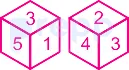
Two different positions of the same dice are shown. Which number will be at the top if 6 is at the bottom?
- A
2
- B
4
- C
1
- D
3
Show answer
D. 3Here, we can observe that 1, 2, 4, 5 are adjacent to 3. Thus, 3 will be opposite 6.
Hence, if 6 is at bottom 3 will be at top.
Paper & answer key PDF ↗ Question 7archived
Select the set in which the numbers are related in the same way as are the numbers of the following set.
(7, 13, 21)
- A
(2, 8, 16)
- B
(9, 16, 25)
- C
(17, 22, 30)
- D
(12, 18, 25)
Show answer
A. (2, 8, 16)Understanding Number Relationships in Sets
The question asks us to identify a set of numbers that shares the same relationship between its elements as the given set (7, 13, 21). To solve this, we first need to analyze the pattern or relationship within the given set.
Analyzing the Given Set (7, 13, 21)
Let's look at the differences between consecutive numbers in the set (7, 13, 21):
Difference between the second number (13) and the first number (7): \(13 - 7 = 6\)
Difference between the third number (21) and the second number (13): \(21 - 13 = 8\)
The pattern in the given set is that the difference between the first two numbers is 6, and the difference between the second and third numbers is 8. The differences increase by 2 (\(8 - 6 = 2\)). So, the relationship is based on adding consecutive even numbers (6, then 8) to the preceding number.
Examining the Options for Similar Relationships
Now, we will examine each option set to see which one follows the same pattern of differences (adding 6, then adding 8).
Option 1: (2, 8, 16)
Difference between 8 and 2: \(8 - 2 = 6\)
Difference between 16 and 8: \(16 - 8 = 8\)
The differences are 6 and 8. This pattern matches the pattern of the given set (7, 13, 21).
Option 2: (9, 16, 25)
Difference between 16 and 9: \(16 - 9 = 7\)
Difference between 25 and 16: \(25 - 16 = 9\)
The differences are 7 and 9. This pattern (adding 7, then adding 9) does not match the pattern of the given set (adding 6, then adding 8).
Option 3: (17, 22, 30)
Difference between 22 and 17: \(22 - 17 = 5\)
Difference between 30 and 22: \(30 - 22 = 8\)
The differences are 5 and 8. This pattern does not match the pattern of the given set (adding 6, then adding 8).
Option 4: (12, 18, 25)
Difference between 18 and 12: \(18 - 12 = 6\)
Difference between 25 and 18: \(25 - 18 = 7\)
The differences are 6 and 7. This pattern does not match the pattern of the given set (adding 6, then adding 8).
Conclusion: Identifying the Matching Set
Comparing the difference patterns:
Set
Difference 1 (2nd - 1st)
Difference 2 (3rd - 2nd)
Pattern Match?
(7, 13, 21)
\(13 - 7 = 6\)
\(21 - 13 = 8\)
Original Pattern (6, 8)
(2, 8, 16)
\(8 - 2 = 6\)
\(16 - 8 = 8\)
Matches (6, 8)
(9, 16, 25)
\(16 - 9 = 7\)
\(25 - 16 = 9\)
Does not match (7, 9)
(17, 22, 30)
\(22 - 17 = 5\)
\(30 - 22 = 8\)
Does not match (5, 8)
(12, 18, 25)
\(18 - 12 = 6\)
\(25 - 18 = 7\)
Does not match (6, 7)
Only the set (2, 8, 16) exhibits the same pattern of differences (adding 6, then adding 8) as the original set (7, 13, 21).
Revision Table: Key Concepts
Concept
Description
Relevance to Problem
Number Analogy
Finding a hidden relationship or rule governing a set of numbers.
The core task is to find an analogous number set.
Consecutive Differences
The difference between adjacent terms in a sequence or set.
Calculating consecutive differences helped reveal the pattern in the given set and options.
Pattern Recognition
Identifying recurring sequences, relationships, or rules.
Crucial for solving this type of problem by finding the pattern in the original set and matching it.
Additional Information: Types of Number Patterns
Number analogy problems often involve various types of patterns. Here are a few common ones:
Arithmetic Progression: Adding a constant value to get the next term (e.g., 2, 5, 8, 11... where the common difference is 3).
Geometric Progression: Multiplying by a constant value to get the next term (e.g., 3, 6, 12, 24... where the common ratio is 2).
Differences/Ratios based on position: Adding or multiplying values that change based on the term's position (like adding consecutive numbers, or consecutive even/odd numbers as seen in this problem).
Square or Cube relationships: Numbers being squares or cubes, or related to squares/cubes of their position or previous numbers (e.g., 1, 4, 9, 16... or 2, 5, 10, 17... where numbers are \(n^2 + 1\)).
Combined Operations: Patterns involving a mix of addition, subtraction, multiplication, division, or other operations.
Analyzing differences between consecutive terms, ratios, or relationships to their position are standard techniques for uncovering these patterns in number analogy questions.
Paper & answer key PDF ↗ Question 8archived
Arrange the following words in a logical and meaningful order.
1. Medicine
2. Diagnosis
3. Prescription
4. Illness
5. Recovery
6. Doctor
- A
4, 6, 3, 2, 1, 5
- B
2, 6, 4, 1, 3, 5
- C
4, 6, 2, 3, 1, 5
- D
4, 6, 1, 3, 2, 5
Show answer
C. 4, 6, 2, 3, 1, 5Understanding the Logical Sequence of Medical Events
This question asks us to arrange a set of words related to the process of dealing with an illness in a logical and meaningful order. Let's analyze the natural flow of events when someone experiences a health issue.
Analyzing Each Word and its Place in the Process
We have the following words:
Medicine
Diagnosis
Prescription
Illness
Recovery
Doctor
We need to determine the most sensible sequence starting from the beginning of a health problem.
Building the Logical Sequence Step-by-Step
The process usually begins when a person experiences an Illness. This is the initial problem. (Word 4)
When someone is ill, they typically seek help from a medical professional, a Doctor. (Word 6)
The doctor examines the patient to identify the specific illness. This process is called making a Diagnosis. (Word 2)
Once the diagnosis is made, the doctor recommends a course of treatment, often by writing a Prescription for medication. (Word 3)
The patient then obtains and takes the recommended Medicine according to the prescription. (Word 1)
Finally, if the treatment is successful, the patient gets better. This return to health is called Recovery. (Word 5)
The Logical and Meaningful Order
Following the steps above, the logical sequence of the words is:
Illness → Doctor → Diagnosis → Prescription → Medicine → Recovery
Translating this back to the numbers assigned to each word:
4 → 6 → 2 → 3 → 1 → 5
So, the correct logical and meaningful order is 4, 6, 2, 3, 1, 5.
Step
Word
Number
1
Illness
4
2
Doctor
6
3
Diagnosis
2
4
Prescription
3
5
Medicine
1
6
Recovery
5
Revision Table: Logical Ordering of Medical Process
Let's quickly review the steps in the medical process sequence:
Identify the initial event: Illness.
Identify the next action: Seek a Doctor.
What the doctor does next: Make a Diagnosis.
Based on diagnosis, what is provided: A Prescription.
What is obtained from the prescription: Medicine.
The desired outcome of treatment: Recovery.
Additional Information: Related Concepts
Understanding the sequence of events in medical care is fundamental. Here are a few related concepts:
Patient Journey: This term refers to the entire experience of a patient from the onset of symptoms through diagnosis, treatment, and recovery (or management of chronic illness). The sequence discussed is a simplified version of a patient journey.
Medical Consultation: The interaction between a patient and a doctor, where the doctor gathers information, examines the patient, diagnoses the condition, and discusses treatment options. Diagnosis and Prescription are key outcomes of a consultation.
Treatment Plan: A detailed strategy developed by a doctor for managing a patient's illness, which often includes medication (Medicine via Prescription), therapy, lifestyle changes, etc.
These concepts further illustrate the logical flow from identifying an illness to achieving recovery through medical intervention.
Paper & answer key PDF ↗ Question 9archived
‘Action’ is related to ‘Reaction’ in the same way as ‘Stimulus’ is related to ‘_________’.
- A
Reception
- B
Response
- C
Vision
- D
Feedback
Show answer
B. ResponseUnderstanding Analogies: Action, Reaction, Stimulus, and Response
Analogy questions test your ability to see relationships between pairs of words and apply that relationship to a new pair. The question gives us the first pair: ‘Action’ is related to ‘Reaction’. We need to find the word that is related to ‘Stimulus’ in the same way.
Analyzing the Relationship: Action and Reaction
Consider the relationship between ‘Action’ and ‘Reaction’:
An action is something that is done or happens.
A reaction is a response or consequence that follows an action.
In physics, Newton's Third Law states that for every action, there is an equal and opposite reaction. This implies a direct cause-and-effect relationship.
So, ‘Reaction’ is the outcome or consequence of an ‘Action’.
We are looking for a word that is the outcome or consequence of a ‘Stimulus’.
Exploring the Relationship: Stimulus and the Missing Word
A ‘Stimulus’ is something that causes a specific reaction or response. It could be a physical event, a change in environment, or anything that triggers an effect in an organism or system.
Based on the first pair, the missing word should be the consequence or outcome that results from a ‘Stimulus’.
Evaluating the Options
Let's look at the provided options and see which one fits the role of being the outcome of a ‘Stimulus’:
Option 1: Reception - Reception is the act of receiving a stimulus, like sensing light or sound. It's part of the process of responding to a stimulus, but not the response itself.
Option 2: Response - A response is a reaction or change that occurs as a result of a stimulus. For example, withdrawing your hand from a hot object is a response to the stimulus of heat. This fits the pattern: Stimulus leads to Response, just as Action leads to Reaction.
Option 3: Vision - Vision is one of the senses, a way that organisms perceive certain types of stimuli (light). It is not a general outcome of any stimulus.
Option 4: Feedback - Feedback is information about the result of a process or action, often used to adjust future actions. While related to how systems function, it's not the primary and immediate outcome of a stimulus in the same way a reaction is to an action.
Conclusion: Stimulus and Response Analogy
Comparing the relationship between ‘Action’ and ‘Reaction’ with the relationship between ‘Stimulus’ and the options, we find that ‘Response’ most accurately represents the outcome or effect caused by a ‘Stimulus’. Therefore, the analogy holds: ‘Action’ is to ‘Reaction’ as ‘Stimulus’ is to ‘Response’.
Revision Table: Key Concepts
Term
Definition
Analogy Role
Action
A deed or event
Cause/Trigger 1
Reaction
Outcome or consequence of an action
Effect/Outcome 1
Stimulus
Something that causes a response
Cause/Trigger 2
Response
A reaction to a stimulus
Effect/Outcome 2
Additional Information: Stimulus-Response Model
In biology and psychology, the stimulus-response model is a fundamental concept. It describes how an organism perceives a stimulus (input) and produces a response (output). This simple model is essential for understanding behaviors, reflexes, and learning processes. For example, a bright light (stimulus) causes the pupil of your eye to constrict (response). The relationship is direct and cause-and-effect, mirroring the Action-Reaction pair.
Paper & answer key PDF ↗ Question 10archived
Two statements are given followed by three conclusions numbered I, II and III. Assuming the statements to be true, even if they seem to be at variance with commonly known facts, decide which of the conclusions logically follow(s) from the statements.
Statements:
Some cars are vehicles.
No vehicle is a four-wheeler.
Conclusions:
I. No car is a four-wheeler.
II. All four-wheelers are cars.
III. Some vehicles are cars.
- A
All conclusions follow
- B
Only conclusions I and II follow
- C
Only conclusion I follows
- D
Only conclusion III follows
Show answer
D. Only conclusion III followsAnalyzing Logical Statements and Conclusions
The question presents two statements regarding the relationships between 'cars', 'vehicles', and 'four-wheelers'. We need to determine which of the given conclusions logically follow from these statements, assuming the statements are true.
Given Statements:
Statement 1: Some cars are vehicles.
Statement 2: No vehicle is a four-wheeler.
Given Conclusions:
Conclusion I: No car is a four-wheeler.
Conclusion II: All four-wheelers are cars.
Conclusion III: Some vehicles are cars.
Evaluating Each Conclusion
Let's analyze each conclusion based on the provided statements.
Analysis of Conclusion I: No car is a four-wheeler.
Statement 1 tells us that there is an overlap between the set of cars and the set of vehicles. Statement 2 tells us that the set of vehicles and the set of four-wheelers are completely separate.
From Statement 1 ($\text{Some Cars are Vehicles}$), we know there exists at least one car that is also a vehicle. Let's call this subset 'Cars-that-are-Vehicles'.
From Statement 2 ($\text{No Vehicle is a Four-wheeler}$), we know that nothing in the set of vehicles can be a four-wheeler. Since 'Cars-that-are-Vehicles' are part of the set of vehicles, none of these cars can be four-wheelers.
However, Statement 1 only talks about 'Some' cars. This implies there might be other cars that are not vehicles. The statements provide no information about whether these 'Cars-that-are-not-Vehicles' are four-wheelers or not. They could be four-wheelers, or they might not be. Therefore, we cannot definitively conclude that *No* car is a four-wheeler based on the given information. Conclusion I does not logically follow.
Analysis of Conclusion II: All four-wheelers are cars.
Statement 2 clearly states that $\text{No Vehicle is a Four-wheeler}$. This means the sets of vehicles and four-wheelers are disjoint.
Statement 1 tells us about an overlap between cars and vehicles ($\text{Some Cars are Vehicles}$).
The statements give no information that connects the entire set of four-wheelers to the set of cars in a way that suggests all four-wheelers must be cars. In fact, since four-wheelers are separate from vehicles, and only *some* cars are vehicles, this conclusion cannot be drawn. Conclusion II does not logically follow.
Analysis of Conclusion III: Some vehicles are cars.
Statement 1 is $\text{Some cars are vehicles}$. This statement asserts that there is at least one entity (or element) that belongs to both the set of cars and the set of vehicles.
The relationship described by a 'Some X are Y' statement is symmetrical in terms of existence of common elements. If 'Some X are Y' is true, it directly implies that 'Some Y are X' must also be true. For example, if some students are athletes, then it must also be true that some athletes are students.
Applying this logic to Statement 1: If $\text{Some cars are vehicles}$ is true, then it logically follows that $\text{Some vehicles are cars}$ must also be true.
Therefore, Conclusion III logically follows directly from Statement 1.
Summary of Conclusions:
Based on our analysis:
Conclusion I: No car is a four-wheeler - Does not follow.
Conclusion II: All four-wheelers are cars - Does not follow.
Conclusion III: Some vehicles are cars - Follows.
Only Conclusion III logically follows from the given statements.
Statement/Conclusion
Type
Relationship
Logically Follows?
Reasoning
Statement 1: Some cars are vehicles.
I ($\text{Some A are B}$)
Partial overlap between Cars and Vehicles.
N/A
Given premise.
Statement 2: No vehicle is a four-wheeler.
E ($\text{No B is C}$)
No overlap between Vehicles and Four-wheelers.
N/A
Given premise.
Conclusion I: No car is a four-wheeler.
E ($\text{No A is C}$)
No overlap between Cars and Four-wheelers.
No
Premises I+E typically yield O* ($\text{Some A are not C}$). Cannot conclude 'No A is C'.
Conclusion II: All four-wheelers are cars.
A ($\text{All C are A}$)
Four-wheelers are a subset of Cars.
No
No information supports this; contradicts relationship between Vehicles and Four-wheelers.
Conclusion III: Some vehicles are cars.
I ($\text{Some B are A}$)
Partial overlap between Vehicles and Cars.
Yes
This is the converse of Statement 1 ($\text{Some cars are vehicles}$), which is always logically equivalent.
Revision Table: Key Concepts in Syllogism
Statement Type
Form
Relationship
Valid Converse
Universal Affirmative
All A are B
A is subset of B
Some B are A
Universal Negative
No A is B
A and B are disjoint
No B is A
Particular Affirmative
Some A are B
A and B overlap
Some B are A
Particular Negative
Some A are not B
Partial separation of A from B
Not generally valid
Additional Information: Syllogism Rules
Syllogism is a form of deductive reasoning where a conclusion is drawn from two given premises. Understanding the types of statements (Universal Affirmative, Universal Negative, Particular Affirmative, Particular Negative) and how they interact is crucial for solving these problems.
In this problem:
"Some cars are vehicles" is a Particular Affirmative (I type).
"No vehicle is a four-wheeler" is a Universal Negative (E type).
The combination of an I statement and an E statement (I + E) can sometimes yield a valid conclusion of the Particular Negative (O*) type. The standard valid conclusion form for I+E in the given order (Some A are B, No B is C) is "Some A are not C". Conclusion I ($\text{No A is C}$) is a Universal Negative (E type), which is a stronger claim than "Some A are not C" and does not necessarily follow.
Conclusion III ($\text{Some vehicles are cars}$) is the converse of Statement 1 ($\text{Some cars are vehicles}$). The converse of a particular affirmative statement is always logically valid.
Paper & answer key PDF ↗ Question 11archived
Select the option in which the given figure is embedded.

- A
Option A (shown in image)
- B
Option B (shown in image)
- C
Option C (shown in image)
- D
Option D (shown in image)
Show answer
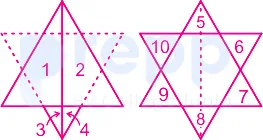
C. Option C (shown in image)Hence, the given figure is embedded in the figure in option 3.
 Paper & answer key PDF ↗
 Question 12archived
Select the figure that will come next in the following figure series.

- A
Option A (shown in image)
- B
Option B (shown in image)
- C
Option C (shown in image)
- D
Option D (shown in image)
Show answer
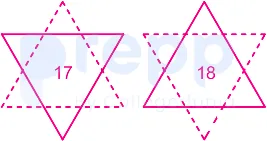
C. Option C (shown in image)In the above series the water image and mirror image both were taken to obtain the alternate image. For eg: If we take the mirror image of the water image of the first figure then we will obtain the third figure.
Therefore,
Hence, option 3 is the correct answer.
 Paper & answer key PDF ↗
 Question 13archived
A paper is folded and cut as shown below. How will it appear when unfolded?

- A
Option A (shown in image)
- B
Option B (shown in image)
- C
Option C (shown in image)
- D
Option D (shown in image)
Show answer
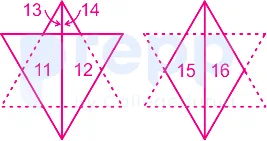
A. Option A (shown in image)Hence, the figure in option 1 is the correct answer.
 Paper & answer key PDF ↗
 Question 14archived
Which number will replace the question mark (?) in the following series?
2, 5, 11, 23, 44, ?
- A
77
- B
63
- C
66
- D
51
Show answer
A. 77This question asks us to find the missing number in the given series: 2, 5, 11, 23, 44, ?. To solve this, we need to identify the pattern or rule that connects the numbers in the sequence.
Understanding Number Series Patterns
Number series questions often involve arithmetic progressions, geometric progressions, differences, double differences, or other mathematical operations applied sequentially. Finding the pattern usually starts by examining the differences between consecutive terms.
Step-by-Step Solution to Finding the Pattern
Let's look at the differences between successive terms in the given series:
Difference between the 2nd and 1st term: \(5 - 2 = 3\)
Difference between the 3rd and 2nd term: \(11 - 5 = 6\)
Difference between the 4th and 3rd term: \(23 - 11 = 12\)
Difference between the 5th and 4th term: \(44 - 23 = 21\)
The sequence of these first differences is 3, 6, 12, 21. This sequence doesn't seem to have a constant difference or a constant ratio immediately. Let's look at the differences between these first differences (this is called the second difference):
Difference between the 2nd and 1st first difference: \(6 - 3 = 3\)
Difference between the 3rd and 2nd first difference: \(12 - 6 = 6\)
Difference between the 4th and 3rd first difference: \(21 - 12 = 9\)
The sequence of second differences is 3, 6, 9. This sequence is an arithmetic progression with a common difference of 3.
Predicting the Next Numbers in the Pattern
Since the second differences form an arithmetic progression (3, 6, 9, ...), the next second difference will be \(9 + 3 = 12\).
Now we can use this to find the next first difference. The sequence of first differences is 3, 6, 12, 21, ?. The next first difference is the previous first difference plus the next second difference: \(21 + 12 = 33\).
Finally, we can find the next number in the original series. The original series is 2, 5, 11, 23, 44, ?. The next number is the previous term plus the next first difference: \(44 + 33 = 77\).
Summarizing the Series and Differences
Term Number
Series Term
First Difference
Second Difference
1
2
-
-
2
5
\(5 - 2 = 3\)
-
3
11
\(11 - 5 = 6\)
\(6 - 3 = 3\)
4
23
\(23 - 11 = 12\)
\(12 - 6 = 6\)
5
44
\(44 - 23 = 21\)
\(21 - 12 = 9\)
6
\(44 + 33 = 77\)
\(21 + 12 = 33\)
\(9 + 3 = 12\)
The next number in the series is 77.
Revision Table: Common Number Series Patterns
Pattern Type
Description
Example
Arithmetic Progression (AP)
Constant difference between consecutive terms.
2, 5, 8, 11, ... (difference is 3)
Geometric Progression (GP)
Constant ratio between consecutive terms.
2, 6, 18, 54, ... (ratio is 3)
Difference Series
Differences between terms form an AP or GP.
Given series 2, 5, 11, 23, 44, ... (differences 3, 6, 12, 21 form a second-order AP)
Square/Cube Series
Terms related to squares or cubes of natural numbers.
1, 4, 9, 16, ... (1², 2², 3², 4²)
Mixed Series
Combination of two or more patterns or operations.
Often involves alternating patterns or multiple operations per step.
Additional Information: Solving Number Series Questions
Solving number series questions requires careful observation and systematic analysis. Here are some tips:
Always start by finding the differences between consecutive terms.
If the first differences don't show a clear pattern, find the differences of the differences (second differences), and so on.
Check for ratios if differences are not consistent, suggesting a geometric progression or a related pattern.
Look for squares, cubes, prime numbers, or other special number sequences.
Consider alternating patterns if the series jumps up and down.
Practice with various types of series to build recognition skills.
Identifying the pattern in the differences, as shown in this problem, is a common technique for solving many number series questions.
Paper & answer key PDF ↗ Question 15archived
Select the combination of letters that when sequentially placed in the gaps of the given letter series will complete the series.
ac_d_b_cbdd_a_bddb
- A
bdcab
- B
bdabc
- C
cbdbc
- D
bdbca
Show answer
B. bdabcSolving Letter Series Completion Problems
Letter series completion questions test your ability to identify a pattern in a given sequence of letters and predict the letters that should fill the gaps to continue or complete that pattern. The key is to examine the arrangement of letters, look for repetition, sequences, or other logical rules governing the series.
Analyzing the Given Letter Series
The given letter series with gaps is:
ac_d_b_cbdd_a_bddb
There are 5 gaps in the series. We need to find which combination of letters from the options, when placed sequentially in these gaps, completes the series based on a logical pattern.
The total length of the series (including gaps) is 16 letters + 5 gaps = 21 positions.
Testing the Options
Let's test each option by substituting the letters into the gaps sequentially:
Option 1: bdcab
Placing 'b', 'd', 'c', 'a', 'b' in the gaps:
ac b d d b c cbdd c a b d d b
The resulting series is: acbddbccbddcabddb. It's not immediately clear if there is a simple repeating pattern here.
Option 2: bdabc
Placing 'b', 'd', 'a', 'b', 'c' in the gaps:
ac b d d b a cbdd b a c b d d b
The resulting series is: acbddbacbddbacbddb. Let's examine this sequence closely.
Option 3: cbdbc
Placing 'c', 'b', 'd', 'b', 'c' in the gaps:
ac c d b b c cbdd d a c b d d b
The resulting series is: accdbbccbdddacddb. No obvious simple repeating pattern.
Option 4: bdbca
Placing 'b', 'd', 'b', 'c', 'a' in the gaps:
ac b d b b c cbdd c a c b d d b
The resulting series is: acbdbbccbddcacddb. No obvious simple repeating pattern.
Identifying the Pattern with Option 2
Looking at the series completed using Option 2:
acbddbacbddbacbddb
We can easily identify a repeating block of letters. Let's try grouping the letters:
acbddb | acbddb | acbddb
The series is formed by repeating the block acbddb three times.
The original series with gaps filled by Option 2 is:
ac
Gap 1: b
d
Gap 2: d
b
Gap 3: a
c
b
d
d
Gap 4: b
a
Gap 5: c
b
d
d
b
Putting it together: ac + b + d + d + b + a + c + b + d + d + b + a + c + b + d + d + b
Comparing this to the series with the repeating block acbddb:
acbddb acbddb acbddb
Original with gaps:
ac_d_b_cbdd_a_bddb
Filled with 'bdabc':
acbddbacbddbacbddb
This perfectly forms the repeating sequence acbddb.
Therefore, the combination of letters 'bdabc' correctly completes the letter series by establishing a repeating pattern.
Gap Number
Letter from Option 2 (bdabc)
Series with gap filled
1
b
acbd_b_cbdd_a_bddb
2
d
acb ddb_cbdd_a_bddb
3
a
acbdd bacbdd_a_bddb
4
b
acbddbacbddba_bddb
5
c
acbddbacbddbacbddb
The completed series is acbddbacbddbacbddb, which is three repetitions of acbddb.
Revision Table: Letter Series Patterns
Understanding common patterns helps in solving letter series questions:
Repeating blocks (as seen in this problem)
Alphabetical sequence (forward or backward)
Skipping letters in sequence (e.g., A, C, E, G...)
Difference patterns (e.g., number of letters between consecutive terms increases or decreases)
Combination of two or more patterns
Patterns based on position of letters (e.g., vowels/consonants at specific positions)
Additional Information: Tips for Solving Letter Series
Here are some tips to solve letter series and series completion problems effectively:
Count the total number of elements (letters + gaps). This can sometimes suggest the length of the repeating block (factors of the total length).
Look for immediate repetitions or sequences of letters.
If there's no simple repetition, try looking at the differences or relationships between adjacent letters or blocks.
Test the options systematically. Substitute the letters from an option into the gaps and see if a clear, consistent pattern emerges.
Practice different types of series to become familiar with various patterns.
Paper & answer key PDF ↗ Question 16archived
How many triangles are there in the following figure?

- A
18
- B
14
- C
16
- D
20
Show answer
Question 17archived
Select the word-pair in which the two words are related in the same way as are the two words in the following word-pair.
Heat : Sun
- A
Ride : Car
- B
Atmosphere : Humidity
- C
Vitamin : Fruit
- D
Home : Terrace
Show answer
C. Vitamin : FruitUnderstanding Analogies: Heat and Sun Relationship
An analogy questions asks us to find a pair of words that share the same relationship as a given pair. The given word-pair is "Heat : Sun". We need to determine the relationship between these two words.
Let's analyze the relationship between Heat and Sun:
The Sun is the primary source of heat that we experience on Earth.
Heat originates from the Sun.
So, the relationship is 'Source : Product' or 'Source of X is Y'. The Sun is the source of Heat.
Now, let's examine the given options and see which one shares a similar relationship.
Analyzing Option 1: Ride : Car
In this pair, a Car provides a Ride. A car is a source of transportation which results in a ride. The relationship is somewhat similar to 'Source : Activity/Output'. However, the 'ride' is an activity enabled by the car, not something produced or emitted by it in the same way heat is from the sun.
Analyzing Option 2: Atmosphere : Humidity
The Atmosphere is the layer of gases surrounding the Earth. Humidity is the amount of water vapor in the air. Humidity is contained within the Atmosphere. The relationship here is 'Container : Content' or 'Whole : Part'. This is not the same relationship as 'Source : Product'.
Analyzing Option 3: Vitamin : Fruit
Fruits are a common and important source of Vitamins. Vitamins are found in fruits. Fruits provide vitamins that are essential for health. The relationship here is 'Product : Source' or 'Source of Product is Y'. If we reverse the order to match "Heat : Sun", it becomes "Fruit : Vitamin", meaning Fruit is a source of Vitamin. This matches the 'Source : Product' relationship observed in "Heat : Sun".
Analyzing Option 4: Home : Terrace
A Terrace is a part of a Home. The relationship here is 'Whole : Part'. This is not the same relationship as 'Source : Product'.
Comparing the Relationships
Let's put the relationships in a table for clarity:
Word-Pair
Relationship
Explanation
Heat : Sun
Product : Source
Sun is the source of Heat.
Ride : Car
Activity : Source
Car is the source of the ability to Ride.
Atmosphere : Humidity
Container : Content
Atmosphere contains Humidity.
Vitamin : Fruit
Product : Source
Fruit is a source of Vitamin.
Home : Terrace
Whole : Part
Terrace is part of a Home.
Comparing the relationships, the relationship in "Heat : Sun" (Product : Source, or Source of Heat is Sun) is most similar to the relationship in "Vitamin : Fruit" (Product : Source, or Source of Vitamin is Fruit).
Conclusion on Analogous Relationship
The analogy "Heat : Sun" establishes a relationship where the second word (Sun) is the source of the first word (Heat). Among the given options, "Vitamin : Fruit" exhibits the same relationship where the second word (Fruit) is a source of the first word (Vitamin).
Revision Table: Key Concepts
Concept
Description
Example
Analogy
A comparison between two things for the purpose of explanation or clarification.
"Life is like a box of chocolates."
Word Analogies
Comparing pairs of words to find similar relationships.
"Dog is to Bark as Cat is to Meow." (Animal : Sound)
Source
The origin or where something comes from.
The sun is the source of light.
Additional Information: Types of Analogies
Understanding common types of word analogies can help solve these questions more easily. Some common types include:
Part to Whole: Finger : Hand (Finger is part of a Hand)
Cause and Effect: Rain : Flood (Rain can cause a Flood)
Object and Function: Knife : Cut (The function of a Knife is to Cut)
Performer and Action: Chef : Cook (A Chef performs the action of Cooking)
Synonyms: Happy : Joyful (Happy is a synonym of Joyful)
Antonyms: Hot : Cold (Hot is an antonym of Cold)
Degree: Warm : Hot (Hot is a greater degree of Warm)
Product and Source: Wool : Sheep (Wool comes from Sheep) - This is the type in the question.
In the case of "Heat : Sun", it's a Product (Heat) originating from a Source (Sun). Similarly, "Vitamin : Fruit" represents a Product (Vitamin) originating from a Source (Fruit).
Paper & answer key PDF ↗ Question 18archived
Which two signs should be interchanged in the following equation to make it correct?
18 + 6 - 6 ÷ 3 × 3 = 6
- A
+ and ×
- B
+ and ÷
- C
+ and -
- D
and ÷
Show answer
B. + and ÷Understanding the Problem: Sign Interchange in Equations
The question asks us to identify which two mathematical operation signs in the given equation, $18 + 6 - 6 \div 3 \times 3 = 6$, need to be swapped with each other to make the equation true. We need to evaluate the equation after each potential sign interchange using the standard order of operations (BODMAS/PEMDAS).
Applying the Order of Operations (BODMAS/PEMDAS)
To correctly evaluate mathematical expressions, we follow a specific order for operations. This order is commonly known as BODMAS or PEMDAS:
B/P: Brackets / Parentheses
O/E: Orders / Exponents
D/M: Division / Multiplication (from left to right)
A/S: Addition / Subtraction (from left to right)
We will apply this rule after interchanging the signs as suggested by each option.
Testing the Options for Correct Sign Interchange
We will test each option by swapping the specified signs in the original equation $18 + 6 - 6 \div 3 \times 3 = 6$ and evaluating the result using BODMAS.
Option 1: Interchange + and ×
Original equation: $18 + 6 - 6 \div 3 \times 3 = 6$
After interchanging + and ×:
$18 \times 6 - 6 \div 3 + 3$
Evaluate using BODMAS:
Division: $6 \div 3 = 2$
Equation becomes: $18 \times 6 - 2 + 3$
Multiplication: $18 \times 6 = 108$
Equation becomes: $108 - 2 + 3$
Subtraction/Addition (left to right): $108 - 2 = 106$
Equation becomes: $106 + 3 = 109$
Since $109 \neq 6$, interchanging + and × does not make the equation correct.
Option 2: Interchange + and ÷
Original equation: $18 + 6 - 6 \div 3 \times 3 = 6$
After interchanging + and ÷:
$18 \div 6 - 6 + 3 \times 3$
Evaluate using BODMAS:
Division: $18 \div 6 = 3$
Equation becomes: $3 - 6 + 3 \times 3$
Multiplication: $3 \times 3 = 9$
Equation becomes: $3 - 6 + 9$
Subtraction/Addition (left to right): $3 - 6 = -3$
Equation becomes: $-3 + 9 = 6$
Since $6 = 6$, interchanging + and ÷ makes the equation correct.
Option 3: Interchange + and -
Original equation: $18 + 6 - 6 \div 3 \times 3 = 6$
After interchanging + and -:
$18 - 6 + 6 \div 3 \times 3$
Evaluate using BODMAS:
Division: $6 \div 3 = 2$
Equation becomes: $18 - 6 + 2 \times 3$
Multiplication: $2 \times 3 = 6$
Equation becomes: $18 - 6 + 6$
Subtraction/Addition (left to right): $18 - 6 = 12$
Equation becomes: $12 + 6 = 18$
Since $18 \neq 6$, interchanging + and - does not make the equation correct.
Option 4: Interchange - and ÷
Original equation: $18 + 6 - 6 \div 3 \times 3 = 6$
After interchanging - and ÷:
$18 + 6 \div 6 - 3 \times 3$
Evaluate using BODMAS:
Division: $6 \div 6 = 1$
Equation becomes: $18 + 1 - 3 \times 3$
Multiplication: $3 \times 3 = 9$
Equation becomes: $18 + 1 - 9$
Addition/Subtraction (left to right): $18 + 1 = 19$
Equation becomes: $19 - 9 = 10$
Since $10 \neq 6$, interchanging - and ÷ does not make the equation correct.
Based on the evaluation of each option, interchanging the signs + and ÷ is the only way to make the given equation $18 + 6 - 6 \div 3 \times 3 = 6$ correct.
Revision Table: Sign Interchange and Equation Result
Signs Interchanged
Modified Equation
Result after BODMAS
Correct Equation?
+ and ×
$18 \times 6 - 6 \div 3 + 3$
$109$
No
+ and ÷
$18 \div 6 - 6 + 3 \times 3$
$6$
Yes
+ and -
$18 - 6 + 6 \div 3 \times 3$
$18$
No
- and ÷
$18 + 6 \div 6 - 3 \times 3$
$10$
No
Additional Information: Importance of Order of Operations
The order of operations is crucial in mathematics. Without a standard order, the same expression could be interpreted in multiple ways, leading to different results. For example, $3 + 4 \times 5$ could be $(3+4) \times 5 = 7 \times 5 = 35$ or $3 + (4 \times 5) = 3 + 20 = 23$. BODMAS/PEMDAS ensures everyone gets the same correct answer by specifying the sequence: multiplication and division before addition and subtraction.
Problems involving interchanging signs test your understanding of both the mathematical operations and the correct order in which they must be performed.
Paper & answer key PDF ↗ Question 19archived
Select the number-pair in which two numbers are related in the same way as are two numbers of the following number-pair.
4 : 32
- A
10 : 160
- B
6 : 108
- C
8 : 248
- D
5 : 62
Show answer
B. 6 : 108Understanding Number Pair Analogy Questions
Number pair analogy questions test your ability to identify the relationship between a pair of numbers and apply that same relationship to other pairs. To solve these questions, you need to analyze the given pair carefully and look for patterns involving arithmetic operations, powers, roots, or combinations thereof.
Analyzing the Given Number Pair: 4 : 32
Let's examine the relationship between the first number, 4, and the second number, 32. We can try different mathematical operations:
Is it multiplication? $4 \times N = 32 \implies N = 32 / 4 = 8$. So, the relationship could be "multiply the first number by 8".
Is it related to powers? $4^2 = 16$, $4^3 = 64$. 32 is half of 64. So, the relationship could be "cube the first number and divide by 2". Let's check this: $4^3 / 2 = 64 / 2 = 32$. This fits perfectly.
Could it be related to squaring? $4^2 = 16$. $16 \times 2 = 32$. So, "square the first number and multiply by 2". Let's check this: $4^2 \times 2 = 16 \times 2 = 32$. This also fits.
Let's compare the two possible relationships: $n^3 / 2$ and $n^2 \times 2$. For a number $n$, $n^2 \times 2 = n \times n \times 2$. And $n^3 / 2 = n \times n^2 / 2$. These look different. However, $n^3/2 = n \times (n^2/2)$ and $n^2 \times 2 = n \times (n \times 2)$. Wait, $n^3/2$ is the most direct relationship derived from $4^3=64$ and $32=64/2$. The relationship $n^2 \times 2$ also works for $n=4$, but let's test the options with the $n^3/2$ rule first, as it seems simpler.
Let's assume the relationship is $n : n^3 / 2$, where the first number is $n$ and the second number is $n^3/2$. For the given pair 4 : 32, this holds true because $4^3 / 2 = 64 / 2 = 32$.
Testing the Options
Now, we apply the relationship $n : n^3 / 2$ to the first number in each option pair and check if it gives the second number.
Option
Number Pair (n : ?)
Calculation ($n^3 / 2$)
Result
Matches Second Number?
1
10 : 160
$10^3 / 2 = 1000 / 2$
500
No (500 ≠ 160)
2
6 : 108
$6^3 / 2 = 216 / 2$
108
Yes (108 = 108)
3
8 : 248
$8^3 / 2 = 512 / 2$
256
No (256 ≠ 248)
4
5 : 62
$5^3 / 2 = 125 / 2$
62.5
No (62.5 ≠ 62)
From the table, we can see that only the number pair 6 : 108 follows the relationship $n : n^3 / 2$.
Conclusion
The number pair 6 : 108 is related in the same way as the number pair 4 : 32. The relationship is that the second number is the cube of the first number divided by 2.
Revision Table: Number Analogy
Original Pair
Identified Relationship
Check
4 : 32
$n : n^3 / 2$
$4^3 / 2 = 64 / 2 = 32$ (Matches)
Option Pair
Check Relationship ($n^3 / 2$)
Result
10 : 160
$10^3 / 2 = 500$
Does not match 160
6 : 108
$6^3 / 2 = 108$
Matches 108
8 : 248
$8^3 / 2 = 256$
Does not match 248
5 : 62
$5^3 / 2 = 62.5$
Does not match 62
Additional Information on Number Series and Analogy
Number analogy questions are a common type in logical reasoning and quantitative aptitude tests. They require you to spot patterns in number pairs, triplets, or series. Common patterns include:
Basic operations: Addition, subtraction, multiplication, division.
Powers and roots: Squares, cubes, square roots, cube roots.
Combinations of operations: E.g., $n^2+k$, $n^3-k$, $n \times (n+k)$, etc.
Digit operations: Sum of digits, product of digits, etc.
Prime numbers, composite numbers.
Odd/Even number properties.
When tackling these questions, it's useful to systematically test common relationships starting with simpler ones (like multiplication) and moving to more complex ones (like powers or combinations). Practicing with different types of number pattern questions helps in quickly identifying the underlying rule.
Paper & answer key PDF ↗ Question 20archived
10 years ago, a father’s age was \(3\frac{1}{2}\) times that of his son, and 10 years from now, the father’s age will be \(2\frac{1}{4}\) times that of the son. What will be the sum of the ages of the father and the son at present?
- A
115 years
- B
100 years
- C
110 years
- D
120 years
Show answer
C. 110 yearsSolving Father and Son Age Word Problems
This problem involves finding the current ages of a father and a son based on given relationships between their ages at different points in time. We can solve this using a system of linear equations.
Defining Variables for Present Ages
Let's use variables to represent their current ages:
Let F be the father's current age in years.
Let S be the son's current age in years.
Setting Up Equations Based on Past and Future Ages
The problem gives us information about their ages 10 years ago and 10 years from now.
10 Years Ago:
Father's age 10 years ago was \(F - 10\).
Son's age 10 years ago was \(S - 10\).
The father's age was \(3\frac{1}{2}\) times that of his son.
This gives us the first equation:
\(F - 10 = 3\frac{1}{2} \times (S - 10)\)
Convert the mixed number to an improper fraction: \(3\frac{1}{2} = \frac{2 \times 3 + 1}{2} = \frac{7}{2}\).
So the equation becomes:
\(F - 10 = \frac{7}{2}(S - 10)\)
Multiply both sides by 2 to remove the fraction:
\(2(F - 10) = 7(S - 10)\)
\(2F - 20 = 7S - 70\)
Rearrange into a standard form:
\(2F - 7S = -70 + 20\)
\(2F - 7S = -50\) (Equation 1)
10 Years From Now:
Father's age 10 years from now will be \(F + 10\).
Son's age 10 years from now will be \(S + 10\).
The father's age will be \(2\frac{1}{4}\) times that of the son.
This gives us the second equation:
\(F + 10 = 2\frac{1}{4} \times (S + 10)\)
Convert the mixed number to an improper fraction: \(2\frac{1}{4} = \frac{4 \times 2 + 1}{4} = \frac{9}{4}\).
So the equation becomes:
\(F + 10 = \frac{9}{4}(S + 10)\)
Multiply both sides by 4 to remove the fraction:
\(4(F + 10) = 9(S + 10)\)
\(4F + 40 = 9S + 90\)
Rearrange into a standard form:
\(4F - 9S = 90 - 40\)
\(4F - 9S = 50\) (Equation 2)
Solving the System of Linear Equations
We now have a system of two linear equations:
\(2F - 7S = -50\)
\(4F - 9S = 50\)
We can solve this system using the elimination method. Multiply Equation 1 by 2 to make the coefficient of F in both equations equal:
\(2 \times (2F - 7S) = 2 \times (-50)\)
\(4F - 14S = -100\) (Equation 3)
Now, subtract Equation 3 from Equation 2:
\((4F - 9S) - (4F - 14S) = 50 - (-100)\)
\(4F - 9S - 4F + 14S = 50 + 100\)
\(5S = 150\)
Solve for S:
\(S = \frac{150}{5}\)
\(S = 30\)
The son's current age is 30 years.
Now substitute the value of S (30) back into either Equation 1 or Equation 2 to find F. Let's use Equation 1:
\(2F - 7(30) = -50\)
\(2F - 210 = -50\)
\(2F = -50 + 210\)
\(2F = 160\)
Solve for F:
\(F = \frac{160}{2}\)
\(F = 80\)
The father's current age is 80 years.
Calculating the Sum of Present Ages
The question asks for the sum of the ages of the father and the son at present. This is \(F + S\).
Sum of present ages = \(80 + 30 = 110\) years.
To verify, let's check the conditions:
10 years ago: Father was \(80-10=70\), Son was \(30-10=20\). Is \(70 = \frac{7}{2} \times 20\)? \(70 = 7 \times 10\), \(70 = 70\). Yes.
10 years from now: Father will be \(80+10=90\), Son will be \(30+10=40\). Is \(90 = \frac{9}{4} \times 40\)? \(90 = 9 \times 10\), \(90 = 90\). Yes.
The calculated ages satisfy the conditions.
figure class="table"
Present Ages and Their Sum
Person
Present Age (Years)
Father
80
Son
30
Sum of Ages
\(80 + 30 = 110\)
Revision Table: Key Concepts in Age Problems
figure class="table"
Age Problem Concepts
Concept
Explanation
Mathematical Representation
Present Age
Age at the current time.
Variable (e.g., A)
Age 'x' years ago
Age in the past.
Present Age - x (e.g., A - x)
Age 'y' years from now
Age in the future.
Present Age + y (e.g., A + y)
Ratio of Ages
Relationship between ages expressed as a ratio or multiple.
A / B = ratio or A = multiple * B
Sum/Difference of Ages
Combined ages or difference between ages.
A + B or A - B
Additional Information: Solving Systems of Linear Equations
Age problems often lead to systems of linear equations. Here are common methods to solve them:
Substitution Method: Solve one equation for one variable (e.g., F in terms of S) and substitute that expression into the other equation.
Elimination Method: Multiply one or both equations by constants so that the coefficients of one variable are opposites or identical. Then add or subtract the equations to eliminate that variable.
Graphical Method: Graph both equations on a coordinate plane. The intersection point represents the solution. This method is less precise for non-integer solutions.
Choosing the best method depends on the specific equations. For the system \(2F - 7S = -50\) and \(4F - 9S = 50\), elimination was efficient because multiplying the first equation by 2 made the coefficient of F (4) match the second equation.
Paper & answer key PDF ↗ Question 21archived
Select the set in which the numbers are related in the same way as are the numbers of the following set.
(10, 18, 38)
- A
(12, 22, 46)
- B
(14, 12, 8)
- C
(4, 12, 22)
- D
(18, 6, 14)
Show answer
A. (12, 22, 46)Understanding Number Set Analogies
Number set analogy questions require you to identify the relationship or pattern between the numbers in a given set and then find another set from the options that follows the same rule. Let's break down the given set (10, 18, 38) to discover the underlying pattern.
Analyzing the Given Number Set (10, 18, 38)
We are given the set (10, 18, 38). Let's denote the first number as \(n_1\), the second as \(n_2\), and the third as \(n_3\).
\(n_1 = 10\)
\(n_2 = 18\)
\(n_3 = 38\)
Let's try to find a relationship between these numbers. We can look at differences, sums, products, or operations involving multiplication and addition/subtraction.
Difference between \(n_2\) and \(n_1\): \(18 - 10 = 8\)
Difference between \(n_3\) and \(n_2\): \(38 - 18 = 20\)
The differences (8 and 20) don't immediately suggest a simple arithmetic or geometric progression. Let's look for relationships involving multiplication.
Consider the relationship between \(n_1\) and \(n_2\):
Is \(n_2\) a multiple of \(n_1\)? No, 18 is not a multiple of 10.
Is \(n_2\) related to \(n_1\) by multiplication and addition/subtraction? Let's try multiplying \(n_1\) by a small integer. \(10 \times 2 = 20\). \(18\) is close to 20. \(20 - 2 = 18\). This looks promising. So, \(n_2 = n_1 \times 2 - 2\). Let's check this: \(10 \times 2 - 2 = 20 - 2 = 18\). This holds true for the first two numbers.
Now let's consider the relationship between \(n_2\) and \(n_3\), perhaps using a similar pattern:
Is \(n_3\) related to \(n_2\) by multiplication and addition/subtraction? Let's try multiplying \(n_2\) by the same integer (2). \(18 \times 2 = 36\). \(38\) is close to 36. \(36 + 2 = 38\). This also looks promising. So, \(n_3 = n_2 \times 2 + 2\). Let's check this: \(18 \times 2 + 2 = 36 + 2 = 38\). This holds true for the second and third numbers.
So, the discovered rule is:
The second number (\(n_2\)) is obtained by multiplying the first number (\(n_1\)) by 2 and subtracting 2: \(n_2 = n_1 \times 2 - 2\).
The third number (\(n_3\)) is obtained by multiplying the second number (\(n_2\)) by 2 and adding 2: \(n_3 = n_2 \times 2 + 2\).
Testing the Rule on the Options
Now we apply this rule to each of the given options to find the set that follows the same pattern.
Option 1: (12, 22, 46)
\(n_1 = 12\)
Check \(n_2\): \(n_1 \times 2 - 2 = 12 \times 2 - 2 = 24 - 2 = 22\). This matches the second number in the set.
Check \(n_3\): \(n_2 \times 2 + 2 = 22 \times 2 + 2 = 44 + 2 = 46\). This matches the third number in the set.
This set (12, 22, 46) follows the same rule as the given set (10, 18, 38).
Option 2: (14, 12, 8)
\(n_1 = 14\)
Check \(n_2\): \(n_1 \times 2 - 2 = 14 \times 2 - 2 = 28 - 2 = 26\). The second number in the set is 12, not 26. This set does not follow the rule.
Option 3: (4, 12, 22)
\(n_1 = 4\)
Check \(n_2\): \(n_1 \times 2 - 2 = 4 \times 2 - 2 = 8 - 2 = 6\). The second number in the set is 12, not 6. This set does not follow the rule.
Option 4: (18, 6, 14)
\(n_1 = 18\)
Check \(n_2\): \(n_1 \times 2 - 2 = 18 \times 2 - 2 = 36 - 2 = 34\). The second number in the set is 6, not 34. This set does not follow the rule.
Conclusion
Based on the analysis, only the set (12, 22, 46) follows the same pattern or relationship as the given set (10, 18, 38).
Set
\(n_1\)
\(n_2\) (Expected: \(n_1 \times 2 - 2\))
\(n_2\) (Given)
\(n_3\) (Expected: \(n_2 \times 2 + 2\))
\(n_3\) (Given)
Follows Rule?
(10, 18, 38)
10
\(10 \times 2 - 2 = 18\)
18
\(18 \times 2 + 2 = 38\)
38
Yes (Base Set)
(12, 22, 46)
12
\(12 \times 2 - 2 = 22\)
22
\(22 \times 2 + 2 = 46\)
46
Yes
(14, 12, 8)
14
\(14 \times 2 - 2 = 26\)
12
-
-
No
(4, 12, 22)
4
\(4 \times 2 - 2 = 6\)
12
-
-
No
(18, 6, 14)
18
\(18 \times 2 - 2 = 34\)
6
-
-
No
Revision Table: Key Concepts
Concept
Description
Application in this Problem
Number Analogy
Finding a relationship or rule in a set of numbers and applying it to another set.
Identifying the pattern in (10, 18, 38).
Pattern Recognition
Observing numbers to find mathematical operations (addition, subtraction, multiplication, division, squaring, etc.) that connect them.
Discovering the \(n_1 \to n_2\) and \(n_2 \to n_3\) rules.
Rule Verification
Testing the hypothesized rule against the given set and then against the options.
Applying \(n_2 = n_1 \times 2 - 2\) and \(n_3 = n_2 \times 2 + 2\) to all sets.
Additional Information: Solving Number Series and Analogies
Number analogies are common in logical reasoning and quantitative aptitude tests. They assess your ability to identify patterns and relationships between numbers. Here are some tips for solving such problems:
Look for simple relationships first: differences, sums, products, quotients between adjacent numbers or numbers at fixed positions.
Consider multiple operations: The pattern might involve a combination of multiplication/division with addition/subtraction, as seen in this problem.
Check for sequences involving squares, cubes, prime numbers, or other special types of numbers.
If the pattern isn't immediately obvious, look at the differences between differences (second-order differences) or ratios.
Systematically test your hypothesized rule on the given example before applying it to the options.
Work through each option carefully, applying the rule to see if it holds true for all numbers in the set.
Practicing different types of number series and analogy problems will help you become familiar with common patterns and improve your speed and accuracy.
Paper & answer key PDF ↗ Question 22archived
If BACK is coded as 11312 and CAKE is coded as 51113, then how will MADE be coded as?
- A
51413
- B
54113
- C
31145
- D
13145
Show answer
B. 54113Understanding Letter Coding and Decoding
This question asks us to decode a word based on a given coding pattern observed in two examples. We need to analyze how the words 'BACK' and 'CAKE' are coded to find the rule and then apply it to the word 'MADE'.
Analyzing the Coding Pattern
Let's look at the first example:
Word: BACK
Coded as: 11312
Let's consider the letters' positions in the English alphabet (A=1, B=2, C=3, ..., Z=26).
B is the 2nd letter.
A is the 1st letter.
C is the 3rd letter.
K is the 11th letter.
The letters in the word BACK are B, A, C, K. Their positions are 2, 1, 3, 11.
The coded string is 11312. If we look at the letters of BACK in reverse order (K, C, A, B), their positions are K(11), C(3), A(1), B(2). Putting these numbers together gives 11312. This matches the given code.
Let's test this rule with the second example:
Word: CAKE
Coded as: 51113
The letters are C, A, K, E. Their positions are C(3), A(1), K(11), E(5).
Applying the proposed rule: Reverse the word (E, K, A, C) and write their positions consecutively.
E is the 5th letter.
K is the 11th letter.
A is the 1st letter.
C is the 3rd letter.
Putting these positions together: 5, 11, 1, 3. This gives the code 51113, which also matches the given code for CAKE.
The pattern is confirmed: Reverse the word and concatenate the alphabetical position of each letter.
Applying the Pattern to MADE
Now we apply the same rule to the word MADE:
Word: MADE
Reverse the word: EDAM.
Find the alphabetical position for each letter in EDAM:
E is the 5th letter.
D is the 4th letter.
A is the 1st letter.
M is the 13th letter.
Concatenate these positions: 5, 4, 1, 13. The resulting code is 54113.
Comparing this code with the given options:
The code 54113 matches option 2.
Conclusion
Based on the coding pattern where the reversed word's letter positions are concatenated, the word MADE is coded as 54113.
Word
Reversed Word
Letter Positions (A=1, ...)
Coded Value
BACK
KCAB
K(11), C(3), A(1), B(2)
11312
CAKE
EKAC
E(5), K(11), A(1), C(3)
51113
MADE
EDAM
E(5), D(4), A(1), M(13)
54113
Revision Table: Key Concepts in Letter Coding
Concept
Description
Example Types
Alphabetical Position
Assigning a number to each letter based on its order in the alphabet (A=1, B=2, etc.).
Direct mapping, reverse mapping, sum of positions, difference of positions.
Letter Reversal
Coding based on the letters of the word written in reverse order.
As seen in this question, position mapping of reversed letters.
Pattern Identification
Analyzing given examples to discover the rule relating the original word to its coded form.
Substitution, displacement, number patterns, symbol usage.
Additional Information: Solving Coding-Decoding Problems
Coding and decoding questions test your ability to find patterns. Here are some common strategies:
Analyze the mapping: Look at corresponding letters/numbers/symbols in the original and coded forms.
Check positions: See if the alphabetical position of letters is used directly, reversed, or in some mathematical operation (sum, difference, product).
Look for reversal: Check if the word or part of the word is reversed before coding.
Identify common letters: If the same letter appears in different words, see if it's always coded the same way.
Consider displacement: The code might be the original letter shifted a certain number of places forward or backward in the alphabet (e.g., A > C is a shift of +2).
Break down the code: If the code is a number, see if it relates to individual letters or the whole word.
Practice: Solving various types of problems helps you recognize common patterns quickly.
Paper & answer key PDF ↗ Question 23archived
Select the Venn diagram that best illustrates the relationship between the following classes.
Parents, Rich Person, Farmers
- A
Option A (shown in image)
- B
Option B (shown in image)
- C
Option C (shown in image)
- D
Option D (shown in image)
Show answer
A. Option A (shown in image)The most appropriate Venn diagram that illustrates the relationship between Parents, Rich Persons, and Farmers is:
Hence, the above Venn diagram is the correct answer.
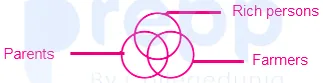 Paper & answer key PDF ↗
 Question 24archived
Select the option that is related to the third letter - cluster in the same way as the second letter - cluster is related to the first letter - cluster.
BECD : YVXW ∷ DGEF : ?
- A
WUTV
- B
VRTS
- C
WTVU
- D
XUWV
Show answer
C. WTVUUnderstanding Letter Cluster Analogies
Letter cluster analogy questions test your ability to find a relationship or pattern between two sets of letters and apply that same pattern to a third set to find a fourth. In this specific analogy, we are given the relationship between 'BECD' and 'YVXW' and need to use that to find the letter cluster related to 'DGEF'.
Analyzing the Relationship: BECD and YVXW
Let's examine the position of each letter in the English alphabet:
A=1, B=2, C=3, ..., Z=26
Mapping the letters in the first pair:
B is the 2nd letter.
E is the 5th letter.
C is the 3rd letter.
D is the 4th letter.
Mapping the letters in the second pair:
Y is the 25th letter.
V is the 22nd letter.
X is the 24th letter.
W is the 23rd letter.
Now, let's look at the relationship between the corresponding letters:
B (2nd) and Y (25th): The sum of their positions is 2 + 25 = 27.
E (5th) and V (22nd): The sum of their positions is 5 + 22 = 27.
C (3rd) and X (24th): The sum of their positions is 3 + 24 = 27.
D (4th) and W (23rd): The sum of their positions is 4 + 23 = 27.
The pattern here is that each letter in the second cluster ('YVXW') is the "opposite" letter of the corresponding letter in the first cluster ('BECD'). Opposite letters are those whose positions in the alphabet add up to 27.
We can represent this relationship mathematically using LaTeX:
\text{Position of letter 1} + \text{Position of letter 2} = 27
Applying the Pattern to DGEF
Now, we apply the same 'opposite letter' rule to the letter cluster 'DGEF'. We need to find the letter whose position adds up to 27 with the position of each letter in 'DGEF'.
D: D is the 4th letter. The opposite letter is the one at position 27 - 4 = 23. The 23rd letter is W.
G: G is the 7th letter. The opposite letter is the one at position 27 - 7 = 20. The 20th letter is T.
E: E is the 5th letter. The opposite letter is the one at position 27 - 5 = 22. The 22nd letter is V.
F: F is the 6th letter. The opposite letter is the one at position 27 - 6 = 21. The 21st letter is U.
Combining these letters in order (corresponding to D, G, E, F), we get the cluster 'WTVU'.
Checking the Options
Let's compare our derived cluster 'WTVU' with the given options:
WUTV
VRTS
WTVU
XUWV
Our result 'WTVU' matches option 3.
Conclusion
The relationship between BECD and YVXW is that each corresponding letter is its alphabetical opposite (summing to 27). Applying this pattern to DGEF gives us WTVU.
Revision Table: Letter Opposite Positions
Letter
Position
Opposite Letter
Opposite Position
Sum
B
2
Y
25
27
E
5
V
22
27
C
3
X
24
27
D
4
W
23
27
G
7
T
20
27
F
6
U
21
27
Additional Information: Solving Analogy Questions
Letter analogies can follow various patterns. Common patterns include:
Adding or subtracting a fixed number to letter positions.
Reversing the order of letters.
Skipping a fixed number of letters.
Using vowels or consonants patterns.
Using 'opposite' letters (like the one in this question).
Combinations of the above patterns.
To solve these questions, it's helpful to:
Write down the alphabetical positions (1-26) for reference.
Analyze the first pair carefully to identify the exact pattern.
Apply the identified pattern consistently to the second element of the analogy.
Check your derived answer against the options provided.
Paper & answer key PDF ↗ Question 25archived
Select the correct mirror image of the given figure when the mirror is placed to the right of the figure.

- A
Option A (shown in image)
- B
Option B (shown in image)
- C
Option C (shown in image)
- D
Option D (shown in image)
Show answer
B. Option B (shown in image)Hence, option 2 is the correct mirror image.
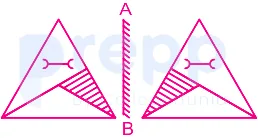 Paper & answer key PDF ↗
 Question 26archived
The Special Olympics World Games 2019 was inaugurated at ________.
- A
Austria
- B
Germany
- C
Abu Dhabi
- D
Sweden
Show answer
C. Abu DhabiUnderstanding the Special Olympics World Games 2019 Inauguration
The question asks about the location where the Special Olympics World Games 2019 were inaugurated. These games are a major international sports event for athletes with intellectual disabilities.
Identifying the Inauguration Location of Special Olympics World Games 2019
To answer this question, we need to know the host city for the Special Olympics World Games held in 2019. The Special Olympics World Games are held every two years, alternating between Summer and Winter Games. The 2019 event was the Summer World Games.
Historical records and official announcements confirm that the Special Olympics World Games 2019 were held in Abu Dhabi, United Arab Emirates (UAE). The inauguration ceremony, marking the official start of the games, took place in the host city.
Therefore, the inauguration of the Special Olympics World Games 2019 was held in Abu Dhabi.
Analyzing the Options
Let's look at the given options:
Austria: Austria hosted the Special Olympics World Winter Games in 2017.
Germany: Germany hosted the Special Olympics World Games (Summer) in Berlin in 2023.
Abu Dhabi: Abu Dhabi, UAE, was the host city for the Special Olympics World Summer Games in 2019.
Sweden: Sweden was originally scheduled to host the Special Olympics World Winter Games in 2021 but later withdrew.
Based on the confirmed host city for the Special Olympics World Games 2019 Summer Games, Abu Dhabi is the correct location for the inauguration.
Confirming the Host City for Special Olympics World Games 2019
The Special Olympics World Games 2019 were a significant event, bringing together thousands of athletes from around the world. The fact that Abu Dhabi was the first city in the Middle East/North Africa region to host the Special Olympics World Games highlights its importance. The opening ceremony was a major part of the event, officially launching the competition and celebrations.
Thus, the inauguration occurred in Abu Dhabi.
Event
Year
Type
Host Location
Special Olympics World Games
2017
Winter
Austria
Special Olympics World Games
2019
Summer
Abu Dhabi, UAE
Special Olympics World Games
2023
Summer
Berlin, Germany
This table clearly shows Abu Dhabi as the host of the Special Olympics World Games in 2019.
Revision Table: Special Olympics World Games Locations
Year
Host City/Country
Game Type (Summer/Winter)
2017
Austria
Winter
2019
Abu Dhabi, UAE
Summer
2023
Berlin, Germany
Summer
Additional Information: Special Olympics World Games
The Special Olympics is a global movement that unleashes the human spirit through the transformative power and joy of sports every day around the world. It is distinct from the Paralympics, though both cater to athletes with disabilities.
Special Olympics focuses on individuals with intellectual disabilities.
Special Olympics provides year-round training and competitions.
The World Games are the flagship event, bringing together thousands of athletes from over 170 countries.
Participation in Special Olympics programs helps athletes develop physical fitness, demonstrate courage, experience joy, and participate in a sharing of gifts, skills, and friendship with their families, other Special Olympics athletes, and the community.
The 2019 Games in Abu Dhabi were a historic event, promoting inclusion and acceptance on a global scale.
Paper & answer key PDF ↗ Question 27archived
Which of the following Articles of the Constitution of India deals with the Uniform Civil Code?
- A
Article 43
- B
Article 45
- C
Article 44
- D
Article 46
Show answer
C. Article 44Understanding the Uniform Civil Code in the Indian Constitution
The question asks which specific Article within the Constitution of India deals with the Uniform Civil Code (UCC). The Uniform Civil Code is a topic under discussion regarding personal laws in India.
Let's look at the relevant part of the Indian Constitution, which is Part IV, containing the Directive Principles of State Policy (DPSP). These principles are guidelines for the government to follow while making laws.
Analysis of the Options
We need to examine each provided Article to determine which one relates to the Uniform Civil Code.
Article 43: This Article deals with securing a living wage, conditions of work ensuring a decent standard of life, and full enjoyment of leisure and social and cultural opportunities for workers. It also promotes cottage industries. This does not relate to a Uniform Civil Code.
Article 45: This Article, in its original form, dealt with provision for free and compulsory education for children. It has since been amended, and the primary right to education is now in Article 21A, while Article 45 focuses on early childhood care and education for children below the age of six years. This does not relate to a Uniform Civil Code.
Article 44: This Article states that the State shall endeavour to secure for the citizens a Uniform Civil Code throughout the territory of India. This directly addresses the concept of a Uniform Civil Code.
Article 46: This Article promotes the educational and economic interests of the weaker sections of the people, especially the Scheduled Castes and the Scheduled Tribes, and protects them from social injustice and all forms of exploitation. This does not relate to a Uniform Civil Code.
Based on the analysis, Article 44 is the Article that explicitly mentions the Uniform Civil Code.
What is the Uniform Civil Code (UCC)?
The Uniform Civil Code refers to a proposed common set of laws governing personal matters for all citizens of India, regardless of their religion. These personal matters typically include marriage, divorce, adoption, inheritance, and succession. Currently, different religious communities in India are often governed by their own personal laws.
Article Number
Subject Matter
Article 43
Living wage, etc., for workers
Article 44
Uniform Civil Code for the citizens
Article 45
Provision for early childhood care and education to children below the age of six years
Article 46
Promotion of educational and economic interests of Scheduled Castes, Scheduled Tribes and other weaker sections
Revision Table: Key Directive Principles
Part of Constitution
Nature of Principles
Relevant Article for UCC
Part IV
Directive Principles of State Policy (DPSPs)
Article 44
Additional Information on Uniform Civil Code and Article 44
Article 44 being part of the Directive Principles means it is a goal that the State should strive to achieve, but it is not directly enforceable in courts like Fundamental Rights are. The implementation of a Uniform Civil Code has been a subject of debate and discussion in India since independence, involving complex legal, social, and political considerations.
The objective behind the Uniform Civil Code, as envisioned in Article 44, is often cited as promoting national integration and gender justice by ensuring all citizens are governed by the same set of personal laws.
Paper & answer key PDF ↗ Question 28archived
Who was the founder of the Badami Chalukya dynasty ?
- A
Mangalesa
- B
Pulakesin I
- C
Narasimhavarman
- D
Kirtivarman
Show answer
B. Pulakesin IUnderstanding the Badami Chalukya Dynasty Founder
The question asks about the founder of the Badami Chalukya dynasty. The Badami Chalukyas were an important dynasty that ruled parts of South India from the 6th to the 8th centuries CE. Their capital was Vatapi, modern Badami, in Karnataka.
Identifying the Founder
Historical records and inscriptions attribute the foundation of the Badami Chalukya dynasty to a specific ruler. Let's look at the options provided:
Mangalesa
Pulakesin I
Narasimhavarman
Kirtivarman
Based on historical evidence, the founder of the Badami Chalukya dynasty was Pulakesin I. He is credited with establishing the early power of the Chalukyas and making Vatapi his capital.
Analysis of Options
Let's briefly consider the other options in the context of the Badami Chalukya dynasty:
Mangalesa: He was a later ruler of the Badami Chalukya dynasty, the brother of Kirtivarman I and uncle of Pulakesin II. He expanded the kingdom.
Narasimhavarman: This name is associated with the Pallava dynasty, a contemporary and often rival of the Badami Chalukyas, particularly Narasimhavarman I who is known for conflicts with Pulakesin II.
Kirtivarman: There were two prominent rulers named Kirtivarman in the Badami Chalukya dynasty. Kirtivarman I was the son of Pulakesin I, and Kirtivarman II was the last ruler overthrown by the Rashtrakutas. Neither was the founder.
Therefore, the correct founder is Pulakesin I.
Key Rulers of Badami Chalukya Dynasty (Early Period)
Ruler
Relationship to Founder
Significance
Pulakesin I
Founder
Established the dynasty, made Vatapi (Badami) the capital. Performed Ashvamedha sacrifice.
Kirtivarman I
Son of Pulakesin I
Expanded the kingdom further.
Mangalesa
Brother of Kirtivarman I
Regent and later ruler, further expanded the kingdom.
Pulakesin II
Son of Kirtivarman I
Most famous ruler, significant military achievements, contemporary of Harshavardhana.
Understanding the lineage and key rulers helps in identifying the founder of the Badami Chalukya dynasty correctly as Pulakesin I.
Revision Table: Badami Chalukya Dynasty
Aspect
Details
Dynasty
Badami Chalukya Dynasty
Capital
Vatapi (modern Badami)
Founder
Pulakesin I
Prominent Ruler
Pulakesin II
Region Ruled
Deccan (parts of modern Karnataka, Maharashtra, Andhra Pradesh)
Additional Information: Badami Chalukya Period
The Badami Chalukya period was significant for art and architecture in the Deccan region. They built numerous rock-cut caves and structural temples, particularly in places like Badami, Aihole, and Pattadakal. Their architectural style influenced later dynasties. The period also saw important literary developments. The conflict between the Chalukyas of Badami and the Pallavas of Kanchipuram was a recurring theme in South Indian history during this era. After the decline of the Badami Chalukyas, the Rashtrakuta dynasty rose to prominence.
Paper & answer key PDF ↗ Question 29archived
Name the gland that controls the functioning of other endocrine glands.
- A
Pancreas
- B
Thymus gland
- C
Adrenal gland
- D
Pituitary gland
Show answer
D. Pituitary glandUnderstanding Endocrine Gland Control
The question asks us to identify the gland responsible for regulating the activity of other endocrine glands. The endocrine system is a network of glands that produce and release hormones directly into the bloodstream, which then travel to target cells or organs to control various bodily functions.
The Pituitary Gland: The Master Regulator
The pituitary gland is often referred to as the 'master gland' because it produces hormones that control many other endocrine glands, including the thyroid gland, adrenal glands, testes, and ovaries. It is a small gland located at the base of the brain, below the hypothalamus. The hypothalamus also plays a crucial role in regulating the pituitary gland itself, creating a complex control system.
Hormones produced by the pituitary gland include:
Thyroid-stimulating hormone (TSH): Controls the thyroid gland.
Adrenocorticotropic hormone (ACTH): Controls the adrenal glands.
Follicle-stimulating hormone (FSH) and Luteinizing hormone (LH): Control the ovaries and testes.
Growth hormone (GH): Affects growth and metabolism.
Prolactin: Stimulates milk production.
Because it influences so many other glands, the pituitary gland is central to maintaining hormonal balance in the body.
Analyzing Other Endocrine Glands
Let's briefly look at the roles of the other options provided:
Pancreas: The pancreas has both exocrine and endocrine functions. Its endocrine function involves producing insulin and glucagon, which regulate blood sugar levels. It is not primarily controlled by the pituitary in the same way as the thyroid or adrenal glands, nor does it control other major endocrine glands.
Thymus gland: The thymus gland is part of both the endocrine and immune systems. It produces hormones like thymosin that are important for the development of T-cells, a type of white blood cell crucial for immunity. Its function is not controlled by the pituitary gland, nor does it control other major endocrine glands.
Adrenal gland: The adrenal glands are located on top of the kidneys. They produce hormones like adrenaline, cortisol, and aldosterone, which are involved in stress response, metabolism, and blood pressure regulation. While the adrenal cortex is controlled by ACTH from the pituitary gland, the adrenal glands themselves do not control the overall functioning of other endocrine glands like the pituitary does.
Conclusion
Based on the roles of these glands, the pituitary gland is the one that exerts control over the functioning of most other endocrine glands.
The correct answer is the Pituitary gland.
Revision Table: Endocrine Gland Overview
GlandPrimary Function(s)Controlled by Pituitary?Controls Other Endocrine Glands?
Pituitary GlandControls other endocrine glands; releases GH, TSH, ACTH, FSH, LH, Prolactin, etc.Influenced by HypothalamusYes (Thyroid, Adrenal, Gonads)
PancreasRegulates blood sugar (Insulin, Glucagon)No (primarily by blood glucose levels)No
Thymus GlandT-cell development (Thymosin)NoNo
Adrenal GlandStress response, metabolism, blood pressure (Cortisol, Adrenaline, Aldosterone)Adrenal cortex controlled by Pituitary (ACTH)No
Additional Information: Pituitary Lobes
The pituitary gland is divided into two main parts:
Anterior Pituitary: This part produces and releases hormones (like TSH, ACTH, FSH, LH, GH, Prolactin) in response to hormones from the hypothalamus. It is connected to the hypothalamus via blood vessels.
Posterior Pituitary: This part stores and releases hormones (Antidiuretic Hormone - ADH, and Oxytocin) that are produced by the hypothalamus. It is connected to the hypothalamus by nerve fibers.
Both lobes are crucial for the pituitary gland's role in regulating the body's hormonal balance and controlling other endocrine glands.
Paper & answer key PDF ↗ Question 30archived
Name the first Indian budget carrier to join the International Air Transport Association (IATA).
- A
Jet Airways
- B
SpiceJet
- C
Indigo
- D
GoAir
Show answer
B. SpiceJetUnderstanding the First Indian Budget Carrier in IATA
This question asks to identify the pioneering Indian budget airline that became a member of the International Air Transport Association (IATA).
IATA is a global trade association for the world's airlines. It represents some 290 airlines or 82% of total air traffic. It supports airline activity and helps formulate industry policy and standards.
Membership in IATA is significant for airlines as it indicates adherence to international standards of safety, security, efficiency, and sustainability. It also facilitates inter-airline cooperation, such as interlining agreements.
Analyzing the Options
Jet Airways: Jet Airways was a full-service airline, not typically classified primarily as a budget carrier, although it did operate subsidiaries that were.
SpiceJet: SpiceJet is a well-known Indian budget airline. Historical records indicate that SpiceJet was indeed the first Indian budget airline to achieve IATA membership.
Indigo: IndiGo is currently India's largest airline and a major budget carrier. However, it joined IATA after SpiceJet.
GoAir: GoAir (now Go First) is another Indian budget airline. It also joined IATA later than SpiceJet.
Determining the First Indian Budget Carrier to Join IATA
Based on the history of Indian aviation and airline memberships, SpiceJet holds the distinction of being the first Indian budget airline to become a full member of IATA.
SpiceJet received its IATA membership in 2010. This was a significant milestone for a budget carrier in India, demonstrating its commitment to global aviation standards.
Conclusion
Considering the membership timelines and the classification of the airlines as budget carriers, SpiceJet is the correct answer as the first Indian budget airline to join IATA.
Indian Airlines IATA Membership Status (as per historical data)
Airline
Type (Primary)
IATA Member
Notes
Jet Airways
Full Service
Yes
Not a budget carrier historically
SpiceJet
Budget Carrier
Yes
First Indian budget carrier to join
Indigo
Budget Carrier
Yes
Joined after SpiceJet
GoAir (Go First)
Budget Carrier
Yes
Joined after SpiceJet
Revision Table: Key Facts on Indian Budget Carriers & IATA
Key Information
Term
Description
IATA
International Air Transport Association, global trade body for airlines.
Budget Carrier
Airline offering lower fares, often with fewer services included.
SpiceJet
Indian budget airline, first of its kind in India to join IATA.
IATA Membership Benefit
Adherence to global standards, facilitation of inter-airline operations.
Additional Information on IATA and Indian Aviation
IATA plays a crucial role in the aviation industry by developing global standards for safety, security, and efficiency. It also manages the IATA Billing and Settlement Plan (BSP), which simplifies the selling, reporting, and remitting procedures of IATA-accredited passenger sales agents.
For Indian airlines, joining IATA signifies their commitment to operating at international best practices. This is important for airlines that wish to expand their international network or participate in global airline alliances or partnerships. The growth of budget carriers like SpiceJet and IndiGo has significantly changed the Indian aviation landscape, making air travel more accessible.
Paper & answer key PDF ↗ Question 31archived
Who was the first ever female secretary general of SAARC (South Asian Association for Regional Cooperation)?
- A
Madeleine Albright
- B
Fathimath Dhiyana Saeed
- C
Jeremiah Nyamane Kingsley
- D
António Guterres
Show answer
B. Fathimath Dhiyana SaeedUnderstanding the Role of SAARC Secretary General
The South Asian Association for Regional Cooperation (SAARC) is an intergovernmental organization and geopolitical union of states in South Asia. It was established in 1985. The SAARC Secretariat is located in Kathmandu, Nepal. The Secretary General is the head of the SAARC Secretariat and is appointed for a non-renewable tenure of three years. The appointment rotates among the member states in alphabetical order.
The question asks to identify the first ever female individual to hold the position of Secretary General of SAARC.
Identifying the First Female SAARC Secretary General
Let's examine the provided options:
Madeleine Albright: She was an American diplomat and the first female United States Secretary of State. Her role was related to U.S. foreign policy, not the SAARC organization.
Fathimath Dhiyana Saeed: She is a politician and diplomat from the Maldives. She served as the Secretary General of SAARC from March 1, 2011, to January 24, 2012. She was indeed the first female to hold this position.
Jeremiah Nyamane Kingsley: This name does not correspond to any known Secretary General of SAARC.
António Guterres: He is a Portuguese politician and diplomat who currently serves as the Secretary-General of the United Nations (UN). His role is related to the UN, not SAARC.
Based on the history of the SAARC Secretariat and the individuals who have served as Secretary General, Fathimath Dhiyana Saeed of the Maldives was the pioneering woman to assume this significant regional role.
Conclusion on the First Female SAARC Secretary General
Therefore, the first ever female Secretary General of SAARC was Fathimath Dhiyana Saeed.
Revision Table: Key SAARC Secretary General Facts
Position
Details
Head of SAARC Secretariat
Secretary General
Tenure
3 years (non-renewable)
Appointment
Rotates alphabetically among member states
First Female SG
Fathimath Dhiyana Saeed (Maldives)
Tenure of First Female SG
2011-2012
Additional Information: SAARC Overview
The South Asian Association for Regional Cooperation (SAARC) aims to promote development and regional integration. Its key objectives include:
To promote the welfare of the peoples of South Asia and to improve their quality of life.
To accelerate economic growth, social progress and cultural development in the region and to provide all individuals the opportunity to live in dignity and to realize their full potentials.
To promote and strengthen collective self-reliance among the countries of South Asia.
To contribute to mutual trust, understanding and appreciation of one another's problems.
To promote active collaboration and mutual assistance in the economic, social, cultural, technical and scientific fields.
To strengthen cooperation with other developing countries.
To strengthen cooperation among themselves in international forums on matters of common interests.
To cooperate with international and regional organizations with similar aims and purposes.
The current member states of SAARC are Afghanistan, Bangladesh, Bhutan, India, Maldives, Nepal, Pakistan, and Sri Lanka.
Paper & answer key PDF ↗ Question 32archived
Buckminsterfullerene is an allotrope of _______.
- A
Boron
- B
Iron
- C
Carbon
- D
Phosphorus
Show answer
C. CarbonUnderstanding Buckminsterfullerene and Carbon Allotropes
Buckminsterfullerene is a fascinating molecule in the world of chemistry. It is widely known and often referred to as a Buckyball. The most common form of Buckminsterfullerene has the chemical formula \( \text{C}_{60} \), meaning it is composed entirely of 60 carbon atoms.
An allotrope refers to one of two or more different physical forms in which an element can exist. These different forms arise from the different ways the atoms of the element can be bonded together or arranged in space. For example, carbon is well-known to exist in several allotropic forms.
Allotropes of Carbon
Carbon is a remarkable element that can exist in various allotropic forms due to its ability to form different types of bonds and structures. Some common allotropes of carbon include:
Diamond: A very hard, transparent crystalline form where each carbon atom is bonded to four other carbon atoms in a tetrahedral structure.
Graphite: A soft, black, slippery solid where carbon atoms are arranged in layers of hexagonal lattices.
Fullerenes: Molecules consisting of carbon atoms connected by single and double bonds to form closed cage-like structures. Buckminsterfullerene (C60) is the most famous example, shaped like a soccer ball (truncated icosahedron).
Carbon nanotubes: Cylindrical molecules made of rolled-up sheets of single-layer carbon atoms (graphene).
Graphene: A single layer of carbon atoms arranged in a two-dimensional hexagonal lattice.
Buckminsterfullerene, specifically the \( \text{C}_{60} \) molecule, is part of the fullerene family, which itself is a class of carbon allotropes.
Evaluating the Options
Let's look at the provided options and determine which element is the basis of Buckminsterfullerene:
Boron: Boron is a different element (atomic number 5). While it forms various complex structures, Buckminsterfullerene is not an allotrope of Boron.
Iron: Iron is a metal (atomic number 26) and is not known to form fullerene structures. Buckminsterfullerene is not an allotrope of Iron.
Carbon: As discussed, Buckminsterfullerene is made exclusively of carbon atoms arranged in a specific cage structure. It is a recognized allotrope of Carbon.
Phosphorus: Phosphorus is another element (atomic number 15) that has different allotropic forms (like white, red, and black phosphorus), but none of these are Buckminsterfullerene. Buckminsterfullerene is not an allotrope of Phosphorus.
Based on the composition and definition of allotropes, Buckminsterfullerene is unequivocally an allotrope of Carbon.
Conclusion on Buckminsterfullerene's Element
Buckminsterfullerene (\( \text{C}_{60} \)), with its unique spherical structure, is composed solely of carbon atoms. It is one of the fascinating allotropes of the element Carbon, alongside other well-known forms like diamond and graphite. Therefore, Buckminsterfullerene is an allotrope of Carbon.
Revision Table: Buckminsterfullerene and Allotropes
Term
Definition/Description
Relation to Question
Buckminsterfullerene
A molecule with a cage-like structure, commonly \( \text{C}_{60} \) (Buckyball).
The subject of the question.
Allotrope
Different physical forms of the same element in the same physical state.
Describes the relationship between Buckminsterfullerene and the element.
Carbon
An element (C, atomic number 6).
The element that forms Buckminsterfullerene.
Allotropes of Carbon
Different forms of carbon like diamond, graphite, fullerenes (including C60), nanotubes, graphene.
Contextualizes Buckminsterfullerene as one of these forms.
Additional Information on Fullerenes and Carbon Allotropes
Fullerenes are a class of carbon allotropes named after Richard Buckminster Fuller, who designed geodesic domes which the molecules resemble. Beyond \( \text{C}_{60} \), fullerenes can exist with different numbers of carbon atoms, such as \( \text{C}_{70} \), \( \text{C}_{76} \), etc., and can have various shapes, although the spherical ones are most common.
The discovery of fullerenes in 1985 by Harold Kroto, Robert Curl, and Richard Smalley earned them the Nobel Prize in Chemistry in 1996. Their unique structure gives them interesting properties, including potential applications in materials science, medicine (like drug delivery), and electronics.
Understanding allotropes is key to understanding why the same element can behave so differently. The distinct bonding and arrangement of atoms in diamond (strong covalent bonds in a 3D lattice) and graphite (layered structure with weaker interlayer forces) lead to their vastly different properties – diamond is extremely hard and an electrical insulator, while graphite is soft, a lubricant, and a good electrical conductor. Fullerenes like Buckminsterfullerene have their own unique set of properties, such as being relatively reactive compared to diamond and graphite, and can be dissolved in certain solvents.
Studying the various allotropes of carbon highlights the versatility of this element and its importance in diverse fields of science and technology.
Paper & answer key PDF ↗ Question 33archived
Which of the following is an aldehyde?
- A
Propanal
- B
Propanol
- C
Propine
- D
Propanone
Show answer
A. PropanalThe question asks us to identify which of the given options is an aldehyde. To answer this, we need to understand what an aldehyde is and the characteristic features of the functional groups present in the other options.
Organic compounds are classified based on the functional group they contain. A functional group is a specific group of atoms within a molecule that is responsible for the characteristic chemical reactions of that molecule.
Understanding Aldehydes and Other Functional Groups
Let's look at the key functional groups relevant to the options provided:
Aldehydes: Contain the formyl group ($\text{-CHO}$). The carbon atom of the carbonyl group ($\text{C=O}$) is bonded to at least one hydrogen atom and typically an alkyl group or another hydrogen atom. The general formula is $\text{R-CHO}$.
Alcohols: Contain the hydroxyl group ($\text{-OH}$). The hydroxyl group is bonded to a saturated carbon atom. The general formula is $\text{R-OH}$.
Alkynes: Are hydrocarbons that contain at least one carbon-carbon triple bond ($\text{-C}\equiv\text{C-}$).
Ketones: Contain the carbonyl group ($\text{C=O}$) bonded to two alkyl or aryl groups. The general formula is $\text{R-CO-R'}$.
Analyzing the Options to Identify the Aldehyde
Let's examine each option:
Propanal: This name follows the IUPAC nomenclature for aldehydes. The suffix '-al' indicates an aldehyde. 'Prop-' indicates a chain of three carbon atoms. The structure of propanal is $\text{CH}_3\text{CH}_2\text{CHO}$. This molecule contains the $\text{-CHO}$ functional group, which is characteristic of aldehydes.
Propanol: This name follows the IUPAC nomenclature for alcohols. The suffix '-ol' indicates an alcohol. 'Prop-' indicates a chain of three carbon atoms. Propanol is an alcohol and contains the $\text{-OH}$ functional group. It can be Propan-1-ol ($\text{CH}_3\text{CH}_2\text{CH}_2\text{OH}$) or Propan-2-ol ($\text{CH}_3\text{CH(OH)CH}_3$).
Propine: This name follows the IUPAC nomenclature for alkynes. The suffix '-ine' indicates an alkyne, meaning it contains a carbon-carbon triple bond. 'Prop-' indicates a chain of three carbon atoms. The structure of propine is $\text{CH}_3\text{C}\equiv\text{CH}$. It is an alkyne.
Propanone: This name follows the IUPAC nomenclature for ketones. The suffix '-one' indicates a ketone. 'Prop-' indicates a chain of three carbon atoms. The structure of propanone is $\text{CH}_3\text{COCH}_3$. This molecule contains the $\text{-CO-}$ functional group bonded to two methyl groups, which is characteristic of ketones. Propanone is also commonly known as acetone.
Based on the analysis of functional groups, Propanal is the compound that contains the aldehyde functional group ($\text{-CHO}$).
Comparison of Compounds and Functional Groups
Compound
Suffix
Functional Group
Class
Propanal
-al
$\text{-CHO}$ (Formyl)
Aldehyde
Propanol
-ol
$\text{-OH}$ (Hydroxyl)
Alcohol
Propine
-ine
$\text{-C}\equiv\text{C-}$ (Triple Bond)
Alkyne
Propanone
-one
$\text{-CO-}$ (Carbonyl within chain)
Ketone
Therefore, Propanal is an aldehyde.
Revision Table: Organic Functional Groups Summary
Key Organic Functional Groups
Functional Group
General Formula
Class of Compound
Suffix (IUPAC)
Aldehyde
$\text{R-CHO}$
Aldehyde
-al
Ketone
$\text{R-CO-R'}$
Ketone
-one
Alcohol
$\text{R-OH}$
Alcohol
-ol
Carboxylic Acid
$\text{R-COOH}$
Carboxylic Acid
-oic acid
Alkyne
$\text{R-C}\equiv\text{C-R'}$
Alkyne
-ine
Alkene
$\text{R-C=C-R'}$
Alkene
-ene
Alkane
$\text{R-C-C-R'}$
Alkane
-ane
Additional Information on Identifying Organic Compounds
Identifying organic compounds often relies on recognizing their characteristic functional groups. The IUPAC nomenclature also provides strong clues through the prefixes and suffixes used in the name. The prefix often indicates the number of carbon atoms in the main chain ('prop-' means three carbons), while the suffix indicates the primary functional group ('-al' for aldehyde, '-ol' for alcohol, '-one' for ketone, '-ine' for alkyne).
For example, in Propanal:
'Prop-' indicates 3 carbon atoms.
'-an-' indicates single bonds between the carbon atoms in the main chain (saturated).
'-al' indicates that it is an aldehyde (contains the $\text{-CHO}$ group).
Understanding these naming conventions and common functional groups is crucial for identifying different classes of organic compounds.
Paper & answer key PDF ↗ Question 34archived
In India, Project Tiger started in ________.
- A
1992
- B
1979
- C
1982
- D
1973
Show answer
D. 1973Understanding Project Tiger in India
This question asks about the starting year of Project Tiger in India. Project Tiger is a major wildlife conservation initiative launched by the Government of India.
What is Project Tiger?
Project Tiger is a centrally sponsored scheme managed by the National Tiger Conservation Authority (NTCA). Its main goal is to conserve the Bengal tiger (Panthera tigris tigris) in India and protect its habitat.
The project aims to ensure a viable population of tigers in their natural habitats, preserving areas of biological importance as a natural heritage for the benefit of the people.
History and Launch of Project Tiger
The tiger population in India faced a severe decline in the 20th century due to hunting and habitat loss. Recognizing this critical situation, the Indian government decided to take significant steps for tiger conservation.
Based on the recommendations of a special task force, Project Tiger was officially launched. The launch involved the establishment of tiger reserves in various parts of the country.
When Did Project Tiger Start?
Project Tiger was inaugurated on April 1, 1973. It was launched from the Jim Corbett National Park in Uttarakhand (then Uttar Pradesh).
Initially, the project covered nine tiger reserves spanning an area of ${9}$,${115}$ square kilometers. Over the years, the number of tiger reserves and the area covered under the project have expanded significantly.
Analyzing the Options
Let's look at the given options:
1992
1979
1982
1973
Based on historical records and information about the launch of major conservation initiatives in India, Project Tiger commenced in 1973.
Key Milestones for Project Tiger
Year
Event/Milestone
1973
Project Tiger officially launched.
1973-74
Nine original Tiger Reserves established.
2006
National Tiger Conservation Authority (NTCA) constituted under the Wild Life (Protection) Act, 1972.
Present
Number of Tiger Reserves increased, tiger population census conducted periodically.
Conclusion
Project Tiger, a landmark conservation program aimed at protecting the national animal of India, the tiger, began in 1973. This makes the year 1973 the correct answer.
Revision Table: Project Tiger Facts
Aspect
Details
Initiative
Project Tiger
Launch Year
1973
Purpose
Tiger conservation and habitat protection in India
Governing Body
National Tiger Conservation Authority (NTCA)
First Reserve
Jim Corbett National Park (among others)
Additional Information on Tiger Conservation in India
Tiger conservation efforts in India have evolved significantly since the launch of Project Tiger. Key elements include:
Habitat Protection: Protecting core tiger habitats and establishing buffer zones.
Anti-Poaching Measures: Strengthening surveillance and law enforcement to combat illegal hunting.
Relocation: Voluntary relocation of villages from core areas of tiger reserves to minimise human-animal conflict and provide undisturbed habitat.
Corridor Management: Protecting and managing corridors that connect different tiger habitats, allowing for tiger movement.
Monitoring: Regular monitoring of tiger populations using methods like camera trapping and pugmark analysis (historically).
Community Involvement: Engaging local communities in conservation efforts.
These comprehensive strategies have helped in stabilizing and, in many areas, increasing the tiger population in India, making Project Tiger a globally recognized conservation success story.
Paper & answer key PDF ↗ Question 35archived
Which of the following is NOT one of the monarchical states that existed in the 7th and early 6th centuries BC in India?
- A
Kosala
- B
Avanti
- C
Vaishali
- D
Magadha
Show answer
C. VaishaliUnderstanding Ancient Indian States in the 7th-6th Centuries BC
In the 7th and early 6th centuries BC, the Indian subcontinent witnessed the emergence of powerful states known as the Mahajanapadas. These were sixteen large kingdoms or oligarchic republics that dominated the political landscape. These states differed in their form of government, primarily categorized as either monarchical states (ruled by a king) or republican states (ruled by an assembly or confederacy).
Analyzing the Given Options
Let's examine each of the options provided to determine their form of government during the period of the Mahajanapadas (7th-6th centuries BC):
Kosala: The Kingdom of Kosala was one of the most important Mahajanapadas. Historical sources indicate that Kosala was a monarchical state, ruled by kings with Shravasti as its capital.
Avanti: Avanti was another prominent Mahajanapada, located in western India. It was also a monarchical state, with Ujjain as its capital, known for its powerful rulers like Pradyota.
Vaishali: Vaishali was the capital city of the Vajjian Confederacy (or Vriji), which was a major Mahajanapada. The Vajjian Confederacy was a well-known example of a republican or non-monarchical state (a gana-sangha) during this period, governed by an assembly of representatives from different clans.
Magadha: Magadha was arguably the most powerful Mahajanapada, located in eastern India. Magadha was a monarchical state that eventually rose to prominence and absorbed many other states, laying the foundation for larger empires.
Identifying the Non-Monarchical State
Based on the analysis of the forms of government of the states mentioned, we can see that Kosala, Avanti, and Magadha were monarchical states ruled by kings. Vaishali, however, was the capital of the Vajjian Confederacy, which was a republican or non-monarchical form of government.
Therefore, Vaishali is the state among the options that was NOT a monarchical state in the 7th and early 6th centuries BC.
Revision Table: States and Governance in 7th-6th Century BC India
State/City
Mahajanapada
Form of Government (7th-6th C. BC)
Monarchical State?
Kosala
Kosala
Monarchy
Yes
Avanti
Avanti
Monarchy
Yes
Vaishali
Vajjian Confederacy
Republic (Gana-sangha)
No
Magadha
Magadha
Monarchy
Yes
Additional Information on Mahajanapadas
The period from the 6th century BC onwards is crucial in Indian history due to the rise of the Mahajanapadas. These were essentially large political units that consolidated power over territories. The forms of government varied:
Monarchical States: Ruled by a single hereditary king. Examples include Kosala, Avanti, Magadha, Vatsa, Kuru, Panchala, etc.
Republican States (Gana-sanghas): Ruled by an assembly, often comprising representatives of various clans or tribes. Power was shared rather than concentrated in a single ruler. The Vajjian Confederacy, with Vaishali as its center, and the Malla republic are prime examples of such states.
The distinction between monarchical and republican states is a significant aspect of the political history of this era, highlighting the diversity in administrative structures prevalent in ancient India.
Paper & answer key PDF ↗ Question 36archived
________ is the traditional musical instrument of the Limboo community of Sikkim.
- A
Naumati
- B
Chyap-Brung
- C
Chutkay
- D
Jeurum Silly
Show answer
B. Chyap-BrungIdentifying Traditional Musical Instruments of Sikkim
Exploring the rich cultural heritage of India involves understanding the unique traditions and art forms of its diverse communities. Sikkim, a state in the Himalayas, is home to several ethnic groups, each contributing to the state's vibrant culture through music, dance, and traditional crafts.
The question asks about a specific traditional musical instrument associated with the Limboo community in Sikkim. The Limboo people, also known as Yakthung, have their own distinct cultural practices, including traditional music played on indigenous instruments.
The Limboo Community and Music in Sikkim
The Limboo community is one of the indigenous groups residing in Sikkim, as well as in parts of Nepal, Bhutan, and West Bengal. Music plays a significant role in their festivals, ceremonies, and daily life. Traditional Limboo music often involves instruments that are unique to their culture, passed down through generations.
Analyzing the Options for the Limboo Instrument
Let's look at the provided options to determine which one is the traditional musical instrument of the Limboo community of Sikkim:
Naumati
Chyap-Brung
Chutkay
Jeurum Silly
Based on cultural knowledge and research into the traditional instruments of Sikkim and its communities, 'Chyap-Brung' is recognized as a key traditional musical instrument specifically associated with the Limboo community.
Understanding Chyap-Brung
The Chyap-Brung is a traditional drum, typically made from hollowed wood and covered with animal hide. It is central to many Limboo cultural performances, including traditional dances and rituals. The rhythm and sound of the Chyap-Brung are distinctive elements of Limboo music.
Other options listed represent different instruments or musical styles that may belong to other communities or regions, but Chyap-Brung is specifically identified with the Limboo people and their musical traditions in Sikkim.
Conclusion on Limboo Musical Instrument
Therefore, the traditional musical instrument of the Limboo community of Sikkim among the given options is the Chyap-Brung.
Community
Traditional Instrument (Example)
Limboo
Chyap-Brung (Drum)
Other communities in Sikkim (Examples vary)
Various instruments like Damsil, Tungna, etc.
Revision Table: Sikkim Traditional Instruments
Instrument
Community / Region
Type
Chyap-Brung
Limboo (Sikkim, Nepal, etc.)
Drum / Percussion
Naumati
Nepal (often used by various communities, incl. Nepali-speaking in Sikkim)
Ensemble of 9 instruments (winds, percussion)
Chutkay
Often refers to a folk dance style, not a specific instrument. Associated with various communities.
Dance style
Jeurum Silly
Information specific to this as a distinct Limboo instrument is less commonly found; may be a variation or less known term.
Less commonly known traditional term
Additional Information: Music and Culture in Sikkim
Sikkim's cultural landscape is a beautiful mosaic of various ethnic groups including the Lepchas, Bhutias, and Nepalis, alongside the Limboo community. Each group has its own unique language, customs, dances, and musical traditions. Traditional musical instruments are not just tools for creating sound; they are often imbued with cultural significance, used in religious ceremonies, social gatherings, and storytelling.
Music often accompanies traditional folk dances, narrating stories or depicting aspects of daily life.
Instruments are often made from natural materials available locally.
Learning these instruments and musical forms is a way of preserving cultural identity.
Understanding the traditional instruments like the Chyap-Brung provides insight into the rich cultural tapestry of the Limboo community and Sikkim as a whole.
Paper & answer key PDF ↗ Question 37archived
Which of the following states passed the Maintenance of Household Registers Bill in March 2019?
- A
Mizoram
- B
Odisha
- C
Assam
- D
West Bengal
Show answer
A. MizoramUnderstanding the Maintenance of Household Registers Bill 2019
The question asks about the state that passed the Maintenance of Household Registers Bill in March 2019. This bill is significant as it relates to maintaining records of residents within the state.
Legislative actions like passing bills are key functions of state governments in India. Bills are proposed laws that, if passed by the state legislature and assented to by the Governor, become acts or laws applicable within the state's jurisdiction.
Analyzing the Options
Let's look at the options provided:
Mizoram
Odisha
Assam
West Bengal
We need to identify which of these states specifically passed the Maintenance of Household Registers Bill during March 2019.
The Correct State: Mizoram
Records show that the state of Mizoram passed the Maintenance of Household Registers Bill in March 2019. This bill aimed to create a database of residents in the state, often cited as a measure to identify illegal immigrants.
The bill mandated that every household in Mizoram register details of its members with the government. This process was intended to help maintain accurate records of people residing in the state.
Purpose of the Bill
The primary purpose behind the Maintenance of Household Registers Bill in Mizoram was to update and maintain a comprehensive list of genuine residents of the state. This initiative was seen as a way to address concerns related to population changes and resource distribution, and particularly the issue of identifying illegal immigrants who may be residing in the state.
Conclusion
Based on legislative records, the state that passed the Maintenance of Household Registers Bill in March 2019 is Mizoram.
State
Maintenance of Household Registers Bill (March 2019)
Mizoram
Passed the Bill
Odisha
Did not pass this specific Bill in March 2019
Assam
Did not pass this specific Bill in March 2019 (has other related initiatives like NRC)
West Bengal
Did not pass this specific Bill in March 2019
Revision Table: Key Facts on State Bills
Bill Name
State
Approximate Time of Passage (if relevant)
Primary Objective
Maintenance of Household Registers Bill
Mizoram
March 2019
Create comprehensive register of residents to identify illegal immigrants.
Citizen registration processes (General)
Various States
Ongoing/Periodic
Voter lists, census data, etc.
Additional Information: Bills and State Legislature
In India, state legislatures have the power to make laws on subjects listed in the State List and Concurrent List of the Constitution. The process involves:
Introduction of a Bill (either in Legislative Assembly or Legislative Council, if bicameral).
Discussion and debate.
Voting.
Passage by both Houses (if bicameral) or by the single House (if unicameral).
Assent by the Governor.
Once assented to, the Bill becomes an Act and is published in the official gazette.
The Maintenance of Household Registers Bill passed by Mizoram followed this legislative process within the state assembly.
Paper & answer key PDF ↗ Question 38archived
The idea of residual powers in Indian constitution has been taken from the constitution of ________.
- A
South Africa
- B
Japan
- C
USA
- D
Canada
Show answer
D. CanadaUnderstanding Residual Powers in Indian Constitution
The Indian Constitution divides legislative powers between the Union (Central) government and the State governments through three lists mentioned in the Seventh Schedule:
Union List (List I): Subjects on which the Parliament has exclusive power to make laws.
State List (List II): Subjects on which the State legislatures have exclusive power to make laws.
Concurrent List (List III): Subjects on which both the Parliament and State legislatures can make laws. If there is a conflict, the Union law prevails.
Source of Residual Powers Idea
Despite these extensive lists, there might be subjects that do not fall under any of the three lists. The power to make laws on these unlisted subjects is known as residual powers.
The concept of vesting residual powers in the Union government in India is a significant feature of its federal structure. This idea was borrowed from the Constitution of Canada.
Comparison with Other Constitutions
It is interesting to note how other federal constitutions deal with residual powers:
In the United States of America (USA), residual powers are vested in the States. This is the opposite of the Indian and Canadian model.
The Australian Constitution, like the USA, vests residual powers in the states.
The choice to vest residual powers with the Union government in India reflects a preference for a strong centre, a characteristic shared with the Canadian federal system.
Analyzing the Options
Let's look at the provided options:
South Africa: The Indian Constitution borrowed concepts like the procedure for amendment and election of Rajya Sabha members from South Africa. Not residual powers.
Japan: The procedure established by law concept was borrowed from Japan. Not residual powers.
USA: The USA constitution vests residual powers in the states, not the federal government. India's system is different.
Canada: The idea of residual powers being vested in the central government was borrowed from Canada. This aligns with the structure adopted by the Indian Constitution.
Therefore, the idea of residual powers in the Indian Constitution was taken from the constitution of Canada.
Revision Table: Sources of Indian Constitution
Borrowed Feature
Source Country
Federal Scheme (strong centre)
Canada
Residual Powers with Centre
Canada
Appointment of State Governors by Centre
Canada
Advisory jurisdiction of Supreme Court
Canada
Parliamentary government
British Constitution
Rule of Law
British Constitution
Judicial Review
USA
Fundamental Rights
USA
Additional Information on Distribution of Powers
The distribution of legislative powers between the Union and States is a core aspect of India's federalism. The Seventh Schedule is crucial for understanding which level of government can legislate on various subjects.
Residual powers, under Article 248 of the Constitution, lie with the Parliament. This means Parliament has the exclusive power to make laws on any matter not enumerated in the Concurrent List or State List. This provision reinforces the central government's authority.
This structure, with residual powers with the centre, helps maintain the unity and integrity of the country by giving the Union government the ability to legislate on new subjects that may emerge over time and are not covered by the original lists.
Paper & answer key PDF ↗ Question 39archived
Which of the following has a strong fruity fragrance?
- A
Ethyl acetate
- B
Methanoic acid
- C
Methyl chloride
- D
Methanol
Show answer
A. Ethyl acetateUnderstanding Fruity Fragrances in Organic Compounds
The question asks to identify the substance among the given options that possesses a strong fruity fragrance. This characteristic fragrance is commonly associated with a specific class of organic compounds.
Let's examine each option:
Ethyl acetate: Ethyl acetate is an ester with the chemical formula \(\text{CH}_3\text{COOCH}_2\text{CH}_3\). Esters are organic compounds formed from a carboxylic acid and an alcohol. They are well-known for their pleasant, often fruity or floral odors and are widely used in flavors and fragrances. Ethyl acetate specifically has a characteristic sweet, fruity smell, often described as apple-like or pear-like.
Methanoic acid: Methanoic acid, also known as formic acid, is a simple carboxylic acid with the chemical formula \(\text{HCOOH}\). Carboxylic acids typically have pungent, sharp, or unpleasant odors, especially the lower molecular weight ones like methanoic acid. It does not have a fruity fragrance.
Methyl chloride: Methyl chloride, or chloromethane, is an alkyl halide with the chemical formula \(\text{CH}_3\text{Cl}\). It is a colorless gas at room temperature and has a sweetish odor. However, it is not typically described as having a fruity fragrance and is primarily known as a refrigerant or solvent.
Methanol: Methanol, also known as methyl alcohol, is a simple alcohol with the chemical formula \(\text{CH}_3\text{OH}\). Alcohols have a characteristic alcoholic odor, but they are not known for having a fruity fragrance in their pure form. Methanol has a distinct pungent odor.
Based on the characteristic smells of these classes of compounds, esters like ethyl acetate are the most likely to have a strong fruity fragrance.
Let's summarize the typical odors:
Substance Class
Example
Typical Odor
Ester
Ethyl acetate
Fruity, floral, pleasant
Carboxylic acid
Methanoic acid
Pungent, sharp, unpleasant
Alkyl halide
Methyl chloride
Sweetish (for some), often solvent-like
Alcohol
Methanol
Alcoholic, sometimes pungent
Comparing the options, ethyl acetate stands out as the compound known for its distinct fruity smell.
Conclusion on Fruity Fragrance
The compound with a strong fruity fragrance among the given options is Ethyl acetate because it is an ester, and esters are commonly associated with such pleasant odors.
Revision Table: Identifying Odors
Substance
Chemical Formula
Class
Characteristic Odor
Ethyl acetate
\(\text{CH}_3\text{COOCH}_2\text{CH}_3\)
Ester
Strong fruity (apple/pear)
Methanoic acid
\(\text{HCOOH}\)
Carboxylic acid
Pungent, irritating
Methyl chloride
\(\text{CH}_3\text{Cl}\)
Alkyl halide
Sweetish (gas)
Methanol
\(\text{CH}_3\text{OH}\)
Alcohol
Pungent, alcoholic
Additional Information on Esters and Fragrance
Esters are formed through a reaction called esterification, typically between a carboxylic acid and an alcohol, often catalyzed by an acid. The general formula for an ester is \(\text{RCOOR'}\), where R and R' are alkyl or aryl groups. The type of carboxylic acid and alcohol used determines the specific ester formed and its unique fragrance. For example:
Ethyl acetate (formed from acetic acid and ethanol) smells like apples or pears.
Methyl butanoate (formed from butanoic acid and methanol) smells like pineapples.
Ethyl butanoate (formed from butanoic acid and ethanol) smells like pineapples or strawberries.
Pentyl acetate (formed from acetic acid and pentanol) smells like bananas.
Due to their pleasant aromas, esters are widely used as artificial flavorings in food, fragrances in perfumes, cosmetics, and soaps, and as solvents in various industries.
Paper & answer key PDF ↗ Question 40archived
Which of the following Public Sector Undertakings was accorded the Maharatna status in February 2013?
- A
BHEL
- B
OIL
- C
CIL
- D
ONGC
Show answer
A. BHELUnderstanding Maharatna Status for PSUs
Public Sector Undertakings (PSUs) in India are categorized based on their size, financial performance, and operational autonomy. These categories include Miniratna, Navratna, and Maharatna. The Maharatna category is the highest classification, offering greater financial and operational freedom to eligible large-sized PSUs.
To be considered for Maharatna status, a PSU must meet certain criteria, including being a Navratna, having an average annual net profit of over ₹5,000 crore for the last three years, an average annual net worth of over ₹15,000 crore for the last three years, and an average annual turnover of over ₹25,000 crore for the last three years, among other requirements.
Examining PSUs and Maharatna Status in February 2013
The question asks specifically about which PSU was granted Maharatna status in February 2013. Let's look at the status of the given options around that time:
BHEL (Bharat Heavy Electricals Limited): BHEL is a major engineering and manufacturing company. In February 2013, the Indian government elevated BHEL (along with GAIL India Ltd.) to Maharatna status. This was a significant development, increasing BHEL's financial autonomy.
OIL (Oil India Limited): OIL is a major Indian public sector company engaged in the exploration, production, and transportation of crude oil and natural gas. While a significant player, OIL held Navratna status prior to receiving Maharatna status later. It was not granted Maharatna status in February 2013.
CIL (Coal India Limited): CIL is the world's largest coal producer. It was already a Maharatna PSU before February 2013. The Maharatna status was granted to CIL prior to this date.
ONGC (Oil and Natural Gas Corporation): ONGC is India's largest crude oil and natural gas company. Like CIL, ONGC was also accorded Maharatna status well before February 2013.
Based on the timeline of Maharatna classifications, BHEL was one of the companies that received this prestigious status in February 2013.
Status of PSUs around February 2013
PSU
Status in Feb 2013
Notes
BHEL
Navratna (Elevated to Maharatna in Feb 2013)
Received Maharatna status in Feb 2013
OIL
Navratna
Received Maharatna status later
CIL
Maharatna
Already had Maharatna status
ONGC
Maharatna
Already had Maharatna status
Therefore, among the options provided, BHEL is the Public Sector Undertaking that was accorded the Maharatna status in February 2013.
Revision Table: Key PSU Classifications
PSU Status Summary
Status
Key Features
Investment Autonomy (Example Limit)
Maharatna
Largest & most profitable PSUs, significant autonomy
₹5,000 crore or 15% of Net Worth (whichever is lower) in a single project
Navratna
Strong PSUs with good track record
₹1,000 crore or 15% of Net Worth (whichever is lower) up to ₹5,000 crore overall
Miniratna (Category I)
Profitable for last 3 years, positive net worth
₹500 crore or 50% of Net Worth (whichever is lower)
Miniratna (Category II)
Profitable for last 3 years, positive net worth
₹300 crore or 50% of Net Worth (whichever is lower)
Additional Information on PSU Classification
The classification system for PSUs was introduced to enhance their efficiency and competitiveness by granting them greater autonomy in investment decisions, joint ventures, and strategic alliances. This allows them to operate more dynamically in a competitive market environment. The Maharatna category was introduced in 2010 to empower the biggest and best-performing Navratna PSUs.
Granting Maharatna status involves a rigorous process where the performance and financial health of the PSU are thoroughly reviewed against the set criteria. The Department of Public Enterprises (DPE) under the Ministry of Finance oversees these classifications.
Paper & answer key PDF ↗ Question 41archived
Which panel set up by the Government of India suggested total decontrol of the sugar industry?
- A
RamSevak Panel
- B
Sri Krishna Panel
- C
Rangarajan Panel
- D
RadheShyam Panel
Show answer
C. Rangarajan PanelUnderstanding the Rangarajan Panel and Sugar Industry Decontrol
The question asks about a specific panel constituted by the Government of India that recommended complete decontrol of the sugar industry. This involves identifying the correct panel from the given options and explaining its key suggestion.
Government Panels and Policy Recommendations
Governments often set up expert panels or committees to study specific sectors of the economy, identify challenges, and propose policy reforms. These recommendations can significantly impact the structure and functioning of industries.
Focusing on the Sugar Industry Panel
The sugar industry in India is a vital agricultural and industrial sector. Historically, it has been subject to various government regulations, including controls on production, distribution, and pricing. Over time, there have been discussions and demands for reforms to make the industry more efficient and market-oriented.
Among the panels set up to examine the issues facing the sugar sector, one stands out for its recommendation of total decontrol. Let's look at the relevant panel.
The Rangarajan Panel and its Recommendation
The panel headed by Dr. C. Rangarajan was indeed tasked with reviewing policies related to the sugar sector. This panel, formally known as the Committee on Regulating and Controlling Sugar Sector, submitted its report in 2012. A major recommendation of the Rangarajan Panel was the total decontrol of the sugar industry. This meant suggesting the removal of various controls that dictated how sugar was produced, sold, and priced.
Key aspects of the total decontrol suggested by the Rangarajan Panel included:
Abolishing the monthly release mechanism for sugar sales, allowing mills freedom to sell based on market demand.
Doing away with the levy sugar obligation, where mills had to sell a portion of their production at a subsidized price to the government.
Removing the regulated minimum distance between sugar mills.
Encouraging a system where sugarcane pricing is based on the market price of sugar and its by-products, moving away from the government-mandated Fair and Remunerative Price (FRP) as the sole basis, though the FRP could act as a safety net.
The rationale behind recommending total decontrol was to introduce market dynamics into the sugar industry, improve efficiency, reduce the financial burden on mills, and potentially benefit farmers and consumers through better price signals and a more competitive environment.
Based on the historical context and the specific recommendations made, the panel that suggested total decontrol of the sugar industry was the Rangarajan Panel.
Analyzing Other Options
The other options listed do not correspond to known panels or committees that recommended total decontrol of the sugar industry in India. The Rangarajan Panel's report is a significant document in the history of sugar sector reforms in the country.
Panel Name
Known Recommendations (Sugar Industry Context)
Rangarajan Panel
Recommended total decontrol of the sugar industry (abolishing levy sugar, monthly release mechanism, etc.)
Ram Sevak Panel
Not specifically known for recommending total decontrol of the sugar industry.
Sri Krishna Panel
Not specifically known for recommending total decontrol of the sugar industry.
Radhe Shyam Panel
Not specifically known for recommending total decontrol of the sugar industry.
Conclusion
The Government of India panel that recommended total decontrol of the sugar industry was the Rangarajan Panel.
Revision Table: Sugar Industry Panels
Feature
Rangarajan Panel
Primary Focus (related to question)
Sugar Sector Regulation
Key Recommendation (related to question)
Total Decontrol of the Sugar Industry
Year of Report (approx.)
2012
Additional Information: Sugar Industry in India
The sugar industry is one of the largest agro-based industries in India. Its regulation involves multiple factors including sugarcane production, pricing, milling, distribution, and export/import. Government intervention has historically been significant, aimed at protecting farmer interests, ensuring consumer supply, and managing price volatility. The recommendations for decontrol aimed to shift towards a more market-driven system, reducing government intervention and allowing market forces to play a greater role in determining prices and distribution.
Paper & answer key PDF ↗ Question 42archived
Name the pass in Uttarakhand which is used by pilgrims to Kailash-Mansarovar Yatra.
- A
Khardung La
- B
Pensi La
- C
Banihal Pass
- D
Lipu Lekh
Show answer
D. Lipu LekhUnderstanding Mountain Passes and the Kailash-Mansarovar Yatra
Mountain passes are natural routes or gaps through mountain ranges, making travel possible between valleys or across mountains. They are crucial for trade, migration, and travel, including pilgrimages like the Kailash-Mansarovar Yatra.
The Kailash-Mansarovar Yatra is a significant pilgrimage to Mount Kailash and Lake Mansarovar in Tibet (China), considered holy sites in Hinduism, Buddhism, Jainism, and Bon faiths. Pilgrims from India traditionally undertake this journey through specific mountain passes.
Analyzing the Passes for the Kailash-Mansarovar Yatra from Uttarakhand
Let's examine the mountain passes listed in the options to determine which one is used by pilgrims from Uttarakhand for the Kailash-Mansarovar Yatra:
Khardung La: Located in Ladakh, Jammu and Kashmir (now Union Territory of Ladakh). It is famous for being one of the world's highest motorable passes. While it is in the Himalayas, it is not located in Uttarakhand and is not part of the main pilgrimage routes from Uttarakhand to Kailash-Mansarovar.
Pensi La: Also located in the Ladakh region, connecting the Suru Valley with the Zanskar Valley. Like Khardung La, it is not situated in Uttarakhand and is not on the traditional yatra routes from Uttarakhand.
Banihal Pass: Situated in the Pir Panjal Range in Jammu and Kashmir (now Union Territory of Jammu and Kashmir). It connects Jammu with the Kashmir Valley. This pass is not related to the pilgrimage routes from Uttarakhand to Kailash-Mansarovar.
Lipu Lekh: Located in Uttarakhand, near the border tri-junction of India, Nepal, and China (Tibet). This pass is historically significant for trade between India and Tibet. It is one of the officially designated mountain passes used by pilgrims from India, specifically via Uttarakhand, for the Kailash-Mansarovar Yatra.
Based on the locations and uses of these passes, Lipu Lekh Pass is the correct answer as it is the pass in Uttarakhand used for the Kailash-Mansarovar Yatra.
Comparison of Passes
Pass Name
Location (State/UT)
Primary Use/Significance
Relevance to Kailash-Mansarovar Yatra from Uttarakhand
Khardung La
Ladakh
High motorable pass
Not a direct route from Uttarakhand
Pensi La
Ladakh
Connects Suru and Zanskar Valley
Not a route from Uttarakhand
Banihal Pass
Jammu and Kashmir
Connects Jammu and Kashmir Valley
Not related to the yatra route from Uttarakhand
Lipu Lekh
Uttarakhand
Trade route, Pilgrimage route
Used for Kailash-Mansarovar Yatra from Uttarakhand
Revision Table: Key Facts about Mountain Passes
Term
Definition/Key Information
Mountain Pass
A navigable route through a mountain range or over a ridge.
Kailash-Mansarovar Yatra
A pilgrimage to Mount Kailash and Lake Mansarovar in Tibet, sacred sites in multiple religions.
Lipu Lekh Pass
Pass in Uttarakhand used for one of the official routes of the Kailash-Mansarovar Yatra.
Additional Information: Kailash-Mansarovar Yatra Routes
Besides the traditional route via Lipu Lekh Pass in Uttarakhand, another route for the Kailash-Mansarovar Yatra from India is through Nathu La Pass in Sikkim. The Lipu Lekh route is primarily a trek, while the Nathu La route is motorable, making it more accessible for some pilgrims. Both routes are facilitated by the Indian government in cooperation with China.
Paper & answer key PDF ↗ Question 43archived
How many great powers (Mahajanpadas) existed in the 7th and early 6th centuries BC, during the life time of Lord Gautam Buddha?
- A
17
- B
16
- C
13
- D
11
Show answer
B. 16Understanding Mahajanapadas in Ancient Indian History
The period spanning the 7th and early 6th centuries BC in ancient India witnessed significant political and social developments. It was during this time, coinciding with the life of Lord Gautam Buddha, that distinct territorial states emerged and consolidated power. These states are traditionally known as Mahajanapadas, meaning "great kingdoms" or "great realms".
Historical texts from both Buddhist and Jaina traditions provide lists of these major political entities. The Buddhist text Anguttara Nikaya and the Jaina text Bhagavati Sutra are key sources that enumerate these Mahajanapadas. While the lists in different texts have slight variations in names, the number commonly cited and widely accepted for this period is sixteen.
The Sixteen Great Mahajanapadas during Buddha's Era
According to the prevalent historical accounts, there were sixteen principal Mahajanapadas that held significant political and economic influence during the time of Lord Gautam Buddha. These kingdoms represented the culmination of the Janapada phase, where tribal territories transformed into larger, more complex states.
Here are the traditionally accepted sixteen Mahajanapadas:
S.No.
Mahajanapada
Capital (Commonly Associated)
Modern Region
1
Anga
Champa
Bhagalpur (Bihar)
2
Magadha
Rajagriha (later Pataliputra)
Patna and Gaya (Bihar)
3
Kasi
Varanasi
Varanasi (Uttar Pradesh)
4
Kosala
Sravasti
Eastern Uttar Pradesh
5
Vajji (or Vriji)
Vaishali
Northern Bihar
6
Malla
Kusinara and Pava
Eastern Uttar Pradesh
7
Chedi
Sothivati
Bundelkhand region
8
Vatsa (or Vamsa)
Kausambi
Allahabad region (Uttar Pradesh)
9
Kuru
Indraprastha, Hastinapur
Delhi, Haryana, Western Uttar Pradesh
10
Panchala
Ahichchhatra and Kampilya
Western Uttar Pradesh
11
Matsya (or Machcha)
Viratanagara
Jaipur (Rajasthan)
12
Surasena
Mathura
Mathura (Uttar Pradesh)
13
Asmaka (or Assaka)
Patana or Potali
Godavari valley (Maharashtra)
14
Avanti
Ujjain and Mahishmati
Malwa region (Madhya Pradesh)
15
Gandhara
Taxila
North-western Pakistan
16
Kambhoja
Rajapura
North-western Pakistan/Afghanistan
These Mahajanapadas were diverse in their political structure; some were monarchical states (ruled by kings), while others like the Vajji confederacy were republican or oligarchic (ruled by a council of representatives).
The emergence of these Mahajanapadas marked a significant shift in the political landscape of ancient India, paving the way for the rise of empires, most notably the Magadha Empire, which eventually assimilated many of these smaller states.
Revision Table: Key Mahajanapadas Facts
Concept
Details
Number of Mahajanapadas
16
Time Period
7th & early 6th centuries BC (during Buddha's life)
Key Sources
Anguttara Nikaya (Buddhist), Bhagavati Sutra (Jaina)
Political Structure
Monarchical or Republican
Additional Information on Mahajanapadas
The development from smaller Janapadas to larger Mahajanapadas was influenced by several factors, including the increased use of iron tools, which facilitated agricultural expansion and the clearing of forests, leading to greater food production and population growth. This surplus supported larger populations and armies. The rise of urban centres associated with the capitals of these Mahajanapadas also played a crucial role in trade and administration.
The period of the Mahajanapadas is also vital because it was the backdrop against which new religious and philosophical movements, such as Buddhism and Jainism, emerged and gained prominence. Lord Buddha and Mahavira travelled extensively within these kingdoms, preaching their doctrines.
Paper & answer key PDF ↗ Question 44archived
Name the state Chandragupta-I got in dowry from the Lichhavis.
- A
Pataliputra
- B
Saketa
- C
Ujjain
- D
Prayaga
Show answer
A. PataliputraChandragupta- I was received as a dowry from the Lichchhavis in Pataliputra.
He married the Lichchhavi princess Kumardevi.
The Gupta era is considered to have been established by Chandragupta I. It began in 320 CE.
Pataliputra city was located at the confluence of the Ganges and Son rivers.
In ancient times, Pataliputra served as the capital for the Maurya, Shunga, Gupta, and other states.
Paper & answer key PDF ↗ Question 45archived
Which team won the Ranji Trophy final 2017?
- A
Mumbai
- B
Punjab
- C
Vidarbha
- D
Delhi
Show answer
C. VidarbhaThe question asks about the winner of the Ranji Trophy final in 2017. The Ranji Trophy is a premier domestic first-class cricket championship played in India.
The options provided are:
Mumbai
Punjab
Vidarbha
Delhi
Understanding the 2017 Ranji Trophy Final Winner
To answer this question correctly, we need to recall the Ranji Trophy season that concluded around the end of 2017 or the start of 2018, as the final is typically played during this period for a season named after the year it primarily takes place (e.g., 2017-18 season). The final for the 2017-18 Ranji Trophy season was contested between Delhi and Vidarbha.
Let's look at the finalists for the 2017-18 season:
Finalist Team 1
Finalist Team 2
Delhi
Vidarbha
The final match was held from December 29, 2017, to January 1, 2018. After a thrilling contest, one of these teams emerged victorious.
Ranji Trophy 2017-18 Final Outcome
In the Ranji Trophy final of the 2017-18 season, Vidarbha played against Delhi. Vidarbha displayed a strong performance throughout the match.
The match concluded with Vidarbha defeating Delhi by 9 wickets. This victory marked Vidarbha's first-ever Ranji Trophy title, making it a historic moment for the team and its fans.
Therefore, the team that won the Ranji Trophy final concluding in early 2018 (part of the 2017-18 season often referred to as the 2017 final in short) was Vidarbha.
Comparing this outcome with the given options:
Mumbai: A strong team with a record number of titles, but they did not win the 2017-18 final.
Punjab: Was not a finalist in the 2017-18 season.
Vidarbha: Was a finalist and the eventual winner of the 2017-18 season.
Delhi: Was the runner-up in the 2017-18 season.
Based on the result of the Ranji Trophy final in the 2017-18 season, Vidarbha was the winning team.
Revision Table: Key Ranji Trophy Finals
Here is a table summarizing a few recent Ranji Trophy finals for context:
Season
Winner
Runner-up
2015-16
Mumbai
Saurashtra
2016-17
Gujarat
Mumbai
2017-18
Vidarbha
Delhi
2018-19
Vidarbha
Saurashtra
2019-20
Saurashtra
Bengal
The table confirms that Vidarbha won the Ranji Trophy final in the 2017-18 season, defeating Delhi.
Additional Information about Ranji Trophy
The Ranji Trophy is India's premier domestic first-class cricket tournament. It is named after Ranjitsinhji, who was the first Indian cricketer to play international cricket.
It involves teams representing regional cricket associations, mostly state-based.
The tournament format typically includes a league stage followed by knockout matches (quarter-finals, semi-finals, and final).
Winning the Ranji Trophy is a significant achievement in Indian domestic cricket.
Players performing well in the Ranji Trophy often get selected for higher levels, including international cricket for India.
Understanding the history and structure of the Ranji Trophy helps in appreciating the significance of winning the final.
Paper & answer key PDF ↗ Question 46archived
Which of the following is the first working prototype of Internet?
- A
APNET
- B
PANET
- C
ANET
- D
ARPANET
Show answer
D. ARPANETUnderstanding the First Internet Prototype
The question asks about the first working prototype that laid the foundation for the Internet as we know it today. Identifying this initial network is crucial to understanding the history and evolution of global communication.
Analyzing the Options
Let's look at the options provided:
APNET
PANET
ANET
ARPANET
We need to determine which of these names corresponds to the network widely recognized as the precursor to the modern Internet.
Identifying ARPANET
The first widely recognized network that demonstrated packet switching and served as a foundational prototype for the Internet was the Advanced Research Projects Agency Network, commonly known as ARPANET.
Here's why ARPANET is significant:
It was established by the Advanced Research Projects Agency (ARPA) of the United States Department of Defense.
Development began in the 1960s, and the first successful connection was made in 1969.
ARPANET was initially created to allow resource sharing among multiple computers used by various research institutions.
It pioneered key technologies like packet switching, which is fundamental to how data is transmitted over the Internet today.
While initially a closed network for research, its principles and technologies formed the basis for the development of other networks and eventually the global Internet.
Comparing the Options
Based on historical records, ARPANET is the correct name for the first working prototype of the Internet. The other options are either incorrect names or do not represent this specific historical network.
Option
Relevance to First Internet Prototype
APNET
Not a recognized name for the first Internet prototype.
PANET
Not a recognized name for the first Internet prototype.
ANET
Not a recognized name for the first Internet prototype.
ARPANET
Correct. Stands for Advanced Research Projects Agency Network, widely considered the precursor to the Internet.
Conclusion on First Internet Prototype
The historical evidence confirms that ARPANET was the network that first demonstrated the feasibility of a wide-area packet-switched network, making it the first working prototype of the Internet.
Revision Table: Key Internet History Concepts
Term
Significance
Year (Approx.)
ARPANET
First major packet-switched network, prototype for Internet.
1969
Packet Switching
Data transmission method used by ARPANET and Internet.
Late 1960s
TCP/IP Protocol
Set of protocols that became the standard for the Internet.
1970s
World Wide Web (WWW)
Information system linked via hypertext over the Internet.
1989
Additional Information: Evolution of the Internet
The journey from ARPANET to the modern Internet involved several key developments:
Development of Protocols: The invention of the Transmission Control Protocol (TCP) and Internet Protocol (IP) in the 1970s was crucial. These protocols allowed different networks to interconnect, leading to the concept of an "internetwork" or "internet."
Growth of Other Networks: Alongside ARPANET, other networks emerged, like CSNET and NSFNET. The connection of these networks using TCP/IP further expanded the reach and utility.
Transition to NSFNET: In the 1980s, the National Science Foundation Network (NSFNET) played a significant role in expanding the network's backbone and providing access to a wider academic and research community.
Commercialization: In the early 1990s, restrictions on commercial traffic were lifted, leading to the rapid growth of commercial Internet service providers and public access.
World Wide Web: The development of the World Wide Web by Tim Berners-Lee at CERN in 1989, and its release in the early 1990s, made the Internet accessible and user-friendly for the general public through web browsers and hyperlinks.
Understanding the role of ARPANET as the foundational step helps appreciate this complex history.
Paper & answer key PDF ↗ Question 47archived
Which of the following Biosphere Reserves was the first to be established by the Government of India?
- A
Sundarbans Biosphere Reserve
- B
Nilgiri Biosphere Reserve
- C
Gulf of Mannar Biosphere Reserve
- D
Nanda Devi Biosphere Reserve
Show answer
B. Nilgiri Biosphere ReserveIdentifying India's First Biosphere Reserve
The question asks us to identify the first Biosphere Reserve established by the Government of India from the given options. Biosphere Reserves are areas of terrestrial and coastal/marine ecosystems or a combination thereof, recognized internationally within the framework of UNESCO's Man and the Biosphere (MAB) Programme.
India has a network of Biosphere Reserves that protect large areas of natural habitat and often include one or more national parks and reserves, along with buffer zones that are open to some economic uses.
Analyzing the Options
Let's look at the establishment dates of the Biosphere Reserves listed in the options:
Sundarbans Biosphere Reserve: Located in West Bengal, known for its mangrove forests. It was established as a Biosphere Reserve in 1989.
Nilgiri Biosphere Reserve: This reserve spans across Tamil Nadu, Kerala, and Karnataka. It is known for its diverse ecosystems. It was established in 1986.
Gulf of Mannar Biosphere Reserve: Situated in Tamil Nadu, covering a marine ecosystem. It was established in 1989.
Nanda Devi Biosphere Reserve: Located in Uttarakhand, known for its high-altitude ecosystems and the Valley of Flowers. It was established in 1988.
Determining the First Biosphere Reserve
Comparing the establishment years:
Nilgiri Biosphere Reserve: 1986
Nanda Devi Biosphere Reserve: 1988
Sundarbans Biosphere Reserve: 1989
Gulf of Mannar Biosphere Reserve: 1989
Based on these dates, the Nilgiri Biosphere Reserve was established earliest among the given options, making it the first Biosphere Reserve in India.
Biosphere Reserve
State(s)
Year of Establishment
Nilgiri
Tamil Nadu, Kerala, Karnataka
1986
Nanda Devi
Uttarakhand
1988
Sundarbans
West Bengal
1989
Gulf of Mannar
Tamil Nadu
1989
Therefore, the Nilgiri Biosphere Reserve holds the distinction of being the first Biosphere Reserve established in India.
Revision Table: Key Biosphere Reserves in India
Biosphere Reserve
Est. Year
State(s)
Key Ecosystem
Nilgiri
1986
TN, KL, KN
Tropical forest, Mountain
Nanda Devi
1988
UK
High altitude mountain
Sundarbans
1989
WB
Mangrove
Gulf of Mannar
1989
TN
Marine
Great Nicobar
1989
A & N Islands
Island, Marine
Manas
1989
Assam
Tropical & sub-tropical
Additional Information about Biosphere Reserves
Biosphere Reserves serve three main functions:
Conservation Function: Protecting genetic resources, species, ecosystems, and landscapes.
Development Function: Fostering economic and human development that is socio-culturally and ecologically sustainable.
Logistic Function: Supporting demonstration projects, environmental education and training, research, and monitoring related to local, national, and global issues of conservation and sustainable development.
These reserves are demarcated into three zones: Core Area (strictly protected), Buffer Zone (some activities permitted), and Transition Zone (sustainable development promoted).
Paper & answer key PDF ↗ Question 48archived
________ is a group folk dance of Sikkim performed in honour of Mount Khangchendzonga, the guardian deity of the Sikkimese people.
- A
Zo-Mal-Lok
- B
Chu-Faat
- C
Tendong Lo Rum Faat
- D
Kinchum-Chu-Bomsa
Show answer
B. Chu-FaatUnderstanding Sikkim's Folk Dances and Deities
Sikkim, a state in Northeast India, is known for its rich cultural heritage, including various folk dances that are often performed to honour deities, celebrate festivals, or mark significant events. These dances are deeply connected to the local traditions and beliefs.
Identifying the Dance Honoring Mount Khangchendzonga
The question asks for a specific group folk dance from Sikkim performed in honour of Mount Khangchendzonga, which is considered the guardian deity of the Sikkimese people. Let's look at the options provided to identify the correct dance.
Zo-Mal-Lok: This dance is typically performed by the Lepcha community and often depicts activities like harvesting.
Chu-Faat: This is a folk dance performed by the Lepcha community in Sikkim. It is specifically performed during the 'Chu Rum Faat' festival in honour of Mount Khangchendzonga and its sister peaks, which are revered as deities. The dancers carry religious texts and symbols.
Tendong Lo Rum Faat: This is a festival and a associated dance that commemorates the survival of the Lepcha people during a great flood, linked to the legend of Tendong Hill.
Kinchum-Chu-Bomsa: This is another folk dance of Sikkim, often performed by the Bhutia community, depicting traditional activities or stories.
Based on the description, the Chu-Faat dance is directly associated with honouring Mount Khangchendzonga.
The Significance of Mount Khangchendzonga
Mount Khangchendzonga is the third highest peak in the world and holds immense religious and cultural significance for the people of Sikkim. It is revered as a protector and a sacred entity, and many local festivals and traditions are centered around its worship.
Conclusion on Sikkim Folk Dance
The Chu-Faat dance is a prominent group folk dance of Sikkim that is performed to pay homage to Mount Khangchendzonga, recognizing its role as the guardian deity of the region. It is an integral part of the cultural and religious practices of Sikkim, particularly among the Lepcha community.
Sikkim Folk Dances Overview
Dance Name
Community (Often Associated)
Purpose/Occasion
Chu-Faat
Lepcha
Honouring Mount Khangchendzonga (Guardian Deity)
Zo-Mal-Lok
Lepcha
Harvesting, cultural depiction
Tendong Lo Rum Faat
Lepcha
Commemorating flood survival, associated with Tendong Hill
Kinchum-Chu-Bomsa
Bhutia
Traditional activities, stories
Revision Table: Key Facts on Sikkim Dance
Concept
Description
Chu-Faat Dance
Group folk dance from Sikkim
Honoured Entity
Mount Khangchendzonga
Significance of Entity
Guardian deity of Sikkimese people
Associated Festival
Chu Rum Faat
Additional Information on Sikkim Culture and Dances
Sikkim's cultural landscape is diverse, influenced by the Lepcha, Bhutia, and Nepali communities. Folk dances play a crucial role in preserving traditions and expressing devotion or celebrating life events. Each dance form has its unique steps, music, costumes, and significance. Understanding these dances provides insight into the beliefs, history, and social structure of the different communities in Sikkim.
Mount Khangchendzonga is not just a geographical feature but is deeply embedded in the spiritual beliefs of the local people, considered sacred and the abode of deities. Festivals like 'Chu Rum Faat' are celebrated with great reverence, highlighting the close relationship between the people, nature, and their spiritual beliefs.
Paper & answer key PDF ↗ Question 49archived
Name the first ever female prime minister in the world.
- A
Golda Meir
- B
Indira Gandhi
- C
Sirimavo Bandaranaike
- D
Elisabeth Domitien
Show answer
C. Sirimavo BandaranaikeIdentifying the World's First Female Prime Minister
The question asks to identify the groundbreaking individual who served as the first ever female prime minister globally. This is a significant event in political history, marking a key step towards gender equality in leadership roles.
To answer this question, we need to recall or research the history of female heads of government around the world and find who attained the position of prime minister first.
Analyzing the Options for the First Female Prime Minister
Let's look at the options provided and consider their historical context:
Golda Meir: Served as the Prime Minister of Israel. She took office in 1969. While a very prominent female leader, she was not the first female prime minister in the world.
Indira Gandhi: Served as the Prime Minister of India. She first took office in 1966. A highly influential figure, but not the first female prime minister globally.
Sirimavo Bandaranaike: Served as the Prime Minister of Ceylon (now Sri Lanka). She first took office in 1960.
Elisabeth Domitien: Served as the Prime Minister of the Central African Republic. She took office in 1975. She was the first female prime minister in an African country, but not the first in the world.
Determining the First Female Prime Minister
Comparing the tenures of the leaders listed:
Sirimavo Bandaranaike: Started in 1960
Indira Gandhi: Started in 1966
Golda Meir: Started in 1969
Elisabeth Domitien: Started in 1975
Based on the dates, Sirimavo Bandaranaike assumed the role of Prime Minister before the others. She became the Prime Minister of Ceylon on 21 July 1960, following the assassination of her husband, the previous prime minister.
Therefore, Sirimavo Bandaranaike holds the distinction of being the first ever female prime minister in the world.
Summary of the First Female Prime Minister
The historical figure who first held the office of Prime Minister as a woman was Sirimavo Bandaranaike of Ceylon (later Sri Lanka). Her appointment in 1960 was a landmark moment internationally.
Name
Country
First Term as Prime Minister
Claim to Fame
Sirimavo Bandaranaike
Ceylon (Sri Lanka)
1960
First ever female Prime Minister in the world
Indira Gandhi
India
1966
First female Prime Minister of India
Golda Meir
Israel
1969
First female Prime Minister of Israel
Elisabeth Domitien
Central African Republic
1975
First female Prime Minister in an African country
Conclusion on the First Female Prime Minister
Reviewing the candidates and their historical tenures confirms that Sirimavo Bandaranaike was indeed the first female prime minister globally.
Revision Table: Key Female Leaders
Leader
Country
Year Became PM
Significance
Sirimavo Bandaranaike
Ceylon/Sri Lanka
1960
World's first female PM
Indira Gandhi
India
1966
India's first female PM
Golda Meir
Israel
1969
Israel's first female PM
Elisabeth Domitien
Central African Republic
1975
First female PM in Africa
Additional Information: Female Heads of Government
While Sirimavo Bandaranaike was the first female Prime Minister, it's important to note the distinction between a head of government (like a Prime Minister or Premier) and a head of state (like a President or Monarch). Sirimavo Bandaranaike was the first female head of government who held the title of Prime Minister.
Other women held significant political power earlier, but perhaps not with the specific title of Prime Minister in a modern parliamentary system. For example, Queen Elizabeth I of England was a powerful head of state much earlier, but operated under a different political structure.
Sirimavo Bandaranaike's achievement paved the way for many other women to assume leadership roles in governments around the world.
Paper & answer key PDF ↗ Question 50archived
In March 2019, social media platforms and the Internet and Mobile Association of India (IAMAI) presented a ________ for the General Election 2019 to the Election Commission of India.
- A
Detailed To Do List
- B
Voluntary Code of Ethics
- C
Centre of Voting List
- D
Precautionary Code
Show answer
B. Voluntary Code of EthicsUnderstanding the Voluntary Code of Ethics for General Election 2019
In the context of the General Election 2019 in India, there were significant discussions about the role of social media platforms in influencing public opinion and the potential for misuse. To address these concerns and ensure a free and fair electoral process, social media companies and industry bodies took a proactive step.
Presentation to the Election Commission of India (ECI)
In March 2019, several social media platforms, working together with the Internet and Mobile Association of India (IAMAI), presented a specific document to the Election Commission of India. This document outlined their commitment and plan of action during the election period.
What was Presented?
The document presented was a Voluntary Code of Ethics for the General Election 2019. This code was developed as a collaborative effort between the social media platforms operating in India and IAMAI, a representative body for the online industry.
The core purpose of this Voluntary Code of Ethics was to:
Ensure transparency regarding political advertising.
Facilitate timely action on content flagged by the Election Commission of India as potentially violating election laws or the code.
Commit to taking down content that promotes hate speech, fake news, or other forms of misinformation aimed at disrupting the electoral process, based on their own community guidelines and legal frameworks.
Establish a dedicated reporting mechanism for the ECI to flag potential violations directly to the platforms.
This code represented a voluntary commitment from the platforms to work alongside the ECI to maintain the integrity of the electoral process in the digital space.
Why Other Options are Incorrect
Detailed To Do List: While the code involved actions, it was more a set of principles and commitments rather than a specific 'to-do' list.
Centre of Voting List: This option is irrelevant to the actions of social media platforms; voter lists are compiled and managed by election authorities, not social media companies or IAMAI.
Precautionary Code: While the code was precautionary in nature, its official and widely reported title was the "Voluntary Code of Ethics".
Therefore, the correct answer is that they presented a Voluntary Code of Ethics.
Revision Table: Key Concepts for General Election 2019 and Social Media
Term
Description
Relevance to 2019 Elections
Election Commission of India (ECI)
Constitutional body responsible for conducting elections in India.
Engaged with social media platforms to ensure fair conduct online.
Internet and Mobile Association of India (IAMAI)
Represents mobile and internet businesses in India.
Facilitated the development and presentation of the code on behalf of platforms.
Social Media Platforms
Websites/apps allowing users to create and share content (e.g., Facebook, Twitter, YouTube).
Agreed to the code to manage content during the election period.
Voluntary Code of Ethics
An agreement outlining commitments to ethical behaviour during elections.
Presented to the ECI to address concerns about online content and political ads.
Additional Information: Role of Social Media in Elections
Social media has become a powerful tool in modern elections, used for campaigning, voter mobilization, and information dissemination. However, it also presents challenges such as the spread of misinformation, hate speech, and foreign interference.
Campaigning: Parties and candidates extensively use social media to reach voters directly.
Information Dissemination: News and information about elections spread rapidly, but so does false information.
Regulatory Challenges: Governments and election bodies worldwide are grappling with how to regulate social media during elections without infringing on free speech.
Voluntary Codes: The approach taken in India with the Voluntary Code of Ethics is one way to encourage self-regulation by platforms in coordination with authorities.
The presentation of the Voluntary Code of Ethics in 2019 was a significant step in acknowledging the responsibility of social media platforms and industry bodies like IAMAI in maintaining a healthy digital environment for democratic processes like the General Election.
Paper & answer key PDF ↗ Question 51archived
If [8(x + y) 3– 27(x – y) 3] ÷ (5y – x) = Ax 2+ Bxy + Cy 2, then the value of (A + B + C) is:
- A
26
- B
19
- C
16
- D
13
Show answer
C. 16Solving Algebraic Expression Division and Finding Coefficients
The question asks us to divide the expression $[8(x + y)^3 – 27(x – y) 3]$ by $(5y – x)$ and express the result in the form $Ax^2 + Bxy + Cy^2$. We then need to find the value of $(A + B + C)$.
We can see that the expression involves cubes. The general form is $a^3 - b^3$. Let's identify 'a' and 'b' from the given expression:
The first term is $8(x+y)^3$, which can be written as $[2(x+y)]^3$. So, we can take $a = 2(x+y) = 2x + 2y$.
The second term is $27(x-y)^3$, which can be written as $[3(x-y)]^3$. So, we can take $b = 3(x-y) = 3x - 3y$.
The expression is in the form $a^3 - b^3$. We know the difference of cubes factorization formula:
\(a^3 - b^3 = (a - b)(a^2 + ab + b^2)\)
Let's calculate $(a - b)$, $a^2$, $ab$, and $b^2$ using our identified 'a' and 'b'.
Step 1: Calculate \( (a - b) \)
\( a - b = (2x + 2y) - (3x - 3y) \)
\( a - b = 2x + 2y - 3x + 3y \)
\( a - b = (2x - 3x) + (2y + 3y) \)
\( a - b = -x + 5y \)
\( a - b = 5y - x \)
Notice that \( (a - b) \) is exactly the divisor given in the question \( (5y - x) \).
Step 2: Calculate \( a^2 \)
\( a^2 = [2(x + y)]^2 \)
\( a^2 = 4(x + y)^2 \)
\( a^2 = 4(x^2 + 2xy + y^2) \)
\( a^2 = 4x^2 + 8xy + 4y^2 \)
Step 3: Calculate \( b^2 \)
\( b^2 = [3(x - y)]^2 \)
\( b^2 = 9(x - y)^2 \)
\( b^2 = 9(x^2 - 2xy + y^2) \)
\( b^2 = 9x^2 - 18xy + 9y^2 \)
Step 4: Calculate \( ab \)
\( ab = [2(x + y)][3(x - y)] \)
\( ab = 6(x + y)(x - y) \)
Using the difference of squares formula \( (x+y)(x-y) = x^2 - y^2 \):
\( ab = 6(x^2 - y^2) \)
\( ab = 6x^2 - 6y^2 \)
Step 5: Perform the Division
The given division is:
\( [8(x + y)^3 – 27(x – y) 3] \div (5y – x) \)
This is \( (a^3 - b^3) \div (a - b) \). Using the formula, this simplifies to \( a^2 + ab + b^2 \).
Now, we substitute the calculated values for \( a^2 \), \( ab \), and \( b^2 \):
\( a^2 + ab + b^2 = (4x^2 + 8xy + 4y^2) + (6x^2 - 6y^2) + (9x^2 - 18xy + 9y^2) \)
Combine the like terms:
Terms with \( x^2 \): \( 4x^2 + 6x^2 + 9x^2 = (4 + 6 + 9)x^2 = 19x^2 \)
Terms with \( xy \): \( 8xy - 18xy = (8 - 18)xy = -10xy \)
Terms with \( y^2 \): \( 4y^2 - 6y^2 + 9y^2 = (4 - 6 + 9)y^2 = ( -2 + 9)y^2 = 7y^2 \)
So, the result of the division is:
\( 19x^2 - 10xy + 7y^2 \)
Step 6: Identify A, B, and C
We are given that the result of the division is equal to \( Ax^2 + Bxy + Cy^2 \). By comparing the coefficients of the terms in our result with this form, we can find the values of A, B, and C.
\( 19x^2 - 10xy + 7y^2 = Ax^2 + Bxy + Cy^2 \)
Comparing the coefficients:
Coefficient of \( x^2 \): \( A = 19 \)
Coefficient of \( xy \): \( B = -10 \)
Coefficient of \( y^2 \): \( C = 7 \)
Step 7: Calculate \( (A + B + C) \)
Finally, we need to find the value of \( (A + B + C) \).
\( A + B + C = 19 + (-10) + 7 \)
\( A + B + C = 19 - 10 + 7 \)
\( A + B + C = 9 + 7 \)
\( A + B + C = 16 \)
Summary of Coefficients and Sum
Coefficient
Value
A
19
B
-10
C
7
A + B + C
16
Revision Table: Key Algebraic Formulas
Formula Name
Formula
Difference of Cubes
\( a^3 - b^3 = (a - b)(a^2 + ab + b^2) \)
Square of a Sum
\( (x + y)^2 = x^2 + 2xy + y^2 \)
Square of a Difference
\( (x - y)^2 = x^2 - 2xy + y^2 \)
Difference of Squares
\( (x + y)(x - y) = x^2 - y^2 \)
Additional Information on Algebraic Expressions
Algebraic expressions are combinations of variables, constants, and mathematical operators. In this problem, we dealt with polynomials, which are a type of algebraic expression where the terms have non-negative integer exponents.
The division of polynomials is similar in concept to the division of numbers. When we divide one polynomial by another, we look for a quotient polynomial and possibly a remainder. In this specific case, the division resulted in a quadratic expression \( Ax^2 + Bxy + Cy^2 \), meaning there was no remainder.
Identifying patterns like the difference of cubes \( a^3 - b^3 \) is crucial for simplifying complex algebraic expressions and performing operations like division efficiently. Knowing standard algebraic identities allows for quicker problem-solving without resorting to long division methods for polynomials in all cases.
Comparing coefficients is a standard technique used when two polynomial expressions are stated to be equal for all valid values of the variables. If \( P(x) = Q(x) \) for all x, then the coefficient of each term in \( P(x) \) must be equal to the coefficient of the corresponding term in \( Q(x) \). Here, we extended this to an expression with two variables \( x \) and \( y \), comparing coefficients of \( x^2 \), \( xy \), and \( y^2 \).
Paper & answer key PDF ↗ Question 52archived
The ratio of the efficiencies of A, B and C is 4 : 5 : 3. Working together, they can complete that work in 25 days. A and C together will complete 35% of that work in:
- A
15 days
- B
18 days
- C
12 days
- D
10 days
Show answer
A. 15 daysUnderstanding Time and Work Problems with Efficiency Ratios
This problem involves the concept of time and work, where the rate of work is described by efficiency. The efficiency ratio tells us how much work each person can do in a given unit of time.
Step-by-Step Solution to the Work Problem
Let the efficiencies of A, B, and C be $4k$, $5k$, and $3k$ units of work per day, respectively, based on the given ratio $4:5:3$. Here, $k$ is a constant of proportionality.
Calculating Total Work
When A, B, and C work together, their combined efficiency is the sum of their individual efficiencies:
Combined Efficiency of (A + B + C) = Efficiency of A + Efficiency of B + Efficiency of C
Combined Efficiency of (A + B + C) = $4k + 5k + 3k = 12k$ units per day.
They complete the total work in 25 days. The total work is calculated as:
Total Work = Combined Efficiency $\times$ Time Taken
Total Work = $12k$ units/day $\times$ 25 days = $300k$ units.
Calculating 35% of the Total Work
We need to find the time taken by A and C to complete 35% of this total work.
35% of Total Work = $0.35 \times$ Total Work
35% of Total Work = $0.35 \times 300k$ units
35% of Total Work = $\frac{35}{100} \times 300k = 35 \times 3k = 105k$ units.
Calculating the Combined Efficiency of A and C
Now, let's find the combined efficiency of A and C:
Combined Efficiency of (A + C) = Efficiency of A + Efficiency of C
Combined Efficiency of (A + C) = $4k + 3k = 7k$ units per day.
Calculating Time Taken by A and C for 35% Work
The time taken by A and C to complete the $105k$ units of work is calculated as:
Time Taken = $\frac{\text{Work to be completed}}{\text{Combined Efficiency}}$
Time Taken by (A + C) = $\frac{105k \text{ units}}{7k \text{ units/day}}$
Time Taken by (A + C) = $\frac{105}{7}$ days
Time Taken by (A + C) = 15 days.
Therefore, A and C together will complete 35% of that work in 15 days.
Person
Efficiency Ratio
Assumed Efficiency (units/day)
A
4
$4k$
B
5
$5k$
C
3
$3k$
Metric
Calculation
Value
Combined Efficiency (A+B+C)
$4k + 5k + 3k$
$12k$ units/day
Total Work
$12k \times 25$
$300k$ units
35% of Total Work
$0.35 \times 300k$
$105k$ units
Combined Efficiency (A+C)
$4k + 3k$
$7k$ units/day
Time for A+C (35% work)
$\frac{105k}{7k}$
15 days
Revision Table: Key Concepts in Time and Work
Concept
Explanation
Formula/Relationship
Efficiency
The amount of work done per unit of time. Higher efficiency means more work in less time.
Efficiency $\propto \frac{1}{\text{Time Taken}}$
Total Work
The total amount of work to be done. It's constant for a given problem.
Total Work = Efficiency $\times$ Time
Combined Efficiency
The sum of individual efficiencies when multiple people work together.
Efficiency$_{total}$ = Efficiency$_1$ + Efficiency$_2$ + ...
Additional Information on Time and Work Problems
Time and Work problems often involve calculating how long it takes individuals or groups to complete a task, given their efficiencies. Key points to remember:
Efficiency and time are inversely proportional for a fixed amount of work. If efficiency doubles, time taken halves.
If a person completes a work in 'd' days, their efficiency is $\frac{1}{d}$ of the total work per day (assuming total work is 1 unit).
When working with ratios, assuming a variable like 'k' for efficiency units helps in setting up equations and finding the total work in terms of 'k', which usually cancels out in the final calculation for time.
Percentage of work just means a fraction of the total work. For example, 35% of work is $\frac{35}{100}$ or 0.35 times the total work.
Paper & answer key PDF ↗ Question 53archived
The marked price of an article is Rs. 315. It is sold for Rs. 288. If there is a loss of 4%, then by what percent above the cost is the article marked?
- A
5
- B
\(5\frac{1}{2}\)
- C
8
- D
\(6\frac{1}{2}\)
Show answer
A. 5Let's break down this problem about the marked price, selling price, cost price, and loss percentage of an article. We are given the marked price (MP), the selling price (SP), and the loss percentage. We need to find out by what percentage the marked price is above the cost price (CP).
Understanding the Terms: Marked Price, Selling Price, Cost Price, and Loss
Cost Price (CP): The price at which an article is bought or the cost of production.
Selling Price (SP): The price at which an article is sold.
Marked Price (MP): The price listed on the article, often higher than the cost price, before any discount is given. Discounts are applied to the marked price.
Loss: Occurs when the Selling Price (SP) is less than the Cost Price (CP).
Loss Percentage: Loss expressed as a percentage of the Cost Price.
Calculating the Cost Price (CP)
We are given the Selling Price (SP) and the Loss Percentage. The formula relating these is:
Loss Percentage $$ = \frac{\text{Loss}}{\text{CP}} \times 100 $$
Also, Loss $$ = \text{CP} - \text{SP} $$
Substituting the second equation into the first:
Loss Percentage $$ = \frac{\text{CP} - \text{SP}}{\text{CP}} \times 100 $$
We are given SP = Rs. 288 and Loss Percentage = 4%.
$$ 4 = \frac{\text{CP} - 288}{\text{CP}} \times 100 $$
Divide both sides by 100:
$$ \frac{4}{100} = \frac{\text{CP} - 288}{\text{CP}} $$
$$ 0.04 = \frac{\text{CP} - 288}{\text{CP}} $$
Multiply both sides by CP:
$$ 0.04 \times \text{CP} = \text{CP} - 288 $$
Rearrange the equation to solve for CP:
$$ 288 = \text{CP} - 0.04 \times \text{CP} $$
$$ 288 = \text{CP}(1 - 0.04) $$
$$ 288 = 0.96 \times \text{CP} $$
$$ \text{CP} = \frac{288}{0.96} $$
To remove the decimal, multiply the numerator and denominator by 100:
$$ \text{CP} = \frac{288 \times 100}{0.96 \times 100} = \frac{28800}{96} $$
Now, perform the division:
$$ \text{CP} = 300 $$
So, the Cost Price of the article is Rs. 300.
Comparing Marked Price and Cost Price
We are given the Marked Price (MP) as Rs. 315 and we calculated the Cost Price (CP) as Rs. 300.
The amount by which the Marked Price is above the Cost Price is:
Difference $$ = \text{MP} - \text{CP} $$
Difference $$ = 315 - 300 = 15 $$
The Marked Price is Rs. 15 above the Cost Price.
Calculating Percentage Above Cost Price
Now, we need to express this difference as a percentage of the Cost Price. The formula for percentage increase is:
Percentage Above CP $$ = \frac{\text{Difference}}{\text{CP}} \times 100 $$
Percentage Above CP $$ = \frac{15}{300} \times 100 $$
Percentage Above CP $$ = \frac{15}{3} \times \frac{100}{100} $$
Percentage Above CP $$ = 5 \times 1 $$
Percentage Above CP $$ = 5 $$
So, the article is marked 5% above the cost price.
Summary of Calculation
Item
Value
Marked Price (MP)
Rs. 315
Selling Price (SP)
Rs. 288
Loss Percentage
4%
Cost Price (CP) Calculation
SP $$ = \text{CP}(1 - \text{Loss %}) $$ <br> $$ 288 = \text{CP}(1 - 0.04) $$ <br> $$ 288 = \text{CP}(0.96) $$ <br> $$ \text{CP} = 288 / 0.96 = 300 $$
Cost Price (CP)
Rs. 300
Amount MP is above CP
MP - CP $$ = 315 - 300 = 15 $$
Percentage Above CP Calculation
$$ \frac{\text{Amount Above CP}}{\text{CP}} \times 100 $$ <br> $$ \frac{15}{300} \times 100 $$ <br> $$ 0.05 \times 100 = 5 $$
Percentage Above CP
5%
Conclusion
Based on our calculations, the article is marked 5% above the cost price.
Revision Table: Profit and Loss Concepts
Concept
Formula
Notes
Profit
SP - CP (when SP > CP)
Gain in a transaction
Loss
CP - SP (when CP > SP)
Loss in a transaction
Profit %
$$ \frac{\text{Profit}}{\text{CP}} \times 100 $$
Always calculated on CP
Loss %
$$ \frac{\text{Loss}}{\text{CP}} \times 100 $$
Always calculated on CP
SP (with Profit)
CP $$ \times (1 + \frac{\text{Profit %}}{100}) $$
Selling Price when there is a profit
SP (with Loss)
CP $$ \times (1 - \frac{\text{Loss %}}{100}) $$
Selling Price when there is a loss
Discount
MP - SP (usually)
Reduction on Marked Price
Discount %
$$ \frac{\text{Discount}}{\text{MP}} \times 100 $$
Always calculated on MP
Additional Information: Relation between CP, SP, MP, Discount, Profit/Loss
In many problems, all these terms are related. Typically, an article is marked up from its Cost Price to get the Marked Price. Then, a discount is offered on the Marked Price to arrive at the Selling Price. The profit or loss is calculated based on the Cost Price and Selling Price.
Mark-up is the difference between MP and CP. The percentage mark-up is calculated on CP.
Discount is the difference between MP and SP. The percentage discount is calculated on MP.
Profit/Loss is the difference between SP and CP. The percentage profit/loss is calculated on CP.
This problem involved a loss, so the SP was less than the CP. The MP was set above the CP, and despite the potential discount (which wasn't mentioned, but is implied by MP > SP), the final SP resulted in a loss compared to the CP.
Paper & answer key PDF ↗ Question 54archived
If the 8-digit number 789x531y is divisible by 72, then the value of (5x – 3y) is:
- A
2
- B
1
- C
-1
- D
0
Show answer
C. -1Understanding Divisibility by 72
The problem asks for the value of the expression \( (5x - 3y) \) given an 8-digit number \( 789x531y \) which is divisible by 72. For a number to be divisible by 72, it must be divisible by its co-prime factors, which are 8 and 9.
Therefore, the number \( 789x531y \) must satisfy two conditions:
It must be divisible by 8.
It must be divisible by 9.
Finding the Value of y using Divisibility by 8
A number is divisible by 8 if the number formed by its last three digits is divisible by 8. In the number \( 789x531y \), the last three digits form the number \( 31y \).
We need to find the value of the digit 'y' (which can be any digit from 0 to 9) such that the number \( 31y \) is divisible by 8. Let's test possible values for y:
Value of y
Number \( 31y \)
\( 31y \div 8 \)
Remainder
Divisible by 8?
0
310
\( 310 \div 8 \)
6
No
1
311
\( 311 \div 8 \)
7
No
2
312
\( 312 \div 8 \)
0
Yes
3
313
\( 313 \div 8 \)
1
No
...
...
...
...
...
9
319
\( 319 \div 8 \)
7
No
From the table (or by calculation), we find that \( 312 \div 8 = 39 \), which means 312 is divisible by 8. No other digit for 'y' in the range 0-9 results in a number divisible by 8.
Therefore, the value of \( y \) must be 2.
Finding the Value of x using Divisibility by 9
A number is divisible by 9 if the sum of its digits is divisible by 9. The digits of the number \( 789x531y \) are 7, 8, 9, x, 5, 3, 1, and y.
The sum of the digits is \( 7 + 8 + 9 + x + 5 + 3 + 1 + y \).
Sum \( = 33 + x + y \).
We already found that \( y = 2 \). Substitute this value into the sum of digits:
Sum \( = 33 + x + 2 = 35 + x \).
For the number to be divisible by 9, the sum \( 35 + x \) must be divisible by 9. Since 'x' is a single digit (0-9), let's find the possible values for \( 35 + x \) that are multiples of 9:
The smallest multiple of 9 greater than or equal to 35 is 36.
If \( 35 + x = 36 \), then \( x = 36 - 35 = 1 \).
The next multiple of 9 is 45.
If \( 35 + x = 45 \), then \( x = 45 - 35 = 10 \). However, 'x' must be a single digit, so 10 is not a valid value for x.
Any subsequent multiple of 9 will result in an even larger value for x.
Therefore, the only possible value for \( x \) is 1.
Calculating the Value of (5x – 3y)
We have found that \( x = 1 \) and \( y = 2 \). Now we can calculate the value of the expression \( (5x - 3y) \).
\( 5x - 3y = 5(1) - 3(2) \)
\( = 5 - 6 \)
\( = -1 \)
Thus, the value of \( (5x - 3y) \) is -1.
Verification
Let's check if the number \( 78915312 \) (with x=1, y=2) is indeed divisible by 72.
Last three digits are 312. \( 312 \div 8 = 39 \). Divisible by 8.
Sum of digits \( 7+8+9+1+5+3+1+2 = 36 \). \( 36 \div 9 = 4 \). Divisible by 9.
Since the number is divisible by both 8 and 9, it is divisible by 72. The values \( x=1 \) and \( y=2 \) are correct.
The calculated value of \( (5x - 3y) \) is -1.
Revision Table: Divisibility Rules
Divisible by
Rule
Example
8
The number formed by the last three digits is divisible by 8.
12312: 312 ÷ 8 = 39. Yes.
9
The sum of the digits is divisible by 9.
12312: 1+2+3+1+2 = 9. 9 ÷ 9 = 1. Yes.
72
The number is divisible by both 8 and 9.
12312 is divisible by both 8 and 9, so it is divisible by 72.
Additional Information: Solving Divisibility Problems
When solving problems involving divisibility by composite numbers (like 72 = 8 × 9, 36 = 4 × 9, 90 = 9 × 10, etc.), it's helpful to break down the divisor into its co-prime factors. Then, apply the divisibility rules for those factors individually.
For divisibility by 8, focus only on the last three digits.
For divisibility by 9, focus on the sum of all digits.
For divisibility by 10, the last digit must be 0.
For divisibility by 4, the number formed by the last two digits must be divisible by 4.
By applying these rules systematically, you can find the unknown digits in a number.
Paper & answer key PDF ↗ Question 55archived
Renu bought an article for Rs. 1,240 and sold it at a loss of 25%. With this amount, she bought another article and sold it at a gain of 40%. Her overall percentage profit is:
- A
12
- B
\(6\frac{2}{3}\)
- C
5
- D
15
Show answer
C. 5Calculating Overall Percentage Profit
This problem involves two successive transactions: Renu first sells an article at a loss and then uses that amount to buy another article which she sells at a gain. We need to find her overall percentage profit or loss from the initial purchase to the final sale.
Step 1: Calculate the Selling Price of the First Article
Renu bought the first article for Rs. 1,240, which is the Cost Price (CP) of the first article. She sold it at a loss of 25%.
Cost Price (CP\(_1\)) = Rs. 1240
Loss Percentage = 25%
The Selling Price (SP) of an article sold at a loss is calculated using the formula:
\(\text{SP} = \text{CP} \times \left(1 - \frac{\text{Loss \%}}{100}\right)\)
Substituting the given values:
\(\text{SP}_1 = 1240 \times \left(1 - \frac{25}{100}\right)\)
\(\text{SP}_1 = 1240 \times \left(1 - 0.25\right)\)
\(\text{SP}_1 = 1240 \times 0.75\)
Calculating the value:
\(\text{SP}_1 = 930\)
So, Renu sold the first article for Rs. 930.
Step 2: Calculate the Selling Price of the Second Article
With the amount from the sale of the first article (Rs. 930), Renu bought another article. This amount becomes the Cost Price (CP) of the second article. She sold this second article at a gain of 40%.
Cost Price (CP\(_2\)) = Rs. 930
Gain Percentage = 40%
The Selling Price (SP) of an article sold at a gain is calculated using the formula:
\(\text{SP} = \text{CP} \times \left(1 + \frac{\text{Gain \%}}{100}\right)\)
Substituting the given values:
\(\text{SP}_2 = 930 \times \left(1 + \frac{40}{100}\right)\)
\(\text{SP}_2 = 930 \times \left(1 + 0.40\right)\)
\(\text{SP}_2 = 930 \times 1.40\)
Calculating the value:
\(\text{SP}_2 = 1302\)
So, Renu sold the second article for Rs. 1302.
Step 3: Calculate the Overall Profit or Loss and Percentage Profit
To find the overall percentage profit, we compare the initial cost price of the first article with the final selling price of the second article.
Initial Cost Price (Overall CP) = CP\(_1\) = Rs. 1240
Final Selling Price (Overall SP) = SP\(_2\) = Rs. 1302
Since the Overall SP (Rs. 1302) is greater than the Overall CP (Rs. 1240), there is an overall profit.
Overall Profit = Overall SP - Overall CP
Overall Profit = \(1302 - 1240\)
Overall Profit = Rs. 62
The overall percentage profit is calculated using the formula:
\(\text{Overall Percentage Profit} = \frac{\text{Overall Profit}}{\text{Overall CP}} \times 100\)
Substituting the values:
\(\text{Overall Percentage Profit} = \frac{62}{1240} \times 100\)
\(\text{Overall Percentage Profit} = \frac{1}{20} \times 100\)
\(\text{Overall Percentage Profit} = 5\)
The overall percentage profit is 5%.
Summary of Transactions
Transaction
Cost Price (CP)
Selling Price (SP)
Profit/Loss
1st Article
Rs. 1240
Rs. 930 (25% loss)
Rs. 310 loss
2nd Article
Rs. 930
Rs. 1302 (40% gain)
Rs. 372 gain
Overall
Rs. 1240 (Initial CP)
Rs. 1302 (Final SP)
Rs. 62 gain
Therefore, Renu's overall percentage profit is 5%.
Overall Percentage Profit Calculation Summary
Initial Cost Price = Rs. 1240
Calculated SP after 25% loss = Rs. 930
This SP becomes CP for the second article = Rs. 930
Calculated SP after 40% gain = Rs. 1302
Overall Profit = Final SP - Initial CP = Rs. \(1302 - 1240\) = Rs. 62
Overall Percentage Profit = \(\frac{62}{1240} \times 100 \% = 5\%\)
Revision Table: Key Concepts in Profit and Loss
Profit and Loss Formulas
Concept
Formula
Profit (P)
SP - CP (when SP > CP)
Loss (L)
CP - SP (when CP > SP)
Profit %
\(\frac{\text{Profit}}{\text{CP}} \times 100\)
Loss %
\(\frac{\text{Loss}}{\text{CP}} \times 100\)
SP (with Profit %)
\(CP \times \left(1 + \frac{\text{Profit \%}}{100}\right)\)
SP (with Loss %)
\(CP \times \left(1 - \frac{\text{Loss \%}}{100}\right)\)
Additional Information on Successive Transactions
Problems involving successive profit or loss percentages on transactions can be solved step-by-step as shown above. Alternatively, they can sometimes be approached using effective percentage change concepts, though the step-by-step method is often clearer for beginners. The key is to correctly identify the base amount (Cost Price) for each percentage calculation. In the second transaction, the Cost Price is the Selling Price from the first transaction. The overall profit or loss is always calculated based on the initial Cost Price.
Understanding the difference between Cost Price (CP) and Selling Price (SP) is crucial. CP is what you pay to buy something, and SP is what you get when you sell it. Profit or loss occurs based on the difference between SP and CP relative to the CP.
Paper & answer key PDF ↗ Question 56archived
The value of 5 ÷ 5 of 5 × 2 + 2 ÷ 2 of 2 × 5 – (5 – 2) ÷ 6 × 2 is:
- A
19/10
- B
23/2
- C
9/5
- D
19
Show answer
A. 19/10The correct answer is 19/10.
The BODMAS or PEMDAS rule ensures that everyone arrives at the same unique answer for a given expression. The 'of' operation, while often meaning multiplication, is typically performed before standard multiplication and division when it appears directly with numbers or quantities like percentages ("20% of 100"). Understanding how to correctly interpret and solve expressions with mixed operations is a key skill in arithmetic and algebra.
Paper & answer key PDF ↗ Question 57archived
The ratio of the total production of cars of type C and E taken together in 2013 to the total production of cars of type D in 2014 and 2016 and type E in 2017 taken together is:
- A
8 : 13
- B
13 : 32
- C
8 : 11
- D
5 : 8
Show answer
A. 8 : 13Analyzing Car Production Data to Calculate Ratios
The question asks us to find the ratio of the total production of cars of type C and E taken together in 2013 to the total production of cars of type D in 2014 and 2016 and type E in 2017 taken together. We need to extract the relevant data from the provided table and perform the required calculations.
Cars/Year
2013
2014
2015
2016
2017
A
35
40
48
50
36
B
39
45
54
60
72
C
52
25
32
54
45
D
50
42
45
46
47
E
36
46
42
48
55
Calculating Total Production for the First Quantity
We need to find the total production of cars of type C and E in the year 2013.
Production of Type C cars in 2013 = 52 thousand
Production of Type E cars in 2013 = 36 thousand
Total production of Type C and E cars in 2013 is the sum of their individual productions:
\( \text{Total Production (C+E in 2013)} = \text{Production of C in 2013} + \text{Production of E in 2013} \)
\( \text{Total Production (C+E in 2013)} = 52 + 36 = 88 \text{ thousand} \)
So, the first quantity for the ratio is 88.
Calculating Total Production for the Second Quantity
Next, we need to find the total production of cars of type D in 2014 and 2016, and type E in 2017.
Production of Type D cars in 2014 = 42 thousand
Production of Type D cars in 2016 = 46 thousand
Production of Type E cars in 2017 = 55 thousand
Total production for this second quantity is the sum of these values:
\( \text{Total Production (D in 2014 + D in 2016 + E in 2017)} = \text{Production of D in 2014} + \text{Production of D in 2016} + \text{Production of E in 2017} \)
\( \text{Total Production (D in 2014 + D in 2016 + E in 2017)} = 42 + 46 + 55 = 143 \text{ thousand} \)
So, the second quantity for the ratio is 143.
Determining the Required Ratio
The question asks for the ratio of the first quantity (Total Production C+E in 2013) to the second quantity (Total Production D in 2014 + D in 2016 + E in 2017).
\( \text{Ratio} = \frac{\text{Total Production (C+E in 2013)}}{\text{Total Production (D in 2014 + D in 2016 + E in 2017)}} \)
\( \text{Ratio} = \frac{88}{143} \)
To simplify the ratio, we need to find the greatest common divisor (GCD) of 88 and 143. Both numbers are divisible by 11.
\( 88 \div 11 = 8 \)
\( 143 \div 11 = 13 \)
So, the simplified ratio is 8 : 13.
Conclusion
The ratio of the total production of cars of type C and E taken together in 2013 to the total production of cars of type D in 2014 and 2016 and type E in 2017 taken together is 8 : 13.
Revision Table: Key Car Production Data Points
Car Type
Year
Production (Thousands)
C
2013
52
E
2013
36
D
2014
42
D
2016
46
E
2017
55
This table summarizes the specific production figures used in the calculation.
Additional Information on Data Interpretation and Ratios
Data interpretation questions like this require careful reading of the question and accurate extraction of data from tables or graphs. Ratios represent a comparison between two quantities. A ratio \(a:b\) can also be written as a fraction \(a/b\). To simplify a ratio, divide both parts by their greatest common divisor (GCD). Understanding how to calculate totals and ratios from structured data is a fundamental skill in quantitative aptitude and data analysis.
In this problem, we performed the following steps:
Identified the specific data points required from the table based on car type and year.
Calculated the sum of the first set of data points (C in 2013 + E in 2013).
Calculated the sum of the second set of data points (D in 2014 + D in 2016 + E in 2017).
Formed the ratio of the first sum to the second sum.
Simplified the resulting ratio to its lowest terms.
These steps are typical for solving ratio-based data interpretation problems.
Paper & answer key PDF ↗ Question 58archived
If 16x 2+ 9y 2+ 4z 2= 24(x – y + z) – 61, then the value of (xy + 2z) is:
- A
5
- B
1
- C
3
- D
2
Show answer
A. 5Solving the Algebraic Equation
We are given the equation \(16x^2 + 9y^2 + 4z^2 = 24(x – y + z) – 61\). Our goal is to find the value of the expression \((xy + 2z)\). To do this, we first need to find the values of \(x\), \(y\), and \(z\) by manipulating the given equation.
Rearranging the Equation
Let's expand the right side of the equation and move all terms to one side to set the equation equal to zero:
\(16x^2 + 9y^2 + 4z^2 = 24x – 24y + 24z – 61\)
Move all terms to the left side:
\(16x^2 – 24x + 9y^2 + 24y + 4z^2 – 24z + 61 = 0\)
Completing the Square
This equation involves quadratic terms (\(x^2\), \(y^2\), \(z^2\)) and linear terms (\(x\), \(y\), \(z\)). This form suggests we can complete the square for each variable independently. Let's group the terms by variable:
\((16x^2 – 24x) + (9y^2 + 24y) + (4z^2 – 24z) + 61 = 0\)
Completing the Square for x:
Consider the term \(16x^2 – 24x\). We can write this as \((4x)^2 – 2(4x)(3)\). To complete the square in the form \((a-b)^2 = a^2 - 2ab + b^2\), we need to add \(b^2 = 3^2 = 9\). Adding and subtracting 9:
\((16x^2 – 24x + 9) – 9 = (4x – 3)^2 – 9\)
Completing the Square for y:
Consider the term \(9y^2 + 24y\). We can write this as \((3y)^2 + 2(3y)(4)\). To complete the square in the form \((a+b)^2 = a^2 + 2ab + b^2\), we need to add \(b^2 = 4^2 = 16\). Adding and subtracting 16:
\((9y^2 + 24y + 16) – 16 = (3y + 4)^2 – 16\)
Completing the Square for z:
Consider the term \(4z^2 – 24z\). We can write this as \((2z)^2 – 2(2z)(6)\). To complete the square in the form \((a-b)^2 = a^2 - 2ab + b^2\), we need to add \(b^2 = 6^2 = 36\). Adding and subtracting 36:
\((4z^2 – 24z + 36) – 36 = (2z – 6)^2 – 36\)
Rewriting the Equation with Completed Squares
Now, substitute these completed square forms back into the rearranged equation:
\(((4x – 3)^2 – 9) + ((3y + 4)^2 – 16) + ((2z – 6)^2 – 36) + 61 = 0\)
Group the squared terms and the constant terms:
\((4x – 3)^2 + (3y + 4)^2 + (2z – 6)^2 – 9 – 16 – 36 + 61 = 0\)
Calculate the sum of the constant terms:
\(-9 – 16 – 36 + 61 = -25 – 36 + 61 = -61 + 61 = 0\)
So the equation simplifies to:
\((4x – 3)^2 + (3y + 4)^2 + (2z – 6)^2 = 0\)
Finding the Values of x, y, and z
The sum of squares of real numbers is zero if and only if each individual square term is zero. Therefore, we must have:
\(4x – 3 = 0\)
\(3y + 4 = 0\)
\(2z – 6 = 0\)
Solving for \(x\), \(y\), and \(z\) from these equations:
From \(4x – 3 = 0 \implies 4x = 3 \implies x = \frac{3}{4}\)
From \(3y + 4 = 0 \implies 3y = -4 \implies y = -\frac{4}{3}\)
From \(2z – 6 = 0 \implies 2z = 6 \implies z = 3\)
Calculating the Value of (xy + 2z)
Now that we have the values of \(x\), \(y\), and \(z\), we can find the value of the expression \((xy + 2z)\):
Calculate \(xy\): \(xy = \left(\frac{3}{4}\right) \times \left(-\frac{4}{3}\right) = -\frac{3 \times 4}{4 \times 3} = -\frac{12}{12} = -1\)
Calculate \(2z\): \(2z = 2 \times 3 = 6\)
Calculate \((xy + 2z)\): \(xy + 2z = -1 + 6 = 5\)
The value of \((xy + 2z)\) is 5.
Conclusion
By rearranging the given algebraic equation and completing the square for each variable (\(x\), \(y\), and \(z\)), we were able to find unique values for each variable. Substituting these values into the expression \((xy + 2z)\) yielded the final result.
Variable
Equation from Completed Square
Value
\(x\)
\(4x – 3 = 0\)
\(x = 3/4\)
\(y\)
\(3y + 4 = 0\)
\(y = -4/3\)
\(z\)
\(2z – 6 = 0\)
\(z = 3\)
Revision Table: Key Concepts in Algebraic Solutions
Concept
Description
Relevance to this Problem
Expanding Expressions
Removing parentheses by multiplying terms.
Used to simplify \(24(x – y + z)\).
Rearranging Equations
Moving terms across the equals sign to isolate variables or set to zero.
Used to bring all terms to one side of the equation.
Completing the Square
A technique to rewrite a quadratic expression \(ax^2 + bx\) as a perfect square trinomial plus a constant, typically \((ax + c)^2 + d\).
Essential for transforming the equation into a sum of squares.
Sum of Squares Property
For real numbers, if \(A^2 + B^2 + C^2 = 0\), then \(A=0\), \(B=0\), and \(C=0\).
Crucial for solving for \(x\), \(y\), and \(z\) once the equation is in the form of a sum of squares equal to zero.
Substitution
Replacing variables with their known values in an expression.
Used to find the final value of \((xy + 2z)\).
Additional Information: Why Completing the Square Works Here
The given equation \(16x^2 – 24x + 9y^2 + 24y + 4z^2 – 24z + 61 = 0\) is a quadratic equation in three variables. Unlike equations with solutions forming curves or surfaces, the specific coefficients and constant (61) allow this equation to be factored into a sum of squared linear terms. The fact that the sum of squares must be zero forces each linear term inside the square to be zero. This happens because squares of real numbers are always non-negative (\(\ge 0\)). If a sum of non-negative terms is zero, every single term must be zero. This unique property allows us to find specific numerical values for \(x\), \(y\), and \(z\), rather than a range of possible values.
Paper & answer key PDF ↗ Question 59archived
In ΔABC, AD ⊥ BC and BE ⊥ AC. AD and BE intersect each other at F. If BF = AC, then the measure of ∠ABC is:
- A
50°
- B
60°
- C
45°
- D
70°
Show answer
C. 45°Solving for Angle ABC in a Triangle Geometry Problem
The question asks us to find the measure of angle ABC in a triangle ABC, given that AD is perpendicular to BC, BE is perpendicular to AC, the altitudes AD and BE intersect at F, and BF = AC.
Let's break down the given information:
ΔABC is a triangle.
AD is an altitude from A to BC, so ∠ADB = ∠ADC = 90°.
BE is an altitude from B to AC, so ∠BEA = ∠BEC = 90°.
AD and BE intersect at F. F is the orthocenter of ΔABC.
We are given the condition BF = AC.
We need to find the measure of ∠ABC. Let's denote ∠ABC as ∠B and ∠ACB as ∠C.
Analyzing Angles Related to the Orthocenter
Consider the right-angled triangles formed by the altitudes intersecting at F.
In right-angled ΔBDF:
The angles are ∠BDF = 90°, ∠FBD = ∠B, and ∠BFD. The sum of angles in a triangle is 180°, so ∠BFD = 180° - 90° - ∠B = 90° - ∠B.
The intersection point F creates vertically opposite angles ∠AFE and ∠BFD. Thus, ∠AFE = ∠BFD = 90° - ∠B.
Now consider right-angled ΔAEF:
The angles are ∠AEF = 90°, ∠AFE = 90° - ∠B, and ∠FAE. The sum of angles in a triangle is 180°, so ∠FAE = 180° - 90° - (90° - ∠B) = ∠B.
The angle ∠FAE is the angle between the line segment AE (which lies on AC) and the line segment AF (which lies on AD). Therefore, ∠FAE is the angle ∠DAC.
So, we have derived the important angle relation: ∠DAC = ∠B.
Implication of ∠DAC = ∠B
Consider the right-angled ΔADC. The sum of angles is 180°:
$\angle\text{ADC} + \angle\text{ACD} + \angle\text{CAD} = 180^\circ$
$90^\circ + \angle\text{C} + \angle\text{DAC} = 180^\circ$
Substituting ∠DAC = ∠B into this equation:
$90^\circ + \angle\text{C} + \angle\text{B} = 180^\circ$
This simplifies to $\angle\text{B} + \angle\text{C} = 90^\circ$.
In ΔABC, the sum of angles is ∠A + ∠B + ∠C = 180°. Substituting ∠B + ∠C = 90°:
$\angle\text{A} + 90^\circ = 180^\circ$
$\angle\text{A} = 90^\circ$
This means that if BF = AC, then ΔABC must be a right-angled triangle with the right angle at vertex A.
Using the Condition BF = AC with Trigonometry
Now let's use the given condition BF = AC along with the angle relationships we found.
In right-angled ΔBDF, using sine rule:
$\frac{BF}{\sin(\angle BDF)} = \frac{DF}{\sin(\angle FBD)} = \frac{BD}{\sin(\angle BFD)}$
$\frac{BF}{\sin(90^\circ)} = \frac{DF}{\sin(\angle B)} = \frac{BD}{\sin(90^\circ - \angle B)}$
$BF = \frac{DF}{\sin(\angle B)} = \frac{BD}{\cos(\angle B)}$
So, $DF = BF \sin(\angle B)$ and $BD = BF \cos(\angle B)$.
In right-angled ΔADC, using sine rule:
$\frac{AC}{\sin(\angle ADC)} = \frac{AD}{\sin(\angle ACD)} = \frac{CD}{\sin(\angle CAD)}$
$\frac{AC}{\sin(90^\circ)} = \frac{AD}{\sin(\angle C)} = \frac{CD}{\sin(\angle DAC)}$
$AC = \frac{AD}{\sin(\angle C)} = \frac{CD}{\sin(\angle DAC)}$
We found ∠DAC = ∠B. Substituting this:
$AC = \frac{AD}{\sin(\angle C)} = \frac{CD}{\sin(\angle B)}$
So, $AD = AC \sin(\angle C)$ and $CD = AC \sin(\angle B)$.
We are given BF = AC. Let's substitute AC with BF in the equations for AD and CD:
$AD = BF \sin(\angle C)$
$CD = BF \sin(\angle B)$
From our previous results using ΔBDF, we have $DF = BF \sin(\angle B)$.
Comparing the expressions for CD and DF, we find that $CD = DF$.
Solving for the Angle Measure
Now consider the right-angled ΔCDF. We know ∠CDF = 90° and we just found that CD = DF.
A right-angled triangle with two equal sides is an isosceles right-angled triangle. In such a triangle, the angles opposite the equal sides are equal, and each measures 45°.
The angles opposite sides CD and DF are ∠CFD and ∠C respectively.
Therefore, $\angle\text{C} = \angle\text{CFD} = 45^\circ$.
We previously established that ∠B + ∠C = 90° because ∠A = 90°.
Substituting ∠C = 45° into this equation:
$\angle\text{B} + 45^\circ = 90^\circ$
$\angle\text{B} = 90^\circ - 45^\circ = 45^\circ$
So, the measure of ∠ABC is 45°.
Let's summarize the key steps:
Used angle properties in right triangles AEF and BDF to show ∠EAD = ∠B.
Recognized that ∠EAD is ∠DAC. So ∠DAC = ∠B.
Used angles in right triangle ADC to show ∠B + ∠C = 90°.
Used angles in triangle ABC to show ∠A = 90°.
Used sine rule in triangles BDF and ADC and the condition BF=AC to show CD = DF.
Concluded that triangle CDF is a right-angled isosceles triangle, giving ∠C = 45°.
Used ∠B + ∠C = 90° to find ∠B = 45°.
The measure of ∠ABC is 45°.
Angle Relation Derived
Consequence
$\angle\text{FAE} = \angle\text{B}$ ($\angle\text{EAD} = \angle\text{B}$)
In ΔADC, $\angle\text{DAC} = \angle\text{B}$. Since $\angle\text{DAC} + \angle\text{C} = 90^\circ$, this gives $\angle\text{B} + \angle\text{C} = 90^\circ$.
$\angle\text{B} + \angle\text{C} = 90^\circ$
In ΔABC, $\angle\text{A} + (\angle\text{B} + \angle\text{C}) = 180^\circ$, so $\angle\text{A} + 90^\circ = 180^\circ$, which means $\angle\text{A} = 90^\circ$. ΔABC is a right triangle.
BF = AC and Sine Rule
In ΔBDF, $DF = BF \sin(\angle B)$. In ΔADC, $CD = AC \sin(\angle DAC) = AC \sin(\angle B)$ (since $\angle\text{DAC} = \angle\text{B}$). Since BF=AC, $DF = CD$.
$CD = DF$ in ΔCDF ($\angle\text{CDF} = 90^\circ$)
ΔCDF is a right isosceles triangle, so $\angle\text{C} = 45^\circ$.
$\angle\text{C} = 45^\circ$ and $\angle\text{B} + \angle\text{C} = 90^\circ$
$\angle\text{B} + 45^\circ = 90^\circ$, so $\angle\text{B} = 45^\circ$.
The final answer is 45°.
Revision Table: Key Geometric Concepts
Concept
Definition/Property
Relevance to the Problem
Altitude
A line segment from a vertex perpendicular to the opposite side.
AD ⊥ BC, BE ⊥ AC form right angles.
Orthocenter
The point where the three altitudes of a triangle intersect.
F is the orthocenter; F is the intersection of AD and BE.
Right Triangle Angle Sum
The two acute angles in a right triangle sum to 90°.
Used extensively in ΔBDF, ΔAEF, ΔADC, ΔCDF.
Vertically Opposite Angles
Angles opposite each other at an intersection of two lines are equal.
Used for $\angle\text{AFE} = \angle\text{BFD}$.
Isosceles Right Triangle
A right triangle with two equal sides; the two acute angles are 45°.
The property CD=DF in ΔCDF proves it is isosceles right-angled.
Additional Information: Orthocenter Properties
The orthocenter F has several interesting properties:
The location of the orthocenter depends on the type of triangle:
For an acute triangle, the orthocenter is inside the triangle.
For a right triangle, the orthocenter is at the vertex with the right angle.
For an obtuse triangle, the orthocenter is outside the triangle.
In our problem, we deduced that ∠A = 90°. This means ΔABC is a right triangle, and the orthocenter F should be at vertex A.
Let's check if F=A is consistent with CD=DF and BF=AC.
If F=A, then AD is the altitude from A to BC. D is on BC.
If F=A, then BE is the altitude from B to AC. Since F (A) is on BE, BE must pass through A. Since BE is altitude to AC, and passes through A, ∠BAE = 90° or ∠BEA = 90°. Since E is on AC, BE ⊥ AC means ∠BEA = 90°. If BE passes through A, E must be A. So BE is the line segment BA. The length of BE is BA.
The orthocenter is A. So F=A. BF = BA. The condition BF = AC becomes BA = AC.
In a right triangle with ∠A = 90° and BA = AC, it's an isosceles right triangle, so ∠B = ∠C = 45°.
In this triangle, AD is the altitude from A to the hypotenuse BC. D is the midpoint of BC. CD = BD = BC/2. AD is also the median to BC, and its length is AD = BC/2. Thus, CD = AD.
If F=A, then DF is the distance from D to A, which is AD. So DF = AD. Since CD=AD, we get CD=DF.
This confirms that the derived angles (∠A=90°, ∠B=45°, ∠C=45°) are consistent with all given conditions, including BF=AC leading to F=A and BA=AC, and the geometric consequence CD=DF.
Paper & answer key PDF ↗ Question 60archived
If 0° < θ < 90° and cos 2θ = 3 (cot 2θ – cos 2θ) then the value of (1/2 × secθ + sinθ) -1 is:
- A
√3 + 2
- B
2(2 – √3)
- C
√3 + 1
- D
2(√3 – 1)
Show answer
B. 2(2 – √3)⇒ cos 2θ = 3 (cot 2θ – cos 2θ)
⇒ cos 2θ = 3 cos 2θ (cosec 2θ – 1)
⇒ 1 = 3 cot 2θ
⇒ tan 2θ = 3
⇒ θ = 60°
\( \Rightarrow {\rm{\;}}{\left( {\frac{1}{2}\sec {\rm{\theta }} + {\rm{}}\sin {\rm{\theta }}} \right)^{ - 1}}\)
\(\Rightarrow \;{\left( {\frac{1}{2}\sec 60^\circ {\rm{}} + {\rm{}}\sin 60^\circ } \right)^{ - 1}}\)
⇒ [(1/2) × 2 + √3/2] -1
⇒ [(2 + √3)/2] -1
⇒ [2/(2 + √3)] × [(2 – √3) / (2 – √3)]
⇒ 2(2 – √3)
Paper & answer key PDF ↗ Question 61archived
The compound interest on a certain sum in \(2\frac{1}{2}\) years at 10% p.a., interest compounded yearly, is Rs. 1,623. The sum is:
- A
Rs. 7,200
- B
Rs. 5,000
- C
Rs. 6,500
- D
Rs. 6,000
Show answer
D. Rs. 6,000Understanding the Compound Interest Problem
This question asks us to find the initial sum of money, also known as the principal, given the compound interest earned over a specific time period at a certain interest rate. The interest is compounded yearly, but the time period is \(2\frac{1}{2}\) years, which involves a fractional period.
Calculating Compound Interest for Fractional Time Periods
When the time period for compound interest is a fraction (like \(2\frac{1}{2}\) years), and the interest is compounded yearly, we calculate the amount as follows:
The amount for the full years is calculated using the standard compound interest formula. For the fractional part of the year, simple interest is calculated on the amount accumulated at the end of the last full year.
The formula for the Amount (\(A\)) after \(n\) full years and a fraction \(f\) (where the total time is \(n + f\)) at an annual rate \(R\) is:
\(A = P(1 + \frac{R}{100})^n (1 + \frac{fR}{100})\)
Where:
\(P\) is the Principal sum
\(R\) is the annual interest rate
\(n\) is the number of full years
\(f\) is the fractional part of the year
Step-by-Step Solution to Find the Principal Sum
Given Information:
Compound Interest (CI) = Rs. 1,623
Time (\(T\)) = \(2\frac{1}{2}\) years
Annual Interest Rate (\(R\)) = 10% p.a.
Compounding frequency: Yearly
Here, \(n = 2\) (full years) and \(f = \frac{1}{2}\) (fractional part).
The formula for the Amount (\(A\)) becomes:
\(A = P(1 + \frac{10}{100})^2 (1 + \frac{\frac{1}{2} \times 10}{100})\)
\(A = P(1 + \frac{1}{10})^2 (1 + \frac{5}{100})\)
\(A = P(\frac{11}{10})^2 (1 + \frac{1}{20})\)
\(A = P(\frac{121}{100}) (\frac{21}{20})\)
\(A = P \times \frac{121 \times 21}{100 \times 20}\)
\(A = P \times \frac{2541}{2000}\)
The Compound Interest (CI) is the difference between the Amount and the Principal:
\(CI = A - P\)
\(1623 = P \times \frac{2541}{2000} - P\)
\(1623 = P (\frac{2541}{2000} - 1)\)
\(1623 = P (\frac{2541 - 2000}{2000})\)
\(1623 = P (\frac{541}{2000})\)
Now, we need to solve for \(P\):
\(P = 1623 \times \frac{2000}{541}\)
Let's divide 1623 by 541. We can observe that \(541 \times 3 = 1623\).
\(P = 3 \times 2000\)
\(P = 6000\)
So, the principal sum is Rs. 6,000.
Summary of Calculation
Description
Value
Compound Interest (CI)
Rs. 1,623
Time (Full years, n)
2 years
Time (Fraction, f)
\( \frac{1}{2} \) year
Annual Rate (R)
10%
Amount Calculation
\( P(1 + \frac{10}{100})^2 (1 + \frac{\frac{1}{2} \times 10}{100}) \)
Simplified Amount (A)
\( P \times \frac{2541}{2000} \)
CI Formula
\( A - P \)
Equation for P
\( 1623 = P (\frac{2541}{2000} - 1) \)
Resulting P
Rs. 6,000
Revision Table: Compound Interest Basics
Term
Definition
Formula Snippet (Yearly Compounding)
Principal (P)
The initial sum of money invested or borrowed.
Base value in formulas.
Amount (A)
The total sum after interest is added to the principal.
\( A = P(1 + \frac{R}{100})^n \)
Interest Rate (R)
The percentage at which interest is charged or earned per period (usually per annum).
\( R/100 \) in formulas.
Time (n or T)
The duration for which the money is invested or borrowed.
Exponent 'n' in formulas for full periods.
Compound Interest (CI)
Interest calculated on the initial principal and also on the accumulated interest from previous periods.
\( CI = A - P \)
Additional Information: Handling Fractional Time in CI
When calculating compound interest for a period like \(2\frac{1}{2}\) years with yearly compounding, it's crucial to understand why we split the calculation. The interest for the full years (2 years) is compounded normally. This means that at the end of year 1, interest is added to the principal, and this new amount becomes the principal for year 2. At the end of year 2, interest is added again, and this amount is carried forward.
For the remaining half year (\( \frac{1}{2} \) year), the interest is calculated on the amount accumulated at the end of 2 full years. Since it's less than a full compounding period, the interest for this fraction of the year is effectively simple interest on the accumulated amount. The annual rate \(R\) is applied for the fraction \(f\), resulting in a rate of \(f \times R\) for that specific period.
Using the formula \(A = P(1 + \frac{R}{100})^n (1 + \frac{fR}{100})\) correctly combines the compound effect for full years and the simple interest effect for the fractional year.
Paper & answer key PDF ↗ Question 62archived
If the data regarding the production of cars of type B is represented by a pie-chart, then the angle of the sector representing the production of cars in 2016 will be:
- A
72°
- B
60°
- C
96°
- D
80°
Show answer
D. 80°Calculating Pie Chart Angle for Car Production Data
The question asks us to determine the angle of the sector representing the production of cars of type B in the year 2016, assuming the data for type B cars across all years is represented in a pie chart.
To find the angle for a specific category in a pie chart, we need two things:
The value for that specific category.
The total value for all categories being represented.
The angle for a sector in a pie chart is calculated using the formula:
\text{Angle} = \left( \frac{\text{Value of Category}}{\text{Total Value}} \right) \times 360^\circ
Step 1: Identify the Relevant Data for Type B Cars
We need the production figures for type B cars for each year from the provided table. The table shows the production in thousands.
Year
Type B Car Production (thousands)
2013
39
2014
45
2015
54
2016
60
2017
72
The value for the specific category (production in 2016) is 60 thousand.
Step 2: Calculate the Total Production of Type B Cars
The total value is the sum of type B car production across all the years (2013 to 2017).
\text{Total Production} = 39 + 45 + 54 + 60 + 72
\text{Total Production} = 270 \text{ thousand}
Step 3: Calculate the Angle for the Year 2016 in the Pie Chart
Now we use the formula with the values we found:
\text{Angle for 2016} = \left( \frac{\text{Production in 2016}}{\text{Total Production}} \right) \times 360^\circ
\text{Angle for 2016} = \left( \frac{60}{270} \right) \times 360^\circ
We can simplify the fraction \(\frac{60}{270}\):
\frac{60}{270} = \frac{6}{27} = \frac{2}{9}
Now substitute the simplified fraction back into the formula:
\text{Angle for 2016} = \left( \frac{2}{9} \right) \times 360^\circ
\text{Angle for 2016} = 2 \times \left( \frac{360}{9} \right)^\circ
\text{Angle for 2016} = 2 \times 40^\circ
\text{Angle for 2016} = 80^\circ
So, the angle of the sector representing the production of cars of type B in 2016 in a pie chart is 80 degrees.
Revision Table: Key Concepts
Concept
Explanation
Formula/Calculation Example
Pie Chart Sector Angle
Represents a category's proportion of the total as an angle out of 360°.
\( \left( \frac{\text{Part}}{\text{Whole}} \right) \times 360^\circ \)
Total Value
The sum of all values being represented in the pie chart.
Sum of production figures for Type B (2013-2017) = 270
Category Value
The specific value for which the angle is being calculated.
Production for 2016 = 60
Additional Information: Representing Data Visually
Pie charts are useful for showing the proportion of different categories that make up a whole. Each slice (sector) of the pie represents a category, and the size of the slice is proportional to the value it represents.
Other common ways to represent data visually include:
Bar Graphs: Used to compare values across different categories.
Line Graphs: Used to show trends over time.
Histograms: Used to show the distribution of numerical data.
Tables: Used to present precise numerical data in an organized structure, as seen in the question.
Understanding how to convert raw data from tables into visual representations like pie charts is important for data analysis and interpretation.
Paper & answer key PDF ↗ Question 63archived
The total production of cars of type B in 2013, 2014, 2015 and 2017 taken together is what percent less than the total production of all types of cars in 2017? (Correct to one decimal place)
- A
17.6
- B
18.4
- C
18.2
- D
15.8
Show answer
A. 17.6Analyzing Car Production Data from the Table
The question asks us to calculate the percentage by which the total production of cars of type B in the years 2013, 2014, 2015, and 2017 is less than the total production of all types of cars in the year 2017. We need to use the data provided in the table to find these totals and then calculate the percentage difference.
Step 1: Calculate Total Production of Car Type B in Specified Years
From the table, we find the production figures for car type B in the years 2013, 2014, 2015, and 2017:
2013: 39 thousand
2014: 45 thousand
2015: 54 thousand
2017: 72 thousand
Total production of car type B in these years is the sum of these values:
\( \text{Total B (2013, 2014, 2015, 2017)} = 39 + 45 + 54 + 72 \)
\( \text{Total B} = 84 + 54 + 72 \)
\( \text{Total B} = 138 + 72 \)
\( \text{Total B} = 210 \text{ thousand cars} \)
Step 2: Calculate Total Production of All Types of Cars in 2017
From the table, we find the production figures for all types of cars in the year 2017:
Type A: 36 thousand
Type B: 72 thousand
Type C: 45 thousand
Type D: 47 thousand
Type E: 55 thousand
Total production of all types of cars in 2017 is the sum of these values:
\( \text{Total All (2017)} = 36 + 72 + 45 + 47 + 55 \)
\( \text{Total All (2017)} = 108 + 45 + 47 + 55 \)
\( \text{Total All (2017)} = 153 + 47 + 55 \)
\( \text{Total All (2017)} = 200 + 55 \)
\( \text{Total All (2017)} = 255 \text{ thousand cars} \)
Step 3: Calculate the Difference in Production
We need to find how much less the total production of car type B in the specified years is compared to the total production of all cars in 2017.
\( \text{Difference} = \text{Total All (2017)} - \text{Total B (2013, 2014, 2015, 2017)} \)
\( \text{Difference} = 255 - 210 \)
\( \text{Difference} = 45 \text{ thousand cars} \)
Step 4: Calculate the Percentage Less
To find the percentage that the total B production is less than the total 2017 production, we use the formula:
\( \text{Percentage Less} = \frac{\text{Difference}}{\text{Total All (2017)}} \times 100 \)
Substitute the calculated values:
\( \text{Percentage Less} = \frac{45}{255} \times 100 \)
Simplify the fraction \( \frac{45}{255} \). Both numerator and denominator are divisible by 5:
\( \frac{45}{255} = \frac{45 \div 5}{255 \div 5} = \frac{9}{51} \)
Both 9 and 51 are divisible by 3:
\( \frac{9}{51} = \frac{9 \div 3}{51 \div 3} = \frac{3}{17} \)
Now calculate the percentage:
\( \text{Percentage Less} = \frac{3}{17} \times 100 = \frac{300}{17} \)
Performing the division:
\( 300 \div 17 \approx 17.647... \)
Step 5: Round to One Decimal Place
The question asks for the answer correct to one decimal place. Rounding 17.647... to one decimal place gives 17.6.
\( \text{Percentage Less} \approx 17.6\% \)
Thus, the total production of cars of type B in 2013, 2014, 2015, and 2017 taken together is approximately 17.6% less than the total production of all types of cars in 2017.
Summary of Calculations
Description
Value (in thousands)
Total Type B Production (2013, 2014, 2015, 2017)
210
Total All Types Production (2017)
255
Difference
45
Percentage Less
\( \frac{45}{255} \times 100 \approx 17.6\% \)
Revision Table: Car Production Analysis
This table summarizes the key figures used in solving the car production data problem.
Year
Type A
Type B
Type C
Type D
Type E
Total (Year)
2013
35
39
52
50
36
212
2014
40
45
25
42
46
198
2015
48
54
32
45
42
221
2016
50
60
54
46
48
258
2017
36
72
45
47
55
255
Total B (Selected Years)
210 (39+45+54+72)
Total All (2017)
255 (36+72+45+47+55)
Additional Information: Understanding Percentage Difference
When we calculate "what percent less than Y is X", we are essentially finding the difference \( (Y - X) \) and expressing this difference as a percentage of the base value, which is Y. The formula is \( \frac{Y - X}{Y} \times 100 \). In this problem, Y is the total production of all cars in 2017, and X is the total production of type B cars in the specified years.
Percentage difference calculations are common in data interpretation questions.
It is crucial to identify the correct base value (the number after "less than" or "more than") for the denominator.
Rounding rules are important; always check how many decimal places are required.
Breaking down the problem into smaller steps (calculating totals, finding the difference, then calculating the percentage) makes it easier to solve.
Paper & answer key PDF ↗ Question 64archived
If x is subtracted from each of 23, 39, 32 and 56, the numbers so obtained, in this order, are in proportion. What is the mean proportional between (x + 4) and (3x + 1)?
- A
15
- B
14
- C
12
- D
10
Show answer
C. 12Understanding Proportion and Solving for x
The problem states that when a number, let's call it \(x\), is subtracted from each of 23, 39, 32, and 56, the resulting numbers are in proportion. This means that the ratio of the first two numbers is equal to the ratio of the last two numbers.
The numbers obtained after subtracting \(x\) are:
\(23 - x\)
\(39 - x\)
\(32 - x\)
\(56 - x\)
Since these numbers are in proportion, we can write the equation:
\(\frac{23 - x}{39 - x} = \frac{32 - x}{56 - x}\)
To solve for \(x\), we can cross-multiply:
\((23 - x)(56 - x) = (32 - x)(39 - x)\)
Now, we expand both sides of the equation:
\(23 \times 56 - 23x - 56x + x^2 = 32 \times 39 - 32x - 39x + x^2\)
\(1288 - 79x + x^2 = 1248 - 71x + x^2\)
Subtract \(x^2\) from both sides of the equation:
\(1288 - 79x = 1248 - 71x\)
Now, let's rearrange the terms to isolate \(x\). We can add \(79x\) to both sides and subtract \(1248\) from both sides:
\(1288 - 1248 = 79x - 71x\)
\(40 = 8x\)
Divide by 8 to find the value of \(x\):
\(x = \frac{40}{8}\)
\(x = 5\)
So, the value of \(x\) is 5.
Calculating the Mean Proportional
The question asks for the mean proportional between \((x + 4)\) and \((3x + 1)\). First, we need to find the values of these two expressions using the calculated value of \(x=5\).
The first term is \((x + 4)\):
\(x + 4 = 5 + 4 = 9\)
The second term is \((3x + 1)\):
\(3x + 1 = 3(5) + 1 = 15 + 1 = 16\)
The numbers are 9 and 16.
The mean proportional between two numbers \(a\) and \(b\) is given by the formula \(\sqrt{ab}\).
In this case, \(a = 9\) and \(b = 16\). The mean proportional is:
\(\sqrt{9 \times 16}\)
Calculate the product inside the square root:
\(\sqrt{144}\)
The square root of 144 is 12.
\(\sqrt{144} = 12\)
Therefore, the mean proportional between \((x + 4)\) and \((3x + 1)\) is 12.
Step-by-Step Solution Summary
Set up the proportion equation: \(\frac{23 - x}{39 - x} = \frac{32 - x}{56 - x}\).
Cross-multiply and expand: \((23 - x)(56 - x) = (32 - x)(39 - x) \Rightarrow 1288 - 79x + x^2 = 1248 - 71x + x^2\).
Solve for \(x\): \(1288 - 1248 = 79x - 71x \Rightarrow 40 = 8x \Rightarrow x = 5\).
Calculate the numbers for the mean proportional: \((x+4) = (5+4) = 9\) and \((3x+1) = (3(5)+1) = 16\).
Calculate the mean proportional: \(\sqrt{9 \times 16} = \sqrt{144} = 12\).
Revision Table: Proportion and Mean Proportional Concepts
Concept
Definition
Example
Proportion
An equality between two ratios. If \(a, b, c, d\) are in proportion, then \(\frac{a}{b} = \frac{c}{d}\).
If 2, 4, 6, 12 are in proportion, then \(\frac{2}{4} = \frac{6}{12}\) (both equal \(\frac{1}{2}\)).
Mean Proportional
For two numbers \(a\) and \(b\), the mean proportional \(m\) is a number such that \(a, m, b\) are in geometric progression, meaning \(\frac{a}{m} = \frac{m}{b}\) or \(m^2 = ab\). Thus, \(m = \sqrt{ab}\).
The mean proportional between 4 and 9 is \(\sqrt{4 \times 9} = \sqrt{36} = 6\).
Additional Information on Proportionality
When four numbers \(a, b, c, d\) are in proportion, written as \(a : b :: c : d\), it means that the ratio of the first term to the second term is equal to the ratio of the third term to the fourth term. Mathematically, this is expressed as \(\frac{a}{b} = \frac{c}{d}\).
In a proportion \(a : b :: c : d\):
\(a\) and \(d\) are called the extreme terms.
\(b\) and \(c\) are called the mean terms.
A key property of proportion is that the product of the extremes is equal to the product of the means:
\(a \times d = b \times c\)
This property was used in solving the problem when we performed cross-multiplication: \((23-x)(56-x) = (39-x)(32-x)\).
The concept of mean proportional is a special case of proportion. If three numbers \(a, b, c\) are in continued proportion, it means \(a : b :: b : c\), or \(\frac{a}{b} = \frac{b}{c}\). In this case, \(b\) is called the mean proportional between \(a\) and \(c\).
Paper & answer key PDF ↗ Question 65archived
A takes 30 minutes more than B to cover a distance of 15 km at a certain speed. But if A doubles his speed, he takes one hour less than B to cover the same distance. What is the speed (in km/h) of B?
- A
5
- B
\(6\frac{1}{2}\)
- C
6
- D
\(5\frac{1}{2}\)
Show answer
C. 6Solving Speed, Distance, and Time Problems
This problem involves two individuals, A and B, covering a fixed distance with different speeds and times. We are given two scenarios relating their travel times and need to find the speed of B.
Let's define the variables:
Distance \( D = 15 \) km
A's original speed \( = v_A \) km/h
B's speed \( = v_B \) km/h
A's original time taken \( = t_A \) hours
B's time taken \( = t_B \) hours
The relationship between distance, speed, and time is: \text{Time} = \frac{\text{Distance}}{\text{Speed}}.
Scenario 1: A takes 30 minutes more than B
In the first scenario, A takes 30 minutes more than B to cover 15 km. 30 minutes is equal to \frac{30}{60} = 0.5 hours.
Time taken by A: t_A = \frac{D}{v_A} = \frac{15}{v_A} hours
Time taken by B: t_B = \frac{D}{v_B} = \frac{15}{v_B} hours
The condition is t_A = t_B + 0.5. Substituting the expressions for time, we get:
\frac{15}{v_A} = \frac{15}{v_B} + 0.5 \quad \text{(Equation 1)}
Scenario 2: A doubles speed and takes 1 hour less than B
In the second scenario, A doubles his speed, which becomes 2v_A. A takes 1 hour less than B to cover the same 15 km distance.
A's new speed \( = 2v_A \) km/h
A's new time taken \( = t_{A'} = \frac{D}{2v_A} = \frac{15}{2v_A} hours
The condition is t_{A'} = t_B - 1. Substituting the expressions for time, we get:
\frac{15}{2v_A} = \frac{15}{v_B} - 1 \quad \text{(Equation 2)}
Solving the System of Equations
We now have a system of two equations with two unknowns, \( v_A \) and \( v_B \):
\frac{15}{v_A} = \frac{15}{v_B} + 0.5
\frac{15}{2v_A} = \frac{15}{v_B} - 1
Let's rearrange Equation 1 to express \frac{15}{v_B}:
\frac{15}{v_B} = \frac{15}{v_A} - 0.5
Now substitute this expression for \frac{15}{v_B} into Equation 2:
\frac{15}{2v_A} = \left(\frac{15}{v_A} - 0.5\right) - 1
\frac{15}{2v_A} = \frac{15}{v_A} - 1.5
To solve for \( v_A \), let's move the term with \( v_A \) to one side:
1.5 = \frac{15}{v_A} - \frac{15}{2v_A}
Find a common denominator on the right side, which is 2v_A:
1.5 = \frac{2 \times 15}{2v_A} - \frac{15}{2v_A}
1.5 = \frac{30 - 15}{2v_A}
1.5 = \frac{15}{2v_A}
Now, solve for \( v_A \):
1.5 \times (2v_A) = 15
3v_A = 15
v_A = \frac{15}{3} = 5 km/h
So, A's original speed is 5 km/h.
Now we can find B's speed \( v_B \) using either Equation 1 or the rearranged expression for \frac{15}{v_B}. Using the rearranged expression:
\frac{15}{v_B} = \frac{15}{v_A} - 0.5
Substitute \( v_A = 5 \):
\frac{15}{v_B} = \frac{15}{5} - 0.5
\frac{15}{v_B} = 3 - 0.5
\frac{15}{v_B} = 2.5
Solve for \( v_B \):
v_B = \frac{15}{2.5} = \frac{150}{25} = 6 km/h
B's speed is 6 km/h.
Verification
Let's check if these speeds satisfy the original conditions.
\( v_A = 5 \) km/h, \( v_B = 6 \) km/h, \( D = 15 \) km.
Original time for A: t_A = \frac{15}{5} = 3 hours.
Original time for B: t_B = \frac{15}{6} = 2.5 hours.
Condition 1: A takes 30 minutes (0.5 hours) more than B. Is t_A = t_B + 0.5? 3 = 2.5 + 0.5. Yes, 3 = 3.
A's doubled speed: 2v_A = 2 \times 5 = 10 km/h.
A's new time: t_{A'} = \frac{15}{10} = 1.5 hours.
Condition 2: A takes 1 hour less than B. Is t_{A'} = t_B - 1? 1.5 = 2.5 - 1. Yes, 1.5 = 1.5.
Both conditions are satisfied with \( v_A = 5 \) km/h and \( v_B = 6 \) km/h.
The speed of B is 6 km/h.
Revision Table: Speed, Distance, and Time Concepts
Concept
Formula
Units (Standard)
Speed
\text{Speed} = \frac{\text{Distance}}{\text{Time}}
m/s or km/h
Distance
\text{Distance} = \text{Speed} \times \text{Time}
m or km
Time
\text{Time} = \frac{\text{Distance}}{\text{Speed}}
s or h
Conversion
1 hour = 60 minutes
Conversion
1 km = 1000 meters
Additional Information: Solving Word Problems
Solving word problems involving speed, distance, and time often requires the following steps:
Read the problem carefully to understand the given information and what needs to be found.
Assign variables to the unknown quantities, such as speeds or times.
Use the formula D = S \times T (Distance = Speed × Time) or its variations (S = D/T, T = D/S) to write equations based on the conditions given in the problem. Remember to ensure consistent units (e.g., use hours if speed is in km/h).
Set up a system of equations if there are multiple unknowns or scenarios.
Solve the system of equations using methods like substitution or elimination.
Check your answer by plugging the calculated values back into the original problem statement or equations to ensure they satisfy all conditions.
State the final answer clearly, including the correct units.
Paper & answer key PDF ↗ Question 66archived
Two circles of radii 10 cm and 8 cm intersect at the points P and Q. If PQ = 12 cm, and the distance between the centres of the circles is x cm. The value of x (correct to one decimal place) is:
- A
14.8
- B
12.8
- C
13.3
- D
13.9
Show answer
C. 13.3Understanding Intersecting Circles and Common Chords
When two circles intersect, they share two common points, which form a line segment called the common chord. The line connecting the centers of the two circles is perpendicular to this common chord and bisects it.
Let's define the given elements:
Radius of the first circle (r₁): 10 cm
Radius of the second circle (r₂): 8 cm
Length of the common chord (PQ): 12 cm
Distance between the centers of the circles (x): This is what we need to find.
Let the centers of the two circles be O₁ and O₂. The common chord is PQ. Let M be the point where the line segment O₁O₂ intersects the common chord PQ. Since O₁O₂ bisects PQ, we have PM = MQ = PQ/2.
Therefore, PM = 12 cm / 2 = 6 cm.
The line O₁O₂ is perpendicular to PQ, which means ∠PMO₁ = ∠PMO₂ = 90 degrees. This creates two right-angled triangles: ▵O₁MP and ▵O₂MP.
Applying the Pythagorean Theorem
We can use the Pythagorean theorem in both right-angled triangles to find the distances O₁M and O₂M.
Step 1: Find O₁M in ▵O₁MP
In ▵O₁MP, the hypotenuse is the radius O₁P = r₁ = 10 cm, and one side is PM = 6 cm. Let O₁M = d₁.
According to the Pythagorean theorem:
$(O_1M)^2 + (PM)^2 = (O_1P)^2$
$d_1^2 + (6 \text{ cm})^2 = (10 \text{ cm})^2$
$d_1^2 + 36 = 100$
$d_1^2 = 100 - 36$
$d_1^2 = 64$
$d_1 = \sqrt{64} = 8 \text{ cm}$
So, the distance from the center of the first circle to the midpoint of the chord is 8 cm.
Step 2: Find O₂M in ▵O₂MP
In ▵O₂MP, the hypotenuse is the radius O₂P = r₂ = 8 cm, and one side is PM = 6 cm. Let O₂M = d₂.
According to the Pythagorean theorem:
$(O_2M)^2 + (PM)^2 = (O_2P)^2$
$d_2^2 + (6 \text{ cm})^2 = (8 \text{ cm})^2$
$d_2^2 + 36 = 64$
$d_2^2 = 64 - 36$
$d_2^2 = 28$
$d_2 = \sqrt{28} \text{ cm}$
Step 3: Calculate the Distance Between Centers
The distance between the centers O₁ and O₂ is x. Since the circles intersect, their centers O₁ and O₂ are on opposite sides of the common chord PQ. Therefore, the distance between the centers is the sum of the distances O₁M and O₂M.
$x = O_1M + O_2M$
$x = 8 + \sqrt{28} \text{ cm}$
Now, we need to calculate the value of $\sqrt{28}$ and add it to 8.
$\sqrt{28} \approx 5.2915$
$x \approx 8 + 5.2915$
$x \approx 13.2915 \text{ cm}$
Step 4: Round to One Decimal Place
The question asks for the value of x correct to one decimal place.
$x \approx 13.3 \text{ cm}$
Summary of Values
Measurement
Value
Radius of 1st circle (r₁)
10 cm
Radius of 2nd circle (r₂)
8 cm
Common Chord (PQ)
12 cm
Half-chord (PM)
6 cm
Distance O₁M
8 cm
Distance O₂M
$\sqrt{28} \approx 5.2915$ cm
Distance O₁O₂ (x)
$8 + \sqrt{28} \approx 13.2915$ cm
x (rounded)
13.3 cm
The calculated value for the distance between the centers, correct to one decimal place, is 13.3 cm.
Revision Table: Intersecting Circles Problem
Concept
Formula/Principle
Application
Common Chord Property
Line joining centers is $\perp$ bisector of common chord.
PM = MQ = PQ/2. O₁O₂ $\perp$ PQ at M.
Pythagorean Theorem
$a^2 + b^2 = c^2$ (in a right triangle)
Applied to $\triangle$O₁MP and $\triangle$O₂MP to find O₁M and O₂M.
Distance Between Centers
Sum or difference of O₁M and O₂M.
Sum O₁M + O₂M when centers are on opposite sides of chord.
Additional Information: Geometry of Intersecting Circles
Understanding the geometry of intersecting circles is fundamental. The common chord is a key element. Its properties, such as being perpendicular to the line of centers and being bisected by it, are crucial for solving problems like this one. The radii of the circles serve as hypotenuses in the right triangles formed with the half-chord and segments of the line of centers.
There are two main cases for the distance between centers (x) of intersecting circles with radii r₁ and r₂ and common chord length L:
Centers on Opposite Sides of the Common Chord: As in this problem, the distance is the sum of the distances from each center to the midpoint of the chord. This happens when the circles properly intersect. In this case, $|r_1 - r_2| < x < r_1 + r_2$.
Centers on the Same Side of the Common Chord: This less common case occurs when one circle is largely inside the other, and they intersect at two points. The distance is the difference of the distances from each center to the midpoint of the chord.
In most standard problems involving intersecting circles forming a common chord, the centers are on opposite sides, as depicted by the nature of two distinct intersection points P and Q forming a chord of significant length relative to the radii.
Paper & answer key PDF ↗ Question 67archived
If x + y + z = 19, xy + yz + zx = 114, then the value of \(\sqrt {{{\rm{x}}^3}{\rm{\;}} + {\rm{\;}}{{\rm{y}}^3}{\rm{\;}} + {\rm{\;}}{{\rm{z}}^3} - 3{\rm{xyz}}} \) is:
- A
21
- B
13
- C
17
- D
19
Show answer
D. 19Solving Algebraic Expression Problems
This problem requires us to find the value of an algebraic expression using given sums and sum of products of three variables x, y, and z. We are given:
\({\rm{x}} + {\rm{y}} + {\rm{z}} = 19\)
\({\rm{xy}} + {\rm{yz}} + {\rm{zx}} = 114\)
We need to find the value of \(\sqrt {{{\rm{x}}^3}{\rm{\;}} + {\rm{\;}}{{\rm{y}}^3}{\rm{\;}} + {\rm{\;}}{{\rm{z}}^3} - 3{\rm{xyz}}} \).
Recall Algebraic Identities
To solve this, we need to use relevant algebraic identities. The expression inside the square root, \({\rm{x}}^3 + {\rm{y}}^3 + {\rm{z}}^3 - 3{\rm{xyz}}\), is a standard form related to the sum of cubes. The identity is:
\({{\rm{a}}^3}{\rm{\;}} + {\rm{\;}}{{\rm{b}}^3}{\rm{\;}} + {\rm{\;}}{{\rm{c}}^3} - 3{\rm{abc}} = \left( {{\rm{a}} + {\rm{b}} + {\rm{c}}} \right)\left( {{{\rm{a}}^2}{\rm{\;}} + {\rm{\;}}{{\rm{b}}^2}{\rm{\;}} + {\rm{\;}}{{\rm{c}}^2} - {\rm{ab}} - {\rm{bc}} - {\rm{ca}}} \right)\)
We can rewrite the second factor as:
\({{\rm{a}}^2}{\rm{\;}} + {\rm{\;}}{{\rm{b}}^2}{\rm{\;}} + {\rm{\;}}{{\rm{c}}^2} - \left( {{\rm{ab}} + {\rm{bc}} + {\rm{ca}}} \right)\)
So the identity becomes:
\({{\rm{x}}^3}{\rm{\;}} + {\rm{\;}}{{\rm{y}}^3}{\rm{\;}} + {\rm{\;}}{{\rm{z}}^3} - 3{\rm{xyz}} = \left( {{\rm{x}} + {\rm{y}} + {\rm{z}}} \right)\left( {{{\rm{x}}^2}{\rm{\;}} + {\rm{\;}}{{\rm{y}}^2}{\rm{\;}} + {\rm{\;}}{{\rm{z}}^2} - \left( {{\rm{xy}} + {\rm{yz}} + {\rm{zx}}} \right)} \right)\)
We are given \({\rm{x}} + {\rm{y}} + {\rm{z}}\) and \({\rm{xy}} + {\rm{yz}} + {\rm{zx}}\). We need to find \({\rm{x}}^2 + {\rm{y}}^2 + {\rm{z}}^2\). We can use another identity:
\({\left( {{\rm{a}} + {\rm{b}} + {\rm{c}}} \right)^2} = {{\rm{a}}^2}{\rm{\;}} + {\rm{\;}}{{\rm{b}}^2}{\rm{\;}} + {\rm{\;}}{{\rm{c}}^2} + 2\left( {{\rm{ab}} + {\rm{bc}} + {\rm{ca}}} \right)\)
Rearranging this to find \({\rm{a}}^2 + {\rm{b}}^2 + {\rm{c}}^2\):
\({{\rm{a}}^2}{\rm{\;}} + {\rm{\;}}{{\rm{b}}^2}{\rm{\;}} + {\rm{\;}}{{\rm{c}}^2} = {\left( {{\rm{a}} + {\rm{b}} + {\rm{c}}} \right)^2} - 2\left( {{\rm{ab}} + {\rm{bc}} + {\rm{ca}}} \right)\)
Step-by-Step Calculation
Step 1: Find the value of \({\rm{x}}^2 + {\rm{y}}^2 + {\rm{z}}^2\)
Using the identity \({\rm{x}}^2 + {\rm{y}}^2 + {\rm{z}}^2 = {\left( {{\rm{x}} + {\rm{y}} + {\rm{z}}} \right)^2} - 2\left( {{\rm{xy}} + {\rm{yz}} + {\rm{zx}}} \right)\) and the given values:
\({{\rm{x}}^2}{\rm{\;}} + {\rm{\;}}{{\rm{y}}^2}{\rm{\;}} + {\rm{\;}}{{\rm{z}}^2} = {\left( {19} \right)^2} - 2\left( {114} \right)\)
\({{\rm{x}}^2}{\rm{\;}} + {\rm{\;}}{{\rm{y}}^2}{\rm{\;}} + {\rm{\;}}{{\rm{z}}^2} = 361 - 228\)
\({{\rm{x}}^2}{\rm{\;}} + {\rm{\;}}{{\rm{y}}^2}{\rm{\;}} + {\rm{\;}}{{\rm{z}}^2} = 133\)
Step 2: Find the value of \({\rm{x}}^3 + {\rm{y}}^3 + {\rm{z}}^3 - 3{\rm{xyz}}\)
Using the identity \({\rm{x}}^3 + {\rm{y}}^3 + {\rm{z}}^3 - 3{\rm{xyz}} = \left( {{\rm{x}} + {\rm{y}} + {\rm{z}}} \right)\left( {{{\rm{x}}^2}{\rm{\;}} + {\rm{\;}}{{\rm{y}}^2}{\rm{\;}} + {\rm{\;}}{{\rm{z}}^2} - \left( {{\rm{xy}} + {\rm{yz}} + {\rm{zx}}} \right)} \right)\) and the values we have:
\({\rm{x}} + {\rm{y}} + {\rm{z}} = 19\)
\({\rm{x}}^2 + {\rm{y}}^2 + {\rm{z}}^2 = 133\)
\({\rm{xy}} + {\rm{yz}} + {\rm{zx}} = 114\)
Substitute these values into the identity:
\({{\rm{x}}^3}{\rm{\;}} + {\rm{\;}}{{\rm{y}}^3}{\rm{\;}} + {\rm{\;}}{{\rm{z}}^3} - 3{\rm{xyz}} = \left( {19} \right)\left( {133 - 114} \right)\)
\({{\rm{x}}^3}{\rm{\;}} + {\rm{\;}}{{\rm{y}}^3}{\rm{\;}} + {\rm{\;}}{{\rm{z}}^3} - 3{\rm{xyz}} = \left( {19} \right)\left( {19} \right)\)
\({{\rm{x}}^3}{\rm{\;}} + {\rm{\;}}{{\rm{y}}^3}{\rm{\;}} + {\rm{\;}}{{\rm{z}}^3} - 3{\rm{xyz}} = {19^2}\)
\({{\rm{x}}^3}{\rm{\;}} + {\rm{\;}}{{\rm{y}}^3}{\rm{\;}} + {\rm{\;}}{{\rm{z}}^3} - 3{\rm{xyz}} = 361\)
Step 3: Find the value of the square root
We need to find \(\sqrt {{{\rm{x}}^3}{\rm{\;}} + {\rm{\;}}{{\rm{y}}^3}{\rm{\;}} + {\rm{\;}}{{\rm{z}}^3} - 3{\rm{xyz}}} \). We found that \({\rm{x}}^3 + {\rm{y}}^3 + {\rm{z}}^3 - 3{\rm{xyz}} = 361\).
Therefore, the value is:
\(\sqrt {361} \)
The square root of 361 is 19.
\(\sqrt {361} = 19\)
Summary of Calculations
Given/Calculated Value
Value
\({\rm{x}} + {\rm{y}} + {\rm{z}}\)
19
\({\rm{xy}} + {\rm{yz}} + {\rm{zx}}\)
114
\({\rm{x}}^2 + {\rm{y}}^2 + {\rm{z}}^2\)
133
\({\rm{x}}^3 + {\rm{y}}^3 + {\rm{z}}^3 - 3{\rm{xyz}}\)
361
\(\sqrt {{{\rm{x}}^3}{\rm{\;}} + {\rm{\;}}{{\rm{y}}^3}{\rm{\;}} + {\rm{\;}}{{\rm{z}}^3} - 3{\rm{xyz}}} \)
19
The value of the given expression is 19.
Revision Table: Key Algebraic Identities
Identity
Description
\({\left( {{\rm{a}} + {\rm{b}} + {\rm{c}}} \right)^2} = {{\rm{a}}^2}{\rm{\;}} + {\rm{\;}}{{\rm{b}}^2}{\rm{\;}} + {\rm{\;}}{{\rm{c}}^2} + 2\left( {{\rm{ab}} + {\rm{bc}} + {\rm{ca}}} \right)\)
Square of the sum of three terms. Useful for relating sum of squares to sum and sum of products.
\({{\rm{a}}^3}{\rm{\;}} + {\rm{\;}}{{\rm{b}}^3}{\rm{\;}} + {\rm{\;}}{{\rm{c}}^3} - 3{\rm{abc}} = \left( {{\rm{a}} + {\rm{b}} + {\rm{c}}} \right)\left( {{{\rm{a}}^2}{\rm{\;}} + {\rm{\;}}{{\rm{b}}^2}{\rm{\;}} + {\rm{\;}}{{\rm{c}}^2} - {\rm{ab}} - {\rm{bc}} - {\rm{ca}}} \right)\)
Sum of cubes identity involving three terms. Essential for expressions like \({\rm{x}}^3 + {\rm{y}}^3 + {\rm{z}}^3 - 3{\rm{xyz}}\).
Additional Information: Algebraic Identities for Exam Prep
Algebraic identities are fundamental equations that hold true for any values of the variables involved. Mastering these identities is crucial for solving various problems in algebra, including factorization, simplification, and solving equations. The identities used in this problem are particularly common in competitive exams.
Understanding how to manipulate these identities allows you to simplify complex expressions and find relationships between different quantities. For example, knowing the expansion of \({\left( {{\rm{x}} + {\rm{y}} + {\rm{z}}} \right)^2}\) helps you quickly find the sum of squares if the sum and sum of products are known. Similarly, the identity for \({\rm{x}}^3 + {\rm{y}}^3 + {\rm{z}}^3 - 3{\rm{xyz}}\) is a powerful tool for problems involving cubic expressions of three variables.
Practicing problems that require applying these identities in different contexts is key to improving your algebraic skills. Pay attention to how terms are grouped and factored in each identity.
Paper & answer key PDF ↗ Question 68archived
ΔABC is similar to ΔDEF. The area of ΔABC is 100 cm 2and the area of ΔDEF is 49 cm 2. If the altitude of ΔABC = 5 cm, then the corresponding altitude of ΔDEF is:
- A
4.5 cm
- B
7 cm
- C
3.5 cm
- D
6 cm
Show answer
C. 3.5 cmUnderstanding Similar Triangles and Altitudes
This problem involves the properties of similar triangles. When two triangles are similar, their corresponding sides are proportional, and the ratio of their areas is equal to the square of the ratio of their corresponding sides, corresponding altitudes, corresponding medians, or corresponding angle bisectors.
Given Information:
ΔABC is similar to ΔDEF ($\Delta \text{ABC} \sim \Delta \text{DEF}$).
Area of ΔABC = 100 cm$^2$.
Area of ΔDEF = 49 cm$^2$.
Altitude of ΔABC (let's call it $h_{ABC}$) = 5 cm.
We need to find the corresponding altitude of ΔDEF (let's call it $h_{DEF}$).
Applying the Property of Similar Triangles
For similar triangles, the ratio of their areas is equal to the square of the ratio of their corresponding altitudes. Mathematically, this can be written as:
$$ \frac{\text{Area}(\Delta \text{ABC})}{\text{Area}(\Delta \text{DEF})} = \left(\frac{h_{ABC}}{h_{DEF}}\right)^2 $$
Step-by-Step Calculation:
Substitute the given values into the formula:
$$ \frac{100}{49} = \left(\frac{5}{h_{DEF}}\right)^2 $$
To find $h_{DEF}$, we first take the square root of both sides of the equation:
$$ \sqrt{\frac{100}{49}} = \sqrt{\left(\frac{5}{h_{DEF}}\right)^2} $$
$$ \frac{\sqrt{100}}{\sqrt{49}} = \frac{5}{h_{DEF}} $$
$$ \frac{10}{7} = \frac{5}{h_{DEF}} $$
Now, we can solve for $h_{DEF}$ by cross-multiplication:
$$ 10 \times h_{DEF} = 7 \times 5 $$
$$ 10 \times h_{DEF} = 35 $$
Divide both sides by 10:
$$ h_{DEF} = \frac{35}{10} $$
$$ h_{DEF} = 3.5 $$
So, the corresponding altitude of ΔDEF is 3.5 cm.
Final Answer
The corresponding altitude of ΔDEF is 3.5 cm.
Given
Value
Area of ΔABC
100 cm$^2$
Area of ΔDEF
49 cm$^2$
Altitude of ΔABC
5 cm
Revision Table: Key Formulas for Similar Triangles
Property
Formula
Ratio of Areas
$\frac{\text{Area}_1}{\text{Area}_2} = \left(\frac{\text{Side}_1}{\text{Side}_2}\right)^2 = \left(\frac{\text{Altitude}_1}{\text{Altitude}_2}\right)^2 = \left(\frac{\text{Median}_1}{\text{Median}_2}\right)^2$
Ratio of Perimeters
$\frac{\text{Perimeter}_1}{\text{Perimeter}_2} = \frac{\text{Side}_1}{\text{Side}_2}$
Additional Information on Similar Triangles
Similar triangles are triangles that have the same shape but can be different in size. This means:
All corresponding angles are equal.
All corresponding sides are in the same proportion (this proportion is called the scale factor).
The relationship between areas and linear dimensions (like sides or altitudes) in similar figures is always a square relationship because area is measured in square units. If the ratio of corresponding linear dimensions is $k$, then the ratio of their areas is $k^2$. In this problem, the ratio of altitudes is $5/h_{DEF}$, and the ratio of areas is $100/49$. So, $(5/h_{DEF})^2 = 100/49$.
Paper & answer key PDF ↗ Question 69archived
The average weight of a certain number of students in a class is 68.5 kg. If 4 new students having weights 72.2 kg, 70.8 kg, 70.3 kg and 66.7 kg join the class, then the average weight of all the students increases by 300 g. The number of students in the class, initially, is:
- A
16
- B
11
- C
21
- D
26
Show answer
A. 16Understanding the Average Weight Problem
This problem involves calculating the initial number of students in a class given their average weight. We are told that when 4 new students join with specific weights, the overall average weight of all students changes. We need to use the concepts of average, total weight, and algebraic equations to find the original number of students.
The average weight is calculated by dividing the total weight by the number of students. When new students join, both the total weight and the number of students increase, which affects the new average weight.
Key information provided:
Initial average weight of students = 68.5 kg
Number of new students joining = 4
Weights of the 4 new students = 72.2 kg, 70.8 kg, 70.3 kg, 66.7 kg
Increase in average weight after new students join = 300 g
First, let's convert the increase in average weight to kilograms:
Since 1 kg = 1000 g,
300 g = $\frac{300}{1000}$ kg = 0.3 kg
So, the new average weight of all students = Initial average weight + Increase in average weight
New average weight = 68.5 kg + 0.3 kg = 68.8 kg
Step-by-Step Solution to Find Initial Students
Let 'n' be the initial number of students in the class.
Step 1: Calculate the initial total weight.
Initial total weight = Initial number of students $\times$ Initial average weight
Initial total weight = $n \times 68.5$ kg = $68.5n$ kg
Step 2: Calculate the total weight of the new students.
Total weight of 4 new students = Sum of their individual weights
Total weight of new students = 72.2 kg + 70.8 kg + 70.3 kg + 66.7 kg
Let's calculate this sum:
Student
Weight (kg)
New Student 1
72.2
New Student 2
70.8
New Student 3
70.3
New Student 4
66.7
Total
280.0
Total weight of new students = 280 kg
Step 3: Determine the new number of students.
New number of students = Initial number of students + Number of new students
New number of students = $n + 4$
Step 4: Calculate the new total weight.
New total weight = Initial total weight + Total weight of new students
New total weight = $68.5n + 280$ kg
Step 5: Set up an equation using the new average weight.
New average weight = $\frac{\text{New total weight}}{\text{New number of students}}$
We know the new average weight is 68.8 kg. So, we can write the equation:
$68.8 = \frac{68.5n + 280}{n + 4}$
Step 6: Solve the equation for 'n'.
Multiply both sides by $(n + 4)$:
$68.8(n + 4) = 68.5n + 280$
Distribute 68.8 on the left side:
$68.8n + 68.8 \times 4 = 68.5n + 280$
Calculate $68.8 \times 4$:
$68.8 \times 4 = 275.2$
So the equation becomes:
$68.8n + 275.2 = 68.5n + 280$
Now, gather the 'n' terms on one side and the constant terms on the other side:
$68.8n - 68.5n = 280 - 275.2$
Simplify both sides:
$0.3n = 4.8$
Finally, solve for 'n' by dividing both sides by 0.3:
$n = \frac{4.8}{0.3}$
To divide decimals, we can multiply the numerator and denominator by 10 to remove the decimal point:
$n = \frac{4.8 \times 10}{0.3 \times 10} = \frac{48}{3}$
Divide 48 by 3:
$48 \div 3 = 16$
So, $n = 16$
The initial number of students in the class was 16.
Verification of the Result
Let's check if the result is correct. If the initial number of students is 16 and their average weight is 68.5 kg:
Initial total weight = $16 \times 68.5 = 1096$ kg.
4 new students join with a total weight of 280 kg.
New number of students = $16 + 4 = 20$.
New total weight = $1096 + 280 = 1376$ kg.
New average weight = $\frac{1376}{20} = 68.8$ kg.
The initial average was 68.5 kg and the new average is 68.8 kg. The increase in average is $68.8 - 68.5 = 0.3$ kg, which is equal to 300 g. This matches the information given in the problem, confirming our calculation is correct.
Revision Table: Average Weight Concepts
Concept
Definition
Formula
Average (Mean)
A measure of central tendency; the sum of all values divided by the number of values.
Average = $\frac{\text{Sum of values}}{\text{Number of values}}$
Total Sum/Weight
The sum of all values in a set.
Total Sum = Average $\times$ Number of values
Change in Average
The difference between the new average and the old average.
Change = New Average - Old Average
Adding New Values
When new values are added, the total sum and the number of values change, affecting the average.
New Average = $\frac{\text{Old Total Sum + Sum of New Values}}{\text{Old Number + Number of New Values}}$
Additional Information: Solving Average Problems
Problems involving averages often require setting up equations based on the relationship between average, total sum, and the number of items. When dealing with changes (like adding or removing items), it's crucial to keep track of how both the total sum and the number of items are affected.
Units are also important. In this problem, the increase in average was given in grams (g), while the weights and initial average were in kilograms (kg). Converting all values to the same unit (kg in this case) is a necessary first step to avoid errors in calculation.
Algebraic manipulation is key to solving for the unknown variable, which in this case was the initial number of students. Carefully applying inverse operations (addition/subtraction, multiplication/division) allows you to isolate the variable and find its value.
Paper & answer key PDF ↗ Question 70archived
The income of Raju is 20% more than his expenditure. If his income increases by 60% and his expenditure increases by 70%, then by what percent does his savings increase/decrease?
- A
It decreases by 2%
- B
It decreases by 10%
- C
It increases by 2%
- D
It increases by 10%
Show answer
D. It increases by 10%This problem involves understanding the relationship between income, expenditure, and savings and how changes in income and expenditure affect savings. The fundamental relationship is:
\(\text{Income} = \text{Expenditure} + \text{Savings}\)
We are given the initial relationship between Raju's income and expenditure and how both change. We need to find the resulting percentage change in his savings.
Understanding Raju's Initial Financial Situation
We are told that Raju's income is 20% more than his expenditure. To make calculations simple, let's assume a value for his initial expenditure.
Assume Initial Expenditure = 100 units.
Initial Income is 20% more than Initial Expenditure.
\(\text{Initial Income} = \text{Initial Expenditure} + 20\% \text{ of } \text{Initial Expenditure}\)
\(\text{Initial Income} = 100 + \left(\frac{20}{100} \times 100\right)\)
\(\text{Initial Income} = 100 + 20 = 120 \text{ units.}\)
Now we can find Raju's initial savings using the relationship \(\text{Income} = \text{Expenditure} + \text{Savings}\).
\(\text{Initial Savings} = \text{Initial Income} - \text{Initial Expenditure}\)
\(\text{Initial Savings} = 120 - 100 = 20 \text{ units.}\)
Calculating Raju's New Financial Situation
Next, we are told how Raju's income and expenditure change.
His income increases by 60%.
\(\text{New Income} = \text{Initial Income} + 60\% \text{ of } \text{Initial Income}\)
\(\text{New Income} = 120 + \left(\frac{60}{100} \times 120\right)\)
\(\text{New Income} = 120 + (0.60 \times 120)\)
\(\text{New Income} = 120 + 72 = 192 \text{ units.}\)
His expenditure increases by 70%.
\(\text{New Expenditure} = \text{Initial Expenditure} + 70\% \text{ of } \text{Initial Expenditure}\)
\(\text{New Expenditure} = 100 + \left(\frac{70}{100} \times 100\right)\)
\(\text{New Expenditure} = 100 + 70 = 170 \text{ units.}\)
Now find Raju's new savings using the relationship \(\text{Income} = \text{Expenditure} + \text{Savings}\).
\(\text{New Savings} = \text{New Income} - \text{New Expenditure}\)
\(\text{New Savings} = 192 - 170 = 22 \text{ units.}\)
Determining the Percentage Change in Savings
We now have the initial savings and the new savings. We can find the change in savings and express it as a percentage of the initial savings.
Change in Savings = New Savings - Initial Savings
\(\text{Change in Savings} = 22 - 20 = 2 \text{ units.}\)
Percentage Change in Savings:
\(\text{Percentage Change} = \left(\frac{\text{Change in Savings}}{\text{Initial Savings}}\right) \times 100\%\)
\(\text{Percentage Change} = \left(\frac{2}{20}\right) \times 100\%\)
\(\text{Percentage Change} = \left(\frac{1}{10}\right) \times 100\%\)
\(\text{Percentage Change} = 10\%\)
Since the change in savings is positive (2 units), the savings have increased by 10%.
Summary of Raju's Financial Situation
Item
Initial (Units)
Change
New (Units)
Expenditure
100
+70%
170
Income
120
+60%
192
Savings
20
+2 (10% increase)
22
Revision Table: Key Formulas
Essential Formulas for Percentage Problems
Concept
Formula
Basic Relationship
\(\text{Income} = \text{Expenditure} + \text{Savings}\)
Value after P% increase
\(\text{Initial Value} \times \left(1 + \frac{P}{100}\right)\) or \(\text{Initial Value} + \left(\frac{P}{100} \times \text{Initial Value}\right)\)
Percentage Change
\(\left(\frac{\text{New Value} - \text{Initial Value}}{\text{Initial Value}}\right) \times 100\%\)
Additional Information: Alternative Approach with Ratios
Instead of assuming a base value like 100, we can also solve this using ratios.
Initial: Income is 20% more than Expenditure. If Expenditure = 100, Income = 120. Ratio E:I = 100:120 = 5:6. Savings = Income - Expenditure. If E=5k, I=6k, then S=k.
New: Income increases by 60%. New Income = \(6k \times (1 + 0.60) = 6k \times 1.6 = 9.6k\).
New: Expenditure increases by 70%. New Expenditure = \(5k \times (1 + 0.70) = 5k \times 1.7 = 8.5k\).
New Savings = New Income - New Expenditure = \(9.6k - 8.5k = 1.1k\).
Initial Savings = \(k\).
Change in Savings = \(1.1k - k = 0.1k\).
Percentage Change in Savings = \(\left(\frac{0.1k}{k}\right) \times 100\% = 0.1 \times 100\% = 10\%\).
This confirms the result obtained by assuming a base value. Both methods are valid for solving income and expenditure percentage problems.
Paper & answer key PDF ↗ Question 71archived
How much iron sheet (in m 2) will be needed to construct a rectangular tank measuring 10 m × 8 m × 6 m, if a circular opening of radius one metre is to be left at the top of the tank? (correct to one decimal place)
- A
370.4
- B
370.8
- C
372.9
- D
371.6
Show answer
C. 372.9Calculating Iron Sheet Needed for a Rectangular Tank
Let's find out how much iron sheet is required to build the rectangular tank with a circular opening at the top. We need to calculate the total surface area that will be covered by the iron sheet.
The rectangular tank has the following dimensions:
Dimension
Measurement
Length (L)
10 m
Width (W)
8 m
Height (H)
6 m
The tank has a bottom, four vertical sides, and a top with a circular opening.
Area of Different Parts of the Tank
We can calculate the area of each part separately:
Area of the bottom: This is a rectangle with dimensions Length $\times$ Width.
Area of the four sides: These are two pairs of rectangles. Two sides have dimensions Length $\times$ Height, and the other two sides have dimensions Width $\times$ Height.
Area of the top: This is a rectangle with a circular opening. The area covered by the sheet will be the area of the full rectangle minus the area of the circle.
Step-by-Step Area Calculation
Let's calculate the area of each part:
Area of the bottom:
\( \text{Area}_{\text{bottom}} = L \times W = 10 \text{ m} \times 8 \text{ m} = 80 \text{ m}^2 \)
Area of the four sides:
\( \text{Area}_{\text{sides}} = 2 \times (L \times H) + 2 \times (W \times H) \)
\( \text{Area}_{\text{sides}} = 2 \times (10 \text{ m} \times 6 \text{ m}) + 2 \times (8 \text{ m} \times 6 \text{ m}) \)
\( \text{Area}_{\text{sides}} = 2 \times 60 \text{ m}^2 + 2 \times 48 \text{ m}^2 \)
\( \text{Area}_{\text{sides}} = 120 \text{ m}^2 + 96 \text{ m}^2 = 216 \text{ m}^2 \)
Area of the full top face:
\( \text{Area}_{\text{full top}} = L \times W = 10 \text{ m} \times 8 \text{ m} = 80 \text{ m}^2 \)
Area of the circular opening:
The radius (r) of the circular opening is given as 1 metre.
\( \text{Area}_{\text{opening}} = \pi r^2 = \pi \times (1 \text{ m})^2 = \pi \text{ m}^2 \)
Area of the top sheet with the opening:
\( \text{Area}_{\text{top with opening}} = \text{Area}_{\text{full top}} - \text{Area}_{\text{opening}} \)
\( \text{Area}_{\text{top with opening}} = 80 \text{ m}^2 - \pi \text{ m}^2 \)
Total Area of Iron Sheet Needed
The total area of the iron sheet required is the sum of the area of the bottom, the area of the four sides, and the area of the top with the opening.
\( \text{Total Area} = \text{Area}_{\text{bottom}} + \text{Area}_{\text{sides}} + \text{Area}_{\text{top with opening}} \)
\( \text{Total Area} = 80 \text{ m}^2 + 216 \text{ m}^2 + (80 - \pi) \text{ m}^2 \)
\( \text{Total Area} = 80 + 216 + 80 - \pi \text{ m}^2 \)
\( \text{Total Area} = 376 - \pi \text{ m}^2 \)
Using the value of \( \pi \approx 3.14159 \), we calculate the total area:
\( \text{Total Area} \approx 376 - 3.14159 \text{ m}^2 \)
\( \text{Total Area} \approx 372.85841 \text{ m}^2 \)
We need to round the answer to one decimal place.
\( \text{Total Area} \approx 372.9 \text{ m}^2 \)
Therefore, approximately 372.9 m$^2$ of iron sheet will be needed.
Revision Table: Rectangular Tank Area Calculation
Part
Formula / Calculation
Area (m\(^2\))
Bottom
L \(\times\) W = 10 \(\times\) 8
80
Four Sides
2(LH + WH) = 2(10 \(\times\) 6 + 8 \(\times\) 6) = 2(60 + 48) = 2(108)
216
Full Top
L \(\times\) W = 10 \(\times\) 8
80
Circular Opening
\(\pi r^2 = \pi (1)^2\)
\(\pi\)
Top with Opening
Full Top - Opening = 80 - \(\pi\)
\(80 - \pi\)
Total Sheet Area
Bottom + Sides + Top with Opening = 80 + 216 + (80 - \(\pi\)) = 376 - \(\pi\)
\(376 - \pi \approx 372.9\)
Additional Information: Surface Area Concepts
The surface area of a 3D object is the total area of all its faces or surfaces. For a rectangular tank (a cuboid), calculating the required material involves summing the areas of the specific faces that need to be covered.
A closed rectangular tank has 6 faces: bottom, top, front, back, left, and right. The total surface area is \(2(LW + LH + WH)\).
An open-top rectangular tank (without any top) has 5 faces: bottom, front, back, left, and right. The surface area is \(LW + 2(LH + WH)\).
In this problem, the tank has a bottom, four sides, and a top with a hole. So, we calculate the area of the bottom, the area of the four sides, and then the area of the top face MINUS the area of the hole.
Understanding whether the tank is open, closed, or has specific openings is crucial for correctly identifying which areas to include in the total surface area calculation for the sheet material needed.
Paper & answer key PDF ↗ Question 72archived
If cos θ = 2p/(1 + p 2), then tan θ is equal to:
- A
\(\frac{{2{\rm{p}}}}{{1 - {{\rm{p}}^2}}}\)
- B
\(\frac{{{{\rm{p}}^2}}}{{1{\rm{\;}} + {\rm{\;}}{{\rm{p}}^2}}}\)
- C
\(\frac{{1 - {{\rm{p}}^2}}}{{2{\rm{p}}}}\)
- D
\(\frac{{1 - {{\rm{p}}^2}}}{{1{\rm{\;}} + {\rm{\;}}{{\rm{p}}^2}}}\)
Show answer
C. \(\frac{{1 - {{\rm{p}}^2}}}{{2{\rm{p}}}}\)Solving the Trigonometry Problem: Finding tan θ
The question asks us to find the value of \(\tan \theta\) given that \(\cos \theta = \frac{2p}{1 + p^2}\). This problem involves using trigonometric identities to relate the given cosine value to the required tangent value.
Approach using Parameter Substitution for tan θ
The form of the given expression for \(\cos \theta\), \(\frac{2p}{1+p^2}\), is very similar to standard trigonometric identities, particularly those involving a parameter often substituted as \(\tan \phi\) or related to half-angle formulas.
Let's try a substitution \(p = \tan \phi\). This substitution is helpful because expressions like \(\frac{2p}{1+p^2}\), \(\frac{1-p^2}{1+p^2}\), and \(\frac{2p}{1-p^2}\) transform nicely into double angle formulas under this substitution.
Substitute \(p = \tan \phi\) into the given equation for \(\cos \theta\):
\[ \cos \theta = \frac{2 \tan \phi}{1 + (\tan \phi)^2} \]
Using the Pythagorean identity \(1 + \tan^2 \phi = \sec^2 \phi\), we get:
\[ \cos \theta = \frac{2 \tan \phi}{\sec^2 \phi} \]
Now, rewrite \(\tan \phi\) as \(\frac{\sin \phi}{\cos \phi}\) and \(\sec^2 \phi\) as \(\frac{1}{\cos^2 \phi}\):
\[ \cos \theta = \frac{2 \frac{\sin \phi}{\cos \phi}}{\frac{1}{\cos^2 \phi}} = 2 \frac{\sin \phi}{\cos \phi} \cdot \cos^2 \phi = 2 \sin \phi \cos \phi \]
We recognize \(2 \sin \phi \cos \phi\) as the double angle identity for sine, \(\sin(2\phi)\).
So, we have \(\cos \theta = \sin(2\phi)\).
Our goal is to find \(\tan \theta\). We can relate \(\cos \theta\) to \(\tan \theta\). We know that \(\sin x = \cos(\frac{\pi}{2} - x)\). Applying this identity, we can write \(\sin(2\phi)\) as \(\cos(\frac{\pi}{2} - 2\phi)\).
Thus, \(\cos \theta = \cos\left(\frac{\pi}{2} - 2\phi\right)\).
This relationship between \(\theta\) and \(\frac{\pi}{2} - 2\phi\) allows us to find \(\tan \theta\). Assuming a principal value, we can relate \(\theta\) and \(\frac{\pi}{2} - 2\phi\).
Now, let's find \(\tan \theta\):
\[ \tan \theta = \tan\left(\frac{\pi}{2} - 2\phi\right) \]
Using the complementary angle identity \(\tan(\frac{\pi}{2} - x) = \cot x\), we get:
\[ \tan \theta = \cot(2\phi) \]
Now, we need to express \(\cot(2\phi)\) in terms of \(p\). We know \(\cot(2\phi) = \frac{1}{\tan(2\phi)}\). The double angle identity for tangent is \(\tan(2\phi) = \frac{2 \tan \phi}{1 - \tan^2 \phi}\).
So, \(\tan \theta\) becomes:
\[ \tan \theta = \frac{1}{\frac{2 \tan \phi}{1 - \tan^2 \phi}} = \frac{1 - \tan^2 \phi}{2 \tan \phi} \]
Finally, substitute back \(p = \tan \phi\):
\[ \tan \theta = \frac{1 - p^2}{2p} \]
This is the expression for \(\tan \theta\) in terms of \(p\).
Verification with Options
Comparing our result with the provided options:
Option 1: \(\frac{{2{\rm{p}}}}{{1 - {{\rm{p}}^2}}}\)
Option 2: \(\frac{{{{\rm{p}}^2}}}{{1{\rm{\;}} + {\rm{\;}}{{\rm{p}}^2}}}\)
Option 3: \(\frac{{1 - {{\rm{p}}^2}}}{{2{\rm{p}}}}\)
Option 4: \(\frac{{1 - {{\rm{p}}^2}}}{{1{\rm{\;}} + {\rm{\;}}{{\rm{p}}^2}}}\)
Our derived expression for \(\tan \theta\), which is \(\frac{1 - p^2}{2p}\), matches Option 3.
Alternative Method: Using a Right Triangle
Another way to approach this is using a right triangle. If \(\cos \theta = \frac{2p}{1+p^2}\), we can consider this as the ratio of the adjacent side to the hypotenuse in a right triangle. Let the adjacent side be \(2p\) and the hypotenuse be \(1+p^2\).
Using the Pythagorean theorem, the square of the opposite side is:
\[ (\text{Opposite})^2 = (\text{Hypotenuse})^2 - (\text{Adjacent})^2 \]
\[ (\text{Opposite})^2 = (1+p^2)^2 - (2p)^2 \]
\[ (\text{Opposite})^2 = (1 + 2p^2 + p^4) - 4p^2 \]
\[ (\text{Opposite})^2 = 1 - 2p^2 + p^4 \]
\[ (\text{Opposite})^2 = (1 - p^2)^2 \]
Taking the square root, the opposite side is \(\sqrt{(1-p^2)^2} = |1-p^2|\).
Now, \(\tan \theta\) is the ratio of the opposite side to the adjacent side:
\[ \tan \theta = \frac{\text{Opposite}}{\text{Adjacent}} = \frac{|1-p^2|}{2p} \]
The option \(\frac{1-p^2}{2p}\) suggests that we consider the case where \(1-p^2\) is positive or has the appropriate sign matching the quadrant of \(\theta\) and the sign of \(2p\).
Revision Table: Core Trigonometric Relationships
Concept
Relevant Identity
How it Helps Find tan θ
Cosine Given
\(\cos \theta = \frac{2p}{1+p^2}\)
Starting point of the problem.
Parameter Substitution
Let \(p = \tan \phi\)
Transforms the expression into a known form.
Double Angle Sine
\(\frac{2 \tan \phi}{1 + \tan^2 \phi} = \sin(2\phi)\)
Used to simplify \(\cos \theta\) after substitution.
Cosine-Sine Relation
\(\sin x = \cos(\frac{\pi}{2} - x)\)
Links \(\cos \theta\) to a complementary angle of \(2\phi\).
Complementary Angle Tangent
\(\tan(\frac{\pi}{2} - x) = \cot x\)
Helps find \(\tan \theta\) from the related angle.
Double Angle Tangent
\(\cot(2\phi) = \frac{1 - \tan^2 \phi}{2 \tan \phi}\)
Expresses \(\tan \theta\) in terms of \(\tan \phi\).
Right Triangle Basics
\(\cos \theta = \frac{\text{Adj}}{\text{Hyp}}\), \(\tan \theta = \frac{\text{Opp}}{\text{Adj}}\)
Alternative method using geometric properties.
Pythagorean Theorem
\(a^2 + b^2 = c^2\)
Used in the right triangle method to find the unknown side.
Additional Information: Trigonometric Forms
The expressions \(\frac{2t}{1+t^2}\), \(\frac{1-t^2}{1+t^2}\), and \(\frac{2t}{1-t^2}\) are standard forms that arise from the t-substitution \(t = \tan(x/2)\). They represent \(\sin x\), \(\cos x\), and \(\tan x\), respectively. Recognizing that \(\cos \theta = \frac{2p}{1+p^2}\) matches the form of \(\sin x\) with \(x=2\phi\) and \(t=p=\tan\phi\) is a crucial observation for using the parameter substitution method efficiently.
The fact that the given \(\cos \theta\) expression matches the sine double-angle form suggests a relationship between \(\theta\) and \(2\phi\). The relation \(\cos \theta = \sin(2\phi)\) leads to \(\cos \theta = \cos(\frac{\pi}{2} - 2\phi)\), indicating that \(\theta\) is related to \(\frac{\pi}{2} - 2\phi\). Consequently, \(\tan \theta\) is related to \(\tan(\frac{\pi}{2} - 2\phi) = \cot(2\phi)\). Knowing the identity for \(\cot(2\phi)\) in terms of \(\tan \phi\) directly gives the result in terms of \(p\).
While the right triangle method is intuitive, the parameter substitution method is powerful for simplifying expressions of this specific rational form involving \(p^2\).
Paper & answer key PDF ↗ Question 73archived
ΔABC is inscribed in a circle with centre O. AO is produced to meet the circle at K and AD⊥ BC. If ∠B = 80° and ∠C = 64°, then the measure of ∠DAK is:
- A
16°
- B
12°
- C
20°
- D
10°
Show answer
A. 16°Given AD ⊥ BC, ∠B = 80° and ∠C = 64°
Join O to B and join O to C where point O is circum-centre of the triangle.
⇒ ∠BOA = 2∠BCA = 2 × 64° = 128°
In ΔBOA
⇒ OB = OA (radius of the circle)
⇒ ∠AB0 = ∠OAB
⇒ ∠ABO + ∠OAB + ∠BOA = 180°
⇒ 2∠OAB = 180° – 128° = 52°
⇒ ∠OAB = 26°
In ΔABD
⇒ ∠ABD + ∠BDA + ∠DAB = 180°
⇒ ∠DAB = 180° – 90° – 80° = 10°
⇒ ∠DAK = ∠BAO – ∠BAD = 26° – 10° = 16°
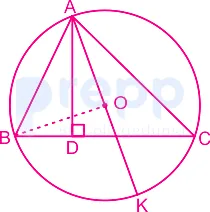 Paper & answer key PDF ↗
 Question 74archived
\({\left( {\frac{{\sin {\rm{\theta }} - 2{{\sin }^3}{\rm{\theta }}}}{{2{{\cos }^3}{\rm{\theta }} - \cos {\rm{\theta }}}}} \right)^2}{\rm{}} + {\rm{}}1,{\rm{\;\theta }} \ne 45^\circ ,\) is equal to:
- A
cot2 θ
- B
cosec2 θ
- C
2tan2 θ
- D
sec2 θ
Show answer
D. sec2 θSimplifying Trigonometric Expressions: A Step-by-Step Guide
Let's simplify the given trigonometric expression: \({\left( {\frac{{\sin {\rm{\theta }} - 2{{\sin }^3}{\rm{\theta }}}}{{2{{\cos }^3}{\rm{\theta }} - \cos {\rm{\theta }}}}} \right)^2}{\rm{}} + {\rm{}}1\), where \({\rm{\theta }} \ne 45^\circ \).
To simplify this expression, we will first focus on the fraction inside the parenthesis: \(\frac{{\sin {\rm{\theta }} - 2{{\sin }^3}{\rm{\theta }}}}{{2{{\cos }^3}{\rm{\theta }} - \cos {\rm{\theta }}}}\).
Factoring and Using Trigonometric Identities
We can factor out common terms from the numerator and the denominator.
Numerator: \(\sin {\rm{\theta }} - 2{{\sin }^3}{\rm{\theta }} = \sin {\rm{\theta }}(1 - 2{\sin ^2}{\rm{\theta }})\)
Denominator: \(2{{\cos }^3}{\rm{\theta }} - \cos {\rm{\theta }} = \cos {\rm{\theta }}(2{\cos ^2}{\rm{\theta }} - 1)\)
So, the fraction becomes:
\[ \frac{{\sin {\rm{\theta }}(1 - 2{{\sin }^2}{\rm{\theta }})}}{{\cos {\rm{\theta }}(2{{\cos }^2}{\rm{\theta }} - 1)}} \]
Now, we need to use some trigonometric identities. Recall the double angle formulas for cosine:
\(\cos 2{\rm{\theta }} = {\cos ^2}{\rm{\theta }} - {\sin ^2}{\rm{\theta }}\)
\(\cos 2{\rm{\theta }} = 2{\cos ^2}{\rm{\theta }} - 1\)
\(\cos 2{\rm{\theta }} = 1 - 2{\sin ^2}{\rm{\theta }}\)
Notice that the terms in the parentheses in our fraction, \( (1 - 2{\sin ^2}{\rm{\theta}}) \) and \( (2{\cos ^2}{\rm{\theta}} - 1) \), are both equal to \( \cos 2{\rm{\theta}} \).
Substituting Identities into the Expression
Substitute these identities back into the fraction:
\[ \frac{{\sin {\rm{\theta }}({\cos 2{\rm{\theta }}})}}{{\cos {\rm{\theta }}({\cos 2{\rm{\theta }}})}} \]
Since \({\rm{\theta }} \ne 45^\circ \), \(2{\rm{\theta }} \ne 90^\circ \), which means \({\cos 2{\rm{\theta }}} \ne 0\). Therefore, we can cancel out the \({\cos 2{\rm{\theta }}}\) term from the numerator and the denominator.
\[ \frac{{\sin {\rm{\theta }}}}{{{\cos {\rm{\theta }}}}} \]
We know that \( \frac{{\sin {\rm{\theta }}}}{{{\cos {\rm{\theta }}}}} = \tan {\rm{\theta }} \).
Completing the Simplification
Now, substitute this back into the original expression:
\[ {\left( {\frac{{\sin {\rm{\theta }} - 2{{\sin }^3}{\rm{\theta }}}}{{2{{\cos }^3}{\rm{\theta }} - \cos {\rm{\theta }}}}} \right)^2}{\rm{}} + {\rm{}}1 = {\left( {\tan {\rm{\theta }}}} \right)^2} + 1 = {\tan ^2}{\rm{\theta }} + 1 \]
Finally, recall another fundamental trigonometric identity:
\[ 1 + {\tan ^2}{\rm{\theta }} = {\sec ^2}{\rm{\theta }} \]
So, the simplified expression is \( {\sec ^2}{\rm{\theta }} \).
Matching with Options
Let's compare our result with the given options:
Option
Expression
1
\({\cot ^2}{\rm{\theta }}\)
2
\({\csc ^2}{\rm{\theta }}\)
3
\(2{\tan ^2}{\rm{\theta }}\)
4
\({\sec ^2}{\rm{\theta }}\)
Our simplified expression \({\sec ^2}{\rm{\theta }}\) matches Option 4.
Revision Table: Key Trigonometric Identities Used
Identity
Formula
Tangent Identity
\({\tan {\rm{\theta }}} = \frac{{\sin {\rm{\theta }}}}{{{\cos {\rm{\theta }}}}}\)
Double Angle Cosine Identity
\({\cos 2{\rm{\theta }}} = 1 - 2{\sin ^2}{\rm{\theta }}\)
Double Angle Cosine Identity
\({\cos 2{\rm{\theta }}} = 2{\cos ^2}{\rm{\theta }} - 1\)
Pythagorean Identity variant
\(1 + {\tan ^2}{\rm{\theta }} = {\sec ^2}{\rm{\theta }}\)
Additional Information: Understanding Trigonometric Simplification
Simplifying trigonometric expressions is a common task in trigonometry and calculus. It often involves using fundamental identities to rewrite expressions in a simpler form. Key strategies include:
Factoring out common terms.
Using Pythagorean identities (\({\sin ^2}{\rm{\theta }} + {\cos ^2}{\rm{\theta }} = 1\), \(1 + {\tan ^2}{\rm{\theta }} = {\sec ^2}{\rm{\theta }}\), \(1 + {\cot ^2}{\rm{\theta }} = {\csc ^2}{\rm{\theta }}\)).
Using quotient identities (\({\tan {\rm{\theta }}} = \frac{{\sin {\rm{\theta }}}}{{{\cos {\rm{\theta }}}}}\), \({\cot {\rm{\theta }}} = \frac{{\cos {\rm{\theta }}}}{{{\sin {\rm{\theta }}}}}\)).
Using reciprocal identities (\({\sec {\rm{\theta }}} = \frac{1}{{{\cos {\rm{\theta }}}}}\), \({\csc {\rm{\theta }}} = \frac{1}{{\sin {\rm{\theta }}}}\), \({\cot {\rm{\theta }}} = \frac{1}{{\tan {\rm{\theta }}}}\)).
Using double angle, half angle, sum/difference, and product-to-sum identities when applicable.
Converting all terms to sine and cosine can sometimes help in simplification.
The condition \({\rm{\theta }} \ne 45^\circ \) is important because if \({\rm{\theta }} = 45^\circ \), then \(2{\rm{\theta }} = 90^\circ \), and \({\cos 2{\rm{\theta }}} = \cos 90^\circ = 0\). The original expression's denominator would become zero, making the expression undefined. This condition ensures that we are not dividing by zero when cancelling out \({\cos 2{\rm{\theta }}}\).
Paper & answer key PDF ↗ Question 75archived
The production of cars of type A in 2015 and of type C in 2013 taken together is approximately what percent of the total production of cars of type D in five years?
- A
43.5
- B
40.2
- C
42.4
- D
42.8
Show answer
A. 43.5Analyzing Car Production Data from the Table
The question asks us to find the percentage that the combined production of cars of type A in 2015 and type C in 2013 represents out of the total production of cars of type D over five years (2013-2017).
First, let's look at the provided table showing the production of different types of cars (in thousands) over the years 2013 to 2017.
Cars/Year
2013
2014
2015
2016
2017
A
35
40
48
50
36
B
39
45
54
60
72
C
52
25
32
54
45
D
50
42
45
46
47
E
36
46
42
48
55
Step-by-Step Calculation
1. Find the production of type A cars in 2015.
Looking at the table, in the row for 'A' and column for '2015', the production is 48 thousand.
Production of type A in 2015 = 48 thousand
2. Find the production of type C cars in 2013.
Looking at the table, in the row for 'C' and column for '2013', the production is 52 thousand.
Production of type C in 2013 = 52 thousand
3. Calculate the combined production of type A (2015) and type C (2013).
We need to sum the production figures from steps 1 and 2.
Combined production = Production of A (2015) + Production of C (2013)
Combined production = 48 + 52 = 100 thousand
4. Calculate the total production of type D cars over five years (2013-2017).
Sum the production figures for type D across all five years (2013, 2014, 2015, 2016, and 2017).
Total production of D = Production of D (2013) + D (2014) + D (2015) + D (2016) + D (2017)
Total production of D = 50 + 42 + 45 + 46 + 47
Total production of D = 230 thousand
5. Calculate the required percentage.
The question asks for the combined production (from step 3) as a percentage of the total production of type D (from step 4). The formula for percentage is:
$$ \text{Percentage} = \left( \frac{\text{Part}}{\text{Whole}} \right) \times 100\% $$
Here, the 'Part' is the combined production of A (2015) and C (2013), and the 'Whole' is the total production of D over five years.
$$ \text{Percentage} = \left( \frac{100}{230} \right) \times 100\% $$
$$ \text{Percentage} = \left( \frac{10}{23} \right) \times 100\% $$
Now, perform the division:
$$ \frac{10}{23} \approx 0.4347826 $$
Multiply by 100:
$$ 0.4347826 \times 100\% \approx 43.47826\% $$
6. Round the percentage to approximately one decimal place.
Rounding 43.47826% to one decimal place gives 43.5%.
Therefore, the production of cars of type A in 2015 and of type C in 2013 taken together is approximately 43.5 percent of the total production of cars of type D in five years.
Revision Table: Key Values
Item
Value (thousand)
Production of Type A (2015)
48
Production of Type C (2013)
52
Combined Production (A 2015 + C 2013)
100
Total Production of Type D (2013-2017)
230
Required Percentage (Approx.)
43.5%
Additional Information: Data Interpretation and Percentages
This question involves interpreting data presented in a table and calculating percentages. Data interpretation skills are crucial for understanding information organized in various formats like tables, charts, and graphs.
Tables: Tables organize data in rows and columns, making it easy to locate specific values based on categories (like Car Type and Year in this case).
Percentages: A percentage is a way of expressing a number as a fraction of 100. It's often used to compare a part to a whole or to show change. The formula \( (\text{Part} / \text{Whole}) \times 100\% \) is fundamental for percentage calculations.
Approximate Values: Questions often ask for approximate percentages, meaning you may need to round your final answer to a specified number of decimal places.
Practicing with different types of data representation and calculations helps build confidence in solving data interpretation questions.
Paper & answer key PDF ↗ Question 76archived
In the sentence identify the segment which contains the grammatical error.
Due to the Cyclone Idai vast areas of land have been flooded, roads destroyed and communications disrupting in Zimbabwe and Mosambique.
- A
vast areas of land have been flooded
- B
Due to the Cyclone Idai
- C
roads destroyed
- D
and communications disrupting
Show answer
D. and communications disruptingIdentifying the Grammatical Error in the Sentence
The question asks us to identify the segment in the given sentence that contains a grammatical error. The sentence is: "Due to the Cyclone Idai vast areas of land have been flooded, roads destroyed and communications disrupting in Zimbabwe and Mosambique."
Let's break down the sentence structure, focusing on the events caused by the Cyclone Idai:
Vast areas of land have been flooded.
Roads destroyed.
Communications disrupting.
These three phrases list the consequences of the cyclone. For clarity and correctness, lists of this kind often use a parallel structure. This means that the grammatical form of each item in the list should be similar.
Analyzing the Sentence Segments for Errors
Let's look closely at how the consequences are described:
"vast areas of land have been flooded": This part uses the present perfect passive voice ("have been" + past participle "flooded").
"roads destroyed": This part uses the past participle "destroyed". It implies a passive construction, such as "roads have been destroyed" or "roads were destroyed". This structure is similar to the first part, using a form of passive voice with a past participle.
"communications disrupting": This part uses the present participle "disrupting". To maintain parallelism with the previous items ("flooded", "destroyed"), which use past participles in a passive context, this part should also use a past participle in a passive context. The correct form should be "disrupted". It implies "communications have been disrupted" or "communications were disrupted".
The phrase "communications disrupting" does not follow the parallel structure established by "vast areas of land have been flooded" and "roads destroyed". It should be "communications disrupted" to match the passive voice and past participle form used for the other consequences.
Identifying the Incorrect Segment
Based on the analysis of parallel structure and verb forms, the segment containing the grammatical error is "and communications disrupting". The verb form "disrupting" should be the past participle "disrupted" to be grammatically consistent with the other parts of the list ("flooded", "destroyed").
Revision Table: Correcting the Error
Here's a look at the segment with the error and its correction:
Incorrect Segment
Grammatical Reason
Correct Form
and communications disrupting
Lack of parallelism; requires passive voice past participle to match "flooded" and "destroyed".
and communications disrupted
The corrected sentence would read: "Due to the Cyclone Idai vast areas of land have been flooded, roads destroyed and communications disrupted in Zimbabwe and Mosambique."
Additional Information on Grammatical Concepts
Understanding parallel structure and passive voice is crucial for identifying such errors.
Parallel Structure (Parallelism): This means using the same pattern of words to show that two or more ideas have the same level of importance. In lists or series, items should be in the same grammatical form (e.g., all nouns, all infinitives, all -ing forms, all past participles).
Passive Voice: In the passive voice, the subject of the sentence receives the action, rather than performing it. It is often formed using a form of the verb "to be" plus the past participle of the main verb (e.g., "The road was destroyed." "Communications were disrupted."). In our example sentence, "vast areas of land have been flooded", "roads destroyed" (implicitly "have been destroyed"), and "communications disrupted" (implicitly "have been disrupted") all describe things that happened to the land, roads, and communications (they received the action).
Ensuring parallel structure helps make sentences clear, balanced, and easy to read. The error in the original sentence disrupts this balance.
Paper & answer key PDF ↗ Question 77archived
Select the most appropriate option for blank No. 5.
- A
councillor
- B
member
- C
mayor
- D
worker
Show answer
D. workerUnderstanding the Passage and the Task
The question asks us to fill in five blanks in a passage to make it coherent and meaningful. We need to select the most appropriate word for each blank from the given alternatives. The passage tells a story about an Italian town where the mayor and councilors had to clean the streets because the town had no manual workers.
We are specifically asked to find the most appropriate option for blank No. 5.
Let's look at the sentence containing blank No. 5:
"The town Zerfaliu's last (5)______ retired six months ago and nobody has been hired since then. "We can't do anything - we are blocked by bureaucracy," the mayor says."
This sentence explains *why* the town has no manual workers. It says the "last" person in a certain role retired, and no one has replaced them. The missing word should describe the type of person whose retirement led to the lack of manual workers.
Analyzing Options for Blank No. 5
Let's examine the provided options for blank No. 5:
councillor: A councillor is typically a member of a local government council. While important, their main role is usually in decision-making and governance, not manual street cleaning or maintenance.
member: This is a very general term. A 'member' of what? While the person could be a member of the community or a staff member, the context requires a more specific term related to the work that is now missing (manual labor).
mayor: The mayor is the head of the town's administration. The passage mentions the mayor cleaning streets, implying this is unusual for the mayor, not their regular job which has been left vacant.
worker: This word describes someone employed to perform labor, especially manual labor. The passage explicitly states the town is without "manual workers". If the "last worker" retired, it directly explains the lack of manual workers.
Selecting the Most Appropriate Word for Blank No. 5
Based on the context of the passage, which highlights the absence of "manual workers," the word that best fits blank No. 5 is the one that describes a person whose job involves manual labor for the town. The retirement of the "last ______" is given as the reason for the current situation.
Comparing the options:
'councillor' and 'mayor' are roles in local government, not typically manual labor positions.
'member' is too vague.
'worker' specifically refers to someone who performs work, aligning perfectly with the "manual workers" mentioned in the passage. The retirement of the last 'worker' would indeed leave the town short of manual labor staff.
Therefore, 'worker' is the most appropriate choice for blank No. 5.
Option
Relevance to Manual Labor Context
Appropriateness for Blank 5
councillor
Low (Government/Decision-making role)
Not Appropriate
member
Vague (Could be any member)
Not Appropriate
mayor
Low (Head of administration)
Not Appropriate
worker
High (Performs labor, fits "manual workers")
Most Appropriate
Revision Table: Blank 5 Analysis
Let's quickly review why 'worker' fits the context:
The passage is about a town without "manual workers".
The sentence for blank 5 says the "last ______ retired", explaining the situation.
A 'worker' is someone employed for labor.
The retirement of the last 'worker' naturally leads to a lack of 'manual workers'.
Additional Information: Context Clues
When filling in blanks in a passage, it's crucial to use context clues. These are hints within the surrounding text that help you understand the meaning and identify the correct word. In this case, the phrases "town with no manual workers" and "nobody has been hired since then" are strong context clues indicating that blank 5 must refer to a type of employee who performs manual labor.
Understanding the roles of people like councillors and mayors helps eliminate options that don't fit the job description implied by the passage.
Paper & answer key PDF ↗ Question 78archived
Select the most appropriate word to fill in the blank.
The State Government argued that it could not ______ the increase in the teachers' salaries as awarded by the court.
- A
afford
- B
get
- C
stand
- D
spare
Show answer
A. affordFill in the Blank: Understanding Word Choice
The question asks us to select the most appropriate word to complete the sentence: "The State Government argued that it could not ______ the increase in the teachers' salaries as awarded by the court." We need to choose a word that fits the context, which is about the State Government's ability or inability to manage the financial cost of the salary increase.
Analyzing the Options for Sentence Completion
Let's look at the meaning of each option and see how it fits into the sentence:
afford: This means to have enough money to pay for something. If the government cannot afford the increase, it means they do not have the financial means to pay it.
get: This means to obtain or receive something. This word doesn't make sense in the context of paying for salaries.
stand: This can mean to tolerate or endure something. While the government might not like the increase, saying they "cannot stand" it doesn't convey financial inability, but rather intolerance or dislike. It doesn't fit the meaning of paying salaries.
spare: This means to give up something, like money or time, that one could keep or use for another purpose. "Cannot spare" implies they have no surplus funds to allocate, which is close, but "afford" directly addresses the ability to meet the cost itself, not just having spare funds.
Selecting the Most Appropriate Word: Afford
The sentence describes the State Government's argument against implementing the salary increase. The most common and appropriate reason a government might argue against a court-ordered salary increase is financial constraints. The word that specifically relates to having the financial ability to pay for something is "afford".
If the State Government cannot afford the increase, it means they lack the necessary funds to pay the higher salaries. This aligns perfectly with a typical argument made by a government facing a significant financial obligation like increased salaries.
Completed Sentence
Filling in the blank with the most appropriate word, the sentence becomes:
"The State Government argued that it could not afford the increase in the teachers' salaries as awarded by the court."
Revision Table: Understanding Vocabulary in Context
Word
Meaning in Context
Fits the Blank?
Reason
afford
Have sufficient financial means to pay for.
Yes
Directly relates to financial capability to pay salaries.
get
Obtain or receive.
No
Not related to paying costs.
stand
Tolerate or endure.
No
Relates to emotional/mental tolerance, not financial ability.
spare
Give up something (like money) that could be kept.
Less Appropriate
Implies lack of surplus, but "afford" directly means unable to meet the cost.
Additional Information: Using 'Afford' Correctly
The verb 'afford' is commonly used to talk about financial capability. Here are a few examples:
I can't afford a new car right now.
They decided to stay home because they couldn't afford a vacation this year.
The company can afford to give raises to its employees.
'Afford' is typically followed by the item being paid for (like 'the increase', 'a car', 'a vacation') or a verb phrase using 'to' (like 'afford to buy', 'afford to go').
In the given sentence, the government is stating its financial inability to pay for the 'increase in salaries', making 'afford' the correct and most natural choice.
Paper & answer key PDF ↗ Question 79archived
Given below are four jumbled sentences. Select the option that gives their correct order.
A. That sort of pollution, which is also widespread in other south east Asian nations, regularly kills wildlife like whales and turtles that ingest the waste.
B. Environmental groups have tagged the Philippines as one of the world's biggest ocean polluters due to its reliance on single-use plastic.
C. In Thailand also, a whale died last year after swallowing more than 80 plastic bags.
D. In the latest case, a whale with 40 kilos of plastic trash in its stomach died on Saturday in southern Philippines where it was stranded a day earlier.
- A
BCAD
- B
ABCD
- C
BADC
- D
DABC
Show answer
C. BADCUnderstanding Sentence Order: Plastic Pollution in the Philippines
The question asks us to arrange four jumbled sentences (A, B, C, and D) into a coherent paragraph. To do this, we need to identify the main topic, the opening sentence, supporting details, examples, and the concluding sentence or idea. The sentences discuss plastic pollution and its impact, particularly in the Philippines and Southeast Asia.
Let's look at the sentences:
<strong>A.</strong> That sort of pollution, which is also widespread in other south east Asian nations, regularly kills wildlife like whales and turtles that ingest the waste.
<strong>B.</strong> Environmental groups have tagged the Philippines as one of the world's biggest ocean polluters due to its reliance on single-use plastic.
<strong>C.</strong> In Thailand also, a whale died last year after swallowing more than 80 plastic bags.
<strong>D.</strong> In the latest case, a whale with 40 kilos of plastic trash in its stomach died on Saturday in southern Philippines where it was stranded a day earlier.
Analyzing the Sentence Flow
We need to find a logical sequence that connects these ideas.
Sentence B introduces the main topic: the Philippines being a major ocean polluter due to single-use plastic. This sounds like a good introductory sentence for a paragraph about plastic pollution in the region.
Sentence D talks about a specific, recent case of a whale dying with plastic trash in its stomach, happening in the southern Philippines. This provides a concrete example directly related to the issue mentioned in sentence B (plastic pollution in the Philippines). So, D logically follows B as a supporting detail.
Sentence A discusses the general effect of "That sort of pollution" (referring back to the plastic pollution) which kills wildlife like whales and turtles. It also broadens the scope by mentioning this pollution is widespread in "other south east Asian nations." This sentence connects the specific example (whale death in D) to the general problem and extends the context beyond just the Philippines.
Sentence C provides another specific example of a whale death due to plastic, but this time in Thailand, which is one of the "other south east Asian nations" mentioned in sentence A. Therefore, C fits well after A as a further example supporting the claim that this pollution is widespread and harmful to wildlife in the region.
Based on this analysis, the most logical order is B > D > A > C.
Step-by-step Derivation of the Order
Start with the sentence that introduces the main topic and location. Sentence B identifies the Philippines and its plastic pollution problem. This is a strong opening.
Follow the opening with a specific example related to the topic and location introduced. Sentence D provides a recent case of a whale dying from plastic in the Philippines. This directly supports B.
Introduce the general impact and expand the scope. Sentence A talks about how "that sort of pollution" kills wildlife and is common in "other south east Asian nations." This sentence acts as a transition from the specific Philippines case to the broader regional issue.
Provide a specific example from one of the "other south east Asian nations" mentioned in A. Sentence C gives the example of a whale death in Thailand due to plastic. This reinforces the point made in A.
The resulting order is BADC.
Let's read the sentences in this order to confirm the flow:
B. Environmental groups have tagged the Philippines as one of the world's biggest ocean polluters due to its reliance on single-use plastic.
D. In the latest case, a whale with 40 kilos of plastic trash in its stomach died on Saturday in southern Philippines where it was stranded a day earlier.
A. That sort of pollution, which is also widespread in other south east Asian nations, regularly kills wildlife like whales and turtles that ingest the waste.
C. In Thailand also, a whale died last year after swallowing more than 80 plastic bags.
This sequence creates a coherent paragraph that introduces the problem, provides a specific example, explains the general consequences, and adds another example from a different location.
Correct Sentence Arrangement
The correct order of the sentences is BADC.
Position
Sentence
Reasoning
1st
B
Introduces the main topic (Philippines, plastic pollution).
2nd
D
Provides a specific, recent example in the Philippines.
3rd
A
Explains the general impact on wildlife and expands to other nations. Links back using "That sort of pollution".
4th
C
Gives another specific example from one of the "other nations" mentioned in A.
Revision Table: Checking Sentence Order Flow
Reviewing the connections between sentences:
B to D: Introduces the Philippines' pollution (B), followed by a specific incident in the Philippines (D). Connects the general statement to a concrete case.
D to A: Describes a whale death from plastic (D), followed by a statement that "That sort of pollution" kills wildlife like whales and turtles, and is widespread (A). Connects the specific example to the general phenomenon and expands scope.
A to C: Mentions widespread pollution in "other south east Asian nations" causing deaths (A), followed by an example of a whale death in Thailand (an "other south east Asian nation") (C). Provides a specific instance supporting the broadened claim.
Additional Information: Paragraph Structure Basics
A typical paragraph often follows a structure that helps ensure clarity and logical flow:
Topic Sentence: Introduces the main idea of the paragraph (often at the beginning).
Supporting Sentences: Provide details, examples, explanations, or evidence to support the topic sentence.
Concluding Sentence (Optional): Summarizes the main points or transitions to the next paragraph.
In this jumbled sentences exercise, identifying a potential topic sentence (B) and looking for supporting details (D, A, C) that build upon that topic helps in finding the correct order.
Connecting words or phrases like "That sort of pollution" (in A) or mentioning locations like "In Thailand also" (in C) are important clues to how sentences relate to each other.
Paper & answer key PDF ↗ Question 80archived
Select the correct active form of the given sentence.
The main gate of the building was being guarded by gun-totting guards.
- A
The main gate of the building were guarding gun-totting guards.
- B
Gun-totting guards were guarding the main gate of the building.
- C
Gun-totting guards have been guarding the main gate of the building.
- D
Gun-totting guards guarded the main gate of the building.
Show answer
B. Gun-totting guards were guarding the main gate of the building.Understanding Voice Change: Passive to Active
The question asks us to convert a sentence from passive voice to active voice. The given sentence is: "The main gate of the building was being guarded by gun-totting guards."
Identifying Passive Voice Elements
In a passive voice sentence, the subject receives the action. The structure often involves a form of the verb 'to be' + past participle + 'by' + agent (the doer of the action). Let's break down the given sentence:
Subject (receiving action): The main gate of the building
Verb: was being guarded (form of 'to be' + past participle)
Agent (performing action): gun-totting guards (introduced by 'by')
Tense: Past Continuous (indicated by 'was being guarding')
Steps to Convert from Passive to Active Voice
To change a sentence from passive to active voice, follow these steps:
Identify the agent (the person or thing performing the action) in the passive sentence. This agent will become the subject of the active sentence.
Identify the verb in the passive sentence and determine its tense.
Change the verb to the corresponding active form, ensuring it agrees with the new subject in number. The tense must remain the same.
Identify the subject of the passive sentence. This will become the object of the active sentence.
Remove the 'by' phrase.
Applying the Conversion Steps
Let's apply these steps to the sentence: "The main gate of the building was being guarded by gun-totting guards."
Step 1 (New Subject): The agent is "gun-totting guards". This becomes the new subject.
Step 2 & 3 (Active Verb): The passive verb is "was being guarded", which is Past Continuous. The active Past Continuous form is 'was/were' + verb-ing. Since the new subject "gun-totting guards" is plural, we use 'were'. The main verb is 'guard', so the active form is "were guarding".
Step 4 (New Object): The subject of the passive sentence is "The main gate of the building". This becomes the object.
Step 5 (Remove 'by'): Remove "by gun-totting guards" and use "gun-totting guards" as the subject.
Combining these elements, the active sentence is: "Gun-totting guards were guarding the main gate of the building."
Evaluating the Options
Let's compare our derived active sentence with the given options:
Option 1: "The main gate of the building were guarding gun-totting guards." - Incorrect. The original subject is acting, which is wrong, and the verb "were guarding" doesn't agree with the singular subject "gate".
Option 2: "Gun-totting guards were guarding the main gate of the building." - This matches our derived sentence. The subject is "gun-totting guards", the verb "were guarding" is active past continuous, and the object is "the main gate of the building". This is the correct active form.
Option 3: "Gun-totting guards have been guarding the main gate of the building." - Incorrect tense. "have been guarding" is present perfect continuous, not past continuous.
Option 4: "Gun-totting guards guarded the main gate of the building." - Incorrect tense. "guarded" is simple past tense, not past continuous.
Therefore, Option 2 is the correct active form of the given passive sentence.
Passive vs. Active Voice (Past Continuous)
Feature
Passive Voice
Active Voice
Subject
Receives the action
Performs the action
Structure
Subject + was/were + being + V<sub>3</sub> + by + Agent
Agent + was/were + V<sub>ing</sub> + Subject (as object)
Example
The gate was being guarded by guards.
Guards were guarding the gate.
Revision Table: Sentence Voice Conversion
Here's a quick summary of the conversion process for this specific sentence structure.
Original Passive Sentence: The main gate of the building was being guarded by gun-totting guards.
Identify Agent: gun-totting guards
Identify Passive Verb Tense: Past Continuous (was being guarded)
Identify Passive Subject: The main gate of the building
New Active Subject: gun-totting guards
New Active Verb (Past Continuous): were guarding (plural subject requires 'were')
New Active Object: The main gate of the building
Resulting Active Sentence: Gun-totting guards were guarding the main gate of the building.
Additional Information: Understanding Sentence Voice
Sentence voice indicates whether the subject performs the action (active voice) or receives the action (passive voice). Choosing between active and passive voice depends on what you want to emphasize.
Active Voice: Emphasizes the doer of the action. It is generally more direct, clear, and concise. Example: The dog chased the ball. (Emphasis on the dog)
Passive Voice: Emphasizes the action or the recipient of the action. It is useful when the doer is unknown, unimportant, or when you want to avoid mentioning the doer. Example: The ball was chased by the dog. (Emphasis on the ball) or The discovery was made in 1950. (Doer not specified/important)
While both voices are grammatically correct, active voice is often preferred in writing for its clarity and impact. However, passive voice has its place in specific contexts like scientific writing or when reporting news where the action is more important than the actor.
Paper & answer key PDF ↗ Question 81archived
Select the most appropriate meaning of the given idiom.
costs an arm and a leg
- A
nothing to lose
- B
rarely available
- C
easy to obtain
- D
very expensive
Show answer
D. very expensiveUnderstanding the Idiom: Costs an Arm and a Leg
Idioms are phrases or expressions that have a figurative, non-literal meaning. The meaning of an idiom cannot be understood simply by knowing the meanings of the individual words. The idiom "costs an arm and a leg" is a common English expression used to describe something very expensive.
Analyzing the Idiom "Costs an Arm and a Leg"
Let's break down the meaning of this idiom. If something costs an arm and a leg, it implies that the price is so high, it feels like you are giving away extremely valuable parts of your body to afford it. This highlights the significant cost involved.
For example:
"That new car is amazing, but it costs an arm and a leg." (meaning the car is very expensive)
"Going on vacation during peak season costs an arm and a leg." (meaning the vacation is very expensive)
Evaluating the Options
Let's look at the given options and see which one best fits the meaning of the idiom "costs an arm and a leg".
Option 1: nothing to lose
This phrase means that a situation has no potential negative outcome for you, or that you have no possessions or status to protect. This is completely different from the meaning of "costs an arm and a leg".
Option 2: rarely available
This describes something that is difficult to find or purchase because it is not often accessible or produced. While rare items can sometimes be expensive, the idiom "costs an arm and a leg" specifically refers to the high cost, not the availability.
Option 3: easy to obtain
This means something is simple or convenient to get. This is the opposite of something being very expensive, as obtaining expensive things often requires significant effort (earning money).
Option 4: very expensive
This directly describes something with a high price or cost. As we discussed, the idiom "costs an arm and a leg" is used precisely to mean that something is very costly.
Based on the analysis, the most appropriate meaning of the idiom "costs an arm and a leg" is that something is very expensive.
Revision Table: Understanding Idioms
Idiom
Meaning
Break a leg
Good luck (often used before a performance)
Hit the books
To study hard
Piece of cake
Something very easy
Let the cat out of the bag
To reveal a secret
Additional Information on Idioms
Idioms add color and richness to language. Learning common idioms is important for understanding native speakers and improving fluency in English. They often originate from historical events, cultural practices, or common observations about life. The idiom "costs an arm and a leg" is believed to have originated from the idea of making a significant sacrifice.
Paper & answer key PDF ↗ Question 82archived
Select the most appropriate meaning of the given idiom.
get out of hand
- A
get upset
- B
give up something
- C
get out of control
- D
to complete a task
Show answer
C. get out of controlUnderstanding Idioms: What Does 'Get Out of Hand' Mean?
Idioms are phrases where the meaning is not obvious from the individual words. To understand an idiom, you need to know its figurative meaning. The idiom we are looking at is 'get out of hand'.
The idiom 'get out of hand' is used to describe a situation or person that has become difficult to control or manage. Think about something that was once under control, perhaps manageable with gentle guidance, but now it's become wild, chaotic, or ungovernable. That's when it has 'gotten out of hand'.
Meaning of 'Get Out of Hand'
When something 'gets out of hand', it means it loses control, often becoming unruly, difficult to deal with, or even dangerous because it is no longer manageable. It suggests a loss of authority or ability to influence the situation's direction.
Let's consider the given options in the context of this idiom's meaning:
Option
Explanation
Fits 'Get Out of Hand'?
get upset
This means to become unhappy, angry, or disappointed. While losing control might make someone upset, the idiom itself describes the state of the situation, not a person's emotional reaction to it.
No
give up something
This means to stop trying to do something or to stop having something. The idiom 'get out of hand' doesn't imply stopping or abandoning something; it describes a situation that has become difficult to manage, not necessarily one that has been given up on.
No
get out of control
This means to become impossible to manage, restrain, or regulate. This directly matches the core meaning of 'get out of hand' – a loss of control over a situation, person, or thing.
Yes
to complete a task
This means finishing an assigned piece of work. This has no relation to the idiom 'get out of hand', which describes a situation becoming unmanageable, not the completion of work.
No
Why 'Get Out of Control' is the Correct Meaning
Based on the analysis of the idiom's usage and the meaning of the options, 'get out of control' is the most accurate and appropriate meaning for 'get out of hand'. When something 'gets out of hand', it is precisely because it has lost control or become uncontrollable.
For example, if a small protest starts peacefully but then turns violent, you could say the situation 'got out of hand'. Similarly, if a child's behavior becomes wild and difficult to manage, their behavior 'got out of hand'. Both examples show a loss of control.
Revision Table: Key Idioms & Meanings
Idiom
Meaning
Example Usage
Get out of hand
To become impossible to control or manage
The party got out of hand when too many people arrived.
Break the ice
To say or do something that makes people feel more relaxed in a social situation
He told a joke to break the ice at the meeting.
Bite the bullet
To face a difficult or unpleasant situation with courage
You just have to bite the bullet and get the work done.
Additional Information on English Idioms
Learning idioms is important for understanding and using English fluently. They add color and depth to the language. Idioms often have cultural or historical origins that explain their figurative meaning, though knowing the origin isn't always necessary to use the idiom correctly.
Tips for learning idioms:
See how the idiom is used in different sentences.
Try using the idiom yourself in conversations or writing.
Group idioms by theme (e.g., idioms about feelings, time, control).
Understanding phrases like 'get out of hand' improves comprehension and communication skills in English.
Paper & answer key PDF ↗ Question 83archived
Select the most appropriate option for blank No. 1.
- A
was left
- B
leaves
- C
was leaving
- D
has left
Show answer
A. was leftUnderstanding Fill in the Blanks in English Passages
This question requires us to fill in the blanks in a given passage to make it grammatically correct and contextually meaningful. We need to select the most appropriate option for each blank based on the flow and structure of the sentences.
Analyzing Blank No. 1
Let's look at the sentence containing blank No. 1:
"An Italian mayor has been cleaning the streets along with his councilors after their town (1)______ with no manual workers, it's reported."
We need a verb form for blank (1) that describes the state the town is in, specifically the state of having "no manual workers". The phrase "after their town..." suggests a consequence or a resulting state following some event (implied to be the retirement of workers mentioned later). The verb needs to fit with "with no manual workers".
Let's examine the options:
was left: This is the past tense passive voice of the verb 'leave'. It means the town was caused to be in a state of having no manual workers by someone or something else. This structure perfectly fits the idea that the town ended up in this state due to workers retiring and no new hires.
leaves: This is the present tense active voice. It would mean the town itself is performing the action of 'leaving'. "Their town leaves with no manual workers" doesn't make sense in this context.
was leaving: This is the past continuous tense active voice. It suggests the town was in the process of leaving something or somewhere. "Their town was leaving with no manual workers" is grammatically awkward and doesn't convey the intended meaning of being in a state of having no workers.
has left: This is the present perfect tense active voice. It means the town has completed the action of leaving. Similar to "leaves", it implies the town performed the action, which doesn't fit the context of the town being in a state of lacking workers.
The most logical meaning is that the town ended up in the state of having no manual workers because the workers were gone (retired). The passive voice "was left" correctly conveys this idea – the town did not choose this state, but was put into it by circumstances (lack of workers).
Therefore, the sentence should be: "An Italian mayor has been cleaning the streets along with his councilors after their town was left with no manual workers, it's reported."
Conclusion for Blank No. 1
Based on the grammatical structure and the context of the passage, the most appropriate option for blank No. 1 is "was left".
Revision Table: Key Concepts
Concept
Explanation
Example in Context
Passive Voice
Used when the subject of the sentence is acted upon, rather than performing the action. Formed with a form of 'be' + past participle.
"The town was left with no manual workers." (The town is acted upon; it didn't leave itself).
Past Tense
Refers to an action or state that happened before the present time.
The retirement of workers is a past event that led to the current situation, making a past tense form appropriate for the resulting state.
Context Clues
Words and phrases in the passage that help determine the meaning of unknown words or the correct grammatical structure needed.
"after their town..." and "with no manual workers" provide clues about the state the town is in as a consequence of something.
Additional Information on Sentence Structure
Understanding how different verb tenses and voices change the meaning of a sentence is crucial for fill-in-the-blank questions. The active voice emphasizes the doer of the action (e.g., "The workers left the town"), while the passive voice emphasizes the recipient of the action or the resulting state (e.g., "The town was left by the workers" or, as in this case, "The town was left with no manual workers").
In this passage, the focus is on the town's resulting state (having no workers) which prompts the mayor's action, rather than on who or what caused that state directly in this specific clause. The passive voice fits this focus perfectly.
Paper & answer key PDF ↗ Question 84archived
Select the most appropriate option for blank No. 3.
- A
local
- B
next
- C
neighbour
- D
near
Show answer
A. localUnderstanding the Passage and Fill in the Blank Questions
The passage describes an unusual situation in an Italian town where the mayor and councilors are cleaning the streets because there are no manual workers. This happened because the town's last manual worker retired six months ago, and bureaucratic hurdles prevent hiring new staff. The specific sentence we are focusing on for blank No. 3 is: "In fact, (2)______ was sweeping the piazza in front of the (3)______ church in preparation for market day, (4)______ the deputy mayor's father and a town councilor armed with a high-pressure hose."
Analyzing Blank No. 3: Choosing the Most Appropriate Word
Blank No. 3 requires a word to describe the church located in front of the piazza where cleaning is taking place. Let's look at the options provided:
local
next
neighbour
near
We need to select the word that best fits the context of describing a church that is situated in the town's main square (piazza).
Evaluating the Options
local: This word is used to describe something that belongs to or is specific to a particular place or area, such as a town. A "local church" is the church that serves the people of that specific locality. This fits well with the idea of a church in the town's piazza.
next: This word indicates position immediately beside or following something else. While the church might be next to the piazza, "next church" isn't a common or natural way to refer to a prominent church in a town's main square in this context.
neighbour: This word typically refers to a person living near or next door, or things situated next to each other. It is not used to describe a building like a church in relation to a piazza.
near: This word indicates a short distance away. While the church is undoubtedly near the piazza, "near church" doesn't specifically identify it as *the* church of that town located prominently there. "Local church" is a more fitting description in this context.
Determining the Best Fit for Blank No. 3
Considering the context of the passage, which is about a specific town (Zerfaliu) and its situation, describing the church in its main square as the "local church" is the most natural and appropriate choice. It identifies the church as belonging to that specific locality, which is relevant to the narrative about the town's problems.
Option
Suitability for Blank 3
Reasoning
local
Most Appropriate
Refers to the church specific to the town, fitting the context of the town's piazza.
next
Less Appropriate
Implies immediate adjacency, but "local church" is a better descriptive phrase for a town's main church.
neighbour
Inappropriate
Not typically used to describe a building's relation to a place.
near
Less Appropriate
Indicates proximity, but "local church" is a more specific and common term in this context.
Therefore, the word "local" is the most appropriate option to fill in blank No. 3.
Revision Table: Key Terms from the Passage
Term
Context in Passage
Meaning
mayor
Leader of the town's cleaning effort
An elected head of a city, town, or other municipality.
councilors
Assisting the mayor in cleaning
Members of a council, typically a local government body.
manual workers
Missing from the town staff
People who do physical labour.
piazza
Being swept in front of the church
A public square, especially in an Italian town.
bureaucracy
Reason for not hiring new workers
A system of government in which most of the important decisions are made by state officials rather than by elected representatives.
Additional Information: Understanding Context in Fill in the Blanks
When answering fill-in-the-blank questions, especially in a passage, it is crucial to consider the overall context, the surrounding words, and the flow of ideas. Here's why:
Meaning: The word chosen must make sense semantically within the sentence and the entire passage.
Grammar: The word must be grammatically correct in the position it occupies (e.g., adjective, noun, verb form).
Collocation: Some words naturally go together. For example, "local church" is a common collocation.
Tone and Style: The language used in the passage should match the word you choose.
In this passage, understanding that the mayor and councilors are stepping in to perform tasks because the town itself lacks workers helps to select words that relate to the town and its specific locations, such as the "local" church in the "piazza".
Paper & answer key PDF ↗ Question 85archived
Select the correct passive form of the given sentence.
Do not park your car in front of my house.
- A
My house should not be parked in front of your car.
- B
Your car could not be parked in front of my house
- C
Your car need not be parked in front of my house.
- D
Your car should not be parked in front of my house
Show answer
D. Your car should not be parked in front of my houseUnderstanding Passive Voice Transformation
The question asks us to select the correct passive form of the given sentence: "Do not park your car in front of my house." This is an imperative sentence, which is a command or instruction. It is also a negative sentence because it uses "Do not".
Analyzing the Active Sentence
The original sentence is in the active voice. Let's identify its parts:
Subject: The subject is implied, which is "You" (the person being addressed).
Verb: The main verb is "park".
Object: The object of the verb is "your car".
Adverbial Phrase: "in front of my house" tells us where the action should not happen.
So, the structure is essentially: You + do not park + your car + in front of my house.
Transforming Negative Imperatives to Passive Voice
When transforming imperative sentences (commands) to the passive voice, especially negative ones, we often use modal verbs like 'should' or 'must' to convey the sense of command or prohibition, along with the structure 'be + past participle'. The object of the active sentence becomes the subject of the passive sentence.
For a negative imperative like "Do not + verb + object...", a common passive structure is:
Object + should not be + past participle of the verb + (rest of the sentence)
Applying the Transformation
Using the structure above for "Do not park your car in front of my house":
Object (becomes subject): Your car
Modal + not + be + past participle: should not be parked (Past participle of 'park' is 'parked')
Rest of the sentence: in front of my house
Putting it together, the passive form is: Your car should not be parked in front of my house.
Evaluating the Options
Let's examine each option provided:
My house should not be parked in front of your car.
This option incorrectly makes "My house" the subject and changes the meaning entirely. The object of the active sentence ("your car") must become the subject of the passive sentence.
Your car could not be parked in front of my house
This option uses "could not be parked", which implies inability rather than a command or prohibition. The original sentence is a direct instruction not to park.
Your car need not be parked in front of my house.
This option uses "need not be parked", which means it is not necessary to park. The original sentence is a prohibition – it is forbidden to park.
Your car should not be parked in front of my house
This option correctly uses "Your car" as the subject and the structure "should not be parked". This structure accurately conveys the negative imperative (prohibition) from the original active sentence in the passive voice.
Based on the analysis, the fourth option correctly transforms the negative imperative sentence into the passive voice while retaining the intended meaning of prohibition.
Correct Passive Form
The correct passive form of "Do not park your car in front of my house" is "Your car should not be parked in front of my house."
Revision Table: Active vs. Passive Voice
Feature
Active Voice
Passive Voice
Focus
The performer of the action (Subject)
The receiver of the action (Object in active, Subject in passive)
Structure (Simple)
Subject + Verb + Object
Object + be + Past Participle + (by Subject)
Structure (Negative Imperative)
Do not + Verb + Object
Object + should not be / must not be + Past Participle
Example (This question)
Do not park your car...
Your car should not be parked...
Additional Information on Passive Voice
The passive voice is used when the action itself or the receiver of the action is more important than the performer of the action. In the case of imperative sentences transformed into passive, it often makes the command or prohibition sound slightly less direct, or it puts the focus on the thing that is affected by the command (e.g., 'your car').
Other ways to express negative imperatives in passive voice might use 'must not be + past participle' if the prohibition is very strong. For example, "Do not enter this area" could become "This area must not be entered." The choice between 'should not be' and 'must not be' depends on the strength of the command.
Sometimes, the passive voice of an imperative is formed using "Let + object + not be + past participle" for negative commands, such as "Let your car not be parked in front of my house." However, this form is less common in modern English compared to the 'should not be' or 'must not be' constructions, especially for prohibitions involving objects like vehicles or items.
Paper & answer key PDF ↗ Question 86archived
Select the antonym of the given word.
TENDER
- A
gentle
- B
rough
- C
soft
- D
warm
Show answer
B. roughUnderstanding the Antonym of TENDER
The question asks us to select the antonym of the word "TENDER" from the given options. An antonym is a word that means the opposite of another word. To find the correct antonym, we first need to understand the meaning of the word "TENDER".
Meaning of TENDER
The word "TENDER" can have several meanings depending on the context, but in the context of physical qualities or texture, it often means:
Soft or delicate
Easily bruised or damaged
Gentle or kind
Considering the options provided, the word "TENDER" is most likely used here in the sense of being soft, delicate, or easily handled.
Analyzing the Options
Let's examine each option and determine its relationship to the word "TENDER".
Option 1: gentle
"Gentle" means kind, mild, or soft. This word is actually very close in meaning to "TENDER", especially in the sense of touch or handling. Therefore, "gentle" is a synonym, not an antonym, of "TENDER".
Option 2: rough
"Rough" means having an uneven or irregular surface, not smooth or soft. It can also mean involving violence or force, or difficult and unpleasant. In contrast to "TENDER" (meaning soft or gentle), "rough" describes something that is not smooth, can be harsh to touch, or involves lack of gentleness. This seems to be the opposite of "TENDER".
Option 3: soft
"Soft" means easy to mold, cut, compress, or fold; not hard or firm. This is a primary definition of "TENDER" when describing texture. Thus, "soft" is a synonym of "TENDER", not an antonym.
Option 4: warm
"Warm" relates to having or giving out heat. While a tender person might be warm-hearted, "warm" is not the opposite of "TENDER" in the context of physical qualities or texture. It describes temperature, not texture or gentleness.
Identifying the Antonym
Comparing the meanings, "rough" is the most direct opposite of "TENDER". If something is "TENDER" (soft, gentle, delicate), its antonym would be something that is "rough" (not smooth, harsh, not gentle).
Word
Meaning relevant to options
Relationship to TENDER
TENDER
Soft, delicate, gentle, easily hurt
The word in question
gentle
Kind, mild, soft
Synonym
rough
Not smooth or soft, harsh, not gentle
Antonym
soft
Not hard or firm, yielding to touch
Synonym
warm
Having or giving out heat
Unrelated as an antonym of texture/gentleness
Based on the analysis, "rough" is the antonym of "TENDER".
Revision Table: Antonyms and Synonyms
Word
Synonyms
Antonyms
TENDER (texture/feeling)
soft, gentle, delicate, sensitive, mild
rough, tough, hard, firm, strong, insensitive
TENDER (offer)
bid, offer, proposal
withdrawal, refusal, rejection
It's important to consider the context when looking for synonyms or antonyms, but in this case, the options clearly point towards the physical/quality meaning of "TENDER".
Additional Information: Word Meanings and Context
Words can have multiple meanings, and understanding the correct meaning in a given context is crucial for choosing the right synonym or antonym. Let's look at different uses of the word "TENDER":
Texture/Feel: As discussed, meaning soft (tender meat), delicate (tender skin), or easily hurt (a tender bruise).
Character/Personality: Meaning kind, gentle, or compassionate (a tender heart).
Age: Meaning young or inexperienced (of tender age).
Formal Offer: Meaning to offer formally (to tender a resignation, a tender for a contract).
Nautical: A small boat used to service a larger one (ship's tender).
In this question, the options "gentle," "rough," "soft," and "warm" primarily relate to the texture, feel, or perhaps emotional quality of "TENDER." Among these, "rough" is the only one that consistently serves as a direct opposite to "TENDER" in its most common relevant meanings (soft, gentle, delicate).
Paper & answer key PDF ↗ Question 87archived
Select the most appropriate option for blank No. 4
- A
as well
- B
also
- C
alongside
- D
along
Show answer
C. alongsideFilling Blanks in a Passage: Understanding Word Usage
The question asks us to fill in the fourth blank in the provided passage to make it grammatically correct and contextually meaningful. The passage describes a situation in an Italian town where the mayor and councilors are cleaning the streets because there are no manual workers.
Let's look at the sentence containing the fourth blank:
"In fact, (2)______ was sweeping the piazza in front of the (3)______ church in preparation for market day, (4)______ the deputy mayor's father and a town councilor armed with a high-pressure hose."
This sentence describes actions happening in the piazza. Someone is sweeping (Blank 2 tells us who), and simultaneously, the deputy mayor's father and a town councilor are present and equipped with a high-pressure hose, suggesting they are also involved in the cleaning effort. We need a word for Blank 4 that connects the sweeping action with the presence and activity of these other people.
Analyzing Options for Blank No. 4
Let's examine the given options:
Option 1: as well
Option 2: also
Option 3: alongside
Option 4: along
Now, let's consider how each option fits into the sentence:
Option 1: as well - "as well" usually means 'also' and is typically placed at the end of a clause or sentence (e.g., "I am sweeping as well"). Placing it before the subject ("the deputy mayor's father...") like this makes the sentence grammatically incorrect.
Option 2: also - "also" means 'in addition' or 'too'. While it conveys the idea that others were present or helping, placing "also" directly before the subject ("also the deputy mayor's father...") in this structure feels awkward and unnatural compared to other options that indicate shared activity or presence. For example, you might say "He was sweeping, and also the deputy mayor's father was helping," but inserting "also" here doesn't flow well.
Option 3: alongside - "alongside" means 'next to' or 'together with'. When used with people, it implies being with them or acting in concert with them. "alongside the deputy mayor's father and a town councilor" suggests that the sweeping was happening in the presence of these other people, who were also involved in the cleaning process (using a hose). This word fits the context perfectly, indicating shared effort or presence during the activity.
Option 4: along - "along" typically refers to movement in a line or length (e.g., "walking along the road"). It does not fit the context of people working together in a cleaning activity in a piazza.
Suitability of Options for Blank 4
Option
Meaning
Fit in Sentence
Reasoning
as well
Also (usually end-position)
Incorrect
Incorrect grammatical placement.
also
In addition, too
Awkward
Grammatically possible in other structures, but awkward here.
alongside
Together with, next to
Excellent
Indicates shared presence and activity during cleaning.
along
Moving in line
Incorrect
Does not fit the context of cleaning together.
Conclusion for Blank 4
Based on the analysis, the most appropriate word to fill in Blank No. 4 is "alongside". It accurately describes the situation where the sweeping was being done together with, or in the presence of, the deputy mayor's father and a town councilor who were also involved in the cleaning using a hose.
Revision Table: Passage Completion Keywords
Concept
Key Points
Passage Completion
Choosing words to fit context and grammar.
Contextual Clues
Understanding the surrounding sentences for meaning.
Grammar Rules
Ensuring the sentence structure is correct with the chosen word.
Vocabulary
Knowing the meanings and usage of alternative words.
Additional Information: Understanding "Alongside" and Similar Words
"Alongside" is a preposition and sometimes an adverb that indicates being next to someone or something, or acting together with someone or something. In the context of people, it often suggests collaboration, support, or simply co-presence during an activity.
Examples:
He stood alongside his teammates. (Next to)
The project manager worked alongside the engineers. (Together with)
The new policy was introduced alongside training sessions. (At the same time as)
Comparing "alongside" with "also" and "as well":
"Also" and "as well" primarily indicate addition or inclusion ("this too").
"Alongside" specifically suggests physical proximity or working/acting together with someone.
In the passage, the sweeping and the hosing are related cleaning activities happening concurrently by different people. "Alongside" captures this sense of shared presence and collaborative effort better than just stating that the other people were "also" there.
Paper & answer key PDF ↗ Question 88archived
Select the synonym of the given word.
TILT
- A
cross
- B
support
- C
slant
- D
straighten
Show answer
C. slantUnderstanding the Synonym for TILT
The question asks us to identify the synonym for the word TILT. A synonym is a word that has a meaning very similar or exactly the same as another word. We need to find the option that best matches the meaning of TILT.
Meaning of TILT
The word TILT means to move into a sloping position; to incline or cause to incline. Imagine an object that is not standing upright but is leaning to one side – that is the state of being tilted.
Analyzing the Options
Let's look at the meaning of each option provided:
cross: This word typically means to go or extend across something, like crossing a street. It does not relate to inclining or sloping.
support: This word means to hold something up or provide assistance. It is often the opposite of tilting, as support implies stability and an upright position.
slant: This word means to have or cause to have a sloping or oblique position or angle; to incline. This meaning is very similar to TILT.
straighten: This word means to make or become straight. It is the direct opposite of TILT, which involves making something slope or lean.
Identifying the Correct Synonym
Comparing the meanings, we can see that slant is the word that most closely matches the meaning of TILT. Both words describe an action or state of being inclined or leaning.
For example:
The picture frame was slightly tilted on the wall.
The picture frame had a slant because it was tilted.
The other options, cross, support, and straighten, do not share this meaning of inclination.
Conclusion
Therefore, the correct synonym for the word TILT among the given options is slant.
Paper & answer key PDF ↗ Question 89archived
Select the wrongly spelt word.
- A
comparison
- B
communication
- C
compitition
- D
comparable
Show answer
C. compititionIdentifying the Misspelled Word
The question asks us to identify the word that is spelled incorrectly among the given options. Let's examine each word carefully to check its spelling.
comparison
communication
compitition
comparable
Analysis of the Misspelled Word
We need to look at each option and determine if its spelling is correct according to standard English rules. Three of the words are spelled correctly, and one is misspelled.
Let's check the spelling of each word:
comparison: This word is correctly spelled. It means examining the similarities and differences between two or more things.
communication: This word is correctly spelled. It refers to the act of conveying information or ideas.
compitition: This word is misspelled. The correct spelling of this word is 'competition'. Competition means rivalry between individuals or groups over an objective.
comparable: This word is correctly spelled. It means able to be compared with something else of a similar nature.
Correct Spelling Identified
Based on our analysis, the word that is misspelled is 'compitition'. The correct spelling uses 'e' instead of 'i' in the second syllable.
Incorrect spelling: compitition
Correct spelling: competition
Verification of Other Words
As checked above, the words 'comparison', 'communication', and 'comparable' are all spelled correctly.
Therefore, the wrongly spelt word is 'compitition'.
Revision Table: Spelling Errors Analysis
Word from Option
Spelling Status
Correct Spelling (if applicable)
comparison
Correct
comparison
communication
Correct
communication
compitition
Incorrect
competition
comparable
Correct
comparable
Additional Information: Common Spelling Mistakes
Spelling mistakes are common, especially with words that sound similar or have tricky letter combinations. Here are a few types of common spelling errors:
Vowel substitutions: Like 'compitition' for 'competition', substituting one vowel for another (e.g., 'definately' for 'definitely', 'seperate' for 'separate').
Consonant doubling: Incorrectly doubling or failing to double consonants (e.g., 'accomodate' for 'accommodate', 'embarass' for 'embarrass').
Silent letters: Words with silent letters can be confusing (e.g., 'recieve' for 'receive', 'knowlege' for 'knowledge').
Homophones: Words that sound alike but have different spellings and meanings (e.g., 'their', 'there', 'they're').
Practicing and learning common prefixes and suffixes can also help improve spelling.
Paper & answer key PDF ↗ Question 90archived
Select the most appropriate option to substitute the underlined segment in the given sentence. If no substitution is required, select No improvement.
I l ook for a better job for the last two months, but nothing is in sight
- A
have looked for a better job
- B
have been looking for a better job
- C
looked for a better job
- D
No improvement
Show answer
B. have been looking for a better jobUnderstanding the Sentence and Tense Usage
The original sentence is: "I look for a better job for the last two months, but nothing is in sight." The phrase "for the last two months" indicates a duration of time that started in the past and continues up to the present moment. This type of time expression typically requires a perfect tense, specifically either the Present Perfect Simple or the Present Perfect Continuous, depending on whether the action is viewed as completed or ongoing.
Analysing the Options for Substitution
Let's examine each option provided to determine the most appropriate substitute for the underlined segment "I look for a better job":
Option 1: have looked for a better job - This is the Present Perfect Simple tense. It can be used for actions that started in the past and continue to the present, or for completed actions with present results. While it could sometimes fit with a duration, the context "nothing is in sight" strongly suggests the searching activity is still ongoing.
Option 2: have been looking for a better job - This is the Present Perfect Continuous tense. This tense is specifically used to describe an action that began in the past, has continued up to the present time, and may still be continuing. This fits perfectly with the phrase "for the last two months" and the implication that the search is ongoing because "nothing is in sight".
Option 3: looked for a better job - This is the Simple Past tense. The Simple Past is used for actions that started and finished at a specific point in the past. It does not describe an action that continued up to the present, which contradicts the phrase "for the last two months".
Option 4: No improvement - The original sentence uses the Simple Present tense ("I look"), which is used for habits, routines, or facts, not for actions that started in the past and continued for a duration up to the present. Therefore, improvement is required.
Choosing the Correct Tense
The context of the sentence, particularly the phrase "for the last two months" and the implication of a continuous, uncompleted search ("nothing is in sight"), points towards the need for a tense that emphasizes the duration and ongoing nature of the action. The Present Perfect Continuous tense ("have been looking") is the most suitable tense for this purpose.
Comparing the Present Perfect Simple and Present Perfect Continuous for Duration:
Tense
Focus
Example (with duration)
Present Perfect Simple
Focus on the completion or result of the action, or when the duration refers to a state or a completed number of actions.
I have lived here for five years (state).
I have read three books this month (completed actions).
Present Perfect Continuous
Focus on the duration and ongoing nature of the action. Often used for temporary actions.
I have been living here for the last month (possibly temporary, emphasis on duration).
I have been reading a book all afternoon (ongoing action).
In the given sentence, the action is "looking for a job," which is an activity that takes time and is presented as ongoing because the desired outcome (finding a job) hasn't happened yet ("nothing is in sight"). This aligns better with the focus of the Present Perfect Continuous.
Conclusion: Selecting the Best Option
Based on the analysis of the tenses and the context provided by the duration "for the last two months" and the statement "nothing is in sight," the Present Perfect Continuous tense, "have been looking for a better job," is the most appropriate substitute.
Revision Table: Present Tenses for Duration
Tense
Structure
Usage with Duration
Example
Present Perfect Simple
subject + have/has + past participle
For states, completed actions with duration ending now, or repeated actions.
She has worked here for ten years (state).
Present Perfect Continuous
subject + have/has + been + verb-ing
For actions that started in the past, continue up to now, and may still be ongoing. Emphasizes duration.
They have been waiting for an hour (ongoing action).
Additional Information: Common Time Expressions
Certain time expressions often signal the need for perfect tenses. Understanding these can help you choose the correct tense.
Common expressions for Present Perfect/Present Perfect Continuous:
for + duration (e.g., for two months, for a year, for a long time)
since + point in time (e.g., since Monday, since 2010, since I was a child)
lately, recently
all day, all week, all year
Considerations:
State verbs (e.g., know, believe, understand, love, hate, want) are generally not used in continuous tenses. Use Present Perfect Simple with duration for these. (e.g., I have known him for years, not I have been knowing him).
Action verbs can use either tense, depending on the focus (duration vs. result/completion). "Looking for a job" is an action verb, and the context emphasizes the ongoing nature.
Paper & answer key PDF ↗ Question 91archived
Select the most appropriate option for blank No. 2.
- A
it
- B
he
- C
they
- D
she
Show answer
B. heUnderstanding the Passage and the Blank
The passage describes a situation in an Italian town where the mayor and councilors are cleaning the streets because there are no manual workers left. The sentence containing blank No. 2 is: "In fact, (2)______ was sweeping the piazza in front of the (3)______ church in preparation for market day..." We need to select the most appropriate word to fill this blank based on the context of the passage and grammatical correctness.
Let's look at the context around blank No. 2:
The previous sentence mentions "An Italian mayor has been cleaning the streets along with his councilors".
The sentence with the blank says someone "was sweeping the piazza". The verb "was sweeping" is singular, indicating the subject must be a single person or thing.
The following part of the sentence mentions "the deputy mayor's father and a town councilor", indicating other people were also involved in cleaning, but the blank refers to someone singular who "was sweeping".
Analyzing the Options for Blank No. 2
We are given four options for blank No. 2:
it
he
they
she
Let's evaluate each option:
Option 1: it - The pronoun "it" is typically used for inanimate objects or animals, not for a person sweeping. This option does not fit the context.
Option 2: he - The pronoun "he" is a singular male pronoun. The passage mentions an "Italian mayor" and "his councilors". A mayor is a person, and "his" suggests the mayor is male, fitting the use of "he". Grammatically, "he was sweeping" is correct because the verb is singular. Contextually, it makes sense that the mayor, who is described as cleaning, would be the one sweeping the piazza.
Option 3: they - The pronoun "they" is plural. The verb used is "was sweeping", which is singular. If the subject were "they", the verb would need to be "were sweeping". Therefore, this option is grammatically incorrect.
Option 4: she - The pronoun "she" is a singular female pronoun. While grammatically correct with the verb "was sweeping", the passage introduces the main subject as an "Italian mayor" and uses the possessive "his councilors", strongly implying the mayor is male. Without any mention of a female subject performing the sweeping, "he" is a much more likely fit given the established context.
Determining the Most Appropriate Option
Based on the grammatical requirement (a singular subject for "was sweeping") and the contextual information (the mayor, implied to be male by "his", is involved in cleaning), the pronoun "he" is the most appropriate choice for blank No. 2. It refers back to the singular male subject introduced in the previous sentence, the mayor.
Filling the blank with "he", the sentence reads: "In fact, he was sweeping the piazza in front of the (3)______ church in preparation for market day..." This sentence flows logically from the description of the mayor cleaning streets and sets the scene for others joining.
Option
Pronoun Type
Grammatical Fit (with "was sweeping")
Contextual Fit (referring to mayor)
Appropriateness
it
Singular, neutral
Grammatically fits
Does not fit contextually (not a person)
Incorrect
he
Singular, male
Grammatically fits
Fits contextually (mayor implied male)
Most Appropriate
they
Plural
Grammatically incorrect (verb is singular)
Does not fit grammatically
Incorrect
she
Singular, female
Grammatically fits
Less likely contextually (mayor implied male)
Less Appropriate
Conclusion
Considering both the singular verb "was sweeping" and the context provided about the Italian mayor and his cleaning efforts, the pronoun "he" is the only option that is both grammatically correct and logically consistent with the narrative. Therefore, "he" is the most appropriate word to fill blank No. 2.
Revision Table: Analyzing Blank No. 2
Let's review the analysis for blank No. 2.
Blank location: Follows "In fact," and precedes "was sweeping".
Required word type: A subject pronoun.
Verb tense/number: "was sweeping" is singular past continuous.
Contextual clues: Refers to someone involved in cleaning, likely the Italian mayor mentioned earlier.
Evaluation: 'he' is a singular male pronoun fitting the verb and context. Other options are either incorrect grammatically ('they') or contextually less likely ('it', 'she').
Additional Information: Pronoun Usage in Context
Choosing the correct pronoun in a passage completion task often requires understanding two key things:
Grammatical Agreement: The pronoun must agree with the verb in terms of number (singular or plural). If the verb is singular (like "was sweeping"), the pronoun must be singular ('I', 'you', 'he', 'she', 'it'). If the verb is plural (like "were sweeping"), the pronoun must be plural ('we', 'you', 'they').
Contextual Reference: The pronoun must clearly refer to a noun or pronoun mentioned earlier in the passage. This is called its antecedent. You need to look at the surrounding sentences to figure out who or what the pronoun is referring to. In this passage, "he" refers back to the "Italian mayor".
Paying close attention to these aspects helps accurately fill in blanks in reading comprehension exercises like this passage completion task.
Paper & answer key PDF ↗ Question 92archived
Select the wrongly spelt word.
- A
example
- B
examplify
- C
exhale
- D
exempt
Show answer
B. examplifyIdentify the Misspelt Word
The question asks us to identify the word that is spelt incorrectly from the given options. Let's examine each word to determine its correct spelling and usage.
Analysing Each Spelling Option
We will look at each provided word option and check its spelling:
example: This word is a noun meaning something representative of a class or group, or a pattern for imitation. Its spelling is correct.
examplify: This word is intended to be a verb meaning to illustrate by example or to be an example of. Let's verify its spelling.
exhale: This word is a verb meaning to breathe out air. Its spelling is correct.
exempt: This word is typically an adjective or verb meaning free from an obligation or liability imposed on others. Its spelling is correct.
Identifying the Incorrect Spelling
Upon reviewing common English spellings, we find that the word "examplify" is not the standard or correct spelling. The correct spelling of the verb meaning to illustrate by example or serve as an example is "exemplify". The incorrect letter is 'a' instead of 'e' in the second syllable.
Therefore, the word "examplify" is the wrongly spelt word among the given options.
Confirming Correct Spellings
Let's confirm the spellings of the correctly spelt words:
Example: Correct
Exhale: Correct
Exempt: Correct
The incorrect spelling is indeed "examplify", which should be "exemplify".
Conclusion on Misspelt Word
Based on the analysis, the word that is spelt wrongly is "examplify". The correct spelling is "exemplify".
Revision Table: Common Spellings
Here is a quick table summarising the spellings discussed:
Word
Spelling Status
Correct Spelling (if different)
example
Correct
-
examplify
Incorrect
exemplify
exhale
Correct
-
exempt
Correct
-
Additional Information on Spelling Errors
Spelling errors like "examplify" for "exemplify" are common and often occur with words that sound similar or have similar prefixes/suffixes. Paying attention to prefixes such as 'ex-' and root words can help improve spelling accuracy. The verb "exemplify" is related to the noun "example".
The prefix 'ex-' often means "out of" or "from".
The root "ample" is related to example.
Combining these elements correctly helps form words like 'example' and 'exemplify'.
Regular practice and using dictionaries are effective ways to avoid such spelling mistakes.
Paper & answer key PDF ↗ Question 93archived
Select the word which means the same as the group of words given.
A person, animal or plant belonging originally to a place
- A
alien
- B
occupant
- C
resident
- D
native
Show answer
D. nativeUnderstanding the Term: Belonging Originally to a Place
The question asks for a single word that describes a person, animal, or plant that belongs originally to a specific place. This concept is about origin and natural presence in a location since the beginning.
Analysing the Options for Original Belonging
Let's look at each option to see which one best fits the description "A person, animal or plant belonging originally to a place".
alien: An alien is typically someone from another country or planet. While they are in a place, they do not belong there originally. The term implies being foreign or not native.
occupant: An occupant is a person who resides or is present in a place, house, or building at a particular time. This term refers to temporary presence or residence, not original belonging.
resident: A resident is someone who lives in a place permanently or for a long time. Like an occupant, a resident lives in a place, but this does not mean they originated there. They could have moved there.
native: The word "native" refers to a person, animal, or plant that was born in a particular place or originated there naturally. This directly matches the description of belonging originally to a place.
Identifying the Correct Word for Original Origin
Based on the analysis of the options, the word that means "A person, animal or plant belonging originally to a place" is 'native'. It specifically denotes origin and natural belonging to a location.
Definition of Native
The definition of 'native' is:
Adjective: Associated with the place or circumstances of a person’s birth.
Noun: A person born in a specified place or associated with a place by birth, whether subsequently resident there or not.
This definition aligns perfectly with the phrase "belonging originally to a place".
Summary of Options
Word
Meaning
Fits "Belonging Originally to a Place"?
alien
Foreigner, from another place
No
occupant
One who occupies a place (often temporarily)
No
resident
One who lives in a place (long-term)
No
native
Belonging by birth or origin to a place
Yes
Therefore, the word that correctly describes a person, animal, or plant belonging originally to a place is 'native'.
Revision Table: Words Describing Presence and Origin
Term
Focus
Relation to Origin
Example Use
Native
Origin/Birthplace
Belongs originally
Native to Australia (e.g., kangaroo)
Resident
Place of Dwelling
May or may not be native
A resident of New York City
Occupant
Presence/Holding a Space
No relation to origin
The occupant of room 301
Alien
Foreign/Not Native
Does not belong originally
An alien species in an ecosystem
Additional Information: Vocabulary for Location and Belonging
Understanding words related to location and belonging is crucial for building strong vocabulary. Words like native, indigenous (often used similarly to native, especially for peoples and cultures), endemic (for species unique to a specific location), resident, and occupant all describe presence in a place but with different nuances regarding origin, duration, and status.
Knowing these distinctions helps in accurate communication and comprehension, particularly in subjects like biology, geography, sociology, and law.
Paper & answer key PDF ↗ Question 94archived
Select the most appropriate option to substitute the underlined segment in the given sentence. If no substitution is required, select No improvement.
If you join this job now, it proves to be good in the long run.
- A
it proves good
- B
it will prove to be good
- C
it has proved to be good
- D
No improvement
Show answer
B. it will prove to be goodUnderstanding the Sentence Structure
The given sentence is: "If you join this job now, it proves to be good in the long run."
This sentence is a conditional sentence. Conditional sentences have two parts: the 'if' clause (the condition) and the main clause (the result). They describe a condition and the result of that condition.
Analyzing the Type of Conditional Sentence
Let's look at the structure of the 'if' clause: "If you join this job now". The verb "join" is in the simple present tense. When the 'if' clause is in the simple present tense and the sentence talks about a likely future result of a present or future condition, it is typically a First Conditional sentence (also known as Type 1 Conditional).
Structure of First Conditional Sentences
The standard structure for First Conditional sentences is:
If + Simple Present, will + Base Form of the verb
This structure is used to talk about probable situations and their probable results in the future.
Examining the Main Clause
In the given sentence, the main clause is "it proves to be good in the long run." The underlined segment is "it proves to be good". The verb "proves" is in the simple present tense.
However, the phrase "in the long run" clearly indicates a future outcome. According to the structure of the First Conditional, when the 'if' clause is in the simple present, the main clause should typically use 'will' + base form to express the future result.
Therefore, the simple present "it proves" in the main clause does not fit the required future context indicated by "in the long run" and the structure of a typical First Conditional sentence.
Evaluating the Substitution Options
Let's look at the provided options for substituting the underlined segment "it proves to be good":
it proves good
it will prove to be good
it has proved to be good
No improvement
Option 1: it proves good
This option uses the simple present tense ("proves"). As discussed, the main clause requires a future tense form because of the "in the long run" phrase and the First Conditional structure. Using simple present here is incorrect in this context.
Option 2: it will prove to be good
This option uses "will prove", which is the future tense ('will' + base form). This perfectly aligns with the structure of a First Conditional sentence (If + simple present, will + base form) and correctly expresses the future outcome described by "in the long run". This is the appropriate tense and structure for the main clause in this context.
Option 3: it has proved to be good
This option uses the present perfect tense ("has proved"). The present perfect is used to describe actions that happened in the past but have relevance in the present, or actions that started in the past and continue to the present. It does not fit the context of describing a probable future outcome resulting from a present condition ("If you join this job now").
Option 4: No improvement
The original sentence uses "it proves to be good" in the main clause, which is simple present. As explained, this is grammatically incorrect for expressing a future result in a First Conditional structure. Therefore, improvement is required.
Conclusion
Based on the analysis of the sentence structure and the rules of First Conditional sentences, the main clause should use the future tense form 'will' + base verb to indicate the probable future outcome. Option 2, "it will prove to be good", correctly uses this structure.
Sentence Part
Original Tense/Form
Required Tense/Form
Explanation
If clause ("If you join this job now")
Simple Present (join)
Simple Present (join)
Correct as per First Conditional structure.
Main clause ("it proves to be good in the long run")
Simple Present (proves)
Future (will prove)
Required for future outcome in First Conditional.
Revision Table: Understanding Conditionals
Type
Structure
Usage
Example
Zero Conditional
If + Simple Present, Simple Present
For general truths, facts, habits.
If you heat ice, it melts.
First Conditional
If + Simple Present, will + Base Form
For probable future results of present/future conditions.
If it rains, we will stay inside.
Second Conditional
If + Simple Past, would + Base Form
For unreal or improbable present/future situations and their results.
If I won the lottery, I would buy a house.
Third Conditional
If + Past Perfect, would have + Past Participle
For unreal situations in the past and their results in the past.
If I had studied harder, I would have passed the exam.
Additional Information on Verb Tenses and Sentence Structure
Correctly identifying the verb tense in both the 'if' clause and the main clause is crucial for constructing grammatically correct conditional sentences. The tense in one clause dictates the appropriate tense or form in the other clause, according to established grammar rules for conditional types.
In this specific sentence, the presence of "in the long run" is a strong indicator that the result is expected in the future, reinforcing the need for a future tense in the main clause when the condition is present.
Paper & answer key PDF ↗ Question 95archived
Select the most appropriate word to fill in the blank.
Scientists at Cambridge University are ______ how plants can give us sustainable energy.
- A
investigating
- B
inspecting
- C
scrutinizing
- D
looking
Show answer
A. investigatingUnderstanding the Question: Filling the Blank
The question asks us to select the most appropriate word to complete the sentence: "Scientists at Cambridge University are ______ how plants can give us sustainable energy." This is a vocabulary-based fill-in-the-blank question that tests our understanding of different verbs and how they are used in a scientific context.
The sentence describes the activity of scientists at a university. They are doing something related to how plants can provide sustainable energy. This activity is clearly a form of scientific study or research.
Analyzing the Options for Scientific Study
Let's examine each of the given options and their meanings:
investigating: This verb means to carry out a systematic or formal inquiry to discover and examine the facts of (an incident, allegation, etc.) so as to establish the truth. In a scientific context, it means to study, examine, or explore something systematically to discover facts or principles.
inspecting: This verb means to look at (something) closely, typically in order to assess their condition or to discover any shortcomings. While it involves looking closely, it's often about checking condition or finding faults, less about fundamental research into how something works or could be used.
scrutinizing: This verb means to examine or inspect closely and thoroughly. Similar to 'inspecting', it implies a very close, critical look, often at details or data, but might not encompass the entire process of exploring a phenomenon for potential applications like generating energy.
looking: This is a very general verb meaning to direct one's gaze towards someone or something or in a particular direction. While it's part of any observation, it's too informal and general to describe the systematic research conducted by university scientists.
Selecting the Most Appropriate Verb
The sentence describes scientists working on how plants can provide sustainable energy. This involves systematic study, experimentation, and discovery — the core activities of scientific research.
Let's compare how well each word fits the context of scientists at Cambridge University studying plants for sustainable energy:
Word
Meaning in Context
Fit for Scientific Research on Sustainable Energy
investigating
Carrying out systematic inquiry/study to discover how plants provide energy.
Excellent fit. This accurately describes the scientific process of researching a potential source of energy.
inspecting
Looking closely at plants, perhaps for condition or specific features related to energy.
Limited fit. 'Inspecting' is too narrow; it doesn't cover the broader research process of discovering *how* and *if* plants *can* give sustainable energy.
scrutinizing
Examining plants or data about them closely and thoroughly.
Partial fit. While scrutiny is part of research, it's not the overall term for the investigation into the potential use of plants for energy.
looking
Simply observing plants.
Poor fit. Too general and informal for systematic scientific work at a university.
Based on the meanings and context, 'investigating' is the most precise and appropriate verb to describe the systematic study being conducted by the scientists to understand how plants could be used to generate sustainable energy.
Conclusion: The Best Word is Investigating
The phrase "Scientists at Cambridge University are investigating how plants can give us sustainable energy" makes perfect sense in a scientific context. They are conducting research, exploring the possibilities, and studying the mechanisms by which plants might contribute to sustainable energy generation.
Therefore, the most appropriate word to fill in the blank is "investigating".
Revision Table: Key Scientific Vocabulary
Term
Typical Use in Science
Related Concepts
Investigate
Systematic study, research, inquiry into a phenomenon or question.
Research, experiment, study, analyze, explore.
Inspect
Close examination, often for condition, quality, or specific features.
Examine, check, survey, review.
Scrutinize
Detailed and critical examination.
Examine closely, analyze critically, pore over.
Look
General observation.
Observe, see, view.
Additional Information: Scientific Research and Sustainable Energy
Scientific research is a systematic process involving observation, experimentation, and analysis to understand the natural world or solve practical problems. Universities like Cambridge are major centers for this kind of work.
Sustainable energy refers to energy sources that can be replenished naturally and have minimal environmental impact. Examples include solar, wind, hydroelectric, geothermal, and biomass energy.
Plants play a role in sustainable energy through processes like photosynthesis (which captures solar energy) and as biomass that can be converted into biofuels or used for direct combustion (though the sustainability depends on how the biomass is produced and used).
Researching how plants can contribute to sustainable energy involves various scientific disciplines, including biology, chemistry, physics, and engineering. Scientists might investigate processes within the plant, methods for converting plant material into energy, or ways to grow plants specifically for energy production.
Paper & answer key PDF ↗ Question 96archived
Given below are four jumbled sentences. Select the option that gives their correct order.
A. The elephant tusks were tracked from the Democratic Republic of Congo for two months.
B. Customs officials in Thailand say it's the biggest seizure in the country's history.
C. Four tonnes of ivory, with a market value of $6 million - it was an impressive haul.
D. Officials say they were being transported to Laos, from where they believed the ivory would be sold to customers across Asia.
- A
ABCD
- B
CABD
- C
ACDB
- D
CBAD
Show answer
D. CBADUnderstanding Jumbled Sentences and Finding the Correct Order
This question asks us to arrange four jumbled sentences (A, B, C, and D) into a coherent paragraph that describes a specific event: a large ivory seizure.
To solve jumbled sentence questions, we need to look for connections between sentences, identifying potential starting points, logical sequences, and concluding remarks. We should analyze the content of each sentence to understand the flow of information or the narrative being presented.
Sentence A: The elephant tusks were tracked from the Democratic Republic of Congo for two months. (Focuses on the origin and tracking process)
Sentence B: Customs officials in Thailand say it's the biggest seizure in the country's history. (Highlights the significance of the event)
Sentence C: Four tonnes of ivory, with a market value of $6 million - it was an impressive haul. (Introduces the subject matter - the ivory haul - and its scale/value)
Sentence D: Officials say they were being transported to Laos, from where they believed the ivory would be sold to customers across Asia. (Describes the intended destination and market)
Step-by-Step Analysis to Determine the Correct Order
Let's consider how these sentences could logically connect:
A good starting sentence often introduces the main topic or event. Sentence C introduces the "four tonnes of ivory" haul and its value, which sets the stage for a report about a seizure. This makes C a strong candidate for the opening sentence.
After introducing the impressive haul (C), it is logical to describe the significance of this haul. Sentence B states that customs officials call it the "biggest seizure in the country's history." This statement directly relates to the scale mentioned in C and follows well. So, CB seems like a likely pair.
Now we have sentences A and D, which provide more details about the ivory. Sentence A talks about the origin and tracking ("tracked from the Democratic Republic of Congo for two months"). Sentence D talks about the destination ("transported to Laos, from where they believed the ivory would be sold to customers across Asia").
The sequence CB introduces the haul and its importance. Sentences A and D provide context about the journey of the ivory. It makes sense to first describe the origin and tracking (A) before explaining the intended final destination and market (D). This gives a logical flow: What was seized (C)? How significant was it (B)? Where did it come from and how was it tracked (A)? Where was it going (D)?
This analysis suggests the order C, B, A, D.
Testing the Order CBAD
Let's read the sentences in the order CBAD:
Four tonnes of ivory, with a market value of $6 million - it was an impressive haul.
Customs officials in Thailand say it's the biggest seizure in the country's history.
The elephant tusks were tracked from the Democratic Republic of Congo for two months.
Officials say they were being transported to Laos, from where they believed the ivory would be sold to customers across Asia.
This sequence flows logically. It starts by introducing the seizure and its scale, then states its significance, followed by details about its origin and tracking, and finally explains its intended final destination. This structure provides a clear and coherent account of the ivory seizure.
Therefore, the correct order is CBAD.
Correct Sequence of Sentences
Here is the correct sequence:
C. Four tonnes of ivory, with a market value of $6 million - it was an impressive haul.
B. Customs officials in Thailand say it's the biggest seizure in the country's history.
A. The elephant tusks were tracked from the Democratic Republic of Congo for two months.
D. Officials say they were being transported to Laos, from where they believed the ivory would be sold to customers across Asia.
Revision Table: Jumbled Sentences Analysis
Sentence
Content Focus
Potential Role
Logical Placement in CBAD
A
Origin & Tracking (Congo)
Detail/Background
Follows C & B, explains finding
B
Significance (Biggest Seizure in Thailand)
Impact/Importance
Follows C, states importance of haul
C
The Haul (4 tonnes, $6 million)
Introduction of Subject
Opening Sentence
D
Destination & Market (Laos, Asia)
Intended Outcome Prevented
Follows A, explains final step
Additional Information: Tips for Solving Sentence Reordering Questions
Solving jumbled sentence questions, also known as sentence reordering or paragraph formation, requires identifying logical connections between sentences. Here are some tips:
Find the Opening Sentence: Look for a sentence that introduces a topic, person, or event. It often contains a general idea or a noun that is referred to by pronouns later. Avoid sentences starting with conjunctions (like 'and', 'but', 'so') or pronouns (like 'he', 'she', 'it', 'they') unless the reference is clear from the context provided within the jumbled set itself (which is rare for the absolute start).
Identify Linking Words and Phrases: Pay attention to transition words (e.g., 'however', 'therefore', 'in addition'), pronouns (referring to nouns in previous sentences), and time indicators (e.g., 'first', 'then', 'later', 'after this').
Look for Cause and Effect: Some sentences describe a cause, and others describe an effect. Arranging them in chronological or logical order is crucial.
Spot Mandatory Pairs: Sometimes, two sentences are clearly linked and must appear together, forming a mandatory pair. Identifying these pairs can simplify the process.
Follow Chronological Order: If the sentences describe a sequence of events, arrange them in the order they happened.
Establish a Narrative Flow: Think about how a story or report would unfold. Introduction > Details/Background > Conclusion/Outcome.
Read Through the Formed Paragraph: Once you have an potential order, read the sentences together in that sequence to see if they make sense and form a coherent paragraph.
Use Options to Your Advantage: The given options can help. If you are confident about the first sentence or a mandatory pair, look for options that start with that sentence or contain that pair.
Paper & answer key PDF ↗ Question 97archived
Select the antonym of the given word.
ESCALATE
- A
reduce
- B
raise
- C
enlarge
- D
heighten
Show answer
A. reduceFinding the Antonym for ESCALATE
The question asks for the antonym of the word "ESCALATE". An antonym is a word that means the opposite of another word.
Let's first understand the meaning of the word ESCALATE.
ESCALATE means to increase rapidly in intensity, extent, or magnitude. For example, tensions might escalate, or prices might escalate.
Now let's look at the options provided:
reduce
raise
enlarge
heighten
We need to find the word among these options that has the opposite meaning of ESCALATE.
Let's analyze each option:
reduce: To make smaller or less in amount, degree, or size.
raise: To lift something to a higher position, or to increase the amount, level, or strength of something.
enlarge: To make something larger.
heighten: To make something more intense or stronger; to increase.
Comparing the meaning of ESCALATE (to increase rapidly) with the options:
reduce: Means to decrease or make less. This is the opposite of increasing.
raise: Means to increase. This is a synonym or related term, not an antonym.
enlarge: Means to make bigger. This is related to increasing, not the opposite.
heighten: Means to increase or intensify. This is a synonym, not an antonym.
Therefore, the word that is the opposite of ESCALATE is "reduce".
The antonym of ESCALATE is reduce.
Revision Table: Understanding Antonyms
Word
Meaning
Antonym
Meaning of Antonym
ESCALATE
To increase rapidly in intensity or size.
reduce
To decrease or make less.
Additional Information on Word Relationships
Understanding how words relate to each other, such as identifying antonyms and synonyms, is crucial for building vocabulary and comprehension.
Synonyms: Words that have similar meanings (e.g., ESCALATE, increase, intensify, heighten, amplify).
Antonyms: Words that have opposite meanings (e.g., ESCALATE, reduce, decrease, diminish).
Homonyms: Words that sound alike or are spelled alike but have different meanings (e.g., 'there', 'their', 'they're').
When encountering an unfamiliar word like ESCALATE in a question asking for its antonym, try to:
Determine the meaning of the word.
Consider the meanings of the options.
Find the option that presents the most direct opposite meaning.
In this case, ESCALATE implies a movement or change upwards or towards greater intensity, while reduce implies a movement or change downwards or towards less intensity.
Paper & answer key PDF ↗ Question 98archived
Select the word which means the same as the group of words given.
A person without a settled home or regular work who wanders from place to place and lives by begging.
- A
itinerant
- B
truant
- C
migrant
- D
vagrant
Show answer
D. vagrantUnderstanding the Question: Identifying the Meaning
The question asks us to find a single word that accurately describes a specific type of person. The description given is: "A person without a settled home or regular work who wanders from place to place and lives by begging." We need to examine the provided options and determine which word best fits this detailed description.
Analyzing the Options for the Correct Meaning
Let's carefully look at each word given in the options and understand its meaning:
Option 1: itinerant
The word 'itinerant' refers to someone who travels from place to place, often for work. While an itinerant person wanders, this word doesn't necessarily imply they have no settled home, no regular work, or live by begging.
Option 2: truant
A 'truant' is specifically a student who stays away from school without permission. This meaning is completely different from the description provided in the question.
Option 3: migrant
A 'migrant' is a person who moves from one place to another, especially to find work or better living conditions. This term is broader and doesn't necessarily mean the person is without a home, work, or relies on begging. They might be moving with their family or seeking legitimate employment.
Option 4: vagrant
The word 'vagrant' specifically describes a person who does not have a settled home or regular work and wanders from place to place, living by asking for money or food (begging). This definition perfectly matches the description given in the question.
Matching the Description to the Vocabulary Word
Comparing the definitions of the options with the phrase "A person without a settled home or regular work who wanders from place to place and lives by begging", we see that the definition of 'vagrant' aligns precisely with all aspects of the description.
Without a settled home: Yes, a vagrant has no settled home.
Without regular work: Yes, a vagrant typically lacks regular employment.
Wanders from place to place: Yes, this is characteristic of a vagrant.
Lives by begging: Yes, begging is a common way a vagrant supports themselves.
Therefore, 'vagrant' is the most accurate word for the group of words provided.
Conclusion: Identifying the Correct Vocabulary Term
Based on the analysis of each option's meaning, the word that means the same as "A person without a settled home or regular work who wanders from place to place and lives by begging" is 'vagrant'.
Revision Table: Vocabulary Words and Meanings
Word
Meaning Relevant to Question
itinerant
One who travels from place to place (often for work)
truant
A student absent from school without permission
migrant
One who moves from one place to another (especially for work/conditions)
vagrant
Person without home/work who wanders and begs
Additional Information on Related Vocabulary
Understanding the subtle differences between similar words is crucial for vocabulary building. While 'itinerant' and 'migrant' imply movement, they don't carry the same implications of homelessness, lack of work, and begging as 'vagrant'. 'Truant' is completely unrelated to the concept of wandering adults.
Knowing these distinctions helps in choosing the most precise word to convey a specific meaning in English vocabulary.
Paper & answer key PDF ↗ Question 99archived
In the sentence identify the segment which contains the grammatical error.
She got two quick promotions in order that she has good communication skills.
- A
she has good communication skills
- B
She got
- C
two quick promotions
- D
in order that
Show answer
D. in order thatIdentifying Grammatical Errors in Sentences
The question asks us to find the part of the sentence that contains a grammatical error. The sentence is: "She got two quick promotions in order that she has good communication skills."
Let's analyze the sentence segment by segment to pinpoint the grammatical issue.
Analyzing Sentence Segments for Grammatical Errors
She got: This segment is the subject ("She") and the verb ("got") in the simple past tense. This is grammatically correct and fits the context of receiving promotions.
two quick promotions: This is the object of the verb "got". "two" is a determiner, "quick" is an adjective modifying "promotions". This segment is grammatically sound.
she has good communication skills: This is a clause stating the reason. "she" is the subject, "has" is the verb, and "good communication skills" is the object/complement. This clause itself is grammatically correct in terms of subject-verb agreement and structure.
in order that: This is a subordinating conjunction used to connect the main clause ("She got two quick promotions") to the subordinate clause ("she has good communication skills"). This phrase typically introduces a clause expressing purpose or intention. For example, "She studies hard in order that she may pass the exam." The clause following "in order that" often uses modal verbs like 'may', 'might', 'can', or 'will'.
Why "in order that" is Incorrect Here
In the given sentence, the second clause ("she has good communication skills") provides the reason or cause for the promotions, not the purpose. The promotions were not given *for the purpose of* her having communication skills; they were given *because* she has good communication skills.
The phrase "in order that" is inappropriate for expressing a reason or cause. Conjunctions commonly used to express reason are "because", "since", or "as".
The sentence should correctly use a conjunction that indicates causality, such as:
She got two quick promotions because she has good communication skills.
She got two quick promotions since she has good communication skills.
Therefore, the segment "in order that" contains the grammatical error because it is used incorrectly to express reason instead of purpose.
Let's summarize the analysis:
Segment
Analysis
Grammatical Status
She got
Subject + Verb (Past Simple)
Correct
two quick promotions
Determiner + Adjective + Noun (Object)
Correct
in order that
Subordinating Conjunction linking clauses
Incorrect usage (used for reason instead of purpose)
she has good communication skills
Subject + Verb + Object/Complement (Clause)
Correct (as a standalone clause)
Based on this analysis, the segment "in order that" is the source of the grammatical error.
Conclusion on Grammatical Error Identification
The grammatical error lies in the use of the conjunction "in order that" to express reason. It should be replaced with a conjunction like "because" or "since" to correctly convey the relationship between the two clauses.
Revision Table: Correcting Sentence Structure
Original Sentence Segment
Correction
Reason
in order that
because / since
"in order that" expresses purpose, "because" / "since" expresses reason. The sentence describes the reason for the promotions.
Additional Information on Subordinating Conjunctions
Subordinating conjunctions connect a subordinate clause to a main clause. They show the relationship between the two clauses. Different conjunctions indicate different relationships:
Cause/Reason: because, since, as
Purpose: in order that, so that
Time: when, while, before, after, until
Condition: if, unless, provided that
Contrast: although, though, even though, while, whereas
Choosing the correct subordinating conjunction is crucial for conveying the intended meaning of the sentence accurately.
In our sentence, the relationship between getting promotions and having good communication skills is one of cause and effect (good communication skills caused the promotions), hence a conjunction of reason is required.
Paper & answer key PDF ↗ Question 100archived
Select the synonym of the given word.
GARRULOUS
- A
concise
- B
throaty
- C
guttural
- D
talkative
Show answer
D. talkativeUnderstanding the Word Garrulous
The question asks us to find the synonym of the word "GARRULOUS". A synonym is a word that has the same or nearly the same meaning as another word.
The word "garrulous" is an adjective used to describe someone who is excessively talkative, especially about unimportant matters.
Let's look at the given options and determine which one is a synonym for "garrulous".
Analyzing the Options
Option 1: concise
Meaning: expressing much in few words; brief. This is the opposite of talking a lot. So, "concise" is an antonym, not a synonym, of "garrulous".
Option 2: throaty
Meaning: sounding as if produced deep in the throat; husky. This word describes the quality of a sound or voice, not the amount someone talks.
Option 3: guttural
Meaning: (of a speech sound) produced in the throat; harsh-sounding. Like "throaty", this word describes the sound quality, not talkativeness.
Option 4: talkative
Meaning: inclined to talk a great deal. This meaning perfectly matches the definition of "garrulous".
Identifying the Synonym of Garrulous
Based on the analysis of the options, the word that means inclined to talk a great deal is "talkative". Therefore, "talkative" is a synonym for "garrulous".
Comparison Table
Word
Meaning
Relationship to Garrulous
Garrulous
Excessively talkative, especially on trivial matters
Main word
Concise
Expressing much in few words
Antonym
Throaty
Sounding deep in the throat
Unrelated (describes sound)
Guttural
Sounding in the throat; harsh
Unrelated (describes sound)
Talkative
Inclined to talk a great deal
Synonym
Conclusion
The synonym of GARRULOUS is talkative.
Revision Table: Garrulous and Synonyms
Word
Synonym
Meaning Hint
Garrulous
Talkative
Talks a lot
Garrulous
Loquacious
Fond of talking
Garrulous
Chatty
Fond of casual talk
Additional Information: Learning Vocabulary
Learning synonyms is a great way to expand your vocabulary. When you learn a new word like "garrulous", try to find its synonyms and antonyms. This helps you understand the nuances of meaning and use the words effectively in different contexts.
Some other words related to talking include:
Eloquent: Fluent or persuasive in speaking or writing.
Reticent: Not revealing one's thoughts or feelings readily; reserved. (Often an antonym for garrulous)
Taciturn: Reserved or uncommunicative in speech; saying little. (Often an antonym for garrulous)
Voluble: Speaking or spoken incessantly and fluently. (Similar to garrulous)
Paying attention to word roots and prefixes/suffixes can also help. For example, "loquacious" comes from the Latin root "loqu-" which means to speak.
Paper & answer key PDF ↗ Browser storage is unavailable. You can still browse and practise; progress will last for this visit.