Question 1archived
Three of the following four numbers are alike in a certain way and one is different. Pick the number that is different from the rest.
- A
254
- B
217
- C
126
- D
189
Show answer
A. 254Finding the Different Number in a Series
This question asks us to identify the number that is different from the rest in a given set of four numbers. This type of problem tests our ability to find a pattern or rule that applies to a group of numbers, and identify the one that doesn't follow that rule. The given numbers are 254, 217, 126, and 189.
Let's examine the properties of these numbers to find a common pattern among three of them.
254
217
126
189
We can try looking for patterns like even/odd, sum of digits, perfect squares or cubes $\pm$ a number, or divisibility rules.
Checking for Divisibility by 7
Let's test if these numbers are divisible by 7.
For 217: $217 \div 7$
Calculation
Result
$217 \div 7$
31
217 is divisible by 7 ($217 = 7 \times 31$).
For 126: $126 \div 7$
Calculation
Result
$126 \div 7$
18
126 is divisible by 7 ($126 = 7 \times 18$).
For 189: $189 \div 7$
Calculation
Result
$189 \div 7$
27
189 is divisible by 7 ($189 = 7 \times 27$).
For 254: $254 \div 7$
Calculation
Result
$254 \div 7$
$36$ with a remainder ($254 = 7 \times 36 + 2$)
254 is NOT divisible by 7.
Based on this analysis, we can see that three numbers (217, 126, and 189) are divisible by 7, while one number (254) is not divisible by 7. This establishes a clear pattern where 254 is the number that does not fit the rule.
Conclusion
The numbers 217, 126, and 189 share the property of being divisible by 7. The number 254 does not share this property. Therefore, 254 is the number that is different from the rest.
Revision Table: Analyzing Number Properties
Number
Divisible by 7?
Notes
254
No ($254 = 7 \times 36 + 2$)
Not divisible by 7
217
Yes ($217 = 7 \times 31$)
Divisible by 7
126
Yes ($126 = 7 \times 18$)
Divisible by 7
189
Yes ($189 = 7 \times 27$)
Divisible by 7
Additional Information: Odd One Out Reasoning
Odd one out questions in reasoning test involve classifying a group of items (numbers, letters, words, figures) based on a common characteristic or rule. The goal is to identify the one item that does not belong to the group. Common patterns to look for include:
Mathematical operations (addition, subtraction, multiplication, division).
Properties of numbers (even/odd, prime/composite, perfect squares/cubes, divisibility rules).
Sequences or series (arithmetic progression, geometric progression, etc.).
Sum or product of digits.
Arrangement or structure (for letters, words, or figures).
Finding the pattern often requires checking multiple possibilities until one fits three or more items in the set, leaving only one item that is different.
Paper & answer key PDF ↗ Question 2archived
Select the correct mirror image of the given figure when the mirror is placed to the right of the figure.

- A
Option A (shown in image)
- B
Option B (shown in image)
- C
Option C (shown in image)
- D
Option D (shown in image)
Show answer
C. Option C (shown in image)Hence 3 is correct answer.
 Paper & answer key PDF ↗
 Question 3archived
Select the combination of letters that when sequentially placed in the gaps of the given letter series will complete the series.
b_bab_bc_abbb_ba_b
- A
cbbcb
- B
cbabc
- C
cbbac
- D
bcbab
Show answer
A. cbbcbUnderstanding Letter Series Questions
Letter series questions test your ability to identify a pattern or sequence in a given set of letters with some missing elements. To solve these, you need to find the underlying rule that governs the sequence and use it to fill in the gaps.
Analyzing the Given Letter Series
The given letter series is: b_bab_bc_abbb_ba_b
Let's count the total number of positions in the series, including the underscores (gaps). The series has 18 positions. The gaps are represented by underscores.
The positions of the gaps are at index 2, 6, 9, 14, and 17.
We are given options, each containing a sequence of 5 letters to fill these 5 gaps.
Step-by-Step Solution: Trying the Options
The common approach is to try each option and see if the resulting series reveals a clear pattern. Let's take the correct option, which is cbbcb, and place these letters sequentially in the gaps.
Original series with gaps marked by position:
b1 _2 b3 a4 b5 _6 b7 c8 _9 a10 b11 b12 b13 _14 b15 a16 _17 b18
Now, let's fill the gaps at positions 2, 6, 9, 14, and 17 with the letters c, b, b, c, b from the option cbbcb:
Position 2 gets 'c'
Position 6 gets 'b'
Position 9 gets 'b'
Position 14 gets 'c'
Position 17 gets 'b'
The series after filling the gaps becomes:
b1 c2 b3 a4 b5 b6 b7 c8 b9 a10 b11 b12 b13 c14 b15 a16 b17 b18
Writing the complete filled series: bcbab bbc bab bbc bab b
Identifying the Pattern in the Completed Series
Now, let's examine the filled series bcbab bbc bab bbc bab b to find a repeating pattern. The total length of the series is 18. We can look for patterns by dividing the series into equal parts based on factors of 18 (2, 3, 6, 9).
Let's try dividing the series into blocks of length 6:
bcbab b | bcbab b | bcbab b
This doesn't seem to be the correct division as the actual filled series is bcbab bbc bab bbc bab b.
Let's look closely at the sequence again: bcbab bbc bab bbc bab b
We can observe a repetition of shorter sequences within this longer one.
The sequence bc appears at positions 1-2, 7-8, 13-14.
The sequence ba appears at positions 3-4, 9-10, 15-16.
The sequence bb appears at positions 5-6, 11-12, 17-18.
This suggests the pattern is a repetition of the group of three pairs: (bc)(ba)(bb).
Let's write out the series based on this repeating pattern for 3 cycles:
(bc)(ba)(bb) + (bc)(ba)(bb) + (bc)(ba)(bb)
Expanding this gives:
b c b a b b b c b a b b b c b a b b
This perfectly matches the filled series bcbab bbc bab bbc bab b we obtained by using the letters cbbcb in the gaps.
Verifying the Solution
Let's compare the pattern bc b a bb bc ba bb bc ba bb with the original series b_bab_bc_abbb_ba_b.
Position
Pattern Character
Original Series Character
Match?
Gap Filled By
1
b
b
Yes
2
c
_
Gap
c (from option)
3
b
b
Yes
4
a
a
Yes
5
b
b
Yes
6
b
_
Gap
b (from option)
7
b
b
Yes
8
c
c
Yes
9
b
_
Gap
b (from option)
10
a
a
Yes
11
b
b
Yes
12
b
b
Yes
13
b
b
Yes
14
c
_
Gap
c (from option)
15
b
b
Yes
16
a
a
Yes
17
b
_
Gap
b (from option)
18
b
b
Yes
As the table shows, when the gaps are filled with cbbcb, the resulting series follows the clear repeating pattern of (bc)(ba)(bb). This confirms that cbbcb is the correct combination of letters to complete the letter series.
Revision Table: Key Concepts in Letter Series
Concept
Description
Identifying Gaps
Count underscores or blank spaces to know how many letters are missing.
Total Length
Determine the total number of positions (letters + gaps) to help find pattern length divisors.
Testing Options
Substitute letters from options into gaps to create a complete series.
Pattern Recognition
Look for repeating blocks of letters, increasing/decreasing sequences, alternating patterns, or sequences based on letter positions. Divide the series into equal segments.
Verification
Check if the identified pattern holds true for the entire filled series and corresponds to the original non-gap letters.
Additional Information: Types of Letter Series Patterns
Letter series problems can have various types of patterns. Recognizing these can help in solving the question faster:
Repeating Block Pattern: A specific sequence of letters repeats throughout the series (e.g., abc abc abc...).
Alternating Pattern: Two or more different patterns alternate (e.g., AB CD AB CD...).
Increasing/Decreasing Gap Pattern: The number of letters between specific characters follows a pattern (e.g., a_b__c___d...).
Alphabetical Order Pattern: The letters follow a sequence based on their position in the alphabet (e.g., a, c, e, g...).
Combination of Patterns: A series might combine different types of patterns.
For the letter series b_bab_bc_abbb_ba_b, the pattern found was a repetition of a block composed of smaller sequences (bc)(ba)(bb), which falls under the repeating block pattern category.
Paper & answer key PDF ↗ Question 4archived
In a code language, VICTORY is written as CIVSYRO. How will TRAITOR be written as in that language?
- A
RTAJORT
- B
ARTHROT
- C
RATHORT
- D
ARTJOTR
Show answer
B. ARTHROTPattern followed is:
Similarly
Hence, ARTHROT is the correct answer.

 Paper & answer key PDF ↗
 Question 5archived
Three of the following four letter-clusters are alike in a certain way and one is different. Pick the odd one out.
- A
CFIL
- B
PSUX
- C
MOQS
- D
GHIJ
Show answer
B. PSUXThis question asks us to identify the letter cluster that is different from the other three based on a certain pattern. These types of questions are common in logical reasoning sections and usually involve analyzing the positions of letters in the English alphabet.
Analyzing Letter Cluster Patterns
To find the odd one out, let's examine the pattern within each letter cluster. A common approach is to look at the difference in the alphabetical position of consecutive letters.
We assign a numerical value to each letter based on its position in the alphabet (A=1, B=2, C=3, ..., Z=26).
Letter Cluster
Letter Positions
Difference Between Consecutive Letters
CFIL
C=3, F=6, I=9, L=12
6 - 3 = 3, 9 - 6 = 3, 12 - 9 = 3
PSUX
P=16, S=19, U=21, X=24
19 - 16 = 3, 21 - 19 = 2, 24 - 21 = 3
MOQS
M=13, O=15, Q=17, S=19
15 - 13 = 2, 17 - 15 = 2, 19 - 17 = 2
GHIJ
G=7, H=8, I=9, J=10
8 - 7 = 1, 9 - 8 = 1, 10 - 9 = 1
Identifying the Odd Letter Cluster Pattern
Let's summarize the patterns we observed from the differences:
CFIL: The difference between consecutive letters is consistently 3 (+3, +3, +3).
PSUX: The differences are 3, 2, and 3 (+3, +2, +3). The pattern is not consistent.
MOQS: The difference between consecutive letters is consistently 2 (+2, +2, +2).
GHIJ: The difference between consecutive letters is consistently 1 (+1, +1, +1).
Three of the clusters (CFIL, MOQS, and GHIJ) show a consistent difference between consecutive letters throughout the cluster (+3, +2, and +1 respectively). However, the cluster PSUX shows a varying difference (+3, +2, +3).
Therefore, PSUX follows a different pattern compared to the other three letter clusters.
Conclusion
Based on the analysis of the patterns using letter positions, the letter cluster PSUX is the odd one out because the difference between consecutive letters is not uniform (+3, +2, +3), unlike the consistent differences found in CFIL (+3), MOQS (+2), and GHIJ (+1).
The odd one out is PSUX.
Revision Table: Letter Series Patterns
Letter Cluster
Pattern (Differences)
Consistency
CFIL
+3, +3, +3
Consistent
PSUX
+3, +2, +3
Inconsistent
MOQS
+2, +2, +2
Consistent
GHIJ
+1, +1, +1
Consistent
Additional Information: Solving Letter Series Reasoning
Letter series and letter cluster questions are a key part of logical reasoning tests. Here are some tips for solving them:
Know the Alphabet Positions: Memorizing the position of each letter (A=1, B=2, etc.) or being able to quickly count them is crucial.
Look for Differences: Calculate the difference between consecutive letters. This often reveals arithmetic patterns (+n, -n, +n, -n; or a consistent difference).
Check for Skipping: Sometimes letters are skipped based on a pattern (e.g., skipping one letter, then two, then one, etc.).
Vowel/Consonant Patterns: The pattern might be related to vowels and consonants.
Reverse Alphabetical Order: Sometimes the series follows the alphabet in reverse.
Combination Patterns: More complex series can combine different patterns (e.g., alternating between +2 and -1, or two interleaved series).
Practice: Solving various types of letter series problems helps in recognizing common patterns quickly.
Paper & answer key PDF ↗ Question 6archived
Select the option that is related to the third letter-cluster in the same way as the second letter-cluster is related to the first letter-cluster.
CEGI : AGEK ∷ DFHJ : ?
- A
CGIK
- B
BDJK
- C
CHFI
- D
BHFL
Show answer
D. BHFLUnderstanding Letter Cluster Analogies
This question asks us to find a relationship between letter clusters based on an analogy. We are given the pair 'CEGI : AGEK' and need to apply the same logic to 'DFHJ' to find the corresponding cluster. These types of questions test your ability to identify patterns in letter sequences, often involving alphabetical positions or specific transformations.
Analyzing the First Letter Cluster Pair: CEGI to AGEK
Let's examine the transformation from CEGI to AGEK. We can look at the position of each letter in the English alphabet:
C is the 3rd letter.
E is the 5th letter.
G is the 7th letter.
I is the 9th letter.
So, CEGI corresponds to the positions 3, 5, 7, 9.
Now let's look at AGEK:
A is the 1st letter.
G is the 7th letter.
E is the 5th letter.
K is the 11th letter.
So, AGEK corresponds to the positions 1, 7, 5, 11.
Identifying the Pattern in Letter Transformations
Let's compare the positions of the letters from CEGI to AGEK:
First letter: C (3) goes to A (1). The change is $3 - 1 = 2$. This means the position decreased by 2 ($3 \xrightarrow{-2} 1$).
Second letter: E (5) goes to G (7). The change is $7 - 5 = 2$. This means the position increased by 2 ($5 \xrightarrow{+2} 7$).
Third letter: G (7) goes to E (5). The change is $7 - 5 = 2$. This means the position decreased by 2 ($7 \xrightarrow{-2} 5$).
Fourth letter: I (9) goes to K (11). The change is $11 - 9 = 2$. This means the position increased by 2 ($9 \xrightarrow{+2} 11$).
The pattern of transformation for the letter positions is: $-2, +2, -2, +2$.
Applying the Pattern to DFHJ
Now we apply this same pattern to the letter cluster DFHJ. First, find the alphabetical positions of DFHJ:
D is the 4th letter.
F is the 6th letter.
H is the 8th letter.
J is the 10th letter.
So, DFHJ corresponds to the positions 4, 6, 8, 10.
Apply the pattern $-2, +2, -2, +2$ to these positions:
First letter: Position 4 $\xrightarrow{-2}$ $4 - 2 = 2$. The 2nd letter is B.
Second letter: Position 6 $\xrightarrow{+2}$ $6 + 2 = 8$. The 8th letter is H.
Third letter: Position 8 $\xrightarrow{-2}$ $8 - 2 = 6$. The 6th letter is F.
Fourth letter: Position 10 $\xrightarrow{+2}$ $10 + 2 = 12$. The 12th letter is L.
The resulting letter cluster is BHFL.
Verifying the Result with Options
Let's check the options provided to see which one matches BHFL:
Option
Letter Cluster
Positions
Matches BHFL?
1
CGIK
3, 7, 9, 11
No
2
BDJK
2, 4, 10, 11
No
3
CHFI
3, 8, 6, 9
No
4
BHFL
2, 8, 6, 12
Yes
Option 4, BHFL, matches our calculated result.
Conclusion
The relationship between the first pair of letter clusters, CEGI and AGEK, is a sequential change in the alphabetical position of each letter: the first letter's position decreases by 2, the second increases by 2, the third decreases by 2, and the fourth increases by 2. Applying this $-2, +2, -2, +2$ pattern to DFHJ results in the letter cluster BHFL.
Revision Table: Letter Cluster Analogy
Step
Process
CEGI → AGEK
DFHJ → ?
1
Identify letter positions
C(3), E(5), G(7), I(9) → A(1), G(7), E(5), K(11)
D(4), F(6), H(8), J(10) → ?
2
Find the pattern of change
$3 \xrightarrow{-2} 1$, $5 \xrightarrow{+2} 7$, $7 \xrightarrow{-2} 5$, $9 \xrightarrow{+2} 11$
Apply $-2, +2, -2, +2$ pattern
3
Apply pattern to the third cluster
-
$4 \xrightarrow{-2} 2$ (B), $6 \xrightarrow{+2} 8$ (H), $8 \xrightarrow{-2} 6$ (F), $10 \xrightarrow{+2} 12$ (L)
4
Resulting cluster
AGEK
BHFL
Additional Information on Letter Series and Analogy Reasoning
Letter series and analogy questions are common in reasoning tests. They require you to look for logical rules connecting sequences of letters. These rules can involve various patterns:
Positional Change: Adding or subtracting a fixed number or a varying sequence of numbers to the alphabetical position of each letter.
Skipping Letters: Skipping a certain number of letters in the alphabet between terms.
Reverse Alphabetical Order: Using the alphabet backward.
Vowel/Consonant Patterns: Rules based on whether letters are vowels or consonants.
Combination of Rules: Sometimes a mix of different patterns is used.
To solve these problems effectively, it's helpful to:
Know the alphabetical position of each letter quickly.
Write down the given clusters and their positions.
Calculate the difference or relationship between corresponding letters.
Look for a consistent pattern across the letters or between the clusters.
Apply the identified pattern systematically to the third term.
Check your resulting cluster against the options.
Practice with different types of letter series and analogy problems can improve your pattern recognition skills.
Paper & answer key PDF ↗ Question 7archived
A paper is folded and cut as shown below. How will it appear when unfolded?

- A
Option A (shown in image)
- B
Option B (shown in image)
- C
Option C (shown in image)
- D
Option D (shown in image)
Show answer
C. Option C (shown in image)Hence, option 3 is the correct answer.
 Paper & answer key PDF ↗
 Question 8archived
Which two signs should be interchanged in the following equation to make it correct?
12 – 8 + 12 × 9 ÷ 3 = 9
- A
+ and ÷
- B
+ and ×
- C
+ and -
- D
– and ÷
Show answer
A. + and ÷Solving Equation by Interchanging Mathematical Signs
The question asks us to identify which two mathematical signs in the given equation \(12 – 8 + 12 × 9 ÷ 3 = 9\) need to be interchanged to make the equation mathematically correct. Currently, evaluating the given equation using the BODMAS/PEMDAS rule (Brackets, Orders, Division and Multiplication from left to right, Addition and Subtraction from left to right) gives us:
\(12 – 8 + 12 × 9 ÷ 3\)
First, perform Multiplication and Division from left to right:
\(12 – 8 + (12 \times 9) ÷ 3\)
\(12 – 8 + 108 ÷ 3\)
\(12 – 8 + 36\)
Next, perform Addition and Subtraction from left to right:
\((12 – 8) + 36\)
\(4 + 36 = 40\)
Since \(40 \neq 9\), the original equation is incorrect. We will now test each option by interchanging the specified signs and evaluating the new equation.
Testing Option 1: Interchange + and ÷
Original equation: \(12 – 8 + 12 × 9 ÷ 3 = 9\)
Interchange '+' and '÷': \(12 – 8 \div 12 × 9 + 3\)
Now, evaluate the new equation using BODMAS/PEMDAS:
\(12 – (8 \div 12) × 9 + 3\)
\(12 – \left(\frac{8}{12}\right) \times 9 + 3\)
\(12 – \left(\frac{2}{3}\right) \times 9 + 3\)
Perform Multiplication:
\(12 – \left(\frac{2}{3} \times 9\right) + 3\)
\(12 – 6 + 3\)
Perform Subtraction and Addition from left to right:
\((12 – 6) + 3\)
\(6 + 3 = 9\)
Since the result is 9, which matches the right side of the equation, interchanging '+' and '÷' makes the equation correct.
Testing Option 2: Interchange + and ×
Original equation: \(12 – 8 + 12 × 9 ÷ 3 = 9\)
Interchange '+' and '×': \(12 – 8 \times 12 + 9 ÷ 3\)
Evaluate using BODMAS/PEMDAS:
\(12 – (8 \times 12) + (9 ÷ 3)\)
\(12 – 96 + 3\)
\((12 – 96) + 3\)
\(-84 + 3 = -81\)
\(-81 \neq 9\). This option is incorrect.
Testing Option 3: Interchange + and –
Original equation: \(12 – 8 + 12 × 9 ÷ 3 = 9\)
Interchange '+' and '-': \(12 + 8 – 12 × 9 ÷ 3\)
Evaluate using BODMAS/PEMDAS:
\(12 + 8 – (12 \times 9 ÷ 3)\)
\(12 + 8 – (108 ÷ 3)\)
\(12 + 8 – 36\)
\((12 + 8) – 36\)
\(20 – 36 = -16\)
\(-16 \neq 9\). This option is incorrect.
Testing Option 4: Interchange – and ÷
Original equation: \(12 – 8 + 12 × 9 ÷ 3 = 9\)
Interchange '–' and '÷': \(12 ÷ 8 + 12 × 9 – 3\)
Evaluate using BODMAS/PEMDAS:
\((12 ÷ 8) + (12 × 9) – 3\)
\(\left(\frac{12}{8}\right) + 108 – 3\)
\(\left(\frac{3}{2}\right) + 108 – 3\)
\(1.5 + 108 – 3\)
\((1.5 + 108) – 3\)
\(109.5 – 3 = 106.5\)
\(106.5 \neq 9\). This option is incorrect.
Based on the evaluation of each option, interchanging the signs '+' and '÷' makes the equation correct.
Revision Table: Testing Sign Interchanges
Option
Signs Interchanged
New Equation
Evaluation (BODMAS/PEMDAS)
Result
Correct?
Original
None
\(12 – 8 + 12 × 9 ÷ 3\)
\(12 – 8 + (108 ÷ 3) = 12 – 8 + 36 = 4 + 36 = 40\)
40
No
1
+ and ÷
\(12 – 8 \div 12 × 9 + 3\)
\(12 – (8 \div 12) × 9 + 3 = 12 – (2/3) \times 9 + 3 = 12 – 6 + 3 = 6 + 3 = 9\)
9
Yes
2
+ and ×
\(12 – 8 × 12 + 9 ÷ 3\)
\(12 – (8 \times 12) + (9 ÷ 3) = 12 – 96 + 3 = -84 + 3 = -81\)
-81
No
3
+ and –
\(12 + 8 – 12 × 9 ÷ 3\)
\(12 + 8 – (12 \times 9 \div 3) = 12 + 8 – (108 \div 3) = 12 + 8 – 36 = 20 – 36 = -16\)
-16
No
4
– and ÷
\(12 ÷ 8 + 12 × 9 – 3\)
\((12 ÷ 8) + (12 × 9) – 3 = 1.5 + 108 – 3 = 109.5 – 3 = 106.5\)
106.5
No
Additional Information: BODMAS/PEMDAS Rule
The BODMAS rule, also known as PEMDAS in some regions, is a standard order of operations used to evaluate mathematical expressions. It dictates the sequence in which operations should be performed to ensure a consistent result. The acronym stands for:
Brackets (or Parentheses)
Orders (or Exponents - powers and square roots)
Division and Multiplication (from left to right)
Addition and Subtraction (from left to right)
When solving an equation with multiple operations, you always start with any calculations inside brackets or parentheses. Then, you handle any orders or exponents. Next, you perform all division and multiplication operations from left to right as they appear. Finally, you perform all addition and subtraction operations from left to right.
Paper & answer key PDF ↗ Question 9archived
Two statements are given followed by three conclusions numbered I, II and III. Assuming the statements to be true, even if they seem to be at variance with commonly known facts, decide which of the conclusions logically follow(s) from the statements.
Comments :
All rulers are machines.
Some machines are costly items.
Conclusions :
I. Some rulers are costly items.
II. Some costly items are machines.
III. All costly items are machines.
- A
Both conclusions II and III follow
- B
Both conclusions I and II follow
- C
Only conclusion II follows
- D
Only conclusion I follows
Show answer
C. Only conclusion II followsUnderstanding Statements and Conclusions
This question asks us to analyze logical statements and determine which conclusions can be validly drawn from them. We are given two statements and three conclusions. We must assume the statements are true, even if they contradict common knowledge, and find which conclusions logically follow.
Analyzing the Given Statements
Let's break down the provided statements:
Statement 1: All rulers are machines. This is a universal affirmative statement. It means that the entire set of 'rulers' is included within the set of 'machines'.
Statement 2: Some machines are costly items. This is a particular affirmative statement. It means there is at least one 'machine' that is also a 'costly item'. It does not say ALL machines are costly, nor does it say NO machines are costly.
We can visualize these statements using Venn diagrams:
Concept
Representation
Explanation
All rulers are machines
Circle 'Rulers' is inside Circle 'Machines'
Every ruler belongs to the category of machines.
Some machines are costly items
Circle 'Machines' and Circle 'Costly Items' overlap
There is a common area between machines and costly items, but the overlap is only 'some' of the machines and 'some' of the costly items.
Evaluating the Conclusions
Now let's examine each conclusion based on the statements:
Conclusion I: Some rulers are costly items.
This conclusion tries to connect 'rulers' and 'costly items'. Statement 1 connects rulers to machines. Statement 2 connects machines to costly items. The structure is 'All A are B' and 'Some B are C'. From these, you cannot definitively conclude 'Some A are C'. The overlap between 'machines' and 'costly items' might or might not include the portion of 'machines' that are 'rulers'. Therefore, this conclusion does not logically follow.
Conclusion II: Some costly items are machines.
This conclusion relates 'costly items' and 'machines'. Statement 2 says, "Some machines are costly items." This is a statement of the form 'Some X are Y'. A valid immediate inference from 'Some X are Y' is its converse, 'Some Y are X'. Thus, if "Some machines are costly items" is true, then "Some costly items are machines" is also logically true. This conclusion follows from Statement 2.
Conclusion III: All costly items are machines.
This conclusion also relates 'costly items' and 'machines'. Statement 2 only tells us that "Some machines are costly items". It provides no information about whether ALL costly items are machines. The Venn diagram for Statement 2 shows only a partial overlap; the 'Costly Items' circle extends outside the 'Machines' circle. Therefore, this conclusion does not logically follow from the statements.
Summary of Conclusions
Conclusion
Logically Follows?
Reasoning
I. Some rulers are costly items.
No
Cannot be concluded from "All A are B" and "Some B are C".
II. Some costly items are machines.
Yes
This is the converse of Statement 2 ("Some machines are costly items"), which is a valid inference for 'Some' statements.
III. All costly items are machines.
No
Cannot conclude a universal statement ("All C are B") from a particular statement ("Some B are C").
Based on the analysis, only Conclusion II logically follows from the given statements.
Revision Table: Key Concepts in Logic
Concept
Explanation
Example (from question)
Statement
An assertion considered to be true for the purpose of the argument.
All rulers are machines.
Conclusion
A proposition that is argued to follow logically from the statements.
Some rulers are costly items.
Syllogism
A form of logical reasoning where a conclusion is derived from two statements (premises).
Statements 1 and 2 together form premises for potential syllogisms.
Immediate Inference
A conclusion drawn directly from a single statement.
Concluding "Some costly items are machines" from "Some machines are costly items" is an immediate inference (converse).
Additional Information: Types of Statements and Inferences
In logic problems like this, statements are often categorized:
Universal Affirmative (A): All S are P (e.g., All rulers are machines).
Universal Negative (E): No S are P (e.g., No rulers are costly items).
Particular Affirmative (I): Some S are P (e.g., Some machines are costly items).
Particular Negative (O): Some S are not P (e.g., Some machines are not costly items).
Immediate inferences, like the converse used in evaluating Conclusion II, are important. The converse of an 'I' statement ('Some S are P') is always valid ('Some P are S'). However, the converse of an 'A' statement ('All S are P') is not always valid ('All P are S' is not necessarily true; only 'Some P are S' is valid via limitation). The converse of 'E' ('No S are P') is valid ('No P are S'). The converse of 'O' ('Some S are not P') is not valid.
Understanding these types of statements and valid inferences helps in solving statements and conclusions questions efficiently and accurately determining which conclusions logically follow.
Paper & answer key PDF ↗ Question 10archived
If DIG is coded as 25 and CUT is coded as 49, then how will KICK be coded as?
- A
39
- B
34
- C
41
- D
43
Show answer
A. 39Solving Letter Coding Problems: Finding the Code for KICK
This question involves a coding pattern where words are assigned numerical values. We are given the codes for two words, DIG and CUT, and need to find the code for KICK based on the same pattern.
Analyzing the Given Codes
We are given:
DIG is coded as 25
CUT is coded as 49
Let's look at the positional values of the letters in the alphabet (A=1, B=2, C=3, ..., Z=26).
For DIG:
D is the 4th letter.
I is the 9th letter.
G is the 7th letter.
Sum of positional values: \(4 + 9 + 7 = 20\).
The given code is 25. The difference between the code and the sum is \(25 - 20 = 5\).
For CUT:
C is the 3rd letter.
U is the 21st letter.
T is the 20th letter.
Sum of positional values: \(3 + 21 + 20 = 44\).
The given code is 49. The difference between the code and the sum is \(49 - 44 = 5\).
Identifying the Pattern
From the analysis of both DIG and CUT, we observe a consistent pattern:
The code for a word is obtained by summing the positional values of its letters and then adding 5 to the sum.
Pattern: Sum of Positional Values + 5 = Code
Applying the Pattern to KICK
Now, let's apply this pattern to the word KICK.
K is the 11th letter.
I is the 9th letter.
C is the 3rd letter.
K is the 11th letter.
Sum of positional values for KICK: \(11 + 9 + 3 + 11 = 34\).
Applying the identified pattern:
Code for KICK = Sum of Positional Values + 5
Code for KICK = \(34 + 5 = 39\).
Therefore, KICK will be coded as 39.
Conclusion
Based on the pattern observed in the coding of DIG and CUT, the word KICK is coded as 39.
Word
Letter Positions
Sum of Positions
Code
Pattern Check (Sum + 5)
DIG
4, 9, 7
\(4+9+7=20\)
25
\(20+5=25\) (Matches)
CUT
3, 21, 20
\(3+21+20=44\)
49
\(44+5=49\) (Matches)
KICK
11, 9, 3, 11
\(11+9+3+11=34\)
?
\(34+5=39\) (Calculated Code)
Revision Table: Letter Coding Patterns
Concept
Description
Example (using A=1, B=2...)
Positional Value Sum
Sum of the alphabetical positions of letters in a word.
CAT: \(3+1+20 = 24\)
Positional Value Operations
Applying arithmetic operations (addition, subtraction, multiplication, etc.) to positional values.
Sum + Constant (as in this problem), Sum * Constant, etc.
Alphabetical Position
The numerical rank of a letter in the standard English alphabet (A=1, B=2, ... Z=26).
F=6, P=16, Z=26
Additional Information: Types of Coding-Decoding
Coding-Decoding is a common topic in reasoning sections of competitive exams. It tests your ability to decipher patterns in how information is coded and decode messages based on those patterns. Common types include:
Letter Coding: Letters are coded using other letters.
Number Coding: Letters or words are coded using numbers (as in this problem).
Symbol Coding: Letters or words are coded using symbols.
Mixed Coding: A mix of numbers, letters, or symbols is used, often in sentences.
Substitution Coding: Words are substituted with other words (e.g., 'if blue is called green').
Solving these problems requires observing the given examples carefully, identifying the rule or pattern, and then applying it to find the answer for the new word or message.
Paper & answer key PDF ↗ Question 11archived
Select the set in which the numbers are related in the same way as are the numbers of the following set.
(9, 35, 16)
- A
(81, 65, 36)
- B
(36, 55, 25)
- C
(25, 30, 4)
- D
(16, 50, 64)
Show answer
B. (36, 55, 25)Understanding Number Relations and Patterns
The question asks us to find a set of numbers that shares the same relationship between its elements as the given set (9, 35, 16). To solve this, we first need to analyze the pattern or rule that connects the numbers in the original set.
Analyzing the Given Set (9, 35, 16)
Let's look closely at the numbers 9, 35, and 16. We can observe that the first number (9) and the third number (16) are perfect squares:
$9 = 3^2$
$16 = 4^2$
Let's consider the square roots of these numbers, which are 3 and 4. How can we get the middle number, 35, from 3 and 4? Let's try some operations:
Sum of square roots: $3 + 4 = 7$
Product of square roots: $3 \times 4 = 12$
Neither the sum nor the product directly gives 35. However, if we take the sum of the square roots (7) and multiply it by 5, we get $7 \times 5 = 35$. This matches the middle number.
So, the pattern seems to be: The first and third numbers are perfect squares. The middle number is 5 times the sum of the square roots of the first and third numbers.
Let the set be (A, B, C). The pattern is: If $A = x^2$ and $C = y^2$, then $B = (x+y) \times 5$.
Applying the Pattern to the Options
Now, let's test this pattern on the given options:
Option 1: (81, 65, 36)
First number: 81. $\sqrt{81} = 9$.
Third number: 36. $\sqrt{36} = 6$.
Sum of square roots: $9 + 6 = 15$.
5 times the sum: $15 \times 5 = 75$.
The middle number in the option is 65. Our calculated value is 75. These do not match. So, Option 1 does not follow the pattern.
Option 2: (36, 55, 25)
First number: 36. $\sqrt{36} = 6$.
Third number: 25. $\sqrt{25} = 5$.
Sum of square roots: $6 + 5 = 11$.
5 times the sum: $11 \times 5 = 55$.
The middle number in the option is 55. Our calculated value is 55. These match! So, Option 2 follows the pattern.
Option 3: (25, 30, 4)
First number: 25. $\sqrt{25} = 5$.
Third number: 4. $\sqrt{4} = 2$.
Sum of square roots: $5 + 2 = 7$.
5 times the sum: $7 \times 5 = 35$.
The middle number in the option is 30. Our calculated value is 35. These do not match. So, Option 3 does not follow the pattern.
Option 4: (16, 50, 64)
First number: 16. $\sqrt{16} = 4$.
Third number: 64. $\sqrt{64} = 8$.
Sum of square roots: $4 + 8 = 12$.
5 times the sum: $12 \times 5 = 60$.
The middle number in the option is 50. Our calculated value is 60. These do not match. So, Option 4 does not follow the pattern.
Conclusion
Based on the analysis, only Option 2 follows the same number relation pattern as the original set (9, 35, 16).
The relationship is: the first and third numbers are perfect squares, and the middle number is 5 times the sum of their square roots.
For the original set (9, 35, 16): $\sqrt{9}=3$, $\sqrt{16}=4$. $(3+4) \times 5 = 7 \times 5 = 35$.
For option (36, 55, 25): $\sqrt{36}=6$, $\sqrt{25}=5$. $(6+5) \times 5 = 11 \times 5 = 55$.
Revision Table: Number Relation Summary
Set
First Number (A)
Third Number (C)
$\sqrt{A}$
$\sqrt{C}$
$(\sqrt{A} + \sqrt{C}) \times 5$
Middle Number (B)
Pattern Matches?
(9, 35, 16)
9
16
3
4
$(3+4) \times 5 = 35$
35
Yes (Original)
(81, 65, 36)
81
36
9
6
$(9+6) \times 5 = 75$
65
No
(36, 55, 25)
36
25
6
5
$(6+5) \times 5 = 55$
55
Yes
(25, 30, 4)
25
4
5
2
$(5+2) \times 5 = 35$
30
No
(16, 50, 64)
16
64
4
8
$(4+8) \times 5 = 60$
50
No
Additional Information: Solving Number Analogy Problems
Number analogy or number relation problems require you to identify the underlying mathematical rule connecting the numbers in a given set or pair. This rule could involve basic arithmetic operations, squares, cubes, square roots, digit sums, or a combination of these.
Here are some common strategies to approach these problems:
Look for perfect squares or cubes.
Check for relationships between the first and last numbers to get the middle number, or vice versa.
Consider the sum, difference, product, or division of the numbers or their roots/powers.
Sometimes the pattern might involve adding or subtracting a constant number or a multiple of one of the numbers.
If the numbers are large, consider the sum or product of their digits.
Test your discovered pattern rigorously on all options before concluding.
Practice with various types of number relation problems helps in quickly identifying patterns during exams.
Paper & answer key PDF ↗ Question 12archived
Which number will replace the question mark (?) in the following series?
3, 7, 16, 35, ?, 153
- A
74
- B
63
- C
84
- D
78
Show answer
A. 74The pattern followed is:
Hence, the correct answer is "74".
Alternate Method
7 – 3 = 4
7 + (4 × 2 + 1) = 16
16 – 7 = 9
16 + (9 × 2 + 1) = 35
35 – 16 = 19
35 + (19 × 2 + 1) = 74
74 – 35 = 39
74 + (39 × 2 + 1) = 153
Hence, 74 is the correct answer.

 Paper & answer key PDF ↗
 Question 13archived
Arrange the following words in a logical and meaningful order.
1. Buy
2. Dinner
3. Market
4. Vegetables
5. Cook
- A
4, 5, 3, 1, 2
- B
3, 4, 1, 5, 2
- C
3, 5, 4, 1, 2
- D
1, 4, 5, 3, 2
Show answer
B. 3, 4, 1, 5, 2Understanding Logical Word Arrangement
The question asks us to arrange a given set of words in a logical and meaningful sequence. This type of question tests our ability to understand the natural flow of events or actions described by the words.
The given words are:
Buy
Dinner
Market
Vegetables
Cook
We need to think about the typical steps involved in preparing and having a meal like dinner, especially one involving vegetables.
Step-by-Step Logical Reasoning
Let's consider the sequence of actions necessary to get vegetables and prepare dinner:
First, you need a place to get the ingredients. The most logical place among the options is the Market (3).
At the Market, you would look for the necessary ingredients, which are Vegetables (4).
Once you find the Vegetables at the Market, the next step is to Buy (1) them.
After buying the Vegetables, you take them home and prepare them. This involves the process of Cooking (5).
Finally, after cooking the Vegetables and other components, you are ready to have Dinner (2).
Determining the Logical Sequence of Words
Following the steps above, the logical order of the words is:
Market → Vegetables → Buy → Cook → Dinner
Corresponding to the numbers assigned to each word, the sequence is:
3 → 4 → 1 → 5 → 2
So, the logical and meaningful order is 3, 4, 1, 5, 2.
Comparing with Options
Let's look at the provided options and see which one matches our logical sequence:
Option
Sequence
Matches Logic?
1
4, 5, 3, 1, 2
Vegetables → Cook → Market → Buy → Dinner (Illogical - you can't cook before buying or going to market)
2
3, 4, 1, 5, 2
Market → Vegetables → Buy → Cook → Dinner (Logical sequence)
3
3, 5, 4, 1, 2
Market → Cook → Vegetables → Buy → Dinner (Illogical - you can't cook before getting vegetables or buying them)
4
1, 4, 5, 3, 2
Buy → Vegetables → Cook → Market → Dinner (Illogical - you must go to the market before buying)
The sequence 3, 4, 1, 5, 2 perfectly matches Option 2, representing the logical flow from getting ingredients at the market to having dinner.
Logical Word Arrangement Conclusion
Based on the step-by-step reasoning, the correct logical and meaningful order of the words is Market (3), Vegetables (4), Buy (1), Cook (5), and Dinner (2). This sequence reflects the natural progression of acquiring food items, preparing them, and finally consuming the meal.
Revision Table: Logical Reasoning Summary
Step
Action/Place
Word
Number
1
Go to the place
Market
3
2
Find the items
Vegetables
4
3
Purchase the items
Buy
1
4
Prepare the meal
Cook
5
5
Eat the meal
Dinner
2
Additional Information on Logical Reasoning Questions
Logical word arrangement questions are common in reasoning tests. They require you to think about the practical order in which events occur or actions are performed. These questions can involve various scenarios, such as daily routines, processes (like preparing food), or sequences of events over time. The key is to identify the starting point and the subsequent steps that logically follow each other until the process is complete. Sometimes, there might be multiple possible logical sequences, but you should choose the one that makes the most sense in a common real-world context and aligns with the provided options. Practicing with different types of scenarios helps improve your ability to quickly identify the underlying logic.
Paper & answer key PDF ↗ Question 14archived
How many squares are there in the following figure?

- A
12
- B
16
- C
14
- D
13
Show answer
C. 14Hence, total number of squares is 14.
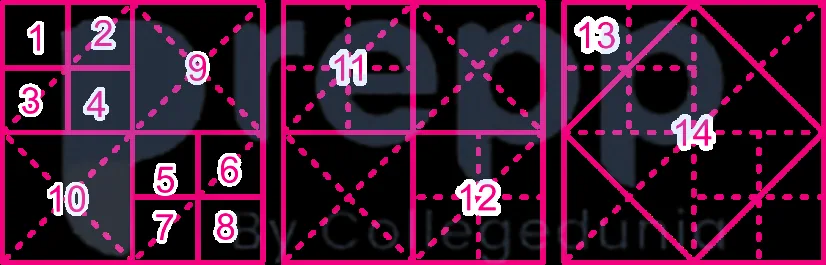 Paper & answer key PDF ↗
 Question 15archived
Select the Venn diagram that best illustrates the relationship between the following classes.
Uncle, Relatives, Rich
- A
Option A (shown in image)
- B
Option B (shown in image)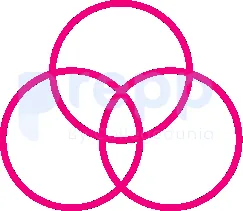
- C
Option C (shown in image)
- D
Option D (shown in image)
Show answer
D. Option D (shown in image)Hence, option 4 is the correct answer.
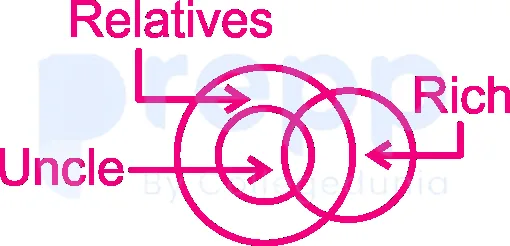 Paper & answer key PDF ↗
 Question 16archived
Rs. 1,875 is divided among A, B and C in such a way that A’s share is half of the combined share of B and C, and B’s share is one-fourth of the combined share of A and C. By what amount is C’s share more than that of A?
- A
Rs. 500
- B
Rs. 250
- C
Rs. 200
- D
Rs. 225
Show answer
B. Rs. 250Solving the Share Division Problem
This problem involves dividing a total amount of money among three people (A, B, and C) based on given ratios relating their shares. We need to determine each person's individual share and then find the difference between C's share and A's share.
Understanding the Given Conditions
We are given two main conditions about how the total amount of Rs. 1,875 is divided:
A's share is half of the combined share of B and C.
B's share is one-fourth of the combined share of A and C.
Let A, B, and C represent the amounts received by A, B, and C respectively.
Setting Up the Equations
Based on the given information, we can write the following equations:
The total amount is Rs. 1,875: \(A + B + C = 1875\)
A's share is half of (B + C): \(A = \frac{1}{2}(B + C)\) which can be rearranged to \(2A = B + C\).
B's share is one-fourth of (A + C): \(B = \frac{1}{4}(A + C)\) which can be rearranged to \(4B = A + C\).
Solving for the Shares of A, B, and C
We have a system of three equations. We can use substitution to solve for the individual shares.
From equation (2), we know that \(B + C = 2A\). We can substitute this into equation (1):
\(A + (B + C) = 1875\)
\(A + (2A) = 1875\)
\(3A = 1875\)
Now, we can find A's share:
\(A = \frac{1875}{3}\)
\(A = 625\)
So, A's share is Rs. 625.
Now we use equation (3), \(4B = A + C\). We know \(A = 625\), so:
\(4B = 625 + C\)
We also know from \(B + C = 2A\) that \(B + C = 2 \times 625 = 1250\). From this, we can express C in terms of B: \(C = 1250 - B\).
Substitute this expression for C into the equation \(4B = 625 + C\):
\(4B = 625 + (1250 - B)\)
\(4B = 625 + 1250 - B\)
\(4B + B = 1875\)
\(5B = 1875\)
Now, we can find B's share:
\(B = \frac{1875}{5}\)
\(B = 375\)
So, B's share is Rs. 375.
Finally, we can find C's share using the equation \(C = 1250 - B\):
\(C = 1250 - 375\)
\(C = 875\)
So, C's share is Rs. 875.
Summary of Shares
Person
Share (Rs.)
A
625
B
375
C
875
Total
1875
Calculating the Difference between C's Share and A's Share
The question asks by what amount is C's share more than that of A. This is the difference \(C - A\).
\(C - A = 875 - 625\)
\(C - A = 250\)
C's share is Rs. 250 more than A's share.
Verification
Let's quickly check if the calculated shares satisfy the initial conditions:
Is A = (B + C) / 2? \(625 = (375 + 875) / 2 = 1250 / 2 = 625\). Yes.
Is B = (A + C) / 4? \(375 = (625 + 875) / 4 = 1500 / 4 = 375\). Yes.
The shares are correct.
Revision Table: Share Division Problem
Concept
Application in this problem
Translating words to equations
Converting statements about share ratios into algebraic equations (\(A = \frac{1}{2}(B+C)\), etc.)
System of linear equations
Having multiple equations (\(A+B+C=1875\), \(2A=B+C\), \(4B=A+C\)) to solve for multiple unknowns (A, B, C).
Substitution method
Using one equation to express a variable in terms of others and substituting it into another equation to simplify and solve.
Calculating difference
Subtracting one share amount from another to find how much more one person received.
Additional Information: Ratio and Proportion Concepts
Problems involving dividing a sum based on given relationships between shares are common in quantitative aptitude. These often relate to concepts of ratio and proportion.
Ratio: A comparison of two quantities. In this problem, the relationships given (like A's share being half of B+C) implicitly define ratios between the shares or sums of shares.
Proportion: An equality of two ratios. While not explicitly stated as ratios like A:B:C, the given conditions allow us to find the proportionate shares.
Solving with Ratios: Sometimes, ratios like A:B:C can be directly found. For instance, from \(2A = B + C\), we can see \(A : (B+C) = 1:2\). From \(4B = A + C\), we see \(B : (A+C) = 1:4\). Combining these to find A:B:C can be another way to approach such problems, but solving the system of equations is often more straightforward when the relationships are sums like A = k(B+C).
Understanding how to translate word problems into algebraic equations is a crucial skill for solving these types of share division problems.
Paper & answer key PDF ↗ Question 17archived
Select the figure that will come next in the following figure series.

- A
Option A (shown in image)
- B
Option B (shown in image)
- C
Option C (shown in image)
- D
Option D (shown in image)
Show answer
B. Option B (shown in image)Pattern followed is:
1 st image has 2 vertical lines and 1 horizontal line, 2 nd image is mirror image of 1 st image.
3 rd image has 3 vertical lines and 2 horizontal lines, 4 th image is mirror image of 3 rd image.
Hence 5 th image will have 4 vertical lines and 3 horizontal lines.
Only option with 4 vertical lines and 3 horizontal lines is option 2.
Hence, option 2 is the correct answer.
Paper & answer key PDF ↗ Question 18archived
Three of the following four words are alike in a certain way and one is different. Pick the odd word out.
- A
Fennel
- B
Groundnut
- C
Mustard
- D
Cumin
Show answer
B. GroundnutFennel, Mustard, Cumin are Spices.
Groundnut is not a spice.
Hence, Groundnut is the odd among them.
Paper & answer key PDF ↗ Question 19archived
Select the set in which the numbers are related in the same way as are the numbers of the following set.
(3, 24, 4)
- A
(6, 35, 11)
- B
(2, 30, 8)
- C
(4, 72, 9)
- D
(12, 84, 4)
Show answer
C. (4, 72, 9)Finding the Number Relationship in the Set (3, 24, 4)
The question asks us to identify a set of numbers from the given options that shares the same mathematical relationship between its elements as the set (3, 24, 4).
Let's analyze the given set (3, 24, 4). We need to find a rule that connects the three numbers. Let's denote the numbers in a set as (A, B, C).
In the set (3, 24, 4), A = 3, B = 24, and C = 4.
We can look for simple arithmetic relationships between these numbers.
Adding the first and third numbers: $\text{A} + \text{C} = 3 + 4 = 7$. This is not the middle number 24.
Multiplying the first and third numbers: $\text{A} \times \text{C} = 3 \times 4 = 12$. This is not the middle number 24.
Let's see if there's a relationship involving multiplication and possibly a constant or another operation.
Notice that $12 \times 2 = 24$. So, it appears the middle number (B) is obtained by multiplying the first number (A) and the third number (C) together, and then multiplying the result by 2.
Let's formalize this relationship: $\text{B} = 2 \times (\text{A} \times \text{C})$.
Let's check this relationship with the given set (3, 24, 4):
$\text{A} = 3$, $\text{C} = 4$.
$2 \times (\text{A} \times \text{C}) = 2 \times (3 \times 4) = 2 \times 12 = 24$.
This matches the middle number B = 24. So, the relationship $\text{B} = 2 \times (\text{A} \times \text{C})$ holds for the set (3, 24, 4).
Testing the Relationship with the Options
Now, we will test each of the given options to see which set follows the same relationship: $\text{B} = 2 \times (\text{A} \times \text{C})$.
Option 1 Analysis: (6, 35, 11)
Here, A = 6, B = 35, C = 11.
Using the relationship $\text{B} = 2 \times (\text{A} \times \text{C})$:
$2 \times (\text{A} \times \text{C}) = 2 \times (6 \times 11) = 2 \times 66 = 132$.
The calculated value is 132, which is not equal to the middle number B = 35. So, this set does not follow the relationship.
Option 2 Analysis: (2, 30, 8)
Here, A = 2, B = 30, C = 8.
Using the relationship $\text{B} = 2 \times (\text{A} \times \text{C})$:
$2 \times (\text{A} \times \text{C}) = 2 \times (2 \times 8) = 2 \times 16 = 32$.
The calculated value is 32, which is not equal to the middle number B = 30. So, this set does not follow the relationship.
Option 3 Analysis: (4, 72, 9)
Here, A = 4, B = 72, C = 9.
Using the relationship $\text{B} = 2 \times (\text{A} \times \text{C})$:
$2 \times (\text{A} \times \text{C}) = 2 \times (4 \times 9) = 2 \times 36 = 72$.
The calculated value is 72, which is equal to the middle number B = 72. So, this set follows the relationship.
Option 4 Analysis: (12, 84, 4)
Here, A = 12, B = 84, C = 4.
Using the relationship $\text{B} = 2 \times (\text{A} \times \text{C})$:
$2 \times (\text{A} \times \text{C}) = 2 \times (12 \times 4) = 2 \times 48 = 96$.
The calculated value is 96, which is not equal to the middle number B = 84. So, this set does not follow the relationship.
Conclusion: Identifying the Matching Set
Based on the analysis, only the set (4, 72, 9) follows the same relationship $\text{B} = 2 \times (\text{A} \times \text{C})$ as the given set (3, 24, 4).
Set
A
B
C
Calculated $2 \times (\text{A} \times \text{C})$
Matches B?
(3, 24, 4)
3
24
4
$2 \times (3 \times 4) = 24$
Yes
(6, 35, 11)
6
35
11
$2 \times (6 \times 11) = 132$
No
(2, 30, 8)
2
30
8
$2 \times (2 \times 8) = 32$
No
(4, 72, 9)
4
72
9
$2 \times (4 \times 9) = 72$
Yes
(12, 84, 4)
12
84
4
$2 \times (12 \times 4) = 96$
No
Revision Table: Number Analogy Practice
Practicing number analogy questions helps improve logical reasoning and pattern identification skills. Key steps involve:
Analyzing the relationship in the given example set.
Identifying a mathematical rule (addition, subtraction, multiplication, division, squares, cubes, or combinations).
Applying the identified rule to each option.
Checking which option satisfies the rule.
Considering alternative rules if the first one doesn't work for any option.
Additional Information: Number Patterns and Logic
Number pattern and analogy questions are common in aptitude tests. They assess your ability to observe, find rules, and apply them. Relationships can be simple or complex. Some common types of relationships include:
Arithmetic progression (constant difference).
Geometric progression (constant ratio).
Operations involving squares or cubes.
Relationships between digits of the numbers.
Combinations of multiple operations.
Systematic analysis and testing of possible rules are crucial for solving such problems effectively.
Paper & answer key PDF ↗ Question 20archived
In a family of eight persons, there are two couples, each having two children. B and D are brothers, and each has two children. E is the aunt of A, who is the cousin brother of C. C is the sister of H, who is the cousin brother of G. F is the wife of B. How is H related to F?
- A
Son-in-law
- B
Nephew
- C
Brother-in-law
- D
Son
Show answer
B. NephewTree diagram:
Hence, His the nephew of F.
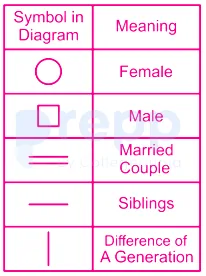
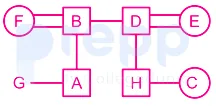 Paper & answer key PDF ↗
 Question 21archived
Select the number-pair in which the two numbers are related in the same way as are the two numbers of the following number-pair.
36 : 84
- A
21 : 51
- B
57 : 135
- C
27 : 63
- D
45 : 95
Show answer
C. 27 : 63Understanding Number Pair Relationships
The problem asks us to identify the relationship between the two numbers in the pair 36 : 84 and find another pair among the given options that shares the same relationship. These types of questions test our ability to find patterns and apply them.
Analyzing the Given Number Pair: 36 : 84
Let's examine the relationship between 36 and 84. We can look for common factors, ratios, or simple arithmetic operations.
One common approach is to find the ratio between the two numbers or look at their common factors.
Let's simplify the ratio $\frac{84}{36}$. Both numbers are divisible by common factors like 6 or 12. The greatest common divisor (GCD) of 36 and 84 is 12.
$36 = 12 \times 3$
$84 = 12 \times 7$
So, the pair 36 : 84 can be written as $(12 \times 3) : (12 \times 7)$. This shows a ratio of $3 : 7$ between the numbers, where the first number is 3 parts and the second number is 7 parts, scaled by a common factor (12 in this case).
Another way to express this relationship is that the second number is $\frac{7}{3}$ times the first number:
$\frac{84}{36} = \frac{12 \times 7}{12 \times 3} = \frac{7}{3}$
Checking the Options for the Same Relationship
Now we will examine each option to see if it follows the same pattern, i.e., if the second number is $\frac{7}{3}$ times the first number, or if the ratio between the two numbers simplifies to $3 : 7$ based on their GCD.
Option 1: 21 : 51
Let's find the ratio $\frac{51}{21}$. Both 21 and 51 are divisible by 3.
$\frac{51}{21} = \frac{3 \times 17}{3 \times 7} = \frac{17}{7}$
The ratio is 17:7, not 7:3. The GCD of 21 and 51 is 3. $21 = 3 \times 7$, $51 = 3 \times 17$. This gives a pattern $(k \times 7) : (k \times 17)$, not $(k \times 3) : (k \times 7)$. This option does not match.
Option 2: 57 : 135
Let's find the ratio $\frac{135}{57}$. Both 57 and 135 are divisible by 3.
$\frac{135}{57} = \frac{3 \times 45}{3 \times 19} = \frac{45}{19}$
The ratio is 45:19, not 7:3. The GCD of 57 and 135 is 3. $57 = 3 \times 19$, $135 = 3 \times 45$. This gives a pattern $(k \times 19) : (k \times 45)$, not $(k \times 3) : (k \times 7)$. This option does not match.
Option 3: 27 : 63
Let's find the ratio $\frac{63}{27}$. Both 27 and 63 are divisible by common factors like 3 or 9. The GCD of 27 and 63 is 9.
$\frac{63}{27} = \frac{9 \times 7}{9 \times 3} = \frac{7}{3}$
The ratio is 7:3. This matches the relationship found in the original pair 36 : 84. Also, using the GCD pattern: $27 = 9 \times 3$, $63 = 9 \times 7$. This follows the $(k \times 3) : (k \times 7)$ pattern with $k=9$. This option matches the relationship.
Option 4: 45 : 95
Let's find the ratio $\frac{95}{45}$. Both 45 and 95 are divisible by 5.
$\frac{95}{45} = \frac{5 \times 19}{5 \times 9} = \frac{19}{9}$
The ratio is 19:9, not 7:3. The GCD of 45 and 95 is 5. $45 = 5 \times 9$, $95 = 5 \times 19$. This gives a pattern $(k \times 9) : (k \times 19)$, not $(k \times 3) : (k \times 7)$. This option does not match.
Conclusion
Based on the analysis, only the number pair 27 : 63 shares the same relationship as 36 : 84. The relationship is that the two numbers are in the ratio of $3 : 7$, or the second number is $\frac{7}{3}$ times the first number. This relationship can also be expressed as the pair being in the form $(k \times 3) : (k \times 7)$, where $k$ is the greatest common divisor of the two numbers.
Revision Table: Comparing Pairs
Number Pair
GCD
Pair expressed as (GCD $\times$ Factor1) : (GCD $\times$ Factor2)
Ratio (Factor1 : Factor2)
Matches Original (3:7) Pattern?
36 : 84
12
(12 $\times$ 3) : (12 $\times$ 7)
3 : 7
Yes (Original)
21 : 51
3
(3 $\times$ 7) : (3 $\times$ 17)
7 : 17
No
57 : 135
3
(3 $\times$ 19) : (3 $\times$ 45)
19 : 45
No
27 : 63
9
(9 $\times$ 3) : (9 $\times$ 7)
3 : 7
Yes
45 : 95
5
(5 $\times$ 9) : (5 $\times$ 19)
9 : 19
No
Additional Information: Solving Number Analogy Problems
Number analogy or number pair relationship problems are common in reasoning and quantitative aptitude tests. To solve them effectively, consider the following strategies:
Identify Basic Operations: Check for addition, subtraction, multiplication, or division relationships.
Check for Squares, Cubes, Roots: The numbers might be related to squares, cubes, or their roots.
Look for Patterns in Digits: Sometimes the relationship involves the digits of the numbers (sum of digits, product of digits, etc.).
Find the Ratio or Proportion: As seen in this problem, simplifying the ratio between the numbers often reveals the pattern.
Consider Common Factors or Multiples: Finding the GCD or LCM can help break down the numbers and see the underlying structure.
Examine Prime Numbers: The numbers might be prime or related to prime factors.
Look for Sequences or Series Rules: Although less common in simple pairs, sometimes a rule from series applies.
Combine Operations: The relationship might involve a combination of different operations (e.g., multiply by X and then add Y).
Systematically testing these possible relationships for the given pair and then applying the found rule to the options is key to solving such problems.
Paper & answer key PDF ↗ Question 22archived
Select the word-pair in which the two words are related in the same way as are the two words in the following word-pair.
Book : Thesaurus
- A
Reptile : Python
- B
Furniture : Wood
- C
Tree : Forest
- D
Tennis : Ball
Show answer
A. Reptile : PythonUnderstanding Word Pair Analogies: Book : Thesaurus
Word pair analogies test your ability to identify the relationship between two given words and then find another pair of words that shares the same relationship. In the given word pair, we have Book : Thesaurus.
Let's analyze the relationship between these two words:
A Thesaurus is a specific type of Book. It is a reference book containing lists of words with synonyms and antonyms.
So, the relationship is 'A is a type of B' or 'Specific example : Category'.
Now, let's examine the relationships in each of the given options to find the one that matches the relationship in Book : Thesaurus.
Option
Word Pair
Relationship Analysis
Match?
1
Reptile : Python
A Python is a specific type of Reptile (a large nonvenomous snake).
Yes
2
Furniture : Wood
Wood is a material from which Furniture can be made. This is a 'Material : Product' or 'Product : Material' relationship, not 'Type of'.
No
3
Tree : Forest
A Forest is a collection or group of Trees. This is a 'Part : Whole' or 'Member : Group' relationship, not 'Type of'.
No
4
Tennis : Ball
A Ball is an object used to play Tennis. This is an 'Activity : Equipment' relationship, not 'Type of'.
No
Comparing the relationships, we see that the relationship in the pair Reptile : Python is the same as in Book : Thesaurus. In both cases, the second word is a specific type of the first word.
Therefore, the word pair Reptile : Python is related in the same way as Book : Thesaurus.
Revision Table: Word Pair Relationships
Understanding common types of relationships in word analogies is crucial for solving these questions quickly and accurately.
Relationship Type
Example Pair
Type of / Category : Example
Bird : Sparrow
Part : Whole
Finger : Hand
Cause : Effect
Fire : Ash
Worker : Tool
Carpenter : Hammer
Action : Object
Read : Book
Antonyms
Hot : Cold
Synonyms
Happy : Joyful
Additional Information: Mastering Analogy Questions
To improve your ability to solve word analogy questions effectively, consider the following tips:
Always try to determine the precise relationship between the first pair of words. Be as specific as possible (e.g., is it just 'part of' or specifically 'a wheel is part of a car'?).
Test the identified relationship on each option pair. Eliminate options that clearly do not fit.
If multiple options seem plausible, refine the relationship description. Sometimes the relationship is more specific than initially thought.
Practice with various types of word pairs to become familiar with common relationships.
Pay attention to the order of the words in the pair. The relationship often works in one direction (e.g., 'Example : Category' is different from 'Category : Example').
In the case of Book : Thesaurus, the order is 'Category : Specific Example'. Option 1, Reptile : Python, also follows this order 'Category : Specific Example'.
Paper & answer key PDF ↗ Question 23archived
Two different positions of the same dice are shown. Which number will be at the top if 6 is at the bottom?

- A
5
- B
3
- C
4
- D
2
Show answer
D. 2In 1 st cube 5 and 6 are adjacent face to 1
If we turn the 2 nd cube so that 1 faces towards front then 3 will be opposite of 5.
4 is opposite of 1 as it is not adjacent to 1 in any diagrams.
So, 6 and 2 will be opposite to each other.
Hence, 2 will be at top when 6 is at bottom.
Paper & answer key PDF ↗ Question 24archived
Select the option in which the given figure is embedded.(Rotation not allowed)

- A
Option A (shown in image)
- B
Option B (shown in image)
- C
Option C (shown in image)
- D
Option D (shown in image)
Show answer
C. Option C (shown in image)Hence, option 3 is the correct answer.
 Paper & answer key PDF ↗
 Question 25archived
‘Lawyer’ is related to ‘Justice’ in the same way as ‘Arbitrator’ is related to ‘________’.
- A
Communication
- B
Injustice
- C
Settlement
- D
Judgment
Show answer
C. SettlementUnderstanding the Analogy: Lawyer, Justice, Arbitrator
This question presents an analogy, asking us to complete a second pair of words based on the relationship established in the first pair. The first pair is 'Lawyer' and 'Justice'. We need to determine the connection between these two terms and then apply that same logic to find the missing word related to 'Arbitrator'.
Relationship between Lawyer and Justice
A Lawyer is a legal professional. Their primary role is to represent individuals or organizations in legal matters, advocate for their rights, and navigate the legal system. A central aim of a lawyer's work, within the framework of law, is to pursue or uphold Justice for their clients or in the legal system itself.
So, the relationship is that the first word (Lawyer) is a profession or role, and the second word (Justice) is a key outcome or principle they work towards or are associated with within their field.
Applying the Relationship to Arbitrator
Now consider the word Arbitrator. An arbitrator is a neutral third party appointed to settle a dispute outside of court. This process is called arbitration, a form of alternative dispute resolution (ADR). The arbitrator hears evidence and arguments from both sides involved in the dispute.
Following the established relationship, we need to find a word that represents the primary outcome or goal that an Arbitrator works towards or facilitates in a dispute resolution process.
Analyzing the Options for Arbitrator's Outcome
Let's examine the options provided:
Communication: While an arbitrator facilitates communication between parties, this is a means to an end, not the ultimate outcome of the arbitration process.
Injustice: This is the opposite of justice and is not something a neutral arbitrator would aim for. The goal is a fair resolution.
Settlement: Arbitrators are involved in helping parties reach a resolution, often resulting in a binding decision or an agreement that settles the dispute. The term 'settlement' directly relates to resolving a conflict, which is the core purpose of arbitration.
Judgment: An arbitrator makes an 'award', which is similar to a judgment in that it is a final and often binding decision. However, 'Settlement' aligns slightly better with the broader concept of resolving the dispute, and it is a common term associated with ADR processes aimed at finding a resolution outside of traditional court judgments.
Conclusion: Finding the Analogy Match
Considering the options, the most fitting term for the outcome or goal that an Arbitrator works towards, analogous to how a Lawyer works towards Justice, is Settlement. An arbitrator's role is to bring a dispute to a settlement, either by facilitating an agreement or by imposing a binding decision that settles the matter.
Thus, the analogy is: Lawyer is related to Justice in the same way as Arbitrator is related to Settlement.
Revision Table: Professions and Goals
Profession/RolePrimary Goal/Outcome
LawyerJustice (within the legal system)
ArbitratorSettlement (Resolution of dispute)
Additional Information: Role of an Arbitrator
An arbitrator plays a crucial role in alternative dispute resolution. Unlike a judge who presides over a court trial according to strict procedures, an arbitrator's process can be more flexible. They are chosen by the parties involved in the dispute (or by a court or institution if the parties cannot agree). The decision made by an arbitrator, called an 'award', is often legally binding and enforceable, much like a court judgment. The aim is always to provide a final and conclusive resolution, leading to a settlement of the issues between the disputing parties.
Paper & answer key PDF ↗ Question 26archived
Who is the first female Director General of Police in Puducherry?
- A
Kiran Bedi
- B
Kanchan Choudhary
- C
Sundari Nanda
- D
Aswathy Tonge
Show answer
C. Sundari NandaUnderstanding the Role of DGP and First Female DGP Puducherry
The Director General of Police (DGP) is the highest-ranking police officer in an Indian state or Union Territory. They are typically the head of the state or UT police force. The question asks about the first female police officer to hold this significant post in the Union Territory of Puducherry.
Let's look at the options provided:
Kiran Bedi: Kiran Bedi is a well-known retired Indian Police Service (IPS) officer. She was the first woman to join the IPS in 1972. She also served as the Lieutenant Governor of Puducherry from 2016 to 2021. While a prominent figure associated with Puducherry, she held the administrative role of Lieutenant Governor, not the police chief (DGP).
Kanchan Choudhary Bhattacharya: Kanchan Choudhary Bhattacharya was also a trailblazing IPS officer. She became the first woman Director General of Police of an Indian state (Uttarakhand) in 2004. However, she was not the first female DGP of Puducherry.
Sundari Nanda: Sundari Nanda is an IPS officer who served as the Director General of Police of Puducherry. Reports confirm that she was indeed the first woman to be appointed as the DGP of Puducherry. She took charge of this role.
Aswathy Tonge: Aswathy Tonge is also an IPS officer who has served in various capacities. However, information available does not identify her as the first female DGP of Puducherry.
Based on the analysis of the options and historical records, Sundari Nanda holds the distinction of being the first female Director General of Police in Puducherry.
First Female Police Chiefs in India
It's interesting to note the pioneers in police leadership roles:
First Woman IPS Officer: Kiran Bedi
First Woman DGP of a State: Kanchan Choudhary Bhattacharya (Uttarakhand)
First Woman DGP of Puducherry: Sundari Nanda
Revision Table: Key Female Police Leaders
Name
Notable Achievement
Context (State/UT/Role)
Kiran Bedi
First Woman IPS Officer
India / Various roles including Lt. Governor (Puducherry)
Kanchan Choudhary Bhattacharya
First Woman DGP of a State
Uttarakhand
Sundari Nanda
First Woman DGP of Puducherry
Puducherry (Union Territory)
Additional Information: The Role of a DGP
The Director General of Police (DGP) is the highest-ranking police officer in a state or Union Territory police force. The post is usually held by an officer with the rank of Director General. The DGP is accountable for the overall law and order situation, crime prevention, and administration of the police force in their jurisdiction. They report to the state or UT government.
Paper & answer key PDF ↗ Question 27archived
The ________ edition of the India-Indonesia coordinated patrol (IND-INDO CORPAT) held from 19 March to 4 th April 2019 was inaugurated at Port Blair, Andaman and Nicobar Islands.
- A
33rd
- B
45th
- C
42nd
- D
23rd
Show answer
A. 33rdUnderstanding India-Indonesia Coordinated Patrol (IND-INDO CORPAT)
Coordinated Patrols, known as CORPATs, are regular exercises conducted between maritime neighbours to enhance security and interoperability in shared maritime zones. The India-Indonesia Coordinated Patrol (IND-INDO CORPAT) is a significant bilateral exercise aimed at ensuring maritime security in the Indian Ocean region.
The 33rd Edition of IND-INDO CORPAT 2019
The question asks about a specific edition of the India-Indonesia Coordinated Patrol held from March 19 to April 4, 2019. This particular iteration was the 33rd edition of the IND-INDO CORPAT series.
Key details about this edition:
Event: India-Indonesia Coordinated Patrol (IND-INDO CORPAT)
Edition: 33rd
Dates: 19 March to 4th April 2019
Inauguration/Location: Port Blair, Andaman and Nicobar Islands
These coordinated patrols serve multiple purposes:
Enhancing mutual understanding and interoperability between the navies.
Preventing and suppressing illegal activities like illegal fishing, drug trafficking, maritime terrorism, and piracy.
Strengthening bilateral ties and cooperation in maritime security.
The inauguration ceremony at Port Blair marked the formal commencement of the patrol phase, which involved ships from both navies patrolling along the International Maritime Boundary Line (IMBL).
Significance of India-Indonesia Maritime Cooperation
India and Indonesia share a common maritime boundary and have vested interests in the security and stability of the Indian Ocean. Regular exercises like IND-INDO CORPAT are crucial for building trust, sharing information, and responding effectively to common maritime challenges.
The choice of Port Blair highlights the strategic importance of the Andaman and Nicobar Islands for India's maritime security and its reach into Southeast Asia.
Comparing Options
Let's look at the provided options in the context of the IND-INDO CORPAT held in March-April 2019:
Option
Edition Number
Relevance to March-April 2019 Patrol
Option 1
33rd
Matches the specific edition held during the specified period.
Option 2
45th
A later edition number, not corresponding to 2019.
Option 3
42nd
A later edition number, not corresponding to 2019.
Option 4
23rd
An earlier edition number, not corresponding to 2019.
Based on the official information regarding the event, the coordinated patrol held from March 19 to April 4, 2019, inaugurated at Port Blair, was indeed the 33rd edition.
Revision Table: Key Facts
Exercise Name
Participants
Purpose
Specific Edition (March-April 2019)
Location of Inauguration
IND-INDO CORPAT
India & Indonesia Navies
Maritime Security, Anti-Piracy, Anti-Illegal Fishing, Interoperability
33rd
Port Blair, Andaman and Nicobar Islands
Additional Information on Maritime Patrols
Coordinated patrols are a common feature of maritime security strategies globally. They are bilateral or multilateral efforts where participating nations patrol designated areas together or coordinate their individual patrols based on pre-agreed procedures. This helps in:
Creating a unified front against maritime threats.
Improving domain awareness.
Standardizing operational procedures.
Building trust and confidence between participating forces.
India conducts CORPATs with several other countries in the Indian Ocean Region, reinforcing its commitment to regional maritime security and cooperation.
Paper & answer key PDF ↗ Question 28archived
The Indian National Association was established in 1876 by ______ in Calcutta
- A
Badruddin Tyabji
- B
Sisir Kumar Ghosh
- C
V. K. Chiplunkar
- D
Anand Mohan Bose
Show answer
D. Anand Mohan BoseUnderstanding the Indian National Association Establishment
The question asks about the establishment of the Indian National Association in 1876 in Calcutta. This was a significant political organization in British India, considered one of the precursors to the Indian National Congress.
Let's look at the key figure associated with its establishment.
Establishment of the Indian National Association
The Indian National Association, also known as the Indian Association of Calcutta, was founded on July 26, 1876, in Calcutta. The primary leaders credited with establishing this organization were Surendranath Banerjee and Anand Mohan Bose.
Its objectives included:
Creating a strong public opinion on political questions.
Uniting the Indian people on a common political program.
Promoting Hindu-Muslim friendship.
Facilitating mass participation in public movements.
The association aimed to represent the interests of the educated middle class and peasants and sought reforms in the administrative system, particularly regarding the Indian Civil Service examinations.
Analyzing the Options
Let's examine the given options in the context of the establishment of the Indian National Association:
Badruddin Tyabji: He was a prominent lawyer and one of the founders of the Indian National Congress in 1885. He presided over the third session of the Indian National Congress in Madras in 1887. He was not involved in the establishment of the Indian National Association in 1876.
Sisir Kumar Ghosh: He was a journalist and one of the founders of the Amrita Bazar Patrika newspaper. While he was a significant figure in the political and social life of Bengal, the establishment of the Indian National Association is primarily attributed to Surendranath Banerjee and Anand Mohan Bose. Sisir Kumar Ghosh was more directly associated with the India League, founded in 1875.
V. K. Chiplunkar: Vishnushastri Krushnashastri Chiplunkar was a Marathi writer and journalist from Pune. He is known for his contributions to Marathi literature and co-founding institutions like the New English School in Pune along with Bal Gangadhar Tilak and Gopal Ganesh Agarkar. He was not associated with the establishment of the Indian National Association in Calcutta.
Anand Mohan Bose: As discussed, Anand Mohan Bose was one of the key founders of the Indian National Association along with Surendranath Banerjee in 1876 in Calcutta. He was a prominent barrister and a leading figure in the Brahmo Samaj movement as well. He later became the President of the Indian National Congress session in Madras in 1898.
Conclusion
Based on the historical facts, the Indian National Association was established in 1876 in Calcutta by Surendranath Banerjee and Anand Mohan Bose. Therefore, Anand Mohan Bose is the correct answer among the given options.
Revision Table: Key Political Associations before INC
Association
Year
Place
Founders/Key Figures
Zamindari Association (Landholders' Society)
1838
Calcutta
Dwarkanath Tagore, Prasanna Kumar Tagore, Radhakanta Deb
British India Association
1851
Calcutta
Devendranath Tagore, Radhakanta Deb
India League
1875
Calcutta
Sisir Kumar Ghosh
Indian National Association (Indian Association)
1876
Calcutta
Surendranath Banerjee, Anand Mohan Bose
Poona Sarvajanik Sabha
1867
Poona
Mahadev Govind Ranade, S.H. Chiplunkar, Ganesh Vasudev Joshi
Bombay Presidency Association
1885
Bombay
Badruddin Tyabji, Pherozeshah Mehta, K.T. Telang
Madras Mahajana Sabha
1884
Madras
M. Veeraraghavachariar, G. Subramania Iyer, P. Anandacharlu
Additional Information on Anand Mohan Bose
Anand Mohan Bose (1846-1906) was an influential Indian politician, academic, and social reformer. He was one of the earliest Indians to graduate from Cambridge University and was a brilliant mathematician. His commitment to nationalistic activities led him to co-found the Indian National Association, which played a crucial role in articulating the political demands of educated Indians and organizing public movements before the advent of the Indian National Congress. He was also deeply involved in the Brahmo Samaj movement, advocating for social reforms and rationalism.
Paper & answer key PDF ↗ Question 29archived
According to The Economist Intelligence Unit report 'Worldwide Cost of Living Survey 2019', which of the following is NOT one of the three cheapest cities in India?
- A
New Delhi
- B
Mumbai
- C
Bengaluru
- D
Chennai
Show answer
B. MumbaiUnderstanding the Worldwide Cost of Living Survey 2019
The question asks about The Economist Intelligence Unit (EIU) report 'Worldwide Cost of Living Survey 2019'. This survey compares the cost of living in various cities around the world. It helps understand how expensive or affordable different cities are relative to each other.
We are specifically asked to identify which of the listed Indian cities was NOT among the three cheapest cities in India according to this particular report for 2019, from the given options: New Delhi, Mumbai, Bengaluru, and Chennai.
Analyzing Indian Cities in the EIU 2019 Report
According to The Economist Intelligence Unit's 'Worldwide Cost of Living Survey 2019', several Indian cities were noted for being among the cheapest in the world. This is due to various factors including lower average wages and less volatile inflation compared to some other regions globally.
Let's look at how the cities mentioned in the options were typically ranked in the context of being affordable:
New Delhi: Frequently cited as one of the cheapest major cities globally and in India in the 2019 report.
Bengaluru: Also ranked highly among the most affordable cities in India and globally in the 2019 survey.
Chennai: Similarly, Chennai was listed as one of the cheapest cities in the 2019 Economist EIU report.
Mumbai: While still relatively affordable compared to global financial hubs like New York or London, Mumbai was consistently ranked as more expensive than cities like New Delhi, Bengaluru, and Chennai within India according to the 2019 survey.
Identifying the City Not Among the Cheapest
Based on the analysis of the 2019 EIU report rankings for Indian cities, New Delhi, Bengaluru, and Chennai were all noted as being among the cheapest cities. Mumbai, while affordable on a global scale, was ranked as more expensive than these three within India. Therefore, Mumbai is the city from the options that was NOT one of the three cheapest cities in India according to The Economist Intelligence Unit report 'Worldwide Cost of Living Survey 2019'.
Summary of Findings
City
Status in EIU 2019 Report (Among Options)
New Delhi
Among the cheapest cities in India
Mumbai
NOT among the three cheapest cities in India
Bengaluru
Among the cheapest cities in India
Chennai
Among the cheapest cities in India
This table summarizes the status of each city listed in the options regarding their ranking among the cheapest Indian cities in the 2019 report.
Revision Table: Key Concepts
Term
Explanation
Worldwide Cost of Living Survey
A report by The Economist Intelligence Unit (EIU) that compares the cost of living in various global cities based on a basket of common goods and services.
Cost of Living Index
A measure used to compare the cost of maintaining a certain standard of living in different geographic locations. Often relative to a base city (e.g., New York).
Additional Information: The EIU Survey Methodology
The Economist Intelligence Unit's Worldwide Cost of Living survey typically compares prices of over 160 products and services, including food, clothing, household supplies, personal care items, rent, transport, utilities, private schooling, and recreational costs. The survey uses New York City as the base city with an index score of 100. Other cities are then indexed relative to New York. A higher index score means a city is more expensive than New York, and a lower score means it is cheaper.
The 2019 report highlighted that cities in India, Pakistan, and Nepal were among the least expensive cities globally. While Mumbai is a major financial hub, its relative cost of living compared to New Delhi, Bengaluru, and Chennai placed it outside the top three cheapest within the specific context of the options provided in that year's survey.
Paper & answer key PDF ↗ Question 30archived
Who attacked and looted the famous Somnath temple in 1025 AD?
- A
Muhammad Gori
- B
Mahmud of Ghazni
- C
Genghis Khan
- D
Nadir Shah
Show answer
B. Mahmud of GhazniUnderstanding the Somnath Temple Attack in 1025 AD
The question asks about the ruler who attacked and looted the famous Somnath temple in 1025 AD. This is a significant event in Indian history, particularly concerning the raids from the Ghaznavid dynasty.
Identifying the Invader: Mahmud of Ghazni
Historically, the attack on the Somnath temple in 1025 AD is attributed to Mahmud of Ghazni. He was the ruler of the Ghaznavid dynasty, which controlled a vast empire stretching from Persia to the Punjab region.
Mahmud of Ghazni conducted numerous invasions into the Indian subcontinent between 1000 AD and 1027 AD. His primary motives were to acquire wealth from the rich temples and cities and to spread Islam, although the economic motive is often considered paramount.
The raid on the Somnath temple, located on the coast of Gujarat, was one of his most famous and devastating campaigns. The temple was renowned for its immense wealth, accumulated over centuries through donations and pilgrim offerings. Mahmud successfully breached the temple defenses, looted its treasures, and destroyed the main idol.
Analyzing the Options
Let's look at why the other options are incorrect:
Muhammad Gori: Muhammad Ghori was another ruler who invaded India, but his invasions began later than Mahmud of Ghazni's, primarily from the late 12th century onwards (around 1175 AD). He is known for defeating Prithviraj Chauhan in the Second Battle of Tarain (1192 AD) and establishing the foundation for the Delhi Sultanate. He did not attack the Somnath temple in 1025 AD.
Genghis Khan: Genghis Khan was the founder of the Mongol Empire in the early 13th century. While the Mongols did invade parts of Persia and posed a threat to the borders of India during the time of the Delhi Sultanate, Genghis Khan himself did not lead an invasion and looting of the Somnath temple. His activities were centered in Central Asia and further west during the period around 1025 AD.
Nadir Shah: Nadir Shah was the ruler of Persia who invaded India much later, in 1739. He is famous for defeating the Mughal army at the Battle of Karnal and looting Delhi, taking away treasures like the Peacock Throne and the Koh-i-Noor diamond. His invasion was centuries after the attack on the Somnath temple in 1025 AD.
Based on historical records, the ruler who attacked and looted the Somnath temple in 1025 AD was indeed Mahmud of Ghazni.
Key Invaders of India and Their Time Periods
Invader
Approximate Period of Invasions in India
Notable Actions (Selected)
Mahmud of Ghazni
1000-1027 AD
Attacked Somnath temple (1025 AD), multiple raids on northern India
Muhammad Ghori
Late 12th Century - Early 13th Century
Defeated Prithviraj Chauhan (1192 AD), laid foundation for Delhi Sultanate
Genghis Khan
Early 13th Century (Activities near India's borders)
Founder of Mongol Empire, threat to Delhi Sultanate
Nadir Shah
18th Century (1739 AD)
Sacked Delhi, looted treasures including Peacock Throne
Conclusion
The historical figure responsible for the attack and looting of the Somnath temple in 1025 AD is Mahmud of Ghazni. His numerous raids significantly impacted the political and economic landscape of northwestern India during that period.
Revision Table: Somnath Temple Attack
Event
Date
Invader
Location
Significance
Attack and Looting of Somnath Temple
1025 AD
Mahmud of Ghazni
Somnath, Gujarat
One of the most destructive raids by Mahmud of Ghazni, targeted temple wealth
Additional Information: Mahmud of Ghazni and His Raids
Mahmud of Ghazni, son of Sebuktigin, inherited the Ghaznavid empire. He is known for his seventeen expeditions into India. These expeditions were not aimed at permanent conquest and rule initially, but primarily at plundering the vast riches of Indian temples and cities. The wealth acquired was used to build and beautify his capital city, Ghazni, and to fund his military campaigns elsewhere.
His raids weakened many regional powers in northern India and paved the way for later Muslim invasions aimed at establishing long-term rule. The attack on Somnath remains one of the most widely discussed events of his campaigns due to the temple's prominence and the scale of destruction and looting involved.
Paper & answer key PDF ↗ Question 31archived
Which gas in its solid state is also known as dry ice?
- A
Nitrogen
- B
Oxygen
- C
Hydrogen
- D
Carbon dioxide
Show answer
D. Carbon dioxideThe question asks to identify the gas whose solid state is commonly known as dry ice. Dry ice is a well-known substance with unique properties.
Understanding Dry Ice: Solid State of Gases
Dry ice is the solid form of carbon dioxide ($\text{CO}_2$). It gets its name "dry ice" because it does not melt into a liquid like regular ice (solid water). Instead, it undergoes a process called sublimation, where it directly changes from a solid into a gas.
Why Solid Carbon Dioxide is Dry Ice
Carbon dioxide gas, when cooled to very low temperatures (around $-78.5^\circ\text{C}$ or $-109.3^\circ\text{F}$) at standard atmospheric pressure, turns directly into a solid. This solid $\text{CO}_2$ has several characteristics:
It is extremely cold, making it useful as a refrigerant.
It sublimes, meaning it turns directly into a gas without becoming a liquid under normal atmospheric pressure. This "dry" transition is where it gets its name.
It produces a visible fog when it interacts with moist air, which is due to the condensation of water vapor, not the $\text{CO}_2$ itself becoming visible.
Let's consider the given options:
Nitrogen: Solid nitrogen is also very cold, but it is not called dry ice. Nitrogen solidifies at even lower temperatures (below $-210^\circ\text{C}$).
Oxygen: Solid oxygen is a pale blue solid and is also extremely cold, solidifying below $-218^\circ\text{C}$. It is not known as dry ice.
Hydrogen: Solid hydrogen is the solid form of hydrogen gas, requiring temperatures below $-259^\circ\text{C}$ to solidify. It is not dry ice.
Carbon dioxide: As discussed, the solid state of carbon dioxide is precisely what is known as dry ice.
Key Concepts about Dry Ice
Dry ice is solid $\text{CO}_2$.
It sublimes at atmospheric pressure.
It is very cold and used for cooling.
Revision Table: Gas and its Solid State Name
Gas
Chemical Formula
Solid State Name/Description
Nitrogen
$\text{N}_2$
Solid nitrogen (very low temp solid)
Oxygen
$\text{O}_2$
Solid oxygen (very low temp solid)
Hydrogen
$\text{H}_2$
Solid hydrogen (very low temp solid)
Carbon dioxide
$\text{CO}_2$
Dry ice
Additional Information on Dry Ice and Solid Gases
Dry ice is widely used for transporting frozen goods, creating theatrical fog effects, and in various industrial processes. Handling dry ice requires caution due to its extremely low temperature, which can cause frostbite.
While other gases like nitrogen, oxygen, and hydrogen can also be solidified at extremely low temperatures, their solid forms have different properties and names compared to dry ice.
Therefore, the gas that is known as dry ice in its solid state is carbon dioxide.
Paper & answer key PDF ↗ Question 32archived
The lone gold medal for India was won by ____________ at the 38 th GeeBee Boxing Tournament held at Helsinki, Finland.
- A
Shiva Thapa
- B
Naveen Kumar
- C
Mohammed Hussamuddin
- D
Kavinder Singh Bisht
Show answer
D. Kavinder Singh BishtThe question asks to identify the Indian boxer who secured the single gold medal for India at the 38th GeeBee Boxing Tournament held in Helsinki, Finland.
Understanding the GeeBee Boxing Tournament
The GeeBee Boxing Tournament is an international boxing event that takes place annually in Helsinki, Finland. It attracts boxers from various countries, providing a platform for competition and preparation for major championships.
India's Performance at the 38th GeeBee Boxing Tournament
At the 38th edition of the GeeBee Boxing Tournament, held in Helsinki, Finland, the Indian contingent participated with the aim of winning medals. While several boxers represented India, only one managed to clinch a gold medal, making it India's lone gold at this specific event.
Identifying India's Lone Gold Medalist
The boxer who won the lone gold medal for India at the 38th GeeBee Boxing Tournament in Helsinki, Finland, was Kavinder Singh Bisht. He competed in his respective weight category and emerged victorious in the final bout to secure the gold.
Let's look at the options provided:
Shiva Thapa
Naveen Kumar
Mohammed Hussamuddin
Kavinder Singh Bisht
Based on the results of the tournament, Kavinder Singh Bisht was indeed the boxer who won the gold medal for India.
Therefore, the correct answer is Kavinder Singh Bisht.
Summary of Key Details
Tournament: 38th GeeBee Boxing Tournament
Location: Helsinki, Finland
India's Gold Medal Count: One (Lone gold medal)
Indian Gold Medalist: Kavinder Singh Bisht
Revision Table: Important Boxing Tournament Details
Tournament
Location
Significance
GeeBee Boxing Tournament
Helsinki, Finland
Annual international boxing event
38th Edition (mentioned in question)
Helsinki, Finland
Specific edition where Kavinder Singh Bisht won gold for India
Additional Information: Indian Boxers and International Success
Indian boxers have been increasingly successful on the international stage in various tournaments, including the Olympics, World Championships, Asian Games, Commonwealth Games, and prestigious events like the GeeBee Boxing Tournament. Participation and success in such tournaments are crucial for improving rankings and gaining experience.
Kavinder Singh Bisht is a notable Indian boxer who has represented the country in several international competitions. His gold medal at the GeeBee tournament is one of his significant achievements.
Paper & answer key PDF ↗ Question 33archived
Which country was the first to implement Goods and Services Tax (GST)?
- A
Canada
- B
Germany
- C
USA
- D
France
Show answer
D. FranceUnderstanding the First Country to Implement GST
The question asks about the pioneering country that first implemented the Goods and Services Tax (GST). GST is a type of indirect tax levied on the supply of goods and services. While many countries have adopted this tax system in various forms, one nation stands out as the first.
Let's look at the options provided:
Canada
Germany
USA
France
The concept of a value-added tax (VAT), which is the basis for GST systems in most countries, originated in France. France introduced a form of VAT in 1954, making it the first country in the world to implement such a tax system. This tax was initially applied to large businesses but was later extended to cover most business transactions.
This French system served as a model for many other countries around the world to adopt their own versions of VAT or GST.
Therefore, based on historical records regarding the implementation of a broad-based consumption tax system similar to modern GST/VAT, France was the first country.
Revision Table: Key Details on GST/VAT Origin
Concept
Description
What is GST?
A consumption tax on goods and services at each stage of production or distribution.
Origin Country
France
Year of First Implementation (VAT form)
1954
Pioneer
Maurice Lauré (French economist)
Additional Information: GST and VAT Systems
While the terms GST and VAT are often used interchangeably, they refer to similar consumption tax systems. VAT (Value Added Tax) is the more common term globally. GST (Goods and Services Tax) is primarily used in countries like Canada, Australia, India, and others. Both are multi-stage taxes collected at each step of the supply chain, with a mechanism for businesses to claim credit for the tax paid on inputs.
The implementation in France in 1954 marked a significant shift in taxation, moving from single-point sales taxes or cascade taxes (tax on tax) to a system where tax is applied only to the value added at each stage.
The spread of VAT/GST systems worldwide accelerated in the latter half of the 20th century, becoming a major source of government revenue for over 160 countries today.
Paper & answer key PDF ↗ Question 34archived
The Malimath Committee Report deals with:
- A
criminal justice system reforms
- B
textile sector reforms
- C
stock market reforms
- D
judicial delays
Show answer
A. criminal justice system reformsUnderstanding the Malimath Committee Report on Criminal Justice
The question asks about the subject matter of the Malimath Committee Report. This committee was significant for its recommendations concerning the Indian criminal justice system.
The Committee was headed by Justice V.S. Malimath, a former Chief Justice of the Karnataka and Kerala High Courts. It was constituted by the Government of India in 2000 to suggest reforms to the century-old criminal justice system in India. The committee submitted its report in 2003.
The primary objective of the Malimath Committee was to recommend measures to improve the efficiency and effectiveness of the criminal justice system, focusing on aspects like speedy trials, conviction rates, protection of victims, and the roles of the police, prosecution, and judiciary.
Detailed Analysis of the Options
criminal justice system reforms: The Malimath Committee was specifically set up to propose changes and improvements to the criminal justice system in India. Its report covers various aspects like police investigation, prosecution, courts, and prisons, with the aim of making the system more victim-centric and efficient. This aligns directly with the purpose and recommendations of the Malimath Committee.
stock market reforms: Committees related to stock market reforms typically deal with regulations, market structure, investor protection in financial markets. The Malimath Committee's mandate was entirely different.
textile sector reforms: Reforms in the textile sector would involve policies related to production, trade, technology, and labor within the textile industry. This is unrelated to the work of the Malimath Committee.
judicial delays: While judicial delays are a significant issue and the Malimath Committee did touch upon the need for speedy trials as part of criminal justice reform, the report's scope was much broader than just addressing delays. It covered comprehensive reforms to the entire criminal justice process, not solely the issue of delays across all judicial matters (civil and criminal). Therefore, 'criminal justice system reforms' is a more accurate and complete description of the report's subject.
Based on the committee's mandate and report, its work directly pertains to criminal justice system reforms.
Some key recommendations of the Malimath Committee included:
Measures for speedy trial, such as increasing the number of judges.
Introducing a victim compensation fund and giving victims participation rights in criminal trials.
Reforms in the evidence law.
Separation of investigation and prosecution roles.
These points further underscore the fact that the report focused on reforming the criminal justice system.
Conclusion on Malimath Committee Report Focus
The Malimath Committee Report is a landmark document primarily concerned with suggesting comprehensive reforms to the criminal justice system in India to make it more responsive, efficient, and just.
Revision Table: Malimath Committee Key Points
Committee Name
Headed By
Year of Report
Primary Focus
Malimath Committee
Justice V.S. Malimath
2003
Reforms to the Criminal Justice System in India
Additional Information: Indian Criminal Justice Reforms
Reforming the criminal justice system has been a subject of study by several committees in India over the years, highlighting the ongoing need for improvements. The Malimath Committee is one of the prominent ones.
The Indian criminal justice system involves complex processes starting from reporting a crime, investigation by police, prosecution, trial in courts, and finally punishment or acquittal. The Malimath Committee's recommendations aimed at addressing systemic issues like low conviction rates, delayed justice, poor conditions of victims and witnesses, and the burden on the police and judiciary.
Understanding the Malimath Committee Report is crucial for anyone studying Indian polity, governance, or legal reforms.
Paper & answer key PDF ↗ Question 35archived
Which queen died fighting Mughal armies while defending Garha Katanga in 1564?
- A
Rani Ahilyabai
- B
Rani Rudrambara
- C
Rani Avantibai
- D
Rani Durgavati
Show answer
D. Rani DurgavatiThe question asks about a brave queen who defended her kingdom, Garha Katanga, against the Mughal armies in 1564 and unfortunately died fighting in that battle. To answer this, we need to recall the history of Indian kingdoms and their interactions with the Mughal Empire during the 16th century.
Understanding Garha Katanga and the Mughal Invasion in 1564
Garha Katanga was a kingdom located in the Gondwana region of central India. In the year 1564, the Mughal forces, led by Asaf Khan, launched an invasion against Garha Katanga during the reign of Emperor Akbar.
Who Ruled Garha Katanga in 1564?
At the time of the Mughal invasion in 1564, Garha Katanga was ruled by Rani Durgavati. She was a valiant queen who took charge of the kingdom after the death of her husband, Dalpat Shah, ruling on behalf of her young son, Vir Narayan.
Rani Durgavati's Defence Against the Mughals
When the Mughal army invaded, Rani Durgavati did not surrender. Instead, she chose to fight bravely to protect her kingdom and her people. She led her army into battle against the much larger and powerful Mughal forces.
The battle was fierce. Despite initial successes and her personal bravery, Rani Durgavati's forces were eventually overwhelmed by the Mughals. Facing defeat and unwilling to be captured, Rani Durgavati tragically died on the battlefield in 1564 while defending Garha Katanga.
Analyzing the Options
Let's briefly look at the other options provided:
Rani Ahilyabai: Rani Ahilyabai Holkar was a ruler of the Malwa kingdom in the 18th century, long after the events of 1564.
Rani Rudrambara: This name does not correspond to a widely recognized queen who fought the Mughals in 1564. There was Rani Rudrama Devi of the Kakatiya dynasty, but she ruled in the 13th century.
Rani Avantibai: Rani Avantibai Lodhi was a queen from the Mandla region who fought against the British during the Indian Mutiny of 1857, significantly later than 1564.
Based on historical records, Rani Durgavati is the queen who fought and died defending Garha Katanga against the Mughal armies in 1564.
Conclusion: The Queen of Garha Katanga in 1564 Battle
The historical context clearly points to Rani Durgavati as the queen who made the ultimate sacrifice defending Garha Katanga from the Mughal invasion in 1564. Her bravery and resistance are remembered in history.
Queen's Name
Associated Region/Kingdom
Period/Event
Rani Ahilyabai
Malwa (Indore)
18th Century Ruler
Rani Rudrambara / Rudrama Devi
Kakatiya Dynasty
13th Century Ruler
Rani Avantibai
Mandla
1857 Mutiny against British
Rani Durgavati
Garha Katanga (Gondwana)
Fought Mughals in 1564
Revision Table: Key Facts about Rani Durgavati
Detail
Information
Kingdom
Garha Katanga (part of Gondwana)
Opponent
Mughal Army (led by Asaf Khan)
Year of Battle/Death
1564
Cause of Death
Died fighting in battle
Additional Information: Significance of Garha Katanga's Defence
The defence of Garha Katanga by Rani Durgavati is a significant event in the history of central India and the Mughal expansion. It highlights the resistance offered by regional kingdoms against the growing power of the Mughal Empire under Akbar. Although Garha Katanga was eventually annexed by the Mughals for a period, Rani Durgavati's courage became a symbol of resistance.
Garha Katanga was known for its wealth, partly due to the trapping and export of wild elephants, which was a valuable resource coveted by the Mughals.
Paper & answer key PDF ↗ Question 36archived
The Musi and Bhima are tributaries of the river ______.
- A
Brahmaputra
- B
Mahanadi
- C
Krishna
- D
Kaveri
Show answer
C. KrishnaUnderstanding Musi and Bhima Tributaries of the Krishna River
This question asks us to identify the major river into which the Musi and Bhima rivers flow as tributaries. A tributary is a river or stream that flows into a larger river or lake.
Let's consider the location and course of the Musi and Bhima rivers in India:
The Bhima River originates in the Western Ghats and flows southeast through Maharashtra, Karnataka, and Telangana before joining the Krishna River. It is a major tributary of the Krishna.
The Musi River is a tributary of the Krishna River in the Deccan Plateau. It flows through the city of Hyderabad before joining the Krishna River in Nalgonda district, Telangana.
Based on geographical knowledge, both the Musi and Bhima rivers are well-known tributaries of the Krishna River.
Let's briefly look at the other options to confirm why they are incorrect:
Brahmaputra: The Brahmaputra River flows mainly through Northeast India and Bangladesh. The Musi and Bhima rivers are located in South and Central India, far from the Brahmaputra basin.
Mahanadi: The Mahanadi River flows through states like Chhattisgarh and Odisha in Eastern India. The Musi and Bhima rivers are located in a different part of the country.
Kaveri: The Kaveri River flows through Karnataka and Tamil Nadu in Southern India. While it is a major South Indian river like the Krishna, its primary tributaries are different (e.g., Hemavati, Arkavati, Lakshmana Tirtha).
Therefore, the Musi and Bhima rivers are tributaries of the Krishna river.
Tributary River
Major River
Location
Musi River
Krishna River
Telangana (flows through Hyderabad)
Bhima River
Krishna River
Maharashtra, Karnataka, Telangana
Yamuna River
Ganges River
North India
Godavari River
Bay of Bengal (direct)
Maharashtra, Telangana, Andhra Pradesh
Revision Table: Key Indian Rivers and Tributaries
Major River
Notable Tributaries
Krishna River
Bhima, Musi, Koyna, Tungabhadra, Ghataprabha, Malaprabha
Godavari River
Pravara, Purna, Manjira, Penganga, Wardha, Wainganga, Indravati, Sabari
Kaveri River
Harangi, Hemavati, Kabini, Bhavani, Amravati, Noyyal
Ganges River
Yamuna, Ramganga, Gomti, Ghaghara, Gandak, Kosi, Son
Brahmaputra River
Lohit, Dibang, Subansiri, Manas, Teesta
Additional Information: The Krishna River Basin
The Krishna River is one of the longest rivers in India, flowing through Maharashtra, Karnataka, Telangana, and Andhra Pradesh. It originates from Mahabaleshwar in Maharashtra. The Krishna basin is a significant part of the Deccan Plateau and is crucial for agriculture and water supply in the region. Understanding the major tributaries like Bhima and Musi is important for studying the geography and river systems of South India.
Paper & answer key PDF ↗ Question 37archived
The Tata Iron and Steel company (TISCO) was established by Dorabji Tata in:
- A
1911
- B
1919
- C
1913
- D
1907
Show answer
D. 1907The question asks about the establishment year of the Tata Iron and Steel Company (TISCO) by Dorabji Tata.
Understanding TISCO and its Founder
The Tata Iron and Steel Company (TISCO), now known as Tata Steel, is one of the oldest and largest steel producers in India. It was a pioneering venture in Indian industry.
The company was envisioned by Jamsetji Nusserwanji Tata and was brought to fruition by his elder son, Dorabji Tata, after Jamsetji's death.
Finding the TISCO Establishment Year
Let's examine the options provided to determine the correct establishment year of TISCO by Dorabji Tata.
Option 1: 1911 - This year is related to the start of pig iron production at TISCO.
Option 2: 1919 - This year is later than the actual establishment.
Option 3: 1913 - This year saw the first production of steel at TISCO.
Option 4: 1907 - Historical records confirm that the Tata Iron and Steel Company (TISCO) was formally registered and established by Dorabji Tata in this year. The location chosen for the plant was Sakchi, which was later renamed Jamshedpur in honour of Jamsetji Tata.
Based on historical facts, the Tata Iron and Steel Company (TISCO) was established in 1907.
Revision Table: Key Dates for TISCO
Event
Year
TISCO Established
1907
Production of Pig Iron Begins
1911
Production of Steel Begins
1913
Sakchi Renamed Jamshedpur
1919
Additional Information about TISCO's Origins
The establishment of TISCO was a significant step towards industrializing India. Jamsetji Tata had a vision of setting up an iron and steel plant in India, but it was his son, Dorabji Tata, who made this dream a reality after years of meticulous search for raw materials and a suitable location.
The founding of TISCO in 1907 laid the groundwork for India's modern industrial sector and the planned city of Jamshedpur grew around the plant.
Paper & answer key PDF ↗ Question 38archived
Which of the following places was ruled by the Wadiyar dynasty?
- A
Jabalpur
- B
Patna
- C
Guwahati
- D
Mysore
Show answer
D. MysoreUnderstanding the Wadiyar Dynasty and Mysore's History
The question asks about the place that was historically ruled by the Wadiyar dynasty. To answer this, we need to know the history of the Wadiyar rulers and their kingdom.
The Wadiyar dynasty was a prominent royal family that ruled a kingdom in South India. Their reign spanned several centuries, playing a significant role in the history of the region.
Which Place Did the Wadiyar Dynasty Rule?
Let's look at the options provided:
Jabalpur
Patna
Guwahati
Mysore
Based on historical records, the Wadiyar dynasty is most famously associated with ruling the Kingdom of Mysore.
The Kingdom of Mysore was established in 1399 and was initially a feudatory state of the Vijayanagara Empire. With the decline of the Vijayanagara Empire, the Kingdom of Mysore under the Wadiyars gradually gained independence and expanded its territory. Mysore city served as the capital for much of their rule.
Why Mysore?
The connection between the Wadiyar dynasty and Mysore is deeply rooted in history. They ruled the region with Mysore as their capital for a significant period. Even after periods of interruption by rulers like Hyder Ali and Tipu Sultan, the Wadiyar dynasty was restored to power by the British and continued to rule Mysore as a princely state until India's independence in 1947.
Examining Other Options
Jabalpur: Jabalpur is located in Madhya Pradesh and has a history associated with dynasties like the Kalachuris and the Gonds, but not the Wadiyars.
Patna: Patna, the capital of Bihar, has a long history, including being the capital of the Magadha Empire (Pataliputra). It was ruled by various empires and dynasties over time, but not the Wadiyar dynasty.
Guwahati: Guwahati is in Assam and has a history linked to the Kamarupa Kingdom and later Ahom rulers, among others. It was not ruled by the Wadiyar dynasty.
Therefore, historical evidence clearly points to Mysore as the place ruled by the Wadiyar dynasty.
Conclusion on the Wadiyar Dynasty's Rule
The Wadiyar dynasty's rule is synonymous with the history of the Kingdom of Mysore. Their legacy includes significant contributions to the region's administration, culture, and development.
Revision Table: Places and Associated Dynasties (Examples)
Place
Associated Dynasty/Rulers (Examples)
Mysore
Wadiyar Dynasty
Jabalpur
Kalachuris, Gonds
Patna
Mauryas, Guptas, Mughal Empire, various others
Guwahati
Kamarupa Kings, Ahom Kingdom
Additional Information: The Mysore Kingdom
The Kingdom of Mysore under the Wadiyars was known for its administrative efficiency and patronage of arts and culture. Notable rulers include Krishnaraja Wadiyar IV, often referred to as the 'Rajarshi' (sage king), who oversaw significant progress in various sectors during the early 20th century. The kingdom played a complex role during the colonial period, transitioning from an independent power to a princely state under British paramountcy.
Paper & answer key PDF ↗ Question 39archived
The Olympic Council of Asia (OCA) has decided to reintroduce ______in the 2022 Asian Games to be held at Hangzhou, China after it was dropped in 2018.
- A
volleyball
- B
soccer
- C
fencing
- D
cricket
Show answer
D. cricketUnderstanding the Reintroduction of Sports in Asian Games
The question asks about a specific sport that the Olympic Council of Asia (OCA) decided to bring back for the 2022 Asian Games held in Hangzhou, China. This sport had been excluded from the previous edition of the games in 2018.
Let's analyze the options provided and the historical context of sports in the Asian Games.
Volleyball: Volleyball has been a regular sport in the Asian Games for many editions and was not dropped in 2018.
Soccer: Soccer (Football) is another core sport that has been consistently featured in the Asian Games and was present in 2018.
Fencing: Fencing has also been a part of the Asian Games program for a significant period and was included in 2018.
Cricket: Cricket was included in the Asian Games in the 2010 edition held in Guangzhou and the 2014 edition held in Incheon. However, it was dropped from the 2018 Jakarta-Palembang Games. The Olympic Council of Asia (OCA) then decided to reintroduce cricket for the 2022 Asian Games in Hangzhou.
Based on the history of sport inclusion and exclusion in recent Asian Games, the sport that fits the description of being dropped in 2018 and reintroduced for the 2022 Hangzhou Asian Games by the Olympic Council of Asia (OCA) is cricket.
The reintroduction of cricket, particularly the T20 format, was seen as a move to increase the appeal of the Asian Games and involve countries where cricket is popular.
History of Cricket's Inclusion in Asian Games
Cricket's journey in the Asian Games has seen some changes:
2010 Guangzhou, China: Cricket (T20 format) was included.
2014 Incheon, South Korea: Cricket (T20 format) was included.
2018 Jakarta-Palembang, Indonesia: Cricket was dropped from the program.
2022 Hangzhou, China: Cricket (T20 format) was reintroduced.
Asian Games Year
Host City/Country
Cricket Status
2010
Guangzhou, China
Included (T20)
2014
Incheon, South Korea
Included (T20)
2018
Jakarta-Palembang, Indonesia
Dropped
2022 (held in 2023)
Hangzhou, China
Reintroduced (T20)
Therefore, the sport that was reintroduced in the 2022 Asian Games in Hangzhou after being dropped in 2018 is cricket.
Revision Table: Key Details on Asian Games Cricket
Event Detail
Description
Governing Body Deciding
Olympic Council of Asia (OCA)
Games Year
2022 (Hangzhou)
Previous Status (2018)
Dropped
New Status (2022)
Reintroduced
Sport
Cricket
Format (when included)
T20
Additional Information: Olympic Council of Asia and Asian Games Sports
The Olympic Council of Asia (OCA) is the governing body of sports in Asia, recognized by the International Olympic Committee (IOC). It is responsible for organizing the Asian Games and other continental multi-sport events. The OCA's role includes deciding which sports are included in the Asian Games program, taking into consideration factors like popularity in the region, Olympic status, and facilities available in the host city. The decision to include or exclude sports can change from one edition of the games to the next, as seen with cricket. The 2022 Asian Games featured a wide array of sports, showcasing athletic talent across the Asian continent.
Paper & answer key PDF ↗ Question 40archived
_________ dance, performed by Buddhists to ward off evil spirits, is a dance form of Himachal Pradesh.
- A
Chham
- B
Dham
- C
Gogra
- D
Natya
Show answer
A. ChhamUnderstanding the Chham Dance of Himachal Pradesh
The question asks about a specific dance form performed by Buddhists in Himachal Pradesh to ward off evil spirits. Let's analyse the options provided to identify this unique cultural expression.
Analysing the Dance Options
We are given four options:
Chham
Dham
Gogra
Natya
Each of these might represent a dance form, but only one fits the description of a Buddhist dance from Himachal Pradesh performed to ward off evil spirits.
Identifying the Correct Dance Form
The description specifically points to a dance performed by the Buddhist community in Himachal Pradesh with a ritualistic purpose – warding off evil spirits. Let's examine the options:
Chham: This is a vibrant mask dance performed by Buddhist monks (Lamas) in monasteries in regions like Himachal Pradesh (especially Lahaul and Spiti, Kinnaur) and Sikkim, as part of religious festivals. It symbolises the victory of good over evil and is indeed performed to ward off evil spirits and negative forces. The dancers wear colourful costumes and expressive masks representing various deities and demons.
Dham: This dance form is associated with the Kangra district of Himachal Pradesh. It is typically performed during marriages and other festive occasions by women, often accompanying the Dhol (drum). It is not primarily a Buddhist ritual dance aimed at warding off evil spirits.
Gogra: Gogra is also a folk dance from Himachal Pradesh, primarily performed during festivals like Holi in certain areas. It is a lively group dance, but not specifically a Buddhist ritual dance for warding off evil.
Natya: This is a very broad term in Indian classical arts, generally referring to drama or performance art, which includes dance, music, and acting. While many regional dance forms might fall under the umbrella of 'Natya' in a general sense, 'Natya' itself is not the specific name of the described dance form from Himachal Pradesh.
Based on the characteristics provided in the question – Buddhist performance, Himachal Pradesh origin, and purpose of warding off evil spirits – the Chham dance is the correct fit.
Summary Table of Dance Forms
Dance Form
Region/Community
Purpose/Context
Chham
Himachal Pradesh (Buddhist Monasteries)
Ritual dance, warding off evil spirits, religious festivals
Dham
Himachal Pradesh (Kangra)
Marriage ceremonies, festivals
Gogra
Himachal Pradesh (various regions)
Festivals (e.g., Holi)
Natya
General term for performance art
Broad category including dance, drama, music
Therefore, the dance performed by Buddhists to ward off evil spirits in Himachal Pradesh is the Chham dance.
Revision Table: Key Facts about Chham Dance
Aspect
Description
Name
Chham dance
Performed by
Buddhist monks (Lamas)
Location
Monasteries in Himachal Pradesh (Lahaul & Spiti, Kinnaur) and other Himalayan regions
Purpose
To ward off evil spirits, symbolise good > evil, part of religious festivals
Characteristics
Masked dance, colourful costumes, expressive movements
Additional Information on Himachal Pradesh Dances
Himachal Pradesh is rich in diverse folk dance traditions reflecting its varied geography and communities. While Chham dance is a significant Buddhist ritual dance, other regions and communities in Himachal Pradesh have their own distinct forms.
Many Himachali dances involve vibrant music played on traditional instruments like Dhol, Nagara, Shehnai, and trumpets.
Dances like Nati are popular across many parts of the state and are often performed during fairs and festivals as a community celebration.
Some dances are linked to agricultural cycles, celebrating harvest or praying for good yields.
The costumes in Himachali dances are often colourful and reflect the local attire of the region.
Understanding these different dance forms provides insight into the cultural tapestry of Himachal Pradesh.
Paper & answer key PDF ↗ Question 41archived
Sundari, a well known species of trees, is found in:
- A
himalayan mountains
- B
tropical deciduous forests
- C
mangrove forests
- D
tropical rainforests
Show answer
C. mangrove forestsLet's understand where the famous Sundari tree is typically found by examining its habitat requirements and the characteristics of different forest types.
The Sundari tree (scientifically known as Heritiera fomes) is a highly important tree species, especially in certain coastal regions. Its name is believed to be the origin of the name 'Sundarbans', the large mangrove forest area shared by Bangladesh and India.
Understanding Sundari Tree Habitat
Sundari trees are specifically adapted to survive in challenging environments. These environments are characterized by:
High salinity in soil and water.
Waterlogged conditions, often flooded by tides.
Anaerobic soil (low oxygen) due to waterlogging.
Trees growing in such conditions need special adaptations to handle salt, get oxygen for their roots, and anchor themselves in soft, muddy ground.
Analyzing Forest Types for Sundari Trees
Let's look at the options provided and see which one matches the habitat requirements of the Sundari tree:
Himalayan mountains: These are cold or temperate regions with rocky or mountainous terrain. This environment is completely different from the coastal, saline, waterlogged conditions required by Sundari trees. Sundari trees are not found here.
Tropical deciduous forests: These forests are found in areas with a distinct wet and dry season. The trees shed their leaves during the dry season. While they are tropical, they are typically not coastal, saline, or constantly waterlogged environments. Sundari trees are not adapted for these conditions.
Mangrove forests: These forests are found in coastal areas and estuaries, where freshwater meets saltwater. They are characterized by tidal inundation, high salinity, muddy and waterlogged soil. Trees in mangrove forests have special adaptations like pneumatophores (aerial roots for breathing), prop roots for support, and salt tolerance mechanisms. The Sundari tree is a prime example of a species specifically adapted to thrive in mangrove ecosystems. The Sundarbans are the largest contiguous mangrove forest in the world and are named after the abundance of Sundari trees.
Tropical rainforests: These forests receive high rainfall throughout the year and are typically found in non-saline environments. The soil is often well-drained compared to mangrove areas. While tropical, the lack of salinity and tidal conditions makes this habitat unsuitable for Sundari trees.
Conclusion on Sundari Tree Location
Based on the specific adaptations and habitat requirements of the Sundari tree, it is evident that they are found in environments characterized by saline, waterlogged, tidal conditions. This description perfectly matches mangrove forests.
Therefore, Sundari trees are well known species of trees found in mangrove forests.
Revision Table: Comparing Habitats
Forest Type
Typical Location
Water Salinity
Soil Condition
Suitable for Sundari Tree?
Himalayan Mountains
Mountainous, high altitude
Freshwater (streams, rivers)
Varied (rocky, soil)
No
Tropical Deciduous Forests
Inland tropical regions
Freshwater
Seasonal drying/wetting
No
Mangrove Forests
Coastal, Estuaries
Saline/Brackish
Waterlogged, muddy, anaerobic
Yes
Tropical Rainforests
Tropical regions, high rainfall
Freshwater
Humid, well-drained (comparatively)
No
Additional Information on Mangrove Ecosystems
Mangrove forests are incredibly important ecosystems. They serve multiple crucial functions:
They act as natural barriers, protecting coastlines from erosion, storm surges, and tsunamis.
They provide nurseries and breeding grounds for a wide variety of fish, crustaceans, and other marine life, supporting coastal fisheries.
They sequester large amounts of carbon, helping to mitigate climate change.
They support unique biodiversity, including specialized plants like the Sundari tree and various animal species.
The adaptations of mangrove trees, such as aerial roots (pneumatophores) and salt-filtering mechanisms, are fascinating examples of evolution in response to harsh conditions.
The Sundari tree is a keystone species in the Sundarbans mangrove ecosystem, providing habitat and resources for many other organisms.
Paper & answer key PDF ↗ Question 42archived
The property of catenation is predominant in _______.
- A
sulphur
- B
carbon
- C
silicon
- D
nitrogen
Show answer
B. carbonUnderstanding Catenation: The Self-Bonding Property
Catenation is a unique property shown by certain elements where atoms of the same element link together to form long chains, rings, or complex structures through covalent bonds. This ability is primarily dependent on the strength of the bond formed between two identical atoms and the element's valency.
Let's examine the elements provided in the options regarding their catenation ability:
Sulphur (S): Sulphur atoms can form S-S bonds and exhibit catenation. It commonly exists as S₈ rings and also forms longer chains. However, the S-S bond is generally weaker compared to the C-C bond.
Carbon (C): Carbon shows a remarkable ability to form strong covalent bonds with other carbon atoms (C-C bonds). This leads to the formation of a vast variety of stable structures, including straight chains, branched chains, and rings of various sizes. This property of predominant catenation is the backbone of organic chemistry. The C-C bond is relatively strong, making the resulting chains and rings stable.
Silicon (Si): Silicon, which is in the same group as carbon, also exhibits catenation (Si-Si bonds). However, the Si-Si bond is significantly weaker than the C-C bond. Additionally, silicon is a larger atom than carbon, which affects the stability of longer chains due to steric factors and reactivity with other elements like oxygen. Therefore, silicon's catenation is much more limited compared to carbon.
Nitrogen (N): Nitrogen can form single bonds with other nitrogen atoms (N-N bonds). However, the N-N single bond is relatively weak, mainly due to the repulsion between the lone pairs of electrons on the two nitrogen atoms. This weakness limits the extent of catenation in nitrogen, which typically forms only short chains or rings.
Comparing the extent and stability of catenation among these elements, carbon stands out due to the high strength of the carbon-carbon single bond (\(\text{C-C}\)). This allows carbon to form exceptionally long and stable chains and rings, making its catenation property predominant.
Element
Ability to Catenate
Reason for Extent of Catenation
Carbon (C)
High (Predominant)
Strong C-C bond, small atomic size
Sulphur (S)
Moderate
Relatively weaker S-S bond compared to C-C
Silicon (Si)
Limited
Weaker Si-Si bond, larger atomic size, reactivity
Nitrogen (N)
Very Limited
Weak N-N bond (lone pair repulsion)
Based on the analysis, carbon shows the most predominant catenation among the given options.
Revision Table: Key Facts on Catenation
Term
Definition/Description
Predominant Element Example
Catenation
The ability of an element to form covalent bonds with atoms of the same element.
Carbon
Factors affecting Catenation
Bond strength between identical atoms, atomic size, valency, presence of lone pairs.
Stronger bonds favour catenation.
Carbon's Catenation
Very high due to strong C-C bonds, forming stable chains and rings. Forms basis of organic chemistry.
Alkanes, Alkenes, Alkynes, Cyclic hydrocarbons, Fullerenes, Graphite, Diamond.
Additional Information: Examples and Significance of Catenation
The predominant catenation property of carbon is fundamental to the diversity and complexity of organic compounds. Organic molecules, which form the basis of life, are essentially carbon skeletons with other atoms attached.
Hydrocarbons: Simple organic compounds made only of carbon and hydrogen atoms, featuring carbon chains and rings.
Allotropes of Carbon: Diamond, graphite, fullerenes, and carbon nanotubes are examples of different structures formed solely by carbon atoms linked through covalent bonds, showcasing extensive catenation.
Silicones: While silicon's catenation is limited, it can form compounds called silicones which have Si-O-Si linkages forming the backbone, rather than direct Si-Si chains, mixed with organic groups. This highlights the comparative difference in Si-Si vs C-C bond stability.
Understanding catenation helps explain why certain elements form complex molecular structures and why carbon chemistry is so vast.
Paper & answer key PDF ↗ Question 43archived
Methyl propane is an isomer of:
- A
n-hexane
- B
n-pentane
- C
n-propane
- D
n-butane
Show answer
D. n-butaneUnderstanding Isomers in Organic Chemistry
In organic chemistry, isomers are molecules that have the same molecular formula but different structural formulas. This means they contain the same number of atoms of each element, but the atoms are connected or arranged in a different way.
To determine which compound is an isomer of methyl propane, we first need to understand what methyl propane is and determine its molecular formula. Then, we will find the molecular formulas for the given options and compare them.
What is Methyl Propane?
Methyl propane is a common name for a branched-chain alkane. The systematic IUPAC name for methyl propane is 2-methylpropane. Let's figure out its structure and molecular formula:
Propane indicates a chain of three carbon atoms.
"Methyl" at position 2 means a \(\text{CH}_3\) group is attached to the second carbon atom of the propane chain.
The structure looks like this:
CH<sub>3</sub>
|
CH<sub>3</sub>-CH-CH<sub>3</sub>
Counting the atoms:
Carbon atoms: 4 (one central, three in methyl groups)
Hydrogen atoms: \(3 + 1 + 3 + 3 = 10\)
So, the molecular formula for methyl propane (2-methylpropane) is \(\text{C}_4\text{H}_{10}\).
Analyzing the Options to Find the Isomer
Now, let's determine the molecular formula for each of the given options:
n-hexane: This is a straight-chain alkane with 6 carbon atoms. The general formula for alkanes is \(\text{C}_n\text{H}_{2n+2}\). For n-hexane, \(n=6\). So, the formula is \(\text{C}_6\text{H}_{(2\times 6)+2} = \text{C}_6\text{H}_{14}\).
n-pentane: This is a straight-chain alkane with 5 carbon atoms. For n-pentane, \(n=5\). So, the formula is \(\text{C}_5\text{H}_{(2\times 5)+2} = \text{C}_5\text{H}_{12}\).
n-propane: This is a straight-chain alkane with 3 carbon atoms. For n-propane, \(n=3\). So, the formula is \(\text{C}_3\text{H}_{(2\times 3)+2} = \text{C}_3\text{H}_8\).
n-butane: This is a straight-chain alkane with 4 carbon atoms. For n-butane, \(n=4\). So, the formula is \(\text{C}_4\text{H}_{(2\times 4)+2} = \text{C}_4\text{H}_{10}\).
Comparing Molecular Formulas
Let's compare the molecular formula of methyl propane (\(\text{C}_4\text{H}_{10}\)) with the molecular formulas of the options:
Compound
Molecular Formula
Isomer of Methyl Propane (\(\text{C}_4\text{H}_{10}\))?
Methyl propane (2-methylpropane)
\(\text{C}_4\text{H}_{10}\)
-
n-hexane
\(\text{C}_6\text{H}_{14}\)
No (Different formula)
n-pentane
\(\text{C}_5\text{H}_{12}\)
No (Different formula)
n-propane
\(\text{C}_3\text{H}_8\)
No (Different formula)
n-butane
\(\text{C}_4\text{H}_{10}\)
Yes (Same formula, different structure)
As the table shows, n-butane has the same molecular formula (\(\text{C}_4\text{H}_{10}\)) as methyl propane, but it has a different structure (a straight chain). Therefore, n-butane is an isomer of methyl propane.
Conclusion
Methyl propane (2-methylpropane) and n-butane are structural isomers because they share the same molecular formula, \(\text{C}_4\text{H}_{10}\), but have different arrangements of their atoms.
Revision Table: Isomers of Butane
Name
Common Name
IUPAC Name
Structure
Molecular Formula
n-butane
n-butane
butane
\(\text{CH}_3-\text{CH}_2-\text{CH}_2-\text{CH}_3\)
\(\text{C}_4\text{H}_{10}\)
Methyl propane
isobutane
2-methylpropane
CH<sub>3</sub>
|
CH<sub>3</sub>-CH-CH<sub>3</sub>
\(\text{C}_4\text{H}_{10}\)
Additional Information on Structural Isomerism
Structural isomerism, also known as constitutional isomerism, is a type of isomerism where molecules with the same molecular formula have different bonding patterns and atomic connectivity. There are different types of structural isomerism:
Chain Isomerism: Isomers differ in the arrangement of the carbon chain (e.g., straight chain vs. branched chain), like n-butane and methyl propane.
Position Isomerism: Isomers have the same functional group, but it is located at a different position on the carbon chain (e.g., 1-propanol and 2-propanol).
Functional Group Isomerism: Isomers have different functional groups (e.g., ethanol, an alcohol, and dimethyl ether, an ether, both \(\text{C}_2\text{H}_6\text{O}\)).
Identifying isomers is a fundamental concept in organic chemistry for understanding the diversity of organic compounds.
Paper & answer key PDF ↗ Question 44archived
Which of the following elements is a metalloid?
- A
Silicon
- B
Tin
- C
Bismuth
- D
Phosphorus
Show answer
A. SiliconIdentifying Metalloid Elements in Chemistry
Elements in the periodic table are broadly classified into metals, nonmetals, and metalloids. Metalloids, also known as semimetals, are a group of elements that exhibit properties intermediate between those of metals and nonmetals. They are typically found along the diagonal line separating the metals from the nonmetals on the periodic table.
The question asks to identify which of the given elements is a metalloid. Let's examine each option:
Silicon (Si): Silicon is in Group 14 and Period 3 of the periodic table. It is located to the right of the staircase-like line that distinguishes metals from nonmetals. Silicon exhibits properties of both metals and nonmetals, such as having a metallic luster but being a semiconductor rather than a good conductor of electricity. It is widely recognized as a metalloid.
Tin (Sn): Tin is in Group 14 and Period 5. It is located below the metalloids in its group (Silicon and Germanium) and is classified as a post-transition metal, which is a type of metal. Tin is a malleable and ductile metal with good conductivity.
Bismuth (Bi): Bismuth is in Group 15 and Period 6. It is located well below the metalloids and is classified as a post-transition metal. Bismuth is a brittle, crystalline metal.
Phosphorus (P): Phosphorus is in Group 15 and Period 3. It is located to the right and above the metalloids on the periodic table and is classified as a nonmetal. Phosphorus exists in various allotropic forms, some of which are highly reactive nonmetals.
Based on their positions and properties, Silicon fits the description of a metalloid, while Tin and Bismuth are metals, and Phosphorus is a nonmetal.
Here is a summary of the elements provided:
Element
Symbol
Group
Period
Classification
Silicon
Si
14
3
Metalloid
Tin
Sn
14
5
Metal (Post-transition)
Bismuth
Bi
15
6
Metal (Post-transition)
Phosphorus
P
15
3
Nonmetal
Therefore, Silicon is the metalloid among the given options.
Revision Table: Key Element Classifications
Element
Symbol
Type
Silicon
Si
Metalloid
Tin
Sn
Metal
Bismuth
Bi
Metal
Phosphorus
P
Nonmetal
Additional Information on Element Types
Understanding the difference between metals, nonmetals, and metalloids is fundamental in chemistry. Their distinct properties arise from their atomic structure and how readily they gain, lose, or share electrons.
Metals: Generally located on the left side of the periodic table. They are typically solid at room temperature (except mercury), are good conductors of heat and electricity, are malleable (can be hammered into thin sheets), ductile (can be drawn into wires), and have a metallic luster (shiny). They tend to lose electrons to form positive ions (cations).
Nonmetals: Generally located on the right side of the periodic table. They exist as solids, liquids, or gases at room temperature. They are poor conductors of heat and electricity, are brittle in solid form, and lack metallic luster. They tend to gain or share electrons to form negative ions (anions) or covalent bonds.
Metalloids: Found along the border between metals and nonmetals. They exhibit properties of both classes. For example, they may have a metallic appearance but are brittle like nonmetals. Their electrical conductivity is intermediate between that of metals and nonmetals, and it increases with temperature, making them semiconductors, which are crucial in electronics. Common metalloids include Boron (B), Silicon (Si), Germanium (Ge), Arsenic (As), Antimony (Sb), Tellurium (Te), and Polonium (Po - sometimes considered a metalloid or post-transition metal).
Paper & answer key PDF ↗ Question 45archived
In March 2019, _________ was sworn in as the new chief minister of Goa, following the demise of Manohar Parrikar.
- A
Ashok Gehlot
- B
Vasundhara Raje
- C
H. D. Kumaraswamy
- D
Pramod Sawant
Show answer
D. Pramod SawantGoa Chief Minister After Manohar Parrikar in March 2019
The question asks who was sworn in as the new Chief Minister of Goa in March 2019, following the passing of the then Chief Minister, Manohar Parrikar.
Following the unfortunate demise of Manohar Parrikar on March 17, 2019, a new leader was needed to take the helm of the Goa state government. The political situation required swift action to ensure continuity in the state administration.
Let's look at the options provided:
Ashok Gehlot: Ashok Gehlot was the Chief Minister of Rajasthan during this period.
Vasundhara Raje: Vasundhara Raje was the former Chief Minister of Rajasthan.
H. D. Kumaraswamy: H. D. Kumaraswamy was the Chief Minister of Karnataka during this period.
Pramod Sawant: Pramod Sawant was the Speaker of the Goa Legislative Assembly at the time of Manohar Parrikar's death.
After discussions among the ruling coalition partners, Pramod Sawant was chosen and subsequently sworn in as the 11th Chief Minister of Goa on March 19, 2019. He took office shortly after Manohar Parrikar's demise, leading the coalition government in the state.
Therefore, the person who was sworn in as the new Chief Minister of Goa after Manohar Parrikar in March 2019 was Pramod Sawant.
Understanding the Role of a Chief Minister
The Chief Minister is the elected head of government of a state in India. The Chief Minister is appointed by the Governor of the state. They are responsible for the day-to-day administration of the state and lead the council of ministers.
Chief Ministers mentioned and their states (March 2019 context)
Name
State
Role in March 2019
Manohar Parrikar
Goa
Serving CM (passed away March 17, 2019)
Pramod Sawant
Goa
Speaker, later sworn in as CM
Ashok Gehlot
Rajasthan
Serving CM
Vasundhara Raje
Rajasthan
Former CM
H. D. Kumaraswamy
Karnataka
Serving CM
Revision Table: Goa Chief Ministers
Recent Chief Ministers of Goa relevant to 2019
Chief Minister
Term Started
Term Ended
Manohar Parrikar
March 14, 2017
March 17, 2019
Pramod Sawant
March 19, 2019
Present
Additional Information on Goa Politics and Governance
Goa is one of the smaller states of India by area and population.
The state has a legislative assembly, and the party or coalition with a majority forms the government.
The political landscape in Goa has seen various parties and coalitions in power over the years.
The process of selecting a new Chief Minister after the death or resignation of an incumbent often involves consultations among the ruling political parties and the Governor.
The Governor plays a constitutional role in appointing the Chief Minister and administering the oath of office.
Paper & answer key PDF ↗ Question 46archived
Name the first ever judge of the Supreme Court against whom the motion of impeachment was introduced into Parliament in Independent India.
- A
Justice Mahajan
- B
Justice Subba Rao
- C
Justice Viraswami
- D
Justice Ramaswami
Show answer
D. Justice RamaswamiUnderstanding the First Impeachment Motion Against a Supreme Court Judge in India
The question asks to identify the very first judge of the Supreme Court of Independent India against whom a motion for impeachment was formally introduced in the Parliament.
In India, judges of the Supreme Court can be removed from office only through a process of impeachment by Parliament on grounds of proved misbehaviour or incapacity. This process is outlined in the Constitution of India.
Identifying the Judge: Justice V. Ramaswami
After careful examination of historical records regarding the Indian judiciary and parliamentary proceedings, it is found that the first-ever motion for the removal (impeachment) of a Supreme Court judge was initiated against Justice V. Ramaswami.
The motion was introduced in Parliament based on allegations of financial irregularities during his tenure as Chief Justice of the Punjab and Haryana High Court before he was elevated to the Supreme Court.
Details of the Impeachment Motion
The allegations against Justice V. Ramaswami were serious and led to a significant parliamentary debate.
An inquiry committee, constituted under the Judges (Inquiry) Act, 1968, found him guilty of several charges.
Following the committee's report, a motion for his impeachment was taken up in the Lok Sabha in May 1993.
The motion required a special majority for passing (a majority of the total membership of the House and a majority of not less than two-thirds of the members present and voting).
Although a majority of members present and voting supported the impeachment, the motion failed to secure the required special majority because the Indian National Congress party abstained from voting.
Thus, despite the inquiry committee's findings and the motion being introduced and debated, Justice V. Ramaswami was not impeached as the motion did not pass in Parliament with the required majority.
Why Other Options Are Not Correct
Justice Mahajan: Patanjali Sastri succeeded him as Chief Justice of India in 1951. There is no record of an impeachment motion being introduced against Justice Mahajan.
Justice Subba Rao: Koka Subba Rao served as Chief Justice of India. While he was a prominent judge, he resigned to contest the presidential election in 1967. There was no impeachment motion against him.
Justice Viraswami: This name does not correspond to a Supreme Court judge against whom an impeachment motion was introduced in the relevant period. The name might be associated with other judicial roles, but not the first impeachment motion against a Supreme Court judge.
Based on historical facts, Justice Ramaswami was the first judge of the Supreme Court against whom an impeachment motion was introduced in the Parliament of Independent India.
Revision Table: Key Facts about Justice Ramaswami Impeachment Motion
Aspect
Details
Judge Involved
Justice V. Ramaswami
Court
Supreme Court of India
Nature of Action
Motion for Impeachment (Removal)
Grounds
Allegations of financial irregularities
Parliamentary House
Lok Sabha
Year of Motion
1993
Outcome
Motion failed to pass due to lack of required special majority (abstention by a major party)
Additional Information: Judicial Accountability and Impeachment Process
The process of impeachment for judges in India is a crucial part of ensuring judicial accountability. Here are some key points:
The procedure for removal of a Supreme Court or High Court judge is the same.
A removal motion must be signed by at least 100 members of the Lok Sabha or 50 members of the Rajya Sabha.
The motion is then handed over to the Speaker/Chairman, who may either admit or refuse it.
If admitted, an inquiry committee of three members (usually a Supreme Court judge, a Chief Justice of a High Court, and a distinguished jurist) is constituted to investigate the charges.
If the committee finds the judge guilty, the motion is debated in the respective House.
If passed by a special majority in both Houses, the address is presented to the President of India, who then issues an order for the judge's removal.
The case of Justice V. Ramaswami remains a landmark event as it was the first time this complex procedure was initiated in Independent India.
Paper & answer key PDF ↗ Question 47archived
'Thoda' a sport dance belongs to which of the following states?
- A
Andhra Pradesh
- B
Haryana
- C
Himachal Pradesh
- D
Sikkim
Show answer
C. Himachal PradeshUnderstanding Thoda Sport Dance and its State
The question asks about 'Thoda', a sport dance, and its associated state. Understanding different cultural dances and their origins is important for general knowledge and competitive exams.
The dance form known as 'Thoda' is distinct because it combines elements of martial arts with dance. It is not just a performance but also a sport where participants demonstrate their archery skills in a mock battle.
Origin of Thoda Dance
Thoda originated in the state of Himachal Pradesh. It is traditionally performed during fairs and festivals, particularly in the Kullu and Shimla districts. The dance represents the ancient martial traditions of the region, where two groups of performers act out a battle scene using bows and arrows.
Analysing the Options for Thoda Dance
Let's look at the given options:
Andhra Pradesh: Known for classical dances like Kuchipudi and folk dances like Lambadi. Thoda is not associated with Andhra Pradesh.
Haryana: Famous for folk dances such as Ghoomar (though also popular in Rajasthan), Saang, and Dhamal. Thoda is not from Haryana.
Himachal Pradesh: As discussed, Thoda is a traditional sport dance from Himachal Pradesh. It is deeply rooted in the cultural and historical context of the state, reflecting its martial past.
Sikkim: Known for mask dances and other folk performances like Maruni and Tamang Selo. Thoda is not associated with Sikkim.
Based on this analysis, Himachal Pradesh is the correct state for the 'Thoda' sport dance.
Conclusion on Thoda Dance and State
The 'Thoda' sport dance is a unique blend of dance and archery, representing the historical martial practices of its region. This dance form is specifically associated with the state of Himachal Pradesh.
Therefore, the correct answer is Himachal Pradesh.
Revision Table: Thoda Dance Key Facts
Aspect
Details
Name of Dance
Thoda
Type
Sport Dance / Martial Dance
State of Origin
Himachal Pradesh
Key Element
Archery (mock battle)
Purpose/Context
Traditionally performed during fairs and festivals
Additional Information: Dances of Himachal Pradesh
Himachal Pradesh is rich in cultural traditions, including various folk dances besides Thoda. Some other notable folk dances from Himachal Pradesh include:
Nati: A popular folk dance, often performed in large groups during festivals and celebrations. Different regions of Himachal Pradesh have their own variations of Nati.
Kariyala: A form of folk theatre combining dance, drama, and music.
Dangi: A folk dance originating from the Chamba district.
Mala Dance: A dance performed by women, often forming a circle.
These dances reflect the diverse customs and lifestyles of the people living in the different valleys and regions of Himachal Pradesh.
Paper & answer key PDF ↗ Question 48archived
J. J. Thomson received the Nobel Prize in Physics for the discovery of _____.
- A
electrons
- B
positrons
- C
protons
- D
neutrons
Show answer
A. electronsJ. J. Thomson's Nobel Prize Discovery in Physics
J. J. Thomson, a renowned British physicist, made a monumental discovery that revolutionized our understanding of the atom. His pioneering work focused on experiments involving cathode rays.
In the late 19th century, scientists were studying the nature of cathode rays, which are streams of particles observed in vacuum tubes when a voltage is applied. Thomson conducted experiments using different gases and different cathode materials in the tubes. By applying electric and magnetic fields to the cathode rays, he was able to measure the ratio of their charge to their mass ($\frac{e}{m}$).
His experiments yielded surprising results. He found that this charge-to-mass ratio was the same regardless of the gas used in the tube or the material of the cathode. This indicated that the particles forming the cathode rays were a fundamental constituent of matter.
Thomson's measurements showed that these particles were much lighter than the lightest known atom at the time, hydrogen. He proposed that these particles, which he initially called "corpuscles," were negatively charged and were components of atoms. Later, these particles were named electrons.
The discovery of the electron provided the first evidence that atoms were not indivisible, contrary to the prevailing belief based on Dalton's atomic theory. This discovery opened up the field of particle physics and led to new models of atomic structure.
For his groundbreaking work on the conduction of electricity by gases and his discovery of the electron, J. J. Thomson was awarded the Nobel Prize in Physics in 1906.
Let's consider the other options:
Positrons: Positrons are antiparticles of electrons, having the same mass but a positive charge. They were theoretically predicted by Paul Dirac in 1928 and experimentally discovered by Carl Anderson in 1932.
Protons: Protons are positively charged particles found in the nucleus of an atom. While the existence of positive rays (canal rays) was observed earlier by Eugen Goldstein, Ernest Rutherford is credited with discovering the proton in 1919.
Neutrons: Neutrons are neutral particles found in the nucleus of an atom. They were discovered much later by James Chadwick in 1932.
Therefore, J. J. Thomson's Nobel Prize was specifically for the discovery of electrons.
Key Discoveries in Atomic Physics
Particle
Discoverer
Approximate Year of Discovery
Electron
J. J. Thomson
1897
Proton
Ernest Rutherford
1919
Neutron
James Chadwick
1932
Positron
Carl Anderson
1932
Revision Table: Understanding J. J. Thomson and Electron Discovery
Here's a quick review of the key points related to J. J. Thomson's work and the electron discovery:
Scientist: J. J. Thomson
Field of Study: Conduction of electricity through gases, Cathode rays
Key Experiment: Deflection of cathode rays by electric and magnetic fields
Discovery: Electron (initially called corpuscle)
Nature of Electron: Negatively charged subatomic particle
Significance: First evidence that atoms are divisible; Led to the plum pudding model
Nobel Prize: Physics, 1906
Additional Information: Impact of Electron Discovery on Atomic Theory
The discovery of the electron had a profound impact on the scientific understanding of matter. Before Thomson's work, atoms were considered the fundamental, indivisible building blocks of the universe. The identification of a particle much smaller and lighter than an atom, and which was a component of atoms from various elements, clearly showed that atoms had internal structure.
This led J. J. Thomson to propose the "plum pudding" model of the atom in 1904. In this model, the atom was imagined as a sphere of uniformly distributed positive charge, with negatively charged electrons (like plums) embedded within it (like pudding). Although this model was later superseded by Rutherford's nuclear model, it was an essential step in the development of atomic theory, incorporating the newly discovered electron.
Thomson's work paved the way for subsequent discoveries of other subatomic particles like the proton and neutron, ultimately leading to the modern understanding of the atomic nucleus and the quantum mechanical model of the atom.
Paper & answer key PDF ↗ Question 49archived
Which of the following is mined in the Badampahar mines of Odisha?
- A
Dolomite
- B
Azurite
- C
Hematite
- D
Bauxite
Show answer
C. HematiteUnderstanding Mining in Odisha: Badampahar Mines
The question asks about the specific mineral that is extracted from the Badampahar mines located in Odisha. Odisha is a state in India known for its rich mineral resources. Different regions within Odisha are famous for the mining of various ores and minerals. Understanding which mineral deposits are found in specific locations is important when studying the geography and economy of the region.
Location and Significance of Badampahar Mines
The Badampahar region is situated in the Mayurbhanj district of Odisha. This area is historically significant for its contribution to India's mineral production. The name "Badampahar" translates roughly to "almond hill", but it is renowned not for almonds, but for its valuable mineral wealth.
Analysis of Mineral Options
Let's examine the provided options to determine which mineral is primarily mined in the Badampahar mines:
Dolomite: Dolomite is a sedimentary carbonate rock and a mineral. It is often used in construction, as a source of magnesium, and in the production of cement. While found in Odisha, it is not the primary mineral associated with the Badampahar mines.
Azurite: Azurite is a copper mineral. It is known for its distinctive deep blue color and is often found in association with other copper ores. Copper mining occurs in various parts of India, but Badampahar is not known as a major copper mining site.
Hematite: Hematite is the mineral form of iron(III) oxide (\(\text{Fe}_2\text{O}_3\)). It is the most important ore of iron. Odisha is a leading state in iron ore production in India, and the northern districts, including Mayurbhanj where Badampahar is located, are significant sources of hematite iron ore.
Bauxite: Bauxite is an aluminum ore. Odisha is also a major producer of bauxite in India, with significant deposits in districts like Koraput, Rayagada, and Kalahandi. However, Badampahar is historically and primarily associated with iron ore mining, specifically hematite.
Identifying the Mineral Mined in Badampahar
Historical records and geological surveys indicate that the Badampahar mines in Odisha are famous for their deposits of high-quality iron ore. The predominant iron ore found and mined in this region is Hematite. These mines, along with others in the vicinity like those in the Singhbhum region, have played a crucial role in supplying iron ore to steel plants.
Conclusion
Based on the geological and historical context of the Badampahar mines in Odisha, the mineral that is primarily extracted there is Hematite, which is a key ore of iron.
Common Minerals and Their Ores
Mineral/Ore Type
Primary Element Extracted
Associated Odisha Mining Areas (Examples)
Hematite
Iron
Badampahar, Sundargarh, Keonjhar
Bauxite
Aluminum
Koraput, Rayagada, Kalahandi
Dolomite
Magnesium, Calcium
Sundargarh, Sambalpur
Azurite
Copper
Not a major deposit in Badampahar area
Revision Table: Badampahar Mining Facts
Feature
Detail
Location
Badampahar, Mayurbhanj district, Odisha, India
Primary Mineral Mined
Hematite
Mineral Type
Iron Ore
Significance
Important source of iron ore for steel industry
Additional Information on Odisha Mining
Odisha is one of the most mineral-rich states in India. Apart from iron ore and bauxite, other minerals found in Odisha include chromite, manganese ore, coal, limestone, and dolomite.
Iron Ore: Odisha is the largest producer of iron ore in India. Key mining belts include Sundargarh, Keonjhar, and Mayurbhanj.
Bauxite: Odisha is a major producer of bauxite, used for aluminum production. Significant deposits are found in the Eastern Ghats region.
Chromite: Odisha is the leading producer of chromite, essential for stainless steel production. The Jajpur district is a major chromite mining area.
Manganese Ore: Odisha is also a significant producer of manganese ore, used in steel production.
The mining sector plays a vital role in Odisha's economy, contributing significantly to industrial development and employment. Sustainable mining practices are crucial to minimize environmental impact.
Paper & answer key PDF ↗ Question 50archived
_______ is the founder of Facebook.
- A
Larry Page
- B
Jimmy Wales
- C
Brian Acton
- D
Mark Zuckerberg
Show answer
D. Mark ZuckerbergUnderstanding the Founder of Facebook
The question asks to identify the founder of the popular social media platform, Facebook. To answer this correctly, we need to know the key figures involved in the creation and early development of Facebook.
Analyzing the Options for Facebook Founder
Let's look at the individuals listed in the options:
Larry Page: Larry Page is well-known as one of the co-founders of Google. He is not associated with the founding of Facebook.
Jimmy Wales: Jimmy Wales is primarily known as the co-founder of the online encyclopedia, Wikipedia. He is not related to Facebook's origins.
Brian Acton: Brian Acton is a computer programmer who co-founded WhatsApp, a popular messaging service. WhatsApp was later acquired by Facebook, but Acton was not a founder of Facebook itself.
Mark Zuckerberg: Mark Zuckerberg is widely recognized as the principal founder of Facebook. He launched the platform in 2004 while studying at Harvard University.
Based on the roles of these individuals in the tech industry, we can determine the founder of Facebook.
Identifying the Correct Facebook Founder
Mark Zuckerberg is credited as the main founder of Facebook. He started the platform along with fellow students Eduardo Saverin, Andrew McCollum, Dustin Moskovitz, and Chris Hughes. However, Mark Zuckerberg has consistently been the public face and leader of the company since its inception.
Therefore, the individual who founded Facebook among the given options is Mark Zuckerberg.
Revision Table: Key Tech Founders
Founder
Known For
Mark Zuckerberg
Facebook, Meta Platforms
Larry Page
Google (Co-founder)
Jimmy Wales
Wikipedia (Co-founder)
Brian Acton
WhatsApp (Co-founder)
Jeff Bezos
Amazon
Bill Gates
Microsoft (Co-founder)
Additional Information on Facebook's Origins
Facebook was initially launched as "TheFacebook" exclusively for Harvard students in February 2004. It later expanded to other universities and eventually became accessible to everyone worldwide. Mark Zuckerberg's vision was to create a social utility that mapped the world's information and connections.
The company behind Facebook is now called Meta Platforms, which owns Facebook, Instagram, WhatsApp, and Oculus, focusing on building the metaverse.
Paper & answer key PDF ↗ Question 51archived
The value of 2 × 3 ÷ 2 of 3 × 2 ÷ (4 + 4 × 4 ÷ 4 of 4 – 4 ÷ 4 × 4) is:
- A
2
- B
8
- C
1
- D
4
Show answer
A. 2Understanding the Order of Operations
To solve this mathematical expression, we need to follow the correct order of operations. The widely used rule is BODMAS or PEDMAS, which dictates the sequence in which operations should be performed:
Brackets (Parentheses)
Orders (Powers, Square roots) / Of
Division and Multiplication (from left to right)
Addition and Subtraction (from left to right)
The term "of" is usually evaluated after Brackets and Orders but before Division and Multiplication. It acts like multiplication but takes precedence over standard multiplication and division in some conventions, especially when it appears before division/multiplication.
Evaluating the Expression Step-by-Step
The given expression is: \(2 \times 3 \div 2 \text{ of } 3 \times 2 \div (4 + 4 \times 4 \div 4 \text{ of } 4 - 4 \div 4 \times 4)\)
Step 1: Evaluate the expression inside the Brackets
The expression inside the brackets is: \(4 + 4 \times 4 \div 4 \text{ of } 4 - 4 \div 4 \times 4\)
Following BODMAS inside the brackets:
First, evaluate "of": \(4 \text{ of } 4 = 4 \times 4 = 16\). The expression becomes: \(4 + 4 \times 4 \div 16 - 4 \div 4 \times 4\)
Next, perform Division and Multiplication from left to right:
\(4 \times 4 = 16\). Expression: \(4 + 16 \div 16 - 4 \div 4 \times 4\)
\(16 \div 16 = 1\). Expression: \(4 + 1 - 4 \div 4 \times 4\)
\(4 \div 4 = 1\). Expression: \(4 + 1 - 1 \times 4\)
\(1 \times 4 = 4\). Expression: \(4 + 1 - 4\)
Finally, perform Addition and Subtraction from left to right:
\(4 + 1 = 5\). Expression: \(5 - 4\)
\(5 - 4 = 1\).
So, the value inside the brackets is \(1\).
Step 2: Substitute the bracket value back into the main expression
The main expression now becomes: \(2 \times 3 \div 2 \text{ of } 3 \times 2 \div 1\)
Step 3: Evaluate the main expression following BODMAS
First, evaluate "of": \(2 \text{ of } 3 = 2 \times 3 = 6\). The expression becomes: \(2 \times 3 \div 6 \times 2 \div 1\)
Next, perform Division and Multiplication from left to right:
\(2 \times 3 = 6\). Expression: \(6 \div 6 \times 2 \div 1\)
\(6 \div 6 = 1\). Expression: \(1 \times 2 \div 1\)
\(1 \times 2 = 2\). Expression: \(2 \div 1\)
\(2 \div 1 = 2\).
The final value of the expression is \(2\).
Conclusion
By carefully following the order of operations (BODMAS), we evaluated the given expression step by step, first solving the part inside the brackets and then the rest of the expression.
The value of the expression \(2 \times 3 \div 2 \text{ of } 3 \times 2 \div (4 + 4 \times 4 \div 4 \text{ of } 4 - 4 \div 4 \times 4)\) is \(2\).
Operation
Priority (High to Low)
Brackets
1
Orders (Powers, Roots) / Of
2
Division and Multiplication
3 (Left to Right)
Addition and Subtraction
4 (Left to Right)
Revision Table: Key Steps
Step
Calculation
Result
Inner Brackets - 'of'
\(4 \text{ of } 4 = 4 \times 4\)
\(16\)
Inner Brackets - D/M
\(4 + 4 \times 4 \div 16 - 4 \div 4 \times 4\) = \(4 + 16 \div 16 - 1 \times 4\) = \(4 + 1 - 4\)
\(1\)
Main Expression - 'of'
\(2 \text{ of } 3 = 2 \times 3\)
\(6\)
Main Expression - D/M
\(2 \times 3 \div 6 \times 2 \div 1\) = \(6 \div 6 \times 2 \div 1\) = \(1 \times 2 \div 1\) = \(2 \div 1\)
\(2\)
Additional Information on Order of Operations
The BODMAS or PEDMAS rule ensures that everyone gets the same answer when evaluating a complex expression. Without a standard order, different interpretations would lead to different results. The key is to work through the operations in the specified sequence, dealing with Brackets first, then Orders or 'Of', followed by Division and Multiplication (from left to right), and finally Addition and Subtraction (from left to right).
Remember that Division and Multiplication have equal priority and should be performed as they appear from left to right. Similarly, Addition and Subtraction have equal priority and are performed from left to right.
Paper & answer key PDF ↗ Question 52archived
The average of twelve numbers is 42. The average of the last five numbers is 40, and that of the first four numbers is 44. The 6 th number is 6 less than the fifth and 5 less than the 7 th number. The average of the 5 th and the 7 th numbers is:
- A
43.5
- B
43
- C
44
- D
44.5
Show answer
D. 44.5Solving the Average of Twelve Numbers Problem
This problem asks us to find the average of the 5th and 7th numbers from a sequence of twelve numbers, given information about the overall average, the average of the first four numbers, and the average of the last five numbers, along with specific relationships between the 5th, 6th, and 7th numbers.
Understanding the Given Information
We are given the following facts:
The average of twelve numbers ($N_1$ to $N_{12}$) is 42.
The average of the first four numbers ($N_1$ to $N_4$) is 44.
The average of the last five numbers ($N_8$ to $N_{12}$) is 40.
The 6th number ($N_6$) is 6 less than the 5th number ($N_5$).
The 6th number ($N_6$) is 5 less than the 7th number ($N_7$).
We need to find the average of the 5th number ($N_5$) and the 7th number ($N_7$), which is $\frac{N_5 + N_7}{2}$.
Step-by-Step Calculation
1. Calculate the total sum of the twelve numbers
The sum of a set of numbers is equal to their average multiplied by the count of the numbers.
Sum of 12 numbers = Average of 12 numbers $\times$ Number of numbers
Sum of $N_1$ to $N_{12} = 42 \times 12 = 504$.
So, $N_1 + N_2 + ... + N_{12} = 504$.
2. Calculate the sum of the first four numbers
Sum of first 4 numbers = Average of first 4 numbers $\times$ Number of numbers
Sum of $N_1$ to $N_4 = 44 \times 4 = 176$.
So, $N_1 + N_2 + N_3 + N_4 = 176$.
3. Calculate the sum of the last five numbers
Sum of last 5 numbers = Average of last 5 numbers $\times$ Number of numbers
Sum of $N_8$ to $N_{12} = 40 \times 5 = 200$.
So, $N_8 + N_9 + N_{10} + N_{11} + N_{12} = 200$.
4. Calculate the sum of the middle three numbers (5th, 6th, and 7th)
The sum of all twelve numbers is the sum of the first four, plus the sum of the next three (5th, 6th, 7th), plus the sum of the last five numbers.
Sum of $N_1$ to $N_{12} = (\text{Sum of } N_1 \text{ to } N_4) + (N_5 + N_6 + N_7) + (\text{Sum of } N_8 \text{ to } N_{12})$.
We can find the sum of $N_5$, $N_6$, and $N_7$ by subtracting the sums of the first four and last five numbers from the total sum:
$N_5 + N_6 + N_7 = (\text{Sum of } N_1 \text{ to } N_{12}) - (\text{Sum of } N_1 \text{ to } N_4) - (\text{Sum of } N_8 \text{ to } N_{12})$
$N_5 + N_6 + N_7 = 504 - 176 - 200$
$N_5 + N_6 + N_7 = 504 - 376 = 128$.
5. Use the relationships between the 5th, 6th, and 7th numbers
We are given:
$N_6 = N_5 - 6$
$N_6 = N_7 - 5$
From the second equation, we can express $N_7$ in terms of $N_6$: $N_7 = N_6 + 5$.
Now, let's express both $N_6$ and $N_7$ in terms of $N_5$.
$N_6 = N_5 - 6$
Substitute this expression for $N_6$ into the equation for $N_7$: $N_7 = (N_5 - 6) + 5 = N_5 - 1$.
So, we have the three numbers expressed in terms of $N_5$:
$N_5$
$N_6 = N_5 - 6$
$N_7 = N_5 - 1$
6. Substitute these expressions into the sum of the three numbers
We know that $N_5 + N_6 + N_7 = 128$. Substitute the expressions from step 5:
$N_5 + (N_5 - 6) + (N_5 - 1) = 128$
Combine like terms:
$3N_5 - 7 = 128$
Add 7 to both sides:
$3N_5 = 128 + 7$
$3N_5 = 135$
Divide by 3 to find $N_5$:
$N_5 = \frac{135}{3} = 45$.
7. Calculate the 7th number ($N_7$)
We have the relationship $N_7 = N_5 - 1$. Substitute the value of $N_5$:
$N_7 = 45 - 1 = 44$.
(Just to verify, let's find $N_6$: $N_6 = N_5 - 6 = 45 - 6 = 39$. Also $N_6 = N_7 - 5 = 44 - 5 = 39$. This is consistent. The sum $N_5+N_6+N_7 = 45+39+44 = 128$, which matches our earlier calculation.)
8. Calculate the average of the 5th and 7th numbers
The average of $N_5$ and $N_7$ is $\frac{N_5 + N_7}{2}$.
Average $= \frac{45 + 44}{2} = \frac{89}{2} = 44.5$.
Summary of Results
Here is a summary of the numbers we found:
Description
Value
Sum of first 4 numbers
176
Sum of last 5 numbers
200
Sum of all 12 numbers
504
Sum of 5th, 6th, 7th numbers
128
5th number ($N_5$)
45
6th number ($N_6$)
39
7th number ($N_7$)
44
Average of 5th and 7th numbers
44.5
The average of the 5th and the 7th numbers is 44.5.
Revision Table: Key Concepts in Average Problems
Concept
Definition/Formula
Application in this Problem
Average
Sum of numbers / Count of numbers
Used to find total sum, sum of parts, and final required average.
Sum of Numbers
Average $\times$ Count of numbers
Used to convert given averages into sums for calculations.
Relationship between numbers
Expressed as equations (e.g., $N_6 = N_5 - 6$)
Used to set up equations to solve for unknown number values.
Additional Information: Solving Sequence Problems
Problems involving sequences of numbers and their averages often require breaking down the total sum into parts. If you know the total sum and the sums of some parts, you can find the sum of the remaining part(s) by subtraction. Relationships between specific numbers in the sequence can then be used to find the individual values of those numbers, often through setting up and solving algebraic equations. Always double-check your number relationships and calculations, especially when dealing with multiple numbers and conditions like in this twelve numbers problem.
Paper & answer key PDF ↗ Question 53archived
If 4 – 2sin 2θ – 5cos θ = 0, 0° < θ < 90°, then the value of sin θ + tan θ is:
- A
(3√2)/2
- B
(3√3)/2
- C
3√2
- D
2√3
Show answer
B. (3√3)/2Understanding the Trigonometric Equation and Goal
The question asks us to find the value of \( \sin \theta + \tan \theta \) given the trigonometric equation \( 4 - 2\sin 2\theta - 5\cos \theta = 0 \), where \( 0^\circ < \theta < 90^\circ \).
Our first step is to analyze the given equation and try to find the value of \( \theta \) that satisfies it within the specified range. Then, we will use this value of \( \theta \) to calculate \( \sin \theta + \tan \theta \).
Solving the Trigonometric Equation
The given equation is:
\[ 4 - 2\sin 2\theta - 5\cos \theta = 0 \]
We can use the double angle identity for \( \sin 2\theta \), which is \( \sin 2\theta = 2\sin \theta \cos \theta \). Substituting this into the equation, we get:
\[ 4 - 2(2\sin \theta \cos \theta) - 5\cos \theta = 0 \]
\[ 4 - 4\sin \theta \cos \theta - 5\cos \theta = 0 \]
Rearranging the terms:
\[ 4 = 4\sin \theta \cos \theta + 5\cos \theta \]
\[ 4 = \cos \theta (4\sin \theta + 5) \]
Solving this equation directly for \( \theta \) can be complex. However, the problem provides options for the value of \( \sin \theta + \tan \theta \) which often suggests that \( \theta \) might be a standard angle or a specific value that leads to a simple result.
Calculating the Value of sin θ + tan θ
Let's consider standard angles in the range \( 0^\circ < \theta < 90^\circ \) and calculate the value of \( \sin \theta + \tan \theta \).
For \( \theta = 30^\circ \):
\( \sin 30^\circ = \frac{1}{2} \)
\( \tan 30^\circ = \frac{1}{\sqrt{3}} = \frac{\sqrt{3}}{3} \)
\( \sin 30^\circ + \tan 30^\circ = \frac{1}{2} + \frac{\sqrt{3}}{3} = \frac{3 + 2\sqrt{3}}{6} \)
For \( \theta = 45^\circ \):
\( \sin 45^\circ = \frac{\sqrt{2}}{2} \)
\( \tan 45^\circ = 1 \)
\( \sin 45^\circ + \tan 45^\circ = \frac{\sqrt{2}}{2} + 1 = \frac{\sqrt{2} + 2}{2} \)
For \( \theta = 60^\circ \):
\( \sin 60^\circ = \frac{\sqrt{3}}{2} \)
\( \tan 60^\circ = \sqrt{3} \)
\( \sin 60^\circ + \tan 60^\circ = \frac{\sqrt{3}}{2} + \sqrt{3} = \frac{\sqrt{3}}{2} + \frac{2\sqrt{3}}{2} = \frac{3\sqrt{3}}{2} \)
Comparing this value with the given options, we find a match.
Therefore, the value of \( \sin \theta + \tan \theta \) is \( \frac{3\sqrt{3}}{2} \).
Revision Table: Key Trigonometric Values
\( \theta \)
\( \sin \theta \)
\( \cos \theta \)
\( \tan \theta \)
\( 30^\circ \)
\( \frac{1}{2} \)
\( \frac{\sqrt{3}}{2} \)
\( \frac{1}{\sqrt{3}} \)
\( 45^\circ \)
\( \frac{\sqrt{2}}{2} \)
\( \frac{\sqrt{2}}{2} \)
\( 1 \)
\( 60^\circ \)
\( \frac{\sqrt{3}}{2} \)
\( \frac{1}{2} \)
\( \sqrt{3} \)
Additional Information on Trigonometric Identities
Trigonometric identities are equations that are true for all values of the variables for which the expressions are defined. They are fundamental in simplifying and solving trigonometric equations.
Some key identities used in solving trigonometric problems include:
Pythagorean Identity: \( \sin^2 \theta + \cos^2 \theta = 1 \)
Quotient Identity: \( \tan \theta = \frac{\sin \theta}{\cos \theta} \)
Double Angle Identities:
\( \sin 2\theta = 2\sin \theta \cos \theta \)
\( \cos 2\theta = \cos^2 \theta - \sin^2 \theta = 2\cos^2 \theta - 1 = 1 - 2\sin^2 \theta \)
\( \tan 2\theta = \frac{2\tan \theta}{1 - \tan^2 \theta} \)
Mastering these identities is crucial for effectively tackling trigonometric equations and expressions.
Paper & answer key PDF ↗ Question 54archived
If a nine-digit number 985x3678y is divisible by 72, then the value of (4x – 3y) is:
- A
3
- B
5
- C
6
- D
4
Show answer
D. 4Finding Unknown Digits Using Divisibility by 72
The question asks us to find the value of the expression \( (4x – 3y) \) for a nine-digit number 985x3678y, which is known to be divisible by 72.
A number is divisible by 72 if and only if it is divisible by both 8 and 9. This is because 8 and 9 are co-prime factors of 72 \( (8 \times 9 = 72) \).
Step 1: Apply the Divisibility Rule for 8
The divisibility rule for 8 states that a number is divisible by 8 if its last three digits are divisible by 8.
In the given number 985x3678y, the last three digits are 78y. So, 78y must be divisible by 8.
We need to find the value of the digit y (which can be 0, 1, 2, ..., 9) such that the number formed by 78y is divisible by 8. Let's check the possible values for y:
If y = 0, the number is 780. \( 780 \div 8 = 97.5 \) (Not divisible)
If y = 1, the number is 781. \( 781 \div 8 = 97.625 \) (Not divisible)
If y = 2, the number is 782. \( 782 \div 8 = 97.75 \) (Not divisible)
If y = 3, the number is 783. \( 783 \div 8 = 97.875 \) (Not divisible)
If y = 4, the number is 784. \( 784 \div 8 = 98 \) (Divisible)
If y = 5, the number is 785. \( 785 \div 8 = 98.125 \) (Not divisible)
If y = 6, the number is 786. \( 786 \div 8 = 98.25 \) (Not divisible)
If y = 7, the number is 787. \( 787 \div 8 = 98.375 \) (Not divisible)
If y = 8, the number is 788. \( 788 \div 8 = 98.5 \) (Not divisible)
If y = 9, the number is 789. \( 789 \div 8 = 98.625 \) (Not divisible)
The only value of y for which 78y is divisible by 8 is y = 4.
So, we have found that y = 4.
Step 2: Apply the Divisibility Rule for 9
The divisibility rule for 9 states that a number is divisible by 9 if the sum of its digits is divisible by 9.
The digits of the number 985x3678y are 9, 8, 5, x, 3, 6, 7, 8, and y.
The sum of the digits is \( 9 + 8 + 5 + x + 3 + 6 + 7 + 8 + y \).
Substitute the value of y = 4 we found in Step 1:
Sum of digits \( = 9 + 8 + 5 + x + 3 + 6 + 7 + 8 + 4 \)
Sum of digits \( = (9+8+5+3+6+7+8+4) + x \)
Sum of digits \( = 50 + x \)
For the number to be divisible by 9, the sum of digits \( 50 + x \) must be divisible by 9. We need to find the value of the digit x (which can be 0, 1, 2, ..., 9) such that \( 50 + x \) is a multiple of 9.
Let's check possible values for x:
If x = 0, sum = 50 (Not divisible by 9)
If x = 1, sum = 51 (Not divisible by 9)
If x = 2, sum = 52 (Not divisible by 9)
If x = 3, sum = 53 (Not divisible by 9)
If x = 4, sum = 54. \( 54 \div 9 = 6 \) (Divisible by 9)
If x = 5, sum = 55 (Not divisible by 9)
If x = 6, sum = 56 (Not divisible by 9)
If x = 7, sum = 57 (Not divisible by 9)
If x = 8, sum = 58 (Not divisible by 9)
If x = 9, sum = 59 (Not divisible by 9)
The only value of x for which \( 50 + x \) is divisible by 9 is x = 4.
So, we have found that x = 4.
Step 3: Calculate the Value of the Expression (4x – 3y)
We are asked to find the value of \( (4x – 3y) \). We have found that x = 4 and y = 4.
Substitute these values into the expression:
\( 4x – 3y = 4(4) – 3(4) \)
\( = 16 – 12 \)
\( = 4 \)
The value of \( (4x – 3y) \) is 4.
Revision Table: Divisibility Rules for 8 and 9
Rule
Description
Example (using 985436784)
Divisibility by 8
A number is divisible by 8 if the number formed by its last three digits is divisible by 8.
Last three digits are 784. \( 784 \div 8 = 98 \). Since 784 is divisible by 8, 985436784 is divisible by 8.
Divisibility by 9
A number is divisible by 9 if the sum of its digits is divisible by 9.
Sum of digits \( 9+8+5+4+3+6+7+8+4 = 54 \). \( 54 \div 9 = 6 \). Since the sum of digits is divisible by 9, 985436784 is divisible by 9.
Additional Information: Divisibility by 72
Divisibility by composite numbers often relies on the divisibility by their co-prime factors. Since \( 72 = 8 \times 9 \) and 8 and 9 share no common factors other than 1 (they are co-prime), a number is divisible by 72 if it meets both the divisibility criteria for 8 and the divisibility criteria for 9.
Understanding these individual divisibility rules is crucial for solving problems involving larger divisors like 72.
The rule for 8 is based on the fact that \( 1000 \) is divisible by 8. Any number can be written as \( 1000n + \text{last three digits} \). Since \( 1000n \) is always divisible by 8, the divisibility of the whole number depends only on the last three digits.
The rule for 9 (and 3) is based on the property that \( 10^k - 1 \) is always a string of 9s, which is divisible by 9. This leads to the sum of digits property.
By combining these rules, we can efficiently check divisibility by numbers like 72 without performing the actual long division.
Paper & answer key PDF ↗ Question 55archived
If \(\sin {\rm{\theta }} = \frac{{{{\rm{P}}^2} - 1}}{{{{\rm{P}}^2} + 1}},\) then cos θ is equal to:
- A
\(\frac{{2{\rm{P}}}}{{1 + {{\rm{P}}^2}}}\)
- B
\(\frac{{\rm{P}}}{{{{\rm{P}}^2} - 1}}\)
- C
\(\frac{{\rm{P}}}{{1 + {{\rm{P}}^2}}}\)
- D
\(\frac{{2{\rm{P}}}}{{{{\rm{P}}^2} - 1}}\)
Show answer
A. \(\frac{{2{\rm{P}}}}{{1 + {{\rm{P}}^2}}}\)Solving for Cos θ Given Sin θ
The problem asks us to find the value of \(\cos {\rm{\theta }}\) given the value of \(\sin {\rm{\theta }}\).
We are given:
\(\sin {\rm{\theta }} = \frac{{{{\rm{P}}^2} - 1}}{{{{\rm{P}}^2} + 1}}\)
We can use the fundamental trigonometric identity that relates \(\sin {\rm{\theta }}\) and \(\cos {\rm{\theta }}\).
Using the Pythagorean Trigonometric Identity
The Pythagorean identity states:
\(\sin^2 \theta + \cos^2 \theta = 1\)
To find \(\cos {\rm{\theta }}\), we can rearrange this identity to solve for \(\cos^2 \theta\):
\(\cos^2 \theta = 1 - \sin^2 \theta\)
Substituting the Given Value and Calculating
Now, substitute the given expression for \(\sin {\rm{\theta }}\) into the rearranged identity:
\(\cos^2 \theta = 1 - {\left( {\frac{{{{\rm{P}}^2} - 1}}{{{{\rm{P}}^2} + 1}}} \right)^2}\)
Next, we simplify the right side of the equation:
\(\cos^2 \theta = 1 - \frac{{{{\left( {{{\rm{P}}^2} - 1} \right)}^2}}}{{{{\left( {{{\rm{P}}^2} + 1} \right)}^2}}}\)
Combine the terms by finding a common denominator:
\(\cos^2 \theta = \frac{{{{\left( {{{\rm{P}}^2} + 1} \right)}^2} - {{\left( {{{\rm{P}}^2} - 1} \right)}^2}}}{{{{\left( {{{\rm{P}}^2} + 1} \right)}^2}}}\)
The numerator is in the form of a difference of squares, \(a^2 - b^2\), where \(a = {{\rm{P}}^2} + 1\) and \(b = {{\rm{P}}^2} - 1\). We know that \(a^2 - b^2 = (a-b)(a+b)\). Let's apply this:
Numerator \( = (({{\rm{P}}^2} + 1) - ({{\rm{P}}^2} - 1))(({{\rm{P}}^2} + 1) + ({{\rm{P}}^2} - 1))\)
Numerator \( = ({{\rm{P}}^2} + 1 - {{\rm{P}}^2} + 1)({{\rm{P}}^2} + 1 + {{\rm{P}}^2} - 1)\)
Numerator \( = (2)(2{{\rm{P}}^2})\)
Numerator \( = 4{{\rm{P}}^2}\)
Substitute this back into the expression for \(\cos^2 \theta\):
\(\cos^2 \theta = \frac{{4{{\rm{P}}^2}}}{{{{\left( {{{\rm{P}}^2} + 1} \right)}^2}}}\)
To find \(\cos {\rm{\theta }}\), take the square root of both sides:
\(\cos \theta = \sqrt {\frac{{4{{\rm{P}}^2}}}{{{{\left( {{{\rm{P}}^2} + 1} \right)}^2}}}} \)
\(\cos \theta = \frac{{\sqrt{4{{\rm{P}}^2}}}}{{\sqrt{{{\left( {{{\rm{P}}^2} + 1} \right)}^2}}}}\)
\(\cos \theta = \frac{{|2{\rm{P}}|}}{{|{{\rm{P}}^2} + 1|}}\)
Since \({{\rm{P}}^2} + 1\) is always positive for any real value of P, \(|{{\rm{P}}^2} + 1| = {{\rm{P}}^2} + 1\). The options provided show a positive value for \(\cos \theta\), so we consider the positive square root:
\(\cos \theta = \frac{{2{\rm{P}}}}{{{{\rm{P}}^2} + 1}}\)
This is the value of \(\cos {\rm{\theta }}\).
Comparing the Result with Options
Let's compare our derived value of \(\cos \theta\) with the given options:
\(\frac{{2{\rm{P}}}}{{1 + {{\rm{P}}^2}}}\)
\(\frac{{\rm{P}}}{{{{\rm{P}}^2} - 1}}\)
\(\frac{{\rm{P}}}{{1 + {{\rm{P}}^2}}}\)
\(\frac{{2{\rm{P}}}}{{{{\rm{P}}^2} - 1}}\)
Our calculated value, \(\frac{{2{\rm{P}}}}{{{{\rm{P}}^2} + 1}}\), which is equivalent to \(\frac{{2{\rm{P}}}}{{1 + {{\rm{P}}^2}}}\), matches the first option.
Revision Table: Key Trigonometric Identities
Identity
Description
\(\sin^2 \theta + \cos^2 \theta = 1\)
The fundamental identity connecting sine and cosine.
\(1 + \tan^2 \theta = \sec^2 \theta\)
Identity derived from the fundamental one by dividing by \(\cos^2 \theta\).
\(1 + \cot^2 \theta = \csc^2 \theta\)
Identity derived from the fundamental one by dividing by \(\sin^2 \theta\).
\(\tan \theta = \frac{{\sin \theta}}{{\cos \theta}}\)
Definition of tangent.
Additional Information on Trigonometry Concepts
Trigonometric functions describe the relationship between the angles and sides of right triangles. The sine function (\(\sin \theta\)) of an angle \(\theta\) in a right triangle is defined as the ratio of the length of the opposite side to the length of the hypotenuse. The cosine function (\(\cos \theta\)) is the ratio of the length of the adjacent side to the length of the hypotenuse.
The Pythagorean identity \(\sin^2 \theta + \cos^2 \theta = 1\) is a cornerstone of trigonometry. It holds true for any angle \(\theta\) and is essentially a restatement of the Pythagorean theorem for the unit circle, where the coordinates of a point on the circle at angle \(\theta\) are \((\cos \theta, \sin \theta)\) and the radius (hypotenuse) is 1. Thus, \(x^2 + y^2 = r^2\) becomes \((\cos \theta)^2 + (\sin \theta)^2 = 1^2\), or \(\cos^2 \theta + \sin^2 \theta = 1\).
Paper & answer key PDF ↗ Question 56archived
If decreasing 120 by x% gives the same result as increasing 40 by x%, then x% of 210 is how much percent less than (x + 20)% of 180?
- A
18
- B
\(33\frac{1}{3}\)
- C
20
- D
\(16\frac{2}{3}\)
Show answer
D. \(16\frac{2}{3}\)Understanding and Solving Percentage Problems
The problem involves finding a value 'x' based on a condition related to percentage decrease and increase, and then using this value of 'x' to compare two other percentage calculations.
Setting up the Equation for x
The first part of the question states that decreasing 120 by x% gives the same result as increasing 40 by x%.
Decreasing 120 by x% can be written as \(120 \times (1 - \frac{x}{100})\).
Increasing 40 by x% can be written as \(40 \times (1 + \frac{x}{100})\).
According to the problem, these two results are equal. So, we can set up the equation:
\[120 \times \left(1 - \frac{x}{100}\right) = 40 \times \left(1 + \frac{x}{100}\right)\]
Solving for the Value of x
Now, let's solve this equation for x:
Distribute the numbers on both sides:
\[120 - \frac{120x}{100} = 40 + \frac{40x}{100}\]
Simplify the fractions:
\[120 - \frac{6x}{5} = 40 + \frac{2x}{5}\]
Gather the x terms on one side and constant terms on the other:
\[120 - 40 = \frac{2x}{5} + \frac{6x}{5}\]
\[80 = \frac{8x}{5}\]
Multiply both sides by 5 and divide by 8 to find x:
\[80 \times 5 = 8x\]
\[400 = 8x\]
\[x = \frac{400}{8}\]
\[x = 50\]
So, the value of x is 50.
Calculating the Required Percentage Values
The second part of the question asks us to compare "x% of 210" and "(x + 20)% of 180".
We know x = 50.
Calculate x% of 210:
\[x\% \text{ of } 210 = 50\% \text{ of } 210 = \frac{50}{100} \times 210 = \frac{1}{2} \times 210 = 105\]
Calculate (x + 20)% of 180:
First, find (x + 20)%: \(x + 20 = 50 + 20 = 70\).
\[(x + 20)\% \text{ of } 180 = 70\% \text{ of } 180 = \frac{70}{100} \times 180 = 0.7 \times 180 = 126\]
So, x% of 210 is 105, and (x + 20)% of 180 is 126.
Finding How Much Less (in Percent)
The question asks how much percent less is "x% of 210" (which is 105) than "(x + 20)% of 180" (which is 126).
To find the percentage difference, we use the formula:
\[\text{Percentage less} = \frac{\text{Larger Value} - \text{Smaller Value}}{\text{Larger Value}} \times 100\%\]
Here, the larger value is 126 and the smaller value is 105.
Difference = \(126 - 105 = 21\)
Percentage less = \[\frac{21}{126} \times 100\%\]
Simplify the fraction \(\frac{21}{126}\). Both 21 and 126 are divisible by 21 (since \(126 = 6 \times 21\)):
\[\frac{21}{126} = \frac{1}{6}\]
Now, calculate the percentage:
\[\frac{1}{6} \times 100\% = \frac{100}{6}\% = \frac{50}{3}\%\]
Convert the improper fraction to a mixed number:
\[\frac{50}{3} = 16 \text{ with a remainder of } 2\]
So, \[\frac{50}{3}\% = 16\frac{2}{3}\%\]
Therefore, x% of 210 is \(16\frac{2}{3}\)% less than (x + 20)% of 180.
Revision Table: Key Calculations
Step
Calculation
Result
Find x from equation
\(120(1 - \frac{x}{100}) = 40(1 + \frac{x}{100})\)
\(x = 50\)
Calculate x% of 210
\(50\% \text{ of } 210\)
105
Calculate (x+20)% of 180
\(70\% \text{ of } 180\)
126
Difference
\(126 - 105\)
21
Percentage Less
\(\frac{21}{126} \times 100\%\)
\(16\frac{2}{3}\%\)
Additional Information: Percentage Concepts
Understanding percentage increase and decrease is crucial for solving such problems.
Percentage Decrease: To decrease a quantity \(Q\) by \(x\%\), the new quantity is \(Q \times (1 - \frac{x}{100})\). The factor \((1 - \frac{x}{100})\) represents the remaining percentage.
Percentage Increase: To increase a quantity \(Q\) by \(x\%\), the new quantity is \(Q \times (1 + \frac{x}{100})\). The factor \((1 + \frac{x}{100})\) represents the total percentage after the increase.
Percentage Difference: To find how much less one value (\(V_1\)) is than another (\(V_2\), where \(V_1 < V_2\)) in percentage terms, we calculate \(\frac{V_2 - V_1}{V_2} \times 100\%\). The denominator is always the value you are comparing against.
Converting Fraction to Percentage: Multiply the fraction by 100. For example, \(\frac{1}{6} = \frac{1}{6} \times 100\% = \frac{100}{6}\% = 16\frac{2}{3}\%\).
Practicing problems involving these concepts helps build a strong foundation in percentage calculations.
Paper & answer key PDF ↗ Question 57archived
A solid cube of volume 13824 cm 3is cut into 8 cubes of equal volumes. The ratio of the surface area of the original cube to the sum of the surface areas of three of the smaller cubes is:
- A
8 : 3
- B
2 : 3
- C
4 : 3
- D
2 : 1
Show answer
C. 4 : 3Solving the Cube Volume and Surface Area Ratio Problem
This problem asks us to compare the surface area of a large cube with the combined surface area of three smaller cubes it was cut into. The key is to first find the dimensions of both the original large cube and the smaller cubes based on the given volume.
Step 1: Find the side length of the original cube
The volume of the original solid cube is given as \(13824 \text{ cm}^3\). The formula for the volume of a cube is \(V = s^3\), where \(s\) is the side length. To find the side length, we need to calculate the cube root of the volume.
Volume \(V = 13824 \text{ cm}^3\)
Side length \(s = \sqrt[3]{V} = \sqrt[3]{13824}\text{ cm}\)
We find that \(24^3 = 24 \times 24 \times 24 = 576 \times 24 = 13824\).
So, the side length of the original cube is \(s = 24 \text{ cm}\).
Step 2: Find the volume and side length of each smaller cube
The original cube is cut into 8 smaller cubes of equal volumes. So, the volume of each smaller cube is the total volume divided by 8.
Volume of one smaller cube \(V_{small} = \frac{V}{8} = \frac{13824 \text{ cm}^3}{8} = 1728 \text{ cm}^3\).
Now, we find the side length of a smaller cube, \(s_{small}\), using its volume \(V_{small} = s_{small}^3\).
\(s_{small} = \sqrt[3]{V_{small}} = \sqrt[3]{1728}\text{ cm}\)
We find that \(12^3 = 12 \times 12 \times 12 = 144 \times 12 = 1728\).
So, the side length of each smaller cube is \(s_{small} = 12 \text{ cm}\). Notice that the side length of the smaller cube is exactly half the side length of the original cube, which makes sense because the volume ratio is \(1:8 = 1^3:2^3\), implying the side length ratio is \(1:2\).
Step 3: Calculate the surface area of the original cube
The formula for the surface area of a cube is \(SA = 6s^2\), where \(s\) is the side length.
Surface area of original cube \(SA = 6 \times s^2 = 6 \times (24 \text{ cm})^2\)
\(SA = 6 \times 576 \text{ cm}^2 = 3456 \text{ cm}^2\).
Step 4: Calculate the surface area of one smaller cube
Using the same formula for a smaller cube with side length \(s_{small} = 12 \text{ cm}\).
Surface area of one smaller cube \(SA_{small} = 6 \times s_{small}^2 = 6 \times (12 \text{ cm})^2\)
\(SA_{small} = 6 \times 144 \text{ cm}^2 = 864 \text{ cm}^2\).
Step 5: Calculate the sum of the surface areas of three smaller cubes
We need the sum of the surface areas of three of the smaller cubes. This is simply 3 times the surface area of one smaller cube.
Sum of surface areas of three smaller cubes \(= 3 \times SA_{small} = 3 \times 864 \text{ cm}^2\)
Sum \(= 2592 \text{ cm}^2\).
Step 6: Find the ratio of the surface area of the original cube to the sum of the surface areas of three smaller cubes
The required ratio is \(SA : (3 \times SA_{small})\).
Ratio \(= 3456 : 2592\)
To simplify the ratio, we can divide both numbers by their greatest common divisor, or by common factors iteratively.
Divide by 2: \(1728 : 1296\)
Divide by 2: \(864 : 648\)
Divide by 2: \(432 : 324\)
Divide by 2: \(216 : 162\)
Divide by 2: \(108 : 81\)
Divide by 27 (or by 9 then 3): \(4 : 3\)
The ratio of the surface area of the original cube to the sum of the surface areas of three of the smaller cubes is \(4:3\).
Let's summarize the key values:
Cube
Volume (\(\text{cm}^3\))
Side Length (\(\text{cm}\))
Surface Area (\(\text{cm}^2\))
Original
13824
24
3456
Small (each)
1728
12
864
Three Small (sum)
3 x 1728 = 5184
-
3 x 864 = 2592
Ratio of Original SA to Sum of Three Small SA = \(3456 : 2592 = 4 : 3\).
Revision Table: Cube Properties
Property
Formula (side 's')
Unit
Volume
\(s^3\)
Cubic unit (e.g., \(\text{cm}^3\))
Surface Area
\(6s^2\)
Square unit (e.g., \(\text{cm}^2\))
Side Length
\(s\)
Linear unit (e.g., cm)
Additional Information: Scaling of Cubes
When a cube is scaled, its volume and surface area change by different factors related to the scaling factor of the side length. If the side length is scaled by a factor \(k\) (i.e., the new side length is \(k \times s\)), then:
The new side length is \(k \times s\).
The new surface area is \(6 \times (k \times s)^2 = 6 \times k^2 \times s^2 = k^2 \times (6s^2)\). The surface area scales by \(k^2\).
The new volume is \((k \times s)^3 = k^3 \times s^3\). The volume scales by \(k^3\).
In this problem, the original cube with side \(s = 24 \text{ cm}\) is cut into 8 cubes of equal volume. This means the total volume is divided by 8. Since volume scales by \(k^3\), the side length must scale by \(k\) such that \(k^3 = 1/8\). This gives \(k = \sqrt[3]{1/8} = 1/2\). So, the side length of each smaller cube is \(s_{small} = s/2 = 24/2 = 12 \text{ cm}\). This confirms our calculation.
The surface area of a smaller cube scales by \(k^2 = (1/2)^2 = 1/4\). So, \(SA_{small} = SA / 4\).
\(SA = 3456 \text{ cm}^2\)
\(SA_{small} = 3456 \text{ cm}^2 / 4 = 864 \text{ cm}^2\).
The sum of the surface areas of three smaller cubes is \(3 \times SA_{small} = 3 \times (SA/4) = 3/4 \times SA\).
The ratio of the original surface area to the sum of the surface areas of three smaller cubes is \(SA : (3/4 \times SA)\). Dividing both sides by \(SA\), we get \(1 : 3/4\). Multiplying both sides by 4, we get \(4 : 3\).
This scaling principle provides an alternative way to verify the ratio without calculating the exact surface areas, once the side length ratio is known.
Paper & answer key PDF ↗ Question 58archived
If x 4+ x -4 = 194, x > 0, then the value of (x – 2) 2is:
- A
3
- B
6
- C
2
- D
1
Show answer
A. 3Solving the Algebra Equation x⁴ + x⁻⁴ = 194
The problem asks us to find the value of an expression, specifically $(x-2)^2$, given an equation involving powers of $x$: $x^4 + x^{-4} = 194$, with the condition that $x > 0$. We need to use algebraic manipulation and identities to simplify the given equation and relate it to the expression we need to evaluate.
Step-by-Step Solution to Find the Value of (x – 2)²
We are given the equation:
$$x^4 + x^{-4} = 194$$
This can be rewritten as:
$$x^4 + \frac{1}{x^4} = 194$$
We know the algebraic identity $(a+b)^2 = a^2 + b^2 + 2ab$. Let's apply this to $(x^2 + \frac{1}{x^2})^2$:
$$\left(x^2 + \frac{1}{x^2}\right)^2 = (x^2)^2 + \left(\frac{1}{x^2}\right)^2 + 2 \cdot x^2 \cdot \frac{1}{x^2}$$
$$\left(x^2 + \frac{1}{x^2}\right)^2 = x^4 + \frac{1}{x^4} + 2$$
Substitute the given value of $x^4 + \frac{1}{x^4}$ into this equation:
$$\left(x^2 + \frac{1}{x^2}\right)^2 = 194 + 2$$
$$\left(x^2 + \frac{1}{x^2}\right)^2 = 196$$
Taking the square root of both sides:
$$x^2 + \frac{1}{x^2} = \sqrt{196}$$
$$x^2 + \frac{1}{x^2} = 14 \quad (\text{Since } x > 0, x^2 + \frac{1}{x^2} \text{ must be positive})$$
Now, consider the expression $(x + \frac{1}{x})^2$. Using the same identity:
$$\left(x + \frac{1}{x}\right)^2 = x^2 + \left(\frac{1}{x}\right)^2 + 2 \cdot x \cdot \frac{1}{x}$$
$$\left(x + \frac{1}{x}\right)^2 = x^2 + \frac{1}{x^2} + 2$$
Substitute the value of $x^2 + \frac{1}{x^2}$ we just found:
$$\left(x + \frac{1}{x}\right)^2 = 14 + 2$$
$$\left(x + \frac{1}{x}\right)^2 = 16$$
Taking the square root of both sides:
$$x + \frac{1}{x} = \sqrt{16}$$
$$x + \frac{1}{x} = 4 \quad (\text{Since } x > 0, x + \frac{1}{x} \text{ must be positive})$$
We are asked to find the value of $(x-2)^2$. Let's expand this expression:
$$(x-2)^2 = x^2 - 2 \cdot x \cdot 2 + 2^2$$
$$(x-2)^2 = x^2 - 4x + 4$$
From the equation $x + \frac{1}{x} = 4$, we can multiply the entire equation by $x$ (since $x > 0$, $x \neq 0$):
$$x \left(x + \frac{1}{x}\right) = 4x$$
$$x^2 + 1 = 4x$$
Rearrange this equation to isolate the term $x^2 - 4x$:
$$x^2 - 4x = -1$$
Now substitute this value into the expanded expression for $(x-2)^2$:
$$(x-2)^2 = (x^2 - 4x) + 4$$
$$(x-2)^2 = (-1) + 4$$
$$(x-2)^2 = 3$$
Thus, the value of $(x-2)^2$ is 3.
Summary of Steps
Here is a quick overview of the steps taken:
Start with the given equation $x^4 + \frac{1}{x^4} = 194$.
Use the identity $(a+b)^2 = a^2 + b^2 + 2ab$ to find $x^2 + \frac{1}{x^2}$.
Use the identity $(a+b)^2 = a^2 + b^2 + 2ab$ again to find $x + \frac{1}{x}$.
From $x + \frac{1}{x}$, derive an equation relating $x^2$ and $x$.
Expand the expression $(x-2)^2$.
Substitute the relationship found in step 4 into the expanded expression to find the final value.
Calculation Summary
Given Equation
Intermediate Result
Derived Result
Expression to Find
$x^4 + \frac{1}{x^4} = 194$
$x^2 + \frac{1}{x^2} = 14$
$x + \frac{1}{x} = 4$
$(x-2)^2$
From $x + \frac{1}{x} = 4$, get $x^2 - 4x = -1$
$(x-2)^2 = x^2 - 4x + 4 = (-1) + 4 = 3$
Revision Table: Key Concepts for Algebra Problems
Important Algebraic Identities
Identity
Formula
Square of a sum
$(a+b)^2 = a^2 + b^2 + 2ab$
Square of a difference
$(a-b)^2 = a^2 + b^2 - 2ab$
Difference of squares
$a^2 - b^2 = (a-b)(a+b)$
Additional Information: Solving Equations with Powers
Problems involving sums of powers like $x^n + x^{-n}$ often utilize the squared identities to reduce the powers step-by-step. For instance, starting from $x^4 + \frac{1}{x^4}$, we squared $x^2 + \frac{1}{x^2}$ to create a term involving $x^4 + \frac{1}{x^4}$. Similarly, to get down to an expression involving just $x$ and $\frac{1}{x}$, we then squared $x + \frac{1}{x}$. This pattern of using $(a \pm b)^2$ identities with $a = x^k$ and $b = x^{-k}$ is very common in such algebraic manipulations. The condition $x > 0$ simplifies finding square roots, as expressions like $x + \frac{1}{x}$ and $x^2 + \frac{1}{x^2}$ will always be positive.
In this specific problem, finding $x + \frac{1}{x}$ was the key step, as it allowed us to form the expression $x^2 - 4x$ which was a component of the target expression $(x-2)^2$.
Paper & answer key PDF ↗ Question 59archived
In ΔABC, F and E are the points on sides AB and AC, respectively, such that FE||BC and FE divides the triangle in two parts of equal area. If AD ⊥ BC and AD intersects FE at G,Find GD : AG.
- A
(√2 + 1) : 1
- B
√2 : 1
- C
2√2 : 1
- D
(√2 - 1) : 1
Show answer
D. (√2 - 1) : 1This problem involves analyzing the properties of similar triangles and their areas when a line parallel to the base divides the triangle.
Let's break down the given information:
Triangle ABC.
Points F on AB and E on AC such that FE || BC.
FE divides the triangle into two parts of equal area: ΔAFE and trapezoid FBCE. This means Area(ΔAFE) = Area(FBCE).
AD is an altitude from A to BC, with G being the intersection of AD and FE. Since FE || BC and AD ⊥ BC, AG is the altitude of ΔAFE corresponding to base FE, and AD is the altitude of ΔABC corresponding to base BC. Also, AG ⊥ FE.
Understanding Similar Triangles and Area Ratio
Since FE || BC, the line segment FE is parallel to the base BC. This makes triangle AFE similar to triangle ABC.
We can state the similarity: ΔAFE ~ ΔABC (by AA similarity, as ∠A is common and ∠AFE = ∠ABC, ∠AEF = ∠ACB corresponding angles).
For similar triangles, the ratio of their areas is equal to the square of the ratio of their corresponding altitudes (or corresponding sides).
So, \( \frac{\text{Area}(\Delta\text{AFE})}{\text{Area}(\Delta\text{ABC})} = \left(\frac{\text{AG}}{\text{AD}}\right)^2 \).
Relating Areas
We are given that FE divides the triangle into two parts of equal area. This means:
\( \text{Area}(\Delta\text{AFE}) = \text{Area}(\text{Trapezoid FBCE}) \)
The total area of triangle ABC is the sum of the areas of the two parts:
\( \text{Area}(\Delta\text{ABC}) = \text{Area}(\Delta\text{AFE}) + \text{Area}(\text{Trapezoid FBCE}) \)
Substituting Area(Trapezoid FBCE) = Area(ΔAFE):
\( \text{Area}(\Delta\text{ABC}) = \text{Area}(\Delta\text{AFE}) + \text{Area}(\Delta\text{AFE}) \)
\( \text{Area}(\Delta\text{ABC}) = 2 \times \text{Area}(\Delta\text{AFE}) \)
From this, we get the ratio of the areas:
\( \frac{\text{Area}(\Delta\text{AFE})}{\text{Area}(\Delta\text{ABC})} = \frac{1}{2} \)
Finding the Ratio AG : AD
Now we can use the area ratio of similar triangles:
\( \frac{\text{Area}(\Delta\text{AFE})}{\text{Area}(\Delta\text{ABC})} = \left(\frac{\text{AG}}{\text{AD}}\right)^2 \)
Substitute the area ratio we found:
\( \frac{1}{2} = \left(\frac{\text{AG}}{\text{AD}}\right)^2 \)
Taking the square root of both sides:
\( \sqrt{\frac{1}{2}} = \frac{\text{AG}}{\text{AD}} \)
\( \frac{1}{\sqrt{2}} = \frac{\text{AG}}{\text{AD}} \)
Calculating the Ratio GD : AG
The point G lies on the altitude AD. So, AD is the sum of AG and GD:
\( \text{AD} = \text{AG} + \text{GD} \)
Substitute this into the ratio \( \frac{\text{AG}}{\text{AD}} \):
\( \frac{\text{AG}}{\text{AG} + \text{GD}} = \frac{1}{\sqrt{2}} \)
Now, we need to find the ratio GD : AG. Let's cross-multiply the equation:
\( \sqrt{2} \times \text{AG} = 1 \times (\text{AG} + \text{GD}) \)
\( \sqrt{2} \cdot \text{AG} = \text{AG} + \text{GD} \)
Subtract AG from both sides to isolate GD:
\( \sqrt{2} \cdot \text{AG} - \text{AG} = \text{GD} \)
Factor out AG from the left side:
\( \text{AG}(\sqrt{2} - 1) = \text{GD} \)
To find the ratio GD : AG, divide both sides by AG:
\( \frac{\text{GD}}{\text{AG}} = \sqrt{2} - 1 \)
This can be written as a ratio:
\( \text{GD} : \text{AG} = (\sqrt{2} - 1) : 1 \)
Summary of Steps to Find GD : AG
Here is a step-by-step breakdown of the solution:
Identify ΔAFE and ΔABC as similar triangles because FE || BC.
Use the given condition that Area(ΔAFE) = Area(Trapezoid FBCE) to determine that Area(ΔAFE) is half of Area(ΔABC).
Apply the property that the ratio of areas of similar triangles is the square of the ratio of corresponding altitudes (AG and AD). This gives \( \frac{\text{Area}(\Delta\text{AFE})}{\text{Area}(\Delta\text{ABC})} = \left(\frac{\text{AG}}{\text{AD}}\right)^2 \).
Substitute the area ratio: \( \frac{1}{2} = \left(\frac{\text{AG}}{\text{AD}}\right)^2 \), which leads to \( \frac{\text{AG}}{\text{AD}} = \frac{1}{\sqrt{2}} \).
Use the fact that AD = AG + GD to rewrite the ratio: \( \frac{\text{AG}}{\text{AG} + \text{GD}} = \frac{1}{\sqrt{2}} \).
Solve the equation for the ratio GD/AG, yielding \( \frac{\text{GD}}{\text{AG}} = \sqrt{2} - 1 \).
Express the result as the ratio GD : AG = \( (\sqrt{2} - 1) : 1 \).
Revision Table: Key Geometric Concepts
Concept
Description
Application in Problem
Similar Triangles
Triangles with corresponding angles equal and corresponding sides proportional.
ΔAFE ~ ΔABC because FE || BC.
Area Ratio of Similar Triangles
Ratio of areas = (Ratio of corresponding sides/altitudes)2
\( \frac{\text{Area}(\Delta\text{AFE})}{\text{Area}(\Delta\text{ABC})} = \left(\frac{\text{AG}}{\text{AD}}\right)^2 \)
Altitude
A segment from a vertex perpendicular to the opposite side (or its extension).
AD is the altitude of ΔABC, AG is the altitude of ΔAFE.
Area Division
How a line segment splits a shape into parts.
FE divides ΔABC into ΔAFE and trapezoid FBCE of equal area.
Additional Information: Properties of Parallel Lines in Triangles
When a line segment is drawn parallel to one side of a triangle, intersecting the other two sides, several important properties arise:
Similarity: The smaller triangle formed at the top is always similar to the original triangle.
Proportional Sides: The line segment divides the two sides proportionally. That is, AF/FB = AE/EC. This is the basic proportionality theorem (Thales's Theorem).
Altitude Division: Any altitude from the common vertex to the base is divided proportionally by the parallel line segment. The ratio of the segments of the altitude is the same as the ratio of corresponding sides of the similar triangles. In this case, AG/AD = AF/AB = AE/AC = FE/BC.
Area Relationship: As shown in this problem, the areas of the two parts (the smaller triangle and the trapezoid) can be related. The ratio of the area of the smaller triangle to the area of the original triangle is the square of the ratio of corresponding sides or altitudes.
Understanding these properties is crucial for solving problems involving parallel lines cutting through triangles.
Paper & answer key PDF ↗ Question 60archived
If x + y + z = 19, x 2+ y 2+ z 2= 133 and xz = y 2, then the difference between z and x is:
- A
5
- B
4
- C
3
- D
6
Show answer
A. 5Understanding the Problem: Finding the Difference Between z and x
The question provides us with a system of three equations involving three variables, x, y, and z. We are given:
The sum of x, y, and z: \(x + y + z = 19\)
The sum of the squares of x, y, and z: \(x^2 + y^2 + z^2 = 133\)
A relationship between x, y, and z: \(xz = y^2\)
Our goal is to find the absolute difference between z and x, which is \(|z - x|\).
Step-by-Step Solution
Let's use the given equations to find the values of x, y, and z.
Step 1: Using the square of the sum
We know the algebraic identity: \((x + y + z)^2 = x^2 + y^2 + z^2 + 2(xy + yz + xz)\).
We can substitute the given values into this identity:
\(19^2 = 133 + 2(xy + yz + xz)\)
\(361 = 133 + 2(xy + yz + xz)\)
Now, let's solve for the term \(xy + yz + xz\):
\(2(xy + yz + xz) = 361 - 133\)
\(2(xy + yz + xz) = 228\)
\(xy + yz + xz = \frac{228}{2}\)
\(xy + yz + xz = 114\)
Step 2: Incorporating the relationship \(xz = y^2\)
We are given the condition \(xz = y^2\). Let's substitute this into the equation we just found:
\(xy + yz + y^2 = 114\)
Notice that we can factor out y from the first two terms on the left side:
\(y(x + z) + y^2 = 114\)
Step 3: Substituting from the first equation
From the first given equation, \(x + y + z = 19\), we can express \(x + z\) in terms of y:
\(x + z = 19 - y\)
Now, substitute this expression for \((x + z)\) into the equation from Step 2:
\(y(19 - y) + y^2 = 114\)
\(19y - y^2 + y^2 = 114\)
\(19y = 114\)
Solving for y:
\(y = \frac{114}{19}\)
\(y = 6\)
So, the value of y is 6.
Step 4: Finding x and z using the value of y
Now that we know \(y = 6\), we can use the first and third original equations to find x and z.
From \(x + y + z = 19\):
\(x + 6 + z = 19\)
\(x + z = 19 - 6\)
\(x + z = 13\)
From \(xz = y^2\):
\(xz = 6^2\)
\(xz = 36\)
We now have a system of two equations with two variables, x and z:
\(x + z = 13\)
\(xz = 36\)
Step 5: Solving for x and z
We need to find two numbers, x and z, whose sum is 13 and whose product is 36. These numbers are the roots of the quadratic equation \(t^2 - (x+z)t + xz = 0\).
\(t^2 - 13t + 36 = 0\)
We can factor this quadratic equation:
\((t - 4)(t - 9) = 0\)
The roots are \(t = 4\) and \(t = 9\).
This means that the possible pairs for (x, z) are (4, 9) or (9, 4).
Step 6: Calculating the difference between z and x
We need to find the difference between z and x, which is \(|z - x|\).
Case 1: If \(x = 4\) and \(z = 9\), the difference is \(|9 - 4| = 5\).
Case 2: If \(x = 9\) and \(z = 4\), the difference is \(|4 - 9| = |-5| = 5\).
In both cases, the difference between z and x is 5.
Conclusion
Using the given equations, we found that \(y=6\), and the values for x and z are 4 and 9 (in any order). The difference between z and x is always 5.
Given Information
Derived Equations
Calculated Values
\(x + y + z = 19\)
\(xy + yz + xz = 114\)
\(y = 6\)
\(x^2 + y^2 + z^2 = 133\)
\(y(x+z) + y^2 = 114\)
\(x + z = 13\)
\(xz = y^2\)
\(x + z = 19 - y\)
\(xz = 36\)
Difference \(|z-x| = 5\)
Revision Table: Key Steps to Solve the Problem
Step
Action
Purpose
1
Use \((x+y+z)^2\) identity
Find \(xy + yz + xz\)
2
Substitute \(xz = y^2\)
Simplify the equation involving \(xy, yz, xz\)
3
Substitute \(x+z = 19-y\)
Solve for y
4
Use \(y=6\) in original equations
Find system of equations for x and z
5
Solve the system for x and z
Determine possible values for x and z
6
Calculate \(|z-x|\)
Find the required difference
Additional Information: Symmetric Polynomials
The expressions \(x+y+z\), \(x^2+y^2+z^2\), and \(xy+yz+xz\) are examples of elementary symmetric polynomials (or related expressions). For three variables x, y, and z, the elementary symmetric polynomials are:
\(e_1 = x+y+z\)
\(e_2 = xy+yz+xz\)
\(e_3 = xyz\)
Any symmetric polynomial in x, y, and z can be expressed in terms of \(e_1, e_2, e_3\). In this problem, we used the relationship between \(x+y+z\), \(x^2+y^2+z^2\), and \(xy+yz+xz\).
The given condition \(xz = y^2\) introduces a specific relationship between the variables, making the system solvable and leading to a unique value for y and a pair of values for x and z.
The system \(x+z=13\) and \(xz=36\) is a classic way to set up a quadratic equation whose roots are x and z. This method is useful when you know the sum and product of two numbers.
Paper & answer key PDF ↗ Question 61archived
A circle is inscribed in a triangle ABC. It touches the sides AB, BC and AC at the points R, P and Q respectively. If AQ = 4.5 cm, PC = 5.5 cm and BR = 6 cm, then the perimeter of the ΔABC is:
- A
28 cm
- B
26.5 cm
- C
32 cm
- D
30.5 cm
Show answer
C. 32 cmCalculating Triangle Perimeter with an Inscribed Circle
This problem involves a triangle with a circle inscribed inside it. The circle touches each side of the triangle at a single point. We are given the lengths of three segments formed by these points of tangency and the vertices of the triangle. To find the perimeter of the triangle, we need to determine the lengths of all three sides.
Key Geometric Principle: Tangents from an External Point
A fundamental property related to circles and tangents is that the lengths of tangents drawn from an external point to a circle are equal. In our case, the vertices of the triangle (A, B, and C) are external points to the inscribed circle. The segments from each vertex to the points of tangency on the adjacent sides are the tangents.
From vertex A, the tangents are AR and AQ. Therefore, AR = AQ.
From vertex B, the tangents are BR and BP. Therefore, BR = BP.
From vertex C, the tangents are CP and CQ. Therefore, CP = CQ.
Using the Given Information
We are given the following lengths:
AQ = 4.5 cm
PC = 5.5 cm
BR = 6 cm
Using the tangent property mentioned above, we can find the lengths of the other segments:
AR = AQ = 4.5 cm
BP = BR = 6 cm
CQ = PC = 5.5 cm
Determining the Side Lengths of the Triangle
Each side of the triangle ABC is formed by the sum of two segments created by the point of tangency:
Side AB = AR + RB
Side BC = BP + PC
Side AC = AQ + QC
Now, substitute the calculated lengths:
AB = 4.5 cm + 6 cm = 10.5 cm
BC = 6 cm + 5.5 cm = 11.5 cm
AC = 4.5 cm + 5.5 cm = 10 cm
Let's summarize the side lengths in a table:
Side
Segments
Length (cm)
AB
AR + BR
4.5 + 6 = 10.5
BC
BP + PC
6 + 5.5 = 11.5
AC
AQ + CQ
4.5 + 5.5 = 10
Calculating the Perimeter of Triangle ABC
The perimeter of a triangle is the sum of the lengths of its three sides.
Perimeter of ΔABC = AB + BC + AC
Perimeter = 10.5 cm + 11.5 cm + 10 cm
Perimeter = $(10.5 + 11.5 + 10)$ cm
Perimeter = $(22 + 10)$ cm
Perimeter = $32$ cm
Thus, the perimeter of the triangle ABC is 32 cm.
Revision Table: Key Concepts for Triangle Perimeter
Concept
Description
Application in this Problem
Inscribed Circle
A circle inside a polygon where all sides of the polygon are tangent to the circle.
The circle is tangent to AB, BC, AC at R, P, Q.
Points of Tangency
The points where the circle touches the sides of the polygon.
R, P, Q are the points of tangency.
Tangents from External Point
Segments from an external point to the tangent points on a circle are equal in length.
AR = AQ, BR = BP, CP = CQ. This is crucial for finding segment lengths.
Perimeter of Triangle
The total length of the boundary of the triangle; sum of its three side lengths.
Perimeter = AB + BC + AC. This is the final calculation needed.
Additional Information: Inscribed Circle Properties
The inscribed circle is also known as the incircle of the triangle. The center of the incircle is called the incenter, which is the intersection point of the angle bisectors of the triangle. The radius of the incircle is called the inradius.
The property of equal tangents from an external point is widely used in geometry problems involving tangents to circles. This property holds true regardless of the shape of the external polygon, as long as the circle is tangent to the sides originating from that point.
In this specific problem, knowing any three non-overlapping segment lengths (like AQ, PC, BR) is enough to determine the lengths of all six segments and thus the side lengths and perimeter of the triangle.
Paper & answer key PDF ↗ Question 62archived
The table shows the production of different types of cars (in thousands).
Cars/Year
2012
2013
2014
2015
2016
A
30
35
48
45
56
B
42
48
40
38
56
C
48
36
38
35
44
D
51
24
30
46
54
E
20
42
40
35
43
What is the ratio of the total production of cars of type A in 2014 and type C in 2013 taken together to the total production of cars of type B in 2016 and type E in 2015 taken together?
- A
12 : 13
- B
12 : 11
- C
10 : 11
- D
11 : 12
Show answer
A. 12 : 13Understanding the Car Production Ratio Question
The question asks us to find a specific ratio based on the production figures of different types of cars over several years, as provided in a table. We need to calculate the sum of production for two specific instances and compare it to the sum of production for two other specific instances.
Specifically, the ratio required is:
$\frac{\text{Total production of cars of type A in 2014 and type C in 2013 taken together}}{\text{Total production of cars of type B in 2016 and type E in 2015 taken together}}$
Analyzing the Car Production Data Table
Let's look at the provided table showing the production of different types of cars (in thousands) over the years 2012 to 2016.
Cars/Year
2012
2013
2014
2015
2016
A
30
35
48
45
56
B
42
48
40
38
56
C
48
36
38
35
44
D
51
24
30
46
54
E
20
42
40
35
43
Calculating the Required Production Sums
We need to find the production figures for the specific car types and years mentioned in the question from the table.
Production of cars of type A in 2014: Look at row 'A' and column '2014'. The value is 48 (thousands).
Production of cars of type C in 2013: Look at row 'C' and column '2013'. The value is 36 (thousands).
Production of cars of type B in 2016: Look at row 'B' and column '2016'. The value is 56 (thousands).
Production of cars of type E in 2015: Look at row 'E' and column '2015'. The value is 35 (thousands).
Now, let's calculate the two sums:
Sum of production of type A in 2014 and type C in 2013:
$\text{Sum}_1 = \text{Production (A, 2014)} + \text{Production (C, 2013)}$
$\text{Sum}_1 = 48 + 36 = 84$ (thousands)
Sum of production of type B in 2016 and type E in 2015:
$\text{Sum}_2 = \text{Production (B, 2016)} + \text{Production (E, 2015)}$
$\text{Sum}_2 = 56 + 35 = 91$ (thousands)
Finding the Ratio of Car Production
The ratio we need to find is $\text{Sum}_1 : \text{Sum}_2$.
Ratio = $84 : 91$
Simplifying the Production Ratio
To simplify the ratio $84 : 91$, we need to find the greatest common divisor (GCD) of 84 and 91.
Factors of 84: 1, 2, 3, 4, 6, 7, 12, 14, 21, 28, 42, 84
Factors of 91: 1, 7, 13, 91
The greatest common divisor of 84 and 91 is 7.
Now, divide both parts of the ratio by the GCD:
Ratio = $\frac{84}{7} : \frac{91}{7}$
Ratio = $12 : 13$
So, the ratio of the total production of cars of type A in 2014 and type C in 2013 taken together to the total production of cars of type B in 2016 and type E in 2015 taken together is 12 : 13.
Revision Table: Key Car Production Data Points
Requirement
Car Type
Year
Production (Thousands)
First Sum Component 1
A
2014
48
First Sum Component 2
C
2013
36
Second Sum Component 1
B
2016
56
Second Sum Component 2
E
2015
35
Additional Information on Data Interpretation and Ratios
This question involves data interpretation from a table and calculating ratios. Ratios are used to compare the size of two or more quantities. They can be expressed as a fraction (e.g., $\frac{12}{13}$) or with a colon (e.g., $12 : 13$). When working with ratios, it's often useful to simplify them to their simplest form by dividing all parts of the ratio by their greatest common divisor.
Understanding how to read and extract specific data points from tables is a fundamental skill for solving data interpretation questions common in many exams. Pay close attention to the row and column headers to ensure you select the correct data.
Paper & answer key PDF ↗ Question 63archived
The table shows the production of different types of cars (in thousands).
Cars/Year
2012
2013
2014
2015
2016
A
30
35
48
45
56
B
42
48
40
38
56
C
48
36
38
35
44
D
51
24
30
46
54
E
20
42
40
35
43
Find the number of years, in which the production of cars of type B is less than the average production of type D cars over the years.
- A
1
- B
3
- C
2
- D
4
Show answer
C. 2Analyzing Car Production Data from Table
The question asks us to analyze a table showing the production of different types of cars over several years. Specifically, we need to find out in how many years the production of Type B cars was less than the average production of Type D cars across all the given years.
Understanding the Car Production Data Table
First, let's look at the provided data table showing car production in thousands:
Cars/Year
2012
2013
2014
2015
2016
A
30
35
48
45
56
B
42
48
40
38
56
C
48
36
38
35
44
D
51
24
30
46
54
E
20
42
40
35
43
We are interested in the production data for Type B and Type D cars.
Calculating Average Production of Type D Cars
To find the average production of Type D cars over the years, we need to sum up the production of Type D cars from 2012 to 2016 and divide by the number of years, which is 5.
Production of Type D cars over the years:
2012: 51 thousand
2013: 24 thousand
2014: 30 thousand
2015: 46 thousand
2016: 54 thousand
Total production of Type D cars \( = 51 + 24 + 30 + 46 + 54 \)
\( = 205 \) thousand
Number of years \( = 5 \)
Average production of Type D cars \( = \frac{\text{Total production}}{\text{Number of years}} \)
\( = \frac{205}{5} \)
\( = 41 \) thousand
So, the average production of Type D cars over the years is 41 thousand.
Comparing Type B Production with Average Type D Production
Now, we need to look at the production of Type B cars for each year and compare it with the calculated average production of Type D cars (41 thousand).
Production of Type B cars over the years:
2012: 42 thousand
2013: 48 thousand
2014: 40 thousand
2015: 38 thousand
2016: 56 thousand
Let's compare Type B production with the average Type D production (41) for each year:
Year
Type B Production (thousands)
Is Type B < Average Type D (41)?
2012
42
No (42 is not less than 41)
2013
48
No (48 is not less than 41)
2014
40
Yes (40 is less than 41)
2015
38
Yes (38 is less than 41)
2016
56
No (56 is not less than 41)
From the comparison, we can see that the production of Type B cars was less than the average production of Type D cars in the years 2014 and 2015.
Counting the Number of Years
The years in which Type B production was less than the average Type D production are 2014 and 2015. There are 2 such years.
Therefore, the number of years in which the production of cars of type B is less than the average production of type D cars over the years is 2.
Revision Table: Key Steps in Data Analysis
Step
Description
1
Identify the relevant data series (Type B and Type D production).
2
Calculate the average of the reference series (Average Type D production).
3
Compare the other series (Type B production) with the calculated average for each year.
4
Count the number of instances that satisfy the given condition (Type B < Average Type D).
Additional Information: Understanding Averages and Data Tables
An average (specifically, the arithmetic mean) is a single number that represents the central value of a set of numbers. It is calculated by summing all the values in the set and dividing by the count of values in the set. Averages are useful for summarizing data and making comparisons.
Data tables like the one provided are a structured way to organize information, making it easy to read and extract specific data points. In this table, rows represent the type of car and columns represent the year, with the intersecting cell showing the production figure for that car type in that year.
Paper & answer key PDF ↗ Question 64archived
The table shows the production of different types of cars (in thousands).
Cars/Year
2012
2013
2014
2015
2016
A
30
35
48
45
56
B
42
48
40
38
56
C
48
36
38
35
44
D
51
24
30
46
54
E
20
42
40
35
43
The total production of type B cars in 2012, 2014 and 2015 taken together is approximately what percent more than the total production of type A cars in 2013 and 2016 taken together?
- A
33.2%
- B
31.9%
- C
34.4%
- D
36.3%
Show answer
B. 31.9%Analyzing Car Production Data from the Table
The question asks us to compare the total production of type B cars during specific years with the total production of type A cars during different years from the given table and find the approximate percentage by which the production of type B is more than type A.
Cars/Year
2012
2013
2014
2015
2016
A
30
35
48
45
56
B
42
48
40
38
56
C
48
36
38
35
44
D
51
24
30
46
54
E
20
42
40
35
43
Step-by-Step Calculation of Total Production
First, let's calculate the total production of type B cars in the years 2012, 2014, and 2015:
Production of type B in 2012 = 42 thousand
Production of type B in 2014 = 40 thousand
Production of type B in 2015 = 38 thousand
Total production of type B cars (2012, 2014, 2015) = $42 + 40 + 38 = 120$ thousand.
Next, let's calculate the total production of type A cars in the years 2013 and 2016:
Production of type A in 2013 = 35 thousand
Production of type A in 2016 = 56 thousand
Total production of type A cars (2013, 2016) = $35 + 56 = 91$ thousand.
Calculating the Percentage Increase
We need to find out what percentage the total production of type B (120 thousand) is more than the total production of type A (91 thousand). The formula for percentage increase is:
Percentage Increase $= \left( \frac{\text{Value 1} - \text{Value 2}}{\text{Value 2}} \right) \times 100$
In this case, Value 1 is the total production of type B cars, and Value 2 is the total production of type A cars.
Difference in production $= 120 - 91 = 29$ thousand.
Percentage more $= \left( \frac{\text{Difference}}{\text{Total production of type A}} \right) \times 100$
Percentage more $= \left( \frac{29}{91} \right) \times 100$
Now, let's perform the calculation:
$\frac{29}{91} \approx 0.31868$
$0.31868 \times 100 \approx 31.868\%$
The question asks for the approximate percentage. Rounding $31.868\%$ to one decimal place gives $31.9\%$.
Comparing this value to the given options, we find that $31.9\%$ is one of the choices.
Summary of Calculations:
Total production of type B cars (2012, 2014, 2015) = 120 thousand
Total production of type A cars (2013, 2016) = 91 thousand
Difference = $120 - 91 = 29$ thousand
Percentage more $= \left( \frac{29}{91} \right) \times 100 \approx 31.9\%$
Therefore, the total production of type B cars in 2012, 2014 and 2015 taken together is approximately $31.9\%$ more than the total production of type A cars in 2013 and 2016 taken together.
Revision Table: Key Data Points
Car Type
Years
Production (thousands)
Total Production (thousands)
B
2012, 2014, 2015
42, 40, 38
$42 + 40 + 38 = 120$
A
2013, 2016
35, 56
$35 + 56 = 91$
Additional Information on Percentage Calculations
When comparing two quantities, say Value 1 and Value 2, and asked to find the percentage that Value 1 is more than Value 2, the base for the percentage calculation is always Value 2. The formula is:
Percentage more $= \left( \frac{\text{Value 1} - \text{Value 2}}{\text{Value 2}} \right) \times 100$
If asked for the percentage that Value 1 is less than Value 2, the formula would be:
Percentage less $= \left( \frac{\text{Value 2} - \text{Value 1}}{\text{Value 2}} \right) \times 100$
In this problem, we were comparing type B production TO type A production, asking how much MORE type B was than type A. So, type A production was the base (the 'than' value).
Paper & answer key PDF ↗ Question 65archived
In a ΔABC, the bisectors of ∠B and ∠C meet at point O, inside the triangle. If ∠BOC = 122°, then the measure of ∠A is:
- A
72°
- B
64°
- C
62°
- D
68°
Show answer
B. 64°Understanding Angle Bisectors in a Triangle
The problem asks us to find the measure of angle A in a triangle ABC, given that the angle bisectors of ∠B and ∠C meet at a point O inside the triangle, and the angle ∠BOC is 122°.
Given Information:
In ΔABC, the angle bisectors of ∠B and ∠C meet at O.
∠BOC = 122°.
Concept of Angle Bisectors and Incenter
The point where the angle bisectors of the angles of a triangle meet is called the incenter. This point is equidistant from the sides of the triangle. There is a specific relationship between the angle formed by the bisectors of two angles (∠BOC in this case) and the third angle (∠A) of the triangle.
Formula Relating ∠BOC and ∠A
The relationship between the angle formed by the bisectors of two angles (say ∠B and ∠C) at their intersection point O and the third angle (∠A) of the triangle is given by the formula:
\(\angle \text{BOC} = 90^\circ + \frac{\angle \text{A}}{2}\)
Step-by-Step Calculation of ∠A
We are given ∠BOC = 122°. We can substitute this value into the formula and solve for ∠A.
Write down the formula:
\(122^\circ = 90^\circ + \frac{\angle \text{A}}{2}\)
Subtract 90° from both sides of the equation:
\(122^\circ - 90^\circ = \frac{\angle \text{A}}{2}\)
Calculate the difference:
\(32^\circ = \frac{\angle \text{A}}{2}\)
Multiply both sides by 2 to find ∠A:
\(\angle \text{A} = 32^\circ \times 2\)
Calculate the final value:
\(\angle \text{A} = 64^\circ\)
Thus, the measure of angle A is 64°.
Verification
Let's check if our answer is consistent using the formula:
\(90^\circ + \frac{64^\circ}{2} = 90^\circ + 32^\circ = 122^\circ\)
This matches the given value of ∠BOC, so our calculation is correct.
Conclusion
Based on the properties of angle bisectors meeting at the incenter, and using the formula \(\angle \text{BOC} = 90^\circ + \frac{\angle \text{A}}{2}\), we found that the measure of ∠A is 64°.
Revision Table: Key Concepts
Concept
Description
Angle Bisector
A line segment or ray that divides an angle into two equal angles.
Incenter
The point of concurrency of the three angle bisectors of a triangle. It is the center of the inscribed circle.
Formula for Angle at Incenter
\(\angle \text{BOC} = 90^\circ + \frac{\angle \text{A}}{2}\), where O is the incenter and A, B, C are vertices.
Additional Information: Properties of Incenter
The incenter is a crucial point within a triangle with several interesting properties:
It is the center of the incircle, which is the largest circle that can be inscribed inside the triangle, tangent to all three sides.
Every point on an angle bisector is equidistant from the two sides that form the angle. The incenter is the point equidistant from all three sides of the triangle.
The incenter always lies inside the triangle.
Paper & answer key PDF ↗ Question 66archived
The table shows the production of different types of cars (in thousands).
Cars/Year
2012
2013
2014
2015
2016
A
30
35
48
45
56
B
42
48
40
38
56
C
48
36
38
35
44
D
51
24
30
46
54
E
20
42
40
35
43
If the data related to the production of cars of type E is represented by a pie chart, then the central angle of the sector representing the data of production of cars in 2013 will be:
- A
84°
- B
102°
- C
70°
- D
80°
Show answer
A. 84°Understanding the Data and the Problem
The question provides a table showing the production of five different types of cars (A, B, C, D, E) over five years (2012 to 2016). We are asked to consider the data related to the production of cars of type E and represent it using a pie chart. Specifically, we need to find the central angle of the sector in this pie chart that corresponds to the production of cars of type E in the year 2013.
A pie chart represents parts of a whole. The total production of car type E across all years will represent the 'whole' circle (360°). The production in a specific year (like 2013) will represent a 'part' of this whole, and its corresponding central angle in the pie chart will be proportional to its share of the total production.
Extracting Production Data for Car Type E
Let's extract the production figures (in thousands) for car type E for each year from the given table:
Year
Production of Car Type E (in thousands)
2012
20
2013
42
2014
40
2015
35
2016
43
Calculating Total Production for Car Type E
To find the proportion of production in 2013, we first need to calculate the total production of car type E over all the years (2012 to 2016). This sum will represent the total that corresponds to 360° in the pie chart.
Total Production of Car Type E = Production in 2012 + Production in 2013 + Production in 2014 + Production in 2015 + Production in 2016
Total Production of Car Type E = 20 + 42 + 40 + 35 + 43
Total Production of Car Type E = 180 thousand cars.
Calculating the Central Angle for 2013 Production
The central angle for a sector in a pie chart is calculated using the formula:
\(\text{Central Angle} = \left( \frac{\text{Value of the component}}{\text{Total value}} \right) \times 360^{\circ}\)
In this case:
Value of the component = Production of Car Type E in 2013 = 42 thousand
Total value = Total Production of Car Type E over all years = 180 thousand
Now, we can calculate the central angle for the production of car type E in 2013:
\(\text{Central Angle for 2013} = \left( \frac{42}{180} \right) \times 360^{\circ}\)
We can simplify the calculation:
\(\text{Central Angle for 2013} = \frac{42}{180} \times 360^{\circ}\)
\(\text{Central Angle for 2013} = 42 \times \frac{360}{180}^{\circ}\)
\(\text{Central Angle for 2013} = 42 \times 2^{\circ}\)
\(\text{Central Angle for 2013} = 84^{\circ}\)
Summary of Calculation Steps
Identify the specific data point needed (Production of Car Type E in 2013).
Calculate the total value for the category being charted (Total Production of Car Type E across all years).
Use the formula to convert the proportion of the specific data point to the total into a central angle out of 360°.
Following these steps, the central angle for the production of cars of type E in 2013 is 84°.
Revision Table: Key Concepts
Concept
Description
Formula Used
Pie Chart
A circular statistical graphic divided into slices to illustrate numerical proportion.
N/A
Central Angle
The angle at the center of the circle that defines the sector for a specific category. The sum of all central angles in a pie chart is 360°.
\(\left( \frac{\text{Part}}{\text{Whole}} \right) \times 360^{\circ}\)
Data Interpretation
The process of reviewing data through some process, typically analytical, to arrive at an inference or conclusion.
N/A
Additional Information: Pie Chart Representation
When representing data using a pie chart, each category's value is shown as a slice of the pie. The size of each slice (both in area and in the angle it subtends at the center) is proportional to the quantity it represents. This makes pie charts useful for showing the relative contribution of different categories to a total.
To create a pie chart from given data:
Sum all the values to get the total.
For each category, calculate its proportion of the total (Value of category / Total value).
Multiply each proportion by 360° to get the central angle for that category's sector.
Draw a circle and divide it into sectors using the calculated central angles.
The sum of all the central angles calculated for all categories should always be approximately 360° (minor differences might occur due to rounding).
Paper & answer key PDF ↗ Question 67archived
A person sold an article at a loss of 15%. Had he sold it for Rs. 30.60 more, he would have gained 9%. To gain 10%, he should have sold it for:
- A
Rs. 140.25
- B
Rs. 132
- C
Rs. 128.40
- D
Rs. 130
Show answer
A. Rs. 140.25Let's break down this profit and loss problem step by step to find the selling price needed to achieve a 10% gain.
The problem states that an article was initially sold at a loss of 15%. If the selling price were Rs. 30.60 more, it would have resulted in a gain of 9%. We need to find the selling price required to make a gain of 10%.
Understanding Profit and Loss Concepts
In profit and loss calculations, we usually work with the Cost Price (CP) and the Selling Price (SP). Percentage gain or loss is always calculated on the Cost Price unless stated otherwise.
Loss % = $\frac{\text{Loss}}{\text{CP}} \times 100$
Gain % = $\frac{\text{Gain}}{\text{CP}} \times 100$
If there is a loss of $L\%$, then $SP = CP \times (100-L)/100$.
If there is a gain of $G\%$, then $SP = CP \times (100+G)/100$.
Step-by-Step Solution for Finding the Cost Price
Let the Cost Price of the article be $CP$.
Scenario 1: Sold at a loss of 15%
The selling price (SP1) in this case is:
$SP1 = CP \times \frac{(100 - 15)}{100} = CP \times \frac{85}{100} = 0.85 \times CP$
Scenario 2: Sold with a gain of 9%
The selling price (SP2) in this case is:
$SP2 = CP \times \frac{(100 + 9)}{100} = CP \times \frac{109}{100} = 1.09 \times CP$
According to the problem, if the article was sold for Rs. 30.60 more than the first selling price (SP1), it would be equal to the second selling price (SP2). So, we can write the equation:
$SP2 = SP1 + 30.60$
Substitute the expressions for SP1 and SP2 in terms of CP:
$1.09 \times CP = 0.85 \times CP + 30.60$
Now, let's solve for CP:
$1.09 \times CP - 0.85 \times CP = 30.60$
$(1.09 - 0.85) \times CP = 30.60$
$0.24 \times CP = 30.60$
$CP = \frac{30.60}{0.24}$
$CP = \frac{3060}{240}$ (Multiplying numerator and denominator by 100)
$CP = \frac{306}{24}$ (Dividing numerator and denominator by 10)
$CP = \frac{102}{8}$ (Dividing numerator and denominator by 3)
$CP = \frac{51}{4}$ (Dividing numerator and denominator by 2)
$CP = 12.75 \times 10$ (Since 51/4 = 12.75 and we had 306/24 = 102/8. Let's recheck: 30.60/0.24 = 3060/24 = 127.5)
Let's calculate $3060 \div 240$: $3060/240 = 306/24$. $306 \div 24 = 12.75$. So $CP = 127.50$.
The Cost Price (CP) of the article is Rs. 127.50.
Calculating Selling Price for 10% Gain
Now we need to find the selling price (SP3) at which the person would gain 10%. The gain is calculated on the Cost Price (CP).
Gain required = 10% of CP
Selling Price (SP3) = $CP + (10\% \text{ of } CP)$
$SP3 = CP \times \frac{(100 + 10)}{100} = CP \times \frac{110}{100} = 1.10 \times CP$
Substitute the value of CP we found:
$SP3 = 1.10 \times 127.50$
$SP3 = 1.1 \times 127.5 = 140.25$
So, to gain 10%, the person should have sold the article for Rs. 140.25.
Let's verify the steps:
CP = 127.50
15% Loss: $127.50 \times 0.85 = 108.375$ (approx Rs. 108.38)
9% Gain: $127.50 \times 1.09 = 139.975$ (approx Rs. 139.98)
Difference: $139.975 - 108.375 = 31.6$ (The difference in the problem is 30.60. Let's recheck calculation $30.60 / 0.24$).
$30.60 / 0.24 = (3060/100) / (24/100) = 3060/24$.
$3060 \div 24$. $3060/24 = 127.5$. Okay, CP is indeed 127.50.
SP1 = $127.50 \times 0.85 = 108.375$.
SP2 = $127.50 \times 1.09 = 138.975$.
Difference = $138.975 - 108.375 = 30.60$. This matches the problem statement exactly.
10% Gain SP: $127.50 \times 1.10 = 140.25$.
The calculation is correct.
The selling price required to gain 10% is Rs. 140.25.
Concept
Formula / Value
Let Cost Price (CP)
$CP$
Selling Price at 15% Loss (SP1)
$0.85 \times CP$
Selling Price at 9% Gain (SP2)
$1.09 \times CP$
Given Difference (SP2 - SP1)
Rs. 30.60
Equation to find CP
$1.09 \times CP - 0.85 \times CP = 30.60$
Calculated CP
Rs. 127.50
Target Gain
10%
Target Selling Price (SP3)
$1.10 \times CP$
Calculated SP3
Rs. 140.25
Revision Table: Profit and Loss Basics
Term
Definition
Calculation
Cost Price (CP)
The price at which an article is bought.
Base value for profit/loss percentage.
Selling Price (SP)
The price at which an article is sold.
Result of transaction.
Profit
When SP > CP.
Profit = SP - CP
Loss
When SP < CP.
Loss = CP - SP
Profit %
Profit as a percentage of CP.
$\frac{\text{Profit}}{\text{CP}} \times 100$
Loss %
Loss as a percentage of CP.
$\frac{\text{Loss}}{\text{CP}} \times 100$
Additional Information on Profit and Loss Calculations
Profit and loss problems often involve converting between cost price, selling price, profit percentage, and loss percentage. A key point is always identifying the base for the percentage calculation, which is usually the cost price.
In this problem, the difference in selling prices corresponds to the combined percentage change from 15% loss to 9% gain. The total percentage change is $15\% (\text{loss}) + 9\% (\text{gain}) = 24\%$. This 24% corresponds to the difference of Rs. 30.60. So, $24\%$ of $CP = 30.60$. This confirms our equation $0.24 \times CP = 30.60$. Understanding this relationship can sometimes provide a quicker way to set up the problem.
Once the Cost Price is known, calculating the selling price for any desired profit or loss percentage is straightforward using the formulas $SP = CP \times (1 + \text{gain %}/100)$ or $SP = CP \times (1 - \text{loss %}/100)$.
Paper & answer key PDF ↗ Question 68archived
The ratio of the efficiencies of A, B and C is 2 : 5 : 3. Working together, they can complete a work in 27 days. B and C together can complete 4/9 th part of that work in:
- A
15 days
- B
\(17\frac{1}{7}\;days\)
- C
24 days
- D
27 days
Show answer
A. 15 daysUnderstanding Efficiency and Work Rate
This problem involves the concept of work and time, specifically how efficiency ratios relate to the time taken to complete a task. Efficiency is inversely proportional to the time taken to complete a fixed amount of work. If someone is more efficient, they take less time.
Given Information
Ratio of efficiencies of A, B, and C is 2 : 5 : 3.
Working together, A, B, and C can complete a work in 27 days.
We need to find the time taken by B and C together to complete 4/9th of that work.
Step-by-Step Solution
Step 1: Determine Individual and Combined Efficiency
Let the efficiencies of A, B, and C be \(2x\), \(5x\), and \(3x\) units per day, respectively, where \(x\) is a constant.
The combined efficiency of A, B, and C working together is the sum of their individual efficiencies:
\(\text{Combined Efficiency (A+B+C)} = 2x + 5x + 3x = 10x \text{ units per day}\)
Step 2: Calculate Total Work
The total amount of work can be calculated by multiplying the combined efficiency by the time taken when working together.
\(\text{Total Work} = \text{Combined Efficiency} \times \text{Time taken}\)
\(\text{Total Work} = 10x \text{ units/day} \times 27 \text{ days}\)
\(\text{Total Work} = 270x \text{ units}\)
Step 3: Calculate Combined Efficiency of B and C
Now, let's find the combined efficiency of only B and C.
\(\text{Combined Efficiency (B+C)} = \text{Efficiency of B} + \text{Efficiency of C}\)
\(\text{Combined Efficiency (B+C)} = 5x + 3x = 8x \text{ units per day}\)
Step 4: Calculate the Amount of Work B and C Need to Complete
B and C together need to complete 4/9th part of the total work.
\(\text{Work for B and C} = \frac{4}{9} \times \text{Total Work}\)
\(\text{Work for B and C} = \frac{4}{9} \times 270x \text{ units}\)
\(\text{Work for B and C} = 4 \times 30x \text{ units}\)
\(\text{Work for B and C} = 120x \text{ units}\)
Step 5: Calculate the Time Taken by B and C
The time taken by B and C to complete this specific amount of work is found by dividing the work amount by their combined efficiency.
\(\text{Time taken by (B+C)} = \frac{\text{Work for B and C}}{\text{Combined Efficiency (B+C)}}\)
\(\text{Time taken by (B+C)} = \frac{120x \text{ units}}{8x \text{ units/day}}\)
\(\text{Time taken by (B+C)} = \frac{120}{8} \text{ days}\)
\(\text{Time taken by (B+C)} = 15 \text{ days}\)
So, B and C together can complete 4/9th part of the work in 15 days.
Entity
Efficiency (units/day)
A
\(2x\)
B
\(5x\)
C
\(3x\)
A+B+C
\(10x\)
B+C
\(8x\)
Calculation
Formula/Steps
Result
Total Work
Combined Efficiency (A+B+C) \(\times\) Time taken (A+B+C)
\(10x \times 27 = 270x\) units
Work for B+C
\(\frac{4}{9} \times\) Total Work
\(\frac{4}{9} \times 270x = 120x\) units
Time for B+C
Work for B+C / Combined Efficiency (B+C)
\(120x / 8x = 15\) days
Conclusion
Based on the efficiency ratios and the time taken by A, B, and C together, the time taken by B and C together to complete 4/9th of the work is 15 days.
Revision Table: Key Concepts
Concept
Explanation
Efficiency Ratio
Represents the relative rate at which individuals or groups can complete work. Higher ratio means higher efficiency.
Work and Time Relation
Total Work = Efficiency \(\times\) Time Taken. If efficiency is constant, Work is proportional to Time. If Work is constant, Efficiency is inversely proportional to Time.
Combined Efficiency
When multiple individuals work together, their combined efficiency is the sum of their individual efficiencies.
Additional Information on Work and Time Problems
Work and time problems often involve ratios, fractions, and combining work rates. Understanding the basic relationship between work, rate (efficiency), and time is crucial:
\( \text{Work} = \text{Rate} \times \text{Time} \)
\( \text{Rate} = \frac{\text{Work}}{\text{Time}} \)
\( \text{Time} = \frac{\text{Work}}{\text{Rate}} \)
When dealing with efficiency ratios, you can assign a variable (like \(x\)) to represent a unit of efficiency, making calculations easier. Remember that if a person's efficiency is higher, they complete more work in the same amount of time or take less time to complete the same amount of work.
Problems might involve:
Different individuals working separately.
Individuals working together for a certain period.
One individual leaving or joining mid-task.
Calculating fractions of work completed.
Always ensure that units are consistent (e.g., work units per day, and time in days).
Paper & answer key PDF ↗ Question 69archived
A sum amounts to Rs. 8,028 in 3 years and to Rs. 12,042 in 6 years at a certain rate percent per annum, when the interest is compounded yearly. Find the sum.
- A
Rs. 5,352
- B
Rs. 5,253
- C
Rs. 5,325
- D
Rs. 5,235
Show answer
A. Rs. 5,352The correct answer is Rs. 5,352.
This is because the growth factor over t years, (1 + R/100)^t, is applied twice to the principal to get A_2 = P \times \left((1 + R/100)^t\right)^2, while A_1 = P \times (1 + R/100)^t. Dividing A_2 by A_1 gives (1 + R/100)^t, and dividing A_1 by P also gives (1 + R/100)^t. This property was used in solving the problem by setting the ratio of the amounts over 3 years equal: 8028/P = 12042/8028.
Paper & answer key PDF ↗ Question 70archived
After giving two successive discounts, each of x%, on the marked price of an article, the total discount is Rs. 259.20. If the marked price of the article is Rs. 720, then the value of x is:
- A
18
- B
24
- C
20
- D
25
Show answer
C. 20Understanding Successive Discounts
This problem involves calculating a discount percentage applied twice successively on the marked price of an article. We are given the marked price, the total discount received after two applications of the same percentage discount (x%), and we need to find the value of x.
Given Information:
Marked Price (MP) = Rs. 720
Total Discount = Rs. 259.20
Two successive discounts of x% each are applied.
Calculating the Selling Price
The selling price (SP) is the price of the article after the total discount is applied. It is calculated by subtracting the total discount from the marked price.
Selling Price (SP) = Marked Price - Total Discount
SP = Rs. 720 - Rs. 259.20
SP = Rs. 460.80
Setting up the Equation for Successive Discounts
When a discount of x% is applied to a price, the resulting price is the original price multiplied by $1 - \frac{x}{100}$.
If two successive discounts of x% are applied, the final price is the original price multiplied by $(1 - \frac{x}{100})$ twice.
So, Selling Price = Marked Price $\times (1 - \frac{x}{100}) \times (1 - \frac{x}{100})$
SP = MP $\times (1 - \frac{x}{100})^2$
Solving for the Value of x
Now, we can substitute the values we know into the equation:
Rs. 460.80 = Rs. 720 $\times (1 - \frac{x}{100})^2$
Divide both sides by 720:
(1 - \frac{x}{100})^2 = \frac{460.80}{720}
Let's simplify the fraction $\frac{460.80}{720}$:
\frac{460.80}{720} = \frac{4608}{7200}
We can simplify this fraction by dividing the numerator and denominator by common factors. Both are divisible by 10, then by 8, then by 36:
\frac{4608}{7200} = \frac{4608 \div 8}{7200 \div 8} = \frac{576}{900}
\frac{576}{900} = \frac{576 \div 36}{900 \div 36} = \frac{16}{25}
So, the equation becomes:
(1 - \frac{x}{100})^2 = \frac{16}{25}
Take the square root of both sides:
1 - \frac{x}{100} = \sqrt{\frac{16}{25}} = \pm \frac{4}{5}
Since applying a discount reduces the price, $(1 - \frac{x}{100})$ must be positive (specifically, between 0 and 1). Therefore, we take the positive square root:
1 - \frac{x}{100} = \frac{4}{5}
Now, isolate the term with x:
\frac{x}{100} = 1 - \frac{4}{5}
\frac{x}{100} = \frac{5}{5} - \frac{4}{5} = \frac{1}{5}
Finally, solve for x:
x = \frac{1}{5} \times 100
x = 20
The value of x is 20.
Verification
Let's verify if two successive discounts of 20% on Rs. 720 give a total discount of Rs. 259.20.
Price after first 20% discount = $720 \times (1 - \frac{20}{100}) = 720 \times (1 - 0.20) = 720 \times 0.80 = 576$
Price after second 20% discount = $576 \times (1 - \frac{20}{100}) = 576 \times 0.80 = 460.80$
Total discount = Marked Price - Final Selling Price
Total discount = $720 - 460.80 = 259.20$
This matches the total discount given in the problem. Thus, the value of x is indeed 20.
Item
Value (Rs.)
Marked Price (MP)
720.00
Total Discount
259.20
Selling Price (SP)
460.80
Discount Percentage (x%)
20%
Revision Table: Successive Discounts Calculation
Concept
Formula/Relationship
Selling Price (SP)
SP = MP - Total Discount
Price after 1st x% discount
Price = MP $\times (1 - \frac{x}{100})$
Price after 2 successive x% discounts
SP = MP $\times (1 - \frac{x}{100})^2$
Finding (1 - x/100)
$(1 - \frac{x}{100})^2 = \frac{SP}{MP}$
Additional Information: Understanding Percentage Changes
When a quantity is increased or decreased by a percentage, it can be calculated using a multiplying factor. For a percentage change of p%:
Increase of p%: Multiply the original quantity by $(1 + \frac{p}{100})$.
Decrease of p%: Multiply the original quantity by $(1 - \frac{p}{100})$.
Successive percentage changes involve applying these factors one after another. If a quantity changes by p% and then by q%, the final quantity is the original quantity multiplied by $(1 \pm \frac{p}{100}) \times (1 \pm \frac{q}{100})$, where the sign depends on whether it's an increase (+) or decrease (-).
In the case of two successive discounts of x%, both changes are decreases, and the percentages are the same. The final price is MP $\times (1 - \frac{x}{100}) \times (1 - \frac{x}{100}) = MP \times (1 - \frac{x}{100})^2$.
Paper & answer key PDF ↗ Question 71archived
\(\frac{{2 + {{\tan }^2}\theta + {{\cot }^2}\theta }}{{\sec \theta \;cosec\;\theta }}\) is equal to:
- A
sec θ cosec θ
- B
cos θ sin θ
- C
tan θ
- D
cot θ
Show answer
A. sec θ cosec θSimplifying Trigonometric Expressions
We are asked to simplify the given trigonometric expression:
\[ \frac{{2 + {{\tan }^2}\theta + {{\cot }^2}\theta }}{{\sec \theta \;cosec\;\theta }} \]
To simplify this expression, we can use some fundamental trigonometric identities. Let's focus on the numerator first.
Simplifying the Numerator
The numerator is \(2 + {{\tan }^2}\theta + {{\cot }^2}\theta\). We know the following Pythagorean identities:
\(1 + {{\tan }^2}\theta = {{\sec }^2}\theta\)
\(1 + {{\cot }^2}\theta = {{\cosec }^2}\theta\)
We can rewrite the number 2 as \(1 + 1\). So, the numerator becomes:
\[ 1 + 1 + {{\tan }^2}\theta + {{\cot }^2}\theta \]
Rearranging the terms, we group them with the appropriate squares:
\[ (1 + {{\tan }^2}\theta) + (1 + {{\cot }^2}\theta) \]
Now, applying the identities mentioned above:
\[ {{\sec }^2}\theta + {{\cosec }^2}\theta \]
We can express \({{\sec }^2}\theta\) and \({{\cosec }^2}\theta\) in terms of sine and cosine:
\({{\sec }^2}\theta = \frac{1}{{{{\cos }^2}\theta}}\)
\({{\cosec }^2}\theta = \frac{1}{{{{\sin }^2}\theta}}\)
So the numerator becomes:
\[ \frac{1}{{{{\cos }^2}\theta}} + \frac{1}{{{{\sin }^2}\theta}} \]
To combine these fractions, we find a common denominator, which is \({{\cos }^2}\theta {{\sin }^2}\theta\):
\[ \frac{{{{\sin }^2}\theta + {{\cos }^2}\theta}}{{{{\cos }^2}\theta {{\sin }^2}\theta}} \]
Using the fundamental identity \({{\sin }^2}\theta + {{\cos }^2}\theta = 1\), the numerator simplifies to:
\[ \frac{1}{{{{\cos }^2}\theta {{\sin }^2}\theta}} \]
Simplifying the Denominator
The denominator is \(\sec \theta \;cosec\;\theta\). We can express these terms in terms of sine and cosine:
\(\sec \theta = \frac{1}{{\cos \theta}}\)
\(cosec\;\theta = \frac{1}{{\sin \theta}}\)
So the denominator becomes:
\[ \frac{1}{{\cos \theta}} \cdot \frac{1}{{\sin \theta}} = \frac{1}{{\cos \theta \sin \theta}} \]
Combining Numerator and Denominator
Now we substitute the simplified numerator and denominator back into the original expression:
\[ \frac{{\frac{1}{{{{\cos }^2}\theta {{\sin }^2}\theta}}}}{{\frac{1}{{\cos \theta \sin \theta}}}} \]
Dividing by a fraction is the same as multiplying by its reciprocal:
\[ \frac{1}{{{{\cos }^2}\theta {{\sin }^2}\theta}} \times (\cos \theta \sin \theta) \]
We can cancel one power of \(\cos \theta\) and one power of \(\sin \theta\) from the numerator and the denominator:
\[ \frac{{\cos \theta \sin \theta}}{{{{\cos }^2}\theta {{\sin }^2}\theta}} = \frac{1}{{\cos \theta \sin \theta}} \]
Finally, we can write this back in terms of secant and cosecant:
\[ \frac{1}{{\cos \theta \sin \theta}} = \frac{1}{{\cos \theta}} \cdot \frac{1}{{\sin \theta}} = \sec \theta \;\;cosec\;\theta \]
Comparing with Options
The simplified expression is \(\sec \theta \;\;cosec\;\theta\). Let's compare this with the given options:
Option
Expression
1
\(\sec \theta \;\;cosec\;\theta\)
2
\(\cos \theta \;\;sin\;\theta\)
3
\(\tan \theta\)
4
\(\cot \theta\)
Our simplified expression matches option 1.
Conclusion
The expression \(\frac{{2 + {{\tan }^2}\theta + {{\cot }^2}\theta }}{{\sec \theta \;cosec\;\theta }}\) simplifies to \(\sec \theta \;\;cosec\;\theta\).
Trigonometric Identity Revision Table
Identity Type
Identity
Reciprocal Identities
\(\sec \theta = \frac{1}{{\cos \theta}}\), \(cosec\;\theta = \frac{1}{{\sin \theta}}\)
Pythagorean Identities
\({{\sin }^2}\theta + {{\cos }^2}\theta = 1\), \(1 + {{\tan }^2}\theta = {{\sec }^2}\theta\), \(1 + {{\cot }^2}\theta = {{\cosec }^2}\theta\)
Quotient Identities
\(\tan \theta = \frac{{\sin \theta}}{{\cos \theta}}\), \(\cot \theta = \frac{{\cos \theta}}{{\sin \theta}}\)
Additional Information on Trigonometric Identities and Simplification
Trigonometric identities are equations that are true for all values of the variables for which both sides of the equation are defined. Simplifying trigonometric expressions often involves using these identities to rewrite the expression in a more manageable form.
Domain Considerations: When simplifying expressions involving functions like \(\tan \theta\), \(\cot \theta\), \(\sec \theta\), and \(cosec\;\theta\), it's important to remember their domains. For example, \(\tan \theta\) and \(\sec \theta\) are undefined when \(\cos \theta = 0\), and \(\cot \theta\) and \(cosec\;\theta\) are undefined when \(\sin \theta = 0\). The simplification is valid only for values of \(\theta\) where the original expression is defined. In this case, the original expression requires \(\cos \theta \ne 0\), \(\sin \theta \ne 0\), \(\tan \theta\) is defined, and \(\cot \theta\) is defined, which collectively means \(\sin \theta \ne 0\) and \(\cos \theta \ne 0\). The simplified form \(\sec \theta \;\;cosec\;\theta\) is also defined under these conditions.
Proof vs. Simplification: Proofs of trigonometric identities start from one side and transform it into the other using identities. Simplification aims to reduce an expression to its simplest form, often a single trigonometric function or a constant, though in this case, the simplest form involves two functions.
Common Strategies:
Convert all terms to sine and cosine.
Use Pythagorean identities to simplify squares of functions.
Factor expressions.
Find common denominators.
Mastering these identities and strategies is key to successfully simplifying complex trigonometric expressions.
Paper & answer key PDF ↗ Question 72archived
The ratio of the ages of A and B, four years ago, was 4 : 5. Eight years from now, the ratio of the ages of A and B will be 11 : 13. What is the sum of their present ages?
- A
76 years
- B
96 years
- C
80 years
- D
72 years
Show answer
C. 80 yearsSolving Age Ratio Problems to Find Sum of Present Ages
This problem asks us to find the sum of the present ages of two people, A and B, given information about the ratio of their ages at two different points in time: four years ago and eight years from now. We can solve this by setting up equations based on the given ratios and solving them simultaneously.
Setting up the Equations for Age Ratios
Let the present age of A be $A_p$ years and the present age of B be $B_p$ years.
Information 1: Ratio four years ago
Four years ago, A's age was $A_p - 4$.
Four years ago, B's age was $B_p - 4$.
The ratio of their ages four years ago was 4 : 5.
This gives us the equation:
$\frac{A_p - 4}{B_p - 4} = \frac{4}{5}$
Cross-multiplying, we get:
$5(A_p - 4) = 4(B_p - 4)$
$5A_p - 20 = 4B_p - 16$
$5A_p - 4B_p = -16 + 20$
$5A_p - 4B_p = 4$ (Equation 1)
Information 2: Ratio eight years from now
Eight years from now, A's age will be $A_p + 8$.
Eight years from now, B's age will be $B_p + 8$.
The ratio of their ages eight years from now will be 11 : 13.
This gives us the equation:
$\frac{A_p + 8}{B_p + 8} = \frac{11}{13}$
Cross-multiplying, we get:
$13(A_p + 8) = 11(B_p + 8)$
$13A_p + 104 = 11B_p + 88$
$13A_p - 11B_p = 88 - 104$
$13A_p - 11B_p = -16$ (Equation 2)
Solving the System of Linear Equations
We now have a system of two linear equations with two variables:
Equation 1: $5A_p - 4B_p = 4$
Equation 2: $13A_p - 11B_p = -16$
We can solve this system using methods like substitution or elimination. Let's use the elimination method. Multiply Equation 1 by 11 and Equation 2 by 4 to make the coefficient of $B_p$ the same (with opposite signs if we were adding, but here we'll make them the same and subtract):
$11 \times (5A_p - 4B_p = 4) \Rightarrow 55A_p - 44B_p = 44$ (Equation 3)
$4 \times (13A_p - 11B_p = -16) \Rightarrow 52A_p - 44B_p = -64$ (Equation 4)
Now, subtract Equation 4 from Equation 3:
$(55A_p - 44B_p) - (52A_p - 44B_p) = 44 - (-64)$
$55A_p - 52A_p - 44B_p + 44B_p = 44 + 64$
$3A_p = 108$
$A_p = \frac{108}{3}$
$A_p = 36$
So, A's present age is 36 years.
Now substitute the value of $A_p$ into Equation 1 to find $B_p$:
$5(36) - 4B_p = 4$
$180 - 4B_p = 4$
$180 - 4 = 4B_p$
$176 = 4B_p$
$B_p = \frac{176}{4}$
$B_p = 44$
So, B's present age is 44 years.
Calculating the Sum of Present Ages
The question asks for the sum of their present ages, which is $A_p + B_p$.
Sum of present ages = $36 + 44 = 80$ years.
To verify, let's check the ratios:
Four years ago: A was $36-4=32$, B was $44-4=40$. Ratio $32:40 = 4:5$. Correct.
Eight years from now: A will be $36+8=44$, B will be $44+8=52$. Ratio $44:52 = 11:13$. Correct.
The calculated ages satisfy the conditions given in the problem.
Time Period
A's Age
B's Age
Ratio (A:B)
4 years ago
$A_p - 4 = 32$
$B_p - 4 = 40$
32 : 40 = 4 : 5
Present
$A_p = 36$
$B_p = 44$
36 : 44 = 9 : 11
8 years from now
$A_p + 8 = 44$
$B_p + 8 = 52$
44 : 52 = 11 : 13
The sum of their present ages is 80 years.
Revision Table: Key Concepts in Age Problems
Concept
Explanation
Example
Present Age
The age at the current time. Let it be $P$.
If present age is 30, age 5 years ago was 30-5=25.
Age in the Past
Age $n$ years ago: Present Age $- n$.
If present age is $P$, age $n$ years ago is $P-n$.
Age in the Future
Age $n$ years from now: Present Age $+ n$.
If present age is $P$, age $n$ years from now is $P+n$.
Ratio of Ages
Expressing the relationship between two ages as a fraction. If ratio is $a:b$, then $\frac{\text{Age 1}}{\text{Age 2}} = \frac{a}{b}$.
If A:B ages are 4:5, then $\frac{\text{Age of A}}{\text{Age of B}} = \frac{4}{5}$.
Additional Information: Solving Systems of Equations
Age problems often lead to systems of linear equations. Two common methods for solving them are:
Substitution Method: Solve one equation for one variable, then substitute that expression into the other equation.
Elimination Method: Multiply equations by constants so that the coefficients of one variable are opposites, then add the equations to eliminate that variable.
In this age ratio problem, we used the elimination method to find the present ages of A and B before calculating their sum.
Paper & answer key PDF ↗ Question 73archived
A truck covers a distance of 384 km at a certain speed. If the speed is decreased by 16 km/h, it will take 2 hours more to covers the same distance. 75% of its original speed (in km/h) is:
- A
42
- B
45
- C
48
- D
54
Show answer
C. 48Understanding the Truck Speed Problem
This question involves calculating the original speed of a truck based on how a decrease in speed affects the time taken to cover a fixed distance. We are given the distance, the change in speed, and the resulting change in time. Finally, we need to find 75% of the original speed.
Setting up Equations for Speed, Distance, and Time
Let's use variables to represent the unknown quantities:
Let the original speed of the truck be \(v\) km/h.
Let the original time taken to cover the distance be \(t\) hours.
The total distance covered is 384 km. The fundamental relationship between distance, speed, and time is:
\(\text{Distance} = \text{Speed} \times \text{Time}\)
Using this, we can write the first equation based on the original journey:
\(384 = v \times t \quad (1)\)
Now, consider the second scenario. The speed is decreased by 16 km/h, and the time taken increases by 2 hours:
New speed = \(v - 16\) km/h
New time = \(t + 2\) hours
The distance is the same (384 km). So, we can write the second equation:
\(384 = (v - 16) \times (t + 2) \quad (2)\)
Solving for the Original Speed
We have a system of two equations with two variables (\(v\) and \(t\)). From equation (1), we can express \(t\) in terms of \(v\):
\(t = \frac{384}{v}\)
Substitute this expression for \(t\) into equation (2):
\(384 = (v - 16) \times \left(\frac{384}{v} + 2\right)\)
Now, let's expand the right side of the equation:
\(384 = v \times \left(\frac{384}{v}\right) + v \times 2 - 16 \times \left(\frac{384}{v}\right) - 16 \times 2\)
\(384 = 384 + 2v - \frac{6144}{v} - 32\)
Subtract 384 from both sides:
\(0 = 2v - \frac{6144}{v} - 32\)
To eliminate the fraction, multiply the entire equation by \(v\) (assuming \(v \neq 0\)):
\(0 \times v = 2v \times v - \frac{6144}{v} \times v - 32 \times v\)
\(0 = 2v^2 - 6144 - 32v\)
Rearrange the terms to form a standard quadratic equation:
\(2v^2 - 32v - 6144 = 0\)
Divide the entire equation by 2 to simplify:
\(v^2 - 16v - 3072 = 0\)
We can solve this quadratic equation for \(v\) using the quadratic formula \(v = \frac{-b \pm \sqrt{b^2 - 4ac}}{2a}\), where \(a=1\), \(b=-16\), and \(c=-3072\).
First, calculate the discriminant (\(\Delta = b^2 - 4ac\)):
\(\Delta = (-16)^2 - 4(1)(-3072)\)
\(\Delta = 256 + 12288\)
\(\Delta = 12544\)
Now, find the square root of the discriminant:
\(\sqrt{\Delta} = \sqrt{12544} = 112\)
Apply the quadratic formula:
\(v = \frac{-(-16) \pm 112}{2(1)}\)
\(v = \frac{16 \pm 112}{2}\)
This gives two possible values for \(v\):
\(v_1 = \frac{16 + 112}{2} = \frac{128}{2} = 64\)
\(v_2 = \frac{16 - 112}{2} = \frac{-96}{2} = -48\)
Since speed cannot be negative, we choose the positive value. Therefore, the original speed of the truck is \(v = 64\) km/h.
Calculating 75% of the Original Speed
The question asks for 75% of the original speed. The original speed is 64 km/h.
\(75\% \text{ of } 64 = \frac{75}{100} \times 64\)
We can simplify the fraction \(\frac{75}{100}\) to \(\frac{3}{4}\):
\(\frac{3}{4} \times 64 = 3 \times \left(\frac{64}{4}\right)\)
\(= 3 \times 16\)
\(= 48\)
So, 75% of the original speed is 48 km/h.
Summary of the Solution
We used the relationship between distance, speed, and time to set up two equations based on the given information. Solving these equations led to a quadratic equation for the original speed. By finding the positive root of the quadratic equation, we determined the original speed and then calculated 75% of that speed.
Step
Description
Result
1
Define original speed (\(v\)) and time (\(t\))
\(384 = vt\)
2
Define new speed and time
Speed: \(v-16\), Time: \(t+2\)
3
Set up equation for the second scenario
\(384 = (v-16)(t+2)\)
4
Substitute \(t = \frac{384}{v}\) and solve for \(v\)
Leads to \(v^2 - 16v - 3072 = 0\)
5
Solve the quadratic equation
\(v = 64\) or \(v = -48\)
6
Select valid speed
Original Speed \(v = 64\) km/h
7
Calculate 75% of original speed
\(0.75 \times 64\)
8
Final Answer
48 km/h
Revision Table: Truck Speed Calculations
Concept
Formula
Application Here
Distance, Speed, Time
\(\text{Distance} = \text{Speed} \times \text{Time}\)
Used to set up initial equations: \(384 = vt\) and \(384 = (v-16)(t+2)\)
Substitution Method
Solving system of equations by substituting one variable from one equation into another.
Used to substitute \(t = \frac{384}{v}\) into the second equation to get equation in terms of \(v\) only.
Quadratic Equation
\(ax^2 + bx + c = 0\)
Derived an equation for speed in this form: \(v^2 - 16v - 3072 = 0\)
Quadratic Formula
\(x = \frac{-b \pm \sqrt{b^2 - 4ac}}{2a}\)
Used to solve for \(v\) from the quadratic equation.
Percentage Calculation
\(\text{Percentage} = \frac{\text{Part}}{\text{Whole}} \times 100\) or \(\text{Part} = \frac{\text{Percentage}}{100} \times \text{Whole}\)
Used to find 75% of the original speed.
Additional Information: Distance, Speed, and Time Problems
Problems involving distance, speed, and time are common in quantitative aptitude. They often require setting up equations based on different scenarios (like changes in speed or time) and solving them.
Direct Proportion: At a constant time, distance is directly proportional to speed.
Inverse Proportion: At a constant distance, speed is inversely proportional to time (higher speed means less time, lower speed means more time).
Unit Consistency: Ensure all units (distance, speed, time) are consistent before calculation. For example, if speed is in km/h, distance should be in km and time in hours.
Solving Techniques: These problems often lead to linear equations, quadratic equations, or systems of equations that can be solved using substitution or elimination methods.
Understanding the inverse relationship between speed and time for a fixed distance is crucial for setting up equations correctly in such problems.
Paper & answer key PDF ↗ Question 74archived
If (5√5 x 3– 81√3 y 3) ÷ (√5 x – 3√3 y) = (Ax 2+ By 2+ Cxy), then the value of (6A + B – √15 C) is:
- A
12
- B
15
- C
9
- D
10
Show answer
A. 12Understanding the Algebraic Division Problem
The problem requires us to evaluate an expression involving coefficients derived from a polynomial division. The division provided is:
$$ \frac{5\sqrt{5}x^3 - 81\sqrt{3}y^3}{\sqrt{5}x - 3\sqrt{3}y} = Ax^2 + By^2 + Cxy $$
Our first step is to perform this division to find the values of A, B, and C. Then, we'll use these values to calculate 6A + B - \sqrt{15} C.
Divisor Identification and Algebraic Identity Application
Let's analyze the structure of the numerator: 5\sqrt{5}x^3 - 81\sqrt{3}y^3. This expression fits the pattern of a difference of cubes, a^3 - b^3.
We can express the terms as follows:
5\sqrt{5}x^3 can be written as (\sqrt{5}x)^3, since (\sqrt{5})^3 = \sqrt{5} \times \sqrt{5} \times \sqrt{5} = 5\sqrt{5}.
81\sqrt{3}y^3 can be written as (3\sqrt{3}y)^3, since (3\sqrt{3})^3 = (3)^3 \times (\sqrt{3})^3 = 27 \times 3\sqrt{3} = 81\sqrt{3}.
Let's define a = \sqrt{5}x and b = 3\sqrt{3}y. The given division problem can now be represented as:
$$ \frac{a^3 - b^3}{a - b} $$
Recall the algebraic identity for the difference of cubes:
$$ a^3 - b^3 = (a - b)(a^2 + ab + b^2) $$
Using this identity, the division simplifies to:
$$ \frac{a^3 - b^3}{a - b} = a^2 + ab + b^2 $$
Calculating Polynomial Division Result
Now, we substitute the expressions for a and b back into the simplified result a^2 + ab + b^2:
a^2 = (\sqrt{5}x)^2 = (\sqrt{5})^2 x^2 = 5x^2
b^2 = (3\sqrt{3}y)^2 = (3\sqrt{3})^2 y^2 = (9 \times 3) y^2 = 27y^2
ab = (\sqrt{5}x)(3\sqrt{3}y) = 3(\sqrt{5}\sqrt{3})xy = 3\sqrt{15}xy
Putting these terms together, the result of the polynomial division is:
$$ 5x^2 + 3\sqrt{15}xy + 27y^2 $$
Determining Coefficients A, B, and C
The problem states that the outcome of the division equals Ax^2 + By^2 + Cxy. We compare our calculated result with this given form:
$$ Ax^2 + By^2 + Cxy = 5x^2 + 27y^2 + 3\sqrt{15}xy $$
By matching the coefficients of the corresponding terms (x^2, y^2, and xy) on both sides of the equation, we find:
Coefficient of x^2: A = 5
Coefficient of y^2: B = 27
Coefficient of xy: C = 3\sqrt{15}
Final Calculation of the Expression
The final step is to compute the value of 6A + B - \sqrt{15} C using the coefficients we just determined.
Substitute the values: A = 5, B = 27, C = 3\sqrt{15}.
$$ 6A + B - \sqrt{15} C = 6(5) + 27 - \sqrt{15} (3\sqrt{15}) $$
Let's calculate each part:
6 \times 5 = 30
\sqrt{15} \times (3\sqrt{15}) = 3 \times (\sqrt{15})^2 = 3 \times 15 = 45
Now, substitute these results back into the expression:
$$ 30 + 27 - 45 $$
Perform the addition and subtraction:
$$ 57 - 45 = 12 $$
Thus, the value of the expression 6A + B - \sqrt{15} C is 12.
Paper & answer key PDF ↗ Question 75archived
In a circle of radius 10 cm, with centre O, PQ and PR are two chords each of length 12 cm. PO bisects chord QR at the points S. The length of OS is:
- A
2.5 cm
- B
3.2 cm
- C
3 cm
- D
2.8 cm
Show answer
D. 2.8 cmUnderstanding the Circle Geometry Problem
This problem involves a circle with center O and a given radius, along with two equal chords originating from a point P on the circle. We are asked to find the length of a segment OS, where S is a point on the line connecting O and P, and also on the chord QR, which is formed by the endpoints of the two equal chords PQ and PR.
Let's break down the given information:
Circle with center O and radius = 10 cm. This means the distance from the center O to any point on the circle (like P, Q, R) is 10 cm. So, OQ = OR = OP = 10 cm.
PQ and PR are two chords, and their lengths are equal: PQ = PR = 12 cm.
PO is a line segment connecting the center O to point P on the circle.
PO bisects chord QR at point S. This means S is the midpoint of the chord QR, and the line segment PO passes through S.
Analyzing the Geometry and Identifying Key Properties
Since PQ = PR, point P is equidistant from Q and R. Also, since OQ = OR (both are radii), point O is equidistant from Q and R. A point equidistant from the endpoints of a line segment lies on the perpendicular bisector of that segment. Therefore, the line segment PO is the perpendicular bisector of the chord QR.
Since S is the point where PO bisects QR, S must be the midpoint of QR, and the line segment OS (which lies on PO) must be perpendicular to QR. Similarly, the line segment PS (which also lies on PO) must be perpendicular to QR.
Because both OS and PS are perpendicular to QR at the same point S, the points O, S, and P must lie on the same straight line. This confirms that O, S, P are collinear.
Setting up Triangles and Applying the Pythagorean Theorem
We have identified that OS is perpendicular to QR at S, and PS is perpendicular to QR at S. This gives us two right-angled triangles involving the segments of interest:
Triangle OSQ (right-angled at S)
Triangle PSQ (right-angled at S)
In right triangle OSQ, by the Pythagorean theorem:
\(OS^2 + QS^2 = OQ^2\)
We know OQ = 10 cm (radius). So,
\(OS^2 + QS^2 = 10^2 = 100 \quad \text{(Equation 1)}\)
In right triangle PSQ, by the Pythagorean theorem:
\(PS^2 + QS^2 = PQ^2\)
We know PQ = 12 cm. So,
\(PS^2 + QS^2 = 12^2 = 144 \quad \text{(Equation 2)}\)
Relating OS, PS, and OP
Since O, S, P are collinear and P is on the circle, OP is a radius, so OP = 10 cm.
The point S lies on the chord QR, and also on the line segment OP. Given that the chord length (12 cm) is greater than the radius (10 cm), the endpoints Q and R are relatively 'far' from the center O compared to point P. This geometric configuration implies that the chord QR passes 'between' O and P along the line OP. Thus, S must lie between O and P.
Therefore, the lengths are related by:
\(OP = OS + SP\)
\(10 = OS + SP\)
From this, we can express SP in terms of OS:
\(SP = 10 - OS\)
Solving the Equations
Now we can substitute the expression for SP into Equation 2:
\((10 - OS)^2 + QS^2 = 144\)
Expand the term \((10 - OS)^2\):
\(100 - 20 \cdot OS + OS^2 + QS^2 = 144\)
Notice that Equation 1 is \(OS^2 + QS^2 = 100\). We can substitute this into the expanded equation:
\(100 - 20 \cdot OS + (OS^2 + QS^2) = 144\)
\(100 - 20 \cdot OS + 100 = 144\)
\(200 - 20 \cdot OS = 144\)
Now, isolate the term with OS:
\(20 \cdot OS = 200 - 144\)
\(20 \cdot OS = 56\)
Solve for OS:
\(OS = \frac{56}{20}\)
\(OS = \frac{28}{10}\)
\(OS = 2.8 \text{ cm}\)
Verification
Let's check if this value makes sense. If OS = 2.8 cm, then SP = 10 - 2.8 = 7.2 cm.
From Equation 1: \(QS^2 = 100 - OS^2 = 100 - (2.8)^2 = 100 - 7.84 = 92.16\). So, \(QS = \sqrt{92.16} = 9.6\) cm.
From Equation 2: \(PS^2 = 144 - QS^2 = 144 - 92.16 = 51.84\). So, \(PS = \sqrt{51.84} = 7.2\) cm.
The calculated values QS = 9.6 cm and PS = 7.2 cm are consistent with our relation SP = 7.2 cm. The length of chord QR is \(2 \times QS = 2 \times 9.6 = 19.2\) cm. This is less than the diameter (20 cm), which is geometrically possible for a chord.
The calculated length of OS is 2.8 cm.
Geometric Element
Length (cm)
Radius (OP, OQ, OR)
10
Chord PQ
12
Chord PR
12
OS
2.8 (Calculated)
SP
7.2 (Calculated)
QS or RS
9.6 (Calculated)
Chord QR
19.2 (Calculated)
Conclusion
Based on the geometric properties and the application of the Pythagorean theorem, the length of OS is found to be 2.8 cm.
Revision Table: Key Concepts
Concept
Description
Relevance to Problem
Equal Chords from a Point on Circle
If a point P on a circle is such that chords PQ and PR are equal, then P lies on the perpendicular bisector of QR.
Helps identify PO as the perpendicular bisector of QR.
Perpendicular Bisector
A line segment that is perpendicular to a chord and passes through its midpoint. The center of the circle lies on the perpendicular bisector of any chord.
Confirms S is midpoint of QR and OS & PS are $\perp$ QR.
Collinearity of O, S, P
Since PO is the perpendicular bisector of QR, the intersection point S must lie on PO.
Establishes the relationship OP = OS + SP (or similar, based on order).
Pythagorean Theorem
In a right-angled triangle, the square of the hypotenuse is equal to the sum of the squares of the other two sides (\(a^2 + b^2 = c^2\)).
Used in $\triangle OSQ$ and $\triangle PSQ$ to set up equations.
Additional Information: Properties of Chords
Here are some additional properties of chords in a circle:
A perpendicular from the center of a circle to a chord bisects the chord. (OS $\perp$ QR implies S is midpoint of QR).
The perpendicular bisector of a chord passes through the center of the circle. (PO is the $\perp$ bisector of QR, so O lies on PO, which is given).
Equal chords are equidistant from the center. (While PQ=PR, this property wasn't directly used here, but it's a fundamental concept).
A longer chord is closer to the center than a shorter chord.
The diameter is the longest chord in a circle.
Understanding these properties is crucial for solving problems involving chords and their relationship with the center and radius of a circle.
Paper & answer key PDF ↗ Question 76archived
Select the most appropriate antonym of the given word.
SCARCE
- A
Seldom
- B
Few
- C
Plentiful
- D
Scanty
Show answer
C. PlentifulFinding the Antonym of Scarce
The question asks for the most appropriate antonym of the word "SCARCE". An antonym is a word that means the opposite of another word. To find the antonym of "SCARCE", we first need to understand its meaning and then look for a word among the options that has the opposite meaning.
Understanding the Meaning of Scarce
The word "SCARCE" is an adjective. It is used to describe something that is:
Not easy to find or get.
Insufficient or inadequate in amount.
Rarely available.
Essentially, "SCARCE" means that there is not enough of something, or it is hard to find.
Analyzing the Options for Antonym of Scarce
Let's look at the given options and determine their meanings:
Seldom: This word means rarely, not often. While related to scarcity in terms of frequency, it doesn't directly describe the quantity or availability of something. It is not an antonym for "SCARCE".
Few: This word means a small number of something. This is similar in meaning to "SCARCE" as it implies a limited amount. It is not an antonym.
Plentiful: This word means existing in large amounts, abundant. If something is plentiful, there is more than enough of it, or it is easily available. This is the direct opposite of being "SCARCE".
Scanty: This word means small or insufficient in quantity or amount. This is a synonym or very similar in meaning to "SCARCE". It is not an antonym.
Identifying the Correct Antonym
Based on the analysis of the options, the word that means the opposite of "SCARCE" (not enough, hard to find) is "Plentiful" (large amounts, easily available).
Word
Meaning
Relationship to Scarce
SCARCE
Insufficient, hard to find, not abundant
Original word
Seldom
Rarely (frequency)
Related but not a direct antonym for quantity
Few
Small number (quantity)
Similar meaning
Plentiful
Abundant, large amount
Antonym
Scanty
Insufficient, meager (quantity)
Similar meaning (synonym)
Therefore, "Plentiful" is the most appropriate antonym of "SCARCE".
Conclusion on Antonym of Scarce
The word "SCARCE" describes something that is limited or hard to find. Its opposite would describe something that is available in large quantities or is abundant. Among the given options, "Plentiful" fits this description perfectly.
Revision Table: Antonyms and Synonyms
Understanding antonyms and synonyms is crucial for building vocabulary. Let's quickly recap the relationships for "SCARCE".
Word
Synonyms
Antonyms
SCARCE
Few, Scanty, Meager, Limited, Rare
Plentiful, Abundant, Ample, Copious, Bountiful
This table helps to see how "Few" and "Scanty" are synonyms or related terms, while "Plentiful" is a clear antonym.
Additional Information on Vocabulary Building
Learning antonyms and synonyms together can be a very effective way to expand your vocabulary. When you learn a new word like "SCARCE", try to think about words that mean the same thing (synonyms) and words that mean the opposite (antonyms). This helps you understand the nuances of word meanings and how to use them correctly in different contexts.
Here are some tips for building vocabulary:
Read widely: Encountering words in different contexts helps you understand their meanings and usage.
Use flashcards: Write the word on one side and its definition, synonyms, and antonyms on the other.
Use new words in sentences: Actively using new words helps solidify your understanding.
Study word roots, prefixes, and suffixes: This can help you understand the meaning of many related words.
Understanding vocabulary, including antonyms like "SCARCE" and "Plentiful", is key to strong communication skills.
Paper & answer key PDF ↗ Question 77archived
Select the most appropriate option for blank No. 3.
- A
likely
- B
similarly
- C
same
- D
alike
Show answer
D. alikeUnderstanding the Passage and Blank 3
The passage discusses Seoul's initiative to correct errors in poorly translated street signs. The city government is asking for help from the public. Blank number 3 is part of the sentence:
"It's running (2)______ two-week campaign calling on Koreans and foreigners (3)______ to keep their eyes peeled for (4)______ in English, Japanese and Chinese text, the Korea Times reports."
This sentence explains who the campaign is calling upon to find the errors. It mentions "Koreans and foreigners". The word for blank (3) should describe how both these groups are being called upon or related in this context.
Analyzing the Options for Blank 3
Let's look at the given options for blank number 3:
likely
similarly
same
alike
Evaluating Each Option
Option 1: likely
The word 'likely' means probable or expected. Placing it in the sentence would give: "calling on Koreans and foreigners likely". This doesn't make grammatical sense in this context. It doesn't describe the relationship between Koreans and foreigners or how they are being called upon.
Option 2: similarly
'Similarly' means in a similar manner or way. Placing it would give: "calling on Koreans and foreigners similarly". While it could potentially suggest they are being called upon in a similar way, the phrase "Koreans and foreigners similarly" isn't a standard or natural way to express that both groups are being included.
Option 3: same
'Same' means identical or not different. Placing it would give: "calling on Koreans and foreigners same". This is grammatically incorrect. Koreans and foreigners are distinct groups, not the 'same' group in the sense intended here.
Option 4: alike
'Alike' can mean similar to each other, in the same way, or equally. The phrase "X and Y alike" is a common and natural construction in English used to mean "both X and Y" or "X and Y equally". For example, "teachers and students alike" means both teachers and students. Placing 'alike' in the sentence gives: "calling on Koreans and foreigners alike". This means the campaign is calling on both Koreans and foreigners, treating them equally as potential participants in spotting errors. This fits the context perfectly, as the city wants help from everyone who can identify translation mistakes, regardless of whether they are residents or visitors.
Comparing Options with a Table
Option
Meaning
Fits Blank 3?
Reason
likely
Probable; expected
No
Does not fit grammatically or contextually after "Koreans and foreigners".
similarly
In a similar manner
Less appropriate
While grammatically possible, "Koreans and foreigners similarly" is not the most natural way to say "both groups are included".
same
Identical; not different
No
Grammatically incorrect after "Koreans and foreigners". Koreans and foreigners are not the 'same' group.
alike
Similar to each other; equally; both X and Y
Yes
"Koreans and foreigners alike" is a standard phrase meaning "both Koreans and foreigners", which fits the context of asking for help from both groups.
Conclusion
Based on the analysis of each option and the context of the passage, 'alike' is the most appropriate word for blank number 3. The phrase "Koreans and foreigners alike" clearly conveys that the campaign is asking for help from both groups equally.
Revision Table: Key Concepts
Term
Explanation
Relevance to Passage
Cloze Test
An exercise where words are removed from a text, and the participant fills in the blanks. Tests vocabulary and context understanding.
The type of question presented.
Context Clues
Hints within a sentence or passage that help determine the meaning of a word or the correct word to use.
Used to determine the most appropriate word for blank 3 based on the surrounding text.
Idiomatic Phrases
Phrases or expressions whose meaning is not predictable from the usual meanings of their constituent elements (e.g., "keep their eyes peeled").
Understanding phrases like "X and Y alike" helps select the correct option.
Parts of Speech
Categories of words (noun, verb, adjective, adverb, etc.) based on their function in a sentence. 'Alike' can function as an adjective or adverb; here it functions like an adverbial phrase modifying "calling on".
Understanding how words function helps determine grammatical correctness.
Additional Information: Using 'Alike'
'Alike' is a versatile word. When used after a list of nouns connected by 'and', it functions like an adverb meaning "in the same way" or indicating that the preceding items are treated equally or are equally involved in the action. This is the usage seen in the passage: "Koreans and foreigners alike".
It can also be used as an adjective (usually after a linking verb like 'be') meaning similar. For example, "The twin sisters are very alike." or "They think alike."
In the context of blank 3, 'alike' serves to emphasize that the call for help is directed towards both groups – Koreans and foreigners – without distinction.
Paper & answer key PDF ↗ Question 78archived
Select the wrongly spelt word.
- A
calander
- B
callous
- C
carriage
- D
career
Show answer
A. calanderUnderstanding Wrongly Spelt Words
The question asks us to identify the word that is spelt incorrectly from the given options. Let's examine each word carefully.
Analyzing Each Option's Spelling
We will look at each provided word and check its standard English spelling.
Option 1: calander
Option 2: callous
Option 3: carriage
Option 4: career
Let's go through each word to determine its correct spelling and meaning.
Checking the Spelling of 'calander'
The word provided is 'calander'. The common English word that refers to a system for organizing days, weeks, and months is spelt 'calendar'. The spelling 'calander' is a common misspelling.
Checking the Spelling of 'callous'
The word 'callous' is correctly spelt. It is an adjective meaning feeling or showing no sympathy for others. For example, "a callous attitude to suffering."
Checking the Spelling of 'carriage'
The word 'carriage' is correctly spelt. It refers to a vehicle with wheels, typically pulled by horses and used for carrying people, or a part of a machine that moves and carries something.
Checking the Spelling of 'career'
The word 'career' is correctly spelt. It refers to an occupation undertaken for a significant period of a person's life and with opportunities for progress.
Identifying the Incorrect Spelling
Based on our analysis, the word 'calander' is not the standard English spelling. The correct spelling is 'calendar'. The other words, 'callous', 'carriage', and 'career', are all spelt correctly.
Therefore, the wrongly spelt word is 'calander'.
Word in Option
Is it Correctly Spelt?
Correct Spelling (if different)
Meaning (Brief)
calander
No
calendar
System for days, weeks, months
callous
Yes
callous
Insensitive, unsympathetic
carriage
Yes
carriage
Horse-drawn vehicle or machine part
career
Yes
career
Long-term profession
Revision Table: Common Spelling Mistakes
Common Misspelling
Correct Spelling
acheive
achieve
beleive
believe
recieve
receive
seperate
separate
definately
definitely
maintainence
maintenance
independant
independent
Additional Information: Tips for Improving Spelling
Improving your spelling takes practice and attention. Here are a few tips:
Read Regularly: Reading exposes you to correctly spelt words in context.
Use a Dictionary: If you are unsure about a spelling, look it up.
Learn Common Rules: Familiarize yourself with basic spelling rules (like 'i before e except after c').
Practice Writing: The more you write, the more you reinforce correct spellings.
Learn Word Origins: Knowing the history of words can sometimes help with spelling.
Proofread: Always check your writing for spelling errors.
Focusing on words you commonly misspell, like 'calendar' instead of 'calander', can be very helpful.
Paper & answer key PDF ↗ Question 79archived
Select the most appropriate synonym of the given word.
COERCE
- A
cajole
- B
leave
- C
enchant
- D
pressurize
Show answer
D. pressurizeFinding the Appropriate Synonym for COERCE
Let's break down the meaning of the word 'COERCE' and explore the provided options to find the most suitable synonym.
The word 'COERCE' means to persuade an unwilling person to do something by using force or threats. It implies compelling someone against their will through pressure or intimidation.
Analyzing the Options
We will examine each option to see how its meaning compares to 'COERCE':
cajole: To persuade someone to do something by sustained coaxing or flattery. This involves gentle persuasion, often through charm or sweet talk. This is the opposite of coercion, which uses force or threats.
leave: To depart from a place; to go away. This word is related to physical movement away from something or someone. It has no connection to persuading someone through force or threats.
enchant: To fill someone with delight; charm. This involves attracting or captivating someone's attention and admiration. It relates to creating a positive feeling or fascination, not forcing someone to do something.
pressurize: To attempt to persuade or coerce (someone) into doing something by using sustained pressure or threats. This definition directly includes 'coerce' as part of its meaning and describes the act of applying pressure to force someone's compliance.
Identifying the Correct Synonym
Comparing the meanings, 'pressurize' aligns most closely with 'coerce'. Both words describe the act of using pressure, force, or threats to make someone do something they are reluctant to do. While 'coerce' often suggests a stronger element of force or intimidation, 'pressurize' captures the core idea of applying significant pressure to compel an action, which is the essence of coercion.
Therefore, 'pressurize' is the most appropriate synonym for 'COERCE'.
The final answer is pressurize.
Revision Table: Understanding COERCE and its Synonym
Word
Meaning
Relationship to COERCE
COERCE
To persuade someone unwillingly using force or threats.
Target word for synonym.
cajole
To persuade gently using coaxing or flattery.
Antonym/Opposite meaning.
leave
To depart.
Unrelated meaning.
enchant
To charm or fill with delight.
Unrelated meaning.
pressurize
To attempt to persuade or coerce using sustained pressure or threats.
Closest Synonym.
Additional Information: Exploring Words of Influence
Understanding words like 'coerce' and 'pressurize' is important for recognizing different ways people try to influence others. Other words that relate to influencing or persuading people, but with different nuances, include:
Persuade: To cause someone to do something through reasoning or argument. (Neutral, can be ethical)
Convince: To cause someone to believe firmly in the truth of something. (Focus on belief rather than action, usually through evidence/reason)
Influence: The capacity to have an effect on the character, development, or behavior of someone or something, or the effect itself. (Broad term, can be subtle or overt)
Manipulate: To control or influence (a person or situation) cleverly, unfairly, or unscrupulously. (Often implies deceit or dishonest means)
While 'coerce' and 'pressurize' involve force or threats, 'persuade' and 'convince' typically rely on reason or evidence, and 'manipulate' implies crafty or unfair influence.
Paper & answer key PDF ↗ Question 80archived
Select the most appropriate meaning of the given idiom.
At daggers drawn
- A
bitterly hostile
- B
without hope
- C
deceiving somebody
- D
friendly with each other
Show answer
A. bitterly hostileUnderstanding the Idiom "At Daggers Drawn"
The idiom "At daggers drawn" is used to describe a situation where people or groups are openly hostile towards each other, ready to fight or engage in bitter conflict.
Let's analyse the given options to find the most appropriate meaning:
Option 1: bitterly hostile - This phrase perfectly captures the essence of "at daggers drawn." Daggers are weapons, and being "at daggers drawn" suggests being in a state where people are ready to use them against each other, indicating intense and bitter hostility.
Option 2: without hope - This option describes a feeling of despair or lack of optimism, which is unrelated to the confrontational and hostile nature of the idiom.
Option 3: deceiving somebody - This relates to trickery or dishonesty, which is different from open hostility or conflict.
Option 4: friendly with each other - This is the opposite of the meaning of "at daggers drawn." The idiom signifies animosity, not friendship.
Comparing the options, "bitterly hostile" is the meaning that most accurately reflects the state of being "at daggers drawn."
Meaning of At Daggers Drawn
The idiom means being in a state of mutual hostility or animosity, ready for conflict.
Analyzing the Options for At Daggers Drawn
Based on the meaning, we can clearly see why 'bitterly hostile' is the correct choice.
Idiom / Phrase
Meaning
Relevance to "At daggers drawn"
At daggers drawn
Bitterly hostile; ready to fight
The core meaning of the idiom.
Bitterly hostile
Intensely unfriendly or opposed.
Directly matches the idiom's meaning.
Without hope
Despairing.
Not related to conflict or hostility.
Deceiving somebody
Tricking or misleading someone.
Relates to dishonesty, not open hostility.
Friendly with each other
Amicable; on good terms.
Opposite of the idiom's meaning.
Therefore, the most appropriate meaning of the idiom "At daggers drawn" is "bitterly hostile".
Revision Table: Idioms for Hostility
Idiom
Meaning
Example Usage
At daggers drawn
Bitterly hostile; ready for conflict
After the argument, the two colleagues were at daggers drawn.
Bay for blood
To strongly desire revenge or punishment
The crowd was baying for blood after the verdict.
On the warpath
Very angry and ready to argue or fight
He's on the warpath because someone stole his parking spot.
Additional Information: Understanding Idioms
Idioms are phrases or expressions whose meaning cannot be deduced simply from the ordinary meaning of its individual words. They are a form of figurative language common in English and many other languages. Understanding idioms is crucial for comprehending native speakers and improving language fluency.
Idioms often have historical or cultural origins that explain their literal composition.
Learning idioms requires memorization and exposure to their usage in context.
Misinterpreting an idiom can lead to confusion or misunderstanding.
The idiom "At daggers drawn" is an example of how historical context (duels with daggers) informs the modern meaning of intense hostility.
Paper & answer key PDF ↗ Question 81archived
Select the most appropriate option to substitute the underlined segment in the given sentence. If no substitution is required, select No improvement.
If you park your car here, the traffic policehas fined you .
- A
will fine you
- B
fined you
- C
No improvement
- D
have fined you
Show answer
A. will fine youCorrecting Verb Tense in Conditional Sentences
This question focuses on correcting the verb tense in a conditional sentence. We need to understand how the tense in the 'if' clause affects the tense in the main clause (the consequence).
Understanding Conditional Sentences
The sentence structure is: If you park your car here, the traffic policehas fined you .
This is an example of a First Conditional sentence. These sentences talk about real and possible situations in the future.
The 'if' clause (the condition) sets up a situation in the present or future: "If you park your car here".
The main clause (the consequence) describes what will happen as a result: "the traffic policehas fined you".
Tense Rules for First Conditionals
The standard grammatical rule for the First Conditional is:
If + \text{Simple Present Tense}, \dots \text{Simple Future Tense (will + base verb)}
In our sentence, the 'if' clause "If you park your car here" correctly uses the simple present tense ('park'). Therefore, the consequence clause should use the simple future tense ('will' + verb).
Analyzing the Original Sentence and Options
The original sentence uses "policehas fined you". The verb tense here is the present perfect ('has fined'). This tense doesn't fit the typical structure for the consequence in a first conditional sentence.
Let's look at the options provided for substitution:
Option 1: will fine you: This uses the simple future tense ('will fine'). This matches the grammatical rule perfectly.
Option 2: fined you: This uses the simple past tense ('fined'). This is incorrect for the consequence.
Option 3: No improvement: This suggests the original tense ('has fined') is correct, which is unlikely in this structure.
Option 4: have fined you: This uses the present perfect tense ('have fined'). This is also not the standard tense for the consequence.
Selecting the Most Appropriate Substitution
To correctly express the likely future consequence of parking the car, the simple future tense is required. Option 1, "will fine you", correctly uses "will fine".
Therefore, substituting "will fine you" creates the grammatically correct conditional sentence: "If you park your car here, the traffic police will fine you."
This option provides the necessary future tense for the result clause, aligning with the simple present tense in the condition clause.
Paper & answer key PDF ↗ Question 82archived
Select the most appropriate meaning of the given idiom.
To play ducks and drakes
- A
to be friendly
- B
to act cleverly
- C
to behave recklessly
- D
to change places
Show answer
C. to behave recklesslyUnderstanding the Idiom: To Play Ducks and Drakes
The question asks for the most appropriate meaning of the idiom "To play ducks and drakes". Idioms are phrases where the meaning isn't obvious from the individual words. Understanding idioms is important for mastering English vocabulary and comprehension.
Meaning of "To Play Ducks and Drakes"
The idiom "To play ducks and drakes" has a primary meaning related to reckless behavior, specifically regarding the use of money or resources. It originates from the game of skipping stones across water, which can be seen as a frivolous or wasteful activity.
Therefore, "To play ducks and drakes" means:
To act recklessly or thoughtlessly.
To waste money or property foolishly.
When someone plays ducks and drakes with something, they are handling it carelessly, often leading to its loss or ruin.
Analyzing the Given Options
Let's look at the options provided and see which one matches the meaning of "To play ducks and drakes":
to be friendly
to act cleverly
to behave recklessly
to change places
Comparing the established meaning of the idiom with the options:
"to be friendly" - This is unrelated to the idiom's meaning of wastefulness or carelessness.
"to act cleverly" - This is the opposite of acting recklessly or foolishly.
"to behave recklessly" - This meaning perfectly aligns with the core sense of the idiom, which is about acting without care, especially with money or resources.
"to change places" - This has no connection to the idiom's meaning.
Based on the analysis, the most appropriate meaning is "to behave recklessly".
Example Usage
Here's an example of how the idiom might be used:
Instead of saving his inheritance, he played ducks and drakes with it and lost it all within a year.
This sentence illustrates the meaning of spending money recklessly or wastefully.
Summary of Idiom Meaning
The idiom "To play ducks and drakes" signifies reckless or wasteful behavior, particularly concerning finances or valuable resources.
Idiom
Meaning
Example
To play ducks and drakes
To behave recklessly or wastefully (especially with money)
She played ducks and drakes with her savings.
Revision Table: Common Idioms and Meanings
Let's review the idiom and its meaning to reinforce understanding.
Idiom
Meaning
To play ducks and drakes
To behave recklessly; to waste money or property foolishly
Additional Information: Exploring Reckless Behavior Idioms
Understanding idioms related to reckless behavior can enhance your English skills. Here are a few others:
To throw caution to the wind: To act carelessly or impulsively without considering the risks.
To live on the edge: To live a life that is full of risk or danger.
To skate on thin ice: To be in a risky or dangerous situation.
These idioms, like "to play ducks and drakes," describe actions or situations involving a lack of care or a high degree of risk.
Paper & answer key PDF ↗ Question 83archived
Select the correct passive form of the given sentence.
Do not buy medicines without the doctor's prescription.
- A
Medicines need not be bought without the doctor's prescription
- B
Medicines could not be bought without the doctor's prescription
- C
Medicines should not be bought without the doctor's prescription
- D
Medicines might not be bought without the doctor's prescription
Show answer
C. Medicines should not be bought without the doctor's prescriptionConverting Imperative Sentences to Passive Voice
The question asks us to convert an imperative sentence into its passive form. The given sentence is "Do not buy medicines without the doctor's prescription." This is a negative imperative sentence, which gives a command or instruction, in this case, a prohibition.
To convert an imperative sentence to the passive voice, we typically use one of the following structures:
Using 'Let': Let + object + be + past participle (for affirmative imperatives) or Let + object + not + be + past participle (for negative imperatives).
Using modal verbs: Object + modal (like should, must, need to) + be + past participle. This form is often used for advice, suggestions, requests, or prohibitions, depending on the modal verb chosen.
In the given sentence, "Do not buy medicines without the doctor's prescription," the object is 'medicines' and the verb is 'buy'. The instruction is a strong piece of advice or a prohibition related to health and safety. Using a modal verb like 'should not' or 'must not' followed by 'be' and the past participle is a suitable way to express this in the passive voice.
Let's apply the modal verb structure:
Object + modal + not + be + past participle + rest of the sentence
Object: Medicines
Modal + not: should not (or possibly must not, but 'should not' is a common choice for strong advice/prohibition)
Be + past participle of 'buy': be bought
Rest of the sentence: without the doctor's prescription
Putting it together, the passive form becomes: "Medicines should not be bought without the doctor's prescription."
Let's examine the provided options:
Option 1: Medicines need not be bought without the doctor's prescription. ('need not' implies lack of necessity, which is different from a direct prohibition).
Option 2: Medicines could not be bought without the doctor's prescription. ('could not' implies inability or impossibility, not the meaning of the original instruction).
Option 3: Medicines should not be bought without the doctor's prescription. (This matches our derived passive form and correctly conveys the sense of prohibition or strong advice).
Option 4: Medicines might not be bought without the doctor's prescription. ('might not' expresses possibility, which is not the meaning of the original imperative).
Comparing the options, Option 3 is the correct and most appropriate passive form of the given imperative sentence.
Step-by-Step Conversion
Identify the sentence type: Negative imperative ("Do not buy...").
Identify the object of the verb: "medicines".
Identify the verb: "buy".
Determine the appropriate passive structure for imperatives: Use a modal verb like 'should' or 'must' for prohibitions/advice.
Apply the structure: Object + modal + not + be + past participle.
Object becomes the subject: "Medicines".
Choose the modal verb reflecting the prohibition: "should not".
Add 'be' and the past participle of 'buy': "be bought".
Add the rest of the sentence: "without the doctor's prescription".
Combine: "Medicines should not be bought without the doctor's prescription."
This step-by-step process confirms that Option 3 is the correct passive transformation.
Active vs. Passive Imperative Transformation Examples
Active Imperative (Prohibition)
Passive Form (Using 'Should Not')
Do not touch the wet paint.
The wet paint should not be touched.
Do not waste food.
Food should not be wasted.
Do not open the box.
The box should not be opened.
Do not buy medicines without prescription.
Medicines should not be bought without prescription.
Revision Table: Key Concepts
Passive Voice for Imperative Sentences
Type of Imperative
Passive Structure 1
Passive Structure 2 (Common for advice/prohibition)
Affirmative
Let + object + be + Past Participle
Object + should/must + be + Past Participle
Negative
Let + object + not + be + Past Participle
Object + should/must + not + be + Past Participle
Additional Information: Understanding Voice in Grammar
Voice is a grammatical term used to describe the relationship between the verb and the subject of the sentence. There are two main voices in English:
Active Voice: The subject performs the action. The structure is Subject + Verb + Object. Example: "You buy medicines."
Passive Voice: The subject receives the action. The action is performed by someone or something else (the agent, which may or may not be mentioned, often introduced by 'by'). The structure is Object (becomes subject) + Be verb (in appropriate tense) + Past Participle + (by agent). Example: "Medicines are bought (by you)."
Passive voice is often used when the action is more important than the doer, or when the doer is unknown or obvious. In the case of imperative sentences, converting to passive voice often shifts focus from the implied subject ("you") to the object receiving the instruction ("medicines").
When transforming imperative sentences, especially those involving prohibitions like "Do not buy medicines without prescription," using modal verbs like 'should not' in the passive form emphasizes the advisory or obligatory nature of the instruction, making it clear that this is something that should not happen to the object (medicines being bought without prescription).
Paper & answer key PDF ↗ Question 84archived
Select the most appropriate antonym of the given word.
EXPANSION
- A
inflation
- B
extension
- C
compression
- D
augmentation
Show answer
C. compressionFinding the Antonym of EXPANSION
The question asks us to find the most appropriate antonym for the word EXPANSION.
An antonym is a word that has the opposite meaning of another word.
Understanding the Meaning of EXPANSION
The word EXPANSION refers to the act of becoming larger or more extensive, or the state of being expanded. It implies an increase in size, volume, or scope.
Analyzing the Options for Antonym of EXPANSION
Let's look at the given options and determine their meanings and how they relate to EXPANSION.
inflation: Inflation typically refers to a general increase in prices and decrease in the purchasing value of money. While it involves an increase in quantity of money or credit, in a physical sense, inflation can mean swelling or expanding (like a balloon). So, it is more related to expansion than its opposite.
extension: Extension means the action of extending or the state of being extended; it implies making something longer or broader or taking it to its full extent. This is a synonym or relates closely to EXPANSION, not an antonym.
compression: Compression means the action of compressing or being compressed; it is the reduction in volume (or increase in pressure) of something. This is the direct opposite of expanding or increasing in volume.
augmentation: Augmentation means the action or process of increasing in size or amount. This is another word that means increasing, similar to expansion. It is a synonym, not an antonym.
Identifying the Most Appropriate Antonym
Comparing the options, we can see that:
Inflation relates to swelling/increasing in volume in one sense, but primarily an economic term.
Extension is a synonym for increasing length or scope.
Augmentation is a synonym for increasing in size or amount.
Compression is the direct opposite of expanding or increasing in volume.
Therefore, compression is the most appropriate antonym for EXPANSION as it means decreasing in size or volume, which is the opposite of increasing in size or volume.
Revision Table: Word Meanings
Word
Meaning Related to Size/Volume
Relationship to EXPANSION
EXPANSION
Increasing in size, volume, or scope.
Original word
Inflation
Swelling or increasing in volume (less common physical sense).
Related (increasing volume)
Extension
Increasing length, breadth, or scope.
Synonym/Closely related
Compression
Decreasing in volume; squeezing together.
Antonym (Opposite)
Augmentation
Increasing in size or amount.
Synonym/Closely related
Additional Information: Antonyms in Vocabulary
Understanding antonyms is crucial for improving vocabulary and comprehension. Antonyms help us grasp the full spectrum of meaning for a word by providing its opposite. While some words have direct antonyms (like hot and cold, fast and slow), others might have several words that are opposite in different contexts. In this case, compression is a strong, direct antonym for EXPANSION, especially when talking about physical size or volume.
Paper & answer key PDF ↗ Question 85archived
Given below are four jumbled sentences. Select the option that gives their correct order.
A. The cafe's owner says he's interested in conservation, and hopes customers will realise the animals are worth saving, even though they often have a bad reputation.
B. None of them are venomous, meaning customers can get up close and personal with the reptiles.
C. Here you sip your drink in the company of 35 snakes.
D. This cafe, which has just opened up in Tokyo, is not for the faint of heart.
- A
ABCD
- B
DBCA
- C
DCBA
- D
ABDC
Show answer
C. DCBAUnderstanding Jumbled Sentences and Paragraph Formation
Jumbled sentences questions test your ability to arrange a set of sentences into a coherent and logical paragraph. The goal is to identify the sentence that introduces the topic, followed by sentences that provide details, explanations, or consequences, and finally, a concluding sentence.
Analyzing the Given Jumbled Sentences
Let's look at the four sentences provided:
A. The cafe's owner says he's interested in conservation, and hopes customers will realise the animals are worth saving, even though they often have a bad reputation.
B. None of them are venomous, meaning customers can get up close and personal with the reptiles.
C. Here you sip your drink in the company of 35 snakes.
D. This cafe, which has just opened up in Tokyo, is not for the faint of heart.
Step-by-Step Arrangement Process
We need to find the best sequence that forms a logical paragraph about the Tokyo cafe.
Identify the Opening Sentence: Sentence D introduces a specific topic: "This cafe, which has just opened up in Tokyo". It sets the scene by stating it's "not for the faint of heart," which immediately grabs attention and suggests something unusual. This is a strong candidate for the first sentence.
Find Connecting Sentences: Sentence C starts with "Here," which usually refers to a place just mentioned. If D is the opening sentence about the cafe, C logically follows by describing what you do "here" (at the cafe): "sip your drink in the company of 35 snakes." This explains *why* the cafe is "not for the faint of heart." So, DC is a likely start.
Adding More Details: Sentence B provides further information about the snakes mentioned in sentence C. It clarifies that they are "None of them are venomous," which is a crucial detail if customers are getting "up close and personal." This directly relates to the situation described in C. Thus, B fits well after C, forming DCB.
Locating the Concluding Sentence: Sentence A talks about the owner's intentions and hopes regarding conservation. This provides context and a purpose behind having the snakes in the cafe. It serves as a reflective or concluding thought about the cafe and its inhabitants. It logically follows the description of the cafe, the snakes, and the customer interaction.
Based on this analysis, the most logical order is DCBA.
Verifying the Order (DCBA)
Let's read the sentences in the DCBA sequence:
D. This cafe, which has just opened up in Tokyo, is not for the faint of heart.
C. Here you sip your drink in the company of 35 snakes.
B. None of them are venomous, meaning customers can get up close and personal with the reptiles.
A. The cafe's owner says he's interested in conservation, and hopes customers will realise the animals are worth saving, even though they often have a bad reputation.
This sequence flows smoothly, starting with an introduction, detailing the key feature (snakes), providing further information about the snakes (not venomous), and ending with the owner's perspective and message.
Conclusion
The correct arrangement of the jumbled sentences is DCBA, as it creates a coherent and logical paragraph describing the unique snake cafe in Tokyo.
Revision Table: Ordering Jumbled Sentences
Sentence
Role in Paragraph
Reasoning
D
Introduction
Introduces the topic (Tokyo cafe) and sets the scene (not for faint of heart).
C
Detail/Elaboration
Explains *what* makes the cafe unique ("Here" with 35 snakes). Connects to D.
B
Further Detail
Adds crucial information about the snakes mentioned in C (not venomous, close interaction).
A
Conclusion/Purpose
Provides the owner's perspective and the cafe's underlying message (conservation).
Additional Information: Tips for Jumbled Sentence Questions
Solving jumbled sentence questions effectively requires practice. Here are some tips:
Look for introductory sentences (often introducing a person, place, event, or idea).
Identify connecting words or phrases (e.g., "however," "therefore," "also," "in addition," "here," "this," "these," "such"). These link ideas between sentences.
Find sentences that provide details, examples, causes, or effects related to the introductory sentence.
Look for concluding sentences (often summarizing, providing a consequence, or giving a final thought).
Check pronoun references (e.g., "he," "she," "it," "they"). Make sure they refer back to a noun introduced in a previous sentence.
Read the paragraph in your proposed order to ensure it makes logical sense and flows well.
Paper & answer key PDF ↗ Question 86archived
Select the most appropriate option for blank No. 4.
- A
blunder
- B
oversight
- C
mistakes
- D
guffaws
Show answer
C. mistakesUnderstanding the Passage and Blank No. 4
The passage discusses a campaign by Seoul's city government to correct poorly translated street signs. They are asking the public for help in identifying errors in translations on signs.
The specific sentence for blank No. 4 is: "It's running (2)______ two-week campaign calling on Koreans and foreigners (3)______ to keep their eyes peeled for (4)______ in English, Japanese and Chinese text, the Korea Times reports."
We need to find a word that fits the context of looking for inaccuracies or faults in translated text on street signs.
Analyzing Options for Blank No. 4
Let's look at the given options for blank No. 4:
blunder: This means a stupid or careless mistake. While translation errors can be mistakes, 'blunder' often implies a more significant or embarrassing error. It could fit, but might be too strong or specific.
oversight: This means an unintentional failure to notice or do something. An oversight is typically a mistake made *by a person* in failing to perform an action. The blank refers to the error *in the text* itself, not the act of failing to notice it during creation. So, 'oversight' doesn't fit the grammatical context well.
mistakes: This is a general term for an action or judgment that is wrong or misguided. Translation errors are types of mistakes. This word is broad and fits perfectly in the context of finding general errors in translated text.
guffaws: This means a loud and hearty laugh. This word is completely unrelated to errors or problems in text and does not fit the context at all.
Determining the Most Appropriate Word
Comparing the options, 'mistakes' is the most suitable word to describe inaccuracies found in translated text on street signs. It is a common and appropriate term for errors in this context. 'Blunder' is possible but less general. 'Oversight' is grammatically and contextually incorrect. 'Guffaws' is irrelevant.
Explanation using the Passage Context
The campaign is designed to "improve the experience of foreign tourists". Finding and correcting "mistakes" in signs is crucial for this goal, as errors can cause confusion or provide incorrect information. The word "mistakes" accurately reflects the nature of the problems being sought.
Comparison of Options in Context
Option
Meaning
Fit in Context
blunder
Serious or careless mistake
Possible, but perhaps too strong for every error.
oversight
Failure to notice or do something (action based)
Poor fit; refers to the error in the text, not the act of missing something.
mistakes
General term for errors
Excellent fit; accurately describes inaccuracies in translation.
guffaws
Loud laughs
No fit; irrelevant to text errors.
Based on this analysis, 'mistakes' is clearly the most appropriate option to fill blank No. 4.
Revision Table: Key Terms
Term
Relevance to Question
Importance
Poorly translated
Describes the problem the campaign addresses
High
Street signs
The objects where errors are found
High
Errors
Synonym for 'mistakes' in this context
High
Campaign
The organized effort to find errors
Medium
Foreign tourists
The group who benefits from corrected signs
Medium
Additional Information: Types of Translation Errors
Understanding common types of translation errors can help clarify why 'mistakes' is a good fit. Some common types include:
Literal Translation Errors: Translating word-for-word without considering the meaning or context in the target language, often leading to awkward or nonsensical phrases.
Cultural Errors: Using terms or references that are inappropriate or offensive in the target culture.
Grammatical Errors: Incorrect sentence structure, verb conjugation, or other grammatical issues in the translated text.
Lexical Errors: Using the wrong word, even if it sounds similar to the correct one (e.g., confusing 'affect' and 'effect').
Punctuation and Spelling Errors: Simple mechanical errors that can still cause confusion.
All these fall under the general category of 'mistakes' in translation.
Paper & answer key PDF ↗ Question 87archived
In the sentence identify the segment which contains the grammatical error.
We had to decline several orders in case that the production was held up due to labour strike.
- A
We had to decline
- B
in case that
- C
the production was held up
- D
due to labour strike
Show answer
B. in case thatIdentifying the Grammatical Error in the Sentence
The question asks us to find the part of the sentence that contains a grammatical error. The sentence given is: "We had to decline several orders in case that the production was held up due to labour strike." We need to examine each segment provided in the options.
Analysing Each Sentence Segment
Let's look at the sentence parts based on the options:
"We had to decline": This segment includes the subject "We" and the verb phrase "had to decline". "Had to" expresses necessity or obligation in the past. "Decline" means to refuse. This part is grammatically correct and makes sense in the context.
"in case that": This segment is a conjunction or linking phrase. We need to consider if its usage here is appropriate.
"the production was held up": This segment contains the subject "the production" and the passive verb phrase "was held up". "Held up" means delayed or stopped. This part is grammatically correct and describes the state of production.
"due to labour strike": This phrase uses the prepositional phrase "due to" to introduce the reason for something (in this case, why production was held up). "Labour strike" is the noun phrase following "due to". This part is grammatically correct.
Pinpointing the Grammatical Error: "in case that"
The error lies in the segment "in case that". The phrase "in case" is typically used to talk about something you do to be prepared for a possible future situation. For example:
Take an umbrella in case it rains. (Prepare for possible future rain)
Keep his number handy in case you need to call him. (Prepare for possibly needing to call him)
In the given sentence, "the production was held up due to labour strike" is stated as the reason *why* the orders were declined. It describes a completed past event (production *was* held up) that caused the necessity to decline orders. The sentence is explaining the cause or reason for declining the orders, not a precaution taken for a future possibility.
The phrase "in case that" is not a standard or correct way to express cause or reason in English. Conjunctions like "because", "since", or "as" are used to introduce a reason or cause. Alternatively, a prepositional phrase like "due to the fact that" or simply "because" would be appropriate here.
For example, the sentence could be correctly phrased as:
We had to decline several orders because the production was held up due to labour strike.
We had to decline several orders since the production was held up due to labour strike.
We had to decline several orders as the production was held up due to labour strike.
We had to decline several orders due to the fact that the production was held up due to labour strike.
Therefore, the phrase "in case that" is used incorrectly in this context and introduces a grammatical error.
Conclusion on the Grammatical Error
Based on the analysis, the segment containing the grammatical error is "in case that". The other segments are grammatically sound within the structure of the sentence.
Revision Table: Common Conjunctions and Phrases
Phrase/Conjunction
Meaning/Usage
Example
In case
Preparing for a future possibility
Bring a map in case your GPS fails.
Because
Giving a reason or cause
He was tired because he didn't sleep well.
Since
Giving a reason (often for something that has been true for a while)
Since you're here, you might as well help.
As
Giving a reason (similar to because/since)
As it was getting late, we decided to go home.
Due to
Introducing the reason for something (often followed by a noun or noun phrase)
The game was cancelled due to rain.
Due to the fact that
Introducing the reason (followed by a clause)
The delay was due to the fact that the train broke down.
Additional Information: Understanding Subordinate Clauses of Reason
In the original sentence, the clause "the production was held up due to labour strike" functions as a subordinate clause providing the reason for the main clause "We had to decline several orders".
Subordinate clauses of reason are typically introduced by conjunctions such as "because", "since", or "as". These conjunctions establish a cause-and-effect relationship between the subordinate clause and the main clause.
Using "in case that" attempts to introduce this clause, but "in case" is a conjunction used for different purposes (contingency/precaution), and the addition of "that" is often superfluous and incorrect after "in case" in this context.
Understanding the correct usage of conjunctions and transitional phrases is crucial for constructing grammatically correct and clear sentences that accurately convey the intended meaning, whether it's expressing reason, condition, contrast, or time.
Paper & answer key PDF ↗ Question 88archived
Select the most appropriate option for blank No. 1.
- A
these
- B
this
- C
those
- D
that
Show answer
C. thoseSolving the Fill-in-the-Blank Passage Question
The question asks us to fill in five blanks in a passage about Seoul's city government asking for help to correct street sign translation errors. We need to select the most appropriate word for each blank from the given options. This type of question tests our understanding of context, grammar, and vocabulary.
Analyzing Blank No. 1 in the Passage
Let's focus on Blank No. 1. The relevant part of the sentence is: "Seoul's city government is asking people for help to correct poorly translated street signs with prizes on offer for (1)______ who spot the most errors."
The sentence talks about offering prizes to a specific group of people: those "who spot the most errors". We need a word that fits grammatically and logically before the relative clause "who spot the most errors" to refer back to the people who will receive prizes.
Examining the Options for Blank No. 1
We are given four options for Blank No. 1:
these
this
those
that
Let's consider how each option might fit in the sentence: "prizes on offer for ______ who spot the most errors."
Evaluating Each Option
These: "These" is a plural demonstrative pronoun or adjective. As a pronoun, it refers to people or things near or recently mentioned. While it is plural and could refer to people, "These who spot the most errors" is not the standard or most natural way to phrase this in English.
This: "This" is a singular demonstrative pronoun or adjective. It refers to a single person or thing near or recently mentioned. The clause "who spot the most errors" implies a group of people (plural), so "this" (singular) is grammatically incorrect here.
Those: "Those" is a plural demonstrative pronoun or adjective. As a pronoun, it often refers to people or things further away or, crucially, a group of people identified by a following relative clause (like "who spot the most errors"). "Those who..." is a very common and correct structure to refer to a specific group defined by an action or characteristic.
That: "That" is a singular demonstrative pronoun or adjective. Like "this", it is singular and cannot refer to the plural group of people implied by the phrase "who spot the most errors".
Selecting the Most Appropriate Word for Blank No. 1
Based on the analysis, the sentence requires a plural pronoun to refer to the people who spot the most errors. Both "these" and "those" are plural, but "those" is the standard and most appropriate pronoun to introduce a relative clause identifying a group of people, such as "those who spot the most errors".
The phrase "prizes on offer for those who spot the most errors" means that prizes will be given to the people who are successful in spotting the most errors. This makes perfect sense in the context of the passage, where the city government is running a campaign asking people to find errors and offering prizes.
Conclusion for Blank No. 1
The most appropriate word for Blank No. 1 is "those". It correctly functions as a plural pronoun referring to the group of people defined by the relative clause "who spot the most errors".
Revision Table: Understanding Pronoun Usage
Pronoun
Number
Usage Example with "who..."
Appropriate for Blank 1?
These
Plural
These students who studied hard passed. (Less common than 'those' for general groups)
No (Less natural fit)
This
Singular
This student who studied hard passed.
No (Requires plural)
Those
Plural
Those who studied hard passed. (Common and natural)
Yes (Most appropriate)
That
Singular
That student who studied hard passed.
No (Requires plural)
Additional Information: Demonstrative Pronouns
Demonstrative pronouns (this, that, these, those) are used to point to specific people or things. They can stand alone or act as adjectives before a noun.
This / These: Refer to people or things that are near the speaker or listener, or that have just been mentioned.
That / Those: Refer to people or things that are further away from the speaker or listener, or that are being identified by a subsequent phrase or clause (like a relative clause starting with "who" or "which").
In structures like "______ who...", "those" is frequently used to refer to a general group of people defined by the action or characteristic in the "who" clause. For example: "God helps those who help themselves."
Paper & answer key PDF ↗ Question 89archived
Given below are four jumbled sentences. Select the option that gives their correct order.
A. An environmental group performed a necropsy on the animal and found about 40 kilograms of plastic, including grocery bags and rice sacks.
B. A 4.7-metre long whale died on Saturday in Phillipines where it was stranded a day earlier.
C. "It' s very disgusting and heartbreaking," he said. "We've done necropsies on 61 dolphins and whales in the last 10 years and this is one of the biggest amounts of plastic we've seen."
D . "The animal died from starvation and was unable to eat because of the trash filling its stomach," said Darrell Blatchley, Director of D' Bone Collector Museum Inc..
- A
DABC
- B
BADC
- C
ABCD
- D
BACD
Show answer
B. BADCUnderstanding the Jumbled Sentences
The question asks us to arrange four jumbled sentences (A, B, C, and D) into a coherent paragraph. To do this, we need to read each sentence carefully and look for logical connections, such as cause and effect, sequence of events, or pronoun references.
Sentence A: Describes what an environmental group found after a necropsy (an examination of a dead body).
Sentence B: States that a whale died after being stranded. This introduces the main subject and event.
Sentence C: Contains a quote expressing a reaction to the discovery. The speaker is identified as Darrell Blatchley, Director of D' Bone Collector Museum Inc. in sentence D.
Sentence D: Explains the cause of death based on the necropsy findings and attributes the statement to Darrell Blatchley.
Let's try to identify the starting sentence. Sentence B introduces the event of a whale dying, which seems like a natural beginning for a narrative about the whale's death. Sentences A, C, and D all refer to events or findings that would happen *after* the whale has died (necropsy, cause of death, reaction to findings).
Step-by-Step Ordering of Sentences
Starting with sentence B:
B: A 4.7-metre long whale died on Saturday in Phillipines where it was stranded a day earlier. (This sets the scene - a whale died).
What happened next? A necropsy was performed. A: An environmental group performed a necropsy on the animal and found about 40 kilograms of plastic, including grocery bags and rice sacks. (This follows the death and describes the findings).
What did the findings of the necropsy reveal? The cause of death. D: "The animal died from starvation and was unable to eat because of the trash filling its stomach," said Darrell Blatchley, Director of D' Bone Collector Museum Inc.. (This explains the cause based on the findings in A).
Finally, how did people react to this finding? Sentence C contains a reaction quote. C: "It' s very disgusting and heartbreaking," he said. "We've done necropsies on 61 dolphins and whales in the last 10 years and this is one of the biggest amounts of plastic we've seen." (This is a reaction by Darrell Blatchley, linking back to D).
Putting the sentences together in this order (BADC) creates a logical flow:
A whale died after being stranded (B). A necropsy was done and a large amount of plastic was found (A). The plastic caused starvation, leading to death (D). A director reacted strongly to finding so much plastic (C).
Let's examine the sequence BADC:
B \(\rightarrow\) A: A whale died \(\rightarrow\) Necropsy performed on the animal (the whale) and plastic found. (Logical sequence of events).
A \(\rightarrow\) D: Plastic found \(\rightarrow\) Cause of death linked to the trash found. The speaker in D (Darrell Blatchley) is likely from the environmental group in A, or someone involved with the necropsy findings. (Logical explanation based on findings).
D \(\rightarrow\) C: Cause of death explained \(\rightarrow\) A quote from Darrell Blatchley (same person mentioned in D) reacting to the findings and scale of plastic pollution. The pronoun "he" in C refers to Darrell Blatchley from D. (Logical follow-up with a reaction).
This sequence (BADC) forms a coherent narrative about the whale's death due to plastic pollution.
Analyzing Other Options
Let's briefly look at why other options might not work:
DABC: Starting with D (cause of death) before introducing the whale (B) or the necropsy (A) feels abrupt. C is a quote reacting to findings, which would also seem out of place early on.
ABCD: Starting with A (necropsy findings) before introducing the whale's death (B) is illogical. The necropsy happens after death.
BACD: This starts well (B \(\rightarrow\) A: whale died \(\rightarrow\) necropsy/plastic found). However, placing C (the quote reaction) before D (the explanation of death by Darrell Blatchley) is less logical. The quote in C ("It's very disgusting... biggest amounts of plastic we've seen") is a reaction *to* the findings and their consequence, which is best explained first in D. D introduces Darrell Blatchley, making the "he said" in C clear.
Therefore, the order BADC provides the most logical and grammatically sound flow for the paragraph.
Sentence
Content
Role in Narrative
B
Whale died after stranding.
Introduction of the main subject and event.
A
Necropsy performed; plastic found.
Follow-up action and key finding after death.
D
Cause of death (starvation from plastic); quote from Darrell Blatchley.
Explanation based on findings in A, introduces speaker.
C
Quote from Darrell Blatchley reacting to the findings and scale of plastic.
Reaction and context provided by the speaker introduced in D.
The correct order that presents the events and information in a clear and logical sequence is B, A, D, C.
Revision Table: Jumbled Sentences Arrangement
Original Sentence
Correct Order Position
A. An environmental group performed a necropsy...
2nd
B. A 4.7-metre long whale died...
1st
C. "It' s very disgusting and heartbreaking,"...
4th
D. "The animal died from starvation...
3rd
Additional Information: Paragraph Ordering Skills
Arranging jumbled sentences into a coherent paragraph is a common type of question that tests your ability to understand logical connections and narrative flow. Here are some tips for tackling such questions:
Find the Introduction: Look for a sentence that introduces the main topic, person, event, or idea. This is often the first sentence.
Identify Connections: Look for links between sentences. These can be:
Cause and Effect: One event leading to another.
Sequence of Events: Actions happening in chronological order.
Pronoun References: Pronouns (he, she, it, they) or demonstratives (this, that) referring to nouns in previous sentences.
Transition words: Words or phrases like "therefore," "however," "in addition," "for example," etc.
Repetition of Keywords: Sentences might follow each other if they discuss the same specific thing or concept.
Look for Conclusion/Concluding Remarks: Some sentences might summarise or provide a final thought or reaction. These are often good candidates for the last sentence.
Test the Flow: Once you have a potential order, read the sentences together in that sequence to see if they make sense and form a smooth, logical paragraph.
Practice helps in quickly identifying these connections and patterns to correctly arrange the jumbled sentences.
Paper & answer key PDF ↗ Question 90archived
Select the most appropriate synonym of the given word.
CHRONIC
- A
ordinary
- B
persistent
- C
common
- D
temporary
Show answer
B. persistentFinding the Synonym for CHRONIC
The question asks us to select the most appropriate synonym for the word CHRONIC from the given options.
Understanding the Word CHRONIC
The word CHRONIC is an adjective. It is often used to describe a problem, especially a health problem, that lasts for a long time or recurs frequently.
Meaning: (especially of a problem, disease, or feeling) lasting for a long time; persistent.
Example: A chronic illness, chronic pain, chronic unemployment.
Analyzing the Options
Let's examine each option to see which word is the most appropriate synonym for CHRONIC:
ordinary: This word means common, usual, or not special. It does not relate to something lasting a long time.
Example: An ordinary day, an ordinary person.
This is not a synonym for chronic.
persistent: This word means continuing firmly or obstinately in a course of action in spite of difficulty or opposition. It also means continuing to exist or occur over a prolonged period. This latter meaning aligns closely with CHRONIC.
Example: Persistent cough, persistent effort.
This is a strong synonym for chronic.
common: Similar to ordinary, this means occurring, found, or done often; prevalent. While chronic issues might be common in certain populations, the word 'common' itself doesn't mean long-lasting.
Example: A common cold, a common mistake.
This is not a synonym for chronic.
temporary: This word means lasting for only a limited period of time; not permanent. This is the opposite, or antonym, of CHRONIC.
Example: A temporary solution, temporary housing.
This is an antonym, not a synonym.
Selecting the Most Appropriate Synonym
Based on the meanings, the word that best matches the sense of lasting for a long time or recurring is persistent.
Conclusion
The most appropriate synonym for CHRONIC is persistent.
Revision Table: Chronic and its Synonym
Understanding synonyms helps improve vocabulary. Here's a quick comparison:
Word
Meaning related to duration
Example usage
Synonym?
CHRONIC
Lasting for a long time; recurring
Chronic pain
Yes (often)
persistent
Continuing to exist or occur over a prolonged period
Persistent cough
Yes
ordinary
Common, not special
An ordinary day
No
common
Frequent, prevalent
A common cold
No
temporary
Lasting for a limited time
Temporary fix
No (Antonym)
Additional Information on CHRONIC and Persistence
While CHRONIC and persistent are often synonyms, especially when talking about problems or conditions, they can have slightly different nuances. CHRONIC almost always implies a long duration, whereas persistent can sometimes refer to a shorter, but intense or stubborn, duration, or it can refer to a personality trait (a persistent person).
In medical contexts, CHRONIC specifically refers to a condition that lasts for a year or more and requires ongoing medical attention or limits activities of daily living. Persistent in a medical context can mean symptoms that don't go away easily.
In general usage, when looking for a synonym for the long-lasting aspect of CHRONIC, persistent is the most fitting choice among the given options.
Paper & answer key PDF ↗ Question 91archived
Select the wrongly spelt word.
- A
explicit
- B
expire
- C
explode
- D
exploite
Show answer
D. exploiteIdentifying Misspelt English Words
The question asks us to find the word that is spelt incorrectly among the given options. Let's look at each option carefully and check its spelling.
Option
Word
Is Spelling Correct?
Correct Spelling (if applicable)
1
explicit
Yes
explicit
2
expire
Yes
expire
3
explode
Yes
explode
4
exploite
No
exploit
Let's analyse each word:
Explicit: This word is correctly spelt. It means stated clearly and in detail, leaving no room for confusion or doubt. For example, "He gave explicit instructions."
Expire: This word is correctly spelt. It means (of a document, agreement, or contract) to reach the end of the period for which it is valid, or (of food, drink, etc.) to become no longer edible or usable. For example, "The passport will expire next year."
Explode: This word is correctly spelt. It means to burst or shatter violently and noisily, usually due to internal pressure. For example, "The balloon might explode if you blow it up too much."
Exploite: This word is incorrectly spelt. The correct spelling is exploit. The word 'exploit' means to make full use of and derive benefit from (a resource), or to use (a situation or person) in an unfair or selfish way. For example, "They plan to exploit the new technology," or "He felt his kindness was being exploited."
Based on the analysis, the word 'exploite' is wrongly spelt. The correct spelling is 'exploit'.
Revision Table: Common Spelling Errors
Here are some other common words that are often misspelt:
Common Misspelling
Correct Spelling
recieve
receive
beleive
believe
seperate
separate
definately
definitely
neccessary
necessary
Additional Information: Understanding Vocabulary
Understanding the meaning of words can sometimes help you remember their correct spelling. Here are simple definitions for the words from the options:
Explicit: Clear and direct; stated without hidden meaning.
Expire: To come to an end; to run out of validity.
Explode: To burst violently with noise; to suddenly increase greatly in number or effect.
Exploit: To use something or someone for profit or benefit, often unfairly.
Paper & answer key PDF ↗ Question 92archived
Select the option that can be used as a one-word substitute for the given group of words/phrases.
A person, animal or plant much below the usual height
- A
wizard
- B
creature
- C
witch
- D
dwarf
Show answer
D. dwarfUnderstanding One-Word Substitution for Describing Height
One-word substitution questions test your vocabulary by asking you to find a single word that accurately replaces a given phrase or group of words. This helps improve your ability to express ideas concisely.
The phrase we need to find a substitute for is: A person, animal or plant much below the usual height.
Let's examine the provided options to see which one fits this description.
Analyzing the Options
We will look at the meaning of each option and determine if it matches the definition of being significantly shorter than usual.
wizard: A man who has magical powers, especially in stories. This word refers to magical ability, not height.
creature: An animal, as distinct from a human being. This is a very general term for a living organism and does not specify height.
witch: A woman thought to have evil magic powers. Similar to 'wizard', this refers to magical ability, not height.
dwarf: A person, animal, or plant that is much smaller than is normal for its species, especially a person with the form of dwarfism. This directly describes something much below the usual height.
Based on these definitions, the word that precisely describes a person, animal, or plant that is much below the usual height is 'dwarf'.
Identifying the Correct Substitute Word
The phrase "A person, animal or plant much below the usual height" is best represented by the word 'dwarf'. This term is used in various contexts to describe beings or organisms of significantly short stature compared to the norm for their kind.
Option
Meaning
Fits the Description?
wizard
Person with magical powers
No
creature
A living organism (animal)
No
witch
Woman with magical powers
No
dwarf
Person, animal, or plant much below usual height
Yes
Therefore, 'dwarf' is the accurate one-word substitute for the given phrase.
Revision Table: Key Vocabulary
Word
Meaning in Context
Dwarf
Much below the usual height (person, animal, plant)
Wizard
Person with magical powers
Creature
An animal; a living organism
Witch
Woman with evil magic powers
Additional Information: Related Terms
Understanding related terms can further enhance your vocabulary.
Giant: The opposite of a dwarf, referring to a person, animal, or plant of unusually great size or height.
Midget: An outdated and often offensive term for a person with dwarfism. 'Dwarf' is generally preferred.
Stunted: Refers to the growth of a person, animal, or plant that has been inhibited or checked at an early stage. While it results in being below normal height, 'dwarf' is often used specifically for a distinct form or condition of short stature.
Knowing these distinctions helps in choosing the most appropriate word in different situations.
Paper & answer key PDF ↗ Question 93archived
Select the most appropriate word to fill in the blank.
His company has the ______ of producing the best cricket balls in the country.
- A
opinion
- B
reputation
- C
brand
- D
position
Show answer
B. reputationUnderstanding Fill in the Blank Questions for Word Choice
Fill in the blank questions test your vocabulary and understanding of how words are used in context. To answer correctly, you need to consider the meaning of the sentence and the meanings of the given options.
The sentence provided is: "His company has the ______ of producing the best cricket balls in the country."
We need to find a word that fits logically and grammatically into the blank, describing what a company gains or has because it produces something of very high quality.
Analyzing the Options
Let's examine each option:
Option 1: opinion
An opinion is a belief or judgment. While people may have an opinion about the company, the company itself doesn't 'have the opinion of producing' something in this sense. This word doesn't fit the structure or meaning needed here.
Option 2: reputation
Reputation is the beliefs or opinions that are generally held about someone or something. If a company produces the best product (cricket balls in this case), it will earn a good reputation for quality. This fits the sentence perfectly, as having a good reputation is a direct result of consistently producing the best.
Option 3: brand
A brand is a name, symbol, or design that identifies and differentiates a product or service. While producing the best product contributes to a strong brand, the phrase "has the brand of producing" is not standard English usage. The company has a brand, and its quality production enhances that brand, but it doesn't 'have the brand of producing'.
Option 4: position
Position can refer to market standing or rank. A company might have a strong market position because it produces the best product, but "has the position of producing" is not the correct phrasing. It might have a leading position *in* producing, but 'position of producing' doesn't fit.
Determining the Correct Word
Based on the analysis, the word that best fits the context is reputation. A company that consistently produces the best cricket balls will gain a reputation for quality and excellence in that area. The sentence structure "has the ______ of producing" strongly suggests a word like reputation, indicating what the company is known for based on its actions.
The completed sentence reads: "His company has the reputation of producing the best cricket balls in the country."
Revision Table: Understanding Key Vocabulary
Word
Meaning
Usage in Context
Opinion
A belief or judgment.
Usually about something or someone; not typically 'having the opinion of doing something'.
Reputation
What is generally thought of someone or something; standing.
Gained through actions or qualities, e.g., 'a reputation for quality'. Fits "has the reputation of producing".
Brand
A name, symbol, etc., identifying a product.
A company has a brand; production quality impacts the brand, but 'has the brand of producing' is awkward.
Position
Standing or status, often relative to others.
A company holds a position in the market; 'has the position of producing' is not standard.
Additional Information: Building Vocabulary and Sentence Structure
Improving your vocabulary is crucial for mastering fill-in-the-blank questions. When you encounter an unfamiliar word, try to understand its meaning and how it is used in different sentences. Pay attention to prepositions that often follow certain words (e.g., reputation for, opinion about). Understanding common sentence structures helps you identify which type of word (noun, verb, adjective, etc.) is needed in the blank and how it should relate to the rest of the sentence.
Practice with different types of sentences and vocabulary to build confidence in choosing the most appropriate word.
Paper & answer key PDF ↗ Question 94archived
Select the option that can be used as a one-word substitute for the given group of words/phrases.
A student who idly or without excuse absents himself/herself from school
- A
vagrant
- B
migrant
- C
itinerant
- D
truant
Show answer
D. truantUnderstanding Student Absenteeism: Finding the Right Word
The question asks for a one-word substitute for the phrase: "A student who idly or without excuse absents himself/herself from school". This describes a specific type of absence from an educational setting.
Analyzing the Given Options
Let's examine each option provided to determine which one best fits the description of a student who is absent without excuse.
vagrant: A person without a settled home or regular work who wanders from place to place and lives by begging. This term refers to a lifestyle and lack of home, not specifically to unjustified school absence.
migrant: A person who moves from one place to another, especially in order to find work or better living conditions. This describes someone moving, often for economic reasons, and does not relate to unauthorized school absence.
itinerant: Traveling from place to place to work. Similar to migrant, this describes someone who travels as part of their job or way of life, not a student skipping school.
truant: A student who stays away from school without leave or explanation. This definition perfectly matches the description given in the question — a student absent without excuse.
Identifying the Correct Substitute for an Absent Student
Based on the definitions, the term that specifically refers to a student who is absent from school without permission is "truant". The other options describe people who move from place to place for different reasons (work, lack of home) but are not specifically tied to unauthorized school absence.
Therefore, "truant" is the most appropriate one-word substitute for the given group of words/phrases.
Comparison of Terms
Term
Primary Meaning
Relation to School Absence
Vagrant
Homeless wanderer
None specific
Migrant
Person moving for work/conditions
None specific
Itinerant
Person traveling for work
None specific
Truant
Student absent without excuse
Directly applicable
Conclusion: The Meaning of Truant
The term "truant" is precisely used to describe a student who is deliberately absent from school without a valid reason. This act of skipping school is known as truancy.
Revision Table: Vocabulary for Movement and Absence
Quick Review of Key Terms
Word
Definition
Example Context
Vagrant
A person without a home or job who wanders.
The police officer stopped a vagrant sleeping on a park bench.
Migrant
A person who moves from one place to another to find work.
Migrant workers often travel seasonally.
Itinerant
Traveling from place to place, usually for work.
An itinerant preacher traveled through the countryside.
Truant
A student who stays away from school without permission.
The student was caught being a truant.
Additional Information on Truancy and Absenteeism
Truancy is a specific form of absenteeism. Absenteeism is a broader term meaning not being present at a place where one is expected to be, such as school or work. Truancy refers specifically to students skipping school without a valid excuse. Schools often have policies in place to address truancy, as it can impact a student's academic progress and overall well-being.
Paper & answer key PDF ↗ Question 95archived
In the sentence identify the segment which contains the grammatical error.
Cyclone Idai killed at least 157 people in Zimbabwe and Mozambique although it tore across Southern Africa.
- A
it tore across
- B
Cyclone Idai killed
- C
although
- D
at least 157 people
Show answer
C. althoughIdentifying Grammatical Errors in Sentences
The question asks us to identify the segment in the given sentence that contains a grammatical error. The sentence is: "Cyclone Idai killed at least 157 people in Zimbabwe and Mozambique although it tore across Southern Africa." We need to examine each part of the sentence to find any incorrect usage of words or structure.
Analyzing the Sentence Structure and Meaning
Let's break down the sentence:
"Cyclone Idai killed at least 157 people in Zimbabwe and Mozambique" - This is the main clause, describing the result or consequence.
"although it tore across Southern Africa" - This is a subordinate clause, introduced by the conjunction "although," describing the cause or reason for the deaths.
The conjunction "although" is used to introduce a clause that states a fact that makes the main clause seem surprising or unexpected. It indicates contrast or concession, similar to "even though" or "despite the fact that."
In this sentence, the fact that Cyclone Idai "tore across Southern Africa" is not something that makes the killing of people surprising or unexpected. In fact, it is the very reason *why* people were killed and affected. The cyclone's destructive path directly caused the fatalities.
Identifying the Incorrect Segment
Given the meaning of the sentence, the conjunction used to connect the two clauses should express cause or reason, not contrast. Suitable conjunctions for expressing cause include "as," "since," or "because."
Using "as" or "since": "Cyclone Idai killed at least 157 people in Zimbabwe and Mozambique as it tore across Southern Africa." or "Cyclone Idai killed at least 157 people in Zimbabwe and Mozambique since it tore across Southern Africa." (These imply the tearing across Southern Africa is the reason for the deaths).
Using "because": "Cyclone Idai killed at least 157 people in Zimbabwe and Mozambique because it tore across Southern Africa." (This clearly states the reason).
The word "although" introduces a relationship of contrast, which is grammatically incorrect and illogical in this context. Therefore, the segment containing the error is the conjunction "although."
Evaluating the Options
Let's look at the provided options:
it tore across - This segment describes the action of the cyclone and is grammatically correct in itself.
Cyclone Idai killed - This segment is part of the main clause and is grammatically correct.
although - This is the conjunction connecting the two clauses, and as discussed, it is used incorrectly to express contrast instead of cause.
at least 157 people - This phrase specifies the number of casualties and is grammatically correct.
Based on our analysis, the segment containing the grammatical error is "although".
Sentence Segment
Analysis
Grammatical Correctness
Cyclone Idai killed
Subject and verb of the main clause.
Correct
at least 157 people
Object and quantifier in the main clause.
Correct
in Zimbabwe and Mozambique
Prepositional phrase indicating location.
Correct
although
Conjunction linking the two clauses. Incorrectly implies contrast instead of cause.
Incorrect
it tore across Southern Africa
Subordinate clause describing the cyclone's action (the cause).
Correct structure, but linked incorrectly.
The error lies in the choice of the conjunction "although" which creates an illogical relationship between the two parts of the sentence. A conjunction indicating cause or reason is required here.
Conclusion on the Grammatical Error
The grammatical error is the misuse of the conjunction "although". The correct conjunction should convey that the tearing across Southern Africa was the cause of the deaths, not a contrasting factor.
Revision Table: Common Conjunctions
Understanding different types of conjunctions can help in identifying such errors. Here's a brief revision:
Type of Conjunction
Purpose
Examples
Coordinating
Connects words, phrases, or clauses of equal rank.
for, and, nor, but, or, yet, so (FANBOYS)
Subordinating
Connects a subordinate clause to a main clause, showing a relationship (cause, effect, contrast, time, condition, etc.).
although, because, since, as, if, unless, while, when, where, etc.
Correlative
Pairs of conjunctions used together to connect equivalent sentence elements.
either...or, neither...nor, not only...but also, both...and
In the given sentence, "although" is a subordinating conjunction. The error occurs because the specific relationship it signifies (contrast) does not fit the meaning of the sentence.
Additional Information: Subordinating Conjunctions for Cause and Contrast
Let's look specifically at conjunctions used for cause and contrast:
Conjunctions of Cause/Reason: These introduce clauses that explain *why* something happened.
because
since
as
Example: He stayed home because he was sick.
Conjunctions of Contrast/Concession: These introduce clauses that state something that is true, but which might make the main clause seem surprising or unexpected.
although
even though
though
while (sometimes used for contrast)
Example: Although it was raining, we went for a walk. (Walking in the rain is unexpected).
Comparing these lists, it's clear that "although" belongs to the contrast category, while the sentence requires a conjunction from the cause/reason category like "as" or "since". This reinforces why "although" is the grammatical error in the sentence.
Paper & answer key PDF ↗ Question 96archived
Select the correct active form of the given sentence.
Every passing vehicle was being thoroughly checked by the guards.
- A
The guards were thoroughly checking every passing vehicle.
- B
The guards have thoroughly checked every passing vehicle.
- C
The guards have thoroughly checking every passing vehicle.
- D
The guards had been thoroughly checking every passing vehicle.
Show answer
A. The guards were thoroughly checking every passing vehicle.Understanding Active and Passive Voice Conversion
The question asks us to identify the correct active form of the given sentence: "Every passing vehicle was being thoroughly checked by the guards."
Let's first analyze the structure of the provided sentence to understand its voice and tense.
Analyzing the Passive Sentence Structure
The sentence "Every passing vehicle was being thoroughly checked by the guards" follows the structure of the past continuous passive voice:
\(\text{Subject} + \text{was/were} + \text{being} + \text{Past Participle} + (\text{by} + \text{Agent})\)
In this sentence:
Subject: Every passing vehicle
Verb phrase: was being thoroughly checked
Agent (the doer of the action): the guards (introduced by 'by')
The action (checking) was being done to the subject (every passing vehicle) by the agent (the guards) in the past, continuously.
Converting Passive Voice to Active Voice
To convert a sentence from passive voice to active voice, we need to identify the agent (the doer of the action) in the passive sentence and make it the subject of the active sentence. The original subject of the passive sentence becomes the object (or disappears if not important) in the active sentence. The verb form also needs to change to match the tense and subject of the new active sentence.
For the past continuous passive voice (\(\text{was/were} + \text{being} + \text{Past Participle}\)), the corresponding active voice structure is the past continuous active voice:
\(\text{Subject} + \text{was/were} + \text{Present Participle} (\text{verb-ing}) + \text{Object}\)
Step-by-Step Conversion
Let's convert "Every passing vehicle was being thoroughly checked by the guards" step-by-step:
Identify the agent (doer): "the guards". This will become the subject in the active sentence.
Identify the original subject: "Every passing vehicle". This will become the object in the active sentence.
Determine the tense: The passive sentence uses "was being checked", which is past continuous. The active sentence must also be in the past continuous tense.
Form the past continuous active verb for the new subject "The guards". Since "guards" is plural, we use "were". The main verb is "check". The present participle (\(\text{verb-ing}\)) is "checking". So the verb phrase is "were checking".
Include the adverb "thoroughly". Adverbs typically come after the auxiliary verb and before the main verb in this structure, or after the main verb. "were thoroughly checking" is a common and correct placement.
Combine the new subject, verb phrase, and object: "The guards were thoroughly checking every passing vehicle."
Evaluating the Options
Now let's examine the provided options to find the one that matches our derived active sentence.
Option 1: The guards were thoroughly checking every passing vehicle.
This sentence has "The guards" as the subject, "were thoroughly checking" as the verb phrase (past continuous active), and "every passing vehicle" as the object. This matches the structure and tense we derived for the active form.
Option 2: The guards have thoroughly checked every passing vehicle.
This sentence uses the present perfect tense (\(\text{have} + \text{Past Participle}\)). This is a different tense than the original past continuous and is not the correct active conversion.
Option 3: The guards have thoroughly checking every passing vehicle.
This sentence uses "have checking", which is grammatically incorrect. The structure for present perfect continuous is "have been checking", and for present perfect simple is "have checked". Neither matches the required past continuous active.
Option 4: The guards had been thoroughly checking every passing vehicle.
This sentence uses the past perfect continuous tense (\(\text{had been} + \text{Present Participle}\)). This is also a different tense than the original past continuous and is not the correct active conversion.
Based on our analysis, only Option 1 correctly converts the past continuous passive sentence into its corresponding past continuous active form.
Comparison of Active and Passive Structures
Voice
Tense
Structure Example
Passive
Past Continuous
\(\text{Subject} + \text{was/were} + \text{being} + \text{V}_{3} + (\text{by agent})\)
Active
Past Continuous
\(\text{Subject} + \text{was/were} + \text{V}_{\text{ing}} + \text{Object}\)
Conclusion on Active Voice Conversion
The correct active form of the sentence "Every passing vehicle was being thoroughly checked by the guards" is the one where the guards are the subject and the checking action is shown in the past continuous tense affecting every passing vehicle.
Revision Table: Active and Passive Voice Key Points
Feature
Active Voice
Passive Voice
Focus
On the doer of the action (Subject)
On the action or the receiver of the action (Subject)
Structure
\(\text{Subject} + \text{Verb} + \text{Object}\)
\(\text{Subject} + \text{be} + \text{Past Participle} + (\text{by agent})\)
Usage
When the doer is important or known.
When the action or receiver is more important than the doer, or the doer is unknown/unimportant.
Verb Form
Varies by tense
Uses a form of 'be' + Past Participle
Additional Information on Voice Conversion
Converting sentences between active and passive voice is a fundamental skill in English grammar. It allows you to shift the focus of the sentence. While the passive voice is useful in certain contexts (e.g., scientific writing, reporting news impersonally), the active voice is generally preferred for its directness and clarity.
When converting from passive to active:
Find the agent (the part after 'by'). This becomes your new subject.
Identify the main verb's past participle and the form of 'be'. Determine the original tense from these.
Change the verb to the corresponding tense in the active form, ensuring it agrees with the new subject.
The original subject of the passive sentence becomes the object of the active sentence.
Keep adverbs and other modifiers in appropriate places within the sentence.
Not all passive sentences have a 'by' agent. In such cases, converting to active voice requires knowing or assuming who performed the action. If the doer is truly unknown or irrelevant, an active conversion might not be necessary or possible without adding new information.
Understanding how different tenses are formed in both active and passive voice is crucial for accurate conversion.
Paper & answer key PDF ↗ Question 97archived
Select the most appropriate option for blank No. 5.
- A
important
- B
particular
- C
signifying
- D
meticulous
Show answer
B. particularUnderstanding the Passage and Blank 5
The passage describes Seoul's initiative to improve translated street signs. The city government is asking the public for help to find errors in English, Japanese, and Chinese translations. They are offering prizes for those who report the most errors. The campaign runs for two weeks and encourages both Koreans and foreigners to participate.
The sentence with blank 5 is: "There's a (5)______ focus on public transport signs, maps and information signs at historic sites, as part of a drive to improve the experience of foreign tourists in the South Korean capital. "
This sentence indicates that within the overall effort to check translations, specific types of signs are being given particular attention. We need to choose the word that best describes this targeted or specific attention.
Analyzing the Options for Blank 5
Let's look at the given options and see how well they fit the context of blank 5:
important: This word means having great significance or value. While the focus might be important, saying "an important focus on..." describes the significance of the focus itself, rather than specifying the nature of the focus. The sentence needs a word that highlights *what* is being focused on specifically.
particular: This word means relating to a specific thing or person; belonging to a specific group, class, or category. Using "a particular focus on..." correctly indicates that the attention is directed towards a specific subset of signs (public transport, maps, historic sites) rather than all signs universally. This fits the context perfectly.
signifying: This word means being an indication of or representing something. "A signifying focus" doesn't form a grammatically correct or contextually meaningful phrase in this sentence.
meticulous: This word means showing great attention to detail; very careful and precise. "A meticulous focus" would describe the *quality* of the focus (i.e., how carefully the signs are being checked). However, the sentence is describing the *area* of focus, not the level of detail applied.
Determining the Most Appropriate Option
Based on the analysis, the word that best fits the context, indicating a specific or targeted concentration on certain types of signs, is "particular". The phrase "a particular focus on..." is a standard way to express that attention is being specifically directed towards something.
Therefore, the completed sentence is: "There's a particular focus on public transport signs, maps and information signs at historic sites..."
Revision Table: Key Concepts
Term
Meaning
Relevance to Blank 5
Focus
Concentrated attention or effort
The word being modified by the blank. We need a word to describe the nature of this focus.
Public transport signs, maps, historic sites
Specific categories of signs
These are the areas receiving the "focus". The blank needs to connect the focus to these specific areas.
Particular
Specific; belonging to a specific category
Indicates that the focus is directed towards specific types of signs listed.
Additional Information: Word Choice in Context
Choosing the correct word in a fill-in-the-blank question often depends heavily on the surrounding context and the nuances of meaning of the options provided. Consider these points when selecting vocabulary:
Read the sentence with each option inserted to see if it sounds natural and grammatically correct.
Analyze the meaning of each option and how it changes the meaning of the sentence.
Look for clues in the surrounding sentences that might support one meaning over another. In this case, listing specific types of signs (public transport, maps, historic sites) strongly suggests that the focus is on a particular subset.
Eliminate options that are grammatically incorrect or make no sense in the given context.
Understanding common collocations (words that often go together, like "particular focus") can also help in choosing the most appropriate word.
Paper & answer key PDF ↗ Question 98archived
Select the most appropriate word to fill in the blank.
Around sixty bands in colourful ______ took part in the Notting Hill Carnival.
- A
dressing
- B
apparels
- C
clothings
- D
costumes
Show answer
D. costumesThe question asks us to select the most appropriate word to complete the sentence: "Around sixty bands in colourful ______ took part in the Notting Hill Carnival." We need to consider the context, which is a carnival with musical bands, and the adjective "colourful." The blank needs a word that describes the type of clothing worn by performers in such an event.
Analyzing the Options for the Blank
Dressing: This word usually refers to the process of getting dressed, or a type of sauce for food, or material for a wound. It is not used to describe the garments worn by people in a band or at a carnival. Therefore, "dressing" is not appropriate here.
Apparels: This is a plural form of "apparel," which is a formal or general term for clothing, often used in the context of merchandise (like 'women's apparel'). While it means clothing, it doesn't specifically convey the idea of special or elaborate clothing worn for a performance or event like a carnival.
Clothings: The word "clothing" is typically used as an uncountable noun, referring to garments collectively. The plural form "clothings" is generally considered incorrect or non-standard English, especially in this context. Even if "clothing" were used, it's a general term like "apparels."
Costumes: A "costume" is clothing worn by an actor or performer, or by someone attending a special event like a party or carnival, often designed to represent a particular character, theme, or historical period. The colourful and often elaborate clothing worn by bands participating in a carnival parade is precisely what is meant by "costumes."
Why 'Costumes' Fits Best
The Notting Hill Carnival is famous for its vibrant parades featuring bands and performers wearing elaborate and colourful outfits. These outfits are specifically designed for the performance and celebration, often reflecting themes, characters, or cultural elements. The term that correctly describes this type of special, performative clothing is "costumes." Bands in a carnival parade would wear costumes, not just regular clothing, dressing, or apparels in the general sense.
Therefore, the most appropriate word to fill the blank, accurately describing the colourful garments worn by bands in a carnival setting, is "costumes."
The completed sentence is: Around sixty bands in colourful costumes took part in the Notting Hill Carnival.
Revision Table: Understanding the Words
Word
Typical Meaning
Appropriate for Carnival Bands?
Dressing
Act of getting dressed; sauce; wound material
No
Apparels
General term for clothing (formal/merchandise)
Less appropriate; lacks the 'special/performative' connotation
Clothings
Incorrect plural form of 'clothing' (uncountable)
No (and grammatically incorrect here)
Costumes
Clothing for performance, ceremony, or special event
Yes
Additional Information on Carnival Attire
Carnival attire is a crucial part of the celebration's visual spectacle. Participants, especially those in bands or performance groups, often wear elaborate designs that can include:
Bright colours and patterns.
Feathers, beads, and sequins.
Large headdresses or headpieces.
Specific themes related to culture, history, or fantasy.
These outfits are created specifically for the event and are designed to be visually striking as the bands parade. Using the word "costumes" captures the unique and performative nature of this clothing much better than general terms like "clothing" or "apparels." The Notting Hill Carnival is known for its incredible, elaborate costumes.
Paper & answer key PDF ↗ Question 99archived
Select the most appropriate option to substitute the underlined segment in the given sentence. If no substitution is required, select No improvement.
The workers of this textile factorydemand higher wagesfor a long time.
- A
No improvement
- B
demanded higher wages
- C
has demanded higher wages
- D
have been demanding higher wages
Show answer
D. have been demanding higher wagesUnderstanding Sentence Structure and Verb Tenses
The question asks us to find the most appropriate substitution for the underlined segment in the sentence: "The workers of this textile factory demand higher wagesfor a long time." The key to solving this is understanding how to express an action that has been happening continuously or over a period up to the present moment, indicated by the phrase "for a long time".
Analyzing the Original Sentence
The original sentence uses the simple present tense verb "demand" with the time phrase "for a long time".
Subject: "The workers" (plural)
Verb: "demand" (simple present)
Time Phrase: "for a long time"
The simple present tense is generally used for habitual actions, facts, or scheduled events. However, when indicating an action that started in the past and continued for a duration up to the present, we typically use a perfect or perfect continuous tense. Using the simple present "demand" with "for a long time" is grammatically incorrect in this context.
Evaluating the Substitution Options
Let's look at the provided options for substituting "demand higher wages for a long time".
Option 1: No improvement
As discussed, the original sentence structure using the simple present with "for a long time" is incorrect. Therefore, improvement is required.
Option 2: demanded higher wages
This option uses the simple past tense "demanded". The simple past tense is used for actions that were completed in the past. While "The workers demanded higher wages" is a grammatically correct sentence on its own, adding "for a long time" to a simple past tense usually suggests a specific period entirely in the past. However, the phrase "for a long time" often implies a connection to the present, which isn't strongly conveyed by the simple past tense alone. It doesn't capture the ongoing nature of the action up to the present as effectively as a perfect continuous tense.
Option 3: has demanded higher wages
This option uses the present perfect tense "has demanded". The present perfect tense can be used with "for a long time" to indicate an action that started in the past and continues up to the present. However, the subject of the sentence is "The workers", which is plural. For a plural subject in the present perfect tense, the auxiliary verb should be "have", not "has". Therefore, "has demanded" is grammatically incorrect because of the subject-verb agreement issue.
Option 4: have been demanding higher wages
This option uses the present perfect continuous tense "have been demanding".
Subject: "The workers" (plural) - Correct auxiliary verb "have been".
Tense: Present Perfect Continuous.
The present perfect continuous tense is used for actions that began in the past, have continued for a period of time, and are either still continuing in the present or have just stopped, with a result that is visible now. The phrase "for a long time" is commonly used with the present perfect continuous tense to emphasize the duration of the action. This tense perfectly fits the context of workers starting their demand for higher wages in the past and continuing this action up to the present moment.
Conclusion: Choosing the Best Fit
Comparing the options, the present perfect continuous tense "have been demanding" correctly reflects an action that started in the past and has continued over "a long time" up to the present. It also uses the correct auxiliary verb "have been" for the plural subject "The workers".
Detailed Breakdown of Verb Tenses
Let's summarize the relevant tenses and their usage with duration:
Tense
Structure
Usage with Duration (e.g., 'for a long time')
Example
Simple Present
Subject + Base Verb (s/es)
Incorrect for actions continuing from past to present. Used for habits, facts.
They live here. (Habit)
Simple Past
Subject + Verb-ed
Used for completed actions in the past. Less common with 'for a long time' when emphasizing continuation to present.
They lived here for ten years (in the past, they don't live here now).
Present Perfect
Subject + has/have + Past Participle
Used for actions starting in past and continuing to present, or past actions with present results. Possible with duration.
They have lived here for ten years (and still live here).
Present Perfect Continuous
Subject + has/have been + Verb-ing
Used for actions starting in past, continuing to present, often emphasizing duration or process. Very common with 'for a long time'.
They have been living here for ten years (emphasizing the continuous action).
Based on this, "have been demanding higher wages" is the most appropriate choice for an action continuing over "a long time".
Revision Table: Common Tense Errors
Incorrect Usage Example
Reason for Error
Correct Usage (with duration)
Relevant Tense
I study for three hours now.
Simple present doesn't show duration up to now.
I have been studying for three hours now.
Present Perfect Continuous
She lived here since 2005.
Simple past doesn't show action continuing to present.
She has lived here since 2005. OR She has been living here since 2005.
Present Perfect / Present Perfect Continuous
They are knowing him for years.
'Know' is a stative verb, not typically used in continuous tenses.
They have known him for years.
Present Perfect
Additional Information: Perfect Continuous Tenses
The perfect continuous tenses (Present Perfect Continuous, Past Perfect Continuous, Future Perfect Continuous) are used to talk about the duration of an action. The Present Perfect Continuous is particularly useful when describing an action that started in the past and continues up to the present moment, or has just finished but has a present effect. It emphasizes the ongoing process.
Key indicators for using present perfect continuous often include time phrases like:
for ten minutes / two hours / a long time
since Monday / 2005 / I was a child
all morning / all day / all week
Understanding the context and the meaning the speaker wants to convey is crucial in choosing between the present perfect and present perfect continuous when duration is involved. The continuous form usually highlights the activity itself or its duration.
Paper & answer key PDF ↗ Question 100archived
Select the most appropriate option for blank No. 2.
- A
one
- B
a
- C
an
- D
the
Show answer
B. aSolving Cloze Test Blank 2: Article Usage
The question asks us to select the most appropriate option to fill in blank number 2 in the given passage. Let's examine the sentence containing the blank:
"It's running (2)______ two-week campaign calling on Koreans and foreigners (3)______ to keep their eyes peeled..."
The phrase immediately following the blank is "two-week campaign". This is a singular, countable noun phrase. We need an article before it. Let's look at the options provided:
one
a
an
the
We need to determine which article or word fits best before "two-week campaign".
Option 1: one - While 'one' could technically be used, 'a' is the more common and natural way to introduce a singular, indefinite noun like 'a campaign' in this context. Using 'one' might imply a contrast with 'zero' or 'multiple' campaigns, which is not the primary focus here.
Option 3: an - The article 'an' is used before words that start with a vowel sound. "Two-week" starts with a consonant sound ('t'). Therefore, 'an' is incorrect.
Option 4: the - The article 'the' is a definite article used to refer to a specific noun that has already been mentioned or is understood by the context. Here, the campaign is being introduced for the first time, so 'the' is not appropriate.
Option 2: a - The article 'a' is an indefinite article used before singular, countable nouns that start with a consonant sound. "Two-week campaign" is a singular, countable noun phrase starting with a consonant sound. Therefore, 'a' is the correct indefinite article to use here.
Inserting 'a' into the sentence makes it:
"It's running a two-week campaign calling on Koreans and foreigners..."
This sentence structure is grammatically correct and makes perfect sense in the context of the passage, which describes the Seoul city government initiating a campaign.
Therefore, the most appropriate option for blank No. 2 is 'a'.
Option
Word
Analysis
Appropriateness
1
one
Possible, but 'a' is more common for indefinite singular nouns.
Less appropriate
2
a
Indefinite article for singular noun starting with consonant sound.
Most appropriate
3
an
Used before vowel sounds; "two-week" starts with consonant sound.
Incorrect
4
the
Definite article; campaign is introduced for the first time.
Incorrect
Revision Table: Understanding Articles
Article
Type
Usage
Example
a
Indefinite
Before singular, countable nouns starting with a consonant sound.
a book, a university, a happy day
an
Indefinite
Before singular, countable nouns starting with a vowel sound.
an apple, an hour, an honest person
the
Definite
Before specific or already mentioned nouns, or unique items.
the sun, the book you gave me, the Eiffel Tower
Additional Information: Cloze Test Strategies
Cloze tests assess your vocabulary and grammatical understanding. When attempting a cloze test, consider the following strategies:
Read the entire passage once to understand the overall meaning and context.
Look at the words immediately before and after each blank. These provide crucial grammatical and semantic clues.
Identify the type of word needed for each blank (e.g., noun, verb, adjective, adverb, article, preposition, conjunction).
Consider the options provided for each blank and evaluate which one fits best both grammatically and contextually.
Pay attention to subject-verb agreement, verb tense, article usage (a, an, the), prepositions, and collocations (words that naturally go together).
If unsure, try inserting each option into the blank and reading the sentence aloud to see which sounds most natural.
After filling all the blanks, read the complete passage again to ensure it flows logically and makes sense.
For this specific blank, understanding the use of indefinite articles 'a' and 'an' with singular countable nouns was key. 'A' is used before consonant sounds, and 'an' before vowel sounds. The phrase "two-week campaign" starts with a consonant sound, hence requiring 'a'.
Paper & answer key PDF ↗ Browser storage is unavailable. You can still browse and practise; progress will last for this visit.