Question 1archived
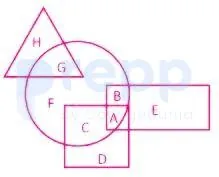
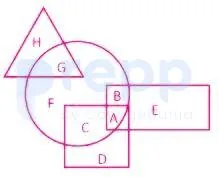
In the Following figure, square represents Artists, triangle represents Military officers, circle represents Collectors and rectangle represents Fathers. Which set of letters represents Collectors who are either Artist or Fathers but not Military Officers?
- A
G, F, D, A
- B
B, C
- C
C, D
- D
B, C, G, F
Show answer
B. B, CIn the above diagram B and C represent Collectors who are either Artist or Fathers but not Military Officers.
 Paper & answer key PDF ↗
 Question 2archived
A piece of paper is folded and punched as shown below in the question figures. From the given answer figures, indicate how it will appear when opened.

- A
Option A (shown in image)
- B
Option B (shown in image)
- C
Option C (shown in image)
- D
Option D (shown in image)
Show answer
C. Option C (shown in image)Hence, answer is figure 3.
 Paper & answer key PDF ↗
 Question 3archived
From the given words, select the word which cannot be formed using the letters of the given word.
JAUNTILY
- A
NEATLY
- B
AUNTY
- C
JAUNT
- D
UNITY
Show answer
A. NEATLYThe letters available in JAUNTILY are {J, A, U, N, T, I, L, Y}.
Checking each option:
AUNTY uses A, U, N, T, Y — all available.
JAUNT uses J, A, U, N, T — all available.
UNITY uses U, N, I, T, Y — all available.
NEATLY requires the letter E, which is not in JAUNTILY. Hence NEATLY cannot be formed.
Paper & answer key PDF ↗ Question 4archived
If UNCOVER is coded as FMXLEVI , then how will TIP be coded as?
- A
LTV
- B
NQV
- C
KHQ
- D
GRK
Show answer
D. GRKThe cipher is the reverse alphabet code: each letter is replaced by its mirror (A↔Z, B↔Y, …), so the position sums to 27. Verify with U(21)+F(6)=27, N(14)+M(13)=27, etc.
Apply to TIP:
\(T(20) \rightarrow 27-20=7 \rightarrow G\)
\(I(9) \rightarrow 27-9=18 \rightarrow R\)
\(P(16) \rightarrow 27-16=11 \rightarrow K\)
Therefore TIP is coded as GRK.
Paper & answer key PDF ↗ Question 5archived
In the following question, select the related number from the given alternatives.
64 : 8 : : 0.01 : ?
- A
0.1
- B
1
- C
10
- D
0.08
Show answer
A. 0.1It is in the form of:
82 = 64
Similarly; 0.12 = 0.01
Therefore, the answer is 0.1.
Paper & answer key PDF ↗ Question 6archived
A series is given, with one number missing. Choose the correct alternative from the given ones that will complete the series.
111, 107.5, 104, ?, 97, 93.5
- A
100
- B
99.5
- C
100.5
- D
99
Show answer
C. 100.5Consecutive differences are constant: \(107.5-111=-3.5\) and \(104-107.5=-3.5\). The series subtracts 3.5 each step.
Missing term \(=104-3.5=100.5\). Check: \(100.5-3.5=97\), which matches the next given term.
Therefore the answer is 100.5.
Paper & answer key PDF ↗ Question 7archived
The weights of 4 boxes are 90, 30, 40 and 60 kilograms. Which of the following cannot be the total weight, in kilograms; of any combination of these boxes and in a combination a box can be used only once?
- A
200
- B
220
- C
180
- D
130
Show answer
A. 200Possible totals from subsets of {90, 30, 40, 60} (each box used at most once):
Singles: 30, 40, 60, 90.
Pairs: 30+40=70, 30+60=90, 30+90=120, 40+60=100, 40+90=130, 60+90=150.
Triples: 30+40+60=130, 30+40+90=160, 30+60+90=180, 40+60+90=190.
All four: 30+40+60+90=220.
Among the options, 220, 180 and 130 are achievable, but 200 is not in this list. Hence 200 kg cannot be formed.
Paper & answer key PDF ↗ Question 8archived
Select the related word from the given alternatives.
Cow : Milk : : Bees : ?
- A
Silk
- B
Honey
- C
Flower
- D
Water
Show answer
B. HoneyThe relationship is producer : product — a cow yields milk.
Applying the same relation to bees: bees produce honey. Silk is from silkworms; flowers and water are inputs/needs, not products of bees.
Paper & answer key PDF ↗ Question 9archived
A series is given, with one term missing. Choose the correct alternative from the given ones that will complete the series.
L, N, Q, S, V, ?
- A
W
- B
Y
- C
Z
- D
X
Show answer
D. XConvert each letter to its alphabet position: L=12, N=14, Q=17, S=19, V=22.
The gaps alternate: \(+2, +3, +2, +3, \ldots\)
The next gap is \(+2\), so the next position is \(22+2=24\), which is the letter X.
Paper & answer key PDF ↗ Question 10archived
In a certain code language, ' + ' represents ' × ', ' - ' represents ' + ', ' × ' represents '÷' and '÷' represents ' - '. What is the answer to the following question?
50 + 5 - 700 × 28 = ?
- A
94
- B
100
- C
90
- D
275
Show answer
D. 275Replace each symbol per the code: \(+\rightarrow\times\), \(-\rightarrow+\), \(\times\rightarrow\div\).
The expression \(50+5-700\times 28\) becomes:
\[50\times 5 + 700\div 28\]
Apply BODMAS — division and multiplication first:
\(700\div 28 = 25\) and \(50\times 5 = 250\).
Therefore the value is \(250+25=\mathbf{275}\).
Paper & answer key PDF ↗ Question 11archived
Select the related letters from the given alternatives.
ACF : GIL : : OQT : ?
- A
VXY
- B
UWZ
- C
RSV
- D
VXZ
Show answer
B. UWZConvert ACF and GIL to positions: A=1, C=3, F=6 and G=7, I=9, L=12.
The differences are \(7-1=6\), \(9-3=6\), \(12-6=6\). Each letter shifts +6.
Apply to OQT (15, 17, 20): \(15+6=21\rightarrow U\), \(17+6=23\rightarrow W\), \(20+6=26\rightarrow Z\).
Hence the answer is UWZ.
Paper & answer key PDF ↗ Question 12archived
Select the odd number from the given alternatives.
- A
49
- B
25
- C
8
- D
36
Show answer
C. 8Check which are perfect squares:
\(49=7^2\), \(25=5^2\), \(36=6^2\) — all perfect squares.
\(8=2^3\) is a perfect cube, not a perfect square.
Hence 8 is the odd one out.
Paper & answer key PDF ↗ Question 13archived
A paper boy cycles 10 km East, then turns South and cycles 3 km, then turns West and cycles 6 km, then turns to his right and cycles 3 km. Where is he now with reference to his starting position?
- A
4 km West
- B
14 km East
- C
4 km East
- D
14 km West
Show answer
C. 4 km EastTake East/North as positive. Track net displacement:
Step 1 — East 10 km: position (+10, 0).
Step 2 — South 3 km: position (+10, −3).
Step 3 — West 6 km: position (+4, −3).
Step 4 — right turn from West is North; cycle 3 km: position (+4, 0).
Net displacement: 4 km East of the start.
Paper & answer key PDF ↗ Question 14archived
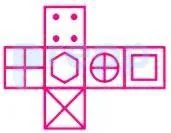
Which of the following cube in the answer figure cannot be made based on the unfolded cube in the question figure?
- A
Option A (shown in image)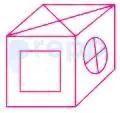
- B
Option B (shown in image)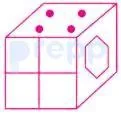
- C
Option C (shown in image)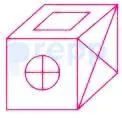
- D
Option D (shown in image)
Show answer
D. Option D (shown in image)Option 4 th cube is not possible from unfolded cube. The doted face and cross face should not be adjacent to each other.
Hence, answer is figure 4.
 Paper & answer key PDF ↗
 Question 15archived
Advik's birthday is on Monday 19 th June. On what day of the week will be Nishith's Birthday in the same year if Nishith was born on 17 th November?
- A
Saturday
- B
Wednesday
- C
Friday
- D
Sunday
Show answer
C. FridayCount days from 19 June to 17 November (same year):
Remaining June: \(30-19=11\); July 31; August 31; September 30; October 31; November (up to 17th) 17.
Total \(=11+31+31+30+31+17=151\) days.
Odd days \(=151 \bmod 7 = 4\) (since \(151=7\times 21+4\)).
Counting 4 days forward from Monday: Tue, Wed, Thu, Fri. Hence Nishith's birthday falls on Friday.
Paper & answer key PDF ↗ Question 16archived
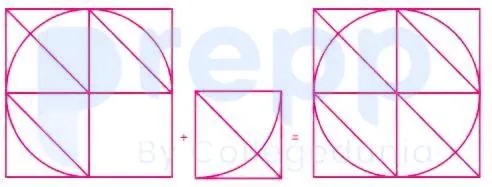
Which answer figure will complete the pattern in the question figure?
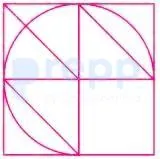
- A
Option A (shown in image)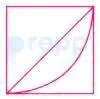
- B
Option B (shown in image)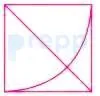
- C
Option C (shown in image)
- D
Option D (shown in image)
Show answer
B. Option B (shown in image)Hence, answer is figure 2.
 Paper & answer key PDF ↗
 Question 17archived
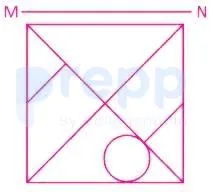
If a mirror is placed on the line MN, then which of the answer figures is the right image of the given figure?
- A
Option A (shown in image)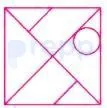
- B
Option B (shown in image)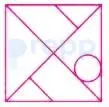
- C
Option C (shown in image)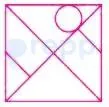
- D
Option D (shown in image)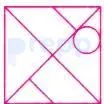
Show answer
C. Option C (shown in image)Hence, answer is figure 3.
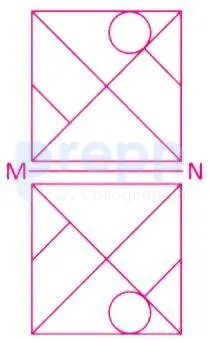 Paper & answer key PDF ↗
 Question 18archived
From the given answer figures, select the one in which the question figure is hidden/embedded.
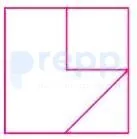
- A
Option A (shown in image)
- B
Option B (shown in image)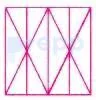
- C
Option C (shown in image)
- D
Option D (shown in image)
Show answer
A. Option A (shown in image)Hence, given image is hidden in figure 1.
Therefore, answer is figure 1.
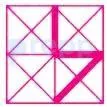 Paper & answer key PDF ↗
 Question 19archived
If 3% 2 = 50, 2% 4 = 60 then what is the value of 5% 4 = ?
- A
16
- B
9
- C
90
- D
20
Show answer
C. 90Spot the rule using the examples: in each case the result equals the sum of the two operands multiplied by 10.
\(3\,\%\,2 = (3+2)\times 10 = 50\) ✓
\(2\,\%\,4 = (2+4)\times 10 = 60\) ✓
Apply to \(5\,\%\,4\): \((5+4)\times 10 = 9\times 10 = 90\).
Paper & answer key PDF ↗ Question 20archived
A word is represented by only one set of numbers as given in any one of the alternatives. The sets of numbers given in the alternatives are represented by two classes of alphabets as shown in the given two matrices. The columns and rows of Matrix - I are numbered from 0 to 4 and that of Matrix - II are numbered from 5 to 9. A letter from these matrices can be represented first by its row and next by its column, for example ‘K’ can be represented by 40, 24 etc. and ‘Z’ can be represented by 98, 67 etc. Similarly, you have to identify the set for the word ‘OXEN’.
Matrix - IMatrix - II
0123456789
0GBIKC5ZXSRT
1LHHHG6ONZPT
2LHIAK7URQZW
3ADMGB8VQXYV
4KJELF9YOXZN
- A
65, 97, 42, 99
- B
21, 33, 58, 67
- C
44, 44, 55, 58
- D
14, 34, 55, 66
Show answer
A. 65, 97, 42, 99Decode each option and check against OXEN. Row-then-column applies; Matrix-I uses indices 0–4, Matrix-II uses 5–9.
O at 65 → Matrix-II, row 6, col 5 = O. ✓
X at 97 → Matrix-II, row 9, col 7 = X. ✓
E at 42 → Matrix-I, row 4, col 2 = E. ✓
N at 99 → Matrix-II, row 9, col 9 = N. ✓
All four match, so the correct set is 65, 97, 42, 99. The other options fail at the first letter (21=H, 44=F, 14=G — none give O).
Paper & answer key PDF ↗ Question 21archived
In the following question, select the number which can be placed at the sign of question mark (?) from the given alternative.
23
?
12
6
13
7
138
117
84
- A
9
- B
13
- C
17
- D
15
Show answer
A. 9Read the grid by columns. Each column satisfies the rule (top − middle) × middle = bottom.
Column 1: \((23-6)\times 6 = 17\times 6 \ne 138\). Try top × middle = bottom: \(23\times 6=138\). ✓
Column 3: \(12\times 7 = 84\). ✓
So the rule is top × middle = bottom. For column 2: \(?\times 13 = 117\), giving \(?=\dfrac{117}{13}=9\).
Paper & answer key PDF ↗ Question 22archived
In the question two statements are given, followed by two conclusions, I and II. You have to consider the statements to be true even if it seems to be at variance from commonly known facts. You have to decide which of the given conclusions, if any, follows from the given statements.
Statement 1: All flowers are leaves.
Statement 2: Some flowers are plants.
Conclusion I: Some leaves are plants.
Conclusion II: Some plants are flowers.
- A
Only conclusion I follows
- B
Only conclusion II follows
- C
Both I and II follow
- D
Neither I nor II follows
Show answer
C. Both I and II followStatement 2 ("Some flowers are plants") is an I-type proposition, so by simple conversion Some plants are flowers — Conclusion II follows.
From Statement 2, take an entity x that is both a flower and a plant. Statement 1 says all flowers are leaves, so x is also a leaf. Hence that x is both a leaf and a plant, i.e. Some leaves are plants — Conclusion I follows.
Both conclusions follow.
Paper & answer key PDF ↗ Question 23archived
A series is given, with one word missing. Choose the correct alternative from the given ones that will complete the series.
upset, aurora, spurn, strut, status, ?
- A
treasure
- B
perfect
- C
right
- D
unique
Show answer
A. treasureRead the second letter of each word in sequence: upset, aurora, spurn, strut, status → P, U, P, T, T.
These letters spell the start of PUTTER. The missing word must therefore have R as its second letter.
Among the options, only treasure (t-r-e-a-s-u-r-e) fits, completing PUTTER.
Paper & answer key PDF ↗ Question 24archived
Select the odd word from the given alternatives.
- A
Stream
- B
Rivulet
- C
River
- D
Valley
Show answer
D. ValleyStream, Rivulet and River are all flowing bodies of water (differing only in size).
Valley is a landform — a low area of land between hills or mountains — not a water body. Hence Valley is the odd one out.
Paper & answer key PDF ↗ Question 25archived
Select the odd letters from the given alternatives.
- A
ADG
- B
HKN
- C
ORU
- D
BDF
Show answer
D. BDFCheck the gap between consecutive letters in each set:
ADG: A(1) → D(4) → G(7), gap +3, +3.
HKN: H(8) → K(11) → N(14), gap +3, +3.
ORU: O(15) → R(18) → U(21), gap +3, +3.
BDF: B(2) → D(4) → F(6), gap +2, +2.
BDF breaks the +3 pattern, so it is the odd one out.
Paper & answer key PDF ↗ Question 26archived
__________ is a collection of data values of same types having a common name.
- A
Object
- B
String
- C
Array
- D
Numbers
Show answer
C. ArrayAn array is an ordered collection of elements of the same data type, stored under one common identifier and accessed by index.
An object holds key-value pairs of possibly different types; a string is a single sequence of characters (one value); “numbers” is a data type, not a container. Hence the definition matches Array.
Paper & answer key PDF ↗ Question 27archived
The process of depositing a layer of any desired metal on another material by means of electricity is called _________.
- A
Electroplating
- B
Galvanization
- C
Rusting
- D
Crystallization
Show answer
A. ElectroplatingElectroplating uses an electric current passed through an electrolyte to deposit a thin layer of a desired metal onto a conductive object (placed at the cathode).
Galvanisation specifically refers to zinc coating (often hot-dip, not necessarily electrical); rusting is corrosion of iron; crystallisation is the formation of solid crystals. Only electroplating matches “any desired metal” deposited by electricity.
Paper & answer key PDF ↗ Question 28archived
Who invented the waterproof raincoat?
- A
Robert Hooke
- B
Cai Lun
- C
Charles Macintosh
- D
William Harvey
Show answer
C. Charles MacintoshScottish chemist Charles Macintosh patented waterproof fabric in 1823, bonding two layers of cloth with rubber dissolved in naphtha. The resulting raincoat became known as the “Mackintosh”.
Robert Hooke is known for the cell and Hooke’s law; Cai Lun for papermaking; William Harvey for describing blood circulation.
Paper & answer key PDF ↗ Question 29archived
In which sport did India win Silver medal at Rio Olympics 2016?
- A
Badminton
- B
Boxing
- C
Hockey
- D
Wrestling
Show answer
A. BadmintonAt the Rio 2016 Olympics, India won two medals: a silver in Badminton (P.V. Sindhu, Women’s Singles) and a bronze in Wrestling (Sakshi Malik, Women’s 58 kg freestyle).
No Indian boxer or hockey team medalled at Rio 2016, so the silver was in Badminton.
Paper & answer key PDF ↗ Question 30archived
"Central Bureau of Intelligence and Investigation" is listed in the __________ list given in the Seventh Schedule of the Constitution of India.
- A
Union
- B
State
- C
Global
- D
Concurrent
Show answer
A. UnionThe Seventh Schedule of the Constitution distributes legislative subjects across the Union, State and Concurrent Lists.
“Central Bureau of Intelligence and Investigation” appears as Entry 8 of the Union List (List I), since national intelligence and investigation are matters of central competence.
Paper & answer key PDF ↗ Question 31archived
Which National Park in Nepal is a continuation of India's Valmiki National Park?
- A
Chitwan National Park
- B
Bandipur National Park
- C
Dudhwa National Park
- D
Jim Corbett National Park
Show answer
A. Chitwan National ParkIndia’s Valmiki National Park in West Champaran (Bihar) shares its northern boundary with Nepal’s Chitwan National Park, together forming a transboundary tiger-rhino landscape.
Bandipur (Nepal) lies in the Churia hills away from this border; Dudhwa and Jim Corbett are Indian parks, not Nepalese. Hence the continuation is Chitwan.
Paper & answer key PDF ↗ Question 32archived
Animals in which the cells are arranged in three embryonic layers are called ________.
- A
Diploblastic
- B
Ectoderm
- C
Triploblastic
- D
Endoderm
Show answer
C. TriploblasticAnimals are classified by the number of germ layers formed during gastrulation. Those with three layers — ectoderm, mesoderm and endoderm — are called triploblastic (e.g. flatworms to chordates).
Diploblastic animals (cnidarians, ctenophores) have only two layers. Ectoderm and endoderm are individual layers, not classifications.
Paper & answer key PDF ↗ Question 33archived
If the ___________ firm has zero costs or only has fixed cost, the quantity supplied in equilibrium is given by the point where the average revenue is zero.
- A
Perfect Competition
- B
Monopoly
- C
Oligopoly
- D
Monopolistic Competition
Show answer
A. Perfect CompetitionFor a firm with zero or only fixed costs, marginal cost is zero. In perfect competition, equilibrium for the firm requires price equal to marginal cost, so \(P = MC = 0\). Since average revenue equals price (\(AR = P\)), equilibrium output is the quantity where AR = 0.
Under monopoly, oligopoly or monopolistic competition the firm faces a downward-sloping demand curve and produces where MR = MC = 0, which gives a positive price (AR > 0), not zero.
Paper & answer key PDF ↗ Question 34archived
The average variable cost curve is _______ shaped.
- A
u
- B
v
- C
x
- D
w
Show answer
A. uAs output rises, variable inputs initially become more productive (specialisation), pushing AVC down. After a point, the law of diminishing marginal returns sets in and AVC rises.
This fall-then-rise pattern gives the average variable cost curve its characteristic U-shape.
Paper & answer key PDF ↗ Question 35archived
What type of image formed by a concave mirror on the screen when the distance between object and mirror is higher than the focus?
- A
Virtual image
- B
Real image
- C
Distant Image
- D
Erect image
Show answer
B. Real imageAn image that can be captured on a screen is necessarily a real image, formed by the actual convergence of reflected rays.
For a concave mirror, whenever the object distance exceeds the focal length (object placed beyond F), reflected rays converge in front of the mirror to produce a real, inverted image. A virtual image (object between pole and F) cannot be obtained on a screen.
Paper & answer key PDF ↗ Question 36archived
___________ is a straw coloured, viscous fluid constituting nearly 55 per cent of the blood.
- A
Plasma
- B
Formed Elements
- C
Blood Groups
- D
Coagulation of Blood
Show answer
A. PlasmaPlasma is the straw-coloured, slightly viscous liquid matrix of blood, making up roughly 55% of total blood volume. It is about 90–92% water and 6–8% proteins (albumin, globulins, fibrinogen), along with salts, glucose, and hormones.
Formed elements (RBCs, WBCs, platelets) are cellular and constitute the remaining ~45%; blood groups are antigen-based classifications; coagulation is a process — none is a straw-coloured fluid.
Paper & answer key PDF ↗ Question 37archived
Which of the statements given below are not correct?
1. The author of 'India 2020: A Vision for the New Millennium' is Shashi Tharoor.
2. The author of 'The Great Indian Novel' is A.P.J. Abdul Kalam.
3. The author of 'My Country My Life' is I.K Gujral.
- A
1 and 2
- B
2 and 3
- C
1 and 3
- D
1, 2 and 3
Show answer
D. 1, 2 and 3Verify each claim:
Statement 1 — ‘India 2020: A Vision for the New Millennium’ was written by A.P.J. Abdul Kalam and Y.S. Rajan, not Shashi Tharoor. Incorrect.
Statement 2 — ‘The Great Indian Novel’ was written by Shashi Tharoor, not A.P.J. Abdul Kalam. Incorrect.
Statement 3 — ‘My Country My Life’ is L.K. Advani’s autobiography; I.K. Gujral’s autobiography is ‘Matters of Discretion’. Incorrect.
All three statements are wrong, so the answer is 1, 2 and 3.
Paper & answer key PDF ↗ Question 38archived
In 1918, Mahatma Gandhi went to __________ to organise a satyagraha movement amongst cotton mill workers.
- A
Madras
- B
Bombay
- C
Surat
- D
Ahmedabad
Show answer
D. AhmedabadIn 1918, Mahatma Gandhi led the Ahmedabad Mill Workers' Satyagraha. Cotton mill workers demanded restoration of the plague bonus and a wage hike; owners refused.
Invited by Anasuya Sarabhai, Gandhi backed a 35% wage increase and undertook his first hunger strike (fast unto death) in India. The tribunal ultimately awarded the 35% rise.
Hence the location was Ahmedabad. Champaran (1917) concerned indigo planters and Kheda (1918) concerned peasant revenue, not cotton mill workers.
Paper & answer key PDF ↗ Question 39archived
Murshid Quli Khan, Alivardi Khan and Sirajuddaullah were all nawabs of __________?
- A
Lucknow
- B
Varanasi
- C
Hyderabad
- D
Bengal
Show answer
D. BengalMurshid Quli Khan (founder of independent Nawabi rule, shifted capital to Murshidabad), Alivardi Khan (r. 1740-1756), and Sirajuddaullah (r. 1756-1757, defeated at Plassey) all ruled Bengal.
Lucknow was the seat of the Nawabs of Awadh; Hyderabad was ruled by Nizams (Asaf Jahi dynasty); Varanasi had no comparable independent Nawabi line.
Paper & answer key PDF ↗ Question 40archived
_________ affect(s) the rate of humus formation of soil.
- A
Flora & Fauna
- B
Time
- C
Temperature
- D
Parent rock
Show answer
A. Flora & FaunaHumus formation is fundamentally a biological decomposition process. Soil flora supply the dead organic matter and soil fauna (microbes, earthworms, fungi) break it down into stable humus.
Hence Flora & Fauna directly control the rate. Time merely measures duration; temperature and parent rock influence the process only indirectly by affecting decomposer activity.
Paper & answer key PDF ↗ Question 41archived
__________ refers to the number of births during a given period in the population that are added to the initial density.
- A
Natality
- B
Mortality
- C
Immigration
- D
Emigration
Show answer
A. NatalityNatality denotes the number of births added to a population over a given period, increasing the initial density.
Mortality (deaths) and emigration (out-movement) reduce density; immigration (in-movement) increases density but from outside individuals, not births. Only natality refers specifically to births.
Paper & answer key PDF ↗ Question 42archived
Sexual reproduction in Algae that takes place through fusion of two similar size gametes is called?
- A
Zoospores
- B
Anisogamous
- C
Isogamous
- D
Oogamous
Show answer
C. IsogamousSexual reproduction in algae is classified by gamete size and motility:
Isogamy — fusing gametes are similar in size (e.g. Ulothrix, some Chlamydomonas).
Anisogamy — gametes differ in size.
Oogamy — large non-motile egg fuses with small motile sperm.
Fusion of two similar-size gametes matches Isogamous. Zoospores are asexual motile spores, not gametes.
Paper & answer key PDF ↗ Question 43archived
The latitudes of main land of India extend between ________.
- A
8°4' N and 37°6' N
- B
8°4' W and 37°6' W
- C
8°4' E and 37°6' E
- D
8°4' S and 37°6' S
Show answer
A. 8°4' N and 37°6' NIndia lies entirely in the Northern and Eastern Hemispheres. The mainland stretches from Kanyakumari (south) to near Indira Col in the Siachen area (north).
Hence the latitudinal extent is \(8^{\circ}4'\,\text{N}\) to \(37^{\circ}6'\,\text{N}\). Options with E/W denote longitudes, and S would place India in the Southern Hemisphere — both invalid.
Paper & answer key PDF ↗ Question 44archived
The distance-time graph for the motion of an object moving with a constant speed is a __________.
- A
Dot
- B
Circle
- C
Straight Line
- D
Curve
Show answer
C. Straight LineOn a distance-time graph, speed equals the slope:
\(\text{speed}=\frac{\Delta \text{distance}}{\Delta \text{time}}\)
Constant speed means equal distances are covered in equal times, so the slope is constant. A constant slope produces a straight line. A curve would indicate changing speed (acceleration); a horizontal line would indicate rest.
Paper & answer key PDF ↗ Question 45archived
Who was the architect of Taj Mahal?
- A
Ustad Ahmad Lahouri
- B
Norman Foster
- C
Henry Irwin
- D
Ustad Ghani Utbuddin
Show answer
A. Ustad Ahmad LahouriThe Taj Mahal at Agra, commissioned by Shah Jahan in memory of Mumtaz Mahal (1631-1653), was designed by Ustad Ahmad Lahouri, a Persian-born architect serving the Mughal court.
Norman Foster is a 20th-21st century British architect; Henry Irwin worked during the British Raj (Mysore Palace, Madras High Court); Ustad Ghani Utbuddin was not the principal architect.
Paper & answer key PDF ↗ Question 46archived
The Nobel Prize in Literature 2016 was awarded to?
- A
Frank Sinatra
- B
Elvis Presley
- C
Bob Dylan
- D
Jimi Hendrix
Show answer
C. Bob DylanThe 2016 Nobel Prize in Literature was awarded to Bob Dylan "for having created new poetic expressions within the great American song tradition."
This was the first time a songwriter received the Literature prize. Sinatra, Presley, and Hendrix — though iconic musicians — never received a Nobel.
Paper & answer key PDF ↗ Question 47archived
In April 2017, amid rising tension over North Korea, which country launched its first domestically built aircraft carrier?
- A
South Korea
- B
Japan
- C
China
- D
USA
Show answer
C. ChinaIn April 2017, China launched its first fully domestically built aircraft carrier, the Type 001A (later commissioned as the Shandong) at Dalian shipyard.
Its earlier carrier Liaoning was a refit of the Soviet Varyag hull. The USA has built carriers domestically since the 1920s; South Korea and Japan had no domestic aircraft carrier launch in April 2017.
Paper & answer key PDF ↗ Question 48archived
___________ is a welfare scheme started by the Prime Minister in order to provide LPG connections to domestic households that fall under the below the poverty line category.
- A
Gram Uday Se Bharat Uday Abhiyan
- B
Pradhan Mantri Ujjwala Yojana
- C
Pradhan Mantri Surakshit Matritva Yojana
- D
Vidyanjali Yojana
Show answer
B. Pradhan Mantri Ujjwala YojanaPradhan Mantri Ujjwala Yojana (PMUY), launched on 1 May 2016 by PM Narendra Modi from Ballia (UP), provides deposit-free LPG connections to women from BPL households to replace polluting traditional cooking fuels.
Gram Uday Se Bharat Uday Abhiyan targets rural governance; PM Surakshit Matritva Yojana provides antenatal care; Vidyanjali Yojana supports school education.
Paper & answer key PDF ↗ Question 49archived
A _________ thread is actually stronger than a steel wire.
- A
wool
- B
cotton
- C
jute
- D
nylon
Show answer
D. nylonNylon, a synthetic polyamide, has very high tensile strength relative to weight thanks to long polymer chains held by strong hydrogen bonds.
A nylon thread of suitable thickness can withstand greater pulling force than a steel wire of the same diameter, and is far stronger than natural fibres wool, cotton, or jute.
Paper & answer key PDF ↗ Question 50archived
There are total _________ parliamentary seats (Rajya Sabha constituency) in Odisha.
- A
11
- B
19
- C
10
- D
1
Show answer
C. 10As per the Fourth Schedule of the Constitution, Rajya Sabha seats are allotted to states based on population. Odisha is allocated 10 seats.
For reference: Uttar Pradesh has 31, Maharashtra 19, Tamil Nadu 18, West Bengal and Bihar 16 each.
Paper & answer key PDF ↗ Question 51archived
At 20% discount the selling price of an article is Rs. 2400, what is the selling price (in Rs.) if the discount is 32.5%?
- A
2125
- B
2225
- C
2025
- D
2325
Show answer
C. 2025Step 1 — Find Marked Price: At 20% discount, SP = 0.8 × MP.
\[\text{MP}=\frac{2400}{0.8}=3000\]
Step 2 — Apply 32.5% discount:
\[\text{SP}=3000\times(1-0.325)=3000\times 0.675\]
\[\text{SP}=\text{Rs. }2025\]
Therefore the new selling price is Rs. 2025.
Paper & answer key PDF ↗ Question 52archived
20% of a = b, then b% of 20 is the same as _________ of a.
- A
8%
- B
40%
- C
4%
- D
80%
Show answer
C. 4%Step 1 — Use the given relation: \(20\%\ \text{of}\ a = b\) gives \(b=\dfrac{a}{5}\).
Step 2 — Compute b% of 20:
\[\frac{b}{100}\times 20 = \frac{b}{5}\]
Substitute \(b=\dfrac{a}{5}\):
\[\frac{1}{5}\times \frac{a}{5}=\frac{a}{25}=\frac{4a}{100}=4\%\ \text{of}\ a\]
Therefore the answer is 4%.
Paper & answer key PDF ↗ Question 53archived
What is the value of Cot60° - Cos45°?
- A
(9 - 2√3)/9
- B
(2√6 - 1)/√3
- C
(1 - 2√3)/2
- D
(√2 - √3)/√6
Show answer
D. (√2 - √3)/√6Substitute standard values \(\cot 60^\circ=\dfrac{1}{\sqrt{3}}\) and \(\cos 45^\circ=\dfrac{1}{\sqrt{2}}\):
\[\cot 60^\circ-\cos 45^\circ=\frac{1}{\sqrt{3}}-\frac{1}{\sqrt{2}}\]
Take LCM \(\sqrt{6}\):
\[=\frac{\sqrt{2}}{\sqrt{6}}-\frac{\sqrt{3}}{\sqrt{6}}=\frac{\sqrt{2}-\sqrt{3}}{\sqrt{6}}\]
Therefore the value is \(\dfrac{\sqrt{2}-\sqrt{3}}{\sqrt{6}}\).
Paper & answer key PDF ↗ Question 54archived
What is the average of all numbers between 8 and 74 which are divisible by 7?
- A
40
- B
41
- C
42
- D
43
Show answer
C. 42Multiples of 7 strictly between 8 and 74 are 14, 21, 28, 35, 42, 49, 56, 63, 70 — an AP with first term 14 and last term 70.
For an AP, the average equals the mean of the first and last terms:
\[\text{Average}=\frac{14+70}{2}=\frac{84}{2}=42\]
Therefore the average is 42.
Paper & answer key PDF ↗ Question 55archived
The slope of the line AB is -2/3. The co-ordinates of points A and B are (x, -3) and (5, 2) respectively. What is the value of x?
- A
4
- B
-14
- C
12.5
- D
-4
Show answer
C. 12.5Using the slope formula with \(A(x,-3)\) and \(B(5,2)\):
\[m=\frac{2-(-3)}{5-x}=\frac{5}{5-x}=-\frac{2}{3}\]
Cross-multiply:
\[-2(5-x)=3\cdot 5\implies -10+2x=15\]
\[2x=25\implies x=12.5\]
Therefore \(x=12.5\).
Paper & answer key PDF ↗ Question 56archived
Even if A and C decide to merge, still D will have how many more taxis (in %) than the merged A and C entity?
- A
15
- B
20
- C
10
- D
25
Show answer
D. 25Number of taxis in A and C after the merge = 25 + 35 = 60
Number of taxis in D = 75
∴ Required % = [(75 - 60)/60] × 100 = (15/60)(100) = 25%
Paper & answer key PDF ↗ Question 57archived
Area of 4 walls of a cuboid 400 sq cm, its length is 15 cm and height is 8 cm. What is its breadth (in cm)?
- A
12
- B
20
- C
24
- D
10
Show answer
D. 10Area of 4 walls (lateral surface area) of a cuboid:
\[A=2(l+b)h\]
Substitute \(A=400\), \(l=15\), \(h=8\):
\[400=2(15+b)(8)=16(15+b)\]
\[15+b=25\implies b=10\]
Therefore the breadth is 10 cm.
Paper & answer key PDF ↗ Question 58archived
If 30 taxis quit company B and joined company D then D will have how many more taxis than C?
- A
40
- B
30
- C
110
- D
70
Show answer
D. 70Number of taxis in D in the new scenario = 75 + 30 = 105
⇒ Number of taxis in C = 35
∴ Required value = (taxis in D) - (taxis in C) = 105 - 35 = 70
Paper & answer key PDF ↗ Question 59archived
What is the reflection of the point (4, 7) in the line y = -1?
- A
(-6, 7)
- B
(-4, -9)
- C
(4, -9)
- D
(-6, -7)
Show answer
C. (4, -9)For reflection in a horizontal line \(y=c\), the x-coordinate is unchanged and the new y-coordinate is \(2c-y\).
With \((x,y)=(4,7)\) and \(c=-1\):
\[y'=2(-1)-7=-9\]
The reflected point is \((4,-9)\). (Check: point is 8 units above \(y=-1\), so image is 8 units below at \(y=-9\).)
Paper & answer key PDF ↗ Question 60archived
∆PQR is right angled at Q. If ∠R = 60°, what is the length of PR (in cm), if RQ = 4√3 cm?
- A
8
- B
4
- C
8√3
- D
8/√3
Show answer
C. 8√3In right-angled \(\triangle PQR\) with \(\angle Q=90^\circ\), PR is the hypotenuse and RQ is adjacent to \(\angle R\).
\[\cos R=\frac{RQ}{PR}\implies \cos 60^\circ=\frac{4\sqrt{3}}{PR}\]
Since \(\cos 60^\circ=\dfrac{1}{2}\):
\[\frac{1}{2}=\frac{4\sqrt{3}}{PR}\implies PR=8\sqrt{3}\text{ cm}\]
Therefore \(PR=8\sqrt{3}\) cm.
Paper & answer key PDF ↗ Question 61archived
The 3rd and 7th term of an arithmetic progression are -9 and 11 respectively. What is the 15th term?
- A
28
- B
87
- C
51
- D
17
Show answer
C. 51For an AP, \(a_n=a+(n-1)d\). Given \(a_3=-9\) and \(a_7=11\):
\[a_7-a_3=4d=11-(-9)=20\implies d=5\]
Then \(a=a_3-2d=-9-10=-19\).
\[a_{15}=a+14d=-19+14(5)=-19+70=51\]
Therefore the 15th term is 51.
Paper & answer key PDF ↗ Question 62archived
A can do 75% of a job in 9 days and B can do half of the job in 8 days. If they work on it together, then in how many days can they do half of the job?
- A
40/7
- B
24/7
- C
7/2
- D
9/2
Show answer
B. 24/7A does 75% in 9 days, so A's full-job time is \(9\times\frac{4}{3}=12\) days; A's rate is \(\frac{1}{12}\)/day.
B does half the job in 8 days, so B's full-job time is 16 days; B's rate is \(\frac{1}{16}\)/day.
Combined rate:
\[\frac{1}{12}+\frac{1}{16}=\frac{4+3}{48}=\frac{7}{48}\text{ per day}\]
Time for half the job:
\[\frac{1/2}{7/48}=\frac{48}{14}=\frac{24}{7}\text{ days}\]
Therefore the answer is \(\dfrac{24}{7}\) days.
Paper & answer key PDF ↗ Question 63archived
The simple and compound interest that can be earned in two years at the same rate is Rs. 1,000 and Rs. 1,040 respectively. What is the rate (percent per annum) of interest?
- A
9
- B
10
- C
8
- D
11
Show answer
C. 8SI per year = \(\frac{1000}{2}=500\). For 2 years, \(\text{CI}-\text{SI}\) equals the interest on the first year's interest.
\[\text{CI}-\text{SI}=1040-1000=40\]
This 40 is the simple interest on Rs. 500 for 1 year at rate R:
\[40=\frac{500\times R\times 1}{100}=5R\implies R=8\%\]
Therefore the rate is 8% per annum.
Paper & answer key PDF ↗ Question 64archived
What is the fourth proportional to 24, 120 and 22?
- A
110
- B
120
- C
10
- D
90
Show answer
A. 110If \(x\) is the fourth proportional to 24, 120, 22, then \(24:120::22:x\), i.e.
\[\frac{24}{120}=\frac{22}{x}\]
Cross-multiplying:
\[24x=120\times 22=2640\implies x=110\]
Therefore the fourth proportional is 110.
Paper & answer key PDF ↗ Question 65archived
If a - b = 2 and ab = 24, then what is the value of a 3 - b 3?
- A
280
- B
124
- C
140
- D
152
Show answer
D. 152Use the identity \(a^3-b^3=(a-b)^3+3ab(a-b)\).
Substitute \(a-b=2\) and \(ab=24\):
\[a^3-b^3=2^3+3(24)(2)=8+144=152\]
Therefore \(a^3-b^3=\) 152.
Paper & answer key PDF ↗ Question 66archived
Sum of twice a fraction and its reciprocal is 17/6. What is the fraction?
- A
4/3
- B
5/4
- C
3/4
- D
4/5
Show answer
C. 3/4Let the fraction be \(x\). Then:
\[2x+\frac{1}{x}=\frac{17}{6}\]
Multiply through by \(6x\):
\[12x^2-17x+6=0\]
Factor:
\[(3x-2)(4x-3)=0\implies x=\tfrac{2}{3}\text{ or }\tfrac{3}{4}\]
Among the options, only \(\dfrac{3}{4}\) appears. Check: \(2\cdot\tfrac{3}{4}+\tfrac{4}{3}=\tfrac{3}{2}+\tfrac{4}{3}=\tfrac{9+8}{6}=\tfrac{17}{6}\).
Therefore the fraction is \(\dfrac{3}{4}\).
Paper & answer key PDF ↗ Question 67archived
What is the remainder when 2468 is divided by 37?
- A
26
- B
36
- C
18
- D
14
Show answer
A. 26Find the nearest multiple of 37 below 2468. Since \(37\times 66=2442\) and \(37\times 67=2479>2468\):
\[2468-2442=26\]
So \(2468=37\times 66+26\), with \(0\le 26<37\).
Therefore the remainder is 26.
Paper & answer key PDF ↗ Question 68archived
After excluding stoppages, the speed of a bus is 60 kmph and after including stoppages, it is 45 kmph. For how many minutes does the bus stop per hour?
- A
10
- B
9
- C
12
- D
15
Show answer
D. 15The bus loses speed because of stoppages. Stoppage time per hour equals the ratio of speed lost to running speed:
\[\text{Stoppage}=\frac{\text{Speed without stops}-\text{Speed with stops}}{\text{Speed without stops}}\times 60\text{ min}\]
\[=\frac{60-45}{60}\times 60=\frac{15}{60}\times 60=15\text{ minutes}\]
Therefore the bus stops for 15 minutes per hour.
Paper & answer key PDF ↗ Question 69archived
D and E are points on side AB and AC respectively of ΔABC. DE is parallel to BC. If AD ∶ DB = 2 ∶ 3, what is the ratio of the area of ΔADE and area of quadrilateral BDEC?
- A
4 ∶ 21
- B
4 ∶ 25
- C
4 ∶ 29
- D
4 ∶ 9
Show answer
A. 4 ∶ 21Since \(DE\parallel BC\), \(\triangle ADE\sim\triangle ABC\) (AA similarity).
Given \(AD:DB=2:3\), so \(\dfrac{AD}{AB}=\dfrac{2}{2+3}=\dfrac{2}{5}\).
Ratio of areas of similar triangles equals square of side ratio:
\[\frac{[\triangle ADE]}{[\triangle ABC]}=\left(\frac{2}{5}\right)^2=\frac{4}{25}\]
Let \([\triangle ADE]=4k\), \([\triangle ABC]=25k\). Then \([BDEC]=25k-4k=21k\).
Therefore \([\triangle ADE]:[BDEC]=\) 4 : 21.
Paper & answer key PDF ↗ Question 70archived
If Tan θ = 9/40, then Sec θ = ?
- A
40/41
- B
9/41
- C
41/40
- D
41/9
Show answer
C. 41/40Use the identity \(\sec^2\theta = 1 + \tan^2\theta\).
\[\sec^2\theta = 1 + \left(\frac{9}{40}\right)^2 = 1 + \frac{81}{1600} = \frac{1681}{1600}\]
Taking the positive root, \(\sec\theta = \dfrac{41}{40}\). Therefore the answer is 41/40.
Paper & answer key PDF ↗ Question 71archived
What are the co-ordinates of the centroid of a triangle, whose vertices are A(2, 5), B(-4, 0) and C(5, 4)?
- A
(-1, 3)
- B
(1, 3)
- C
(1, -3)
- D
(-1, -3)
Show answer
B. (1, 3)The centroid of a triangle with vertices \((x_1,y_1), (x_2,y_2), (x_3,y_3)\) is \(\left(\dfrac{x_1+x_2+x_3}{3}, \dfrac{y_1+y_2+y_3}{3}\right)\).
\[G_x = \frac{2+(-4)+5}{3} = \frac{3}{3} = 1\]
\[G_y = \frac{5+0+4}{3} = \frac{9}{3} = 3\]
Therefore the centroid is (1, 3).
Paper & answer key PDF ↗ Question 72archived
Which taxi company has more taxis than A but less than D?
- A
B
- B
C
- C
F
- D
E
Show answer
B. CTaxi companies having more taxis than A = B, C, D, E
Taxi companies having less taxis than D = A, C, F
∴ Common company in above 2 situations = C
Paper & answer key PDF ↗ Question 73archived
A trader had 1200 kgs of rice. He sold a part of it at 5% profit and the rest at 11% profit, so that he made a total profit of 7%. How much (in kg) rice did he sell at 5% profit?
- A
900
- B
600
- C
40
- D
800
Show answer
D. 800Step 1 — Set up alligation: mix profits 5% and 11% to get mean 7%.
\[\frac{\text{Quantity at 5%}}{\text{Quantity at 11%}} = \frac{11-7}{7-5} = \frac{4}{2} = \frac{2}{1}\]
Step 2 — Apportion 1200 kg: total parts = 2 + 1 = 3.
\[\text{Quantity at 5% profit} = \frac{2}{3} \times 1200 = 800 \text{ kg}\]
Therefore he sold 800 kg at 5% profit.
Paper & answer key PDF ↗ Question 74archived
If each taxi on an average runs 100 km every day and if fuel cost is Rs. 3 per km, then all these taxis spend how much (in Rs.) on fuel every day?
- A
128000
- B
108000
- C
118000
- D
98000
Show answer
B. 108000Total number of taxes in all companies = 25 + 120 + 35 + 75 + 95 + 10 = 360
⇒ Money spent by 1 taxi on fuel in 1 day = 100 × 3 = Rs. 300
⇒ Money spent by 360 taxis on fuel in 1 day = 360 × 300 = 108000
∴ the correct option is 2)
Paper & answer key PDF ↗ Question 75archived
If 5/2 - (6/5)(x - 15/2) = -x/5, then what is the value of x?
- A
-23/2
- B
13/2
- C
-13/2
- D
23/2
Show answer
D. 23/2Step 1 — Clear fractions: multiply both sides by 10 (LCM of 2 and 5).
\[25 - 12\left(x - \tfrac{15}{2}\right) = -2x\]
Step 2 — Expand:
\[25 - 12x + 90 = -2x \implies 115 - 12x = -2x\]
Step 3 — Solve for x:
\[115 = 10x \implies x = \frac{23}{2}\]
Therefore x = 23/2.
Paper & answer key PDF ↗ Question 76archived
Abandoned, torn kite strings stuck in trees benefits whom?
- A
Humans
- B
Creepers
- C
Birds
- D
Trees
Show answer
B. CreepersThe passage states that abandoned manja strings stuck in trees act as a supporting platform for tender climbers, giving them an easy path to reach the treetop. This support directly benefits the creepers (climbers), even though it ultimately harms the tree by letting the canopy be smothered. Humans, birds and trees are described as threatened, not benefitted.
Paper & answer key PDF ↗ Question 77archived
In the following question, some part of the sentence may have errors. Find out which part of the sentence has an error and select the appropriate option. If a sentence is free from error, select 'No Error'.
I took the shortest (1)/ way through the (2)/ little park close the palace. (3)/No Error (4)
- A
1
- B
2
- C
3
- D
4
Show answer
C. 3The adjective close, when expressing nearness, must be followed by the preposition to. "Close the palace" is ungrammatical; the correct phrase is "close to the palace" (or simply "near the palace"). The error lies in part (3).
Paper & answer key PDF ↗ Question 78archived
In the following question, out of the four alternatives, select the alternative which is the best substitute of the words/sentence.
The remains of something that has been badly damaged
- A
Pristin
- B
Immaculate
- C
Wreckage
- D
Sterile
Show answer
C. WreckageWreckage means the remains of something that has been badly damaged or destroyed, especially a vehicle, aircraft or building — a direct match for the phrase. "Pristine" and "immaculate" mean unspoiled or perfectly clean (opposite sense), and "sterile" means free from germs — none of these refer to damaged remains.
Paper & answer key PDF ↗ Question 79archived
In the following question, out of the four alternatives, select the word similar in meaning to the word given.
Perverse
- A
Agreeable
- B
Nefarious
- C
Compliant
- D
Willing
Show answer
B. NefariousPerverse means turned away from what is right or good — wicked, improper, deliberately contrary. Nefarious, meaning wicked or criminal, captures this sense most closely. "Agreeable", "compliant" and "willing" all denote cooperation or pleasantness, the opposite of perverse.
Paper & answer key PDF ↗ Question 80archived
In the following question, out of the four alternatives, select the word opposite in meaning to the word given.
To maneuver
- A
To manipulate
- B
To proceed
- C
To cease
- D
To machinate
Show answer
C. To ceaseTo maneuver means to move or act with skill, strategy or manipulation — it is an active verb. To cease means to stop or bring to an end, which is the direct opposite of acting or moving. "Manipulate" and "machinate" are synonyms (skilful scheming), and "proceed" means to continue, not to stop.
Paper & answer key PDF ↗ Question 81archived
In the following question, a sentence has been given in Direct/Indirect speech. Out of the four alternatives suggested, select the one which best expresses the same sentence in Indirect/Direct speech.
The teacher said, "Nobody can solve the problem."
- A
The teacher said that nobody can solve the problem.
- B
The teacher said that nobody should solve the problem.
- C
The teacher said that somebody can solve the problem.
- D
The teacher said that nobody could solve the problem.
Show answer
D. The teacher said that nobody could solve the problem.When the reporting verb is in the past tense ("said"), the modal can shifts to could in indirect speech, the quotation marks are removed, and the reported clause is introduced by that. Applying these rules: The teacher said that nobody could solve the problem.
Paper & answer key PDF ↗ Question 82archived
How many scientists contributed to a study by country's oldest botanical gardens on how manja can kill a tree?
- A
Two
- B
Three
- C
Five
- D
Four
Show answer
B. ThreeThe passage states: "A research paper by three scientists of the Acharya Jagdish Chandra Bose Indian Botanic Garden... illustrates in detail how the manja, in collusion with climbers, does the damage." Hence three scientists contributed.
Paper & answer key PDF ↗ Question 83archived
In the following question, the sentence is given with blank to be filled in with an appropriate word. Select the correct alternative out of the four and indicate it by selecting the appropriate option.
Moving to the city was eye-__________ for the straitlaced country girl.
- A
clearing
- B
freeing
- C
saving
- D
opening
Show answer
D. openingEye-opening is the established idiom for an experience that reveals something new and surprising or changes one's perspective — exactly what city life would be for a straitlaced country girl. "Eye-clearing" and "eye-freeing" are not standard expressions; "eye-saving" refers to protecting vision and does not fit the context.
Paper & answer key PDF ↗ Question 84archived
In the following question, the sentence is given with blank to be filled in with an appropriate word. Select the correct alternative out of the four and indicate it by selecting the appropriate option.
With a blood test, a physician was able to ___________ the woman's pregnancy.
- A
term
- B
confirm
- C
firm
- D
confer
Show answer
B. confirmA blood test detects hCG and is used to verify pregnancy, so the physician is able to confirm (establish the truth of) the pregnancy. "Term" relates to ending or duration, "firm" means to strengthen, and "confer" means to grant or to consult — none fit a diagnostic verification.
Paper & answer key PDF ↗ Question 85archived
In the following question, out of the four alternatives, select the word opposite in meaning to the word given.
To avert
- A
To aid
- B
To deter
- C
To forestall
- D
To preclude
Show answer
A. To aidTo avert means to prevent something (usually bad) from happening. Its opposite is To aid, which means to help or assist something to happen. "Deter", "forestall" and "preclude" all mean to prevent or hinder, so they are synonyms of avert, not antonyms.
Paper & answer key PDF ↗ Question 86archived
In the following question, out of the four alternatives, select the alternative which best expresses the meaning of the idiom/phrase.
To go to somebody's head
- A
To have a huge ego
- B
To complain to the highest authority
- C
To make someone dizzy or slightly drunk
- D
To arrive at the central point of the topic
Show answer
C. To make someone dizzy or slightly drunkThe idiom to go to somebody's head literally describes alcohol or altitude that makes a person feel dizzy or slightly drunk; figuratively it describes praise or success producing the same lightheaded loss of perspective. Option 3, to make someone dizzy or slightly drunk, captures the literal core meaning. "Huge ego" is a possible consequence but not the idiom's definition; the other options are unrelated.
Paper & answer key PDF ↗ Question 87archived
In the following question, out of the four alternatives, select the alternative which is the best substitute of the words/sentence.
To move back and forth or sideways
- A
Sojourn
- B
Tarriance
- C
Traverse
- D
Breather
Show answer
C. TraverseTraverse means to travel across or through an area, often involving back-and-forth or sideways movement (as a climber traverses a cliff face). It is the best fit for "to move back and forth or sideways".
Sojourn = a temporary stay; Tarriance = lingering/delay; Breather = a short rest. None of these describe lateral motion.
Paper & answer key PDF ↗ Question 88archived
In the following question, four words are given out of which one word is correctly spelt. Select the correctly spelt word.
- A
Mutiniers
- B
Muteneers
- C
Muteniers
- D
Mutineers
Show answer
D. MutineersThe correct spelling is Mutineers — people who take part in a mutiny (rebellion against authority). The standard form keeps the pattern M-U-T-I-N-E-E-R-S.
The other options misplace vowels: Mutiniers uses 'ie' instead of 'ee'; Muteneers and Muteniers wrongly replace the 'i' after 't' with an 'e'.
Paper & answer key PDF ↗ Question 89archived
The question below consists of a set of labelled sentences. Out of the four options given, select the most logical order of the sentences to form a coherent paragraph.
Thus, I stand on a
X -hill and watch a labourer
Y -upon the distant railway
Z -striking with his sledge
- A
XYZ
- B
XZY
- C
ZYX
- D
ZXY
Show answer
B. XZYThe lead-in "Thus, I stand on a" needs a noun — "hill" (X) — to complete it, so X comes first.
After "watch a labourer", the natural sequence is the action then the location. Z ("striking with his sledge") supplies the action; Y ("upon the distant railway") fixes the location. XYZ would give the ungrammatical "railway striking with his sledge".
Hence the order is XZY: "Thus, I stand on a hill and watch a labourer striking with his sledge upon the distant railway."
Paper & answer key PDF ↗ Question 90archived
The question below consists of a set of labelled sentences. Out of the four options given, select the most logical order of the sentences to form a coherent paragraph.
Our only enemies were
X -heat, thirst, and flies, but far
Y -from man or beast than that awful trinity
Z -rather would I have faced any danger
- A
XYZ
- B
ZYX
- C
XZY
- D
ZXY
Show answer
C. XZYX introduces the enemies ("heat, thirst, and flies") and ends with the comparative "but far", so X must come first.
Z ("rather would I have faced any danger") completes the "but far rather" comparison. Y ("from man or beast than that awful trinity") then specifies the alternative danger and refers back to the "awful trinity" of X.
The sequence XZY reads: "Our only enemies were heat, thirst, and flies, but far rather would I have faced any danger from man or beast than that awful trinity."
Paper & answer key PDF ↗ Question 91archived
In the following question, a sentence has been given in Active/Passive voice. Out of the four alternatives suggested, select the one which best expresses the same sentence in Passive/Active voice.
The painter painted the entire bungalow.
- A
The entire bungalow is painted by the painter.
- B
Painting of the entire bungalow was done by the painter.
- C
The entire bungalow was painted by the painter.
- D
Painting of the entire bungalow is done by the painter.
Show answer
C. The entire bungalow was painted by the painter.The active sentence is in the simple past: subject "The painter" + verb "painted" + object "the entire bungalow".
The passive structure is Object + was/were + past participle + by + Subject. The new subject "the entire bungalow" is singular, so the auxiliary is "was", and the past participle of "paint" is "painted".
This gives: The entire bungalow was painted by the painter. Option 1 wrongly uses present tense "is"; options 2 and 4 use the awkward "Painting of... was/is done by".
Paper & answer key PDF ↗ Question 92archived
What would be the acronym for India's oldest botanical garden?
- A
AJCBIBG
- B
AJCBBGI
- C
AJBCIBG
- D
AJBCBGI
Show answer
A. AJCBIBGIndia's oldest botanical garden is the Acharya Jagdish Chandra Bose Indian Botanic Garden, located in Howrah, West Bengal (founded 1787).
Taking the first letter of each word — Acharya, Jagdish, Chandra, Bose, Indian, Botanic, Garden — gives the acronym AJCBIBG.
Paper & answer key PDF ↗ Question 93archived
In the following question, out of the four alternatives, select the alternative which best expresses the meaning of the idiom/phrase.
To make amends
- A
To make new friends
- B
To feel guilty for something you have not done
- C
To compensate
- D
To make flimsy excuses
Show answer
C. To compensateThe idiom "to make amends" means to do something to make up for a wrong or to repair the damage caused by one's actions — i.e. to compensate.
The other options are unrelated: making new friends, feeling guilt for something not done, or offering flimsy excuses do not involve compensating for a wrongdoing.
Paper & answer key PDF ↗ Question 94archived
What gives easy passage to 'climbers' to top of the trees?
- A
Creepers
- B
Torn kites
- C
Lateral branches
- D
Manja
Show answer
D. ManjaThe passage states that abandoned, torn kite strings (i.e. manja) act as a "primary supporting platform" giving tender climbers easy passage to the top of the trees.
Creepers/climbers are the plants being supported (not the support itself); the kite itself is irrelevant once snapped — only its string remains; lateral branches use the first climber for support later, not at the start. Hence the answer is Manja.
Paper & answer key PDF ↗ Question 95archived
In the following question, some part of the sentence may have errors. Find out which part of the sentence has an error and select the appropriate option. If a sentence is free from error, select 'No Error'.
As the bus came to a stop (1)/ the conductor called (2)/ over in a loud voice. (3)/No Error (4)
- A
1
- B
2
- C
3
- D
4
Show answer
C. 3The intended phrasal verb here is "called out" — meaning to shout or announce loudly. The sentence uses "called over", but "call over" means to summon someone to come closer, which does not fit a conductor announcing a stop.
Parts (1) and (2) are grammatically sound; the error is in part (3) — "over in a loud voice" should be "out in a loud voice".
Paper & answer key PDF ↗ Question 96archived
In the following question, four words are given out of which one word is correctly spelt. Select the correctly spelt word.
- A
Obeisance
- B
Obeisanse
- C
Obesance
- D
Obesanse
Show answer
A. ObeisanceThe correct spelling is Obeisance — a noun meaning a gesture of respect (a bow or curtsy), or deferential homage.
The standard form uses the 'ei' vowel pair after 'b' and the '-ance' ending. The other options either drop the 'i' (Obesance, Obesanse) or wrongly end in '-anse' instead of '-ance'.
Paper & answer key PDF ↗ Question 97archived
How can a tree be killed by a creeper?
- A
By blocking its access to sunlight
- B
By wrapping its tentacles around its branches
- C
By sucking away the nutrients
- D
By secreting toxic chemicals
Show answer
A. By blocking its access to sunlightThe passage explains that creepers, once they reach the top of a tree using the manja as support, spread across the canopy and form a dense cover. This layer prevents sunlight from reaching the tree's leaves, blocking photosynthesis and eventually killing the tree.
So the creeper kills the tree by blocking its access to sunlight. The passage does not mention parasitic nutrient absorption, constriction, or toxic chemicals.
Paper & answer key PDF ↗ Question 98archived
In the following question, out of the four alternatives, select the alternative which will improve the bracketed part of the sentence. In case no improvement is needed, select "no improvement".
Why should we ( bothered)?
- A
bother
- B
bothering
- C
to bother
- D
no improvement
Show answer
A. botherThe modal verb "should" must be followed by the base form of the main verb, never a past participle. So "Why should we bothered?" is ungrammatical.
The base form of "bothered" is bother, giving the correct sentence: "Why should we bother?" The other options (bothering, to bother, no improvement) all violate the modal + base-form rule.
Paper & answer key PDF ↗ Question 99archived
In the following question, out of the four alternatives, select the word similar in meaning to the word given.
Exemption
- A
Immunity
- B
Accountability
- C
Liability
- D
Responsibility
Show answer
A. ImmunityExemption means freedom or release from an obligation, duty, or liability imposed on others.
Immunity carries the same sense — protection or exemption from something (e.g. immunity from prosecution, tax). Accountability, liability, and responsibility all denote the opposite — being answerable or under obligation. Hence the synonym is Immunity.
Paper & answer key PDF ↗ Question 100archived
In the following question, out of the four alternatives, select the alternative which will improve the bracketed part of the sentence. In case no improvement is needed, select "no improvement".
I absolutely must (seen) him, however painful it may be for me.
- A
saw
- B
seeing
- C
see
- D
no improvement
Show answer
C. seeThe modal verb "must" is always followed by the base form of the main verb, not the past participle. "Must seen" is therefore ungrammatical.
The base form of "seen" is see, giving: "I absolutely must see him, however painful it may be for me." "Saw" (past) and "seeing" (participle) also fail the modal + base-form rule.
Paper & answer key PDF ↗ Browser storage is unavailable. You can still browse and practise; progress will last for this visit.