Question 1archived
In the following question, select the related word from the given alternatives.
Frog : Amphibian :: Lizard : ?
- A
Rodent
- B
Mammal
- C
Reptile
- D
Insect
Show answer
C. ReptileThe analogy pairs an animal with its biological class: a frog belongs to the class Amphibia. Applying the same relationship, a lizard — a cold-blooded vertebrate with scales that breathes through lungs and lays eggs on land — belongs to the class Reptilia.
Rodents and mammals are warm-blooded; insects are invertebrates with six legs. Hence the answer is Reptile.
Paper & answer key PDF ↗ Question 2archived
In the following question, select the related letters from the given alternatives.
DJLQ : WQOJ : : DMSW : ?
- A
WNHD
- B
WNDH
- C
WHND
- D
WWCC
Show answer
A. WNHDThe pattern uses opposite letters of the alphabet — pairs whose positions sum to 27 (A↔Z, B↔Y, …).
Check the first pair: D(4)↔W(23), J(10)↔Q(17), L(12)↔O(15), Q(17)↔J(10). Each sums to 27.
Apply to DMSW:
D(4) → W(23); M(13) → N(14); S(19) → H(8); W(23) → D(4).
Therefore DMSW : WNHD.
Paper & answer key PDF ↗ Question 3archived
In the following question, select the related number from the given alternatives.
7 : 56 : : 11 : ?
- A
121
- B
123
- C
132
- D
134
Show answer
C. 132In 7 : 56
7 × (7 + 1) = 56
Similarly,
In 11 : ?
11 × (11 + 1) = 132
Hence, answer is 132.
Paper & answer key PDF ↗ Question 4archived
In the following question, select the odd word from the given alternatives.
- A
Music
- B
Singer
- C
Director
- D
Actor
Show answer
A. MusicSinger, Director and Actor are all persons who perform a role in the entertainment industry.
Music, by contrast, is an art form — not a person or profession. Hence it is the odd one out.
Paper & answer key PDF ↗ Question 5archived
In the following question, select the odd letters from the given alternatives.
- A
JGD
- B
NLI
- C
XUR
- D
QNK
Show answer
B. NLICheck the gaps between consecutive letter positions in each group:
JGD: \(10\to7\to4\), differences \(-3,-3\).
XUR: \(24\to21\to18\), differences \(-3,-3\).
QNK: \(17\to14\to11\), differences \(-3,-3\).
NLI: \(14\to12\to9\), differences \(-2,-3\).
NLI breaks the \(-3,-3\) pattern, so NLI is the odd group.
Paper & answer key PDF ↗ Question 6archived
In the following question, select the odd number from the given alternatives.
- A
71
- B
83
- C
89
- D
93
Show answer
D. 9371, 83 and 89 are all prime numbers (divisible only by 1 and themselves).
93 = \(3\times 31\), so it is composite. Hence 93 is the odd number.
Paper & answer key PDF ↗ Question 7archived
Arrange the given words in the sequence in which they occur in the dictionary.
1. Counter
2. Crop
3. Create
4. Carnation
5. Creator
- A
41352
- B
41253
- C
43125
- D
41325
Show answer
A. 41352Compare letter by letter. All start with C, so look at letter 2: 'a' (Carnation) < 'o' (Counter) < 'r' (Create, Creator, Crop).
Among the Cr- words, compare letter 3: Create/Creator have 'e' vs Crop has 'o', so Create and Creator precede Crop. Between Create and Creator, the first five letters match; Create is shorter, so Create comes before Creator.
Order: Carnation (4), Counter (1), Create (3), Creator (5), Crop (2) → 41352.
Paper & answer key PDF ↗ Question 8archived
A series is given with one term missing. Select the correct alternative from the given ones that will complete the series.
A, E, J, N, S, W, ?
- A
Z
- B
A
- C
B
- D
C
Show answer
C. BPositions: A(1), E(5), J(10), N(14), S(19), W(23). The gaps alternate \(+4,+5,+4,+5,+4\), so the next gap is \(+5\).
\(23+5=28\). Wrapping around the 26-letter alphabet: \(28-26=2\), the 2nd letter. The missing term is B.
Paper & answer key PDF ↗ Question 9archived
In the following question, select the missing number from the given series.
3, 7, 16, 35, ?
- A
73
- B
74
- C
78
- D
82
Show answer
B. 74Each term follows \(a_{n+1}=2a_n+n\):
\(3\times2+1=7\)
\(7\times2+2=16\)
\(16\times2+3=35\)
\(35\times2+4=\mathbf{74}\).
Paper & answer key PDF ↗ Question 10archived
The ratio of present ages of L and N is 7 : 5. If the age of N after seven years will be 32 years, what is the present age (in years) of L?
- A
49
- B
35
- C
28
- D
42
Show answer
B. 35Step 1 — Present age of N: N's age after 7 years is 32, so \(N=32-7=25\) years.
Step 2 — Apply ratio: \(L:N=7:5\), so \(L=\dfrac{7}{5}\times 25=35\).
Therefore L's present age is 35 years.
Paper & answer key PDF ↗ Question 11archived
Pointing towards a girl, Chetan said "She is the daughter of the only child of my grandmother". How is Chetan related to that girl?
- A
Father
- B
Son
- C
Brother
- D
Husband
Show answer
C. Brother"The only child of my grandmother" must be Chetan's parent (father or mother).
The girl is the daughter of that only child, i.e. the daughter of Chetan's parent — making her Chetan's sister.
So Chetan is her Brother.
Paper & answer key PDF ↗ Question 12archived
In the following question, from the given alternative words, select the word which cannot be formed using the letters of the given word.
Nightwalker
- A
Talker
- B
Tailer
- C
Waller
- D
Winer
Show answer
C. WallerTo determine which word cannot be formed, let's break down the available letters in the source word and compare them to the options.
Source Word: N I G H T W A L K E R
Letter Count
N: 1
I: 1
G: 1
H: 1
T: 1
W: 1
A: 1
L: 1
K: 1
E: 1
R: 1
Evaluating the Options
Option 1: TALKER
Letters: T, A, L, K, E, R
Status: Can be formed. (All letters are present in Nightwalker).
Option 2: TAILER
Letters: T, A, I, L, E, R
Status: Can be formed. (All letters are present in Nightwalker).
Option 3: WALLER
Letters: W, A, L, L, E, R
Status: Cannot be formed. The word "Nightwalker" only contains one 'L', but "Waller" requires two 'L's.
Option 4: WINER
Letters: W, I, N, E, R
Status: Can be formed. (All letters are present in Nightwalker).
Correct Answer: Option 3 (Waller)
Paper & answer key PDF ↗ Question 13archived
In a certain code language, "SPICEY" is written as "ELOUAY" and "PONDER" is written as "JKLNAZ". How is "HOUSED" written in that code language?
- A
QKDZAO
- B
GNTRDC
- C
WQJFGU
- D
DKQAOZ
Show answer
A. QKDZAOThe cipher is position-dependent, confirmed by two matches: in both SPICEY and PONDER, E at position 5 maps to A; and in PONDER, O at position 2 maps to K.
HOUSED has O at position 2 (→ K) and E at position 5 (→ A). Only QKDZAO has K at position 2 and A at position 5.
Paper & answer key PDF ↗ Question 14archived
If "×" denotes "added to", "÷" denotes "subtracted from", "+" denotes "divided by" and "–" denotes "multiplied by", then
14 × 12 – 16 ÷ 18 = ?
- A
430
- B
180
- C
168
- D
188
Show answer
D. 188Substitute the symbols: ×→+, –→×, ÷→−. The expression becomes \(14+12\times 16-18\).
Apply BODMAS: \(12\times 16=192\), then \(14+192-18=\mathbf{188}\).
Paper & answer key PDF ↗ Question 15archived
If 18 × 12 = 206 and 19 × 22 = 408, then
23 × 36 = ?
- A
878
- B
818
- C
794
- D
776
Show answer
B. 818The hidden rule is \(a\times b-10\):
\(18\times 12-10=216-10=206\) ✓
\(19\times 22-10=418-10=408\) ✓
Apply: \(23\times 36-10=828-10=\mathbf{818}\).
Paper & answer key PDF ↗ Question 16archived
In the following question, select the number which can be placed at the sign question mark (?) form the given alternatives.
2
4
1
5
3
5
7
2
6
39
17
?
- A
11
- B
31
- C
32
- D
37
Show answer
B. 31Read each column as (top × bottom) + middle²:
Col 1: \(2\times 7+5^{2}=14+25=39\) ✓
Col 2: \(4\times 2+3^{2}=8+9=17\) ✓
Col 3: \(1\times 6+5^{2}=6+25=\mathbf{31}\).
Paper & answer key PDF ↗ Question 17archived
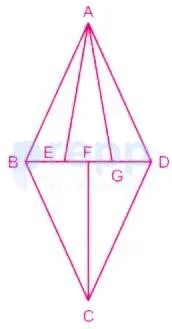
How many triangles are there in the give figure?
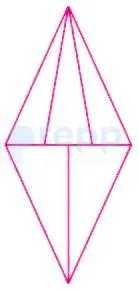
- A
8
- B
9
- C
10
- D
12
Show answer
B. 9Triangles in the figure: ABE, AEG, AGD, ABG, AED, ABD, BCD, BCFand DCF.
Hence, total of 9 triangles are there in the given figure.
 Paper & answer key PDF ↗
 Question 18archived
In each of the following question below are given some statements followed by some conclusions. Taking the given statements to be true even if they seem to be at variance from commonly known facts, read all the conclusions and then decide which of the given conclusion logically follows the given statements.
Statements:
I. Some cups are plates.
II. All spoons are blue.
III. No plates are spoon.
Conclusions:
I. Some cups are not spoon.
II. Some plates are not blue.
III. Some cups are not blue.
IV. Some blue are not plates.
- A
Only conclusion (I), (III) and (IV) follow.
- B
Only conclusion (II) and (IV) follow.
- C
Only conclusion (II), (III) and (IV) follow.
- D
Only conclusion (I) and (IV) follow.
Show answer
D. Only conclusion (I) and (IV) follow.I. Some cups are not spoon — Some cups are plates (I); no plates are spoons (III); so those cups (which are plates) are not spoons. Follows.
II. Some plates are not blue — no link forces plates to be non-blue; all plates could be blue. Does not follow.
III. Some cups are not blue — no link between cups and blue is forced. Does not follow.
IV. Some blue are not plates — all spoons are blue (II) and no spoons are plates (III), so those spoons (which are blue) are not plates. Follows.
Hence only I and IV follow.
Paper & answer key PDF ↗ Question 19archived
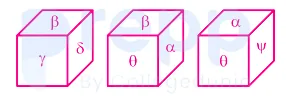
Three positions of a cube are shown below.
Which symbol will come on two faces marked ‘1’ and ‘2’?

- A
α and δ
- B
α and β
- C
θ and β
- D
θ and α
Show answer
D. θ and αOn observing the given first two dices, we say that "β" will come opposite to "ψ".
So, it's confirmed that neither 1 or 2 will be "β".
Therefore, options 2 and 3 will not correct.
On observing the given last two dices, we say that "α" will come opposite to "δ".
So, they are not on the adjacent sides.
Therefore, options 1 is also false.
Hence, the answer is θ and α.
Paper & answer key PDF ↗ Question 20archived
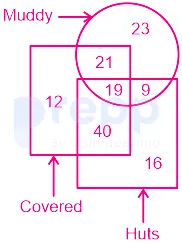
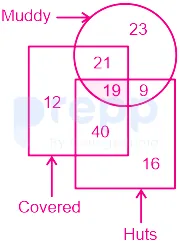
In the given figure, how many huts are covered and muddy?
- A
28
- B
40
- C
33
- D
19
Show answer
D. 19Number of huts that are covered and muddy = 19 (The no. present in the three shapes i.e. square (huts), square (covered) and circle (muddy).
Hence, answer is option 19.
 Paper & answer key PDF ↗
 Question 21archived
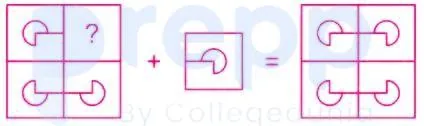
Which answer figure will complete the pattern in the question figure?

- A
Option A (shown in image)
- B
Option B (shown in image)
- C
Option C (shown in image)
- D
Option D (shown in image)
Show answer
D. Option D (shown in image)Figure 4 will complete the incomplete figure as shown in the diagram.
 Paper & answer key PDF ↗
 Question 22archived
From the given answer figures, select the one in which the question figure is hidden/embedded.

- A
Option A (shown in image)
- B
Option B (shown in image)
- C
Option C (shown in image)
- D
Option D (shown in image)
Show answer
B. Option B (shown in image)Clearly, the given question figure is hidden in option 2.
Hence, answer is option 2.
 Paper & answer key PDF ↗
 Question 23archived
A piece of paper is folded and a semi circle is punched as shown below in the question figures. From the given answer figures, indicate how it will appear when opened.

- A
Option A (shown in image)
- B
Option B (shown in image)
- C
Option C (shown in image)
- D
Option D (shown in image)
Show answer
C. Option C (shown in image)Hence, the answer is option 3.
 Paper & answer key PDF ↗
 Question 24archived
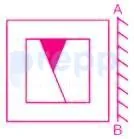
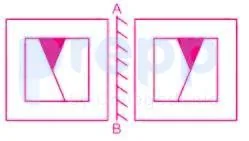
If the mirror is placed on the line AB, then which of the answer figure is the right image of the given figure?
- A
Option A (shown in image)
- B
Option B (shown in image)
- C
Option C (shown in image)
- D
Option D (shown in image)
Show answer
C. Option C (shown in image)Hence, answer is figure 3.
 Paper & answer key PDF ↗
 Question 25archived
A word is represented by only one set of numbers as gives in any one of the alternatives. The sets of numbers given in the alternatives are represented by two classes of alphabets as shown in the given two matrices. The columns and rows of Matrix - I are numbered from 0 to 4 and that of Matrix - II are numbered from 5 to 9. A letter from these matrices can be represented first by its row and next by its column, for example ‘P’ can be represented by 11, 23 etc. and ‘K’ be represented by 65, 89 etc. similarly, you have to identify the set for the word ‘TAKE’.
Matrix - IMatrix - II
0123456789
0ANSTP5REPKO
1TPANS6KOREP
2NSTPA7EPKOR
3PANST8OREPK
4STPAN9PKORE
- A
10, 32, 66, 56
- B
41, 00, 89, 75
- C
03, 43, 78, 99
- D
22, 13, 97, 87
Show answer
B. 41, 00, 89, 75Read each code as row, column. For TAKE we need T, A, K, E in order.
Option 2 — 41, 00, 89, 75:
41 → Matrix I (4,1) = T; 00 → Matrix I (0,0) = A; 89 → Matrix II (8,9) = K; 75 → Matrix II (7,5) = E.
All four letters match, so the code for TAKE is 41, 00, 89, 75.
Paper & answer key PDF ↗ Question 26archived
In which of the following market forms a firm does not exercise control over price?
- A
Mixed Competition
- B
Monopoly
- C
Oligopoly
- D
Perfect Competition
Show answer
D. Perfect CompetitionUnder perfect competition, a large number of firms sell identical products with free entry and exit, so each firm is a price taker — the market price is set by aggregate demand and supply and no single firm can influence it.
A monopolist is a price maker; oligopolists have partial control through strategic interaction; "mixed competition" is not a standard structure.
Paper & answer key PDF ↗ Question 27archived
Which of the following is represented by 'Lorenz Curve'?
- A
Employment
- B
Inflation
- C
Deflation
- D
Income Distribution
Show answer
D. Income DistributionThe Lorenz Curve, developed by Max Lorenz (1905), graphically represents the distribution of income or wealth in a population. The horizontal axis plots the cumulative percentage of recipients (poorest first); the vertical axis plots the cumulative percentage of income they hold.
The straight 45° line from (0,0) to (100,100) denotes perfect equality. The greater the curve bows away from this line, the higher the income inequality. The Gini coefficient is derived from this curve. Hence the Lorenz Curve represents Income Distribution.
Paper & answer key PDF ↗ Question 28archived
Which of the following is not a fundamental duty?
- A
To abide by the Constitution and respect the National Flag
- B
To promote harmony and brotherhood
- C
To uphold and protect the sovereignty
- D
Abolition of titles except military and academic
Show answer
D. Abolition of titles except military and academicFundamental Duties are listed under Article 51A in Part IVA of the Constitution, added by the 42nd Amendment (1976) on the recommendation of the Swaran Singh Committee.
Abiding by the Constitution and respecting the National Flag [51A(a)], promoting harmony and brotherhood [51A(e)], and upholding the sovereignty, unity and integrity of India [51A(c)] are all Fundamental Duties.
However, abolition of titles except military and academic is contained in Article 18 under Part III — it is a Fundamental Right (Right to Equality), not a duty. Hence it is the odd one out.
Paper & answer key PDF ↗ Question 29archived
Which article can be used by the President of India to declare financial emergency?
- A
Article 32
- B
Article 349
- C
Article 360
- D
Article 365
Show answer
C. Article 360Emergency provisions are in Part XVIII of the Constitution. Article 360 empowers the President to proclaim a Financial Emergency if the financial stability or credit of India (or any part of it) is threatened.
The other articles deal with different matters: Article 32 — Right to Constitutional Remedies; Article 349 — special procedure for legislation on language; Article 365 — consequences of a State failing to comply with Union directions (a ground for President's Rule under Article 356). A Financial Emergency under Article 360 has never been declared in India.
Paper & answer key PDF ↗ Question 30archived
The Poona Pact was signed between Mahatma Gandhi and __________.
- A
Muhammad Ali Jinnah
- B
Lord Irwin
- C
Subhash Chandra Bose
- D
B. R. Ambedkar
Show answer
D. B. R. AmbedkarThe Poona Pact was signed on 24 September 1932 at Yerawada Central Jail, Pune, between Mahatma Gandhi and Dr. B. R. Ambedkar.
It was concluded in response to the Communal Award (1932) of British PM Ramsay MacDonald, which had granted separate electorates to the Depressed Classes. Gandhi opposed this through a fast unto death. The pact replaced separate electorates with joint electorates, increasing reserved seats for the Depressed Classes from 71 to 147 in provincial legislatures and 18% in the Central Legislature.
Paper & answer key PDF ↗ Question 31archived
Which Governor General abolished the 'Sati System' in India?
- A
Lord Canning
- B
Lord Ripon
- C
Lord Wiliam Bentinck
- D
Lord Dalhousie
Show answer
C. Lord Wiliam BentinckThe Sati System was abolished by Lord William Bentinck, Governor-General of Bengal (1828–1835), through Regulation XVII of 1829, which declared sati a punishable offence (culpable homicide).
The reform was strongly supported by Raja Ram Mohan Roy. The other options served much later and are linked to different events: Lord Dalhousie (Doctrine of Lapse), Lord Canning (1857 Revolt, first Viceroy), and Lord Ripon (local self-government, Ilbert Bill).
Paper & answer key PDF ↗ Question 32archived
Which of the following is NOT a primary green house gas in the earth's atmosphere?
- A
Methane
- B
Ozone
- C
Nitrous oxide
- D
Hydrogen
Show answer
D. HydrogenThe primary greenhouse gases in Earth's atmosphere are water vapour (H2O), carbon dioxide (CO2), methane (CH4), nitrous oxide (N2O) and ozone (O3). These molecules absorb and re-emit infrared radiation, trapping heat.
Hydrogen (H2) is a symmetric diatomic molecule with no dipole moment and does not absorb infrared radiation significantly, so it is not a primary greenhouse gas. Methane, ozone and nitrous oxide are all recognised primary GHGs.
Paper & answer key PDF ↗ Question 33archived
Which type of forest is most widespread in India?
- A
Tropical Evergreen Forests
- B
Tropical Deciduous Forests
- C
Montane Forests
- D
Mangrove Forests
Show answer
B. Tropical Deciduous ForestsTropical Deciduous Forests, also called monsoon forests, are the most widespread forest type in India. They thrive in regions receiving annual rainfall between 70 cm and 200 cm — conditions that cover most of central India, the Deccan plateau, eastern plains and Western Ghats foothills.
They are divided into moist deciduous (100–200 cm) and dry deciduous (70–100 cm), supporting commercially valuable trees like teak, sal, sandalwood and bamboo. Trees shed leaves for 6–8 weeks in the dry season. Evergreen, montane and mangrove forests are restricted to much narrower climatic zones.
Paper & answer key PDF ↗ Question 34archived
Which blood group is universal donor?
- A
O+
- B
O–
- C
AB–
- D
AB+
Show answer
B. O–A universal donor's red blood cells must carry no antigens that the recipient's plasma antibodies can attack.
O– blood lacks A antigens, B antigens and the Rh(D) antigen. With none of these antigens present, O– red cells can be safely transfused to recipients of any ABO/Rh group, making it the universal red cell donor.
O+ still carries the Rh antigen and is unsafe for Rh-negative recipients. AB– and AB+ carry A and B antigens, restricting them to AB recipients only. (AB+ is the universal recipient, not donor.)
Paper & answer key PDF ↗ Question 35archived
In how many parts is the human brain divided?
- A
2
- B
3
- C
4
- D
5
Show answer
B. 3Anatomically, the human brain is divided into three main parts:
Forebrain — cerebrum, thalamus, hypothalamus; responsible for thinking, memory, voluntary action and sensory processing.
Midbrain — part of the brainstem; controls visual and auditory reflexes and relays signals between forebrain and hindbrain.
Hindbrain — cerebellum, pons and medulla oblongata; controls balance, posture and vital functions like breathing and heart rate.
Paper & answer key PDF ↗ Question 36archived
In which of the following class can we put Adrenaline?
- A
Hormone
- B
Enzyme
- C
Protein
- D
Fat
Show answer
A. HormoneAdrenaline (epinephrine) is secreted by the adrenal medulla directly into the bloodstream, where it travels to target organs such as the heart, lungs, blood vessels and liver to trigger the "fight-or-flight" response (raised heart rate, blood pressure and glucose release).
Acting as a chemical messenger from an endocrine gland makes it a hormone (a catecholamine derived from tyrosine). It is not an enzyme (no catalytic role), not a protein (it is a small amino-acid derivative), and not a fat.
Paper & answer key PDF ↗ Question 37archived
Supercooling is cooling of liquid ________.
- A
below melting point
- B
below freezing point
- C
at melting point
- D
above melting point
Show answer
B. below freezing pointSupercooling is the process of cooling a liquid below its freezing point without it solidifying. The liquid remains in a metastable state because crystal nucleation has not started — usually due to high purity or absence of nucleation sites.
For example, very pure water can stay liquid well below \(0^\circ\text{C}\). Any disturbance or seed crystal then triggers rapid freezing. Cooling "at" or "above" the melting point does not describe this phenomenon.
Paper & answer key PDF ↗ Question 38archived
When light passes from one medium to another there is a change in its direction, this phenomenon is called ________.
- A
Refraction
- B
Diffraction
- C
Propagation
- D
None of the above
Show answer
A. RefractionWhen light passes from one transparent medium to another, its speed changes (because the refractive indices differ). This change in speed at the boundary causes the ray to bend — a phenomenon called refraction, governed by Snell's law.
Diffraction is the bending of waves around obstacles or through narrow slits, not at a media boundary. Propagation simply means the transmission of light through a medium and does not involve a directional change. Hence the correct answer is Refraction.
Paper & answer key PDF ↗ Question 39archived
Which among the following is not an input device?
- A
Plotter
- B
Magnetic Ink Character Recognition (MICR)
- C
Optical Mark Recognition (OMR)
- D
Barcode Reader
Show answer
A. PlotterAn input device feeds data into the computer; an output device delivers processed data out.
A Plotter takes computer instructions and draws graphics or large-format prints (CAD drawings, blueprints) on paper — it is an output device.
MICR (reads magnetic ink characters on cheques), OMR (reads marked answer sheets/forms) and Barcode Readers (read printed barcodes) all convert physical information into digital data sent to the computer, so they are input devices.
Paper & answer key PDF ↗ Question 40archived
Which of the following is also known as Carbolic Acid?
- A
Phenol
- B
Hydroxide
- C
Sulphuric Acid
- D
Ethanol
Show answer
A. PhenolPhenol (C6H5OH) is the aromatic compound historically known as Carbolic Acid. It was first isolated from coal tar and famously used by Joseph Lister (1860s) as an antiseptic in surgery. Its acidic nature comes from the –OH group attached to the benzene ring.
Hydroxide (OH–) is merely an ion, sulphuric acid (H2SO4) is an inorganic mineral acid, and ethanol (C2H5OH) is an aliphatic alcohol — none of these is Carbolic Acid.
Paper & answer key PDF ↗ Question 41archived
Who discovered electron?
- A
E. Goldstien
- B
J. J. Thomson
- C
Ernest Rutherford
- D
J. Chadwick
Show answer
B. J. J. ThomsonThe electron was discovered by Sir J. J. Thomson in 1897 through his cathode-ray tube experiments. He showed cathode rays were deflected by electric and magnetic fields, proving they were negatively charged particles, and measured their charge-to-mass ratio \(e/m\), which was independent of the cathode material.
E. Goldstein discovered canal (anode) rays leading to the proton concept; Ernest Rutherford discovered the atomic nucleus and proton; James Chadwick discovered the neutron (1932).
Paper & answer key PDF ↗ Question 42archived
Who is a major driving force behind the 'Narmada Bachao Andolan'?
- A
Anna Hazare
- B
Medha Patkar
- C
Shantha Sinha
- D
Manasi Pradhan
Show answer
B. Medha PatkarMedha Patkar is the principal founder and leader of the Narmada Bachao Andolan, launched in 1985 against the Sardar Sarovar and other dams on the Narmada river. She organised tribal communities, farmers and environmentalists, led padyatras and indefinite fasts, and took the displacement and rehabilitation issue to the Supreme Court.
Anna Hazare led the anti-corruption Jan Lokpal movement; Shantha Sinha is known for anti-child-labour work (MV Foundation); Manasi Pradhan campaigns against violence on women. None of them is linked to the NBA.
Paper & answer key PDF ↗ Question 43archived
'Udey Desh ka Aam Nagrik' (UDAN) scheme for regional air connectivity will provide travel to tier 2 and tier 3 cities at the rate of Rs ________ per hour.
- A
1500
- B
2000
- C
2500
- D
3000
Show answer
C. 2500Under the UDAN (Ude Desh ka Aam Naagrik) regional connectivity scheme launched in October 2016 by the Ministry of Civil Aviation, airfares on RCS routes connecting tier-2 and tier-3 cities are capped at Rs 2,500 per hour of flight (about 500-600 km) for a fixed quota of seats. The shortfall against operational cost is met through Viability Gap Funding (VGF) financed by a regional connectivity levy on other domestic routes.
Paper & answer key PDF ↗ Question 44archived
Who invented radar?
- A
Fred Morrison
- B
Heinrich Hertz
- C
Van Tassel
- D
W. K. Roentgen
Show answer
B. Heinrich HertzAmong the given options, Heinrich Hertz is the one credited in this answer key. The German physicist proved the existence of electromagnetic waves in 1887 and showed that they could be reflected by metallic objects — the very principle on which radar (RAdio Detection And Ranging) operates. Practical radar systems were later built by Christian Hulsmeyer (1904) and Robert Watson-Watt (1935), but Hertz laid the scientific foundation.
Roentgen discovered X-rays; Fred Morrison invented the Frisbee; Van Tassel is unrelated to radar.
Paper & answer key PDF ↗ Question 45archived
David Warner plays cricket for which country?
- A
England
- B
New Zealand
- C
Australia
- D
Sri Lanka
Show answer
C. AustraliaDavid Warner is a left-handed opening batter who represents the Australian national cricket team across Tests, ODIs and T20Is. He made his international debut for Australia in January 2009 and has been a mainstay of their top order, winning multiple ICC trophies including the 2015 ODI World Cup and the 2021 T20 World Cup with Australia.
Paper & answer key PDF ↗ Question 46archived
Japanese art ‘Ikebana’ is related to ________.
- A
paper folding
- B
flower arrangement
- C
tree cutting
- D
sand art
Show answer
B. flower arrangementIkebana is the traditional Japanese art of flower arrangement, in which flowers, branches, leaves and the container are composed with attention to line, space and asymmetry. It originated from ritual floral offerings in Buddhist temples and developed into formal schools such as Ikenobo, Ohara and Sogetsu.
Paper folding is Origami, miniature tree cultivation is Bonsai, and sand art is unrelated to Ikebana.
Paper & answer key PDF ↗ Question 47archived
Who was awarded the 2017 Padma Bhushan Award in the field of Art-Music?
- A
Devi Prasad Dwivedi
- B
Anuradha Paudwal
- C
Vishwa Mohan Bhatt
- D
K. J. Yesudas
Show answer
C. Vishwa Mohan BhattVishwa Mohan Bhatt, the Grammy-winning classical musician and inventor of the Mohan Veena (a modified Hawaiian slide guitar), was conferred the Padma Bhushan in 2017 in the Art-Music category for his contribution to Hindustani classical music.
K. J. Yesudas received the Padma Vibhushan in 2017 (not Padma Bhushan); Anuradha Paudwal got the Padma Shri (2017); Devi Prasad Dwivedi received the Padma Bhushan for Literature & Education, not music.
Paper & answer key PDF ↗ Question 48archived
Who has recently launched his autobiography titled 'An Unsuitable Boy'?
- A
Rishi Kapoor
- B
MS Dhoni
- C
Karan Johar
- D
Vikram Seth
Show answer
C. Karan Johar'An Unsuitable Boy' (2017) is the autobiography of filmmaker Karan Johar, co-written with journalist Poonam Saxena. The title is a deliberate play on Vikram Seth's novel A Suitable Boy, and the book covers Johar's childhood, his entry into Bollywood through Kuch Kuch Hota Hai, his friendships and personal struggles.
Rishi Kapoor's autobiography is Khullam Khulla; MS Dhoni has not written an autobiography; Vikram Seth authored the novel A Suitable Boy, not this autobiography.
Paper & answer key PDF ↗ Question 49archived
Which of the following country is not a member of 'The Indian Ocean Rim Association (IORA)'?
- A
Sri Lanka
- B
Mauritius
- C
Seychelles
- D
China
Show answer
D. ChinaThe Indian Ocean Rim Association (IORA), founded in 1997 with its secretariat in Ebene, Mauritius, comprises 23 littoral states of the Indian Ocean. Sri Lanka, Mauritius and Seychelles are all founding/full Member States. China is not a littoral state of the Indian Ocean and is included only as a Dialogue Partner, not a Member State.
Hence, China is the country in the list that is not a member of IORA.
Paper & answer key PDF ↗ Question 50archived
Which country has launched the longest bullet train line covering a distance of 2252 kilometers in January, 2017?
- A
Japan
- B
China
- C
Afghanistan
- D
Myanmar
Show answer
B. ChinaIn January 2017, China launched the Shanghai-Kunming High-Speed Railway, spanning approximately 2,252 km through Zhejiang, Jiangxi, Hunan, Guizhou and Yunnan provinces. It became the world's longest single bullet-train line at that time, with trains running at up to 330 km/h and cutting the Shanghai-Kunming journey from over 34 hours to about 11 hours.
Japan operates the Shinkansen network but did not launch a 2,252 km line in January 2017; Afghanistan and Myanmar do not have high-speed rail.
Paper & answer key PDF ↗ Question 51archived
What is the sum of all prime numbers between 60 and 80?
- A
272
- B
284
- C
351
- D
414
Show answer
C. 351Step 1 — List primes between 60 and 80:
Checking divisibility by 2, 3, 5, 7 for each number in (60, 80), the primes are \(61,\ 67,\ 71,\ 73,\ 79\).
Step 2 — Add them:
\[61+67+71+73+79 = 351\]
Therefore the required sum is 351.
Paper & answer key PDF ↗ Question 52archived
A and B have to type a book together containing 120 pages. A takes 9 hrs to type 36 pages and B takes 5 hrs to type 40 pages. A typed first 60 pages alone and the last 60 pages were typed by A and B together. How much time (in hours) will be taken to type the complete book?
- A
24
- B
20
- C
12
- D
15
Show answer
B. 20Step 1 — Individual rates:
\(A=\dfrac{36}{9}=4\) pages/hr; \(B=\dfrac{40}{5}=8\) pages/hr.
Step 2 — First 60 pages (A alone):
\[\dfrac{60}{4}=15\text{ hours}\]
Step 3 — Last 60 pages (A + B together):
Combined rate \(=4+8=12\) pages/hr, so time \(=\dfrac{60}{12}=5\) hours.
Step 4 — Total time:
\(15+5=\mathbf{20}\) hours.
Paper & answer key PDF ↗ Question 53archived
ABC is a right angled triangle in which ∠B = 90°, AB = 5 cm and BC = 12 cm. What is the approximate volume (in cm 3) of the double cone formed by rotating the triangle about its hypotenuse?
- A
190 cm3
- B
290 cm3
- C
390 cm3
- D
578 cm3
Show answer
B. 290 cm3Step 1 — Hypotenuse:
\(AC=\sqrt{5^{2}+12^{2}}=\sqrt{169}=13\) cm.
Step 2 — Radius of common base (altitude from B to AC):
Using area in two ways, \(\tfrac{1}{2}\cdot 5\cdot 12=\tfrac{1}{2}\cdot 13\cdot r\), giving \(r=\dfrac{60}{13}\) cm.
Step 3 — Volume of double cone:
The two cones share radius \(r\) and their heights add up to the hypotenuse, so
\[V=\tfrac{1}{3}\pi r^{2}\cdot AC=\tfrac{1}{3}\pi\left(\tfrac{60}{13}\right)^{2}\!\cdot 13=\dfrac{1200\pi}{13}\]
\(\approx 289.5\) cm3, closest to 290 cm3.
Paper & answer key PDF ↗ Question 54archived
A trader allowed a discount of 15% on a trolley bag having list price of Rs 1360 and earns a profit of 15.6%. What is the cost price (in Rs) of the trolley bag?
- A
1000
- B
1005
- C
1050
- D
1156
Show answer
A. 1000Step 1 — Selling price after 15% discount:
\[SP=1360\times\tfrac{85}{100}=1156\]
Step 2 — Cost price from 15.6% profit:
\[CP=\dfrac{SP}{1+\tfrac{15.6}{100}}=\dfrac{1156}{1.156}=1000\]
Therefore the cost price is Rs 1000.
Paper & answer key PDF ↗ Question 55archived
Price of a diamond is directly proportional to square of its weight. A man broke the diamond accidently in three pieces in the ratio of 3 : 5 : 7 and thus loses Rs 42600. What was the original price (in Rs) of the diamond?
- A
11786
- B
60000
- C
67500
- D
75000
Show answer
C. 67500Let the weights of the three pieces be \(3k,5k,7k\); total original weight \(=15k\). Since price \(\propto\) (weight)2, take price \(=Cw^{2}\).
Step 1 — Original vs broken value (in units of \(Ck^{2}\)):
Original \(=(15)^{2}=225\); broken \(=3^{2}+5^{2}+7^{2}=9+25+49=83\).
Step 2 — Loss equation:
\[(225-83)\,Ck^{2}=142\,Ck^{2}=42600\;\Rightarrow\;Ck^{2}=300\]
Step 3 — Original price:
\(225\times 300=\mathbf{67500}\). Hence the diamond originally cost Rs 67,500.
Paper & answer key PDF ↗ Question 56archived
The average weight of 100 students is 32 kg. The average weight of first 49 students is 30 kg and of last 50 students is 34 kg. What is the weight (in kg) of the 50th student?
- A
25
- B
30
- C
32
- D
33
Show answer
B. 30Step 1 — Total weights:
All 100 students: \(100\times 32=3200\) kg.
First 49: \(49\times 30=1470\) kg. Last 50 (students 51-100): \(50\times 34=1700\) kg.
Step 2 — Isolate the 50th student:
The 50th student is the only one not counted in either subgroup, so
\[W_{50}=3200-(1470+1700)=3200-3170=30\text{ kg}\]
Therefore the 50th student weighs 30 kg.
Paper & answer key PDF ↗ Question 57archived
By selling 90 pens for Rs 80 a man loses 20%. What should be the selling price (in Rs) of 90 pens for 20% profit?
- A
90
- B
100
- C
110
- D
120
Show answer
D. 120Step 1 — Find CP from the 20% loss:
\[CP=\frac{SP}{1-\tfrac{L}{100}}=\frac{80}{0.80}=\text{Rs }100\]
Step 2 — Apply 20% profit on CP:
\[SP'=CP\times\left(1+\tfrac{20}{100}\right)=100\times1.20=\text{Rs }120\]
Hence the required selling price of 90 pens is Rs 120.
Paper & answer key PDF ↗ Question 58archived
Raman spends 80% of his income. If his income is increased by 25% and the expenditure increase by 10%, then what will be the percentage increase in his savings?
- A
17
- B
70
- C
77
- D
85
Show answer
D. 85Step 1 — Assume income = 100: Expenditure = 80, Savings = 100 − 80 = 20.
Step 2 — Apply the changes:
\[\text{New Income}=100\times1.25=125,\quad \text{New Expenditure}=80\times1.10=88\]
Step 3 — New savings and percentage rise:
\[\text{New Savings}=125-88=37\]
\[\% \text{ increase}=\frac{37-20}{20}\times100=\frac{17}{20}\times100=85\%\]
Hence savings rise by 85%.
Paper & answer key PDF ↗ Question 59archived
A man makes four trips of equal distances. His speed on first trip was 60 km/hr and in each subsequent trip his speed was half of the previous trip. What is the average speed (in km/hr) of the man in these four trips?
- A
16
- B
30
- C
28.125
- D
27.5
Show answer
A. 16For equal distances the average speed is the harmonic mean of the four speeds. Speeds halve each trip: 60, 30, 15, 7.5 km/hr.
\[\text{Avg}=\frac{4}{\tfrac{1}{60}+\tfrac{1}{30}+\tfrac{1}{15}+\tfrac{1}{7.5}}=\frac{4}{\tfrac{1+2+4+8}{60}}=\frac{4}{\tfrac{15}{60}}=\frac{4\times60}{15}\]
\[\text{Avg}=16\text{ km/hr}\]
Hence the average speed is 16 km/hr.
Paper & answer key PDF ↗ Question 60archived
Rohan borrowed a certain sum of money at simple interest. Rate of interest was 3% per annum for first 3 years, 4% per annum for next 5 years and 6% per annum for next 7 years. If he paid Rs 2059 as interest, then what is the sum borrowed (in Rs)?
- A
2400
- B
2500
- C
2900
- D
3100
Show answer
C. 2900Total simple interest equals the sum of \(\tfrac{PRT}{100}\) for each period.
\(SI=\frac{P(3\cdot3+4\cdot5+6\cdot7)}{100}=\frac{P(9+20+42)}{100}=\frac{71P}{100}\)
Set equal to 2059 and solve:
\(\frac{71P}{100}=2059 \;\Rightarrow\; P=\frac{2059\times100}{71}=2900\)
Hence the sum borrowed is Rs 2900.
Paper & answer key PDF ↗ Question 61archived
If x + y = 5, x 3+ y 3= 35, then what is the positive difference between x and y?
- A
0
- B
1
- C
5
- D
6
Show answer
B. 1Use the identity \((x-y)^2=(x+y)^2-4xy\), so we need \(xy\).
Step 1 — Find xy: From \(x^3+y^3=(x+y)^3-3xy(x+y)\):
\[35=125-3xy(5)\;\Rightarrow\;15xy=90\;\Rightarrow\;xy=6\]
Step 2 — Compute the difference:
\[(x-y)^2=5^2-4(6)=25-24=1\;\Rightarrow\;|x-y|=1\]
Hence the positive difference is 1.
Paper & answer key PDF ↗ Question 62archived
If \(x = \sqrt {\frac{{2 + \sqrt 3 }}{{2 - \sqrt 3 }}}\) , then what is the value of (x 2+ x – 9)?
- A
0
- B
3√2
- C
3√3
- D
5√3
Show answer
D. 5√3Step 1 — Rationalise: Multiply numerator and denominator inside the root by \((2+\sqrt3)\):
\[x=\sqrt{\frac{(2+\sqrt3)^2}{(2)^2-(\sqrt3)^2}}=\sqrt{(2+\sqrt3)^2}=2+\sqrt3\]
Step 2 — Evaluate: \(x^2=(2+\sqrt3)^2=7+4\sqrt3\).
\[x^2+x-9=(7+4\sqrt3)+(2+\sqrt3)-9=0+5\sqrt3=5\sqrt3\]
Hence the value is \(5\sqrt3\).
Paper & answer key PDF ↗ Question 63archived
If x + y + z = 0, then what is the value of \(\frac{{{x^2}}}{{3z}} + \frac{{{y^3}}}{{3xz}} + \frac{{{z^2}}}{{3x}}\) ?
- A
0
- B
xz
- C
y
- D
3y
Show answer
C. yReading the expression as \(\dfrac{x^3}{3z}+\dfrac{y^3}{3xz}+\dfrac{z^3}{3x}\) (a standard typo for the y-term), take common denominator \(3xz\):
\[\frac{x^3+y^3+z^3}{3xz}\]
Since \(x+y+z=0\), the identity \(x^3+y^3+z^3=3xyz\) applies:
\[\frac{3xyz}{3xz}=y\]
Hence the value is y.
Paper & answer key PDF ↗ Question 64archived
If (x – 1/x = 1), then what is the value of \(\frac{1}{x}\left( {\frac{1}{{x - 1}} - \frac{1}{{x + 1}} + \frac{1}{{{x^2} + 1}} - \frac{1}{{{x^2} - 1}}} \right)\) ?
- A
±√5
- B
2/5
- C
±2/√5
- D
4/(5 ± √5)
Show answer
D. 4/(5 ± √5)Step 1 — Simplify the bracket:
\[\frac{1}{x-1}-\frac{1}{x+1}=\frac{2}{x^2-1},\quad \frac{1}{x^2+1}-\frac{1}{x^2-1}=\frac{-2}{x^4-1}\]
Combining and factoring:
\[\frac{1}{x}\cdot\frac{2}{x^2-1}\left(1-\frac{1}{x^2+1}\right)=\frac{2x}{(x^2-1)(x^2+1)}\]
Step 2 — Use the condition: \(x-\tfrac1x=1\Rightarrow x^2-1=x\), so \(x^2=x+1\). Substituting:
\[\frac{2x}{x(x^2+1)}=\frac{2}{x+2}\]
Step 3 — Solve \(x^2-x-1=0\): \(x=\tfrac{1\pm\sqrt5}{2}\), giving \(x+2=\tfrac{5\pm\sqrt5}{2}\), so the value is \(\tfrac{4}{5\pm\sqrt5}\).
Hence the answer is \(\dfrac{4}{5\pm\sqrt5}\).
Paper & answer key PDF ↗ Question 65archived
PQ is a diameter of a circle with centre O. RS is a chord parallel to PQ subtends an angle of 40° at the centre of the circle. If PR and QS are produced to meet at T, then what will be the measure (in degrees) of ∠PTQ?
- A
55
- B
60
- C
70
- D
90
Show answer
C. 70Since RS ∥ PQ, arcs PR and QS are equal, so \(\angle POR=\angle QOS\). On the diameter:
\[2\angle POR+40^\circ=180^\circ\;\Rightarrow\;\angle POR=\angle QOS=70^\circ\]
Angle \(\angle ROQ=\angle ROS+\angle SOQ=40^\circ+70^\circ=110^\circ\); similarly \(\angle POS=110^\circ\). By the inscribed-angle theorem:
\[\angle RPQ=\tfrac12(110^\circ)=55^\circ,\quad \angle SQP=\tfrac12(110^\circ)=55^\circ\]
In \(\triangle PTQ\):
\[\angle PTQ=180^\circ-55^\circ-55^\circ=70^\circ\]
Hence \(\angle PTQ=\mathbf{70^\circ}\).
Paper & answer key PDF ↗ Question 66archived
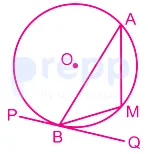
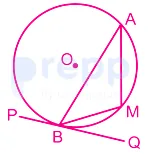
In the given figure, ∠AMB = 130°, then what is the value (in degrees) of ∠ABQ?
- A
40
- B
50
- C
60
- D
90
Show answer
B. 50Given:
∠AMB = 130°
Calculation:
According to the alternate segment theorem, in a circle, the angle between a chord and a tangent at the intersection is equal to the angle in the alternate section
Hence, in the given figure,
∠ABP = ∠AMB = 130°
∴ ∠ABQ = 180° – ∠ABP = 180° – 130° = 50°
So, the value of ∠ABQ is 50 °
 Paper & answer key PDF ↗
 Question 67archived
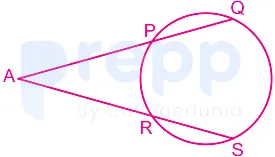
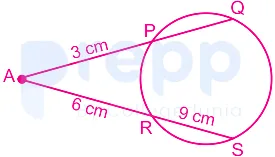
In the given figure, AP = 3 cm, AR = 6 cm and RS = 9 cm, then what is the value (in cm) of PQ?
- A
9
- B
12
- C
18
- D
27
Show answer
D. 27Given:
AP = 3 cm, AR = 6 cm, RS = 9 cm
Concept used:
AR × AS = AP × AQ
Calculation:
AR × AS = AP × AQ
⇒ 6 × (6 + 9) = 3 × (3 + PQ)
⇒ PQ + 3 = 30
⇒ PQ = 27 cm
∴ PQ = 27 cm
So, the value of PQ = 27 cm.
 Paper & answer key PDF ↗
 Question 68archived
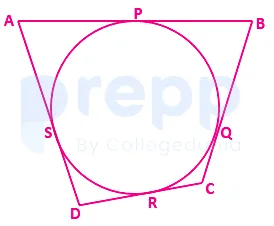
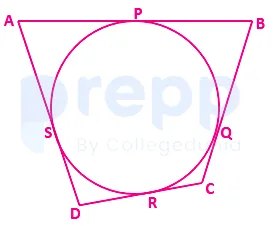
In the given figure, a circle touches quadrilateral ABCD. If AB = 2x + 3, BC = 3x – 1, CD = x + 6 and DA = x + 4, then what is the value of x?
- A
3
- B
4.5
- C
6
- D
6.5
Show answer
C. 6A quadrilateral whose all four sides touch a circle, is known as cyclic quadrilateral
Also, when two tangents are drawn from an external point to a circle, the lengths of the tangents is equal
Hence, in the given figure,
⇒ AP = AS
⇒ BP = BQ
⇒ CR = CQ
⇒ DR = DS
Adding all four equations, we get,
⇒ AP + BP + CR + DR = AS + DS + BQ + CQ
⇒ AB + CD = AD + BC
Substituting values,
⇒ 2x + 3 + x + 6 = 3x – 1 + x + 4
⇒ 3x + 9 = 4x + 3
⇒ 4x – 3x = 9 – 3
⇒ x = 6
 Paper & answer key PDF ↗
 Question 69archived
If cosec 2θ = 625/576, then what is the value of [(sinθ – cosθ)/(sinθ + cosθ)]?
- A
1
- B
31/17
- C
17/31
- D
14/25
Show answer
C. 17/31Given \(\csc^2\theta=\tfrac{625}{576}\), so \(\sin^2\theta=\tfrac{576}{625}\Rightarrow \sin\theta=\tfrac{24}{25},\;\cos\theta=\tfrac{7}{25}\) (right-triangle 7-24-25).
Divide numerator and denominator of the target by \(\cos\theta\):
\[\frac{\sin\theta-\cos\theta}{\sin\theta+\cos\theta}=\frac{\tan\theta-1}{\tan\theta+1}=\frac{\tfrac{24}{7}-1}{\tfrac{24}{7}+1}=\frac{17}{31}\]
Hence the value is \(\tfrac{17}{31}\).
Paper & answer key PDF ↗ Question 70archived
What is the value of \(\frac{3}{2}\left( {\frac{{\cos 39}}{{\sin 51}}} \right) - \sqrt {({{\sin }^2}39 + {{\sin }^2}51})\) ?
- A
1/2
- B
5/2
- C
0
- D
either 1/2 or 5/2
Show answer
D. either 1/2 or 5/2Since \(51^\circ=90^\circ-39^\circ\), we have \(\sin 51^\circ=\cos 39^\circ\), so the first term reduces:
\[\frac{3}{2}\cdot\frac{\cos 39^\circ}{\sin 51^\circ}=\frac{3}{2}\cdot 1=\frac{3}{2}\]
Under the root, \(\sin^2 39^\circ+\sin^2 51^\circ=\sin^2 39^\circ+\cos^2 39^\circ=1\), so \(\sqrt{1}=\pm1\). The expression becomes \(\tfrac{3}{2}\mp1\), giving \(\tfrac{1}{2}\) or \(\tfrac{5}{2}\).
Hence the answer is either 1/2 or 5/2.
Paper & answer key PDF ↗ Question 71archived
If cot A = [sin B/(1 – cos B)], then what is the value of cot 2A?
- A
cot(B/2)
- B
cot 2B
- C
cot B
- D
tan B
Show answer
C. cot BUse half-angle identities: \(\sin B=2\sin\tfrac{B}{2}\cos\tfrac{B}{2}\) and \(1-\cos B=2\sin^2\tfrac{B}{2}\).
\[\cot A=\frac{2\sin\tfrac{B}{2}\cos\tfrac{B}{2}}{2\sin^2\tfrac{B}{2}}=\frac{\cos(B/2)}{\sin(B/2)}=\cot\tfrac{B}{2}\]
So \(A=\tfrac{B}{2}\), giving \(2A=B\).
Hence \(\cot 2A=\mathbf{\cot B}\).
Paper & answer key PDF ↗ Question 72archived
Company 1 sold 20000 bikes each year from 2011 to 2016 and company 2 sold 10000 bikes each year from 2011 to 2016. What is the difference (in units) in average yearly production of company 1 and 2?
- A
6733.33
- B
7500
- C
8666.66
- D
9333.33
Show answer
D. 9333.33For company 1 total production from year 2011 to 2016 can be given as
⇒ total production = sale per year × (sum of ratios of all year), because sale is same in all years
⇒ total production for company 1 = 20000 × (0.6 + 0.9 + 0.7 + 0.9 + 1.3 + 1.3)
⇒ total production = 114000
⇒ Average = 114000/6 = 19000
For company 2 total production from year 2011 to 2016 can be given as
⇒ total production = sale per year × (sum of ratios of all year), because sale is same in all years
⇒ total production for company 2 = 10000 × (0.8 + 0.75 + 0.4 + 1.45 + 1.3 + 1.1)
⇒ total production = 58000
⇒ Average = 58000/6 = 9666.66
⇒ Difference is 19000 – 9666.66
∴ The difference is 9333.34
Paper & answer key PDF ↗ Question 73archived
The production of company 1 in year 2014 is 18000 and sales of company 2 in year 2012 is 15000. What is the ratio of difference in sales and production of company 1 in year 2014 and company 2 in year 2012?
- A
8 : 15
- B
7 : 16
- C
9 : 11
- D
3 : 8
Show answer
A. 8 : 15From the graph the ratio of production and sale for company 1 in 2014 is 0.9 and for
company 2 in 2012 is 0.75
For company 1 in year 2014,
0.9 = production/sale
⇒ sale = 18000/0.9 = 20000
Difference between sales and production can be given as
⇒ 20000 – 18000 = 2000
Given that for company 2, the sale in 2012 is equal 15000
For year 2012,
0.75 = production/sale
⇒ production = 0.75 × 15000 = 11250
Difference between sales and production can be given as
⇒ 15000 – 11250 = 3750
Ratio can be given as 2000/3750
∴ The required ratio is 8 : 15
Paper & answer key PDF ↗ Question 74archived
The production of company 2 in year 2012 is 30000. If sales of company 2 in year 2012 and 2013 is same, then what was its production (in units) in year 2013?
- A
100000
- B
16000
- C
30000
- D
20000
Show answer
B. 16000From the graph the ratio of production and sale for company 2in 2012 is 0.75 and that in
2013 is 0.4
⇒ For year 2012, 0.75 = production/sale
⇒ sale = 30000/0.75 = 40000
Given that sale in 2012 is equal to sale in 2013
⇒ For year 2013, 0.4 = production/sale
⇒ production = 0.4 × 40000 = 16000
∴ The production in 2013 is 16000
Paper & answer key PDF ↗ Question 75archived
If the sales of company 1 in year 2015 was 50000 units, then what was its production (in units) in year 2015?
- A
38460
- B
45000
- C
52000
- D
65000
Show answer
D. 65000From the graph ratio of production to sales in year 2015 is 1.3
⇒ 1.3 = production/sales
⇒ production = 1.3 × 50000 = 65000
∴ The production of Company 1 in year 2015 is 65000 units
Paper & answer key PDF ↗ Question 76archived
In the following question, some part of the sentence may have errors. Find out which part of the sentence has an error and select the appropriate option. If a sentence is free from error, select 'No error'.
He did not go (1)/ to the temple on foot, (2)/ he went there by the car. (3)/ No Error (4)
- A
1
- B
2
- C
3
- D
4
Show answer
C. 3For general modes of transport, the preposition by takes the noun directly without an article: by car, by bus, by train. The phrase "by the car" in segment (3) is wrong; it should read "by car". Segments (1) and (2) are grammatically sound ("did not go", "on foot" are idiomatic).
Hence the error lies in segment (3).
Paper & answer key PDF ↗ Question 77archived
In the following question, some part of the sentence may have errors. Find out which part of the sentence has an error and select the appropriate option. If a sentence is free from error, select 'No error' .
She ascended (1)/ to the throne (2)/ at the early age of seven. (3)/ No Error (4)
- A
1
- B
2
- C
3
- D
4
Show answer
B. 2The verb ascend, when used for taking power, is transitive and takes the object directly — "ascended the throne", not "ascended to the throne". The preposition "to" in segment (2) is redundant. Segments (1) and (3) are correct ("at the early age of" is standard).
Hence the error lies in segment (2).
Paper & answer key PDF ↗ Question 78archived
In the following question, the sentence given with blank to be filled in with an appropriate word. Select the alternative out of the four and indicate it by selecting the appropriate option.
Neha's mother was annoyed with her as she could not _____ her examination.
- A
Get off
- B
Get on
- C
Get upon
- D
Get through
Show answer
D. Get throughThe blank needs a phrasal verb meaning "to pass / succeed in". Get through precisely carries this sense ("get through an exam" = pass it). Her mother's annoyance follows from Neha failing to pass.
The other options don't fit: get off = leave/escape, get on = make progress / board, get upon is not standard idiomatic English. Hence the answer is Get through.
Paper & answer key PDF ↗ Question 79archived
In the following question, the sentence given with blank is to be filled in with an appropriate word. Select the alternative out of the four and indicate it by selecting the appropriate option.
I shall _____ her if she apologises to me for her misbehaviour.
- A
sorry
- B
forgive
- C
punish
- D
scold
Show answer
B. forgiveThe sentence sets up a conditional: an apology will be followed by a positive response from the speaker. The verb that logically pairs with receiving an apology is forgive — to stop feeling angry or resentful for an offence.
"Sorry" is an adjective, not a verb that follows "shall". "Punish" and "scold" are negative reactions and contradict the idea of accepting an apology. Hence the completed sentence reads: "I shall forgive her if she apologises to me for her misbehaviour."
Paper & answer key PDF ↗ Question 80archived
In the following question, out of the four alternatives, select the word similar in meaning to the word given.
Ebullient
- A
Deceitful
- B
Insincerity
- C
Enthusiastic
- D
Prejudice
Show answer
C. EnthusiasticEbullient means cheerful and full of energy — lively, exuberant, bubbling with positive excitement. The closest match among the options is Enthusiastic, which shares the sense of eager, energetic positivity.
"Deceitful" (dishonest) and "Insincerity" (lack of genuineness) are unrelated to high spirits, and "Prejudice" (biased opinion) carries no connotation of energy or cheer.
Paper & answer key PDF ↗ Question 81archived
In the following question, out of the four alternatives, select the word similar in meaning to the word given.
Truculent
- A
Ferocious
- B
Luxurious
- C
Luscious
- D
Delicious
Show answer
A. FerociousTruculent means aggressively defiant, hostile, fierce, or eager to fight. The option that captures this savage, aggressive quality is Ferocious, which means savagely fierce, cruel, or violent.
"Luxurious", "Luscious", and "Delicious" all relate to pleasure, taste, or comfort and bear no link to hostility or aggression.
Paper & answer key PDF ↗ Question 82archived
In the following question, out of the four alternatives, select the word opposite in meaning to the word given.
Niggardly
- A
Mingy
- B
Inefficient
- C
Generous
- D
Sinful
Show answer
C. GenerousNiggardly means stingy — reluctant to give or spend. Its direct antonym is Generous, which describes a readiness to give freely.
"Mingy" is a synonym, not an antonym. "Inefficient" (unproductive) and "Sinful" (immoral) are unrelated to giving habits.
Paper & answer key PDF ↗ Question 83archived
In the following question, out of the four alternatives, select the word opposite in meaning to the word given.
Dissident
- A
Alienated
- B
Iconoclast
- C
Divisive
- D
Orthodox
Show answer
D. OrthodoxA dissident opposes official policy or established beliefs. Its opposite must describe someone who conforms to accepted views — that is Orthodox, meaning one who follows traditional or established doctrines.
"Iconoclast" is a near-synonym (someone who attacks cherished beliefs). "Alienated" describes a feeling of estrangement, and "Divisive" describes an effect — neither is the opposite of dissident.
Paper & answer key PDF ↗ Question 84archived
In the following question, out of the four alternatives, select the alternative which best expresses the meaning of the idiom/Phrase.
Bear the palm
- A
To face the consequences
- B
To meet death
- C
To be able to predict future
- D
To win
Show answer
D. To winThe idiom "Bear the palm" originates from the ancient practice of awarding a palm branch to the victor of a contest. It therefore means to win or be victorious.
"Face the consequences", "meet death", and "predict the future" have no link to the symbolism of triumph that the palm branch represents.
Paper & answer key PDF ↗ Question 85archived
In the following question, out of the four alternatives, select the alternative which best expresses the meaning of the idiom/Phrase.
To give the devil his due.
- A
To punish the wrong person
- B
To give credit to even a notorious person
- C
To let the enemy learn the lesson on his own
- D
To stand in the way of the devil
Show answer
B. To give credit to even a notorious personThe idiom "To give the devil his due" means to acknowledge the merits or good qualities of someone who is otherwise disliked or considered bad. It reflects fairness in judgment — giving credit where it is deserved, even to a notorious person.
Hence the best match is "To give credit to even a notorious person". The other options relate to punishment, opposition, or letting an enemy learn — none captures the idea of fair acknowledgment.
Paper & answer key PDF ↗ Question 86archived
Improve the bracketed part of the sentence.
(No sooner the advertisement regarding the launch of new smartphone appeared) than there was a rush on the online website for prebooking the same.
- A
No sooner the advertisement regarding the launched of new smart phone appeared
- B
No sooner did the advertisement regarding the launch of new smart phone appear
- C
The advertisement regarding the launch of new smart phone was no sooner having appeared
- D
No improvement
Show answer
B. No sooner did the advertisement regarding the launch of new smart phone appearWhen a sentence begins with the negative adverb "No sooner", inversion is required: No sooner + auxiliary (did/had) + subject + main verb. The correlative conjunction is than (not "when").
The original lacks inversion. Option 2 — "No sooner did the advertisement regarding the launch of new smart phone appear" — correctly places the auxiliary "did" before the subject, with the main verb in its base form. Options 1 and 3 are grammatically faulty, and Option 4 ("No improvement") ignores the missing inversion.
Paper & answer key PDF ↗ Question 87archived
Improve the bracketed part of the sentence.
The equipment is (adapted to) cotton industries.
- A
Adapted from
- B
Adapted for
- C
Adapted of
- D
No improvement
Show answer
B. Adapted forThe verb "adapt" takes different prepositions depending on meaning: adapted to = adjusted to an environment/condition; adapted for = modified for a specific purpose or use; adapted from = derived from a source.
Here the equipment is made suitable for use in cotton industries — a purpose, not an environment. The correct preposition is therefore "Adapted for".
Paper & answer key PDF ↗ Question 88archived
In the following question, out of the four alternatives, select the alternative which is the best substitute of the phrase .
One who loads and unloads ships
- A
Stevedore
- B
Transgressor
- C
Lapidist
- D
Reticent
Show answer
A. StevedoreA Stevedore (also called a docker or longshoreman) is a person employed at a port to load and unload cargo from ships. This exactly matches the given phrase.
A "Transgressor" is a lawbreaker, a "Lapidist" cuts and polishes gemstones, and "Reticent" is an adjective meaning reserved — none refers to port cargo work.
Paper & answer key PDF ↗ Question 89archived
In the following question, out of the four alternatives, select the alternative which is the best substitute of the phrase .
Belief or opinion contrary to what is generally accepted
- A
Invocation
- B
Incognito
- C
Heresy
- D
Mercenary
Show answer
C. HeresyHeresy means a belief or opinion that strongly contradicts orthodox or generally accepted doctrine — originally religious, but extended to any prevailing view. This is exactly what the phrase describes.
"Invocation" (a calling upon a deity), "Incognito" (with concealed identity), and "Mercenary" (a hired soldier) bear no relation to dissenting beliefs.
Paper & answer key PDF ↗ Question 90archived
In the following question, four words are given out of which one word is incorrectly spelt. Find the incorrectly spelt word.
- A
Tomorrow
- B
Occurence
- C
Temperature
- D
Preferable
Show answer
B. OccurenceThe misspelt word is Occurence. The correct spelling is Occurrence — with a double "r" and double "c". The suffix "-ence" is added to "occurr-", and consonant doubling applies because the stress falls on the final syllable of "occur".
"Tomorrow", "Temperature", and "Preferable" are all spelt correctly.
Paper & answer key PDF ↗ Question 91archived
In the following question, four words are given out of which one word is incorrectly spelt. Find the incorrectly spelt word
- A
Receeding
- B
Cemetery
- C
Parallelogram
- D
Rehearsal
Show answer
A. ReceedingThe misspelt word is Receeding. The correct spelling is Receding — with a single "e" after the "c". It comes from "recede" (to move back), and dropping the silent "e" before adding "-ing" gives "receding".
"Cemetery", "Parallelogram", and "Rehearsal" are all spelt correctly.
Paper & answer key PDF ↗ Question 92archived
The question below consists of a set of labelled sentences. Out of the four options given, select the most logical order of the sentences to form a coherent paragraph.
P: If all the requirements of the villages are satisfied there by itself, then the peasants will usefully utilize their spare time.
Q: Let us consider the village artisans.
R: This will also provide employment to all the educated people of the villages.
S: Having discussed the problems and requirements of rural life.
- A
SQPR
- B
PRQS
- C
QRPS
- D
PSQR
Show answer
A. SQPRS opens the paragraph — the phrase "Having discussed the problems and requirements of rural life" is an introductory participial clause that sets the context. Q follows naturally with "Let us consider the village artisans", narrowing focus to a specific group.
P then explains the outcome — if village requirements are met, peasants will utilise their spare time. R concludes with an additional benefit signalled by "This will also provide employment". Hence the order is SQPR.
Paper & answer key PDF ↗ Question 93archived
The question below consists of a set of labelled sentences. Out of the four options given, select the most logical order of the sentences to form a coherent paragraph.
P: Practical farming includes knowledge of fruit and vegetable farming.
Q: These schools need not necessarily have their own farms because the village itself will provide ample field work facilities.
R: Agriculture should be made compulsory in higher secondary schools; alternatively, the urban students can be taught town-planning, industrial planning etc.
S: Therefore, at this stage, only theoretical education for the village students would suffice
- A
QRSP
- B
RPQS
- C
RSPQ
- D
QPRS
Show answer
B. RPQSR introduces the topic — making agriculture compulsory in higher secondary schools and an alternative for urban students. P elaborates on what such agricultural education involves: practical farming, including fruit and vegetable farming.
Q addresses the resource concern — "These schools" (referring back to R) need no farms of their own because the village offers field facilities. S concludes with "Therefore... theoretical education... would suffice" for village students at this stage. The coherent order is RPQS.
Paper & answer key PDF ↗ Question 94archived
In the following question, a sentence has been given in Active/Passive voice. Out of four alternatives suggested, select the one which best expresses the same sentence in Passive/Active voice.
I saw him leaving the movie theatre.
- A
He was seen leaving the movie theatre by me
- B
Leaving the movie theatre he was seen by me.
- C
He was seen to be leaving the movie theatre.
- D
He had been seen leaving the movie theatre.
Show answer
A. He was seen leaving the movie theatre by meFor a perception verb (see/hear/watch) followed by object + present participle in the active, the passive keeps the participle: Object + was/were + seen + present participle + by + agent.
Active: "I saw him leaving the movie theatre." Object "him" becomes subject "He"; "saw" becomes "was seen"; "leaving the movie theatre" stays unchanged; agent "by me" closes the sentence.
Hence the correct passive is "He was seen leaving the movie theatre by me." Option 2 misplaces the participle phrase; option 3 wrongly inserts "to be"; option 4 shifts tense to past perfect.
Paper & answer key PDF ↗ Question 95archived
In the following question, a sentence has been given in Direct/Indirect speech. Out of the four alternatives suggested, select the one which best expresses the same sentence in Indirect/Direct speech.
The principal said, "Be quiet, girls."
- A
The principal called the girls and ordered them to be quiet.
- B
The principal commanded the girls that they be quiet.
- C
The principal urged the girls to be quiet
- D
The principal said that the girls should be quiet.
Show answer
C. The principal urged the girls to be quietImperative direct speech converts to indirect using a suitable reporting verb (ordered / told / urged / requested) + object + to + base verb. The inverted commas and vocative are dropped.
"Be quiet, girls" is a positive imperative addressed to the girls. The structure becomes: The principal + reporting verb + the girls + to be quiet.
Among the options, "The principal urged the girls to be quiet" follows this exact structure. Option 2 uses an ungrammatical "that they be quiet" clause; option 4 reduces a command to a mere statement with "said that"; option 1 adds an unstated action ("called the girls").
Paper & answer key PDF ↗ Question 96archived
His life is all care and _____.
- A
wisdom
- B
success
- C
worry
- D
anxiety
Show answer
C. worryThe passage paints modern man as imprisoned by routine, so the blank in "His life is all care and _____" needs a negative noun that pairs idiomatically with care.
"Care and worry" is the standard collocation describing a life burdened by responsibilities and anxieties, matching the passage's tone. "Wisdom" and "success" are positive and break the tone; "anxiety" is close in meaning but is not the conventional pairing with "care". Hence worry fits best.
Paper & answer key PDF ↗ Question 97archived
He does not have _____ for anything
- A
resources
- B
time
- C
material
- D
money
Show answer
B. timeThe passage opens by saying modern man is "imprisoned by his time-table and his routine" — clearly a complaint about lack of time. The blank fits that exact idea: "He does not have time for anything but his duties and occupation."
"Resources", "material" and "money" do not connect to the time-table/routine framing; only time is the scarce thing a rigid schedule eats up.
Paper & answer key PDF ↗ Question 98archived
but his duties and occupation for _____ money.
- A
making
- B
minting
- C
collecting
- D
spending
Show answer
A. makingThe phrase "occupation for _____ money" needs a verb that describes earning money through one's work.
"Making money" is the standard idiom for earning income from an occupation. "Minting" literally means producing coins; "collecting" suggests gathering dues; "spending" is the opposite of earning. Hence making fits the sentence.
Paper & answer key PDF ↗ Question 99archived
Men, in all _____ may have been prone to this disease and; indeed,
- A
spheres
- B
streams
- C
areas
- D
ages
Show answer
D. agesThe sentence contrasts how Indians and Westerners have suffered the "disease" of routine-bound life over time, so the blank needs a noun denoting historical periods.
"Men, in all ages" idiomatically means men throughout history — exactly the universal-across-time sense the sentence requires. "Spheres" and "areas" suggest domains of activity; "streams" suggests flows/categories — none capture the temporal sweep the passage needs.
Paper & answer key PDF ↗ Question 100archived
we in India may not have been _____ by it to the extent that people in western countries have been.
- A
infected
- B
inflicted
- C
accompanied
- D
associate
Show answer
B. inflictedThe passage calls routine-bound life a "disease". The blank needs a verb meaning suffered from / harmed by, used with the preposition by.
"Inflicted" means caused to suffer something harmful and pairs naturally with "by" in this context. "Infected" is used for literal pathogens, not metaphorical lifestyle diseases; "accompanied" and "associate" do not convey suffering. Hence inflicted fits best.
Note: "afflicted by" is the strictly correct usage; "inflicted by" is widely accepted in Indian-English question banks and is the intended answer here.
Paper & answer key PDF ↗ Browser storage is unavailable. You can still browse and practise; progress will last for this visit.