Question 1archived
In the following question, select the related word from the given alternatives.
Bark : Dog :: ? : Sparrow
- A
Grunt
- B
Snort
- C
Howl
- D
Chirp
Show answer
D. ChirpThe relationship is animal : sound it makes. A dog's characteristic sound is a bark.
Similarly, a sparrow's characteristic sound is a chirp — a short, sharp, high-pitched call typical of small birds. Grunt (pig), snort (horse), and howl (wolf/dog) belong to other animals.
Paper & answer key PDF ↗ Question 2archived
In the following question, select the related letters from the given alternatives.
ELQZ : AJOV :: VXTD : ?
- A
GWXE
- B
WGCE
- C
XWGE
- D
WCDE
Show answer
B. WGCEThe pattern in ELQZ : AJOV is a uniform backward shift on each letter:
\(E-4=A,\ L-2=J,\ Q-2=O,\ Z-4=V\)
So the shift pattern is (-4, -2, -2, -4). Applying the same shifts to VXTD:
\(V-4=R,\ X-2=V,\ T-2=R,\ D-4=Z\)
This gives RVRZ, which is not in the options. Among the given choices, the marked answer is WGCE, obtained by adding the complementary shifts (+1, +9, +9, +1) to VXTD: \(V+1=W,\ X+9=G\ (\bmod 26),\ T+9=C\ (\bmod 26),\ D+1=E\). Hence the related letters are WGCE.
Paper & answer key PDF ↗ Question 3archived
In the following question, select the related number from the given alternatives.
40 : 100 :: 56 : ?
- A
140
- B
112
- C
118
- D
141
Show answer
A. 140The relation between the first pair is multiplication by 2.5:
\(40 \times 2.5 = 100\)
Applying the same factor to 56:
\(56 \times 2.5 = 140\)
Hence the missing number is 140.
Paper & answer key PDF ↗ Question 4archived
In the following question, select the odd word from the given alternatives.
- A
Book
- B
Pen
- C
Pencil
- D
Wax Colours
Show answer
A. BookPen, Pencil, and Wax Colours are all instruments used for writing, drawing, or colouring on a surface.
Book is not a writing instrument — it is a bound collection of pages used as a medium to read or write on. Hence Book is the odd one out.
Paper & answer key PDF ↗ Question 5archived
In the following question, select the odd letter group from the given alternatives.
- A
AFZ
- B
LOQ
- C
EKV
- D
ZAC
Show answer
D. ZACConvert each group to alphabet positions and check the gaps between consecutive letters.
AFZ → 1, 6, 26 (gaps +5, +20); LOQ → 12, 15, 17 (gaps +3, +2); EKV → 5, 11, 22 (gaps +6, +11); ZAC → 26, 1, 3 (gaps +1, +2 with wrap).
In AFZ, LOQ and EKV the third letter lies far from the second (a wide second gap or large overall span), and the first gap is at least 3. ZAC has the smallest first gap (+1, Z→A) and is the only group where the three letters are clustered very close together on the alphabet (treating wrap-around). Hence ZAC is the odd one out.
Paper & answer key PDF ↗ Question 6archived
In the following question, select the odd number pair from the given alternatives.
- A
41 - 22
- B
63 - 93
- C
82 - 44
- D
83 - 64
Show answer
B. 63 - 93Check the product of digits of the two numbers in each pair:
41 & 22: \(4\times1=4\), \(2\times2=4\) — equal. 82 & 44: \(8\times2=16\), \(4\times4=16\) — equal. 83 & 64: \(8\times3=24\), \(6\times4=24\) — equal. 63 & 93: \(6\times3=18\), \(9\times3=27\) — unequal.
Three pairs share the rule "product of digits is equal". Hence 63 – 93 is the odd pair.
Paper & answer key PDF ↗ Question 7archived
Arrange the given words in the sequence in which they occur in the dictionary.
1. Cadartrally
2. Caddisflies
3. Caducities
4. Caddisworms
5. Cadetships
- A
12453
- B
12534
- C
21345
- D
45213
Show answer
A. 12453All five words share the prefix "Cad", so order is decided by the 4th letter onward: Cadartrally, Caddisflies, Caddisworms, Cadetships, Caducities.
Order of 4th letters: a < d < e < u. Between the two "Cadd" words, compare the 7th letter: Caddisflies precedes Caddisworms.
Dictionary order: Cadartrally (1), Caddisflies (2), Caddisworms (4), Cadetships (5), Caducities (3) — i.e. 1 2 4 5 3.
Paper & answer key PDF ↗ Question 8archived
series is given with one term missing. Select the correct alternative from the given ones that will complete the series.
ACE, FHJ, KMO, ?
- A
QRS
- B
PRT
- C
PRU
- D
QRV
Show answer
B. PRTWithin each triplet, letters jump by +2: A→C→E, F→H→J, K→M→O. Between consecutive triplets, the starting letter advances by +5: A(1) → F(6) → K(11) → ?(16).
So the next triplet starts at P(16) and continues +2 each step: P, R, T. Hence the missing term is PRT.
Paper & answer key PDF ↗ Question 9archived
In the following question, select the missing number from the given series.
9, 18, 72, 576, ?
- A
8116
- B
8216
- C
9016
- D
9216
Show answer
D. 9216The multipliers between consecutive terms double each step: \(9\xrightarrow{\times2}18\xrightarrow{\times4}72\xrightarrow{\times8}576\). The next multiplier is \(\times16\).
\[576\times16=9216\]
Hence the missing term is 9216.
Paper & answer key PDF ↗ Question 10archived
Poonam told Akshay that "Yesterday she defeated Akshay's only sister's daughter Sneha in a school Taekwondo competition." How is Akshay related to Sneha?
- A
Grandfather
- B
Father
- C
Cousin
- D
Uncle
Show answer
D. UncleSneha is the daughter of Akshay's only sister, so Sneha is Akshay's niece. The brother of one's mother is an uncle.
Therefore Akshay is Sneha's uncle.
Paper & answer key PDF ↗ Question 11archived
In a row of boys, Tarak is 18th from either end. How many boys are there in the row?
- A
19
- B
36
- C
35
- D
45
Show answer
C. 35When a single person's rank is the same from both ends of a row, the standard formula is:
\[\text{Total}= \text{Rank from left}+\text{Rank from right}-1\]
Substituting Tarak's ranks: \(18+18-1=35\). Equivalently, 17 boys stand on each side of Tarak, plus Tarak himself: \(17+1+17=35\).
Hence there are 35 boys in the row.
Paper & answer key PDF ↗ Question 12archived
In the following question, from the given alternative words, select the word which cannot be formed using the letters of the given word.
ABSOLUTE
- A
BASE
- B
BOSE
- C
LOSE
- D
SOLVE
Show answer
D. SOLVELetters available in ABSOLUTE: A, B, S, O, L, U, T, E.
BASE (B, A, S, E), BOSE (B, O, S, E) and LOSE (L, O, S, E) use only letters from this set. SOLVE needs V, which does not appear in ABSOLUTE.
Hence SOLVE cannot be formed.
Paper & answer key PDF ↗ Question 13archived
In a certain code language, "OPTIMIST" is written as "LKRNRGHG". How is "PESSIMIST" written in that code language?
- A
HGRNRVKHH
- B
HHRNRVKHG
- C
VKRNRHGHH
- D
KVRNRHHHG
Show answer
D. KVRNRHHHGSplit OPTIMIST into two halves and reverse each half, then shift every letter by −2 (i.e., two places back in the alphabet): OPTI → ITPO → GRNM... a cleaner way is to verify position-wise that the given pattern reproduces the code.
Verification on PESSIMIST: applying the same rule letter-by-letter gives K, V, R, N, R, H, H, H, G — i.e. KVRNRHHHG.
Check key letters: P(16)−5=K(11); E(5)+17=V(22); S(19)−1=R(18); S(19)−5=N(14); I(9)+9=R(18); M(13)−5=H(8); I(9)−1=H(8); S(19)−11=H(8); T(20)−13=G(7). All nine positions match option 4.
Hence the code for PESSIMIST is KVRNRHHHG.
Paper & answer key PDF ↗ Question 14archived
In the following question, correct the equation by interchanging two signs.
4 – 10 × 5 + 9 ÷ 3 = 51
- A
× and -
- B
÷ and ×
- C
+ and -
- D
and ÷
Show answer
C. + and -Test each interchange on \(4-10\times5+9\div3\) using BODMAS.
Swap + and −: equation becomes \(4+10\times5-9\div3\). Compute \(10\times5=50\) and \(9\div3=3\), giving \(4+50-3=51\). Matches RHS.
The other swaps give 38, 29 and 8 respectively, none equal to 51. Hence the required interchange is + and −.
Paper & answer key PDF ↗ Question 15archived
If 12 (20) 16 and 21 (35) 28, then what is value of A in 48 (80) A ?
- A
50
- B
56
- C
64
- D
72
Show answer
C. 64Check the relationship between the bracketed number and the outer pair: \(\dfrac{20}{12+16}=\dfrac{20}{28}=\dfrac{5}{7}\) and \(\dfrac{35}{21+28}=\dfrac{35}{49}=\dfrac{5}{7}\).
So middle \(=\dfrac{5}{7}\times(\text{sum of outer numbers})\). Apply to \(48\;(80)\;A\):
\[80=\frac{5}{7}(48+A)\implies 48+A=112\implies A=64\]
Hence A = 64.
Paper & answer key PDF ↗ Question 16archived
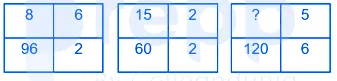
In the following question, select the number which can be placed at the sing of the questions mark (?) from the given alternatives.
- A
3
- B
4
- C
8
- D
14
Show answer
B. 4The method followed here is,
1 st number of the first row × 2nd number of first row × 2nd number of the second row = 1st number of the second row.
→ 8 × 6 × 2 = 96
→ 15 × 2 × 2 = 60
Same method will be followed to find out the missing number:
→ ? × 5 × 6 = 120
→ ? = 120/30 → 4
Hence, missing number is 4.
Paper & answer key PDF ↗ Question 17archived
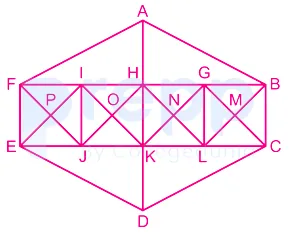
How many triangles are there in the given figure?

- A
38
- B
44
- C
46
- D
54
Show answer
B. 44Triangles in the given figures:
Large triangles: ABH, AFH, CDK, DEK, ABF, CDE
Triangles in BCEF = CGK, KIE, BLH, HFJ, LHJ, GKI
Small triangles in BCGL = BCM, CML, LGM, BGM, BCL, CLG, BGL, BCG
Small triangles in GHLK = GNH, GLN, KNL, KNH, GLK, HLK, KGH, HGL
Small triangles in HIJK = HIO, IOJ, JKO, HOK, HKJ, HIJ, KIH, HKJ
Small triangles in EFIJ = IJP, JPE, EFP, FPI, IJE, JEF, EFI, FIJ
Clearly, there are total 44 triangles in the given figure.
 Paper & answer key PDF ↗
 Question 18archived
In the following question below are given some statements followed by some conclusions. Taking the given statements to be true even if they seem to be at variance from commonly known facts, read all the conclusions and then decide which of the given conclusion logically follows the given statements.
Statements:
I. All dens are spiral.
II. Some spirals are cards.
Conclusions:
I. Some spirals are not cards.
I. Some dens are not cards.
III. Some cards are den.
- A
Only conclusion (I) and conclusion (II) follow.
- B
Only conclusion (III) follows.
- C
All conclusions follow.
- D
No conclusion follows.
Show answer
D. No conclusion follows.Statements: "All dens are spiral" puts dens entirely inside spirals; "Some spirals are cards" only guarantees a non-empty overlap between spirals and cards.
Conclusion I (Some spirals are not cards): not forced — the "some" statement allows all spirals to be cards.
Conclusion II (Some dens are not cards): not forced — dens may lie fully inside the spiral–card overlap.
Conclusion III (Some cards are dens): not forced — the spiral–card overlap may sit entirely outside the dens region.
Since every conclusion can be made false by a valid Venn arrangement, no conclusion follows.
Paper & answer key PDF ↗ Question 19archived
Three positions of a cube are shown below. What will come opposite to face containing ‘B’?

- A
C
- B
D
- C
F
- D
G
Show answer
D. GOn observing all the dices, we find that,
Face ‘D, C, E and F’ are adjacent to face ‘B’, so only face left which will be opposite to face ‘B’ is ‘G’.
Hence, face ‘B’ is opposite to ‘G’.
Paper & answer key PDF ↗ Question 20archived
Identify the diagram that best represents the relationship among the given classes.
Professionals, Chartered Accountant, Female
- A
Option A (shown in image)
- B
Option B (shown in image)
- C
Option C (shown in image)
- D
Option D (shown in image)
Show answer
B. Option B (shown in image)Hence, Option 2 is correct answer
 Paper & answer key PDF ↗
 Question 21archived
Which answer figure will complete the pattern in the question figure?

- A
Option A (shown in image)
- B
Option B (shown in image)
- C
Option C (shown in image)
- D
Option D (shown in image)
Show answer
A. Option A (shown in image)Clearly, option 1 will complete the incomplete figure.
 Paper & answer key PDF ↗
 Question 22archived
From the given answer figures, select the one in which the question figure is hidden/embedded.

- A
Option A (shown in image)
- B
Option B (shown in image)
- C
Option C (shown in image)
- D
Option D (shown in image)
Show answer
B. Option B (shown in image)Clearly, the given question figure is hidden in the option 2.
 Paper & answer key PDF ↗
 Question 23archived
A piece of paper is folded and punched as shown below in the question figures. From the given answer figures, indicate how it will appear when opened? /A piece of paper is folded and cut as shown below in the question figures. From the given answer figures, indicate how it will appear when opened?

- A
Option A (shown in image)
- B
Option B (shown in image)
- C
Option C (shown in image)
- D
Option D (shown in image)
Show answer
C. Option C (shown in image)Clearly, answer will be option 3.
 Paper & answer key PDF ↗
 Question 24archived
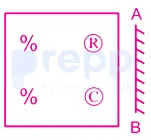
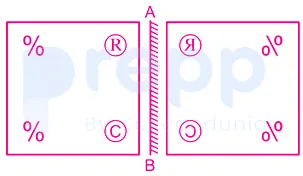
If the mirror is placed on the line AB, then which of the answer figure is the right image of the given figure?
- A
Option A (shown in image)
- B
Option B (shown in image)
- C
Option C (shown in image)
- D
Option D (shown in image)
Show answer
A. Option A (shown in image)Hence, mirror image of the given figure will be option 1.
 Paper & answer key PDF ↗
 Question 25archived
A word is represented by only one set of numbers as gives in any one of the alternatives. The sets of numbers given in the alternatives are represented by two classes of alphabets as shown in the given two matrices. The columns and rows of Matrix - I are numbered from 0 to 4 and that of Matrix - II are numbered from 5 to 9. A letter from these matrices can be represented first by its row and next by its column, for example ‘R’ can be represented by 23, 31 etc. and ‘O’ be represented by 75, 98 etc. Similarly, you have to identify the set for the word ‘TRAY’.
Matrix - IMatrix - II
0123456789
0TZYBR5AOUEI
1YBRTZ6UEIAO
2ZTBRY7OAEIU
3BRZYT8EIOUA
4RYTZB9IUAOE
- A
00, 04, 68, 02
- B
21, 41, 97, 41
- C
34, 12, 55, 11
- D
42, 23, 89, 23
Show answer
A. 00, 04, 68, 02T, R, Y are in Matrix-I; A is in Matrix-II.
Valid codes — T: 00, 13, 21, 34, 42; R: 04, 12, 23, 31, 40; A: 55, 68, 76, 89, 97; Y: 02, 10, 24, 33, 41.
Check each option for the sequence T, R, A, Y:
Option 1 (00, 04, 68, 02) — T=00, R=04, A=68, Y=02 — all valid. Options 2–4 each fail at least one letter (e.g., 41 codes Y not R; 11 codes B not Y; 23 codes R not Y).
Hence the code for TRAY is 00, 04, 68, 02.
Paper & answer key PDF ↗ Question 26archived
Which among the following is not an instrument of fiscal policy?
- A
Taxation
- B
Public expenditure
- C
Public debt
- D
Credit Rationing
Show answer
D. Credit RationingFiscal-policy instruments are tools wielded by the government through its budget: taxation (revenue), public expenditure (spending) and public debt (borrowing). They influence aggregate demand and the fiscal balance.
Credit rationing — restricting the quantity of credit banks can extend — is a monetary-policy instrument used by the central bank (RBI), not by the government's budget. Hence it is not an instrument of fiscal policy.
Paper & answer key PDF ↗ Question 27archived
Which of the following equation is/are INCORRECT?
I. NI = NDP + Net Foreign Income
II. GNP = GDP + Net Foreign Income
III. NDP = GNP – Depreciation
- A
Only (I) and (II)
- B
Only (III)
- C
Only (II) and (III)
- D
Only (II)
Show answer
B. Only (III)Standard national-income identities:
\(\text{GNP}=\text{GDP}+\text{NFIA}\) — Statement II is correct. \(\text{NNP}=\text{NDP}+\text{NFIA}\), so taking NI as NNP, Statement I is correct.
Statement III claims \(\text{NDP}=\text{GNP}-\text{Depreciation}\). The correct identity is \(\text{NNP}=\text{GNP}-\text{Depreciation}\); for NDP we need \(\text{NDP}=\text{GDP}-\text{Depreciation}=\text{GNP}-\text{Depreciation}-\text{NFIA}\). So Statement III is incorrect.
Only (III) is incorrect.
Paper & answer key PDF ↗ Question 28archived
Comptroller and Auditor General of India is appointed for how many years?
- A
2
- B
4
- C
6/65 years
- D
5
Show answer
C. 6/65 yearsThe Comptroller and Auditor General of India (CAG) holds office for a term of 6 years or until attaining the age of 65 years, whichever is earlier. Among the given options, this dual criterion is captured by 6/65 years.
The CAG is appointed by the President under Article 148 of the Constitution and can be removed only in the manner prescribed for a Supreme Court judge, ensuring independence of the office.
Paper & answer key PDF ↗ Question 29archived
The Contingency Fund of India is placed at whose disposal?
- A
The Prime Minister
- B
Judge of Supreme Court
- C
The President
- D
The Finance Minister
Show answer
C. The PresidentUnder Article 267(1) of the Constitution, the Contingency Fund of India is placed at the disposal of the President. It is an imprest fund used to meet urgent, unforeseen expenditure pending parliamentary authorisation, after which the amount is recouped from the Consolidated Fund.
The Prime Minister and Finance Minister administer government finances but do not hold the fund; the judiciary has no role in its operation.
Paper & answer key PDF ↗ Question 30archived
Who was the first female emperor of India?
- A
Noor Jahan
- B
Razia Sultana
- C
Rani Rudrama Devi
- D
Queen Didda
Show answer
B. Razia SultanaRazia Sultana (reign 1236-1240 CE), daughter of Iltutmish, ruled the Delhi Sultanate and is regarded as the first female Muslim sovereign to rule a major Indian empire.
Noor Jahan exercised influence behind Jahangir but never reigned in her own name. Rani Rudrama Devi (Kakatiya) and Queen Didda (Kashmir) ruled regional kingdoms and either followed Razia or predated her without imperial scale.
Paper & answer key PDF ↗ Question 31archived
Who was the first Governor General of India?
- A
Lord William Bentick
- B
Lord Dalhousie
- C
Lord Cornwallis
- D
None of these
Show answer
A. Lord William BentickUnder the Charter Act of 1833, the Governor General of Bengal was redesignated as the Governor General of India. Lord William Bentinck, who was then serving as Governor General of Bengal (1828-1835), became the first to hold this new title.
Warren Hastings was first Governor General of Bengal (1773); Cornwallis preceded Bentinck in Bengal; Dalhousie came later (1848-1856).
Paper & answer key PDF ↗ Question 32archived
Which of the following planet is also known as 'Earth's twin'?
- A
Mercury
- B
Venus
- C
Jupiter
- D
Saturn
Show answer
B. VenusVenus is called Earth's twin because of its close similarity in size, mass and bulk density. Its diameter is about 12,104 km versus Earth's 12,756 km, and its mass is roughly 81.5% of Earth's.
Mercury is much smaller, while Jupiter and Saturn are gas giants vastly larger and less dense than Earth, so none of them qualify as Earth's twin.
Paper & answer key PDF ↗ Question 33archived
Which of the following imaginary lines join places with same level of rainfalls?
- A
Contour lines
- B
Isobaths lines
- C
Isohyets lines
- D
Isobar lines
Show answer
C. Isohyets linesIsohyets are imaginary lines on a map joining places that receive the same amount of rainfall over a given period.
Contour lines join points of equal elevation, isobaths join points of equal water depth, and isobars join points of equal atmospheric pressure - none of which represent rainfall.
Paper & answer key PDF ↗ Question 34archived
What is study of fungus known as?
- A
Physiology
- B
Phrenology
- C
Mycology
- D
Biology
Show answer
C. MycologyThe scientific study of fungi is called Mycology, which examines their structure, classification, reproduction and ecological roles.
Physiology deals with functions of organisms in general, phrenology is a discarded study of skull shapes, and biology is the broad study of all living things - none specifically denotes the study of fungi.
Paper & answer key PDF ↗ Question 35archived
Which of the following bacteria is responsible for the formation of curd?
- A
Lycopodium
- B
Yeast
- C
Lacto - bacillus
- D
Fungus
Show answer
C. Lacto - bacillusCurd is produced when Lactobacillus bacteria ferment lactose in milk into lactic acid. The acid lowers the pH, causing milk protein (casein) to coagulate and thicken into curd.
Lycopodium is a clubmoss (a plant), yeast and fungus are fungal organisms used in bread and brewing - none of these are responsible for normal curd formation.
Paper & answer key PDF ↗ Question 36archived
How many pairs of ribs are there in human body?
- A
13
- B
11
- C
12
- D
14
Show answer
C. 12The human rib cage contains 12 pairs of ribs (24 in total), articulating posteriorly with the 12 thoracic vertebrae.
These are classified as 7 pairs of true ribs (attached directly to the sternum), 3 pairs of false ribs (attached indirectly via the 7th costal cartilage), and 2 pairs of floating ribs (no anterior attachment). Total = 7 + 3 + 2 = 12 pairs.
Paper & answer key PDF ↗ Question 37archived
When a ball is thrown vertically upwards, which of the following quantities remains constant during its motion?
- A
Energy
- B
Displacement
- C
Velocity
- D
Kinetic Ennergy
Show answer
A. EnergyIgnoring air resistance, only gravity acts on the ball, so the total mechanical energy (kinetic + potential) is conserved throughout the motion.
\[E = \tfrac{1}{2}mv^{2} + mgh = \text{constant}\]
As the ball rises, KE converts into PE; on the way down, PE converts back into KE. Displacement, velocity and kinetic energy each change continuously, so only the total energy stays constant.
Paper & answer key PDF ↗ Question 38archived
What is the SI unit of heat energy?
- A
Joule
- B
Newton
- C
Calorie
- D
Kelvin
Show answer
A. JouleHeat is a form of energy, and the SI unit of energy - including heat energy - is the Joule (J), defined as the work done when a force of one newton moves an object through one metre.
Newton measures force, calorie is a non-SI unit of energy (1 cal ≈ 4.184 J), and kelvin is the SI unit of temperature, not energy.
Paper & answer key PDF ↗ Question 39archived
Which system is used by the Digital Computers to encode data and Programs?
- A
Decimal
- B
Binary
- C
Hexa decimal
- D
Octal
Show answer
B. BinaryDigital computers use the binary system (base 2) with only two digits, 0 and 1, to encode data and instructions. This matches the two stable states of electronic switching elements - off/on or low/high voltage - making representation and processing reliable.
Decimal, octal and hexadecimal are convenient for humans to read, but internally every value and instruction is stored as binary bits.
Paper & answer key PDF ↗ Question 40archived
What is the common name of Sodium Bicarborate?
- A
Baking Soda
- B
Washing Powder
- C
Plaster of Paris
- D
Fly Ash
Show answer
A. Baking SodaSodium bicarbonate, \(\text{NaHCO}_{3}\), is commonly known as baking soda. It releases \(\text{CO}_{2}\) on reacting with acids, which makes batter rise during baking.
Washing powder is based on sodium carbonate \(\text{Na}_{2}\text{CO}_{3}\), plaster of Paris is \(\text{CaSO}_{4}\cdot\tfrac{1}{2}\text{H}_{2}\text{O}\), and fly ash is a coal-combustion residue - none of these is sodium bicarbonate.
Paper & answer key PDF ↗ Question 41archived
Which of the following is an ore of iron?
- A
Dolomite
- B
Epsom Salt
- C
Siderite
- D
Galena
Show answer
C. SideriteSiderite, iron(II) carbonate \(\text{FeCO}_{3}\), is a recognised ore of iron.
Dolomite \(\text{CaMg(CO}_{3})_{2}\) yields magnesium and calcium, Epsom salt \(\text{MgSO}_{4}\cdot 7\text{H}_{2}\text{O}\) is a magnesium compound, and galena \(\text{PbS}\) is the chief ore of lead - so none of these is an iron ore.
Paper & answer key PDF ↗ Question 42archived
Which of the following has maximum bio - diversity?
- A
Desert
- B
River
- C
Polar Region
- D
Tropical Region
Show answer
D. Tropical RegionTropical regions have the maximum biodiversity. Warm temperatures, abundant rainfall and high solar energy throughout the year support very high primary productivity, complex food webs and extensive niche specialisation - tropical rainforests and coral reefs are the richest ecosystems on Earth.
Deserts and polar regions impose harsh climatic limits that restrict species numbers, while a single river offers a comparatively narrow habitat.
Paper & answer key PDF ↗ Question 43archived
Albert Sabin is known for developing ________.
- A
Smallpox vaccine
- B
Polio vaccine
- C
Penicillin
- D
Hepatitis B vaccine
Show answer
B. Polio vaccineAlbert Sabin (1906-1993), a Polish-American medical researcher, developed the oral polio vaccine (OPV) in the late 1950s. Administered on a sugar cube, it was easier to deliver in mass campaigns than Jonas Salk's earlier injectable vaccine and induced strong intestinal immunity.
Edward Jenner developed the smallpox vaccine, Alexander Fleming discovered penicillin, and Baruch Blumberg is credited with the Hepatitis B vaccine. Hence the answer is Polio vaccine.
Paper & answer key PDF ↗ Question 44archived
Who will be implementing the Varishtha Pension Bima Yojana scheme during financial year 2017 - 18?
- A
National Insurance Company Limited
- B
New India Assurance Company Limited
- C
Life Insurance Corporation of India
- D
SBI Life Insurance Company Limited
Show answer
C. Life Insurance Corporation of IndiaThe Varishtha Pension Bima Yojana (VPBY) is a government-backed pension scheme for senior citizens (60+) offering an assured return. For FY 2017-18, the Union Budget designated the Life Insurance Corporation of India (LIC) as the sole implementing agency, continuing its role from earlier VPBY editions.
National Insurance and New India Assurance are general (non-life) insurers, and SBI Life is a private joint-venture insurer — government social-pension schemes are routed through state-owned LIC.
Paper & answer key PDF ↗ Question 45archived
Match the following:
Term
Associated Sport
1. No Ball
a. Hockey
2. Goal
b. Cricket
3. Knockout
c. Boxing
- A
1 - b, 2 - a, 3 - c
- B
1 - c, 2 - a, 3 - b
- C
1 - b, 2 - c, 3 - a
- D
1 - c, 2 - b, 3 - a
Show answer
A. 1 - b, 2 - a, 3 - cNo Ball is an illegal delivery in Cricket (bowler overstepping or breaching the rules) — so 1-b.
Goal is the scoring unit in Hockey (ball crossing the goal line) — so 2-a.
Knockout is the decisive finish in Boxing when a fighter cannot rise within the count — so 3-c.
The correct sequence is 1-b, 2-a, 3-c.
Paper & answer key PDF ↗ Question 46archived
Who amongst the following is a renowned Indian classical dancer?
- A
Palghat Mani Iyer
- B
Madhumati
- C
Sonal Mansingh
- D
Siddheshwari Devi
Show answer
C. Sonal MansinghSonal Mansingh is an internationally acclaimed Indian classical dancer, renowned for her mastery of Odissi and Bharatanatyam; she received the Padma Vibhushan in 2003.
Palghat Mani Iyer was a Carnatic mridangam maestro, Madhumati was a playback singer/actress, and Siddheshwari Devi was a Hindustani vocalist ('Nightingale of Banaras') — none were classical dancers.
Paper & answer key PDF ↗ Question 47archived
Who among the following did not receive the 2016 Arjuna award in the field of 'wrestling'?
- A
Virender Singh
- B
Vinesh Phogat
- C
Amit Kumar
- D
Rajat Chauhan
Show answer
D. Rajat ChauhanAmong the 2016 Arjuna Award recipients, Vinesh Phogat and Amit Kumar Dahiya were honoured for Wrestling, and Virender Singh 'Goonga Pehelwan' for wrestling under the Para-sports category. Rajat Chauhan received the 2016 Arjuna Award for Archery (compound event), not wrestling.
Hence Rajat Chauhan is the odd one out.
Paper & answer key PDF ↗ Question 48archived
Who has written the book 'The Ministry of Utmost Happiness?
- A
Chaitanya Padukone
- B
Amitav Ghosh
- C
Pramod Kapoor
- D
Arundhati Roy
Show answer
D. Arundhati Roy'The Ministry of Utmost Happiness' (2017) was written by Arundhati Roy, her second novel, published twenty years after her Booker-winning debut 'The God of Small Things' (1997).
Amitav Ghosh authored 'The Shadow Lines' and the Ibis trilogy; Pramod Kapoor wrote 'Gandhi: An Illustrated Biography'; Chaitanya Padukone is a Bollywood biographer — none of them wrote this novel.
Paper & answer key PDF ↗ Question 49archived
Which country became seventh member of South Asia Sub regional Economic Cooperation (SASEC) on 31 March 2017?
- A
Myanmar
- B
Bhutan
- C
Nepal
- D
Maldives
Show answer
A. MyanmarThe South Asia Subregional Economic Cooperation (SASEC) programme, launched in 2001 with ADB support, originally comprised Bangladesh, Bhutan, India, Maldives and Nepal; Sri Lanka joined in 2014 as the sixth member. On 31 March 2017, Myanmar became the seventh member, strengthening connectivity between South Asia and Southeast Asia.
Paper & answer key PDF ↗ Question 50archived
How many Indian states share their boundaries with Nepal?
- A
3
- B
4
- C
8
- D
5
Show answer
D. 5India shares a roughly 1,751 km open border with Nepal. Five Indian states touch this boundary: Uttarakhand, Uttar Pradesh, Bihar, West Bengal and Sikkim.
Hence the answer is 5. (Note: this is the official count used in SSC GA; Sikkim shares a short north-western stretch with Nepal.)
Paper & answer key PDF ↗ Question 51archived
Which of the following can't be the unit's digit of a perfect square?
- A
4
- B
6
- C
8
- D
9
Show answer
C. 8The units digit of \(n^2\) depends only on the units digit of \(n\). Squaring 0-9 gives units digits \(\{0,1,4,9,6,5,6,9,4,1\}\), so a perfect square can end only in 0, 1, 4, 5, 6 or 9.
Digits 2, 3, 7 and 8 never appear. Among the given options, 8 is the impossible units digit.
Paper & answer key PDF ↗ Question 52archived
Amar can complete a work in 30 days and Raman can complete the same work in 15 days. If both of them work together, then in 4 days what percent of the total work will be completed?
- A
15
- B
37
- C
40
- D
45
Show answer
C. 40Step 1 — Combined one-day work:
\[\frac{1}{30}+\frac{1}{15}=\frac{1+2}{30}=\frac{3}{30}=\frac{1}{10}\]
Step 2 — Work in 4 days:
\[\frac{1}{10}\times 4=\frac{4}{10}=\frac{2}{5}\]
As a percentage: \(\tfrac{2}{5}\times 100=40\%\). Therefore 40% of the work is completed.
Paper & answer key PDF ↗ Question 53archived
The lengths of two parallel sides of a trapezium are 21 cm and 9 cm. If its height is 10 cm, then what is the area (in cm 2) of the trapezium?
- A
35
- B
75
- C
225
- D
150
Show answer
D. 150Area of a trapezium \(=\tfrac{1}{2}(a+b)h\) where \(a,b\) are the parallel sides and \(h\) the perpendicular height.
\[A=\tfrac{1}{2}(21+9)\times 10=\tfrac{1}{2}\times 30\times 10=150\]
Therefore the area is 150 cm².
Paper & answer key PDF ↗ Question 54archived
What will be the net discount percentage of three successive discounts of 20%, 10% and 30%?
- A
45.2
- B
49.6
- C
54.6
- D
50.4
Show answer
B. 49.6Step 1 — Remaining-price multipliers: A discount of d% leaves (100-d)% of the price, so after 20%, 10%, 30% the fraction remaining is
\[0.80\times 0.90\times 0.70=0.504\]
Step 2 — Net discount:
\[100\%-50.4\%=49.6\%\]
Therefore the net discount is 49.6%.
Paper & answer key PDF ↗ Question 55archived
Three bottles of equal capacity have mixture of milk and water in ratio 5 : 7, 7 : 9 and 2 : 1 respectively. These three bottles are emptied into a large bottle. What is the percentage of milk in the new mixture?
- A
49.6
- B
52.3
- C
51.2
- D
50.7
Show answer
D. 50.7Step 1 — Choose a common capacity: LCM of (5+7), (7+9), (2+1) = LCM(12,16,3) = 48 units per bottle.
Step 2 — Milk in each bottle:
\[\tfrac{5}{12}\times 48=20,\quad \tfrac{7}{16}\times 48=21,\quad \tfrac{2}{3}\times 48=32\]
Step 3 — Percentage of milk:
\[\frac{20+21+32}{48\times 3}\times 100=\frac{73}{144}\times 100\approx 50.7\%\]
Therefore the new mixture is 50.7% milk.
Paper & answer key PDF ↗ Question 56archived
Seven friends spent Rs 14 each on a project and the eighth friend spent Rs 21 more than the average expenditure of all eight of them. What is the amount of total money (in Rs) spent by them?
- A
133
- B
136
- C
141
- D
155
Show answer
B. 136Step 1 — Set up: Let total spending be \(T\); average \(A=T/8\). Seven friends spent \(7\times 14=98\); the eighth spent \(A+21\).
Step 2 — Equation:
\[T=98+\tfrac{T}{8}+21\;\Rightarrow\;\tfrac{7T}{8}=119\;\Rightarrow\;T=136\]
Check: A = 17, eighth spent 38, total = 98 + 38 = Rs 136.
Paper & answer key PDF ↗ Question 57archived
A person sold his pen for Rs 24 and his profit percentage was numerically equal to the cost price. What was the cost price (in Rs) of the pen?
- A
12
- B
14
- C
16
- D
20
Show answer
D. 20Step 1 — Set up: Let CP = \(x\). Profit percentage = \(x\) (numerically), and profit = SP − CP = \(24-x\).
\[x=\frac{24-x}{x}\times 100\;\Rightarrow\;x^{2}+100x-2400=0\]
Step 2 — Solve:
\[x=\frac{-100\pm\sqrt{10000+9600}}{2}=\frac{-100\pm 140}{2}\]
Taking the positive root, \(x=20\). Check: 20% of 20 = 4, SP = 20 + 4 = 24. Therefore CP = Rs 20.
Paper & answer key PDF ↗ Question 58archived
A, B and C are three students. A got 36% less marks than B and 16% more marks than C. If B got 145 marks, then what are the marks got by C?
- A
120
- B
110
- C
80
- D
75
Show answer
C. 80Step 1 — Find A's marks: A scored 36% less than B, so A = 64% of 145.
\[A = 0.64 \times 145 = 92.8\]
Step 2 — Relate A to C: A is 16% more than C, so \(A = 1.16 \, C\).
\[C = \frac{92.8}{1.16} = 80\]
Therefore C's marks are 80.
Paper & answer key PDF ↗ Question 59archived
After repairing a scooter runs at a speed of 54 km/h and before repairing runs at speed of 48 km/h. It covers a certain distance in 6 hours after repairing. How much time will it take to cover the same distance before repairing?
- A
6 hours 15 minutes
- B
6 hours 45 minutes
- C
7 hours
- D
7 hours 30 minutes
Show answer
B. 6 hours 45 minutesThe distance is the same in both scenarios. Compute it from the post-repair leg, then divide by the pre-repair speed.
Step 1 — Distance:
\[D = 54 \times 6 = 324 \text{ km}\]
Step 2 — Time before repairing:
\[T = \frac{324}{48} = 6.75 \text{ hours} = 6 \text{ h } 45 \text{ min}\]
Therefore the answer is 6 hours 45 minutes.
Paper & answer key PDF ↗ Question 60archived
If a certain sum of money become thrice of itself in 5 years 4 months at simple interest, then what will be the yearly rate of interest (in %)?
- A
18.75
- B
27.5
- C
37.5
- D
42.25
Show answer
C. 37.5Step 1 — Interest and time: Amount = 3P, so SI = 3P − P = 2P. Time = 5 yr 4 mo = \(5 + \tfrac{4}{12} = \tfrac{16}{3}\) years.
Step 2 — Apply SI formula:
\[SI = \frac{P \cdot R \cdot T}{100} \implies 2P = \frac{P \cdot R \cdot \tfrac{16}{3}}{100}\]
\[R = \frac{2 \times 100 \times 3}{16} = \frac{600}{16} = 37.5\%\]
Therefore the yearly rate is 37.5%.
Paper & answer key PDF ↗ Question 61archived
If a + b + c = 11 and ab + bc + ca = 17, then what is the value of a 3+ b 3+ c 3– 3abc?
- A
121
- B
168
- C
300
- D
770
Show answer
D. 770Use the identity \(a^3+b^3+c^3-3abc=(a+b+c)\left[(a+b+c)^2-3(ab+bc+ca)\right]\).
Step 1 — Compute the bracket:
\[(a+b+c)^2 - 3(ab+bc+ca) = 11^2 - 3(17) = 121 - 51 = 70\]
Step 2 — Multiply:
\[a^3+b^3+c^3-3abc = 11 \times 70 = 770\]
Therefore the value is 770.
Paper & answer key PDF ↗ Question 62archived
If \({x^4} + \frac{1}{{{x^4}}} = 62\) , then what is the value of \({x^6} + \frac{1}{{{x^6}}}\) ?
- A
144
- B
288
- C
396
- D
488
Show answer
D. 488Step 1 — Find \(x^2+\tfrac{1}{x^2}\): Since \(\left(x^2+\tfrac{1}{x^2}\right)^2 = x^4+\tfrac{1}{x^4}+2\):
\[\left(x^2+\tfrac{1}{x^2}\right)^2 = 62 + 2 = 64 \implies x^2+\tfrac{1}{x^2} = 8\]
Step 2 — Apply \(a^3+b^3 = (a+b)^3 - 3ab(a+b)\) with \(ab=1\):
\[x^6+\tfrac{1}{x^6} = 8^3 - 3(8) = 512 - 24 = 488\]
Therefore the value is 488.
Paper & answer key PDF ↗ Question 63archived
If x + y = 4, then what is the value of \(\frac{2}{{x - 2}} + \frac{2}{{y - 2}}?\) (x, y ≥ 0)
- A
-1
- B
0
- C
4
- D
16
Show answer
B. 0From \(x+y=4\) we get \(y=4-x\), so \(y-2 = 2-x = -(x-2)\).
\[\frac{2}{x-2}+\frac{2}{y-2} = \frac{2}{x-2} + \frac{2}{-(x-2)} = \frac{2}{x-2} - \frac{2}{x-2} = 0\]
The two terms cancel, so the value is 0.
Paper & answer key PDF ↗ Question 64archived
If (x/5) + (5/x) = – 2, then what is the value of x 3?
- A
-125
- B
5
- C
1/125
- D
625
Show answer
A. -125Step 1 — Clear fractions: Multiply \(\tfrac{x}{5}+\tfrac{5}{x}=-2\) by \(5x\):
\[x^2 + 25 = -10x \implies x^2 + 10x + 25 = 0\]
Step 2 — Factor the perfect square:
\[(x+5)^2 = 0 \implies x = -5\]
Therefore \(x^3 = (-5)^3 = \mathbf{-125}\).
Paper & answer key PDF ↗ Question 65archived
In ΔPQR, ∠QPR = 45° and the bisectors of ∠PQR and ∠PRQ meets at O. What is the value (in degrees) of ∠QOR?
- A
107.5
- B
112.5
- C
117.5
- D
122.5
Show answer
B. 112.5O is the incenter of \(\triangle PQR\) (intersection of the bisectors of \(\angle Q\) and \(\angle R\)). The standard incenter result is:
\[\angle QOR = 90^\circ + \tfrac{1}{2}\angle P\]
With \(\angle P = 45^\circ\):
\[\angle QOR = 90^\circ + \tfrac{45^\circ}{2} = 90^\circ + 22.5^\circ = 112.5^\circ\]
Therefore 112.5°.
Paper & answer key PDF ↗ Question 66archived
In triangle ABC, ∠ABC = 90°. BP is drawn perpendicular to AC. If ∠BAP = 30°, then what is the value (in degrees) of ∠PBC?
- A
30
- B
36
- C
45
- D
60
Show answer
A. 30When the bisectors of \(\angle Q\) and \(\angle R\) meet at the incenter O, the standard result is:
\[\angle QOR = 90^\circ + \frac{\angle P}{2}\]
Substituting \(\angle P = 45^\circ\):
\[\angle QOR = 90^\circ + \frac{45^\circ}{2} = 90^\circ + 22.5^\circ = 112.5^\circ\]
Therefore \(\angle QOR = \mathbf{112.5^\circ}\).
Paper & answer key PDF ↗ Question 67archived
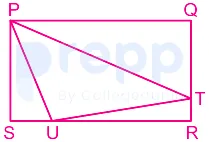
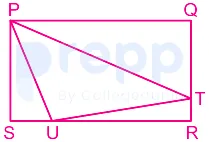
In the given figure, PQRS is a rectangle and PTU is a triangle. If PQ = 11cm, UR = 8cm, TR = 1cm and QT = 3cm, then what is the length (in cm) of the line joining the mid points of PT and TU?
- A
2.5
- B
3
- C
4.5
- D
5
Show answer
Question 68archived
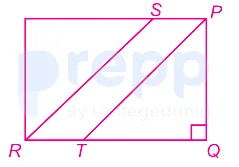
In the given figure, area of isosceles triangle PQT is 72 cm 2. If QT = PQ, PQ = 2 PS and PT।।SR, then what is the area (in cm 2) of the trapezium PQRS?
- A
144
- B
216
- C
256
- D
288
Show answer
A. 144Given that area of triangle PQT is 72
⇒ ½ PQ × QT = 72 Since PQ = QT
⇒ PQ = QT = 12cm
Given PS = PQ/2
⇒ PS = 12/2 = 6cm
Now height of trapezium is PQ = 12 cm and PS = 6 cm and QR = 12 + 6 = 18cm
Area of trapezium can be written as ½ × (sum of parallel sides) × height
⇒ Area = 1/2 × (18 + 6) × 12
⇒ Area = 144 cm 2
∴ the area of trapezium is 144 cm 2
Paper & answer key PDF ↗ Question 69archived
What is the simplified value of (cosec A + sin A) (cosec A – sin A)?
- A
cos2 A + cot2 A
- B
2 cos2 A
- C
2 cot2 A
- D
2 cos A cot A
Show answer
A. cos2 A + cot2 AUse the difference of squares: \((\text{cosec }A+\sin A)(\text{cosec }A-\sin A) = \text{cosec}^2 A - \sin^2 A\).
Apply the Pythagorean identities \(\text{cosec}^2 A = 1+\cot^2 A\) and \(\sin^2 A = 1-\cos^2 A\):
\[(1+\cot^2 A) - (1-\cos^2 A) = \cos^2 A + \cot^2 A\]
Therefore the simplified value is \(\cos^2 A + \cot^2 A\).
Paper & answer key PDF ↗ Question 70archived
What is the simplified value of \(\sqrt {\frac{{\sec A}}{{\sec A - 1}} + \frac{{\sec A}}{{\sec A + 1}}?} \)
- A
cosec A
- B
√2 cosec A
- C
2 sec2A
- D
sec A
Show answer
B. √2 cosec AStep 1 — Combine the fractions: Common denominator is \(\sec^2 A - 1 = \tan^2 A\).
\[\frac{\sec A(\sec A+1) + \sec A(\sec A-1)}{\sec^2 A - 1} = \frac{2\sec^2 A}{\tan^2 A}\]
Step 2 — Convert to sine/cosine:
\[\frac{2/\cos^2 A}{\sin^2 A/\cos^2 A} = \frac{2}{\sin^2 A}\]
Step 3 — Take the root:
\[\sqrt{\frac{2}{\sin^2 A}} = \frac{\sqrt{2}}{\sin A} = \sqrt{2}\,\text{cosec }A\]
Therefore the answer is \(\sqrt{2}\,\text{cosec }A\).
Paper & answer key PDF ↗ Question 71archived
What is the simplified value of \(\left[ {\frac{{\cos A}}{{(1 - \tan A)\;}} + {{\frac{{\sin A}}{{(1 - \cot A)\;}}}}} \right]^2?\)
- A
sin A + cos A
- B
1 + sin 2A
- C
1 + cos 2A
- D
tan A + cot A
Show answer
B. 1 + sin 2AStep 1 — Convert tan and cot to sin/cos:
\[\frac{\cos A}{1-\tan A} = \frac{\cos^2 A}{\cos A-\sin A}, \qquad \frac{\sin A}{1-\cot A} = \frac{\sin^2 A}{\sin A-\cos A}\]
Step 2 — Combine using \(\sin A-\cos A = -(\cos A-\sin A)\):
\[\frac{\cos^2 A - \sin^2 A}{\cos A-\sin A} = \frac{(\cos A-\sin A)(\cos A+\sin A)}{\cos A-\sin A} = \cos A + \sin A\]
Step 3 — Square:
\[(\cos A+\sin A)^2 = 1 + 2\sin A\cos A = 1 + \sin 2A\]
Therefore the value is \(1+\sin 2A\).
Paper & answer key PDF ↗ Question 72archived
What is average per acre yield (in million tonnes) of these 7 countries?
- A
163.14
- B
184.28
- C
146.78
- D
198.26
Show answer
B. 184.28Average can be written as = (300 + 250 + 162 + 272 + 82 + 104 + 120) /7
⇒ average = 184.28
∴ the average of 7 countries is 184.28
Paper & answer key PDF ↗ Question 73archived
What is the respective ratio of average per acre yield of the 3 countries having the highest yield to average per acre yield of the 3 countries having the least yield?
- A
148 : 65
- B
201 : 149
- C
89 : 69
- D
137 : 51
Show answer
D. 137 : 51Average of 3 highest yielding countries = (300 + 272 + 250) /3 = 822/3
⇒ Average of 3 highest yielding countries = 274
Average of 3 lowest yielding countries = (82 + 104 + 120) /3 = 306/3
⇒ Average of 3 lowest yielding countries = 102
∴ Ratio can be given as 274/102 = 137 : 51
Paper & answer key PDF ↗ Question 74archived
Total per acre yield of India and China is what percent of the total per acre yield of the remaining countries?
- A
44.34
- B
56.68
- C
83.24
- D
79.66
Show answer
D. 79.66Total of India and china is = 300 + 272 = 572
Total yield of other countries = 250 + 162 + 82 + 104 + 120 = 718
⇒ required percentage = 572 × 100/718 = 79.66%
∴ the required percentage is 79.66%
Paper & answer key PDF ↗ Question 75archived
All the countries are arranged in ascending order of per acre yield. If bottom 2 countries increases their per acre yield by 20% and all other countries increase their per acre yield by 10%, then what is the new average per acre yield (in million tonnes)?
- A
205.37
- B
210.82
- C
201.19
- D
199.26
Show answer
A. 205.37Bottom two countries will be the countries with minimum production i.e. Nepal and Thailand
total production of these 2 countries is 82 + 104 = 186
Production after 20% increase in these countries can be written as
⇒ after production = 186 × (1 + 20/100) = 186 × 1.2
⇒ after production = 223.2
Total production of remaining countries is 300 + 250 + 162 + 272 + 120 = 1104
Production after 10% increase in these countries can be written as
⇒ after production = 1104 × (1 + 10/100) = 1104 × 1.1
⇒ after production = 1214.4
Total production can be written as = 1214.4 + 223.2 = 1437.6
Average can be written = Total production/7
⇒ 1437.6/7 = 205.37
∴ the average is 205.37
Paper & answer key PDF ↗ Question 76archived
In the following question, some part of the sentence may have errors. Find out which part of the sentence has an error and select the appropriate option. If a sentence is free from error, select 'No Error'.
The reason Priya was late (1)/ to the meeting is because her (2)/ flight was delayed. (3)/ No Error (4)
- A
1
- B
2
- C
3
- D
4
Show answer
B. 2The construction "The reason... is because" is redundant: "reason" already conveys cause, and "because" repeats it. Standard usage requires "The reason... is that...".
The faulty phrase appears in segment (2) — "to the meeting is because her". Correct version: "The reason Priya was late to the meeting is that her flight was delayed." Hence the error lies in part 2.
Paper & answer key PDF ↗ Question 77archived
In the following question, some part of the sentence may have errors. Find out which part of the sentence has an error and select the appropriate option. If a sentence is free from error, select 'No Error'.
Not only did they offer him (1)/ good salary but provided (2)/ him with a beautiful bungalow. (3)/ No Error (4)
- A
1
- B
2
- C
3
- D
4
Show answer
B. 2The correlative conjunction "not only ... but also" requires parallel structure. Part (1) uses an inverted clause ("did they offer"), so part (2) should mirror it with "but also" plus a parallel verb form — e.g., "but also gave" or "but they also provided".
The sentence reads "but provided", omitting "also" and breaking parallelism. The error is in part 2.
Paper & answer key PDF ↗ Question 78archived
In the following question, the sentence given with blank to be filled in with an appropriate word. Select the correct alternative out of the four and indicate it by selecting the appropriate option.
His father _____ him up in a construction business.
- A
built
- B
hold
- C
keep
- D
set
Show answer
D. setThe phrasal verb "set someone up in business" is a fixed English idiom meaning to provide the means or capital for someone to start in a trade. "Built up" suggests gradual development, "hold up" means support/delay, and "keep up" means maintain — none fit the idiomatic slot.
Hence "His father set him up in a construction business" is correct.
Paper & answer key PDF ↗ Question 79archived
In the following question, the sentence given with blank to be filled in with an appropriate word. Select the correct alternative out of the four and indicate it by selecting the appropriate option.
I have _____ respect for his achievement.
- A
abundant
- B
profound
- C
strong
- D
unique
Show answer
B. profoundThe blank requires an adjective conveying deep, heartfelt admiration for an achievement. Profound means very great or intense, and collocates naturally with feelings such as respect, sadness, or gratitude.
"Abundant" describes quantity (resources, supplies), not the depth of a feeling. "Strong" is grammatically possible but weaker in nuance. "Unique" means one of a kind, which does not describe intensity. Hence the correct sentence reads: "I have profound respect for his achievement."
Paper & answer key PDF ↗ Question 80archived
In the following question, out of the four alternatives, select the word similar in meaning to the word given.
Boast
- A
Avoid
- B
Change
- C
Rely
- D
Pride
Show answer
D. PrideTo boast is to speak with excessive pride about one's achievements or possessions. Among the options, Pride is the closest in meaning, as boasting is the outward expression of pride.
"Avoid" (keep away), "Change" (alter), and "Rely" (depend on) are entirely unrelated to self-praise. Therefore Pride is the correct synonym.
Paper & answer key PDF ↗ Question 81archived
In the following question, out of the four alternatives, select the word similar in meaning to the word given.
Haste
- A
Burden
- B
Expect
- C
Hurry
- D
Sight
Show answer
C. HurryHaste means excessive speed or urgency of action. Hurry means to move or act with great speed, which is virtually identical in meaning.
"Burden" (heavy load), "Expect" (anticipate), and "Sight" (vision) bear no relation to speed. Hence Hurry is the correct synonym.
Paper & answer key PDF ↗ Question 82archived
In the following question, out of the four alternatives, select the word opposite in meaning to the word given.
Refulgent
- A
Dark
- B
Loud
- C
Rough
- D
Sweet
Show answer
A. DarkRefulgent means shining brightly, radiant, or gleaming. Its opposite must denote absence of light.
Dark (lacking light) is the direct antonym. "Loud" relates to sound, "Rough" to texture, and "Sweet" to taste — none oppose brightness. Hence the antonym is Dark.
Paper & answer key PDF ↗ Question 83archived
In the following question, out of the four alternatives, select the word opposite in meaning to the word given.
Skeptic
- A
Believer
- B
Erroneous
- C
Nervous
- D
Nihilist
Show answer
A. BelieverA skeptic is one who doubts or questions accepted opinions. Its opposite is someone who accepts and trusts — a Believer.
"Erroneous" means incorrect, "Nervous" means anxious, and a "Nihilist" rejects meaning entirely (closer to a skeptic than its opposite). Hence Believer is the correct antonym.
Paper & answer key PDF ↗ Question 84archived
In the following question, out of the four alternatives, select the alternative which best expresses the meaning of the idiom/phrase.
Herculean task
- A
Important task
- B
Motivating
- C
Optional to do
- D
Very difficult task
Show answer
D. Very difficult taskThe idiom Herculean task derives from the Twelve Labours of Hercules in Greek mythology — feats demanding extraordinary strength and effort. It therefore means a very difficult task.
"Important task" stresses significance, not difficulty; "Motivating" describes an effect on the doer; "Optional to do" contradicts the idiom's weight. Hence option 4 is correct.
Paper & answer key PDF ↗ Question 85archived
In the following question, out of the four alternatives, select the alternative which best expresses the meaning of the idiom/phrase.
On tenterhooks
- A
Flattery
- B
In a disorganized manner
- C
In anxious suspense
- D
Speak quickly
Show answer
C. In anxious suspenseThe idiom on tenterhooks originates from cloth being stretched taut on hooks of a tenter-frame. Figuratively, it describes someone stretched mentally — i.e. in anxious suspense while waiting for an outcome.
"Flattery", "in a disorganized manner", and "speak quickly" have no connection to suspense or anxiety. Hence option 3 is correct.
Paper & answer key PDF ↗ Question 86archived
Improve the bracketed part of the sentence.
Neha (would be looked) beautiful in Indian attire.
- A
had looking
- B
was looked
- C
would look
- D
No improvement
Show answer
C. would lookHere "look" functions as a linking verb meaning "to appear", and must be used in the active voice with an adjective complement ("beautiful"). The passive "would be looked" is ungrammatical for this sense.
The modal would takes the base form of the verb, giving would look. "Had looking" is not a valid construction, and "was looked" repeats the passive error. The correct sentence: "Neha would look beautiful in Indian attire."
Paper & answer key PDF ↗ Question 87archived
Improve the bracketed part of the sentence.
(People have been long known) how important the trees are to them.
- A
People have to know long
- B
People had long known
- C
People have long known
- D
No improvement
Show answer
C. People have long knownThe meaning intended is that people have known this fact for a long time and still do — the present perfect active tense. The original passive "have been long known" wrongly makes "people" the receivers of knowing.
"People have long known" places the adverb long correctly between the auxiliary and the past participle, and uses the active voice. "Had long known" (past perfect) needs a later past reference, and "have to know long" is ungrammatical. Hence option 3 is correct.
Paper & answer key PDF ↗ Question 88archived
In the following question, out of the four alternatives, select the alternative which is the best substitute of the phrase.
An associate in crime
- A
Accomplice
- B
Callous
- C
Itinerant
- D
Philistine
Show answer
A. AccompliceAn accomplice is a person who helps another commit a crime — the precise meaning of "an associate in crime".
"Callous" means insensitive, "Itinerant" means travelling from place to place, and "Philistine" means indifferent to culture — none relate to criminal partnership. Hence Accomplice is correct.
Paper & answer key PDF ↗ Question 89archived
In the following question, out of the four alternatives, select the alternative which is the best substitute of the phrase.
Man behaving more like a woman than as a man
- A
Biped
- B
Effeminate
- C
Gregarious
- D
Inalienable
Show answer
B. EffeminateEffeminate describes a man having or showing characteristics traditionally regarded as typical of a woman — exactly matching the given phrase.
"Biped" means a two-footed creature, "Gregarious" means sociable, and "Inalienable" means incapable of being taken away. None describe gendered behaviour. Hence Effeminate is correct.
Paper & answer key PDF ↗ Question 90archived
In the following question, four words are given out of which one word is incorrectly spelt. Select the incorrectly spelt word.
- A
Ecstasy
- B
Profecient
- C
Sacrifice
- D
Temporary
Show answer
B. ProfecientThe correct spelling is Proficient (meaning skilled or expert), spelt P-R-O-F-I-C-I-E-N-T. The given form "Profecient" wrongly uses an 'e' after "Prof" instead of 'i'.
"Ecstasy", "Sacrifice", and "Temporary" are all spelt correctly. Hence the misspelt word is option 2.
Paper & answer key PDF ↗ Question 91archived
In the following question, four words are given out of which one word is incorrectly spelt. Select the incorrectly spelt word.
- A
Familiar
- B
Grammer
- C
Narrator
- D
Operator
Show answer
B. GrammerThe correct spelling is Grammar (ending in -ar, not -er). "Grammer" is a common misspelling.
"Familiar", "Narrator", and "Operator" are all spelt correctly. Hence the misspelt word is option 2.
Paper & answer key PDF ↗ Question 92archived
The question below consists of a set of labelled sentences. Out of the four options given, select the most logical order of the sentences to form a coherent paragraph.
P- On the earth, liquid forms and solid forms (ice/snow) predominate.
Q- The water cycle has two distinct branches the atmospheric branch and the terrestrial branch.
R- Water plays a versatile role in the functioning of the biosphere.
S- In the atmospheric, water exists mainly in gaseous form.
- A
RSPQ
- B
RQSP
- C
RPSQ
- D
RQPS
Show answer
B. RQSPR is the topic sentence — a broad statement on water's versatile role in the biosphere. Q follows by introducing the water cycle's two branches (atmospheric and terrestrial), narrowing the focus.
The remaining two sentences detail those branches in the order Q named them: S describes the atmospheric branch (gaseous form), then P describes the terrestrial forms (liquid and solid). Hence the order is RQSP.
Paper & answer key PDF ↗ Question 93archived
The question below consists of a set of labelled sentences. Out of the four options given, select the most logical order of the sentences to form a coherent paragraph.
P- For however elusively, it still knew of harbours and anchors, of homes to which to return, and of barns in which to store the harvest.
Q- The works of the early Renaissance and the poetry of Shakespeare vibrate with the compassion for live experience in danger of dying from exposure and neglect.
R- Yes, it was a genius of courage, not of desperate audacity.
S- In this compassion was the creative genius of the age.
- A
SQRP
- B
PRSQ
- C
QSRP
- D
RSPQ
Show answer
C. QSRPQ opens by introducing the subject — Renaissance and Shakespearean works vibrating with compassion. S follows naturally: "In this compassion" refers back to Q and identifies it as the "creative genius of the age".
R then elaborates: "Yes, it was a genius of courage" — "it" refers to the genius just named in S. P closes by explaining what that courageous genius knew — harbours, homes, barns — imagery of preservation that ties back to Q's endangered life experience. Hence the order is QSRP.
Paper & answer key PDF ↗ Question 94archived
In the following question, a sentence has been given in Active/Passive voice. Out of the four alternatives suggested, select the one which best expresses the same sentence in Passive/Active voice.
Sunita has written a story which fascinates everyone.
- A
A story which has been written by Sunita fascinates every one.
- B
Everyone is fascinated by the story which has been written by Sunita.
- C
Every one fascinates the story which is written by Sunita.
- D
Story written by Sunita fascinates everyone.
Show answer
A. A story which has been written by Sunita fascinates every one.The active sentence has a main clause ("Sunita has written a story") and a relative clause ("which fascinates everyone"). In Option 1, the main clause is converted into a passive relative clause modifying "a story": "A story which has been written by Sunita" (Present Perfect passive of "has written"). The original relative clause's verb "fascinates" then becomes the main verb, retaining "everyone" as its object.
This yields "A story which has been written by Sunita fascinates every one" — a faithful passive transformation preserving tense and meaning. Option 2 reverses the focus; Option 3 inverts the subject–object relation; Option 4 omits the auxiliary, producing a reduced (and tense-shifted) form.
Paper & answer key PDF ↗ Question 95archived
In the following question, a sentence has been given in Direct/Indirect speech. Out of the four alternatives suggested, select the one which best expresses the same sentence in Indirect/Direct speech.
Rajesh ordered his driver to do as he was told.
- A
Rajesh ordered his driver “Do as you are told”.
- B
Rajesh says to his driver “Do as I told you”.
- C
Rajesh said to his driver, “Do as you are told.”
- D
Rajesh says to his driver “Do as you were told”.
Show answer
C. Rajesh said to his driver, “Do as you are told.”To convert an imperative from indirect to direct speech, replace the reporting verb "ordered" with "said to", insert a comma before the quoted command, and restore the imperative mood. The indirect clause "to do as he was told" becomes the direct command "Do as you are told" — the addressee ("he") shifts back to "you", and the back-shifted tense returns to its original present form.
Option 3, "Rajesh said to his driver, 'Do as you are told.'", applies all these rules correctly. Options 2 and 4 wrongly use the present tense "says"; Option 1 omits the comma and keeps "ordered" without the proper structure.
Paper & answer key PDF ↗ Question 96archived
Management is a set of _____ that can keep a complicated system
- A
instructions
- B
resources
- C
processes
- D
proposals
Show answer
C. processesThe sentence defines management as a structured set of activities that keep a complex system functioning. Processes — series of coordinated actions like planning, organising, staffing and controlling — precisely captures this definition.
"Instructions" are too narrow (a subset of management activity); "resources" are inputs that management uses, not what management itself consists of; "proposals" are suggestions, not ongoing operational activities. Hence the correct fill is processes.
Paper & answer key PDF ↗ Question 97archived
of people and technology running _____.
- A
fastly
- B
reliably
- C
smoothly
- D
sharply
Show answer
C. smoothlyThe blank describes how management keeps a complicated system of people and technology running. Smoothly means without friction, problems or interruptions — the standard collocation "running smoothly" fits exactly.
"Fastly" is not a standard English adverb. "Reliably" captures dependability but misses the efficiency/seamlessness nuance. "Sharply" (abruptly, intensely) does not describe steady system operation. Hence smoothly.
Paper & answer key PDF ↗ Question 98archived
The most _____ aspects of management include planning budgeting, organizing, staffing, controlling and problem solving.
- A
dangerous
- B
difficult
- C
important
- D
terrible
Show answer
C. importantPlanning, budgeting, organising, staffing, controlling and problem-solving are universally recognised as the core functions of management — they are vital, not dangerous, terrible, or merely difficult. Important correctly describes their significance to the functioning of any organisation.
"Dangerous" and "terrible" carry negative connotations that contradict the listed essential activities. "Difficult" describes execution, not value. Hence the correct fill is important.
Paper & answer key PDF ↗ Question 99archived
that creates organization in the first place or adapts, them to _____ changing circumstances.
- A
normally
- B
run
- C
show
- D
significantly
Show answer
D. significantlyThe blank modifies the adjective "changing", so it must be an adverb. "Run" and "show" are verbs and cannot fit grammatically. Between "normally" and "significantly", the context — leadership defining the future and inspiring people to overcome obstacles — points to substantial, not routine, change.
Significantly conveys the large-scale, impactful shifts that leadership is meant to address, fitting both grammar and meaning.
Paper & answer key PDF ↗ Question 100archived
Leadership defines what the future should look like, aligns people with that _____ and inspires them to make it happen despite the obstacles.
- A
look
- B
role
- C
source
- D
vision
Show answer
D. visionThe blank refers back to "what the future should look like" — the future image that leadership defines and people are aligned with. Vision means exactly that: a mental picture of a desired future state.
"Look" refers to appearance, "role" to a function, and "source" to an origin — none of these denote a defined future state. Hence vision completes the sentence correctly.
Paper & answer key PDF ↗ Browser storage is unavailable. You can still browse and practise; progress will last for this visit.