Question 1archived
Arrange the given words in the sequence in which they occur in the dictionary.
1. Decollete
2. Desecrate
3. Decorous
4. Desipicable
5. Destitute
- A
13245
- B
15243
- C
32451
- D
45231
Show answer
A. 13245All five words start with "De". Splitting by the third letter: "Dec" group — Decollete (1), Decorous (3); "Des" group — Desecrate (2), Despicable (4), Destitute (5). "Dec" precedes "Des".
Within "Dec", compare the 5th letter: Decollete (l) before Decorous (r), so order is 1, 3.
Within "Des", compare the 4th letter: Desecrate (e) < Despicable (p) < Destitute (t), giving 2, 4, 5.
Combined dictionary order: 1, 3, 2, 4, 5.
Paper & answer key PDF ↗ Question 2archived
In the following question, select the related number from the given alternatives.
ACOUSTIC : 91 : : RENOUNCE : ?
- A
95
- B
99
- C
105
- D
109
Show answer
A. 95The rule is the sum of the alphabetical positions of the letters.
Step 1 — Verify with ACOUSTIC:
\(1+3+15+21+19+20+9+3 = 91\)
Step 2 — Apply to RENOUNCE:
\(18+5+14+15+21+14+3+5 = 95\)
Therefore the answer is 95.
Paper & answer key PDF ↗ Question 3archived
In the following question, select the odd letters from the given alternatives.
- A
ACFJ
- B
RTWA
- C
NPSV
- D
HJMQ
Show answer
C. NPSVCheck the gaps between consecutive letter positions in each group.
ACFJ: 1, 3, 6, 10 — gaps +2, +3, +4.
RTWA: 18, 20, 23, 27(A) — gaps +2, +3, +4.
HJMQ: 8, 10, 13, 17 — gaps +2, +3, +4.
NPSV: 14, 16, 19, 22 — gaps +2, +3, +3.
Three groups follow +2, +3, +4 but NPSV breaks the pattern, so NPSV is the odd one out.
Paper & answer key PDF ↗ Question 4archived
In the following question, correct the given equation by interchanging two numbers.
8 × 3 ÷ 4 + 9 – 5 = 16
- A
3 and 4
- B
4 and 8
- C
5 and 3
- D
5 and 9
Show answer
C. 5 and 3Apply BODMAS after swapping each suggested pair and check whether the LHS equals 16.
Swap 5 and 3: \(8 \times 5 \div 4 + 9 - 3\)
\(= 40 \div 4 + 9 - 3 = 10 + 9 - 3 = 16\) ✓
The other swaps give 14.67, 5.5, and 2 respectively — none equal 16. Hence the correct interchange is 5 and 3.
Paper & answer key PDF ↗ Question 5archived
If (2)# * 4 = 2 and (4)# * 4 = 16, then what is the value of A in (6)# * A = 18?
- A
12
- B
14
- C
16
- D
20
Show answer
A. 12Step 1 — Identify the rule: Test \(x^3 \div y\).
For (2)#*4: \(2^3 \div 4 = 8 \div 4 = 2\) ✓
For (4)#*4: \(4^3 \div 4 = 64 \div 4 = 16\) ✓
Step 2 — Apply to (6)#*A = 18:
\(\dfrac{6^3}{A} = 18 \implies \dfrac{216}{A} = 18 \implies A = \dfrac{216}{18} = 12\)
Therefore A = 12.
Paper & answer key PDF ↗ Question 6archived
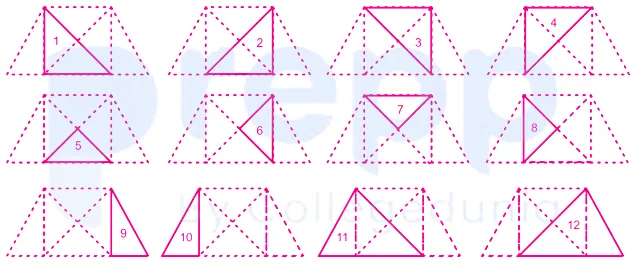
How many triangles are there in the figure?

- A
8
- B
10
- C
12
- D
14
Show answer
C. 12Hence, there are 12 triangles in the given question figure.
 Paper & answer key PDF ↗
 Question 7archived
the following question, select the missing number from the given series.
1357, 3085, 5282, 8026, ?
- A
9961
- B
10441
- C
11321
- D
11401
Show answer
D. 11401Step 1 — Compute consecutive differences:
\(3085-1357=1728=12^{3}\)
\(5282-3085=2197=13^{3}\)
\(8026-5282=2744=14^{3}\)
Step 2 — Apply the pattern: the differences are successive cubes, so the next difference is \(15^{3}=3375\).
Therefore the missing term is \(8026+3375=\mathbf{11401}\).
Paper & answer key PDF ↗ Question 8archived
In the following question, select the related word from the given alternatives.
Calendar : Date : : Index : ?
- A
Name of Author
- B
Glossary
- C
Content
- D
Summary
Show answer
C. ContentA calendar is the structured reference that lists dates; analogously, an index is the structured reference that lists the contents of a book. The relationship is reference-tool to the items it organises.
A glossary lists term meanings (not what an index points to), the author's name is metadata, and a summary is a condensed overview — none match the relationship. Hence the answer is Content.
Paper & answer key PDF ↗ Question 9archived
5 year hence, ratio of ages of A and B will be 7 : 5 and difference between their ages will be 4 years. What are present ages (in years) of A and B respectively?
- A
5, 9
- B
6, 5
- C
9, 5
- D
9, 6
Show answer
C. 9, 5Step 1 — Set up ages 5 years hence: let them be \(7x\) and \(5x\).
Step 2 — Use the constant age difference:
\[7x-5x=4 \implies x=2\]
Step 3 — Back-calculate present ages: ages in 5 years are \(14\) and \(10\), so present ages are \(14-5=9\) and \(10-5=5\).
Therefore A and B are 9 and 5 years respectively.
Paper & answer key PDF ↗ Question 10archived
In a certain code language, "RAIN" is written as "42", "OHBQ" is written as "42". How is "SUMMER" written in that code language?
- A
98
- B
88
- C
87
- D
89
Show answer
D. 89The code is the sum of the alphabetical position values of the letters.
Check: \(R+A+I+N=18+1+9+14=42\) and \(O+H+B+Q=15+8+2+17=42\).
For SUMMER: \(S+U+M+M+E+R=19+21+13+13+5+18=\mathbf{89}\).
Paper & answer key PDF ↗ Question 11archived
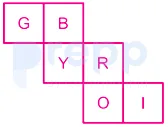
From the given options, which figure can be formed by folding the figure given in the question?
- A
Option A (shown in image)
- B
Option B (shown in image)
- C
Option C (shown in image)
- D
Option D (shown in image)
Show answer
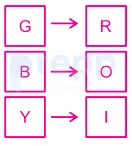
B. Option B (shown in image)1) It cannot be formed as ‘B’ is opposite to ‘O’.
2) It can be formed.
3) It cannot be formed as ‘Y’ is opposite to ‘I’.
4) It cannot be formed as ‘G’ is opposite to ‘R’.
Hence, dice (option) 2 can be formed.
 Paper & answer key PDF ↗
 Question 12archived
In the following question, which one set of letters when sequentially placed at the gaps in the given letter series shall complete it?
a _ bc _ a _ bcdabc _ da _ cd _
- A
acbddb
- B
adbcbd
- C
cabddc
- D
ddcbbc
Show answer
B. adbcbdThe series is built from the repeating block abcd. Filling the six blanks with a, d, b, c, b, d gives \(\underline{a\,a\,b\,c}\,\underline{d\,a\,b\,b}\,\underline{c\,d\,a\,b}\,\underline{c\,c\,d\,a}\,\underline{b\,c\,d\,d}\) — the four-letter block abcd cycles cleanly through every position, with each insertion completing the next rotation.
Hence the correct set is adbcbd.
Paper & answer key PDF ↗ Question 13archived
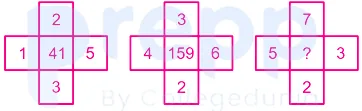
In the following question, select the number which can be placed at the sign of question mark (?) from the given alternatives.
- A
189
- B
227
- C
277
- D
339
Show answer
B. 227First image:
(1 × 2 × 5 × 3) + (1 + 2 + 5 + 3) → 30 + 11 → 41
Second image:
(4 × 3 × 6 × 2) + (4 + 3 + 6 + 2) → 144 + 15 → 159
Similarly,
Third image:
(5 × 7 × 3 × 2) + (5 + 7 + 3 + 2) → 210 + 17 → 227
Hence, the missing number in the diagram is ‘227’.
Paper & answer key PDF ↗ Question 14archived
In the following question below are given some statements followed by some conclusions. Taking the given statements to be true even if they seem to be at variance from commonly known facts, read all the conclusions and then decide which of the given conclusion logically follows the given statements.
Statements :
I. All rackets are bats.
II. All bats are wickets.
Conclusions:
I. Some wickets are rackets.
II. All wickets are rackets.
- A
Only conclusion (I) follows.
- B
Only conclusion (II) follows.
- C
Neither conclusion (I) nor conclusion (II) follows.
- D
Both conclusions follow.
Show answer
A. Only conclusion (I) follows.Statements: All rackets ⊂ bats ⊂ wickets. So all rackets are wickets, which means at least some wickets are rackets — Conclusion I follows.
Conclusion II ("All wickets are rackets") would require wickets ⊂ rackets, but the statements only guarantee inclusion in the opposite direction; wickets may include bats and other items that are not rackets, so II does not follow.
Therefore only Conclusion I follows.
Paper & answer key PDF ↗ Question 15archived
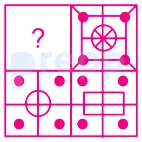
Which answer figure will complete the pattern in the question figure?
- A
Option A (shown in image)
- B
Option B (shown in image)
- C
Option C (shown in image)
- D
Option D (shown in image)
Show answer
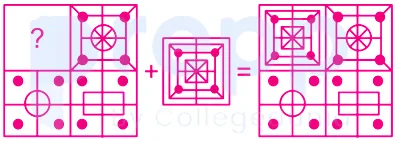
C. Option C (shown in image)After looking at the picture, we can assume that the upper circle is the part of its diagonal circle where extra cross lines have been brought. So, the missing part will be the square where the cross line has been added.
Hence, option 3 will complete the given question figure.
 Paper & answer key PDF ↗
 Question 16archived
A piece of paper is folded and punched as shown below in the question figures. From the given answer figures, indicate how it will appear when opened? ×

- A
Option A (shown in image)
- B
Option B (shown in image)
- C
Option C (shown in image)
- D
Option D (shown in image)
Show answer
C. Option C (shown in image)Hence, the unfolded figure will be similar to option 3.
 Paper & answer key PDF ↗
 Question 17archived
A word is represented by only one set of numbers as given in any one of the alternatives. The sets of numbers given in the alternatives are represented by two classes of alphabets as shown in the given two matrices. The columns and rows of Matrix-I are numbered from 0 to 4 and that of Matrix-II are numbered from 5 to 9. A letter from these matrices can be represented first by its row and next by its column, for example ‘X’ can be represented by 21, 44, etc. and ‘R’ can be represented by 67, 98, etc. Similarly, you have to identify the set for the word ‘CREEP’.
Matrix-I
Matrix-II
0
1
2
3
4
5
6
7
8
9
0
E
C
P
X
T
5
R
L
N
O
M
1
C
P
X
T
E
6
O
M
R
L
N
2
P
X
T
E
C
7
L
N
O
M
R
3
X
T
E
C
P
8
M
R
L
N
O
4
T
E
C
P
X
9
N
O
M
R
L
- A
10, 79, 23, 32, 42
- B
24, 55, 14, 41, 12
- C
33, 86, 32, 13, 43
- D
42, 98, 41, 00, 34
Show answer
D. 42, 98, 41, 00, 34Decode each pair as (row, column) from the correct matrix and check it spells C-R-E-E-P.
Option 4 (42, 98, 41, 00, 34):
42 → Matrix-I (4,2) = C; 98 → Matrix-II (9,8) = R; 41 → Matrix-I (4,1) = E; 00 → Matrix-I (0,0) = E; 34 → Matrix-I (3,4) = P.
All five pairs match, so the code for CREEP is 42, 98, 41, 00, 34. The other options fail at one or more letters (e.g. Option 1's 42 gives C instead of P; Option 2's 55 gives L instead of R).
Paper & answer key PDF ↗ Question 18archived
In the following question, select the related number from the given alternatives.
243 : 819 : : 163 : ?
- A
487
- B
563
- C
572
- D
593
Show answer
A. 487Pattern: second number = first number + (product of its digits)2.
Check: \(2\times4\times3=24,\ 24^{2}=576,\ 243+576=819\).
Apply to 163: \(1\times6\times3=18,\ 18^{2}=324,\ 163+324=\mathbf{487}\).
Paper & answer key PDF ↗ Question 19archived
From the given answer figures, select the one in which the question figure is hidden/embedded.

- A
Option A (shown in image)
- B
Option B (shown in image)
- C
Option C (shown in image)
- D
Option D (shown in image)
Show answer
A. Option A (shown in image)Hence, the question figure is hidden in option 1.
 Paper & answer key PDF ↗
 Question 20archived
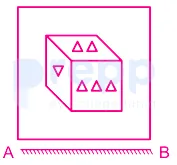
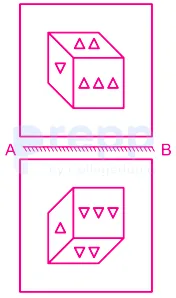
If a mirror is placed on the line AB, then which of the answer figure is the right image of the given figure?
- A
Option A (shown in image)
- B
Option B (shown in image)
- C
Option C (shown in image)
- D
Option D (shown in image)
Show answer
A. Option A (shown in image)Hence, the mirror image of the question figure will be similar to option 1.
 Paper & answer key PDF ↗
 Question 21archived
From a point, Lokesh starts walking towards south and after walking 30 meters he turns to his right and walks 20 meters, then he turns right again and walks 30 meters. He finally turns to his left and walk 40 meters. In which direction is he with reference to the starting point?
- A
North-West
- B
East
- C
West
- D
South
Show answer
C. WestTrack the net displacement. Facing south, a right turn faces west; another right faces north; a left from north faces west.
North–South: 30 m south then 30 m north cancel to 0.
East–West: 20 m west + 40 m west = 60 m west.
The net displacement is 60 m due west, so Lokesh is to the West of the starting point.
Paper & answer key PDF ↗ Question 22archived
In the following question, select the odd number group from the given alternatives.
- A
(4, 16, 48)
- B
(6, 36, 90)
- C
(8, 64, 160)
- D
(12, 144, 360)
Show answer
A. (4, 16, 48)In each group the second number is the square of the first. Check the ratio of the third to the second:
(6, 36, 90): \(90/36=2.5\); (8, 64, 160): \(160/64=2.5\); (12, 144, 360): \(360/144=2.5\).
But (4, 16, 48): \(48/16=3\), not 2.5. Hence (4, 16, 48) is the odd group.
Paper & answer key PDF ↗ Question 23archived
Identify the diagram that best represents the relationship among the given classes.
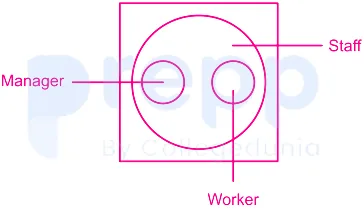
Staff, Manager, Worker
- A
Option A (shown in image)
- B
Option B (shown in image)
- C
Option C (shown in image)
- D
Option D (shown in image)
Show answer
B. Option B (shown in image)Hence, the answer is option 3.
 Paper & answer key PDF ↗
 Question 24archived
In the following question, select the odd word from the given alternatives.
- A
Football
- B
Table Tennis
- C
Cricket
- D
Hockey
Show answer
B. Table TennisFootball, Cricket and Hockey are all outdoor field team sports played on a large ground with a ball/puck.
Table Tennis is the odd one out — it is an indoor sport played on a table, not on a field.
Paper & answer key PDF ↗ Question 25archived
In the following question, from the given alternative words, select the word which cannot be formed using the letters of the given word.
ENCYCLOPEDIA
- A
CONE
- B
CYCLE
- C
NOISY
- D
PEACE
Show answer
C. NOISYLetters available in ENCYCLOPEDIA: A, C, C, D, E, E, E, I, L, N, O, P, Y. The letter S is not present.
CONE, CYCLE and PEACE use only letters from this pool, but NOISY requires an S, which is missing. Hence NOISY cannot be formed.
Paper & answer key PDF ↗ Question 26archived
Plant tissues are of how many types?
- A
3
- B
2
- C
5
- D
6
Show answer
A. 3Plant tissues are broadly grouped into three main types: meristematic tissue (actively dividing cells responsible for growth, found at root and shoot tips), simple permanent tissue (parenchyma, collenchyma, sclerenchyma — one cell type, used for storage, support and protection), and complex permanent tissue (xylem and phloem — multiple cell types working together for transport of water, minerals and food).
Hence the correct answer is 3.
Paper & answer key PDF ↗ Question 27archived
Which of the following are constituents of Indian Parliament?
(i) The President
(ii) The Council of States (Rajya Sabha)
(iii) The House of the People (Lok Sabha)
- A
(ii) and (iii)
- B
(i) and (ii)
- C
(i) and (iii)
- D
(i), (ii) and (iii)
Show answer
D. (i), (ii) and (iii)As per Article 79 of the Constitution of India, the Parliament of India consists of the President and two Houses — the Council of States (Rajya Sabha) and the House of the People (Lok Sabha).
Though the President is not a member of either House, the President is an integral constituent of Parliament — summoning/proroguing sessions and giving assent to Bills. Hence all three (i), (ii) and (iii) are constituents, making (i), (ii) and (iii) the correct answer.
Paper & answer key PDF ↗ Question 28archived
In which city is the Forest Research Institute of India located?
- A
New Delhi
- B
Hyderabad
- C
Dehradun
- D
Shimla
Show answer
C. DehradunThe Forest Research Institute (FRI) is located in Dehradun, Uttarakhand. Established in 1906 (with origins in the 1878 Forest School), it is a premier institution under the Indian Council of Forestry Research and Education (ICFRE) and a deemed university known for its colonial-era architecture and forestry museum.
Paper & answer key PDF ↗ Question 29archived
What is a bug in computer terminology?
- A
A virus
- B
A program
- C
An error in program
- D
Magnetic disk storage device
Show answer
C. An error in programIn computer terminology, a bug is an error, flaw, or fault in a program that causes it to produce an incorrect result or behave in an unintended way. The process of locating and removing bugs is called debugging.
A virus is malicious software, a program is a set of instructions (a bug exists within a program), and a magnetic disk is a hardware storage device — none of these define a bug. Hence an error in program is correct.
Paper & answer key PDF ↗ Question 30archived
Who built the Konark''s Sun Temple?
- A
Anantavarman Chodaganga Deva
- B
Narasimhadeva I
- C
Kapilendra Deva Routaray
- D
Purushottam Dev
Show answer
B. Narasimhadeva IThe Konark Sun Temple in Odisha was built by King Narasimhadeva I of the Eastern Ganga dynasty around 1250 CE, reportedly to commemorate his military victory over Muslim forces. Designed as a colossal chariot of the Sun God Surya with 12 pairs of wheels and 7 horses, it is a UNESCO World Heritage Site.
Anantavarman Chodaganga Deva built the Jagannath Temple at Puri; Kapilendra Deva and Purushottam Dev were later Gajapati rulers. Hence Narasimhadeva I is correct.
Paper & answer key PDF ↗ Question 31archived
Who discovered bacteria?
- A
Antonie Ven Leeuwenhoek
- B
Robert Brown
- C
Robert Hook
- D
Robert Koch
Show answer
A. Antonie Ven LeeuwenhoekAntonie van Leeuwenhoek, a Dutch lens-maker, was the first to observe and describe bacteria in 1676 using his self-built single-lens microscopes. He called them animalcules ("little animals") after observing them in pond water, saliva and dental plaque, and communicated his findings to the Royal Society of London — earning him the title "Father of Microbiology".
Robert Brown discovered the cell nucleus, Robert Hooke coined the term "cell", and Robert Koch identified disease-causing bacteria — but none discovered bacteria.
Paper & answer key PDF ↗ Question 32archived
What was invented by Zacharias Jansen?
- A
Jet Engine
- B
Radium
- C
Microscope
- D
Electric Lamp
Show answer
C. MicroscopeZacharias Jansen, a Dutch spectacle-maker from Middelburg, is credited with inventing the compound microscope around 1590–1600, working together with his father Hans Jansen. By combining multiple lenses in a tube, the device achieved much higher magnification than a simple single-lens microscope, paving the way for microbiology.
The jet engine (Whittle/von Ohain), radium (Curies) and the electric lamp (Edison) all came centuries later.
Paper & answer key PDF ↗ Question 33archived
Who is the author of the book titled 'Numbers Do Lie'?
- A
Anil Menon
- B
Akash Chopra
- C
Ian Chapell
- D
Kunal Basu
Show answer
B. Akash ChopraThe book 'Numbers Do Lie' is co-authored by Aakash Chopra (former Indian Test opener and cricket commentator) along with Impact Index founders Jaideep Varma and Jatin Thakkar. Published in 2017, it challenges popular cricket statistics by examining the context behind the numbers across 61 myths in the game.
Anil Menon and Kunal Basu are fiction writers, and Ian Chappell is an Australian cricketer-commentator — none authored this book.
Paper & answer key PDF ↗ Question 34archived
India has longest international border with which country?
- A
Bhutan
- B
Nepal
- C
Bangladesh
- D
Pakistan
Show answer
C. BangladeshIndia shares its longest international land border with Bangladesh, stretching about 4,096.7 km across West Bengal, Assam, Meghalaya, Tripura and Mizoram.
For comparison: China — about 3,488 km, Pakistan — about 3,323 km, Nepal — about 1,751 km, Myanmar — about 1,643 km, and Bhutan — about 699 km. Hence among the options, Bangladesh is correct.
Paper & answer key PDF ↗ Question 35archived
Which one of the following is not a property of electromagnetic waves?
- A
Electromagnetic waves do not show interference and diffraction.
- B
Oscillating electric field and magnetic field are perpendicular to each other.
- C
Electromagnetic waves are transverse waves.
- D
Electromagnetic waves do not require a medium to propagate.
Show answer
A. Electromagnetic waves do not show interference and diffraction.The question asks which statement is NOT a property of electromagnetic (EM) waves.
EM waves are transverse (oscillating \(\vec{E}\) and \(\vec{B}\) fields mutually perpendicular and perpendicular to the direction of propagation) and require no medium — they travel through vacuum at the speed of light \(c = 1/\sqrt{\mu_0 \epsilon_0}\). Statements (2), (3) and (4) are therefore true.
Being waves, EM waves do exhibit interference, diffraction, reflection, refraction and polarisation — as seen in thin-film colours and Young's double-slit experiment. Hence statement (1) — that they do not show interference and diffraction — is false and is the correct answer.
Paper & answer key PDF ↗ Question 36archived
Who has won the 'Miss Universe 2016' title?
- A
Pia Wurtzbach
- B
Iris Mittenaere
- C
Raquel Pellissier
- D
Andrea Tova
Show answer
B. Iris MittenaereIris Mittenaere of France won the 65th Miss Universe 2016 pageant, held on 30 January 2017 in Manila, Philippines. She was crowned by her predecessor Pia Wurtzbach (Miss Universe 2015).
Raquel Pelissier (Haiti) was first runner-up and Andrea Tovar (Colombia) second runner-up. Hence Iris Mittenaere is correct.
Paper & answer key PDF ↗ Question 37archived
What is the other name of Sahyadri Range?
- A
Lesser Himalayas
- B
Shivaliks
- C
Western Ghats
- D
Eastern Ghats
Show answer
C. Western GhatsThe Sahyadri Range is the other name for the Western Ghats — a mountain chain running parallel to India's western coast from Gujarat through Maharashtra, Goa, Karnataka and Kerala to Tamil Nadu. It separates the Deccan Plateau from the Arabian Sea coast, is a UNESCO World Heritage Site and one of the world's eight "hottest hotspots" of biodiversity.
The Lesser Himalayas and Shivaliks belong to the Himalayan system, while the Eastern Ghats run along the Bay of Bengal coast.
Paper & answer key PDF ↗ Question 38archived
pH of the human blood is ________.
- A
Slightly Acidic
- B
Highly Acidic
- C
Slightly Basic
- D
Highly Basic
Show answer
C. Slightly BasicNormal human blood pH is tightly maintained between \(7.35\) and \(7.45\). Since this range lies just above the neutral value of 7, blood is classified as slightly basic (alkaline).
This narrow range is regulated by the bicarbonate buffer system, along with the lungs and kidneys. Values below 7.35 lead to acidosis and above 7.45 to alkalosis.
Paper & answer key PDF ↗ Question 39archived
In which of the following game, ball is not used?
- A
Football
- B
Cricket
- C
Badminton
- D
Tennis
Show answer
C. BadmintonFootball, Cricket and Tennis are all played with a ball (spherical football, hard cricket ball, felt-covered tennis ball respectively).
Badminton is the exception — it is played with a shuttlecock (a feathered/synthetic conical projectile), not a ball. Hence the answer is Badminton.
Paper & answer key PDF ↗ Question 40archived
Who was the first Governor General of Bengal?
- A
Robert Clive
- B
William Bentick
- C
Warren Hastings
- D
Charles Cornawallis
Show answer
C. Warren HastingsThe Regulating Act of 1773 elevated the post of Governor of Bengal to Governor-General of Bengal, with authority over the Madras and Bombay presidencies. Warren Hastings (Governor of Bengal since 1772) became the first to hold this new title, serving from 1774 to 1785.
Robert Clive was only Governor of Bengal (pre-1773); Cornwallis succeeded Hastings; William Bentinck later became the first Governor-General of India under the Charter Act of 1833.
Paper & answer key PDF ↗ Question 41archived
In which market form, a market or an industry is dominated by a single seller?
- A
Oligopoly
- B
Monopoly
- C
Duopoly
- D
Monopolistic Competition
Show answer
B. MonopolyA monopoly is a market structure in which a single seller controls the entire supply of a product that has no close substitutes. The firm is the industry, faces the whole market demand curve, and acts as a price-maker due to high barriers to entry.
Oligopoly has a few dominant firms, duopoly exactly two, and monopolistic competition many sellers of differentiated products — none of these is dominated by a single seller.
Paper & answer key PDF ↗ Question 42archived
A radio-active substance has a half life of six months. Three-fourth of the substance will decay in ______.
- A
Six months
- B
Ten months
- C
Twelve Months
- D
Twenty four months
Show answer
C. Twelve MonthsAfter each half-life, the remaining quantity halves. If three-fourths has decayed, the remaining fraction is \(\tfrac{1}{4}\) of the original.
\[\left(\tfrac{1}{2}\right)^{n}=\tfrac{1}{4}\implies n=2\ \text{half-lives}\]
With each half-life equal to 6 months, total time \(=2\times 6 =\) 12 months.
Paper & answer key PDF ↗ Question 43archived
Match the following.
Festival
State
1. Gangaur
a. West Bengal
2. Ganesh Chaturthi
b. Rajasthan
3. Durga Puja
c. Maharashtra
- A
1-b, 2-c, 3-a
- B
1-c, 2-a, 3-b
- C
1-b, 2-a, 3-c
- D
1-a, 2-c, 3-b
Show answer
A. 1-b, 2-c, 3-aGangaur is celebrated in Rajasthan in honour of Goddess Gauri (consort of Shiva). Ganesh Chaturthi is most prominently celebrated in Maharashtra. Durga Puja is the principal festival of West Bengal.
So 1-b, 2-c, 3-a, matching option (a).
Paper & answer key PDF ↗ Question 44archived
Which one of the following is also regarded as Disguised unemployment?
- A
Underemployment
- B
Frictional unemployment
- C
Seasonal unemployment
- D
Cyclical unemployment
Show answer
A. UnderemploymentDisguised unemployment occurs when more workers are engaged in an activity than required, so the marginal productivity of labour is zero — common on small Indian farms. Such workers are nominally employed but contribute nothing extra to output.
This is a classic form of underemployment, where labour is not fully utilised. Frictional (between-jobs), seasonal (off-season), and cyclical (recession-driven) unemployment describe entirely different situations.
Paper & answer key PDF ↗ Question 45archived
It is difficult to fix a nail on a freely suspended wooden frame. Which law supports this statement?
- A
Law of inertia
- B
Newton's second law
- C
Newton's third law
- D
Pascal's law
Show answer
C. Newton's third lawBy Newton's third law, every action has an equal and opposite reaction. When the hammer strikes the nail, the nail (and the frame) pushes back with an equal force on the hammer, while the frame itself receives a reaction that would normally be balanced by a support.
Because the frame is freely suspended, nothing opposes this reaction, so the frame swings away instead of resisting the blow. The energy of the strike goes into moving the frame rather than driving the nail, making nailing difficult.
Paper & answer key PDF ↗ Question 46archived
What is the name of a group of similar cells performing a specific function?
- A
Tissue
- B
Organ
- C
Organ system
- D
Cellular organization
Show answer
A. TissueA tissue is a group of structurally similar cells with a common origin that work together to perform a specific function — e.g., muscle, nervous, epithelial and connective tissues in animals; xylem and phloem in plants.
An organ is built from different tissues; an organ system is a group of organs; "cellular organisation" merely describes how cells are arranged. Only tissue matches the definition given.
Paper & answer key PDF ↗ Question 47archived
Deen Dayal Rasoi Yojana to provide food at only Rs. 5 has been launched on 6th April, 2017 by which state?
- A
Chattisgarh
- B
Haryana
- C
Madhya Pradesh
- D
Uttar Pradesh
Show answer
C. Madhya PradeshThe Deen Dayal Rasoi Yojana was launched by the Madhya Pradesh government on 6 April 2017 to provide a full meal at the subsidised price of Rs. 5 to the poor, daily-wage labourers, rickshaw pullers and other needy people.
The scheme was rolled out across major cities of the state and aligns with broader food-security objectives.
Paper & answer key PDF ↗ Question 48archived
Amazon river flows through which of the following country?
- A
USA
- B
France
- C
Brazil
- D
Canada
Show answer
C. BrazilThe Amazon, the world's largest river by discharge, rises in the Peruvian Andes and flows eastwards across South America, draining into the Atlantic Ocean. Of the listed countries, only Brazil lies in South America and contains the major portion of the river's course and basin.
The USA and Canada are in North America, and mainland France is in Europe — none is traversed by the Amazon.
Paper & answer key PDF ↗ Question 49archived
Who among the following is the executive head of state in India?
- A
Prime Minister
- B
President
- C
Cabinet Secretary
- D
Finance Secretary
Show answer
B. PresidentIndia follows a parliamentary system in which the President is the constitutional head of state. Article 53 vests the executive power of the Union in the President, and all executive actions of the Government of India are formally taken in their name.
The Prime Minister is the head of government (real executive); the Cabinet Secretary and Finance Secretary are senior civil servants holding purely administrative posts.
Paper & answer key PDF ↗ Question 50archived
Who has been appointed as the Secretary General of the United Nations in January, 2017?
- A
Ban Ki-Moon
- B
Kofi Annan
- C
Boutros-Boutros Ghali
- D
Antonio Guterres
Show answer
D. Antonio GuterresAntonio Guterres, former Prime Minister of Portugal and former UN High Commissioner for Refugees, took office as the 9th Secretary-General of the United Nations on 1 January 2017, succeeding Ban Ki-moon.
Ban Ki-moon's term ended on 31 December 2016; Kofi Annan (1997-2006) and Boutros Boutros-Ghali (1992-1996) had served much earlier.
Paper & answer key PDF ↗ Question 51archived
A can complete a work in 20 days and B can complete the same work in 25 days. If both of them work together, then in 3 days what percent of the total work will be completed?
- A
9
- B
12
- C
25
- D
27
Show answer
D. 27Step 1 — Combined one-day work:
\[\frac{1}{20}+\frac{1}{25}=\frac{5+4}{100}=\frac{9}{100}\]
Step 2 — Work in 3 days:
\[\frac{9}{100}\times 3=\frac{27}{100}\]
This equals 27% of the total work.
Paper & answer key PDF ↗ Question 52archived
Two people A and B are at a distance of 260 km from each other at 9 : 00 a.m. A immediately starts moving towards B at a speed of 25 km/h and at 11 : 00 a.m. B starts moving towards A at a speed of 10 km/hr. At what time (in p.m.) will they meet each other?
- A
5 : 00
- B
6 : 00
- C
6 : 30
- D
7 : 00
Show answer
A. 5 : 00Step 1 — Distance A covers alone (9 a.m. to 11 a.m.):
\[25\times 2=50\text{ km}\]
Step 2 — Remaining gap at 11 a.m.:
\[260-50=210\text{ km}\]
Step 3 — Closing speed and meeting time: Both move towards each other at \(25+10=35\) km/h, so they meet in \(210/35=6\) hours.
Meeting time = 11 a.m. + 6 h = 5:00 p.m.
Paper & answer key PDF ↗ Question 53archived
A, B and C are three students. A got 18% more marks than B and 12% less than C. If B got 220 marks, then how much marks C has got?
- A
230
- B
295
- C
240
- D
290
Show answer
B. 295Step 1 — Find A's marks: A is 18% more than B = 220.
\[A=220\times 1.18=259.6\]
Step 2 — Relate A and C: A is 12% less than C, so \(A=0.88\,C\).
\[C=\frac{259.6}{0.88}=295\]
Therefore C scored 295 marks.
Paper & answer key PDF ↗ Question 54archived
If x 4+ (1/x 4) = 34, then what is the value of x 3– (1/x 3)?
- A
0
- B
6
- C
8
- D
14
Show answer
D. 14Step 1 — Find \(x^2+\tfrac{1}{x^2}\):
\[\left(x^2+\tfrac{1}{x^2}\right)^2=x^4+\tfrac{1}{x^4}+2=34+2=36\]
So \(x^2+\tfrac{1}{x^2}=6\).
Step 2 — Find \(x-\tfrac{1}{x}\):
\[\left(x-\tfrac{1}{x}\right)^2=x^2+\tfrac{1}{x^2}-2=6-2=4\implies x-\tfrac{1}{x}=2\]
Step 3 — Apply \(a^3-b^3=(a-b)(a^2+ab+b^2)\):
\[x^3-\tfrac{1}{x^3}=\left(x-\tfrac{1}{x}\right)\left(x^2+1+\tfrac{1}{x^2}\right)=2\times(6+1)=14\]
Therefore the value is 14.
Paper & answer key PDF ↗ Question 55archived
Smaller diagonal of a rhombus is equal to length of its sides. If length of each side is 6 cm, then what is the area (in cm 2) of an equilateral triangle whose side is equal to the bigger diagonal of the rhombus?
- A
18√3
- B
27√3
- C
32√3
- D
36√3
Show answer
B. 27√3Diagonals of a rhombus bisect at right angles, so each half-diagonal forms a right triangle with the side as hypotenuse.
Step 1 — Find the bigger diagonal \(d_2\):
\[6^2=\left(\tfrac{6}{2}\right)^2+\left(\tfrac{d_2}{2}\right)^2\implies \left(\tfrac{d_2}{2}\right)^2=27\]
So \(d_2=2\sqrt{27}=6\sqrt{3}\) cm.
Step 2 — Area of equilateral triangle with side \(6\sqrt{3}\):
\[\text{Area}=\frac{\sqrt{3}}{4}(6\sqrt{3})^2=\frac{\sqrt{3}}{4}\times 108=27\sqrt{3}\text{ cm}^2\]
Therefore the area is \(27\sqrt{3}\) cm2.
Paper & answer key PDF ↗ Question 56archived
If the total population of City 4 is 600000, then how many literate people are there in city 4?
- A
480000
- B
378000
- C
468000
- D
348000
Show answer
B. 378000From the table, City 4 has a literacy rate of 63%.
\[\text{Literate population}=\frac{63}{100}\times 600000=378000\]
Hence the number of literate people in City 4 is 378,000.
Paper & answer key PDF ↗ Question 57archived
Total population of City 6 is 200000 and the total population of City 2 is 220000. What is the respective ratio of literate males of City 2 and literate females of City 6?
- A
348 : 595
- B
255 : 199
- C
595 : 348
- D
199 : 255
Show answer
C. 595 : 348Step 1 — Literate males in City 2 (85% literate, M:F = 7:4):
\[0.85\times 220000=187000;\quad \tfrac{7}{11}\times 187000=119000\]
Step 2 — Literate females in City 6 (58% literate, M:F = 2:3):
\[0.58\times 200000=116000;\quad \tfrac{3}{5}\times 116000=69600\]
Step 3 — Required ratio:
\[119000:69600=1190:696=595:348\]
Therefore the ratio is 595 : 348.
Paper & answer key PDF ↗ Question 58archived
The population of the 6 cities are 250000, 200000, 220000, 300000, 150000 and 400000 respectively. Which is the correct order of the number of literate people in these cities?
- A
City 6 > City 1 > City 4 > City 2 > City 3 > City 5
- B
City 4 > City 6 > City 1 > City 2 > City 3 > City 5
- C
City 6 > City 4 > City 1 > City 3 > City 2 > City 5
- D
City 6 > City 1 > City 4 > City 3 > City 2 > City 5
Show answer
D. City 6 > City 1 > City 4 > City 3 > City 2 > City 5Compute literate population = literacy % × total population for each city:
City 1: \(0.80\times 250000=200000\)
City 2: \(0.85\times 200000=170000\)
City 3: \(0.78\times 220000=171600\)
City 4: \(0.63\times 300000=189000\)
City 5: \(0.92\times 150000=138000\)
City 6: \(0.58\times 400000=232000\)
Descending order: 232000 > 200000 > 189000 > 171600 > 170000 > 138000, i.e. City 6 > City 1 > City 4 > City 3 > City 2 > City 5.
Paper & answer key PDF ↗ Question 59archived
If Rs. 2500 becomes to Rs. 2970.25 in 2 years at compound interest compounded annually, then what is the yearly rate of interest (in %)?
- A
7
- B
9
- C
11
- D
13
Show answer
B. 9Apply the compound interest formula \(A=P\left(1+\tfrac{r}{100}\right)^n\) with \(P=2500,\ A=2970.25,\ n=2\):
\[\left(1+\tfrac{r}{100}\right)^2=\frac{2970.25}{2500}=1.1881\]
Taking the square root: \(1+\tfrac{r}{100}=1.09\), so \(r=9\).
The yearly rate of interest is 9%.
Paper & answer key PDF ↗ Question 60archived
What is the simplified value of (secA + cosA) (secA – cosA)?
- A
2 tan2A
- B
2 sin2A
- C
sin2A tan2A
- D
sin2A + tan2A
Show answer
D. sin2A + tan2AApply the difference-of-squares identity:
\[(\sec A+\cos A)(\sec A-\cos A)=\sec^2 A-\cos^2 A\]
Use \(\sec^2 A=1+\tan^2 A\) and \(\cos^2 A=1-\sin^2 A\):
\[\sec^2 A-\cos^2 A=(1+\tan^2 A)-(1-\sin^2 A)=\sin^2 A+\tan^2 A\]
Therefore the simplified value is \(\sin^2 A+\tan^2 A\).
Paper & answer key PDF ↗ Question 61archived
If x = 1 – y and x 2= 2 – y 2, then what is the value of xy?
- A
1
- B
2
- C
-1/2
- D
-1
Show answer
C. -1/2Rewrite the two conditions: \(x+y=1\) and \(x^2+y^2=2\).
Use the identity \((x+y)^2=x^2+y^2+2xy\):
\[1^2=2+2xy\implies 2xy=-1\implies xy=-\tfrac{1}{2}\]
Therefore \(xy=\mathbf{-\tfrac{1}{2}}\).
Paper & answer key PDF ↗ Question 62archived
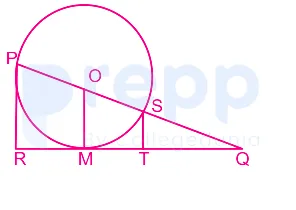
In the given figure, PR and ST are perpendicular to tangent QR. PQ passes through centre O of the circle whose diameter is 10 cm. If PR = 9 cm, then what is the length (in cm) of ST?
- A
1
- B
1.25
- C
1.5
- D
2
Show answer
A. 1let us assume ST be a and SQ be y
Radius = 10/2 = 5cm
⇒ taking sin(Q) in triangles QST, QOM and QPR
⇒ sin(Q) = a/y = 5/ (5 + y) = 9/ (10 + y), using last 2 equations
⇒ 50 + 5y = 45 + 9y
⇒ y = 5/4
using this in the equation a/y = 5/ (5 + y)
⇒ 4a/5 = 5/ (5 + 5/4)
⇒ a = 1
∴ ST is 1 cm
Paper & answer key PDF ↗ Question 63archived
The length of two parallel sides of a trapezium are 18 m and 24 m. If its height is 12 m, then what is the area (in m 2) of the trapezium?
- A
155
- B
252
- C
242
- D
133
Show answer
B. 252Area of a trapezium \(=\tfrac{1}{2}\times(\text{sum of parallel sides})\times\text{height}\).
\[\text{Area}=\tfrac{1}{2}\times(18+24)\times 12=\tfrac{1}{2}\times 42\times 12=252\ \text{m}^2\]
Hence the area is 252 m2.
Paper & answer key PDF ↗ Question 64archived
If two successive discounts of 50% and 10% are offered, then what is the net discount?
- A
50
- B
55
- C
60
- D
65
Show answer
B. 55For two successive discounts \(d_1\) and \(d_2\), the equivalent single discount is:
\[D=d_1+d_2-\frac{d_1 d_2}{100}\]
\[D=50+10-\frac{50\times 10}{100}=60-5=55\%\]
Therefore the net discount is 55%.
Paper & answer key PDF ↗ Question 65archived
PQRS is a cyclic quadrilateral and PQ is the diameter of the circle. If ∠RPQ = 38°, then what is the value (in degrees) of ∠PSR?
- A
52
- B
77
- C
128
- D
142
Show answer
C. 128Step 1 — Angle in semicircle: Since PQ is the diameter, \(\angle PRQ=90^\circ\).
Step 2 — Find \(\angle PQR\) in \(\triangle PQR\):
\[\angle PQR=180^\circ-90^\circ-38^\circ=52^\circ\]
Step 3 — Cyclic quadrilateral property: Opposite angles sum to \(180^\circ\), so \(\angle PSR+\angle PQR=180^\circ\).
\[\angle PSR=180^\circ-52^\circ=128^\circ\]
Therefore \(\angle PSR=128^\circ\).
Paper & answer key PDF ↗ Question 66archived
If x + [1/(x + 7)] = 0, then what is the value of x – [1/(x + 7)]?
- A
3√5
- B
3√5 – 7
- C
3√5 + 7
- D
8
Show answer
B. 3√5 – 7Step 1 — Use the given relation: From \(x+\dfrac{1}{x+7}=0\) we get \(\dfrac{1}{x+7}=-x\). Hence:
\[x-\frac{1}{x+7}=x-(-x)=2x\]
Step 2 — Solve for x: Multiplying \(x+\dfrac{1}{x+7}=0\) by \((x+7)\) gives \(x^2+7x+1=0\).
\[x=\frac{-7\pm\sqrt{49-4}}{2}=\frac{-7\pm 3\sqrt{5}}{2}\]
Step 3 — Compute 2x: \(2x=-7\pm 3\sqrt{5}\). The value matching the options is \(3\sqrt{5}-7\).
Paper & answer key PDF ↗ Question 67archived
If (1/x) + (1/y) + (1/z) = 0 and x + y + z = 9, then what is the value of x 3+ y 3+ z 3– 3xyz?
- A
81
- B
361
- C
729
- D
6561
Show answer
C. 729Step 1 — Translate the first condition:
\[\frac{1}{x}+\frac{1}{y}+\frac{1}{z}=\frac{xy+yz+zx}{xyz}=0 \implies xy+yz+zx=0\]
Step 2 — Find \(x^2+y^2+z^2\):
\[(x+y+z)^2=x^2+y^2+z^2+2(xy+yz+zx)\]
\[9^2=x^2+y^2+z^2+0 \implies x^2+y^2+z^2=81\]
Step 3 — Apply the cubic identity:
\[x^3+y^3+z^3-3xyz=(x+y+z)(x^2+y^2+z^2-xy-yz-zx)\]
\[=9\times(81-0)=\mathbf{729}\]
Paper & answer key PDF ↗ Question 68archived
How many numbers are there from 700 to 950 (including both) which are neither divisible by 3 nor by 7?
- A
107
- B
141
- C
144
- D
145
Show answer
C. 144Step 1 — Total count: Numbers from 700 to 950 inclusive \(=950-700+1=251\).
Step 2 — Multiples of 3 (702 to 948): \(\dfrac{948-702}{3}+1=83\).
Step 3 — Multiples of 7 (700 to 945): \(\dfrac{945-700}{7}+1=36\).
Step 4 — Multiples of 21 (714 to 945): \(\dfrac{945-714}{21}+1=12\).
Step 5 — Inclusion–exclusion: Divisible by 3 or 7 \(=83+36-12=107\).
Neither \(=251-107=\mathbf{144}\).
Paper & answer key PDF ↗ Question 69archived
For an article the profit is 190% of the cost price. If the cost price increase by 10% but the selling price remains same, then profit is what percentage of selling price (approximately)?
- A
54
- B
62
- C
70
- D
163
Show answer
B. 62Step 1 — Set up CP and SP: Let CP = Rs 100. Profit = 190% of CP = Rs 190, so SP = 100 + 190 = Rs 290.
Step 2 — New CP after 10% rise: New CP = \(100\times 1.10=110\). SP unchanged at 290.
Step 3 — New profit and ratio to SP:
\[\text{New profit}=290-110=180\]
\[\frac{180}{290}\times 100\approx 62.07\%\]
Hence profit is approximately 62% of the selling price.
Paper & answer key PDF ↗ Question 70archived
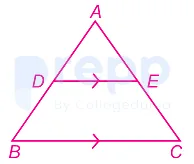
In the given figure, DE || BC and AD ∶ DB = 5 ∶ 3, then what is the value of (DE/BC)?
- A
5/8
- B
2/3
- C
3/4
- D
5/3
Show answer
A. 5/8Given AD/DB = 5/3
⇒ DB/AD = 3/5, add 1 to both sides
⇒ (AD + DB)/AD = (5 + 3)/5
⇒ AB/AD = 8/5
⇒ AD/AB = 5/8
Since triangle ADC is similar to ABC [From AAA similarity]
⇒ DE/BC = AD/AB = 5/8
∴ DE/BC = 5/8
Paper & answer key PDF ↗ Question 71archived
What is the simplified value of \(\frac{{\tan A}}{{1 - \cot A}} + \frac{{\cot A}}{{1 - \tan A}} - \frac{2}{{sin2A}}?\)
- A
–1
- B
0
- C
1
- D
2
Show answer
C. 1Step 1 — Combine the first two terms: Write \(\tan A=\tfrac{\sin A}{\cos A}\), \(\cot A=\tfrac{\cos A}{\sin A}\). Then
\[\frac{\tan A}{1-\cot A}+\frac{\cot A}{1-\tan A}=\frac{\sin^2 A}{\cos A(\sin A-\cos A)}+\frac{\cos^2 A}{\sin A(\cos A-\sin A)}\]
\[=\frac{\sin^3 A-\cos^3 A}{\sin A\cos A(\sin A-\cos A)}\]
Step 2 — Apply \(a^3-b^3\) and \(\sin^2+\cos^2=1\):
\[=\frac{(\sin A-\cos A)(1+\sin A\cos A)}{\sin A\cos A(\sin A-\cos A)}=\frac{1+\sin A\cos A}{\sin A\cos A}\]
Step 3 — Subtract \(\tfrac{2}{\sin 2A}=\tfrac{1}{\sin A\cos A}\):
\[\frac{1+\sin A\cos A}{\sin A\cos A}-\frac{1}{\sin A\cos A}=1\]
The simplified value is 1.
Paper & answer key PDF ↗ Question 72archived
If there are 259210 literate females in City 5, then what is the total population of City 5?
- A
644000
- B
354200
- C
690000
- D
483000
Show answer
A. 644000Step 1 — Literate males: Ratio M : F = 9 : 7 with F = 259210, so
\[M=\frac{9}{7}\times 259210=9\times 37030=333270\]
Step 2 — Total literate: \(333270+259210=592480\).
Step 3 — Apply 92% literacy:
\[\text{Population}=\frac{592480}{92}\times 100=6440\times 100=644000\]
Therefore the total population of City 5 is 644000.
Paper & answer key PDF ↗ Question 73archived
Three bottles of equal capacity containing mixture of milk and water in ratio 2 : 5, 3 : 4 and 4 : 5 respectively. These three bottles are emptied into a large bottle. What will be the ratio of milk and water respectively in the large bottle?
- A
73 : 106
- B
73 : 116
- C
73 : 113
- D
73 : 189
Show answer
B. 73 : 116Step 1 — Common capacity: LCM of the ratio sums 7, 7 and 9 is 63. Assume each bottle holds 63 units.
Step 2 — Split each bottle:
Bottle 1 (2 : 5): milk \(=\tfrac{2}{7}\times 63=18\), water \(=45\).
Bottle 2 (3 : 4): milk \(=\tfrac{3}{7}\times 63=27\), water \(=36\).
Bottle 3 (4 : 5): milk \(=\tfrac{4}{9}\times 63=28\), water \(=35\).
Step 3 — Combine: Milk \(=18+27+28=73\); water \(=45+36+35=116\).
Final ratio milk : water = 73 : 116.
Paper & answer key PDF ↗ Question 74archived
The average age of 6 members of a family is 20 yeaRs. If the age of the servant is included, then the average age increase by 25%. What is the age (in years) of the servant?
- A
30
- B
35
- C
50
- D
55
Show answer
D. 55Step 1 — Initial total age: \(6\times 20=120\) years.
Step 2 — New average: 25% rise of 20 gives \(20+5=25\) years.
Step 3 — New total with 7 members: \(7\times 25=175\) years.
Step 4 — Servant's age: \(175-120=55\) years.
Hence the servant is 55 years old.
Paper & answer key PDF ↗ Question 75archived
What is the simplified value of \({\left( {\frac{{cosec\;A}}{{\cot A + \tan A}}} \right)^2}\)
- A
2cos2A
- B
1 – sin2A
- C
sec2A
- D
secA tanA
Show answer
B. 1 – sin2AStep 1 — Simplify the denominator:
\[\cot A+\tan A=\frac{\cos A}{\sin A}+\frac{\sin A}{\cos A}=\frac{\cos^2 A+\sin^2 A}{\sin A\cos A}=\frac{1}{\sin A\cos A}\]
Step 2 — Simplify the inner fraction:
\[\frac{\operatorname{cosec} A}{\cot A+\tan A}=\frac{1/\sin A}{1/(\sin A\cos A)}=\cos A\]
Step 3 — Square: \(\left(\cos A\right)^2=\cos^2 A=1-\sin^2 A\).
Therefore the simplified value is \(1-\sin^2 A\).
Paper & answer key PDF ↗ Question 76archived
In the following question, out of the four alternatives, select the word similar in meaning to the word given.
Monotonous
- A
Dull
- B
Timid
- C
Unfriendly
- D
Lusty
Show answer
A. DullMonotonous means dull, tedious and repetitive — lacking variety or interest.
Among the options, Dull (lacking excitement or interest) is the closest synonym. "Timid" means shy, "Unfriendly" means hostile, and "Lusty" means full of vigour — none relate to repetitive boredom.
Paper & answer key PDF ↗ Question 77archived
Improve the bracketed part of the sentence.
(Being a pleasant evening), we went out for a long drive on a highway.
- A
As a pleasant evening
- B
It being a pleasant evening
- C
With a pleasant evening
- D
No improvement
Show answer
B. It being a pleasant eveningThe original phrase "Being a pleasant evening" is a dangling participle — its implied subject (the evening) does not match the main-clause subject ("we").
The correction needs an absolute construction with its own subject. "It being a pleasant evening" supplies "It" as the subject of "being", giving the cause for going out and removing the dangling modifier. Hence option 2 is correct.
Paper & answer key PDF ↗ Question 78archived
In the following question, some part of the sentence may have errors. Find out which part of the sentence has an error and select the appropriate option. If a sentence is free from error, select 'No Error'.
The Tata group owns (1)/ many industries, that are spread (2)/ across the globe. (3)/ No Error (4)
- A
1
- B
2
- C
3
- D
4
Show answer
B. 2The error is in part (2): "many industries, that are spread".
When a comma precedes the relative pronoun, the clause is non-restrictive and must use which, not that. ("That" introduces restrictive clauses with no comma.) The correct phrasing is "many industries, which are spread across the globe." Parts (1) and (3) are grammatically fine.
Paper & answer key PDF ↗ Question 79archived
In the following question, out of the four alternatives, select the word opposite in meaning to the word given.
Colossal
- A
Epic
- B
Rust
- C
Teeny
- D
Vast
Show answer
C. TeenyColossal means extremely large or gigantic, so its antonym must mean very small.
Teeny means very small/tiny — the direct opposite. "Epic" and "Vast" are synonyms (large in scale), and "Rust" is unrelated.
Paper & answer key PDF ↗ Question 80archived
In the following question, out of the four alternatives, select the alternative which is the best substitute of the phrase.
A roundabout way of speaking
- A
Centipede
- B
Circumlocution
- C
Coercion
- D
Concentric
Show answer
B. CircumlocutionCircumlocution (Latin circum = around + locutio = speech) literally means "speaking around" — using many words or indirect expressions to avoid coming to the point. This precisely matches "a roundabout way of speaking".
"Centipede" is an insect, "Coercion" is forcing someone, and "Concentric" describes shapes sharing a centre — none relate to speech.
Paper & answer key PDF ↗ Question 81archived
In the following question, out of the four alternatives, select the word opposite in meaning to the word given.
Opprobrium
- A
Adulation
- B
Ignominy
- C
Mystical
- D
Preclude
Show answer
A. AdulationOpprobrium means harsh public criticism, disgrace or scorn. Its antonym must convey praise or admiration.
Adulation means excessive praise and flattery — the direct opposite. "Ignominy" is a synonym (public shame), while "Mystical" and "Preclude" are unrelated.
Paper & answer key PDF ↗ Question 82archived
If so, English is perhaps the most _____ lens through which to see animals.
- A
distorting
- B
disturbing
- C
popular
- D
useful
Show answer
A. distortingThe passage frames English as a biased "lens" that gives a "cross-eyed view" of animals and associates them with baseness and vulgarity — clearly a skewed, inaccurate portrayal.
A lens that twists or misrepresents reality is a distorting one. "Disturbing" describes emotional impact, "popular" is irrelevant, and "useful" contradicts the negative tone of the passage.
Paper & answer key PDF ↗ Question 83archived
It has _____ a cross eyed view of birds, beasts, fish and fowl.
- A
accompanied
- B
exercised
- C
perpetuated
- D
undeterred
Show answer
C. perpetuatedThe passage argues that English has long maintained a biased ("cross-eyed") view of animals. The verb in the blank must convey causing this view to continue over time.
Perpetuated means "caused to continue indefinitely" — a perfect fit. "Accompanied" implies mere co-occurrence, "exercised a view" is not idiomatic, and "undeterred" means undiscouraged.
Paper & answer key PDF ↗ Question 84archived
The very word "animal" can _____ the brutish and the sensual.
- A
connote
- B
rectify
- C
trouble
- D
understand
Show answer
A. connoteThe blank needs a verb meaning "to suggest or imply in addition to the literal meaning".
Connote exactly means this — the word "animal" carries the additional implication of brutishness and sensuality. "Rectify" (correct), "trouble" (cause distress) and "understand" (perceive meaning) do not suit a word as subject implying associations.
Paper & answer key PDF ↗ Question 85archived
In the following question, out of the four alternatives, select the alternative which is the best substitute of the phrase.
An old unmarried woman
- A
Masochist
- B
Septuagenarian
- C
Sniper
- D
Spinster
Show answer
D. SpinsterA Spinster is an unmarried woman, typically one past the usual marrying age — matching "an old unmarried woman" exactly.
"Masochist" (one who enjoys pain), "Septuagenarian" (person aged 70–79, marital status not specified) and "Sniper" (concealed marksman) do not fit.
Paper & answer key PDF ↗ Question 86archived
Animal _____ imply baseness and vulgarity.
- A
breeding
- B
gestures
- C
instincts
- D
species
Show answer
C. instinctsThe passage argues that English associates animals with negative human traits. The blank needs a noun about animal behaviour that language links to "baseness and vulgarity".
Instincts — innate, primal drives — are commonly contrasted with refined human reasoning and so naturally carry connotations of baseness. "Breeding", "gestures" and "species" do not bear such pejorative associations in this context.
Paper & answer key PDF ↗ Question 87archived
In the following question, out of the four alternatives, select the alternative which best expresses the meaning of the idiom/phrase.
Not to mince matters
- A
To be at ease
- B
To not confuse others
- C
To not interfere in others affairs
- D
To speak frankly
Show answer
D. To speak franklyThe idiom "not to mince matters" (also "not to mince words") means to speak directly and bluntly, without softening or sugar-coating the message.
Hence option 4, To speak frankly, is correct. The other options — being at ease, avoiding confusion, or not interfering — describe unrelated behaviours.
Paper & answer key PDF ↗ Question 88archived
In the following question, a sentence has been given in Active/Passive voice. Out of the four alternatives suggested, select the one which best expresses the same sentence in Passive/Active voice.
Rohan was not told about the e-mail.
- A
Nobody told Rohan about the e-mail.
- B
Somebody did not tell Rohan about the e-mail
- C
The e-mail was not told about to Rohan.
- D
There was nobody who could tell Rohan about the e-mail.
Show answer
A. Nobody told Rohan about the e-mail.The given sentence is in the passive voice ("was not told" = was + past participle). To convert it to active voice while preserving the negative meaning, the implied agent must be nobody, since "Rohan was not told" means no person performed the act of telling.
Hence the active form is "Nobody told Rohan about the e-mail." Option 2 ("Somebody did not tell...") wrongly implies a specific person failed to tell while leaving open that others might have. Option 3 stays in passive voice, and Option 4 changes the meaning by introducing capability ("could tell").
Paper & answer key PDF ↗ Question 89archived
Language, they say, is the _____ through which human beings perceive the world.
- A
lens
- B
resource
- C
source
- D
telescope
Show answer
A. lensThe blank needs a metaphor for a medium that shapes how we view reality. A lens filters and focuses what we see without creating the image itself — exactly how language shapes perception of the world.
"Resource" and "source" suggest origin or supply, not a filter for viewing. "Telescope" is too specific (distant viewing) and unidiomatic in this context. Hence lens is correct.
Paper & answer key PDF ↗ Question 90archived
Improve the bracketed part of the sentence.
The doctor (has advice) him to take proper diet.
- A
has advised
- B
had been advised
- C
was advised
- D
No improvement
Show answer
A. has advised"Advice" is a noun; after the auxiliary "has" we need the past participle of the verb "advise", which is advised. This gives the present perfect active form: "The doctor has advised him to take proper diet."
Options 2 and 3 ("had been advised", "was advised") shift to passive voice, wrongly making the doctor the recipient. "No improvement" fails because "has advice" is ungrammatical.
Paper & answer key PDF ↗ Question 91archived
In the following question, out of the four alternatives, select the word similar in meaning to the word given.
Elusive
- A
Baffling
- B
Enticing
- C
Directing
- D
Soothing
Show answer
A. BafflingElusive describes something hard to find, catch, or understand. Baffling means perplexing or hard to comprehend — both share the core sense of difficulty in grasping or pinning down.
"Enticing" (attractive) and "soothing" (calming) describe pleasant qualities, not difficulty. "Directing" (guiding) is unrelated. Hence Baffling is the closest synonym.
Paper & answer key PDF ↗ Question 92archived
The question below consists of a set of labelled sentences. Out of the four options given, select the most logical order of the sentences to form a coherent paragraph.
P- However, our environment also needs some help from all of us to get maintained as usual to nourish our lives forever and to never ruin our lives.
Q- It gives us all things which we need to live our life on this planet.
R- It provides us a better medium to grow and develop.
S- An environment includes all the natural resources which surround us to help in a number of ways.
- A
PQRS
- B
QPSR
- C
SRQP
- D
QSPR
Show answer
C. SRQPSentence S defines the environment and its helpful role — a natural opening. R elaborates by naming a specific benefit ("a better medium to grow and develop"). Q extends this with another benefit ("gives us all things we need"). P closes with the connector "However," pivoting from what the environment gives us to what it needs from us.
Hence the order is SRQP.
Paper & answer key PDF ↗ Question 93archived
In the following question, four words are given out of which one word is incorrectly spelt . Select the incorrectly spelt word.
- A
Century
- B
Finance
- C
Remember
- D
Sponser
Show answer
D. SponserIdentifying the Misspelled Word
This question requires us to find the word that has an incorrect spelling among the given options. We need to carefully examine each word.
Analyzing the Spelling of Each Option
Let's look at each word provided:
Century: This word refers to a period of one hundred years. The spelling 'Century' is correct.
Finance: This term relates to the management of money, banking, investments, and credit. The spelling 'Finance' is correct.
Remember: This word means to keep something in or bring back into the mind. The spelling 'Remember' is correct.
Sponser: This word appears to be an attempt to spell the word related to someone who pays for or supports an event, show, or person. However, the spelling 'Sponser' is incorrect.
Correcting the Misspelled Word
The word 'Sponser' is misspelled. The correct spelling is Sponsor.
A sponsor is typically an individual or organization that provides funds for a project or activity carried out by another, often in exchange for advertising or publicity.
Conclusion on Misspelling
Based on the analysis, the word Sponser is the incorrectly spelt word among the choices provided. The correctly spelt version is 'Sponsor'.
Paper & answer key PDF ↗ Question 94archived
In the following question, the sentence given with blank to be filled in with an appropriate word. Select the correct alternative out of the four and indicate it by selecting the appropriate option.
He could excel in his board exams only after _____ very hard.
- A
continuing
- B
functioning
- C
learning
- D
working
Show answer
D. workingThe blank takes a gerund describing the effort that led to excelling. "Working very hard" is the natural collocation for sustained effort that produces academic success.
"Continuing" lacks the sense of exertion; "functioning" applies to machines/systems; "learning very hard" is unidiomatic (we say "studying hard", not "learning hard"). Hence working fits best.
Paper & answer key PDF ↗ Question 95archived
The question below consists of a set of labelled sentences. Out of the four options given, select the most logical order of the sentences to form a coherent paragraph.
P- The starting point can be the experience of a minority within society generally or even the experience of a group of people within a progressive social movement which does not live up to its progressive agenda in every respect.
Q- Within (or after) postmodernism a grand unifying theory no longer seems possible. This does not exclude the possibility or the necessity of dialogue.
R- The starting points of social criticism can be very different and the different forms of socialism never have a monopoly on Social Criticism.
S- Nevertheless most social critics still consider the Critique of capitalism to be central.
- A
PRQS
- B
RPQS
- C
RQPS
- D
PSRQ
Show answer
B. RPQSSentence R opens with a broad claim — social criticism has diverse starting points and no school monopolises it. P follows with concrete examples of those starting points (a minority's experience, a progressive movement's shortfall). Q supplies the theoretical context: under postmodernism a grand unifying theory is impossible, though dialogue remains. S closes with "Nevertheless" — despite the diversity, the critique of capitalism stays central.
Hence the order is RPQS.
Paper & answer key PDF ↗ Question 96archived
In the following question, a sentence has been given in Direct/Indirect speech. Out of the four alternatives suggested, select the one which best expresses the same sentence in Indirect /Direct speech.
Ram said to Rohan, "Don't run so fast."
- A
Ram advised Rohan don't run so fast.
- B
Ram asked Rohan why is he running so fast.
- C
Ram requested Rohan not to run so fast.
- D
Ram told Rohan not to run so fast.
Show answer
D. Ram told Rohan not to run so fast.The direct sentence is a negative imperative. The standard indirect conversion replaces "said to" with a reporting verb (told/asked/ordered) and changes "Don't + verb" to "not to + verb".
Option 1 keeps the direct form "don't run" — grammatically wrong. Option 2 turns the command into a question. Option 3 ("requested") is acceptable but adds a politeness shade not in the original. Option 4 — "Ram told Rohan not to run so fast" — uses the neutral reporting verb and the correct infinitive structure, making it the best match.
Paper & answer key PDF ↗ Question 97archived
In the following question, some part of the sentence may have errors. Find out which part of the sentence has an error and select the appropriate option. If a sentence is free from error, select 'No Error'.
She has not been (1)/ to the restaurant (2)/ much late. (3)/ No Error (4)
- A
1
- B
2
- C
3
- D
4
Show answer
C. 3Part (3) — "much late" — contains the error. "Much" modifies comparatives (much later, much better) or uncountable nouns, not a plain adverb/adjective like "late". The correct intensifier here is "very late" or "too late".
Parts (1) "She has not been" (present perfect) and (2) "to the restaurant" are grammatically fine. Hence the error lies in segment 3.
Paper & answer key PDF ↗ Question 98archived
In the following question, four words are given out of which one word is incorrectly spelt. Select the incorrectly spelt word.
- A
Autumn
- B
Desperate
- C
Reciept
- D
Traffic
Show answer
C. RecieptReciept is misspelt. The correct spelling is Receipt, following the rule "i before e, except after c" — since 'c' precedes the vowels, the order is 'ei', not 'ie'.
"Autumn", "Desperate" and "Traffic" are all spelt correctly. Hence Option 3 is the answer.
Paper & answer key PDF ↗ Question 99archived
In the following question, the sentence given with blank to be filled in with an appropriate word. Select the correct alternative out of the four and indicate it by selecting the appropriate option.
He _____ his camera on the table.
- A
laid
- B
lain
- C
lay
- D
lie
Show answer
A. laidThe verb takes a direct object ("his camera"), so the required verb is transitive lay (to place), not intransitive lie (to recline). The action is completed in the past, so we need the past tense of "lay", which is laid.
"Lain" is the past participle of "lie" and needs an auxiliary. "Lay" alone is either the present base (mismatched with singular "He") or the past of intransitive "lie". "Lie" cannot take an object. Hence laid is correct.
Paper & answer key PDF ↗ Question 100archived
In the following question, out of the four alternatives, select the alternative which best expresses the meaning of the idiom/phrase.
All agog
- A
Avoid
- B
Contentment
- C
Amazed
- D
Unsystematically
Show answer
C. AmazedThe idiom "all agog" means full of eager excitement, wonder, or anticipation — i.e. amazed.
"Avoid" (to keep away from), "contentment" (satisfied calm) and "unsystematically" (without method) bear no connection to eager wonder, so option 3 is the closest match.
Paper & answer key PDF ↗ Browser storage is unavailable. You can still browse and practise; progress will last for this visit.