Question 1archived
In the following question, select the related word from the given alternatives.
Kilometre : Metre : : Tonne : ?
- A
Litre
- B
Kilogram
- C
Hours
- D
Weight
Show answer
B. KilogramThe relationship is larger unit : 1000 × smaller unit of the same quantity. \(1\ \text{km}=1000\ \text{m}\), so for mass we need a unit such that \(1\ \text{tonne}=1000\ \text{?}\).
Since \(1\ \text{tonne}=1000\ \text{kg}\), the answer is Kilogram. Litre (volume), Hours (time) and Weight (not a unit) do not fit.
Paper & answer key PDF ↗ Question 2archived
In the following question, select the related letters from the given alternatives.
AGN : IOV : : BLM : ?
- A
JTU
- B
KTU
- C
JUV
- D
TUJ
Show answer
A. JTUEach letter shifts +8 positions in the alphabet: A(1)→I(9), G(7)→O(15), N(14)→V(22).
Applying +8 to BLM: B(2)→J(10), L(12)→T(20), M(13)→U(21). Hence BLM → JTU.
Paper & answer key PDF ↗ Question 3archived
In the following question, select the related number from the given alternatives.
9143 : 9963 : : 6731 : ?
- A
1368
- B
5666
- C
8964
- D
9694
Show answer
C. 8964The pattern links the two numbers by the sum of their digits, which increases by 10: \(9+1+4+3=17\) and \(9+9+6+3=27\), a jump of 10.
For 6731, digit-sum \(=6+7+3+1=17\), so the answer must have digit-sum 27. Checking options: 1368→18, 5666→23, 8964→27, 9694→28. Hence the answer is 8964.
Paper & answer key PDF ↗ Question 4archived
In the following question, select the odd word from the given alternatives.
- A
Chennai
- B
Daman
- C
Raipur
- D
Dispur
Show answer
B. DamanChennai (Tamil Nadu), Raipur (Chhattisgarh) and Dispur (Assam) are capitals of Indian states. Daman, however, is a capital of the Union Territory of Dadra and Nagar Haveli and Daman and Diu.
Hence Daman is the odd one out.
Paper & answer key PDF ↗ Question 5archived
In the following question, select the odd letters from the given alternatives.
- A
B
- B
D
- C
P
- D
W
Show answer
D. WLetters B, D and P each contain a curved stroke in their structure. W is built from straight lines only, with no curves.
Hence W is the odd letter.
Paper & answer key PDF ↗ Question 6archived
In the following question, select the odd number from the given alternatives.
- A
313
- B
425
- C
925
- D
1035
Show answer
A. 313Check divisibility by 5 (last digit 0 or 5): 425, 925 and 1035 all end in 5 and are divisible by 5. 313 ends in 3 and is not.
Hence 313 is the odd number.
Paper & answer key PDF ↗ Question 7archived
Arrange the given words in the sequence in which they occur in the dictionary.
1. Ball
2. Balanced
3. Balls
4. Balance
5. Balancing
- A
24135
- B
42135
- C
42513
- D
54213
Show answer
C. 42513All five words share the prefix "Bal". Comparing the 4th letter, "Bala..." (a) precedes "Ball..." (l), so words 4, 2, 5 come before 1 and 3.
Within the Bala-group, after "Balanc" the next letters are e(Balance), e→d(Balanced), i(Balancing): Balance(4) → Balanced(2) → Balancing(5). Within the Ball-group, Ball(1) precedes Balls(3) as the shorter word.
Final order: 4-2-5-1-3.
Paper & answer key PDF ↗ Question 8archived
A series is given with one term missing. Select the correct alternative from the given ones that will complete the series.
AG, LR, WC, HN, ?
- A
QY
- B
RX
- C
SY
- D
TZ
Show answer
C. SYEach term advances both letters by +11 positions (mod 26) in the alphabet.
First letters: A(1) \(\to\) L(12) \(\to\) W(23) \(\to\) H(34\(\equiv\)8) \(\to\) S(19).
Second letters: G(7) \(\to\) R(18) \(\to\) C(29\(\equiv\)3) \(\to\) N(14) \(\to\) Y(25).
Hence the missing term is SY.
Paper & answer key PDF ↗ Question 9archived
A series is given with one term missing. Select the correct alternative from the given ones that will complete the series.
13, 16, 11, 18, 9, 20, ?
- A
3
- B
5
- C
6
- D
7
Show answer
D. 7The series alternates addition and subtraction of consecutive odd numbers starting from 3.
13 \(\xrightarrow{+3}\) 16 \(\xrightarrow{-5}\) 11 \(\xrightarrow{+7}\) 18 \(\xrightarrow{-9}\) 9 \(\xrightarrow{+11}\) 20 \(\xrightarrow{-13}\) ?
\(20-13=7\). Hence the missing term is 7.
Paper & answer key PDF ↗ Question 10archived
Punit said to a lady, "The sister of your father's wife is my aunt". How is the lady related to Punit?
- A
Daughter
- B
Grand Daughter
- C
Niece
- D
Cousin sister
Show answer
D. Cousin sister"Your father's wife" is the lady's mother; her sister is the lady's maternal aunt.
This maternal aunt is also Punit's aunt, so Punit's mother and the lady's mother are sisters. Therefore the lady and Punit are children of two sisters, i.e. cousins. Since the lady is female, she is Punit's cousin sister.
Paper & answer key PDF ↗ Question 11archived
There are 45 trees in a row. The lemon tree is 20th from right end. What is the rank of lemon tree from left end?
- A
26
- B
24
- C
25
- D
2
Show answer
A. 26Using the standard ranking formula:
\[\text{Rank from Left}=\text{Total}-\text{Rank from Right}+1\]
\[=45-20+1=26\]
Hence the lemon tree is 26th from the left end.
Paper & answer key PDF ↗ Question 12archived
In the following question, from the given alternative words, select the word which cannot be formed using the letters of the given word.
UNIFORMITY
- A
ANNUITY
- B
FORUM
- C
MINT
- D
UNIFORM
Show answer
A. ANNUITYUnderstanding the Word Formation Puzzle
The question asks us to find which of the given words cannot be formed using only the letters available in the word "UNIFORMITY". To solve this, we first need to list the letters present in the word "UNIFORMITY" and their counts.
Letters in UNIFORMITY
The letters in the word "UNIFORMITY" are:
U: 1
N: 1
I: 2
F: 1
O: 1
R: 1
M: 1
T: 1
Y: 1
So, we have one of each letter U, N, F, O, R, M, T, Y, and two occurrences of the letter I.
Analyzing the Options for Word Formation
Now, let's examine each option to see if it can be formed using the letters from "UNIFORMITY". We will check if all required letters for each option are present in our list of available letters and if their counts are sufficient.
Option 1: ANNUITY
Let's look at the letters needed to form the word "ANNUITY":
A: 1
N: 2
U: 1
I: 1
T: 1
Y: 1
Comparing these required letters with the available letters in "UNIFORMITY":
We need 'A', but there is no 'A' in "UNIFORMITY".
We need two 'N's, but there is only one 'N' in "UNIFORMITY".
Since the word "ANNUITY" requires letters ('A' and a second 'N') that are not available in "UNIFORMITY", this word cannot be formed.
Option 2: FORUM
Let's look at the letters needed to form the word "FORUM":
F: 1
O: 1
R: 1
U: 1
M: 1
Comparing these required letters with the available letters in "UNIFORMITY":
We need 'F', and there is one 'F' in "UNIFORMITY".
We need 'O', and there is one 'O' in "UNIFORMITY".
We need 'R', and there is one 'R' in "UNIFORMITY".
We need 'U', and there is one 'U' in "UNIFORMITY".
We need 'M', and there is one 'M' in "UNIFORMITY".
All required letters for "FORUM" are available in "UNIFORMITY" with sufficient counts. Therefore, this word can be formed.
Option 3: MINT
Let's look at the letters needed to form the word "MINT":
M: 1
I: 1
N: 1
T: 1
Comparing these required letters with the available letters in "UNIFORMITY":
We need 'M', and there is one 'M' in "UNIFORMITY".
We need 'I', and there are two 'I's in "UNIFORMITY" (one is sufficient).
We need 'N', and there is one 'N' in "UNIFORMITY".
We need 'T', and there is one 'T' in "UNIFORMITY".
All required letters for "MINT" are available in "UNIFORMITY" with sufficient counts. Therefore, this word can be formed.
Option 4: UNIFORM
Let's look at the letters needed to form the word "UNIFORM":
U: 1
N: 1
I: 1
F: 1
O: 1
R: 1
M: 1
Comparing these required letters with the available letters in "UNIFORMITY":
We need 'U', and there is one 'U' in "UNIFORMITY".
We need 'N', and there is one 'N' in "UNIFORMITY".
We need 'I', and there are two 'I's in "UNIFORMITY" (one is sufficient).
We need 'F', and there is one 'F' in "UNIFORMITY".
We need 'O', and there is one 'O' in "UNIFORMITY".
We need 'R', and there is one 'R' in "UNIFORMITY".
We need 'M', and there is one 'M' in "UNIFORMITY".
All required letters for "UNIFORM" are available in "UNIFORMITY" with sufficient counts. Therefore, this word can be formed.
Conclusion
Based on our analysis, the word "ANNUITY" cannot be formed using the letters from "UNIFORMITY" because it requires the letter 'A' and two 'N's, neither of which are available in the required quantity (or at all for 'A') in "UNIFORMITY". The other options, FORUM, MINT, and UNIFORM, can all be formed using the letters from "UNIFORMITY".
Revision Table: Word Formation from UNIFORMITY
Word
Letters Required
Available in UNIFORMITY?
Can be Formed?
ANNUITY
A (1), N (2), U (1), I (1), T (1), Y (1)
No 'A', Only one 'N' (Needs 2)
No
FORUM
F (1), O (1), R (1), U (1), M (1)
Yes (F:1, O:1, R:1, U:1, M:1 available)
Yes
MINT
M (1), I (1), N (1), T (1)
Yes (M:1, I:2, N:1, T:1 available)
Yes
UNIFORM
U (1), N (1), I (1), F (1), O (1), R (1), M (1)
Yes (U:1, N:1, I:2, F:1, O:1, R:1, M:1 available)
Yes
Additional Information: Letter Puzzles and Word Games
Word formation puzzles, like the one above, are common in verbal ability and reasoning tests. They assess your attention to detail and vocabulary. The key is to carefully check the count of each letter needed for the potential word against the count of available letters in the source word. Variations might involve checking if letters are used more times than they appear in the source word, or if letters not present in the source word are used.
Understanding how to break down words into their constituent letters and compare lists is a fundamental skill in solving these types of letter-based puzzles.
Paper & answer key PDF ↗ Question 13archived
In a certain code language, "TIRED" is written as "56" and "BRAIN" is written as "44". How is "LAZY" written in that code language?
- A
64
- B
61
- C
58
- D
43
Show answer
A. 64The code equals the sum of the alphabetical positions of the letters in the word.
Check: TIRED = \(20+9+18+5+4=56\); BRAIN = \(2+18+1+9+14=44\).
For LAZY: \(12+1+26+25=64\). Hence the code is 64.
Paper & answer key PDF ↗ Question 14archived
In the following question, by using which mathematical operator will the expression become correct?
18 ? 6 ? 9 ? 27
- A
×, ÷ and =
- B
÷, × and =
- C
×, + and =
- D
+, – and =
Show answer
B. ÷, × and =Substitute the operators from each option and apply BODMAS.
Option 2 (\(\div, \times, =\)): \(18\div 6\times 9 = 3\times 9 = 27\), which equals 27. True.
The other options give \(12\), \(117\), and \(15\) respectively — none equal 27. Hence the correct set is \(\div, \times\) and \(=\).
Paper & answer key PDF ↗ Question 15archived
If 18 (9) 3 and 36 (30) 5, then what is the value of A in 19 (A) 18?
- A
33
- B
57
- C
75
- D
96
Show answer
B. 57The bracketed number equals the product of the two outer numbers divided by 6.
Check: \(\dfrac{18\times 3}{6}=9\); \(\dfrac{36\times 5}{6}=30\). Pattern confirmed.
Applying to 19 (A) 18: \(A=\dfrac{19\times 18}{6}=19\times 3=57\). Hence A = 57.
Paper & answer key PDF ↗ Question 16archived
In the following question, select the number which can be placed at the sign of question mark (?) from the given alternatives.
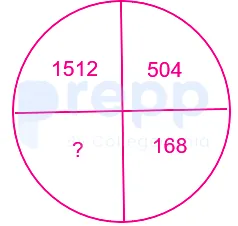
- A
53
- B
56
- C
59
- D
66
Show answer
B. 561512 ÷ 168 = 9
504 ÷ 56 = 9
Hence 56 is the correct answer.
Paper & answer key PDF ↗ Question 17archived
How many triangles are there in the given figure?

- A
14
- B
15
- C
17
- D
18
Show answer
C. 17The given figure has 17 triangles in total.
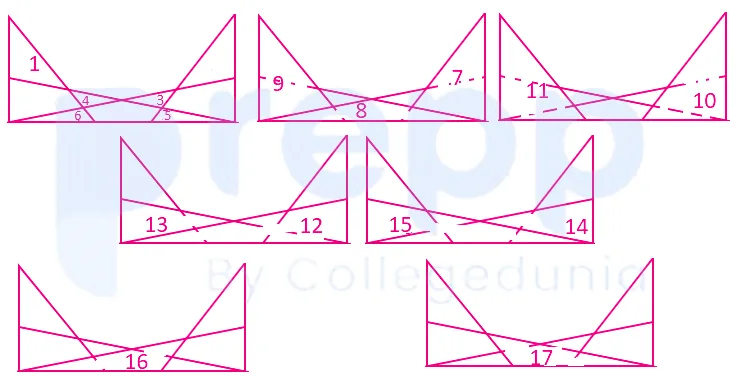 Paper & answer key PDF ↗
 Question 18archived
In the following question below are given some statements followed by some conclusions. Taking the given statements to be true even if they seem to be at variance from commonly known facts, read all the conclusions and then decide which of the given conclusion logically follows the given statements.
Statements:
I. Some pens are pencils.
II. All pencils are erasers.
Conclusions:
I. Some pencils are not pens.
II. Some erasers are not pens.
- A
Some pencils are not pens.
- B
Only conclusion (II) follows.
- C
Neither conclusion (I) nor conclusion (II) follows.
- D
Both conclusions follow.
Show answer
C. Neither conclusion (I) nor conclusion (II) follows.Statements: Some pens are pencils (\(P \cap C \neq \varnothing\)); All pencils are erasers (\(C \subseteq E\)).
Conclusion I — Some pencils are not pens: A possibility diagram where the whole set of pencils sits inside pens (\(C \subseteq P\)) still satisfies both statements. In that case every pencil is a pen, so "some pencils are not pens" need not be true. Hence I does not follow.
Conclusion II — Some erasers are not pens: Nothing forces any eraser to lie outside pens. A diagram in which all erasers are pens (\(E \subseteq P\)) with \(C \subseteq E\) still satisfies both premises. Hence II does not follow either.
Therefore neither conclusion follows, matching option 3.
Paper & answer key PDF ↗ Question 19archived
Three positions of cube are shown below. What will come opposite to face containing '4'?
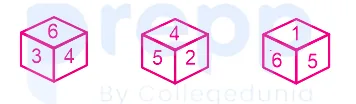
- A
1
- B
2
- C
4
- D
5
Show answer
A. 1The four sides adjacent to face containing ‘4’ are faces containing ‘5’, ‘2’, ‘6’, and ‘3’. Thus the side opposite to ‘4’ is ‘1’.
Paper & answer key PDF ↗ Question 20archived
Identify the diagram that best represents the relationship among the given classes.
Music Instrument, Piano, Guitar
- A
Option A (shown in image)
- B
Option B (shown in image)
- C
Option C (shown in image)
- D
Option D (shown in image)
Show answer
B. Option B (shown in image)Piano and Guitar are two types of music instruments. Thus, option figure 2 is correct.
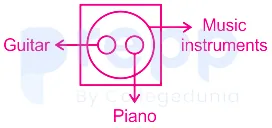 Paper & answer key PDF ↗
 Question 21archived
Which answer figure will complete the pattern in the following question figure?

- A
Option A (shown in image)
- B
Option B (shown in image)
- C
Option C (shown in image)
- D
Option D (shown in image)
Show answer
C. Option C (shown in image)The final pattern will be as shown in below,
Thus image 3) completes the given pattern.
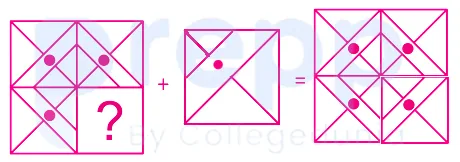 Paper & answer key PDF ↗
 Question 22archived
From the given answer figures, select the one in which the question figure is hidden/embedded.

- A
Option A (shown in image)
- B
Option B (shown in image)
- C
Option C (shown in image)
- D
Option D (shown in image)
Show answer
A. Option A (shown in image)On close observation, we find that fig. 1 is embedded in question figure as shown below:
Hence, Image of option 1) is correct answer.
 Paper & answer key PDF ↗
 Question 23archived
A piece of paper is folded and punched as shown below in the question figures. From the given answer figures, indicate how it will appear when opened?
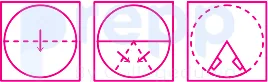
- A
Option A (shown in image)
- B
Option B (shown in image)
- C
Option C (shown in image)
- D
Option D (shown in image)
Show answer
D. Option D (shown in image)The paper cutting folding image is given below:
Hence, the correct answer is option 4.
 Paper & answer key PDF ↗
 Question 24archived
If the mirror is placed on the line AB, then which of the answer figure is the right image of the given figure?
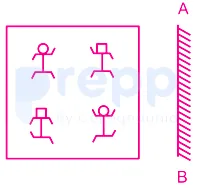
- A
Option A (shown in image)
- B
Option B (shown in image)
- C
Option C (shown in image)
- D
Option D (shown in image)
Show answer
B. Option B (shown in image)The archived key marks Option 2 as correct; a worked explanation is not included in this transcription.
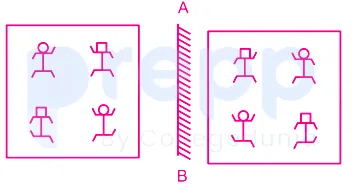 Paper & answer key PDF ↗
 Question 25archived
A word is represented by only one set of numbers as given in any one pf the alternatives. The sets of numbers given in the alternatives are represented by two classes of alphabets as shown in the given two matrices. The columns and rows of Matrix-I are numbered from 0 to 4 and that of Matrix-II are numbered from 5 to 9. A letter from these matrices can be represented first by its row and next by its column, for example, ‘K’ can be represented by 10, 31, etc., and ‘M’ can be represented by 76, 87, etc. Similarly, you have to identify the set for the word “SCAM”.
Matrix - I
Matrix - II
0
1
2
3
4
5
6
7
8
9
0
S
P
K
N
C
5
I
R
A
J
M
1
K
S
C
P
N
6
J
M
R
A
I
2
P
C
N
S
K
7
J
M
R
A
I
3
N
K
S
C
P
8
R
A
M
I
J
4
C
N
P
K
S
9
M
I
J
R
A
- A
00, 13, 57, 76
- B
11, 04, 86, 59
- C
23, 22, 99, 95
- D
32, 40, 66, 68
Show answer
B. 11, 04, 86, 59Locate each letter in the matrices (row, column).
S in Matrix-I: 00, 11, 23, 32, 44. C in Matrix-I: 04, 12, 21, 33, 40. A in Matrix-II: 57, 68, 78, 86, 95. M in Matrix-II: 59, 66, 75, 87, 99.
Option 2 gives S=11, C=04, A=86, M=59 — all valid. The other options contain at least one invalid code. Hence the code for SCAM is 11, 04, 86, 59.
Paper & answer key PDF ↗ Question 26archived
Who gave the 'General Equilibrium Theory'?
- A
J. M. Keynes
- B
Leon Walras
- C
David Ricardo
- D
Adam Smith
Show answer
B. Leon WalrasThe General Equilibrium Theory was formulated by the French economist Leon Walras in his work Éléments d'économie politique pure (1874). He modelled the economy as a system of simultaneous equations showing that all markets can clear together at one set of prices.
Adam Smith and David Ricardo are classical economists who predate the theory, and J. M. Keynes is associated with macroeconomic aggregate-demand analysis.
Paper & answer key PDF ↗ Question 27archived
Which of the following is not true about a Demand Draft?
- A
It is a negotiable instrument.
- B
It is a banker's cheque.
- C
It may be dishonoured for lack of funds.
- D
It is issued by a bank.
Show answer
C. It may be dishonoured for lack of funds.A Demand Draft is a pre-paid banker's instrument: the bank collects the full amount upfront and then issues the draft, so payment is guaranteed by the bank itself.
Hence it cannot be dishonoured for lack of funds — the funds are already with the bank. The other statements are true: a DD is a negotiable instrument, is a banker's cheque, and is issued only by a bank.
Paper & answer key PDF ↗ Question 28archived
Who administers the oath to the President of India?
- A
Governor General of India
- B
Chief Justice of India
- C
Prime Minister of India
- D
Vice President of India
Show answer
B. Chief Justice of IndiaUnder Article 60 of the Constitution of India, the oath of office to the President is administered by the Chief Justice of India; in his absence, the senior-most available Judge of the Supreme Court administers it.
The Governor General's office ended in 1950, while the Prime Minister and Vice President have no constitutional role in the President's oath.
Paper & answer key PDF ↗ Question 29archived
Who among the following gave monistic theory of sovereignty?
- A
Austin
- B
Darwin
- C
Aristotle
- D
Marx
Show answer
A. AustinJohn Austin, the 19th-century British jurist, propounded the monistic (or legal/absolute) theory of sovereignty. He held that sovereignty resides in a determinate human superior who is habitually obeyed by the bulk of society and is not himself obedient to any higher authority; law is simply the command of this sovereign backed by sanctions.
Darwin (biologist), Aristotle (political philosophy of the polis, not sovereignty), and Marx (class-struggle theory of the state) are not associated with the monistic theory.
Paper & answer key PDF ↗ Question 30archived
Which one is the correct chronological order of the following events?
I. Quit India Movement
II. Shimla Conference
III. Poona Pact
IV. Cabinet Mission
- A
II, IV, I, III
- B
III, IV, II, I
- C
III, I, II, IV
- D
IV, II, III, I
Show answer
C. III, I, II, IVMatch each event to its year: III. Poona Pact — 1932; I. Quit India Movement — 1942; II. Shimla Conference — 1945; IV. Cabinet Mission — 1946.
Arranging chronologically (earliest to latest): 1932 → 1942 → 1945 → 1946, which corresponds to III, I, II, IV.
Paper & answer key PDF ↗ Question 31archived
In 1917, which movement was launched by Mahatma Gandhi from Champaran?
- A
Satyagraha
- B
Non cooperation movement
- C
Quit India movement
- D
Swadeshi Movement
Show answer
A. SatyagrahaIn 1917, Mahatma Gandhi launched the Champaran Satyagraha in Bihar to support indigo cultivators oppressed by the British tinkathia system, under which peasants were forced to grow indigo on 3/20th of their land on unfair terms. It was Gandhi's first application of Satyagraha (truth-force, non-violent resistance) on Indian soil.
The Non-Cooperation Movement (1920), Quit India Movement (1942) and Swadeshi Movement (1905, post-Bengal Partition) all came later and from different locations.
Paper & answer key PDF ↗ Question 32archived
What is the name of the tropical cyclones in the China Sea?
- A
Hurricanes
- B
Tornado
- C
Twister
- D
Typhoon
Show answer
D. TyphoonTropical cyclones in the Northwest Pacific Ocean, including the China Sea, Japan and the Philippines, are called Typhoons.
Hurricanes are the equivalent storms in the North Atlantic and Northeast Pacific; tornadoes (also called twisters) are violently rotating land-based air columns, much smaller in scale than tropical cyclones and unrelated to the China Sea naming convention.
Paper & answer key PDF ↗ Question 33archived
Which among the following country is not a part of Scandinavia?
- A
Norway
- B
Finland
- C
Sweden
- D
Denmark
Show answer
B. FinlandScandinavia, in its standard definition, comprises the three kingdoms of Denmark, Norway and Sweden — countries that share the closely related North Germanic languages (Danish, Norwegian, Swedish) and a common historical-cultural heritage.
Finland is part of the broader Nordic group but is excluded from Scandinavia proper because Finnish is a Uralic language unrelated to the North Germanic family, and Finland's political history is distinct. Hence Finland is the odd one out.
Paper & answer key PDF ↗ Question 34archived
Cattle quickly swallow grass and store it in their _________.
- A
Rumen
- B
Oesophagus
- C
Small intestine
- D
Salivary glands
Show answer
A. RumenCattle are ruminants with a four-chambered stomach (rumen, reticulum, omasum, abomasum). They swallow grass quickly with minimal chewing and store it in the largest first chamber, the rumen, where microbial fermentation breaks down cellulose. The partly digested mass (cud) is later regurgitated, re-chewed and re-swallowed.
The oesophagus is only a passageway; the small intestine handles absorption after full digestion; salivary glands secrete saliva but store nothing.
Paper & answer key PDF ↗ Question 35archived
Which of the following carries oxygen to various parts of human body?
- A
Red blood cells
- B
White blood cells
- C
Plasma
- D
Nerves
Show answer
A. Red blood cellsRed blood cells (erythrocytes) carry oxygen throughout the body. They contain haemoglobin, an iron-containing protein that binds oxygen in the lungs (where partial pressure is high) and releases it to tissues (where partial pressure is low).
White blood cells are immune cells; plasma is mostly a transport medium for nutrients, hormones and wastes (only a tiny fraction of oxygen dissolves in it); nerves transmit electrical signals, not gases.
Paper & answer key PDF ↗ Question 36archived
Which of the following function is performed by the kidneys in the human body?
- A
Excretion
- B
Respiration
- C
Digestion
- D
Transportation
Show answer
A. ExcretionThe kidneys perform excretion — they filter blood to remove metabolic wastes such as urea, creatinine, excess salts and water, eliminating them as urine. They also help regulate blood pressure, electrolyte and water balance.
Respiration (gas exchange) is performed by the lungs; digestion by the alimentary canal and accessory glands; transportation by the circulatory system. None of these are primary kidney functions.
Paper & answer key PDF ↗ Question 37archived
The bending of light when it passes around a corner or a slit is due to ______.
- A
Reflection
- B
Refraction
- C
Diffraction
- D
Total internal reflection
Show answer
C. DiffractionThe bending or spreading of light around the edges of an obstacle or through a narrow slit is called diffraction. It is a characteristic wave phenomenon and becomes appreciable when the size of the slit or obstacle is comparable to the wavelength \(\lambda\) of light.
Reflection is bouncing off a surface; refraction is bending while changing media; total internal reflection is complete reflection inside a denser medium beyond the critical angle — none describe bending around a corner or slit.
Paper & answer key PDF ↗ Question 38archived
What is the reason for formation of Mirage in desert?
- A
Refraction of light
- B
Reflection of light
- C
Both Refraction and Total internal reflection of light
- D
Total internal reflection of light
Show answer
C. Both Refraction and Total internal reflection of lightIn a desert, the ground heats the air just above it, creating a stack of air layers whose density (and refractive index) increases with height. Light from the sky travelling downward repeatedly bends away from the normal as it enters successively rarer (hotter) layers — this is continuous refraction.
Eventually the angle of incidence exceeds the critical angle \(\theta_c\), where \(\sin\theta_c = \dfrac{n_2}{n_1}\), and the ray undergoes total internal reflection, curving back up to the observer's eye. The brain projects it straight, producing the watery image on the sand.
Hence a mirage involves both refraction and total internal reflection of light.
Paper & answer key PDF ↗ Question 39archived
FORTRAN is not used for _________.
(I) drawing pictures
(II) Carrying out mathematics computations
- A
Only (I)
- B
Only (II)
- C
Both (I) and (II)
- D
Neither (I) nor (II)
Show answer
A. Only (I)FORTRAN (FORmula TRANslation), developed by IBM in the 1950s, was purpose-built for scientific and mathematical computation — numerical analysis, simulations, weather forecasting, engineering calculations — so statement (II) describes a core use.
It has no native graphics capability and is not designed for drawing pictures, making statement (I) the task FORTRAN is not used for. Therefore the correct choice is Only (I).
Paper & answer key PDF ↗ Question 40archived
Which of the following bonds are weakest in nature?
- A
Single bond
- B
Double bond
- C
Triple bond
- D
Hydrogen bond
Show answer
D. Hydrogen bondBond strength is measured by the energy needed to break the bond. Covalent single, double and triple bonds are intramolecular and very strong — typical C–C, C=C and C≡C bond energies are roughly \(347,\ 614\ \text{and}\ 839\ \text{kJ/mol}\) respectively.
A hydrogen bond is an intermolecular attraction between an H bonded to a highly electronegative atom (N, O, F) and another electronegative atom. Its energy is only about \(10\text{–}40\ \text{kJ/mol}\) — an order of magnitude weaker than any covalent bond listed. Hence the hydrogen bond is the weakest.
Paper & answer key PDF ↗ Question 41archived
In the following reaction, fill in the blank.
Acid + Base → _______ + Water
- A
Carbon dioxide
- B
Metal Oxide
- C
Hydrogen Gas
- D
Salt
Show answer
D. SaltA neutralisation reaction follows the general pattern: Acid + Base → Salt + Water. The \(H^+\) from the acid combines with \(OH^-\) from the base to give water, while the remaining cation of the base and anion of the acid form a salt.
Example: \(HCl + NaOH \rightarrow NaCl + H_2O\). Hence the blank is Salt. Carbon dioxide forms only when acids react with carbonates; hydrogen gas evolves with active metals, not bases.
Paper & answer key PDF ↗ Question 42archived
Bishnoi movement was started against which of the following?
- A
Cutting of Trees
- B
Inequality of Women
- C
Killing of Animals
- D
Increasing Pollution
Show answer
A. Cutting of TreesThe Bishnoi movement is rooted in the protection of trees, particularly the sacred Khejri tree. In 1730, at Khejarli village near Jodhpur, 363 Bishnois led by Amrita Devi sacrificed their lives hugging trees to stop the Maharaja of Marwar's soldiers from felling them for a new palace.
The movement was therefore primarily started against the cutting of trees. While Bishnoi principles also forbid killing animals, the defining historical trigger was tree-felling, not hunting or pollution.
Paper & answer key PDF ↗ Question 43archived
What is the major aim of Pradhan Mantri Ujjwala Yojana?
- A
To provide electricity
- B
To provide LED bulbs
- C
To provide LPG connections
- D
To construct village roads
Show answer
C. To provide LPG connectionsThe Pradhan Mantri Ujjwala Yojana (PMUY), launched on 1 May 2016 by the Ministry of Petroleum & Natural Gas, aims to provide free LPG connections to women from BPL households. Its goal is to replace polluting traditional fuels (firewood, dung) with clean cooking gas, improving women's health and reducing indoor air pollution.
Electricity falls under Saubhagya Yojana, LED bulbs under UJALA, and village roads under PMGSY — none relate to Ujjwala.
Paper & answer key PDF ↗ Question 44archived
Who invented television?
- A
Michael Faraday
- B
Joseph Henry
- C
Abbe Caselli
- D
John Logie Baird
Show answer
D. John Logie BairdJohn Logie Baird, a Scottish engineer, gave the first public demonstration of a working television system in London in 1926, transmitting moving silhouette images using a mechanical Nipkow disk. He is widely credited as the inventor of television.
Faraday and Joseph Henry are associated with electromagnetic induction, and Giovanni Caselli built the pantelegraph (an early fax), not television.
Paper & answer key PDF ↗ Question 45archived
How many players are there in a team of Volleyball?
- A
8
- B
4
- C
6
- D
5
Show answer
C. 6In standard indoor volleyball, each team fields 6 players on the court at a time — three in the front row and three in the back row — as per FIVB rules. Substitutes sit on the bench but are not on court simultaneously.
Basketball uses 5, kabaddi uses 7; the volleyball figure is 6. Beach volleyball (a variant) has 2 per side, but the standard format referenced here is 6.
Paper & answer key PDF ↗ Question 46archived
Match the following.
Temple
Lord
1. Lingaraja Temple, Odisha
a. Lord Mahavira
2. Tijara Mandir, Rajasthan
b. Lord Vishnu
3. Venketeswara Temple, Tirupati
c. Lord Shiva
- A
1 - b, 2 - c, 3 - a
- B
1 - c, 2 - a, 3 - b
- C
1 - a, 2 - c, 3 - b
- D
1 - b, 2 - a, 3 - c
Show answer
B. 1 - c, 2 - a, 3 - bMatching each temple with its presiding deity:
1. Lingaraja Temple, Bhubaneswar (Odisha) — dedicated to Lord Shiva (as Harihara) → c.
2. Tijara Mandir, Alwar (Rajasthan) — a Digambar Jain temple of Chandraprabha, associated with the Jain tradition of Lord Mahavira → a.
3. Venkateswara Temple, Tirupati — dedicated to Lord Venkateswara, a form of Lord Vishnu → b.
Hence the correct combination is 1–c, 2–a, 3–b.
Paper & answer key PDF ↗ Question 47archived
Who among the following has been recently awarded with ‘Indian of the year’ award?
- A
Sunita Rani
- B
Dhiraj Singh
- C
Preeti Shenoy
- D
Abhishek Kumar
Show answer
C. Preeti ShenoyAmong the listed names, author Preeti Shenoy — one of India's bestselling English-language fiction writers — was recognised with the 'Indian of the Year' honour by a leading media platform for her literary contributions. Sunita Rani is an athlete, while Dhiraj Singh and Abhishek Kumar are not linked to this award.
Paper & answer key PDF ↗ Question 48archived
Who is the author of the book titled 'Selection Day'?
- A
Aravind Adiga
- B
Anil Menon
- C
Krishna Sobti
- D
Arunava Sinha
Show answer
A. Aravind AdigaSelection Day (2016) is a novel by Aravind Adiga, the Booker-winning author of The White Tiger. Set in Mumbai, it follows two brothers groomed to be cricket prodigies and explores class, ambition and modern Indian society. It was later adapted into a Netflix series.
Anil Menon writes science fiction, Krishna Sobti was a Hindi novelist, and Arunava Sinha is a Bengali-to-English translator — none of them wrote Selection Day.
Paper & answer key PDF ↗ Question 49archived
Which of the following country is not a member of BRICS association?
- A
Brazil
- B
Russia
- C
Iceland
- D
China
Show answer
C. IcelandBRICS originally stood for Brazil, Russia, India, China and South Africa (added in 2010). Brazil, Russia and China are all founding members.
Iceland is a Nordic European country and has never been part of BRICS, making it the odd one out.
Paper & answer key PDF ↗ Question 50archived
With which of its neighbouring country India has Kalapani territorial dispute?
- A
Nepal
- B
Bangladesh
- C
Pakistan
- D
Sri Lanka
Show answer
A. NepalThe Kalapani region lies at the tri-junction of India, Nepal and China in Uttarakhand's Pithoragarh district. India administers it, but Nepal claims it as part of Darchula district. The dispute arises from differing interpretations of the source of the Kali River, the boundary fixed by the 1816 Treaty of Sugauli.
Hence Kalapani is a territorial dispute between India and Nepal. Bangladesh, Pakistan and Sri Lanka are unrelated to this particular issue.
Paper & answer key PDF ↗ Question 51archived
Which value among \(\sqrt[3]{5},\sqrt[4]{6},\;\sqrt[6]{{12}},\sqrt[{12}]{{276}}\) is the largest?
- A
\(\sqrt[3]{5}\)
- B
\(\sqrt[4]{6}\)
- C
\(\sqrt[6]{{18}}\)
- D
\(\sqrt[6]{{12}}\)
Show answer
A. \(\sqrt[3]{5}\)Step 1 — Take LCM of indices: The roots are 3, 4, 6, 12. LCM = 12. Raise every term to the 12th power to compare.
\((\sqrt[3]{5})^{12}=5^{4}=625\)
\((\sqrt[4]{6})^{12}=6^{3}=216\)
\((\sqrt[6]{12})^{12}=12^{2}=144\)
\((\sqrt[{12}]{276})^{12}=276\)
Step 2 — Compare: 625 > 276 > 216 > 144. The largest is 625, corresponding to \(\sqrt[3]{5}\).
Therefore \(\sqrt[3]{5}\) is the largest.
Paper & answer key PDF ↗ Question 52archived
A piece of work was finished by A, B and C together. A and B together finished 60% of the work and B and C together finished 70% of the work. Who among the three is most efficient?
- A
A
- B
B
- C
C
- D
A or B
Show answer
C. CStep 1 — Find C's share: A + B did 60%, so C did \(100\%-60\%=40\%\).
Step 2 — Find A's share: B + C did 70%, so A did \(100\%-70\%=30\%\).
Step 3 — Find B's share: \(B = 60\%-30\% = 30\%\).
Step 4 — Compare: A = 30%, B = 30%, C = 40%. Since all worked for the same duration, efficiency is proportional to work done.
Therefore C is the most efficient.
Paper & answer key PDF ↗ Question 53archived
Three solid spheres of radius 3 cm, 4 cm and 5 cm are melted and re-casted into a solid sphere. What will be the percentage decrease in the surface area?
- A
12%
- B
14%
- C
16%
- D
28%
Show answer
D. 28%Step 1 — New sphere radius (volume conserved):
\[r_{new}^3 = 3^3+4^3+5^3 = 27+64+125 = 216 \implies r_{new}=6 \text{ cm}\]
Step 2 — Surface areas:
Initial total \(=4\pi(3^2+4^2+5^2)=4\pi(50)=200\pi\) cm2. Final \(=4\pi(6^2)=144\pi\) cm2.
Step 3 — Percentage decrease:
\[\frac{200\pi-144\pi}{200\pi}\times 100=\frac{56}{200}\times 100=28\%\]
Therefore the surface area decreases by 28%.
Paper & answer key PDF ↗ Question 54archived
The marked price of a sofa set is Rs 4800 which is sold at Rs 3672 at two successive discounts. If the first discount is 10%, then what will be the second discount (in %)?
- A
13
- B
14
- C
15
- D
17
Show answer
C. 15Step 1 — Price after first 10% discount:
\[4800\times(1-0.10)=4800\times 0.9=4320\]
Step 2 — Second discount amount: \(4320-3672=648\).
Step 3 — Second discount percentage (on 4320):
\[\frac{648}{4320}\times 100=\frac{3}{20}\times 100=15\%\]
Therefore the second discount is 15%.
Paper & answer key PDF ↗ Question 55archived
A, B and C invested amounts in the ratio 3 : 4 : 5 respectively. If the schemes offered compound interest at the rate of 20% per annum, 15% per annum and 10% per annum respectively, then what will be the ratio of their interest after 1 year?
- A
3 : 15 : 25
- B
6 : 6 : 5
- C
36 : 46 : 55
- D
12 : 23 : 11
Show answer
B. 6 : 6 : 5For exactly 1 year with annual compounding, CI equals SI, so interest \(=\dfrac{P\cdot R}{100}\), i.e. proportional to \(P\times R\).
Take principals as 3, 4, 5 and rates 20, 15, 10:
\(3\times 20 : 4\times 15 : 5\times 10 = 60:60:50 = 6:6:5\)
Therefore the ratio of interests is 6 : 6 : 5.
Paper & answer key PDF ↗ Question 56archived
The average age of 120 members of a society is 60.7 years. By addition of 30 new members, the average age becomes 56.3 years. What is the average age (in years) of newly joined members?
- A
36.5
- B
37.2
- C
38.3
- D
38.7
Show answer
D. 38.7Step 1 — Total ages:
Initial: \(120\times 60.7=7284\). After addition: \(150\times 56.3=8445\).
Step 2 — Sum of ages of 30 new members:
\[8445-7284=1161\]
Step 3 — Average of new members:
\[\frac{1161}{30}=38.7 \text{ years}\]
Therefore the average age of the new members is 38.7 years.
Paper & answer key PDF ↗ Question 57archived
By selling 175 pineapples, the gain is equal to the selling price of 50 pineapples. What is the gain percentage?
- A
28
- B
30
- C
32
- D
40
Show answer
D. 40Let SP and CP be per pineapple. Gain on 175 pineapples \(=175\,SP-175\,CP\), and this equals \(50\,SP\).
\[175\,SP-175\,CP=50\,SP \implies 125\,SP=175\,CP \implies \frac{SP}{CP}=\frac{7}{5}\]
Gain on one item \(=SP-CP=\tfrac{2}{5}CP\), so
\[\text{Gain }\%=\frac{2/5\,CP}{CP}\times 100=40\%\]
Therefore the gain percentage is 40%.
Paper & answer key PDF ↗ Question 58archived
If A has got 20% more marks than B, then by what percent marks of B are less than the marks of A?
- A
16.66
- B
20
- C
33.33
- D
14.28
Show answer
A. 16.66Let B = 100. Then A \(=100+20=120\).
Percentage by which B is less than A (base = A):
\[\frac{A-B}{A}\times 100=\frac{20}{120}\times 100=\frac{100}{6}\approx 16.66\%\]
Therefore B's marks are 16.66% less than A's. Equivalently, using \(\frac{x}{100+x}\times 100=\frac{20}{120}\times 100\).
Paper & answer key PDF ↗ Question 59archived
A train leaves Delhi at 10 a.m. and reaches Jaipur at 4 p.m. on same day. Another train leaves Jaipur at 12 p.m. and reaches Delhi at 5 p.m. on same day. What is the time of day (approximately) when the two trains will meet?
- A
1 : 42 p.m.
- B
1 : 27 p.m.
- C
2 : 04 p.m.
- D
1 : 49 p.m.
Show answer
D. 1 : 49 p.m.Let distance be \(D\). Speeds: \(S_1=D/6\) (Delhi→Jaipur), \(S_2=D/5\) (Jaipur→Delhi).
Step 1 — Gap at 12 p.m.: Train 1 has run 2 hours, covering \(2\cdot D/6=D/3\). Remaining gap \(=2D/3\).
Step 2 — Relative speed (opposite directions):
\[S_1+S_2=\frac{D}{6}+\frac{D}{5}=\frac{11D}{30}\]
Step 3 — Time to meet after 12 p.m.:
\[t=\frac{2D/3}{11D/30}=\frac{20}{11}\text{ hr}=1\text{ hr }\tfrac{540}{11}\text{ min}\approx 1\text{ hr }49\text{ min}\]
Therefore they meet at approximately 1:49 p.m.
Paper & answer key PDF ↗ Question 60archived
The difference between the compound interest compounding half yearly for 1 year and the simple interest for 1 year on a certain sum of money lent out at 8% per annum is Rs 64. What is the sum (in Rs)?
- A
40000
- B
42000
- C
44000
- D
44800
Show answer
A. 40000For half-yearly compounding at 8% p.a. for 1 year, rate per period = 4%, periods = 2.
Step 1 — Express CI and SI:
\[CI=P\left[\left(1+\tfrac{4}{100}\right)^2-1\right]=P\cdot\tfrac{51}{625},\quad SI=\tfrac{P\cdot 8\cdot 1}{100}=\tfrac{50P}{625}\]
Step 2 — Apply the difference:
\[CI-SI=\frac{51P-50P}{625}=\frac{P}{625}=64\]
\[P=64\times 625=40000\]
Therefore the sum is Rs 40,000.
Paper & answer key PDF ↗ Question 61archived
If (x – 2) and (x + 3) are the factors of the equation x 2+ k 1x + k 2= 0, then what are the values of k 1 and k 2?
- A
k1 = 6, k2 = -1
- B
k1 = 1, k2 = -6
- C
k1 = 1, k2 = 6
- D
k1 = -6, k2 = 1
Show answer
B. k1 = 1, k2 = -6If \((x-2)\) and \((x+3)\) are factors of the monic quadratic, then
\[(x-2)(x+3)=x^2+x-6\]
Comparing with \(x^2+k_1 x+k_2=0\): \(k_1=1\) and \(k_2=-6\).
Therefore \(k_1=1,\ k_2=-6\).
Paper & answer key PDF ↗ Question 62archived
If (x - y) = 7, then what is the value of (x - 15) 3 - (y - 8) 3?
- A
0
- B
343
- C
392
- D
2863
Show answer
A. 0Let \(A=x-15\) and \(B=y-8\). Then
\[A-B=(x-15)-(y-8)=(x-y)-7=7-7=0\]
So \(A=B\), which gives \(A^3-B^3=0\).
Therefore \((x-15)^3-(y-8)^3=\mathbf{0}\).
Paper & answer key PDF ↗ Question 63archived
If x – y – √18 = -1 and x + y – 3√2 = 1, what is the value of 12xy(x 2 – y 2)?
- A
0
- B
1
- C
512√2
- D
612√2
Show answer
D. 612√2Given: x – y = –1 + √18 ----(i)
⇒ x + y = 1 + 3√2 ----(ii)
Multiplying (i) and (ii) . We get
⇒ x 2 – y 2= (–1 + √18) (1 + 3√2)
⇒ x 2 – y 2= -1 + 18 = 17
Now, from (i) and (ii)
⇒ x = 3√2 and y = 1
So, 12xy = 12(3√2) = 36√2
∴ Required value = 12xy(x 2 – y 2) = (36√2) (17) = 612√2
Paper & answer key PDF ↗ Question 64archived
If p/q = r/s = t/u = √5, then what is the value of [(3p 2+ 4r 2+ 5t 2) /(3q 2+ 4s 2+ 5u 2) ]?
- A
1/5
- B
5
- C
25
- D
60
Show answer
B. 5Since \(\dfrac{p}{q}=\dfrac{r}{s}=\dfrac{t}{u}=\sqrt{5}\), squaring gives \(p^2=5q^2,\ r^2=5s^2,\ t^2=5u^2\).
Substitute into the numerator:
\[3p^2+4r^2+5t^2=5\bigl(3q^2+4s^2+5u^2\bigr)\]
\[\therefore\ \frac{3p^2+4r^2+5t^2}{3q^2+4s^2+5u^2}=\mathbf{5}\]
Paper & answer key PDF ↗ Question 65archived
In triangle ABC, a perpendicular line is drawn from the vertex A to a point D on BC. If BC = 9 cm and DC = 3 cm, then what is the ratio of the areas of triangle ABD and triangle ADC respectively?
- A
1 : 1
- B
2 : 1
- C
3 : 1
- D
4 : 1
Show answer
B. 2 : 1AD is a common altitude of both triangles ABD and ADC, with bases BD and DC on the same line.
Step 1 — Find BD: \(BD=BC-DC=9-3=6\) cm.
Step 2 — Equal heights, so areas in ratio of bases:
\[\frac{[\triangle ABD]}{[\triangle ADC]}=\frac{BD}{DC}=\frac{6}{3}=\frac{2}{1}\]
Therefore the ratio is 2 : 1.
Paper & answer key PDF ↗ Question 66archived
PQR is a right angled triangle in which ∠R = 90°. If RS ⊥ PQ, PR = 3 cm and RQ = 4 cm, then what is the value of RS (in cm)?
- A
12/5
- B
36/5
- C
5
- D
2.5
Show answer
A. 12/5Step 1 — Find hypotenuse PQ:
\(PQ=\sqrt{PR^2+RQ^2}=\sqrt{9+16}=5\) cm.
Step 2 — Equate two area expressions:
Area \(=\tfrac{1}{2}\cdot PR\cdot RQ=\tfrac{1}{2}\cdot PQ\cdot RS\).
\[\tfrac{1}{2}\cdot 3\cdot 4=\tfrac{1}{2}\cdot 5\cdot RS\implies RS=\dfrac{12}{5}\text{ cm}\]
Therefore RS = 12/5 cm.
Paper & answer key PDF ↗ Question 67archived
In triangle PQR, A is the point of intersection of all the altitudes and B is the point of intersection of all the angle bisectors of the triangle. If ∠PBR = 105°, then what is the value of ∠PAR (in degrees)?
- A
60
- B
150
- C
105
- D
115
Show answer
B. 150For the incentre B, the standard result is \(\angle PBR=90^\circ+\tfrac{1}{2}\angle Q\). For the orthocentre A, \(\angle PAR=180^\circ-\angle Q\).
Step 1 — Find ∠Q:
\(105^\circ=90^\circ+\tfrac{1}{2}\angle Q\implies \angle Q=30^\circ\).
Step 2 — Apply orthocentre formula:
\(\angle PAR=180^\circ-30^\circ=150^\circ\).
Therefore ∠PAR = 150°.
Paper & answer key PDF ↗ Question 68archived
If there are 4 lines in a plane, then what cannot be the number of points of intersection of these lines?
- A
0
- B
5
- C
4
- D
7
Show answer
D. 7The maximum number of intersection points for 4 lines (no two parallel, no three concurrent) is \(\binom{4}{2}=6\).
Achievable counts are 0 (all parallel), 1 (all concurrent), 3 (three parallel + one transversal), 4 (two pairs of parallels, or three concurrent + one separate), 5 (two parallel + two intersecting them and each other), and 6 (general position).
Since 7 exceeds the maximum 6, 7 cannot occur.
Paper & answer key PDF ↗ Question 69archived
What is the simplified value of cosec 2A + cot 2A?
- A
sec A
- B
sec (A/2)
- C
cot A
- D
cot 2A
Show answer
C. cot ARewrite using sine and cosine:
\[\operatorname{cosec}2A+\cot 2A=\dfrac{1+\cos 2A}{\sin 2A}\]
Apply \(1+\cos 2A=2\cos^2 A\) and \(\sin 2A=2\sin A\cos A\):
\[\dfrac{2\cos^2 A}{2\sin A\cos A}=\dfrac{\cos A}{\sin A}=\cot A\]
Therefore the expression simplifies to cot A.
Paper & answer key PDF ↗ Question 70archived
If A = 30°, B = 60° and C = 135°, then what is the value of sin 3A + cos 3B + tan 3C – 3sin A cos B tan C?
- A
0
- B
1
- C
8
- D
9
Show answer
A. 0The exponent 3 denotes a power applied to the trig value, not a triple angle. So evaluate \(\sin^3 A+\cos^3 B+\tan^3 C-3\sin A\cos B\tan C\).
With \(\sin 30^\circ=\tfrac{1}{2}\), \(\cos 60^\circ=\tfrac{1}{2}\), \(\tan 135^\circ=-1\):
\[\left(\tfrac{1}{2}\right)^3+\left(\tfrac{1}{2}\right)^3+(-1)^3-3\cdot\tfrac{1}{2}\cdot\tfrac{1}{2}\cdot(-1)=\tfrac{1}{8}+\tfrac{1}{8}-1+\tfrac{3}{4}=0\]
The identity \(a^3+b^3+c^3-3abc=(a+b+c)(\dots)\) with \(a+b+c=\tfrac{1}{2}+\tfrac{1}{2}-1=0\) confirms the value is 0.
Paper & answer key PDF ↗ Question 71archived
What is the least value of tan 2 θ + cot 2 θ + sin 2 θ + cos 2 θ + sec 2 θ + cosec 2 θ?
- A
1
- B
5
- C
3
- D
7
Show answer
D. 7Group using identities. By Pythagoras: \(\sin^2\theta+\cos^2\theta=1\).
By AM-GM with \(\tan^2\theta\cdot\cot^2\theta=1\): \(\tan^2\theta+\cot^2\theta\ge 2\).
Using \(\sec^2\theta=1+\tan^2\theta\) and \(\operatorname{cosec}^2\theta=1+\cot^2\theta\):
\[\sec^2\theta+\operatorname{cosec}^2\theta=2+\tan^2\theta+\cot^2\theta\ge 4\]
All three minima are reached together at \(\theta=45^\circ\), giving total \(1+2+4=\mathbf{7}\).
Paper & answer key PDF ↗ Question 72archived
If Mr. Raghav taught a total of 500 hours, then what is the difference in number of hours of teaching algebra and modern Maths?
- A
15
- B
20
- C
25
- D
40
Show answer
C. 25Number of hours dedicated to algebra = (9/100) x 500 = 45 hours
Number of hours dedicated to modern maths = (4/100) x 500 = 20 hours
∴ difference in number of hours of teaching algebra and modern Maths = 45 – 20 = 25 hours.
Paper & answer key PDF ↗ Question 73archived
Mr. Raghav taught Geometry for 36 hours. If the time taken in teaching Ratio consitutes one-fourth of the time for Arithmetic, then for how much time (in hours) did he taught the topic of Ratio?
- A
46
- B
51.75
- C
69
- D
103.5
Show answer
C. 69Number of hours dedicated to geometry = 36 hours
Since, 36 hours is 6% of the total hours taught
⇒ 1% of total hours = 36/6 = 6 hours
⇒ Total hours = 6 x 100 = 600 hours
Number of hours dedicated to arithmetic = (46/100) (600) = 276 hours
∴ Number of hours dedicated to ratio = 276/4 = 69 hours
Paper & answer key PDF ↗ Question 74archived
If Data Interpretation and Modern Maths were taught for a combined time of 96 hours, then for how much time (in hours) were Number system and Geometry taught?
- A
136
- B
184
- C
216
- D
232
Show answer
D. 232% of time dedicated to Data Interpretation and Modern Maths = 8 + 4 = 12%
⇒ Given : 12% of total hours = 96 hours
⇒ 1% of total hours = 96/12 = 8hours
Hence, total hours = 8 x 100 = 800 hours
⇒ % time dedicated to Number system and Geometry taught = 23 + 6 = 29%
So, total hours dedicated to Number system and Geometry = 800 x (29/100) = 232 hrs
∴ answer is 232 hours
Paper & answer key PDF ↗ Question 75archived
A new topic named Problem Solving was also introduced and it was decided that 10% time of all topics except Arithmetic will be devoted to it. What will be the central angle (in degrees) made by Problem Solving in the new pie chart?
- A
17.28
- B
18
- C
19.44
- D
36
Show answer
C. 19.44% left after removing arithmetic = 100 – 46 = 54%
⇒ 10% of the left percentage is dedicated to problem solving
⇒ % dedicated to problem solving = (10/100) x 54 = 5.4%
∴ the central angle = (5.4/100) x 360° = 19.44°
Paper & answer key PDF ↗ Question 76archived
In the following question, some part of the sentence may have errors. Find out which part of the sentence has an error and select the appropriate option. If a sentence is free from error, select ‘No error’.
If you had (1)/ told me earlier (2)/ I will help you. (3)/ No Error (4)
- A
1
- B
2
- C
3
- D
4
Show answer
C. 3The 'if' clause uses past perfect ("If you had told me earlier"), which sets up the third conditional. The main clause must therefore take "would have + past participle", not the simple future "will help".
The error lies in part (3) "I will help you"; the correct form is "I would have helped you."
Paper & answer key PDF ↗ Question 77archived
In the following question, some part of the sentence may have errors. Find out which part of the sentence has an error and select the appropriate option. If a sentence is free from error, select ‘No error’.
Her mother is (1)/ angry and (2)/ indifferent to me. (3)/ No Error (4)
- A
1
- B
2
- C
3
- D
4
Show answer
B. 2Adjective-preposition collocations differ here: "angry" pairs with with (a person), while "indifferent" pairs with to. The sentence forces both adjectives to share "to me", which is wrong for "angry".
The fix is "angry with and indifferent to me." Hence the error sits in part (2) "angry and", where the preposition "with" is missing.
Paper & answer key PDF ↗ Question 78archived
In the following question, the sentence is given with blank to be filled in with an appropriate word. Select the correct alternative out of the four and indicate it by selecting the appropriate option.
Don’t loiter _____ the corridor.
- A
around
- B
off
- C
of
- D
at
Show answer
A. around"Loiter" collocates with around to mean lingering aimlessly in or about a place. "Off" and "of" are grammatically wrong with "loiter", and "at" would point to a single spot rather than the length of the corridor.
The correct sentence is "Don't loiter around the corridor."
Paper & answer key PDF ↗ Question 79archived
In the following question, the sentence is given with blank to be filled in with an appropriate word. Select the correct alternative out of the four and indicate it by selecting the appropriate option.
I will scold him when _____.
- A
he will come
- B
he comes
- C
he would come
- D
he had come.
Show answer
B. he comesWhen the main clause is in the simple future ("I will scold him"), a subordinate clause introduced by the temporal conjunction "when" takes the simple present, not "will".
Therefore the correct completion is "he comes": "I will scold him when he comes." "He will come", "he would come" and "he had come" all violate this sequence-of-tenses rule.
Paper & answer key PDF ↗ Question 80archived
In the following question, out of the four alternatives, select the word similar in meaning to the word given.
Mellifluous
- A
Shiver
- B
Frank
- C
Immoral
- D
Dulcet
Show answer
D. DulcetMellifluous means sweet-sounding, smooth and pleasing to the ear (from Latin mel, honey + fluere, to flow).
Dulcet means sweet and soothing, especially of a sound or voice — an exact match. "Shiver" (tremble), "Frank" (candid) and "Immoral" (unethical) bear no relation to sound quality.
Paper & answer key PDF ↗ Question 81archived
In the following question, out of the four alternatives, select the word similar in meaning to the word given.
Dodge
- A
Soften
- B
Order
- C
Avoid
- D
Chaotic
Show answer
C. AvoidDodge means to evade something by a quick movement or by cunning — essentially, to avoid. "He dodged the question" = "He avoided the question."
"Soften" (make less harsh), "Order" (command/arrangement) and "Chaotic" (disordered) carry unrelated meanings, so Avoid is the correct synonym.
Paper & answer key PDF ↗ Question 82archived
In the following question, out of the four alternatives, select the word opposite in meaning to the word given.
Meretricious
- A
Brazen
- B
Natural
- C
Exemplary
- D
Gaudy
Show answer
B. NaturalMeretricious means apparently attractive but lacking real value — gaudy, showy, or artificially flashy. Its antonym must convey genuineness and lack of artificiality.
Natural means unaffected, genuine, and not artificial — the direct opposite of falsely showy. Hence the answer is Natural.
Gaudy is a synonym, not an antonym. Brazen (bold, shameless) and Exemplary (model-worthy) describe unrelated qualities.
Paper & answer key PDF ↗ Question 83archived
In the following question, out of the four alternatives, select the word opposite in meaning to the word given.
Nebulous
- A
Definite
- B
Inchoate
- C
Dismal
- D
Sullen
Show answer
A. DefiniteNebulous means vague, hazy, or ill-defined. Its antonym must convey clarity and precision.
Definite means clearly defined, distinct, and not vague — a direct opposite. Hence the answer is Definite.
Inchoate (just begun, undeveloped) is closer to a synonym than an antonym. Dismal and Sullen describe gloomy moods, unrelated to clarity.
Paper & answer key PDF ↗ Question 84archived
In the following question, out of the four alternatives, select the alternative which best expresses the meaning of the idiom/Phrase.
Spick and Span
- A
High and low
- B
Dark and light
- C
Neat and clean
- D
Happy and sad
Show answer
C. Neat and cleanThe idiom Spick and Span describes something perfectly tidy and clean, free of dirt or clutter.
The phrase that matches this meaning is Neat and clean. High and low means everywhere; Dark and light refers to illumination; Happy and sad refers to emotions — none relate to cleanliness.
Paper & answer key PDF ↗ Question 85archived
In the following question, out of the four alternatives, select the alternative which best expresses the meaning of the idiom/Phrase.
To draw the longbow
- A
To nullify
- B
To exaggerate
- C
To underrate
- D
To demarcate
Show answer
B. To exaggerateThe idiom To draw the longbow means to tell an improbable story or stretch the truth — i.e. to exaggerate.
Hence the correct substitute is To exaggerate. To nullify (make void), To underrate (the opposite of exaggerate) and To demarcate (set boundaries) do not fit the figurative sense of overstatement.
Paper & answer key PDF ↗ Question 86archived
Improve the bracketed part of the sentence.
By rescuing the child from the fire, the local resident (added another feather to his cap).
- A
did not make a significant achievement
- B
was gifted with precious thing
- C
was crowned and rewarded
- D
No improvement
Show answer
D. No improvementThe idiom "add another feather to one's cap" means to gain a fresh honour or credit for a notable achievement. Rescuing a child from fire is exactly such an achievement, so the bracketed phrase fits the context perfectly.
Option 1 contradicts the heroic act; Option 2 ("gifted with precious thing") misreads the idiom as receiving a gift; Option 3 ("crowned and rewarded") is too literal. Hence No improvement is required.
Paper & answer key PDF ↗ Question 87archived
Improve the bracketed part of the sentence.
The government plans to (take up) the construction project soon.
- A
Take on
- B
Take off
- C
Take in
- D
No improvement
Show answer
D. No improvementThe phrasal verb take up means to begin or undertake an activity or task — exactly what the government is doing with the construction project. The original sentence is grammatically correct and contextually apt.
Take off (leave the ground / succeed) and take in (understand / deceive) do not fit. While take on is also acceptable, it is not required as an improvement. Hence No improvement.
Paper & answer key PDF ↗ Question 88archived
Select the option that can be used as a one-word substitute for the given group of words/phrases.
A man devoid of kind feeling and sympathy.
- A
Callous
- B
Credulous
- C
Gullible
- D
Bohemian
Show answer
A. CallousThe phrase describes a person lacking kindness and sympathy — i.e. emotionally hardened and insensitive to others' suffering.
Callous precisely means insensitive and unsympathetic, making it the correct substitute. Credulous and Gullible both mean easily deceived, and Bohemian denotes an unconventional lifestyle — none relate to absence of sympathy.
Paper & answer key PDF ↗ Question 89archived
In the following question, out of the four alternatives, select the alternative which is the best substitute of the phrase.
One who eats too much
- A
Impostor
- B
Glutton
- C
Hypochondriac
- D
Intestate
Show answer
B. GluttonA Glutton is a person who eats excessively or is greedy in eating — the exact match for the given phrase.
Impostor means one who pretends to be someone else; Hypochondriac means one excessively anxious about health; Intestate refers to someone who dies without making a will. None relate to overeating.
Paper & answer key PDF ↗ Question 90archived
In the following question, four words are given out of which one word is incorrectly spelt. Find the incorrectly spelt word.
- A
Forfeit
- B
Gorilla
- C
Blissfull
- D
Corrupt
Show answer
C. BlissfullChecking each option: Forfeit, Gorilla, and Corrupt are spelt correctly.
Blissfull is incorrect. The suffix -ful (meaning "full of") always carries a single l when added to a noun. The correct form is Blissful.
Paper & answer key PDF ↗ Question 91archived
In the following question, four words are given out of which one word is incorrectly spelt. Find the incorrectly spelt word.
- A
Afforestation
- B
Translusent
- C
Foreigner
- D
Achievement
Show answer
B. TranslusentAfforestation, Foreigner, and Achievement are all spelt correctly.
Translusent is incorrect. The word meaning "allowing light to pass through diffusely" derives from Latin lucere (to shine) and is correctly spelt Translucent — with a c, not an s.
Paper & answer key PDF ↗ Question 92archived
The question below consists of a set of labelled sentences. Out of the four options given, select the most logical order of the sentences to form a coherent paragraph.
P- The aim must be to ensure that our country does not experience either paucity or a-surfeit of trained manpower in any specific segment of our economy.
Q- When we set about the task of higher education, we should be absolutely clear in our perception of the goals of education in the specific context of our nation’s development.
R- No doubt, one of the important aims of education would be to create the required range and nature of trained manpower assessed to be needed by different sectors of national growth.
S- The entire educational apparatus must be geared progressively to fulfill the requirements of different phases of our growth in every sector primary, secondary and tertiary.
- A
SQPR
- B
QRSP
- C
SRQP
- D
PSQR
Show answer
B. QRSPQ is the opening — it introduces the topic by stressing the need for clarity about the goals of higher education in the context of national development.
R follows naturally with "No doubt, one of the important aims…", specifying creation of trained manpower as a key aim drawn from Q's broader goals.
S then explains the mechanism — the educational apparatus must be geared progressively to fulfil sectoral requirements identified in R.
P concludes by stating the ultimate aim: avoiding both paucity and surfeit of trained manpower. Hence the order is QRSP.
Paper & answer key PDF ↗ Question 93archived
The question below consists of a set of labelled sentences. Out of the four options given, select the most logical order of the sentences to form a coherent paragraph.
P- Bureaucratic cultures can smother those who want to respond to shifting conditions.
Q- Arrogant managers can over evaluate their current performance and competitive position, listen poorly and learn slowly.
R- And the lack of leadership leaves no force inside these organizations to break out of the morass.
S- Inwardly focused employees can have difficulty seeing the very forces that present threats and opportunities.
- A
PRQS
- B
SPQR
- C
RQPS
- D
QSPR
Show answer
D. QSPRQ opens by introducing the first internal problem — arrogant managers who misjudge performance and learn slowly.
S extends this with a parallel problem: inwardly focused employees who miss external threats and opportunities, complementing Q's manager-level failure.
P broadens the picture to organisational culture — bureaucratic cultures smother those who try to respond, providing the structural backdrop for Q and S.
R concludes with "And the lack of leadership…", where "the morass" refers to the combined problems above. Hence the order is QSPR.
Paper & answer key PDF ↗ Question 94archived
In the following question, a sentence has been given in Active/Passive voice. Out of four alternatives suggested, select the one which best expresses the same sentence in Passive/Active voice.
She teaches us English.
- A
English is being taught to us by her.
- B
We are taught English by her.
- C
English have been taught to us by her.
- D
We had been taught English by her.
Show answer
B. We are taught English by her.The active sentence "She teaches us English" is in the Simple Present tense with two objects: indirect ("us") and direct ("English"). Either object can become the passive subject.
Taking the indirect object "us" as the new subject gives "We are taught English by her." The structure is Subject + is/am/are + past participle + by + agent, which matches Simple Present passive.
Option 1 uses present continuous ("is being taught"); Option 3 uses present perfect ("have been taught"); Option 4 uses past perfect ("had been taught"). Only Option 2 preserves the Simple Present tense.
Paper & answer key PDF ↗ Question 95archived
In the following question, a sentence has been given in Direct/Indirect speech. Out of the four alternatives suggested, select the one which best expresses the same sentence in Indirect/Direct speech.
Nisha said to Swati, " Will you help me in my project just now?"
- A
Nisha told Swati whether she will help her in her project just now
- B
Nisha asked Swati if she would help her in her project just then.
- C
Nisha questioned to Swati that will you help me in my project just now.
- D
Nisha asked to Swati that will she help her in her work just now.
Show answer
B. Nisha asked Swati if she would help her in her project just then.For a yes/no interrogative in direct speech, the reporting verb "said to" becomes "asked", the conjunction "if" (or "whether") joins the clauses, and the sentence becomes assertive in order.
Since the reporting verb is past tense, "will" shifts to "would". Pronouns change: "you" (Swati) becomes "she", "me/my" (Nisha) become "her". The time marker "just now" shifts to "just then".
This yields: "Nisha asked Swati if she would help her in her project just then." Options 1, 3, and 4 fail on reporting verb, conjunction, tense, or time-shift rules.
Paper & answer key PDF ↗ Question 96archived
Democracy should _____ dignity of the individual.
- A
built
- B
ensure
- C
keep
- D
support
Show answer
B. ensureThe sentence states a core duty of democracy toward individual dignity. "Ensure" means to guarantee or make certain, which captures democracy's active commitment to protect dignity.
"Built" is wrong because dignity is inherent, not constructed. "Keep" is weak and intransitive in this context. "Support" is too passive for a guaranteed obligation. Hence the correct word is ensure.
Paper & answer key PDF ↗ Question 97archived
It should also aim at the _____ good
- A
greatest
- B
smallest
- C
largest
- D
heaviest
Show answer
A. greatestThe blank is part of the well-known utilitarian principle "the greatest good of the greatest number", associated with Bentham and Mill and often cited as a democratic ideal.
"Smallest" contradicts the aim of collective welfare. "Largest" does not collocate naturally with "good". "Heaviest" is irrelevant. Only greatest completes the standard phrase.
Paper & answer key PDF ↗ Question 98archived
of the greatest _____. The opposition party
- A
people
- B
digit
- C
number
- D
individual
Show answer
C. numberThe blank completes the standard utilitarian phrase "the greatest good of the greatest number", signifying maximum benefit to the largest section of society.
"People" is grammatically possible but breaks the fixed idiom. "Digit" is meaningless here. "Individual" contradicts the collective sense of "greatest". Therefore number is correct.
Paper & answer key PDF ↗ Question 99archived
should _____ the wrong plans, policies and decisions of the government in power.
- A
rely on
- B
against
- C
support
- D
oppose
Show answer
D. opposeAn opposition party's defining role is to challenge and resist the ruling government's flawed plans, policies, and decisions. The verb that conveys this is "oppose".
"Rely on" implies dependence — the opposite role. "Against" is a preposition, not a verb, so it fails grammatically. "Support" would mean endorsing wrong actions, contradicting the opposition's function. Hence oppose fits.
Paper & answer key PDF ↗ Question 100archived
The government should cater to the _____ needs of the people to make its position solid.
- A
genuine
- B
mere
- C
emotional
- D
luxurious
Show answer
A. genuineA government strengthens its position by addressing the real, fundamental requirements of citizens — basic necessities, safety, and services. The word for such real needs is "genuine".
"Mere" trivialises needs. "Emotional" is too narrow to make a government's position solid. "Luxurious" denotes non-essential comforts, which would alienate the public rather than build support. Hence genuine is correct.
Paper & answer key PDF ↗ Browser storage is unavailable. You can still browse and practise; progress will last for this visit.