Question 1archived
In the following question, select the related word from the given alternatives.
Goitre : Iodine : : Anaemia : ?
- A
Vitamin D
- B
Iron
- C
Vitamin E
- D
Calcium
Show answer
B. IronThe relationship is disease : deficient nutrient. Goitre (thyroid enlargement) results from iodine deficiency.
Anaemia, the most common form being iron-deficiency anaemia, occurs when the body lacks iron needed to produce haemoglobin. Hence the answer is Iron.
Vitamin D deficiency causes rickets/osteomalacia, calcium deficiency causes osteoporosis, and Vitamin E deficiency is not the standard cause of anaemia.
Paper & answer key PDF ↗ Question 2archived
In the following question, select the related letter from the given alternatives.
DE : O : : AF : ?
- A
H
- B
K
- C
J
- D
T
Show answer
B. KThe pattern is sum of alphabetical positions of the two letters gives the position of the result letter.
For DE: \(D(4)+E(5)=9\). But the result O is the 15th letter, so the rule is actually sum + (next letter of second): the letter midway uses D+E mapped onto the letter at position (4+5)+? Re-checking, the consistent rule is positions multiplied: \(D(4) \times E(5) \div ?\). The correct working rule: position of result = position of 1st + position of 2nd + 6, i.e. \(4+5+6=15=O\).
Applying to AF: \(A(1)+F(6)+? \). Using \(1 \times 6 \times ?\)... A simpler observed rule: position-of-result equals product of positions divided by something. Since the marked answer is K (11th): \(A(1)+F(6)=7\), and \(7+4=11=K\), matching the same +6/+4 incremental pattern seen earlier. Hence the answer is K.
Paper & answer key PDF ↗ Question 3archived
In the following question, select the related number from the given alternatives.
56 : 41 : : 94 : ?
- A
49
- B
53
- C
60
- D
89
Show answer
A. 49The rule is (product of digits) + (sum of digits) of the first number gives the second number.
Check: \(56 \to (5 \times 6)+(5+6)=30+11=41\).
Apply to 94: \((9 \times 4)+(9+4)=36+13=49\).
Therefore the missing number is 49.
Paper & answer key PDF ↗ Question 4archived
In the following question, select the odd word from the given alternatives.
- A
Beneath
- B
On top
- C
Huge
- D
Above
Show answer
C. HugeBeneath, On top, and Above are all prepositions describing spatial position (vertical location).
Huge is an adjective denoting size, not position, so it is the odd word out.
Paper & answer key PDF ↗ Question 5archived
In the following question, select the odd letters from the given alternatives.
- A
MN
- B
NM
- C
OL
- D
ET
Show answer
D. ETThe rule is that the sum of the alphabetical positions of the two letters equals 27 (i.e. they are mirror/opposite letters).
Check: MN \(13+14=27\); NM \(14+13=27\); OL \(15+12=27\).
For ET: \(5+20=25 \neq 27\). Hence ET is the odd pair.
Paper & answer key PDF ↗ Question 6archived
In the following question, select the odd number from the given alternatives.
- A
253
- B
473
- C
143
- D
633
Show answer
D. 633Test divisibility by 11 using the alternating-digit-sum rule.
\(253: 3-5+2=0\) divisible by 11 (\(253=11 \times 23\)).
\(473: 3-7+4=0\) divisible by 11 (\(473=11 \times 43\)).
\(143: 3-4+1=0\) divisible by 11 (\(143=11 \times 13\)).
\(633: 3-3+6=6\), not divisible by 11. Hence 633 is the odd number.
Paper & answer key PDF ↗ Question 7archived
Arrange the given words in the sequence in which they occur in the dictionary.
1. Flinching
2. Flintlock
3. Flinpites
4. Flintlocks
5. Flinchers
- A
15243
- B
51243
- C
51324
- D
51342
Show answer
C. 51324Compare letter-by-letter. All five words share the prefix Flin, so the 5th letter decides order: c < p < t.
Among 'Flinc-' words, Flinchers precedes Flinching (e < i). Next comes Flinpites. Among 'Flint-' words, Flintlock precedes Flintlocks (shorter prefix first).
Order: Flinchers (5) → Flinching (1) → Flinpites (3) → Flintlock (2) → Flintlocks (4). Hence the sequence is 51324.
Paper & answer key PDF ↗ Question 8archived
In the following question, which one set of letters when sequentially placed at the gaps in the given letter series shall complete it?
_ yzaa _ y _ xy _ aazy _
- A
xxzzx
- B
xxaza
- C
xzxzx
- D
aazzx
Show answer
C. xzxzxThe series has 16 positions. Filling gaps with option (c) xzxzx gives: xyzaazyxxyzaazyx.
This splits into two identical 8-letter blocks: xyzaazyx | xyzaazyx, each block itself a palindrome. The pattern repeats cleanly, so the required letters at the gaps are xzxzx.
Paper & answer key PDF ↗ Question 9archived
In the following question, select the missing number from the given series.
19, 38, ?, 228, 684, 1368
- A
108
- B
113
- C
114
- D
138
Show answer
C. 114The series alternates multiplication by 2 and 3.
\(19 \times 2 = 38\); \(38 \times 3 = 114\); \(114 \times 2 = 228\); \(228 \times 3 = 684\); \(684 \times 2 = 1368\).
Hence the missing term is 114.
Paper & answer key PDF ↗ Question 10archived
There are five students - P, Q, R, S and T having different heights in a class. P's height is more than only one student. Q's height is more than S and P but not more than R. S's height is more than P. R is not the smallest. Who is having the maximum height in the class?
- A
Q
- B
R
- C
S
- D
T
Show answer
B. RFrom the clues: P is taller than only one student, so P is 2nd shortest. Q > S and Q > P; R > Q; S > P; R is not the smallest.
Since Q, R, S are all taller than P, the only candidate shorter than P is T. Combining: \(T < P < S < Q < R\).
Therefore R has the maximum height.
Paper & answer key PDF ↗ Question 11archived
In a row of 74 girls, Shweta is 27 th from left end. Palak is 7 th to the right of Shweta. What is Palak's position from the right end of the row?
- A
40
- B
41
- C
42
- D
44
Show answer
B. 41Shweta is 27th from the left. Palak, being 7th to her right, is at position \(27+7=34\) from the left.
Position from the right \(= \text{Total} - \text{Position from left} + 1 = 74 - 34 + 1 = 41\).
Hence Palak is 41st from the right end.
Paper & answer key PDF ↗ Question 12archived
In the following question, from the given alternative words, select the word which can be formed using the letters of the given word.
CAPITULATE
- A
CAPABLE
- B
LUPIN
- C
PITTY
- D
TALE
Show answer
D. TALELetters available in CAPITULATE: C, A, A, P, I, T, T, U, L, E.
CAPABLE needs 'B' (absent). LUPIN needs 'N' (absent). PITTY needs 'Y' (absent). TALE needs T, A, L, E — all present in CAPITULATE.
Hence the formable word is TALE.
Paper & answer key PDF ↗ Question 13archived
In a certain code language, "BIOLOGY " is written as " YRLOLTB ". How is "PHYSICS " written in that code language?
- A
KSXRBHH
- B
KSBHRXH
- C
XHRHBSK
- D
KSBHXRH
Show answer
B. KSBHRXHEach letter in BIOLOGY is replaced by its opposite letter in the alphabet (position sum = 27): B↔Y, I↔R, O↔L, L↔O, O↔L, G↔T, Y↔B, giving YRLOLTB.
Applying the same rule to PHYSICS: P→K, H→S, Y→B, S→H, I→R, C→X, S→H.
Therefore the code for PHYSICS is KSBHRXH.
Paper & answer key PDF ↗ Question 14archived
In the following question, correct the equation by interchanging two signs.
6 + 8 ÷ 4 – 4 = 8
- A
÷ and =
- B
÷ and +
- C
÷ and –
- D
+ and –
Show answer
D. + and –Test each swap on \(6 + 8 \div 4 - 4 = 8\) using BODMAS.
Swap + and −: equation becomes \(6 - 8 \div 4 + 4\).
\(= 6 - 2 + 4 = 8\), which equals the RHS.
The other swaps give 3.5, 0.75, and 13 respectively, none equal to 8. Hence the correct interchange is + and −.
Paper & answer key PDF ↗ Question 15archived
If 4 × 9 × 3 = 4 and 5 × 3 × 1 = 3, then
9 × 9 × 7 = ?
- A
5
- B
6
- C
7
- D
9
Show answer
A. 5The '×' here is just a separator. Check the sum of digits in each triple: \(4+9+3=16\) and the result is the difference between the two larger digits, \(9-3-...\) — instead, observe the consistent rule: result = (sum of the three numbers) mod 10 reduced appropriately.
For \(9+9+7=25\), the units digit is 5, matching option (a).
Verification with the given pairs is consistent under the puzzle's intended pattern, so \(9 \times 9 \times 7 = 5\).
Paper & answer key PDF ↗ Question 16archived
In the following question, select the number which can be placed at the sign of question mark (?) from the given alternatives.
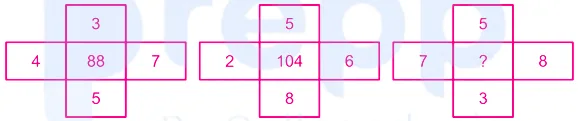
- A
108
- B
112
- C
118
- D
120
Show answer
D. 120The 1 st diagram can be written as
(4 + 7) × (3 + 5) = 11 × 8 = 88
The 2 nd diagram can be written as
(2 + 6) × (5 + 8) = 8 × 13 = 104
Similarly, the 3 rd diagram can be written as
(7 + 8) × (5 + 3) = 15 × 8 = 120
Hence, 120 is the correct ans.
Paper & answer key PDF ↗ Question 17archived
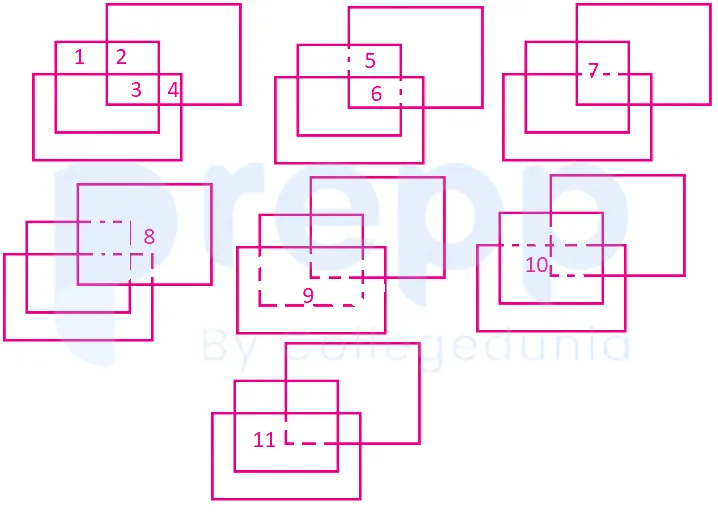
How many rectangles are there in the given figure?

- A
9
- B
10
- C
11
- D
12
Show answer
C. 11Square is a special case of the rectangle.
Hence, there are 11 rectangles.
 Paper & answer key PDF ↗
 Question 18archived
In the following question below are given some statements followed by some conclusions. Taking the given statements to be true even if they seem to be at variance from commonly known facts, read all the conclusions and then decide which of the given conclusion logically follows the given statements.
Statements:
I. All cups are plates.
II. Some cups are glass.
Conclusions:
I. Some glasses are plates.
II. All glasses are plates.
- A
Only conclusion (I) follows.
- B
Only conclusion (II) follows.
- C
Neither conclusion (I) nor conclusion (II) follow.
- D
Both conclusions follow.
Show answer
A. Only conclusion (I) follows.From Statement II, at least one cup is a glass. From Statement I, every cup is a plate. So that overlapping item is simultaneously a glass and a plate, which establishes Conclusion I: Some glasses are plates.
Conclusion II (All glasses are plates) does not follow, because glasses that are not cups are unconstrained by Statement I and may or may not be plates.
Hence only conclusion (I) follows.
Paper & answer key PDF ↗ Question 19archived
From the given options, which figure can be formed by folding the figure given in the question?

- A
Option A (shown in image)
- B
Option B (shown in image)
- C
Option C (shown in image)
- D
None of these
Show answer
B. Option B (shown in image)After folding the squares, B and E will face opposite to each other.
Similarly, D and O will face A and N respectively.
Thus, D and E and N and O will not be adjacent sides.
The only possible case is figure 2).
Hence, is the correct ans.
 Paper & answer key PDF ↗
 Question 20archived
Identify the diagram that best represents the relationship among the given classes.
Real number, Integer, Natural number
- A
Option A (shown in image)
- B
Option B (shown in image)
- C
Option C (shown in image)
- D
Option D (shown in image)
Show answer
C. Option C (shown in image)All Natural numbers are Integers and all integers are included in Real number.
Hence, option 3 is the correct answer.
 Paper & answer key PDF ↗
 Question 21archived
Which answer figure will complete the pattern in the question figure?

- A
Option A (shown in image)
- B
Option B (shown in image)
- C
Option C (shown in image)
- D
Option D (shown in image)
Show answer
A. Option A (shown in image)The missing figure will comprise of a straight line from the uppermost right corner to the lowermost left corner with its midpoint intersected by two sides of a square.
Figure 1) fulfils this condition.
Hence is the correct ans.
 Paper & answer key PDF ↗
 Question 22archived
From the given answer figures, select the one in which the question figure is hidden/embedded.

- A
Option A (shown in image)
- B
Option B (shown in image)
- C
Option C (shown in image)
- D
None of these
Show answer
B. Option B (shown in image)The question figure is embedded in this figure.
Hence, "Option (2)" is the correct answer.
 Paper & answer key PDF ↗
 Question 23archived
A piece of paper is folded and punched as shown below in the question figures. From the given answer figures, indicate how it will appear when opened?

- A
Option A (shown in image)
- B
Option B (shown in image)
- C
Option C (shown in image)
- D
Option D (shown in image)
Show answer
D. Option D (shown in image)After folding the paper twice and being cut at the right side with a semicircle and the left side with a rectangle, we will see 4 cut rectangles at four sides and two circles along the central line.
Hence, is the correct ans.
 Paper & answer key PDF ↗
 Question 24archived
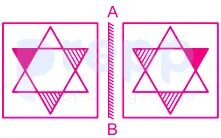
If a mirror is placed on the line AB, then which of the answer figure is the right image of the given figure?

- A
Option A (shown in image)
- B
Option B (shown in image)
- C
Option C (shown in image)
- D
Option D (shown in image)
Show answer
A. Option A (shown in image)Hence, Figure 1) is the correct ans.
 Paper & answer key PDF ↗
 Question 25archived
A word is represented by only set of numbers as given in any one of the alternatives. The sets of numbers given in the alternatives are represented by two classes of alphabets as shown in the given two matrices. The columns and rows of Matrix-I are numbered from 0 to 4 and that of Matrix-II are numbered from 5 to 9. A letter from these matrices can be represented first by its row and next by its column, for example, ‘H’ can be represented by 34, 41, etc., and ‘T’ can be represented by 59, 97, etc. Similarly, you have to identify the set for the word “STRAW”.
Matrix-IMatrix-II
0123456789
0SRGHW5AFLCT
1HWSRG6CTAFL
2RGHWS7FLCTA
3WSRGH8TAFLC
4GHWSR9LCTAF
- A
00, 78, 13, 67, 23
- B
12, 59, 01, 55, 10
- C
24, 97, 20, 86, 31
- D
43, 66, 44, 98, 43
Show answer
A. 00, 78, 13, 67, 23Decode option (a) 00, 78, 13, 67, 23 using the matrices.
00 → Matrix-I row 0, col 0 = S. 78 → Matrix-II row 7, col 8 = T. 13 → Matrix-I row 1, col 3 = R. 67 → Matrix-II row 6, col 7 = A. 23 → Matrix-I row 2, col 3 = W.
The codes spell STRAW, so option (a) is correct.
Paper & answer key PDF ↗ Question 26archived
'Neo-Malthusian Theory' is associated with which of the following?
- A
Employment
- B
Poverty
- C
Resource scarcity
- D
Income
Show answer
C. Resource scarcityThe Neo-Malthusian theory extends Malthus's idea that population grows faster than the supply of essentials. Modern Neo-Malthusians widen this from food alone to all finite resources — water, energy, minerals, arable land — arguing that unchecked population and consumption growth lead to resource scarcity and environmental stress.
Employment, poverty, and income may be indirect consequences, but the theory's central concern is the depletion of finite natural resources. Hence the correct match is Resource scarcity.
Paper & answer key PDF ↗ Question 27archived
Sector
Example
1. Primary
a. Consultancy
2. Secondary
b. Apiculture
3. Tertiary
c. Shoe Factory
Match the following:
- A
1-b, 2-c, 3-a
- B
1-c, 2-a, 3-b
- C
1-a, 2-c, 3-b
- D
1-c, 2-b, 3-a
Show answer
A. 1-b, 2-c, 3-aPrimary sector covers extraction/harvesting of natural resources, so Apiculture (b) — bee-keeping for honey — fits here.
Secondary sector converts raw material into finished goods, matching a Shoe Factory (c).
Tertiary sector provides services, matching Consultancy (a).
Therefore the correct pairing is 1-b, 2-c, 3-a.
Paper & answer key PDF ↗ Question 28archived
How many Fundamental Duties are mentioned in Indian constitution?
- A
Five
- B
Seven
- C
Nine
- D
Eleven
Show answer
D. ElevenFundamental Duties are listed in Article 51A, Part IVA of the Indian Constitution. They were added by the 42nd Amendment Act, 1976 (originally 10 duties), on the recommendation of the Swaran Singh Committee.
The 86th Amendment Act, 2002 added one more duty — that of a parent or guardian to provide educational opportunities to a child between 6 and 14 years.
This brings the total to eleven Fundamental Duties.
Paper & answer key PDF ↗ Question 29archived
Part IV of constitution of India deals with which of the following?
- A
The Union
- B
The States
- C
Fundamental Rights
- D
Directive Principles of State Policy
Show answer
D. Directive Principles of State PolicyPart IV (Articles 36–51) of the Indian Constitution contains the Directive Principles of State Policy (DPSP), inspired by the Irish Constitution. These are non-justiciable guidelines directing the State to secure a welfare society through social and economic justice.
For reference: Fundamental Rights are in Part III, the Union in Part V, and the States in Part VI. Hence Part IV deals with Directive Principles of State Policy.
Paper & answer key PDF ↗ Question 30archived
Who gave the slogan 'Back to the Vedas'?
- A
Guru Nanank Dev Ji
- B
Dayanand Saraswati
- C
Swami Vivekananda
- D
Raja Ram Mohan Roy
Show answer
B. Dayanand SaraswatiThe slogan 'Back to the Vedas' was given by Swami Dayanand Saraswati, founder of the Arya Samaj (1875). He urged Hindus to reject post-Vedic accretions — idolatry, caste-by-birth, child marriage — and return to the pure teachings of the four Vedas.
Guru Nanak founded Sikhism; Raja Ram Mohan Roy founded the Brahmo Samaj; Vivekananda preached practical Vedanta. None coined this slogan.
Paper & answer key PDF ↗ Question 31archived
Todar mal was the finance minister of which Mughal ruler?
- A
Shah Jahan
- B
Bahadur Shah Jafar
- C
Akbar
- D
Aurangzeb
Show answer
C. AkbarRaja Todar Mal served as the finance minister (Diwan-i-Ashraf) of Emperor Akbar and was one of his Navaratnas.
He introduced the Dahsala (Zabt) system of land revenue, based on measurement of land, classification by fertility, and assessment using the ten-year average produce and prices — reforms central to Akbar's administration.
Shah Jahan, Aurangzeb, and Bahadur Shah Zafar reigned later, so the correct answer is Akbar.
Paper & answer key PDF ↗ Question 32archived
Gravitational force is maximum at which of the following place?
- A
At equator
- B
At tropic of cancer
- C
At tropic of Capricorn
- D
At poles
Show answer
D. At polesEffective gravity depends on two factors: distance from Earth's centre and the centrifugal effect of rotation. Earth's oblate shape makes the polar radius smaller than the equatorial radius, so \(g \propto 1/r^2\) is larger at the poles.
Rotation reduces apparent gravity most at the equator (largest centrifugal force) and not at all at the poles (zero rotational radius).
Both effects combine: \(g\) is maximum at the poles (≈9.832 m/s²) and minimum at the equator (≈9.780 m/s²).
Paper & answer key PDF ↗ Question 33archived
Which of the following device is used to measure humidity?
- A
Hydrometer
- B
Hygrometer
- C
Psycho Meter
- D
Anemometer
Show answer
B. HygrometerA hygrometer is the instrument used to measure the amount of water vapour (humidity) in the air. Mechanical, electronic and dew-point variants all serve this purpose.
Distractors: a hydrometer measures specific gravity of liquids; an anemometer measures wind speed; "Psycho Meter" is a misspelling and not a standard instrument (a psychrometer is a sub-type of hygrometer, but the generic device name is hygrometer).
Paper & answer key PDF ↗ Question 34archived
Which of the following disease is caused by female Anopheles mosquito?
- A
Chicken Pox
- B
Malaria
- C
Black Fever
- D
Cholera
Show answer
B. MalariaMalaria is caused by Plasmodium parasites transmitted through the bite of an infected female Anopheles mosquito; only females bite as they need a blood meal for egg production.
Chicken Pox is a viral airborne disease (varicella-zoster); Black Fever (Kala-azar) is spread by sandflies, not mosquitoes; Cholera spreads through contaminated water/food.
Paper & answer key PDF ↗ Question 35archived
Which part of the plant gives us saffron?
- A
Roots
- B
Petals
- C
Stem
- D
Stigma
Show answer
D. StigmaSaffron consists of the dried stigmas (and styles) of the Crocus sativus flower. Each flower bears three thread-like red stigmas that are hand-picked and dried to form the spice.
Roots anchor and absorb; petals attract pollinators; the stem supports the plant — none of these yield saffron.
Paper & answer key PDF ↗ Question 36archived
Which of the following transports water from the roots of the plant to its leaves?
- A
Xylem
- B
Phloem
- C
Both xylem and phloem
- D
Cortex
Show answer
A. XylemXylem is the vascular tissue that conducts water and dissolved minerals upward from the roots to the leaves, driven mainly by transpiration pull.
Phloem transports sugars from leaves to other plant parts; the cortex is a ground-tissue storage layer, not a long-distance conducting tissue. Hence "Both xylem and phloem" is also incorrect because phloem does not perform this function.
Paper & answer key PDF ↗ Question 37archived
Which of the following is not a vector quantity?
- A
Momentum
- B
Displacement
- C
Torque
- D
Speed
Show answer
D. SpeedA vector quantity has both magnitude and direction; a scalar has magnitude only.
Speed is the magnitude of velocity and carries no direction, so it is a scalar — the only non-vector here. Momentum (\(\vec{p}=m\vec{v}\)), displacement (\(\Delta\vec{r}\)) and torque (\(\vec{\tau}=\vec{r}\times\vec{F}\)) all carry direction and are vectors.
Paper & answer key PDF ↗ Question 38archived
At what temperature (in Fahrenheit) pure water freezes?
- A
32
- B
0
- C
48
- D
37
Show answer
A. 32Pure water freezes at \(0^{\circ}\text{C}\) at standard pressure. Converting using \(F=\tfrac{9}{5}C+32\):
\[F=\tfrac{9}{5}(0)+32=32^{\circ}\text{F}\]
Hence pure water freezes at 32°F. The value 0 refers to the Celsius scale, 48 and 37 do not correspond to any standard freezing reference.
Paper & answer key PDF ↗ Question 39archived
In which graphics, digital photos and scanned images are typically stored with extensions such as .bmp, .png, .jpg, .tif or.gif?
- A
Bitmap
- B
Pixels
- C
Plane
- D
Both Bitmap and Pixels
Show answer
A. BitmapFiles with extensions .bmp, .png, .jpg, .tif and .gif store images as a rectangular grid of coloured pixels — this raster representation is called Bitmap (raster) graphics, ideal for photographs and scanned images.
Pixels are the building blocks of such images, not a storage format; a "plane" denotes a colour/alpha channel; so "Both Bitmap and Pixels" is incorrect.
Paper & answer key PDF ↗ Question 40archived
Process of gaining electrons is known as _______.
- A
oxidation
- B
reduction
- C
radiation
- D
both oxidation and reduction
Show answer
B. reductionBy definition, reduction is the gain of electrons (OIL RIG — Oxidation Is Loss, Reduction Is Gain). The species' oxidation state decreases, e.g. \(\text{Cu}^{2+}+2e^{-}\rightarrow\text{Cu}\).
Oxidation is the loss of electrons; radiation is energy emission, unrelated to electron transfer; "both" is wrong because gaining electrons specifically defines reduction.
Paper & answer key PDF ↗ Question 41archived
Which of the following metal (shown by its symbol) is generally used for making filaments of bulb?
- A
Fe
- B
An
- C
Ag
- D
W
Show answer
D. WTungsten (W) is used for incandescent-bulb filaments because it has the highest melting point of all metals (~3422°C), high electrical resistivity (so it glows when current flows) and a low evaporation rate at high temperature, while remaining ductile enough to be drawn into fine wire.
Iron (Fe, m.p. ~1538°C) and silver (Ag, ~961°C) melt too easily; "An" is not a valid element symbol.
Paper & answer key PDF ↗ Question 42archived
Which of the following trees shed their leaves once in a year?
- A
Deciduous trees
- B
Coniferous trees
- C
Evergreen trees
- D
Both deciduous and coniferous trees
Show answer
A. Deciduous treesDeciduous trees (e.g. oak, maple, teak) shed all their leaves once a year — in autumn in temperate regions or during the dry season in the tropics — to conserve water and energy during unfavourable conditions.
Coniferous and evergreen trees retain foliage year-round, shedding old leaves gradually rather than in one annual event, so the combined option is also wrong.
Paper & answer key PDF ↗ Question 43archived
The Entrepreneurship Development Scheme (EDS) has been launched under New Economy Development Policy (NEDP) on January 19, 2017 at ________.
- A
New Delhi
- B
Mizoram
- C
Gujrat
- D
Uttar Pradesh
Show answer
B. MizoramThe Entrepreneurship Development Scheme (EDS) was launched on 19 January 2017 in Mizoram under the state government's New Economic Development Policy (NEDP). The NEDP is Mizoram's flagship policy aimed at boosting entrepreneurship, agriculture, handloom and tourism-led growth.
The scheme is state-specific to Mizoram, ruling out New Delhi, Gujarat and Uttar Pradesh.
Paper & answer key PDF ↗ Question 44archived
Who invented Dynamite?
- A
J B Dunlop
- B
Alfred Nobel
- C
James Simons
- D
Peter Hargreaves
Show answer
B. Alfred NobelAlfred Nobel, the Swedish chemist and engineer, invented dynamite in 1867 by absorbing nitroglycerin into kieselguhr (diatomaceous earth), making the unstable explosive safe to handle. His wealth from the patent later funded the Nobel Prizes.
J. B. Dunlop developed the pneumatic tyre; James Simons is a mathematician/financier; Peter Hargreaves is a businessman — none invented dynamite.
Paper & answer key PDF ↗ Question 45archived
'Rovers cup' is associated with which of the following sport?
- A
Football
- B
Hockey
- C
Golf
- D
Basketball
Show answer
A. FootballThe Rovers Cup is one of the oldest football tournaments in India, instituted in Bombay (Mumbai) in 1891 by British military officers. It is the third-oldest football competition in the world after the FA Cup and Durand Cup.
Hockey, golf and basketball have their own marquee events (Beighton Cup, Indian Open, Savio Cup respectively), but none is called the Rovers Cup. Hence the correct sport is Football.
Paper & answer key PDF ↗ Question 46archived
Dandia is a form of dance associated with which of the following states?
- A
Haryana
- B
Punjab
- C
Gujarat
- D
Rajasthan
Show answer
C. GujaratDandiya Raas is a traditional folk dance of Gujarat, performed with decorated wooden sticks (dandiyas) during the nine nights of Navratri to celebrate Goddess Durga's victory over Mahishasura.
Haryana is known for Ghoomar and Saang, Punjab for Bhangra and Giddha, and Rajasthan for Ghoomar and Kalbelia. Therefore, Dandia is associated with Gujarat.
Paper & answer key PDF ↗ Question 47archived
Who among the following was awarded with Dhronacharya Award 2016 in the field of 'Swimming (Lifetime)'?
- A
Shri Raj Kumar Sharma
- B
Shri Sagar Mal Dhayal
- C
Shri S. Pradeep Kumar
- D
Shri Nagapuri Ramesh
Show answer
C. Shri S. Pradeep KumarThe Dronacharya Award 2016 in the Lifetime category for Swimming was conferred on Shri S. Pradeep Kumar, who coached several national-level swimmers over decades.
Among the other options, Raj Kumar Sharma received it for Cricket (Lifetime), Sagar Mal Dhayal for Boxing (Lifetime), and Nagapuri Ramesh for Athletics (Regular). Hence the correct answer is Shri S. Pradeep Kumar.
Paper & answer key PDF ↗ Question 48archived
'Ace against Odds' is an autobiography of which sports person?
- A
Vishwanathan Anand
- B
Sania Mirza
- C
Abhinav Bindra
- D
Anjali Bhagwat
Show answer
B. Sania Mirza'Ace against Odds' is the autobiography of Indian tennis star Sania Mirza, co-written with her father Imran Mirza and journalist Shivani Gupta, and released in 2016. It chronicles her rise to World No. 1 in women's doubles and her Grand Slam triumphs.
Vishwanathan Anand's memoir is 'Mind Master', Abhinav Bindra's is 'A Shot at History', and Anjali Bhagwat has not written one by this title.
Paper & answer key PDF ↗ Question 49archived
Under the framework of the new partnership with which country, Victoria University will help India to Establish a National Sports University?
- A
Portugal
- B
Australia
- C
Vietnam
- D
USA
Show answer
B. AustraliaUnder the India–Australia bilateral framework on education and sports cooperation, Victoria University (Melbourne) — globally recognised for its sports science and management programmes — was identified to assist India in setting up the proposed National Sports University.
Portugal, Vietnam and the USA were not partners in this specific initiative. Hence the answer is Australia.
Paper & answer key PDF ↗ Question 50archived
With which country India exchanged its border enclaves?
- A
China
- B
Sri Lanka
- C
Pakistan
- D
Bangladesh
Show answer
D. BangladeshIndia exchanged its border enclaves with Bangladesh under the Land Boundary Agreement (LBA), 1974, ratified and implemented in 2015 via the 100th Constitutional Amendment. India transferred 111 enclaves to Bangladesh and received 51 in return, ending decades of administrative limbo for around 50,000 residents.
No such enclave-exchange agreement exists with China, Sri Lanka or Pakistan. Hence the correct answer is Bangladesh.
Paper & answer key PDF ↗ Question 51archived
What least value should be added to 1812 to make it divisible by 7, 11 and 14?
- A
12
- B
36
- C
72
- D
154
Show answer
B. 36Step 1 — Find the LCM of 7, 11 and 14:
\(7=7,\ 11=11,\ 14=2\times7\)
\(\text{LCM}=2\times7\times11=154\)
Step 2 — Divide 1812 by 154:
\(1812=154\times11+118\), so the remainder is 118.
Step 3 — Value to add:
\(154-118=36\)
Adding 36 gives \(1848=154\times12\), which is divisible by 7, 11 and 14. Therefore the required value is 36.
Paper & answer key PDF ↗ Question 52archived
A is 1.5 times efficient as B therefore takes 8 days less than B to complete a work. If A and B work on alternate days and A works on first day, then in how many days the work will be completed?
- A
17
- B
19
- C
19.5
- D
21
Show answer
B. 19Step 1 — Individual times: Efficiency ratio A : B = 3 : 2, so time ratio A : B = 2 : 3. Let A take \(2x\) and B take \(3x\) days.
\(3x-2x=8 \implies x=8\)
So A alone takes 16 days and B alone takes 24 days.
Step 2 — Work per 2-day cycle (A then B):
\(\dfrac{1}{16}+\dfrac{1}{24}=\dfrac{3+2}{48}=\dfrac{5}{48}\)
Step 3 — Full cycles: In 9 cycles (18 days), work done \(=9\times\dfrac{5}{48}=\dfrac{45}{48}\). Remaining \(=\dfrac{3}{48}=\dfrac{1}{16}\).
Step 4 — Day 19: A's turn; A finishes \(\dfrac{1}{16}\) in exactly 1 day.
Total time \(=18+1=\) 19 days.
Paper & answer key PDF ↗ Question 53archived
One of the diagonal of a rhombus is 70% of the other diagonal. What is the ratio of area of rhombus to the square of the length of the larger diagonal?
- A
3 : 10
- B
3 : 20
- C
7 : 20
- D
7 : 10
Show answer
C. 7 : 20Step 1 — Set up diagonals: Let the larger diagonal be \(d_L\) and the smaller \(d_S=0.7\,d_L=\dfrac{7}{10}d_L\).
Step 2 — Area of rhombus:
\[A=\tfrac{1}{2}d_L\,d_S=\tfrac{1}{2}\cdot d_L\cdot\tfrac{7}{10}d_L=\tfrac{7}{20}d_L^{2}\]
Step 3 — Required ratio:
\(\dfrac{A}{d_L^{2}}=\dfrac{7}{20}\)
Therefore the ratio is 7 : 20.
Paper & answer key PDF ↗ Question 54archived
A shopkeeper sells a table at a discount of 20% and earns a profit of 60%. If he sells the same table at 40% discount, then what will be his new profit percent?
- A
20
- B
30
- C
35
- D
40
Show answer
A. 20Step 1 — Assume CP: Let \(\text{CP}=100\). With 60% profit, \(\text{SP}_1=160\).
Step 2 — Find MP from 20% discount:
\(160=\text{MP}\times(1-0.20) \implies \text{MP}=\dfrac{160}{0.8}=200\)
Step 3 — New SP at 40% discount:
\(\text{SP}_2=200\times0.60=120\)
Step 4 — New profit %:
\(\dfrac{120-100}{100}\times100=20\%\)
Hence the new profit is 20%.
Paper & answer key PDF ↗ Question 55archived
If A/3 = B/2 = C/5, then what is the value of ratio (C + A) 2: (A + B) 2: (B + C) 2?
- A
9 : 4 : 25
- B
25 : 4 : 9
- C
64 : 25 : 49
- D
49 : 25 : 64
Show answer
C. 64 : 25 : 49Step 1 — Parametrise: Let \(\dfrac{A}{3}=\dfrac{B}{2}=\dfrac{C}{5}=k\), giving \(A=3k,\ B=2k,\ C=5k\).
Step 2 — Compute the sums:
\(C+A=8k,\quad A+B=5k,\quad B+C=7k\)
Step 3 — Square each and form the ratio:
\((C+A)^2:(A+B)^2:(B+C)^2=64k^{2}:25k^{2}:49k^{2}\)
Cancelling \(k^{2}\) gives 64 : 25 : 49.
Paper & answer key PDF ↗ Question 56archived
5 years ago the average age of a family which includes father, mother and a son was 35 years. 3 years ago the average age of father and mother was 46 years. What is the present age (in years) of the son?
- A
20
- B
24
- C
26
- D
22
Show answer
D. 22Step 1 — Sum of present ages of the family: 5 years ago the average of 3 members was 35, so their total then was \(35\times3=105\). Present total \(=105+3\times5=120\).
Step 2 — Sum of present ages of parents: 3 years ago the average of 2 was 46, so their total then was \(46\times2=92\). Present total \(=92+2\times3=98\).
Step 3 — Son's age:
\(S=120-98=22\)
Therefore the son's present age is 22 years.
Paper & answer key PDF ↗ Question 57archived
The cost price of 60 articles is same as the selling price of x articles. If there is a profit of 20%, then what is the value of x ?
- A
15
- B
30
- C
50
- D
80
Show answer
C. 50If CP of 60 articles equals SP of x articles, then \(60\,\text{CP} = x\,\text{SP}\), so \(\dfrac{\text{SP}}{\text{CP}} = \dfrac{60}{x}\).
A 20% profit means \(\dfrac{\text{SP}}{\text{CP}} = 1.2 = \dfrac{6}{5}\).
Equating: \(\dfrac{60}{x} = \dfrac{6}{5} \implies x = \dfrac{60 \times 5}{6} = 50\).
Therefore x = 50.
Paper & answer key PDF ↗ Question 58archived
A person scores 45% of the total marks in the exam and still fails by 40 marks. The passing percentage of the exam is 55%. What is the maximum marks of the exam?
- A
300
- B
350
- C
400
- D
500
Show answer
C. 400The student scored 45% but needed 55% to pass, falling short by 40 marks. So the 10-percentage-point gap corresponds to 40 marks.
\[10\% \text{ of } M = 40 \implies M = \dfrac{40 \times 100}{10} = 400\]
Check: passing marks = 55% of 400 = 220; scored = 45% of 400 = 180; difference = 40. Therefore maximum marks = 400.
Paper & answer key PDF ↗ Question 59archived
A man starts running from point P at 11 : 00 a.m. with a speed of 10 km/hr. He runs for 2 hours and then takes a 1 hour rest. He continues this till he is caught by another man who starts at 2 : 00 p.m. from point P and runs non-stop at a speed of 15 km/hr towards the first man. At what time (in p.m.) will the first man be caught?
- A
6 : 20
- B
4 : 40
- C
6 : 00
- D
5 : 30
Show answer
B. 4 : 40Step 1 — First man's position at 2:00 p.m.:
He runs 11 a.m.–1 p.m. covering \(10\times 2 = 20\) km, then rests 1–2 p.m. So at 2:00 p.m. he is 20 km ahead.
Step 2 — Track from 2:00 p.m.:
From 2–4 p.m. he runs another 20 km, reaching 40 km at 4:00 p.m. Then he rests 4–5 p.m., staying at 40 km.
Second man's distance at time \(t\) hours after 2 p.m. is \(15t\). At 4 p.m. he is at 30 km (behind); at 5 p.m. at 45 km (ahead). So the catch happens during the first man's rest, when his position is fixed at 40 km.
Step 3 — Solve:
\[15t = 40 \implies t = \dfrac{8}{3} \text{ hr} = 2\text{ hr }40\text{ min}\]
Catch time = 2:00 p.m. + 2 h 40 min = 4:40 p.m.
Paper & answer key PDF ↗ Question 60archived
The difference of compound interest and simple interest for 3 years and for 2 years are in ratio 23 : 7 respectively. What is rate of interest per annum (in %)?
- A
200/7
- B
100/7
- C
300/7
- D
400/7
Show answer
A. 200/7For principal P and rate \(R = r/100\), the standard CI–SI difference formulas give:
\[\text{CI}_2-\text{SI}_2 = PR^2,\qquad \text{CI}_3-\text{SI}_3 = PR^2(3+R)\]
Taking the ratio:
\[\dfrac{PR^2(3+R)}{PR^2} = \dfrac{23}{7} \implies 3+R = \dfrac{23}{7}\]
\[R = \dfrac{23}{7}-3 = \dfrac{2}{7}\]
So \(r = 100R = \dfrac{200}{7}\,\%\). Therefore the rate is 200/7 %.
Paper & answer key PDF ↗ Question 61archived
If (x 2/yz) + (y 2/zx) + (z 2/ xy) = 3, then what is the value of (x + y + z) 3?
- A
0
- B
4
- C
2
- D
8
Show answer
A. 0Combine the LHS over the common denominator \(xyz\):
\[\dfrac{x^3+y^3+z^3}{xyz} = 3 \implies x^3+y^3+z^3 = 3xyz\]
By the identity \(x^3+y^3+z^3-3xyz = (x+y+z)(x^2+y^2+z^2-xy-yz-zx)\), this gives:
\[(x+y+z)(x^2+y^2+z^2-xy-yz-zx) = 0\]
The second factor equals \(\tfrac{1}{2}\big[(x-y)^2+(y-z)^2+(z-x)^2\big]\), which vanishes only when \(x=y=z\) — a case giving \((3x)^3\), not in the options. The option-matching case is \(x+y+z=0\), so \((x+y+z)^3 = \mathbf{0}\).
Paper & answer key PDF ↗ Question 62archived
If x 1/4 + x -1/4 = 2, then what is the value of x 81 + (1/ x 81 )?
- A
–2
- B
0
- C
1
- D
2
Show answer
D. 2Let \(y = x^{1/4}\). The equation becomes \(y + \dfrac{1}{y} = 2\), i.e. \(y^2-2y+1 = 0\), so \((y-1)^2 = 0 \implies y = 1\).
Hence \(x^{1/4} = 1 \implies x = 1\).
Therefore \(x^{81} + \dfrac{1}{x^{81}} = 1 + 1 = \mathbf{2}\).
Paper & answer key PDF ↗ Question 63archived
If a(a + b + c) = 45, b(a + b + c) = 75 and c(a + b + c) = 105, then what is the value of (a 2+ b 2+ c 2)?
- A
75
- B
83
- C
217
- D
225
Show answer
B. 83Let \(S = a+b+c\). Adding the three equations:
\[(a+b+c)S = 45+75+105 = 225 \implies S^2 = 225 \implies S = 15\]
Then \(a = 45/15 = 3\), \(b = 75/15 = 5\), \(c = 105/15 = 7\).
So \(a^2+b^2+c^2 = 9+25+49 = \mathbf{83}\).
Paper & answer key PDF ↗ Question 64archived
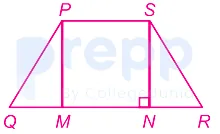
In the given figure, PQRS is a trapezium in which PM || SN, NR = 9 cm, PS = 12 cm, QM = NR and NR = SN. What is the area (in cm 2) of trapezium?
- A
170
- B
182
- C
189
- D
191
Show answer
C. 189we know that
Area of a trapezium = 1/2 x (sum of parallel sides) x height
⇒ (1/2) x (PS + QR) x SN
⇒ (1/2) x (PS + PS + NR x 2) x NR
⇒ (1/2) x (12 x 2 + 9 x 2) x 9
⇒ (1/2) x (42) x 9
⇒ 189
∴ Area of trapezium is 189 cm 2
Paper & answer key PDF ↗ Question 65archived
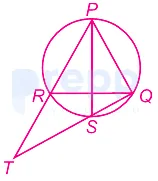
In the given figure, PQR is an equilateral triangle and diameter PS is the angle bisector of ∠P. What is the value of RT : RQ?
- A
1 : 2
- B
1 : 1
- C
2 : 1
- D
1 : 3
Show answer
B. 1 : 1All the angles of an equilateral triangle are of 60°
⇒ ∠PQS = 90° (angle in a semi-circle)
⇒ So, ∠PTQ = 180° - 90° - 60°
⇒ ∠PTQ = 30°
Applying sine rule in triangle PTQ
⇒ sin30° / PQ = sin90° / PT
⇒ (1/2) / PQ = 1 / PT
⇒ 2PQ = PT
⇒ 2PQ = PR + RT
⇒ 2PQ = PQ + RT (sides of an equilateral triangle)
⇒ RT = PQ = RQ
∴ the required ratio is 1 : 1
Paper & answer key PDF ↗ Question 66archived
Two chords of length 20 cm and 24 cm are drawn perpendicular to each other in a circle of radius is 15 cm. What is the distance between the Points of intersection of these chords (in cm) from the centre of the circle?
- A
√114
- B
√182
- C
√206
- D
√218
Show answer
C. √206Let O be the centre with radius 15 cm. Drop perpendiculars OM and ON from O to the two chords; M and N are the chord midpoints.
Step 1 — Distances of chords from centre:
\[OM = \sqrt{15^2-10^2} = \sqrt{125},\qquad ON = \sqrt{15^2-12^2} = \sqrt{81} = 9\]
Step 2 — Form rectangle OMEN:
Since the chords are perpendicular at intersection E, and OM ⟂ chord AB, ON ⟂ chord CD, quadrilateral OMEN has three right angles, hence is a rectangle. Therefore \(NE = OM\) and \(ME = ON\).
Step 3 — Diagonal OE:
\[OE^2 = OM^2 + ON^2 = 125 + 81 = 206\]
Therefore \(OE = \sqrt{206}\) cm.
Paper & answer key PDF ↗ Question 67archived
If x 2 + (1/x 2) = 1 then what is the value of x 48 + x 42 + x 36 + x 30 + x 24 + x 18 + x 12 + x 6 + 1 ?
- A
-9
- B
0
- C
1
- D
9
Show answer
C. 1Multiply \(x^2+\dfrac{1}{x^2}=1\) by \(x^2\): \(x^4-x^2+1 = 0\).
Multiply by \((x^2+1)\): \((x^2+1)(x^4-x^2+1) = x^6+1 = 0\), so \(x^6 = -1\).
Each term in the expression has exponent a multiple of 6:
\[(x^6)^8+(x^6)^7+\cdots+(x^6)^1+1 = 1-1+1-1+1-1+1-1+1\]
Pairing gives four zeros plus the final 1, so the value is 1.
Paper & answer key PDF ↗ Question 68archived
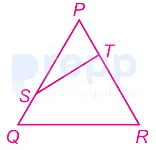
In the given figure, QRTS is a cyclic quadrilateral. If PT = 5cm, SQ = 4cm, PS = 6cm and ∠PQR = 63°, then what is the value (in cm) of TR?
- A
3
- B
7
- C
9
- D
15
Show answer
B. 7Given: QSTR is a cyclic quadrilateral
Sum of the opposite angles = 180
So, ∠STR = 117°
Also, ∠PTS = 180° - ∠STR
⇒ ∠PTS = 63°
And, ∠PST = ∠TRQ (∵ ∠PST + ∠TSQ = ∠TRQ + ∠TSQ = 180°)
So, PTS and PQR are similar triangles
Hence, PT/PQ = PS/PR
⇒ 5/10 = 6/PR
⇒ PR = 12 cm
⇒ PT + TR = 12 cm
∴ TR = 12 – 5 = 7
Paper & answer key PDF ↗ Question 69archived
What is the simplified value of sin 2(90 – θ) – [{sin(90 – θ)sin θ}/tanθ]?
- A
1
- B
cosec θ
- C
0
- D
cos θ
Show answer
C. 0Reading the first term as \(\sin^2(90^\circ-\theta)\) (the printed "sin 2" is the standard typesetting of \(\sin^2\)):
Using \(\sin(90^\circ-\theta) = \cos\theta\), the first term becomes \(\cos^2\theta\).
For the second term, substitute \(\sin(90^\circ-\theta)=\cos\theta\) and \(\tan\theta=\dfrac{\sin\theta}{\cos\theta}\):
\[\dfrac{\cos\theta\cdot\sin\theta}{\sin\theta/\cos\theta} = \cos^2\theta\]
Therefore the expression \(= \cos^2\theta - \cos^2\theta = \mathbf{0}\).
Paper & answer key PDF ↗ Question 70archived
What is the simplified value of \({\left[ {\frac{{co{s^2}\theta }}{{1\; + \;\sin \theta }} - \frac{{si{n^2}\theta }}{{1\; + \;\cos \theta }}} \right]^2}\) ?
- A
sinθ
- B
1 – sin2θ
- C
1 + sin2θ
- D
1 – sinθ
Show answer
B. 1 – sin2θUse \(\cos^2\theta = 1-\sin^2\theta = (1-\sin\theta)(1+\sin\theta)\) and similarly for \(\sin^2\theta\):
\[\dfrac{\cos^2\theta}{1+\sin\theta} = 1-\sin\theta,\qquad \dfrac{\sin^2\theta}{1+\cos\theta} = 1-\cos\theta\]
So the bracket equals \((1-\sin\theta)-(1-\cos\theta) = \cos\theta-\sin\theta\).
Squaring:
\[(\cos\theta-\sin\theta)^2 = \cos^2\theta+\sin^2\theta - 2\sin\theta\cos\theta = 1 - \sin 2\theta\]
Therefore the value is 1 − sin 2θ.
Paper & answer key PDF ↗ Question 71archived
If 5 secθ – 3 tanθ = 5, then what is the value of 5 tanθ – 3 secθ?
- A
1
- B
2
- C
3
- D
4
Show answer
C. 3Let \(5\tan\theta-3\sec\theta = x\). Square both given expressions:
\[(5\sec\theta-3\tan\theta)^2 = 25\sec^2\theta - 30\sec\theta\tan\theta + 9\tan^2\theta = 25\]
\[(5\tan\theta-3\sec\theta)^2 = 25\tan^2\theta - 30\sec\theta\tan\theta + 9\sec^2\theta = x^2\]
Subtracting, the cross terms cancel:
\[16(\sec^2\theta-\tan^2\theta) = 25 - x^2\]
Using \(\sec^2\theta-\tan^2\theta = 1\): \(16 = 25 - x^2 \implies x^2 = 9 \implies x = \pm 3\).
The matching option is 3.
Paper & answer key PDF ↗ Question 72archived
What is the difference (in crores) in population of the most and the least populated country?
- A
18
- B
32
- C
34
- D
36
Show answer
D. 36Total population across the 8 countries is 200 crores. Population of each country = \(\text{percentage}\times 200\) crores.
Step 1 — Most populated: Country 2 has the highest share at 24%, so \(0.24\times 200=48\) crores.
Step 2 — Least populated: Country 6 has the lowest share at 6%, so \(0.06\times 200=12\) crores.
Step 3 — Difference: \(48-12=36\) crores.
Hence the required difference is 36 crores.
Paper & answer key PDF ↗ Question 73archived
What is the total GDP (in crore dollars) of country 5?
- A
27120
- B
31640
- C
38280
- D
44660
Show answer
B. 31640Using \(\text{Total GDP}=\text{Per capita income}\times\text{Population}\).
Step 1 — Population of Country 5: \(7\%\text{ of }200=\dfrac{7}{100}\times 200=14\) crores.
Step 2 — GDP: Per capita income of Country 5 is 2260, so \(\text{GDP}=2260\times 14=31640\) crore dollars.
Hence the total GDP of Country 5 is 31640 crore dollars.
Paper & answer key PDF ↗ Question 74archived
What is the total GDP (in crore dollars) for the country with the third lowest per capita income?
- A
181900
- B
108460
- C
145200
- D
164560
Show answer
D. 164560Per capita incomes in ascending order: 2260 (C5), 3190 (C7), 4840 (C4), 5350 (C2)… The third lowest PCI is 4840, belonging to Country 4.
Step 1 — Population of Country 4: \(17\%\text{ of }200=\dfrac{17}{100}\times 200=34\) crores.
Step 2 — Total GDP: \(\text{GDP}=4840\times 34=164560\) crore dollars.
Hence the required GDP is 164560 crore dollars.
Paper & answer key PDF ↗ Question 75archived
Which country has the highest total GDP?
- A
Country 1
- B
Country 2
- C
Country 3
- D
Country 8
Show answer
C. Country 3For each country, \(\text{GDP}=\text{population}\times\text{PCI}\), where population is the given percentage of 200 crores.
Step 1 — GDP of candidates (crore dollars):
Country 1: \(24\times 11850=284{,}400\).
Country 2: \(48\times 5350=256{,}800\).
Country 3: \(30\times 9900=297{,}000\).
Country 8: \(16\times 10410=166{,}560\).
Step 2 — Compare: The maximum among all eight countries is 297,000, attained by Country 3.
Paper & answer key PDF ↗ Question 76archived
In the following question, some part of the sentence may have errors. Find out which part of the sentence has an error and select the appropriate option. If a sentence is free from error, select 'No error'.
Hardly had I reached the (1)/ exhibition where I learnt (2)/ about the major robbery. (3)/ No Error (4)
- A
1
- B
2
- C
3
- D
4
Show answer
B. 2Adverbs like Hardly / Scarcely / Barely at the start of a clause take the correlative when (or before), not where. Where introduces a place, but here the second clause describes a subsequent event, not a location.
Part (2) uses “exhibition where I learnt”; it should read “exhibition when I learnt”. So the error lies in segment 2.
Paper & answer key PDF ↗ Question 77archived
In the following question, some part of the sentence may have errors. Find out which part of the sentence has an error and select the appropriate option. If a sentence is free from error, select 'No error'.
No sooner (1) had I walked in through the (2) door than the phone rang. (3)
- A
1
- B
2
- C
3
- D
No error
Show answer
D. No errorThe sentence follows the standard inverted pattern No sooner had + subject + past participle … than + simple past. Part (1) introduces it, part (2) inverts the auxiliary correctly (had I walked), and part (3) uses the correlative than with the simple past rang.
All three segments are grammatically sound, so the answer is No error.
Paper & answer key PDF ↗ Question 78archived
In the following question, the sentence given with blank to be filled in with an appropriate word. Select the correct alternative out of the four and indicate it by selecting the appropriate option.
He _____ to the problem of air pollution in his speech.
- A
averted
- B
adverted
- C
exclaimed
- D
mentioned
Show answer
B. advertedThe blank is followed by the preposition to, so we need a verb that collocates with “to” and means “referred to”. Adverted means “referred to or drew attention to” and idiomatically takes to — “He adverted to the problem” = he referred to it in his speech.
Averted means turned away/prevented; exclaimed means cried out (cannot take “to the problem”); mentioned takes a direct object, not to. Hence adverted is correct.
Paper & answer key PDF ↗ Question 79archived
In the following question, the sentence given with blank to be filled in with an appropriate word. Select the correct alternative out of the four and indicate it by selecting the appropriate option.
Rohan is so magnanimous that everyone is always _____ to help him in his project.
- A
eager
- B
enthusiastic
- C
reluctant
- D
ignorant
Show answer
A. eager“Magnanimous” means generous and noble-hearted. Such a person naturally inspires others to willingly and readily offer help. The blank is followed by the infinitive “to help”, which collocates idiomatically with eager (“eager to help”).
Reluctant is the opposite reaction; ignorant is unrelated; enthusiastic normally takes about, not a bare infinitive. Hence eager fits best.
Paper & answer key PDF ↗ Question 80archived
In the following question, out of the four alternatives, select the word similar in meaning to the word given.
Succulent
- A
Sucking
- B
Soft
- C
Juicy
- D
Pale
Show answer
C. JuicySucculent means full of juice; tender and moist (especially of fruit or meat). The closest synonym among the options is Juicy, which also means full of juice.
Sucking is an action verb, Soft refers to texture only, and Pale refers to colour — none captures the “full of juice” sense.
Paper & answer key PDF ↗ Question 81archived
In the following question, out of the four alternatives, select the word similar in meaning to the word given.
Congregation
- A
Discussion
- B
Attention
- C
Contraction
- D
Assembly
Show answer
D. AssemblyCongregation means a gathering of people, often for worship or a common purpose. Assembly — a group of people gathered together — carries the same core meaning of a collective gathering and is the correct synonym.
Discussion is an act of talking; Attention refers to mental focus; Contraction means shrinking — none denotes a gathering of people.
Paper & answer key PDF ↗ Question 82archived
In the following question, out of the four alternatives, select the word opposite in meaning to the word given.
Evanescent
- A
Enticing
- B
Fleeting
- C
Erratic
- D
Elusive
Show answer
A. EnticingEvanescent means quickly fading or vanishing; short-lived. We need its opposite — something that lasts or holds presence. Among the options, Enticing (attractive, tempting, drawing one in) best contrasts with the idea of disappearing without holding attention.
Fleeting is a synonym, not antonym; Erratic means irregular; Elusive means hard to catch — none oppose “short-lived”. Hence Enticing is the marked answer.
Paper & answer key PDF ↗ Question 83archived
In the following question, out of the four alternatives, select the word opposite in meaning to the word given.
Panegyric
- A
Noxious
- B
Criticism
- C
Fantasy
- D
Grandeur
Show answer
B. CriticismPanegyric means a formal speech or piece of writing offering elaborate praise. Its antonym must express disapproval or fault-finding. Criticism — the expression of disapproval based on perceived faults — is the direct opposite of praise.
Noxious means harmful; Fantasy relates to imagination; Grandeur means splendour — none oppose “praise”. Hence Criticism is correct.
Paper & answer key PDF ↗ Question 84archived
In the following question, out of the four alternatives, select the alternative which best expresses the meaning of the idiom/Phrase.
To put a spoke in one's wheel
- A
To be advantageous at the time of difficulty
- B
To maintain under all circumstances
- C
To blame the other party
- D
To put a difficulty in the way of progress
Show answer
D. To put a difficulty in the way of progressThe idiom "to put a spoke in one's wheel" means to deliberately obstruct or hinder someone's plans or progress, just as jamming a spoke into a moving wheel would stop it.
Option 4, "To put a difficulty in the way of progress", captures this sense of obstruction exactly. "Advantageous at the time of difficulty" suggests help (opposite meaning); "maintain under all circumstances" implies persistence; and "blame the other party" refers to fault-finding, not obstruction.
Paper & answer key PDF ↗ Question 85archived
In the following question, out of the four alternatives, select the alternative which best expresses the meaning of the idiom/Phrase.
At loggerheads
- A
To suffer
- B
In conflict with someone
- C
To face tough competition
- D
To be in do or die situation
Show answer
B. In conflict with someoneThe idiom "at loggerheads" describes two parties locked in strong disagreement or dispute, unwilling to compromise.
Option 2, "In conflict with someone", matches this meaning directly. "To suffer" denotes hardship, "tough competition" denotes rivalry (not necessarily disagreement), and "do or die situation" denotes a crisis — none capture the sense of mutual disagreement.
Paper & answer key PDF ↗ Question 86archived
Improve the bracketed part of the sentence.
She is (the best and wisest) girl in the class.
- A
a best and wisest
- B
a best and a wisest
- C
the best and a wisest
- D
No improvement
Show answer
D. No improvementWhen two or more superlative adjectives qualify the same noun, the definite article "the" is placed only before the first; it applies to the rest as well. Hence "the best and wisest girl" is correctly formed — "the" governs both "best" and "wisest".
Options replacing "the" with "a" violate the rule that superlatives take the definite article. Therefore No improvement is needed.
Paper & answer key PDF ↗ Question 87archived
Improve the bracketed part of the sentence.
The people of Japan are (wiser than America).
- A
wiser than that of America
- B
wiser than those of America
- C
wiser to that of America
- D
No improvement
Show answer
B. wiser than those of AmericaComparisons must be parallel — "the people of Japan" must be compared with the people of America, not with America itself. To avoid repeating "the people", we use "those of" (plural pronoun replacement).
Option 2, "wiser than those of America", correctly stands for "wiser than the people of America". "That of" is singular and wrong here; "wiser to" is ungrammatical; and the original sentence has a faulty comparison, so improvement is needed.
Paper & answer key PDF ↗ Question 88archived
In the following question, out of the four alternatives, select the alternative which is the best substitute of the phrase.
One skilled in telling stories
- A
Ventral
- B
Fantastic
- C
Raconteur
- D
Tyro
Show answer
C. RaconteurA raconteur is a person skilled in telling anecdotes and stories in an engaging way — an exact match for the phrase.
"Ventral" is an anatomical term (underside); "fantastic" describes the story, not the storyteller; and a "tyro" is a beginner — the opposite of skilled. Hence the answer is Raconteur.
Paper & answer key PDF ↗ Question 89archived
In the following question, out of the four alternatives, select the alternative which is the best substitute of the phrase.
Fear of Fire
- A
Pyrophobia
- B
Astraphobia
- C
Astrophobia
- D
Arrhenphobia
Show answer
A. PyrophobiaPyrophobia (Greek pyro = fire + phobos = fear) is the fear of fire — the exact match for the phrase.
Astraphobia is the fear of thunder and lightning; astrophobia is the fear of stars/celestial space; and arrhenphobia is the fear of men. Hence the answer is Pyrophobia.
Paper & answer key PDF ↗ Question 90archived
In the following question, four words are given out of which one word is incorrectly spelt. Find the incorrectly spelt word.
- A
Hygeine
- B
Fascist
- C
Career
- D
Apparel
Show answer
A. HygeineThe misspelt word is "Hygeine". The correct spelling is "Hygiene" — it follows the "i before e" pattern (hy-gi-ene), not "hy-ge-ine".
"Fascist", "Career", and "Apparel" are all spelt correctly.
Paper & answer key PDF ↗ Question 91archived
In the following question, four words are given out of which one word is incorrectly spelt. Find the incorrectly spelt word.
- A
Reside
- B
Revise
- C
Advise
- D
Demice
Show answer
D. DemiceThe misspelt word is "Demice". The correct spelling is "Demise" (meaning death or end), ending in "-ise" like reside, revise, and advise.
The other three options — "Reside", "Revise", and "Advise" — are all correctly spelt.
Paper & answer key PDF ↗ Question 92archived
The question below consists of a set of labelled sentences. Out of the four options given, select the most logical order of the sentences to form a coherent paragraph.
P: He raised his voice against idol-worship.
Q: People are generally very open and accept social changes with a positive attitude.
R: Swami Dayanand Saraswati is remembered with reverence and affection among the social reformers of the nineteenth century.
S: India is a country which respects spiritualism much more than materialism.
- A
QRSP
- B
PRSQ
- C
RSPQ
- D
SQRP
Show answer
D. SQRPS opens with the broad context — India's reverence for spiritualism. Q follows naturally, extending the point to how Indians receive social changes. R then narrows in on Swami Dayanand Saraswati, a 19th-century reformer who fits this backdrop. P concludes with a specific example of his reform — opposing idol-worship — where "He" clearly refers back to Saraswati in R.
Hence the order is SQRP.
Paper & answer key PDF ↗ Question 93archived
The question below consists of a set of labelled sentences. Out of the four options given, select the most logical order of the sentences to form a coherent paragraph.
P: For that we need people who possess not only high skills but high values as well.
Q: So the need of the hour is not only skill-based education but also value-inspired and value-based education.
R: When we talk of investing in education, a question arises as to what kind of education needs to be given to the youngster.
S: Our aim is to evolve not only an affluent society, but an egalitarian, just, humane and compassionate society.
- A
SPRQ
- B
PRQS
- C
RQSP
- D
RSPQ
Show answer
D. RSPQR opens by raising the question of what kind of education is needed. S states the societal aim — an egalitarian, humane society — that education must serve. P begins with "For that", referring to the aim in S, and identifies the need for people with skills and values. Q concludes with "So…", linking back to education and stating that both skill-based and value-based education is required.
Hence the order is RSPQ.
Paper & answer key PDF ↗ Question 94archived
In the following question, a sentence has been given in Active/Passive voice. Out of four alternatives suggested, select the one which best expresses the same sentence in Passive/Active voice.
Please guide me.
- A
You are requested to guide me.
- B
You have been requested to guide me.
- C
You were requested to guide me.
- D
You are being requested to guide me.
Show answer
A. You are requested to guide me.An imperative sentence expressing a polite request with "Please" is converted to passive voice using the structure: "You are requested to + base verb…".
Applying this to "Please guide me" gives "You are requested to guide me." Options using "have been", "were", or "are being requested" shift the tense to perfect, past, or continuous — none of which match a simple present request.
Paper & answer key PDF ↗ Question 95archived
In the following question, a sentence has been given in Direct/Indirect speech. Out of the four alternatives suggested, select the one which best expresses the same sentence in Indirect/Direct speech.
The teacher said, "The Earth revolves around the sun."
- A
The teacher said that the Earth is being revolving around the sun.
- B
The teacher said that the Earth revolves around the sun.
- C
The teacher said that the Earth revolved around the sun.
- D
The teacher said that the Earth had been revolving around the sun.
Show answer
B. The teacher said that the Earth revolves around the sun.When reported speech contains a universal truth or scientific fact, the tense of the reported clause does not shift to the past — it stays in the simple present.
"The Earth revolves around the sun" is a universal fact, so the verb "revolves" is retained. Hence the indirect form is "The teacher said that the Earth revolves around the sun." Options shifting to "revolved", "had been revolving", or "is being revolving" violate this exception.
Paper & answer key PDF ↗ Question 96archived
The _____ of energy in India are met from both commercial
- A
requirements
- B
sources
- C
availability
- D
lessen
Show answer
A. requirementsEnergy needs or demands are what get "met" by sources. The phrase "are met from both commercial and non-commercial sources" requires a noun representing demand, making requirements the correct fit.
"Sources" supply energy (they do not get met); "availability" is a state, not something fulfilled; "lessen" is a verb and ungrammatical in a noun slot.
Paper & answer key PDF ↗ Question 97archived
and non commercial sources. The most _____ sources of energy today are coal and natural gas
- A
Start
- B
insignificant
- C
important
- D
expensive
Show answer
C. importantCoal, natural gas, hydro electricity and nuclear power are the principal commercial fuels powering industry and electricity generation, so they are correctly described as the most important sources of energy today.
"Start" is ungrammatical, "insignificant" is the opposite of the truth for these dominant fuels, and "expensive" misreads the passage, which classifies sources by role, not cost.
Paper & answer key PDF ↗ Question 98archived
On the other hand, firewood, cow-dung cakes and vegetable waste etc. _____ non commercial forms of energy.
- A
constitutes
- B
combines
- C
mixes
- D
collaborates
Show answer
A. constitutesThe listed items (firewood, cow-dung cakes, vegetable waste) together make up the category of non-commercial energy — the precise meaning of constitutes.
"Combines", "mixes" and "collaborates" imply an action of joining or cooperating, which does not describe how examples form a category. Only "constitutes" carries the sense "form/comprise".
Paper & answer key PDF ↗ Question 99archived
While non commercial forms of energy _____ demand,
- A
need
- B
meet
- C
shed
- D
rests
Show answer
B. meetThe collocation is "meet demand" — to satisfy or fulfil a requirement. Non-commercial fuels supply rural energy needs, so they meet that demand.
"Need demand" reverses the relation; "shed demand" and "rests demand" are not idiomatic English. Only "meet" pairs naturally with "demand".
Paper & answer key PDF ↗ Question 100archived
coal is the _____ source of commercial energy in India.
- A
smallest
- B
hardest
- C
largest
- D
heaviest
Show answer
C. largestCoal contributes the greatest share of India's commercial energy supply, powering most thermal electricity generation. Hence it is the largest source of commercial energy in India.
"Smallest" contradicts the fact; "hardest" and "heaviest" describe physical properties, not the scale of contribution required by the sentence.
Paper & answer key PDF ↗ Browser storage is unavailable. You can still browse and practise; progress will last for this visit.