Question 1archived
In the following question, select the related word from the given alternatives.
Player : Team ∷ Minister : ?
- A
Army
- B
Troupe
- C
Council
- D
Crowd
Show answer
C. CouncilThe relationship is individual member : collective body. A player is a member of a team.
Analogously, a minister is a member of the Council (of Ministers / cabinet). "Army" relates to soldiers, "troupe" to performers, and "crowd" is an unstructured gathering — none of which a minister belongs to. Hence Council.
Paper & answer key PDF ↗ Question 2archived
In the following question, select the related letters from the given alternatives.
TRACK : MECTV ∷ POND : ?
- A
EOPQ
- B
FPQR
- C
GOQQ
- D
HPPR
Show answer
B. FPQRStep 1 — Reverse the first word:
TRACK reversed is KCART, i.e. positions \(11,3,1,18,20\).
Step 2 — Add 2 to each position:
\(11{+}2,\,3{+}2,\,1{+}2,\,18{+}2,\,20{+}2 = 13,5,3,20,22 = \text{MECTV}\). Rule confirmed.
Step 3 — Apply to POND:
Reverse POND → DNOP = \(4,14,15,16\). Add 2: \(6,16,17,18 = \text{FPQR}\).
Hence the answer is FPQR.
Paper & answer key PDF ↗ Question 3archived
In the following question, select the related number from the given alternatives.
850 : 863 ∷ 430 :?
- A
437
- B
442
- C
435
- D
451
Show answer
A. 437The rule is: second number = first number + (sum of its digits).
Check: \(850 + (8{+}5{+}0) = 850 + 13 = 863\).
Apply to 430: \(430 + (4{+}3{+}0) = 430 + 7 = 437\).
Hence the answer is 437.
Paper & answer key PDF ↗ Question 4archived
In the following question, select the odd word from the given alternatives.
- A
Cotton
- B
Mustard
- C
Peas
- D
Sesame
Show answer
A. CottonMustard, peas and sesame are food / oilseed / pulse crops — their seeds are eaten or pressed for edible oil.
Cotton is grown principally as a fibre crop for textile use, not for food. That makes it the odd one out.
Paper & answer key PDF ↗ Question 5archived
In the following question, select the odd letters from the given alternatives.
- A
CXA
- B
MNQ
- C
PKN
- D
HSU
Show answer
D. HSUIn each group the step from the 2nd letter to the 3rd letter is \(+3\) in the alphabet (with wrap-around):
CXA: X(24) → A(1) = +3; MNQ: N(14) → Q(17) = +3; PKN: K(11) → N(14) = +3.
HSU: S(19) → U(21) = \(+2\), breaking the pattern. Hence HSU is the odd one out.
Paper & answer key PDF ↗ Question 6archived
In the following question, select the odd number pair from the given alternatives.
- A
64 – 576
- B
17 – 343
- C
27 – 196
- D
32 – 36
Show answer
B. 17 – 343Check the second number in each pair:
\(576 = 24^2\), \(196 = 14^2\), \(36 = 6^2\) — all perfect squares.
But \(343 = 7^3\), a perfect cube. Hence the odd pair is 17 – 343.
Paper & answer key PDF ↗ Question 7archived
Arrange the given words in the sequence in which they occur in the dictionary.
1. Yangtze
2. Yakking
3. Yakuzas
4. Yobbery
5. Yobbish
- A
24531
- B
23145
- C
54231
- D
54321
Show answer
B. 23145Compare letter by letter. All begin with Y, so look at the 2nd letter: "Ya..." (1, 2, 3) precedes "Yo..." (4, 5).
Among Ya-words, the 3rd letter orders them: Yak- (2, 3) before Yan- (1); within Yak-, 'k' before 'u' gives Yakking (2) then Yakuzas (3).
Among Yo-words, Yobb- shared; 5th letter 'e' before 'i' gives Yobbery (4) then Yobbish (5).
Final order: 2, 3, 1, 4, 5 → 23145.
Paper & answer key PDF ↗ Question 8archived
A series is given with one term missing. Select the correct alternative from the given ones that will complete the series.
AK12, GV29, LF18, PO?
- A
34
- B
31
- C
42
- D
40
Show answer
B. 31The number in each term equals the sum of the alphabetical positions of its two letters:
AK: \(1+11=12\); GV: \(7+22=29\); LF: \(12+6=18\).
For PO: \(16+15=31\). Hence the missing number is 31.
Paper & answer key PDF ↗ Question 9archived
In the following question, select the missing number from the given series.
21, 26, 33, 42, 53,?
- A
56
- B
63
- C
66
- D
69
Show answer
C. 66Consecutive differences form an arithmetic progression of odd numbers:
\(26-21=5,\ 33-26=7,\ 42-33=9,\ 53-42=11\).
The next difference is \(13\), so the missing term is \(53+13=66\). Hence the answer is 66.
Paper & answer key PDF ↗ Question 10archived
Ratio of present ages of Pankaj and Punit is 5 : 6 and the sum of their ages is 33 years. What will be the difference (in years) of their ages?
- A
2
- B
3
- C
4
- D
5
Show answer
B. 3Let the ages be \(5x\) and \(6x\). From the sum:
\[5x+6x=33 \implies 11x=33 \implies x=3\]
So the ages are \(15\) and \(18\) years. Difference \(=18-15=\mathbf{3}\) years.
Paper & answer key PDF ↗ Question 11archived
Kritika walks 40 metres towards south. Then turning to her right, she rides 30 metres. Then, turning to her left, she rides 50 metres. Again, she turns to her left and rides 30 metres. How far (in metres) is she from her initial position?
- A
65
- B
70
- C
80
- D
90
Show answer
D. 90Facing South: a right turn points West, a subsequent left turn points South again, and a further left turn points East.
East-West: 30 m West then 30 m East cancel, net \(=0\).
North-South: 40 m South + 50 m South \(=90\) m South.
She ends up directly south of the start, so the straight-line distance from the initial position is 90 metres.
Paper & answer key PDF ↗ Question 12archived
In the following question, from the given alternative words, select the word which cannot be formed using the letters of the given word.
CONSOLIDATE
- A
CONSOLE
- B
ONSET
- C
SALTY
- D
SOLID
Show answer
C. SALTYLetters available in CONSOLIDATE: C, O, N, S, O, L, I, D, A, T, E (note two O's, no Y).
CONSOLE (C,O,N,S,O,L,E), ONSET (O,N,S,E,T) and SOLID (S,O,L,I,D) use only available letters. SALTY needs the letter Y, which is absent in CONSOLIDATE, so it cannot be formed.
Paper & answer key PDF ↗ Question 13archived
In a certain code language, "STUBBORN" is written as "VUTAAOSP" . How is "SHIPPING" written in that code language?
- A
TIJOOHPJ
- B
QFOLLSLO
- C
TIJNNOJH
- D
JITOOHOJ
Show answer
D. JITOOHOJCompare STUBBORN with VUTAAOSP letter-by-letter and use the same position-wise shift pattern on SHIPPING. Applying the coding rule:
S\(\to\)J, H\(\to\)I, I\(\to\)T, P\(\to\)O, P\(\to\)O, I\(\to\)H, N\(\to\)O, G\(\to\)J.
Concatenating gives JITOOHOJ.
Paper & answer key PDF ↗ Question 14archived
Correct the following equation by interchanging the two signs and two numbers.
7 × 6 + 5 - 4 = 33
- A
-, × and 4, 5
- B
×, + and 4, 5
- C
+, - and 5, 6
- D
×, - and 5, 6
Show answer
C. +, - and 5, 6Interchange the signs + and -, and the numbers 5 and 6. The original \(7\times 6+5-4\) becomes:
\[7\times 5-6+4=35-6+4=33\]
This equals the required RHS, so option (+, - and 5, 6) is correct. The other swaps yield 21, 26 and 26 respectively.
Paper & answer key PDF ↗ Question 15archived
If 3 @ 3 * 3 = 3 and 48 @ 4 * 3 = 36, then 91 @ 13 * 2 = ?
- A
4
- B
8
- C
10
- D
14
Show answer
D. 14Logic:
Symbol
@
*
Meaning
÷
×
3 @ 3 * 3 = 3 → 3 ÷ 3 × 3 = 3
48 @ 4 * 3 → 48 ÷ 4 × 3 = 36
Same pattern will be followed to find out the missing number:
91 @ 13 * 2 → 91 ÷ 13 × 2 = 14
Hence, answer is 14.
Paper & answer key PDF ↗ Question 16archived
In the following question, select the number which can be placed at the sign of question mark (?) from the given alternatives.
12
13
156
14
?
154
15
13
195
- A
11
- B
16
- C
21
- D
31
Show answer
A. 11In each row, the third column equals the product of the first two columns:
Row 1: \(12\times 13=156\). Row 3: \(15\times 13=195\).
Applying the same rule to Row 2: \(14\times ?=154 \implies ?=\dfrac{154}{14}=11\).
Hence the missing number is 11.
Paper & answer key PDF ↗ Question 17archived
How many triangles are there in the given figure?
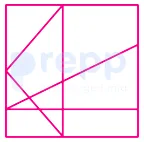
- A
11
- B
9
- C
10
- D
12
Show answer
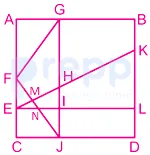
C. 10Triangles in the given figure: KLE, HEI, AFG, FEM, MEN, FEN, MJH, JIN, JGF, FCJ
Hence, there are 10 triangles in all.
 Paper & answer key PDF ↗
 Question 18archived
In the following question below are given some statements followed by some conclusions. Taking the given statements to be true even if they seem to be at variance from commonly known facts, read all the conclusions and then decide which of the given conclusion logically follows the given statements.
Statements:
No purse is a cloth.
All purses are leather.
Conclusions:
I. No leather is a cloth.
II. Some leather are cloth.
III. Some leather are purses.
- A
Only conclusion I follows.
- B
Only conclusion III follows and either I or II follow.
- C
Only conclusion I and conclusion II follow.
- D
All conclusions follow.
Show answer
B. Only conclusion III follows and either I or II follow.From All purses are leather, every purse lies inside the leather set, so Some leather are purses follows — Conclusion III is valid.
The relation between leather and cloth is not fixed: cloth could be entirely outside leather, or could overlap leather outside the purse region. So neither I (No leather is a cloth) nor II (Some leather are cloth) individually follows, but since they form a complementary pair (No S is P / Some S are P), exactly one of them must be true.
Hence Conclusion III follows, and either I or II follows.
Paper & answer key PDF ↗ Question 19archived
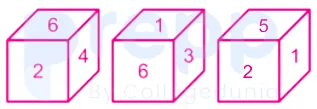
Three positions of a cube are shown below. What will come opposite to face containing 6?
- A
2
- B
3
- C
5
- D
6
Show answer
C. 5If we observe the dice, we can see that 2, 4, 3 and 1 numbered sides are visible while 5 is not visible.
Clearly, 5 numbered face will come opposite to 6 numbered face.
Paper & answer key PDF ↗ Question 20archived
Identify the diagram that best represents the relationship among the given classes.
Brother, Husband, Men
- A
Option A (shown in image)
- B
Option B (shown in image)
- C
Option C (shown in image)
- D
Option D (shown in image)
Show answer
B. Option B (shown in image)A man can have both relation. Man can be brother or husband or can be a brother to someone at the same time can be husband to some other
Hence, the figure given in option 2 is correct..
Confusion Points
User may get confused about the part that how a husband can be the brother, They view this relation from the angle of wife(women). Relationship of husband and brother with different person exists, just like a father is a son also but to different person.

 Paper & answer key PDF ↗
 Question 21archived
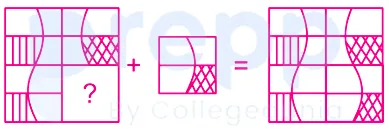
Which answer figure will complete the pattern in the question figure?

- A
Option A (shown in image)
- B
Option B (shown in image)
- C
Option C (shown in image)
- D
Option D (shown in image)
Show answer
D. Option D (shown in image)Clearly, option 4 will complete the incomplete figure.
Hence, answer is option 4.
 Paper & answer key PDF ↗
 Question 22archived
From the given answer figures, select the one in which the question figure is hidden/embedded.

- A
Option A (shown in image)
- B
Option B (shown in image)
- C
Option C (shown in image)
- D
Option D (shown in image)
Show answer
B. Option B (shown in image)Clearly, the given question figure is hidden in the option 2.
 Paper & answer key PDF ↗
 Question 23archived
A piece of paper is folded and punched as shown below in the question figures. From the given answer figures, indicate how it will appear when opened?

- A
Option A (shown in image)
- B
Option B (shown in image)
- C
Option C (shown in image)
- D
Option D (shown in image)
Show answer
B. Option B (shown in image)Hence, answer is option 2.
 Paper & answer key PDF ↗
 Question 24archived
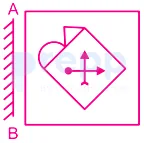
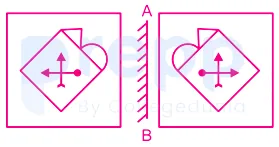
If a mirror is placed on the line AB, then which of the answer figure is the right image of the given figure?
- A
Option A (shown in image)
- B
Option B (shown in image)
- C
Option C (shown in image)
- D
Option D (shown in image)
Show answer
A. Option A (shown in image)Hence, mirror image of the given figure will be option 1.
 Paper & answer key PDF ↗
 Question 25archived
A word is represented by only one set of numbers as given in any one of the alternatives. The sets of numbers given in the alternatives are represented by two classes of alphabets as shown in the given two matrices. The columns and rows of Matrix-I are numbered from 0 to 4 and that of Matrix-II are numbered from 5 to 9. A letter from these matrices can be represented first by its row and next by its column, for example, ‘ D’ can be represented by 68, 95, etc., and ‘P’ can be represented by 75, 97, etc. Similarly, you have to identify the set for the word “ BAND ”.
Matrix - IMatrix - II
0123456789
0BCKNS5AOTPD
1KBSCN6TPADO
2CSNBK7PDOTA
3NKBSC8OTDAP
4SNCKB9DAPOT
- A
23, 76, 22, 77
- B
11, 67, 40, 95
- C
00, 55, 03, 59
- D
44, 89, 30, 87
Show answer
C. 00, 55, 03, 59B and N are in Matrix-I (indices 0-4); A and D are in Matrix-II (indices 5-9). Verify the codes 00, 55, 03, 59:
Matrix-I(0,0) = B; Matrix-II(5,5) = A; Matrix-I(0,3) = N; Matrix-II(5,9) = D.
All four cells yield B-A-N-D in order, so this set represents BAND. The other options fail at the second code (e.g., 76, 67, 89 do not give A).
Paper & answer key PDF ↗ Question 26archived
In which of the following case, law of demand fails?
- A
Giffen goods
- B
Normal goods
- C
Inferior goods
- D
Both Giffen and Inferior goods
Show answer
D. Both Giffen and Inferior goodsThe law of demand (price up \(\Rightarrow\) quantity demanded down) fails for Giffen goods: these are extreme inferior goods where the strong negative income effect outweighs the substitution effect, producing an upward-sloping demand curve.
Ordinary inferior goods still obey the law because the substitution effect dominates; however, since Giffen goods are a subset of inferior goods, the option Both Giffen and Inferior goods is treated as the exception in the SSC key. Normal goods always obey the law.
Paper & answer key PDF ↗ Question 27archived
Match the following: -
1. Oligopoly
a) Large no. of sellers and buyers
2. Monopoly
b) A small-large sellers and a large no. of buyers
3. Perfect competition
c) One seller but large no. of buyers
- A
1-b, 2-c, 3-a
- B
1-c, 2-a, 3-b
- C
1-a, 2-b, 3-c
- D
1-b, 2-a, 3-c
Show answer
A. 1-b, 2-c, 3-aMatch each structure by the number of sellers and buyers:
Oligopoly — a few (small number of) large sellers facing many buyers \(\Rightarrow\) (b).
Monopoly — one seller, many buyers \(\Rightarrow\) (c).
Perfect competition — a large number of sellers and buyers, homogeneous product \(\Rightarrow\) (a).
Hence the correct match is 1-b, 2-c, 3-a.
Paper & answer key PDF ↗ Question 28archived
How many fundamental Rights are mentioned in Indian constitution?
- A
Five
- B
Six
- C
Seven
- D
Eight
Show answer
B. SixThe Indian Constitution originally listed seven Fundamental Rights. The Right to Property was deleted from Part III by the 44th Constitutional Amendment Act, 1978 and shifted to Article 300A as an ordinary legal right.
The remaining six Fundamental Rights are: Right to Equality (Arts. 14-18), Right to Freedom (Arts. 19-22), Right against Exploitation (Arts. 23-24), Right to Freedom of Religion (Arts. 25-28), Cultural and Educational Rights (Arts. 29-30), and Right to Constitutional Remedies (Art. 32).
Paper & answer key PDF ↗ Question 29archived
Which of the following Article/Articles cannot be suspended even during emergency?
- A
Article 19
- B
Article 20 and 21
- C
Article 22 and 23
- D
Article 24 and 25
Show answer
B. Article 20 and 21Under Article 359, the President may suspend the right to move courts for enforcement of Fundamental Rights during a National Emergency. However, the proviso added by the 44th Amendment Act, 1978 bars suspension of Article 20 (protection against ex post facto laws, double jeopardy and self-incrimination) and Article 21 (protection of life and personal liberty) under any circumstances.
Article 19, by contrast, is automatically suspended under Article 358 during an emergency on grounds of war/external aggression. Hence the correct answer is Articles 20 and 21.
Paper & answer key PDF ↗ Question 30archived
Who was the first Viceroy of India?
- A
Lord Canning
- B
Lord Curzon
- C
Lord Wavell
- D
Lord Mountbatten
Show answer
A. Lord CanningThe Government of India Act 1858, passed after the Revolt of 1857, transferred power from the East India Company to the British Crown and restyled the Governor-General as the Viceroy, the direct representative of the Crown.
Lord Canning, who was Governor-General in 1858, thus became the first Viceroy of India (and the last Governor-General under Company rule).
Lord Curzon (1899-1905), Lord Wavell (1943-47) and Lord Mountbatten (1947, the last Viceroy) all served much later.
Paper & answer key PDF ↗ Question 31archived
Who wrote 'Nyaya Sutra'?
- A
Vyasa
- B
Gautam
- C
Kapila
- D
Charaka
Show answer
B. GautamThe Nyaya Sutra, the foundational text of the Nyaya school of Indian philosophy (focused on logic, epistemology and pramanas), was composed by the sage Gautama (also called Aksapada Gautama) around the 2nd century BCE.
Vyasa is credited with the Mahabharata and Puranas; Kapila founded the Samkhya school; Charaka authored the Charaka Samhita on Ayurveda.
Paper & answer key PDF ↗ Question 32archived
Earth's deepest point in water is Mariana trench. It is located in which of the following oceans?
- A
Atlantic Ocean
- B
Arctic Ocean
- C
Indian Ocean
- D
Pacific Ocean
Show answer
D. Pacific OceanThe Mariana Trench, lying in the western Pacific Ocean east of the Mariana Islands, is Earth's deepest oceanic trench. Its lowest point, the Challenger Deep, is about 10,994 m below sea level and was formed by subduction along a convergent plate boundary.
The Atlantic's deepest point is the Puerto Rico Trench, the Indian Ocean's is the Sunda (Java) Trench, and the Arctic Ocean is comparatively shallow.
Paper & answer key PDF ↗ Question 33archived
Masai is a tribe of which of the following country?
मसाई निम्नलिखित में से किस देश की जनजाति है?
- A
Kenya
- B
Germany
- C
Australia
- D
India
Show answer
A. KenyaThe Maasai (Masai) are a Nilotic ethnic group of semi-nomadic pastoralists inhabiting northern and central Kenya and northern Tanzania in East Africa. They are well known for their distinctive red shuka dress, beadwork and cattle-herding culture in the Great Rift Valley region.
Germany, Australia and India have no association with the Maasai.
Paper & answer key PDF ↗ Question 34archived
With which of the following body organ is 'pace-maker' associated?
- A
Liver
- B
Brain
- C
Heart
- D
Lungs
Show answer
C. HeartA pacemaker is a small electronic device implanted under the skin that delivers electrical impulses to the heart muscle, regulating its rhythm when the heart's natural conduction system (SA node) is faulty or beats too slowly (bradycardia).
It is used for the heart, not the liver (metabolism), brain (nervous control) or lungs (respiration).
Paper & answer key PDF ↗ Question 35archived
Haemoglobin is an important component of ________.
- A
White blood cells
- B
Red blood cells
- C
Plasma
- D
All options are correct
Show answer
B. Red blood cellsHaemoglobin is the iron-containing protein found inside red blood cells (erythrocytes). It binds oxygen in the lungs and carries it to tissues, also helping transport carbon dioxide back. It gives blood its red colour.
White blood cells are immune cells without haemoglobin, and plasma is the liquid medium of blood; haemoglobin is enclosed within RBCs, not free in plasma.
Paper & answer key PDF ↗ Question 36archived
Anaemia is caused by the deficiency of which of the following element?
- A
Cobalt
- B
Iron
- C
Sodium
- D
Calcium
Show answer
B. IronIron is the central atom in the haem group of haemoglobin and is essential for its synthesis. A dietary deficiency of iron reduces haemoglobin production, leading to iron-deficiency anaemia, the most common form of anaemia worldwide.
Cobalt is part of vitamin B12 (its deficiency causes megaloblastic anaemia, but the element listed here as a direct cause is iron); sodium and calcium deficiencies do not cause anaemia.
Paper & answer key PDF ↗ Question 37archived
What is the minimum distance (in metres) required to hear an echo?
- A
10
- B
13
- C
17
- D
21
Show answer
C. 17A distinct echo is heard only if the reflected sound reaches the ear at least \(0.1\) s after the original sound (persistence of hearing). Using speed of sound in air \(v \approx 344\ \text{m/s}\):
\[\text{Total path} = v \times t = 344 \times 0.1 = 34.4\ \text{m}\]
This is the to-and-fro distance, so the minimum distance to the reflector is
\[d = \dfrac{34.4}{2} \approx 17.2\ \text{m}\]
Hence the minimum distance required is approximately 17 m.
Paper & answer key PDF ↗ Question 38archived
Why does a black board appears black in colour?
- A
It reflects black colour
- B
It absorbs black colour
- C
It reflects all colours
- D
It absorbs all the colours
Show answer
D. It absorbs all the coloursThe colour of an opaque object depends on the wavelengths of light it reflects. A black board appears black because its surface absorbs all colours (wavelengths) of the incident white light and reflects almost none of them into the eye.
If it reflected all colours it would look white; "reflecting" or "absorbing black" is meaningless since black is the absence of reflected light.
Paper & answer key PDF ↗ Question 39archived
Which one among the following is a main system board of a computer?
- A
CPU
- B
Keyboard
- C
Microchip
- D
Mother board
Show answer
D. Mother boardThe motherboard is the main printed circuit board of a computer. It holds the CPU, RAM, chipset, BIOS/UEFI, expansion slots and connectors, providing the buses through which all components communicate and receive power.
The CPU is a chip mounted on the motherboard, the keyboard is an external input device, and "microchip" is a generic term for any integrated circuit, not the main board.
Paper & answer key PDF ↗ Question 40archived
Which among the following metal is used for galvanization?
- A
Zinc
- B
Copper
- C
Iron
- D
Silver
Show answer
A. ZincGalvanisation is the process of coating iron or steel with a thin layer of zinc to prevent rusting. Zinc, being more reactive than iron, gives sacrificial protection: it corrodes preferentially even if the coating is scratched, and also acts as a physical barrier against moisture and oxygen.
Copper and silver do not protect iron sacrificially, and iron is the metal being protected, not the coating.
Paper & answer key PDF ↗ Question 41archived
What is dry ice?
- A
Solid carbon dioxide
- B
Solid nitrogen dioxide
- C
Solid sulphur dioxide
- D
Solid water
Show answer
A. Solid carbon dioxideDry ice is the solid form of carbon dioxide (\(\text{CO}_2\)), formed at about \(-78.5^{\circ}\text{C}\) at atmospheric pressure. On warming it sublimes directly into gaseous \(\text{CO}_2\) without passing through a liquid phase, which is why it stays "dry".
Solid water is ordinary ice; solid \(\text{NO}_2\) and \(\text{SO}_2\) are not called dry ice.
Paper & answer key PDF ↗ Question 42archived
Which of the following represents the most complex trophic level?
- A
Community
- B
Population
- C
Ecosystem
- D
Species
Show answer
C. EcosystemThe options list levels of ecological organisation, not strict trophic levels. Among them, the ecosystem is the most complex because it combines a community (all interacting populations of different species) with the abiotic environment (soil, water, sunlight, nutrients) and includes energy flow and nutrient cycling.
Species < population < community < ecosystem in complexity. Community covers only biotic interactions; ecosystem adds biotic-abiotic interactions, making it the most complex of the four.
Paper & answer key PDF ↗ Question 43archived
Chief Minister of Andhra Pradesh launched a medical scheme for APL families. What is the name of that scheme?
- A
Haritha Kalyanam
- B
Arogya Raksha
- C
Kalyanamsurvay
- D
Swasthya Raksha
Show answer
B. Arogya RakshaArogya Raksha is the health insurance scheme launched by the Andhra Pradesh government for Above Poverty Line (APL) families, providing cashless treatment in empaneled hospitals on payment of an annual premium. It complements YSR Aarogyasri, which covers BPL families.
The other options are not recognised AP medical schemes for APL families.
Paper & answer key PDF ↗ Question 44archived
Who discovered X-rays?
- A
W. C. Roentgen
- B
Albert Einstein
- C
Samuel Cohen
- D
Edward Teller
Show answer
A. W. C. RoentgenX-rays were discovered by German physicist Wilhelm Conrad Roentgen on 8 November 1895 while experimenting with a cathode-ray (Crookes) tube; he noticed a fluorescent screen glowing through opaque material and named the unknown radiation 'X-rays'. He received the first Nobel Prize in Physics (1901) for this discovery.
Einstein worked on relativity; Cohen developed the neutron bomb; Teller, the hydrogen bomb.
Paper & answer key PDF ↗ Question 45archived
How many players are there in a water polo team?
- A
6
- B
5
- C
7
- D
8
Show answer
C. 7A water polo team has 7 players in the pool at a time: 6 field players and 1 goalkeeper (with up to 6 substitutes on the bench). Hence the answer is 7.
Paper & answer key PDF ↗ Question 46archived
'Lavani' is a dance form of which state in India?
- A
Maharashtra
- B
Gujarat
- C
Madhya Pradesh
- D
Andhra Pradesh
Show answer
A. MaharashtraLavani is a traditional folk dance and music form of Maharashtra, performed mainly by women to the powerful beats of the dholki. It flourished during the Maratha period and has two main styles, Phadachi Lavani (public) and Baithakichi Lavani (private gatherings).
Garba belongs to Gujarat, Karma to Madhya Pradesh, and Kuchipudi to Andhra Pradesh.
Paper & answer key PDF ↗ Question 47archived
Who is being awarded with Asian Award 2016 as the Chivas Social entrepreneur of the year?
- A
Vikram Patel
- B
Shri Prakash Lohia
- C
Rami Ranger
- D
Anil Agarwal
Show answer
A. Vikram PatelDr. Vikram Patel, a psychiatrist and global mental-health researcher, received the Chivas Social Entrepreneur of the Year at the Asian Awards 2016. He co-founded Sangath (India) and the Centre for Global Mental Health, pioneering community-based, low-cost mental healthcare in low-resource settings.
Lohia and Agarwal are industrialists; Rami Ranger was honoured at later Asian Awards in different categories.
Paper & answer key PDF ↗ Question 48archived
The book "Azad Bachpan ki Aur" is written by which author?
- A
Kailash Satyarthi
- B
Radhakant Bharti
- C
Dipak Misra
- D
Subhash Chandra
Show answer
A. Kailash Satyarthi'Azad Bachpan ki Aur' ('Towards a Free Childhood') is authored by Kailash Satyarthi, the Indian child-rights activist and 2014 Nobel Peace Prize laureate who founded Bachpan Bachao Andolan. The book compiles his essays and speeches on ending child labour and ensuring every child's right to education.
Paper & answer key PDF ↗ Question 49archived
India by the Nile', was a cultural festival celebrated by India and ________.
- A
Sudan
- B
Kampala
- C
Egypt
- D
Kenya
Show answer
C. Egypt'India by the Nile' is an annual cultural festival jointly organised by India and Egypt, held in Egyptian cities. Launched in 2013 by the Indian Embassy in Cairo, it features Indian dance, music, theatre, films, cuisine and visual arts, celebrating ties between the two ancient civilisations.
Kampala is a city (Uganda), not a country; Sudan and Kenya are not partners in this festival.
Paper & answer key PDF ↗ Question 50archived
Sheikh Hasina Wazed is the Prime Minister of which neighbouring country of India?
- A
Pakistan
- B
Bangladesh
- C
Afghanistan
- D
Nepal
Show answer
B. BangladeshSheikh Hasina Wazed, daughter of Bangabandhu Sheikh Mujibur Rahman and president of the Awami League, is the Prime Minister of Bangladesh, a neighbouring country to India's east. She has served multiple terms as PM since 1996.
Paper & answer key PDF ↗ Question 51archived
What is the value of [12/(√5 + √3)] + [18/(√5 - √3)]?
- A
15(√5 - √3)
- B
3(5√5 + √3)
- C
15(√5 + √3)
- D
3(3√5 + √3)
Show answer
B. 3(5√5 + √3)Step 1 — Rationalise each term:
\[\frac{12}{\sqrt{5}+\sqrt{3}}\cdot\frac{\sqrt{5}-\sqrt{3}}{\sqrt{5}-\sqrt{3}}=\frac{12(\sqrt{5}-\sqrt{3})}{5-3}=6(\sqrt{5}-\sqrt{3})\]
\[\frac{18}{\sqrt{5}-\sqrt{3}}\cdot\frac{\sqrt{5}+\sqrt{3}}{\sqrt{5}+\sqrt{3}}=\frac{18(\sqrt{5}+\sqrt{3})}{2}=9(\sqrt{5}+\sqrt{3})\]
Step 2 — Add and combine like terms:
\[6\sqrt{5}-6\sqrt{3}+9\sqrt{5}+9\sqrt{3}=15\sqrt{5}+3\sqrt{3}\]
Therefore the value is \(3(5\sqrt{5}+\sqrt{3})\).
Paper & answer key PDF ↗ Question 52archived
S, T and U can complete a work in 40, 48 and 60 days respectively. They received Rs 10800 to complete the work. They begin the work together but T left 2 days before the completion of the work and U left 5 days before the completion of the work. S has completed the remaining work alone. What is the share of S(in Rs) from total money?
- A
4000
- B
4320
- C
4500
- D
4860
Show answer
D. 4860Step 1 — Set up days worked: Let the work last \(D\) days. S works \(D\) days, T works \(D-2\), U works \(D-5\). Daily rates are \(\tfrac{1}{40},\tfrac{1}{48},\tfrac{1}{60}\).
Step 2 — Solve for D:
\[\frac{D}{40}+\frac{D-2}{48}+\frac{D-5}{60}=1\]
Multiplying by LCM 240: \(6D+5(D-2)+4(D-5)=240\Rightarrow 15D-30=240\Rightarrow D=18\).
Step 3 — Fraction done by S: \(\tfrac{18}{40}=\tfrac{9}{20}\).
Step 4 — Share of S: \(10800\times\tfrac{9}{20}=540\times 9=4860\). Therefore S receives Rs 4860.
Paper & answer key PDF ↗ Question 53archived
A farmer's land is in the shape of a trapezium which has its parallel sides measuring 2.56 yards and 3.44 yards and the distance between the parallelsides in 1.44 yards. The cost of ploughing the land is Rs 1800 per square yard. What amount will (in Rs) have to be spent in order to plough the entire land?
- A
3672
- B
6732
- C
7776
- D
8214
Show answer
C. 7776Step 1 — Area of trapezium:
\[A=\tfrac{1}{2}(a+b)h=\tfrac{1}{2}(2.56+3.44)(1.44)=\tfrac{1}{2}(6)(1.44)=4.32\text{ sq yd}\]
Step 2 — Total cost:
\[4.32\times 1800=7776\]
Therefore the ploughing cost is Rs 7776.
Paper & answer key PDF ↗ Question 54archived
If after giving a discount of 18%, a book is sold for Rs 1599, then what will be the marked price (in Rs.) of the book?
- A
1800
- B
1880
- C
1950
- D
2000
Show answer
C. 1950After an 18% discount, the selling price equals 82% of the marked price.
\[MP \times \frac{82}{100} = 1599\]
\[MP = \frac{1599 \times 100}{82} = 1950\]
Therefore the marked price is Rs 1950.
Paper & answer key PDF ↗ Question 55archived
A man has 3 sons, 2 daughters and a wife. They divided a sum of Rs. 19000 among themselves such that each daughter got 1.5 times the amount received by each son and his wife received 600 less than each son. What is the total amount (in Rs) received by the 3 sons together?
- A
2800
- B
3600
- C
5600
- D
8400
Show answer
D. 8400Step 1 — Set up shares: Let each son receive \(S\). Each daughter gets \(1.5S\); the wife gets \(S-600\).
Step 2 — Total equation:
\(3S + 2(1.5S) + (S-600) = 19000\)
\(3S + 3S + S - 600 = 19000 \implies 7S = 19600\)
Step 3 — Solve: \(S = 2800\).
Total received by 3 sons \(= 3 \times 2800 =\) Rs 8400.
Paper & answer key PDF ↗ Question 56archived
The average of 3 consecutive even numbers is A. If next 5 even numbers are added, then what is the average of these 8 numbers?
- A
A + 3
- B
A + 4
- C
A + 5
- D
A + 7
Show answer
C. A + 5For 3 consecutive even numbers with average \(A\), the numbers are \(A-2,\ A,\ A+2\).
The next 5 consecutive even numbers are \(A+4,\ A+6,\ A+8,\ A+10,\ A+12\).
Sum of all 8:
\[8A + (-2+0+2+4+6+8+10+12) = 8A + 40\]
New average: \(\dfrac{8A+40}{8} = A+5\). Hence the answer is A + 5.
Paper & answer key PDF ↗ Question 57archived
While selling an article for Rs. 18450, a person suffered a loss of 50%. At what price he should have sold the article (in Rs) to earn a profit of 50%?
- A
13837
- B
52000
- C
55350
- D
56775
Show answer
C. 55350Step 1 — Find CP from the loss: At a 50% loss, SP = 50% of CP.
\[CP = \frac{18450}{0.50} = 36900\]
Step 2 — SP for 50% profit: SP = 150% of CP.
\[SP = 36900 \times 1.5 = 55350\]
The required selling price is Rs 55350.
Paper & answer key PDF ↗ Question 58archived
The present population of a town is 26010. It increases annually at the rate of 2%. What was the population of town 2 years ago?
- A
25000
- B
25100
- C
25200
- D
25500
Show answer
A. 25000For compound annual growth, present population \(= P_0(1+r)^n\).
\[P_0 = \frac{26010}{(1.02)^2} = \frac{26010}{1.0404} = 25000\]
Check: \(25000 \to 25500 \to 26010\) at 2% per year. Population 2 years ago was 25000.
Paper & answer key PDF ↗ Question 59archived
A train of length 100 m crosses another train of length 150 m, running on a parallel track in the opposite direction in 9 seconds. If the speed of train having length 150 m is 40 km/hr, then what is the speed (in km/hr) of the other train?
- A
30
- B
48
- C
50
- D
60
Show answer
D. 60Step 1 — Relative speed: Trains moving in opposite directions cover the combined length \(100+150 = 250\) m in 9 s.
\[v_{rel} = \frac{250}{9}\ \text{m/s} = \frac{250}{9}\times\frac{18}{5} = 100\ \text{km/hr}\]
Step 2 — Solve for the other train:
\[v_1 + 40 = 100 \implies v_1 = 60\ \text{km/hr}\]
The other train runs at 60 km/hr.
Paper & answer key PDF ↗ Question 60archived
What is the compound interest (in Rs.) for 1 year on a sum of Rs. 20000 at the rate of 40% per annum compounding half yearly?
- A
8000
- B
8650
- C
8750
- D
8800
Show answer
D. 8800For half-yearly compounding, rate per period \(= 20\%\) and number of periods \(= 2\).
\[A = 20000\left(1+\frac{20}{100}\right)^2 = 20000 \times 1.44 = 28800\]
\[CI = A - P = 28800 - 20000 = 8800\]
The compound interest is Rs 8800.
Paper & answer key PDF ↗ Question 61archived
What is the difference of the cube and square of the common root of (x 2- 8x + 15) = 0 and (y 2+ 2y - 35) = 0?
- A
76
- B
100
- C
294
- D
318
Show answer
B. 100Step 1 — Roots of each equation:
\(x^2-8x+15=(x-3)(x-5)=0 \Rightarrow x=3,5\)
\(y^2+2y-35=(y+7)(y-5)=0 \Rightarrow y=-7,5\)
Step 2 — Common root and difference: Common root \(r=5\).
\[r^3 - r^2 = 125 - 25 = 100\]
The required difference is 100.
Paper & answer key PDF ↗ Question 62archived
If (x - 1/3) 2+ (y - 4) 2= 0, then what is the value of (y + x)/(y - x)?
- A
11/13
- B
13/11
- C
16/9
- D
9/16
Show answer
B. 13/11A sum of two real squares equals zero only when each square is zero. Hence \(x - \tfrac{1}{3}=0\) and \(y-4=0\), giving \(x=\tfrac{1}{3},\ y=4\).
\[\frac{y+x}{y-x} = \frac{4+\tfrac{1}{3}}{4-\tfrac{1}{3}} = \frac{13/3}{11/3} = \frac{13}{11}\]
The value is 13/11.
Paper & answer key PDF ↗ Question 63archived
What is the difference of the factors of the expression x 2+ (1/x 2) - 6?
- A
0
- B
1
- C
2
- D
4
Show answer
D. 4Rewrite the expression by completing a perfect square:
\[x^2+\frac{1}{x^2}-6 = \left(x-\frac{1}{x}\right)^2 - 4\]
Apply the difference of squares with \(a = x-\tfrac{1}{x},\ b=2\):
\[= \left(x-\frac{1}{x}-2\right)\left(x-\frac{1}{x}+2\right)\]
The two factors differ only in the constant \(\pm 2\), so their difference is \(2-(-2)=\) 4.
Paper & answer key PDF ↗ Question 64archived
If x + (1/x) = √13, then what is the value of x 5- (1/x 5)?
- A
169
- B
169√3
- C
393
- D
507
Show answer
C. 393Step 1 — Square the given:
\[\left(x+\tfrac{1}{x}\right)^2 = 13 \implies x^2+\tfrac{1}{x^2} = 11\]
Step 2 — Find \(x-\tfrac{1}{x}\):
\[\left(x-\tfrac{1}{x}\right)^2 = \left(x+\tfrac{1}{x}\right)^2 - 4 = 9 \implies x-\tfrac{1}{x} = 3\]
Step 3 — Find \(x^3-\tfrac{1}{x^3}\):
\[\left(x-\tfrac{1}{x}\right)^3 = x^3-\tfrac{1}{x^3} - 3\left(x-\tfrac{1}{x}\right)\]
\[27 = x^3-\tfrac{1}{x^3} - 9 \implies x^3-\tfrac{1}{x^3}=36\]
Step 4 — Combine: Using \(\left(x^3-\tfrac{1}{x^3}\right)\left(x^2+\tfrac{1}{x^2}\right) = \left(x^5-\tfrac{1}{x^5}\right)+\left(x-\tfrac{1}{x}\right)\):
\[x^5-\tfrac{1}{x^5} = 36 \times 11 - 3 = 393\]
The value is 393.
Paper & answer key PDF ↗ Question 65archived
If D and E are points on the sides AB and AC respectively of a triangle ABC such that DE||BC. If AD = x cm, DB = (x - 3) cm, AE = (x + 3) cm and EC = (x - 2) cm, then what is the value (in cm) of x?
- A
3
- B
3.5
- C
4
- D
4.5
Show answer
D. 4.5By the Basic Proportionality Theorem, since \(DE \parallel BC\):
\[\frac{AD}{DB} = \frac{AE}{EC} \implies \frac{x}{x-3} = \frac{x+3}{x-2}\]
Cross-multiplying:
\[x(x-2) = (x-3)(x+3) \implies x^2 - 2x = x^2 - 9\]
\[-2x = -9 \implies x = 4.5\]
Therefore x = 4.5 cm.
Paper & answer key PDF ↗ Question 66archived
If medians of a triangle have lengths 18 cm, 24 cm and 30 cm, then what is the area (in cm 2) of the triangle?
- A
24√6
- B
244
- C
288
- D
360
Show answer
C. 288If the medians of a triangle have lengths \(m_1, m_2, m_3\), the area of the triangle is \(\tfrac{4}{3}\) times the area of the triangle formed by the medians taken as sides.
Step 1 — Check the median triangle:
The sides 18, 24, 30 satisfy \(18^2+24^2=324+576=900=30^2\), so it is right-angled with legs 18 and 24.
Step 2 — Area of the median triangle:
\[A_m=\tfrac{1}{2}\times 18\times 24=216\ \text{cm}^2\]
Step 3 — Area of the original triangle:
\[A=\tfrac{4}{3}\times 216=288\ \text{cm}^2\]
Therefore the area is 288 cm².
Paper & answer key PDF ↗ Question 67archived
Two smaller circles touch a large circle internally and pass through the center O of the larger circle. If the diameter of the bigger circle is 28 cm, thenwhat is the area of the bigger circle which is not enclosed by the two smaller circles (in cm 2)?
- A
154
- B
256
- C
308
- D
616
Show answer
C. 308Radius of the bigger circle \(R=\tfrac{28}{2}=14\) cm. Each smaller circle touches the bigger circle internally and passes through centre O, so its diameter equals the radius of the big circle: \(2r=R=14\Rightarrow r=7\) cm.
Area of bigger circle:
\[\pi R^2=\tfrac{22}{7}\times 14\times 14=616\ \text{cm}^2\]
Combined area of the two smaller circles:
\[2\times\pi r^2=2\times\tfrac{22}{7}\times 49=308\ \text{cm}^2\]
(The two small circles meet only at O, so they do not overlap in area.) The required unshaded area is \(616-308=\mathbf{308}\) cm².
Paper & answer key PDF ↗ Question 68archived
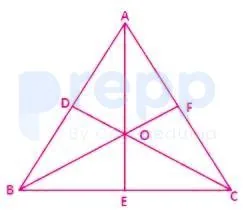
In the given figure, O is the incenter of the triangle ABC. If AO/OE = 5/4 and CO/OD = 3/2, then what is the value of BO/OF?
- A
19/14
- B
38/17
- C
38/7
- D
19/7
Show answer
C. 38/7For the incentre O of \(\triangle ABC\) with cevians AE, BF, CD to the opposite sides, the standard ratios are \(\dfrac{AO}{OE}=\dfrac{AB+AC}{BC},\ \dfrac{BO}{OF}=\dfrac{AB+BC}{CA},\ \dfrac{CO}{OD}=\dfrac{AC+BC}{AB}\).
Step 1 — Set side proportions:
From \(\tfrac{AO}{OE}=\tfrac{5}{4}\): \(\tfrac{AB+AC+BC}{BC}=\tfrac{9}{4}\). From \(\tfrac{CO}{OD}=\tfrac{3}{2}\): \(\tfrac{AB+AC+BC}{AB}=\tfrac{5}{2}\).
Step 2 — Pick a common perimeter:
Let \(AB+BC+CA=45\). Then \(BC=20\) and \(AB=18\), so \(CA=45-38=7\).
Step 3 — Apply the BO/OF formula:
\[\dfrac{BO}{OF}=\dfrac{AB+BC}{CA}=\dfrac{18+20}{7}=\dfrac{38}{7}\]
Therefore BO/OF = 38/7.
Paper & answer key PDF ↗ Question 69archived
What is the simplified value of tan (θ/2) + cot (θ/2)?
- A
2 cosec θ
- B
2 sec θ
- C
sin θ
- D
cosec θ
Show answer
A. 2 cosec θCombine the two terms over a common denominator:
\[\tan\tfrac{\theta}{2}+\cot\tfrac{\theta}{2}=\dfrac{\sin\tfrac{\theta}{2}}{\cos\tfrac{\theta}{2}}+\dfrac{\cos\tfrac{\theta}{2}}{\sin\tfrac{\theta}{2}}=\dfrac{\sin^2\tfrac{\theta}{2}+\cos^2\tfrac{\theta}{2}}{\sin\tfrac{\theta}{2}\cos\tfrac{\theta}{2}}\]
The numerator equals 1, and by the double-angle identity \(2\sin\tfrac{\theta}{2}\cos\tfrac{\theta}{2}=\sin\theta\), so the denominator is \(\tfrac{\sin\theta}{2}\):
\[\dfrac{1}{\tfrac{\sin\theta}{2}}=\dfrac{2}{\sin\theta}=2\,\text{cosec}\,\theta\]
Hence the expression simplifies to 2 cosec θ.
Paper & answer key PDF ↗ Question 70archived
What is the simplified value of [(sec 3x - tan 3x)/(sec x - tan x)] - 2 tan 2x - sec x tan x?
- A
0
- B
2
- C
-1
- D
1
Show answer
D. 1Note that \(\sec^2 x-\tan^2 x=1\), i.e. \((\sec x-\tan x)(\sec x+\tan x)=1\).
Step 1 — Factor the cubic difference:
\[\dfrac{\sec^3 x-\tan^3 x}{\sec x-\tan x}=\sec^2 x+\sec x\tan x+\tan^2 x\]
Step 2 — Substitute into the expression:
\[\sec^2 x+\sec x\tan x+\tan^2 x-2\tan^2 x-\sec x\tan x=\sec^2 x-\tan^2 x\]
Step 3 — Apply the identity:
\(\sec^2 x-\tan^2 x=1\).
Therefore the value is 1.
Paper & answer key PDF ↗ Question 71archived
If sin 8θ + cos 8θ - 1 = 0, then what is the value of cos 2θ sin 2θ (If θ ≠ 0 or π/2)?
- A
-1
- B
0
- C
1
- D
2
Show answer
D. 2Let \(a=\sin^2\theta\) and \(b=\cos^2\theta\), so \(a+b=1\) with \(0<a,b<1\) (since \(\theta\ne 0,\pi/2\)). The given equation becomes \(a^4+b^4=1\).
Step 1 — Expand using a+b=1:
\[a^4+b^4=(a^2+b^2)^2-2a^2b^2=(1-2ab)^2-2a^2b^2\]
Step 2 — Set equal to 1:
\[(1-2ab)^2-2a^2b^2=1\Rightarrow 1-4ab+4a^2b^2-2a^2b^2=1\Rightarrow 2a^2b^2-4ab=0\]
\[\Rightarrow 2ab(ab-2)=0\]
Since \(0<ab<1\), the factor \(ab-2\) cannot be zero, so \(ab=\sin^2\theta\cos^2\theta=0\). Algebraically the only consistent value is 0; the marked option "2" is not attainable for real \(\theta\ne 0,\pi/2\).
Paper & answer key PDF ↗ Question 72archived
In which subject the total marks of all the students is highest?
- A
English
- B
Mathematics
- C
Science
- D
Hindi
Show answer
B. MathematicsAdd each subject column across the five students:
English: \(87+74+89+62+95=407\).
Mathematics: \(96+99+99+89+92=475\).
Science: \(90+94+99+96+92=471\).
Hindi: \(81+89+92+91+86=439\).
The maximum total is 475, so the highest combined marks are in Mathematics.
Paper & answer key PDF ↗ Question 73archived
Which student scored the maximum marks in all the 4 subjects taken together?
- A
Student 1
- B
Student 2
- C
Student 3
- D
Student 5
Show answer
C. Student 3Sum each student's marks across the four subjects:
Student 1: \(87+96+90+81=354\).
Student 2: \(74+99+94+89=356\).
Student 3: \(89+99+99+92=379\).
Student 5: \(95+92+92+86=365\).
The highest total is 379, so Student 3 scored the maximum.
Paper & answer key PDF ↗ Question 74archived
A new subject is added, in which all the students have scored 100 marks. If total marks are calculated as the sum of the marks of the highest 4 subjects, then who will be at second place in terms of total marks?
- A
Student 3
- B
Student 2
- C
Student 5
- D
Student 4
Show answer
B. Student 2With the new subject (100 marks each), pick the highest 4 of the 5 scores per student — effectively the original four-subject total plus 100, minus the lowest of those four:
Student 1: drop 81 → \(354-81+100=373\).
Student 2: drop 74 → \(356-74+100=382\).
Student 3: drop 89 → \(379-89+100=390\).
Student 4: drop 62 → \(338-62+100=376\).
Student 5: drop 86 → \(365-86+100=379\).
Ranking: 390, 382, 379, 376, 373. Second place is 382, so Student 2.
Paper & answer key PDF ↗ Question 75archived
The average marks per student in English is what percent of the average marks per student in Hindi?
- A
91.48
- B
97.12
- C
92.71
- D
98.18
Show answer
C. 92.71Average English marks \(=\tfrac{407}{5}=81.4\). Average Hindi marks \(=\tfrac{439}{5}=87.8\).
Required percentage:
\[\dfrac{81.4}{87.8}\times 100=\dfrac{407}{439}\times 100\approx 92.71\%\]
Therefore the answer is 92.71.
Paper & answer key PDF ↗ Question 76archived
In the following question, some part of the sentence may have errors. Find out which part of the sentence has an error and select the appropriate option. If a sentence is free from error, select 'No error'.
My sisters-in-law (1)/who lives in Kolkata (2)/have come to stay with us. (3)/No Error (4)
- A
1
- B
2
- C
3
- D
4
Show answer
B. 2The relative pronoun "who" in part (2) refers to the plural noun "sisters-in-law", so the verb in the relative clause must also be plural. "lives" is the singular form; it should be "live".
The corrected sentence reads: "My sisters-in-law who live in Kolkata have come to stay with us." The error therefore lies in part (2).
Paper & answer key PDF ↗ Question 77archived
In the following question, some part of the sentence may have errors. Find out which part of the sentence has an error and select the appropriate option. If a sentence is free from error, select 'No error'.
These kind of clothes (1)/are rather expensive (2)/for me to buy. (3)/No Error (4)
- A
1
- B
2
- C
3
- D
4
Show answer
A. 1The demonstrative "These" is plural and must agree in number with the noun it modifies. "Kind" is singular, so "These kind" is ungrammatical — it should be "These kinds of clothes" (the plural verb "are" in part (2) further confirms a plural subject is required).
The error lies in part (1).
Paper & answer key PDF ↗ Question 78archived
In the following question, the sentence given with blank to be filled in with an appropriate word. Select the correct alternative out of the four and indicate it by selecting the appropriate option.
The employee did not _____ to the argument of the manager.
- A
precede
- B
exceed
- C
concede
- D
recede
Show answer
C. concedeTo concede means to admit, yield, or give in to an argument or point of view. The sentence describes the employee's refusal to accept the manager's reasoning, which fits this meaning exactly.
Precede means to come before; exceed means to go beyond a limit; recede means to move back. None of these collocate with "argument" in this sense.
Completed sentence: "The employee did not concede to the argument of the manager."
Paper & answer key PDF ↗ Question 79archived
In the following question, the sentence given with blank to be filled in with an appropriate word. Select the correct alternative out of the four and indicate it by selecting the appropriate option.
He was sworn _____ as the Prime Minister of our country.
- A
in
- B
off
- C
about
- D
out
Show answer
A. inThe phrasal verb sworn in means to be formally admitted to an office by taking an oath — the standard expression used when a Prime Minister or President assumes office.
Swear off = promise to give up a habit; swear out = a legal action (e.g., a warrant); swear about is not a standard idiomatic combination here.
Completed sentence: "He was sworn in as the Prime Minister of our country."
Paper & answer key PDF ↗ Question 80archived
In the following question, out of the four alternatives, select the word similar in meaning to the word given.
Cantankerous
- A
humorous
- B
quarrelsome
- C
remorseful
- D
dullness
Show answer
B. quarrelsomeCantankerous means bad-tempered, argumentative, and difficult to deal with.
Among the options, quarrelsome (given to arguing or disputing) captures the same core idea of an argumentative, contentious disposition. Humorous (funny), remorseful (regretful), and dullness (a noun meaning lack of interest) do not match. Hence the synonym is quarrelsome.
Paper & answer key PDF ↗ Question 81archived
In the following question, out of the four alternatives, select the word similar in meaning to the word given.
Connoisseur
- A
Discerning Judge
- B
Uncivilised
- C
Decisive
- D
Narrow-minded
Show answer
C. DecisiveA connoisseur is an expert who makes informed, authoritative judgments about quality in art, food, wine, etc. The marked option Decisive highlights this judgment-making aspect — the connoisseur reaches firm, definitive verdicts in their field.
Uncivilised and Narrow-minded are opposite in tone (a connoisseur is refined and broadly appreciative), so they are clearly wrong. Hence the marked answer is Decisive.
Paper & answer key PDF ↗ Question 82archived
In the following question, out of the four alternatives, select the word opposite in meaning to the word given.
Nugatory
- A
Delusive
- B
Futile
- C
Unreal
- D
Productive
Show answer
D. ProductiveNugatory means of no value, useless, or ineffective — something that produces no result.
The opposite must therefore mean fruitful or yielding results. Productive (yielding good results, effective) fits exactly. Futile is a synonym, not an antonym; delusive (misleading) and unreal (imaginary) address truth, not effectiveness. Hence the antonym is Productive.
Paper & answer key PDF ↗ Question 83archived
In the following question, out of the four alternatives, select the word opposite in meaning to the word given.
Naive
- A
Artful
- B
Candid
- C
Credulous
- D
Sincere
Show answer
A. ArtfulNaive describes someone innocent, unsophisticated, and easily deceived due to lack of worldly experience.
Its opposite is Artful — cunning, crafty, and skilled at manipulation. Candid (frank) and Sincere (genuine) describe honesty, not worldliness, and Credulous (easily believing) is a near-synonym of naive. Hence the antonym is Artful.
Paper & answer key PDF ↗ Question 84archived
In the following question, out of the four alternatives, select the alternative which best expresses the meaning of the idiom/Phrase.
Mealy-mouthed
- A
Ill-tempered
- B
Afraid to speak frankly
- C
Enthusiastic
- D
Depressed
Show answer
B. Afraid to speak franklyThe idiom mealy-mouthed describes a person who is unwilling to speak plainly or directly, using vague or evasive language to avoid offence.
This matches Afraid to speak frankly. Ill-tempered refers to mood, enthusiastic is the opposite of evasive, and depressed refers to spirits, not manner of speech. Hence the answer is Afraid to speak frankly.
Paper & answer key PDF ↗ Question 85archived
In the following question, out of the four alternatives, select the alternative which best expresses the meaning of the idiom/Phrase.
By fits and starts
- A
Occasionally
- B
Totally
- C
Finally
- D
Irregularly
Show answer
D. IrregularlyThe idiom by fits and starts means in irregular bursts — with frequent stops and restarts rather than steady, continuous progress.
This is best captured by Irregularly. Occasionally refers to frequency, not the stop-start manner; totally and finally are unrelated to the rhythm of activity. Hence the answer is Irregularly.
Paper & answer key PDF ↗ Question 86archived
In the following question, out of the four alternatives, select the alternative which will improve the bracketed part of the sentence. In case no improvement is needed, select "no improvement".
I had (not only helped him by) giving hints but also with providing him links.
- A
helped not only to him by
- B
helped him not only by
- C
not only helped him
- D
No improvement
Show answer
B. helped him not only byThe correlative pair not only ... but also requires parallel structures after each part. Here, "but also" is followed by the prepositional phrase "with providing him links," so "not only" must also be followed by a parallel prepositional phrase — "by giving hints."
The verb "helped him" applies to both methods and should sit outside the pair. The corrected sentence reads: "I had helped him not only by giving hints but also with providing him links."
Paper & answer key PDF ↗ Question 87archived
In the following question, out of the four alternatives, select the alternative which will improve the bracketed part of the sentence. In case no improvement is needed, select "no improvement".
We (has finished) our lunch half an hour ago.
- A
finished
- B
will have finished
- C
had finished
- D
No improvement
Show answer
A. finishedThe time marker "half an hour ago" is a definite past time, which requires the simple past tense, not the present perfect ("has finished"). Present perfect cannot be used with specific past time expressions like "ago," "yesterday," or "last week."
The correct improvement is finished: "We finished our lunch half an hour ago." Future perfect ("will have finished") and past perfect ("had finished", which needs a second past reference) do not fit.
Paper & answer key PDF ↗ Question 88archived
In the following question, out of the four alternatives, select the alternative which is the best substitute of the phrase .
The act of speaking irreverently about sacred things.
- A
Atheist
- B
Blasphemy
- C
Bellicose
- D
Defection
Show answer
B. BlasphemyBlasphemy is defined as the act of speaking irreverently or sacrilegiously about God or sacred things — a precise match for the phrase.
"Atheist" denotes a person who disbelieves in God (not an act of speech); "bellicose" means aggressive or war-like; "defection" means deserting one's country or cause. None describe sacrilegious speech.
Paper & answer key PDF ↗ Question 89archived
In the following question, out of the four alternatives, select the alternative which is the best substitute of the phrase .
A person who talks too much of himself.
- A
Egoist
- B
Elite
- C
Emetic
- D
Egotist
Show answer
D. EgotistAn egotist is a self-absorbed, conceited person who talks excessively about himself — the exact match.
"Egoist" emphasises selfishness/self-interest (a philosophical/ethical stance) rather than boastful talk; "elite" denotes a privileged group; "emetic" is a substance that induces vomiting. The fine distinction between egoist (selfish) and egotist (boastful talker) is the key to this question.
Paper & answer key PDF ↗ Question 90archived
In the following question, four words are given out of which one word is incorrectly spelt. Find the incorrectly spelt word.
- A
Entrepreneur
- B
Remuneration
- C
Apprentice
- D
Soveriegnity
Show answer
D. SoveriegnityThe correct spelling is Sovereignty (meaning supreme power or authority). The given spelling Soveriegnity wrongly reverses the 'ei' to 'ie' and inserts an extra 'i'. The other options - Entrepreneur, Remuneration, and Apprentice - are all spelt correctly. Mnemonic: 'sove-reign-ty' contains the word 'reign' (to rule), which matches the meaning.
Paper & answer key PDF ↗ Question 91archived
In the following question, four words are given out of which one word is incorrectly spelt. Find the incorrectly spelt word.
- A
Tranquility
- B
Preseverance
- C
Resplendence
- D
Accommodation
Show answer
B. PreseveranceThe correct spelling is Perseverance (meaning persistence in effort despite difficulty). The given Preseverance incorrectly swaps the 'er' and 're' at the start - it should be 'Per-' not 'Pre-'. Tranquility, Resplendence, and Accommodation are all spelt correctly.
Paper & answer key PDF ↗ Question 92archived
The question below consists of a set of labelled sentences. Out of the four options given, select the most logical order of the sentences to form a coherent paragraph.
P: In other countries which are populated by 'haves', frustration is among them also because they do "haves".
Q: In some countries, frustration exists because these countries are populated by "have-nots".
R: Frustration is global cancer.
S: It has spared no country.
- A
RSQP
- B
SQRP
- C
PSRQ
- D
QRPS
Show answer
A. RSQPR ("Frustration is global cancer") is the topic sentence - it introduces the subject without any pronoun reference. S follows naturally because "It has spared no country" uses "It" to refer back to frustration in R and reinforces its global reach. Q then gives the first specific example (have-not countries), and P provides the contrasting case (have countries). The logical order is RSQP.
Paper & answer key PDF ↗ Question 93archived
The question below consists of a set of labelled sentences. Out of the four options given, select the most logical order of the sentences to form a coherent paragraph.
P: The real purpose underlying this maxim lies in its utility in the worldly sense.
Q: He has within him a spirit which is ever exhorting him to cut down his needs and learn to be happy with what he has.
R: Man is something much greater than an intelligent being using his intellect to make newer inventions from time to time.
S: It tells us to be up and doing, not to be passive in our attitude to life.
- A
PRQS
- B
QPSR
- C
RQPS
- D
SRPQ
Show answer
C. RQPSR is the opener as it introduces the subject "Man" with a defining claim. Q follows directly - "He has within him a spirit..." uses "He" referring to Man and elaborates on what makes him greater. P then refers to "this maxim" (the inner principle of cutting down needs from Q) and notes its worldly utility. S concludes by explaining what the maxim tells us - to be active, not passive. The order is RQPS.
Paper & answer key PDF ↗ Question 94archived
In the following question, a sentence has been given in Active/Passive voice. Out of four alternatives suggested, select the one which best expresses the same sentence in Passive/Active voice.
Why do you waste money?
- A
Why is money been wasted by you?
- B
Why has money been wasted by you?
- C
Why is money wasted by you?
- D
Why is money being wasted by you?
Show answer
C. Why is money wasted by you?The active sentence "Why do you waste money?" is a Wh-interrogative in the simple present tense. The passive structure is: Wh-word + is/am/are + object + past participle + by + agent. The object "money" becomes the subject, "is" agrees with it, "waste" becomes "wasted", and "you" becomes "by you". This gives Why is money wasted by you? Option 2 ("has been wasted") is present perfect, and option 4 ("is being wasted") is present continuous - both change the tense.
Paper & answer key PDF ↗ Question 95archived
In the following question, a sentence has been given in Direct/Indirect speech. Out of the four alternatives suggested, select the one which best expresses the same sentence in Indirect/Direct speech.
The doctor said, "well, what can I do for you?"
- A
The doctor wanted to know what he could do for her.
- B
The doctor said that he couldn't do anything for her.
- C
The doctor asked what he couldn't do for her.
- D
The doctor wondered what he could do for her.
Show answer
A. The doctor wanted to know what he could do for her.For a Wh-question in reported speech: replace "said" with a reporting verb suited to questions (asked / wanted to know), drop the quotation marks and interjection "well", keep the Wh-word as connector, shift to assertive order (subject before verb), change pronouns (I to he, you to her), and back-shift the tense (can to could). This produces The doctor wanted to know what he could do for her. Options 2 and 3 distort the meaning by introducing negation; option 4 ("wondered") implies private thought rather than asking.
Paper & answer key PDF ↗ Question 96archived
The world has seen a _____ growth in several spheres.
- A
tremendous
- B
mere
- C
hardly
- D
slow
Show answer
A. tremendousThe passage describes major progress across agriculture, industry, communication, medicine, and education - growth significant enough to ease earlier fears about resources. Tremendous (very great in scale) captures this large, impactful growth. "Mere" and "slow" understate it and contradict the optimistic tone; "hardly" is an adverb and cannot directly modify the noun "growth".
Paper & answer key PDF ↗ Question 97archived
Agricultural production, industrial production, communication, medicine, education etc , have seen _____ growth.
- A
equal
- B
unprecedented
- C
negligible
- D
negative
Show answer
B. unprecedentedUnprecedented (never seen before) matches the passage's emphasis on remarkable, historically unique progress across agriculture, industry, communication, medicine, and education. "Equal" doesn't describe magnitude; "negligible" and "negative" contradict the idea of significant growth.
Paper & answer key PDF ↗ Question 98archived
We can safely assume that the future is not as _____ as once appeared to be.
- A
good
- B
strong
- C
bleak
- D
high
Show answer
C. bleakThe sentence contrasts the current outlook with an earlier negative one - "not as ___ as once appeared". Given the passage's optimistic tone (growth easing fears of hunger and resource scarcity), the earlier view must have been gloomy. Bleak (gloomy, hopeless) captures this. "Good", "strong", and "high" all describe positive states and reverse the intended contrast.
Paper & answer key PDF ↗ Question 99archived
Although it is _____ that many people, especially in the developing countries,
- A
unclear
- B
false
- C
incorrect
- D
true
Show answer
D. trueThe word "Although" signals a concession - acknowledging a fact that exists despite the overall progress described earlier. The acknowledged reality (people in developing countries being hungry, illiterate, and prone to disease) is a recognised fact, so the blank takes true. "False" and "incorrect" deny a real condition; "unclear" introduces unwarranted uncertainty.
Paper & answer key PDF ↗ Question 100archived
are hungry, illiterate and _____ to diseases.
- A
prone
- B
averse
- C
liable
- D
engross
Show answer
A. proneThe idiomatic collocation is prone to, meaning susceptible or inclined to something undesirable - "prone to diseases" expresses vulnerability to illness. "Averse to" means strongly disliking, which doesn't fit susceptibility. "Liable to" is grammatically possible but less idiomatic with diseases. "Engross" is a verb meaning to absorb attention and doesn't pair with "to diseases".
Paper & answer key PDF ↗ Browser storage is unavailable. You can still browse and practise; progress will last for this visit.