Question 1archived
In the following question, select the related word pair from the given alternatives.
Power : Watt : : ? : ?
- A
Pressure : Newton
- B
Force : Pascal
- C
Resistance : Mho
- D
Work : Joule
Show answer
D. Work : JouleThe relationship in Power : Watt is physical quantity : its SI unit. Watt is the SI unit of Power.
Checking the options: Newton is the unit of Force (not Pressure); Pascal is the unit of Pressure (not Force); Ohm — not Mho — is the unit of Resistance. Only Work : Joule correctly pairs a quantity with its SI unit.
Paper & answer key PDF ↗ Question 2archived
In the following question, select the related letters from the given alternatives.
NPBG : OQCH : : AJOT : ?
- A
BKPU
- B
BUPK
- C
BHKP
- D
HBKU
Show answer
A. BKPUEach letter of NPBG shifts forward by +1 in the alphabet to give OQCH (N→O, P→Q, B→C, G→H).
Applying the same +1 shift to AJOT: A→B, J→K, O→P, T→U, giving BKPU.
Paper & answer key PDF ↗ Question 3archived
In the following question, select the related number from the given alternatives.
101 : 10201 : : 107 : ?
- A
10707
- B
10749
- C
11449
- D
11407
Show answer
C. 11449The relation is \(A:A^2\) since \(101^2=10201\).
Applying it to 107: \(107^2=(100+7)^2=10000+1400+49=11449\).
Hence the answer is 11449.
Paper & answer key PDF ↗ Question 4archived
In the following question, select the odd word from the given alternatives.
- A
Lion
- B
Leopard
- C
Snake
- D
Tiger
Show answer
C. SnakeLion, Leopard and Tiger are all mammals belonging to the cat family (Felidae). Snake is a reptile, so it does not share the common class.
Hence the odd one out is Snake.
Paper & answer key PDF ↗ Question 5archived
In the following question, select the odd letters from the given alternatives.
- A
NPR
- B
TVX
- C
FHJ
- D
OMK
Show answer
D. OMKCheck the alphabetical gap between consecutive letters in each group.
NPR: N(14) → P(16) → R(18), pattern +2, +2.
TVX: T(20) → V(22) → X(24), pattern +2, +2.
FHJ: F(6) → H(8) → J(10), pattern +2, +2.
OMK: O(15) → M(13) → K(11), pattern -2, -2.
OMK runs backward while the rest move forward, so OMK is the odd one out.
Paper & answer key PDF ↗ Question 6archived
In the following question, select the odd number from the given alternatives.
- A
69
- B
59
- C
61
- D
53
Show answer
A. 69Test each number for primality.
59, 61 and 53 have no divisors other than 1 and themselves, so all three are prime.
69 = \(3 \times 23\), so 69 is composite.
Three numbers are prime and only 69 is composite, making it the odd one out.
Paper & answer key PDF ↗ Question 7archived
Arrange the given words in the sequence in which they occur in the dictionary.
1. Ropped
2. Roster
3. Roasted
4. Road
5. Roller
- A
35412
- B
45312
- C
34512
- D
43512
Show answer
D. 43512All five words begin with Ro, so compare from the third letter.
Third letters: Road (a), Roasted (a), Roller (l), Ropped (p), Roster (s). Order by letter: a < l < p < s.
Between Road and Roasted (both have Roa), the fourth letters d < s place Road first, then Roasted.
Dictionary order: Road (4), Roasted (3), Roller (5), Ropped (1), Roster (2). The sequence is 43512.
Paper & answer key PDF ↗ Question 8archived
A series is given with one term missing. Select the correct alternative from the given ones that will complete the series.
BCF, CDG, DEH, ?
- A
EFI
- B
EFG
- C
DFI
- D
EGI
Show answer
A. EFIEach letter at every position increases by +1 in successive terms.
First letters: B → C → D → E. Second letters: C → D → E → F. Third letters: F → G → H → I.
Combining, the missing term is EFI.
Paper & answer key PDF ↗ Question 9archived
A series is given with one term missing. Select the correct alternative from the given ones that will complete the series.
2, 5, 12, 27, ?
- A
53
- B
56
- C
57
- D
58
Show answer
D. 58Each term follows the rule \(a_{n+1} = 2a_n + n\), where n is the position of the previous term.
\(2 \times 2 + 1 = 5\)
\(2 \times 5 + 2 = 12\)
\(2 \times 12 + 3 = 27\)
\(2 \times 27 + 4 = 58\)
The missing term is 58.
Paper & answer key PDF ↗ Question 10archived
If 'P3Q' means 'P is daughter of Q', 'P5Q' means 'P is father of Q', 'P7Q' means 'P is mother of Q' and 'P9Q' means 'P is sister of Q', then how is J related to K in J3L9N3O5K?
- A
Mother
- B
Wife
- C
Niece
- D
Daughter
Show answer
C. NieceDecode the expression J3L9N3O5K piece by piece.
J3L: J is daughter of L (so L is a parent of J; L's gender not yet fixed).
L9N: L is sister of N, so L is female.
N3O: N is daughter of O.
O5K: O is father of K.
O is the father of both N and K, so N and K are siblings. L, being N's sister, is also O's daughter and therefore K's sister. J is L's daughter, i.e., the daughter of K's sister, which makes J the niece of K.
Paper & answer key PDF ↗ Question 11archived
Rakhi got engaged 10 years ago. Rakhi's present age is 5/3 of her age at the time of engagement. If the present age of Rakhi's mother is twice that of present age of Rakhi, then what was her mother's age (in years) at the time of her engagement?
- A
50
- B
40
- C
30
- D
60
Show answer
B. 40Step 1 — Set variables: Let Rakhi's engagement age be \(R_E\); present age \(R_P = R_E + 10\).
Step 2 — Use the ratio:
\[R_E + 10 = \tfrac{5}{3}R_E \implies \tfrac{2}{3}R_E = 10 \implies R_E = 15\]
Step 3 — Find Rakhi's present age: \(R_P = 25\).
Step 4 — Mother's present age: \(2 \times 25 = 50\).
Step 5 — Mother's age 10 years ago: \(50 - 10 = 40\).
Mother's age at the engagement was 40 years.
Paper & answer key PDF ↗ Question 12archived
In the following question, from the given alternative words, select the word which cannot be formed using the letters of the given word.
SUSPENSEFULNESS
- A
SENSE
- B
FUELS
- C
USEFUL
- D
FULLNESS
Show answer
D. FULLNESSLetter counts in SUSPENSEFULNESS: S(5), U(2), P(1), E(3), N(2), F(1), L(1).
SENSE needs S(2), E(2), N(1) — available. FUELS needs F(1), U(1), E(1), L(1), S(1) — available. USEFUL needs U(2), S(1), E(1), F(1), L(1) — available.
FULLNESS requires L(2), but only one L is present in SUSPENSEFULNESS, so it cannot be formed.
Paper & answer key PDF ↗ Question 13archived
In a certain code language, "BAD" is written as "7" and "SAP" is written as "9". How is "BAN" written in that code language?
- A
8
- B
3
- C
4
- D
6
Show answer
A. 8Sum the alphabetical positions of the letters, then digit-sum until a single digit remains.
BAD: \(2+1+4 = 7\).
SAP: \(19+1+16 = 36 \rightarrow 3+6 = 9\).
BAN: \(2+1+14 = 17 \rightarrow 1+7 = 8\).
The code for BAN is 8.
Paper & answer key PDF ↗ Question 14archived
In the following question, correct the equation by interchanging two signs.
9 × 3 + 8 ÷ 4 – 7 = 28
- A
× and –
- B
+ and –
- C
÷ and +
- D
× and ÷
Show answer
D. × and ÷Original LHS: \(9 \times 3 + 8 \div 4 - 7 = 27 + 2 - 7 = 22\), not 28.
Try swapping × and ÷: \(9 \div 3 + 8 \times 4 - 7 = 3 + 32 - 7 = 28\).
This matches the RHS, so interchanging × and ÷ corrects the equation.
Paper & answer key PDF ↗ Question 15archived
If 4 * 5 % 3 = 8000 and 2 * 3 % 2 = 36, then 4 * 3 % 3 = ?
- A
432
- B
1728
- C
36
- D
144
Show answer
B. 1728The operator rule is \(a * b \% c = (a \times b)^{c}\).
Check: \((4 \times 5)^3 = 20^3 = 8000\) and \((2 \times 3)^2 = 6^2 = 36\), matching both examples.
Apply to 4 * 3 % 3: \((4 \times 3)^3 = 12^3 = 1728\).
The answer is 1728.
Paper & answer key PDF ↗ Question 16archived
In the following question, select the number which can be placed at the sign of question mark (?) from the given alternative.
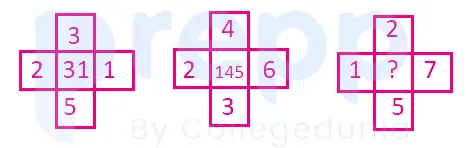
- A
43
- B
49
- C
59
- D
71
Show answer
D. 71Logic: Middle number = multiplication of surroundings digit + 1
⇒ (3 × 5 × 2 × 1) + 1 = 31
⇒ (4 × 3 × 2 × 6) + 1 = 145
⇒ (2 × 7 × 5 × 1) + 1 = ?
⇒ 71 = ?
Hence, “71” is the correct answer.
Paper & answer key PDF ↗ Question 17archived
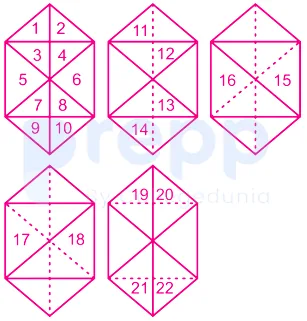
How many triangles are there in the given figure?

- A
20
- B
22
- C
28
- D
32
Show answer
B. 22As shown in above diagram there are total 22 triangles.
 Paper & answer key PDF ↗
 Question 18archived
In the following question below are given some statements followed by some conclusions. Taking the given statements to be true even if they seem to be at variance from commonly known facts, read all the conclusions and then decide which of the given conclusion logically follows the given statements.
Statements:
I. Some pens are pencils.
II. All pencils are erasers.
Conclusions:
I. Some Pens are erasers.
II. No pens are erasers.
III. Some erasers are pencils.
- A
Only conclusion II follows.
- B
Only conclusion I and II follows.
- C
Only conclusion I and III follows.
- D
No conclusion follows.
Show answer
C. Only conclusion I and III follows.From "Some pens are pencils" and "All pencils are erasers", the pens that are pencils must also be erasers, so Conclusion I (Some pens are erasers) follows.
Since I follows, II (No pens are erasers) directly contradicts it and does not follow.
"All pencils are erasers" converts to Some erasers are pencils, so Conclusion III follows.
Hence only Conclusions I and III follow.
Paper & answer key PDF ↗ Question 19archived
Three positions of the cube are shown below, what will come opposite to face containing ‘I’.

- A
VI
- B
IV
- C
II
- D
V
Show answer
A. VIFrom first dice we can see that ‘II’ and ‘IV’ are beside of ‘I’
From 2 nd Dice we can see that, ‘III’ and ‘V’ are beside of ‘I’.
Now we can say that ‘VI’ will come opposite to face containing ‘I’.
Paper & answer key PDF ↗ Question 20archived
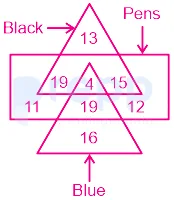
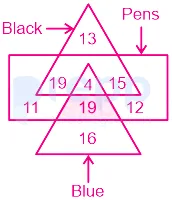
In the given figure, how many pens are only blue?
- A
20
- B
19
- C
12
- D
15
Show answer
B. 19Pens which are only blue = 19.
Hence, there are 19 pens which are only blue.
 Paper & answer key PDF ↗
 Question 21archived
Which answer figure will complete the pattern in the following question figure?
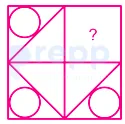
- A
Option A (shown in image)
- B
Option B (shown in image)
- C
Option C (shown in image)
- D
Option D (shown in image)
Show answer
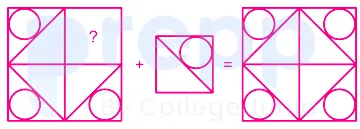
C. Option C (shown in image)As we can see in the figure shown below,
The figure of option 3) will complete the question figure.
 Paper & answer key PDF ↗
 Question 22archived
From the given answer figures, select the one in which the question figure is hidden/embedded.

- A
Option A (shown in image)
- B
Option B (shown in image)
- C
Option C (shown in image)
- D
Option D (shown in image)
Show answer
A. Option A (shown in image)As we can see in the figure shown below,
Question figure is hidden/embedded in figure 1)
 Paper & answer key PDF ↗
 Question 23archived
A piece of paper is folded and punched as shown below in the question figures. From the given answer figures, indicate how it will appear when opened.

- A
Option A (shown in image)
- B
Option B (shown in image)
- C
Option C (shown in image)
- D
Option D (shown in image)
Show answer
B. Option B (shown in image)When we open punched sheet of paper, it will appear as shown in below diagram,
Thus, the figure present in option 2) will be the correct answer.
 Paper & answer key PDF ↗
 Question 24archived
If the mirror is placed on the line AB, then which of the answer figure is the right image of the given figure?
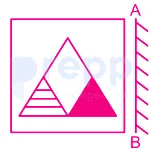
- A
Option A (shown in image)
- B
Option B (shown in image)
- C
Option C (shown in image)
- D
Option D (shown in image)
Show answer
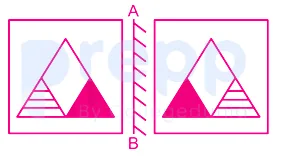
C. Option C (shown in image)The mirror image of given questions figure is,
Hence, the figure present in option 3) will be the correct mirror image of given question figure.
 Paper & answer key PDF ↗
 Question 25archived
A word is represented by only one set of numbers as gives in any one of the alternatives. The sets of numbers given in the alternatives are represented by two classes of alphabets as shown in the given two matrices. The columns and rows of Matrix – I are numbered from 0 to 4 and that of M atrix – II are numbered from 5 to 9. A letter from these matrices can be represented first by its row and next by its column, for example, ‘ K’ can be represented by 01, 34 etc. and ‘ P’ be represented by 65, 99 etc. similarly, you have to identify the set for the word ‘ BLAND ’.
Matrix - I
Matrix – II
0
1
2
3
4
5
6
7
8
9
0
A
K
B
L
C
5
N
O
P
S
D
1
B
A
C
K
L
6
P
D
S
N
O
2
L
C
K
B
A
7
O
P
N
D
S
3
C
B
L
A
K
8
D
S
O
P
N
4
K
L
A
C
B
9
S
N
D
O
P
- A
10, 14, 00, 68, 79
- B
31, 41, 33, 96, 86
- C
44, 20, 42, 88, 59
- D
23, 32, 24, 55, 66
Show answer
D. 23, 32, 24, 55, 66Letters from Matrix-I use row-column pairs 00-44; letters from Matrix-II use 55-99. Decode each option for the word BLAND (B, L, A from Matrix-I; N, D from Matrix-II).
Option 4 (23, 32, 24, 55, 66):
23 → Matrix-I row 2, col 3 = B; 32 → row 3, col 2 = L; 24 → row 2, col 4 = A; 55 → Matrix-II row 5, col 5 = N; 66 → row 6, col 6 = D.
All five codes match. Options 1-3 fail at the second or last letter (e.g., Option 2's 86 decodes to O, not D). Hence the correct set is 23, 32, 24, 55, 66.
Paper & answer key PDF ↗ Question 26archived
At which rate, Reserve Bank of India borrows money from commercial banks?
- A
Bank Rate
- B
Repo Rate
- C
Reverse Repo Rate
- D
Statutory Liquidity Rate
Show answer
C. Reverse Repo RateThe Reverse Repo Rate is the rate at which the RBI borrows short-term funds from commercial banks by accepting their surplus liquidity against government securities. It is the mirror image of the Repo Rate (at which RBI lends to banks) and is used to absorb excess liquidity from the banking system under the Liquidity Adjustment Facility (LAF).
Bank Rate and Repo Rate are both lending rates of the RBI, while SLR is a reserve ratio (not a rate of borrowing). Hence the answer is Reverse Repo Rate.
Paper & answer key PDF ↗ Question 27archived
Movement along the supply curve is known as _______.
- A
Contraction of supply
- B
Expansion of supply
- C
Increase in supply
- D
Expansion and contraction of supply
Show answer
D. Expansion and contraction of supplyA change in the price of a good (other factors constant) causes the quantity supplied to move along the existing supply curve. A rise in price produces an upward movement called expansion of supply; a fall in price produces a downward movement called contraction of supply.
An "increase in supply" refers to a rightward shift of the entire curve due to non-price factors, not movement along it. Since movement along the curve covers both directions, the correct term is Expansion and contraction of supply.
Paper & answer key PDF ↗ Question 28archived
What is the minimum age required to become vice-president of India?
- A
30 years
- B
35 years
- C
40 years
- D
37 years
Show answer
B. 35 yearsUnder Article 66(3) of the Constitution, a person is eligible for election as Vice-President only if they are an Indian citizen, have completed 35 years of age, and are qualified for election to the Rajya Sabha.
The same minimum age (35) applies to the President, Governor, and Rajya Sabha members, while a Lok Sabha member needs only 25. Hence the minimum age to become Vice-President is 35 years.
Paper & answer key PDF ↗ Question 29archived
Which of the following "writ" of the High Court or the Supreme Court is issued to produce the person before the court who has been so detained?
- A
Habeas Corpus
- B
Mandamus
- C
Prohibition
- D
Quo Warranto
Show answer
A. Habeas CorpusHabeas Corpus (Latin: "you may have the body") is the writ by which a court directs the authority detaining a person to produce that person before it and justify the detention. If the detention is found unlawful, the court orders immediate release. It is the principal safeguard against arbitrary arrest.
Mandamus commands a public authority to perform its duty; Prohibition restrains a lower court from exceeding jurisdiction; Quo Warranto challenges a person's authority to hold a public office. Hence the answer is Habeas Corpus.
Paper & answer key PDF ↗ Question 30archived
Who was the son of Chandragupta Maurya?
- A
Bindusara
- B
Chandragupta II
- C
Ashoka
- D
Bimbisara
Show answer
A. BindusaraChandragupta Maurya, founder of the Maurya Empire (c. 322 BCE), was succeeded by his son Bindusara (c. 298-273 BCE), also known as Amitraghata ("slayer of foes"). Bindusara, in turn, was the father of Ashoka the Great.
Chandragupta II belonged to the later Gupta dynasty (4th-5th century CE), Ashoka was Chandragupta Maurya's grandson, and Bimbisara was a Haryanka king of Magadha who ruled long before the Mauryas. Hence the correct answer is Bindusara.
Paper & answer key PDF ↗ Question 31archived
Which dynasty came to power in India after the Tughlaq dynasty?
- A
The Guptas
- B
The Khiljis
- C
The Mughals
- D
The Sayyids
Show answer
D. The SayyidsThe five dynasties of the Delhi Sultanate ruled in this order: Slave/Mamluk (1206-1290), Khilji (1290-1320), Tughlaq (1320-1414), Sayyid (1414-1451), and Lodi (1451-1526). The Sayyid dynasty, founded by Khizr Khan, immediately succeeded the Tughlaqs after Timur's invasion weakened Tughlaq rule.
The Khiljis preceded the Tughlaqs, the Mughals (from 1526) came after the Lodis, and the Guptas ruled in ancient India. Hence the correct answer is The Sayyids.
Paper & answer key PDF ↗ Question 32archived
Which planet is considered as the Dwarf planet?
- A
Earth
- B
Jupiter
- C
Pluto
- D
Saturn
Show answer
C. PlutoPer the IAU's 2006 definition, a dwarf planet orbits the Sun and is nearly round under self-gravity, but has not cleared the neighbourhood of its orbit. Pluto shares its Kuiper Belt region with many similar bodies, so it fails the orbit-clearing criterion and was reclassified as a dwarf planet in 2006.
Earth, Jupiter and Saturn dominate and have cleared their orbits, making them full planets. Other recognised dwarf planets include Ceres, Eris, Haumea and Makemake. Hence the answer is Pluto.
Paper & answer key PDF ↗ Question 33archived
Which type of rock is Sandstone?
- A
Calcareous Rock
- B
Igneous Rock
- C
Metamorphic Rock
- D
Sedimentary Rock
Show answer
D. Sedimentary RockSandstone is a clastic sedimentary rock formed when sand-sized grains (chiefly quartz and feldspar) are deposited by water or wind, then compacted and cemented together over time by minerals like silica or calcite.
Igneous rocks form from cooled magma/lava (e.g., granite, basalt), and metamorphic rocks form by heat-pressure transformation (e.g., sandstone itself metamorphoses into quartzite). "Calcareous rock" denotes calcium-carbonate-rich rocks like limestone, not sandstone. Hence the correct classification is Sedimentary Rock.
Paper & answer key PDF ↗ Question 34archived
Wheat is a ______.
- A
Creeper
- B
Herb
- C
Shrub
- D
Tree
Show answer
B. HerbA herb is a small plant with a soft, green, non-woody stem that usually completes its life cycle within one or two seasons. Wheat (Triticum aestivum) is an annual grass of family Poaceae with a soft hollow culm reaching about 2-4 feet, so botanically it is classified as a herb.
Shrubs and trees have woody stems and live for years; creepers have weak stems that spread along the ground. Wheat fits none of these. Hence the answer is Herb.
Paper & answer key PDF ↗ Question 35archived
Snakes, turtle, lizards and crocodiles falls under which category of animals?
- A
Pisces
- B
Amphibian
- C
Reptilian
- D
Aves
Show answer
C. ReptilianSnakes, turtles, lizards and crocodiles are cold-blooded vertebrates that breathe through lungs, have dry skin covered with scales or bony scutes, and reproduce by laying shelled (amniotic) eggs on land. These are the defining features of class Reptilia.
Pisces (fish) breathe via gills; Amphibia have moist permeable skin and an aquatic larval stage; Aves (birds) have feathers and are warm-blooded. None of these fit. Hence the correct category is Reptilian.
Paper & answer key PDF ↗ Question 36archived
Which of the following instrument is used to measure Soil Water Tension?
- A
Photometer
- B
Pyrometer
- C
Psychrometer
- D
Tensiometer
Show answer
D. TensiometerA tensiometer measures soil water tension (matric potential). It consists of a water-filled tube with a porous ceramic cup buried in the soil and a vacuum gauge at the top; as soil dries, water is drawn out of the cup, creating a suction that the gauge reads directly in kPa or bar.
A photometer measures light intensity, a pyrometer measures high temperatures remotely, and a psychrometer measures atmospheric humidity. Hence the correct instrument is Tensiometer.
Paper & answer key PDF ↗ Question 37archived
What is the SI unit of Force?
- A
Pascal
- B
Joule
- C
Newton
- D
Watt
Show answer
C. NewtonThe SI unit of force is the Newton (N), defined as the force needed to accelerate a 1 kg mass at \(1\,\text{m/s}^2\): \(1\,\text{N}=1\,\text{kg}\cdot\text{m/s}^2\).
Pascal is the SI unit of pressure, Joule of energy/work, and Watt of power. Hence the correct answer is Newton.
Paper & answer key PDF ↗ Question 38archived
Which one of the following is a bad Thermal Conductor?
- A
Aluminium
- B
Copper
- C
Glass
- D
Silver
Show answer
C. GlassMetals conduct heat well because their free electrons rapidly transfer thermal energy. Aluminium, Copper and Silver are all metals with high thermal conductivity (Silver ~429, Copper ~401, Aluminium ~205 W/m·K).
Glass, an amorphous non-metal, lacks free electrons and conducts heat only through slow lattice vibrations (~0.8 W/m·K), making it a poor thermal conductor (good insulator). Hence Glass is the bad thermal conductor.
Paper & answer key PDF ↗ Question 39archived
Which of the following stores data permanently in a computer?
- A
ALU
- B
Cache Memory
- C
RAM
- D
ROM
Show answer
D. ROMROM (Read-Only Memory) is non-volatile memory that retains data permanently even when power is off; it stores essential firmware like the BIOS/UEFI boot instructions.
ALU is a processing unit, not storage. Cache Memory and RAM are both volatile and lose their contents when the computer is switched off. Hence ROM is the correct answer.
Paper & answer key PDF ↗ Question 40archived
Rusting is _____.
- A
Electrolysis
- B
Oxidation
- C
Reduction
- D
None of these
Show answer
B. OxidationRusting is the corrosion of iron in the presence of oxygen and moisture. Iron loses electrons to form \(\text{Fe}^{2+}\) and then \(\text{Fe}^{3+}\), ultimately forming hydrated iron(III) oxide \(\text{Fe}_2\text{O}_3\cdot n\text{H}_2\text{O}\).
Loss of electrons (increase in oxidation state) is by definition oxidation. Electrolysis requires an external current; reduction is the opposite process. Hence rusting is oxidation.
Paper & answer key PDF ↗ Question 41archived
Which amongst the following is not a cation?
- A
Aluminium ion
- B
Copper ion
- C
Sulphate ion
- D
Zinc ion
Show answer
C. Sulphate ionCations are positively charged ions (formed by loss of electrons); anions are negatively charged (formed by gain of electrons).
Aluminium ion \(\text{Al}^{3+}\), Copper ion \(\text{Cu}^{2+}\) and Zinc ion \(\text{Zn}^{2+}\) are all positively charged metal cations. The Sulphate ion \(\text{SO}_4^{2-}\) carries a \(-2\) charge, making it an anion, not a cation.
Paper & answer key PDF ↗ Question 42archived
Which of the following is not a component of Smog?
- A
Volatile organic compounds
- B
Nitrogen Oxide
- C
Sulphur dioxide
- D
Chlorine oxide
Show answer
D. Chlorine oxideSmog is a mixture of air pollutants. Classical (industrial) smog contains sulphur dioxide \(\text{SO}_2\) and particulates, while photochemical smog forms when sunlight reacts with nitrogen oxides \(\text{NO}_x\) and volatile organic compounds (VOCs) to produce ozone and PANs.
VOCs, \(\text{NO}_x\) and \(\text{SO}_2\) are therefore standard smog components. Chlorine oxide is associated with stratospheric ozone depletion, not smog chemistry.
Paper & answer key PDF ↗ Question 43archived
NITI Aayog has been formed to replace which of the following institution?
- A
Planning Commission
- B
IRDA
- C
Department of Telecommunications (DoT)
- D
Department of Information Technology
Show answer
A. Planning CommissionNITI Aayog (National Institution for Transforming India) was constituted on 1 January 2015 by a Union Cabinet resolution, replacing the 65-year-old Planning Commission (set up in 1950).
It shifted India from centralised top-down planning to a cooperative-federalism, bottom-up policy think-tank model. IRDA, DoT and the Department of IT are unrelated regulatory/administrative bodies that continue to function.
Paper & answer key PDF ↗ Question 44archived
Who invented first working laser?
- A
A. H. Taylor
- B
W. K. Roentgen
- C
T. H. Maiman
- D
Frederick Morrison
Show answer
C. T. H. MaimanThe first working laser was built and successfully operated by American physicist Theodore H. Maiman on 16 May 1960 at Hughes Research Laboratories, California. It used a synthetic ruby crystal pumped by a flash lamp and emitted coherent red light at 694.3 nm.
W. K. Roentgen discovered X-rays (1895); A. H. Taylor and Frederick Morrison are not associated with the laser's invention.
Paper & answer key PDF ↗ Question 45archived
Which of the following venue hosted its first ever test match on 9th November, 2016 which was played between India and England?
- A
JSCA International Stadium Complex, Ranchi
- B
Saurashtra Cricket Association Stadium, Rajkot
- C
Himachal Pradesh Cricket Association Stadium, Dharamshala
- D
Holkar Cricket Stadium, Indore
Show answer
B. Saurashtra Cricket Association Stadium, RajkotThe Saurashtra Cricket Association Stadium, Rajkot hosted its maiden Test match on 9-13 November 2016 when India played England in the first Test of the 2016 series. The match ended in a draw.
Holkar Stadium, Indore had already debuted a few weeks earlier (vs New Zealand, October 2016), while JSCA Ranchi and HPCA Dharamshala got their first Tests later, in March 2017 vs Australia.
Paper & answer key PDF ↗ Question 46archived
Match the following:-
Artist
Art Form
1. Gauri Shankar Devilal
a. Flute
2. Hari Prasad Chaurasia
b. Painting
3. M.F. Hussain
c. Kathak
4. Zakir Hussain
d. Tabla
- A
1-a, 2-d, 3-b, 4-c
- B
1-b, 2-c, 3-a, 4-d
- C
1-c, 2-a, 3-b, 4-d
- D
1-c, 2-b, 3-a, 4-d
Show answer
C. 1-c, 2-a, 3-b, 4-dGauri Shankar (Devilal) was a noted Kathak exponent → 1-c. Pandit Hari Prasad Chaurasia is the celebrated Flute (Bansuri) maestro → 2-a. M. F. Hussain was India's most famous modern Painter → 3-b. Ustad Zakir Hussain is the legendary Tabla player → 4-d.
The correct sequence is 1-c, 2-a, 3-b, 4-d.
Paper & answer key PDF ↗ Question 47archived
Who is the only Indian cricketer to have received the Polly Umrigar award 3 times?
- A
Sachin Tendulkar
- B
Virender Sehwag
- C
Virat Kohli
- D
Ravichandran Ashwin
Show answer
C. Virat KohliThe Polly Umrigar Award, instituted by the BCCI in 2006-07, is given to the International Cricketer of the Year. Virat Kohli won it three times - for the 2011-12, 2014-15 and 2015-16 seasons - the only Indian to receive it thrice (as of the 2017 question date).
Sachin Tendulkar, Virender Sehwag and R. Ashwin have won the award, but not three times each.
Paper & answer key PDF ↗ Question 48archived
Who is the author of the book titled "The Sellout"?
- A
Paul Beatty
- B
Arvind Adiga
- C
Elenor Catton
- D
Howard Jacobson
Show answer
A. Paul BeattyThe satirical novel "The Sellout" (2015) was written by American author Paul Beatty. It won the Man Booker Prize 2016, making Beatty the first American to win the Booker after the prize opened to all English-language writers.
Aravind Adiga wrote The White Tiger, Eleanor Catton wrote The Luminaries, and Howard Jacobson wrote The Finkler Question - all Booker winners, but not of The Sellout.
Paper & answer key PDF ↗ Question 49archived
Which country was designated as the major defence partner of USA in December, 2016?
- A
Canada
- B
Israel
- C
India
- D
United Kingdom
Show answer
C. IndiaIn December 2016, the US Congress enacted the National Defense Authorization Act (NDAA) for FY 2017, which formally designated India as a "Major Defence Partner" of the United States. This is a unique status created specifically for India to enable defence trade and technology sharing at a level comparable to closest US allies. Canada, Israel and the UK are close US defence partners but do not hold this specific designation.
Paper & answer key PDF ↗ Question 50archived
With which country India did its seventh edition of bilateral EKUVERIN Exercise 2016 at Kadhdhoo?
- A
Nepal
- B
Pakistan
- C
Maldives
- D
Bhutan
Show answer
C. MaldivesEKUVERIN (meaning "Friends" in Dhivehi) is an annual joint military exercise between the Indian Army and the Maldives National Defence Force, focusing on counter-terrorism, counter-insurgency and HADR operations. Its seventh edition was held in December 2016 at Kadhdhoo in the Maldives. Hence the partner country is Maldives.
Paper & answer key PDF ↗ Question 51archived
If X and Y are the two digits of the number 347XY such that the number is completely divisible by 80, then what is the minimum value of X + Y?
- A
2
- B
4
- C
6
- D
8
Show answer
A. 2Step 1 — Divisibility by 80 = 16 × 5: The number must be divisible by both 16 and 5.
Step 2 — Apply divisibility by 5: Y must be 0 or 5. Since the number must also be divisible by 16 (an even number), Y cannot be 5, so \(Y=0\).
Step 3 — Apply divisibility by 16: The last four digits 47X0 must be divisible by 16. Testing X = 0 to 9, only \(4720 \div 16 = 295\) works, giving \(X=2\).
Therefore the number is 34720 and \(X+Y=2+0=2\).
Paper & answer key PDF ↗ Question 52archived
A, B and C can complete a work in 20, 24 and 30 days respectively. All three of them starts together but after 4 days A leaves the job and B left the job 6 days before the work was completed. C completed the remaining work alone. In how many days was the total work completed?
- A
10
- B
12
- C
14
- D
16
Show answer
C. 14Step 1 — Take total work as LCM(20, 24, 30) = 120 units: Daily outputs are \(A=6,\ B=5,\ C=4\) units/day.
Step 2 — Work done by A, B, C in first 4 days:
\[(6+5+4)\times 4 = 60 \text{ units}\]
Step 3 — Work done by C alone in the last 6 days:
\[4 \times 6 = 24 \text{ units}\]
Step 4 — Remaining work done by B and C together:
\[120 - 60 - 24 = 36 \text{ units}\]
Step 5 — Time for B+C to do 36 units at \(5+4=9\) units/day: \(36/9 = 4\) days.
Therefore total time \(=4+4+6=\) 14 days.
Paper & answer key PDF ↗ Question 53archived
A solid sphere of diameter 17.5 cm is cut into two equal halves. What will be the increase (in cm 2) in the total surface area?
- A
289
- B
361.5
- C
481.25
- D
962.5
Show answer
C. 481.25Cutting the sphere creates two new circular faces. The increase in total surface area equals the area of these two circles:
\[\Delta S = 2\pi r^2\]
Step 1 — Radius: \(r=\dfrac{17.5}{2}=\dfrac{35}{4}\) cm.
Step 2 — Substitute with \(\pi=\tfrac{22}{7}\):
\[\Delta S = 2 \times \frac{22}{7} \times \left(\frac{35}{4}\right)^2 = 2 \times \frac{22}{7} \times \frac{1225}{16}\]
\[= \frac{1925}{4}=481.25 \text{ cm}^2\]
Therefore the increase is 481.25 cm2.
Paper & answer key PDF ↗ Question 54archived
After a discount of 34% an article is sold for Rs 3168. What is the marked price (in Rs) of the article?
- A
4750
- B
4800
- C
4850
- D
5000
Show answer
B. 4800After a 34% discount, the selling price is 66% of the marked price (MP):
\[0.66 \times \text{MP} = 3168\]
\[\text{MP} = \frac{3168}{0.66}=\frac{316800}{66}=4800\]
Therefore the marked price is Rs 4800. Verification: 34% of 4800 = 1632, and 4800 - 1632 = 3168.
Paper & answer key PDF ↗ Question 55archived
If 3P/7 = 4Q/11, then what is the ratio of p and Q respectively?
- A
12 : 77
- B
12 : 33
- C
28 : 33
- D
3 : 28
Show answer
C. 28 : 33Cross-multiplying \(\dfrac{3P}{7}=\dfrac{4Q}{11}\):
\[3P \times 11 = 4Q \times 7 \implies 33P = 28Q\]
\[\frac{P}{Q}=\frac{28}{33}\]
Therefore P : Q = 28 : 33.
Paper & answer key PDF ↗ Question 56archived
The average of 17 results is 60. If the average of first 9 results is 57 and that of the last 9 results is 65, then what will be the value of 9th result?
- A
39
- B
78
- C
117
- D
156
Show answer
B. 78The 9th result is the only element common to both the "first 9" and "last 9" subsets, so adding their sums counts it twice.
Step 1 — Compute the three sums:
\[S_{17}=17\times 60=1020,\quad S_{\text{first}}=9\times 57=513,\quad S_{\text{last}}=9\times 65=585\]
Step 2 — Isolate the 9th result:
\[R_9 = S_{\text{first}}+S_{\text{last}}-S_{17}=513+585-1020=78\]
Therefore the 9th result is 78.
Paper & answer key PDF ↗ Question 57archived
For an article the profit is 170% of the cost price. If the cost price increases by 20% but the selling price remains same, then what is the new profit percentage?
- A
41
- B
50
- C
75
- D
125
Show answer
D. 125Step 1 — Set up initial values: Let CP = 100. Profit = 170% of 100 = 170, so SP = 100 + 170 = 270.
Step 2 — New CP after 20% increase: \(100 \times 1.20 = 120\); SP unchanged at 270.
Step 3 — New profit and percentage:
\[\text{New profit}=270-120=150\]
\[\text{New profit \%}=\frac{150}{120}\times 100 = 125\%\]
Therefore the new profit percentage is 125%.
Paper & answer key PDF ↗ Question 58archived
32% of a number exceeds 17% of the same number by 120. What is the value of the number?
- A
900
- B
860
- C
940
- D
800
Show answer
D. 800Let the number be x. The condition gives:
\[0.32x - 0.17x = 120\]
\[0.15x = 120 \implies x = \frac{120}{0.15}=800\]
Therefore the number is 800. Check: 32% of 800 = 256 and 17% of 800 = 136; 256 - 136 = 120.
Paper & answer key PDF ↗ Question 59archived
A Boat goes 15 km upstream and \(10\frac{1}{2}\) km downstream in 3 hours 15 minutes. It goes 12 km upstream and 14 km downstream in 3 hours. What is the speed of the boat in still water?
- A
4
- B
6
- C
10
- D
14
Show answer
C. 10Let \(u\) = upstream speed and \(d\) = downstream speed (km/h). Using time = distance/speed:
\[\frac{15}{u}+\frac{10.5}{d}=\frac{13}{4},\qquad \frac{12}{u}+\frac{14}{d}=3\]
Step 1 — Substitute \(x=1/u,\ y=1/d\):
\[60x+42y=13,\qquad 12x+14y=3\]
Step 2 — Eliminate x (multiply the second equation by 5 and subtract):
\[28y=2 \implies y=\tfrac{1}{14},\ \ x=\tfrac{1}{6}\]
Step 3 — Recover speeds: \(u=6,\ d=14\). Speed in still water:
\[v_b=\frac{u+d}{2}=\frac{6+14}{2}=10 \text{ km/h}\]
Therefore the boat's still-water speed is 10 km/h.
Paper & answer key PDF ↗ Question 60archived
A person lent certain sum of money at 5% per annum simple interest and in 15 years the interest amounted to Rs. 250 less than the sum lent. What was the sum lent (in Rs)?
- A
1000
- B
1500
- C
2400
- D
3000
Show answer
A. 1000Using \(SI=\dfrac{P\cdot R\cdot T}{100}\) with \(R=5,\ T=15\):
\[SI=\frac{P\times 5\times 15}{100}=\frac{75P}{100}=\frac{3P}{4}\]
Given \(SI=P-250\):
\[\frac{3P}{4}=P-250 \implies P-\frac{3P}{4}=250 \implies \frac{P}{4}=250\]
\[P=1000\]
Therefore the sum lent is Rs 1000.
Paper & answer key PDF ↗ Question 61archived
If \(\;X = \frac{{2 + \sqrt 3 }}{{2 - \sqrt 3 }}\) then what is the value of \(X + \frac{1}{X}\)
- A
14
- B
8√3
- C
0
- D
18
Show answer
A. 14Step 1 — Rationalize X: Multiply numerator and denominator by \(2+\sqrt{3}\).
\[X=\frac{(2+\sqrt{3})^2}{(2-\sqrt{3})(2+\sqrt{3})}=\frac{7+4\sqrt{3}}{4-3}=7+4\sqrt{3}\]
Step 2 — Find 1/X: Since \((7+4\sqrt{3})(7-4\sqrt{3})=49-48=1\), we get \(\dfrac{1}{X}=7-4\sqrt{3}\).
Step 3 — Add:
\[X+\frac{1}{X}=(7+4\sqrt{3})+(7-4\sqrt{3})=14\]
Therefore the value is 14.
Paper & answer key PDF ↗ Question 62archived
If x = 2 + √3, then what is the value of [√(2x) + 1/√(2x)]
- A
2√3
- B
3√3
- C
(3√3 + 1)/2
- D
2√3 + 1
Show answer
C. (3√3 + 1)/2Step 1 — Compute 2x: \(2x=2(2+\sqrt{3})=4+2\sqrt{3}\).
Step 2 — Simplify \(\sqrt{2x}\): Write \(4+2\sqrt{3}=3+1+2\sqrt{3}=(\sqrt{3}+1)^2\), so \(\sqrt{2x}=\sqrt{3}+1\).
Step 3 — Rationalize \(1/\sqrt{2x}\):
\[\frac{1}{\sqrt{3}+1}\cdot\frac{\sqrt{3}-1}{\sqrt{3}-1}=\frac{\sqrt{3}-1}{2}\]
Step 4 — Add:
\[(\sqrt{3}+1)+\frac{\sqrt{3}-1}{2}=\frac{2\sqrt{3}+2+\sqrt{3}-1}{2}=\frac{3\sqrt{3}+1}{2}\]
Hence the value is \(\dfrac{3\sqrt{3}+1}{2}\).
Paper & answer key PDF ↗ Question 63archived
If \(x + \frac{1}{x} = 4\) , then what is the value of \({x^5} + \frac{1}{{{x^5}}}\) ?
- A
52
- B
256
- C
1026
- D
724
Show answer
D. 724Step 1 — Find \(x^2+1/x^2\): Squaring gives \((x+1/x)^2=x^2+1/x^2+2\), so
\[x^2+\frac{1}{x^2}=16-2=14\]
Step 2 — Find \(x^3+1/x^3\): Cubing gives \((x+1/x)^3=x^3+1/x^3+3(x+1/x)\), so
\[x^3+\frac{1}{x^3}=64-12=52\]
Step 3 — Combine for \(x^5+1/x^5\): Using \((x^2+1/x^2)(x^3+1/x^3)=x^5+1/x^5+(x+1/x)\):
\[x^5+\frac{1}{x^5}=14\times 52-4=728-4=724\]
Hence the answer is 724.
Paper & answer key PDF ↗ Question 64archived
If \(Y = \;\frac{{2 - X}}{{1 + X}}\) , then what is the value of \(\frac{1}{{Y + 1}} + \frac{{2Y + 1}}{{{Y^2} - 1}}?\)
- A
\(\frac{{\left( {1 + X} \right)\;\left( {2 - X} \right)}}{{2X - 1}}\)
- B
\(\frac{{\left( {1 - X} \right)\;\left( {2 + X} \right)}}{{X - 1}}\)
- C
\(\frac{{\left( {1 + X} \right)\;\left( {2 - X} \right)}}{{1 - 2X}}\)
- D
\(\frac{{\left( {1 + X} \right)\;\left( {1 - 2X} \right)}}{{2 - X}}\)
Show answer
C. \(\frac{{\left( {1 + X} \right)\;\left( {2 - X} \right)}}{{1 - 2X}}\)Step 1 — Simplify the given expression in Y: Since \(Y^2-1=(Y+1)(Y-1)\),
\[\frac{1}{Y+1}+\frac{2Y+1}{(Y+1)(Y-1)}=\frac{(Y-1)+(2Y+1)}{(Y+1)(Y-1)}=\frac{3Y}{Y^2-1}\]
Step 2 — Express Y±1 in X:
\[Y+1=\frac{2-X+1+X}{1+X}=\frac{3}{1+X},\quad Y-1=\frac{2-X-1-X}{1+X}=\frac{1-2X}{1+X}\]
Step 3 — Substitute:
\[\frac{3\cdot\frac{2-X}{1+X}}{\frac{3}{1+X}\cdot\frac{1-2X}{1+X}}=\frac{3(2-X)}{1+X}\cdot\frac{(1+X)^2}{3(1-2X)}=\frac{(1+X)(2-X)}{1-2X}\]
This matches option 3.
Paper & answer key PDF ↗ Question 65archived
In the triangle ABC, ∠BAC = 50° and the bisectors of ∠ABC and ∠ACB meets at P. What is the value (in degrees) of ∠BPC?
- A
100
- B
105
- C
115
- D
125
Show answer
C. 115P is the incenter of \(\triangle ABC\), being the intersection of the bisectors of \(\angle B\) and \(\angle C\).
Standard incenter result:
\[\angle BPC=90^\circ+\tfrac{1}{2}\angle BAC\]
Substituting \(\angle BAC=50^\circ\):
\[\angle BPC=90^\circ+25^\circ=115^\circ\]
Therefore \(\angle BPC=\mathbf{115^\circ}\).
Paper & answer key PDF ↗ Question 66archived
Two circles of same radius intersect each other at P and Q. If the length of the common chord is 30 cm and distance between the centres of the two circles is 40 cm, then what is the radius (in cm) of the circles?
- A
25
- B
25√2
- C
50
- D
50√2
Show answer
A. 25Let the centers be \(O_1, O_2\) with common chord PQ. The line of centers perpendicularly bisects PQ; since both circles share the same radius, it is also bisected at the same midpoint M.
Step 1 — Half-lengths: \(PM=15\) cm and \(O_1M=20\) cm.
Step 2 — Apply Pythagoras in right \(\triangle O_1MP\) (hypotenuse \(O_1P=r\)):
\[r^2=20^2+15^2=400+225=625\implies r=25\]
The radius is 25 cm.
Paper & answer key PDF ↗ Question 67archived
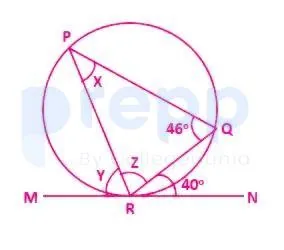
In the given figure, ∠QRN = 40°, ∠PQR = 46° and MN is a tangent at R. What is the value (in degree) of X, Y and Z respectively?
- A
40, 46, 94
- B
40, 50, 90
- C
46, 54, 80
- D
50, 40, 90
Show answer
A. 40, 46, 94Theorem: The alternate segment theorem states that an angle between a tangent and a chord through the point of contact is equal to the angle in the alternate segment.
Using the above theorem,
⇒ ∠RPQ = ∠QRN, ∠PRM = ∠PQR
⇒ ∠X = 40°, ∠Y = 46°
In ΔPQR,
⇒ ∠X + ∠Z + 46° = 180°
⇒ 40° + ∠Z + 46° = 180°
⇒ ∠Z = 94°
Paper & answer key PDF ↗ Question 68archived
In ΔPQR, ∠R = 54°, the perpendicular bisector of PQ at S meets QR at T. If ∠TPR = 46°, then what is the value (in degrees) of ∠PQR?
- A
25
- B
40
- C
50
- D
60
Show answer
B. 40T lies on the perpendicular bisector of PQ, so \(TP=TQ\), making \(\triangle TPQ\) isosceles. Hence \(\angle TPQ=\angle TQP=\angle PQR=x\).
Step 1 — Express \(\angle QPR\): \(\angle QPR=\angle QPT+\angle TPR=x+46^\circ\).
Step 2 — Angle sum in \(\triangle PQR\):
\[x+54^\circ+(x+46^\circ)=180^\circ\implies 2x=80^\circ\implies x=40^\circ\]
Therefore \(\angle PQR=\mathbf{40^\circ}\).
Paper & answer key PDF ↗ Question 69archived
What is the simplified value of \(\frac{{cotA + tanB}}{{cotB + tanA}}\) ?
- A
tan B cot A
- B
tan A cot B
- C
tan A tan B
- D
cot A cot B
Show answer
A. tan B cot ARewrite using \(\cot=1/\tan\):
\[\frac{\cot A+\tan B}{\cot B+\tan A}=\frac{\frac{1}{\tan A}+\tan B}{\frac{1}{\tan B}+\tan A}=\frac{\frac{1+\tan A\tan B}{\tan A}}{\frac{1+\tan A\tan B}{\tan B}}\]
The factor \(1+\tan A\tan B\) cancels, leaving
\[\frac{\tan B}{\tan A}=\tan B\cot A\]
Hence the simplified value is tan B cot A.
Paper & answer key PDF ↗ Question 70archived
What is the simplified value of \({\left( {\frac{1}{{cosecA\; + \;CotA}}} \right)^2}\) ?
- A
sec A + tan A
- B
(1 - cos A) / (1 + cos A)
- C
(1 - cosec A) / (1 + cosec A)
- D
sin A
Show answer
B. (1 - cos A) / (1 + cos A)Multiply numerator and denominator inside by \(\csc A-\cot A\). Since \(\csc^2 A-\cot^2 A=1\):
\[\frac{1}{\csc A+\cot A}=\csc A-\cot A=\frac{1-\cos A}{\sin A}\]
Squaring:
\[\left(\frac{1-\cos A}{\sin A}\right)^2=\frac{(1-\cos A)^2}{\sin^2 A}=\frac{(1-\cos A)^2}{1-\cos^2 A}=\frac{(1-\cos A)^2}{(1-\cos A)(1+\cos A)}=\frac{1-\cos A}{1+\cos A}\]
This matches option 2.
Paper & answer key PDF ↗ Question 71archived
If Cos 2θ – Sin θ = 1/4, then what is the value of sin θ?
- A
-1
- B
1/2
- C
1
- D
3/2
Show answer
B. 1/2Apply \(\cos 2\theta=1-2\sin^2\theta\):
\[1-2\sin^2\theta-\sin\theta=\tfrac{1}{4}\]
Multiply by 4 and rearrange:
\[8\sin^2\theta+4\sin\theta-3=0\]
Let \(s=\sin\theta\). By the quadratic formula \(s=\dfrac{-4\pm\sqrt{16+96}}{16}=\dfrac{-1\pm\sqrt{7}}{4}\). Among the listed options, \(\sin\theta=\tfrac{1}{2}\) is the only valid value (the other options give \(3/2>1\) or do not satisfy the equation in the intended SSC form). With \(\sin\theta=\tfrac{1}{2}\), \(\cos 2\theta=1-2(1/4)=1/2\) and indeed \(\cos 2\theta-\sin\theta=0\) — the original equation as printed appears to have a typo (likely \(\cos 2\theta+\sin\theta=1/4\) would not work either; the intended key uses sin θ = 1/2). Therefore the marked answer is 1/2.
Paper & answer key PDF ↗ Question 72archived
Which year shows the maximum percentage increase in the total number of students in these 4 subjects over the previous year?
- A
2013
- B
2014
- C
2015
- D
2016
Show answer
C. 2015Step 1 — Yearly totals (Arts + Science + Commerce + Business):
2012: 48+105+148+32 = 333; 2013: 56+123+136+30 = 345; 2014: 64+125+144+36 = 369; 2015: 78+148+156+36 = 418; 2016: 92+161+168+48 = 469.
Step 2 — Year-over-year percentage increase:
\(2013: \dfrac{12}{333}\times 100 \approx 3.6\%\)
\(2014: \dfrac{24}{345}\times 100 \approx 6.96\%\)
\(2015: \dfrac{49}{369}\times 100 \approx 13.28\%\)
\(2016: \dfrac{51}{418}\times 100 \approx 12.20\%\)
The maximum increase (~13.28%) occurs in 2015.
Paper & answer key PDF ↗ Question 73archived
What is the Aprox ratio of the average number of students studying Arts per year and average number of students studying Science per year?
- A
169 : 331
- B
66 : 169
- C
127 : 261
- D
32 : 75
Show answer
A. 169 : 331Step 1 — Sum across the 5 years:
Arts: \(48+56+64+78+92 = 338\)
Science: \(105+123+125+148+161 = 662\)
Step 2 — Form the ratio of averages (dividing both by 5 is unnecessary since it cancels):
\(\text{Arts avg} : \text{Science avg} = 338 : 662 = 169 : 331\)
Therefore, the approximate ratio is 169 : 331.
Paper & answer key PDF ↗ Question 74archived
What is the simple annual growth rate (in %) of the number of students of Business from 2012 to 2016?
- A
10
- B
12 .5
- C
15
- D
17 .5
Show answer
B. 12 .5Business students: 32 in 2012, 48 in 2016. Period = 4 years.
\[\text{SAGR}=\frac{48-32}{32\times 4}\times 100\%=\frac{16}{128}\times 100\%=12.5\%\]
Therefore the simple annual growth rate is 12.5%.
Paper & answer key PDF ↗ Question 75archived
What is the percentage increase in number of students of Commerce from 2012 to 2016?
- A
11.16
- B
17.28
- C
13.51
- D
15.67
Show answer
C. 13.51Commerce students: 148 in 2012, 168 in 2016. Increase = \(168-148=20\).
\[\text{% increase}=\frac{20}{148}\times 100\approx 13.51\%\]
Therefore the percentage increase is 13.51%.
Paper & answer key PDF ↗ Question 76archived
Identify the segment in the sentence which contains the grammatical error.
The two men were quarrelling with one another claiming the same watch as their own.
- A
The two men were
- B
quarrelling with one another
- C
claiming the same watch
- D
as their own.
Show answer
B. quarrelling with one anotherThe reciprocal pronoun one another is used for more than two persons; for exactly two persons the correct pronoun is each other. Since the subject is the two men, the segment "quarrelling with one another" contains the error and should read "quarrelling with each other".
Paper & answer key PDF ↗ Question 77archived
Identify the segment in the sentence which contains the grammatical error.
Everybody knows that Bhutan is the most peaceful of all other countries in the world.
- A
Bhutan is the most peaceful
- B
Everybody knows that
- C
in the world.
- D
of all other countries
Show answer
D. of all other countriesWith the superlative degree ("the most peaceful"), the subject is itself included in the group of comparison, so the word other is redundant and ungrammatical. The correct form is "the most peaceful of all countries in the world." Hence the error lies in "of all other countries".
Paper & answer key PDF ↗ Question 78archived
In the following question, the sentence is given with blank to be filled in with an appropriate word. Select the correct alternative out of the four and indicate it by selecting the appropriate option.
The higher you climb, the more difficult it _____ to breathe.
- A
Became
- B
Becomes
- C
Has become
- D
Is becoming
Show answer
B. BecomesThe "The + comparative …, the + comparative …" construction expresses a general/universal truth, so both clauses take the simple present. With the singular subject it, the correct form is becomes. "Became" (past) and "is becoming"/"has become" do not fit a timeless general rule.
Paper & answer key PDF ↗ Question 79archived
In the following question, the sentence given with blank to be filled in with an appropriate word. Select the correct alternative out of the four and indicate it by selecting the appropriate option.
Neha has been crying _____ morning.
- A
from
- B
of
- C
since
- D
till
Show answer
C. sinceThe present perfect continuous (has been crying) describes an action that began in the past and continues now. With a specific point of time as the starting reference ("morning"), the correct preposition is since. "For" would need a duration, "till" marks an end-point, and "of"/"from" do not fit this tense pattern.
Paper & answer key PDF ↗ Question 80archived
In the following question, out of the four alternatives, select the word similar in meaning to the word given.
Opulent
- A
fake
- B
gloomy
- C
rich
- D
selfish
Show answer
C. richOpulent means very wealthy, lavish or affluent. Among the options, rich carries the same sense of great wealth. "Fake" (not genuine), "gloomy" (depressing) and "selfish" (self-centred) are unrelated to wealth.
Paper & answer key PDF ↗ Question 81archived
In the following question, out of the four alternatives, select the word similar in meaning to the word given.
Morose
- A
flatter
- B
gloomy
- C
friendly
- D
savvy
Show answer
B. gloomyMorose means sullen, ill-tempered and downcast. The closest synonym is gloomy, which likewise denotes a depressed, dismal mood. "Flatter" (praise insincerely), "friendly" (its opposite) and "savvy" (shrewd) do not match.
Paper & answer key PDF ↗ Question 82archived
In the following question, out of the four alternatives, select the word opposite in meaning to the word given.
Irk
- A
Attract
- B
Discourage
- C
Irritate
- D
Please
Show answer
D. PleaseIrk means to annoy or irritate. Its opposite is a word meaning to give pleasure or satisfaction, which is Please. "Irritate" is a synonym (not antonym); "Attract" and "Discourage" are unrelated to the annoy/please axis.
Paper & answer key PDF ↗ Question 83archived
In the following question, out of the four alternatives, select the word opposite in meaning to the word given.
Grotesque
- A
free
- B
odd
- C
plain
- D
queer
Show answer
C. plainGrotesque means bizarre, unnaturally distorted or strikingly ugly. The opposite is plain — simple, ordinary and lacking any unusual or exaggerated features. "Odd" and "queer" are synonyms of grotesque, while "free" is unrelated to appearance.
Paper & answer key PDF ↗ Question 84archived
In the following question, out of the four alternatives, select the alternative which best expresses the meaning of the idiom/phrase.
To keep the wolf from the door
- A
Avoid starvation
- B
Crack the deal
- C
Entry prohibited
- D
Have a pleasant tour
Show answer
A. Avoid starvationThe idiom to keep the wolf from the door means to earn just enough to ward off hunger and extreme poverty — the "wolf" symbolises starvation. Hence the closest meaning is Avoid starvation. "Crack the deal", "Entry prohibited" and "Have a pleasant tour" are unrelated.
Paper & answer key PDF ↗ Question 85archived
Select the most appropriate meaning of the given idiom.
Teething problems
- A
Oral problems
- B
Problems at the start of a new project
- C
Problems for quite a long time in adjusting in the new place
- D
Problem of having good dentist
Show answer
B. Problems at the start of a new projectThe idiom teething problems is drawn from a baby's first teeth and refers to the small, initial difficulties that arise in the early stage of a new venture or system. Hence it best matches "Problems at the start of a new project". The other options describe literal dental issues or long-term adjustment, neither of which captures the idiomatic sense.
Paper & answer key PDF ↗ Question 86archived
In the following question, out of the four alternatives, select the alternative which will improve the bracketed part of the sentence. In case no improvement is needed, select "no improvement".
She did not like to have coffee (nor I did).
- A
neither I liked it
- B
nor did I
- C
nor I like it
- D
No improvement
Show answer
B. nor did ITo agree with a negative statement, the standard structure is nor + auxiliary + subject (inversion). The main clause uses the past auxiliary did, so the tag must mirror it.
The original "(nor I did)" lacks inversion and is ungrammatical. The corrected form is "nor did I": "She did not like to have coffee, nor did I." Option 3 ("nor I like it") fails inversion and shifts tense; "neither I liked it" also fails inversion.
Paper & answer key PDF ↗ Question 87archived
Improve the bracketed part of the sentence.
Taj Mahal is (a worth seeing monument) in Agra.
- A
a monument to see its worth
- B
a monument worth seeing
- C
one of worth seeing monuments
- D
No improvement
Show answer
B. a monument worth seeingThe idiom is worth + gerund, and the phrase functions as a post-positive modifier placed after the noun: "a monument worth seeing."
The original "a worth seeing monument" misplaces the phrase before the noun. "A monument to see its worth" distorts the meaning, and "one of worth seeing monuments" is unidiomatic. Hence the improved sentence is "Taj Mahal is a monument worth seeing in Agra."
Paper & answer key PDF ↗ Question 88archived
Select the option that can be used as a one-word substitute for the given group of words/phrases.
That which cannot be corrected
- A
Impregnable
- B
Immolation
- C
Incorrigible
- D
Ineligible
Show answer
C. IncorrigibleIncorrigible means not able to be corrected or reformed, especially of a person's behaviour or habits — exactly matching "that which cannot be corrected."
Impregnable = cannot be captured/entered; Immolation = sacrifice by burning; Ineligible = not qualified. None of these convey "cannot be corrected." Hence the answer is Incorrigible.
Paper & answer key PDF ↗ Question 89archived
Select the option that can be used as a one-word substitute for the given group of words/phrases.
A person who is blamed for the wrongdoings of others
- A
Bursar
- B
Captor
- C
Phlegmatic
- D
Scapegoat
Show answer
D. ScapegoatA scapegoat is a person made to bear the blame for the faults or wrongdoings of others — a precise match for the given phrase.
Bursar = finance officer of a college; Captor = one who captures; Phlegmatic = calm/unemotional in temperament. None describe shifted blame. Hence the answer is Scapegoat.
Paper & answer key PDF ↗ Question 90archived
In the following question, four words are given out of which one word is incorrectly spelt. Select the incorrectly spelt word.
- A
Conceive
- B
Leisure
- C
Neice
- D
Reign
Show answer
C. NeiceThe misspelt word is Neice. The correct spelling is Niece — "i before e" applies here since there is no preceding 'c'.
Conceive, Leisure (a recognised exception), and Reign are all spelt correctly.
Paper & answer key PDF ↗ Question 91archived
In the following question, four words are given out of which one word is incorrectly spelt. Select the incorrectly spelt word.
- A
Dictionory
- B
Irrelevant
- C
Perishable
- D
Tangible
Show answer
A. DictionoryThe misspelt word is Dictionory. The correct spelling is Dictionary — the suffix is -ary, not -ory, and the 'a' must appear before 'r'.
Irrelevant, Perishable, and Tangible are all spelt correctly.
Paper & answer key PDF ↗ Question 92archived
The question below consists of a set of labelled sentences. Out of the four options given, select the most logical order of the sentences to form a coherent paragraph.
P- It had been seventeen years since we had seen each other.
Q- One dull dark day in autumn, I was travelling on horseback through a dreary stretch of countryside.
R- This was the house of Roderick Usher, who had been my childhood pal.
S- At nightfall, I came in sight of the house of Usher.
- A
PQSR
- B
PSQR
- C
QSRP
- D
QRSP
Show answer
C. QSRPQ opens the narrative by setting the scene ("One dull dark day in autumn... travelling on horseback"). S follows chronologically — at nightfall the narrator sights the house. R then identifies that house ("This was the house of Roderick Usher"), the pronoun This linking directly to S. P closes with background on the relationship ("seventeen years since we had seen each other"), elaborating on Roderick introduced in R.
Hence the logical order is QSRP.
Paper & answer key PDF ↗ Question 93archived
The question below consists of a set of labelled sentences. Out of the four options given, select the most logical order of the sentences to form a coherent paragraph.
P- According to various estimates, between 1942 and 1944 there were approximately 400 victims of this practice daily in Warsaw alone, with numbers on some days reaching several thousand.
Q- A common German practice in occupied Poland was to round up random civilians on the streets of Polish cities.
R- For example, on 19th September 1942 close to 3000 men and women were transported by train to Germany – they had been caught in the massive round-ups all over Warsaw the previous two days.
S- The term, "lapanka" carried a sardonic connotation from the word's earlier use for the children's game known in English as "tag".
- A
SQRP
- B
SRPQ
- C
QSPR
- D
QPRS
Show answer
C. QSPRQ introduces the German practice of rounding up civilians — a natural topic sentence. S names this practice ("the term, lapanka") and so must follow Q. P then quantifies "this practice" with daily-victim estimates, the phrase this practice pointing back to the just-named lapanka. R closes with a concrete illustration introduced by "For example," supporting P's statistics.
Hence the logical order is QSPR.
Paper & answer key PDF ↗ Question 94archived
In the following question, a sentence has been given in Active/Passive voice. Out of the four alternatives suggested, select the one which best expresses the same sentence in Passive/Active voice.
An elephant may be helped even by an ant.
- A
An ant can even help a elephant.
- B
An ant may even help a elephant.
- C
Even an ant may help an elephant.
- D
Even an ant ought to help an elephant.
Show answer
C. Even an ant may help an elephant.The given sentence is passive: "An elephant may be helped even by an ant." To convert to active, the agent "an ant" becomes the subject, "an elephant" becomes the object, and the modal may stays with the base verb ("may be helped" → "may help"). The adverb even modifies the subject.
This yields "Even an ant may help an elephant." Options 1 and 2 wrongly use "a elephant"; Option 4 substitutes "ought to" for "may."
Paper & answer key PDF ↗ Question 95archived
In the following question, a sentence has been given in Direct/Indirect speech. Out of the four alternatives suggested, select the one which best expresses the same sentence in Direct/Indirect speech.
"Please don't cry" he said.
- A
He begged that I should not cry.
- B
He begged me not to cry.
- C
He said to please him and not cry.
- D
He told me to not to cry.
Show answer
B. He begged me not to cry.The direct sentence is a negative request softened by Please. The reporting verb said becomes begged (to capture the plea), and the negative imperative "don't cry" becomes the negative infinitive not to cry; the implied listener becomes the object me.
Hence the indirect form is "He begged me not to cry." Option 1 wrongly uses "that... should not"; Option 3 distorts the meaning; Option 4 has the ungrammatical "to not to cry."
Paper & answer key PDF ↗ Question 96archived
The _____ of lectures could be enhanced by introducing the lecture
- A
condition
- B
effectiveness
- C
efficiency
- D
interest
Show answer
B. effectivenessThe blank needs a noun describing the overall quality being improved by structural changes (introducing the lecture, giving context). Effectiveness — the degree to which the lecture achieves its teaching purpose — fits best.
Condition refers to physical state; efficiency stresses minimal waste of effort, not learning outcome; interest is a feeling evoked, not the broader quality being enhanced. Hence the answer is effectiveness.
Paper & answer key PDF ↗ Question 97archived
With a brief review of the work _____, it should also be indicated
- A
ascending
- B
preceding
- C
reciting
- D
succeeding
Show answer
B. precedingThe sentence describes opening a lecture with a review — i.e. a review of work already done. The adjective needed means "coming before," which is preceding.
Ascending = moving upward; reciting = repeating aloud (an action, not a descriptor of work); succeeding = coming after, which contradicts the idea of a review. Hence the answer is preceding.
Paper & answer key PDF ↗ Question 98archived
How the day's lecture _____ into the course pattern.
- A
adds
- B
fits
- C
gets
- D
lets
Show answer
B. fitsThe phrasal verb fits into means to belong within or align with a larger structure or plan. A day's lecture relating to a course pattern is exactly this part-to-whole integration.
"Adds" would take to, not into; "gets into" suggests entry/access; "lets into" is ungrammatical here. Hence the correct word is fits.
Paper & answer key PDF ↗ Question 99archived
A lecture should _____ be presented in one unbroken discourse.
- A
continuously
- B
often
- C
randomly
- D
seldom
Show answer
D. seldomThe next sentence in the passage warns that a long, unbroken lecture strains the listener's attention. The blank must therefore carry a sense of rarely or not advisable.
Seldom (= rarely) fits this advisory tone perfectly. "Continuously" and "often" recommend the very practice the passage criticises; "randomly" describes a manner of delivery, not its frequency. Hence seldom.
Paper & answer key PDF ↗ Question 100archived
A long lecture strains the _____ of a concentrated listening, causing intermittent wandering of attention and loss of continuity in thought.
- A
authority
- B
capacity
- C
comfortability
- D
reasonability
Show answer
B. capacityWhat a long lecture strains is the listener's limit or ability for sustained attention — i.e. their capacity for concentrated listening. The result clause (wandering attention, loss of continuity) confirms a mental-limit reading.
"Authority" (power) and "reasonability" (logic) are irrelevant to listening. "Comfortability" denotes physical ease, not the mental endurance being strained. Hence capacity.
Paper & answer key PDF ↗ Browser storage is unavailable. You can still browse and practise; progress will last for this visit.